A Spirituality of Religion

Spirituality of Essence_Religion of IdentityThe separation of spirituality from religion is a best-selling topic these days, particularly as religion continues to impress us with its tendencies toward conviction, bigotry, and violence – and complacency. More and more people are either dropping out or quietly declaring themselves “spiritual but not religious.”

In previous posts I have tried to make a case against such a clean separation of spirituality and religion. I’m not suggesting that a religion devoid of an active and deep spirituality is an impossibility; we see enough of that all around us. Certainly religion can lose its inspiration, its creativity, its compassion and ethical vision. At that point it becomes a perfunctory framework of rituals and stilted phrases. In my view, it is no longer really a religion. We may put that label on it, but we do so by mistake.

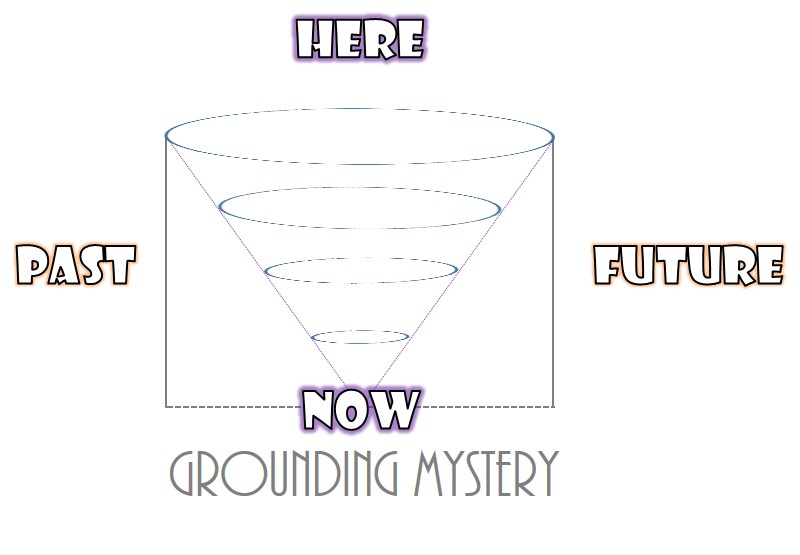
From the Latin religare, religion is a system by which the various domains and concerns of daily life are coordinated and anchored to the grounding mystery of being. Spirituality refers to the inner experience of this grounding mystery, as well as to an awakened intention in the way it is lived out. Spirituality, then, is the living intention of a dynamic religion, while religion is the relevant extension of a vibrant spirituality. A religion can lose its spirituality and die, but spirituality requires the structural support of religion if it is to engage the concerns of daily life.

My spin on religion challenges us to break out of the conventional definition, where we commonly speak of ‘the world religions’ as historical institutions organized on the cultural level. If the word merely refers to a system that coordinates and anchors our human concerns and activities to the present mystery of reality, then you have a religion, and so do I. Whether or not we affiliate ourselves with one of the institutional religions is of secondary importance to the question of how we individually (as well as communally) connect our lives to the grounding mystery and carry it consciously into all that we do.

This gives me a chance to illumine the relationship between two big ideas in my Tracts blog: the grounding mystery and creative authority. Very quickly (as if that will help), the grounding mystery is a metaphorical reference to the present mystery of reality, to the Real Presence manifesting to (and as) our awareness in this moment. Our deepest engagement with it is far below the reach of words, and this, along with the fact that it surpasses any definition our minds might attempt to throw around it, makes it universally recognized across the mystical traditions as ineffable, beyond name and form.

Our only direct access to the grounding mystery is by an inward path of quiet contemplation. Outwardly we can observe its countless manifestations, its many masks; inwardly we know it as mystery, disguised as our self. This may sound very “Eastern,” but Western mysticism carries the identical realization. Simply stated, you are a human being, a human manifestation of being, an expression of the grounding mystery in human form. The wonderful thing is that each of us can contemplate and release ourselves to that deeper mystery at any moment.

In my diagram above, I have placed identity (ego: my self: “I”) inside a list of terms that together represent a spectrum of existence ranging from the interior depths of being to the extended outreach of our individual lives in the world. Below – or rather, underneath and supporting – identity is consciousness, life, matter, and energy in descending order. Identity has its ground in consciousness, consciousness has its ground in life, life has its ground in matter, and matter has its ground in energy. The deeper we go, the more ineffable the ground becomes. We can say a lot about identity, less about consciousness, still less about life or matter, and really nothing about energy that makes any sense (even the scientists talk about its ‘spookiness’, indeterminacy, and quantum unpredictability).

Despite the fact that we can’t say much about the present mystery of reality that underlies and supports identity, this is precisely where spirituality lives. We have an intuitive sense that this deeper support is ‘more real’, and when we allow our center of attention to sink to these deeper registers, we feel more present and authentic within ourselves. Still, such an inward descent requires that we let go of all those attachments and hangups that keep ego intact – and this is what makes a vibrant spirituality such a threat to religions that have lost their soul. Its communion with a mystery that cannot be named, represented, or even precisely located must be heretical because it is incomprehensible.

Moving up my list from identity, we don’t release ego but rather assume it in all that follows. This is where religion comes into play. Our connections outward into daily life and relationships are necessarily personal, which is to say they involve who we are in the world (as distinct from what we are). Ultimately our individual development into maturity means that we start choosing (or willing, volition) the life we want, enacting our intentions (agency), taking responsibility in what happens, and fully investing ourselves in the process (care). This outward flow from identity to care is what I mean by ‘creative authority’.

Because it is all about shaping and coordinating the adventure of identity, from the awakening of self-consciousness in infancy, through the complicated role-plays of adulthood, and into the retirement of old age, religion should support our progress to creative authority (also known as self-actualization). Too often, however, its influence attempts to move us in the opposite direction where we are pushed back into a more dependent, submissive, and obedient state. This is when our religion, now outgrown and losing relevance, begins to strangle our spirituality. While the force of our spiritual growth is oriented on the higher ideal of human fulfillment, the dead weight of our religion pulls us into frustration and futility.

That’s when it is time to break through yesterday’s religion and create a new system, one that can coordinate and anchor our daily concerns and activities to the present mystery of reality, and in a way that expresses our true spirit. One way or another, it will lead beyond ego and to the other side of god.

Ethical Calculus (and the Next Election)

MembershipI’ve made the argument – whether successfully is for my reader to decide – that the question “Who am I?” is rather superficial when compared with the question “What am I?” Of course, my ‘who’ is much more interesting since it involves my unique personality: my individual preferences, idiosyncrasies, quirks and convictions – all those things that set me apart from everything else around me. This question of identity (who) is asking about what makes me special, and is arguably the question that advertisers have learned how to expertly convert into sales.

There are even spiritual teachings that turn this notion of personal identity (ego) into a principle of absolute reality, asserting the existence of a Supreme Self whose consciousness underlies and includes all things. I don’t fault them for projecting all of existence in our image. In fact, I regard it as inevitable and appropriate to a certain stage in our spiritual development. The provident nature of our universe, in the way it has generated and supports the adventure of life and consciousness, inspired our ancestors long ago to regard it as evidence of a superior intelligence looking out for us – and perhaps wanting something from us.

I will come back to this in a moment, but let me quickly distinguish what I take to be the far more important (if less interesting) question: What am I? This is not asking about what sets me apart and makes me special. Actually – and this is likely why we find it less interesting or even threatening – the question of ‘what’ I am (rather than ‘who’ I am) forces our inquiry below the superficial conditions and cultural arrangements that prop ego in place. It is asking about my essence (from the Greek esse, being).

In essence, I am a human being.

Of course, we can push even deeper than that: a human being is a complex manifestation of energy, matter, life, consciousness, identity, volition, agency, responsibility, and care – an evolutionary progression that can be traced in reverse to the grounding mystery of being itself. You’ll notice that ‘identity’ (who: ego: “I”) is just an aspect of what a human being is essentially, and far from the deepest. It certainly should be included in a fuller understanding, but the way it has come to dominate or dismiss other aspects of our human nature may help explain the present mess in which we find ourselves.

As we move forward, let’s be mindful of keeping these two principles – one (identity) pushing our considerations into tighter and more exclusive terms, and the other (essence) pulling us into deeper and more inclusive realms of being. Identity makes you special and sets you apart. Essence plunges beneath this pedestal of ego consciousness and grounds your existence in the present mystery of reality. Some mystical traditions teach the necessity of blowing out (nirvana) personal identity in pursuit of an unqualified oneness where no distinctions remain.

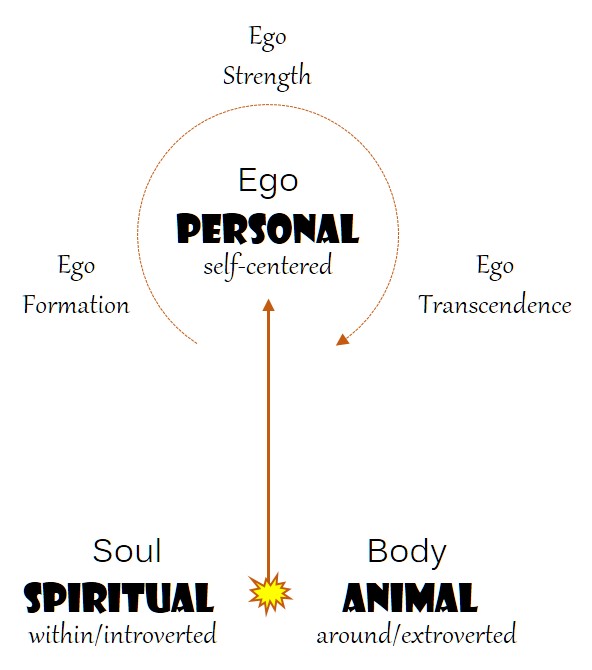
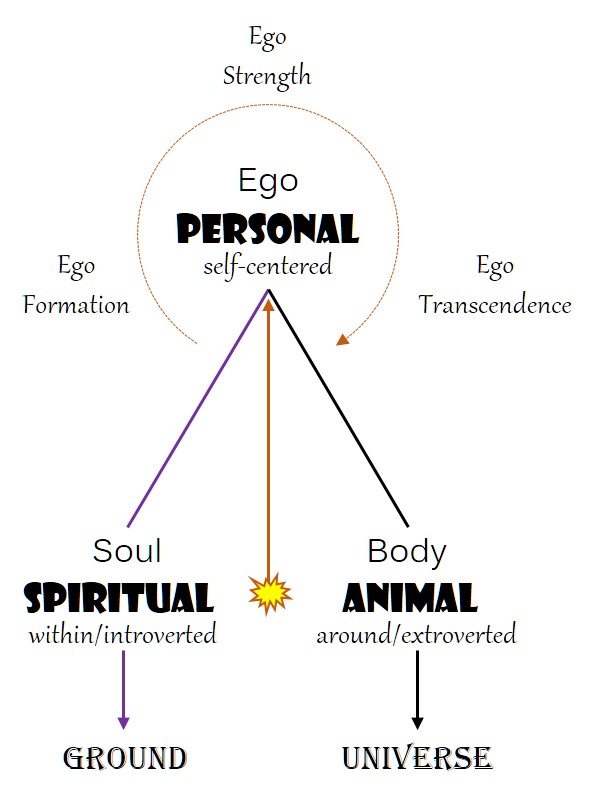
I don’t agree. Sure enough, if we conceive these two principles (identity and essence) as mutually exclusive, then one side probably needs to win. In that case, more reality (essence) is better than less (identity), so the prescription of eliminating ego is the way to go. But what if they’re not mutually exclusive? What if the upward push into tighter identities is in creative opposition with the downward pull of deeper essence? What if a stable, balanced, and unified personality (a virtue known as “ego strength”) is not something to be extinguished, but rather transcended in an enlarged vision of our place in the universe? Let’s see how that would play out.

We might characterize essence as what we are working with, and identity as what we are shaping into. This shaping of what we are essentially into who we are as identities does not take place in a vacuum, but always within some kind of context. For humans, the more influential contexts are social – our family, our tribe, our culture. If identity is a function of identifying with something, then the earliest and therefore deepest agreements that shape our personalities concern our position in the social order and taking our place as ‘one of us’.

That’s why we continue to carry the dynamics of early childhood into our adult lives, playing out (usually without thinking and often against our better judgment) the neurotic styles that helped us get our way (at least a good part of the time) amid the contest of affection, resources, and alliances that was our family of origin. If the contest was especially vigorous (and maybe at times violent), our membership in that circle forged an identity that had to scrap for our share, outsmart our rivals, or else wait patiently for the leftovers.

My diagram shows how identity conceivably expands outward to larger spheres where resources are more plentiful, but where the dynamic of relationships – how to respect, get along, and cooperate with others – is that much more complicated. I say ‘conceivably’ because, while it seems natural that things would progress in this direction, conflict and hardships closer to the tight center of identity produce insecurities that can make such an outward expansion all but impossible. The consequence is an ego which is guarded, suspicious, stingy … and dangerously small.

A ‘small’ identity is dangerous because it is incapable of taking into consideration any values or interests outside the circle of its closest attachments. Its primary (and typically exclusive) membership is with those who share a common skin color, language, ideology, or way of life. Anything else – that is, everything outside the circle of membership – is automatically suspect and not to be trusted. The value of raw materials and consumer waste, of immigrants and refugees, of the infirm and unborn, is determined according to an ethical calculus with “me and mine” at the center. What works for me (and mine) is ipso facto good. Whatever interferes with this is evil – not just bad but diabolical.

Such an ethical calculus will necessarily reflect and promote concerns inside the circle. It matters, then, how large our circle of membership is … it matters a lot. If I identify myself only with a particular nationality, ethnic group, social class, religious denomination, or political party, that circle may include a large number of people but it excludes many, many more. It will absolutely exclude other forms of life that don’t fit those categories whatsoever. As far as I am concerned, these are nothing more than resources, ‘wildlife’, savages, or pests that should be dealt with according to whether they benefit or hinder my personal interests.

And this is where a spirituality of essence needs to be heard again – before it’s too late. By pulling our center of awareness to deeper levels where the superficial distinctions at the surface are left behind, we can rediscover (for it is, in fact, a truth that primitive cultures honored long ago) the essential unity of being. Resting in the grounding mystery, we will be inspired to live in conscious communion with all things.

A Culture of Dependency

Consumer_Patient_VictimAs I see it, the ultimate aim of human self-actualization is not some godlike state of disembodied transcendence, but a mode of consciousness and active life that I call creative authority. This mode of existence is, in fact, one of the outstanding powers attributed to, and glorified in, our numerous representations of god through the millenniums. However, more consistent with a constructivist and evolutionary approach to religion, the construct of god (as metaphor and literary figure) has served to project and focus our aspirations on what is waking within us. The creative authority depicted in our gods, then, is really the higher self calling us forward.

In this post I will not criticize the various ways that corrupt religion has actually interfered with our evolutionary progress as a species, but rather how certain developments in our larger culture have managed to push us away from the ideal of creative authority and deeper into a mindset of dependency. As long as we persist in this mindset – and there are seductive incentives for doing so – we will be prevented from becoming fully human.

Creative authority is about choosing our response to life as it comes, and making choices that move us deeper into the life we really want. Choice (as my diagram shows) combines the freedom to choose with responsibility for the choices we make. While freedom without responsibility may be the fantasy of adolescence, creative authority keeps the two always together.

It is a mark of maturity – and, I would add, self-actualization – when the individual begins freely choosing and taking responsibility for the life he or she chooses.

The general trend of Western culture, however, especially in the last hundred years, has been to convert the individual away from creative authority and into a very different mode of consciousness. Instead of cultivating the identity of one whose inner life is filled with creative energy, talent, intelligence and possibility, a product of this conversion regards him- or herself as empty inside, an energy sink that must perpetually be filled as it becomes depleted. What would otherwise mature in the direction of a self-identified creator gets identified by the culture as a consumer.

A consumer, therefore, is the exact opposite of a creator: not inside-out but outside-in defines the flow of energy, life, spirit and value. A creator enjoys the freedom and accepts responsibility for constructing meaning, making connections, and managing a personal world. Under the spell of the Great Machine, a consumer by contrast looks outward (since there’s nothing inside anyway) for what will fill the void within, satisfy the craving, and make him or her whole again.

There is an obvious marketing strategy in all of this: as long as an individual believes that something essential is missing inside, and that his or her only option is to look outside the self for completion, the retail possibilities are limitless.

Once the trance of consumer identity is accomplished, the next (and logical) step is to take on the role of patient. From the Latin pati, a patient is not just someone who suffers, but who passively suffers – someone to whom unfortunate things happen. Again, we should note the divergence of this idea from the self-concept of a creator who takes responsibility for the meaning constructed around pain and loss, as well as for the path back to health. While a patient waits on salvation from outside, a creator is actively engaged as a co-operator in the process.

As long as the individual remains passive in the treatment process, the Great Machine and its retinue of ‘experts’ can diagnose, prescribe, and perform their magic – for that is the mystique it has to the patient’s mind – on their inert subject. The patient is needy, not resourceful; and the goal of treatment is palliative (bringing temporary relief), not really curative (promoting chronic health). Once brought into the system as a patient, an individual can be expected to remain in this compliant state indefinitely – at least until the symptoms are gone.

Oftentimes the underlying problem is rooted in a patient’s mind-body balance, personal lifestyle, stage of life, or philosophy of existence – in other words, things in which the individual really does have options and should take an active role. Making the necessary changes here would truly make a lasting difference. This would suggest that the patient somehow has a choice in the matter, that he or she has some measure of creative authority in the way things are. But let’s not forget: the passive sufferer is empty inside and utterly dependent upon salvation from beyond.

It’s one more fateful step that lands an individual in the self-identity of a victim. I’m not talking about obvious cases where innocent and defenseless persons are abused, exploited, or attacked. Terrorists are partly empowered by our anxiety over not being made victims, and unsuspecting bystanders who happen to be in the wrong place at the wrong time are victims in a straightforward sense.

Just as our self-identity as patients is implicit to our identity as consumers, so too is a belief in our own helplessness as victims implied in our passive mode of waiting on help from outside. When the required assistance or promised solution doesn’t come, in the expected form and on time, we are ready to cry out our protest as victims of malpractice, discrimination, or criminal neglect. Never mind that our demand was exaggerated and unrealistic to begin with, given that it came out of the conviction of our own impotence. We are entitled to what reality owes us, and reality owes us a lot.

By this slow and steady slide, then, we have been converted from creators to consumers, from consumers to patients, and from patients to victims: mired in a culture of dependency. Whereas our creative authority would put us in a very different relationship to life, others, and the world around us, this increasing dependency has only managed to cut us off from our own true nature, from one another, and from the present mystery of reality.

The truth is, we are not empty, needy, and helpless. Our self-actualization intends to move us into greater freedom and responsibility, into a wider empathy and a larger community, into a deeper center and a higher wisdom. In the process we become more fully human.

Inside-Out

Peace_Joy_LoveThe Great Machine of consumerism is always at work, spinning the gauzy web of illusion that enthralls much of modern consciousness. It persuades us to look outward for the secret to happiness, which today might be contained in a new-and-improved formula of this, tomorrow as an upgraded model of that, next year in some revolutionary medicine coming to market, or the new lease on life promised at retirement. Maybe it’s this sexy thing, or that job promotion.

But it never comes.

Make no mistake: we end up spending or sacrificing what we have to in order to acquire the key that will unlock our truest joy. But now it sits in the garage or on the shelf and under a pile of other keys that have let us down. The problem is, we can never know for sure if the real problem was that we tried too hard, or not hard enough; that we started too late or quit too soon; that the dosage wasn’t quite right, or that we didn’t have things in the right combination. Maybe it’s our own damned fault after all.

And that’s how it works.

It gets going very early, long before we’re old enough to have money in our pockets or sense in our heads. The first trick of the Great Machine of consumerism is to convince us that we are empty inside, that we’re ‘not enough’ and need something else to make us complete and full-filled. We can’t be happy in and of ourselves since, left to ourselves, we are lacking what it takes – whatever it takes to make us happy.

When we find our answer and place our bet, the desperate need that it be the key we’ve been looking for puts upon it an impossible expectation: “Complete me.” For a little while, the novelty and excitement seem to do the trick (this is the second trick of the Great Machine). And if our key to happiness happens to be another person, all our lavish affection is received with equal fervor – particularly if that other person is empty inside and believes she has found her key in you.

But (you know the story) our impossible expectations cannot be realized. Disappointment is inevitable, our frustration mounts, and we grow increasingly anxious as this latest secret to happiness is exposed for the counterfeit it is. The fault, contra Shakespeare’s Cassius, must be in our stars, certainly not in ourselves. So … it’s time to find the real thing.

And off we go.

In the dark wake of our programmed bereavement, many are ready to agree that this so-called ‘pursuit of happiness’ is a misguided pipe dream. Who told us that we always needed a smile on our face and a lift in our spirit? Why do we have to always be of good cheer and turn our frowns upside-down? Let’s just take happiness as it comes, if it comes, along with everything else. If we need to talk with someone or take medication to help us stay in the game, then maybe this prophylactic margin of cynicism (how about we call it ‘realism’?) will keep us from having to suffer … very much.

Of course, you see the real problem, don’t you? It’s neither in the stars (out there), nor exactly in ourselves. The joy we’re looking for cannot be found, because it’s already ours. It is a spontaneous expression of inner peace, of our spiritual release to the grounding mystery of being itself. This ability to simply relax into being and rest in the rise-and-fall of the life process is what we naturally did in our mother’s womb, and for a short time afterwards.

Then we got pulled under the spell of our own emptiness and helplessness, and of our need for a salvation from outside us. Unhooked from our inner peace in this way, the secret to happiness could only be out there. From that moment, the natural inside-out flow of our self actualization got reversed to an outside-in program of gulping consumerism; we were re-hooked, but now to the Great Machine.

The good news – the gospel, dharma, or whatever you want to call it – is that we don’t have to stay under the spell. True enough, we have a choice between a genuine joy arising from inner peace and the cheap thrills (though much of it ain’t cheap) beckoning to us from the TV screen. But when we do choose to turn off the Tube and let our focus sink into the Real Presence of mystery within, we find ourselves resting in a provident universe – from the circling stars in their galaxies overhead to the quantum oscillations of consciousness inside our cells. The still center of this turning magnitude resides right there, in you; and the other one is right here, in me.

When we live out of this center, an inner sense of wellbeing rises and fills us with joy. This is not the fleeting thrill and spasmodic cheer we often mistake for true happiness. Joy is a perennial bloom whose secret source is not outside us, but not exactly inside us, either. A better term would be ‘within’ us – with and in and deep beneath the persons we are pretending to be. Joy is not ‘mine’ or ‘yours’, but is rather the lift of being and fullness of life in us, manifesting as us, and flowing through us.

Perhaps it is another name for the human spirit.

Joy, or genuine happiness, is inwardly rooted, deep in the peace of our grounding mystery. We don’t need to look for it because we already have it. Once we realize this – the moment we really get it, our understanding of love makes a radical shift. What had been our lust and longing for what will complete us and make us happy is transformed into an outflow of creative goodwill and selfless generosity.

Because we no longer need something or someone else to make us happy, the deep contentment of inner peace and our spiritually grounded joie de vivre can move us into the world without this complication. We can reach out and give of ourselves with no strings attached, no demand for reciprocity, no expectation of reward.

Love which is as joyously free as that, is a love that can save the world.

The Paradox of Education and the Search for Its Soul

Human Education

Civilization is a race between education and catastrophe. – H.G. Wells

A paradox is something that seems self-contradictory or absurd but in reality expresses a possible truth. Its apparent self-contradiction can generate a tension so strong that it snaps and collapses into a dualism of either this or that, this versus that, this but not that. In a paradox, this and that are held as complementary in a larger truth that can be appreciated only as their tension is preserved.

The paradoxical nature of education is suggested already in the very definition of the word. Very simply, to educate is “to lead out.” From the Latin educere, it can refer to “leading” a mind “out” of ignorance and into knowledge, or to “leading” the deeper intelligence and native talents of mind “out” of dormancy and into actualization. Which is it? If we can honor the paradox, it is both.

But the paradox of education has not been honored, particularly in the West where the operating assumption is that what we need to know and know how to do, if we have any hope of making it in this world, is something we need instruction in. Our natural ignorance must be dispelled with the information and techniques that make society work. Otherwise we will be left in a ‘state of nature’ with the beasts, infants, and idiots – ‘blank slates’ forever.

In a way, this preference for technical knowledge over self-actualization, for mastering the outer world over nurturing our inner spirit, plays out in “the two cultures” (C.P. Snow) of Western education, with science, technology, engineering and mathematics (STEM) on one side; the humanities, the arts, religion and philosophy (HARP) on the other. Because STEM prepares students for professions in the industries driving our world economy, and while HARP amounts to a major distraction from real-world concerns, the Western curriculum in recent decades has been steadily shifting away from spirit and more to machines, out of feeling and more into thinking – more and more into facts, data, analytics, and the technical skills that society depends on.

As the gap widens, a general appreciation for and even an understanding of our own inner life is rapidly diminishing.

Working in higher education, the human cost of this shift is painfully obvious. As the process of education gets reduced to classroom instruction, standardized testing, grade rubrics, academic interventions, and remedial accommodations, students themselves get left out. It may appear as if students are the principal value, but in actuality they are little more than an ID number, a GPA, a graduation and job placement statistic. An expert stands at the front of the room and all the blank slates are arranged in straight rows, facing forward, passively absorbing the data-stream. More students than ever before are succumbing to boredom, depression, anxiety, and the autoimmune complications that fall out from these.

It might sound as if I’m advocating for more art and music in our schools, and while I think that would be a good thing, it’s not the point I’m making here. The leading-out-of-ignorance and leading-out-into-expression models of the educational enterprise are not mutually exclusive, as my argument for their paradoxical relation suggests. It’s not that STEM aligns with the first model and HARP with the second, and that we need more HARP to fix our problem. Our current crisis in education cannot be reduced to the disappearance of performance studios and the proliferation of laboratory classrooms.

As paradox, education is both about preparing students for the workaday world of adult life and assisting in their self-actualization as human beings.

When a paradox is functionally intact, the tension generated between its internal poles is apprehended by our minds all at once, as it were. It is one thing – paradoxically. But after its tension snaps and this unity collapses, repairing a paradox to its original state isn’t simply a matter of gluing the pieces back together. As in all dynamic unities, the whole is always more than the mere sum of its parts. So too, an active paradox is one plus one … plus. For education, I believe this non-added ‘plus’ is its soul, now lost.

In the nursery rhyme, Humpty Dumpty is depicted as a big egg who falls from atop a wall and breaks into pieces. “All the king’s horses and all the king’s men couldn’t put Humpty Dumpty back together again.” Our solution for education will not come by tape and glue; we need to contemplate the chicken (unacknowledged in the rhyme) that came before the egg.

We should agree that education is not only a matter of preparing future employees for the job market; it is also about developing human beings. When the paradox snaps and the process becomes one of filling blank slates with the technical information and employable skills they will need to punch clocks and pay taxes, we stop teaching students how to think and start imposing an orthodoxy of what to think. It’s a short but precipitous slide from there to standardized testing, academic failure, and the crisis we have on our hands.

When I consider the soul of education, what I’m getting at is the deeper spiritual source out of which human consciousness, thought, feeling, desire, and intention arise; it is the grounding mystery within. My reader needs to know that I attach no metaphysical status to this grounding mystery: it is neither some thing or some place, nor can we properly say it exists on its own. It is not god – although I do regard the grounding mystery as the inspiration behind our best metaphors of god.

Finally, in calling this deeper source spiritual I am not thereby setting it apart from the physical realm and our animal life, as in the classical separation in religion of ‘soul’ from ‘body’ – yet another symptom, along with our current malaise in education, of the Great Collapse.

In the diagram above, I offer the image of a tree to illustrate what I mean by the soul of education. My use of an organic metaphor rather than a mechanical one is intended to make the point that education is a living enterprise; it is dynamic, vibrant, and constantly evolving – or it could be, and hopefully will be again one day. Just as in the life of a tree, there is directional flow in the life of education, which I represent in the four terms arranged around the tree.

The place within, where the grounding mystery – that wellspring and spontaneous stream of consciousness – first crosses the threshold from ineffable experience into the articulate network of language, is our imagination. Metaphors (from Greek, meaning to “carry across”) quite literally are preverbal images that translate experience into meaning and serve as foundational insights into the nature of reality. Imagination is perhaps what makes us most uniquely human, and its death is the moment when education begins to lose its soul.

These primordial images rising out of the metaphorical imagination stimulate a more conscious creativity, enabling us to see beyond the given facts into a wider range of probabilities, hidden frontiers of possibility, and even into what is only conceivable but not (yet) possible. Human creativity is a productive and prodigal force in the universe, generated by a powerful urge to simply bring forth and realize what is within us. When it gets blocked, stifled, or penalized for not staying inside the lines, the consequence is spiritual frustration and all the psychosomatic illnesses that Western medicine refuses to validate.

When creativity is allowed to flow and the imagined possibilities can continue to evolve, the wonderful outcome is innovation: bringing about something utterly new. What do we see when we consider human culture – its hardware in the infrastructure, architecture, art, technology, clothing, costumes, uniforms, utensils, instruments, tools, machines and all the rest? And what about its software in the languages, disciplines, theories, paradigms, belief systems, codes, laws, principles, ideas, and ideals that comprise our many systems of meaning? These things are not mere facts of nature but artifacts of culture, and all of them started as innovations of human creativity.

Which brings me quite naturally to my fourth term: community. From previous posts my reader will know that community is not merely a synonym for ‘family’ or ‘group’ or ‘tribe’ or even ‘society’. While these other terms can be defined quantitatively, as a collective of individuals who relate or are related in specific ways, community names a qualitative up-shift in the consciousness of a group, where the intentional and empathetic interactions of members prime conditions for a consilient leap to higher unity. (For more on this, see The Promise of Consilience.)

Community in this sense serves as an incubator of innovation, a provident support for creativity and a deep engagement with the metaphorical imagination. It is itself a manifestation of all this magic happening deeper down, even as it holds sacred space for the magic to happen. In my view, this is what education is and what our schools should be doing.

We need to become communities of learning by restoring the paradox of education and recovering its lost soul.

Fully Present

Fully PresentIn the Wisdom Circle I’m part of, conversation flows along tangents into topics that interest us or challenge our pursuit of a relevant secular spirituality. Whatever arena we wander into, it’s not just a new perspective we’re after, but some kind of meaningful and responsible course of action. Given such-and-such, what can we do in the interest of greater honesty, integrity, and effectiveness? Our objective in every case is to clarify how a fully engaged spirituality might affect or transform the way we live in this world.

I am reminded of the diagnostic matrix used in conventional psychotherapy for identifying and treating a client’s peculiar form of suffering. Typically a strong and overwhelming feeling of unhappiness is what first motivates an individual to seek professional help, and it’s here that interpretation begins. And as such feeling will commonly exert either a suppressive or compulsive effect on behavior, sapping one’s drive or spurring conduct that only adds to the problem, any counselor who’s paying attention will also look carefully at what the client is doing.

After the linkage between feeling and behavior has been established, the task of therapy becomes one of bringing to light the associated thoughts and beliefs which have the client locked in a mindset that is perhaps irrational, unrealistic, juvenile, or delusional. As thinking provides an overlay of commentary on suffering – adding justification, self-judgment, conspiracy theories, or just more confusion to the pain – it is necessary to get this storyteller out of the closet and into the light of interrogation. It is hoped that by changing up the mental script a client will begin to feel better about things, start acting differently, and thereafter produce more positive results.

In the diagram above, a red line from feeling to doing represents that irresistible impulse to act in ways that perpetuate or amplify an individual’s suffering. The curved green line is meant to illustrate that elevation into thinking which will expose the faulty logic and distorted beliefs keeping it all in play. Higher elevation into thinking involves the individual in more rational reflection and discrimination, where the driving narrative of one’s personal myth can be analyzed, updated, and strategically modified.

In our Western psychology of mental health, these three correlates – feeling, doing, and thinking – form the ‘holy trinity’ of therapy. The better therapies work with all three in a more or less balanced way. Nevertheless, each one has also been favored over the others in the major schools of medicinal (feeling), behavioral (doing), and cognitive (thinking) therapy. Competition among these schools has prompted research into which modality is superior, or what combination of factors represents our magic door to mental health.

Interestingly enough, the research has shown all of them to be about equally effective, and maybe the results improve a little when they are combined in some way. But ‘effective’ here doesn’t mean significantly effective. In fact, they perform just slightly better than placebo and often come with side-effects no one wants. Research consistently bears out the greater influence of another factor, quite apart from the specific treatment protocol: The quality of relationship between therapist and client (called the therapeutic alliance) proves to be the real magic door. Any why is that?

In my diagram, the deeper essence of this fourth factor is identified as the individual’s sense of grounding in a reality that is supportive and provident. Obviously, a therapist (or anyone else) who is welcoming, trustworthy, empathetic, insightful, and encouraging will demonstrate such a reality to the client. The ‘alliance’ part of this involves an individual in gradually calming down, finding ground, getting centered, and opening up to the other person. The more open a client becomes, the more confirmation he or she receives that reality is provident and supportive, which in turn encourages an even deeper release and a larger horizon of faith. This is the dimension of being (be).

This factor of grounding offers a fourth correlate in a more complete picture of mental health and happiness. Changing how we think with talk therapy, how we feel with drug therapy, and/or what we do with behavior therapy is not enough. I have drawn lines from each of these three to the grounding mystery within, because it’s only as they are internally grounded that our thoughts, feelings, and behaviors can be genuinely creative. Otherwise, insecurity will tend to hijack our faculties and generate a delusion of our separateness (isolated, exposed, defensive, critical, judgmental, etc.) – where true happiness is impossible.

You’ll notice that the line between think and be is actually an arrow, from the latter to the former. Because thinking is the mental activity by which we construct meaning and build out a worldview, it is vitally important that its product (i.e., our perspective on and orientation in reality) is properly grounded in the way things really are.

No doubt this reveals my cognitive bias, but enough of my own experience and observation of others has convinced me that until our thinking is reality-oriented and the meaning we construct is sufficiently clear-sighted to acknowledge that the grounding mystery cannot be captured in words or theories, we will tend to become prisoners of our own convictions and fall that much farther out of touch. By the time that happens, how we feel and what we do have been commandeered by a distorted, outdated, and dogmatic orthodoxy.

A human being is a human manifestation of being, an expression of the grounding mystery in human form. The wonderful thing is that each of us can contemplate and release ourselves to that deeper mystery at any moment. Ideally we live our lives as passionate and reasonable people, growing ever more proficient in the skills that help us be successful individuals, partners, parents, community members, and citizens.

The big question has to do with the degree in which we have realized our full potential, evolved our consciousness, and found our way back to the place it all begins, right here and now.

Creative Spirit and the Invitation to Life in Its Fullness

matter_life_spiritMatter reacts. Life adapts. Spirit creates. 

With that, I have summarized the 14-billion-year cosmic process in three stages and just six words. I’m using the term ‘stage’ here less in its temporal sense than as a way of identifying distinct levels of complexity in the evolutionary architecture of our universe. True enough, energy first fused into matter, then stirred to life, and eventually awakened as spirit. But each preceding stage continued as foundation to subsequent ones, not just persisting underneath the others but taken up, incorporated, and transformed in the breakthroughs they represented.

You, for instance, are a rather remarkable synthesis of physical matter, animal life, and creative spirit. Your life is generated and sustained out of a deep economy of physical reactions going on in your body all the time. And as you move through the changing environments of your life, your body and mind are adapting so as to optimize your ‘fit’ to the way things are. The adaptation of life amounts to this constant quest for the niches where environmental stress is manageable, internal distress is minimized, and the opportunity for longevity and reproduction is greatest. Once life finds such niches, it settles in and makes itself at home.

Think about the various niches you have settled into, those safe corners and familiar grooves where “everyting irie.”

And this is our problem as human beings. Whereas the material processes that keep us alive are autonomic and unconscious; and while slipping into a best fit with our surroundings is a preconscious preference for the path of least resistance; that aspect which makes us most uniquely human – our creative spirit – must operate in full awareness and by conscious choice. For this reason, habit, convention, custom, orthodoxy, and even morality as the rules that determine our social affections and behavior, can keep us so deep in our grooves that spirit has no chance of waking up.

If my reader ever wonders why I am so critical of orthodoxy (not only in religion) and the mental bypass of conviction which closes the mind to everything but its own absolute truth, this is why. As the theme of this blog is ‘exploring creative change’, my passionate interest is in that transforming process whereby human beings break through the constraints of family patterns, tribal traditions, belief systems, and identity contracts that keep us asleep.

My message is not that we need to trash them all, necessarily, or leave them behind and go it alone through life. When the creative spirit awakens in us, some of these things will be dropped off and left behind, as their authority is no longer required. But others, like that literal god who comes to life again as a literary figure and metaphor of the grounding mystery, can light up with fresh relevance and illumine the path ahead. Creative spirit awakens ‘on the other side of god’ and invites us to live in conscious awareness of our place in the unity of existence.

In an interesting way, each of those three stages in the cosmic process surpasses the one immediately preceding it by breaking (through) a law that would prevent its progress. Life has to overcome the stabilizing force of entropy which is constantly pulling matter down into more steady states of equilibrium. By self-replication, sexual reproduction, and social bonding, life pushes upwards against this law of matter and thereby secures for itself a higher stage of existence. Life’s law is that niche-seeking survival mandate mentioned earlier: stay as deep inside those grooves of pleasure and avoid any pain that signals compromise, exposure, and a loss of security.

Habituate yourself to your surroundings, to the circumstances of your life, to the role-play and ideology of your tribe: that’s what the preconscious law of life will have you do. It’s safer inside the circle, where you can live closer to what you know and be assured of the resources you need to survive. Do what you’re told, don’t rock the boat, stay in line, wait your turn, look before you leap. If you’re still alive, it must be working. Why tempt fate? What’s the point in thinking outside the box, when the box contains all you need to know?

I could add more platitudes and proverbs of the status quo, but you probably have a pretty good feel for this law of adaptation that manages to keep so many of us spiritually asleep. If the creative spirit is to awaken in us, we will have to confront, break through, and rise above the trance of security and its delusion of meaning. The very identity that has been shaped for us by our taller powers and tribal handlers is now our greatest impediment, our most formidable obstacle to genuine liberty.

Just say to yourself, “I want to be free to live my own life, to follow my bliss, and realize the fullness of what I am” – merely let those words out of your mouth, and just as quickly will come rebuke and admonition for entertaining such a selfish fantasy. So insidious is this reproof against genuine self-actualization, that the script spins automatically inside your own head. What you don’t understand is that this script, together with its sponsoring tribal ideology, is itself a fantasy, and a selfish one of the highest order.

After all, this is the center of identity known as ego, which is really a mechanism of social adaptation by which the tribal mind replicates itself in the individual. You were disciplined, shaped, and instructed to hold certain things as self-evidently true. That’s just the way it is, you were told. Because I said so. It’s in the Bible. Your brainwashing was nearly complete before your rational and critical-thinking prefrontal cortex could come online to help you see through much of this so-called wisdom. If you grew up in a strict religious household, then the everlasting consequence of god’s judgment further secured your duty as carrier of your tribe’s memetic code (i.e., the cultural analogue of our genetic code, but constructed out of memes rather than genes).

Needless to say, the creative spirit doesn’t break (through) the rule of life in society as an act of belligerence, but as liberative and transpersonal, meaning that it breaks beyond the ego stage of consciousness and sets us free for a larger vision of where we really are, and where this great cosmic process is inviting us to go.

Time and Eternity

Time_EternityOur preferred orientation in reality is centered in the mental location called ego (‘I’), from which we look out and appraise things according to the standards of “me” and “mine.” The ego is at once insecure, defensive, possessive, and ambitious – and not a little conceited for regarding itself the center of reality. But even this is forgivable when we understand how easy it is to confuse our personal worlds with the present mystery of reality.

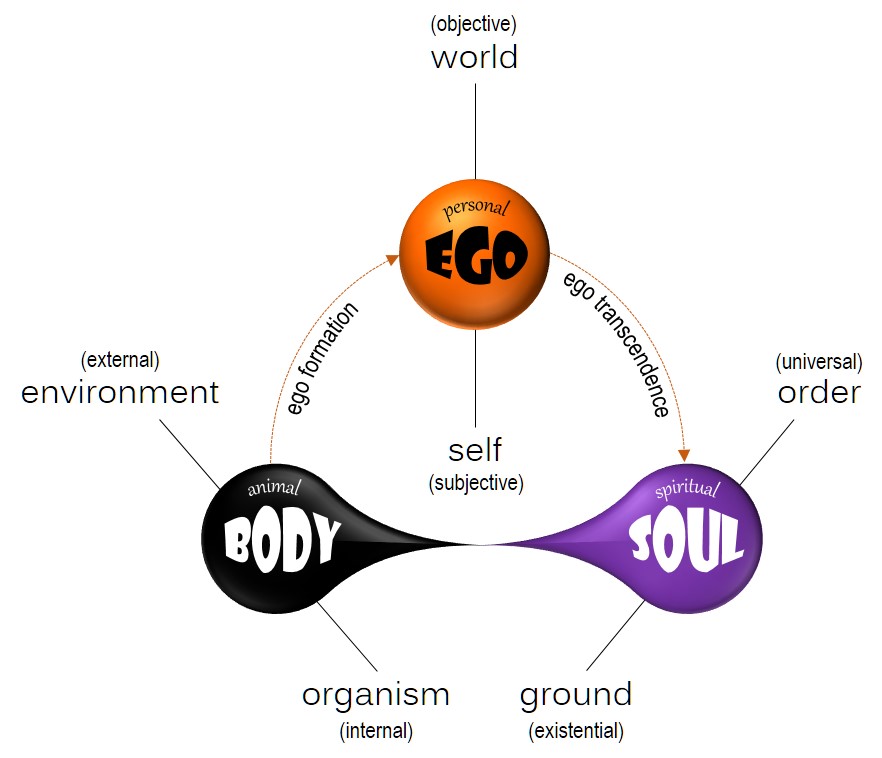
Before we go any farther, let’s get our bearings in the diagram above. A returning reader will recognize my color codes for the three centers of experience: black for the body, orange for the ego, and purple for the soul. It is of the utmost importance that these distinct centers, or mental locations of consciousness, not be divided into separate ‘parts’ of us, which has traditionally gone down the path of ranking them, opposing them, confusing them, and finally claiming a product of this confusion (the so-called personal soul) as “the real me.” I’ve done my best to keep them all in the picture of what makes us human, even while acknowledging ego as a late arrival and seat of our most persistent delusions.

Along the periphery of my diagram I have placed terms that can help us better appreciate the distinctions not only in ourselves (the mental locations) but in the realms of experience our three centers of consciousness open to us. Each of these realms is depicted in a double aspect, with the bolder text naming an aspect which is ‘facing away’ from us, so to speak, and the lighter text naming an aspect that we directly experience.

Let’s just step into the diagram and try to make sense of it.

At the top is a realm that corresponds to our animal body. As a physical organism, the body is an expression of and participates in a 14-billion-year process that we call the universe. In its aspect of facing away from us – by which I mean the aspect that we speak of in more general (distant and objective) terms – our universe is the universal order of all things.

From this philosophical and scientific perspective, the body’s realm has been observed, investigated, probed, classified, measured, mapped, denatured and transformed by human knowledge and technology. As the universal order, it holds together and turns through intervals of rhythmic time, the largest of which is the interval of our universe itself (universe literally means “turning as one”).

When considering this order in its aspect as facing toward us, the sensory-physical realm of the body is experienced as a provident universe. All of this has somehow conspired to bring about the emergence of life and ignition of consciousness, providing what we require to survive and flourish. Just pause to reflect on how profoundly and intimately your animal nature depends upon, participates in, and contributes to the great web of life.

This cosmic web cannot be reduced to only what transpires here on our planet, but expands outward to include the moon, the Sun, our solar system, galaxy, and far beyond even that. The ‘Goldilocks’ position of Earth relative to the Sun is not simply a matter of local ratios of gravity, light, atmospheric gases, and surface temperature. For a full account we must include The Whole Shebang, from the very beginning and stretching across the entire universe. Before any attempt was made to attribute all of this to a supreme creator, the human mind was overwhelmed by the awareness of living in a provident universe.

So there’s our first part of the picture. As our mental location that engages with the realm of matter, the body lives by virtue of participating in rhythmic time and enjoying its place in a universal order at once infinitely expansive and provident. Anytime your consciousness looks out from this location, you are doing it as an organism in communion with the vast web of life.

When we shift focus to the mental location known as ego, our point of engagement with reality moves to another realm. Here time is terminal, meaning that it follows a line with a starting point and an ending point. It doesn’t revolve through regenerating cycles like we see in the provident universe, but rather flows from beginning to end along a time sequence that is tethered to our personal identity. While the material substance of our body has recycled through countless revolutions of rhythmic time, and will continue through many more after the body expires and decomposes, our ego, that center of who (as distinct from what) we are, is confined to our biological lifetime.

From ego’s position there is a line of time leading up to it, known retrospectively as ‘the past’, and a line projected ahead of it, known as ‘the future’. The past is the sequence of events and experiences which have somehow shaped our identity to this point, while the future is how this center of continuity is anticipated to play out. I use the term ‘play’ in the sense of role-playing, which is the only way ego can stay in the game – as so-and-so who is striving to make something of myself: a respectable character, a good reputation and public image, a successful                        (whatever roles I happen to be playing).

In its less personal aspect, this is the realm of our individual lifeline, which will be summed up by a dash between the dates of our birth and death on a future headstone. Actually, because ego is a social construction that achieves self-consciousness only around the time we acquire language and start making identity contracts with our tribe, its lifeline is shorter than the body’s chronological age. And with the onset of dementia, many of us will to some extent lose our center of social identity before our body expires. We can measure an ego’s individual lifeline scientifically according to this terminal career of executive self-consciousness.

But when we consider it from your perspective as the individual in question, this line represents your personal myth. From the Greek for a narrative “plot,” myth refers to the storyline around which the meaning of your life is constructed. We are used to thinking of myths as the fabulous stories that serve to support, orient, and inspire entire cultures, but each of us has our own authorized (and aggressively defended) narrative of identity as well.

At various times this identity narrative will suffer assaults from without and within, casting ego into confusion, anxiety, frustration, or despair as its continuity of meaning is undermined. Its greatest challenge, of course, is brought on by the fact that ego’s career is correlated to the life of the body – which must one day expire.

Along with other challenges related to its place and value in society, the inevitability of death is something that ego had to work through fairly early on. A solution that we find across the cultures was arrived at by a process of dissociation whereby ego detached from the body and imagined an immortal existence for itself on the other side of death.

This is where the confusion regarding a ‘personal soul’ took root, fundamentally changing religion’s cultural function from that of coordinating life in society with the rhythms of nature, to securing the postmortem destiny of the disembodied ego/soul. Thus began ego’s impersonation of the soul, and religion’s consequent (and longstanding) betrayal of genuine spirituality.

Referring back to my diagram, you’ll notice that the individual lifeline of ego does an end-run around the small circle at the center of the picture. That circle represents the present moment, the only instant in which we can ever touch reality. It is a moment without duration, and for that reason we can legitimately speak of it as ‘timeless’.

Even though ego exists always in the present moment, a preoccupation with the past and future of its own personal myth prevents it from fully engaging with the here and now. Besides, given that the present moment has no duration, any attempt on the part of ego to grasp and hold this vanishing instant only serves to further remove ego from the present mystery of reality.

So now we come to the third mental location of consciousness, the touchpoint on reality accessed right here in the present moment. Soul is not our center of personal identity, and it really needs some serious deconstruction in order to be liberated from captivity to Captain Ego. It is neither ‘in control’ (as if ego is) nor the ‘part of me’ that survives death and lives forever.

Soul is where consciousness engages reality in the deepest depths of our existence, in what mystics have named the ground of being. This ground is neither past nor future, but always and only now.

In its objective aspect, which allows us to reflect on it and share our insights with each other, this is the ground of existence, or existential ground, the creative source that energizes, supports, and expresses itself in/as the manifest universe. In logic, the term “existential” is distinguished from “universal” as referring to ‘this one individual’ rather than to an entire class or collective. As a qualifying adjective of the ground, then, we need to be clear that we are speaking of what gives rise to each existing thing, and what can only be accessed by an inward descent of our own existence.

This reference to our own existence once again shifts focus to the intimate and experiential aspect, where present reality is felt and known as the grounding mystery of being itself. Its uplift rises as the life energy, nervous state, mental force, open focus, and creative intelligence that conspire in our awareness of this present moment.

The “narrow gate” (a metaphor from the teachings of Jesus) which ego is unable to enter for its obsession with being somebody special, is the soul’s path to union with the Really Real. Because it can only be found in the present moment and the present moment has no duration, soul and its ground are outside of time, timeless, and eternal. Mystics and spiritual masters have named it the Eternal Now.

In the process whereby ego impersonated the soul, this notion of eternity was equated with and corrupted into the idea of endless time, which was necessary to accommodate the ego’s desperate need to live forever. “Eternal life” and “everlasting life” are very different notions, however, with the latter denoting this idea of an unending quantitative extension of time, and the former (eternal) referring to the qualitative depth of a genuine, authentic, and abundant life in this moment.

The mystical undercurrents of our world religions still contemplate and practice the disciplines which allow consciousness to sink below the surface tension of personal identity in order to dwell in the present mystery, an adventure in meditation metaphorically represented as a ‘death’ or dissolution of the self-involved ego. Unfortunately as religion got commandeered and perverted by ego ambitions, this deeper and more original engagement with spiritual life was discredited by emerging orthodoxies, persecuted to the margins, and generally forgotten.

And so, here we are.

The Irenic Revolution

OneMy children are in their twenties now and making their way into college degrees, careers, and relationships that will hopefully support happy and fulfilled lives. They are kind, creative, and fun-loving kids who worry sometimes about drifting out of touch with classmates and childhood friends as they pursue their dreams.

One type of silent trauma we all struggle through at this time in life is a deepening sense of being on our own in the world. A system that supported and moved us along for so many years now expects us to settle into jobs, manage households, and occupy tax brackets that will help turn the wheel for others coming up behind us.

One concern of my kids has to do with finding a place where they can connect with others their age and explore, in community, the meaning of life. Churches these days are either too dogmatic and moralistic, telling people what to believe and how to behave, or else equally stuck in complacency where the question to which “Jesus is the answer” has long been forgotten. The failure of Christian orthodoxy to keep up and stay relevant with contemporary science, the current secular scene, and the irreverent curiosity of young people in their “individuative-reflective” stage of faith (James Fowler), makes it unattractive – even offensive – as an option.

What’s more, my kids and many other young people who may have grown up under the tutelage of theistic religion are no longer willing to buy into the idea of a god ‘out there’ who is watching over the world, intervening on our behalf, and waiting for our saved souls on the other side of this mortal life. The metaphysical backdrop that may have once given context to a mythology of ups and downs, incarnations and ascensions, virgin births and miraculous resurrections, garden paradises and a home in heaven, no longer fits with what we know about the universe and the adventure of life on our planet.

But they’re not ready to declare themselves ‘atheists’, either. Somehow the argument over whether or not god exists seems unimportant to them. If a literal deity (the god ‘up there’) doesn’t make sense in light of contemporary science, and if the old dualisms of body and soul, matter and spirit, insiders and outsiders no longer resonate with our current world picture, are we left only with the responsible choice of tossing it all aside and leaving religion behind?

In the heat of their reaction, many have not taken a moment to consider the possibility that god might be a literary being and not a literal one at all, and that the sacred stories (myths) where this literary figure lives might still have metaphorical significance, even as the backdrop of an archaic metaphysics has become incredible to us.

Because young adults today are separated from their peer circles by the obligation of getting on with their lives, it is common for them to feel isolated, but also aberrant and alone in their ordeal. If churches and even parachurch organizations are not providing welcome to their questions, doubts, and ‘heretical’ interests, where can they turn? Perhaps they are indeed exceptional, in the sense that no one really shares their struggle or can understand what they’re going through.

And that’s where I tell my kids: You are not alone. In fact, you are part of a worldwide majority of young people who happen to believe, quite mistakenly, that they are lone delinquents of their dominant cultures. As the regulated and gridlocked world of adult life subjects you to a shakedown of your creative intelligence and free-ranging curiosity, this is your opportunity to reach out and find each other. CircleWhat the world needs now is an irenic revolution, inspired and led by young people who want to transcend differences and explore our common ground as human beings. In communities dedicated to the shared pursuit of peace and understanding, they will help move spirituality outside the boxes of orthodoxy and atheism, into a post-theistic future. Together they will foment tolerance, loving-kindness, honest dialogue, and radical responsibility. Instead of terrorists who seek to generate anxiety, they will be irenists (from the Greek irene, peace) who cultivate a deep center of calm presence, inner strength, and creative authority. Their mission in the world will be to wage peace in every quarter until every person on this planet is fearless and free.NetworkI am part of such a gathering which meets every week to talk about the concerns, challenges, and opportunities we daily face as human beings. We call ourselves a “wisdom circle,” not because we’re so smart or have all the answers, but to remind us of our primary task, which is to listen and learn from one another as we seek to live by the principles of wisdom. We understand these principles as guiding insights into the nature of genuine community, where individuality is respected, creativity is celebrated, empathy is nurtured, and unity (not always agreement!) is our highest aspiration.Mega NetworkOur wisdom circle has no ambitions of growing our numbers to the point where we exceed the seating capacity of our homes. We would never allow our gathering to become so large that we could no longer arrange ourselves in a circle, but instead have to sit in rows (like church pews). The point is to look at the faces of each other, to listen to each other, learn from each other, and leap together in the consilient experience that is community.

One question that soon comes up is, What should we talk about? Is the topic of conversation merely a roulette wheel of whatever somebody wants to discuss? Sometimes. More often, however, the dialogue gets started around a recent blog post of mine. (It doesn’t stay on the topic necessarily, but sidetracks can be unexpectedly fruitful as well.) My “tracts of revolution” blog is a library of reflections on such topics as spirituality, philosophy, science, the brain, psychology, education, religion, post-theism, the new humanism, mysticism, ethics, favorite authors, and current events – all sharing the golden thread of my general theme, which is ‘exploring creative change’.

Why don’t we – or why don’t you, reader – find a few others who want to be in dialogue over things that really matter? Commit to gathering weekly. Set up a rotating hosting schedule; brew some coffee, spread a table, open a bottle of wine. Decide on a topic; or choose a blog post, share the link, and ask individuals to read it beforehand. Remember that consensus or agreement is not the purpose of a wisdom circle, and I certainly would not want my views and conclusions to become some kind of orthodoxy. PeaceThe purpose is to become a community, because community is why we’re here. We need to start thinking like the universe and living as one.

Join the irenic revolution.

Human Progress and the Four Forces

Four ForcesI write this on New Year’s Day, a traditional time when people around the world make resolutions to be more responsible, love each other more deeply, and finally do something about the dreams they’ve been procrastinating on. In 30-days time, which is about how long it takes for real change to get established or abandoned, we’ll check in again.

It doesn’t always or even typically go the way we had hoped it would.

In a post titled Life Without Hope I defended the importance of hope against a trend in popular psychology which regards it essentially as yet another way human beings divert attention away from the present moment into things that aren’t real. As the expectancy of something to come, hope pulls us out of the here-and-now and thereby undermines our one genuine touchpoint in reality.

Of course, the hopeful person is still very much in the present moment, for there is nowhere else one can be, but the investment of awareness is being channeled away from what is to a future prospect of only what might be.

What this argument fails to take into consideration is the fact that our brains, particularly the most recent and uniquely human part called the prefrontal cortex, have evolved (quite literally) with the future in mind. Generally speaking, animals with more evolved brains and nervous systems are able to anticipate, predict, and plan their actions in view of future (i.e., hoped for) outcomes. Not only does this give them an advantage over animals lacking the talent, but such a future orientation allows for creative options denied to lesser brains.

Naturally the challenge is to live in touch with the present as we plan for the future. Each of us is familiar with the way that obsessing over tomorrow can cause us to overlook the priceless gift (present) of today.

As I see it, hope is one of those undeniable forces that shape human progress. As we prepare ourselves for another year, our anticipation of what it might bring and our plans for what we hope to accomplish exercise a powerful influence on what actually comes about.

But another force works in opposition to hope. I’m referring to the deep grooves of habit that hold us in well-established patterns of behavior and belief. Just like hope, habit is sometimes denigrated as a negative influence that prevents us from fully engaging in present experience. We do something long enough, or it was set in place early enough, that now we don’t even have to give it a second thought. Whether we learned it through repeated practice and discipline like a skill, or picked it up more or less spontaneously in reaction to trauma or chronic stress, habituated behavior and its associated beliefs constitute a good deal of what is meant by character.

Henry Ford famously said, “Whether you believe you can do a thing or not, you are right.” He was referring not to some magical power in belief itself, but to the power of habit in shaping our judgments regarding our own creative authority. If we routinely (i.e., habitually) dismiss or deny our capacity to change current reality and bring about something new, that deep and familiar groove will eventually deliver us to our grave.

The real danger in habit has to do with the way it locks us inside behavioral patterns and mental boxes that stifle our creativity. We become hostages of our own convictions, spellbound by the mystique of certainty, and dead to the creative intelligence that got us thinking in the first place.

Each of us has an ego, a separate center of personal identity that strives both to fit in and stand out at the same time. From birth our tribe began prodding and luring our behavior in the direction of communal aims, all the while giving support to the emergence of personal ambitions regarding our future goals. Some of those goals never crystallized out of the fantasy state, where they functioned more as a therapy of mental escape from the fixed conditions of everyday life than as motivators of actual progress. As we know, a habit of insecurity, entitlement, self-doubt, and procrastination can keep us perpetually stuck in the daydream of what we wish our lives could be.

In that daydream we tend to live out of touch with our body (since it is where our trauma and shame are stored) and equally alienated from our soul (which is where intuition and unity-awareness are found). If we could only pay attention, symptomatic messages in the body would reveal where our creative energy and higher human progress is currently blocked – in hang-ups around security and power (gut), attachment and love (heart), or meaning and truth (head).

The body itself is informed by a deep instinctual intelligence with roots reaching back into our evolutionary prehistory. Those urges, drives, and reflexes were formed over millenniums of symbiotic adaptation to the limits and opportunities of the environment. Even though the innovations of culture have liberated us somewhat from the force of instinct, we are foolish not to include our animal nature and its visceral intelligence in our New Year’s resolutions. No diet, whether endorsed by medical doctors or Hollywood movie stars, will produce a healthy body if we have lost attunement with the body’s own primal knowing of what is truly wholesome and beneficial to health.

Opposite the dark urgencies of instinct are the bright revelations of wisdom, guarded (or ignored) under the stewardship of our diverse cultures. The soul’s insight into the truth of things is like a transcendent light shining through the stained glass icons of meaning that our cultures honor and protect. Oftentimes this light illumines the genuine beauty and grace of those icons. But sometimes, particularly when they have become dogmatic, inflexible, and absolute in their claims on truth, it may inspire the birth of new images and metaphors in pursuit of a higher meaning.

Wisdom should not be confused with knowledge or “being smart.” Throughout its history, the evolving stream of human wisdom has been contemplated as carrying the ethical insights and mystical realizations that can help us live more authentically, more compassionately, and more peacefully together in community. Wisdom will always challenge us to sink deeper and open wider to the present mystery of reality, always beyond the moral judgments and doctrinal orthodoxies that currently divide us.

Our progress, both individually and collectively, will be short-lived so long as we continue to believe and behave as if we’re separate from (and superior to) the rest. Wellbeing – truly being well (a cognate of the term ‘whole’) – is about living with the Big Picture in mind and promoting wholeness in all we do.

In my diagram the double arrow between instinct and wisdom is bigger yet less distinct than the single-direction arrows from habit to hope, while the latter are more pronounced. This is to make the point that as long as we stay in the grooves defining who we are and what’s in it for me, access to the deeper force of instinct and the higher force of wisdom will be largely unavailable to us. And as long as that’s the case, our human progress, both in this coming year and in the decades still to come, will be questionable indeed.