The Rhetoric of Democracy

Political Rhetoric

In fifth-century BCE Athens, the birthplace of Western democracy, the political scene was an ongoing contest between the ‘rule of a few’ (oligarchy) and the ‘power of the people’ (democracy). By Plato’s time democracy had generated more problems than it could resolve, motivating the philosopher to reject it outright as a viable model for government. Its fatal flaw, in his opinion, was in the way it put ordinary people (demos) at the mercy of politicians whose deceptive rhetoric made them believe things that weren’t true, and vote on promises they had no intention of keeping.

Ordinary people – today we might refer to it as ‘popular psychology’ – don’t live their lives by the light of clear reason as much as they follow the inclination of their strongest passions. Without training and practice in logic, argument, and critical thinking, the average voter lacks the necessary skills for teasing apart sincerity and balderdash, straight truth and clever spin, the hard way through and the easy way out.

Why in the world would we risk the enterprise of government and the future of its citizens by surrendering our fate to the most persuasive stumper?

Plato himself was in favor of what he called the ‘philosopher king’, a monarchy ruled benevolently under the wise guidance of an enlightened leader. Apparently his low opinion of ordinary folk was offset by an equally idealistic fantasy of a fully self-actualized sovereign lord. Nevertheless a benevolent dictator would still be preferable to the rule of a few (oligarchy) from the wealthy class whose policies inevitably serve their own interests rather than those of the general citizenry.

Just because you are rich and enjoy high status doesn’t mean that you are also wise, altruistic, or even all that smart.

And yet, the American story is full of great rhetoric in the speeches and writings of individual men and women whose ideas (and promises) changed the course of history. Think of the politicians and rebels, the reformers and revolutionaries, the mavericks and visionaries, the anonymous tracts and famous authors who pictured alternative realities and challenged the orthodoxy of their day, in words that stirred ordinary people to accomplish great things.

Just because popular psychology is vulnerable to agitation, inspiration, and persuasion doesn’t necessarily mean that the rhetoric of democracy should be censored.

Politicians and other individuals seeking positions of influence in society will not stop using words and conjuring images with the purpose of moving their audiences into agreement with their visions and in support of their leadership. Every speech is a construction designed on the linguistic magic of manipulating feelings, beliefs, and motivations. The words themselves, of course, but also the tone, volume, and cadence of speech; repetitions, alliterations, and metaphorical associations; body posture, gestures, and facial expressions – all of it is fashioned and delivered to make an impact and provoke some kind of change in the audience.

Instead of censoring or (as Plato would have it) outlawing rhetorical flourishes from our political candidates, we might do better to understand what it is inside us, the audience and potential voters, that gets so quickly pulled in and taken along. In the best of all possible worlds our politicians would speak to our genuine needs and interests, to our deeper virtues and higher aspirations, rather than yanking our chains to support their agendas.

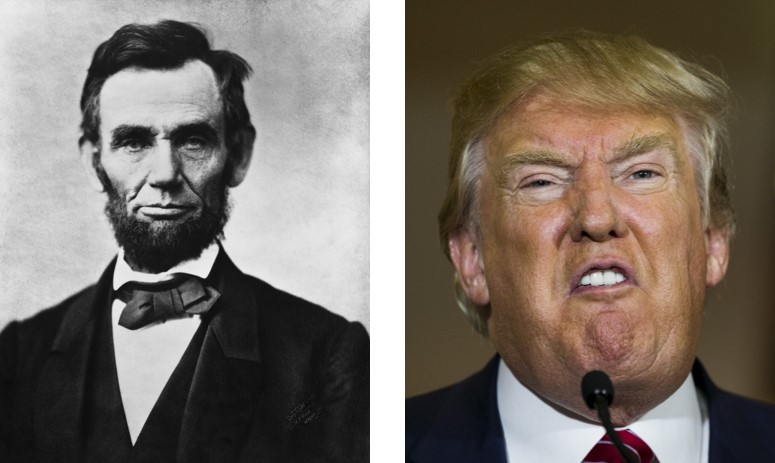
I propose that my theory of Quadratic Intelligence can shed light on this question about what ‘the people’ really want and need. Once we have some clarity on that score, we will be able to tell when a candidate is trying to take us for a ride or put us under a spell – preferably before the magic goes to work on us. My diagram above illustrates the four types of intelligence (hence quadratic) that have evolved as a system in each of us, connecting them to regions of the body where they seem to be centered. For a more in-depth discussion of each type, check out The Harmony of Intelligence, Quadratic Intelligence, and What’s Your QIP?

When politicians warn us that immigration is undermining our economy, how terrorists are conspiring inside our borders, and how our security as a nation is being compromised, they are speaking to our visceral intelligence (VQ). More accurately we should say that they are using words interpreted by our rational intelligence (RQ) for the purpose of provoking strong feelings in our emotional intelligence (EQ) so as to effect a change in our nervous system (VQ) that will move us to action.

Visceral intelligence is centered in our gut, which is why the politician’s warning is experienced as upset in our stomach and intestines. This is where the resources of our environment are converted into the energy our body needs to live. VQ monitors this balance and lets us know when we might be losing the safety and life support we require. Of the four intelligences, this one is the most primitive, and when it gets poked or yanked everything higher up gets put on standby until the crisis can be resolved. Because the body’s visceral intelligence has primacy in emergency situations, the politicians know that poking our need for security will get us to pay attention to their message.

For a majority of voters, perhaps, concerns over safety and survival are not as worrisome as the daily reminder that life just isn’t going their way. Our emotional intelligence (EQ) is more attuned to what’s happening around us, to the degree in which our circumstances are either open or closed to our pursuit of happiness. To define happiness as the feeling that things are going our way does not automatically make it a selfish pursuit. Things ‘go our way’ when our relationships are positive and supportive, when we are making progress toward our goals, and when our desires, on balance, are fulfilled more than they are frustrated.

One pernicious bit of rhetoric works to convince us that something is missing from our lives, that we can’t really be happy until the void is filled. Given that our happiness seems to rise and fall on the rhythms of pleasure and fortune, politicians can easily exploit our readiness to look outside ourselves for the key to lasting happiness. (Indeed, panhandlers and snake oil salesmen perfected this technique long ago.)

They bait us by ticking down a list of things that aren’t tipped in our favor and then ask, “How can you be happy, with all this going against you?”

By this time the charm is set and we have taken the hook. That’s right! we think to ourselves. How have I been managing without this person in office?

Plato was correct in his observation that ordinary people make most of their important decisions in life on the basis of how the options make them feel. In many cases our best interest would be better served if we could just detach ourselves from the passions and exercise a little more reason instead. This ability to detach, discriminate, critique, compare, analyze, extrapolate, and consider things from a more objective standpoint is made possible by our rational intelligence (RQ).

Frankly, rhetoric of any kind is less about convincing us through the logic of argument than it is about moving us emotionally in support of its conclusion.

Rational intelligence works out our need for meaning – that things and life make sense in the bigger picture and longer view. We shouldn’t be surprised if most of democracy’s rhetoric rarely attains this level of clear-thinking consideration. If the big picture is invoked at all, it will usually be in the interest of constructing a rational frame around an emotional or visceral issue. Cut back on emissions and develop clean energy technology because our coastal cities will be underwater within a decade if we don’t – that kind of thing.

But remember, your average voter doesn’t push levers or pencil in bubbles according to sound theory or even the evidence we have in hand. (Who conducted those studies anyway?)

If the rhetoric of democracy prefers to play closer to our animal urgencies and powerful moods than to the shining logic of higher reason, it hardly ever manages to touch the dimensions of our spiritual intelligence (SQ). This is probably due to the fact that most politicians and ordinary people fail even to acknowledge its presence, much less give it priority in their lives. Of course I’m not referring here to our religious affiliations, since religion can be as dissociated from spiritual intelligence as anything else we do – oddly enough, even actively repressing it in many cases.

Our spiritual intelligence makes it possible for us to break free of our personal perspective – that is to say, of the perspective on reality that is tied to our separate center of identity as egos – and re-enter the oneness of being. If this sounds like a bunch of metaphysical gobbledygook, we must know that our separate identity is merely a delusion of consciousness, a construct that exists only in the performance space of a role-play (society) where we hope one day to be somebody and make something of ourselves.

This is in fact the (insubstantial) part of us that politicians work to recruit for votes: the part that declares, “I AM a Republican” or “I AM a Democrat,” “I AM for this” and “I AM against that.”

When we break past the delusion of a separate identity, our spiritual intelligence opens consciousness to the grounding mystery within and to the sacred universe beyond. Ego drops away as awareness descends to its Source (what I call the mystical turn), whereas in going outward it is transcended in communion with the Whole (the ethical turn). We come to understand that we are manifestations of one reality, along with everything else, and together we belong to the same.

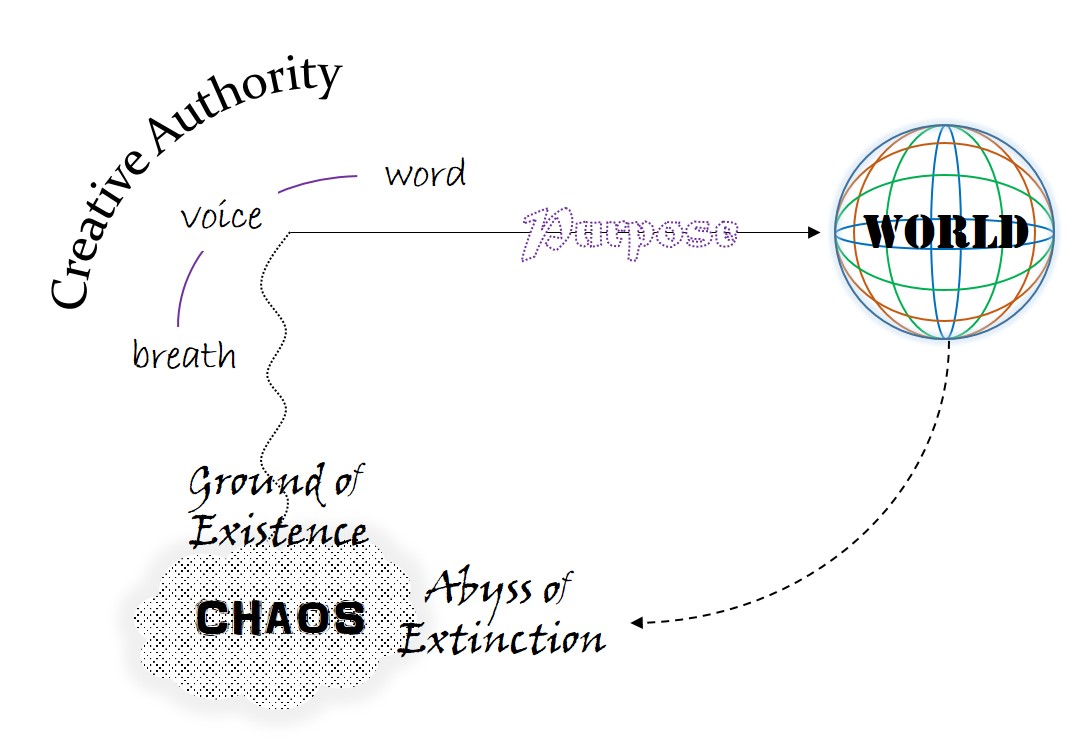
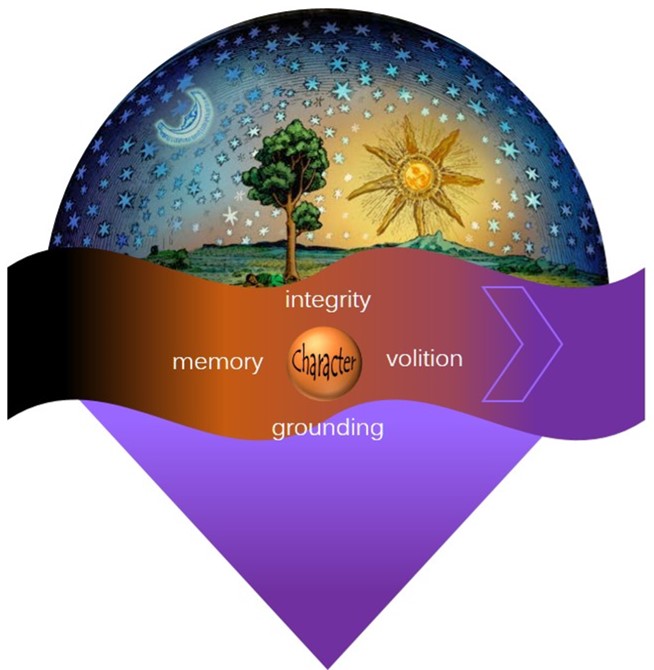
Taking full responsibility for our place in the greater community of life is what I mean by creative authority.

Rhetoric is simply the ability to use language effectively. It doesn’t have to be deceptive or biased or tied to a party platform. Indeed the “rhetoric of democracy” might be about using language to focus our longings and lift the human spirit, to inspire a greater love for each other and for our planetary home. And ultimately, perhaps, to awaken us to the fullness of what we are here to become.

The Human Path

Full Picture EvolutionHuman beings are on an evolutionary arc, progressing individually and as a species toward a ‘self-actualized’ fulfillment of our unique nature. With all the criticisms I have already directed against the personal ego – that conceited blowhard who craves validation, praise, glory, and immortality – it might come as a surprise for me to acknowledge it as the legitimate center around and in relation to which the whole project turns.

Cloud beings, tree beings, dog beings, monkey beings: all of these are distinct manifestations (cloud, tree, dog, monkey) of a single mystery (being). But none of them have created religions designed to awaken and elevate their own deeper natures, to leverage their evolutionary leaps into higher modes of life and contemplate their communion with the universe. The haven’t because they can’t, and they can’t because they lack a separate center of personal identity from which such a grand perspective might be taken and such a magnificent program of self-transformation conceived. They lack egos.

As far as we know, only human beings have egos.

My main issue with the ego has to do with its habit of hijacking our individual development and evolution as a species, pulling it off course into a tangled thicket of odd fixations. Even religion has gotten recruited into its service, idealizing our tendencies toward pettiness, vanity, judgmentalism, and out-group aggression in a deified image of ourselves. As religion degenerates into a hierarchical system of social control, it ceases to function as a program for the transformation of human beings into self-responsible creative agents.

Especially in its absolutist theistic forms, religion is rightfully rejected as a sick and dangerous fever of neurotic self-obsession.

These arrests and setbacks in the development of ego and its religion do not warrant our blanket condemnation of them, however. Indeed if my general theory is correct, then the dismissal or termination of ego (and its religion) runs the risk of subverting the larger project of human fulfillment. To the degree that we are successful in eliminating them (convinced we are finally progressing beyond them), the absence of ego and its religion could bring our career as a species to an unhappy end.

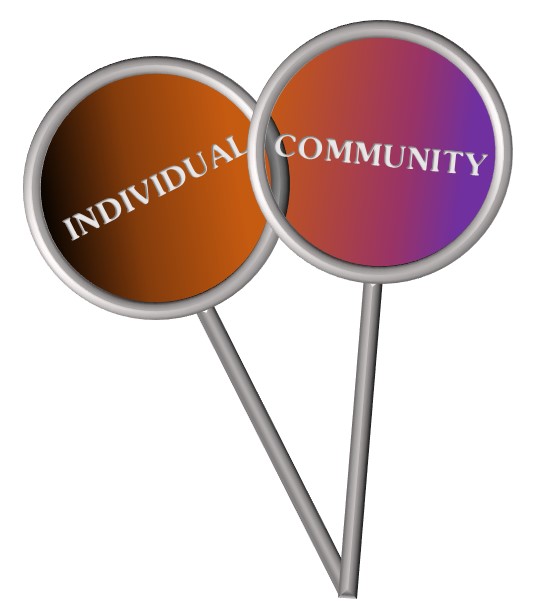
Directing your attention to my diagram above, let’s keep our eyes on that feature in the middle labeled ‘personal identity’. Rather than being the perfection and end-all of our development as individuals, the achievement of a separate center of identity (ego with its personal world) is really a middle stage between an animal prehistory submerged in instinct and a spiritual higher state awakened in wisdom. As Freud helped us see, ego management is a rather tense affair, as the individual tries to balance the ambition of ‘me and mine’ against the conscience of a tribal ‘us and ours’.

Somewhere in that tension the individual ego needs to maintain membership (as ‘one of us’) while also honoring the inner promptings of the higher self. If a tribe supports the emergence of creative authority in the individual, then a transformative breakthrough of this order will be encouraged and celebrated, rather than condemned as it often is in repressive social systems.

This is typically where that deified superego of the tribal deity is used by the group to denounce, quash, and uproot the ‘sin’ of vainglorious self-regard – a character trait which, oddly enough, is protected as belonging by exclusive rights to the deity.

But the ego brings its own resistance to the project of human transformation. A good number of those ambitions are formed around the drive for security, a frequency of nervous state that correlates to an environment perceived as safe and supportive. Because none of us gets through infancy and early childhood without some insecurity, our focus gets set on attaching ourselves to those anchors and sources of security that will keep things from falling apart.

As we go, we construct our web of personal meaning (i.e., our world) around these anchors and sources, incorporating them into our identity and way of life.

It’s no wonder, then, that what I earlier called the inner promptings of our higher self, to break through the attachments that comprise for us the emotional structure of reality, might be strenuously resisted by the ego. To the degree that animal security finds significant compensation in personal identity, further progress of development into spiritual maturity will be felt as heading in exactly the wrong direction. Such a ‘breakthrough’ would be tantamount to a ‘breakdown’ of security, control, order, and meaning – the very death of ego!

One strategy often used in justifying ego’s resistance involves lampooning spiritual maturity as not only heretical, but as also a blatant refusal of personal responsibility. For ego to maintain membership in the social system of attachments, an individual needs to uphold certain moral obligations and subordinate his or her own needs to the will of the group. Any sign of the individual’s loosening allegiance to tribal rules and orthodoxy – asking too many of the wrong questions, expressing doubts and misgivings, pushing on boundaries or challenging assumptions, feeling empathy for outsiders and voicing an interest in the broader concerns of life on earth – such potential disruptions of the consensus trance are quickly discouraged as forsaking what is true, right, and good.

When an individual possesses sufficient ego strength (where the personality is stable, balanced, and unified) and the time is developmentally right, an access point will open from the realm of personal identity, to a mode of conscious life momentarily free from the constraints of ‘me and mine’/’us and ours’.

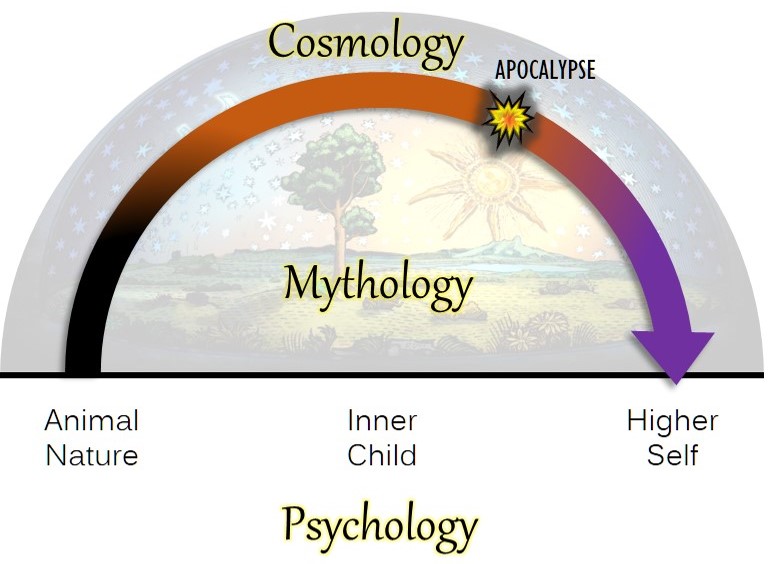
Once the breakthrough is gained, an upward turn along the arc will involve a self-transcending leap beyond identity, while a downward turn from this same point proceeds by a self-releasing drop beneath identity. This inward-and-downward turn is also the mystical turn where consciousness sinks back contemplatively into the grounding mystery and ineffable source of our being. The upward-and-outward turn is the ethical turn where consciousness rises into our creative authority as agents of a higher wholeness, consilient leaders on the advancing wave of evolutionary change.

My stair-step diagram could be interpreted as anticipating a future state of spiritual maturity where ego (that troublemaker) has been finally outgrown, discredited, and permanently left behind – along with its religion. But by now it should be clear that according to this theory ego plays a much more integral role in the longer project of human self-actualization.

Even though it is purely a social construct (and substantially unreal, as the Buddha noted), the delusion of our separateness (which is a function of ego consciousness) is the very thing all higher religions provide insights and techniques for breaking through.

What’s Your QIP?

Quad Intel GridOne of my innovations in the field of human psychology is the notion of Quadratic Intelligence. Expanding on recent theory and research has helped us beyond the early 20th-century notion of intelligence as only our (IQ) competency in reading, writing, and arithmetic – the so-called academic set. Opening the definition of intelligence so as to include emotional (Goleman, 1995), spiritual (Zohar & Marshall, 2000), and less conscious body processes has liberated discourse on the subject from a crippling Western bias where intelligence equals computation, logical operations, and problem-solving acumen. My insight has to do with seeing these four types of intelligence – Rational, Emotional, Spiritual, and Visceral – evolving together as a system, unfolding in sequence (V-E-R-S) and interacting dynamically throughout human development.

Before we move into the diagram and take a look around, one other general comment is in order. Not only has the West tended to favor rational processes over others, but it also has a long tradition of ‘impersonating the soul’, by which I mean that the center of spiritual intelligence, or soul, has been taken as another name for the separate center of personal identity, commonly called ego (Latin for the first-person singular “I”). This is likely a complication of our deep history in theism, where the formation of personal identity as represented in the deity and managed in the devotee is a prevailing focus of concern.

An unfortunate consequence of this confusion is a tendency to associate spiritual intelligence (SQ) with ‘psychic’ abilities, out-of-body experiences, metaphysical visions, and special access to the supernatural. It has also perpetuated an unhealthy dualism that conceives the human being as a body with a soul or a soul inside a body – in either case a deeply divided being.

A sick religion that capitalizes on this dualism is obsessed with getting the captive soul safely to its heavenly home, free and far away from the mortal body. Just about everything connected to our physical life as animals – our drives, appetites, proclivities, and secretions – has been put under one taboo or another, as despicable vices that threaten to drag us into hell.

So when I speak of spiritual intelligence I am referring to that strand of quadratic intelligence that gives human beings our distinctive creative ability – to imagine, compose, invent, and in various ways transcend the boundaries of our present situation. Soul, then, is not an immortal entity riding temporarily inside a mortal frame, but the very center of this creative intelligence. By extension, spirituality is not only about breaking out and escaping our limitations, but transforming them by virtue of a new perspective, attitude, and mode of life.

What I call ‘creative authority’ is this very mode of life whereby individuals take responsibility as creators of the identities, worlds, and relationships that either facilitate or frustrate the realization of their own higher selves and those around them.

Just as our thinking mind is no more important to what we are than our feeling heart, neither is our spiritual soul any more special and sacred than our animal body. While our consciousness may be characterized by an inherent duality – introverted to the intuitive-mystical realm within and extroverted to the sensory-physical realm without – we are fundamentally indivisible in our essential nature as spiritual animals.

After insisting on the integral unity of our quadratic intelligence I can move on to make the point that each of us develops and demonstrates the four types in individual ways that are unique to our genetic temperament, early upbringing, surrounding culture, pressing concerns, and evolving character. This is where my diagram comes in.

Let’s start with a question. From the following four options, which term best describes your preference for orienting and navigating your way through life: strategy, inspiration, sympathy, or common sense? Here are the definitions.

Strategy

You prefer to make plans, set goals, and work through a sequence of tasks that lead where you want to go. This preference suggests that you tend to favor reasonable and creative approaches to the challenges and opportunities of life. If you self-identify as preferring strategy, then you might further refine this preference as leaning more to the rational (RQ) or spiritual (SQ) side. In other words, strategy could be more about detaching from your subjective feelings and staying on course with a prescribed plan, or the value might lie more in how it enables you to transcend the way things are and bring about a ‘new reality’. The unifying idea is the way strategy clarifies and prescribes an overarching purpose in what you do.

Inspiration

You seek out experiences that ‘breathe in’ (inspire) greater joy, beauty, and wonder that will enrich your life. This preference suggests that you tend to favor creative and passionate endeavors which connect you to something much bigger than yourself. Depending on how you lean into inspiration it might be more about this feeling of engagement (EQ), or perhaps you would describe it in terms of an inner release and going beyond (transcending) the bounds of ordinary awareness (SQ). It isn’t necessary to postulate a supernatural or metaphysical source behind the experience of inspiration. It simply represents the cooperation of your emotional and spiritual intelligence in taking in ‘something more’ – the whole that is more than the sum of its parts (think of the artistic image that ‘comes through’ the patterns of color in a painting, or the gestalt that rises through the harmonies of individual instruments of an orchestra).

Sympathy

I’m using this word in its classical sense, as a resonant response between and among things of similar nature. It certainly takes on an emotional character in the realm of human relationships, in the way individuals are ‘moved’ by the mysterious forces of attraction, empathy, and aggression to match each other’s mood. If sympathy is what orients and motivates you through life, then you tend to go with ‘how things feel’ or ‘what feels right’ in the moment. Leaning more on the side of EQ, this is typically experienced as a refined feeling that may prompt secondary reflection, whereas a stronger anchor in the unconscious reactions of the body (VQ) will evoke a more spontaneous behavioral response. Sympathy is the emotional and visceral basis of our more ‘elevated’ intuitions of compassion and empathy. As distinct from them, sympathy is something we feel in our heart and sense in our gut, often as an ineffable reaction occurring prior to any conscious reflection or ethical resolve.

Common Sense

Our ‘common senses’ refer to the five sensory-physical modes of perception – sight, hearing, smell, taste, and touch. If this is your preference for orienting yourself in reality, then these sense-data serve as the foundation of reliable knowledge. Just as your visceral intelligence (VQ) anchors consciousness in the organic urgencies of life (e.g., the compulsive urge to breathe), your physical organs of perception tether attention to what we might call the realm of the obvious. The modern school of philosophy known as ‘common sense realism’ (Thomas Reid) shows how this preference can lean strongly to the rational (RQ) side, where even the detachment of our logical mind only infers and constructs from the information apprehended first through the senses. If you are a common sense realist, then you likely insist that truth must derive from, and ultimately come back to, the reality of perceivable facts.

My Quadratic Intelligence model allows us to appreciate the multifaceted nature of human intelligence, and helps as well in the need to expand our definition of it beyond one type of intelligence or another. The concept of preference (strategy, inspiration, sympathy, or common sense) can also rein in a tendency to arrange these types of intelligence in a (personally biased) hierarchy of importance. For example, although spiritual intelligence comes online later (i.e., farther into maturity) than visceral intelligence (which is active in the very beginning of fetal life), this doesn’t make it ‘better’ or more essential to what we are as human beings.

Indeed there are plenty of examples where our spiritual ability to go beyond (transcend) what is given has inspired individuals to abandon their connection to everyday reality for apocalyptic and otherworldly speculations, which are then professed as divine revelations by these ‘visionaries’ who use them to draw notoriety, influence, and profit.

You might struggle at first in closing down on just one preference over others. As well you should, since all of these are at least potentially active in your quest to make sense of reality, connect meaningfully to those around you, and become fully human. Consider arranging all four preferences in an order that reflects your personal Quadratic Intelligence Profile (QIP). Such an exercise might suggest areas that could use more attention and training, to develop yourself in a more well-rounded fashion – although a ‘perfect balance’ among the four preferences should probably not be a goal.

The End of Religion

Ego StagesIn my efforts to define what I mean by ‘post-theism’ (as distinct from other uses of the term you might find out there), it’s been critically important not to confuse it with straight-up atheism on one side, or on the other with clever spins on the ‘post-‘ idea that contemporary Christian theism is attaching to the ’emerging church’ movement (for example). My construction is intended to name a stage of religion that comes decisively after theism, as a transformation beyond it that holds the promise of facilitating human spiritual evolution to the next level, without getting hung up in debates over the existence of god.

This type of post-theism acknowledges god as a construct of the mythopoetic imagination, not as a literal being but rather the principal figure in sacred stories – more properly, then, as a literary being. Our representations of god serve the purpose of orienting us in an intelligible universe (regarded as the creation of god), inspiring us to worthy aims (identified with the will of god), and guiding our ethical development as persons into virtues of community life (glorified in the character of god). The ultimate aim, ethically speaking, is for the devotee to so consciously internalize and intentionally express the virtues of god’s character that the need for an objective ideal is permanently transcended. Human evolution continues from that point, on the other side (after: post) of god.

It helps considerably if we don’t treat theism as one thing, as a singular religious phenomenon which must either be accepted or rejected en bloc. Its development out of primitive animism arches over many millenniums, and its career has been one of steady progress (with frequent setbacks) into a spirituality and way of life more mystically grounded, ethically responsible, and globally connected than before. These very developments now threaten the more tribal forms of theism which are losing relevance faster than ever despite their appeal to insecure and extremist types. In this post I offer a lens for understanding theism in its development, tracking its ‘leading indicator’ in ego’s rise to maturity – and beyond.

The major phases of theism correlate to the career of personal identity (ego) in the human beings responsible for it as a worldview and way of life. (We still need to be reminded of the fact that religions are human inventions created for the purpose of linking concerns of daily life back to the present mystery of reality, represented and personified in the construct of deity.) We can conveniently analyze ego’s career into an early, middle, and late phase, where personal maturity in a stable, balanced, and unified self (the markers of ego strength) is the aim. My theory simply regards these distinct phases as stages, in the sense of platforms that provide the developing ego identity with shifting orientations in and perspectives on reality.

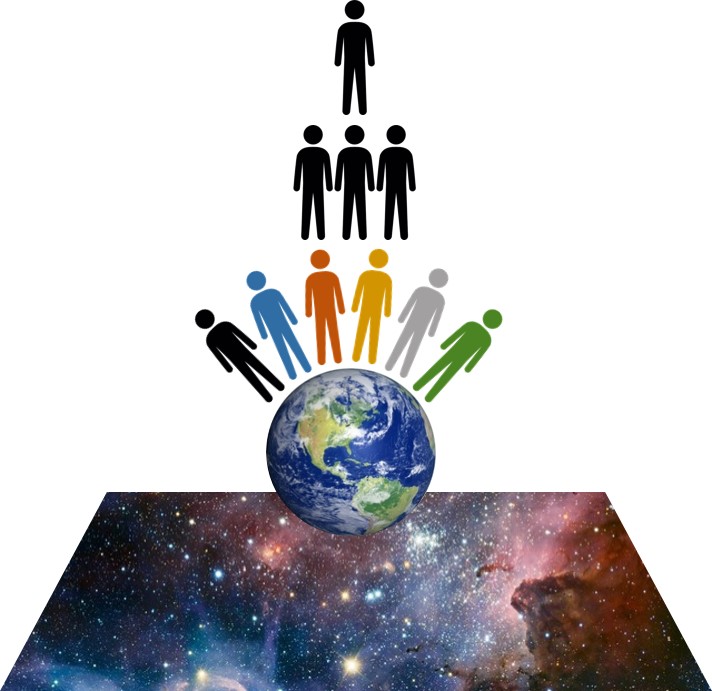
As a constructivist it should be clear by now that I see personal self-conscious identity (ego) as something that is not essential to our nature as human beings, which is to say that it is not in our given nature as products of evolution. Instead, it is socially constructed in the cultural workspace of our tribes. The taller powers (our parents, other adults and older peers) shape us into who we are, as a central node in the complex role-play of tribal life. We then perform our various roles according to the rules, values, and expectations (i.e., the morality) of the social groups in which we have an identity.

In the diagram above, this construction of ego identity (color-coded orange) is tracked in its slow progress through the essential aspects of our nature, body (coded black) and soul (purple). Depending on where we take our perspective in ego’s development, the relationship of these two aspects to each other is differently construed – in terms of ‘opposition’, ‘reconciliation’, or ‘communion’. These terms are thus offered as key concepts in our understanding of ego’s development, as well as that of theistic religion.

In the opposition phase, our separate center of personal identity (ego) is not very well defined. The very imposition of ego, however, causes a split in consciousness where an inner subjective realm is gradually divided from an outer objective realm, or ‘soul’ from ‘body’. Whereas soul and body in our essential nature are simply the introverted (intuitive-spiritual) and extroverted (sensory-physical) aspects of an evolved consciousness, our executive center of personal identity throws them into opposition. Now ‘I’ (ego) have a soul and a body, and the challenge becomes one of constructing a meaningful relationship between them.

This is where we find all those wonderfully complicated and emotionally charged stories (myths) about the separation of matter from spirit, of body and soul, giving account of how we happened into this conflicted state in which we presently find ourselves. It might get worked out into a fabulous mythology that puts god in opposition to the world as a bodiless and transcendent entity existing apart from our fallen carnal nature. Elaborate rituals must be invented, and then spun back to the people as revelations, that can provide a necessary atonement for resolving the negative conditions of our ignorance, guilt, and selfishness.

As personal identity continues to develop, these opposing forces of body and soul are gradually reconciled – brought together in a healthier marriage rather than striving in conflict. While traditionally interpreted in light of the older orthodoxy of opposition, Paul’s reflections on the person of Christ as one in whom ‘god was reconciling the world to himself’ (2 Corinthians 5:19) – that is to say, as one in whom body and soul were fully united in his essential nature – might be seen as evidence of this shift in perspective where ego (the Christ ideal) has progressed beyond a body-soul opposition and more into its own stable center of identity. At any rate, there is no doubt that Paul helped to move theism past the opposition of Two (god and humanity) and toward a synthesis into One (a deified humanity or incarnate deity).

As an aside I should note that Christian orthodoxy for the most part has ignored, and perhaps even willfully rejected, a theism of reconciliation for a reinstatement of the older theism based in opposition. Jesus came to be regarded not as the ‘New Man’, in line with Paul’s meditations, but as the key player in a transaction of salvation whereby our guilt was paid off and god’s wrath against sin was appeased. Even though humanity’s criminal record was expunged, god and the world remain essentially separate from each other.

This derailment of Christian orthodoxy from the intended path of theism’s evolution has, I am arguing, prevented the religion from progressing into its post-theistic phase. Despite the efforts of Jesus, and Paul after him, to move theism past the oppositions of god-versus-world, soul-versus-body, self-versus-other, us-versus-them, into a new paradigm where such divisions are transcended and made whole, Christian churches today remain locked in a pathological dualism. But we still need to consider what a full embrace of its post-theistic destiny would look like.

In my diagram, the distinct and separate ego has reached the point in its development where ‘me and mine’ no longer limit a fuller vision of reality. While a sense of oneself as a person continues to be in the picture, the sharp division of body (black) and soul (purple) gives way to a blended continuum of animal and spiritual life. We are ‘spiritual animals’ after all, and now our awareness and agency as persons can move us into a new but still self-conscious mode of being. My name for this mode of being is communion, literally ‘together as one’. There is no god on one side and the world on another. No souls separate from bodies awaiting deliverance to a postmortem paradise. No ‘us’ on one side and ‘them’ on the other.

We are all one together. Nothing, really, is separate from the rest. The realization of this oneness, however, depends on our ability to appreciate ourselves (and all things) as manifestations of the same mystery. Such a profound appreciation – Jesus and other luminaries called it love – will fundamentally change how we live.

Journey Back to Reality

BreakthroughJust as soon as I make a case for the necessity of religion, it’s time to insist on our need to transcend it. If my atheist friends squirm at my insistence that we all have a religion – a system of beliefs, attitudes, values and practices that links the separate ego back to reality – my friends who are believers will shake their heads at my suggestion that we need to leave it behind. Why take the time to defend religion (not one or another religion, but religion itself) when the point is to go beyond it?

A popular notion of religion conceives it as a means to an end, as a way through this world to another one. We trust that our religion will answer those really big questions and ultimately save our soul when the body gives out and our life on earth is over. Even a slight acquaintance with the history of religion should disabuse us of that fantasy, as the ‘soul rescue’ model came on the scene only very recently and is based on a dualism of body and soul which is probably less than 3,000 years old.

For the greater part of its history religion has focused human concern on the challenges and opportunities of life on earth. Essentially it is about assisting human beings in the evolutionary work of “cultivating faith, nurturing love, and constructing meaning,” of reconnecting to reality and becoming real. Why we might need to become real is more obvious when we understand the extent in which ego formation (the development of a separate center of self-conscious identity) removes us from the spontaneous stream of life experience and from the present mystery of reality.

The rise of personhood and individuality is a slow arc across human cultural history, and religion functions to keep it from detaching pathologically from the mystical (contemplative), ethical (communal), and universal (cosmological) dimensions of our existence. Few critics of religion today recognize just how important it was during the formative stages of human evolution, not to mention how important it continues to be as our destiny unfolds. Just because certain aspects of religion, and even entire religions, may change or disappear as we progress doesn’t mean that religion itself is expendable.

The question is not whether but how ego consciousness today is linked back to the grounding mystery within, to the living community of persons, and to the larger context of life on earth. Does our religion ‘work’ to this extent, or not?

My diagram summarizes the ‘journey back to reality’ that healthy religion is intended to facilitate. The place to begin is at the bottom-right, where looped purple and black chain-links remind us of the essential nature of human beings as spiritual animals. We are not souls in bodies or bodies with souls, but sentient animals with a rich inner life. Our body is oriented by the senses in an extroverted fashion to the physical environment, while our soul opens consciousness to its own inner depths. In the dialogue of inner and outer, mediated by metaphor and story (myth), we perceive the oneness of all things and our place in the order of existence.

Shifting over to the bottom-left and slowly swinging upward in the diagram introduces another piece of the puzzle, in that developing center of self-conscious identity (ego) mentioned earlier. If ‘spiritual animal’ is what we are as human beings, ego identity is a quest for who we are – where we belong, to whom, as a member of which tribe, in what occupation, and so on. Early on, the tribe is most active in shaping our animal nature into a well-behaved dependent – a ‘good’ boy or girl who observes the rules of the game. Certain base impulses have to be restrained, or else channeled in ways that conform to the morality of tribal life.

Our fundamental relationship to the body is established at this stage, as either something we can honor and enjoy, or instead feel unsure and ashamed about.

The first separation in ego formation, then, is a separation of self-consciousness from the sensations, drives, and urgencies of the body. Ideally there is a general sense of security, where the emerging ego feels supported and valued as a member. But even in the well-adjusted individual some anxiety persists around the question (inarticulate at this point) of whether it’s really safe to trust, making security a chronic concern for the ego. We see this, for instance, in the infant that clings to its mother for safety and nourishment, unwilling to let go for fear of not having what it needs to survive. Attachment, then, is how ego compensates for insecurity, by latching onto whatever promises the unconditional support it has lost in the process of separation.

Every ego thus carries an inherent self-contradiction: the separation necessary for establishing its own center of identity amplifies a deep insecurity, which ego then seeks to overcome by attaching to an external anchor – be it mother, family, nation, wealth, status, deity, heavenly reward, or whatever. The deeper the insecurity, the stronger and more desperate the attachment: a condition that interferes with and can completely undermine the process of healthy ego formation. This self-contradiction is usually resolved (perhaps only justified or explained away) by the construction of meaning that our tribe erects around us. As an obedient and honor-seeking member of the group, we should be willing – better yet, eager – to sacrifice everything in service to its idols and ideals.

Insofar as religion can become a closed orthodoxy and a hierarchy of top-down control, it was inevitable that this natural course of human evolution (i.e., the rise of ego consciousness) would generate a crisis – and a worldwide one. Wherever the rising force of personal identity and individual freedom confronts a regime of moral repression and thought control, something needs to give.

It’s important to understand, however, that because ego is inherently insecure to some extent, the framework of meaning it comes to inhabit and defend as its personal world is not wide open to reality, but just as small and simplified as it needs to be. In my diagram, a ladder of ego development leads up into a more or less coherent worldview (symbolized by a sphere) held inside a set of beliefs concerning ‘the way it is’ (symbolized by a box around the sphere). Even a healthy personality, exhibiting the telltale signs of ego strength (stable, balanced, and unified), is separated from reality by its world construct.

We don’t need to demonize the ego and make it the cause of all our trouble, as some world religions have done. The goal of ‘salvation’ (referring to the process of being set free and made whole) is not to cancel or reverse what ego formation has accomplished, but rather to transcend personal identity and reconcile consciousness to reality once again. I say ‘once again’, but in fact the connection this time is conscious and intentional, whereas its pre-egoic state was unconscious and spontaneous.

By definition, nothing is separate from reality, which means that ego’s separate identity is actually (in the words of Albert Einstein) “an optical delusion of consciousness.” This is what needs to be transcended.

Having made our way to the top of my diagram, we can now follow the path of our journey back to reality. To really see things as they are, the veil of meaning that separates us from reality (or to use a related analogy, the mental labels we affix to things and other people) must be pulled aside. What is revealed, then, is perfectly meaningless: reality in all its glory, the pure radiance of being. Truth is always beyond meaning, and our meanings are true only insofar as they accurately represent the way things really are. And yet, even the most accurate representation is still just a representation; the present mystery of reality transcends all media of thought, language, art, and theory. It is ineffable.

When we are liberated from the constraints of belief, prejudice, and unrealistic expectations, other persons can be respected as free individuals rather than as emotional attachments that protect or ‘complete’ us. Such open and sacred regard for others, expressed as empathic care for their health and well-being, is what we call love. Genuine love and community is a dynamic of freedom, trust, kindness, and honesty between individuals. It isn’t ‘blind’ at all, but profoundly clear-sighted. Attachment is what makes us blind to others, regarding them only as we need them to be – how reassured, desirable, important, or threatened they make us feel.

If truth is the way things really are behind the meanings we impose on them, and if love refers to a genuine human connection that is free from neurotic attachment, then power, as the opposite of insecurity, has to do with our conscious connection to the grounding mystery within. Paul Tillich expanded the notion of being (taken as a verb rather than a noun) as ‘the power to be’, interpreting existence (from existere) as the place where reality manifests (or ‘stands out’) in this or that thing.

Much of mystical spirituality might be characterized as an inward descent of consciousness, dropping past the identifications of ego, into the deeper registers of inner life until the wellspring of being-itself is reached.

Our quest for identity sets the stage, as it were, for our journey back to reality. As the quest is our preoccupation during the first half of life, the journey will (or perhaps I can dare say, should) serve as the orienting metaphor for a spirituality of the second half. Yes indeed, we will occasionally get hooked into the drama of ‘me and mine’ – much more frequently than we would care to admit – losing our way time and again. But soul seeks truth, not meaning. It celebrates love, not possession. And it rests quietly in being, in the secret source of power.

A Father’s Heart

My present relationship with my father began a little more than two years ago, when we lost my mother. Since then we have talked on the phone morning and evening, just about every day. I suppose the combination of my being more temperamentally similar to my mother, and my father’s steady fulfillment of his family role as provider and disciplinarian, had made him seem more distant – not absent or uncaring, but more other, the counterpart to her enveloping nearness. Throughout my early life, he was like that promontory on the seacoast which provides a fixed point for the orientation of ships rising and falling on the waves.

I think there’s something archetypal about a father, as there is about a mother. Whereas she is the encompassing reality out of which we need to be delivered in our quest for identity, he represents in his otherness the ideal and future goal of what we are becoming. Our fathers might not exhibit the ethical character that inspires our own positive moral formation – although my father truly did – but simply in their otherness they stir our longing to stand out and be somebody. This might help explain why some young men who grow up without a positive role model in their fathers are at higher risk of becoming sociopaths and extremists.

Sometimes I wonder if my father’s role in our family system as the lawmaker and disciplinarian kept me from seeing the sentimental and softer side of him. Maybe his life story as a firstborn son and obligated farm hand, eventually serving as a church pastor in a denomination that was strongly patriarchal, shaped his own development away from the more tender and expressive virtues. No doubt, who we are and how we are in the world is to some extent determined by our situation in life and the responsibilities we are asked to shoulder. Even given that, I realized later on that how I saw my father was also limited by my own needs, ignorance, and insecurities.

Just last month my father’s only sibling and last remaining family member passed away, leaving him with the solitary task of sifting and sorting through legal documents, family memorabilia, and other of my uncle’s personal effects. He’s remarked more frequently of late how tired and ‘shaky’ he feels, driving back and forth from Michigan to Iowa and having to make decisions over the disposition of property and the family farm. He is struck at times by how little is holding him here anymore, after losing his parents, a son, his wife, friends along the way, and now his only brother. As the anchors of love and commitment are pulled up from his world, he feels increasingly adrift and alone in life.

In the midst of it, however, his faith remains strong, which I’m sure is the deep core of his character stability that has always impressed me. While his theology – the vocabulary and discourse he uses to make sense of his faith – is not identical with my own, I resonate with my father’s sense of a provident mystery that is present with him even in his loss and grief. We are not separate from reality after all, and ultimate reality (what we name God) is not ‘something else’ but rather the essential ground in which, as the Apostle Paul says quoting the Cretan philosopher Epimenides, ‘we live and move and have our being’. In his quiet moments, my father finds reassurance that he is not really alone.

At first, our frequent phone conversations were my way of keeping in touch and sharing the grief of losing my mother. It was distressing to picture him there, sitting by himself on the edge of the bed or staring through tears at his morning oatmeal. I wanted to be with him, to give what comfort I could offer. Over time, however, it was his faith that ministered to me. He seemed softer, more vulnerable; and in his vulnerability, more genuine and present in the moment. Our connection grew stronger, and I found myself looking forward to the next chance we’d have to talk.

Someday I want to be like my father.

Why is it so easy for us to take what is precious for granted? When our loved ones are alive and with us, how do we dare let a day pass without telling them how much they mean to us? Why does it take losing them to remind us? I will not wait, not another day. After all, the day might not come.

Dad, I love you. Thank you for being a rock for me, and for helping me find my way.Promontory

Does Your Religion Work?

The question is not whether religion will one day be only a memory of our brutal and superstitious past as a species, or else singularly responsible for our future catastrophic self-destruction. A lot of people feel that we would be better off without it. In their perspective religion is unnecessary baggage crowding the mental space we could be using for more relevant and practical concerns. We can’t deal rationally with these things until we abandon superstition, come to our senses, and work together for real solutions.

A returning reader is familiar with my less categorical appraisal of religion. I can be critical of every tradition and denomination with respect to how easily it gets tangled in our neurotic obsessions with glory, guilt, sex, violence and death. But at the same time I am constantly in search of what we might call ‘religion in essence’, as distinct from its countless historical manifestations. From the etymology of the term we can define religion as the system of attitudes, beliefs, values and practices that works to link us back (Latin religare) to reality, resolving the separation inherent to the rise of ego consciousness.

Personal identity is a process of social construction that gradually establishes an executive center in the ego – actually a deputy center, subordinate to the authorities of family and tribe. Ego stands above the body and apart from others, and if development has been particularly difficult or traumatic, it becomes estranged from its own inner life (soul) as well. When this condition of separation is severe enough, a profound insecurity can overtake the personality. The essential function of religion is to provide the means for ego to reconnect with reality – internally with its own grounding mystery, relationally with others, and transcendentally through a meaningful world-picture (or cosmology).Faith_Love_Meaning

Distinguishing essential religion in this sense from its various manifestations – inspired or deluded, genuine or dysfunctional as the case may be – gives us a useful model for assessing the relative health of our own. Whether or not you believe in god, say your prayers, go to church, or hold out hope of an afterlife, the real litmus test of any religion has to do with how effectively it connects you to the grounding mystery within, to others who share the world with you, and to the universe that surrounds you.

My shorthand for these dimensions and associated practices of life is illustrated to the right. I’ll unpack each term more thoroughly in a bit, but for now I’ll restate my general thesis in the following way.

Religion is the system by which human beings cultivate faith, nurture love, and construct meaning. However you do that, is your religion.

Faith

We begin with faith because its presence or absence sets the tone for everything else. From the time we were still in our mother’s womb, our nervous system was picking up clues as to whether reality was provident and supportive, or instead hostile and dangerous. This was long before we had an ego and prior to our acquisition of language. Consequently the deep impression registered in our nervous system was both unconscious and ineffable.

In the context of essential religion, faith has nothing to do with beliefs – orthodox or otherwise. The roots of the word reach far below the articulate mind and its propositional truths, into the matter of trust, surrender, and release. I prefer release because it keeps the dynamics of faith centered internally, where to trust (in) anything we must first let go and open up to what is beyond us.

Its opposite is not heresy or intellectual doubt, but anxiety – more accurately existential anxiety, a profound dis-ease concerning the nature of reality. Our nervous system is gripped with tension, skittish and hyper-reactive, which sets us up for nervous exhaustion. This anxiety is the cause of so much that goes wrong in religion.

Because faith is our trusting release to the grounding mystery of being itself, it’s not something that can be measured or manipulated. It is our spontaneous ability to surrender control, relax into being, and rest in the moment. The good news is that it’s an ability we can develop by intentional practice.

Love

We might expect that a deeply grounded faith will translate in positive ways to our relationships with others, and this is indeed the case. The ego is established in its own separate center, which suggests that reaching out for affection, intimacy, cooperation, and reconciliation is where our religion is really tested – and where many fail. A deficiency in faith (i.e., excessive anxiety) makes us suspicious of others and unable to trust them, so when they let us down as they inevitably must, our core impression of reality is confirmed. Around it goes, in a self-reinforcing loop.

Because ego-formation moves our center of personal identity into its own separate position, the real work of religion lies in caring for others, respecting their interests, understanding their needs, forgiving their faults, and helping them thrive. In short, the real work of religion is about love. We should be able to say with confidence that any religion which fails to cultivate the power of love in human relationships, even more when it arouses and justifies hostility towards others, is neither healthy nor true. This insight is what motivated Siddhartha to eschew metaphysics and Jesus to renounce orthodoxy, revealing the way of liberation as consisting in loving-kindness.

Meaning

The age of postmodernity coincides with the dawning realization that meaning is not something we find in reality, but construct for ourselves. Words are human creations, and the sentences, stories, and worldviews they make up really are made up. If there’s a crisis of meaning these days, it’s not that life has let us down but that we are doing a bad job making life meaningful.

At the highest level, our religion inspires a view of the full horizon of existence, a unified theory of how the Whole Thing moves as one. In prehistoric and ancient times such theories were dramatic narratives, which we know as myths. As we approach modern times, these stories become more mathematical than narrative in structure, and personal elements are strictly excluded. A downside of this shift from sacred stories to scientific theories is our difficulty in seeing ourselves in the bigger picture. If we reduce mind to brain, brain to body, and body to nothing but dead matter, where is the self? Where is the human spirit? How is it possible to say that we belong to the universe?

One more quick drop down to the level of faith will help us appreciate how the meaning of life is really a creative project of our shared life together, and how the quality of our relationships is directly a function of how deep and strong is our individual faith. Faith, that is to say, encourages love, and love engages us in the collaborative pursuit of meaning.

That’s when you know your religion works.

Terminal Education and the Death of Culture

Terminal EducationYouth is being wasted on education. More and more young people are becoming victims of what can be called ‘terminal education’, which is not about lifelong learning and opening minds to the world – not anymore. Increasingly the education process is a conveyor-belt affair, where naive and optimistic youth are moved through a series of stations along the way to a long life of work.

Many of them don’t make it, and it’s not entirely their fault.

Feeling the pressure of limited resources and a fluctuating job market, college administrators are remodeling the process of education into a production-line for making graduates who are expected in turn to fill jobs and strengthen the economy. A stronger economy should mean more resources eventually coming back to the college, right? It might work that way if our colleges weren’t turning out such dismal figures when it comes to academic achievement, graduation rates, and job placement for their graduates.

There are really two systemic problems with our current education system, one of which is the terminal orientation of the process (the main focus of this blog post). Underlying this problem, however, with a history equally as deep, is the way our system over-accommodates students in their struggle to succeed in school. Rather than working to empower in students the determination, best effort, perseverance, and resilience that lead to meaningful achievement, schools already from the elementary level have been lowering the bar, so as to reduce the risk of failure.

Are they doing this because they feel badly for the struggling students? No, these accommodations are being provided so that students will produce the academic outcomes (grades, grade point averages, and standardized test scores) that increase institutional eligibility for external funding, updated technology, and higher quality teachers.

Generally the rule is that accommodations cost more the later such interventions are needed, so by putting accommodations in place early this threat can be averted. Unfortunately what happens is that students are pushed up a grade without the intellectual skills and emotional resources to succeed there.

When it’s time for college, they’re not ready – not by a long shot. But colleges need to show robust enrollments, so they end up falling in line with the accommodation train. Remedial classes, academic interventions, prerequisites for credit classes, and even special accommodation for students who can produce a diagnosis from a growing list of learning disorders – all of it necessary if the year-end report is to show an institution’s market value.

Maybe the underpreparedness of students is part of the reason that education has become terminal. If all your time and resources are tied up in simply getting them to graduation, what’s left for the work of opening minds, igniting passion, nurturing creativity, and developing human potential? Not much. And frankly, the students themselves don’t seem to want it. Never mind that they have no inkling of what ‘it’ even is, having rarely been empowered in the love of learning.

A depleted system produces deficient members, whose deficiency further depletes the health reserve of the system: this is the kind of reinforcing feedback loop that inevitably ends with extinction.

I suppose that’s one meaning of the word ‘terminal’.

But another meaning, and the one I want to focus on here, describes how education today is aimed at very specific and measurable outcomes, and ultimately on the need of students to find gainful employment.

Why are you planning to go to college? Because I need to find a job. And of course, before I can find a job I need to earn a degree. For the degree, I have to get decent grades. In order to get a grade I have to take a class. And before I can take a class, it’s necessary to choose a college and be accepted.

Why are you doing this again? To find a job. When I get a job, it will all be worth it and my education will finally be over. Done. Finis.

It shouldn’t surprise us to learn that many students don’t make it. In my diagram above, the likelihood of success at each step diminishes the farther along students get, as indicated by the thinning arrow. With each step the definition of success also becomes less clear, as illustrated in the fading shade of text. Additionally, the consequence of failure grows more severe as students move through the stations: withdrawing from a class is not as serious as dropping out of school, and the disillusionment that comes when your degree fails to unlock a career can be personally devastating.

‘Plan B’ is another way of saying that things didn’t work out as you hoped they would.

If all this focus is placed on the terminal outcome of finding a job, there is little inherent value acknowledged in the process of education itself. It’s not really about learning how to think and solve problems, developing talent and unleashing creativity, or opening minds to the mysteries of life and promoting the self-actualization of human beings. And yet it is these things which have been the seedbed of human culture for millenniums, not ‘getting a job’.

Terminal education is both a symptom and a warning that our culture is losing its spirit.

Thankfully it’s not too late to turn things around.

College is more than a pipeline of graduates into the workforce, and the deepest value of education is probably something that can’t even be measured. For at least four years (in the conventional scheme of things) young people are growing into their adult selves, learning how to get along in the world, pushing open boundaries, tapping the inner springs of their native intelligence, discovering passions and exploring their dreams.

A higher education – but really, at every grade along the way – needs to have one eye on the economic landscape and changing demands of the job market, with the other on its sacred stewardship of the human spirit.

Unfinished Business

Unfinished BusinessI guess I write a lot about what I feel is most urgently needing our attention these days. Current events are interesting because they’re in the news and on our minds, but popular engagement with the news of the day tends to skim the surface of what’s really going on. It’s not nuclear proliferation, terrorist plots, melting ice caps, or the next election that we should be figuring out, but the deeper forces that are presently driving and shaping our reality.

We need a psychological model that reveals the truth about ourselves without reducing us to mindless matter, on one side, or elevating us to metaphysical dimensions, on the other. Importantly it should provide an honest accounting of both the promises and liabilities that attach to our human nature, in a way that makes sense in a secular and global age. The elements of my model are not new in themselves, but I offer definitions and relationships among the elements that are novel – and, I hope, relevant to the current challenges we face.

My diagram above draws an arc of development from a body-centered (early) phase, through an ego-centered (middle) phase, and reaching fulfillment in a soul-centered (late) phase. I’ve joined body and soul in something of a tensive image, stretching between the animal and spiritual aspects of our essential nature. A simple statement of this essential nature is that we are ‘spiritual animals’, animals with a capacity for imagination, creativity, contemplation, transcendence, and communion.

We are not ‘souls in bodies’ or ‘bodies with souls’, but rather a marvelous duality of consciousness that is at once centered in life (body) and grounded in being (soul).

Before we hitch a ride with ego along that rising and falling arc, let’s spend a little more time getting to know the body where its hero journey begins. In other posts I have characterized body as naturally extroverted, that is, as flexing consciousness outward to the surrounding environment and continuously regulating its own internal state (as an organism) according to those external cues and conditions. The body’s own internal urgencies operate for the most part below our conscious awareness and almost entirely outside our conscious control. We might regard the body itself as a highly evolved energy exchange between external resources and these internal urgencies, between the provident conditions of the environment and its own metabolic demands as a living organism.

Ego formation (the rising arc of personal development) entails some decisive negotiations with the body’s animal nature, a process that is motivated and supervised by our tribe. The expected outcome of this process is a centered identity that sees itself as belonging to ‘us’, obediently performing roles that contribute to the welfare of the group. What we call morality is the set of rules, values, incentives, and deterrents that constrain us to behave like a ‘good boy’ or ‘nice girl’ and eventually as a compliant member of the tribe.

Psychologically ego formation is also where reality starts to divide in two, with an objective (‘thrown-over’) world on one side, and a subjective (‘thrown-under’) self on the other side of this line. World here is not a synonym for reality, as we sometimes speak of ‘the real world’ as a factual and nonfictional realm beyond us. As I use the term, world refers to the construct of symbols, language, meaning, and morality that ego, with the help of its tribe, builds around itself. Much of it is (in fact) fictional, in the sense of being a narrative construction of metaphors and stories that form a cross-referencing web of meaning where an individual feels secure.

Self is also a narrative construct made from strands of memory, preferences, beliefs, and ambitions that connect into a relatively continuous braid of character which ego identifies as ‘me’. As a construct, self is no more real than the world in which ego finds refuge and significance. Personal identity, therefore, represents a separate project from the deeper evolutionary one of becoming a mature and fully actualized human being. Indeed, the project of identity-formation can seriously impede and even completely undermine human progress in this larger sense.

Instead of an ego that is stable, balanced, and unified – together comprising a virtue known as ‘ego strength’ – development gets arrested in one or more spectrum disorders (borderline personality, bipolar mood, or dissociative identity).

Getting stuck here – arrested, hooked, fixated – is what lies behind so much suffering that individuals chronically endure and proceed to inflict on each other. Rather than operating from a position of creative authority where the adaptive compatibility between self and world affords the freedom and responsibility to be oneself, neurotic insecurity closes the mind inside rigid convictions and condemns the individual to a prison of shame and conceit, impotence and aggression, profound doubt and fundamentalist certainty, all or nothing.

Increasingly desperate bids for security turn into deadly campaigns for supremacy; or else, which in the long run amounts to the same thing, a final relief from torment through suicide.

A critical deficiency in ego strength prevents an individual from being able to ‘go beyond’, or transcend, the self-and-world construct for the sake of a larger and more authentic experience. Creative inspiration, mystical contemplation, empathic communion, genuinely open dialogue – such experiences are unavailable to the personality which is trapped inside itself.

These experiences, sought and celebrated in healthy cultures, are only possible as ego succeeds in letting go, dropping out, and moving beyond the conventional structures of meaning, deeper into the present mystery of reality.

And thus we have arrived at our consideration of soul, as that introspective turn of consciousness to its own grounding mystery. Even here, however, ego might attempt to take control and claim the inner life of soul as merely another name for subjectivity, for the permanent core of personal identity. I’ve suggested in other posts that this error of mistaken identity is behind the widespread religious doctrine of personal immortality. It’s essential to note, however, that the grounding mystery within is neither the ego, its personality, nor the self of ‘who I am.’

Despite the obvious popularity of the idea across cultures, the invention of personal immortality marks a serious corruption in our proper understanding of the soul.

When ego is transcended – not negated, rejected, renounced, or subjugated, but released and surpassed in a more inclusive, holistic, and unitive experience – consciousness sinks into its own grounding mystery and proceeds thence (or perhaps simultaneously) outwards along the expanding horizons of sensory awareness to the breakthrough insight that All is One. From deep within, far below the surface concerns of our historical situation, we find the grace to relax into being, open ourselves to reality, and ponder our place in the turning rhythms of a universal order (or universe).

This is the birthplace of philosophy, according to its original intention as the ‘love of wisdom’. Only as we achieve liberation from the centripetal (shrinking and tightening) constraints of personal identity can we appreciate the astonishing truth that, in us, the universe is contemplating itself. If we can be faithful in this practice, those chronic and intractable problems that are currently threatening to undo us will simply unwind and fall away.

Matter, Life, Spirit

Matter_Life_Spirit

One of the challenges we face as we advance deeper into a secular and global reality is how to redefine the terms ‘spirit’, ‘spiritual’, and ‘spirituality’ so they can have relevance to life today. While they carried metaphorical meaning in a mythopoetic reality, and were converted into a supernatural and metaphysical realm above or apart from the historical reality of empirical facts, in our increasingly this-worldly (secular) and interconnected (global) realities of today, their meaning is in question.

Many people with an interest in spirituality but not so much in organized religion continue with those old out-dated supernatural and metaphysical references. Spirit (along with soul) is still regarded as ‘not of this world’, separate from our embodied existence, temporarily inhabiting our bodies (or trapped inside), haunting the outer boundaries of science and ordinary life.

One common way of including spirit (etc.) in our contemporary worldview is to see it as a further stage of evolution. Similar to the way life emerged from inorganic matter, so spirit awakened and eventually came forth from life. Such an evolutionary perspective has some obvious advantages over the ancient (historical) view of spirit as something added from outside, or as a higher and more perfect state of being from which we fell once upon a time.

But the evolutionary model has its shortcomings as well, chief of which is the assumption that spirit is something with objective existence, separate from and outside its organic and material substrates. So separate and outside, in fact, that popular conceptions of spirit envision it as occupying its own metaphysical realm, above (super-) nature or behind the sensory-physical screen.

One of the earliest metaphors of spirit (breath, as the invisible life-force that keeps our bodies alive) perhaps encourages the idea of its objective (out there) status and is likely behind the widespread belief that when a body expires, its spirit leaves to go somewhere else to live.

Such commonsense metaphysics notwithstanding, our metaphor of spirit as breath actually supports an opposite idea, which is that it represents not some entity moving in and out of bodies but rather the invigorating life-force within. Whereas life is expressive and out-spreading, spirit is how the universe opens inward to the deeper registers of being. Life is the astonishing product of evolution, the ‘roll-out’ of organic and sentient species, while spirit is the equally astonishing capacity of life for involution, particularly in the species of homo sapiens, where the light of consciousness is turned upon its own inner depths.

I realize that in refusing the lure of metaphysics and choosing not to regard spirit as something outside or behind the realm of physical life, I am taking a significant departure from the common path of religion. I do this not to be contentious, and certainly not because I am sympathetic with reductionist theories that leave us with nothing but ‘atoms in the void’. It might sound at first as if my denial of spirit – and of the god-symbol used to represent it – as a separately existing reality apart from that of our physical life is a vote for atheism, but this is not the case at all.

As my returning reader knows by now, I am an evangelist for post-theism, which moves the conversation past the stalemate of theism and atheism in order to explore the nature of spirituality after (on the other side of: post-) our conventional representations of god. A study of religious history reveals the indisputable development of god from intuition into metaphor, from metaphor into symbol, from symbol into concept, and (fatefully) from literary figure (in the myths) into a literal being (up there, out there). Along the way god becomes progressively more humane, that is, less brutal and more gracious, less temperamental and more reasonable, less demanding and more forgiving.

This progression in god’s development makes perfect sense from a constructivist point of view, where the whole business is interpreted as one long project in cultural meaning-making. Our representation of god serves a purpose, and when this purpose is fulfilled our task becomes one of stepping fully into our own creative authority. In this sense we ‘grow into god’, not in becoming gods but by actualizing the (projected) virtues represented in god and gradually moving past our need to orient on a transcendent ideal. Obedience gives way to aspiration, and aspiration matures in self-actualization.

Spirit, then, does not ‘live inside us’, as in the classical conception of the indwelling soul, but is rather the deep creative center and inner ground of being where human opens inward to being and the universe becomes aware of itself in us. Even though my model presents it as a later-stage development, spirit is not something added to or housed inside the physical chassis of our living body, but (again) refers to the capacity of consciousness to contemplate its own grounding mystery.

In three moves, we (1) shift attention from the sensory-physical realm, (2) turn inward to the ground of being where we come to an ineffable intuition of oneness, and then (3) open again to the surrounding field with the profound appreciation that ‘All is One’.

This deeper (spiritual) vantage point, or what I also call the ‘mental location’ of soul, is the abiding place of genuine spirituality. It allows us to cultivate a mysticism of wonder (or one-der) and work it out into a relevant cosmology and way of life. Our challenge today is to set aside the old metaphysics which are no longer congruent with our current science and psychology, or compatible with the ethical challenges we face as a globally connected species.

We take our place at the source and allow its inspiration to guide us in constructing a habitat of meaning (i.e., a world) that incorporates what we presently know about the universe and our own creative responsibility within it. If we are on the threshold of a spiritual breakthrough of some kind, it will have to lead us deeper into life and closer to one another.