Becoming a Person of Influence

A video version of this blog post can be found here


Here’s the backstory:

You work in a company that manufactures technology goods for the public market. Your job entails oversight of product quality and safety, ensuring that the manufactured goods meet or exceed industry standards. Your product line is highly innovative, but other companies are rising fast and challenging your share of the market.

And here’s your challenge:

Across your industry, a decrease in auditing has led a number of your competitors to compromise on product safety in order to get their goods to market faster and make a quick profit.

You are a loyal employee, and the one who could approve a similar safety compromise in your company. Doing so would keep your company on the competitive edge and likely increase its annual earnings. Who knows?  You might even get a raise!

What values do you consider as you make your decision?

Which level of ethical deliberation holds the superior value and finally determines your decision and justifies your action?

The first level of ethical reasoning doesn’t really use much reasoning in making a choice. It is called Self-interest, and its primary value is in the pleasure, satisfaction, or advantage it brings to ‘me’ – as quickly and risk-free as possible. As the one faced with this challenge, your interest is the only one that counts.adam-smith

Individuals who make choices and take action on the values of Self-interest typically assume that others are choosing and acting on the same basis. They believe that deepest-down people are looking out for themselves and their own interests. The economist-philosopher Adam Smith put forth the theory that market competition among self-interested actors serves to strengthen and improve the economy, by eliminating those who lack ambition or who produce goods and services of inferior quality or at too high a cost.

The next level of ethical deliberation broadens the scope of concern beyond self-interest alone, to include the local groups, teams, classes and organizations in which individuals are members. At this level you understand that social endeavors in which individuals must interact and somehow cooperate for common goals require a set of rules for everyone to follow. The primary value at this level is in the success I can have as a player, employee, member, or citizen in helping my team be its best.

We’re used to thinking of Game Rules as the codes for “right” and “wrong” behavior in the field of sports. Each sport has its own set of rules, and anyone who wants to compete and succeed in a given sport must follow the rules. By definition Game Rules are known as conventions – not absolute laws that apply across all of life, but guidelines and consequences invented for the purpose of defining what it means to win and how to play fair.thomas-hobbes

Game Rules can be found across the social landscape – not only in sports and leisure games, but in school, business, and civilian life as well. Your first exposure to Game Rules was likely in your family of origin where you learned how to behave yourself, wait your turn, do your part, and take only your share. Following the rules doesn’t always mean that you get your way. But overall, when your team succeeds, so do you. The philosopher Thomas Hobbes believed that Game Rules, or what he called the Social Contract, are necessary in order to get self-interested individuals to cooperate and not destroy each other.

In addition to Self-interest and Game Rules as stages of ethical reasoning, a third level has to do with a standard of Moral Character. The primary value is in keeping my integrity and staying true to the person I want to be.

Integrity literally refers to the state of being whole, not falling to pieces or changing your values from one situation to the next, but remaining consistent in your Moral Character. A ‘character’ in story is a figure that may grow and develop as the narrative mlkprogresses, but whose core identity is consistent from one scene to the next.

In the same way, Moral Character holds to a standard of self-consistency – presumably as someone who is responsible, trustworthy, and committed to being a ‘good’ person. Understandably, this is also known as Virtue Ethics.

At this level, you are less concerned with how others view you than how you see yourself. In fact, an individual may refuse to play by the Game Rules because one or more rules violate moral values that he or she is committed to live by. An example from history is Martin Luther King, Jr., whose belief in racial equality and human rights motivated him to protest by civil disobedience the Game Rules of white privilege.

You have probably noticed how each higher level in ethical reasoning holds a larger context in mind. First it’s only you and your Self-interest. Next, you take into consideration the various groups, teams, and organizations you belong to, and the Game Rules that govern behavior inside them. With Moral Character the frame expanded still farther, to take in the longer view of your life and the responsible person you are aspiring to be.

So you may be thinking, Is it possible to expand the frame any farther? What else is there beyond me, the groups where I’m a jeremy-benthammember, and the moral core of who I am? One more level of ethical reasoning invites you to be mindful of everyone, anywhere, who could be impacted by your choices and actions. This concern over the ‘utility’ or usefulness of your action in producing consequences that matter is central to Jeremy Bentham’s ethical theory known as Utilitarianism.

At the level of Maximal Benefit, the primary value is in contributing to the health, happiness, and well-being of myself and all those affected by my actions. Me, but not only me. The groups, teams, and organizations I belong to, but more than these as well. An aspiration to stay true to my character as a moral being, but going beyond even that.

An ethic of Maximal Benefit takes into consideration the fact that nothing is really separate from anything else, and that what we call The Universe is essentially a complex system of relationships between and among countless individuals. Some of these individuals are like you, but a vast majority are very different from you. And yet you and they exist in a web of connections, actions, and consequences.

ethical-reasoningIn this diagram, the outer circle and lines projecting from the center are dashed and not solid, to signify an ever-outward expansion. If your action is thought of as a stone tossed into a pond, how far out does the outermost ripple go? If your choices and behaviors are affecting the larger system, what will the consequences be for other forms of life and the generations still to come? Really, how big is the ‘pond’ you live in?

Ethical development refers to your growing capacity for acting deliberately within an expanding horizon of values.

With ALL OF THAT in mind, what is the best thing to do in a given situation? What action will benefit the maximum number of stakeholders – all those who will be, are likely to be, or one day might be affected? That’s what is meant by Maximal Benefit.

Now let’s come back to the ethical challenge posed at the beginning:

Across your industry, a decrease in auditing has led a number of your competitors to compromise on product safety in order to get their goods to market faster and make a quick profit.

You are a loyal employee, and the one who could approve a similar safety compromise in your company. Doing so would keep your company on the competitive edge and likely increase its annual earnings. Who knows?  You might even get a raise!

What values do you consider as you make your decision?

Which level of ethical deliberation holds the superior value and finally determines your decision and justifies your action?

An ethic of Self-interest disregards any values that have no obvious and direct gain to you. Your decision will be determined by whether you feel that the personal payoff outweighs the risk of getting caught. If you can get away with it and there’s a chance for a pay-raise, then you will allow the safety compromise without much hesitation.

An ethic of Game Rules is most interested in rules and shared expectations governing your behavior. Your decision will be determined by a desire to play fair and help your team succeed. The dilemma is complicated by the fact that other companies competing with you in the bigger game called the Free Market are not playing by the rules. Even though safety standards have been in place for a while, perhaps the times are changing and your company needs to keep up.

An ethic of Moral Character strives to stay true to yourself by acting in a way that is consistent with your understanding of a ‘good person’. Your decision will be determined by this inner voice of conscience. One complication here has to do with the matter of whether one’s conscience is inherent to human nature or a product of social upbringing. To the degree that it is learned and reinforced by society, some individuals go into adult life without much of an inner moral compass.

An ethic of Maximal Benefit considers what effect your action is likely to have in the bigger picture and longer view of things. Your decision will be determined by a pursuit of greatest well-being. In the case of your decision over product safety standards, a possible salary raise, the competitive advantage of your company, and even whether or not a compromise would break your commitment to moral integrity are secondary to the bigger question of what consequences your decision might have farther out and later on for all concerned.

Our Quest for Identity, and What’s Beyond

ego-careerOne of the critical achievements on the long arc to human fulfillment is a capacity for getting over ourselves. Our chronic problems and pathologies are complications of a failure in this regard. We get tangled up, hooked, and held back from our true potential and end up settling for something we aren’t. Instead of focusing on the problem, however, I would rather look more closely at what fulfillment entails.

The exquisite and sought-after experience across the spiritual wisdom traditions of higher culture is a direct realization that All is One, and that, further, the self is not separate from this oneness but belongs to it – or rather, that they are two aspects of the same mystery, contemplating itself. This isn’t merely a conclusion of logical thinking, where ‘all’ is the inclusive class of everything that exists, in which the self is necessarily a member.

What is also called unitive consciousness is not a decision at the end of syllogistic argument, but rather a spontaneous intuition, an ecstasy of awareness in which the deepest center of oneself is known in perfect correlation with the infinite horizon of all things.

Great spiritual lights of our species – again, without deference to culture or religion – have been taken by this mystical realization, and a few of them attempted to communicate the kernel of its insight to their contemporaries. They apprehended the translucent nature of reality where even ordinary things are epiphanies of the Holy One, and their personalities conveyed this self-same light. Witnesses and disciples praised them as unique revelations, glorifying and elevating them to the status of saviors, angels, and gods.

Their message wasn’t from somewhere else, however; not one of them preached an ethic of separation and other-worldly escape. The ‘kingdom of heaven’ in Jesus’ teachings is nowhere but in the very midst of things, at the sacred center of life in this world.

Unitive consciousness does not require the abolition of ego, of the sense each one of us has of our personal identity as an individual. It’s not by an erasure of self that the spontaneous intuition of oneness is gained, but rather by transcending it – affirming it, finding center, and then going beyond our individual self into a deeper and larger experience of wholeness. Again, the genuine mystics have long understood this.

It is the rest of us – insecure and uncertain in our identity, entangled in neurotic attachments and stuck in our convictions – who mistake their message for one of ego annihilation, or, which is merely the opposite side of the same fundamental error, for one of ego salvation and life everlasting.

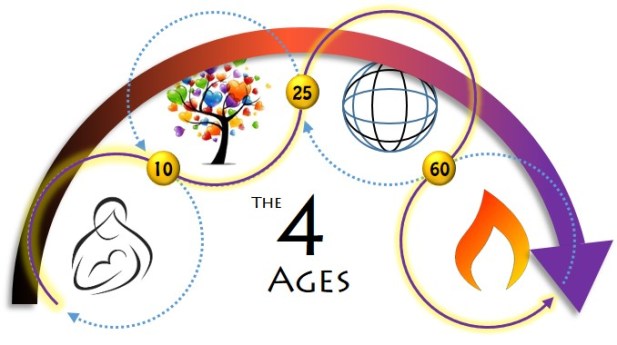
In my diagram above, the middle segment of an arcing arrow involves the process whereby our essential nature as a human being is socially conditioned to the tribal conspiracy of groupthink, also known as the consensus trance. The natural inclinations and urgencies of our animal body are gradually trained into behaviors that complement rather than disrupt the rhythms of social life. If all goes well, our personal identity (or ego) will carry forward a positive sense of embodiment, of being centered in an organism that itself rides in a stream of primal intelligence we can trust.

If it goes otherwise – and I promised that I wouldn’t focus on the problem, so it only gets a mention for now – ego lacks embodiment and we are dissociated from the body’s natural wisdom. The many symptoms of this dissociation are not appreciated as messages and revelations, but instead are medicated or simply ignored.

The responsibility of the tribe, then, is to shape our identity through the assignment of social roles and then provide us with the necessary recognition that will reflect back to us the person we are. We are validated as an insider, as one who belongs. All the perks of membership are offered to us: security, attachment, and meaning give our life orientation and purpose. And these can be enough to keep us inside, fully identified with our roles and dutifully chasing the awards and promotions that make them worthwhile.

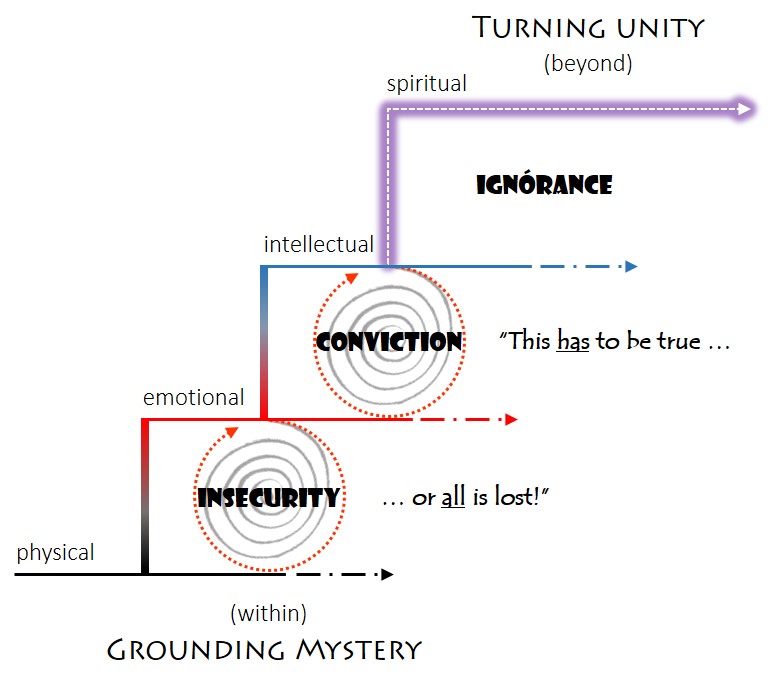
I’ve reflected elsewhere, and many times, on this axis of security, attachment, and meaning in both our fulfillment and pathology as persons. The inherent and inescapable lack of perfect security in life – especially when we are young – motivates our attachment to those who might make up for what’s missing. We can end up locked inside a set of convictions about the way things must be, which allows us to ignore if not outright deny the fact that our shared agreements concerning the meaning of life are also a screen against the present mystery of reality, or the way things really are.

Most of us stay right here, for the rest of our lives. With enough distractions, diversions, and intoxicants – perhaps throwing in the anticipation of another, better life later on, next year or after we die – this daily round at playing the person we’re supposed to be can keep us clinging to the carousel and pretending that all of it really, truly matters. When someone comes along who seems not to take the game as seriously, who seems lighter somehow but still deeply centered in him- or herself, we might look on admiringly, feel threatened by the apparent nonchalance, or else elevate the individual as a glorious exception.

In any case, we misinterpret his or her translucence as a special possession or extraordinary gift. The light, in other words, is degraded into a unique property of the individual which sets him or her apart from the rest of us.

Actually, what we are witnessing is a capacity for transcendence, an ability in that person to go beyond him- or herself for the sake of a deeper and larger experience of life. In our quest for identity, success is measured in ego strength, in our socially supported achievement of a personality that is stable, balanced, and unified under the executive management of a healthy sense of self (ego). Such individuals have it, and this virtue of ego strength allows her to drop the mask for a deeper center of identity, which in turn opens her consciousness to a larger horizon of membership. He doesn’t need to defend his beliefs or clutch at attachments, for he has nothing to lose.

These individuals are transparent to reality, like parting veils on the present mystery, glimpses into our own true nature as human manifestations of being.

It is to this critical threshold of ego-transcendence that our quest for identity is taking us. Find your center, drop your attachments, and get over yourself.

Religion Isn’t The Problem

ego_shadowA common mistake in diagnosing our current predicament is to blame religion, when it’s not religion itself but a particular corrupt type of religion that’s blocking the path to our better selves. Once the focus shifts to theism as the type in question, a second mistake fails to distinguish between corrupt and healthy forms of theism, recommending that we simply push them all into oblivion. Wouldn’t we be better off without religion? What’s wrong with rejecting god once and for all, along with spirituality and everything sacred?

My returning reader knows me as a proponent of post-theism, which is different from atheism on several counts. First, it holds that the major question with respect to god is not about existence but rather his function in the longer project of human fulfillment – even of human salvation, if we understand the term in light of its etymology as “coming into wholeness.”

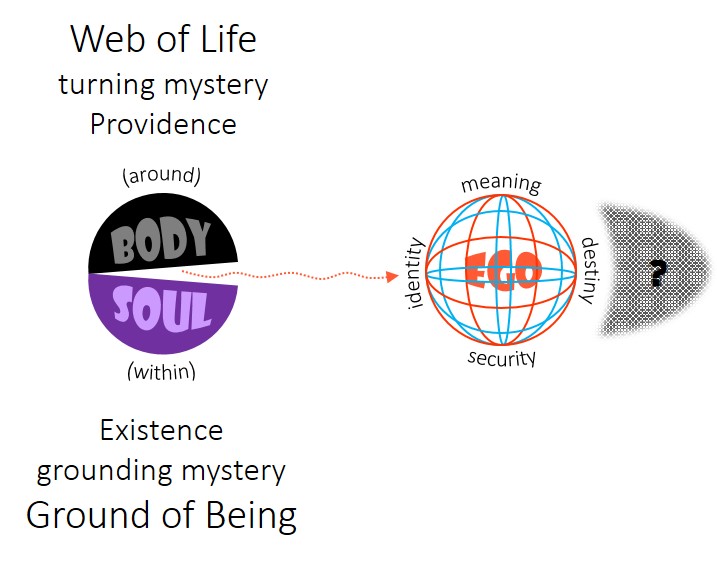
Secondly, post-theism regards religion (from the Latin religare) as a system of stories, symbols, values and practices that “link” us to the grounding mystery within, to one another in community, and all of us together to the great turning mystery of our universe. In fact, reading those crucial linkages in reverse – first to the cosmos (nature), next to others (tribe), and finally to our own inner ground of being – charts out the sequence of stages in the historical development of religion itself: from body-centered animism, through ego-centered theism, and finally into a soul-centered post-theism.

Religion needs to transform throughout this process, but even if it gets stuck at times (as theism has been stuck for a while now) its connecting function is something we humans cannot do without. You may not be formally affiliated with an institutional religion, but you are nevertheless working out connections that support the centered meaning of your life – and that is your religion.

Lastly, in its deep appreciation of the functional roles of god and religion in the spiritual evolution of our species, post-theism differs from most forms of atheism by insisting on the necessary ongoing contribution of theism. Even after it has successfully awakened the individual to his or her own creative authority, and the virtues once attributed to the deity are now actualized in the individual’s own life-expression, it’s not as if theism can be simply abandoned and left in our past. There will always be more individuals coming behind us whose progressive liberation needs the support that only theism can provide.

So that I can move the discussion out of the realm of official world religions and refresh in our minds the critical importance of theism in human development more generically, my diagram above illustrates the correlation between tribal religion and the original theistic system of the family unit. Freud was correct in seeing tribal religion as a societal model based in and projected outwardly from our early experiences of Mother, Father, and the sibling circle.

Of course, nearly two thousand years earlier, Jesus (among other teachers) had conceived this correlation in his metaphor of god as “our heavenly father” and of our neighbors (including enemies!) as brothers and sisters of the same human family.

It’s not a heresy, then, to acknowledge the equivalencies between the divine higher power of a tribal deity and the parental taller powers that shaped our earliest experience. Historically, depending on whether the principal deity was regarded as a (celestial) father or a (terrestrial) mother, the social system of his or her devotees tended to reflect that hierarchy of values – higher-to-lower (ordained) in patriarchal societies, or inner-to-outer (organic) in partnership societies. Societies (such as our own) that have been significantly shaped by the Judeo-Christian or biblical-patriarchal worldview tend to favor an ordained top-down hierarchy, which predisposed us for the longest time to assume that earthly realities are copies or reflections of heavenly ones, when the line of influence actually runs in the opposite direction.

In other words, literal mothers and fathers have served since the beginning as archetypal origins of our various (literary or mythological) representations of god. This makes a human family the primordial theistic system, and every one of us a theist (at least starting out) in this more generic sense. With this correlation in mind, we can easily see how our developmental progress as individuals through the family system has its reflection in the cultural career of theism. We should expect to see some of the common dysfunctions in family dynamics showing up (i.e., projected upward) in the character of theism at the societal level.

Referring to my diagram, let’s first notice how a parent’s role needs to progress according to the emerging center of personal identity in the child. We begin on the left in a state of ‘infantile dependency’, with our newborn experience entirely immersed in the animal urgencies of our body. In this condition of helpless vulnerability, we need before anything else to be protected, cuddled, and nourished by our parent (typically our mother). Her role at this point is to provide for our needs, to give us what our body requires to be calm, satisfied, and secure. In theism proper, this maternal providence is projected upward as the grace of god – freely and presciently giving a devotee what is needed. Give us this day our daily bread.

If our parent is sufficiently attentive to our needs and provident in her care for us, we are enabled to feel attuned with her reassuring presence. This deep attunement is what Erik Erikson called “basic trust,” and it will serve as the foundation for all developmental achievements to come. In religion, such a grounding trust in god’s providence is known as ‘faith’ – not believing thus-and-so about the deity, but entrusting one’s existence to the present support of divine grace.

The progression from infancy into early childhood introduces a new challenge, in learning how to behave ourselves in polite company. Our parental taller powers serve this development in us by clarifying and reinforcing the rules for social behavior. In addition to continuing in their providential role – but gradually pulling back so we can start doing some things for ourselves – they focus on prescribing for us the difference between ‘right’ and ‘wrong’, defining what it means to be a ‘good boy’ or ‘nice girl’. This prescriptive role of our parental taller powers is what gets projected upward as the theistic notion of god’s will. Teach us thy ways, O Lord, and show us the right path.

On our side, we need to obey these prescriptions, these rules of acceptable behavior. A rule system built on the binary codes of right and wrong (with no grey between) is properly called an obedience morality, and all of us need to find our way through it. Some family systems are permissive, which can lead to insufficient clarity and motivation for pro-social behavior, producing moral complacency. Other family systems are repressive, where a child is punished and threatened for acting on his impulses or when she comes close to crossing the line.

Repressive systems are responsible for the rejected and disowned aspects of personality that Carl Jung named the shadow: the part of myself that is unacceptable, censured, or condemned. To fit in and belong we find it necessary to keep all these things in the dark, behind us and down in the cellar of our personality. In my diagram, parental rules (and god’s will as their correlate in tribal religion) which are authoritarian (Because I said so!) and repressive (Don’t you even think about it!) drive down a shadow of insecurity, shame, bigotry, and hostility.

This is the pathology of a dysfunctional theism which is evident all around the planet today, where true believers unleash their own inner demons on their enemies and the world around them. Ironically their moral convictions drive them in destructive ways.

Let’s come back to the healthy family system – for they do exist! As we make our way through childhood, our moral development necessitates a shift from merely obeying (or breaking) rules, to orienting our focus on exemplars of positive virtue. Our parents need to portray for us such virtuous attitudes and behaviors so that we can know how to embody them and live them out. Their demonstrated virtue awakens in us an aspiration to be like them, opening our path to adult responsibility.

Our mythological depictions of god are not only a projection of what’s going on in the theistic family system. The literary figure of deity also serves as a guiding ideal for an entire tribe or culture. We know that not all families are healthy, and no parents are perfect. But just as the general trend in living things is toward their mature and fully actualized selves, so the trend in theism over its long history has been into literary depictions of god that more clearly exemplify the virtues of human fulfillment. Be merciful [or in another version, perfect] as your father in heaven is merciful [or perfect].

We can see this progression even in the relatively brief (1,200 years or so) history of biblical writings, where Yahweh becomes increasingly temperate, merciful, and benevolent in his manner of relating to human beings. (The occasional paroxysms of wrath and vengeance are momentary exceptions to this longer trend in the developing character of god in the Bible, and are more reflective of the distress and insecurity of individual authors and local communities than anything else.)

In The Progress of Wisdom I suggested a way in which we can view several deep spiritual traditions (present-day world religions) as exhibiting our transcultural progress toward a clarified understanding of human fulfillment. The diagram above identifies these stages of awakening to wisdom in the box at the upper-right. Each stage in this broad-scale transformation was preceded slightly by a change in the way god (or ultimate reality) was depicted in the myths, theology, and art of the time.

Covenant fidelity (Judaism) re-imagined deity as less elusive and unpredictable, but instead as committed to the human future by a clear set of promises and fiduciary agreements. A little later in India (Buddhism) an insight into the liberating power of universal compassion took hold. Later still, but continuing with this evolving ideal, Jesus proclaimed his gospel of unconditional forgiveness (love even for the enemy: a message that orthodox Christianity failed to institutionalize). And finally, absolute devotion (Islam) brought this progressive curriculum of spiritual wisdom to a culmination with its ideal of uncompromising commitment to a life of fidelity, compassion, and forgiveness.

To appreciate this as a transcultural curriculum of spiritual wisdom, it’s essential that we see each advancing step in context of the larger developing picture. To split one virtue off from the rest only distorts and perverts it, as when Islamic extremists split absolute devotion from the fuller curriculum and proceed to engage terrorism against outsiders and infidels. Or else, as in the case of Christianity where Jesus’ radical virtue of unconditional forgiveness lies buried beneath an orthodox doctrine of salvation through redemptive violence, it gets sentimentalized and effectively forgotten.

The general point is that as these higher virtues began to awaken in a few individuals, they were added to our mythological depictions of god (or ultimate reality), which then functioned for the entire community as an exemplary model of an authentic and fulfilled humanity. In its worship of the deity, a community intentionally elevates and glorifies the praiseworthy attributes of god, as they recommit themselves to being more like him in their daily lives. In becoming more godlike they are actually becoming more fully human.

Obviously we haven’t been great at getting the message and realizing our true potential as a species. The complications and setbacks that affect every theistic system – the neglect and abuse, the moral repression and shadow pathology mentioned earlier – have arrested our progress again and again. But whereas some go on to advocate for the discrediting of religion and god in the interest of our human maturity, a brighter future, and peace on earth, as a proponent of post-theism I have tried to show that the way to these goals runs through theism (tribal and/or family systems) – and furthermore, that we can’t get there without it.

Our present task, then, is to use our creative authority in the understanding that we are myth-makers who create (and can re-create) worlds. We can elevate an ideal of our evolving nature that calls out our better selves, connects us charitably to one another, and (re-)orients us in the One Life we all share. We need to take responsibility for a theism that will promote homo sapiens sapiens – the truly wise and generous beings we want to be.

A vibrant spirituality after god (post-theos) requires that we go through god. Religion really isn’t the problem.

One Life

ego-estrangementEach of us lives inside a box where things make sense, we feel we belong, and the meaning of life is managed. We got here through a long process of socialization as our tribe shaped us into a proper member. Our identity may seem more substantial than that, but actually who I am and who you are is a social construction that has absolutely no validity outside our box. Identity and membership always go together.

Our experience inside the box has both an objective dimension, referred to as our world, and a subjective dimension, affectionately known as our self. Each of us has a self and a world, and our separate worlds periodically click together and overlap in places where our perspectives on reality are in agreement. We also disagree at times, and our disagreements can turn into conflicts – even violent conflicts as we strive to keep our different worlds intact. If my world should lose its credibility, my self is also in jeopardy since each is implied in the other.

Self is my centered experience of having an identity. Everything that is unique to who I am – my fantasies, insecurities, and ambitions; my personal myth (i.e., the story of who I am), secret aspirations, and the records I keep on those who owe me something or deserve a favor – is kept in this inner room of mirrors.

Objectively my world is not boundless, for that would imply it has no closure, and meaning requires closure. Meaning is contained and defined inside a world horizon, and anything beyond my horizon of meaning is meaningless – at least to me, and I’m the only one that really matters. (Of course you do, too, inside your world.)

Try to imagine your box, my box, and the almost countless number of other boxes that comprise the mosaic of culture: each of us trying desperately to defend our ‘truth space’ as we stay connected to (or try to avoid) the others. There’s no denying that we need each other, and that the great project of human culture somehow depends on our ability to get along, but managing the meaning of life is demanding work!

If we were fortunate enough to grow up in a supportive family where we could develop our talents and potential and were positively assisted toward the achievement of ego strength, then the transpersonal experiences of communion (an inward mystical path to the grounding mystery) and community (an outward ethical path to the turning mystery) opened us to present reality outside our box. Such experiences are not about enlarging our box or magnifying the meaning of life, but instead they engage us with a present mystery that is perfectly meaningless (or indescribably perfect). It very simply is.

It’s not about “my” security, identity, or significance at this point. Whether it comes to us as a rational observation or a mystical intuition, we are spontaneously aware that All is One; or as an ethical realization, that We’re All in This Together. I am grounded in being itself, a manifestation of the provident universe, and a participant in the higher wholeness of all things. Healthy religion has the purpose of bringing us to this position of centered strength (or personal integrity) so that we can drop inwardly or leap outwardly into the One Life.

I have to insert that qualifier “healthy” in acknowledgement of the fact that religion can also interfere with our progress to the transpersonal mystery of holy oneness. This happens when religion gets hijacked by leaders and other influencers who have failed to progress in their own psychospiritual development. Their insecurities, attachments, ambitions, and convictions have them locked inside a box that, for them, is the way – the one and only way of salvation. Yet it’s not a way at all, but a cul-de-sac, a spiritual death trap, a closed and rigid box.

When religion ordains and institutionalizes the arrested development of such individuals, eventually the orthodox portrait of deity gets twisted and corrupted into a projection of their neurotic personalities. Others under their leadership and influence contract this same sickness, and the entire company can spin into dogmatism, bigotry, violent aggression, or even suicide.

If this sounds like a description of the way things are in the Big Box of our global situation, then we have some insight both into how we got here and where the path of liberation leads. You should know, also, that there are many thousands of others who are presently waking up to the One Life all around our planet, and their percentage of the human population is steadily growing. Perhaps you and I can be instrumental in accelerating the process of awakening, by understanding its unfolding in ourselves and serving its advent in others around us. So let’s dig a little deeper into the current pathology, and then remind ourselves of the way out.

Paul Tillich was one of the most important Christian theologians of the twentieth century, and his one-word assessment of our human condition (in this stuck, sick, and fallen sense) was that we are estranged from ultimate reality, which he named being-itself or the ground of being. Estrangement is defined as the state of being removed or kept at a distance, as in the case where an individual is estranged from his or her family. Along with this separation, then, are attitudes and feelings of distrust, condemnation, shame, and hostility.

Tillich wasn’t implying that human beings are condemned by a god, but that our ‘fall’ into a separate ego has infected our general outlook on reality as something set apart and over-against us, menacing and unfriendly.

This anxious outlook on reality can take hold of a religion, as I mentioned above, but religion isn’t its only victim. Other cultural institutions, most crucially the family where the shaping of our personal identity begins, are also taken over. Whereas the gradual differentiation of a separate identity would normally lead to a stable, balanced, and unified personality under the executive management of a healthy ego, when this process isn’t conducted by a caring and supportive community, our insecurity overwhelms us and we shrink our box to stay safe and in control.

In my diagram above, estrangement is connected with two other terms which correspond to the self and world dimensions of personal identity. The fallen condition of estrangement (pathologically separate from reality) is felt internally as emptiness. Synonyms might be discontent, insatiable craving, and the belief that we are deficient or profoundly defective. Externally we are confronted by absurdity, by the nature of reality as ‘absolutely mute’ – indifferent to our needs, unresponsive, cold and uncaring. Tillich believed that the modern era could be characterized as suffering from a spiritual malady of meaninglessness (as earlier eras had struggled with guilt or death).

The condition of estrangement, then, signals our abrupt removal from unity consciousness – from both the grounding mystery within (instead, we are empty inside) and the turning mystery beyond (instead, the cosmos is absurd). This is when we are especially susceptible to religions that promise to save us from this world and reward us with life everlasting.

Where is our true liberation, then? Not in an other-worldly paradise of some kind – although even in this mythological image there is a kernel of insight, since what we seek is engagement with the present mystery of reality, which awaits us outside our box and on the other side of meaning.

Mythic Rhythms and The Meaning of Life

narrative-rhythmsThe revelation that meaning is something we construct rather than uncover in the objective nature of reality marks a crucial breakthrough in our self-consciousness as creators. Such an apocalyptic realization can be found in myths that are thousands of years old, but until very recently the end of our world was regarded as a future event. Contrary to this literal-historical reading of the Apocalypse, I’ve argued that its function in our myths is to serve as a ‘veiled insight’ into our creative authority as storytellers. Now that the secret is out, we have an opportunity to create a new heaven and a new earth.

The ability to see our myths as products of our own creative imagination, rather than naively looking through them and mistaking them for the way things really are, gives us a chance to appreciate them as art and ourselves as artists – or, even better, as artificers (inventors) of meaning and our human worlds. In this post I will identify the distinct registers of meaning that contribute to the tapestry we are weaving – individually, interpersonally with each other, in the company and traditions of our tribe, and those deep, slow rhythms of cultural mythology that carry our primal inklings as a species of belonging to a mystery we cannot fully grasp.

It’s important to remember that cultures don’t compose stories, individual storytellers do. And yet, some insights into existence and our own creative authority – as in the example of seeing through the veil of meaning by the narrative mechanism of apocalypse – were planted in myth but depended on cultural traditions to preserve them over many generations before they could be demythologized and consciously understood. Obviously then, while we as individuals tell stories and live out our own personal myths from day to day, we can expect that some universal themes of our shared human condition are coursing through those idiosyncrasies as well.

For instance, our deep inner life as a species is only accessible to us as individuals. While numerous metaphors and concepts of a culture’s language are employed for the purpose of interpreting our experience of this grounding mystery, it is only by intuitive recognition (and not, say, technical explanation) that another individual can agree and feel profoundly understood. As a metaphor, the ground of being is our attempt to put into words an experience that is too deep for words and was intuitively known by us before we acquired the language to name and describe it; it is therefore essentially ineffable.

This existential support and provident uplift of being felt within us is the source-experience behind all of our most treasured cultural representations of ultimate reality – of God as that upon which (or whom, when personified) our existence, life, and fulfillment depend. When these same representations are taken as literal descriptions of an external being, rather than as metaphorical depictions of the grounding mystery of being itself, the interpersonal recognition of truth, mentioned earlier, is bypassed for a tribal definition of god as the patron deity who demands our worship and obedience.

Of whatever tribal origin and cultural background, mystics have been relentlessly critical of religious orthodoxies that claim to have the authorized version – all others are fakes and heresies – of the “one true god.” Their second mistake was to confuse these theological constructs for some objective being, but the real problem – we might think of it as the original sin – lay in trading away the validity of inner experience for an idol of language that could be standardized and mandated from above.

Over many generations of tribal life, a people constructs a model of reality that serves to orient them within the turning mystery of all things. As cultural counterpart to the individual’s grounding mystery, a model of reality (or cosmology) functions as the universal frame in which space, time, life and destiny unfold. The great sacred narratives of mythology assume this model of reality as the framework underneath and behind their dramatic drapery, as the backgrounding map across, through, and against which the mythic action takes place. The up-and-down travels of the gods, divine messengers, religious heroes, and world saviors in the ancient Near East assumed a three-story model of reality. An account of Jesus ascending to heaven after coming up from the underworld with his victory over death, for instance, made perfect sense to its first-century audience.

It’s been pointed out many times that because our present-day (scientific) model of reality is not so vertically arranged and neatly stacked, these early Christian myths strain the credulity of modern minds. Regardless of what defenders of orthodoxy maintain, it is decidedly not an act of faith to believe them anyway – or worse yet, to reject scientific cosmology in favor of the Bible’s literal truth. This is yet another complication brought on by the original sin of forgetting the origins of spirituality: a literal reading of myth locks the sacred stories to a model of reality that is no longer accurate, relevant, or believable. We either have to leave them behind as so much superstitious nonsense, or else abandon our own intellectual integrity for the sake of ‘keeping the faith’.

In the back-and-forth dialogue between an individual’s inner experience of the grounding mystery and the model of reality by which his or her culture is oriented in the turning mystery, the daily round of our life together in society (the interpersonal and tribal registers of meaning in my diagram) evokes the question of our ethical bearing. What, after all, constitutes a ‘good life’? Our actions and interactions either bring us together in community or push us farther apart. The choices we make as consumers, the votes we cast as citizens, and the company we keep around us are continually shaping who we are, individually and collectively. Our way of life is how we work out our dreams and pursue a meaningful existence.

But, once again, if we are not internally grounded, and if we lack a sense of our place in the universe, our way of life and our life together can become a nightmare. Not inner peace, but chronic anxiety. Not holy wonder, but clinical depression. Not love, but suspicion, aggression, and violence against neighbors and nations. Psychospiritually adrift without grounding and orientation, we also lose the golden thread of our own personal myth and become susceptible to the extremes of conviction or complacency, simply because we have no real sense of ourselves. Instead of thinking ethically and with a greater good in mind, we twist morality around the pursuits of security and self-gratification.

There is good news in all of this, which is that we can always wake up from the nightmare. We are living now at the end of the world, and it’s time to begin again. We don’t have to spin the scripts of yesterday or 2,000 years ago. A new day is dawning and we need better stories, so let’s get started.

The Web of Passions

web-of-passionsHave you ever noticed how ‘devil’ has the word ‘evil’ inside it, and how ‘god’ and ‘good’ are so similar? It can’t be a pure coincidence that a devil and a god are personifications, respectively, of evil and good. Such mythological depictions of evil and good provide a way for us to connect our cultural narratives to the experience of reality as either against us or for us, as a theater of adversity or prosperity, as malevolent or benevolent.

Perhaps deepest down we orient ourselves in life according to whether what we require to live and flourish is actually there for us when we need it. Surely what we need most basically is to stay alive, so it would make sense if all other concerns and aspirations somehow revolve around the passions dedicated to our survival.

I’ll make an even finer distinction and suggest that while our physical safety is very close to the center of what we most need, finding the energy our bodies require to live and be healthy is the pivot of everything else. When it comes down to it, we will risk injury and even death for the sake of basic nutrition.

In this post I will propose a model for understanding the passions that drive our behavior, connect or divide us from each other, and motivate our constructions of meaning. Our ‘Web of Passions’ (as I’ll call it) underlies and energizes even the Matrix of Meaning, which I’ve explored elsewhere. I will make a case that our Web of Passions is the deeper inspiration behind our myths – those grand narratives and sacred stories that orient us in reality and provide guidance through life.

Despite the obvious and sometimes overwhelming complexity of our emotional experience, I will suggest that just ten passions make up the structure of this web. My diagram above illustrates them in their various correlations and proximity to the center, where a couplet of passions, desire and disgust, anchors the whole system.

Keeping in mind our basic concern over energy, nourishment, and health, desire can be appreciated as that passion which drives us toward and takes in what we need to live, while disgust drives us away from what is rotten, toxic, and not good for us. We might think of these as the ‘open’ (desire) and ‘closed’ (disgust) positions in our animal engagement with reality.

Desire and disgust, then, serve as the visceral – or, more exactly, the gastrointestinal – seat of our passions. All the other passions will differentiate and evolve out of this binary set of open/desire and closed/disgust.

And since opening to reality is the path to life, just as closing to it is the path to death, it’s not surprising that so many sacred myths and scientific theories of human origins identify an act of ingestion or the introduction of a novel food source (e.g., the fruit of a tree at the center of Eden or the shift by our hominid ancestors toward a carnivorous diet) as the precipitating event.

What I’m suggesting here is that desire and disgust together determine that ‘first taste’ of reality which originates and underlies our cultural distinctions of good and evil. Furthermore, because go(o)d and d(evil) are principal characters of sacred story, the primordial inspiration for myth-making, along with the art and theology of religion itself, may have unfolded out of this earliest experience of reality as delicious and desirable, or conversely as nauseous and disgusting.

Thus religious community gathers around feasts and festivals (food-centered celebrations), heaven is depicted as a banquet of saints and angels, while hell is imagined in all its slimy, putrid, and gut-retching detail. Purity codes of morality have roots in archaic distinctions between clean and unclean foods; ‘wholesome’, ‘healthy’, and ‘holy’ are derivations of the same root word.

From this point I’ll move pretty quickly through the Web of Passions, since their branching differentiation from the central binary set of desire and disgust is easy to follow. When we desire something, we say that we ‘love’ it; just as when we find something disgusting, we ‘hate’ it. Desire, through love, ramifies into joy (as the fulfillment of desire) on one hand, but into grief (as separation and bereavement) on the other. On the opposite side of the Web, disgust, through hate, bifurcates into anger (as the impulse to push the nasty thing away) on one hand, and into fear (as the panic to get away) on the other.

Further alchemy between grief (from the desire side) and anger (from the disgust side) generates envy, which, as we well know, fuses a longing for what another possesses or enjoys with resentment over the fact that we don’t. Opposite of envy is hope, produced from the odd marriage of joy and fear. The object of hope is, by definition, ‘hoped for’, which presumes its absence in some critical degree, as something we are looking forward to but is yet unrealized. Such anticipation is the joy in hope. But at the same time, we are also aware that what we hope for may not materialize or come to pass, an ambivalence that shows up in our common confusion over feeling ‘eager’ and feeling ‘anxious’ for something good to happen.

These ten passions – desire and disgust, love and hate, anger and fear, joy and grief, envy and hope – are the motivational forces in us that, as we say, make the world go ’round.

Our primal engagement with reality and uniquely human orientation in the universe; the stories we tell about ourselves and others; the sacred myths of ancient and modern cultures; the genesis and apocalypse of the world itself – while the structure of this elaborate human habitation is made up of words and their meanings, it is our passions that make it all meaningful.

As I suggested in Thoughts on the Apocalypse, the end of our world coincides with the breaking-open of awareness to the present mystery of reality, seeing through (and burning away) our illusions of meaning and stepping into our creative authority as makers of a new heaven and a new earth. Our Web of Passions doesn’t determine what kind of world that will be, though I’m confident that its inherent tensions and polarities will keep things interesting.

Stepping Back For the Big Picture

beyond-egoFrom time to time it’s important to take a step back from the detail work of theory-building in order to catch hold of the big picture of what you’re doing. I’ve offered up some wide-ranging ideas on such topics as consciousness, spirituality, post-theism, and human self-actualization, and now I’ll try to bring together the major sight lines of a larger vision.

Backing up conceptually as far as we can brings us to the origins of our present universe. Contemporary cosmology (study of the cosmos) is coming ever closer to a grand unified theory (GUT) that can account for the flaring-forth of energy into the most basic constituents of matter – in an event (or ‘singularity’) popularly known as the Big Bang. Since the fabric of space-time is thought to have emerged at this point, there is no way for scientists to determine when (i.e., at what moment in the past) this occurred, but they have calculated the age of our universe to be somewhere around 14 billion years old.

In my diagram I have represented this primordial transformation of energy crystallizing into the subatomic latticework of matter as the elementary stage of the universal process (or ‘universe’ for short). As I will continue to use this convention of stages, it’s important to understand that I don’t regard a stage as merely a formative period in the historical past that has been left behind. In addition to thinking of it as a previous era in the course of change, I’m using ‘stage’ in its spatial connotation as well, as a supporting platform for ongoing progress. In other words – and this should not come as a surprise – the elementary stage in the rise of our present universe is still very active, providing the energetic and material support to what we’ll look at next.

Stage 2 of the process (comprised of levels 3 and 4) is named the evolutionary stage, since this is when (and where) life first emerges. Technically speaking, the term ‘evolution’ should be reserved for the adventure of life (on our planet and possibly elsewhere) and not for the quantum dynamics at work in the energetic transformations of matter. Life introduces something unique and unprecedented in the way it ‘rolls out’ (or evolves) into more adaptive and complex organisms over time. Organic names the basic life-force, while sentient is how the evolution of life has gradually produced organisms that are more aware, responsive, and engaged with their environment.

At Stage 3 is where a uniquely human form of consciousness makes its appearance. Ego is Latin for ‘I’, referring to that separate center of personal identity which is both a construct of social engineering and the agent of social development. Our animal nature as human beings tracks downward into the instincts and urgencies of survival, while ego ‘sets the stage’ for a transpersonal breakthrough to spirituality and higher wisdom.

A critical condition of this breakthrough experience is provided in the developmental achievement of ego strength, evident in a personality that is stable, balanced, and unified. This threshold (at level 5, egoic) is where a lot of my blog posts focus in, since a lack of ego strength – presenting in a neurotic tangle of insecurity, attachment, and inflexible convictions – is at the root of much of our suffering. I’ve frequently pointed out how some forms of religion, particularly of the theistic type, use this neurotic tangle to promote dogmatism, bigotry, redemptive violence, and otherworldly escapism.

Let’s assume for now that ego strength is achieved. What’s next? The transpersonal level opens in two distinct paths of spirituality, one leading inward to what I call the grounding mystery, and the other outward to the turning mystery. The grounding mystery (or more philosophically, the ground of being) is not something else underneath it all, but the creative source of consciousness within us. In other words, you don’t go looking for it out in the world – or rather, you might try to find it in the world but your quest will come to frustration. This is why the mystical turn utilizes a variety of practices and methods for conducting an inward descent of ego release to the mystery within.

A second transpersonal path takes an ethical turn, beyond ego but this time in the direction of an ascending involvement in ever-larger horizons of participation. In this case, personal identity does not drop away, as on the mystical path, but instead serves our upward leap into genuine community where ego doesn’t dissolve but connects in relationship with others. Historically, the quality of this connection proceeds in correlation with our cultural representations of the divine ideal (summarized in such virtues as creativity, benevolence, equanimity, and wisdom), which it has been the responsibility of organized religion to depict in myth, art, liturgy, and theology. (For the reasons given earlier, this responsibility of religion hasn’t been fully understood or consistently fulfilled.)

As it follows these two distinct transpersonal paths, spirituality advances our quest for a deeper center and a higher purpose. Just as our center in sentience is deeper than our center in personal identity, progress in this direction also opens our ethical considerations to a correspondingly larger horizon – beyond just ‘me and my own’ to all sentient life. The higher purpose in this case is not a set of orders legislated from above (we have already moved into post-theism at this point), but the more far-reaching principles that concern our life together with all living things on this planet. What is our responsibility to the greater community of life?

My general theory regards the cultural stage of human evolution as trending inevitably into transpersonal realms of awareness and action. While still only a relative few have achieved this breakthrough – whether held back by their own neurotic entanglement or by social institutions (e.g., family, class, religion) that are getting in the way – all the signs are indicating a planet-wide spiritual awakening. The counterforces will not likely fade away gently, however, but can be expected to redouble their efforts in holding us captive.

Insecurity, selfishness, hatred, and terror cannot be overcome by violence. We must transcend them, which we do by acknowledging them, understanding them, and then simply letting them go.

Staying Safe, Playing Small

map-of-egoOne of the odd and wonderful things about us humans is how an extended period of juvenile dependency, which makes us impressionable to social shaping like no other species, also leaves us exposed and vulnerable to all kinds of social abuse. What could open the path for creative evolution and human progress often ends up shutting us down inside neurotic hangups and rigid convictions. Odd and wonderful, but tragic as well.

My diagram is fairly complex, but hopefully not overly complicated. Let’s take a tour by starting with that smaller break-out frame to the bottom-right. Since we were very young, each of us has been on a vigilant quest for three things: security, attachment, and meaning. I reversed their order from how they are presented in the break-out frame to acknowledge their developmental sequence in our early formation.

Our deepest and most pressing concern is for an assurance that reality is provident, that what we need to feel safe, included, and nourished is actually there for us when we need it. If it is, then our sense of security functions to open us further to reality. But if we don’t feel secure, our generalized anxiety motivates us to compensate somehow for the missing assurance, which we engineer by attaching ourselves to others with the demand that they keep us safe and satisfied.

I’m using the term attachment in a way more consistent with the Buddhist notion than how it’s used in Western developmental psychology, where it commonly refers to the close and intimate bond between infant and caregiver. But let’s keep both definitions together as representing a deep paradox we have all experienced time and again: our closest relationships are often ‘the ties that bind’ us and prevent our necessary freedom and growth.

To the degree that attachments compensate for a deeper insecurity – which they are incapable of resolving, by the way – the meaning that we construct around ourselves and those we depend on to manage our anxiety tends to be small, rigid, and closed. It’s small because we can’t risk extending our horizon beyond what we can see and control. Our meaning is rigid in that it lacks flexibility and real-time relevance. And it is closed, which is to say that our mental box excludes discrepant information and alternative views, as it inhibits healthy doubt and intellectual curiosity.

Each of us, then, lives inside a narrative construction called a world, and our world both reflects and addresses our historical quest for security, attachment, and meaning. Whether our quest went well or badly in childhood, even now as adults we inhabit a world built on those early emotional codes. Inside our world is where we came to a sense of ourselves as somebody special, with an identity of our own. Despite having reached physical maturity as an adult, this deeper and more primitive part of our personality – what is named our ‘inner child’ – still comes out and takes over whenever we get poked, hooked, or stressed.

Let’s move from the break-out frame to the center of my diagram, where a larger representation of that same box is displayed. At the top and bottom of the world frame are two important insights to keep in mind. First, every world is an exercise in make-believe. (I put the word “make” in parentheses to indicate our widespread unwillingness to admit that we are doing it.) In another post I defined belief as pretending to know something and then forgetting that we’re pretending.

In other words, we act ‘as if’ our judgments about reality are straightforward descriptions of the way it really is, when there is always an element of our need or wish that it be that way.

It’s easy to forget that reality is not made up of words, or that our words – however connected and stretched into broad fabrics of meaning – are not the reality we presume to define. Reality itself, or what I call the present mystery of reality, is just that, something that eludes our mind and its dragnet of language. Of course, so far as we have closed ourselves up inside a small, rigid, and closed frame of meaning (or world), this realization will be vigorously resisted. If meaning is relative and our world is make-believe, then perhaps our identity is a fantasy as well!

Hang on to that thought.

Those who share our world – or, more accurately, whose constructions of meaning significantly overlap and fuse with our own – are just as committed to the conviction of its truth. We are exactly the somebody special we believe we are, and each of us has our place and plays our role in the web of social interactions that contains and validates our identity. Every scenario is a role-play, every player has a role, and each role comes with a script that seems to drive our behavior without us even thinking about it.

And that’s precisely the point: this thoughtless and scripted performance of social role-plays is what keeps our world turning, as it keeps us under its spell.

Welcome to the consensus trance. The word ‘trance’ is in parentheses because no one wants to admit that much of our life in society (and even in privacy) is lived in a state of robotic stupor, enacting programs that have been installed in our brains.

Moving our attention to the center of the frame we find ego, that separate center of personal identity who’s the star of our show. One aspect of personal identity faces the other – other egos, objects, and even the whole shebang of what’s going on (so-called ‘objective reality’). Particularly in our social interactions – which, we must keep in mind, are role-plays in make-believe – ego takes on what we might call ‘modal identities’, referring to who I am in this or that social context. The Latin word persona (“to speak through”) describes the mask a stage actor would wear in personifying a character in a play, usually equipped with a small fluted mouthpiece to amplify volume and aid in voice projection.

A persona might also be thought of as a kind of socially approved deception. As long as we perform our roles according to script and in conformity with the consensus trance, we can lead others to believe that we are the roles we play. Because others who share our world are already susceptible to being duped in this socially acceptable way, we sometimes take advantage of the opportunity by leading them to believe something about us that is neither honest nor true. (As we are not typically eager to confess this, I’ve put the word ‘deceive’ in parentheses.)

While our ego’s persona (one of many) displays and projects only what we want others to know about us, there is a corresponding but opposite aspect that stays out of view – or at least we try hard to keep it hidden. This is what Carl Jung named our shadow, and its dark shade covers not only the things we don’t want others to see, but also things about ourselves we have neglected or ignored. In addition to those inclinations and tendencies in ourselves that had to be pushed down and out of sight (i.e., repressed) so we could be accepted and included – and which, as Jung insisted, are frequently projected onto others who then serve as our enemies and scapegoats – there are deeper treasures like creative intelligence, artistic talents, and dormant potential that go undiscovered.

Now it should be obvious that when we are profoundly insecure, co-dependently attached, and held hostage by our convictions, the parts of ourselves we are repressing and the social deception we have to carry on just to stay in control (or so we believe) conspire to cut us off from others and from our true self. You might think that since everyone is playing along, what’s the harm?

As it turns out, the harm of staying safe and playing small is significant indeed. According to the spiritual wisdom traditions, the serenity we’re seeking as human beings, and which conventionally gets confused with the security we can’t get enough of, is only accessible by a descending path of surrender through the self. The grounding mystery is only found within, as we are able to release our need to be somebody special and simply relax into anonymous being.

And the harmony we long for, which gets confused with a quality of attachment that is not even possible, calls us to transcend the demand that others play to our script and take the ascending path to genuine communion instead. What I like to call the turning mystery of unity is beautifully exemplified in the nature of our universe (“turning as one”), but it can be found wherever individual egos can get over themselves and join in togetherness.

If we can’t – or won’t – surrender inwardly to the grounding mystery and transcend outwardly to the turning mystery, the consequence is that we end up sacrificing fulfillment on the altar of security; we forfeit community for the sake of our attachments; and we come to despair inside a world that is far too small for our spirit.

The Universe as Your Self

self

A coworker recently confessed to a change of mind on the question of whether people are fundamentally generous or selfish. The election of a new US president who is an outspoken advocate of capitalism, and equally outspoken with his opinions against certain demographics and protecting the biosphere, has made her wonder if maybe the darker side of people now coming out is closer to the core of human nature than a consequence of our conditioning. She has held a brighter view on the topic, but perhaps that was naive.

As existence in the global context of international affairs and climate change becomes less secure, our tendency is to pull in the horizon of what contains our centered experience of self. When we were newborns there was no horizon, no outer limit and containing boundary, but neither did we occupy a centered sense of self. The ensuing social construction project of identity that was managed and supervised by our tribe effectively pushed us into our center and set the horizon wherein our identity would have value and clout.

Essentially identity is a function of identifying-with, and our handlers (parents, teachers, and other taller powers) shaped us with both good counsel and moral prejudices as we linked our identity outward. Depending on our actual conditions of life, along with this mixture of wisdom and bigotry, we established our sense of self and set out to make our way in the world.

In reflecting on my friend’s ethical conundrum – whether human beings deepest down are generous or selfish (in classical terms, good or evil) – it strikes me as one important place where spirituality comes into play. By that I am not referring to whether or not one is religious in the conventional sense, by belonging to a faith tradition or believing in god. As I use it, spirituality names a more or less disciplined way of being where certain practices and habits nurture a deep sense of one’s grounding mystery, serving to inspire an individual response (and responsibility) to the higher wholeness (or community) of life.

When we are centered in the grounding mystery – my name for that gracious uplift of existence in the present moment sensed in the provident support of each breath – our horizon of identity expands and we realize that we belong to a much larger experience. Even more than belonging to it, we are manifestations of it.

We experience this expansion of self to the degree that we are able (and willing) to drop the smaller identity contracts defining our personal ego. If we happen to be neurotically insecure, defensive, ambitious, and caught in our convictions, the challenge of letting go of this self and dropping into a larger experience of reality will be too much. As Jesus said to a rich young man who almost got it, “You are not far from the kingdom of God.”

This experience of liberation is not something we can render adequately into words, which is why the mystical traditions that cultivate it prefer to keep silent on the matter. (Both ‘mystery’ and ‘mystical’ are derived from the Greek root muein, meaning ‘to close’ the mouth in speechless wonder.) But we can come at it conceptually with a contemplative tool something like my diagram above. Let’s give it a try.

You, an individual and separate center of personal identity (ego), are there at the top. Congratulations. At this level you stand alone, unique with your personality, autobiography, attachments, and special circumstances of life. As we step down a level, you become aware of belonging to a class of others similar to you. Maybe this is your family or gang of familiars who share your skin color, ethnicity, economic status, moral values, or whatever. The point is, even though there are more of you, your personal identity remains fairly provincial and small.

Of course, beyond the field of local attachments, common beliefs, and shared lifestyle there are many others – and many different types of others. In my diagram the different colors of human form represent the remarkable diversity of humankind: living in different places, different cultures, and carrying on in very different ways. But they are all human, which means that if you cared to, you could allow your horizon of identity expand so as to include everyone else, regardless of what makes them different from you.

‘Human’ rather than some set of subcategories has become the horizon of your self-identity. Now “love your neighbor as yourself” makes better sense as “love your neighbor as your self.”

But what if we didn’t stop at the horizon of our human species, however much larger that boundary of inclusion is than the contracted ego? The next step downward in my diagram holds an image of Earth, representing the riot of life in all its variety on our planet. We need to remember that humans weren’t dropped onto the earth from outside; instead we emerged from the earth as one strand in its evolution of life. In a very direct and concrete way – that is, not merely metaphorical – humankind is an expression of Earth energy, a product of its planetary process, a manifestation and latter-day articulation of ‘geo-intelligence’.

Engaging our grounding mystery at deeper and more elementary levels, we begin to realize that being human doesn’t separate us from the community of life on our planet, which necessarily includes the animal, vegetal, fungal, microbial, and inorganic substrates. Our new ethical mandate now becomes, “Love the earth as your self.” Considerations of our human future must take the planet into account, along with the countless species that are also expressions and contributing members of its biosphere.

In the words of Chief Seathl (or Seattle), “This we know: the earth does not belong to man, man belongs to the earth. All things are connected like the blood that unites us all. Man did not weave the web of life, he is merely a strand in it. Whatever he does to the web, he does to himself.”

Why stop there? Earth, too, is a product of a 14-billion-year process called the universe – the single (uni) turning (verse) mystery of all things. So if the earth formed inside this universal process; and if life emerged out of the earth; and if humans evolved within the streaming adventure of life on our planet; and, last but by all means not least, you came to consciousness as a unique human individual, then the horizon of your centered experience of self includes it all!

You are the universe – again, not the contracted personal ego caught in its delusion of separateness, but your deeply centered experience of self. So, love the universe as your self.

Capitalism Wins

capitalism_democracyFor the first time in American history, capitalism defeated democracy in our choice of a president. I don’t mean that president-elect Donald Trump wasn’t elected by a democratic process (although our electoral college scheme is oddly undemocratic), but that he is not for democracy. His personal worldview and lifestyle do not demonstrate the principles of individual liberty, inclusive community, and human rights. He doesn’t believe in dialogue and compromise. He doesn’t listen carefully or reason well. He lacks compassion for the working poor, the refugee, the differently oriented and otherwise aligned. Trump is a capitalist. We might even say that he’s a celebrity capitalist.

In The Great American Divide I tried to tease apart the two traditions of democracy and capitalism in US history. Our national experiment in democracy has been strained and challenged from the beginning. I’m not treating democracy as merely one form of government among others, but as also a social vision, a deep set of political aspirations that connect – at least in our imaginations if not yet in fact – toward “a more perfect union,” where the individual is understood through the lens of community, as sharing responsibility for the common good. Democracy is fundamentally about ‘the people’, their freedoms individually as well as their obligations to one another.

To throw capitalism into a contest with democracy sounds at first as if I’m committing a serious category error. Democracy is about politics and government, whereas capitalism is about economic opportunity and commerce. You can’t compare apples and oranges, as we say. But actually both democracy and capitalism are what I called seedbed traditions, each holding a set of values and investments for a preferred reality that it hopes to actualize. It doesn’t matter that one is about political process and the other is about economic pursuits.

Whereas democracy looks at the individual through the lens of community, capitalism sees community – or strictly speaking, the collective – through the lens of the individual, of what I desire and deserve, what’s in it for me. This is not to say that democracy disregards the individual, only that it understands the individual as belonging to a social organism, the body politic. It’s really about us – all of us, together. Depending on where you begin, with the individual or with the community, your lens on reality is very different. Your understanding of yourself, of your neighbor, of the larger world around you, and of ‘the good life’ will move you toward one pole or the other.

Frankly, even our founding fathers probably valued capitalism over democracy. Many of them wanted as little government as possible, so as not to interfere with every individual’s ‘pursuit of happiness’, which in their minds was contingent upon our rights to privacy, property, and financial profit. Stay out of my space, keep your hands off my stuff, and get out of my way: this isn’t really about us, all of us, together. But it has been ‘the American way’ from the beginning. It’s how the other nations see us.

Screw ’em. Why should we care what they think?

Peel back the political veneer of Western culture and you’ll see it more clearly as a juggernaut of capitalist ambitions. As our science opens up new frontiers of knowledge, advances in technology enable us to accelerate our pursuit of more – drilling deeper, pushing farther, growing faster (and getting fatter), casting our junk onto the pile so we can have the latest and best. We need to stay ahead of the competition. A rampant capitalism looks only to the prize of its envisioned success, unconcerned for the most part over the collateral damage, systemic side-effects, and long-term consequences of the pursuit.

Happiness is out there and ahead of us, right?

Whether you were for Hillary Clinton or not, the election of Donald Trump was decidedly not a vote for democracy. We can probably all agree that government has gotten too large in some areas, that it’s been sticking its nose in places it doesn’t belong. The framers of the Constitution were wise and well-intentioned to limit its interference on our life and liberty. In some ways, too, our government has become a big part of the problem. Maybe this represents a course correction for the American Experiment. Both Republicans and Democrats – as parties historically committed to government by the people and for the people – have agreed to democracy’s rights and responsibilities, to its privileges and obligations, to its vision of a people united.

Unfortunately the Republican party didn’t have a candidate survive to the end who could represent them, so they settled for Donald Trump. For the next four years and beyond, our nation will be a capitalist enterprise before it is a beacon of democracy. We will spend and tax, exclude and evict, bullying our way through the global china shop.

Trump has been declared, and now we have to play the hand we were dealt.