The Topography of Myth

If you had three choices and you had to pick one, which of these words would you choose to name your core value: attachment, autonomy, or achievement? By ‘core value’ I mean a priority concern that is positioned at the solar center of a system of associated values. Attachment has connection, security, and belonging orbiting around it. Autonomy is anchor for the values of control, freedom, and self-determination. And Achievement is at the center of purpose, progress, and success.

Most likely you recognize the importance of all three core values, and we should more accurately think of them as comprising a cluster rather than as mutually exclusive alternatives. But still, you can probably identify one over the others – at least at this time in your life – as having priority. Which one?

My returning reader might hesitate in choosing attachment as a core value, since I tend to regard it as complicating factor in our development toward creative authority as individuals. The larger multicultural discussion around the topic of attachment acknowledges it as the positive bonding characteristic of healthy relationships (Western), but also as a compensatory maneuver whereby we cling to other people with the impossible expectation that they make us secure, happy, and whole (Eastern). In reality it’s both the connection that makes for positive partnerships and the latching-on that can ruin them. I’ll let it be a paradox (both/and) for you to sort out.

In this post I’d like to reflect on what Joseph Campbell identified as the hero’s journey, the particular shape and pattern that myths from around the world share in common. Beyond their local differences and unique climes, these stories describe a path that is universal. As Campbell pointed out, we might attribute this similarity to cultural diffusion, where it moved outward from one (originating) society to the others by way of migration, conquest, commerce, or evangelism.

His own study inspired him to adopt a different explanation, however, which traces these universal themes, symbols, and storylines into the depths of human psychology. In this case, hero journeys across cultures trace a similar mythos (or narrative plot) because they emerge from and speak to what human beings everywhere experience in common. Another influence on my thinking was Northrop Frye, who in The Great Code: The Bible and Literature conducted an archaeological dig into Western literature, following the diamond vein still deeper into biblical myth, and there uncovered the archetypes of our storytelling imagination.

I will pick up here, in fact, by taking the major moves of the Bible as myth – not merely of the myths found in the Bible, but the Bible itself as constructed on a primary mythic pattern. Here we find three major moves anchored to geographical locations that serve more as timeless archetypes than specific places (here or there): the Garden, the Desert, and the City.

Genesis itself begins in a garden, and Revelation ends with the fulfillment of all things in a New Jerusalem, the city of God. In between is the desert, where the Hebrew slaves made their escape, the exiles reinvented Judaism, Jesus endured his temptations – and through which each of us must pass on our way to adulthood.

My proposal is that these three themes – Garden, Desert, and City – correspond to the three major phases in our growing up as human persons. Thus the Garden represents childhood, the Desert is the setting of youth, and the City stands for our establishment as adults. The storyline that links them together is the hero’s journey.

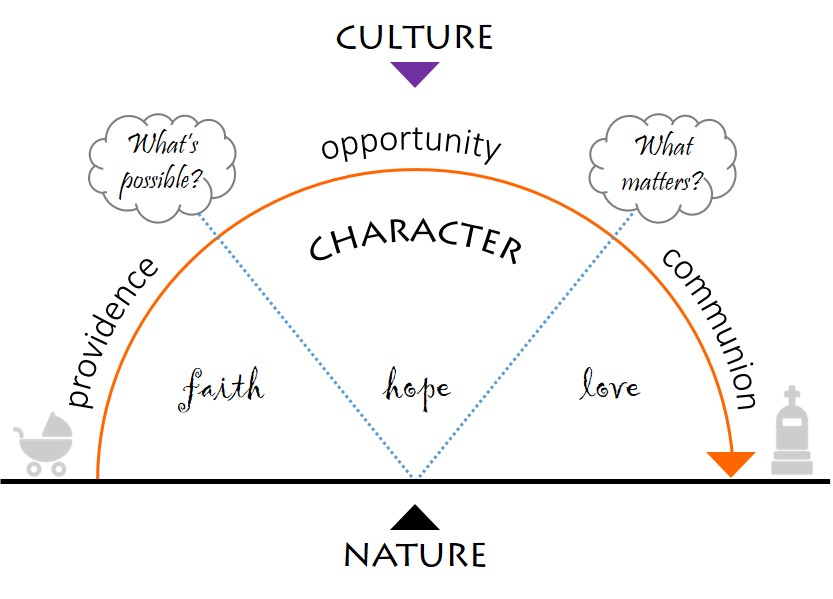
Part of the reason you selected the core value that you did has to do with your individual experience on this journey, a good portion of which was supervised by your parent(s) and other taller powers of the adult world. Your taller powers were responsible for you, and for your journey to be a success they needed to provide certain things to you early on.

The Garden is where (and when) your most basic needs for survival, comfort, and intimacy found their ‘answer’ in reality. You needed to experience reality as provident, as sufficient to your needs and a safe place to be. In a word, your parent(s) and other taller powers were responsible for your protection. In my diagram I have placed a triangle to symbolize what in psychology is called a secure base, which originally referred to mother and subsequently was transferred to other things, places, and people.

In the beginning it was natural for you to seek protection in your mother and attach yourself to her (in the positive, Western, sense of attachment). But eventually you needed to internalize your secure base, to self-soothe and rely more on your own ability instead of grabbing onto whatever and whomever could make you feel better (in the negative, Eastern, sense of attachment).

Just because you may have picked attachment as your core value doesn’t necessarily mean that you are insecure and emotionally dependent on others. You may have had a very positive and supportive experience in the Garden, which instilled in you a strong preference for connection, security, and belonging.

But as is required of every one of us in growing up, you eventually needed to let go of mother and leave the Garden for the journey ahead, on your way to becoming a self-standing and responsible adult. The Desert between Garden and City is a region of trials and tribulations, as we can find in hero myths all around the world. There is no ‘covering’ (the literal definition of protection) to hide beneath; exposure to the sun, extreme temperatures, and predators is a real danger.

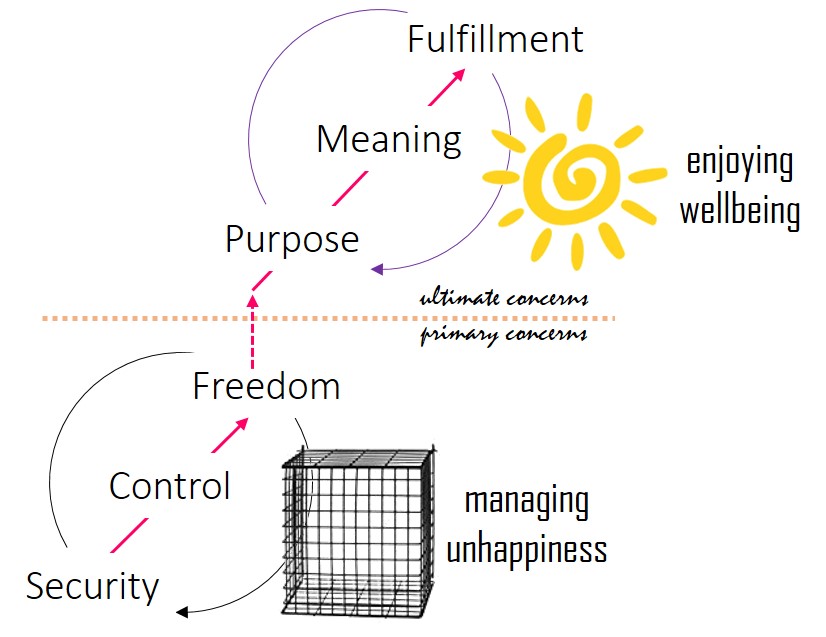
As the Garden is associated with attachment, the Desert is about autonomy: learning how to take control, step into freedom, and strengthen your self-determination. Even before you formally left the Garden for the Desert, your parent(s) and other taller powers were encouraging you to “do it yourself.” Using the potty, tying your shoes, reading books on your own, and riding a bike: everyone had an interest in helping you become a less dependent member of the household.

Encouragement is a demonstration of love and is distinguished from compassion by its kind refusal on the part of the parent (or teacher, trainer, coach, or therapist) to take over and finish the task.

In addition to encouraging your effort, your parent(s) also had to empower you with the necessary knowledge, skills, and resources for what needed to be done. Again, empowerment is very different from the over-used tactic of intervention, where someone more capable steps in and helps the process along. Empowerment, on the other hand, typically takes more time and patience (which is why schools today prefer to intervene), but its far superior benefit is the individual’s self-confidence and inner strength.

Your autonomy therefore was a consequence of being both encouraged (“You can do it!”) and empowered (“Here’s how: Watch me, then you try”) in your progress toward taking control in your life. It’s associated with the Desert and its dangers because progress doesn’t always come easily, but is fraught with setbacks and numerous failed attempts. If your parent(s) and other taller powers – we should throw siblings and peers into the mix as well – were less helpful, patient, and forgiving, you may have learned that taking control was not safe. In failing to satisfy their expectations, you were risking the loss of their love and acceptance as well. Or it might be that their demands were impossible to ignore with impunity, so you became a “control freak” and perfectionist just to stay on their good side.

If the archetype of Mother (however close your actual mother came to incarnating it) represents a secure base where you could always go to to feel safe and loved, the archetype of Father (and to some degree your actual father or father figure) stands for what I call the proving circle. I’ve placed it in my diagram next to ‘achievement’ since it was (and still is) where your ability was tested and your accomplishments validated.

A critical part of becoming a responsible and productive adult involves submitting yourself to the judgment and feedback of others. Depending on how this feedback was delivered and how personally you took it, you came to regard yourself as an individual of worth with a valuable contribution to make. Or not so much.

The Desert, then, is where you learned how to accept the loss of having someone always looking after you, where you needed to be on your own in order to discover both your capacity and your limitations. It’s also where you learned the importance of determined effort (work) in getting where you want to go in life. And if all went well enough, you learned that risk – making yourself vulnerable to failure and rejection in your pursuit of what really matters – is a paradoxical amplifier of life’s meaning, for it is out of those experiences that we grow the most.

The Future of Truth

Let’s see if we can agree on a definition. Truth is not matter of how many of us agree on it, how important or integral it is to our worldview, how central it may be in the definition of who we are, or how it makes us feel. Truth is not what we want it to be, or what the authorities say it is. Truth, rather, is a measure of how reality-oriented an idea or belief is, how well it orients us in reality and connects us to what is really real.

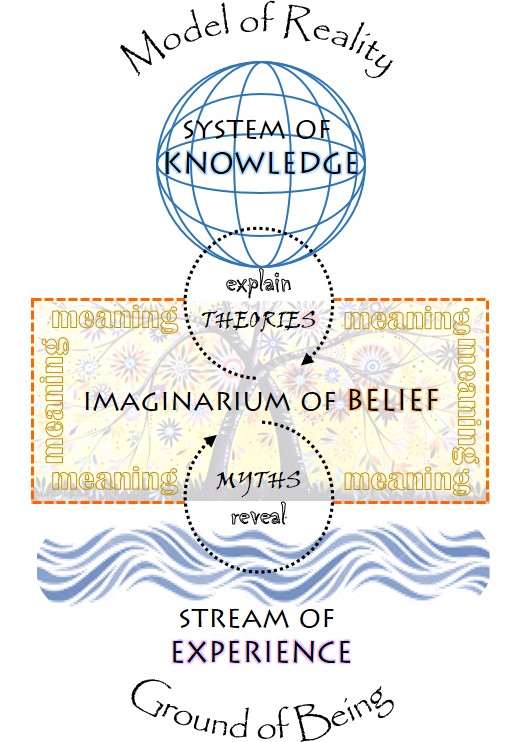
We human beings spend a good part of our lives making up the meaning of life, constructing the quality worlds (W. Glasser) that make life meaningful. That meaning is more or less true in the degree it orients and connects us to reality. When it doesn’t, we are living inside something else – a fantasy, a delusion, a deception: something more made-up than real.

It’s fashionable these days to speak of “my reality” and “your reality,” as if we each can decide what is really real. If it works for me, then it’s “my truth.” You can have yours, and our truths don’t have to match or agree. But if we can agree that truth is a measure of how reality-oriented our quality worlds are, then it’s about more than just what confirms our beliefs and supports our individual (or tribal) ambitions.

Reality is always beyond the meanings we spin and drape across it, and our beliefs allow more or less reality to show through.

The word “truth” from the Greek (aletheia) refers to removing a cover to show something for what it really is. Truth, then, is not the thing-itself but rather the thing-as-revealed, in the moment of revelation (or realization), an experience whereby the present mystery of reality appears through our constructions of meaning. Our experience of it is mediated by our beliefs about it.

To have a genuine experience of reality, our beliefs about it must be true; otherwise our beliefs will not reveal anything and all we have is meaning. You might ask, What’s wrong with that?

My diagram illustrates the standard sequence of Four Ages over our lifespan, represented archetypally in the Child, Youth, Adult, and Elder. (The numbers between Ages mark the critical threshold years when our engagement with reality shifts and everything gets elevated to a more complex and comprehensive perspective on reality.) Childhood, then, is the Age of Faith; Youth is the Age of Passion; Adulthood is the Age of Reason; and later adulthood (our Elder years) is the Age of Wisdom.

As far as the construction of meaning (or our quality world) is concerned, adulthood is the time when our belief system joins the mainstream and we take our place as custodians of culture.

The reality orientation of our beliefs and belief system, however, is largely a reflection of how things went for us during those earlier Ages. In ideal circumstances – given perfect parents, a supportive pantheon of taller powers, and a protected resource-rich environment – the Age of Faith would have instilled in us a profound sense of providence and security.

We then carried this positive sense of security into the Age of Passion, when we set out on the adventure of experimentation and discovery. We formed new relationships, expanded our circle of influence, and became more centered in our personal identity.

Having achieved a high degree of ego strength, grounded in a provident reality and positively connected in a web of relationships, our belief system is now open and flexible. We understand that our knowledge-claims need constant updating in order to be more reality oriented, and we are conscious of the fact that our beliefs – the names, definitions, explanations, and predictions we hold about reality – are only labels and mental constructs.

This acknowledgment keeps our mind in a state of perpetual curiosity: forming questions, testing conclusions, making more associations, and expanding our horizon of knowledge.

At some point, which typically corresponds to a breakthrough realization that our identity is a construct separating us from what is really real, we come into a unifying vision of reality: everything is connected, nothing is separate, and All is One. This universal truth – true of all things, everywhere – is the high mark of spiritual wisdom. By the light of this realization we understand that reality is a universe (a turning unity), that we belong to the whole and have a responsibility to our fellow beings. Furthermore, we are a human manifestation of being, a personification (or coming-into-personhood) of the universe itself.

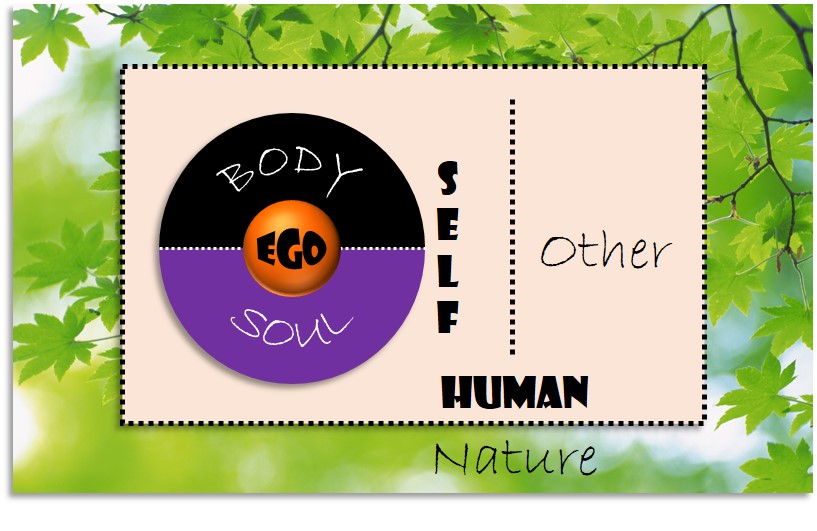
Our unified vision of reality doesn’t suppress or discount the play of opposites generated by and arranged around the ego – body and soul, self and other, human and nature – but rather enables us to appreciate their mutuality and interdependence, the way they together comprise a dynamic whole.

Otherwise …

Our belief system is fixed and closed, with no significant reality outside the box even recognized. Truth is absolute – pure, everlasting, and utterly beyond question: It is the only one of its kind. It doesn’t include everything, but is rather above and outside the rest. Our devotion to absolute truth is glorified as conviction, which perfectly names the condition where our mind is held captive (as a convict) inside the prison of rigid beliefs. Truth is not a matter of looking through our constructions of meaning to the really real, since our constructions are the truth.

The psychological habit of thinking this way came about as part of a strategy for screening out anything in reality that might challenge our emotional need for things to be black or white. Our belief system helps us compensate for and manage a personality that lacks a clear center of executive self-control (aka ego), an inner balance of moods, and a stable grounding in the rhythms and urgencies of the body.

Because we are off-center and insecure, we insist on being accommodated by everything outside ourselves.

The future of truth swings in the balance between curiosity and conviction, which ultimately play out into the alternatives of wisdom or terrorism.

The Wheel of Fortune

Our noses are pressed so far into the business of everyday life, that we rarely push our chair away from the desk far enough to take in the bigger picture. The demands on our time and attention leave us too exhausted at the end of the day to contemplate anything “bigger” than a glass of wine, online distractions, or the prospect of a decent night’s sleep.

We might diagnose our times as suffering from “commotion fatigue,” referring not just to the disturbances happening around us, but even more to the agitation and upheavals going on within. If you were to spin a raw chicken egg on the table, stop it momentarily with your finger and then pull away, the still-spinning insides will get it moving again without your assistance. It’s like that. The inner vortex of frustration, irritation, and anxiety has us spinning even when to all outward appearances we are sitting quietly alone. Eventually all this inner commotion wears us out and leaves us depleted.

Popular forms of therapy include sedation, either self-administered by the glass or in the form of prescription medication, mental distraction, entertainment, or saying “no” to some of the things crowding in on us. Less often do we consider the benefits of opening the window of perception to a reality larger than the set of concerns we are trying to manage.

If asked What’s going on? our answer will likely be limited to the stuff that’s on our personal plate. But, of course, there is much, much more going on than only that.

Getting a sense of our place in the grand scheme of things could provide us with the perspective we need to distinguish between what really deserves our attention and what matters less. If you don’t know where you are, anything might offer the clue you’re looking for; and without a sense of the whole, any clue is as good as another.

Most cultures have – or at least had at some point in the past – a grand-scheme picture of being and time which serves to situate human existence and the individual’s life journey. While this picture is not identical across the cultures and historical periods, for the most part its major components form a constant pattern – something like a transcultural mandala of our species. In this post I’ll adopt a name commonly used for it: The Wheel of Fortune.

Religious myths represent our first efforts at contemplating the Wheel of Fortune. Much later, scientific theories worked out the picture in a more impersonal and abstract language. Myth and theory are really just two ways of approaching the same mystery, one looking through the screen of personality, and the other with this screen methodologically removed. One sees intentionality behind and throughout reality, while the other is committed to regarding it all as a marvelous accident, devoid of purpose or final goal.

Religion positions intelligent volition at the start, center, and end; science lets mindless chance evolve over inconceivable intervals of time and space. The plain fact, which neither one can ignore, is that conditions have indeed provided for the flourishing of life, sentience, and self-awareness in the universe. By intention or by accident?

Is it legitimate for human beings to ask why we are here – to search out our purpose, deciphering clues to our possible fulfillment and responsibility to the whole? Or are we limited only to asking how we got here – the random causality leading up to our arrival over countless eons of time? Religious myths offer revelations into the provident intelligence behind everything. Scientific theories offer explanations that make reality intelligible, but only to us.

It’s helpful to remember that these two storytelling enterprises, religion and science, are contemplating the same reality. Whether it uses metaphorical archetypes or metalogical algorithms in its preferred narrative, one doesn’t have to be right and the other wrong. They can both be right (or wrong), but from different angles of approach.

That is to say, the Wheel of Fortune is a shared fascination of both religion and science, and both historically have been interested in understanding the big picture and our place in the universe. Each component of the Wheel can be represented mythologically or theoretically, as we’ll see.

The cosmic order issued from the preconditions of chaos, personified in myth as a monster (e.g., the serpent Tiamat or the dragon Leviathan) whose body enveloped the primordial stuff of existence. By the sword or command of a god its body was opened up to release this energy and then subsequently dissected into the sky, earth, sea, and underworld.

According to scientific theory, this primordial state was a singularity of infinite potential that exploded outward in expanding waves of energy that quickly crystallized into the elements of matter. Hydrogen and helium fused first to become the center of nascent stars, where stellar nucleosynthesis proceeded to form the heavier elements of outlying matter and solar systems.

According to both narratives, the energy of chaos is paradoxically the ground of existence. While both myth and theory depict the decisive event as having occurred at the beginning of all things, the chaos, whether divided and portioned, or expanding and transformed, continues even now to fuel the creative process. In fact, the creation or ‘big bang’ of our universe wasn’t just an event in the distant past, but is presently ongoing.

Cosmic order continuously arises by the dismemberment of the dragon, by the out-pouring differentiation of chaos into the relatively stable forms of matter.

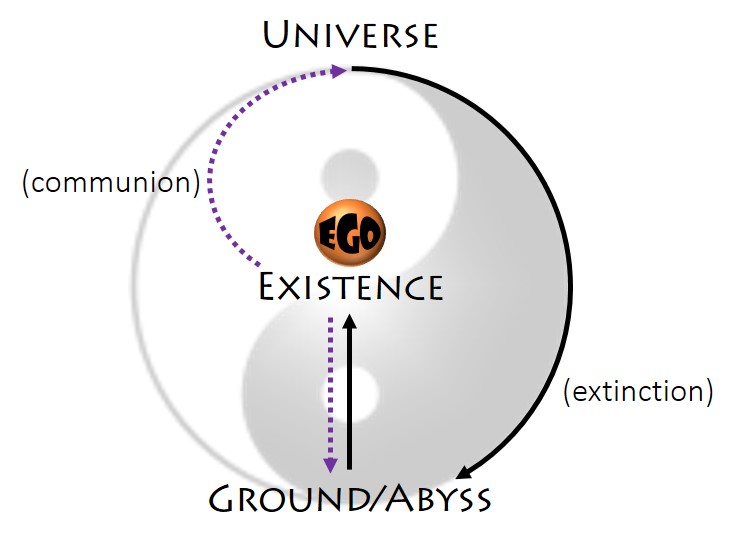
What we are calling the ground of existence, then, refers to the spontaneous uprising of energy into matter, of matter into organism, of organic life into sentience, and of awareness into egoic self-awareness. The ground is not outside of these, but deeply internal to each existing thing.

For a self-aware human being, the grounding mystery is accessed by descending within, through the centers of personal identity (ego) and a sentient nervous system, from which threshold consciousness releases to the organic rhythms of the animal body. Unconscious matter and (deeper still) quantum chaos support everything from still farther down/within, but awareness can only contemplate these ineffable depths from the drop-off of its own center.

The Wheel of Fortune’s upward swing follows the rise of cosmos (order) out of chaos, a coming-into-existence (genesis) of all things. To exist is to ‘stand out’ of this purely potential state, taking form and finding a place in the grand scheme. It is happening all the time; or we might also say, its happening is the very definition of time.

Religious myth and scientific theory are both narrative constructions by which human minds have contemplated the mystery of a provident universe. Whether we ask why we are here (an inquiry into purpose and destiny) or how we got here (exploring causality and evolution), we are seeking to understand our place in the whole.

But the Wheel continues to turn, and as it swings downward this cosmic complexity begins to come loose at the seams. In the myths we hear of the breakdown of order, a worldwide deluge, the fall into mortality and the collapse of virtue, an apocalyptic catastrophe – all archetypes, once again, of what we can perceive going on around us in countless small and larger ways.

Because it looks through the veil of personality, religion sees intention, purpose, and will operating behind things. If gods and heroes are the agents in the Wheel’s upturn, on its downturn the myths feature devils and anti-heroes who conspire in the universe’s unraveling.

Science names this demonic intention toward disorder entropy, which refers to the tendency or “law” that pulls complexity down toward more stable arrangements. Complex systems require more energy to hold together and they function relatively far from equilibrium.

Our brains, for instance, are made of material nerve cells capable of conducting electrical impulses, forming circuits and networks of interaction that give rise to consciousness. Consciousness itself is a highly complex process and inherently unstable; it is dynamic and not static. Entropy is experienced as mental fatigue, and as the brain loses energy its functions collapse to lower, slower, and more stable states.

From a vantage-point higher up in the organizational complexity such as a personal ego, this downward pull toward stability threatens existence and will eventually bring about its end. On the Wheel of Fortune this is where reality is perceived not as the supportive ground of existence but rather as the abyss of extinction – the dragon once again, but now in its aspect as world-devourer and ultimate solvent of forms. The pouring-forth of genesis has its counterbalance on the Wheel in kenosis (from Greek, to empty out).

In the language of science, chaos is not only the quantum field that gives rise to the physical universe. It is also a dark sea of probability and indeterminate fluctuations that is quite literally nothing, in that it has no objective existence of its own. The very act of measuring these fluctuations determines whether they show up as particles or waves, but their behavior is intrinsically unpredictable. A methodological detachment of our research intention from the supposed object of study, which is how science proceeds above the quantum level, is just not possible down here.

Not only do all the qualifications of the Newtonian universe dissolve into nothingness as we approach the quantum field, but even the sacrosanct division of mind and reality folds in upon itself.

Thus the Wheel of Fortune turns – not one time only, but again and again in unceasing revolution. And not only at the highest level, either, where the whole thing turns as the mystery of our universe, but in every quarter, niche, and speck. The great uprising of matter into life, of life into sentience, and of sentience into the self-conscious ego reading these words right now, is circling back around to begin again.

Boundless Presence

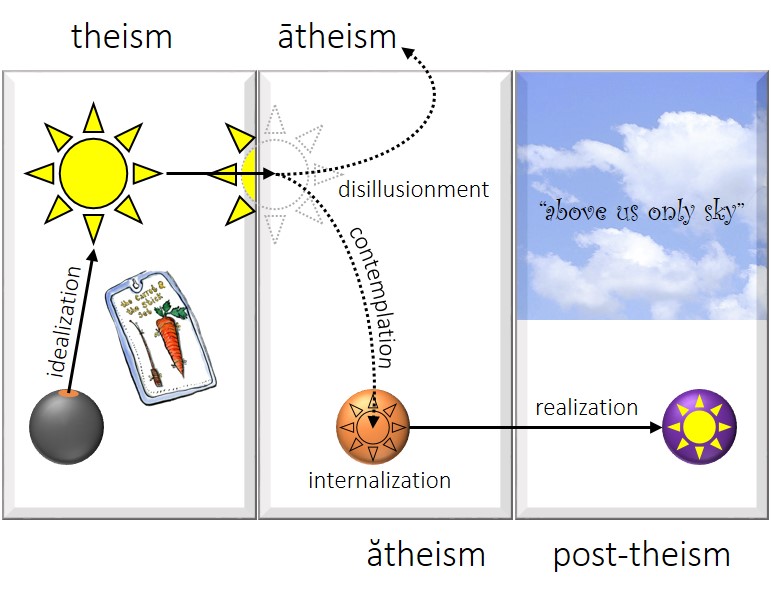
For a while now I’ve been working towards a unified theory of human development that doesn’t merely annex spirituality onto one of the conventional models, but rather affirms it as essential to what we are. To do this successfully I’ve had to draw clear distinctions between spirituality and religion, between healthy religion and pathological forms of religion, between religion oriented on a separate deity (theism) and its evolutionary breakthrough to the liberated life on the other side of god (post-theism).

Because deformities and perversions in religion are so common these days, we can easily get caught in the trap of analyzing the problem. Psychotherapy and the mental health industry have fallen into this trap, to the point where diagnosing disorders and designing treatment plans (talk therapy, drug therapy) around the goal of managing or eliminating symptoms leaves undefined exactly what mental order might be.

What is it to be a healthy, happy, and fully self-actualized human being, and how can we get there? As far as spirituality is concerned, the answer must go beyond tinkering with religion and trying to fix its pathologies.

What we need is a positive and comprehensive model that can shed light on where we are now, as well as show us the opportunities and challenges of the path ahead. Such a vision of the possible human should inspire each of us to dig deeper, reach higher, and give ourselves fully to what we can yet become. I believe I have such a model; see what you think.

Given that human beings came on the scene just a second before midnight in the 14-billion-year-long ‘day’ of our universe, we need to move quickly through all the important events that preceded us and made our arrival possible. The graphic on the right should be read from the bottom-up, which will guide our ascent through the distinct epochs and organizational stages of the universe.

The first and all-encompassing epoch/stage is energy, which transformed next into matter, and then provided the conditions for life (organic) to emerge. Each step in this process defined a smaller horizon of existence, so that the quantum field of energy contains everything else, the atoms and nuclear forces of matter are within that, whereas cells and living things represent a much, much smaller horizon inside matter.

It was billions of years before the organic horizon of living things on Earth incubated a further transformation, in the evolution of sentient life. Sentience refers to the capacity for sensation, awareness, perception, and suffering which is most developed in the animal kingdom. By virtue of possessing nervous systems with some form of central ganglion (leading eventually to brains), sentient creatures also have the ability (in relative degrees) to adapt their behavior in response to the environment. In short, they can learn.

Later still, the family of primates acquired an additional power as an epiphenomenon of sentience, enabling them to be self aware. In our own species this virtue of self-awareness would reach its climax in ego formation, where an individual is not only sensitive and responsive to the environment and reflexively aware of his or her subjective experience, but psychosocially occupies a separate center of personal identity.

Healthy ego development establishes the personality on a stable nervous state, in what I call positive embodiment. Here self-awareness feels ‘at home’, centered and grounded in the vital rhythms of the body. A coherent nervous state oscillates around a baseline of calm, responding appropriately and adaptively to situations as they arise while maintaining composure. A base of stability, then, provides for the emotional balance of mental health.

These are the provident conditions that give rise to a unified sense of self. Altogether the three traits of a stable state, balanced mood, and an executive center of identity comprise what is known as ego strength.

But our story isn’t finished here, even though this is where many of us stop or get stuck. Despite the fact that conventional society and religion (particularly theism) are organized around personal identity and ego needs, self-awareness is still only a stage. The question remains about a likely evolutionary intention behind the formation of a separate center of identity.

A young child impersonates her parents (taller powers), personifies reality with imaginary playmates and the characters of storyland, and is supported in the habit of personalizing her world and taking things personally – all for what? The culture might say: For no other reason or higher purpose than becoming the center of everything, a dedicated consumer looking for happiness in the next purchase or next attachment, and blessed assurance for the life to come.

As a stage, however, and not only a curious innovation of sentient life, egoic self-awareness represents a critical breakpoint – a threshold and not a final destination.

The spiritual wisdom traditions, and now increasingly some secular “fourth force” schools of psychology (after behaviorism, psychoanalysis, and humanist paradigms), regard ego consciousness as a new point of departure – assuming, of course, the provision of adequate ego strength.

Roger Walsh & Frances Vaughan (1993) define the transpersonal as “experiences in which the sense of identity or self extends beyond (trans) the individual or personal to encompass wider aspects of humankind, life, psyche or cosmos.” Whereas the separate ego generates a worldview where body and soul, self and other, human and nature are divided and frequently in conflict, there is a way to reconcile such divisions and become whole again.

A healthy ego makes it possible for the individual to break from the bondage of “me and mine,” to be liberated from the consensus trance of society and religion, and to enjoy the flower and fulfillment of life. Inwardly consciousness drops away from the ego center, into the nervous system and organic processes of the body, both of which of course lie below the threshold of self-conscious personal identity.

By such a meditative descent, the individual ceases to experience him- or herself as an individual at all, but surrenders more completely to the grounding mystery of being itself.

As this transpersonal path inward and downward breaks through deeper centers, their corresponding outward horizons are transcended as well. By outward leaps, consciousness ascends past the boundary of ego concerns and farther out to include all sentient beings, all living things, the material cosmos, and the whole of reality. At this level of awareness, the turning unity that we casually name the universe is experienced – not just imagined or conceived – as our home.

Such is the breakthrough realization that has inspired an enlightened ethic in various periods and places around the planet, promoting genuine community: We’re all in this together.

Healthy ego formation, then, makes possible the experience of a new reality beyond the limiting horizon of “me and mine,” by the transpersonal breakthrough beyond ego.

The grounding mystery of no-thing and the turning unity of all things are two aspects (inner and outer) of what I call the present mystery of reality.

Spiritual intelligence (SQ) reconnects consciousness to its ground and home after a long and complicated adventure into identity. The symbols, stories, rituals, and rites of passage that facilitate this adventure to its intended fulfillment constitute the essence of religion (from the Latin religare, to link back, reconcile, or reconnect).

The present mystery of reality is now more than just a concept in the mind, and has become a transpersonal experience of boundless presence. But neither is this an end in itself, for now the real work of genuine community can begin. Now that we have gotten over ourselves, nothing more stands in the way.

The Relevancy Gap in Education

In other posts I have bemoaned the trend in education today where its primary value is judged by whether it prepares a student adequately for gainful employment after graduation. Instead of opening minds, constructing meaning, and creating worlds, education has gotten reduced to little more than job training.

As this happens, students stop caring and surrender responsibility for their learning, relying on the system to tell them what they need to know and what they’re supposed to do with it.

If you ask students what action new knowledge is for, the first answer of many is that it’s for passing tests, which in turn is for graduating and getting a job. Will the new knowledge be useful in their job some day? Maybe, but probably not.

The classroom question, “Will this be on the test?” is eventually followed by the workplace question, “Is this necessary for me to do my job?” If so, then effort will be made to retain it. If not, it gets tossed on the scrap pile of useless information.

A quick and dirty summary of what’s wrong with education today sees it as “teaching to the test,” by which is meant not only progress assessments along the path of mastery, but standardized tests that serve as gateways for students to next-level instruction, graduation, or professional certification. The goal in each case is to pass the test with a grade that meets or exceeds the cut-score for moving on.

Teachers teach to the test by focusing instruction only on what will be tested. Passing grades mean good success data that schools can report to their funding sources and accreditation associations. In order to improve their numbers, schools have accommodated student underachievement with shortcuts and allowances, effectively lowering the challenge gradient for students to climb.

It’s not long, however, before interventions must be introduced in order to build up the deficiencies that such accommodations worked around or even fostered over time.

Soon enough education has become an expensive process of instructors teaching to the test, students dreading the test, accommodations to help them make it through one test, and interventions to get them ready for the test next in line.

The expense is measured not only in terms of the billions of dollars required to keep this gauntlet in operation, but in the toll it is taking on the confidence, self-respect, creativity, and passion in nearly everyone involved, which is a cost much more tragic and devastating. We might hail the commitment to lifelong learning, but who wants to prolong the agony of education beyond the goal of getting a job?

As I pointed out in The Paradox of Education and the Search for Its Soul, the roots of our words educate and instruct set them in very different value systems. Educare means “to lead out,” which might be nothing more than leading a youngster out into the adult world. But more likely it has to do with leading the creative intelligence and talent of students out into the constructive discourse of world-building known as culture. Instruct, on the other hand, means to “to put in,” and is about downloading knowledge and skills into one regarded as naive, incompetent, or untrained.

In the second perspective, students are ignorant of the sophisticated things they need to know in order to make it in the world. But according to the first, in the spirit of educare – and it’s helpful that “care” is right there in the word itself – they are crackling with potential, and all a teacher really needs to do is light a match and show the way.

As illustrated in my diagram above, there is a serious relevancy gap in education today. To fix the problem of poor student performance, accommodations and interventions are introduced early, but somewhere farther down the line students are stressing out, burning out, and dropping out in record numbers.

Even “getting a job” – while it might be the reason a greater percentage of them give for being in college – is not enough to keep students engaged anymore. The real problem is not that students are stupid, lazy, or unable to learn, but that passing tests and getting a job doesn’t inspire them to learn.

Effective teachers know the importance of helping students make connections between new information and what they love. The heart is the center of our personal experience and includes what we are curious about and interested in, what we desire and what currently holds our emotional investment – all frequencies of passion that inspire our construction of meaning.

Unless students can connect new information to their personal lives, it may be retained for the goal of passing the test, but it won’t be incorporated into their worldview or enrich their perspective on reality.

Obviously, our better teachers know their students by taking the time to discover what they love. The wise proverb, “They won’t care how much you know until they know how much you care” speaks to this relevancy gap in education today. Students can feel the difference when teachers are teaching to the test, or instead are teaching to help them learn, personalize new information, and construct meaning.

Looking At and Looking Through

When you stand before a Monet painting of water lilies, you might choose to analyze it according to its physical dimensions, the composition and pigment of the paint, the particular arrangement of highlight and shadow, and how close Monet came to a realistic depiction of actual water lilies.

At the conclusion of your analysis you would have a catalog of observable facts, to which you could also add more factual details such as the time period, historical circumstances, events from Monet’s personal life and his development as a painter. This mode of analysis employs the power of observation in order to explain what you are looking at.

But you might choose to contemplate the painting instead of analyzing it. In that case you wouldn’t be observing from an objective distance and reducing it to a catalog of facts, but rather encountering it as an artistic creation. His rendering of water lilies is not asking to be explained or compared with actual water lilies.

The intention of art is not to explain (literally to spread out on a flat surface for examination) but to reveal (to pull back a veil and allow something to be seen). Your contemplation of Monet’s painting represents a very different mode of perception from that of analysis, inviting a kind of dialogue between you and the artist.

A painting, like everything else made by the creative skill of human beings and not found in nature, is what we call an artifact. In evolutionary history, the threshold between animal nature and human culture is defined by the artifacts that our species created, as together they constructed a peculiarly human world – the network of tools, utilities, technologies, symbols, values, agreements, and beliefs that carry the meaning of life for us.

As one kind of artifact, a machine is the product of an engineering and technical intelligence. Monet’s painting of water lilies, on the other hand, is an expression of an intuitive and aesthetic intelligence. Such distinct types of intelligence co-evolving in human beings are what make us a wonderfully visionary, prolific, and complicated species.

The question of whether a given artifact is more art or fact is an interesting one, with far-reaching implications. When you analyze Monet’s water lilies into a catalog of physical and historical details, you are treating it as a fact – something to look at, to observe, and ultimately to explain. Once explained, the object is said to be ‘known’. Each color pigment has a chromatic number value. Each shape has proximal value with respect to real objects. The painting traces along a line of causality back to Monet himself, as the man who made it at a specific time in history.

Your thorough explanation effectively reduces the painting to an object before you.

In the second mode, of contemplation, you instead encounter the artifact as more art than fact. As art, Monet’s painting cannot be decomposed into its basic and essentially separate elements. Indeed, its artistic virtue as a medium of revelation (as a veil parting) requires that you behold the painting as a whole. Only then is it possible – and we can only hope for the possibility since it is nothing you can control or make happen – for the work of art to show you what cannot be observed.

To behold is an exquisitely receptive (as distinct from merely passive) act of contemplation. With patient and mindful attention, you may eventually come to see not what Monet saw but as he saw, ushered into his experience of water lilies.

We can easily summarize these two modes of perception as the difference between looking at (observation, analysis, explanation) and looking through (encounter, contemplation, revelation). It is the difference between treating an artifact as an opaque fact or as translucent art. In the first case, Monet’s painting is a rather inaccurate and unrealistic depiction of water lilies. In the second, it represents (i.e., makes present again) something that is not a thing: Monet’s experience of the present mystery of reality manifested in water lilies.

Now, you may lack even an inkling of art appreciation. To you it’s just a picture, and not a very impressive attempt by someone who fashioned himself a painter. He could better have painted houses or fences, for at least that would have contributed something useful to society. With today’s advances in photography, we shouldn’t have to settle for illustrations that are barely recognizable and basically worthless as depictions of actual facts.

There is a similar widespread inability, especially among those living in the light (or under the shadow) of modern science, for appreciating story as art – particularly the sacred stories of culture and religion known as myths. Stories, too, are artifacts, which means that we can choose how we engage them, as art or as fact.

Despite the difference in their media, a story is very similar to a painting in that both depict images for us to hold in mind. Originally and for many millenniums, human cultures composed myths that were intended for the modes of encounter, contemplation, and revelation. It would have made no sense whatsoever for a creation myth, for example, to be analyzed into its narrative elements or taken as an explanation of observable facts.

As art, the myth was not regarded as an eye-witness report of long-ago events in the history of the cosmos. Rather it was recited in sacred settings of ritual performance (not locked inside printed books) and the storyteller would usher his or her community into an experience of an awesome yet provident universe, the cradle and household of all living things.

With the rise of science, artistic insight into the present mystery of reality was gradually eclipsed by factual observations, empirical analysis, and rational explanations. This new mode of engaging with reality certainly marked a great advance in the human journey, but our fascination with knowledge and control came at a cost.

In his landmark meditation I and Thou, the Jewish philosopher Martin Buber distinguished between two modes of consciousness, one ancient and the other more modern. He named these I-Thou and I-It, where the second term in each pair identifies the nature of what the I (ego) perceives and relates to. I-Thou lines up with the artifact as art, even regarding the whole of reality as opening in dialogue with our contemplative mind.

Buber wasn’t suggesting that a personal god is on the other end of the line, but rather that the human being stands in a reciprocal relationship with reality. Our own personalities are not an alien feature of the universe but expressions of it. As we gaze upon the stars, we are contemplating our own nature.

I-It is where reality outside the ego is not only depersonalized and pushed into the distance, but personality itself is reduced – to social conditioning, biological temperament, genes and chromosomes. This is the artifact as fact, and all of reality as nothing more than a great constellation of observable and theoretical facts. It is Monet’s painting of water lilies as so much paint and poor realism, the myths of religion as either supernatural journalism (e.g., the literal Bible) or primitive superstition.

Unfortunately the I-It mentality has affected both science and religion today. Wholeness, dialogue, contemplation, insight, mystery, and revelation are dropping away or getting disqualified as legitimate interests. For many, science studies this world as religion prepares us for the next. For a growing number of others, science has the answers we seek for the progress we need, while religion peddles deception, sanctifies ignorance, and ordains terrorism.

And in the meantime both enterprises are in danger of losing their souls.

Passing Through, Never Home

In The Shining Way I presented in outline the way of salvation that true religion sponsors and promotes. Not all religions, but true religion. That qualification allowed me to make a critical distinction between religion-in-essence or religion-itself, and the sometimes pathological forms it can take when it gets hijacked by that most dangerous force in all the universe – our neurotic ego.

Right now, each and every religion is either tracking with or departing from the Shining Way, which is our guiding path into deeper meaning, greater joy, and higher wholeness as human beings. Throughout its history a given religion will trace a meandering line: coming closer, trending with, crossing over, or veering away from genuine community and our higher nature.

These days, it happens that the major traditions of name-brand religion are rapidly losing relevance and credibility, sliding into complacency, bigotry or terrorism, and ramping the enthusiasm of members for a final escape – an end-time deliverance out of this world.

When we identify religion-itself with its pathological deformities, we make two very serious mistakes. First, as just mentioned, we forfeit our chance to better understand the role and function of healthy religion in our evolving spirituality as human beings. By throwing out the baby with the toxic bathwater, we lose the ability to ground our existence and orient our lives inside a system of values and aspirations that can lift us into our higher nature.

The second mistake is even more critical, since it lies at the roots of the first one: In our effort to break away from religion and leave it in the past, we miss an opportunity for honest self-examination, which is also our chance for the liberation our souls truly desire.

This is not liberation as in deliverance or escape, but liberation as in being set free to become whole again. With our adventure into a separate center of self-conscious personal identity, we fell out of the unconscious oneness of our first nature (i.e., our living body). As the myths and wisdom traditions across cultures attest, our ensuing psychospiritual journey is about dying to the self we’ve been duped into believing we are, waking up from the trance of our separateness (which also means our specialness and self-importance), and rising into the fullness of what we are as human beings.

For this to happen we must surrender our center of personal identity (aka ego or second nature) and go beyond ourselves – not negate, renounce, or cancel out the ego, but rather to leap from its stable base into a conscious wholeness where body and soul, self and other, human and nature are affirmed in their unity. The stability of this base is a key precondition of our self-transcendence, for without it the thrust of our leap will only push our feet deeper into the muck of ego neurosis.

In this post my task is to reach into the muck in order to uncover and examine what’s got us stuck, which I’m hoping will also crack the code of what makes a religion pathological.

Certainly, the early and widespread interest of primitive religion in the postmortem was a very natural extension of human curiosity and imagination. What had been a breathing, moving, and vibrant individual the day before is now lying motionless and cold before us. What happened? Where did that animating life-force go? Because it was also so intimately connected with the unique personality of that individual, it wasn’t a terrible strain on logic to assume that it may have relocated elsewhere. For millenniums ancient peoples envisioned a place where the departed spirits of their friends, relatives, and ancestors (why not their pets and other animals?) continued in some kind of existence.

With the rise of theism and ego consciousness, however, a moral obsession over the dualism of right and wrong inspired a division in this shadowland of the afterlife. Now, depending on one’s station in life (e.g., landowner or peasant), or whether they were sinner or saint, a departed spirit – which was becoming more like a ghostly version of the individual’s former identity (ego) – would be punished or rewarded accordingly.

This dualism in the very nature of reality served to orient and motivate the moral compliance of members, and thus to enforce the social order. It was also during this stage in the evolution of religion (theism) that patron deities were imagined in roles of lawgiver, supervisor, judge, advocate, or disciplinarian. In the reciprocity of obedience and worship for a deity’s blessing and protection, devotees had a ‘higher reason’ to remain dutifully in their assigned ranks.

One thing we need to remember as we consider this emergence of the self-conscious ego is how its separation from the enveloping realities of the womb, the nursing bond, and the primal family circle brings with it some degree of insecurity. The fall into greater exposure and self-conscious vulnerability prompts the individual to seek attachment, where he will early on find safety, warmth, and nourishment; and later the acceptance, recognition, and approval he needs to belong. Attachment, that is to say, compensates for and hopefully resolves the insecurity which inevitably comes along with ego formation.

Because insecurity is registered in the nervous system as restlessness and anxiety, one way of managing it – particularly if positive attachment objects are unavailable – is by dissociating from the body. It is common for victims of child abuse, for instance, to seek escape where physical flight isn’t an option, by ‘walling off’ the violated part of themselves, even engaging in a fantasy of existing apart from their bodies. This dissociated self then becomes ‘my true self’, ‘who I am’ as separate from the pain and suffering the individual is forced to endure.

A consequence of dissociation is that the personality lacks the stable support of a coherent nervous state, and stability is a foundational virtue of ego strength.

Now, before you conclude that I’m making a causal connection between pathological religion and priests who were abused as children, hold on. The fact is that each of us is insecure in our unique degree, and that, further, all of us without exception have sought refuge outside and apart from our bodies. A good number of us entertain fantasies of living on without the pain and drag of an embodied life, as bloodless souls in heaven after we die.

Perhaps a majority of us have grown so estranged from our animal nature, that we try to suppress the body’s messaging system (called ‘symptoms’) through a variety of distractions, intoxicants, and medications. And we all tend to lock ourselves up inside convictions that keep us from having to be fully present in the moment – present in our pain, present to one another, or present with whatever challenge is at hand.

As I mentioned in The Shining Way, a neurotic ego is insecure (check), defensive around that insecurity (check), insists on its special entitlement (conceited: check), and holes up dogmatically inside convictions that keep the pain and confusion of life at a distance (check). In this sense, the neurotic ego is always ‘passing through and never home’. And there is the causal connection I’m wanting to make:

The homeless ego, dissociated from our first nature, has hijacked religion and is steering it like a jetliner for the far horizon of this life, as far as possible from the mess we’re in, but tragically also away from the present mystery of reality.

The Shining Way

Religion tends to be different from a mere philosophy of life in its claim to offer a way through, out of, or beyond what presently holds us back or stands in the way of our highest fulfillment. In the genuine traditions of spirituality, such a solution avoids the temptation of either an other-worldly escape on the one hand, or on the other a do-it-yourself program where individuals must struggle to make it on their own. It’s not only a perspective on reality that religion provides, then, but a way of salvation – a path in life that leads to and promotes the freedom, happiness, connection and wholeness we seek as human beings.

Our tendency today is to regard the various religions as spiritual retail outlets, each putting its program on offer in competition for the consumer loyalty of shoppers – in recent decades called seekers or the unchurched. As we should expect, each name-brand religion has terms and conditions that are unique to its history and worldview. In addition to its characterization of what we need to get “through, out of, or beyond,” each religion has its own individualized set of symbols, key figures, sources of authority, and moral codes that members are expected to honor.

Muhammad and the Quran are not featured in Christianity, and neither are the teachings of Jesus or Christian atonement theories studied in Buddhist temples. The halacha and mitzvah of Moses are not among the devotional aspirations of a Native American vision quest, nor is zazen practiced in Islam. When we view the religions according to what makes them unique and different from each other, the way of salvation seems like it must be one choice among many.

In face of such confusion, perhaps secular atheism has it right: Do away with religion altogether and the world will be a better place for us all.

If you care to study religion more deeply, however, you will understand that it (in all its healthy varieties) is a sociohistorical expression of something much more profound. Here the terminological distinction between religion and spirituality is helpful, so long as we can resist setting these against each other, as when religion becomes “organized religion” and spirituality gets relegated to one’s individual quest for inner peace or mystical insight.

Religion and spirituality go together – and always have – in the same way as the vital life of a tree goes with the material structure of its roots, trunk, branches and leaves. Our own inner life is always (and only) inner to an outer mortal body. These are not two things that can be separated, but two aspects of one reality distinguished in a fuller understanding.

The questionable doctrine of the immortal soul notwithstanding, this dynamic unity of two aspects (inner essence and outer expression) cannot be divided. Not only do “inner” and “outer” imply each other logically (i.e., in thought), they are inseparably united ontologically (i.e., in being) as well.

It’s not as if the inner life of a tree can exist outside and without the support of its physical system. Nor can the inner life of soul persist absent the body; it is inner only to a whole self, not as one part that can be separated from another part. In the same way, religion without spirituality is dead, but spirituality cannot exist without embodiment in religion. Religion comprises the symbols, stories, beliefs, rituals, and practices that embody the spirituality of individuals in community. Such expressions or outer forms can be highly relevant and effective in what they do, serving to channel the essence or inner life of spirituality into our shared experience.

But these forms can also fall out of alignment and lose relevance, as when the model of reality (cosmology) serving as backdrop to early Christian myths shifted by virtue of scientific discovery from a three-story fixed structure to an outwardly expanding universe. This cosmological shift gradually rendered the sacred stories – of angels descending, a savior ascending, the Holy Spirit descending, the savior descending again, and the company of true believers ascending at last to be with god forever in heaven – literally nonsense. Or at least nonsense if taken literally.

Unfortunately, when religion is sliding into irrelevance, believers, at the admonition of their leaders, can start to insist on the literal reading of sacred stories. If the savior did not literally (that is, factually) go up to heaven and will not literally come back down to earth, and very soon, what becomes of these stories, the canon of scripture, and to the entire tradition of faith? Since a “true story” must be based in fact, and facts are properties of physical reality, then these stories must be literally true or not at all. When this error in narrative interpretation finds a footing in religion, the whole enterprise starts to close in on itself and the lifeline to a deeper spirituality is lost.

If we were to open the religions again to the wellspring of spirituality we would witness a renaissance of creativity, meaning, and joy across the human family. The culturally unique elements would be appreciated as eloquent “styles” in the expression of our inner life as a species, flourishing in fertile niches of geography, history, tradition, and community.

The metaphorical narratives of mythology is where spirituality first breaks the surface into cultural expression. By looking through these narrative expressions, deeper into the unique and culture-specific elements, we can discern what I will call the “Shining Way” of salvation. Again, I’m not using this term salvation as a program of world-escape but instead as a guiding path towards our fulfillment and well-being as individuals, communities, and earthlings. As I’ve tried to unpack the finer details in many other posts of this blog, here we will only take in the big picture and broad strokes of this Shining Way.


We begin life in a state of unconscious oneness, where our individual consciousness is yet undifferentiated from the provident environments of mother’s womb and the family circle. This is the state depicted in myth as a garden paradise, where every requirement of life is spontaneously satisfied and reality is fully sufficient to our needs. Consciousness is completely anchored in the synchronicity of the body’s urgencies and the enveloping rhythms of providence. We call this our ‘first nature’ since it is what ushers us into the animal realm of instinct, survival, and the life-force.

It was out of this unconscious oneness that our individual identity gradually emerged and gained form. What we call our ‘second nature’ consists of the habits – the routines of behavior, feeling, and belief – that our tribe used to shape us into a well-behaved and obedient member of the group. This is a period of growing self-consciousness, of sometimes painful experiences of separation from the earlier state of immersion where we felt enveloped and secure.

In mythology it is that fateful transition away from oneness and into a separate center of personal identity known as ‘the fall’. Paradoxically it is at once both a loss and a gain, a fall out of unconscious oneness and an exciting entrée to a self-conscious existence.

As our second nature, ego ideally develops increasing strength, particularly through the formative years of childhood. Again ideally, we will arrive at a point where our personality is stable (based in a calm and coherent nervous state), balanced (emotionally centered), and unified (managed under an executive sense of who we are) – the key indicators of ego strength.

I have to insert that ominous qualifier ‘ideally’ because ego consciousness doesn’t always advance in the direction of our creative authority as individuals. If our mother’s womb and early family circle were not all that provident – subjecting us to dangerous toxins, stress hormones, abuse or neglect – and because we inevitably make some poor choices of our own, ego can get stuck in a closing spiral of neurotic self-obsession.

As I have explored in other posts, theism is a form of religion that features the super-ego of a patron deity who authorizes a tribe’s moral code and serves as its literary model in the character development of devotees. Theism is a necessary stage in the evolution of religion, just as ego formation is a necessary stage in human development. But just as ego needs to eventually open up to a larger transpersonal mode of consciousness (we’ll get to that in a bit), a healthy theism must also unfold into a larger post-theistic perspective.

Ego and patron deity co-evolve, that is to say, and when ego formation goes awry, theism becomes pathological. Now you have a social system that is both a projection of ego neurosis and a magnifier of it throughout the collective of like-minded believers.

A neurotic ego is deeply insecure, defensive around that insecurity, conceited (“It’s all about me”), and unable to think outside the box of belief (i.e., dogmatic). Not surprisingly, these traits find their counterpart in the portrait of god among pathological forms of theism. Ironically, while these forms of theism tend to glorify separation, aggression, and violence in their concepts of god, on the Shining Way of salvation these are seen as the source of our greatest suffering.

But let’s get back to the good news.

When ego strength has been achieved in our second nature, we are able to surrender our center of identity for a larger and fuller experience of life. In Christian mythology, this release of the personal center is represented in the scene where Jesus surrenders his will to a higher calling and commits his life on the cross into the hands of a compassionate and forgiving god.

NOTE: I’m keeping the action in the present tense because the myth is not primarily an account of the past, but rather an archetypal representation of the Shining Way. As archetype, Jesus in early Christian mythology is not merely a historical individual of long ago, but represents humanity as a whole. He is, as the apostle Paul recognized, the Second Adam or New Man, the turning point into a new age.

When we surrender our center of personal identity, consciousness can expand beyond the small horizon of “me and mine.” What we come to is not a larger sense of ourselves but, as Siddhartha observed, an awareness of ‘no-self’, an experience of consciousness dropping the illusion of separation and ego’s supposed reality. What the neurotic ego would certainly regard and strenuously resist as catastrophic oblivion is experienced instead as boundless presence.

Such insight marks the breakthrough to unity consciousness and is represented in myth as the Buddha’s earth-shaking affirmation under the Bodhi tree, and as the resurrection of Christ from the dead.

According to the Shining Way, liberation from the habits and conditions of our second nature leads us by transcendence to our higher nature. We have progressed in our adventure, then, from a primordial unconscious oneness, through the ordeals and complications of self-consciousness, and with the successful release of attachments we come at last to the conscious wholeness of body and soul, self and other, human and nature.

If we’re going to work this out, we will have to do it together. There is no other way.

The Weights of Truth

Most of us, most of the time, don’t really grasp the fact that we are continually constructing the meaning of life. A naïve perspective assumes that meaning is something ‘out there’ in reality to be searched out, discovered, and assimilated into our view of things. So, even though constructivism has been in our cultural consciousness now for well over a hundred years, the overwhelming majority of us don’t accept it as a valid statement concerning the nature of meaning and our mind’s role in making life meaningful.

In our day particularly, rationality has gone out of fashion. Our social agreements and personal beliefs are based on other sources and foundations, not so much on whether our explanations and reasons are very reasonable.

It’s of critical importance, then, that we take some time to dig into this question of truth and how we construct the meaning of life. As a tool I have designed what I call “weights of truth,” organized as a pyramid of sources and foundations, with each level building on ones underneath it and in turn serving as a basis for those higher up. By “weight” I mean that we tend to rely more (deeper levels) or less (higher levels) on the various sources and foundations; that is to say, we give them more or less weight in our construction of meaning.

Let me start by defining each weight (or level), and then we can come back to look at how this relates to a couple enterprises of culture that frequently contradict each other – at least in our time. Science and religion don’t have to compete for our loyalty, and for the longest time they actually complemented each other in constructions of meaning known as the distinct worldviews of human culture. After we have clarified the various weights of truth, I’ll make a case for how science and religion might once again cooperate towards a larger and more relevant meaning of life.

Experience

When the individual senses, perceives, or undergoes something we say that he or she has an experience of it. As we all know, these senses and perceptions are not always (or even all that frequently) reliable representations of reality. There is a subjective quality to experience that makes it finally impossible to verify whether two individuals in the same situation are really undergoing the same thing. Experience is notoriously mercurial and inescapably biased. And yet we rely on it all the time to determine what is true and meaningfully relevant in what’s going on.

Included in this category are the profound and essentially ineffable assumptions we carry from our prenatal, newborn, and early childhood period. Way back then our brain was calibrating our body’s internal state according to its sense impressions of the environment. Mother’s womb, the family circle, and our material surroundings conspired to form in us a nervous state that would maximize our chance to survive and grow. A warm, nurturing, enriched, and supportive environment strengthened a sense of reality as provident, benign, and friendly. In contrast, a toxic, hostile, and abusive environment signaled our nervous system to assume a state of anxiety, hypervigilance, and chronic distress.

I give the greatest weight to experience precisely because everything else in our construction of meaning is built upon this baseline nervous state formed in our early days and years of life. As already suggested, its ineffability – the fact that we can’t fully find the words to articulate how we’re feeling at this level – is due to its formation prior to our acquisition of language. Consequently, experience is where the articulate mind sinks into the literally unspeakable urgencies of the body. To us, this is very simply (and indisputably) the ways things are. As we look out on reality, our nervous system is filtering out and focusing in on whatever confirms a visceral sense of what truly matters.

Testimony

By testimony I mean the words and witness of other people. It is positioned deep among the weights of truth because our worldview, as a construction of meaning, borrows heavily on the authority of those we depend on and admire. For reasons that don’t need to be explained, our baseline nervous state in early life seeks and finds confirmation in what our taller powers tell us about the nature of reality. Taller powers who abuse or neglect us are more likely to hold beliefs that represent life as “nasty, brutish, and short,” just as provident taller powers tend to speak of reality in more positive and optimistic terms. In this way, their nervous state literally spoke to our nervous state and we joined the trance.

In essence, testimony is less about the factual accuracy of what is said than the trustworthy character of a witness. That’s why testimonies in the courtroom are validated or impeached on the basis of how honest and truthful a witness is made out to be. Particularly in religion, the unimpeachable authority of witnesses who attest to revelations whereby a higher truth was made known to them is a powerful shaping influence on the worldview of believers. They – or more accurately, their words as preserved in scripture and tradition – either confirm what believers already sense or hope is true, or else the authority of their witness might persuade nonbelievers to convert.

Rhetoric

The power of language in shaping thought, evoking feeling, and confirming or persuading belief is what we call rhetoric. The ancient tradition of Greek rationalism elicited suspicion in the philosophical establishment towards those (called Sophists) who used language to stir the emotions and entrance an audience, rather than challenging students to think in clear and distinct ideas. Rhetoric goes very naturally together with testimony, since it’s not typically the rationality of what someone says that pulls us over to their side, so much as how they say it.

Thus charisma, speech-craft, pitch, volume and the cadence of words spoken (along with posture, gestures, and body language) are most often what persuades us, more so than the coherence, soundness, or realism of what is said. Indeed, if we have to determine the truth-value of someone’s testimony, we will check it against how trustworthy the person is before we bother checking the facts. It may well be that our susceptibility to rhetorical entrancement goes back to the sing-song voice of our mother that so effectively calmed us down and put us to sleep.

Evidence

Evidence is how reality presents itself to our senses. We detect something ‘out there’ and focus our perception in order to establish its objective status. Evidence is not how something feels to us or what it seems to be like, but what it is as determined through our observations of it. Despite this virtue of objectivity, however, we still find it necessary at times to distinguish between strong evidence, which is based in the way things really are, and false evidence that can lead us to believe something that isn’t really a fact at all.

For example, before Copernicus the cosmology of most people took the observation of the sun arcing across the daytime sky as evidence of Earth’s stationary position at the center of everything. They really were seeing the sun moving, although what they saw wasn’t really the sun moving. It was false evidence, and it took Copernicus, Galileo, Kepler, Brahe, and a few other astronomers to finally convince most of us that in reality it’s the earth that moves around the sun. Western science has been a wildly successful enterprise in exposing false evidence and verifying strong evidence.

Logic

My last weight of truth in the construction of meaning is logic, another element of language but more about the connection and coherence among the thoughts that words represent than the craft and persuasive power of speech. We can regard science as a research discipline (or system of disciplines) that is constantly working towards the most rational explanation of empirical observations gained through specialized instruments and meticulous observation in the field or laboratory. The terms rational and empirical acknowledge the two principal traditions of philosophy (rationalism and empiricism) that have shaped our Western mind and worldview.

In other words, science isn’t and cannot be only about evidence – just the facts, as we say. It too, like religion and culture in general, is involved in the process of constructing meaning. Digging up fossils, splitting atoms, and organizing data must eventually flow into an exercise of theory-building, which is itself a special kind of storytelling but without the spell of rhetoric. No doubt, the success of science has everything to do with its commitment to doubting experience, setting aside testimony (e.g., “We believe it because Copernicus said so!”), completely replacing rhetorical flourishes with mathematical terminology, and bringing only the strongest evidence into theoretical patterns and predictions that can withstand rigorous controlled experiments.


Science and Religion in the Construction of Meaning

At the beginning of this post I alluded to that complicated relationship between an enterprise (science) dedicated to keeping our constructions of meaning as logical and evidence-based as possible, and one (religion) that is much more interested in reality as the provident, creative, and benign mystery in which we have our existence. For millenniums these two enterprises – one looking out and around to the turning unity of all things, and the other looking within and beneath ego to the grounding mystery of being itself – collaborated in the construction of worldviews that guided the lifeways of both indigenous tribes and great civilizations around our planet.

Instead of a Great Chain of Being as proposed by esoteric philosophies, I am suggesting that what really held these constructions of meaning together and made them work was something closer to my weights of truth and the continuum of meaning they comprise.

But when the theoretical framework of reality as articulated by science started to shift toward stronger evidence and more rational explanations, the sacred stories of religion couldn’t adapt as quickly. They continued to assume a three-story universe in the background of their sacred narratives, while science was revealing a very different cosmic order. In the attempt to save its myths, religion insisted on their basis in fact (evidence), drawing on the words of infallible witnesses (testimony) who had walked with gods, encountered angels, and touched the savior with their very hands.

Today many devotees and true believers are trying desperately to keep science in service to religion, arguing for creationism, supernatural agencies, historical miracles, and a world beyond this one. But it won’t work – it can’t work, for the straightforward reason that its claims are rapidly losing currency, credibility, and relevance in contemporary life. It could be argued that our dogmatic insistence on the truth of obsolete and collapsing constructions of meaning is what is driving religion to fanaticism these days, at the same time as many disillusioned former believers are quietly slipping out of the sanctuary.

By positioning religion deeper in the pyramid of weights I am making a case for interpreting its mythology as poetic art, representing in metaphor an experience of the present mystery of reality, and preserving its testimony through the tradition of generations. Rather than journalistic accounts of supernatural beings and miraculous deeds from a golden age of salvation history, its sacred stories serve to orient human existence – right now – in the great web of life and the adventure that each of us must take on, of waking to our higher nature and giving back in gratitude.

Forgiveness and Our Way Forward

Human beings are an unfinished species, both in the sense of having some rough edges and in having a potential that is not yet fully actualized. At different times in history our immaturity has pushed us to the ledge of suicide where we almost gave in to an either/or, all-or-nothing wager on destiny. Thankfully the better parts of ourselves pulled us back for a second thought.

Today we live in one of those times.

Most likely it isn’t disease, starvation, or over-population that will be our undoing. One thing that our growing population is forcing on us, however, is the challenge of learning how to get along and work together for the maximal benefit of all. As our living quarters become more crowded and the crowd becomes more diverse, we are confronted as never before by our differences. Strangers and outsiders have always threatened our neat, closed horizons of identity and mutual trust. We can get along with what we know, with others like ourselves. But with those we don’t know, or who have a different worldview and way of life from ours – what are we to do with them?

The great traditions of spiritual wisdom developed their distinctive visions around this challenge of getting along, particularly at the flashpoint of our differences. Whether it was the ideal of covenant fidelity introduced by Judaism, the universal compassion that awakened Siddhartha and became the central insight of Buddhism, the radical message (gospel) of unconditional forgiveness that Jesus lifted into our collective consciousness, or the ideal of full surrender to the divine will beyond our constructs of god that brought Muhammad to his knees – the initiating provocation in each case was a quest for the way of salvation, for a way that leads to genuine community.

Obviously I’m not using “salvation” in the popular sense, as a program of deliverance, escape, and everlasting security in the next life. The word literally refers to a process (spontaneous or gradual) whereby injury is healed, health is restored, division is repaired, hope is renewed, and wholeness is actualized.

If salvation in the history of religion has been mythically and metaphorically represented as being set free, made clean, pardoned from guilt, and saved from certain perdition, the deeper energizing concern has always been over the forces within us and between us that keep us out of paradise, locked up in our suffering, and tragically short of our higher ideal.

As long as human beings have been around we’ve lived in societies – from small clans and larger tribes, to neighborhoods and nation-states. And so, for that same period of time we have had to learn how to get along, work through our differences, and contribute creatively to the formation of genuine community.

I’ve used that term – genuine community – a few times now, so it demands some definition. What I mean by it is a certain qualitative and transformational shift that happens when individuals in partnership make an empathetic connection and experience a deeper communion. Out of this grows a shared intention, a cooperative spirit, and a common vision of their life together. In other words, community is not just a synonym for “assembly” or even “congregation, and it doesn’t just happen. Instead it must be created – cultivated, nurtured, fortified, and regularly renewed.

And that’s where forgiveness is important.

I should really say, that’s where forgiveness is essential, since without it a strained or broken relationship cannot heal and continue to grow. Let’s take a closer look at what happens when the bond of trust at the heart of a healthy partnership is ruptured. Or maybe the partnership was never healthy to begin with. How can you – we might as well make this personal – be an instrument of salvation where there presently is abuse, betrayal, misunderstanding, or estrangement? Although none of us is off the hook as perpetrators in causing harm to others, for now we will pretend that you are the victim.

Whenever you are injured, offended, or betrayed, you will notice – if, that is, you can manage a little introspection – that two impulses arise simultaneously in you. One is the impulse of anger: You didn’t deserve this, it’s not right, that other person is guilty and should pay the price for his or her sin. I’ll call this the vengeance impulse, and as it rises within you in reaction to what’s been done to you by that other person, your anger is preparing to fight back and get even.

The other impulse is fear, which I will call the avoidance impulse. You don’t want the hurt to happen again, so your survival strategy marks a quick departure and takes long detours to keep it from happening again. As long as you maintain your distance and avoid crossing paths with your enemy, you stand a chance of staying safe. Because getting even will likely provoke further assault and additional suffering, your fear might be regarded as the wiser of these two impulses. Just cut this person out of your life. Push him away, leave her behind. You deserve better.

The thing about vengeance and avoidance that you need to understand is that they don’t lead to community. In fact they are serious digressions from what I earlier called the way of salvation.

Getting even or running away actually destroys the conditions in which genuine community can flourish. Think about it. When has the retributive reflex, where vengeance “pays back” hurt for hurt, worked out to the satisfaction of both sides involved? The vengeance impulse will wait for its opportunity – whether it’s tomorrow, next year, or three generations from now. The score will be settled: that’s just the way vengeance works. And running away or hiding out? How can individuals learn to live in community if they are living in separation?

This is the question that Jesus pondered. For our future to be long, prosperous, and happy, human beings can’t keep trading violence or seeking refuge from each other. We have to get along. We must learn how to create genuine community. And everyone needs to be included – the stranger, the outsider, especially our enemy. It was his focus on this particular relationship between enemies that inspired Jesus to understand, profess, and exemplify a new way.

This is the way of unconditional forgiveness. And even though his message got buried underneath centuries of Christian orthodoxy that took his movement in the exact opposite direction, this gospel of Jesus is finally being heard again.

Let’s come back to the very moment when your friend, or someone you trusted, became your enemy. No doubt, our most significant enemies are not those on the other side of the world, but who share our bread, our bed, and maybe even our genes. We opened ourselves up to them and made ourselves vulnerable. We trusted them, and they took advantage of our trust. There you are. What will you do next?

If you let your anger or your fear determine what you do next – whether you allow vengeance to make you into a combatant or avoidance into a defector – you will be giving power to your enemy, for the simple and straightforward reason that your identity in that moment is defined by what they did to you. Your attitude, character, and behavior will be decided in reaction. If you get even, it is in reaction. If you pull away, it is in reaction.

In either case, you are allowing your enemy to define you and limit your options. Fight back or get out. What other choice is there? This is where Jesus saw a third option.

Not as a reactor and giving power to your enemy, but by getting centered in your true nature as a creator. Picture that flashpoint immediately following the moment when the injury, offense, or betrayal takes place: let’s just call that “the space” between you and your enemy. As a creator, your challenge is to step into that space, stand your ground, and demonstrate love.

The ‘standing your ground’ part sounds as if you should be preparing for a fight, but that’s not what Jesus meant. When he counseled his disciples, “If someone slaps you on the right cheek, turn your other cheek to him as well” (Matthew 5:39) he was not suggesting that they should just submit themselves passively to violent treatment by others. For a right-handed assailant to slap your right cheek, he’d have to use the back of his hand. This is how an aggressor intends to humiliate you and put you in your place. In order to “turn the other cheek” you would have to straighten up again and face your assailant, asserting yourself as his equal.

It is well known that Mahatma Gandhi found inspiration for his nonviolent resistance to British rule in this very passage from the teaching of Jesus. Later, Martin Luther King, Jr., himself a Baptist pastor who was additionally empowered by Gandhi’s more recent example, took it to the urban streets for the sake of race equality and human rights.

The message of Jesus was not a glorification of weakness and suffering; his was a gospel about power – specifically about the power of love.

So you step into that space, stand your ground, and then demonstrate love. I say “demonstrate” because chances are, you probably don’t feel much love for your enemy. He just hurt you; she just betrayed your trust. Your anger and fear are both very real. The point here is not that you should have gooey compassion and warm fuzzies towards the one who just “slapped you on the right cheek.” To demonstrate love is to act out the behaviors of love – even if you don’t feel very loving. What are those behaviors? You probably already know:

Love is patient; love is kind; love is not envious or boastful or arrogant or rude. It does not insist on its own way; it is not irritable or resentful; it does not rejoice in wrongdoing, but rejoices in the truth. It bears all things, believes all things, hopes all things, endures all things. – 1 Corinthians 13:4-7

In the spirit of fake it till you make it, demonstrating love in such ways eventually brings about two very interesting outcomes. First, your anger and fear dissolve away, and in their place arises a creative force that has no equal in all the universe. This force is the bond of partnership, community, and wholeness. A second outcome is that you will completely “disarm” your enemy. Where he was inwardly preparing for your vengeance or avoidance, your forgiveness removes the fuel for his fire, and it won’t be long before he loses all confidence in his power over you.

Forgiveness, then, starts in letting go (the literal meaning of the Greek word) of anger and fear. Jesus taught that it is really not about pardoning sin or absolving guilt. It may be the case that your enemy doesn’t even see the need to repent, and perhaps doesn’t care enough about you to make the effort. Forgiveness doesn’t always lead to reconciliation. He may need to be held accountable for the damage he’s done, but it won’t be about appeasing your anger. You may need to move out of the relationship and get on with life without her, but it won’t be as a victim of fear.

You are free, and that’s what matters. Genuine community is where individuals are learning to live together, in the freedom that love makes possible.