When it comes to understanding ourselves, humans tend to be a fairly confused species. This is not to say that other species really understand themselves, either. It’s likely our evolved talent for self-conscious reflection and contemplation that makes understanding ourselves even possible, as well as what’s behind our confusion – and a lot of our suffering.
So, are we Homo sapiens, unique persons, or heroes on a journey?
You would probably agree that all three of these categories of identity seem to fit. We are all of those things. And yet, the categories themselves are not synonymous or interchangeable. Being an animal is one thing, while being a person or the main character in our own life story seems to identify other very distinct dimensions of what makes us human.
Before we allow these distinct dimensions of human identity split off to become the principals in competing theories of human nature – biological versus sociological versus mythological (from the Greek mythos, referring to a narrative plot or story) – we should try to appreciate them as each capturing something basic to a complete, or holistic, picture of ourselves.
Analyzing them into mutually exclusive elements leaves us with only parts and no longer the whole.
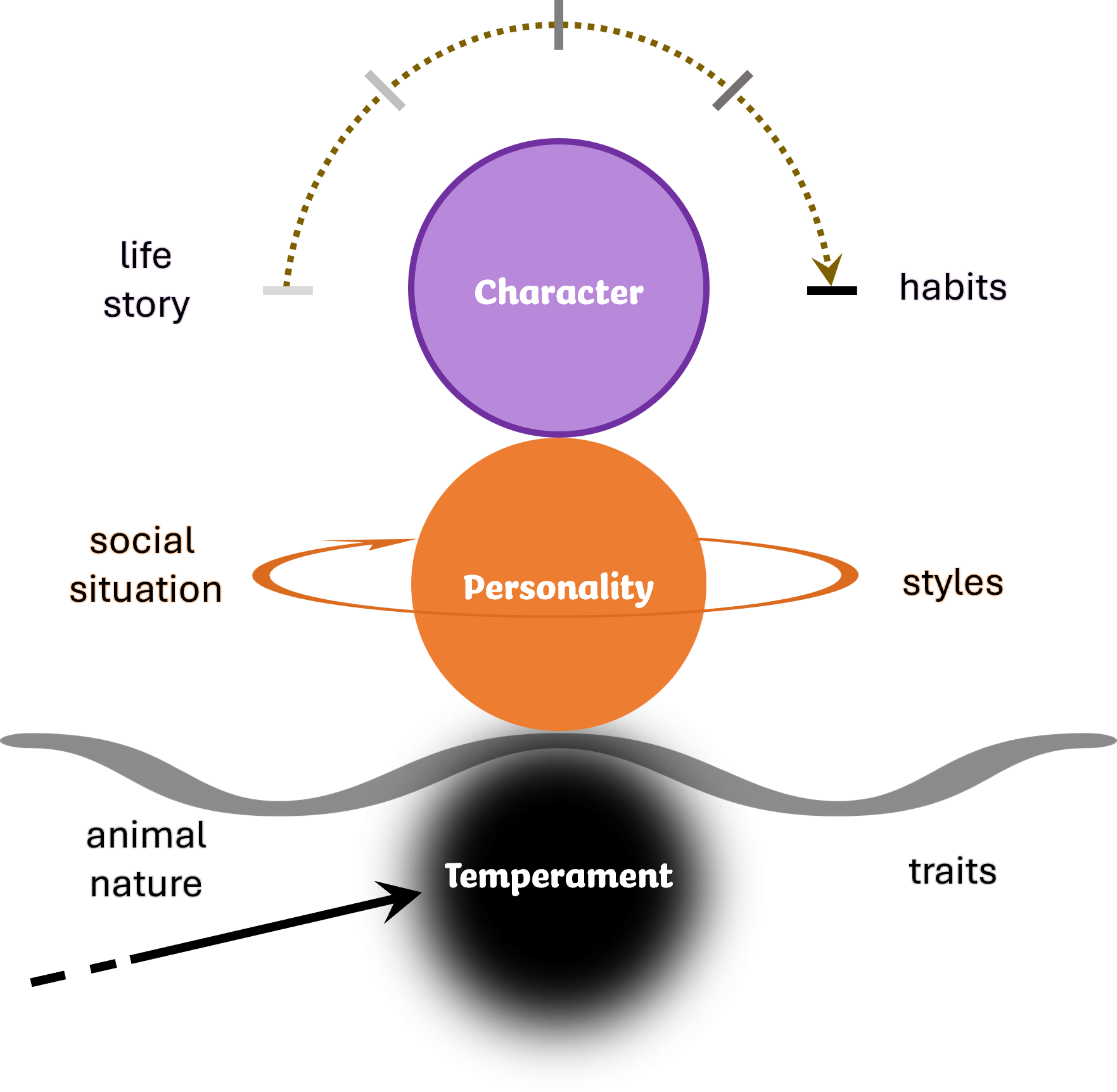
I propose a trinitarian perspective, where the three-in-one mystery of the relationships among temperament, personality, and character can be honored as we seek to understand their distinct contributions. The illustration above will serve as our map.
A human being can be understood as consisting of temperament, personality, and character. Each of these corresponds to and centers our experience in one of three dimensions: temperament in an animal nature, personality in a social situation, and character in a life story.
The three are arranged on the map to suggest a developmental process: rooted in the traits of temperament, expressed in the styles of personality, all the while acquiring the habits of character. It may help to consider them one at a time and according to this developmental sequence.
Temperament | Traits | Animal Nature
Homo sapiens is the species of a highly evolved primate. Our biology is profoundly (i.e., deeply) identical with other species of our shared genus and family. As our animal nature, the body is a sophisticated incarnation of the lifeforce on planet Earth. The slanted arrow leading up to this dimension of human existence on the map above is intended to suggest the slow evolutionary ascent from simpler to more complex organisms over the roughly four-billion-year-old adventure of Life.
Humans are a relatively late arrival, though we didn’t “arrive” here from somewhere else – and that’s the point.
Our temperament is considered the genetically determined foundation of what we are as humans. Its traits consist of propensities and predispositions, autonomic drives, reflexes, and unconscious instincts that evolved over countless generations and many species, through chance mutations and special adaptations, selected for their advantageous effect on survival and reproduction. The central nervous system of our body is also genetically set to a default state and reaction threshold.
Personality | Styles | Social Situation
Even though young parents spontaneously delight over the unique personality they observe in their infant, in actuality what they are witnessing is the newborn’s temperament – the default tone and variability of the infant nervous state, and the way it responds or reacts to their promptings, to other conditions of the environment, or to how safe and content it feels.
In their ongoing engagement with the child, however, something else begins to emerge – almost as if arising from the sentient ground of the body and finding its center in the social situation of their mutual interactions. This is the personality, centered on an ego (Latin for “I”) who “speaks through” (Latin persona) roles that serve as modes of social connection, performance, communication, and reciprocity.
In learning how to navigate the early social situation, we developed useful styles and routines for getting our needs met.
A subset of style that we learned includes the neurotic styles that may have been effective in getting our way early on – or getting out of the way, as the situation required – but became increasingly “childish” and dysfunctional as we entered adulthood. Neurotic styles are the reactive feelings and behaviors that discharge from the shadow of our personality, where repressed energies of temperament are contained and kept off-stage.
Character | Habits | Life Story
Personality and temperament are not synonymous terms, then, as each names a distinct dimension of what makes us human. If we can understand personality as a social adaptation (or exaptation) of temperament to the more unique environment and special conditions of family life, then character can be understood as the persistent patterns or habits that strengthen our identity over time.
A term taken from the art of storytelling, character refers to the growing definition, familiarity, recognition, and predictability of a narrative personality. From their initial introduction to the audience, and through numerous and variable situations in the story, the character becomes a force in the plot, an agent in its evolving shape and overall meaning.
Our character identifies who we have become (or are becoming) over the longer course of our life story. It is what anchors the story and makes it ours.
This is the factor in mythology that so fascinated Joseph Campbell in his seminal study The Hero With a Thousand Faces (1949). As archetype, the Hero is one who does not merely play a part – in our terms, as a personality in a role – but whose choices and actions define a path and create a world, making possible a whole new way of being. As it is said, character is destiny.
Among the three dimensions of identity, our temperamental traits are the most deep-set and difficult to change – although psychotropic medicine and genetic engineering are making inroads. Otherwise, insofar as our personality styles formed as adaptive responses to social situations in early childhood, they can be changed but only with time and committed work at neutralizing the emotional charge that keeps getting triggered.
And since our character habits came to define who we are only as we repeated the same beliefs and behaviors over time, these can be changed by breaking the cycle and making a different choice. But then that new belief and associated behavior need to be repeated in order to become the healthier habit we want instead.
If we happen to hold the belief that meaningful change isn’t possible, then this habit of thinking is what’s really holding us back.
“Working on ourselves” is a human privilege, I suppose. Or maybe it’s a curse. Either way, our work will be more productive the better we understand ourselves and what it is we are trying to change.

