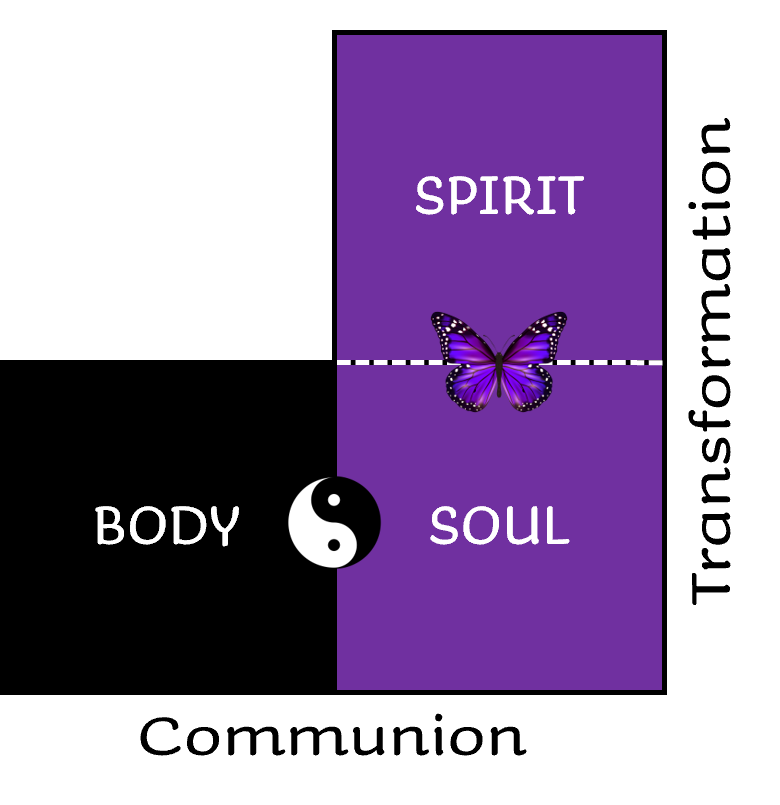
In the illustration on the right, three squares are labeled Body, Soul, and Spirit. Together and holistically these three elements constitute a human being’s essential nature: An animal biology (Body), an inner presence (Soul), and an impetus toward transcendence and self-actualization (Spirit).
Body and Soul are united in the taijitu symbol of Taoism, representing their complementary energies in communion: Yang/Outer/Body and Yin/Inner/Soul. Their communion implies that Body and Soul cannot be separated and set in opposition to each other – even though Western philosophy and religion have presumed to do just that.
Soul and Spirit are actually the two poles of our spiritual intelligence (SQ), where Soul (SQ1) roots consciousness in deeper oneness and Spirit (SQ2) lifts it toward higher wholeness.
Grounding and belonging are thus complementary aspirations (and practices) of the spiritual life. The image of a butterfly on the threshold between Soul and Spirit suggests that their relationship is less about balance, as with Body and Soul, than dynamic transformation. This is the axis of spiritual awakening, liberation, wellbeing and fulfillment.
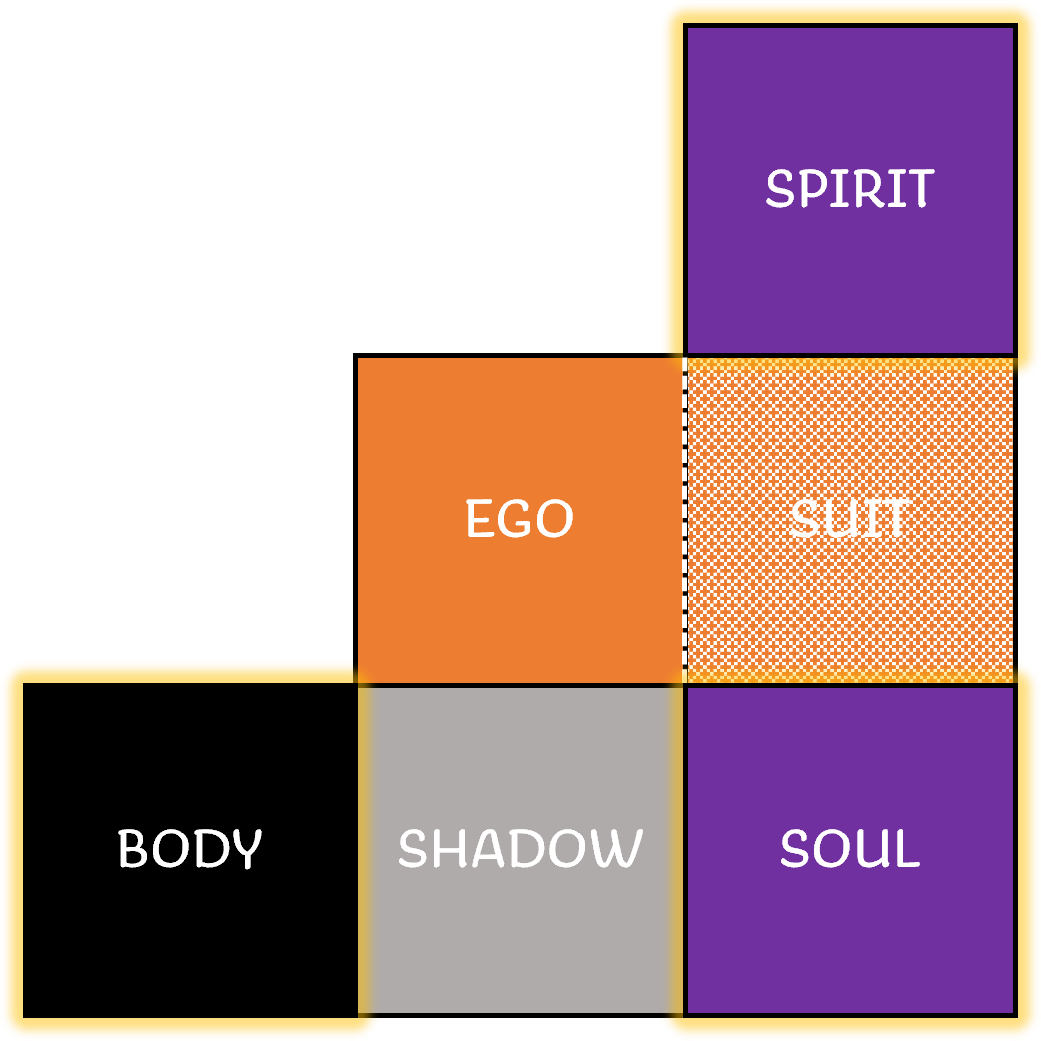
In this next illustration, we still see those elements of our essential nature (highlighted in golden glow), but now they have been split apart by the insertion of three more: ego, suit, and shadow. This second set of elements constitutes our conditioned nature as human beings, forming through the process of socialization and personality development. We are born with our essential nature, but beginning in early childhood, our conditioned nature – also called our “second” nature – starts to dominate attention and concern.
Our personality is really a complex of these three components. Ego is the center of self-conscious awareness, agency, and subjective experience that emerges naturally. Suit refers to the costume of identity that ego wears. A related term, persona, is Latin for the mask through which (per-) an actor spoke (-sona) their part on a performance stage. Both suit and persona/mask can be used interchangeably with role, supporting the idea of identity as something we are assigned or step into, put on and play out to others.
A suit-and-mask ensemble identifies us to others, as it also identifies us with them inside a shared world of meaning – the social theater (aka a world).
Suits are also mechanisms of social expectation and control. We can think of them as filters through which the primal energies, drives, and inclinations of a human animal are blocked, sublimated, and shaped into behavior that conforms to society’s moral frame – to its standards of what is good, right, proper and “normal.”
The resulting construct of personal identity slowly begins to form around the ego, like a cocoon around the caterpillar – where it subsequently falls asleep.
But not everything about us is invited or even allowed on stage. In being blocked – and given our persistent subjective need to feel safe and loved – these forbidden energies, drives, and inclinations get pushed behind us and below the threshold of conscious awareness, where they gather as the shadow in our personality. Some elements of our shadow are charged with self-deprecation – I’m stained, I’m broken, I’m too much or I’m not enough.
Other suppressed or disowned elements include our deeper talents and natural gifts which were neither identified, encouraged, or given space to develop. Inside our shadow, then, there is this “hidden light” awaiting discovery. Taking back our light from the shadow is a crucial aim of “shadow work” in spiritual practice and meditation. It requires a clear-sighted courage to address our shadow directly, since it involves acknowledging and working with those rejected aspects and energies.
Now that we have the full picture of our essential and conditioned natures before us, the “way of salvation” – of human awakening, liberation, wellbeing and fulfillment – can be understood more clearly. In profound disagreement with much conventional religion, the worldwide spiritual wisdom tradition of Sophia Perennis rejects the idea of salvation as a rescue mission of our immortal Soul from the accursed Body, to a paradise somewhere else and later on.
As we have learned, the perceived “sin and corruption” of the Body is a delusional effect of our shadow, of the negative affect and associations (naughty, bad, broken, unacceptable, unloved) that got attached early to our sense of self. A more “opaque” shadow – stronger negative feelings and judgments about ourselves – typically motivates a closer identification with the masks that show and outwardly express to others what they want to see.
An oppressive shadow and a “fused” mask, therefore, are correlates of the same neurotically adaptive dynamic.
Until we can take back our light, the shadow is our adversary (in mythology, Satan) “who” seeks to destroy us from within. Literally demonizing the shadow this way only adds to its oppressive strength. What needs to happen instead involves a shift in perspective (Greek metanoia or change of mind) based on the insight (seeing-through) that our shadow holds the light (mythologically as Lucifer the “light-bearer”) that we need to recover in order to heal and become whole.
Taking back our light, therefore, repairs the division of Body and Soul, restoring thereby the communion of our essential nature.
This restoration of communion in our essential nature opens the vertical channel of Soul and Spirit as well. By de-fusing our masks of identity, differentiating what we are (essential nature) from who we are (conditioned nature), the personality can serve our spiritual transformation rather than interfere with it. Instead of being caught in the self-conscious mode of role performance, a liberated identity enjoys the benefits of role transcendence – assuming, animating, rising above, and “going beyond” the constraints of identity itself for a larger and more holistic experience.
It’s important to appreciate the respective contributions of our essential and conditioned natures to the way of salvation – to our human awakening, liberation, wellbeing, and fulfillment.
Even proponents of Sophia Perennis have, at times, conceived of our two natures in terms of dualism, as a diametrical opposition that can only be resolved once our conditioned nature (ego, shadow, and mask) is escaped or shown to be nothing but an illusion, leaving the Soul/Spirit standing free and clear.
Despite its constructed (or conditioned) nature, however, our personal identity is nonetheless real enough, even if not essential to what we are as human beings. In the end, it’s not one or the other, or one against the other, but both together on our journey of awakening, liberation, wellbeing, and fulfillment.

