Part 1: Beyond Matching — Rethinking Career Interest
What if discovering a satisfying career begins not with asking what interests us, but with understanding what makes something interesting in the first place?
The Familiar Question: What Do You Want to Do?
For many students, choosing a college major or career direction begins with a deceptively simple question: What are you interested in?
Some students have ready answers. They enjoy science, working with people, creating things, or solving technical problems. Others struggle to identify anything that seems especially interesting. Still others have so many interests that choosing a direction feels overwhelming.
Career counselors have long relied on interest assessments to help students navigate these uncertainties. A student answers questions about preferred activities, receives a profile of interests, and explores occupations that correspond to that profile.
This can be an enormously helpful starting point. But consider what happens next. A student completes an assessment and receives a list of matching occupations. Some seem appealing, others unfamiliar, and a few make little sense. The student naturally asks, “Why would I be interested in these careers?”
That question invites us to look beneath the assessment results.
Perhaps the more revealing question is not simply What interests this student? but What is happening within the student that makes particular activities interesting?
The distinction may seem subtle. Its implications for career development, however, are substantial.
What John Holland Helped Us Understand
Psychologist John L. Holland made one of the most influential contributions to modern career counseling through his theory of vocational personalities and work environments.
Holland identified six broad patterns of vocational interest, commonly known by the acronym ‘RIASEC‘:
- Realistic: Working with tools, equipment, materials, and practical tasks.
- Investigative: Exploring questions, analyzing information, and solving problems.
- Artistic: Creating, imagining, designing, and expressing ideas.
- Social: Helping, teaching, supporting, and developing others.
- Enterprising: Leading, persuading, influencing, and pursuing objectives.
- Conventional: Organizing information, managing processes, and maintaining orderly systems.
Holland proposed that people and work environments could be described using these six patterns. Greater congruence between a person’s vocational interests and their environment was expected to support more satisfying vocational experiences.
Decades of research have demonstrated the usefulness of vocational interests for understanding educational and occupational choices. Holland’s framework remains valuable because it gives students a language for recognizing patterns that might otherwise be difficult to articulate. Importantly, most people are not exclusively one type. Their interests reflect combinations of these orientations, often represented by a three-letter code.
Yet Holland’s framework also invites another question. What if these six patterns tell us something not only about the activities people prefer, but about how they characteristically direct their consciousness toward the world?
This possibility forms the starting point for a different perspective on vocational development.
What Makes an Activity Interesting?
Imagine six college students volunteering to help restore a neglected community garden. The garden has overgrown planting beds, damaged irrigation equipment, declining participation, and limited resources. All six students encounter the same situation, yet each is drawn to a different aspect of the challenge.
One immediately notices the broken irrigation system and begins thinking about how to repair it (Realistic). Another wonders why certain plants have failed to thrive and considers testing the soil and growing conditions (Investigative). A third imagines redesigning the garden into a more inviting and attractive space (Artistic). Another recognizes an opportunity to bring neighbors together and encourage greater community participation (Social). A fifth begins thinking about recruiting sponsors and persuading local businesses to support the restoration (Enterprising). The sixth sees the need to organize volunteers, coordinate supplies, and establish a maintenance schedule (Conventional).
The garden presents the same opportunities and challenges to everyone. Yet each student notices something different – something that invites a particular kind of engagement. We might say that each student has different interests. That is certainly true, but it describes the differences more than it explains them.
Consider another possibility: each student brings a characteristic orientation of working consciousness to the situation. That orientation influences what captures their attention, what seems worth doing, and what kind of engagement feels meaningful.
In other words, an activity may become interesting because of the way a person is inclined to engage with it.
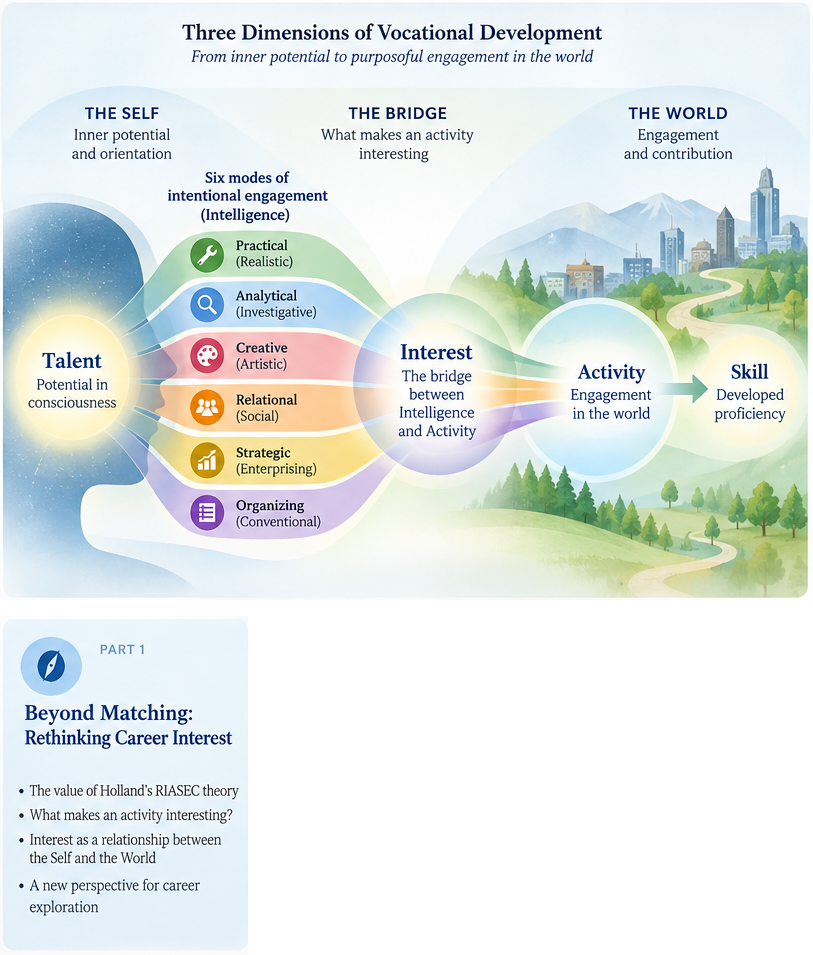
Consider another possibility: Each student brings a characteristic orientation of working consciousness to the situation. That orientation influences what captures their attention, what seems worth doing, and what kind of engagement feels meaningful.
In other words, an activity may become interesting because of the way a person is inclined to engage with it.
This reverses a familiar assumption. We often imagine that activities possess qualities that attract our interests. Some things are interesting, and others are not. But interestingness is not simply an intrinsic property of an activity. Rather, it emerges through the relationship between the individual and the opportunity for engagement.
A familiar saying captures part of this phenomenon: “When all you have is a hammer, everything looks like a nail.” Usually, the expression warns against approaching every problem with the same solution. But it also illustrates something important about human perception: Our characteristic ways of engaging influence what we recognize as opportunities.
The mechanically inclined person notices things that can be built, handled, or repaired. The analytically inclined person recognizes questions to investigate. The relationally inclined person notices opportunities to connect, encourage, or support. Their interests are not simply directing their attention. Their characteristic ways of engaging may help make those opportunities interesting in the first place.
Interest as the Bridge Between Self and World
More than a century ago, philosopher and educator John Dewey challenged the idea that interest is merely an agreeable feeling attached to an activity. In Interest and Effort in Education (1913), Dewey explored interest in relation to purposeful engagement. His work encourages us to understand interest through the meaningful connection between a person and what that person is doing.
A related perspective appears in psychologist James J. Gibson’s The Ecological Approach to Visual Perception (1979). Gibson introduced the concept of affordances – opportunities for action that an environment offers in relation to the capabilities of an individual. A staircase affords climbing to someone capable of climbing it. A musical instrument affords possibilities for performance to someone able to engage with it. The opportunity is not located exclusively in the person or in the object. It exists in their relationship.
These perspectives help illuminate a central proposition of the approach being developed here:
Interest is the bridge between Intelligence in the Self and Activity in the World.
For our purposes, Intelligence does not refer primarily to academic achievement, IQ, or a measurable level of cognitive ability. Instead, it refers to a preferred mode of intentional engagement – a characteristic way working consciousness approaches opportunities and challenges.
Interest emerges when that orientation encounters an activity offering meaningful possibilities for its expression. This does not mean that people consciously decide what to find interesting; nor does it mean that their preferences are fixed. Rather, our characteristic orientations influence what we notice, what attracts our engagement, and what we may find satisfying to pursue.
As experience accumulates, those orientations and interests can themselves develop and change.
A Different Conversation About Career Choice
Consider a student who reports enjoying helping people. A conventional interest assessment might identify this as a Social orientation and suggest occupations such as nursing, teaching, counseling, or social work. Those are reasonable possibilities.
But a counselor could explore the student’s experience more deeply. What is it about helping people that you find satisfying? Is it understanding someone’s difficulties? Finding a practical solution? Explaining something complicated? Encouraging someone to achieve a goal? Organizing resources to meet a need?
The student might discover that helping people is meaningful primarily because it provides opportunities to investigate problems, devise solutions, or organize effective responses. This does not invalidate a Social interest. It reveals that the same activity can engage several orientations of intelligence.
And that insight can broaden vocational possibilities.
Someone who enjoys helping people through analytical problem-solving might discover opportunities in healthcare research, diagnostic technology, public health, or information systems. Someone who enjoys helping through organization might consider healthcare administration, logistics, or program coordination.
The purpose is not to replace one occupational list with another. It is to help students recognize the characteristic ways they find meaning in working with the world.
Such understanding may prove especially valuable for students who have limited exposure to occupations, who are uncertain about their direction, or whose interests have been shaped by a narrow range of experiences.
From Career Matching to Vocational Discovery
Holland’s RIASEC theory provides a valuable structure for exploring the relationship between individuals and work environments. The philosophical proposal introduced here seeks to build upon that foundation.
Suppose the six RIASEC orientations correspond to six preferred modes of intentional engagement: Practical, Analytical, Creative, Relational, Strategic, and Organizing.
Rather than treating these as six separate measures of intellectual ability, we can explore them as characteristic ways consciousness engages with opportunities and challenges. This is a proposed interpretation, not an established finding that six independent intelligences exist. Its value lies in opening another dimension of vocational exploration.
Instead of asking students only what activities they enjoy, we can help them recognize how they approach situations, what opportunities capture their attention, and what makes engagement meaningful.
This perspective also changes how we understand vocational clarity. Clarity is not simply knowing which occupation to pursue. It includes understanding oneself as an active participant in the world – someone whose characteristic ways of engaging can find expression across many educational and occupational settings.
For students and parents, this suggests that career exploration should involve more than reviewing lists of promising jobs. For educators and counselors, it invites a reconsideration of the questions we ask and the experiences we encourage.
Perhaps one of the most valuable questions we can ask a student is: When you encounter something that captures your interest, what is it about the way you engage with it that makes the experience meaningful?
The answer may reveal more than a preferred activity. It may offer a glimpse into the student’s developing vocational identity. And it leads naturally to our next question: Where do these characteristic orientations originate, and how do they develop into increasingly effective skills?
That is where Part 2 of this blog series will pick up the thread next.
Selected References
Dewey, J. (1913). Interest and Effort in Education. Houghton Mifflin.
Gibson, J. J. (1979). The Ecological Approach to Visual Perception. Houghton Mifflin.
Holland, J. L. (1997). Making Vocational Choices: A Theory of Vocational Personalities and Work Environments (3rd ed.). Psychological Assessment Resources.
Nye, C. D., Su, R., Rounds, J., & Drasgow, F. (2012). Vocational interests and performance: A quantitative summary of over 60 years of research. Perspectives on Psychological Science, 7(4), 384–403.
Next in the series: Part 2 — From Talent to Skill: How Intelligence Finds Expression.

