Part 3: From Assessment to Discovery – A New Approach to Career Guidance
What if the most valuable outcome of career counseling is not simply choosing an occupation, but developing a clearer understanding of how we engage with the world – and what we might become?
The Student Who Doesn’t Know What to Major In
Imagine a college student meeting with a career counselor because they cannot decide on a major. They have considered several possibilities, but none seems quite right. Friends have chosen their programs, family members have offered suggestions, and the student feels increasingly pressured to make a decision.
The counselor recommends a career interest assessment based on John Holland’s RIASEC theory. After completing it, the student receives a three-letter interest code and a list of related occupations and college programs. Some possibilities look promising. Others are unfamiliar. But the student remains uncertain: “How do I know which one is right for me?”
This is a familiar challenge in career counseling. Interest assessments provide valuable information, but information alone does not necessarily produce vocational clarity.
What if the assessment could become the beginning of a different conversation – not simply about which occupations match the student’s interests, but about what makes particular activities interesting in the first place?
That possibility brings us to the practical implications of the theory developed in this series.
Vocational Clarity as the Foundation for Informed Choice
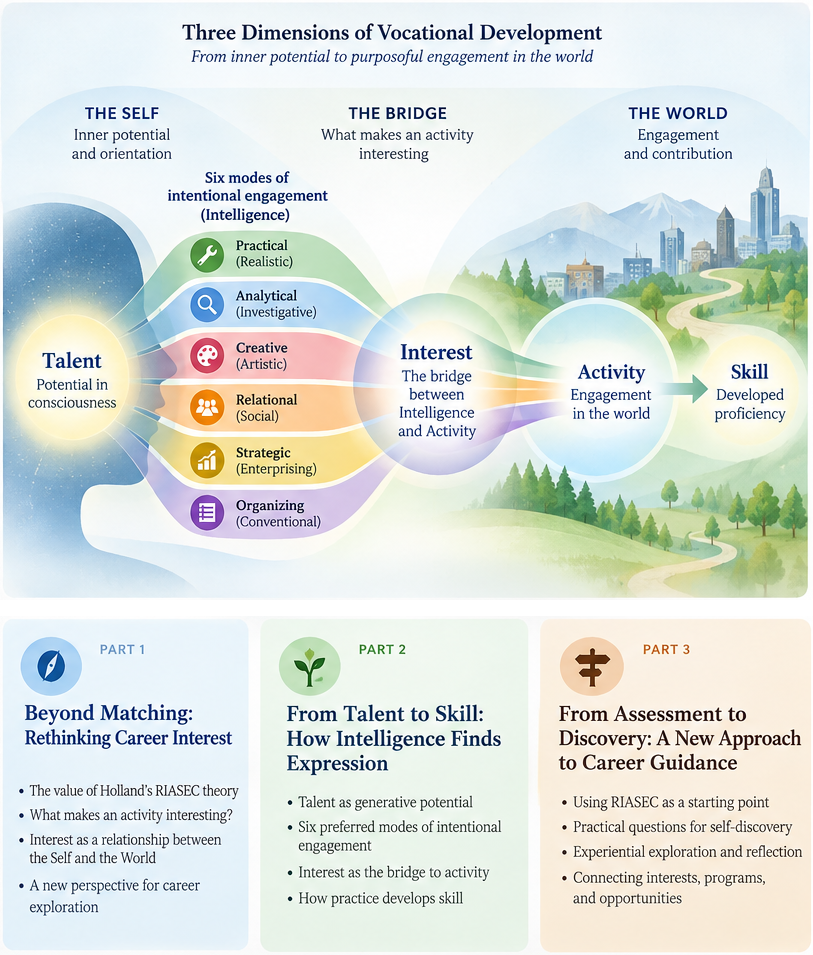
In the first two articles, we explored a philosophical proposition: Interest emerges through the relationship between an individual’s preferred mode of intentional engagement and opportunities for Activity in the world.
We also distinguished five related concepts. Talent is the generative potential of consciousness. Intelligence represents a preferred mode of intentional engagement. Interest is the meaningful relationship between that orientation and an opportunity for Activity. Through experience and practice, increasingly effective behavior develops as Skill.
These distinctions suggest that vocational development involves more than identifying an occupation that matches existing preferences. It also involves developing vocational clarity: an increasingly informed understanding of how we characteristically engage with the world, what opportunities make that engagement meaningful, and how our potential might find expression through education and work.
Vocational clarity and occupational choice are closely related, but they are not identical. Vocational clarity involves developing a growing understanding of one’s preferred modes of engagement, the opportunities that make those modes meaningful, and the sense of purpose and direction that may emerge through experience.
Occupational choice, by contrast, involves selecting a particular field of work through which that developing vocational direction might find expression. A student may choose an occupation without understanding why it is personally meaningful. Conversely, a student may develop considerable vocational clarity while still considering several educational and occupational possibilities.
The objective is not to postpone decisions indefinitely. Rather, greater vocational clarity provides a stronger foundation for making informed choices about education, work, and other opportunities for meaningful contribution. An occupation is something we may choose. A vocation is a direction we come to understand and develop through our engagement with the world.
Reading RIASEC Results Differently
Holland’s RIASEC theory remains central to this approach.
Its six interest orientations – Realistic, Investigative, Artistic, Social, Enterprising, and Conventional – provide a useful structure for understanding patterns of vocational preference. Traditionally, assessment results help identify occupations and work environments that correspond to those patterns. That remains an important application.
But suppose we also interpret the six orientations as possible expressions of six preferred modes of working consciousness: Practical, Analytical, Creative, Relational, Strategic, and Organizing Intelligence.
A Realistic interest might suggest attraction to opportunities for Practical engagement. An Investigative interest might suggest meaningful engagement through Analytical inquiry. The remaining orientations offer corresponding possibilities for Creative, Relational, Strategic, and Organizing engagement.
These proposed correspondences are not established measures of six independent intelligences. Instead, they provide a philosophical framework for exploring what may underlie expressed interests.
This distinction is essential. An interest profile describes patterns of attraction toward activities; it does not establish the boundaries of a person’s Talent or intellectual capacity. The assessment becomes a source of clues rather than a final judgment about the individual.
Changing the Questions We Ask
Return to our undecided college student.
Suppose the student’s strongest RIASEC interests are Investigative, Social, and Artistic. A conventional interpretation might lead to exploring occupations that combine analysis, helping others, and creativity. That is a reasonable starting point.
But the counselor could also invite the student to reflect on how these orientations appear in everyday experience. “When you encounter a difficult problem, what first attracts your attention? Do you enjoy discovering why something happens, helping someone understand it, or imagining a different solution?”
“Can you recall an experience when you became so engaged in an activity that you lost track of time? What were you trying to accomplish? What made that experience satisfying?”
These questions encourage the student to look beyond the activity itself and consider the intention underlying their engagement.
For example, a student who enjoys helping others might discover that the most satisfying part is investigating the cause of someone’s difficulty. Another might find satisfaction in explaining complex information. Still another may enjoy designing an innovative response.
The activity may appear similar, but the preferred mode of engagement differs. This is where the counselor’s role becomes especially important: helping students recognize meaningful patterns in their experiences without prematurely assigning them to categories.
Discovery Requires Experience
Reflection is valuable, but students cannot discover all their possibilities by examining past experiences alone.
Some have had limited opportunities to explore different activities. Others may have developed interests primarily through family expectations, familiar school subjects, or the occupations they happen to know. A student who has never worked with technical equipment may not recognize an inclination toward Practical engagement. Someone who has never organized a project may be unaware of the satisfaction they might find in coordinating complex activities.
This brings us back to our understanding of Talent.
Talent is not exhausted by the Skills already developed. It remains the generative ground from which further intelligent engagement and new capabilities may emerge.
Consequently, the absence of demonstrated skill or expressed interest does not necessarily indicate the absence of developmental potential. Career exploration should therefore create opportunities for discovery, not merely confirm existing preferences.
A student might participate in a short research project, volunteer with a community organization, observe professionals at work, interview someone in an unfamiliar occupation, or take an introductory course outside their usual interests. Afterward, the counselor might ask: “What did you notice first? What drew you into the activity? Which challenges did you enjoy? What would you like to try again?”
Such experiences can reveal possibilities that an interest questionnaire alone may not uncover. They can also challenge assumptions students have formed about their own capabilities.
From Experience to Informed Choice
Discovering a preferred mode of engagement is valuable, but vocational counseling must eventually connect self-understanding with educational and occupational realities. Students need to investigate academic programs, credentials, transfer opportunities, working conditions, employment prospects, and the preparation required for occupations they are considering.
The proposed framework does not replace these practical considerations. It helps students approach them with greater personal understanding.
Our undecided student might discover that Analytical engagement is particularly satisfying when directed toward understanding people’s needs. That realization could encourage exploration of healthcare, psychology, education, human services, or research-related fields. The student can then compare programs, investigate occupational requirements, speak with professionals, and seek relevant experiences.
Rather than asking only, “Which occupation matches my interest code?” the student begins asking, “Where might my preferred ways of engaging find meaningful expression, and what preparation would help me develop the necessary skills?”
This approach also recognizes that vocational interests and choices develop over time.
Robert Lent, Steven Brown, and Gail Hackett’s Social Cognitive Career Theory emphasizes the relationships among interests, self-efficacy, outcome expectations, and environmental opportunities. Their work helps explain how experience and perceived competence influence educational and occupational choices.
Mark Savickas’s career construction theory likewise emphasizes the individual’s active role in developing vocational identity and making meaning through career experiences. These perspectives complement the proposal developed here: vocational guidance can support both practical decision-making and the continuing development of the person making those decisions.
A Different Purpose for Career Counseling
None of this requires abandoning established assessments or replacing occupational information with philosophical discussion.
It does, however, suggest a different emphasis.
An assessment can identify patterns worth exploring. A counselor can help students examine what makes particular experiences meaningful. Educational and experiential opportunities can broaden their understanding of themselves. Practice and feedback can help them develop increasingly effective Skills.
And throughout this process, Talent remains more than the sum of demonstrated abilities. This is especially important for students who feel uncertain about their futures. They need not assume that their current interests represent everything they are capable of becoming.
Nor must they discover one perfect occupation that will permanently satisfy every dimension of their working consciousness. Instead, they can develop the capacity to recognize meaningful opportunities, make informed choices, and continue growing through new experiences.
Rethinking the Questions
Across these three articles, we have moved from career interests to the deeper question of vocational intelligence.
Holland’s RIASEC theory provides the organizing foundation. The proposed framework of Talent, Intelligence, Interest, Activity, and Skill offers a way to understand how human potential may become expressed through meaningful engagement with the world. Its philosophical propositions invite further examination and research. Their immediate practical value, however, lies in the questions they encourage us to ask.
For students, parents, educators, and career counselors, perhaps the most important change begins with a simple shift in perspective.
Instead of asking only, “What do you want to be?” we might also ask: “How do you prefer to engage with the world, what makes that engagement meaningful, and what possibilities might you discover through it?”
The first question invites an occupational choice. The second invites vocational discovery – a continuing exploration of purpose, direction, and the possibilities through which our Talent may find meaningful expression.
Selected References
Holland, J. L. (1997). Making Vocational Choices: A Theory of Vocational Personalities and Work Environments (3rd ed.). Psychological Assessment Resources.
Lent, R. W., Brown, S. D., & Hackett, G. (1994). Toward a unifying social cognitive theory of career and academic interest, choice, and performance. Journal of Vocational Behavior, 45(1), 79–122. https://doi.org/10.1006/jvbe.1994.1027
Savickas, M. L. (2013). Career construction theory and practice. In S. D. Brown & R. W. Lent (Eds.), Career Development and Counseling: Putting Theory and Research to Work (2nd ed., pp. 147–183). Wiley.
This concludes the three-part series, From Career Interests to Vocational Intelligence.

