Part 2: From Talent to Skill – How Intelligence Finds Expression
What if intelligence is not simply something we possess, but something we express through the ways we engage with the world?
Looking Beneath Our Interests
In the first article of this series, Beyond Matching: Rethinking Career Interest, we considered a question that seldom receives much attention in conventional career exploration: What makes an activity interesting?
Drawing upon John Holland’s RIASEC theory, we explored the possibility that interest is not simply a preference for certain activities. Rather, interest emerges through the relationship between an individual’s characteristic way of engaging and the opportunities for activity presented by the world.
Consider again the six college students volunteering to restore a neglected community garden. One notices equipment that needs repairing. Another investigates why the plants are struggling. Others envision a more attractive garden, connect with neighbors, recruit sponsors, or organize volunteers. Their different responses suggest something deeper than a collection of preferences. Each student approaches the same situation with a characteristic orientation of working consciousness.
Where do these orientations originate? And how do they develop into the abilities and skills through which we contribute to the world?
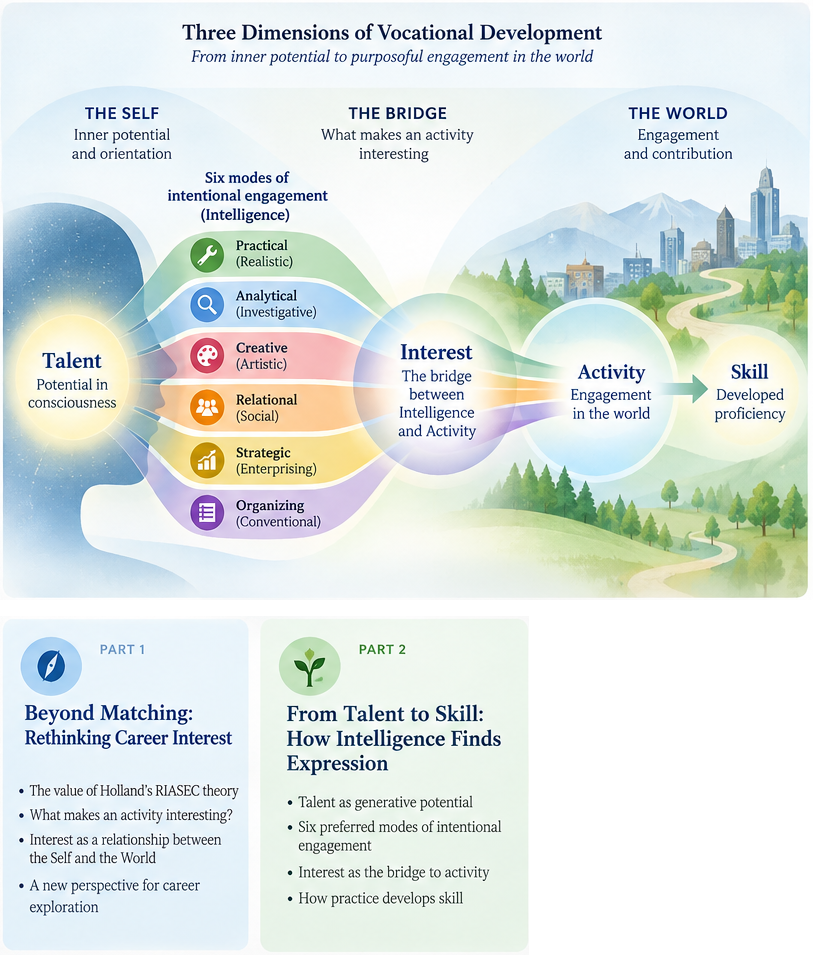
To explore these questions, we need to distinguish five closely related concepts: Talent, Intelligence, Interest, Activity, and Skill.
Talent: The Generative Ground of Human Potential
We commonly use the word talent to describe someone who demonstrates exceptional ability. We speak of talented musicians, athletes, artists, and problem-solvers. But this usage identifies talent primarily through its accomplishments. It tells us relatively little about the potential from which those accomplishments develop.
For our purposes, I propose a more fundamental understanding: Talent is the generative potential of consciousness to actualize natural predispositions and respond adaptively to opportunities and challenges presented by the environment.
This definition recognizes two important dimensions of human development. First, individuals bring natural predispositions into the world. These may include biologically influenced differences in perception, coordination, temperament, attention, and other characteristics.
Second, individuals possess the capacity to respond to circumstances in ways that are not entirely predetermined by those predispositions. Environmental opportunities, challenges, relationships, and experiences can evoke new forms of engagement.
Talent, in this sense, is not a fixed collection of abilities waiting to reveal itself. Nor does it possess an intention of its own, as though it actively seeks expression. Instead, Talent represents a deeper potential that becomes differentiated through developmental experience.
Developmental psychologist Gilbert Gottlieb’s work on probabilistic epigenesis offers a useful scientific perspective. Gottlieb emphasized that biological and behavioral development arise through ongoing interactions among genetic activity, neural processes, behavior, and environmental conditions.
Gottlieb’s research does not establish the philosophical definition of Talent proposed here, but it supports an important premise: natural predispositions influence development without rigidly determining its outcomes. This distinction matters in career counseling. A student who has never demonstrated a particular ability may simply never have encountered the conditions that would encourage its development.
Unexpressed potential should not be confused with absent potential.
Intelligence: Consciousness at Work
If Talent represents generative potential, Intelligence describes how that potential becomes intentionally engaged. We ordinarily associate intelligence with reasoning ability, academic performance, or scores on standardized tests. These measures have legitimate purposes, but they are not the primary concern of this proposal.
Here, Intelligence refers to a preferred mode of intentional engagement – a characteristic way working consciousness approaches opportunities and challenges. The emphasis is on the orientation of consciousness rather than its measured capacity.
When individuals encounter a situation, they do not necessarily attend to the same features or recognize the same possibilities. One person notices how something functions. Another seeks to understand why it functions as it does. Another imagines how it might be different. These responses are not simply different levels of intelligence. They represent different ways of directing intelligent engagement.
Psychologist Robert Sternberg’s work on successful intelligence provides a useful precedent for understanding intelligence in relation to purposeful activity and adaptation. His theory distinguishes analytical, creative, and practical aspects of intelligent functioning.
The present proposal extends this perspective into vocational development by identifying six preferred modes of intentional engagement, corresponding to Holland’s RIASEC framework. These six orientations are not presented as independently validated cognitive abilities. They are proposed as a useful way of understanding how individuals characteristically engage with the world.
Six Preferred Modes of Intentional Engagement
Holland’s six vocational interest types offer an established structure for describing differences in preferred work activities. What happens if we consider each type as an expression of a corresponding orientation of working consciousness?
- Practical Intelligence (Realistic) is directed toward making things work in the physical and technical world. Its characteristic intention is to build, repair, operate, manipulate, or implement. It finds opportunities for meaningful engagement in tangible problems and functional challenges.
- Analytical Intelligence (Investigative) is directed toward understanding. It asks questions, investigates relationships, examines evidence, and seeks explanations. Its characteristic intention is to discover how and why things happen.
- Creative Intelligence (Artistic) is directed toward generating possibilities. It imagines alternatives, creates new forms, expresses ideas, and explores what might become possible beyond existing arrangements.
- Relational Intelligence (Social) is directed toward understanding and engaging with others. It recognizes interpersonal needs, develops connections, facilitates learning, and supports the growth and well-being of people.
- Strategic Intelligence (Enterprising) is directed toward influencing circumstances to achieve desired outcomes. It recognizes opportunities, mobilizes resources, persuades others, establishes direction, and pursues objectives.
- Organizing Intelligence (Conventional) is directed toward establishing structure and coherence. It coordinates activities, arranges information, manages processes, and creates the order necessary for reliable functioning.
These orientations are neither mutually exclusive nor necessarily equal in their expression within an individual. Most situations call upon several of them, and everyone can develop proficiency across multiple modes. The distinction concerns the kind of engagement a person characteristically finds natural, compelling, or meaningful—not an exclusive intellectual identity.
Interest: The Bridge Between Self and World
We can now return to the central proposition of our first article. If Intelligence describes a characteristic orientation of working consciousness, Interest emerges when that orientation encounters an opportunity for meaningful engagement.
Interest is the bridge between Intelligence in the Self and Activity in the World.
The student drawn to repairing the garden’s irrigation system recognizes an opportunity for Practical engagement. The student investigating plant health recognizes an opportunity for Analytical engagement. Others find meaningful possibilities for Creative, Relational, Strategic, or Organizing engagement.
The environment does not determine which opportunity will attract each student. Nor does the individual create those opportunities entirely through personal preference. Interest emerges through their relationship.
Philosopher John Dewey’s Interest and Effort in Education offers an important foundation for understanding interest through purposeful engagement. Similarly, psychologist James J. Gibson’s concept of environmental affordances helps explain how opportunities for action exist in relation to the capabilities of those encountering them.
This perspective suggests that our interests may reveal something about how we characteristically engage with the world. It also suggests that interests can develop as we encounter new opportunities, discover unfamiliar possibilities, and expand our ways of engaging.
Activity: Where Potential Meets Experience
Recognizing an interesting opportunity is not the same as acting upon it.
Activity represents the actual engagement of intelligence with the world. It is where intention becomes behavior, and where potential encounters the demands and consequences of experience.
The student interested in repairing the irrigation system must eventually examine the equipment, identify the problem, and attempt a solution. The student interested in investigating plant health must gather information, evaluate possible explanations, and test conclusions. In each case, engagement provides something that interest alone cannot: experience.
And experience brings feedback. An attempted repair may fail. An explanation may prove incomplete. A creative design may encounter practical limitations. A plan to recruit sponsors may meet resistance. These are not simply obstacles. They are opportunities for learning and adaptation. Through activity, individuals discover both the possibilities and the limitations of their preferred ways of engaging.
Skill: The Refinement of Talent Through Practice
With repeated engagement, experience, and practice, behavior can become increasingly effective. This is the development of Skill. Skill is the progressively refined behavioral expression of Talent through intelligent activity.
The student who initially struggles to repair an irrigation system may, through instruction and practice, develop considerable technical proficiency. The student who investigates plant health may learn increasingly sophisticated methods of observation and analysis.
In both cases, the deeper, relatively undifferentiated potential of Talent finds expression in increasingly specialized and capable behavior. Yet Talent is not exhausted in these accomplishments. It remains the generative ground from which further intelligent engagement and new possibilities for development may emerge.
Psychologist K. Anders Ericsson’s research on deliberate practice helps explain why experience alone does not guarantee expertise. Improvement depends significantly on the quality of practice, appropriate challenges, feedback, and opportunities for correction.
Interest may encourage continued engagement, but proficiency requires learning. The relationship also works in the opposite direction. As individuals become more capable, activities that once seemed confusing or unappealing may become increasingly interesting. Skill can strengthen Interest, expand opportunities for Activity, and influence how Intelligence is subsequently expressed.
Development is therefore not a simple one-way progression. It is an ongoing, reciprocal process.
A Different Understanding of Vocational Development
We can now bring the five concepts together.
Talent represents the generative potential of consciousness. Intelligence is its characteristic orientation toward engagement. Interest is the meaningful relationship established between that orientation and opportunities for Activity. Through experience and practice, Activity becomes increasingly refined as Skill.
This framework does not replace Holland’s RIASEC theory. Rather, it offers a philosophical interpretation of what may underlie the patterns of vocational interest that Holland helped us recognize. It also changes the questions we might ask students. Instead of assuming that current interests reveal the full range of a student’s potential, we can recognize that interests reflect a developing relationship between the individual and the world.
Instead of treating demonstrated abilities as fixed indicators of future possibilities, we can consider how new experiences may activate and develop capacities not yet expressed.
And instead of asking students simply to identify what they are good at, we can invite them to discover how they prefer to engage, what opportunities make that engagement meaningful, and how they might develop greater proficiency through practice. This is more than a different way of interpreting an interest assessment. It is a different perspective on vocational development itself.
In the final article, we’ll consider how this perspective might change the conversations we have with students – and how career counseling can move beyond identifying occupational matches toward facilitating vocational discovery.
Selected References
Dewey, J. (1913). Interest and Effort in Education. Houghton Mifflin.
Ericsson, K. A., Krampe, R. T., & Tesch-Römer, C. (1993). The role of deliberate practice in the acquisition of expert performance. Psychological Review, 100(3), 363–406.
Gibson, J. J. (1979). The Ecological Approach to Visual Perception. Houghton Mifflin.
Gottlieb, G. (1992). Individual Development and Evolution: The Genesis of Novel Behavior. Oxford University Press.
Holland, J. L. (1997). Making Vocational Choices: A Theory of Vocational Personalities and Work Environments (3rd ed.). Psychological Assessment Resources.
Sternberg, R. J. (1996). Successful Intelligence: How Practical and Creative Intelligence Determine Success in Life. Simon & Schuster.
Next in the series: Part 3 — From Assessment to Discovery: A New Approach to Career Guidance.

