Behind the multiplicity of personality profiles that make up the expansive catalog of gods across the traditions of theism, we find four – more than mere attributes, so let’s name them principles, that serve as its architectural framework.
These four principles are not always apparent in every deity, particularly in those that function more as personifications of nature (e.g., Poseidon and the sea) or guardians of cultural institutions (e.g., Hera and the domestic household). But even these, if we should study them on the timeline of social evolution, tend to develop in ways that reveal increasingly more of these principles in the way the god is depicted in story and regarded in worship.
Operating as a kind of template in the mythopoetic design of god are the four principles of Presence, Mystery, Power and Love.
A given god will be more or less present, more or less mysterious, more or less powerful, and more or less loving – where the more or less merely qualifies the principles under specific attributes of temperament and personality, which are reflective of a particular period, locale, and people – the mythmakers themselves.
It is at the level (or in the dimension) of a god’s character that we can see this development more clearly.
Originally reflexes of their local provenance, the gods of theism are soon centered in the devotion and theology (“god talk”) of a community, eventually becoming (‘more or less’) transparent to Presence, Mystery, Power and Love. It is then that a god may disappear, leaving the profound human experiences they had personified to be contemplated and cultivated without the props of costume and cult.
This is when faith and spirituality advance to the stage of post-theism – after theism and on the other side of god. It’s not that “god is dead” or has had their existence convincingly refuted once and for all. Rather, the construct of god is no longer necessary. The mask and veils that had draped the Present Mystery and Power of Love for so many millenniums simply drop away.
Post-theism moves beyond the debate over god’s existence, discerns the Reality of God behind the talked-about god, and explores our human place and responsibility within this Reality.
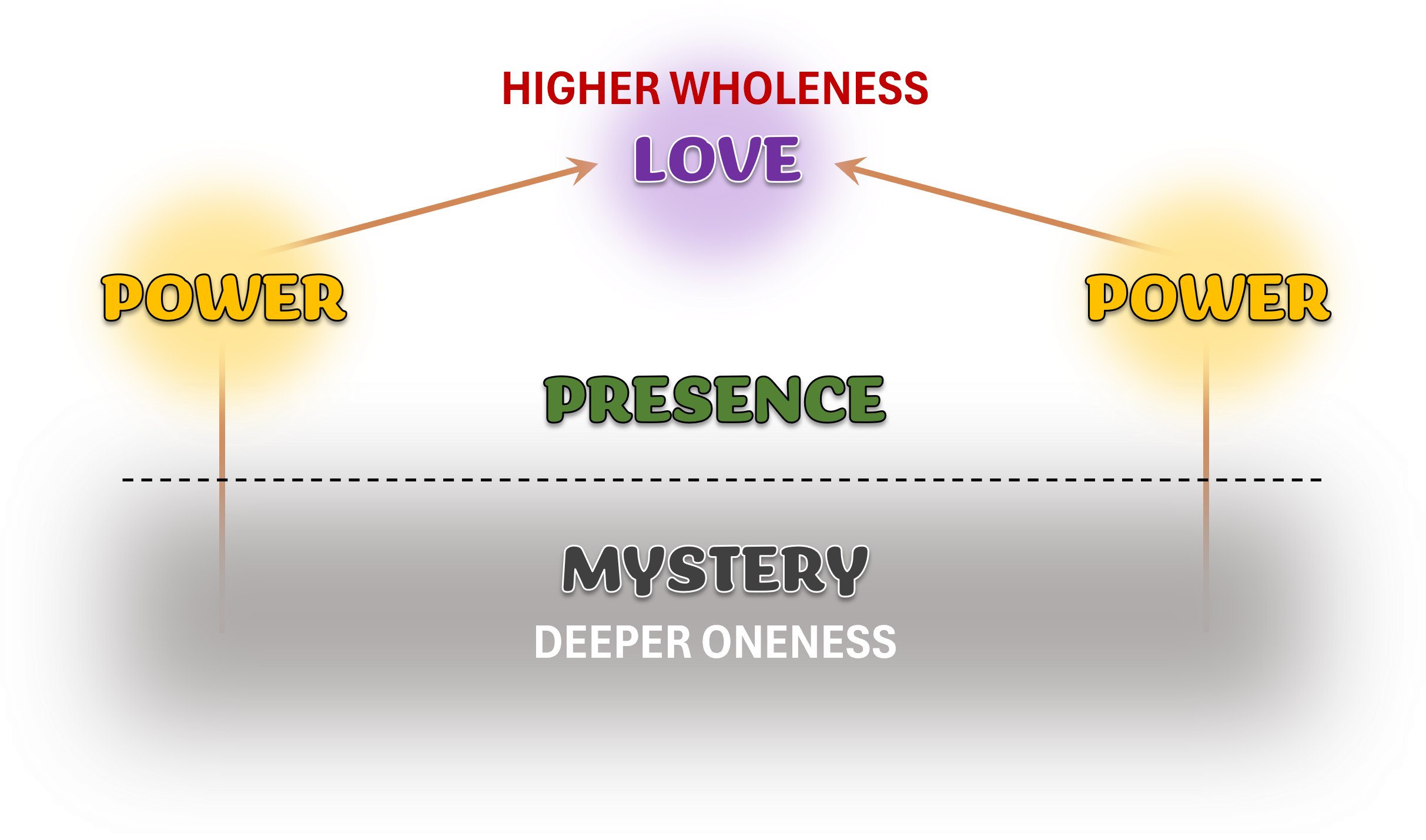
The illustration above will guide our exploration of post-theistic theology, where the focus is no longer on this or that god – Poseidon, Hera, Yahweh, Allah or any other deity – but rather on God as the Present Mystery and Power of Love. The spirituality of post-theism – its experience as distinct from its theology proper – engages with God on two distinct paths, one inward and mystical, the other outward and ethical. Let’s take them in turn.
Mystical Spirituality and the Present Mystery
We must begin with Presence, for the simple reason that nothing in Reality is available to us except Here and Now. What is Presence? What is it for something, or for us as human individuals, to be present? More than merely showing up to a particular place (here) at a specific time (now), being present suggests a certain undefinable quality.
We can show up and still not be truly present – not fully Here and Now. Presence is less a fixed point in space and time, than it is a dynamic process. We might better name it presencing.
For millenniums, humans have taken notice of this phenomenon, giving it the name being, or better yet, be-ing: the manifestation or coming-to-be of Reality in this rock, that flower, a cloud overhead, and in ourselves.
We still speak of ourselves as human beings, as human manifestations of be-ing. We could just as well refer to rocks as rock beings, flowers as flower beings, and to clouds as cloud beings. The principle of Presence, or presencing (be-ing), is what we are contemplating here through its myriad forms and expressions all around us – as well as in us.
If we can think of Presence as the coming-to-be of Reality, as the principle of be-ing that makes something real, then what is it that we sense in the rock, the flower, the cloud, and in ourselves? What is taking form in, becoming present as, and shining through the myriad beings? The beings themselves are its diverse forms, but the Mystery taking form and still hidden within what we can see is itself formless, nameless, and ineffable.
We may call it Mystery, but that is not its proper name. As Lao Tzu acknowledged, the Mystery (Tao) that can be named is not the eternal (i.e., timeless and true) Mystery.
The path from Presence to Mystery is an internal and descending path. While we can contemplate the forms of Mystery in each other and in everything around us, the inner ground of Mystery itself can only be accessed by going within. Mystical spirituality has cultivated the wisdom, insights, practices, and techniques of this ‘inner journey’ for many centuries. What we find at the end of this journey is Nothing – no thing; not an object, not even a goal that can be reached.
The grounding Mystery within us is a deeper oneness that our minds cannot grasp.
According to the mystical spirituality of post-theism, God is the Present Mystery within us and in all things. Looking within, it is beyond name and form; looking around, its Presence shines through the myriad forms and has countless names.
Ethical Spirituality and the Power of Love
Above the threshold between within and around, the Present Mystery of Reality takes form in all that we see. In the illustration, this taking-form (presencing or be-ing) is identified with the center of Power in each existing thing. Mystery is revealed through and as this rock, that flower, the cloud overhead, and as ourselves. Each form embodies and expresses it in its own unique manner and degree: that is what is meant by the principle of Power.
Power is the principle of radiance, embodiment, integrity and resilience. An existing thing’s center is the core of its organized energy and individuality.
In the relational field, two or more individuals interact and connect from their respective centers of Power.
And what is the principle that draws them together? Love.
We are contemplating something here that is much more than mere feeling, personal preference, or strong emotion. As Dante observed, God is “the Love that moves the Sun and other stars” (l’amor che move ‘l sole e l’altre stelle: Divine Comedy). Love is, in other words, a cosmic principle active throughout the Universe – gathering, connecting, bonding, harmonizing, reconciling and uniting individual forms into partnerships, communities, and systems of higher wholeness.
The ethical spirituality of post-theism understands all things as interdependent centers of Power coexisting in relational webs of participation and belonging.
At the level of human interpersonal experience, this upward ascent in the Power of Love relies upon such moral variables as respect, kindness, compassion, service, and commitment – variable because its ascent relies on the individual’s free choice and mindful consent each step of the way.
The ethical path is thus outward (to another) and upward (together), lifted into higher wholeness by the Power of Love.
Although post-theism is very light on “theology” (words, theories, doctrines, and beliefs about god), its principal fascination is with the experience of God as the Present Mystery and Power of Love.
In the words of Jesus, Go and do likewise.

