It is common for college students to envision their career as something that’s ahead of them, as the anticipated next step after graduation. As they make progress on their degree plan, many are secretly hoping that their credential will open the door to a job that pays well and doesn’t suck.
A significant number of students in college have already accepted the widespread opinion regarding work generally, which is that it doesn’t have to be fulfilling or even something you enjoy all that much. Work is a means to the paycheck that will help you afford the enjoyment of life outside of work.
With that understanding, students might perform a quick internet search of high-paying jobs, then choose a program and pick a major designed to get them there.
I’ve written other posts out of my experience working with students who are stuck in the trap of going to college – confused over why they are here and where they’re going, just spinning in circles, changing their major and at increased risk of dropping out from exhaustion and despair.
If colleges can identify these struggling students, they will typically make the programmatic mistake of applying interventions designed to keep students on track with outcomes that reflect institutional success rather than the more individualized success of students themselves.
Another cohort of students should also concern us here: those who have picked a program and a major based on the salary that’s supposed to make work, and the cost of college in getting there, worthwhile. These students aren’t confused. Instead, they are certain – and that’s a problem. Somewhere along the way, or perhaps from the general zeitgeist of society, they got the message that college is for getting a job, and having a job is for getting money.
Let’s name cognitive certainty when students make a decision and lock in their choice. “I want to be rich. That occupation earns a high salary, and this degree will get me there.” The path is predestined and no more consideration is needed. All other options are now out of the picture and off the table.
This “certainty cohort,” as we might label them, is much more likely than the “confusion cohort” to complete their program and graduate. Even if their choice of major is driven by an ambition to be rich – or perhaps by a need to feel secure, to keep up with their peers, or satisfy parental expectations – it is motivated by something outside the student. They also figure prominently among college graduates who end up getting jobs outside their degree (an average of sixty percent).
The reality didn’t square with their expectation, and now they need to find Plan B.
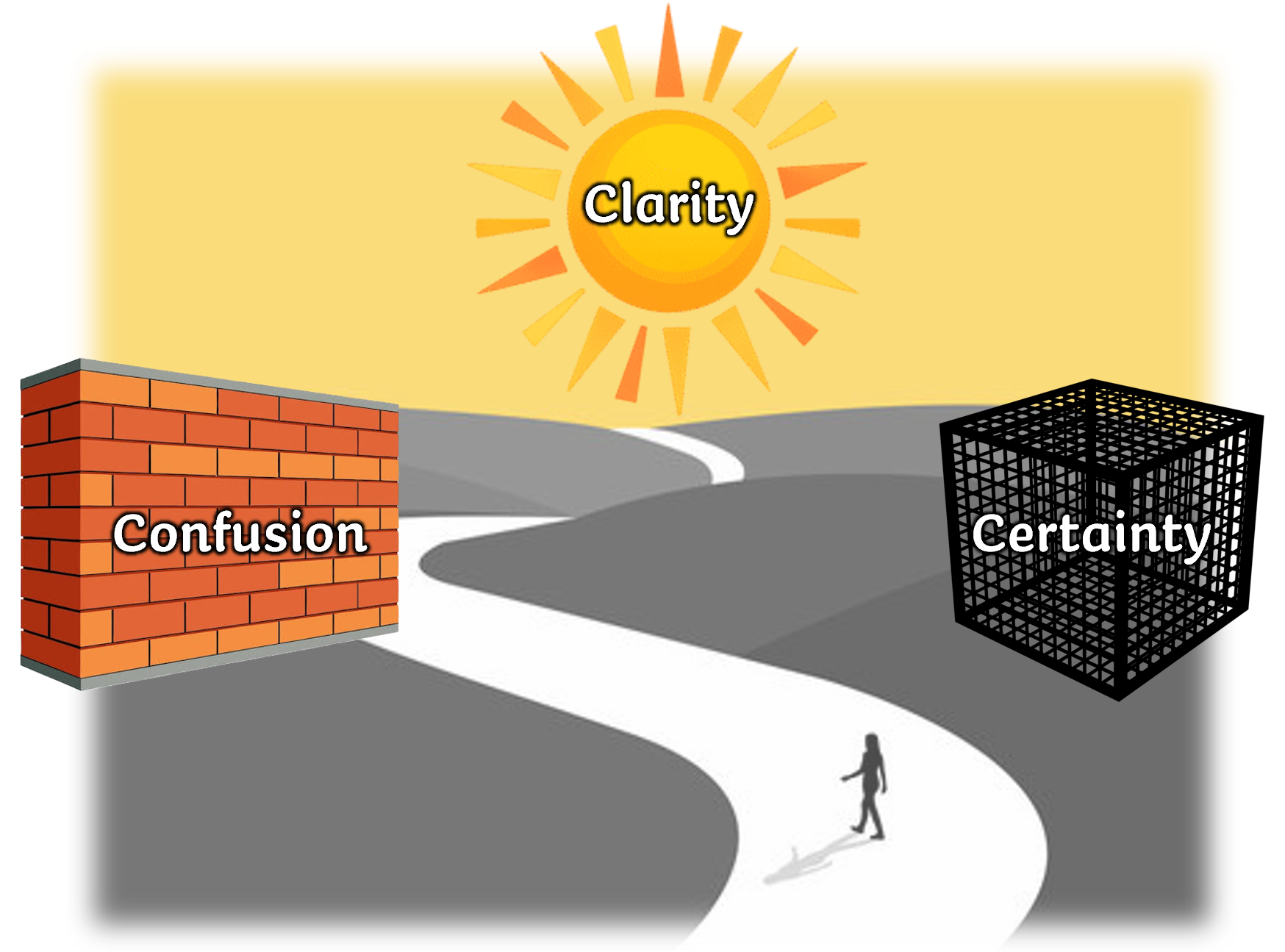
So let’s set the playing field of higher education, where we have a continuum of college student cohorts. Toward one pole of the continuum is the confusion cohort, comprised of students who have no idea why they are in college or where they’re going. They switch majors frequently and many end up stopping-out before completing their program.
At the other end of the continuum is the certainty cohort, who have locked down their choice of major and/or career based on such external factors as job salary, peer behavior, parental and societal expectations. Many of them will complete their college program only to discover post-graduation that the types of work activity in the occupation their program prepared them for are uninteresting, mismatched to their abilities, boring or stressful – only proving the equation that work is suffering.
Their own Plan B awaits.
Both extremes on the continuum have been analyzed for the statistical data to prove that college is a waste of time and money. Either keep switching majors before dropping out, or stick tenaciously with the college program and end up in a second trap called “I hate my job” on the other side of graduation.
That can be a tough trap to get out of, given the need for money and a limited supply of time or energy to look elsewhere, as the student loans and other bills start stacking up.
Any given student is on one side or the other of this continuum, right? Maybe those who give up and drop out early are the really smart ones, at least financially speaking.
Well, first of all, confusion or certainty are not the only cohort options for college students today. In the spirit of Aristotle or the Buddha we might seek a “middle way” between these extremes. This middle way for students in college – and for anyone, in college or not – is called vocational clarity, which I have elsewhere defined as a chosen path of purpose that makes life meaningful.
A “clarity cohort” should be the gold standard for students and the colleges that serve them.
College administrators can (or they could, if they tried) find their confusion cohort by simply tracking how often and when in the process these students change their major. Connecting them to the assessments, resources, guidance and support that can help them achieve vocational clarity early in college (preferably even before they enroll) would be a paradigm-changing step that colleges should consider.
By moving vocational clarity and career development support earlier in the enrollment process, colleges would also be helping students in the certainty cohort move beyond their mental lockdown.
Requiring or strongly recommending students to complete career self-assessments (a work interest assessment in particular) for the purpose of equipping them with a lens for better understanding themselves and exploring occupations in the world of work that center the types of activity they already find interesting, is a responsibility that colleges owe to their students.
It is imperative that we help students appreciate and strengthen the “power lines” that outwardly connect their interests to the activities and skills of work, as well as tie inwardly through their individual intelligence to the deeper creative potential of their developing and still undiscovered talent.
When parents, teachers, coaches, advisors, and counselors can coordinate their conspiracy of support around students with the goal of vocational clarity, the collective enterprise of education will finally be doing its job.

