Diving Deep, Flying High

A lot has happened to get us to this point, where I have written something for you to read and think about.

Fourteen or so billion years ago a quantum singularity broke open to release a burst of infinite energy and give birth to our universe. Within seconds this highly unstable state began to collapse into the first forms of physical matter: superstrings of light, crystalline lattices, and quarkish free radicals that would soon (over the next 150 million years) cool, combine, and form into thermonuclear furnaces of the first stars.

Much, much farther into the future (only about 4 billion years ago) the conditions of organic chemistry necessary for life to emerge gave rise to the first single-celled organisms. Since that point, life has continued to evolve into microbial, plant, and animal forms, developing ever more sophisticated sensory apparatuses and nervous systems among the animals to support an awakening of consciousness.

In the primates, and particularly the hereditary line leading to our own species, this power of sentience acquired the talent of self-awareness, where the formation and management of a personal identity (ego) has now become our constant preoccupation.

So here I am and there you are.

We are just conceited enough to half-believe the rumor which says that we’ve made it to the end, that our species has finally reached self-actualization with the arrival of ego consciousness. The great universal process has been evolving all this time with the aim of achieving an intellectual comprehension of itself in us. This is what the German philosopher Georg Wilhelm Friedrich Hegel believed at any rate.

With the rise of consumerism we’ve managed to put a twist on Hegel’s idea: our special gift is not so much intellectual curiosity as an insatiable craving for what will make us happy. And nothing can make us happy (such is the open secret of our wisdom traditions) which is why we can’t seem to get over ourselves.

It’s like we’re this black hole at the finishing end of evolution, fourteen billion years after the birth of the universe from a primordial black hole. But whereas that one was a spring of creative energy, we have become a sucking drain on the resources of our planet and its fragile web of life.

As long as we continue to regard ego consciousness as the cosmic endgame we won’t be able to change course from a tragic conclusion in global intoxication and our own extinction. If we can’t shift from our present condition to something more liberated and life-affirming, the final outcome decidedly won’t be in our favor.

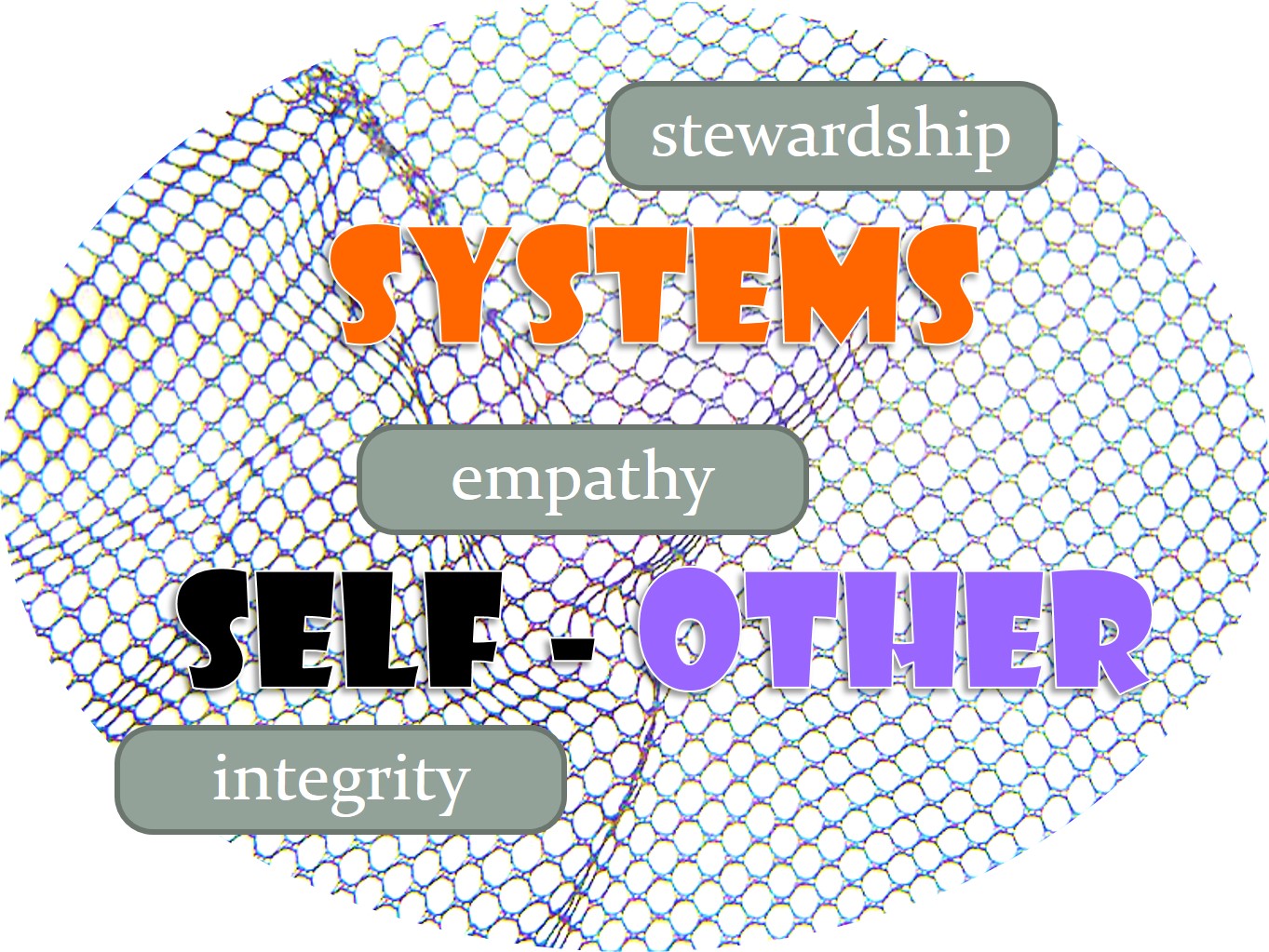
In other posts I have described what I call the three pernicious divisions currently compromising wellbeing and threatening our future. A psychosomatic (soul-body), interpersonal (self-other), and ecological (human-nature) division that breaks the creative polarities of our existence and sets them in opposition (soul without body, self against other, human above nature) undermines our essential wholeness.

I’ve argued as well for seeing theism as a necessary stage in the construction of personal identity (ego) and the social system around it. In its central statement concerning the nature of ultimate reality in terms of personality and will (i.e., the concept of deity), theism provides a stage for our individuation as self-conscious centers of personal identity.

Just as a healthy family system lends provident support and inspiring role models for children in the taller powers who manage the household, so in theism this same arrangement – at least by design – is projected at the societal level. In this household we (first and foremost the insiders) are siblings with one another and children of a god whose will is that we live peaceably together, contribute to the greater good, and grow in virtue.

I characterize theism this way and not as a belief system based in supernatural revelations and miraculous events – which is how it is typically spun by orthodoxy to insiders – for three reasons. First, my characterization is deeply consistent with the evidence we have from the history of religion itself. Secondly it saves theists from having to abandon their common sense, moral conscience, and modern worldview for the sake of holding to a literal reading of their myths.

And finally this model of theism allows for a more responsible and well-reasoned interpretation of a spirituality that thrives beyond the ego, after theism, and on the other side of god – what is named post-theism.

Where does this post-theistic spirituality lead? Not to a hard-line atheism or secular humanism. I’ve clarified these distinctions in other posts, so we’ll move directly to what is unique to post-theism.

Post-theism is transpersonal, which means that it engages with reality beyond ego consciousness. Rather than eliminating ego from the picture, however, this spirituality focuses on making personal identity sufficiently strong (i.e., stable, balanced, and unified) to support the breakthrough experience of a liberated life.

Personal identity continues to be important here as it was in theism. But whereas theism – particularly, I should qualify, in its healthy forms – made ego strength its primary concern, post-theistic spirituality invites us to an experience of reality below the center and beyond the horizon of ego consciousness.

These terms “center” and “horizon” are important to understanding post-theism because they serve to define membership – how we identify ourselves and where our obligations lie. We can clarify them further by saying that our center is what we identify as, while our horizon represents (or contains) what we identify with.

At the level of ego consciousness we identify ourselves as individual persons with unique histories, personalities, and interests: I am a person. Taking this identification means that we also identify with other egos: they are our companions, colleagues, rivals, opponents, and enemies inside the horizon of specifically egoic concerns.

As just mentioned, theism is a social system constructed for the purpose of forming personal identity and developing its potential. Even though it conceives a deity who brought the entire cosmos into being, theism’s primary investment is still in shaping the beliefs, values, and aims of our interpersonal life together in society. Its notion of salvation is centered on our need as persons to be accepted, recognized, forgiven, and reconciled to the tribe that holds our membership.

Below our center of personal identity (or ‘down and within’) are deeper centers corresponding to larger horizons of identity (‘out and beyond’). Whereas we are unique individuals at the egoic level, by dropping to the deeper center of our life as sentient beings who can sense and feel and suffer, we also identify with all sentient beings. The values and concerns that orient our existence now include much more than other egos.

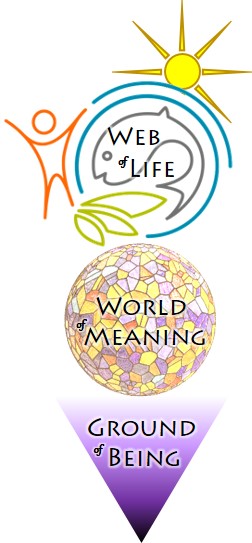
Drop another level to a still-deeper center and we identify ourselves as organisms, or living beings that exist interdependently with countless others in a great web of life. Now our values and concerns open transpersonally to an even larger horizon where we recognize our influence, for good or ill, as well as our responsibility within the biosphere of our living planet.

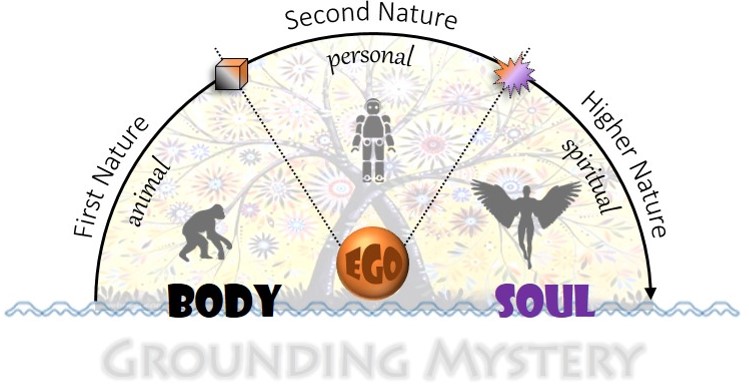
From this center of our life as organisms we can only contemplate the material and quantum realms farther below (and within) as the ineffable ground of being itself. And altogether, from this dark abyss of energy and matter, focusing upward through the realms of life and sentience whose rhythms and animal intuitions support our unique center of personal identity, is what I name the grounding mystery.

With each center up or down, our awareness expands or collapses to its corresponding horizon. The capacity for diving deep and flying high in this manner is a transpersonal capacity, and it takes ego strength to make it possible.

Truth In Christian Mythology

One of the challenges in clarifying a post-theistic spirituality has to do with the fact that its principal concern – what I name the present mystery of reality – is impossible to define. While it is always and only right here, right now, any attempt to put a name and definition around it only manages to conceal the mystery under a veil of meaning.

Our need for certainty might be temporarily satisfied, but in the meantime the curtain of mental tapestry has separated us from what’s really real.

If we could acknowledge that this is what we’re doing, these veils would stand a better chance of parting before the mystery and facilitating a fresh encounter of our mind with reality. But while constructivism makes such an acknowledgment central to its method, orthodoxy, in every cultural domain and not only religion, cannot admit this either to its constituencies of believers or even to itself.

Our mind has a tendency to fall in love with its constructions, to get lost in its own designs. Meaning is something we can control, since it is, after all, our peculiar invention. Mystery – not even “on the other hand” since this puts it on the same axis as meaning – requires an open mind, not one boxed inside its own conclusions.

Our best constructs don’t amount to final answers but better – deeper, larger, and farther reaching – questions.

With the rise of science, the truth of our constructions of meaning (called theories) has become more strongly associated with how accurate they are as descriptions, explanations, and predictions of what’s going on around us – that is, in the factual realm external to our mind. (Even the scientific understanding of our body posits it as something physical, objective, and separate from the observing, analytical mind.)

In the meantime and as a consequence of this growing fascination with objectification, measurement, and control, we have gradually lost our taste and talent for a very different kind of narrative construction. One that doesn’t look out on a supposedly objective reality but rather contemplates the grounding mystery of existence itself.

Myths have been around far longer than theories, and one of the early mistakes of science was to assume that these ancient stories were just ignorant efforts at explaining a reality outside the mind.

Deities and demons, fantastical realms, heroic quests, and miraculous events – the familiar stuff of myths: such were not validated under scientific scrutiny and had to be rejected on our advance to enlightenment. Religion itself fell into amnesia, relinquishing its role as storyteller and settling into the defense of a supernatural realm above the natural realm, or (trying to seem more scientific) a metaphysical realm behind the physics of science.

Otherwise, religion agreed to keep its focus on morality and the life to come.

The theism-atheism debate is relevant here and only here, where the factual (i.e., supernatural, metaphysical) existence of god makes any sense. Theists insist that their stories are literally true and the mythological god is real, while atheists claim they are not, for obvious reasons. Theists profess the necessity of believing in god’s existence as a matter of faith, whereas atheists rightly point out that believing anything without the evidence or logic to support it is intellectually irresponsible.

They are both at a stalemate. We need to move on …

Post-theism provides a way out of this predicament by challenging us to put aside both metaphysics and physics as we reconsider these timeless myths. Their truth is not a matter of factual explanation but mystical revelation – or if you prefer, artistic revelation, precisely in the way a true work of art presents us with an artifact to contemplate and then draws back this veil on a present mystery. This mystery is the here-and-now experience that inspired the artist to begin with.

As revelation, however, it is not a look at someone else’s past experience of the here-and-now but offers a spontaneous insight for the beholder into the deep mystery of This Moment.

To show what I mean, let’s take the central myth of Christianity which has been summarized by orthodoxy in the doctrines of the incarnation, crucifixion, and resurrection of Jesus Christ. But whereas Christian orthodoxy has attached these exclusively to the historical figure of Jesus, that is to say, to a person in the past, we will regard him instead as an archetypal figure, as an instance of what Joseph Campbell named The Hero.As Campbell demonstrated, this Hero has ‘a thousand faces’ reflecting the divers cultures and epochs where his (and her) stories are told – stories that can be interpreted and understood archetypally as about ourselves.

The Hero, then, is our ego, or the self-conscious center of personal identity that each of us is compelled to become. My diagram illustrates this journey of identity with an arching arrow representing the linear path of our individual lifespan. Personal identity is not something we’re born with, and its character cannot simply be reduced to our genes and animal temperament.

Quite otherwise, identity must be constructed, and its construction is a profoundly social project involving our parents and other taller powers, along with siblings and peers who make up our cohort through time.

Just as the Hero’s destiny is to serve as an agent of cultural aspirations (a struggle against fate), progress (a counter to the stabilizing force of tradition), and creativity (as an instigator of new possibilities), so does his or her path chart the trend-line and opportunities associated with our higher evolution as a species.

Briefly in what follows I will translate the incarnation, crucifixion, and resurrection of Jesus Christ as representing three primary stages in the Hero’s Journey each of us is on.

What I call the grounding mystery of reality is all that has transpired to bring forth our existence as human beings. This refers not only to the causal sequence of events leading up to us, but each distinct manifestation of the universe making up our present nature as physical, organic, sentient, and self-conscious individuals.

From our position of ego consciousness we look ‘down’ into the ground of what we essentially are.

As mentioned earlier, it is our socially constructed center of separate identity (ego) that arcs in its journey out, away, and eventually back to the grounding mystery. Because personal identity is socially constructed and independent of genetic inheritance, the start of its journey is represented in the myths as something of a vertical drop from another realm. The Hero may simply show up, but frequently in myths its advent comes about by way of a virgin birth.

Staying with this natal imagery, our best description would be to say that ego is spontaneously conceived (or ‘wakes up’) in the womb of the body.

The longer process of ego formation involves the attachments, agreements, and assignments that conspire to identify us as somebody special and separate from the rest. Our tribe provides us (or so we can hope) with models of maturity, responsibility, and virtue, in the taller powers of adults who watch over us; but also in the construct of a personal deity who exemplifies the perfection of virtue.

In my diagram I have colored the construct of god with a gradient ranging from purple (representing the grounding mystery) to orange (representing ego consciousness), in order to make the point that god is not merely another being, but the personified ground of being as well as the exalted ideal of our own waking nature.

But at the very apex of ego’s formation, just as we come to ourselves as special and separate from the rest, another realization dawns: that we are separate and alone. In the heroic achievement of our unique individuality we also must somehow accept (or otherwise resign to) the full burden of our existence as solitary and mortal beings.

In the Christian myth this is represented by Jesus on the cross when he cries out, “My god, my god, why have you forsaken me?!” (Mark 15:34)

As a narrative mechanism, the cross thrusts our Hero away from the earth but not quite into heaven either, where he hangs in a grey void of isolation, exposure, and abandonment. This is the crucial (‘cross-shaped’ or ‘cross-over’) point that can lead either to utter despair, a desperate craving for security and assurance, or to the breakthrough of genuine awakening.

Which way it goes will depend on our ability to sustain this shock of loneliness and look not away but through it to a transpersonal view of life.

It’s not a coincidence that Jesus’ followers recognized his cross as central to his vision of the liberated life. It was a visual depiction of his core message (gospel) concerning the necessity of dying to one’s separate and special self, whether that specialness is based in a felt sense of pride and superiority, or in shame and inferiority. Both, in fact, can equally fixate ego on itself and keep us from authentic life.

Only by getting over ourselves can we enter into conscious communion with others and with the greater reality beyond us.

Entering into the authentic life of a transpersonal existence brings us to the third stage of our Hero’s journey: resurrection. This isn’t a recovery of our former life but an elevation of consciousness to the liberated life, to what I also call our creative authority as individuals in community. In the Christian myth this higher state of the liberated life is represented in the symbol of an empty tomb, which plays opposite to the virgin womb as the locus of our Hero’s ‘second birth’, set free from the constraints of insecurity, ambition … and belief.

From a post-theistic perspective, one gift of the liberated life is a grace to live in full acceptance of our own mortality, of the passing nature of things, and of the deep abyss in the face of which our most cherished veils of meaning dissolve away.

Who Do You Think You Are?

The modern paradigm of medical and mental health has a built-in bias for diagnosis, due in large part to its historical interest in isolating and treating pathology of various kinds in the body and mind. A consequence of this bias is that while we can zero in on what’s wrong or not working properly, our understanding of what constitutes psychic (mind) and somatic (body) wholeness is less developed.

Individual sufferers go to professionals for help, many of them privately hoping that their psychosomatic health and quality of life will be elevated as a result. Instead they find themselves subjected to ‘treatment plans’ designed to suppress symptoms of dis-ease rather than actualize genuine wellbeing.

When I was in graduate school for a master’s in counseling I was surprised – and increasingly more aggravated – by the requirement put on students to choose our guiding theory from among current orthodox protocols of diagnostic psychotherapy. As professional therapists we would need to work closely with insurance companies, with doctors who could prescribe drugs, and (of course) with the latest edition of the Diagnostic and Statistical Manual of Mental Disorders (DSM) which is continually inventing more categories to pigeonhole the symptoms of suffering among the general population.

Even then it was obvious to me that a concept of ‘disorder’ must presume some deeper grasp on what ‘order’ (aka health, wholeness, or wellbeing) is, but this was barely discernible in the literature and never explained in the classroom. I began to suspect that some larger conspiracy might be directing our training as students and future professionals in the field. As counselors (and not drug prescribers) we could offer short-term talk therapy for clients, but the real money lay in tying client symptoms to more serious disorders with a basis in neurobiology that could justify pharmaceutical interventions.

Now, I’m not denying that some cases can benefit from a combination of talk and drug therapy – although the trend these days is to get patients through counseling and on open-ended prescription medication plans if their symptoms persist, which in 70% of cases they do. Strong research suggests that this rather abysmal success rate of therapy (of either type or in combination) can be attributed not to the particular protocol used, but to the fact that individual sufferers don’t readily take responsibility in the salvation they seek.

And this, in my opinion, swings back around to a diagnostic paradigm that effectively ignores the person and reduces suffering to symptoms seemingly outside the individual’s choice or control.

If we are to take responsibility in our suffering as well as creative authority in our pursuit of wellbeing, we need psychotherapeutic models that envision us as actively engaged in the construction of both suffering and wellbeing. In a sense, that’s what I am working toward in this blog. So it’s in that spirit that I offer another installment on the question of identity and our human journey.

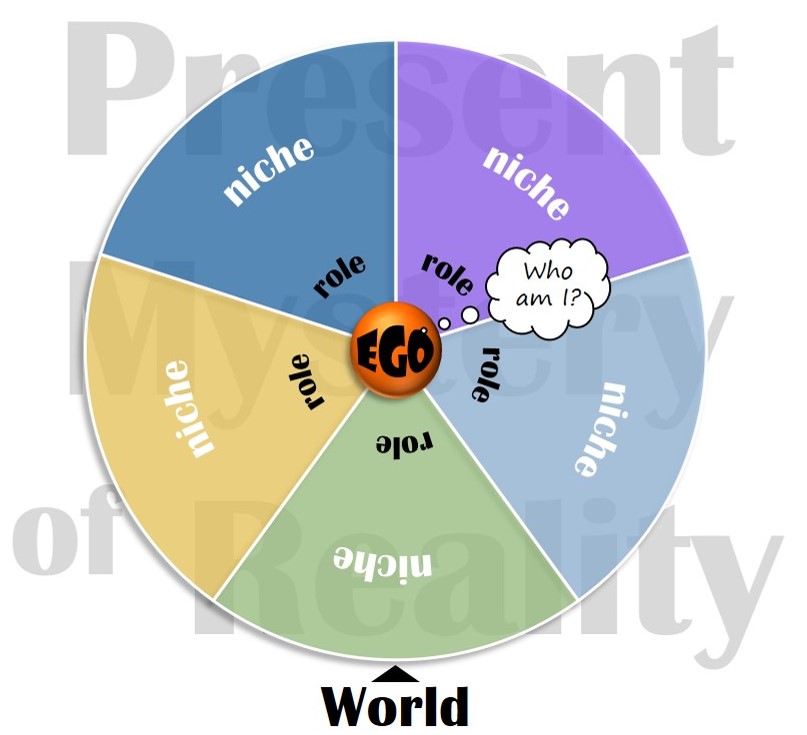
My diagram contains a lot of terminology relative to the construction of identity, but we’ll step through it in a way that simplifies things considerably. Let’s begin at the middle, where the executive center of identity known as our ego is represented. Ego is how we identify ourselves, as the starring actor in a story we’re continually telling ourselves and others – our personal myth. Every myth has a supporting cast of other actors whose importance in the narrative is a function of their proximal influence on matters concerning our need to feel safe, loved, capable, and worthy.

Each of these four feeling-needs (referring not to the fact of our being safe, loved, capable, or worthy, but our need to feel we are such) presents itself at a critical period of our development, in this precise sequence, rising upon earlier ones and setting the stage for those coming later. (As is often the case with my diagrams, information should be read organically from the bottom and flowing or growing upward.)

The four feeling-needs further organize into two broader concerns connecting to ego’s need to belong (or fit in) and be recognized (or stand out) – the two polar drives in our construction of identity. Belonging answers our need to feel safe and loved; recognition satisfies our need to feel capable and worthy.

You can appreciate their polarity in the way they pull against each other: the effort to gain approval (a type of social recognition) often involves a willingness to give up some anonymity (a type of social belonging). Conversely, if our first priority is to hold a position of acceptance (another type of belonging), we will try not to draw undo attention to ourselves (another type of recognition).

In dynamical systems, something called an ‘attractor’ is a recurrent code that draws a system into persistent patterns of organization. In our consideration of the pattern known as personal identity (or the construct of who you are), two polar attractors drive development: at one end is the secure base (an attractor for safety, love, acceptance and belonging), while at the other end is the proving circle (an attractor for personal power, worth, approval and recognition).

Archetypally these correspond to our mother (or mother figure) and father (or father figure), respectively. A number of Freud’s most enduring insights can be liberated from his theory of sexuality and better understood archetypally in these terms instead.

The unique admixture of temperamental predispositions, environmental conditions, and personal life events tends to ‘lean’ our personality more toward one attractor than the other. Even within the range of so-called normal psychology this is the case. A normal well-adjusted personality can value belonging over recognition, or vice versa. The important point is that both attractors and their associated values are critical to our identity and mental health.

What this suggests is that our individual personality can be understood (not diagnosed!) as either security-seeking or esteem-seeking. Identifying more with one doesn’t mean that we have no interest in the other; healthy identity is somewhere in the balance of both. If you happen to value safety and love over power and worth, it may simply reveal that close relationships are more important to you than personal achievements, not that accomplishing things and making progress don’t matter.


You were probably waiting for me to mention this: It can happen that the balance snaps and we get stuck at one pole or the other. Security becomes everything and we end up giving all our energy to pleasing and placating the people we feel we can’t live without. (This is common among children of addicts and victims of abuse.) Or else if we’re caught at the other end, we stay busy trying to flatter and impress others so they’ll esteem us as somebody important and worthy of praise. (This is frequent among celebrities and performers of various kinds.)

The goal of development is to hold the balance and use our stable center of personal identity to leap (or drop) into a larger (or deeper) experience of wholeness and wellbeing. More about that next time …

It’s Not All About You

The holiday season affords fresh opportunities for us to get poked, when others get to see sides of us that, in normal and less stressful times, we manage to keep off-stage. A combination of spending money we don’t really have, fighting traffic on the streets and in stores, and gathering with family members who know best where to poke, puts us in that peculiar holiday mood of excitement, fatigue, annoyance, and regret.

Of course, things would probably go better for us (and for those around us) if we understood what it is inside us that gets triggered, causing us (at least that’s how it feels) to act out in ways we later wish we hadn’t. But this would require some serious and honest self-reflection, when our habit is not to look too closely at what’s going on inside.

To what Socrates said about the unexamined life not being worth living, we could add, with the Buddha, that it also perpetuates needless suffering.

In this post I will guide you on a tour of your personality’s interior – yes, it’s true, of mine as well, along with everyone else’s. My constructivist approach to psychology takes the view that our personality, including its executive center of identity (ego, Latin for “I”), is an illusory architecture of social codes, reflexes, attitudes, and defenses that seems very real but is utterly lacking in substance. Who you are, as distinct from what you are as a human being, is purely a construct, a configuration held together by the pretense of being somebody.

The part of your personality that ego presents to the world, also called your ‘on-stage’ self or mask (Latin persona), is confronted with the challenge of negotiating the satisfaction of your needs in an environment of limited resources and the competing interests of other actors. As long as there are no major surprises, emergencies, or unknowns you can manage this negotiation from day to day without much trouble. But when conditions change unexpectedly or you’re forced into situations where you feel threatened, this ‘thin skin’ of who you’re pretending to be can tear open under the stress.

At this point, still deeper and heretofore hidden vulnerabilities are exposed, and these activate more severe defenses – what Wilhelm Reich named ‘character armor’.

My diagram has taken an illustration of Earth’s interior and adapted it to represent the interior of your personality, with its distinct layers of character armor and the vulnerabilities they are meant to protect. The general idea is that deeper pokes (i.e., assaults or threats that penetrate the surface pretense of who you are), provoke more aggressive and extreme defense reactions, presumably because what’s being defended is closer to the core of who you (believe you) are. My guided tour will begin at the very core and then move out from there into layers higher up and closer to the surface of your managed identity.

I’ve made the point numerous times in this blog that all of us without exception have some degree of insecurity at the core. This is inevitable, given our imperfect parents and the unavoidable mis-timing between the urgency and satisfaction of our basic needs in infancy. So it’s not whether we are insecure, but to what extent our deeper insecurity wreaks neurotic havoc in our personality.

We can think of insecurity – although importantly it insinuates itself into the personality before we have acquired language to name or think about it – as an ineffable (unspeakable) sense of risk attached to existence itself. To some extent we all hold a lingering doubt regarding the provident nature of reality.

When external conditions and events make you feel at risk, it’s this character armor around your core insecurity that gets poked. While in most situations of this kind your very existence is not in question, the effect of such surface signals is to arouse a suspicion against reality and its full support. Perhaps there is a memory of an actual past trauma that your present situation is evoking, or it might simply be pressing upon your general anxiety over the prospect of falling into The Abyss.

For mystics, meditation amounts to an intentional descent (what ego fears as a fall) past the personality and deeper into the grounding mystery of being (ego’s Abyss). In popular religion this release of surrender is called faith – commonly confused with belief, and consequently corrupted.

You need to remember that your personality was formed partly by a conspiracy of taller powers (parents, teachers, mentors, and other adults), but also by the strategies you used to get what you needed. Some of these strategies worked marvelously, while others failed miserably. A complicating factor was the insecurity you carried into each new challenge or opportunity.

Even though the challenge or opportunity was directly about your ability to resolve, overcome, or move through it successfully, a sense that reality might not provide the support you needed undermined your self-confidence. The next layer up from the core of insecurity, then, is all about inadequacy: not being enough or having what it takes.

When you feel inadequate, you are willing to let opportunities slip by. This is because you don’t regard them as genuine opportunities – doors opening to possibility, growth, or improvement – but instead as challenges, in the sense that they require something from you and carry a risk of failure.

Your sense of inadequacy, with its roots in insecurity, quickly re-frames such challenges as problems, which you want less of, not more. You trick yourself into believing that you are avoiding a problem when you are actually turning down an opportunity.

One more layer and our picture is complete. Personalities that lack faith in reality and confidence in themselves commonly employ strategies whereby they compare themselves to others – but also to the ideals of perfection they have in mind – and consistently see themselves as not measuring up. In this way, inadequacy translates into inferiority.

The French psychologist Alfred Adler believed that a sense of inferiority is an early driving factor in human development, as youngsters measure themselves against their taller powers (literally superior, as in above them) who seem so omnipotent.

According to Adler’s theory we can come to adopt an inferiority complex where not only are our efforts never good enough, but we ourselves aren’t good enough as compared with others or our mental ideal. As compensation we may insist on our own self-importance, or push others down so we can feel better about ourselves.

With this stratified model of the personality in front of us you can better understand how identity is constructed, at least in part to sustain the illusion that you are somebody. You have it all together, and you show others only what you want them to see. But be ready. As you gather at the table or around the tree this holiday season, you just might get poked.

It will be a good time to remember that it’s not all about you.

The Filters of Illusion

Constructivism is a philosophy that regards the mind as not merely active in our experience of reality (as opposed to some early modern theories which regarded it as a ‘blank slate’ written upon by experience), but creatively active in the way it constructs the mental models we take as our reality. In the course of ordinary experience we don’t typically discriminate between our constructs and the reality they are meant to represent. Constructivism makes such discrimination foundational to its method.

One important implication of this is that because meaning is constructed by the mind, and because our constructs are mental models and not reality itself, what we normally take as real is really being mistaken as such. In other words, our constructs are illusions that shape and filter our perceptions of reality. Truth, then, becomes a question of how reality-oriented (or realistic) a particular illusion is.

Reality-itself remains a mystery, and every time we construct a model (e.g., a concept, belief, or even a theory like constructivism) to make sense of it, we are spinning a veil of meaning – an illusion that removes us to some degree from what is really real.

The application of these insights as therapy, which is to say, as a method for not only understanding the nature of illusion but living as much as possible in communion with the present mystery of reality, is yet another persistent fantasy of mine. I don’t presume that our goal should be to break entirely and permanently free from illusion, but rather that we should self-consciously step into our creative authority as meaning-makers, storytellers, theory-builders, and make-believers.

Instead of mistaking our mental models for reality, we can acknowledge their character as illusions and proceed to look through them, as veils parting (literally revelations) before our minds. Once we see it, we can then do something about it.

It can happen, however, that an illusion is particularly persistent, in which case the veil doesn’t part but instead traps our mind inside its own delusion. Here there is no difference between a construction of meaning and the reality it represents – there cannot be, simply because what is believed must be the way things really are. We have too much invested in our illusion, too much of our security and identity tied up in the web of meaning we have constructed. We are not free, nor do we wish to be. For without meaning reality would be … well, meaningless, and who could bear that?

Actually, the mystical discovery that reality is perfectly meaningless is wonderfully liberating.

In this post we will analyze three filters of illusion that characterize normal psychology, but which of course can conspire in distressed, demented, or radicalized minds to put individuals so out of touch with reality that great harm can come to them, and through them to others. My interest is with normal and not abnormal psychology, since this is where most of us live. If we can understand how normal people lose touch with reality, we might also gain some insight into what happens when someone falls pathologically into delusion.

My diagram depicts an eye looking out on reality – not the so-called reality represented in our mind, but the present mystery of reality independent of our mental models. It is ineffable: indescribably perfect and perfectly meaningless. The first and most massive filter of illusion is our personal worldview, which is not only the internal picture we have of what’s outside us, but a projection of what’s going on inside us as well.

The philosophy of constructivism received strong confirmation as commerce, conquest, and migration revealed a diversity of cultural worldviews on our planet. This challenged us to consider the possibility that such local distinctions at the societal level might continue down into even more granular detail for individuals – which, of course, it does. Each of us maintains a filter of illusion that represents our place in the scheme of things.

Throughout life our worldview will be updated and evolve in response to greater depth and scope in the range of our experiences.

It is possible for our worldview to lock up and resist this normal process of reality-checking what we think we know. To understand the cause behind such resistance we need to go one step deeper into the filters of illusion. What we find there are ego ambitions that drive and define our personal life – craving those things we feel we can’t be happy without, and fearing the prospect of not getting them or losing them once we do.

This dual drive of desire and fear is the mechanism that defines ambition (ambi = both or two). Our ambitions can be so powerful as to make us insist that reality must be set up in such a way as to support our fantasies of happiness; hence our worldview as a projection of deeper forces within us. Our mental models are less about reality in some objective sense, and more about the restless ambitions that subjectively preoccupy us.

According to the anonymous maxim, we don’t see things as they are, but as we are.

But we’re not yet at the deepest filter in our construction of meaning. One last step carries us into those earliest and most urgent points of interrogation by which our sense of self and reality is forged – what I name our feeling-needs. Whereas our conventional notion of need refers to a correlation between an internal requirement and an external resource, such as the need for nutrition and the provision of food, a feeling-need refers to our need to feel safe, loved, capable, and worthy.

A key to understanding feeling-needs is recognizing that they are not necessarily correlated to external reality. We may be safe in actual fact and completely sheltered from danger, but if we don’t feel safe, that’s what really matters. I’ve written about feeling-needs in other posts, so we won’t go much farther into them here, except to point out the way they are developmentally implicated in each other.

A lack of feeling safe compels us to satisfy this need at the level of love, which turns relationships into attachments. Because real love only grows in freedom, our need to feel loved cannot be satisfied here. So we employ our capabilities in an effort to earn, flatter, please, impress, or coerce others to love us. As a consequence, our sense of worthiness gets tied to acceptance and approval by others, whether we are useful in their feeling-need satisfaction strategies.

In this way individuals become mechanisms in a codependent dysfunctional system, neither one getting what they really need but each too anxious to let go.

Following this sequence in reverse, we now have a better understanding of the filters of illusion. Our unique profile of frustrated feeling-needs fuels our ego ambitions, which in turn predispose us to imagine and construct a personal worldview where our hopes can be fulfilled.

And all of this as we live, right now, in the present mystery of reality.

Human Evolution

In a post from long ago entitled Humanism in a New Key, I offered an interpretation of post-theism where the re-absorption of higher virtues formerly projected in the deities of religion opens up a new era in our evolving spirituality as a species. If the idea of an external god is understood in terms of an intentional object (i.e., as a construct of our mythopoetic imagination) rather than a metaphysical one (i.e., as a being existing outside and separate from us), this critical step can be welcomed and celebrated.

I don’t presume that all theists will embrace the notion, but for many (including myself as a former theist) it can mark the breakthrough to a liberated life.

I find it helpful to view this process in the time-frame of human evolution as it has unfolded over many millenniums. Our species itself emerged in Africa perhaps 200,000 years ago, a late product of the natural evolution of life on Earth. Upon arriving, we proceeded to evolve still further under the shaping influence of culture – a construct system of language, symbols, stories, and technologies that continues to lift us by our own bootstraps.

If the evolution of nature brought about our uniquely complex nervous system and social intelligence, this gear-shift of cultural evolution will lead either to our fulfillment as a species or to our self-destruction. Because human culture is a work in progress, which direction we go remains an open question.

When our theory lacks imagination and insight, the purpose of culture gets reduced to little more than managing nature – our own as well as the natural order around us. In this view, with all its clever innovations and sophisticated methods, culture is just a fancy, interesting, but problematic way of keeping us alive and making copies of our genes – like ‘putting lipstick on a pig’, as we say. Cultures rise and fall, come and go, but we can only fall and go once from the scene of nature to be gone for good. Religion and science fiction can muse over angels and androids and faraway realms, but our real business is survival on this third rock from the sun.

On the other hand, it could be that our fulfillment as a species depends on something original to culture, something not merely derived from or sublimated out of our nature as highly evolved animals. I call this original element community – or more specifically, genuine community – and I’ve tried to show in numerous posts how religion plays a key role in its formation. Genuine community is not merely a society of individuals who get along; something much more transformative is going on.

The larger trajectory towards fulfillment is still unfolding after these many thousands of years, and we today stand on a critical threshold where our next step will bring about a breakthrough or (almost just as likely) a breakdown.

There is a debate over whether human evolution will reach its fulfillment with genuine community (as I argue) or instead with the rise of extraordinary individuals who possess super-human powers and abilities. The ‘exceptionalists’ focus their hopes on such paranormal abilities as levitation, mind-reading, bending spoons, or turning water into wine. They talk of higher consciousness, perfected nature, and immortality, but their specimens are typically from another time and quarter, or else ‘presently unavailable’ for closer examination.

When serving as a Christian pastor, I was frequently taken by how believers’ regard for Jesus as just such an exception kept him safely at a distance and released them of any obligation to be like him. Maybe the possibility was there, but only for the spiritually gifted, not the rest of us.

By shifting our focus to the evolution of community, we don’t have the option of worshiping perfection from a distance. As I see it, our advancement as individuals and the formation of genuine community are deeply correlated. Community provides the supportive environment where identity is constructed and personal commitment to the health of the whole is empowered in the individual. The individual then adds his or her creative influence to the community, which continues to foster a still higher realization of wellbeing. Thus a provident community and personal commitment progressively co-elevate the project of human evolution.

My diagram gives an illustration of this laddering dynamic. Again, a provident community instills in the newborn and young child a deep sense that she belongs. As she matures, the youngster is encouraged to participate in the community as a contributing member. And eventually, if all goes well, the young adult will take a responsible role in creating the new reality of an even stronger, more provident community for all.

This would amount to little more than a redundant cycling of new generations taking their place in society, except for the fact that it has been evolving. And the direction of this evolution – despite occasional setbacks and derailments along the way – has been steadily toward what I call the human ideal, by which I mean the fully self-actualized human being.

Like all living things, we humans have a potential locked up in our genes, but also encoded in the memes (symbols, stories, and folk wisdom) of culture, that gradually opens and develops in the direction of our maturity and fulfillment.

Beyond our physical, emotional, and intellectual maturity as individuals, there are still higher aims that have to do with our life together in community. In a recent post I identified five ethical virtues in particular that are recognized across all cultures as representing this human ideal.

My diagram displays these five virtues at the apex of an ascending arrow, which makes the point that this ideal is always ‘above and ahead’ of us, igniting our aspirations as well as measuring our progress or lack of it.

Theistic religion early on took up the task of focusing human contemplation on the higher virtues of humility, compassion, kindness, generosity, and forgiveness, which it personified in metaphorical figures of deities – humanlike but more perfect, bending their providential powers in the interest of a cohesive community. In myths that were regularly recited and performed in ritual settings of worship, the gods ‘characterized’ how devotees were expected to behave. (As projections, they could also deify our cruder and more violent tendencies as well.)

First by obedience, and gradually more and more by way of aspiration and endeavoring to be ‘like god’, the community of believers began to demonstrate the virtues in their interactions and way of life. This inward activation of what had been externally represented marks the evolutionary threshold where theism transforms into post-theism, where god relocates, as it were, from heaven into the heart, becoming the sacred center of an awakened and liberated life.

Education, Refocused

Let’s assume that when students say they are in college “to get a job,” they really are answering honestly – and hopefully. But let’s also leave open the possibility that what students are really hoping for is life direction, an opportunity to discover and develop the creative potential they possess and live it out in a deeply meaningful way. They may not have the insight and vocabulary to articulate their aspiration in these terms, but the yearning is there, along with a willingness to entrust themselves to an education system committed to this same outcome.

And that’s where the process breaks down.

In fact, the education system is not very much interested in students’ self-discovery; they should be taking care of that outside of class. School is a place for gaining knowledge and skills that will one day land the successful graduate in gainful employment – in a job. And while that sounds very similar to what students themselves are saying, my experience in higher education reveals something else. Most students don’t just want a job; they want purpose.

On the left side of my diagram I have arranged five terms often used interchangeably in respect to the nature of work. As is my custom, their arrangement is hierarchical and organic, which means that the distinctions in value are to be read as growing up from the bottom.

The first value distinction in the nature of work is a job, sometimes taken as a humorous acronym for Just Over Broke. A job is a means for getting money, and quite a lot of jobs pay barely enough for us to keep the lights on, gas in the car, and food in the fridge. The principal reason you might go looking for a job is to make the money you need to afford the basic necessities of life. Students don’t go to college to get a job. They want something more.

An occupation is literally work that keeps you busy, or occupies your time. Out in the world of work there are many occupations – many forms of work whereby individuals keep themselves busy day after day. This value distinction represents a slight up-shift from the objective of staying just over broke. You give your time to an occupation in the hope that it will end up being a decent trade. While a job only pays you money in exchange for your labor, an occupation typically offers more in the form of benefits, promotions, and other incentives.

A profession requires specialized training to acquire the knowledge and skills you need. Post-secondary, technical, and trade school programs are designed to teach and qualify students for work in all sorts of professions: manufacturing, engineering, medicine, business management, social services, etc. For each, there is a special set of skills to master, certificates to achieve, and degrees to earn. As a successful graduate, you hope to find work in the profession for which your college degree prepared you. Almost half of college graduates, however, end up finding work in occupations or jobs outside their chosen degree.

In my diagram, a line to the right circles into a spiral to illustrate the current focus of higher education. Colleges recruit students, turn them into graduates, and then release them to join a trained workforce. The prosperity of every society depends on workers who possess the skills and are willing to trade their time in work for the money they need.

As he sat in a university library in London and pondered this situation, Karl Marx realized that many (or most) of these workers were not finding joy in what they were doing. A big part of this discontent, which Marx analyzed as exploitation, oppression, and the alienation of labor, was a function of capitalism and the way it separates work from the human spirit of the worker, all in the interest of increasing the wealth of those who own the technology of production.

This alienation of the human spirit from truly creative and meaningful work is a condition currently fueled by our education system.

Two more terms in my hierarchy of value distinctions can clarify what I mean by this claim. While a career is commonly just another name for a profession, occupation, or job, it refers more specifically to the arc of your lifespan and the evolution of identity. The person you are is itself a product of numerous storylines arcing and weaving together in a complex tapestry of meaning. There never has been someone just like you, and there never will be again. The unique pattern of aspirations and insecurities, of preferences, insights, and concerns that inform who you are is still evolving.

From the time you were very young until this moment, your creative engagement with life through childhood play, backyard adventures, self-discovery, artistic experimentation, formal training, and in various kinds of work has shaped you into the person you are today.

Students – particularly college students – are fully immersed in this work of constructing identity. They long to connect their current stage in life to the developing core of who they are. One day they hope to find their place in the world, where the spirit within them (referring to the innate desire and drive of human beings to connect, create, and contribute) will take wing.

Every culture and spiritual tradition acknowledges this spirit within, this deep and rising need to transcend mere self-interest for the sake of a higher and larger experience of reality. Many have interpreted it quite intuitively as an invitational call of reality to the self, as a calling from beyond ego. This is the literal meaning of our term vocation.

The career of your identity (or the story of who you are) has brought you to numerous thresholds where the calling of a higher purpose invited you to get over yourself, shift perspective to a bigger frame, and devote your energies to what really matters. Many times (perhaps most) you ignored the call, turned down the volume, got distracted, and carried on with life-as-usual.

Vocation is less about where we feel called or what we feel called to do than what we are called to become. Hero myths from around the world have the protagonist going different places and undergoing different challenges, but they share a central fascination with how the hero changes or is transformed in the process. The hero might be killed and rise to life again with new powers, discover a hidden key that unlocks the gate to freedom, overcome his fear and confront the dragon, or find within herself a virtue that had lain dormant until the critical moment – the circumstances are secondary to the peculiar virtue gained or revealed in the hero’s transformation.

It seems clear to me that what is revealed in those mythic heroes is something their storytellers saw as a human potential. Even though European rationalism made a break from ancient mythology, claiming that humans had attained the fulfillment of their nature with the Age of Reason, our current education system – as both product and mechanism of this preference for rational technique over human virtue – is glaring evidence of how truly ignorant we are.

We don’t hold before our students the high ideal of what the human being possesses in potentia, nor does the typical classroom instructor stand before them as any kind of self-conscious model of virtue or its aspiration.

A refocused education system would not only turn out graduates into a trained workforce, but it would work to inspire and support students in their pursuit of enlightenment. Students aren’t in college just to get a job, but to clarify who they are and what their own hero’s journey is all about. What I’m calling an enlightened humanity refers to the actualization of virtues that exemplify our higher nature.

Five rungs of an ascending ladder in my diagram correspond to five existential and ethical virtues (capacities, powers, qualities, or abilities) that have strong recognition across all cultures, not necessarily independent of their different religious traditions but transcending (going beyond) them in a higher post-theistic focus.

An enlightened humanity is humble (or grounded: from humus, ground), compassionate, kind, generous, and forgiving. An intentional pursuit of this ideal aims to embody and live out these virtues in ever-increasing degrees of realization. This is our vocation, or calling, as a species. Our culture and education system need to renew our commitment to them, just as each of us ought to measure our progress and purpose in life according to how well we demonstrate these virtues in action.

As far as our prospect for genuine community, the liberated life, and planetary wellbeing is concerned, refocusing education on an enlightened humanity may be our most urgent task at hand.


For more thoughts on the state of education today, check out the following posts:

The Underground to Community

Today more than ever our planet needs us in community. Our species is so careless and disorderly, so thoughtless and destructive, so self-involved and unconcerned over the catastrophic impact our behavior is having on the larger web of life – upon which our own viability and well-being depend, it seems necessary to point out – that I wonder how far from the edge we currently are.

Or have we already gone over?

Human and nature, self and other, soul and body have fallen into pernicious divisions, to the point where nature is reacting violently to our longstanding disregard for her balance and capacity, individuals are committing violence against others they don’t even know, and even our bodies are destroying themselves as a consequence of our inattention to matters of the soul. Even if we can see this evidence, the truly concerning thing is that we are feeling increasingly powerless to do anything about it.

We need to come together for solutions, but we seem to have forgotten how.

Our solutions will need to heal the pernicious divisions just mentioned. Humans must awaken to their place in and responsibility to the living system of nature. Neighbors and nations must remember their common humanity.

But both of these breakthroughs depend on our success as individuals in managing a more holistic alignment of our inner (soul) and outer (body) life.

Our task, as illustrated in my diagram, is one of breaking through the meaningless noise of the crowd and engaging in the meaningful dialogue of genuine community. As I will use the term, crowd refers to a kind of herd consciousness that lets us be passive and anonymous, mindlessly conforming to the fashions of the majority. As mood and movement roll like waves through the herd, we let it take us and take us over.

In the crowd we are not responsible. When something sudden and shocking happens, we look up at each other and blink.

Obviously no creative solutions to the challenges we face will come from the crowd. The constant noise – which in communications theory is the absence of signal or useful information – interferes with our ability to speak intelligibly or think intelligently, damaging the inner ear that could tune our attention to a hidden wholeness. In the crowd we don’t have the distance and detachment to even regard our challenges with any clarity, so penned in are we by the commotion around us.

Joseph Campbell analyzed the ‘hero’s journey’ into three distinct yet continuous phases, beginning with a departure from the realm of ordinary life; proceeding to a stage of trials, ordeals, and revelations; and returning home again, but now with gifts and wisdom to share. In this post I will rename Campbell’s phases to correlate with the critical steps leading from herd consciousness (the crowd) to genuine community: solitude, silence, and serenity.

As mentioned earlier, this inner quest of the individual for a more centered and unified life is the journey each of us needs to make.

The hero’s departure, whether for a wilderness, desert waste, dark forest, the open sea, or a distant land, invariably moves him or her into a period of solitude. The revelation or discovery of what changes everything cannot be found in the crowd where the trance of familiarity and group-think dull our spiritual intuitions. It’s necessary to get away from the noise and out of the conditions in which our current assumptions were shaped.

Before attention can shift on its axis to a more inward and contemplative orientation, it must be freed of the usual fixations.

Taking leave of the crowd isn’t always easy. As Erich Fromm pointed out, it offers an “escape from freedom” that might otherwise require us to take responsibility for ourselves.

The cover of anonymity and herd consciousness gives us a sense of belonging to something larger, a place where we can go along with the group and not be individually accountable for our lives.

Even after we’ve left behind the noise of the crowd, however, we still have inner noise to resolve. This isn’t just an echo of group-think in our heads but includes the incessant and frequently judgmental self-talk that ego churns out. We can be sitting by ourselves in silence as the ‘monkey mind’ chatters away.

Much effort might be invested in the work of managing this nervous resident in our head – perhaps giving it something to play with, like a phrase to repeat or an object to fix its focus upon – when the real goal is to preoccupy the ego so that consciousness can make its way quietly to the stairwell.

By an underground passage we enter a vast inner silence, what I call boundless presence – away from herd consciousness and far below ego consciousness. Here we realize how much of all that is just an illusion, a consensus trance where identity is merely a role we’ve been playing and the world only a projection of meaning upon the present mystery of reality.

In the deep, slow rhythm of our breathing body, consciousness can rest in its proper ground. Here there is nothing to worry about and nothing to think about, for there is no “I” to worry or think.

This is serenity: centered, calm, open, and free.

Upon reaching the treasure of this realization, our hero’s next challenge is deciding whether to remain here forever or else bring something back to the herd, in hopes that others – even just one other – might wake from the spell. To our surprise and relief, however, we find that some are already enjoying the liberated life.

Although they still may not see things exactly as we do, we share a mutual appreciation of the fact that truth itself is beyond belief. And while our different beliefs are precious in the way they provide us with standpoints in reality, the crucial task before us is in constructing meaning that can include us all.

Such co-construction of meaning is known as dialogue, and it is the most important enterprise of genuine community. The resulting coherent system of shared meaning is the world that supports our identities, connects us to one another, orients us together in reality, and promotes our creative authority as agents of compassion, understanding, peace, and well-being.

The American Bipolar Disorder

During the insufferably long campaign circus leading up to the 2016 US Presidential election I offered a perspective on what I believed was the real choice then coming into focus. It wasn’t between Clinton’s domestic and Trump’s international priorities. Nor was it over someone who exposed security secrets of our country, or someone else who denigrates women and minorities. Our decision in November was going to be, really for the first time with such clarity in the history of American politics, whether democracy or capitalism would carry us into the future as a nation.

Everyone knows that our political system was originally set up according to the foundational principles of democracy – empowering citizens to elect their own representatives, assemble around causes that matter to them, protest bad decisions and abuses of leadership, and even to remove incompetent leaders from office as necessary. Democracy’s antitype is monarchy, where one individual rules over all.

As the values of autonomy, reason, and creative authority broke through the thawing ground of the Middle Ages, the imperial arrangement of top-down control became increasingly intolerable. The republican form of democracy instituted among the early colonies and states of America still acknowledged a need for high-level vision and leadership, but it would be ‘the people’ who put them in office, not bloodline, usurpation, or a deep purse – well, okay, that last one has always been more about maintaining an illusion of our equal access as citizens to high political office.

In actual practice, however, political influence most often goes to where the money is – and this makes a good segue to that other force shaping American society. Technically not a political ideology, capitalism is rather a way of organizing (and justifying) an economic system centered in the values of liberty and privacy, where a free (i.e., only minimally regulated) market allows for the production, distribution, and exchange of wealth by individuals and corporations. This was originally a very logical correlate to democracy, sharing its concern that wealth (rather than power) should be liberated from the hands of one or a few and made available to the many.

The framers of our US Constitution were strong proponents of capitalism, and the so-called American Dream has always been more about economic than political aspirations. People do come to America to escape political oppression and persecution in their home countries, but ultimately what they hope for is the opportunity to build their wealth and become financially independent. Early on the role of government was to be minimal, and its interference in our individual pursuit of happiness – long mistaken as the natural consequence of economic success – was carefully sanctioned. America is still for many the Land of Opportunity.

Even in my brief characterization of democracy and capitalism it should be obvious that these two ideologies, one political and the other economic, are driving in opposite directions. As I pointed out in Change Your Lens, Change Your World, their opposition originates in the fundamentally different ways they prioritize the individual and the community. Democracy puts priority on community and regards the individual as a responsible agent in its formation and health, whereas capitalism puts the individual before community, which quickly becomes a mere aggregate of self-interested actors.

In the 2016 Presidential election we had a choice between an advocate of democracy on one hand and an advocate for capitalism on the other. The winner was capitalism.

In this post I’d like to expand our frame to the bigger picture, where the genetic codes of democracy and capitalism are placed on a continuum. Along that continuum are key terms that name distinct modes of human relations. Staying in the middle of this continuum where the tension is more easily managed, but where things can quickly snap and fly apart in opposite directions, are the modes associated with democracy (cooperation) and capitalism (competition).

Of course, the modes of cooperation and competition go beyond politics and economics (think of sports and games, for instance), but I’m trying to diagnose the peculiar form of bipolar disorder that our nation struggles with, so our focus will stay here.

Democracy is basically a political philosophy affirming the primary value and critical role of individuals as co-operators. They work together in a spirit of mutuality – certainly not without some lively competition among their different views and interests – for the purpose of managing a government that upholds their freedoms and clarifies their responsibilities to the community. Together they seek equity, agreement, and alliance around the concerns impacting their shared quality of life.

While equality is the unworkable goal of everyone having an equal share of wealth, access, and influence, equity is closer to Marx’s principle of “from each according to ability, to each according to need.” (It’s important to remember that Marx’s call to revolution was against capitalism and its abuses, not against democracy.)

Farther to the polar left on our continuum is the ideal that democratic visionaries have frequently entertained and tried to realize. Communion is a mode of human relations that comes as close as possible to negating individual differences in the solvent of oneness. When the tension snaps, we are left with a state of being where no distinctions remain, there is nothing for our minds to hold on to, and we are submerged in a mystery that cannot be named. Mystics devote themselves to diving in and letting go, but many of them are notorious misfits when it comes to relating well with others.

On the other side of center, capitalism is an economic philosophy that – particularly in the model of Adam Smith – regards individuals as competitors for a finite quantity of market share and wealth. They could be said to cooperate within the rules and regulations of that market, but their primary interest lies in improving efficiency, gaining an advantage over rivals, and achieving excellence in the product or service they offer. Competition provides opportunities for self-improvement, and the matching appetites of opponents drive their mutual pursuit of excellence, taking the lead where they can.

Farther out to the polar right of our continuum is a mode of human relations which amplifies the differences to such a degree that relationship itself is on the verge of extinction – this time not by dissolving into communion but by bursting apart through conflict. This is where competition loses all sense of rivals cooperating on a field of rules, incentives, and goals and becomes instead a ruthless winner-take-all crusade to crush each other. In conflict, opponents refuse to acknowledge their common ground or shared values – if they can even see these anymore.

In this blog I frequently reflect on what I call ‘genuine community’, which could sound as if I favor only the value-set to the left of center – in other words, that I support democracy and have only bad things to say about capitalism. With my incessant interest in spirituality and our more mystical sensibilities, you might also think that I’m not only left of center but a far leftist when it comes to where I believe we should be. Wouldn’t that be something? All of us submerged in the warm bath of mystic union: no self-regard, nothing to upset us, and no aspirations for the future ….

In fact, my understanding of genuine community is not centered exclusively in communion but includes all four modes of human relations. Yes, even conflict will happen in genuine community as the competing interests of individuals and groups flare occasionally into aggressive confrontation. But a healthy community is capable of containing conflict, marshaling the patience, compassion, wisdom, forgiveness, and goodwill necessary for constructive dialogue to take place.

In time, and inside the ground rules of constructive dialogue, opponents discover their common ground and begin working together – first for themselves but eventually for a greater good.

According to this perspective, America is healthiest when democracy empowers its citizens to cooperate in government and community life, at the same time as capitalism provides them with a competitive field where they can sharpen their skills and realize their dreams of prosperity. As a friend of mine recently commented, an ideal situation would be where just-left-of-center Democrats and just-right-of-center Republicans engaged in dialogue, advocacy, and compromise for the wellbeing of all Americans.

Our problem – and this is the heart of our bipolar disorder as a nation in my opinion – is rooted in our apparent inability to stay closer to the center where a healthy balance could be managed. The Republican party is falling farther to the right as the Democrats fall farther left, and the farther apart they get, the less able they are to find common ground and work effectively together. Such extremism (both right and left) throws the larger system into divisions that no longer know how to ‘reach across the aisle’ – so far into opposite ideological directions have they gone.

Now, we should carefully consider the likelihood that our national disorder is really only a projection at the societal level of an imbalance within ourselves individually. Perhaps we have lost our center and that’s why the politicians we elected can’t be the leaders America so desperately needs.

The Beginning of Wisdom

In the ethical monotheism of late Judaism and early Christianity, Yahweh (originally a minor warrior deity of a small federation of habiru tribes in the region of Sinai who eventually became the creator of heaven and earth) was regarded as the supreme judge over the destiny of human beings. He demanded exclusive worship and absolute obedience from his devotees, in exchange for which he provided them with protection and a prosperous life.

The “fear of the Lord” – not living in abject terror of god but with reverent awareness of his watchful supervision – was thus an acknowledgment of the human being’s accountability as a moral agent before the One whose will is the Way of all things.

This fusion of human moral accountability and the omnipotent will of god would create numerous crises for believers over the centuries. From the Babylonian invasion and exile of 586 BCE, through the calamitous failure of Jesus’ revolution, to the twentieth-century holocaust (or Shoah) in which millions of Jews and other faithful were killed, the contradiction in believing that a benevolent deity is in control as innocent human beings suffer has driven many once-devoted theists to abandon their belief in god.

For as long as theism regarded deities as personified agencies of cosmic and natural forces, human suffering could be chalked up to fate – “That’s just the way it is.” But after the Bible’s ethical monotheism elevated the will of god above everything else, a crisis was just a matter of time.

Try as we might to uphold divine sovereignty by making human beings somehow deserving of their suffering (e.g., an individual’s unconfessed sin, inherited guilt from previous generations, or the total depravity of human nature); or on the other side, by appealing to god’s inscrutable plan, the soul-therapy of pain and loss, or adjusting the mixer board of orthodoxy so that god’s righteousness is bumped above his compassion – all of this compromise to our ethical and rational sensibilities has put belief in god’s existence out of the question for many.

Does this leave us with atheism then? It sounds like we need to drop all this nonsense and move on. Haven’t we disproved god’s existence by now, tolerated the logical and moral contradictions, or at least gone long enough without evidence to support the claim? If theism has ruined its credit in our modern minds, isn’t atheism all that’s left?

A good part of this blog is dedicated to clarifying a different conclusion. Just because many of us are no longer able – more importantly we aren’t willing – to sacrifice intellect for faith doesn’t necessarily mean that theism has to be trashed, or that it’s been fatally exposed as a farce.

It could also mean that theism has done its job.


For a time when we were young (so runs my argument) we depended on higher powers to help us feel secure, supervise our development, and exemplify the character virtues that promote cooperation and goodwill. Every family system is a kind of theism where taller powers provide for underlings in these and other ways, and they in turn try to be obedient and respectful of parental authority.

The fear of the Lord was continually in our awareness of being accountable for our words, choices, and behavior. Doing good came back in praise and reward; doing bad called down blame and punishment. If our taller powers were involved and diligent, we eventually came to understand that ‘the world’ (our household) was an interdependent system where our actions had consequences – not just for us alone but for the system as a whole.

In ancient and traditional societies this world model of a household was projected outward onto a larger – in the case of Judaism’s ethical monotheism, a cosmic – scale, where a patron deity (like Yahweh) was imagined as watching over his children, demanding their obedience, and providing for their needs. Such a model of reality gave assurance that the tribe and its individual members weren’t orphans adrift in an indifferent or hostile universe.

Their god personified a provident intention in the greater cosmos, but s/he also reminded them that human beings are part of something larger and owe their contribution to the whole. No action went unnoticed by god; later, Jesus would insist that not even our thoughts and desires are hidden from “the father who sees in secret.” Humans are one big sibling society under the will of the fatherly Yahweh, and each of us is accountable to him. The fear of the Lord is the beginning of wisdom.


We realize now as never before that our representations of ultimate reality are metaphorical constructions that not only assist our contemplation of what is beyond name and form but also serve to link the business of daily life to a transcendent center of value and meaning. Yahweh is a mythic character, a literary figure, a theological construct who personified the provident mystery of reality as superintendent over nature and all nations.

While it is the case that Bible stories tell of Yahweh’s great accomplishment “in the beginning,” his intervention on behalf of Hebrew slaves, his guidance and support of refugees through the wilderness, his revelation of laws by which to govern the community, his ventriloquism through the prophets, his incarnation in Jesus, the fertilization of a new community by his spirit, his orchestration of the missionary church, and the preparation currently underway for the apocalyptic final curtain – we commonly overlook the fact that all of this takes place inside the imaginarium of myth.

Because biblical (or more accurately, mythological) literalists are considering these stories from a standpoint outside this imaginarium – which names a mode of consciousness that is shaped and fully immersed in its own narrative constructions of meaning – the veracity of Yahweh’s character for them must be a function of his separate existence, apart from the stories themselves. In other words, these are not mere stories (certainly not myths!) but eye-witness reports of actual supernatural facts and miraculous events.

It was this loss of the mythic imagination which motivated the conviction that would eventually set the stage for theism’s disproof by science.

We could have gone the route of seeing through the myths as metaphorical representations of reality, and as mythopoetic (rather than scientific) constructions of meaning. In that case, theism might have taken the role of orienting human consciousness in reality, providing mystical grounding and moral guidance in the formation of identity, and then assisted the further transformation of consciousness by facilitating its liberation from ego in a transpersonal re-orientation to life within the turning unity of all things. The pernicious divisions of soul and body, self and other, human and nature would have been transcended and healed, lifting us into a conscious experience of community, wholeness, fulfillment, and wellbeing.

But things went in a different direction.


Now, on the other side of our sacred stories (seeing through them rather than seeing by them) and taking up our lives after god (post-theism), we still have an opportunity to embrace that ancient proverb: The fear of the Lord is the beginning of wisdom. For us, however, it’s not about living under the watchful, provident, and retributive supervision of a god. We can save the kernel of its wisdom and release the husk of theism that protected it for millenniums.

It’s not that we should live in such a way that pleases god the father and motivates his blessing in return. The personified character of god in the myths was only the ‘husk’ inside of which the precious insight was honored and kept – the insight that we are not getting away with anything.

We are accountable. Our beliefs, values, and actions affect much more than we know, for we belong to a larger living system. What we do locally amplifies in its effects to impact global conditions, which in turn nourish, limit, or undermine our local quality of life.

Not only are we not ‘getting away’ from this situation by some escape route to a perfect world (a utopian future or heavenly paradise), the integral intelligence of systemic feedback that is our planet and its cosmic environment will continue to bring back to us the consequences of our daily choices. And as we can see with the effects of industrial pollution and global warming, these consequences are now crossing a critical threshold.

What we sow in our inner life (soul) comes out as health or illness in our body. What we do to others (as Jesus pointed out, especially our enemies) comes back on our self. The degree or lack of reverence and care that we demonstrate for the household of nature reflects the dignity we affirm our deny in our own human species. All is one, and we’re all in this together.

That is wisdom.