According to the worldwide spiritual wisdom tradition known as the Perennial Philosophy or Sophia Perennis, the one thing each of us must realize is that we are not who we think we are. Who is a term attaching to a personal identity, which is all about playing a role on the social performance stage. The Latin persona referred literally to a character mask through which (per) an actor would speak (sona) their part in the play.
We all have a tendency to identify ourselves with the roles we play. To some degree, the larger role-play of society goes more smoothly when an actor forgets they are playing an identity and simply loses themself in – the trade term is “fully commits” to – the part. That’s why it is so common for us to assume we are who we think we are. After all, it’s how our audience sees us, and a convincing performance can win the acceptance, recognition, and social credibility we crave.
For obvious reasons, this tendency and all the complications that come behind it have only grown stronger with the sociocultural evolution of our species. It wasn’t such a factor when humans lived in small clans and had to devote their focus to the pressing challenges of survival. In larger societies, however, attention and energy steadily shifted to concerns over social status, membership, fitting in and playing your part.
To secure our place on the performance stage, it is imperative that we fully commit to our role and identify with the mask we are wearing. We simply are who we pretend to be.
When put that way, it’s perhaps easier to understand what Sophia Perennis is saying regarding the urgency of waking up to (or realizing) the truth of what we are. Such realization begins in the deceptively simple distinction between who we are pretending to be on the social performance stage, and what we are in our nature as a human being.
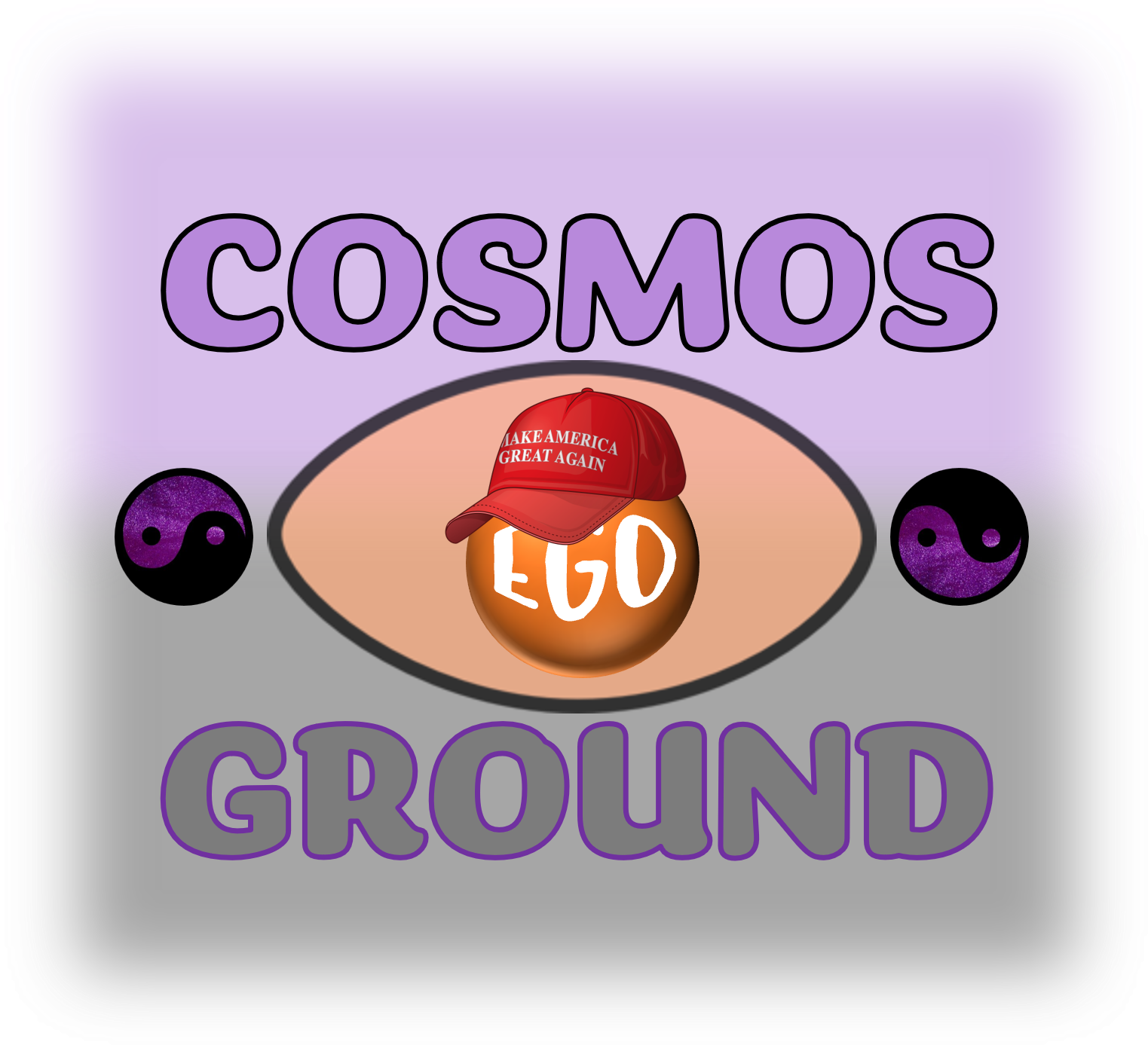
To illustrate this distinction, the window above depicts a self-conscious actor (ego = “I”) wearing a hat, which serves as our equivalent to the mask (persona) that identifies them to others and signifies their membership in the group. You have to use your imagination for this one, but next I want you to see the eye-shaped space enveloping our “MAGA” member as the theater-and-stage complex where this social performance of identity is taking place.
This is the world – not the so-called “real world” of Reality, but the cultural habitat of signs, symbols, stories, images, values and routines that conspire in generating the meaning that humans require for their security, sanity, and wellbeing.
I need to make the point that I’m not isolating an active member of “MAGA” society for any reason other than that they are some of the more visible, vocal, and violence-prone true believers in the news today. There are countless hats I might have chosen – countless large and small, mainstream and extremist, civic, religious, and political, local and online, hobby-based, recovery-focused and fringe-interest groups with membership dues and their own rules of belonging, believing, and behaving.
Inside each world – and by now it should be obvious that there are many worlds currently housing and staging identity performances all over the globe – you will find members who don’t realize they are not really (or in Reality) who they are pretending to be, mostly because they don’t know they are pretending (i.e., performing a role). To them, the distinction between who they are (persona/role) and what they are (human nature) is a distinction without meaning.
This ignorance – and to the degree it is willful, this ignórance – is what forges our convictions and drives different memberships into conflict with each other, each one believing they own the Truth and have the right to destroy or convert (let’s give ’em a chance!) the other.
Back to our illustration, imagine that the eye-shaped world containing our MAGA true believer is pushing open to either side the space required for staging the play. As with every well-designed theater, the audience in the seats and actors on stage are protected from the light and noise of Reality outside the performance hall. For an optimal experience, any thought of what might exist outside the theater should be precluded – at least for the time being.
But in Reality, there is more beyond the performance space and what’s transpiring on stage. One line of access to Reality invites the ego (our actor) to briefly lift off their MAGA hat and take notice of the fact that they do not simply cease to exist with its removal. Under the hat of their social identity is a deeper something – this center of self-conscious experience: the ego-actor or subjective “I.”
This seems to be getting closer to the what beneath the who.
Don’t stop there! counsels Sophia Perennis. Even deeper within and below the self-conscious ego is a sentient body. It’s almost automatic to say “your” sentient body, but it doesn’t really belong to you.
You should notice that, once awareness drops beneath the self-conscious ego and into the sentient body, it simultaneously opens up and out to a much larger horizon of experience. Going down and deeper within, into the sentient body, leads to what Sophia Perennis names the Ground. Arriving at that deep center of awareness, consciousness expands instantly to the larger horizon, where the sentient body participates in what is named the Cosmos (Greek for order, arrangement, system, and whole).
Now, it is an easy mistake to assume that Ground and Cosmos are two separate realities, one down-and-within and the other out-and-beyond.
But this is only an optical delusion of consciousness generated by the imposition of a self-conscious ego. If there were nothing – no cultural theater and social performance stage, no membership role-play or ego-actors with roles to play – to wedge a split between inner-subjective and outer-objective realms of an egocentric experience, there would only be the Present Mystery of Reality.
I say only the Present Mystery of Reality, but there is nothing else. Under our hats of identity, each of us is rooted in the deeper oneness of the Ground and connected to the higher wholeness of the Cosmos.
We are not who we think we are.

