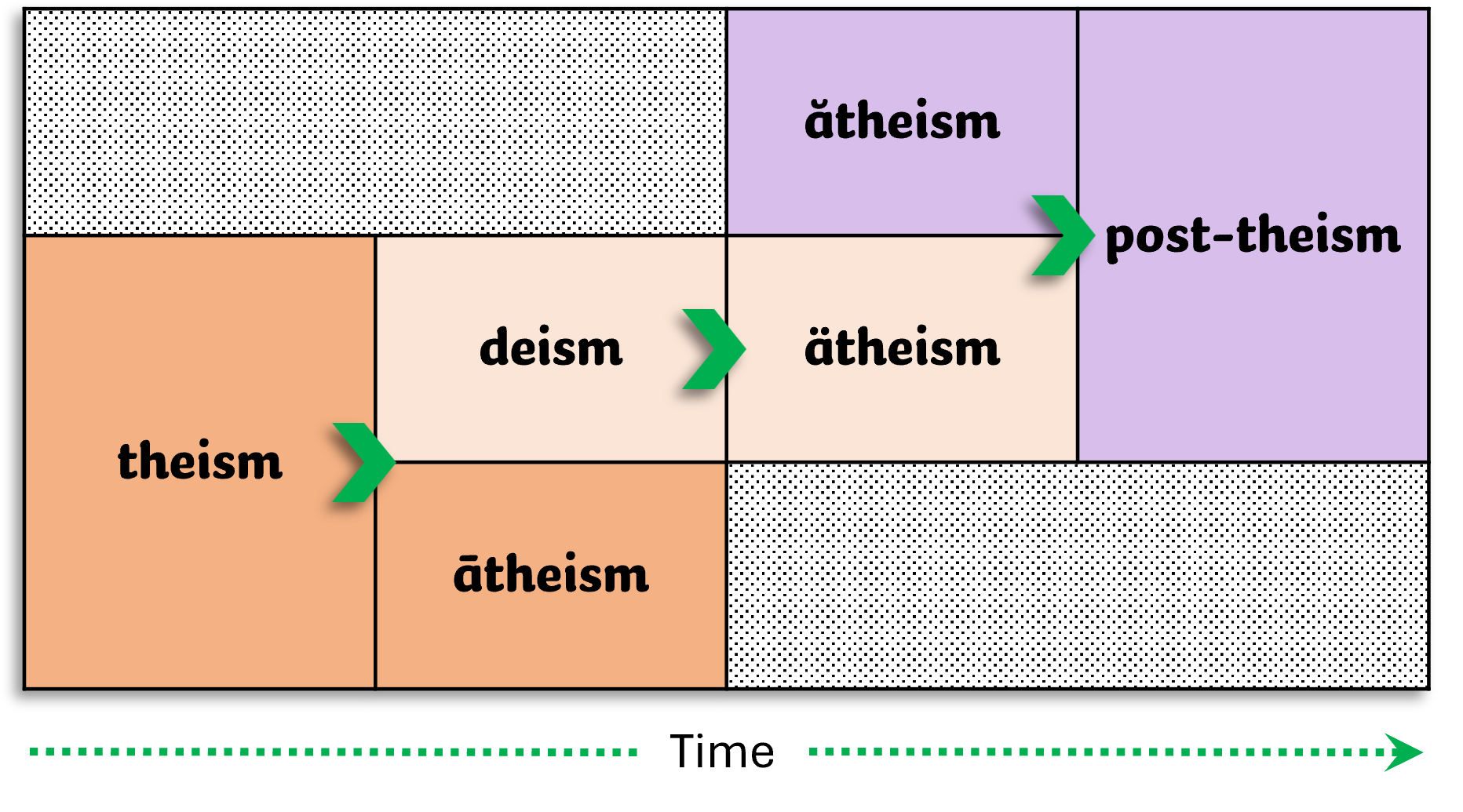
It’s always presumptuous and frequently dangerous to assume that your experience, perspective, and path in life constitute a norm against which that of others might be meaningfully compared. Not long ago, thinking in terms of types and standards of normalcy was widely used as a method for understanding ourselves and each other. Nowadays, however, the notion of intersectional and individualized identity has pushed the use of standard typologies out of vogue.
Presuming that human experiences, perspectives, and paths in life might be not only meaningfully compared but measured against standards of normal or optimal development can get you dismissed as a narrow-minded bigot.
Take the topic of faith development and religious identity, for example. The aggressive reaction to being captured inside a category and reduced to a label is understandable, especially when we sense ourselves as being so much more fluid and mysterious.
On the other hand, a more neurotic and desperate need for a label – a title, a type, a denomination, a diagnosis – can drive us so deep in our claim on a religious identity, that any suggestion of outward comparison or forward development is passionately renounced.
Whether you resist or embrace the thesis of this post, I share it only in the spirit of self-reflection and my personal quest for a more authentic experience, a more relevant perspective, and a more purposeful path in life. If my account doesn’t match yours, by all means stay focused on what you are becoming and learning on the way.
On the other hand, you might find yourself resonating with my storyline of faith, having had similar experiences and perspectival shifts of your own.
The table of terms displayed above is intended as a kind of “growth chart” showing how my religion – understood here primarily as the custodial system of moral values and core beliefs that shapes, nurtures, and orients faith – has evolved over the course of my life. Faith refers not to the beliefs themselves, but to an existential attitude and orientation of basic trust in life that those values and beliefs either articulate or undermine.
An arrow beneath my table indicates the progression of time, through the transformations of religion that faith development makes necessary.
Theism is an appropriate name for the custodial system of values and beliefs during childhood. It is based on the family configuration of taller powers (parents) and their dependents (children) who must rely on them for the protection, nourishment, guidance, and belonging they need to survive, be healthy, and successfully navigate the world. In exchange for these provisions, children must be properly obedient, respecting the provident authority of their taller powers.
This configuration and internal dynamic of the nuclear family is the biosocial basis of theism, and whether or not we happen to be officially affiliated with organized religion during childhood, our early faith is shaped inside its theistic context.
For me, this “natural theism” of family life was also reflected in the cultural theism of formal religion, where my father was an ordained pastor in a reformed Protestant tradition, in which both he and my mother had been raised as children. God was imagined as the higher power – “god the father, creator of heaven and earth,” as recited in the Apostle’s Creed – who loved me, watched over me, and wanted me to be good.
Although I never got to meet this god in my everyday world, I prayed to him up there in heaven and learned more about him in the holy picture-book of Bible stories.
After some time of growing up and seeing things more (as we might say) realistically, the mythology of a higher power (god) literally up in heaven and looking down on the world began to lose relevance to the emerging concerns of my youth. I was learning enough about the universe, human history, and the diversity of other religions to start questioning the validity of those Bible stories. For me, this led to a new type of religion which might aptly be named deism.
Generally speaking, deism is a belief system that conceives of god as the supreme authority who – and any notion of a divine personality is fading fast from the picture – made the universe and programmed its laws, then created humans and endowed them with a conscience to know the difference between right and wrong. Beyond that, the deity pretty much stays out of sight. As a deist, I went to church, sang its hymns, memorized the catechism, prayed at the table and before bed, and tried to be good.
Another branch from theism leads to ātheism, which is pretty much a denial of everything theism claims about god, most importantly his objective existence. The debate between theism and ātheism over the existence of god is a virtual stalemate of an argument, with ātheists rejecting it for lack of factual evidence and theists asserting it on the basis of holy scripture. Ātheists will often invoke the violence and bloodshed committed in god’s name throughout human history as sufficient proof that if the deity does exist, then he shouldn’t; nor does such a god deserve our worship.
For me, having taken the path of deism, it was just a matter of time again before the god who might have gotten things started in the beginning but was now out of the picture, just stopped being much of a factor in my worldview. I name this type of religion ätheism, where the umlaut elongates the letter-sound ‘a’ as in father. It can be simply translated as “no god,” though not as an argument against god’s existence (ātheism), only that it matters so little as to be essentially meaningless.
That’s how it felt to me: my ätheism amounted to dutifully invoking god on Sundays but forgetting him, practically speaking, the rest of the week.
This period as an ätheist was significant to my faith development because it provided some needed time without having to think much about god or adjust my maturing worldview to his mythology. While in college and later during seminary, this theological hiatus gave me sufficient freedom from the question of god’s existence to contemplate the meaning of god instead.
Could it be that our stories, metaphors, images, and concepts of god are human constructs prompted by our encounter with – or if that’s too objective, our sense of – a Present Mystery that cannot otherwise be named or known?
Ătheism, with the a-sound as in apple, marks a more intentional move into Mystery, where language strains to catch and hold an experience or dimension of experience that transcends its tools of trade. Now as an ătheist, I found liberation from the god of mythology, iconography, and theology – or as I later came to make sense of it, the Present Mystery had been set free from the logical limitations of story, image, and word.
The agnosticism of ätheism gradually deepened into the more mystical sensibility of ătheism.
I was a growing ătheist for most of my years in professional Christian ministry. I approached the god of the Bible and of my Protestant orthodoxy as a metaphor of God – the lowercase god as a construct in imagination of the uppercase God of Mystery, Presence, Power, and Love. In my preaching and teaching, I did my best to stretch and break open those traditional constructs so that my audience might sense its depth and demand on their lives.
Instead of explaining god, I felt drawn into a more direct experience of God.
In my experience, ătheism was more mystically oriented – inward and downward, cultivated in meditation and contemplative prayer, explored through interfaith dialogue and interreligious studies. Only in the final few years of ministry, and then especially after I left, did this spirituality of the Present Mystery move decisively to a faith orientation after (post-) god. This is what is meant by post-theism: faith and spirituality lived in the Presence of Mystery, inspired by the Power of Love.
It should be clear that post-theism is not just a sophisticated restatement of ātheism and its preoccupation of being done with god. By an ătheistic exploration deeper into the meaning of god and its grounding in the Mystery of God, there is no remaining interest in debating god’s existence. My post-theistic faith now sees through god, to the higher wholeness on the other side of god – beyond all gods.
The moral values and core beliefs of post-theism are focused on the dynamic complementarity of Love (Yin) and Power (Yang) in the Present Mystery (Tao) of genuine community, with its promise of human fulfillment and the liberated life.
Having reached a post-theistic faith orientation, it is clear that I have not thereby become somehow better – more enlightened, more virtuous, more spiritual – than others who may be coming up a similar path to mine. There is a religion for each stage on the journey of faith, and the best we can do is support, encourage, forgive, and welcome each other into the fellowship of Spirit, the universal Kindom of God.

