We like to think that we act the way we do, believe what we believe, and curate a philosophy of life based on rational choices. We thought it all out and made a decision. Where we stand on things and how we feel about it is the product of careful consideration and common sense.
Right.
That’s just our ego talking. It’s the part of us that presumes to speak for the whole Self. “I” (Latin ego) am in control, “I” know what I’m doing and “I” do what I want. It really is astonishing how long we can persist in our delusion before something – the shock of disappointment or loss, or maybe just the dawning realization that comes with time and maturity – teaches us otherwise.
How and when did it happen for you?
Not yet? It’s coming. If you’re lucky, life itself will disabuse you of your conceit of being in control of it all.
It is then we discover that beneath the fragile surface tension of our presumed control over what we think, how we feel, and what we do is a deep sea of passions. Our personal quality world of identity, freedom, purpose, and meaning is only a bubble at the surface, an illusion that, in the moment we take it for Reality, becomes a delusion.
Reality naturally includes our whole Self, which is why this realization will be either a surprising revelation or a terrifying apocalypse, depending on how invested in the illusion we happen to be. Having the curtains pulled aside (revelation) and our warm blanket yanked off (apocalypse) can be a hell of a way to wake up – but at least we’re awake.
Now, we should consider the possibility that our quality world offers some protection from the deep-sea mystery of our passions, helping us feel at least some measure of security amidst their unpredictable rise and fall.
So, if the illusions of identity, freedom, purpose, and meaning are necessary to our sanity and personal happiness, maybe the fulfillment we seek as human beings requires an ability to swim.
I suppose that was a question …
I mean, if the bubble is bound to break sooner or later, maybe we should develop a healthy respect and appreciation for those deeper forces within us, and learn how to navigate their primal currents instead of trying so hard to hold them at bay. It could even be the better part of wisdom to explore our passions rather than tame them – as if that were even possible.
Let’s give it a try.
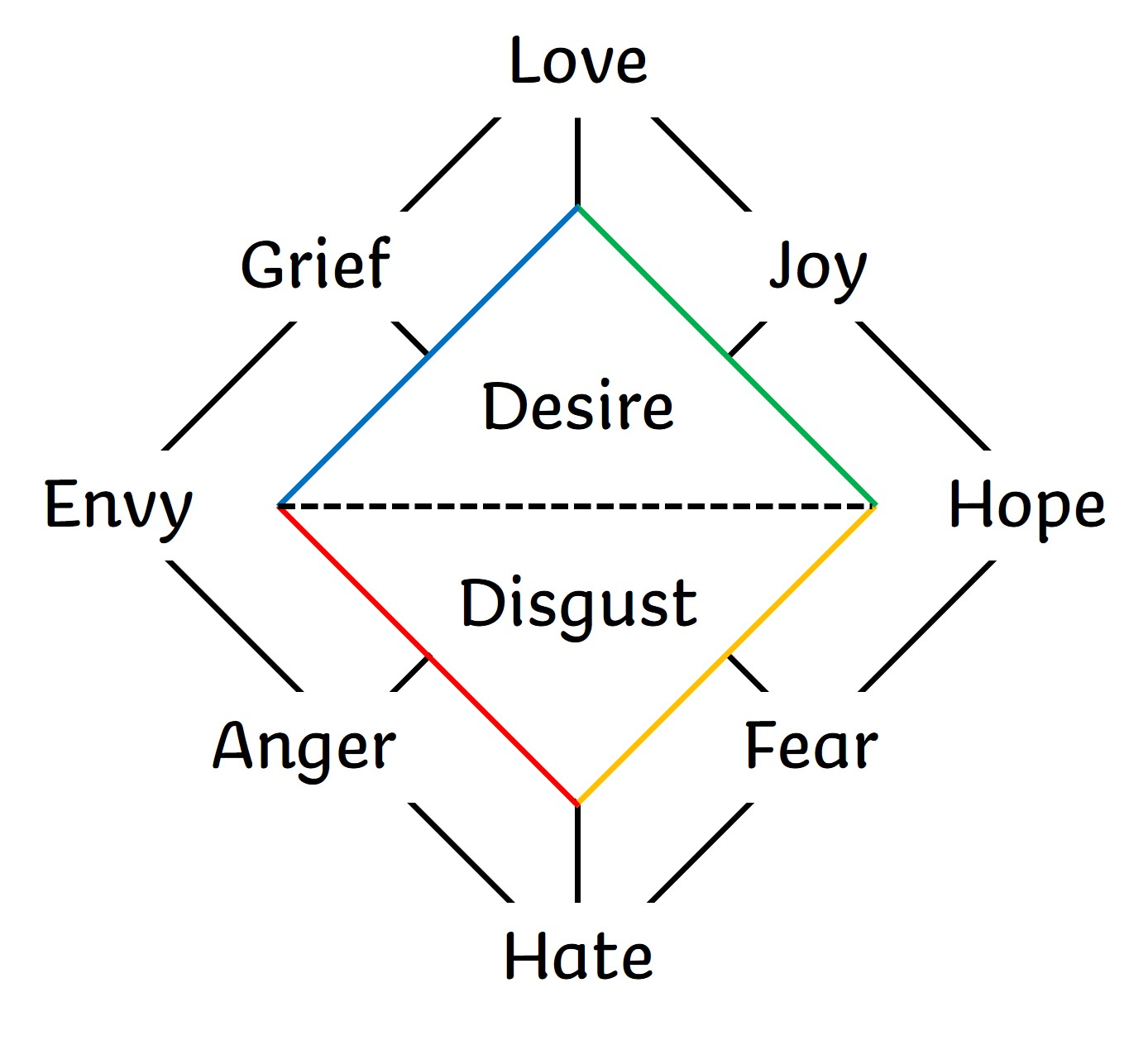
The diagram above offers a typology of the passions, a way of understanding them in genealogical terms of their origins and internal alchemy. At the center of its web is the duality of Desire and Disgust, the primordial pair from which the entire system draws its logic and energy.
Each passion is an action code with an associated nervous state and emotional tone that evolved with the aim of moving its host organism into a particular attitude and behavior with respect to a stimulus, situation, or circumstance.
In the case of these two, Desire moves us toward what holds nutritional energy for our body (e.g., sugar, protein, and fat), while Disgust moves us away from what is likely toxic (e.g., rotting food, decayed flesh, and excrement). These action codes are thus centered on our physical health and energy, and it is safe to presume that they were the first pair of passions to evolve.
Far from a happy marriage, the cohabitation of Desire and Disgust was a diametrically opposed set of reflexes from the very beginning. Perhaps, though, we should think of their pairing not as diametrical but complementary, like the Yin and Yang of the Tao.
Remember the time when you gobbled down a plateful of delicious food, only to eventually transgress the limit of satiety and become suddenly nauseated over the mere thought of taking another bite?
Both Desire and Disgust brought their own children into the household of passions. With Disgust came Hate, Anger, and Fear; and with Desire came Love, Joy, and Grief. While Fear inherited from Disgust the action code of moving away (evasion, avoidance, escape), Hate and Anger express its recessive traits of hostility and aggression. In this typology of the passions, then, Disgust, Fear, Anger, and Hate share a common lineage.
This is why we so often can feel that our enemies – those objects of our anxiety, aggression, and hostility – are “disgusting” to us.
On the opposite side, while Love inherited the action code from Desire of moving toward (connection, bonding, communion), Joy and Grief express its recessive traits of delight and disappointment. This internal alchemy is the reason why so many humans come to the painful discovery that Desire’s fulfillment in Love may bring with it the ecstasies of Joy, but it’s only a matter of time (and mortality) when Joy gives way to Grief.
This makes our relationships with those we Love so often a bipolar affair, and why a few of us try to shorten our fall into Grief by refusing to let Love lift us very high into Joy.
So far, we have been exploring this apparent dualism in the family tree of passions, with Disgust and its offspring of Fear, Anger, and Hate on one side, arranged in opposition to Desire and its offspring of Love, Joy, and Grief on the other. But wouldn’t you know it, Joy and Fear had a little something on the side and out of sight, giving birth to Hope.
When we hold Hope for something to resolve or come to pass, we feel an excitement (Joy) tinged with apprehension (Fear) around the very real possibility that it won’t happen – at least not as we wish.
Now justifiably suspicious of covert shenanigans elsewhere – behold! we find a similar tryst, this time between Grief and Anger, who gave birth to Envy. When we have Envy toward someone because of something they have but we don’t, or something they’ve accomplished but we haven’t, our annoyance over the fact carries equal portions of sadness (Grief) for ourselves and resentment (Anger) towards them.
As suggested in the diagram, Hope and Envy are more sophisticated passions and lack direct lineages to the primal couple of Desire and Disgust and their temperamental offspring. That being the case, it helps to explain how it is that Hope and Envy, toggling the boundary between the two families as they do, so easily elude and delude us. They can completely possess us before we even know it, leaving us discontent and unhappy with the life we have.

