Part of me really wants to believe that human destiny holds something more in store for us than just more of the same.
I mean, more than just strapping ourselves inside spaceships and taking our problems somewhere else.
Human destiny will entail going beyond ourselves somehow, but populating some distant planet isn’t likely to bring the fulfillment we long for.
In this context, fulfillment refers to the process of realizing our full potential as human beings, of fully actualizing the capacity of what is in our nature to become. It’s about becoming fully human – which doesn’t seem to have happened yet.
I also can’t believe that human destiny awaits us in some paradisal afterlife – working the same theme as ‘transplaneting’ ourselves somewhere else, but presumably without our bodies to hold us back or slow us down.
Given that the ancient synonym of fulfillment, salvation, has roots in the idea of being made whole, it doesn’t make sense that human fulfillment would involve dividing up our nature and leaving part of ourselves behind.
The myth of dualism in human nature, of an immortal soul riding through time inside a mortal body until death or rapture sets it free forever, has caused much confusion, needless distraction, and a significant amount of destruction in its denial of the body, the material foundations of life, and the wider web of life itself.
One origin of this idea certainly lies in the self-conscious perception of our place in the physical environment as a sentient body, while also having an inner experience of thoughts, beliefs, hopes and dreams. Having a vantage-point at the center of a self-conscious personal identity is actually what divides our perceptual field into objective and subjective realms.
Body and soul, then, are not two parts of us, but name the two orientations of consciousness, focused outward or inward through the lens of our ego.
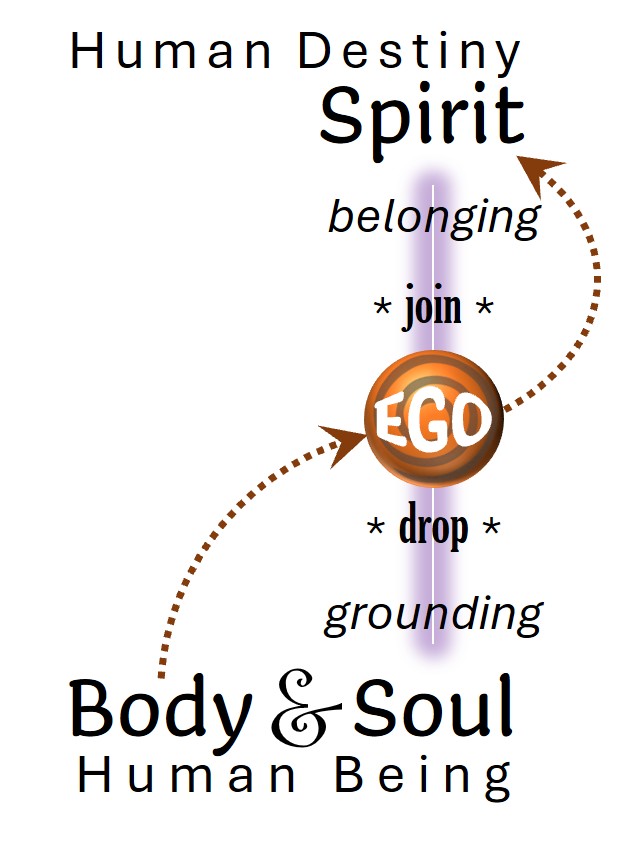
In the illustration above, ego is shown as emerging from the body, which, along with the soul, constitutes our essential nature as human beings. Because we are so accustomed to thinking of these as separate parts of ourselves, it takes consistent and disciplined effort to keep them not just side-by-side in our mind, but to appreciate their essential complementarity as the Yang (body: outward) and Yin (soul: inward) orientations of consciousness (Tao).
To arrive at the point where these two complementary orientations come into view, consciousness needed to differentiate into the self-conscious ego, a process that was (and still is) assisted and supervised by our tribe. The goal of this socialization process is to accommodate us to the roles of social life where we will take our place, behave ourselves, and do our part.
As the principal psychomechanism in this process, ego (Latin for “I”) exerts restraint on the animal impulses of the body so that its primal energy (i.e., the lifeforce) can be redirected toward that goal of social conformity.
As society reacts and reflects back to us its appraisal of our performance, our own inner realm of thoughts, beliefs, hopes, and dreams begins to take shape.
Finally, we have reached the “crossroads” in the title of this post.
Depending on how successful this process of socialization is, we either find ourselves in a position of ego strength or dysfunction – most likely, somewhere on the continuum between them. Depicted in the illustration as a tightening spiral inside the ego, dysfunction pulls us into the urgency of disordered internal states, anxiety and depression being the major poles of mental disorder.
Such disordered states lock us inside, where coping, recovering, or just getting by are all we have energy for.
This is where a high percentage of human beings are currently stuck, locked in the spiral of ego dysfunction. In this condition, our destiny becomes a chronic obsession over escaping the trap, getting out or getting saved, which historically altered the root concept of salvation from becoming whole and more fully human, to being rescued from our body and its disordered internal states.
Departure myths and rescue fantasies have served to distract us from our suffering, tethering our hope to afterlives and other worlds.
But we don’t have to stay locked inside the spiral of dysfunction. I’m not going to suggest that the suffering isn’t real, or that the solution will come with the blink of an eye. As long as we stay fixated on the problem, however, we may never find fulfillment. Treating the symptoms of disorder will not resolve their underlying cause.
The interesting and surprising thing for us to learn is how near at hand our salvation really is. This is a key insight of the worldwide tradition of spiritual wisdom known as Sophia Perennis.
As long as we continue to spin into ourselves, only managing to churn more of the dysfunction we can’t seem to escape, we are prevented from directing awareness along the axis of those two orientations of consciousness discussed earlier: outward through the body and inward through the soul.
Recall that our sightlines into these two realms are dependent on our having successfully established a vantage-point on a center of self-conscious personal identity: the ego. To whatever degree we may lack ego strength, we are vulnerable to getting caught inside the spiral of dysfunction. With ego strength, we are able to engage the outer and inner realms with conscious intention.
The two moves along the axis of our centered awareness might be named drop and jump, regarding what ego does from this center.
Dropping is about releasing, letting go, and descending – even dissolving, “dying,” and losing our separate self in the deeper oneness of Being. Favored names for this deeper oneness include Ground of Being, Being-itself, Nothingness (i.e., no-thingness), and the Present Mystery. Various grounding techniques designed to facilitate this inward descent of awareness into the soul and its ground are practiced all around the world.
In the opposite ‘direction’, jumping involves the ego rather than loosening awareness and dropping away from its center. If dropping goes down, jumping goes up – reaching out, joining with, and ascending to higher orders of participation, harmony, and wholeness. Sacred names for this higher wholeness from the worldwide tradition of wisdom spirituality include Web of Life, Spiritual Community, Cosmic Order, and the Provident Universe (“turning as One” or “one Song”).
Whatever its name, our experience in this realm is one of belonging to a Greater Whole and becoming more whole ourselves. It is our human destiny – if we choose it.
So, here we are at the crossroads. Where now?

