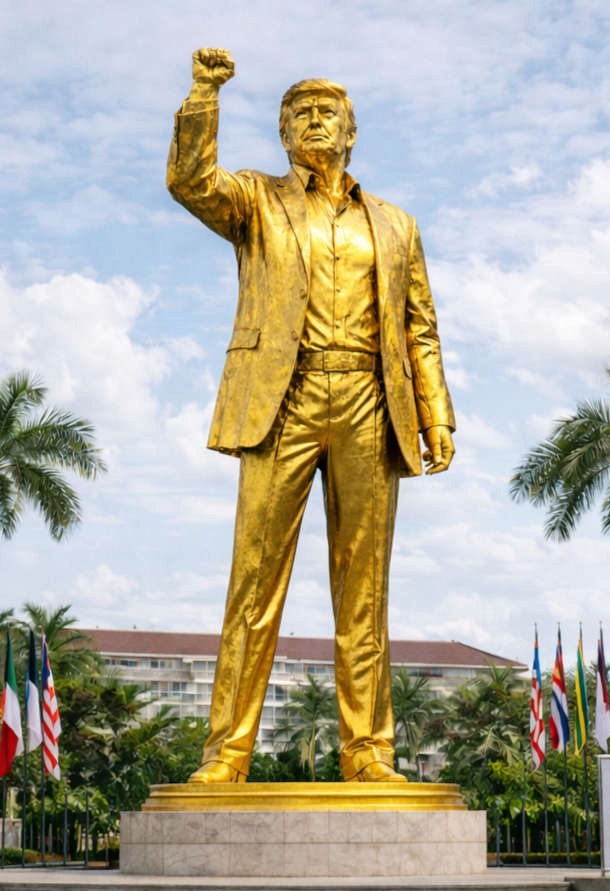
The invitation had called it The Patriotic Dedication Ceremony for the Golden Age of America.
The banners called it A Historic Tribute.
The souvenir hats called it TRUMP THE GREAT.
But as Jesus stood at the edge of the enormous marble plaza, listening to the brass band blare a triumphant rendition of “God Bless the U.S.A.,” he could not stop thinking of a calf.
Not a metaphorical calf. An actual one.
Gold. Shiny. Worshipped by nervous people who preferred certainty to truth.
The statue towered above the crowd at twenty-two feet tall, plated in gold leaf so polished it reflected the noon sun like a second star. Trump’s sculpted chin pointed heavenward with the confidence of a man who had never once considered the possibility that heaven might disagree with him.
Below the statue, vendors sold commemorative steaks on sticks for seventy dollars each.
Jesus watched a man carrying three.
“Buy two, get one freedom steak,” the vendor shouted.
A woman near the front dabbed tears from her eyes as she stared upward. “He saved America,” she whispered reverently.
Jesus tilted His head.
From what? he wondered.
A giant screen flashed campaign slogans while drones hovered overhead capturing cinematic footage of the crowd. Men in expensive suits and women draped in red-white-and-blue sequins gathered near the stage where politicians competed to praise the statue with escalating enthusiasm.
“One day,” declared a governor with lacquered hair, “children will travel here the way pilgrims once traveled to Jerusalem.”
Jesus blinked slowly.
That seems excessive.
Nearby, a pastor wearing sneakers worth more than a carpenter earned in a year lifted both hands dramatically.
“Lord,” he prayed into a microphone, “thank You for raising up this mighty warrior of wealth and strength!”
Jesus looked around instinctively, wondering if perhaps another “lord” had arrived while he wasn’t paying attention.
No, apparently it was him.
Interesting.
The pastor continued. “We reject weakness! We reject humility! We reject the lies of the poor and the jealous!”
Jesus stared at the man for several long seconds.
Then he looked down at his own robe and dusty sandals.
He remembered telling a rich young ruler to sell everything and give to the poor. The young man had walked away grieving because he loved wealth too much.
In hindsight, perhaps he should have suggested branding opportunities instead.
The crowd erupted as Trump himself emerged from behind velvet curtains. Music thundered. Fireworks exploded prematurely in daylight. The giant screen displayed slow-motion footage of eagles.
Trump waved with the majestic confidence of Caesar entering Rome after a military conquest, though the only visible battle wound appeared to be a spray tan malfunction near his left ear.
“Thank you!” he shouted. “Nobody’s ever seen a statue like this before. Nobody!”
The crowd roared.
“It’s bigger than Lincoln,” someone screamed.
Jesus glanced upward at the statue again.
Technically, he thought, that part might actually be true.
Trump circled the stage soaking in applause like a man dying of thirst beneath a waterfall made entirely of compliments.
“I don’t like to compare myself to historical figures,” Trump said, pausing precisely long enough for everyone to compare him to historical figures, “but many people are saying this movement is biblical.”
Jesus quietly exhaled through his nose.
There it was again.
Biblical: That fascinating modern adjective meaning something people already wanted to do anyway.
The speeches continued for nearly an hour.
Every speaker described strength. Dominance. Winning. Revenge. Triumph over enemies. Crushing opponents. Restoring greatness.
No one mentioned mercy.
No one mentioned generosity.
No one mentioned loving enemies.
Jesus thought back to his own sermon on the mountainside and imagined how it would sound rewritten for this occasion.
Blessed are the wealthy, for they shall own the media networks.
Blessed are the loud, for they shall dominate cable news.
Blessed are those who hunger and thirst for ratings.
A chant began swelling through the crowd.
“USA! USA! USA!”
Jesus loved nations. All nations.
But nationalism always puzzled him a little. Humans spent centuries dividing land into competing tribes and then acted shocked when the tribes hated one another.
He remembered saying, “Love your neighbor.”
They had responded by drawing borders and asking for clarification.
The ceremony reached its climax as two enormous American flags dropped away from the statue. Sunlight burst across the golden surface.
The crowd gasped.
Phones rose like worshippers lifting candles in a cathedral.
Trump spread his arms dramatically before the towering image of himself.
For one surreal moment, Jesus thought the man might actually kneel in humility before God.
Instead, Trump pointed upward at the statue and declared, “Beautiful, isn’t it?”
Thunderous applause.
Jesus watched faces in the crowd. Not all of them were cruel. Many looked frightened more than hateful. Exhausted. Angry. Lost. They wanted strength because they feared collapse. They wanted greatness because ordinary life felt humiliating. They wanted a king who promised certainty.
He understood that temptation.
People had once tried to make him king by force too.
He had slipped away quietly then.
Power gained through fear always demanded more fear to sustain itself.
Near the back, a child tugged at his father’s sleeve.
“Dad,” the boy asked innocently, “why is the statue gold?”
The father smiled proudly. “Because gold means greatness.”
Jesus looked down at his own hands.
Hands that had touched lepers.
Hands that had washed feet.
Hands that empire had nailed to wood.
Gold had never impressed him much.
Useful for gifts, perhaps. Decorations. Dentistry, eventually.
But humans consistently mistook expensive things for sacred things.
A television host took the stage next. “This monument represents the return of real Christian values to America!”
Jesus raised an eyebrow.
The host continued. “Strength. Wealth. Power. Victory.”
Jesus thought carefully.
He remembered saying things about feeding the hungry, welcoming strangers, forgiving debts, caring for prisoners, rejecting hypocrisy, and serving the poor.
Somehow these had undergone a remarkable rebranding operation.
It was honestly impressive in a darkly creative way.
Then came the prayer of dedication.
A circle of religious leaders gathered around the statue, laying hands upon its golden feet.
“May this image inspire generations,” one prayed.
Jesus nearly interrupted.
Not because statues were inherently evil. Art could inspire beauty. Memory mattered. Symbolism mattered.
But there was something deeply revealing about constructing a twenty-two-foot monument to a billionaire while millions struggled to afford rent, insulin, or groceries.
A civilization eventually becomes whatever it publicly celebrates.
Rome celebrated conquest.
Babylon celebrated luxury.
This crowd celebrated dominance wrapped in patriotism and dipped in gold.
Jesus wondered what they would have done with him if he arrived now exactly as before.
No money.
No branding consultants.
No political action committee.
Just a wandering brown-skinned laborer telling rich men to stop hoarding wealth and religious leaders to stop exploiting fear.
He suspected cable news would not go well.
The ceremony finally ended with fireworks erupting behind the statue in dazzling bursts of red and gold.
The crowd cheered ecstatically.
Trump stood below his own giant image smiling with visible satisfaction, basking in the glow of self-constructed immortality.
Jesus looked up one final time at the glittering monument.
Then he looked past it.
Beyond the cameras.
Beyond the flags.
Beyond the noise.
Toward the homeless veteran sleeping beneath an overpass three miles away.
Toward the immigrant family hiding from deportation raids.
Toward the single mother working two jobs while politicians argued about greatness.
Toward the addicted, the lonely, the sick, the forgotten.
That was where he had always gone.
Empires built statues because stone was easier than transformation.
Gold was easier than compassion.
Chants were easier than repentance.
And idols—especially political ones—were always easier than a God who demanded humility.
The crowd continued celebrating long after Jesus quietly walked away unnoticed.
Which, he reflected, had happened before.

