I don’t get it perfect every time, but with practice I’m getting better. Over the years working in higher education with students who are trying to find their path, I’ve come to understand what they are seeking as “vocational clarity” – not a major, not an occupation even, but a freely chosen path of purpose that makes life meaningful.
A degree plan and gainful employment after graduation can put flesh on that spiritual aspiration, but freedom, purpose, and meaning are transcendent to the specific programs and credentials of a college education.
Many students are either stuck or at risk of falling in the trap of going to college. Eighty percent of them change their majors multiple times and only around half manage to complete a degree. The education system generally is more interested in student data than in students themselves as unique individual human beings, and the students themselves have gotten the message. Their disengagement is less a motivational problem – which is how teachers and other education professionals tend to regard it – than a coping strategy for avoiding the burnout that commonly follows chronic anxiety.
By the time they reach college and find their way to me, typically by referral, students are not really free to choose anything, much less a path of purpose that makes life meaningful. They are caught in the urgency of disordered internal states – anxiety primary among them – and have little creative agency for the opportunities college might offer. Without this freedom, nothing can be chosen, no path of purpose can be discerned, and the whole college experience can feel oppressive and meaningless.
Over time it became evident to me that dropping out of college may simply be the terminal and overt demonstration of a disengagement strategy that students have been using for years.
The social-learning environments of school had provided little to help students feel safe, supported, and seen for the unique individuals they are; that they belonged and really mattered. When safety, support, recognition and belonging are provided by our social environment, we – not only students but all humans – are much less at risk of falling into the urgency of disordered internal states, and can more freely choose a path of purpose that makes life meaningful.
So, the social-learning environment of a college will be more or less intentional in providing students what they need to feel grounded, calm, and free from the urgency of disordered internal states, and free for the important work of vocational clarity. Accordingly, I propose that we regard the colleges that do this effectively as provident organizations, and that we should characterize what they provide to their students as unconditional love.
Woops. Did I lose you?
The fact is, human beings thrive in social environments where they are loved – and loved not only when they behave as expected or meet certain conditions.
That last part is known as conditional love, and it tends to generate a people-pleasing, socially anxious, and self-doubting type who is more focused on the expectations and disappointments of others than on their own needs and personal aspirations. Unconditional love, on the other hand, doesn’t make them work for it but is freely granted, without conditions – without prerequisites, stipulations, and ultimatums.
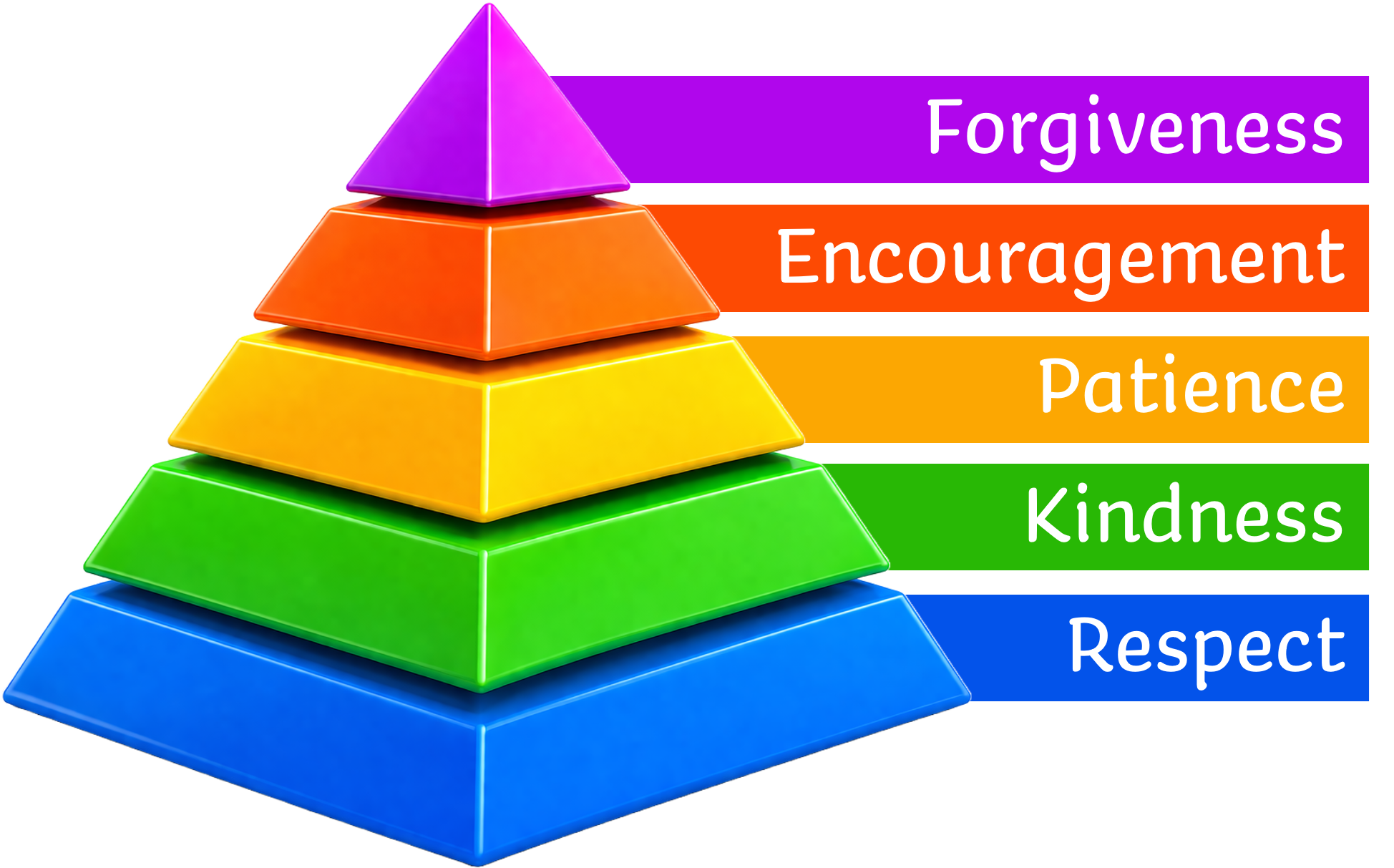
The image of a pyramid is useful in illustrating the core values of unconditional love. Lower levels support those higher up the vertical axis, as those higher levels refine and build upon what is below. These are the core values I strive to embody in my work with college students – not getting it perfect every time, mind you, but recommitting myself to them, day by day.
Respect
From the root meaning “to look back,” “to see again” or “to take a second look,” respect is the foundational core value of unconditional love. It inserts a delay between stimulus and response, inviting me to look again, but now with fresh eyes. I am given the opportunity to really see the human being before me. However this may translate into loving behavior on my part (higher up the pyramid), at the very least, respect draws an absolute, categorical boundary against any words or actions on my part that might transgress on their human dignity.
Kindness
In its positive translation, respect is expressed as kindness. With roots in kin and kindred, kindness is a natural tenderness, compassion, and friendliness arising spontaneously from an intuition of deeper identity with another. Whereas respect is negative in the way it holds me back and gives me distance to acknowledge what is sacred in the other, kindness is positive – showing interest, stepping closer, reaching out, and making a connection.
Additionally, as a core value of unconditional love, kindness is not a measured response but a free gift. It is Love’s solar energy radiating from the sun-center of my being.
Patience
With patience we are back to the negative in this rhythm of unconditional love: opening space and giving time for the student to “get it” … or not; to take the step … or not; to make a change … or not. This is not to suggest that students should never be held accountable or challenged to stretch, take risks, and grow beyond where they currently happen to be. It means, rather, that, like a gardener, I need to honor the rhythm of dormancy, awakening, development, and transformation as it naturally unfolds. I can cultivate the soil and manage certain conditions that might make it more likely to happen, but my impatient prodding and tugging will likely do more harm than good.
Encouragement
Swinging back to the positive, as patience allows me to discern opportunities in my encounter with a student, a well-placed gesture, word, story, or simple affirmation can provide encouragement and “strengthen the heart.” The disordered internal state of anxiety is often projected outward as the fear of failure and risk avoidance, morphing quickly into a self-justified sense of responsibility in holding back, measuring twice, and playing safe. In truth, growth and change can be intimidating, as it challenges and stretches us beyond our limits – and limiting beliefs! – around security, comfort, and control.
Unconditional love, in its core value of encouragement, seeks to empower and liberate the Human Spirit in each student.
Forgiveness
And what happens when a student refuses my encouragement, tests my patience, and seems insensitive to my expressions of kindness? The core value of unconditional love at the apex of the pyramid, forgiveness, is not a matter of commuting a penalty or absolving the student’s guilt for violating the terms of some implicit memorandum of understanding. From the root meaning “to release or let go,” forgiveness is about me letting go of my coalescing judgment regarding this student’s willingness or ability to change, their desire to engage with me, and even their seeming disregard for my role, my feelings, and my dignity as a human being.
By letting go of judgment, I can return to the core value of respect at the foundation of unconditional love and begin a fresh ascent.
 Tracts of Revolution