Mental Bypass in Religion

Intuition_Understanding_ConvictionHow did something with its origins in a mystical intuition of reality’s essential oneness become such a violent force of division in the world? If religion began as a system of symbols, rites, and sacred stories with the purpose of linking the business of daily life back to the grounding mystery of being, where did it start to lose its way and become a program of separation, deliverance, and escape from this world?

Or to make it more personal, what makes an individual who believes in ‘the god of Jesus Christ’ or in Jesus as ‘my personal Lord and Savior’ act in such ways as to utterly contradict the core teachings of Jesus himself?

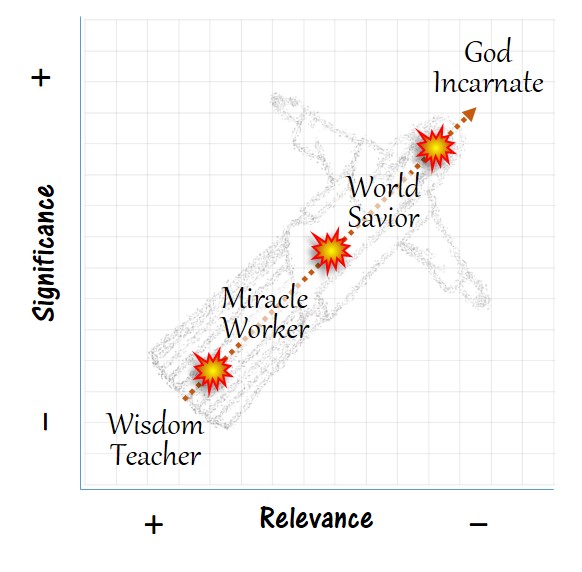
That last question is probably the easiest to answer. A misalignment of Christian behavior with the teachings of Jesus most likely has to do with a difference in consciousness between Jesus and the professing (but hypocritical) follower. It’s not simply a matter of imitating the actions of Jesus or parroting his words; his words and actions manifested a certain degree of enlightenment, empathy, and courage. That’s where the difference lies. It’s not that he was god and we aren’t, or that he was perfect and none of us can be.

Very simply put, Jesus was spiritually grounded and lived his life by the mystical intuition that All is One. To phrase it with more of an ethical focus: We’re all (in) this together.

And probably most of his professing followers aren’t, and don’t.

It may have been this depth of grounding and spiritual clarity that eventually got misconstrued into the metaphysical doctrines of his heavenly origins and divine nature. At any rate, the Jesus of Christian orthodoxy went in an entirely different direction. He became a virgin-born world savior, supreme object of worship, patron of generals and kings, and the one who will eventually come again to judge the quick and the dead. This is the Jesus in whose name Christians have destroyed indigenous cultures, waged war on unbelievers, drowned witches, burned heretics, and condemned homosexuals.

An entirely different direction.

Much of religion today has become identified with emotional convictions of one kind or another. This is the type of belief sponsored by orthodoxy. It’s not about articulating a profound mystical intuition into an intellectual understanding where its relevance to life in the world can be worked out. Instead it is locked inside very specific turns of phrase, tied to proof texts, cross-referenced, embedded in confessions and creeds and recited together with the standing congregation. Its lack of relevant (real-life) meaning is compensated by a fervent passion that ‘it must be so’, since a Christian’s present identity and post-mortem salvation depend on it.

A returning reader will be familiar with my low regard for conviction, as the point where a belief once held by the mind turns the table and becomes its prison. What initially may have served to frame a perspective on something eventually closes down to just ‘this way’ of seeing it. Nothing outside the frame is validated, no alternatives can be considered, no other answers to the question or solutions to the problem. Creative thinking comes to an end. When it happens in religion, wild metaphors that may have once carried an experience of mystery across the threshold into meaning now lay dead in their cages. At this point, without a lifeline remaining to its own spiritual depths, thought becomes rigid, dogmatic, and heartless.

Emotional conviction is perhaps the chief symptom of religion’s collapse. This is not to say that Jesus himself, for example, didn’t carry a great deal of passion into his teaching and way of life. Indeed, his ethical precept of ‘love your enemy’ – which is how he translated the mystical intuition of oneness into a social revolution – generates a mixture of inspiration and anxiety in any reasonable person just contemplating it.

The point is that his passion, and his passionate action, came out of an intellectual understanding of the spiritual basis and strategic purpose of unconditional forgiveness.

We can imagine two of Jesus’ disciples, soon-to-be founders of two distinct traditions of Christianity, holding a conversation after he is gone. “We must love our enemies because Jesus told us to, and we need to stay with his program,” one says to the other. “Although, we might need to qualify what he probably meant by ‘enemy’, since there are some people in this world that are simply impossible to love and frankly don’t deserve it.”

“You’re missing the point,” says the second disciple. “Jesus could love his enemy because he understood that our separation from others is a lie we impose on reality, when in truth we are all one. Forgiveness and love follow rather spontaneously upon the realization that what we do to others, we do to ourselves. We don’t do it because Jesus told us to, but because we are all in this together.”

Whereupon the first disciple proceeded home to begin the work of orthodoxy, and the second carried on with the work of converting truth into love.

Reality Shift

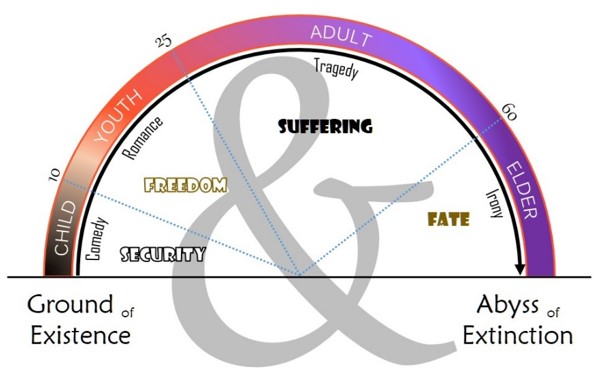
Reality ShiftsA somewhat naive understanding of human evolution and individual development assumes that with each advancing stage, former ones are simply outgrown and left behind. We know, however, that this is not how nature evolves. Earlier and more primitive structures are not abandoned, and neither do they merely lie inert beneath the exciting progress higher up. Instead they get incorporated into the emerging design, differently managed or re-purposed in light of a greater functional complexity.

This matters a lot when it comes to the interpretations of our own progress as individuals and a species. The naive approach has treated our mythological past, for instance, as over and done, leaving us free to face reality (finally!) as it is. Scientific theories relentlessly pursue objective truth, while the ancient myths may entertain us but in the end only obfuscate our view of what’s real. We need more facts, not superstition. The presumption is that our ancestors and other distant cultures stumbled around in ignorance, whereas we now clearly see the way things really are.

A closer look reveals that earlier versions of ourselves – whether bygone generations or former decades in our own lifetime – continue to operate underneath and behind whatever ‘executive functions’ are currently at the helm. In developmental psychology we commonly speak of our ‘inner child’ which refers to an infantile and juvenile subpersonality (Assagioli) that sometimes takes over when we’re tired, sick, hungry, stressed, or threatened. But we should also take into account a still more primal animal nature that lurks in the unconscious and is governed by instinct. These deeper and developmentally earlier versions may not determine our engagement with reality as they once did, but a mature adult must learn how to incorporate ‘gut feelings’ and playful spontaneity in a more socially responsible way of life.

Most likely our biggest limitation has to do with the fact that each advancing stage in development reconnects us with reality in a new way. Or we might say that each stage in development initiates a shift in reality itself, for the straightforward reason that our mode of engagement with reality must be included in what is meant by the term. Along the path of human evolution, then, our species has confronted a new reality at each turn. And across the arc of our evolution these developmental advances have carried forward former versions of ourselves, still operating at deeper and less conscious levels.

I propose that human beings have evolved through three major ‘reality shifts’ and that we are currently on the cusp of a fourth. This is similar to the well-known ‘paradigm shift’ concept made popular from the history of science (T. Kuhn), except that as a constructivist – maybe even a radical constructivist – I want to make it about more than a mere shift in the (mental) “framework containing the basic assumptions, ways of thinking, and methodology that are commonly accepted by members of scientific [or other type of] community” (Paradigm in Dictionary.com). When our framework shifts, everything about our way of engaging with reality also shifts, which means that because reality necessarily includes our way of engaging it, reality itself shifts as well.

Mythopoetic Reality

The first reality shift, and the one that launched our species on its cultural trajectory, is what I’ll call the mythopoetic. Poiein is Greek for ‘to make’, and mythos translates as ‘a narrative plot’ or story; so a mythopoetic reality is one where our engagement with existence is facilitated by the narrative construction of stories. I don’t agree with a popular definition of myth which dismisses it as ‘primitive science’, our first bumbling attempts to explain what’s going on around us in the natural world. Rather, myths articulate and embellish upon foundational metaphors that represent our deepest impressions and intuitions of the grounding mystery, or what I also call the provident ground of being itself.

It’s important to understand that a story-shaped reality has no ‘outside’ – no nonfictional or purely factual realm independent of the mythic imagination. This reality is sustained in the activity of narrative performances where stories are acted out in the tasks of daily life, with the turn of seasons, on special occasions, and around the shared concerns of a community. Whatever may lie beyond the boundaries of a particular story-world is not a ‘mere fact’ but is characterized according to its proximity and potential value to what’s going on inside the story – such as the chaos acknowledged in many ancient myths, dragons lurking at the edges of medieval maps, or the boogeyman in a child’s closet.

As that last example suggests, early childhood is when each of us lived in a mythopoetic reality. We were continuously pretending – daydreaming, fantasizing, dressing up, role-playing, embarking on one adventure after another. In those years we had no interest in, let alone an understanding of, the factual reality that would later become the bedrock truth of our adult experience. That time in our lives – whatever we can remember of it – is probably our best entry to an understanding of what prehistoric story-telling culture was like.

Historical Reality

At some point in the evolutionary past, as well as in our own personal past, the sacred canopy of mythopoetic reality came down – or at least fell just far enough to expose another reality on the other side of our stories. I will call this the shift to historical reality, a shift reflecting the progress of human consciousness beyond the security, meaning, and hope we had earlier found in our myths. For a memory of what it was like, we need to recall that strange mixture of exhilaration and anxiety we felt in adolescence.

The exhilaration came as our perception of time expanded beyond the ‘once upon a time’ and ‘happily ever after’ frame of the story-world, into a causal stream seemingly without beginning or end. As the boundary of our mythopoetic reality blew open to reveal a limitless field of possibilities, the opportunity as well as temptation for all things exotic beckoned to us. On the other side of that exhilaration, however, was an anxiety over our sudden ‘nakedness’ – a niggling self-conscious sense of being stared at. Both of these powerful moods (exhilaration and anxiety) announced the emergence of a separate center of personal identity, or ego.

This separate self provided a new vantage point on a reality without limits (except for those repressive rules imposed on us by authorities), arranged and revolving around ego at its fixed center. It is in this reality and corresponding version of ourselves that an irresistible impulse to throw off constraints and ‘become as the gods’ – free, powerful, and beyond accountability – acquired the drag of guilt and shame for our offense. You should be able to hear a strong theistic theme here, which resolved the problem of separation by a process of atonement and reconciliation.

The dawn of historical consciousness is accompanied by a disenchantment with the mythopoetic reality of early life, which comes as a consequence of ego’s separation from its own grounding mystery. Whereas the mythic imagination continues to operate farther below, the executive ego – or what I also name Captain Ego – is having to take into account a factual realm altogether independent of it. This forces upon ego a need to decide the truth status of those stories, and a few alternatives become obvious.

One answer is that the myths are simple stories of an era when we believed such things. Now we know better and should dispense with them in the interest of progress. A second option, related to the first, might regard the myths as amusing tales that provide a fascinating look inside a less enlightened period.

Another possibility is that myths are descriptive reports of miraculous events and supernatural things revealed in the far-distant past and recorded for our benefit, but of events and things not presently accessible to our senses. This is the option that led to converting the literary (or mythological) god into a literal being, and invented the idea of a supernatural realm above and outside historical reality.

Finally, a fourth answer to the question ‘wherefore the myths?’ would be to explore them as metaphorical clues to our deeper spiritual life. Of the four options, this one is by far the least popular; ego has a hard time with metaphors and anything deeper than its own personality. The doctrine of personal immortality, another invention of this reality shift, dismisses all notions of a spirituality that threatens to swallow up, go beyond, or dissolve away the permanent self.

Secular Reality

The shift to a secular reality came about as the inherited system of supernaturally oriented beliefs rapidly lost relevance to the challenges and opportunities of daily life. This coincides with a shift in consciousness from the insecure and self-conscious ego to a more ’embodied’ and this-worldly (Latin saeculāris) orientation. Such an orientation, while portending the end of supernatural religion and biblical literalists (option 3 above) everywhere, is energetically embraced by many atheists and mystics alike.

‘Humanist’ is probably the best term for describing the emerging value system of this reality shift, as the larger cause for human rights, individual happiness, and personal well-being informs and qualifies more of what we do. The weight and promise of our current situation calls for a clear view of the facts and a more broad-based social responsibility. We don’t look outside the world to a supernatural heaven, an end-time deliverance, or even a metaphysical underground to which we might escape the task before us. The resources and solutions we’re looking for must be found inside – within ourselves, our communities, and in our shared world – this world.

As odd as it sounds, the shift from historical to secular reality makes possible a renewed appreciation for life’s sacredness and what I call the Real Presence of mystery. A reverence for the earth’s elemental forces and exquisite beauties, for the fragile yet tenacious life-force evident all around, a reverence which had been intrinsic to the enchantment of mythopoetic consciousness but was later eclipsed by the rise of the historical ego, returns now, but in a consciousness that better understands its creative responsibility within the whole. Such a heightened sensitivity to the value and promise of what’s inside awakens empathy, inspires compassion, motivates cooperation, and reconciles consciousness to a reality that is more interconnected.

Global Reality

A fourth reality shift, simultaneously ascending within us and descending upon us by a conspiracy of technologies (travel, the Internet, communications, business and trade) opens awareness to our place in a global system. We are really just starting to understand the dynamics of systems – about the interactive forces that hold things together (integrity), connect individuals in higher forms of complexity (synergy), and pull everything down toward more stable states (entropy). (For more on these, see The Consilient Leader.)

As we better understand the nature of systems and our own place in the ecosystem of planet Earth, reality invites our engagement at a new level. Of course, we’ve always belonged to systems, but as consciousness opens up to our responsibilities and creative authority within the systems we inhabit, a new set of values begins to guide our choices, goals, and commitments. Living in a global reality doesn’t allow us to make decisions and take action only around individual self-interest, or even that of our local tribes.

Consequences flow out in waves of rippling influence, not by the linear cause-and-effect of billiard balls. What’s more, the most serious consequences come back on us by intricate feedback loops, slow amplification, and long delays that we cannot predict or control. But when they come, everything in the system is affected. Perhaps the most obvious example of this seeming ‘suddenness’ of catastrophic consequences is the phenomenon of global warming. The buildup of so-called greenhouse gases has been on a slow rise for many decades. But now, all of a sudden, polar ice caps are melting at an alarming rate and sea levels are rising, entire species are going extinct, and convoluted weather systems are bringing upon us one disaster after another.

In my diagram above I have positioned a human stick figure with one foot in secular reality, and the other in global reality – or almost there. This is to make the point that, for the most part, our species is only beginning to grasp the bigger picture, deeper truth, and longer view of our place in the universe. We may hold this intuition in our mythic imagination, but it remains buried beneath an obsession with identity (ego) and a chauvinistic secular humanism. Even now, any incentive for altering routines and convictions must appeal to a concern for ourselves and future generations, rather than a genuine reverence for life and responsibility to the whole.

Global reality is where the evolution of consciousness has reached a point of the universe becoming aware of itself – in us. Instead of this higher awareness setting us apart from the other species, its aim is to inspire us to care more responsibly for the planetary community of life.

The Examined Life

It was Socrates who said that “the unexamined life is not worth living.” He is a key figure in the history of Western consciousness and its growing fascination with the self. At that time, Socrates and others were searching out the individual’s place in the comic and moral orders; only later did the obsession collapse into the neurotic variety that sits at the center of our present consumer culture. Our neuroses notwithstanding, the Socratic axiom is still good advice.

In fact it may be what keeps our strange species from wiping itself out.

In that spirit, I will step through a theoretical model of what makes us human, hopeful that a more accurate and honest self-understanding might not only prolong our stay on this planet but contribute significantly to a future of peace and well-being.

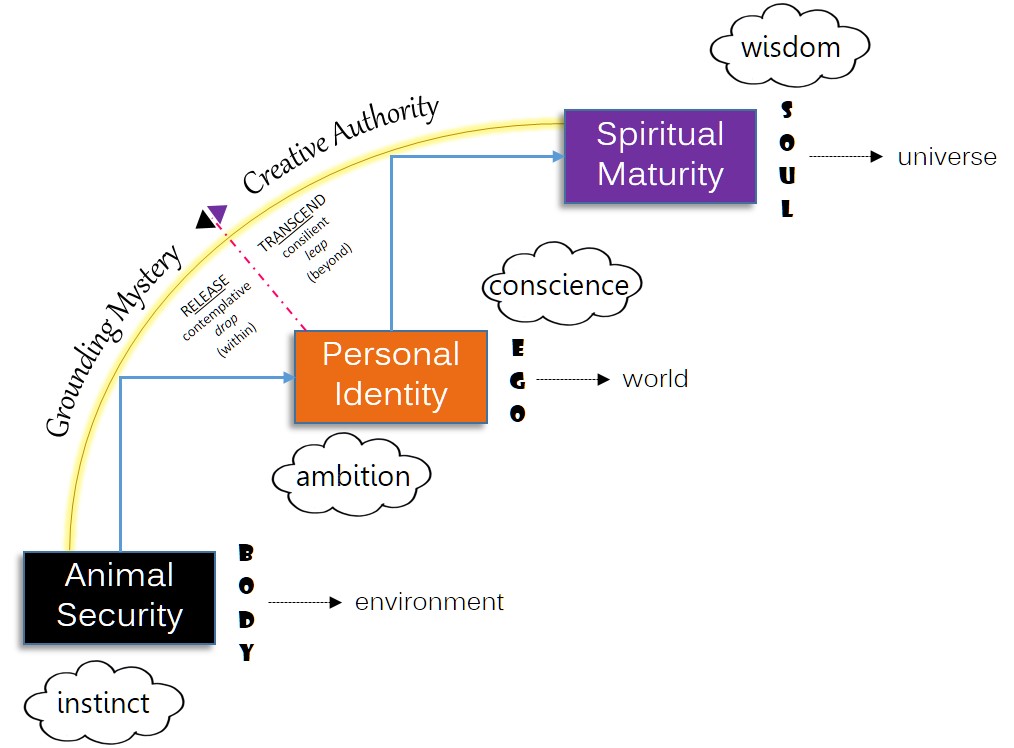
The best place to begin is with what I call our essential nature as human beings. ‘Essence’ here doesn’t refer to some absolute and unchanging reality underneath or behind what is evident to our senses. From the Greek for ‘being’ (esse), it simply speaks to what something is, not as isolated and standing apart from everything else, but just as it is, centered in itself.Model_Step 1With that in mind, I propose that our essential nature as human beings is best captured in the term ‘spiritual animal’. Other similar-sounding titles have been used in the past, such as ‘rational animal’ or ‘political animal’ (both from Aristotle), and ‘symbolic animal’ (Cassirer). But each of these is based in some capacity of higher intelligence that may be ‘higher’ in humans though not entirely unique to us. Besides, whether we are rational, political, or symbol-using animals, the qualifier in each case says more about what sorts of special things human beings do (or can do), not what we are.

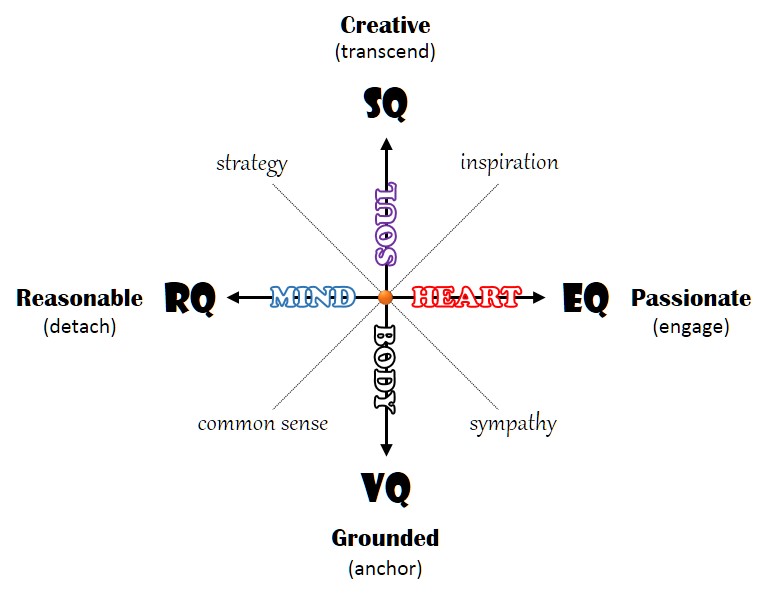
As a spiritual animal our consciousness is dually oriented: inwardly to the inner recesses of contemplative life and outwardly to the sensory-physical environment. Spiritual names the inward-oriented, introverted power of consciousness which has prompted the intuition of our essential oneness with reality (within us). This intuition is profound and ineffable, and it lies at the mystical origin of all (dare I say it?) true religions. Animal not only identifies our membership in a ‘kingdom’ of life, but as an adjective it names the outward-oriented, extroverted power of consciousness which supports the perception of our essential relationship to all things (around us).

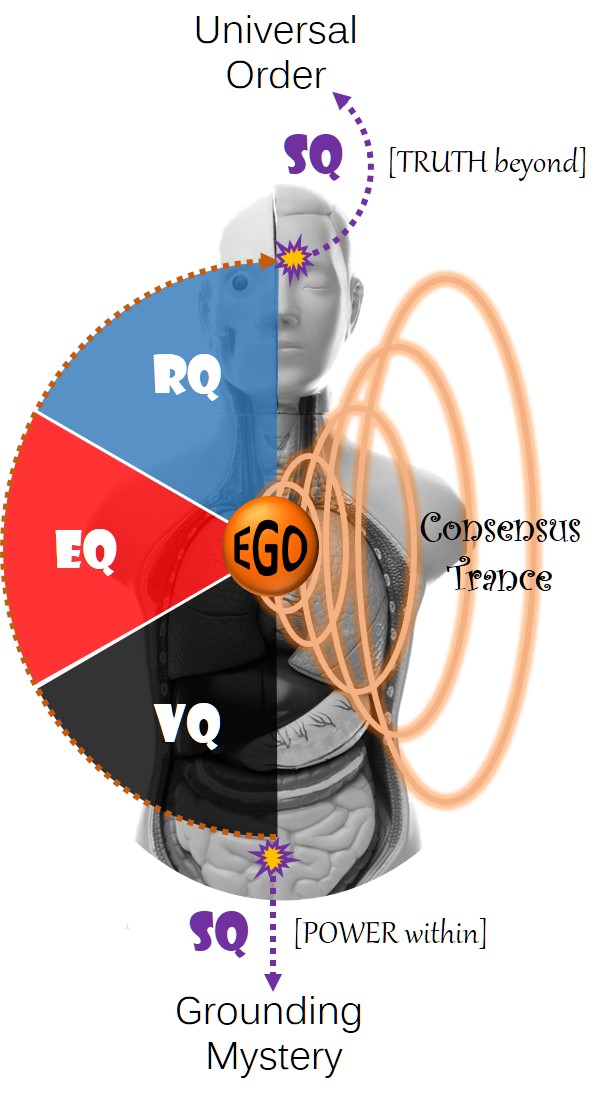
If I use the classical terms ‘soul’ and ‘body’ in connection with this dual orientation of human consciousness, I need to be especially careful not to separate them into opposing ‘parts’ of our nature, where the next step traditionally was to identify with one (soul) against the other (body). So let me stress the point that our essential nature as spiritual animals is a duality in the orientation of consciousness, not a dualism of a mortal body and an immortal soul only temporarily bound together for this earthly life. Our essential nature, in other words, possesses an indivisible integrity: we are body-and-soul, not bodies with souls or souls with bodies.Model_Step 2To this essential nature something else is added, and this I call the conditioned self, or ego. Ego is distinct from the spiritual soul and the animal body – remembering that these are orientations of consciousness and not separate parts – by its character as personal. From the Greek, our adjective ‘personal’ refers to a mode of consciousness that is socially constructed, shaped in the role-play of human relationships, and providing the individual with a mask of identity (actually numerous masks) through which we speak (persona) and interact with others.

A personality is really a rather loose association of distinct drives, attitudes, and dispositions, with each motivational strand capable of breaking the surface and running the show for a time. The psychologist Roberto Assagioli called these distinct strands ‘subpersonalities’ and regarded the ego as an executive manager of sort, with the (socialized) responsibility of keeping each in its place and a general order overall. Through the process of ego formation, this executive center of personal identity gradually assumes control and conducts the personality according to the moral constraints and expectations of society. When the personality has achieved stability, balance, and unity under ego’s effective management, the developed virtue is known as ego strength.

This adventure in ego formation is illustrated at the cultural level in the ascendancy of theism. As the patron deity represents those virtues of character expected of a devotee, god also stands behind and legitimates the disciplinary system that enforces morality. An individual’s subpersonalities, then, have their social equivalent in the many tribal members, each of whom might at any moment attempt to break out and take over. For its part, the patron deity plays the role of ego for the group, asserting the dominant will and keeping order. In a way, Freud’s concept of the superego, not just as the voice of tribal morality over (super) the individual but as a divine ego projected above (super) the group, fits into this picture well.

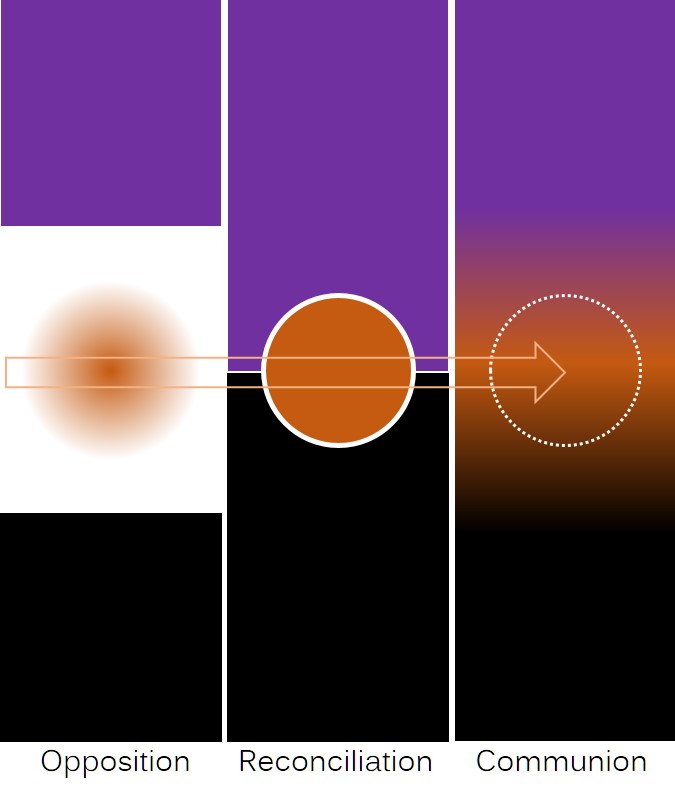
From the perspective granted by our separate ego, body and soul can easily (and mistakenly) be seen as “mine.” We can’t forget, however, that this separate center of personal identity does not actually exist; it is merely a social construct, a representation of ‘who I am’ in this or that tribal context. The longer purpose of ego formation is not simply to establish a personal identity, but rather to empower sufficient ego strength in the individual so that he or she is capable of ‘going beyond’ the self in such higher experiences as love, inspiration, communion, and wholeness.Model_Step 3Ego transcendence ultimately makes it possible for individual consciousness to find reconciliation with our essential nature. As long as our effort and attention are preoccupied with amounting to something, defending ourselves, and holding our own, this invitation to the unified life cannot be fully accepted. In fact, without sufficient ego strength – a deficit which can come about as a consequence of childhood abuse and the lack of positive social support – the prospect of self transcendence can strike deep anxiety in the already insecure ego. (This is the anxiety exploited by sick religion and channeled into bigotry, conviction, and violence in god’s name.)

With sufficient ego strength, however, we are able to go beyond ourselves in a healthy and holistic way, dropping deeper into the grounding mystery within and opening to the provident universe all around. This realization of oneness – that I am both a manifestation of and a participant in the present mystery of reality – promises to transform our way of life in profound ways. We can note, for instance, how Siddhartha Gautama, Jesus of Nazareth, and countless other revolutionaries in consciousness challenged the moral conventions of their time and opened the minds of their contemporaries to the sacred mystery at the heart of reality.

The examined life is indeed worth living.

Easter Without Miracles

Jesus of Nazareth went into the tomb, and Christ the Lord came out.

Jesus was crucified by a conspiracy of Ego, Orthodoxy, and Empire. His message was about the ‘good news’ (gospel) of human liberation and the invitation to life in community. The opposition he confronted on the political, religious, and personal levels was not interested in surrendering control to the spiritual power he both embodied and awakened in others. ‘The world’ – a term used in the New Testament as shorthand for this conspiracy of dark forces – had no choice but to put him away. For Ego, Orthodoxy, and Empire, surrendering is not an option.

A good deal of energy has been wasted on the interpretation of Easter as a physical miracle where the dead Jesus was brought back to life. The so-called resurrection might as well have been a mere resuscitation, had less time elapsed after his death. Even though the New Testament’s biggest advocate (and probable originator) of the belief in the resurrection of Jesus never mentions an empty tomb or the revival of a dead body – indeed for Paul resurrection (literally a raising up) names the process by which Jesus was liberated, exalted, and glorified to the status of Lord – an overwhelming majority of Christians today have reduced it to a mere miracle of coming back to life.

This is supposed to be significant, as it vindicated Jesus as god’s victim of child sacrifice, who saved us from our sins. It’s essential that the body which came out of the tomb is the same that went in; thus the insistence on a ‘bodily resurrection of Jesus’ – one of the Five Fundamentals of evangelical Christianity. If he wasn’t literally (actually, physically) brought back to life, then death hasn’t been vanquished and we are still in our sin, lost forever. The bodily resurrection of Jesus is the miracle upon which the entire plan of salvation turns.

After all, didn’t the apostle Paul (1 Corinthians 15) say as much?

12 Now if Christ is proclaimed as raised from the dead, how can some of you say there is no resurrection of the dead? 13 If there is no resurrection of the dead, then Christ has not been raised; 14 and if Christ has not been raised, then our proclamation has been in vain and your faith has been in vain. 

This sounds very much as if Paul regarded the resurrection of Jesus as a physical miracle. It is necessary, however, to hear these words in the mythological context that Paul had in mind. For him Jesus is the Second Adam (or New Man), the archetype for a new age whose saving work offers a revolutionary counterexample to the First Adam of Genesis. Whereas the First Adam had regarded equality with god as something to be grasped and exploited for his personal advantage, Jesus as the Second Adam surrendered himself totally to god’s purpose (see Philippians 2 for another Pauline meditation on this theme).

For his hubris the First Adam was evicted from the garden wherein stood the tree of life, which is another way of saying that the penalty for his overreaching pride was mortality, or death. As the archetype of humanity (according to this mythology), the First Adam set the pattern for all subsequent generations and was spiritually active (we might say) in each and every one of us – until Jesus, that is. In acknowledgment of the humble devotion and self-sacrifice of Jesus, god ‘raised him up’, metaphorically giving him access to the paradisal tree of life. Identifying with the Second Adam rather than the First makes Jesus spiritually active in the individual Christian. In his letter to the Christians in Galatia Paul says,

I have been crucified with Christ; and it is no longer I who live, but it is Christ who lives in me. 

All of this is to show that Paul, who is widely respected by Christians as our biblical authority on the resurrection of Jesus, did not see it as a miracle in history but as representing a seismic shift for human nature and destiny played out in the archetypal realm – that is to say, in the realm of mythology. This doesn’t mean that ‘nothing happened’, but rather that it’s always happening, that it’s poised to happen again, right now, if we’re prepared to take the myth seriously … but not literally. Taking a myth like this literally, treating it as if the figures and events it describes are in the past (or in the case of apocalyptic myths, the future) drains it of life and power, reducing it to something which must be believed or otherwise dismissed as incredible.

So let me come back to my original statement:

Jesus of Nazareth went into the tomb, and Christ the Lord came out.

Because he challenged the politico-economic system (Empire) of his day and championed the rights of the poor, Jesus was arrested and crucified by Roman authorities. His advocacy on behalf of the many who were suffering under the boot of Roman oppression, pushed ever deeper into debt just to survive, made him an enemy of those in positions of wealth and power. Empire is not simply a form of government, but a domination system that thrives on the exploitation of labor, the burden of debt and confiscation of property, along with a ruthless response to protest, disobedience, and rebellion.

At the time, religious leadership in Judaism was doing its best to regulate what ‘seemed right’ (ortho-dox) with respect to proper behavior, moral purity, observing the Sabbath, and keeping themselves separate from sinners. Jesus played loose with these rules and even deliberately transgressed on them, to the point where these leaders also wanted him gone. As Orthodoxy takes the mind captive to certain convictions, closing down on meaning and ruling out any sense or experience of the grounding mystery and greater community of life, his refusal to give up creative authority for blind obedience made him a threat here as well.

And his essential message, which had to do with an urgency upon the individual to set aside self-interest (Ego) in service of the greater good, effectively called for a reversal in values and motivation, from the centripetal preoccupations of ‘me and mine’ to a centrifugal engagement with ‘all of us, together’. The ambitions of Ego for security, superiority, significance, and worldly success had to be surrendered for the liberation and fulfillment he promised – and for many it was too much to ask. We can blame Empire and Orthodoxy for putting Jesus away, but ultimately it was (and still is) Ego that sealed his tomb.

In the days that followed, a few of his disciples came to realize that Jesus had been so much more than an individual whose way of life had gotten him in trouble with the authorities. Paul recognized in the memory of Jesus the spirit of a New Man (or Second Adam) who opens for all of us the path to life in its fullness. His spirit – not his ghost but the vital energy and continuing influence of his exemplary life – is as real now as it was then.

It was at this point, by a fresh discovery and reorientation to what Jesus had been all about, that Christ the Lord came out of the tomb.Easter

Opening the Present

Here_NowSpirituality is about living mindfully in the here-and-now. Of course, there is nowhere else we can be, but we all know how easy it is to live mindlessly in the present. Most of us are less quick to admit how much we prefer to live outside the present moment – rummaging through the past or chasing after the future where the meaning of our lives is anchored. We spend a lot of time and energy managing our webs of meaning which stretch across the here-and-now, but we are hardly ever really (that is, mindfully) in it.

However real our webs of meaning seem to us, they are suspended between two fictions called the past and the future. By ‘fiction’ I am referring to something that is purely a figment of imagination, a narrative construction, mythical in the strict sense of having only literary and not a literal existence. Most of our waking attention is devoted to minding and mending the many strands of meaning that support our identity (who we are), give us significance, and promote our sense of purpose in life.

A healthy spirituality shouldn’t demand that we permanently abandon our webs and give up on meaning, but it can help keep it all in perspective. Because meaning is made up in our minds and not inherent to reality itself, it is necessary every so often to drop out and consciously reconnect to the grounding mystery of our life in this moment. It’s here (and now) that we can experience the Real Presence of being – what the religions name God, Spirit, The Holy. Before we give it a name, however, and proceed to represent it as a being who is the beginning and end of all things, this Real Presence is the abiding mystery of existence itself.

My diagram above is another cross design, with the horizontal axis of time intersected by a vertical axis of here-and-now. Ego occupies the present moment, as everything does, but without any direct awareness of it, caught up – or we might say, preoccupied – in the business of managing an identity by holding together the fictions of past and future. An attentive mindful engagement with present reality would require a surrender of meaning for mystery, of belief for being, of me-and-mine for here-and-now. It’s a tough sell, given how much is invested in our personal worlds, as well as in the collective (shared) worlds of tribe and culture. No wonder that our tribal religions hold the mystical practice of dropping out with such derision and contempt.

But what is the here-and-now, and why is it widely regarded as such a threat? To answer the first part of this question would involve spinning a meaning around the mystery, pushing it into the distance as our object, and effectively removing ourselves from it. The distance created by such objectification gives us the illusion of control, where meaning can be codified inside an orthodoxy that is beyond doubt and worthy of our ultimate sacrifice – which goes to answering the second part of the question. As long as reality remains something else beneath our mental labels, no meaning can be absolute.

So, instead of defining the here-and-now, let’s ask what these terms represent. What is the mystery behind what we name ‘here’ and beneath what we name ‘now’? Where, exactly, is here? It seems obvious that here is where I am; there refers to any location outside and apart from here. There might be a distant star that I see overhead, another country halfway around the globe, the neighborhood just over the hill, or that book across the table from where I am sitting. It would seem that here, while tethered to my present position, is limited in its scope by a purely arbitrary horizon.

In other words, if my here is this room, then the book and this table are included. If my here is the county I live in, then my neighborhood and the one over the hill are both included. If my here is planet Earth, then that faraway country is included. And if the horizon of my present location is the universe itself, then that distant star is also here. While the center position of here is not arbitrary but instead permanently fixed to my present location, the scope of what’s included is as small or inconceivably large as I care to make it. (Recent blog posts of mine make a case for this virtue of ‘care’ as perhaps the most salient indicator of human self-actualization, if and when it comes about. See “Ethical Calculus (and the Next Election)” and “A Spirituality of Religion”.)

To a great extent it is the work of news media, politicians, preachers, and moral bigots everywhere to contract the horizon of here so that only the right and the righteous are included. Once the line is drawn, just about any manner of violence against outsiders can be justified. The genuine mystic – referring to one who has dropped out of meaning and opens fully to the boundless mystery of being – is an insider par excellence, despite the fact that orthodoxy condemns him or her as a dangerous outsider. When Siddhartha included ‘all sentient beings’ in his ethic of universal compassion, and when Jesus included ‘the enemy’ in his ethic of unconditional forgiveness, they were inviting us to a higher life where outsiders don’t exist.

Implied in fixing the vantage point of here to my present location is an acknowledgment of now. Whereas here is relative to my horizon of awareness, now refers to that fixed point at the center which is always and only in the present. The past is no more and the future is not yet; only the present is. What ego cannot apprehend, in its shuttling back and forth on the story loom between yesterday and tomorrow, is where our soul abides: this timeless moment, the Eternal Now. It is never yesterday or tomorrow; it is always today. Always now.

Opening the present requires that we drop out of meaning and into the mystery, deeper into the center of awareness that is always now, and then allowing the horizons of here to simply dissolve away like fading ripples on a pond, until we are left with that most exquisite and essentially ineffable of insights: All is One.

The Consilient Leader

Reality Process

Reality is not a thing, but a process comprised of three interacting forces which are universal throughout the Great Process we call ‘the universe’. Consilient leaders understand this process, working with rather than against it.

Not long ago I made a case for taking a little-known term out of seclusion and applying it in a fresh way to the realm of education. The term is consilience, and it speaks to what we hope will happen in every classroom (as well as outside them), where individual teachers and students are inspired to “leap together,” each beyond the self and together in community, caught up and transformed in the experience, returning to their individual centers of consciousness with deeper insight, better understanding, informed wonder, and a passion for more.

Now I want to move consilience outside of education proper, to explore its relevance for leadership. The most effective leader, I propose, is a consilient leader who understands and works with the forces that everywhere interact in the process of reality affectionately known as our universe. Consilient leaders are more effective than nonconsilient ones, and individuals who cooperate with the universe tend to be healthier, happier, and more successful than those who strive against it, or who try to exploit its provident nature for selfish gain.

I don’t mean to suggest that consilient leaders own more property or occupy higher social classes than these others. ‘Success’ here is not measured by status but by skill; consilient leaders are more skillful in what they do because they know how to move with the forces of reality rather than against them. In providing for the emergence of life and the ignition of consciousness, for a fertile culture of social support and our own self-actualization as human beings, the universe has set the stage for consilient leaders – indeed, the universe is a manifestation of consilience on the largest scale.

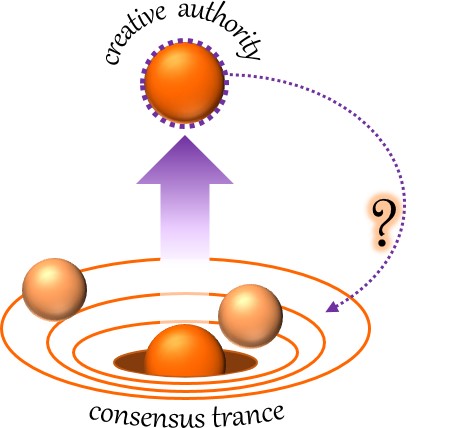
One more qualification on this term ‘consilient leader’ before we jump into the diagram above. By leader I am not necessarily referring to an individual who leads others – a boss, manager, director, principal, president, general, prophet or pastor. I realize that I am crossing against a conventional assumption when it comes to what makes a leader, but I have a much bigger vision in mind. Seeing as how the universe has provided for the rise of creative authority (also known as self-actualization in human beings), a consilient leader is one who uses this creative authority to harness and channel its three forces for the ongoing evolution of genuine community. Others may or may not follow, but the consilient leader is still on the leading edge of human evolution.

Let me give you a guided tour through my diagram, beginning with those three rounded rectangles arranged along the vertical axis. The first term in each rectangle names a level of organization in reality, while the second term identifies the force behind it. It will be easier to understand if we start with the middle set of terms: individual and integrity. By individual I mean any thing that more or less stands on its own – not in some absolute sense, since essentially All is One (as the name ‘universe’ implies), but relatively, in its own individual center while still in relationship with other things. The force that keeps the individual intact is integrity, literally holding together as a whole.

Individuals exist (taking a step upward in my diagram) in systems, which are higher-level organizations that illustrate consilience in an obvious way: a system is more than the mere sum of its parts (individuals). A second force, called synergy, connects individuals together and lifts them into a more energetic and complex web of influence. Synergy, then, is not merely additive (1+1) but exponential, with the higher circuit created in their connection capable of containing the energy jump (the force of integrity at this higher level), multiplying its value, and sharing power across the system.

As we swing down to the bottom of my diagram we begin to feel the effect of reality’s third force, entropy, which refers to the tendency in any organization to collapse into more stable energy states, approaching a state of critical stability called the ground. As the metaphor suggests, ground is the deepest support, a baseline value that represents a threshold between order and chaos, between the intact individual and its disintegration. (In the context of spirituality, what I name the ‘grounding mystery’ is the threshold and lower limit where self-consciousness dissolves into unconscious life, which is the deepest register to which our contemplative awareness can descend.) 

We might be tempted to imagine a universe where entropy is not in play. Isn’t it a depressing thought, all this breaking down, falling apart, and collapsing toward nothingness? Who needs it? Actually, we do. The whole universe would be impossible without the down-pulling force of entropy and its stabilizing ground. Of course from the individual’s perspective entropy is a major buzz harsher. But systems would burn themselves out in limitless synergy if it weren’t for the counterbalancing effect of entropy, bringing things down for rest and regeneration. And right in the middle of this cosmic tug-of-war, the force of integrity does its best to keep the individual intact.

So, my definition of a consilient leader is one who understands that reality is a process manifesting from the interaction of three forces, which contain energy (integrity of the individual), connect individuals (synergy of the system), and collapse systems into more stable states (entropy and the ground). It should be clear from my diagram that reality is not a simple three-layer cake, but that these three forces interact throughout the universe, making nearly every speck an individual, caught up in systems and eventually dissolving into its ground. Look around and you’ll see evidence of their interaction everywhere. Learn how to work with these forces and you are on your way to becoming a consilient leader.

There remains one part of my diagram to be explained: that box of four terms to the right of center. I’ve added these as a reminder that even consilient leaders are individual centers of personal identity, or egos, and their most important work is with other egos, as we all make our way, by fits and starts and frequent setbacks, into that most consilient and highly complex of systems known as genuine community. Egos complicate the work considerably, and the consilient leader must have a self-honest and perspicuous understanding of the challenge they represent. I’ll move down the list fairly quickly, encouraging my interested reader to explore other posts of mine where I analyze ego in greater depth.

Every self-conscious center of personal identity (ego for short) holds certain ambitions for itself. True to the word’s etymology, ambition involves the twin drives (ambi) of desire and fear, one (desire) straining for an imagined or promised reward, while the other (fear) harbors doubt and a growing anxiety around the prospect of failure or falling short of the goal. The insight that desire and fear lock the ego inside an interminable wheel of suffering is a central tenet of Buddhism. Nevertheless this is where ego is bound to stay – which is also why, for the Buddha, the only way out is through the realization that ego is without substance and simply dropping out of the wheel.

These ambitions of ego are really the out-working effort of strong beliefs concerning the nature of things, the meaning of life, and the prospect of happiness. So strong are these beliefs, in fact, that they hold the mind captive and prevent the individual from “thinking outside the box.” Such beliefs – not held by the mind but holding the mind hostage in this way – are called convictions. As their prisoner (literally a convict), the mind is unable to entertain differing points of view, consider evidence against its own absolute truth, or even imagine any truth outside its precious orthodoxy.

Through a combination of ruthless self-examination and social observation, a consilient leader understands that convictions are really just a defensive measure for the protection of certain attachments by which ego identifies itself. Attachments may be about nationality, ethnicity, religion, gender, age, sexual orientation, or whatever, but basically they are ways that individuals identify themselves with (or against) the world around them. The earlier they form, the deeper and more powerful they tend to be, pulling ego into the delusion that without them it is nothing. And again, but from a position of clarity rather than delusion, the Buddha would agree: the ego is really nothing.

Inside even these attachments, then, is a persistent anxiety over the insecurity of ego’s condition. Because it is a construct of social experience and merely the managerial function (lacking substance) of personality, ego is inherently insecure – not only in feeling but in fact. This insecurity seeks compensation in attachments; attachments build justification behind convictions; and convictions drive the ambition for supremacy, perfection, retribution, salvation, glory, or whatever will finally make it better.

I should emphasize the point that every ego has this neurotic architecture – even the ego of a consilient leader. The difference between the consilient leader and the rest is that he or she understands this and is vigilant to the occasions when ego conceit is posing as true integrity.

A Spirituality of Religion

Spirituality of Essence_Religion of IdentityThe separation of spirituality from religion is a best-selling topic these days, particularly as religion continues to impress us with its tendencies toward conviction, bigotry, and violence – and complacency. More and more people are either dropping out or quietly declaring themselves “spiritual but not religious.”

In previous posts I have tried to make a case against such a clean separation of spirituality and religion. I’m not suggesting that a religion devoid of an active and deep spirituality is an impossibility; we see enough of that all around us. Certainly religion can lose its inspiration, its creativity, its compassion and ethical vision. At that point it becomes a perfunctory framework of rituals and stilted phrases. In my view, it is no longer really a religion. We may put that label on it, but we do so by mistake.

From the Latin religare, religion is a system by which the various domains and concerns of daily life are coordinated and anchored to the grounding mystery of being. Spirituality refers to the inner experience of this grounding mystery, as well as to an awakened intention in the way it is lived out. Spirituality, then, is the living intention of a dynamic religion, while religion is the relevant extension of a vibrant spirituality. A religion can lose its spirituality and die, but spirituality requires the structural support of religion if it is to engage the concerns of daily life.

My spin on religion challenges us to break out of the conventional definition, where we commonly speak of ‘the world religions’ as historical institutions organized on the cultural level. If the word merely refers to a system that coordinates and anchors our human concerns and activities to the present mystery of reality, then you have a religion, and so do I. Whether or not we affiliate ourselves with one of the institutional religions is of secondary importance to the question of how we individually (as well as communally) connect our lives to the grounding mystery and carry it consciously into all that we do.

This gives me a chance to illumine the relationship between two big ideas in my Tracts blog: the grounding mystery and creative authority. Very quickly (as if that will help), the grounding mystery is a metaphorical reference to the present mystery of reality, to the Real Presence manifesting to (and as) our awareness in this moment. Our deepest engagement with it is far below the reach of words, and this, along with the fact that it surpasses any definition our minds might attempt to throw around it, makes it universally recognized across the mystical traditions as ineffable, beyond name and form.

Our only direct access to the grounding mystery is by an inward path of quiet contemplation. Outwardly we can observe its countless manifestations, its many masks; inwardly we know it as mystery, disguised as our self. This may sound very “Eastern,” but Western mysticism carries the identical realization. Simply stated, you are a human being, a human manifestation of being, an expression of the grounding mystery in human form. The wonderful thing is that each of us can contemplate and release ourselves to that deeper mystery at any moment.

In my diagram above, I have placed identity (ego: my self: “I”) inside a list of terms that together represent a spectrum of existence ranging from the interior depths of being to the extended outreach of our individual lives in the world. Below – or rather, underneath and supporting – identity is consciousness, life, matter, and energy in descending order. Identity has its ground in consciousness, consciousness has its ground in life, life has its ground in matter, and matter has its ground in energy. The deeper we go, the more ineffable the ground becomes. We can say a lot about identity, less about consciousness, still less about life or matter, and really nothing about energy that makes any sense (even the scientists talk about its ‘spookiness’, indeterminacy, and quantum unpredictability).

Despite the fact that we can’t say much about the present mystery of reality that underlies and supports identity, this is precisely where spirituality lives. We have an intuitive sense that this deeper support is ‘more real’, and when we allow our center of attention to sink to these deeper registers, we feel more present and authentic within ourselves. Still, such an inward descent requires that we let go of all those attachments and hangups that keep ego intact – and this is what makes a vibrant spirituality such a threat to religions that have lost their soul. Its communion with a mystery that cannot be named, represented, or even precisely located must be heretical because it is incomprehensible.

Moving up my list from identity, we don’t release ego but rather assume it in all that follows. This is where religion comes into play. Our connections outward into daily life and relationships are necessarily personal, which is to say they involve who we are in the world (as distinct from what we are). Ultimately our individual development into maturity means that we start choosing (or willing, volition) the life we want, enacting our intentions (agency), taking responsibility in what happens, and fully investing ourselves in the process (care). This outward flow from identity to care is what I mean by ‘creative authority’.

Because it is all about shaping and coordinating the adventure of identity, from the awakening of self-consciousness in infancy, through the complicated role-plays of adulthood, and into the retirement of old age, religion should support our progress to creative authority (also known as self-actualization). Too often, however, its influence attempts to move us in the opposite direction where we are pushed back into a more dependent, submissive, and obedient state. This is when our religion, now outgrown and losing relevance, begins to strangle our spirituality. While the force of our spiritual growth is oriented on the higher ideal of human fulfillment, the dead weight of our religion pulls us into frustration and futility.

That’s when it is time to break through yesterday’s religion and create a new system, one that can coordinate and anchor our daily concerns and activities to the present mystery of reality, and in a way that expresses our true spirit. One way or another, it will lead beyond ego and to the other side of god.

Ethical Calculus (and the Next Election)

MembershipI’ve made the argument – whether successfully is for my reader to decide – that the question “Who am I?” is rather superficial when compared with the question “What am I?” Of course, my ‘who’ is much more interesting since it involves my unique personality: my individual preferences, idiosyncrasies, quirks and convictions – all those things that set me apart from everything else around me. This question of identity (who) is asking about what makes me special, and is arguably the question that advertisers have learned how to expertly convert into sales.

There are even spiritual teachings that turn this notion of personal identity (ego) into a principle of absolute reality, asserting the existence of a Supreme Self whose consciousness underlies and includes all things. I don’t fault them for projecting all of existence in our image. In fact, I regard it as inevitable and appropriate to a certain stage in our spiritual development. The provident nature of our universe, in the way it has generated and supports the adventure of life and consciousness, inspired our ancestors long ago to regard it as evidence of a superior intelligence looking out for us – and perhaps wanting something from us.

I will come back to this in a moment, but let me quickly distinguish what I take to be the far more important (if less interesting) question: What am I? This is not asking about what sets me apart and makes me special. Actually – and this is likely why we find it less interesting or even threatening – the question of ‘what’ I am (rather than ‘who’ I am) forces our inquiry below the superficial conditions and cultural arrangements that prop ego in place. It is asking about my essence (from the Greek esse, being).

In essence, I am a human being.

Of course, we can push even deeper than that: a human being is a complex manifestation of energy, matter, life, consciousness, identity, volition, agency, responsibility, and care – an evolutionary progression that can be traced in reverse to the grounding mystery of being itself. You’ll notice that ‘identity’ (who: ego: “I”) is just an aspect of what a human being is essentially, and far from the deepest. It certainly should be included in a fuller understanding, but the way it has come to dominate or dismiss other aspects of our human nature may help explain the present mess in which we find ourselves.

As we move forward, let’s be mindful of keeping these two principles – one (identity) pushing our considerations into tighter and more exclusive terms, and the other (essence) pulling us into deeper and more inclusive realms of being. Identity makes you special and sets you apart. Essence plunges beneath this pedestal of ego consciousness and grounds your existence in the present mystery of reality. Some mystical traditions teach the necessity of blowing out (nirvana) personal identity in pursuit of an unqualified oneness where no distinctions remain.

I don’t agree. Sure enough, if we conceive these two principles (identity and essence) as mutually exclusive, then one side probably needs to win. In that case, more reality (essence) is better than less (identity), so the prescription of eliminating ego is the way to go. But what if they’re not mutually exclusive? What if the upward push into tighter identities is in creative opposition with the downward pull of deeper essence? What if a stable, balanced, and unified personality (a virtue known as “ego strength”) is not something to be extinguished, but rather transcended in an enlarged vision of our place in the universe? Let’s see how that would play out.

We might characterize essence as what we are working with, and identity as what we are shaping into. This shaping of what we are essentially into who we are as identities does not take place in a vacuum, but always within some kind of context. For humans, the more influential contexts are social – our family, our tribe, our culture. If identity is a function of identifying with something, then the earliest and therefore deepest agreements that shape our personalities concern our position in the social order and taking our place as ‘one of us’.

That’s why we continue to carry the dynamics of early childhood into our adult lives, playing out (usually without thinking and often against our better judgment) the neurotic styles that helped us get our way (at least a good part of the time) amid the contest of affection, resources, and alliances that was our family of origin. If the contest was especially vigorous (and maybe at times violent), our membership in that circle forged an identity that had to scrap for our share, outsmart our rivals, or else wait patiently for the leftovers.

My diagram shows how identity conceivably expands outward to larger spheres where resources are more plentiful, but where the dynamic of relationships – how to respect, get along, and cooperate with others – is that much more complicated. I say ‘conceivably’ because, while it seems natural that things would progress in this direction, conflict and hardships closer to the tight center of identity produce insecurities that can make such an outward expansion all but impossible. The consequence is an ego which is guarded, suspicious, stingy … and dangerously small.

A ‘small’ identity is dangerous because it is incapable of taking into consideration any values or interests outside the circle of its closest attachments. Its primary (and typically exclusive) membership is with those who share a common skin color, language, ideology, or way of life. Anything else – that is, everything outside the circle of membership – is automatically suspect and not to be trusted. The value of raw materials and consumer waste, of immigrants and refugees, of the infirm and unborn, is determined according to an ethical calculus with “me and mine” at the center. What works for me (and mine) is ipso facto good. Whatever interferes with this is evil – not just bad but diabolical.

Such an ethical calculus will necessarily reflect and promote concerns inside the circle. It matters, then, how large our circle of membership is … it matters a lot. If I identify myself only with a particular nationality, ethnic group, social class, religious denomination, or political party, that circle may include a large number of people but it excludes many, many more. It will absolutely exclude other forms of life that don’t fit those categories whatsoever. As far as I am concerned, these are nothing more than resources, ‘wildlife’, savages, or pests that should be dealt with according to whether they benefit or hinder my personal interests.

And this is where a spirituality of essence needs to be heard again – before it’s too late. By pulling our center of awareness to deeper levels where the superficial distinctions at the surface are left behind, we can rediscover (for it is, in fact, a truth that primitive cultures honored long ago) the essential unity of being. Resting in the grounding mystery, we will be inspired to live in conscious communion with all things.

A Culture of Dependency

Consumer_Patient_VictimAs I see it, the ultimate aim of human self-actualization is not some godlike state of disembodied transcendence, but a mode of consciousness and active life that I call creative authority. This mode of existence is, in fact, one of the outstanding powers attributed to, and glorified in, our numerous representations of god through the millenniums. However, more consistent with a constructivist and evolutionary approach to religion, the construct of god (as metaphor and literary figure) has served to project and focus our aspirations on what is waking within us. The creative authority depicted in our gods, then, is really the higher self calling us forward.

In this post I will not criticize the various ways that corrupt religion has actually interfered with our evolutionary progress as a species, but rather how certain developments in our larger culture have managed to push us away from the ideal of creative authority and deeper into a mindset of dependency. As long as we persist in this mindset – and there are seductive incentives for doing so – we will be prevented from becoming fully human.

Creative authority is about choosing our response to life as it comes, and making choices that move us deeper into the life we really want. Choice (as my diagram shows) combines the freedom to choose with responsibility for the choices we make. While freedom without responsibility may be the fantasy of adolescence, creative authority keeps the two always together.

It is a mark of maturity – and, I would add, self-actualization – when the individual begins freely choosing and taking responsibility for the life he or she chooses.

The general trend of Western culture, however, especially in the last hundred years, has been to convert the individual away from creative authority and into a very different mode of consciousness. Instead of cultivating the identity of one whose inner life is filled with creative energy, talent, intelligence and possibility, a product of this conversion regards him- or herself as empty inside, an energy sink that must perpetually be filled as it becomes depleted. What would otherwise mature in the direction of a self-identified creator gets identified by the culture as a consumer.

A consumer, therefore, is the exact opposite of a creator: not inside-out but outside-in defines the flow of energy, life, spirit and value. A creator enjoys the freedom and accepts responsibility for constructing meaning, making connections, and managing a personal world. Under the spell of the Great Machine, a consumer by contrast looks outward (since there’s nothing inside anyway) for what will fill the void within, satisfy the craving, and make him or her whole again.

There is an obvious marketing strategy in all of this: as long as an individual believes that something essential is missing inside, and that his or her only option is to look outside the self for completion, the retail possibilities are limitless.

Once the trance of consumer identity is accomplished, the next (and logical) step is to take on the role of patient. From the Latin pati, a patient is not just someone who suffers, but who passively suffers – someone to whom unfortunate things happen. Again, we should note the divergence of this idea from the self-concept of a creator who takes responsibility for the meaning constructed around pain and loss, as well as for the path back to health. While a patient waits on salvation from outside, a creator is actively engaged as a co-operator in the process.

As long as the individual remains passive in the treatment process, the Great Machine and its retinue of ‘experts’ can diagnose, prescribe, and perform their magic – for that is the mystique it has to the patient’s mind – on their inert subject. The patient is needy, not resourceful; and the goal of treatment is palliative (bringing temporary relief), not really curative (promoting chronic health). Once brought into the system as a patient, an individual can be expected to remain in this compliant state indefinitely – at least until the symptoms are gone.

Oftentimes the underlying problem is rooted in a patient’s mind-body balance, personal lifestyle, stage of life, or philosophy of existence – in other words, things in which the individual really does have options and should take an active role. Making the necessary changes here would truly make a lasting difference. This would suggest that the patient somehow has a choice in the matter, that he or she has some measure of creative authority in the way things are. But let’s not forget: the passive sufferer is empty inside and utterly dependent upon salvation from beyond.

It’s one more fateful step that lands an individual in the self-identity of a victim. I’m not talking about obvious cases where innocent and defenseless persons are abused, exploited, or attacked. Terrorists are partly empowered by our anxiety over not being made victims, and unsuspecting bystanders who happen to be in the wrong place at the wrong time are victims in a straightforward sense.

Just as our self-identity as patients is implicit to our identity as consumers, so too is a belief in our own helplessness as victims implied in our passive mode of waiting on help from outside. When the required assistance or promised solution doesn’t come, in the expected form and on time, we are ready to cry out our protest as victims of malpractice, discrimination, or criminal neglect. Never mind that our demand was exaggerated and unrealistic to begin with, given that it came out of the conviction of our own impotence. We are entitled to what reality owes us, and reality owes us a lot.

By this slow and steady slide, then, we have been converted from creators to consumers, from consumers to patients, and from patients to victims: mired in a culture of dependency. Whereas our creative authority would put us in a very different relationship to life, others, and the world around us, this increasing dependency has only managed to cut us off from our own true nature, from one another, and from the present mystery of reality.

The truth is, we are not empty, needy, and helpless. Our self-actualization intends to move us into greater freedom and responsibility, into a wider empathy and a larger community, into a deeper center and a higher wisdom. In the process we become more fully human.

Inside-Out

Peace_Joy_LoveThe Great Machine of consumerism is always at work, spinning the gauzy web of illusion that enthralls much of modern consciousness. It persuades us to look outward for the secret to happiness, which today might be contained in a new-and-improved formula of this, tomorrow as an upgraded model of that, next year in some revolutionary medicine coming to market, or the new lease on life promised at retirement. Maybe it’s this sexy thing, or that job promotion.

But it never comes.

Make no mistake: we end up spending or sacrificing what we have to in order to acquire the key that will unlock our truest joy. But now it sits in the garage or on the shelf and under a pile of other keys that have let us down. The problem is, we can never know for sure if the real problem was that we tried too hard, or not hard enough; that we started too late or quit too soon; that the dosage wasn’t quite right, or that we didn’t have things in the right combination. Maybe it’s our own damned fault after all.

And that’s how it works.

It gets going very early, long before we’re old enough to have money in our pockets or sense in our heads. The first trick of the Great Machine of consumerism is to convince us that we are empty inside, that we’re ‘not enough’ and need something else to make us complete and full-filled. We can’t be happy in and of ourselves since, left to ourselves, we are lacking what it takes – whatever it takes to make us happy.

When we find our answer and place our bet, the desperate need that it be the key we’ve been looking for puts upon it an impossible expectation: “Complete me.” For a little while, the novelty and excitement seem to do the trick (this is the second trick of the Great Machine). And if our key to happiness happens to be another person, all our lavish affection is received with equal fervor – particularly if that other person is empty inside and believes she has found her key in you.

But (you know the story) our impossible expectations cannot be realized. Disappointment is inevitable, our frustration mounts, and we grow increasingly anxious as this latest secret to happiness is exposed for the counterfeit it is. The fault, contra Shakespeare’s Cassius, must be in our stars, certainly not in ourselves. So … it’s time to find the real thing.

And off we go.

In the dark wake of our programmed bereavement, many are ready to agree that this so-called ‘pursuit of happiness’ is a misguided pipe dream. Who told us that we always needed a smile on our face and a lift in our spirit? Why do we have to always be of good cheer and turn our frowns upside-down? Let’s just take happiness as it comes, if it comes, along with everything else. If we need to talk with someone or take medication to help us stay in the game, then maybe this prophylactic margin of cynicism (how about we call it ‘realism’?) will keep us from having to suffer … very much.

Of course, you see the real problem, don’t you? It’s neither in the stars (out there), nor exactly in ourselves. The joy we’re looking for cannot be found, because it’s already ours. It is a spontaneous expression of inner peace, of our spiritual release to the grounding mystery of being itself. This ability to simply relax into being and rest in the rise-and-fall of the life process is what we naturally did in our mother’s womb, and for a short time afterwards.

Then we got pulled under the spell of our own emptiness and helplessness, and of our need for a salvation from outside us. Unhooked from our inner peace in this way, the secret to happiness could only be out there. From that moment, the natural inside-out flow of our self actualization got reversed to an outside-in program of gulping consumerism; we were re-hooked, but now to the Great Machine.

The good news – the gospel, dharma, or whatever you want to call it – is that we don’t have to stay under the spell. True enough, we have a choice between a genuine joy arising from inner peace and the cheap thrills (though much of it ain’t cheap) beckoning to us from the TV screen. But when we do choose to turn off the Tube and let our focus sink into the Real Presence of mystery within, we find ourselves resting in a provident universe – from the circling stars in their galaxies overhead to the quantum oscillations of consciousness inside our cells. The still center of this turning magnitude resides right there, in you; and the other one is right here, in me.

When we live out of this center, an inner sense of wellbeing rises and fills us with joy. This is not the fleeting thrill and spasmodic cheer we often mistake for true happiness. Joy is a perennial bloom whose secret source is not outside us, but not exactly inside us, either. A better term would be ‘within’ us – with and in and deep beneath the persons we are pretending to be. Joy is not ‘mine’ or ‘yours’, but is rather the lift of being and fullness of life in us, manifesting as us, and flowing through us.

Perhaps it is another name for the human spirit.

Joy, or genuine happiness, is inwardly rooted, deep in the peace of our grounding mystery. We don’t need to look for it because we already have it. Once we realize this – the moment we really get it, our understanding of love makes a radical shift. What had been our lust and longing for what will complete us and make us happy is transformed into an outflow of creative goodwill and selfless generosity.

Because we no longer need something or someone else to make us happy, the deep contentment of inner peace and our spiritually grounded joie de vivre can move us into the world without this complication. We can reach out and give of ourselves with no strings attached, no demand for reciprocity, no expectation of reward.

Love which is as joyously free as that, is a love that can save the world.