Lifelines

AwakeningSoon after you were born your family got to work, training you into a well-behaved member of the tribe (a “good boy” or “good girl”). Although you were already related to others in the circle by genes or adoption, the process of turning you into “one of us” involved the force of culture, as distinct from that of nature. A human society is more than a collective for mate-pairing, reproduction, protecting the young, and sharing resources. Again, at the cultural level it is also a system of morality and ideology – an orthodoxy that shapes the consciousness of its members into a common agreement concerning the meaning of life.

You weren’t born with a preconception of life’s meaning. What something means is a matter of making numerous associations within a coherent reference system, between that thing and other things, from that thing to antecedent causes, symptomatic effects, and prospective ends or outcomes. The meaning of something is about linking it into a web of proximal and distant, similar and different, identical and opposite, previous and subsequent other things. Putting this mental picture together takes time and experience, as well as some pretty serious construction work. Your tribe didn’t leave you alone on the job. It provided you with the materials and tools that meaning-making requires, as well as the blueprints and inspection codes you were expected to follow.

All of this mind-shaping, meaning-making, and world-building activity of culture conspires to put its members into a TRANCE, which has at its core that common agreement concerning the meaning of life mentioned earlier. By definition, a trance is a “passage” or transitional phase to somewhere else. A hypnotist puts his subject into a trance so that he or she will unquestioningly obey the hypnotist’s suggestions. The collective culture puts its members under a similar spell, for the purpose of seducing them with the suggestion that they are separate individuals and incomplete without what the tribe has to offer.

As you slowly slipped under, the dream of your separate existence – variously judged as special, flawed, ignorant, unworthy, or depraved – started to take on the feel of reality. You really were all those things! As you looked out the window from your solitary confinement, you saw other egos obeying the same commands, which only confirmed and validated what you felt. The moment you gave your full agreement to the orthodoxy of egoism you fell completely into the DREAM.

Across the wisdom traditions of the world, the word “awakening” is widely used in reference to the event (or process) that leads to liberation. This term also carries a diagnosis regarding the human condition, which is that you are caught in the dream state of ordinary consciousness – and you don’t even know it. As you look around it all seems very real, when you are really just looking at a dreamscape of your own making.

Let’s spend a little more time with this concept, as it is easily (and often) misunderstood. We are not saying necessarily that what we see around us is only an illusion – not actually there, but only appearing real. Leafy trees, clouds overhead, other people walking about: these are real facts in the external environment, even if their appearance, orientation, and proximity to you are an obvious function of perspective and depend on your relative position as an observer.

These same objects take on an illusory effect when we add your appraisals of them as good or bad, pretty or plain, useful or worthless, yours or mine – all labels rather than actual properties, opinions and not facts, projections of yours onto reality and not at all real. Such judgments concerning the value and meaning of things are part of the fantasy you believe. They are ego extensions; and just as your sense of being a separate self is a construct of cultural orthodoxy, everything that carries this doctrine of separation into your general outlook on reality serves to promote the dream and keep you asleep.

So all those labels, judgments, and opinions are projected onto the reality of things. During childhood you were steadily lured into a trance, taught to believe that you are separate and special, that everything else stands in some relation of value and meaning to you. As this whole process was a slow seduction, you gave your agreement without really knowing what was going on. At times even now you may catch a glimpse through the veil hanging over your mind and be momentarily startled by the realization that your worldview is a cultural incantation – a tribal convention, a mental construct, a fantasy of meaning. But pretty soon the sleepy smoke dulls your focus, the trance takes over, and you are comfortably back in the dream.

The thing is, this dream isn’t all candy canes and rainbows. Inevitably, as in the movie The Truman Show (1998) where the bowsprit of a runaway sailboat carrying Truman (Jim Carrey) tears into the fabricated sky at the edge of the world he believed was real, the social conventions that keep the veil of meaning in place slip out of position or fall into tatters. It might be the sudden death of a loved one, the collapse of a career, the breakup of a friendship, or what I like to call “consumer fatigue”: the progressive exhaustion of hope in chasing fulfillment through something outside yourself.

The Western – specifically North American – ego is powerfully conditioned to regard itself as empty inside, entitled and demanding, and in need of being filled up. Of course there’s no filling-up to any kind of lasting satisfaction, for the simple reason that the consumer ego is a fast open drain.

By whatever means the disturbance comes, the deeper fall from dream into NIGHTMARE can be devastating. Value and meaning have collapsed or leaked away, leaving you disoriented and grief-stricken. For some people this might be the end; seeing no reason to go on, they take their own lives. A few will survive the nightmare and slowly repair their damaged dreamscape, adjusting back into an egocentric existence, though tempered perhaps by a sharp edge of cynicism. And there are those who will endeavor to spread their nightmare onto others, becoming apocalyptic alarmists, militant crusaders, violent terrorists, or convicted fanatics.

If you happen to find yourself in a nightmare, you may be closer to AWAKENING than ever before. As I’m using the term, awakening is not a destination but a process; in this way we might think of it as the reversal of a trance. Just as trance is a passage into the dream state, awakening is the path of disillusionment that leads out. Awakening is ongoing. It can come dramatically or by increments, but the process never ends. Enlightenment can make it sound as if an end has been reached, but once any attempt is made to construct meaning around it, what we have is another illusion and not the persistent commitment to clear-sighted awareness that awakening signifies.

Nightmares are conducive to awakening because the work of disillusionment – the stripping away of illusion – has begun against your will, without your consent, and despite your best efforts at keeping the dream intact. The dream itself has built-in safeguards against awakening, with its 24/7 propaganda machine and seductive promises. In a nightmare, however, the gravity of your loss and the distress of your situation veritably scream a call for change. Sometimes pain can be your most effective teacher, and grief your most precious companion.

Upon awakening you can see things as they really are – without labels, without judgment, and completely free of meaning. You realize that reality is one, everything is interconnected, and nothing (listen up, ego) is separate from the whole. You can relax into being, observe without opinions, and love without fear.

It’s not really about you.

Here You Are

BES_Personality CodeOnce upon a time you fell out of union with maternal providence and exited to a realm of bright light, sharp noises, cold air, and hard surfaces. In an instant your animal instincts were activated in the business of keeping you alive. If all had been well in the womb, then in all likelihood this new blooming, buzzing environment soon resolved into the soft warm skin and cooing face of your mother. Her (or your caretaker’s) attentive presence quickly calmed your nervous system and helped you feel assured that reality was sufficient to your needs.

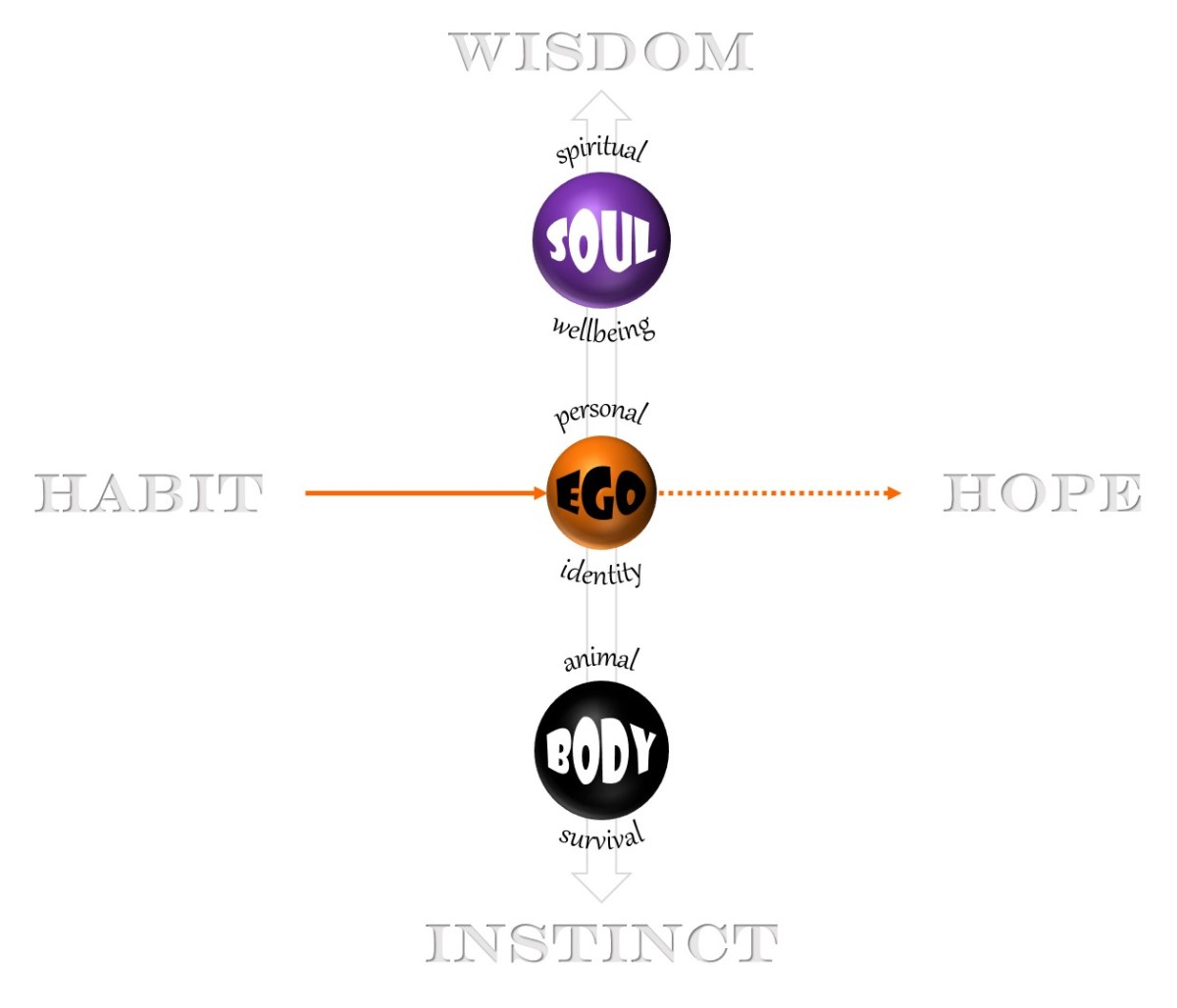
This assurance, imperfect as it is and without guarantees, is known as security. I symbolize it in my diagram above with a triangle, stable with a wide base and balancing everything else on its tip, suggesting that under conditions of insecurity the higher system might not hold together so well. When the nervous system registers a hostile reality instead of a provident one, the resulting pathology can be a borderline personality chronically at risk of falling through the floor and into the body’s urgency.

Your adequate care outside the womb provided an attachment bond which partly pacified your lingering insecurity, as well as served to shape your brain for life in relationships. Research confirms the vital significance of that primal bond, as a mother’s right (intuitive, emotional, and empathic) hemisphere entrains the infant’s brain into a coherent state. I have symbolized this need for attachment with a circle, with its suggestion of inclusion and belonging. If you imagine a vertical energy axis anchored in your gut where the environment is metabolized into the mass and energy of the body, then with attachment our focus has shifted upward to the heart-center.

While we’re on those shape symbols, let’s complete the set by adding a square to represent your emerging need for meaning – to have a mental model that makes sense of reality as you experience it. We’ve moved now from the heart to the head. The frame of your square tends to be as large as your attachments allow, which is simply to say that stronger attachments have the effect of shrinking the scope of relevance only to what is urgent or useful in keeping the bond intact. As a constructivist I regard meaning as something human beings construct rather than “discover” in reality. You are always busy making meaning that protects your attachments and calms your insecurity.

All of this goes into what I have called your Personality Code, referring to the preferred way you orient yourself in reality (gut/security, heart/attachment, or head/meaning) and the relative clarity of consciousness across the three centers. A high degree of clarity correlates with “ego strength,” where your personality is sufficiently stable, balanced, and unified to support experiences of ego-transcendence known as power, love, and truth. For more on the Personality Code, see http://wp.me/p2tkek-DE.

Almost imperceptibly we started with your birth once upon a time and followed the path of early development into your personal identity as an ego. The steps along the way to a fully established sense of who you are – all the drama around your need for security, attachment, and meaning – shaped part of your personality that sits just beneath and behind Captain Ego, called your inner child. I’ve put the term in square brackets to make the point that your inner child, which was who you were during your actual childhood, is today kept inside and out of your adult affairs.

However, still today as an adult whenever you get pinched, triggered, or poked emotionally, to the extent that you feel your security, attachments, and meaning threatened, something very “childish” comes out of you. You become reactive, impulsive, defensive, aggressive, manipulative, or sullen. The particular forms of expression this takes for you is what I have named your neurotic styles, which evolved as adaptive strategies for getting your way. For more on that, see http://wp.me/p3e1Rr-5Y.

It’s important to see that your ego is not some thing, like a metaphysical entity living inside your body. It is simply the self-referencing center of executive control that inhabits the roles provided by your tribe (family, peer group, professional community, political party, nation, etc.). Not only is your ego an actor playing a variety of roles in the realm of relationships, it also serves the function of managing the numerous “sub-personalities” that live inside you. You know these sub-personalities as distinct trajectories of impulse, mood, and motivation that come out and drive your thoughts, feelings, and behavior. One of ego’s principal contributions is to provide some executive management over these various (and occasionally competing) aspects of your personality.

For the most part your ego does a decent job managing this crew and steering through the role plays that comprise your daily life. Somehow through it all you want to keep your identity intact, feel secure, stay connected to the people who matter to you, and live a meaningful life. The system that makes this possible is called your world. In previous posts I have described this concept of a world on the analogy of a spider web. The spider (your ego) spins out a design of thread (your world) across The Void and proceeds to live inside it. Your world is your personal “spin” on things, the peculiar way by which you construct meaning, connect to others, and maintain your sanity.

In my diagram you’ll notice that ego isn’t the crowning achievement or last word on what a human being is or can become. While experience at this level is very dramatic and seemingly all-important, ego and its world are really nothing more than a delusion of consciousness. The neurotic styles of your inner child, the role plays where so much of your attention is invested, and even that executive center of identity called “I, myself” (ego) are a kind of reaction-formation entirely conditioned by your upbringing, your socioeconomic location, your life circumstances, and the somebody you’re trying to be. It’s not only possible but highly likely that most people spend an entire lifetime (in the Orient, numerous lifetimes) striving to keep it together, hold on to what matters, and reach a better station at some point in the future.

The spiritual life is ultimately about an awakening of consciousness beyond ego and its world. While this idea is too often conveyed in mythic-literal language as an out-of-body, end-of-life deliverance to a heavenly paradise, it is actually all about here and now. In fact, because the ego-world duality effectively cuts out a genuine present-moment awareness of existence, awakening from this trance (earlier I called it a delusion) brings you to the very ground of your being, where “I” dissolves away and All is One. This is what I name the present mystery of reality.

Your higher self, then, not only refers to your taller adult self that is capable of taking a more rational and responsible perspective on things. It also names your creative authority for transcending (“going beyond”) me and mine (as well as beyond the tribal us and ours) in a larger, more inclusive, interconnected, and holistic understanding. It is in this spirit that the term “universe” is used to speak of all things turning as one. Rather than merely naming a scientific fact, this concept expresses a spiritual realization, which is to say, a realization reached by your spiritual intelligence (SQ) of the unity of being. In other words, as I’m using it here, “universe” is not simply what’s out there and all around us, but a sacred name for the breakthrough intuition that here and now is all there is.

The universe is not only infinitely larger than your personal world, insofar as it exists on the other side of meaning; it is also prior to all meaning, deeper than words, and nothing (no thing) to speak of. It is: this – farther out than you can see, and That which quietly contemplates it all through your eyes …

Deeper Into Your Personality Code

Let’s begin by arranging the following clusters of values in order of priority as you consider your personal preference.Personality Code CategoriesIs it more important in your opinion to know the truth, love and be loved, or have things under control? Most likely you value all of these, but which cluster is highest on your list? Obviously you shouldn’t choose the one you think I will admire most in you, or the one that those closest to you hope you will select. Just be honest. Whichever ends up third on your list isn’t necessarily of no value to you, but merely of lower value relative to the other clusters.

Personality CodeNow, on the graphic to the left write the letter ‘S’ inside the square, or the letter ‘C’ inside the circle, or the letter ‘T’ inside the triangle, depending on your preferred cluster of values. Only insert the letter in the shape of your top choice, leaving the other shapes blank. Got it?

Let’s move on to the next step.

How would you score yourself on a scale of 1 (low) to 3 (high) that measures how flexible your belief system is? Are you fiercely committed to what you believe, or are you constantly updating your knowledge and opinions as you go along? Would you consider your world – referring to the system of meaning that you have constructed around yourself – less or more reality-oriented? Do you test your beliefs on a regular basis to be sure they square with the way things really are, or would you regard yourself a person of strong convictions that you won’t let go of so easily?

If your belief system is flexible and reality-oriented and you regularly test and update your perspective on things, then give yourself a 3 (high). If you don’t think these qualities describe you at all, give yourself a 1 (low). If you’re somewhere in the middle (somewhat flexible and open-minded but still pretty set in your views), then go with 2 (moderate). Write your number to the right of the ‘equal’ sign next to the square.

Now, how would you score yourself on a scale of 1 (low) to 3 (high) that measures the strength of your relationships with others. Do you move quickly and easily into relationships – and just as easily out of them when partners become controlling and abusive? Is staying in a dysfunctional relationship preferable to being on your own? Would you agree with the statement that “love makes the world go round,” or have your efforts at love more often thrown you into a whirlpool of hurt and confusion? Do you seek out occasions and opportunities where you can meet people, make friends, and expand your network of social support?

If you get along with others and don’t very often get caught in conflicts, then give yourself a 3 (high). If you frequently get crosswise with people and have an impossible time untangling your feelings, give yourself a 1 (low). If you’re somewhere in the middle (preferring company but hesitant over jumping in), then give yourself a 2 (moderate). Write your number to the right of the ‘equal’ sign next to the circle.

Finally, how would you score yourself on a scale of 1 (low) to 3 (high) that measures how stable you are in yourself? Are you doubtful when it comes to your abilities and the support you need to succeed in life? Is it easy for you to give away your power and let others call the shots? Do you hide behind authority and work hard to shine glory on those in control, to such a degree that you have little light left of your own? Are you chronically anxious over the possibility of things not working out, or can you stay grounded come what may?

If you are anchored in your being and in touch with your source of creative power, then give yourself a 3 (high). If on the other hand you lack confidence in yourself and reality in general, give yourself a 1 (low). If you’re somewhere in the middle (capable of trusting but preferring to play it safe), then go with 2 (moderate). Write your number to the right of the ‘equal’ sign next to the triangle.

You should end up with a letter in one of the shapes and a number to the right of each shape. This is your Personality Code. You might be a C132 or a T213 or an S321, or something like that. The letter identifies your preferred locus of engagement with reality, at the level of your head (square), heart (circle), or gut (triangle); while the number sequence represents the relative clarity of consciousness across all three loci.

(For more context, see my introduction to Your Personality Code.)

Ego PathologyThe number range from 1 (low) to 3 (high) places you on a continuum of ego strength, where 1 is borderline, bipolar, and dissociative (not necessarily at clinical levels of pathology) and 3 is stable, balanced, and unified. As explained in previous posts, normal development will satisfy the individual’s need for security, attachment, and meaning, to the point where he or she is capable of (i.e., possesses sufficient ego strength for) transcending “me and mine” in the experience of self-actualization. The clarity and flow of consciousness in self-actualization is variously named power, love, or truth depending on the favored locus (gut, heart, or head respectively) of the individual.

Personality Code FigureYour gut (particularly the digestive organs and glands) is where the raw materials of nutrition undergo conversion into the mass and energy of your body. For that reason it is the portal of consciousness into its own grounding mystery and the deep source of your creative power. This is also why, when your security is threatened or your power is momentarily lost, you feel upset in your gut.

Your heart is where you make emotional connection to what’s around you, most importantly to those human others – family, friends, strangers, and enemies – who collectively shape your personal identity. It is the portal of consciousness into the realm of relationships, your center of empathy and love. For this reason, you might speak of a loss of love as heartbreak and experience it as pain or heaviness in your chest.

And your head (mind) is where the mental construct of a world is made out of your assumptions, beliefs, thoughts, and intuitions of meaning. It is also the portal of consciousness into reality on the other side of meaning, which shines though (or burns away) the veil in moments of truth. However, if the veil is too opaque to let in the light of reality … or we might also say, if a naturally questing intelligence is locked inside inflexible and outdated convictions, this ignore-ance of what’s really real can cause mental fatigue and migraine headaches.

The Personality Code is not intended to render a diagnosis and lay one more identity contract on you. But perhaps it can be useful in helping you see why you get poked and hung up the way you do sometimes. It might also suggest a way through the suffering to a more authentic and fulfilled life.

Paths Into Reality

Although I spend a good amount of time defending the role of religion as the “system of utilities” that translates our spiritual intuitions into the structures of meaning in everyday life, I don’t want to lose sight of the fact that intuition precedes the structures which translate it, and that meaning is secondary to the mystery at the heart of experience. My utilitarian account of religion, where its validity is determined by its usefulness in representing the mystery and supporting a way of life that promotes genuine community, offers a helpful criterion for criticism as well as one that appreciates religion’s valuable contribution.

Religion’s behavior of late has provided more grist for criticism than appreciation, however, leading many to wonder if perhaps its long career is approaching an end. As science and secularism continue to spread across the planet and pervade modern consciousness, perhaps it is time to just let religion go. The problem with letting religion go is that it isn’t going away as many hoped it would, but is instead going the way of irrelevancy and conviction (which are really flip-sides of each other), increasingly willing to condone or commit violence in defense of its idols.

So I will try again to rehabilitate religion to its proper role in personal life and society, this time not by tracing out its system of utilities but instead by looking deeper into the spirituality it intends to embody and express … at least originally. If it doesn’t do this very effectively at our cultural moment, our task should be (I would argue) to deconstruct religion back to its source – not its prehistoric origins but to the source-experience of mystery that informs all true religion, whether animistic, theistic, or post-theistic.Tao PathsI’ve chosen the symbol of Taoism as the backdrop of my illustration above, for the simple reason that it is perhaps the best visual image available for contemplating the nature of reality (or anything) as a dynamic duality of principles. An experience of the present mystery of reality takes place and unfolds along primarily one of two complementary paths, an interior path to the Grounding Mystery (or ground of being) or an exterior path into the Provident Universe (or universal order).

The interior path descends into deeper centers of solitude, progressively farther from the light of sense discrimination and “world awareness,” to the Grounding Mystery where all mental associations and even consciousness of oneself dissolves away. For this reason it is named the “dark path.” This movement apart (or away) from others, objects, and external reality generally is also called apophatic, which refers to the subtraction of words and a refusal to attach mental labels to one’s experience.

A more determined discipline of abandoning names and representations of the mystery is known as renunciation – saying “no” to something that qualifies, delimits, or otherwise interferes with one’s direct experience of the Grounding Mystery. Since the dark path proceeds by separating oneself from surface distractions, surrendering attachments and refusing to put words on the mystery, it often goes by the Latin name via negativa (way of negation). The goal ultimately is to lose (one’s sense of) oneself entirely in mystical union with the Grounding Mystery, to the point where Nothing (literally no thing) remains.

It is out of this ineffable awareness of Real Presence that the meditator will be refreshed in his or her intuition of oneness; that just as his or her deep inner life opens into the Grounding Mystery, so it can be said of all things. The existence of each thing is really a process of be-ing whereby it manifests the mystery of being-itself in its own limited form. All of existence takes on a sacramental character as the outward manifestation of this deep inner mystery.

In many early cultures, and even into the medieval period, a people’s cosmology (their mental model of the universe) was honored as a sacred picture of reality. This helps us understand why the revisions introduced by empirical science were so strongly resisted, and why even Copernicus, Galileo, and Newton initially explained their observations with adjustments, such as epicycles in planetary orbits, that could preserve the sacred cosmology to some extent.

This outward turn leads naturally to our consideration of the second path. The exterior path ascends into higher orders of communion, farther out into the light of sense discrimination and beyond world awareness, to the Provident Universe where all things “turn as one.” At this highest level, nothing is left out and all things exist together as illumined parts of a greater whole. For this reason it is named the “bright path.” This movement towards (or joining as part of) others, objects, or external reality generally is also called kataphatic, which refers to the addition of words and qualifiers in a fuller description of experience.

On this ascending path we are saying “yes” to the distinctions that qualify reality into a Provident Universe, where all things conspire together for the emergence of life and consciousness. Our ability to contemplate this is itself evidence of the fact that our universe is provident, not only in the organism of our body and highly evolved nervous system, but in Earth’s pro-life environment by virtue of its proximity to the Sun, along with the relative position of our galaxy within the expanding fabric of space-time. Theoretically every bit of it makes a contribution to the whole, suggesting that the farthest distant nebulae somehow play (or once played) a part in our present contemplation.

As we move up and out from ourselves, then, we are engaged upon the via positiva, a path where every new encounter is added to our understanding of the whole. The self is not negated but affirmed, world awareness is not renounced but transcended – surpassed and included within a larger frame of communion (literally “together as one”). Whereas the Grounding Mystery is deep within all things and accessible only by the inward via negativa, the Provident Universe is all around each thing and includes all things by the outward via positiva.

Now that we have the two paths of spiritual experience in view, I will draw my reader’s attention to the square at the center of my diagram. This is the box of identity, of the individual personality and its captain ego, which is conditioned according to its driving ambitions for security, attachment, and meaning. Each of us along the way enters into, negotiates, wakes up inside, converts to, and occasionally abandons (betrays, forsakes, releases) the identity contracts that define who we are. The rigid strength of this box is what I call conviction, which is the point where belief takes control of the mind rather than the healthy vice-versa. Just like a convict, an otherwise free and creative intelligence is “bound and determined,” and we all know where that leads.

To the box-dwelling ego, both spiritual paths present an intolerable threat for the simple reason that they require an individual to let go of “me and mine.” Security, attachment, and even the meaning locked up in one’s orthodoxy must be surrendered in the interest of touching and really seeing the present mystery of reality.

But since boxes are easier to manage (as well as mandate on others), most of us choose to stay inside.

Your Personality Code

Gut_TriangleThe triangle symbolizes security and power. Its broad base gives it stability, while the ascending peak anchors its energy to a central axis that keeps it from tipping or being easily moved. This might be a favored shape in your own personality code – referring to the preferred way you orient yourself in reality and engage the world around you. If it does represent your modus operandi in life, this doesn’t have to imply that you are a power monger or tend to push others around, but you probably do enjoy having influence in what’s going on.

Heart_CircleThe circle symbolizes attachment and love. Its round enclosure suggests wholeness and inclusion, while the endlessness of its curve speaks of rhythm and eternal recurrence. If this is the favored shape in your personality code, then you probably place high value on connection, inclusiveness, and intimacy. It doesn’t have to mean that you are sappy or an emotional pushover – although you could be. You might guess correctly that Triangle people and Circle people sometimes don’t get along well, or else they get stuck together in co-dependent relationships.

Head_Square

The square symbolizes meaning and truth. Its boxy shape suggests containment and conclusion, where things are packaged up and put away. The four sides also connote wholeness – not by inclusion (as the circle) but through bringing together different aspects, dimensions, or viewpoints (as in the four cardinal directions and the “four corners of the world”). If your personality code favors the square, then you are a person who engages the world rationally, who wants things to fit together and make logical sense.

I started our review of personality-code shapes with the triangle and ended with the square because that particular order reflects the actual sequence of stages in human development. Our need for security dominates early infancy, when we are forming our deepest impression concerning the provident nature of reality. This impression is registered in our nervous system as a set-point to which our mood, mindset, outlook on life, and emerging worldview will be tethered as we develop.

Depending on whether we feel secure in the care of our higher powers, attachment proceeds either in a healthy direction (infant-mother bonding) or else we attempt to pacify our anxiety by desperately clinging to mother and insisting on being comforted. If our mother (and the family system overall) is anxious and insecure, our insistence on keeping her close will regulate somewhat her anxiety, thereby pulling us both (or all of us) into a co-dependent web of mutual support.

If our family system was characterized by a general insecurity and these co-dependent attachment strategies, our personal construction of meaning was probably closely monitored and prescribed by the higher powers in charge. It was necessary that our mental picture of reality (or worldview) conform to their “orthodoxy.” The stories we told about others and ourselves, our beliefs concerning good and evil, right and wrong – along with the metaphysical backdrop of supernatural forces and principalities – all of them had to match up and justify our shared outlook on things. To belong was to be a confessing member of this orthodoxy, “one of us.”

3 ChakrasWhat I’m calling your personality code, then, might be thought of as the way your individual history (especially your early history) programmed your engagement with reality along an axis of three coordinates situated at points corresponding to your gut (security/power), your heart (attachment/love), and your head (meaning/truth). If the triangle, circle, or square represents your preferred way of engaging reality, then the values associated with that shape (as briefly described above) are what typically orient and motivate your choices in life. Thus we might speak of “triangle types” (or T-types), “circle types” (or C-types), and “square types” (or S-types) in naming how individual personalities operate in the world.

The physical location of these centers in the body is easily verified in ordinary experience. When we feel that our support is being threatened or taken away, when we don’t feel prepared or confident in our ability to meet a challenge, when we are required to stand in front of a group and give a speech – in such times, don’t we typically experience upset in our gut? And when a loved one betrays our trust, abandons us in our need, or is taken from us by death, don’t we commonly speak of this as heartbreak? Finally, when we are unable to make sense of something, when life throws us a curve and our working theory of how it all holds together no longer works, don’t we often experience the disorientation as tension around our eyes and a dull throbbing headache?

Instead of reading the “/” (forward slash) in the word-pair as “and,” as in security and power, the terms actually comprise an opposition of sorts. In fact, a real appreciation of the difference between security and power, attachment and love, meaning and truth might dawn for most of us only later in life, at that critical time when our spiritual awakening is pushing against the boundaries of who we think we are. Our identity up to that point is a summation of numerous identity contracts we hold with ourselves and negotiate with others around us, going way back into our infancy when we formed that deep impression regarding the provident nature of reality.

If we can allow the realization to rise within us, we will come to understand the extent in which our authentic power has been relinquished for the sake of a false sense of security. We will understand how our attachment to possessions, other people, and tribal identities has closed down our capacity for empathy and genuine love. It will become clear to us how our commitment to meaning actually removes us from direct contact with reality, with the truth of things. When we are locked up as convicts inside our convictions, the true nature of existence and its ineffable mystery is inaccessible to us.

The point here is that, while security, attachment, and meaning are necessary to our healthy development, these very developmental achievements can interfere with the full activation of our spiritual intelligence (SQ). This interference can be particularly strong if our personality code is complicated by early trauma, chronic adversity, and tribal mind control.

But the good news is that our innate drive toward self-actualization – what propels every organism into maturity (Aristotle’s entelechy) – continues to seek fulfillment. The day hopefully comes when we discover our power, embrace all things in love, and allow our veils of meaning to fall away before the present mystery of reality.

Human Doing and Human Being

Morality (from the Latin mos, custom): Folkways of central importance accepted without question and embodying the fundamental moral views of a group.

Ethics (from the Greek ethos, custom): The body of moral principles or values governing or distinctive of a particular culture or group.

My description of the ethical function of religion has prompted a few of my readers to request a more careful definition of what I mean by the term “ethical,” and how (or whether) it differs from another word, “moral,” that is commonly used in this regard. Before I answer this question, I’d like to put the ethical function of religion back into context where it serves as the fulfillment-in-behavior of an experience that begins in the (sometimes shocking) awareness of the grounding mystery in which All is One (i.e., the mystical function).Four Functions of Religion_TreeIt’s helpful to consider the system of religion’s four functions on the analogy of a tree. The mystical function corresponds to the tree’s roots reaching deep into the silent ground, while the ethical function is symbolized in the fruit, which is where the mystical nourishment from down within finds productive expression and fulfillment. As I see it, this flow from mystical experience to ethical behavior is not direct, but is rather mediated through the other two functions of religion.

The articulate structure of the tree’s trunk and branches represents the doctrinal function, which is where the spontaneous realization of oneness is converted into meaning. (Don’t we still talk about the various “branches” of knowledge?) Ultimately, the behavioral product (or produce) of ethical conduct calls on the support of inquiry, judgment, reasons, and justifications – in other words, it depends on a context of meaning. We don’t just “automatically” do the right thing; ethics is about intentional behavior that involves a reasonably articulate understanding of what really (and ultimately) matters in a given situation.

In my illustration above, the leaves of the tree are opened out to the light of the sun from whence they draw the energy necessary for photosynthesis. Both the sun and the outreaching leaves symbolize the devotional function of religion – the sun as a representation of the deity, and the sunward orientation of the leaves representing the aspiration of devotees. In religion the deity isn’t only “above” the community as the object of its worship; he or she is also “ahead” of the community as its aspirational ideal, depicting the higher virtues (compassion, kindness, fidelity, forgiveness, etc.) into which human nature is evolving. As they elevate a merciful god in their worship, the community is really glorifying the virtue of mercy itself as an ideal worthy of worship …

… and worthy of ethical pursuit. This is where in theism the devotional and ethical functions connect. And whereas in theism proper this connection operates under the radar of explicit awareness, in post-theism the literary character of the deity is appreciated as a construct of the mythic imagination which has been evolving in an ego-transcending and humanitarian direction over its long career.

This distinction between behavior that is pre-reflective – “under the radar of explicit awareness” – and behavior that is guided by critical reflection is the most helpful way of distinguishing morality and ethics. As can be seen in the dictionary definitions above, both words trace back to the same basic idea (a “custom” or way of doing something), one deriving from Latin and the other from Greek.

As their meanings later merged and developed in common usage, morality and ethics became differentiated to where morality now refers to the “unquestioned” rules and value-judgments that group members live by, while ethics entails a higher level of philosophical reflection on the principles that (perhaps should) govern human behavior.

This difference corresponds exactly, I would argue, with the phases of “early” and “late” theism, where early theism enjoins right behavior “because god commands it and will punish you if you don’t” and late theism exhorts followers to “be merciful as your father in heaven is merciful” (Jesus in Luke 6:36). This is the shift from obedience to aspiration, which I have suggested is a leading indicator in the genuine progress of theism into post-theism (see “Stuck on God“).

We all know that Nietzsche was bitterly critical of what he called “morality,” urging his generation towards the ideal of his “Overman” or ethical superman who throws off the chains of unquestioned moral customs – especially if these are placed beyond question by ecclesiastic orthodoxy – in order to take up their own lives in world-affirming passion. He didn’t believe that taking away the moral prescriptions of childhood would leave grownups without ethical purpose or direction. In this respect Nietzsche sounds a lot like the apostle Paul:

When I was a child, I spoke like a child, I thought like a child, I reasoned like a child; when I became an adult, I put an end to childish ways. (1 Corinthians 13:11)

Our continuing challenge, as I see it, is to urge adults to grow up and not stay in that comfortable groove where because I said so – the “I” here being the parent, the police, or the patron deity – is the motive force behind our actions. True enough, actual children need this supervisory incentive for pro-social behavior, as their brains and social worldview are still in the process of opening up beyond the limited range of self-interest.

What we need are adult caregivers and educators who have advanced sufficiently into their own self-actualization and expanded horizons-of-life to support and encourage youngsters into maturity with “reasonable urgency.” We can still speak to them of provident reality in personal terms, as god’s benevolent care for all creatures, even as god’s loving concern for each of us. But at some point, the adolescent needs to be invited to take up his or her creative authority and become a self-responsible benefactor of the greater good, to embrace life on the other side of god (post theos).

So we progress, however slowly and by fits and starts, from morality to ethics.

A Provident Reality

A reader familiar with my thought stream in this blog knows how central is the concept of a “provident reality.” It also becomes obvious that I use this term in a way that’s not entirely consistent with its classical definition, where it referred to the way of god towards those who trust and believe in him (a masculine reference dominates the tradition). Over time, Providence (usually capitalized) came to be used as a substitute term for god’s benevolent provision, particularly as believers look to the future.

Rather than the notion of providence deriving from our experience of god, however, I have argued that our concept of god arises out of and reflects our (especially early) experiences of reality as provident or otherwise. As I use the term, a “provident reality” does not name a being who cares for us, but the extent in which the totality of existence supports life, community, and the evolution of consciousness. The fact that we are alive and conscious and creative and intentional means, in the very least, that our universe is all of these things – in us.

Despite all our abilities and the positive illusion of our individual autonomy, each of us is deeply dependent on the reality outside our ego for what we need. To live, to thrive, to flourish, to love, to construct meaning and awaken to our full human potential – we depend on reality to provide for us every step of the way. We need air, water, and food; we need shelter, intimacy, and connection; we need language, tools, and the skills to use them; we need guidance, exemplars, and forgiveness when we fall short.

All of us were born into some kind of family system – even if our arrival is what made it a family. We began as helpless dependents, equipped by biology only to breathe on our own, and really not much else. We needed to be fed and cleaned and cuddled and carried. Without a provident higher (taller) power to care for us, we would certainly not have survived. The relationship with our higher power(s) was formed most significantly around those needs of greatest urgency concerning our physical security and the material resources our body required. For reasons I’ll make clear shortly, I will name this providence of the first order.

Depending on how provident the higher powers were with respect to our first-order needs, a corresponding impression of reality was encoded into our nervous system. If the supply was sufficient and the care was adequate, our brain was allowed to settle into a coherent state of focused alertness and relaxed calm. The compatibility between our dependent condition and a reality that provided for our needs promoted the formation of what Erik Erikson called “basic trust” and what the religions name “faith” – faith in the provident nature of reality.

Erikson also observed plenty of cases where individuals demonstrated a compromised ability to trust reality and simply relax into being. Their deep and chronic dis-ease registered an early life where a first-order providence was lacking or perhaps inconsistent. From a neuroscientific perspective we might today diagnose their brainstates as incoherent – confused, irritable, and/or depressed. In religion, such individuals typically express a desperate demand on god’s vigilance and granting of prayers. They also tend to orient themselves to external authorities for the security and resources they require, even into adulthood.

If too much of our energy and attention gets wrapped into first-order concerns, we might never experience or benefit from providence of the second order, referring to social encouragement and creative opportunities in life. Where physical security and material resources are scarce and unreliable, it is common for family systems to fall hostage to a ravaging spiral of anxiety, resentment, and despair over matters of basic survival. Second-order providence sounds like a luxury when one’s daily existence is in question.

This is why nearly every ethical revolutionary in history has made the abolition of poverty central to their vision of a New World. Whatever its contributing factors, the fact that abject poverty destroys the human spirit and erodes the foundation of any society is beyond doubt. As these messiahs, mahatmas, prophets and reformers have insisted, our resolve as a community to provide security and resources to our weakest and most vulnerable members is ultimately what will bring salvation to the world.

When that first-order providence is in place, the social encouragement and creative opportunity that I’m calling second-order providence can work its magic. A human being not only struggles to survive, but every individual embodies the evolving spirit of our species – what the philosopher Aristotle called an “entelechy,” an inner aim, or what I also like to call our evolutionary ideal. As Abraham Maslow pointed out, when our basic needs are adequately met, the farther reaches of our human nature can be actualized.

My definition of second-order providence should make it clear that our higher nature depends for its actualization on the benevolent social support of a community. Social encouragement conveys our commitment to the individual’s emerging creative authority, and our bond of service continues in making opportunities available for the individual to learn, grow, and develop to his or her full potential. Obviously this providential responsibility begins in the family, as parental taller (higher) powers not only put food on the table but also nurture the soul-seeds in their children.

Family is the first theistic system. The dynamic relationship between providers and dependents – so critical, as I have argued, to the healthy emergence of self-responsible creative adults – ultimately plays itself out on the larger stage of culture. Deities are our “fathers” and “mothers” and we are their “children,” which makes the fellowship of believers a sibling circle of “brothers” and “sisters.” (Universalists like Jesus have used this theistic metaphor to make the point that all of us, believers and nonbelievers, friends and enemies alike, are members of one family and deserve each other’s deepest respect. But look where that got him.)Theism_Post-theismAll of this is to say that the inner aim (entelechy) of theism is the full actualization of human beings and the flourishing of a fully inclusive community. An impossible ideal, you say. And I would agree – as long as we stay on this side of god, where the concerns of first-order providence preoccupy our consciousness. On this side, there will never be enough and all we can do is await our deliverance to a better place later on.

On the other side of god, in the spirit of post-theism, we discover that it’s been in us all along to become compassionate caretakers and visionary creators of the New World. To fulfill what our god could only command.

Our Moment of Decision

Today we seem to be at a moment of decision. Looking at the world’s main faith-traditions, ask yourself: Would I rather, along with Pope John-Paul II, turn away from Buddhism and turn first of all to the Muslim, because he like me believes above all else in the unity of God and in God’s revealed will? Or, alternatively, would I rather (possibly along with Pope Francis, but who knows for sure?), would I rather turn first to the Buddhist, and discuss with him the similarities and differences between our mystical and our ethical traditions?  – Don Cupitt, Creative Faith: Religion as a Way of Worldmaking

This quote from Don Cupitt struck me when I read it, in the way it corresponds to my own theory of religion’s development out of primitive animism, through the egocentric period of theism, and ultimately into a fully secular (this-worldly) post-theistic spirituality. Cupitt is a proponent of post-theistic Christianity who urges us to abandon the metaphysics of classical theology (deity, devil, angels, soul and the afterlife) in favor of a fully embodied here-and-now religion of outpouring love.

One way of reading Cupitt’s words is in the mode of comparative religion, where Christianity is positioned between non-theistic Buddhism on one side and hyper-theistic Islam on the other – hyper not intended as a synonym for extreme, militant, or fundamentalist, necessarily, but in the sense that Allah is ontologically separate from his creation and very much out there. Historical Buddhism can be regarded as a post-theistic development within Hinduism which abandoned a concern with gods and metaphysics for a commitment to end human suffering.

But we might also read Cupitt relative to a tension within Christianity itself, between its own hyper-theistic and post-theistic tendencies. I’ve argued elsewhere that Jesus himself should be seen as a post-theistic Jew who sought to move his contemporaries beyond the god of vengeance, retribution, and favoritism, to outdo even god in the practice of unconditional forgiveness and love of enemies. This tradition certainly represents a minority report in Christianity, whereas its orthodoxy has been more “Muslim” than “Buddhist” – much more about the Lord god, his exalted Christ, the Second Coming and Final Judgment than Jesus’ new community of love and liberty.

In my view, post-theism is the inevitable destiny of all religion. I’ve worked hard to distinguish post-theism from the more or less dogmatic atheism that is in fashion nowadays, where god’s literal and objective existence is disputed on logical, scientific, moral, and political grounds. Post-theism does not see the point in arguing the empirical status of a literary figure. Indeed, as a figure of story rather than a fact of history, god’s place in religion is rationally defensible.

The problem arises when religion forgets that its god is a metaphorical representation of the providence all around us and of the grounding mystery within us. A literary character then becomes a literal being, the dynamic action of myth evaporates into the static atmosphere of metaphysics, and the supernatural object draws attention away from the real challenges before us. Tragically the opportunity of growing into our own creative authority is forfeited in the interest of remaining passively dependent on an executive-in-charge who is (coming back around again) a metaphor of our own making.

My own experience, along with what I observe in my friends and remember from my sixteen years in church ministry, has exposed a real “moment of decision” in spiritual development, where the healthy progression of faith would move us into a post-theistic (Cupitt’s “Buddhist”) orientation, but which is prevented by an overbearing theistic (Cupitt’s “Muslim”) orthodoxy that keeps it (in my words) “stuck on god.” The result is a combination of increasing irrelevance, deepening guilt, intellectual disorientation, and spiritual frustration – the last of which tends to come out, Freudian-style, in a spectrum of neurotic disorders and social conflicts.

Two popular ways of “managing” this inner crisis are to either suck it up and buckle down inside a meaningless religion, or else flip it off and get the hell out, bravely embracing one’s new identity as a secular atheist. From a post-theistic perspective, however, neither solution is ultimately soul-satisfying. Trying to carry on in the cramped space of a box too small for our spirit only makes us bitter and depressed, whereas trying to get along without faith in the provident mystery and in our own higher nature – what religion is most essentially about – can leave us feeling adrift in a pointless existence.

If Pope Francis as the figurehead of Catholicism can open his arms to other religions, embrace the scientific enterprise, advocate for the voiceless poor, and celebrate spiritual community wherever he finds it, then we might be encouraged to think that our “mystical and ethical” sensibilities can unite us and lead us forward. Perhaps the world’s interest in him has to do with the way his down-to-earth and inclusive manner resonates with something inside us that hasn’t felt permission to live out of our own center.

Chakra_treeWhen the mystical (our grounding in the present mystery of reality) and the ethical (our connections to one another and to life in general) fall out of focus as functions of healthy religion, the doctrinal (what we believe and accept as true) and the devotional (our worship and sacrifice on behalf of what we regard as supreme in value and power) start to take over. What is intended to be a balanced, evolving, and reality-oriented system of meaning collapses into conviction and becomes oppressive.

As our planet changes and the globe shrinks, as our economies become more intertwined and volatile, as technology is reshaping society and putting potentially catastrophic influence into the hands of more individuals, we need to come together for solutions. The old orthodoxies and their gods cannot save us. Neither terrorism nor complacency will see us through. We need wisdom now more than ever.

Yes, we are at a moment of decision.

What’s Going On

world gridEach of us is responsible for creating and maintaining a personal system of meaning called a world. It isn’t entirely our invention, as much of it, including the foundational elements known as assumptions, were installed by our culture (family and society) even before we acquired language. These pre-verbal dimensions of our world – which I also refer to as our worldview – should not be confused with the ineffable mystery of existence that fascinates mystics and inspires artists across the cultures.

According to the theoretical perspective known as constructivism, “the world” is not just another name for the environment or the globe or our planet Earth. “The” world identifies the personal system of meaning in which live; it is the habitation of this separate center of identity called I-myself. You live in the world, and I live in the world, but our worlds are not exactly the same. We should also make the point that your world today is not the same world you inhabited when you were younger. The “meaning of (my) life” has changed over the years, sometimes dramatically as in response to hardship, trauma, or loss.

belief systemYour world, then, is a construct, the appearance of which is really a function of your assumptions, conclusions, opinions, and predictions about reality based on what you’ve been taught to believe, and of your adaptive strategies along the way. Indeed, what you perceive as your world might be more accurately regarded as a product of your beliefs than a perfect representation of reality.

Even though you may think of your world as arranged outside and around you, its objective existence is only an optical delusion. Behind your world, as a projector is behind the images projected on a screen, is your mindset – that framework of assumptions (etc.) concerning the nature of reality, the meaning of life, the value of persons, and so on. Constructivism suggests that by altering your mindset you can actually revise or recreate your world, in some cases bringing about an apocalyptic “new heavens and new earth” by virtue of an entirely new system of meaning.

The educational author Carol Dweck (2006) has defined the categories of “fixed” and “growth” mindset to distinguish how people tend to regard talent, intelligence, achievement, and excellence as either something we’re basically born with (fixed) or which instead can be developed with effort, practice, and persistence (growth).

outlookBesides its role in supporting a particular construction of meaning (i.e., the world), your mindset also works as a lens or filter setting an emotional tone or general outlook on life. In a therapeutic approach called Mentallurgy (see my blog http://www.braintracts.wordpress.com), I have identified four primary attitudes that color our outlook, selecting for “evidence” that confirms how we feel and screening out (or minimizing) what doesn’t. These primary attitudes are Confidence/optimism (green), Discouragement/melancholy (blue), Anxiety/paranoia (yellow), and Frustration/hostility (red).

We can distinguish worldview, mindset, and outlook by saying that your worldview represents the way things are (to you), your mindset consists of the beliefs you hold with respect to what it all means, and your outlook is how those beliefs cast reality and the future under an emotional tone – generally speaking, positive (green) or negative (blue, yellow, red). Your outlook sets up each situation as an opportunity or adversity, as opening new possibilities for growth and discovery or foreclosing on your happiness and making life hard.

brainMentallurgy is a brain-based therapeutic approach which seeks to empower individuals in taking creative control of their mental focus, storytelling (aka “meaning-making”), and behavior. Ultimately – and I’m making the point explicit here – your worldview is rooted in particular brainstates, referring to more or less persistent moods that link your nervous system to external reality.

When your brainstate is coherent you are able to interpret sensory information, access your feelings, organize your thoughts, understand your needs, and behave in situation-appropriate ways. Alternatively when your brainstate is confused, irritable, or depressed, the connection and flow among these faculties is disrupted or gets stuck. All you have to do is trace these brainstates into their associated mindsets, outlooks, and worldviews to get a feel for how this whole system spins out and feeds back upon itself.

With the technology to scan live working brains, neuroscience is helping us appreciate the wonderful benefits of a coherent brainstate, where the quantum field of consciousness flows in smooth waves across the regions and networks of the brain. We can also see where things tend to get hung up and go awry, depending on whether the brainstate is confused (prefrontal cortex), irritable (limbic system), or depressed (deep temporal lobes).

Because we are obviously talking about something (i.e., consciousness) presenting as a continuum, the positions chosen as distinct brainstates might seem somewhat arbitrary. My choices are persuaded by the frequency in which these particular brainstates manifest themselves in common behavior, as when we’re confidently engaged in what’s going on (coherent), uneasy and disoriented (confused), frustrated and over-reactive (irritable), or lethargic and disinterested (depressed). While all of these may be considered normal behaviors, the hope is that we can shift back into coherence when we feel ourselves slipping or on the way to getting hooked.BMOWAll of this helps us interpret “what’s going on” through a system of correlates – brainstate, mindset, outlook, and worldview. Depending on where in this system we undertake our analysis, a description of what’s going on will employ a vocabulary that is neurological, psychological, or sociological in orientation. When it comes to instigating transformative change (the general theme of this tracts blog), however, we will always have greater success by shifting into a coherent brainstate first.

What does all of this have to do with spirituality (another of my themes)? When our brainstate is coherent, our mindset is also more flexible, our outlook more positive, and our worldview is correspondingly more open and accommodating. We are able to live more intentionally and charitably in the face of what life brings our way.

We are also empowered to live more creatively as we take up the Deeper Process and Higher Purpose of existence itself, transcending the often petty concerns of ego and accepting our responsibility as authors of what’s going on.

Deliver Us From Conviction

In The Great Triathlon of Religion I attempted to put more definition around the type of religion called post-theism. If we are to really appreciate its distinctive contribution to our development as individuals and our evolution as a species, the meaning of post-theism needs to advance beyond being seen as nothing more than a resolution for getting on without god.

A post-theist is not merely a formerly outspoken atheist who just doesn’t care enough anymore to argue the obvious point of god’s nonexistence. In other words, getting on “after god” (post + theos) is a very different mode of life than getting on “without god” (a + theos).

I characterized each of the three types (or phases) of religion as motivated partly out of a need to address a pressing problem of our human condition. Animism has to deal with the inevitability of death, and finds salvation in the promise of rebirth – not individual reincarnation (which is a theory that comes later) but in the cycling rhythms of life that turn within and all around us. The religion of our early life (as a species as well as individuals) is all about participating in this provident web of life with reverence and gratitude.

Theism carries these same themes forward, but in a more self-conscious and socially oriented way, as the emerging center of identity (ego) takes the stage. By now, that impersonal life force moving through all things has taken an anthropomorphic turn, as any number of patron deities who authorize and oversee the world-order. The problem that theism must resolve is the tendency in the individual to deviate from group norms, to “selfishly” pursue his or her own gratification and transgress on the rules for “proper” behavior. If individuals won’t comply with this moral code, the very existence of a civil order is at risk. Guilt is induced with disobedience, and atonement provides the repentant ego a way back into good standing with the community.

The great themes of sin and redemption, fault and forgiveness, transgression and reconciliation are key ideas of theism, as it has to do primarily with interpersonal relationships, the threat of social breakdown, and the process of restoring harmony in the body politic. Toward this end, even the individual might be sacrificed for the common good – perhaps as a vicarious offering, to appease an offended deity, or to satisfy the penalty for sin.

Obviously the great theistic systems of Judaism and Christianity, as represented in the Bible, are very much in this groove. Less obvious – or rather buried underneath multiple layers of theistic commentary and myth-spinning known as the New Testament – is the First Voice of Jesus whose message (gospel) of unconditional forgiveness marked a potential (but ultimately failed) transition to post-theism. His teachings were soon obscured behind a transactional theory of salvation, where his death on a cross for our sins became the turning-point of a conditional redemption (only for the elect or true believers).world religionsThe example of Christianity is illustrative, if mostly in the negative, of the threshold dynamics of post-theism. Our primary problem according to post-theism is not death (as in animism) or sin (as in theism), but conviction, which refers to a critical reversal where beliefs once held by the mind come to hold the mind captive, in a mind-set of absolute certainty.

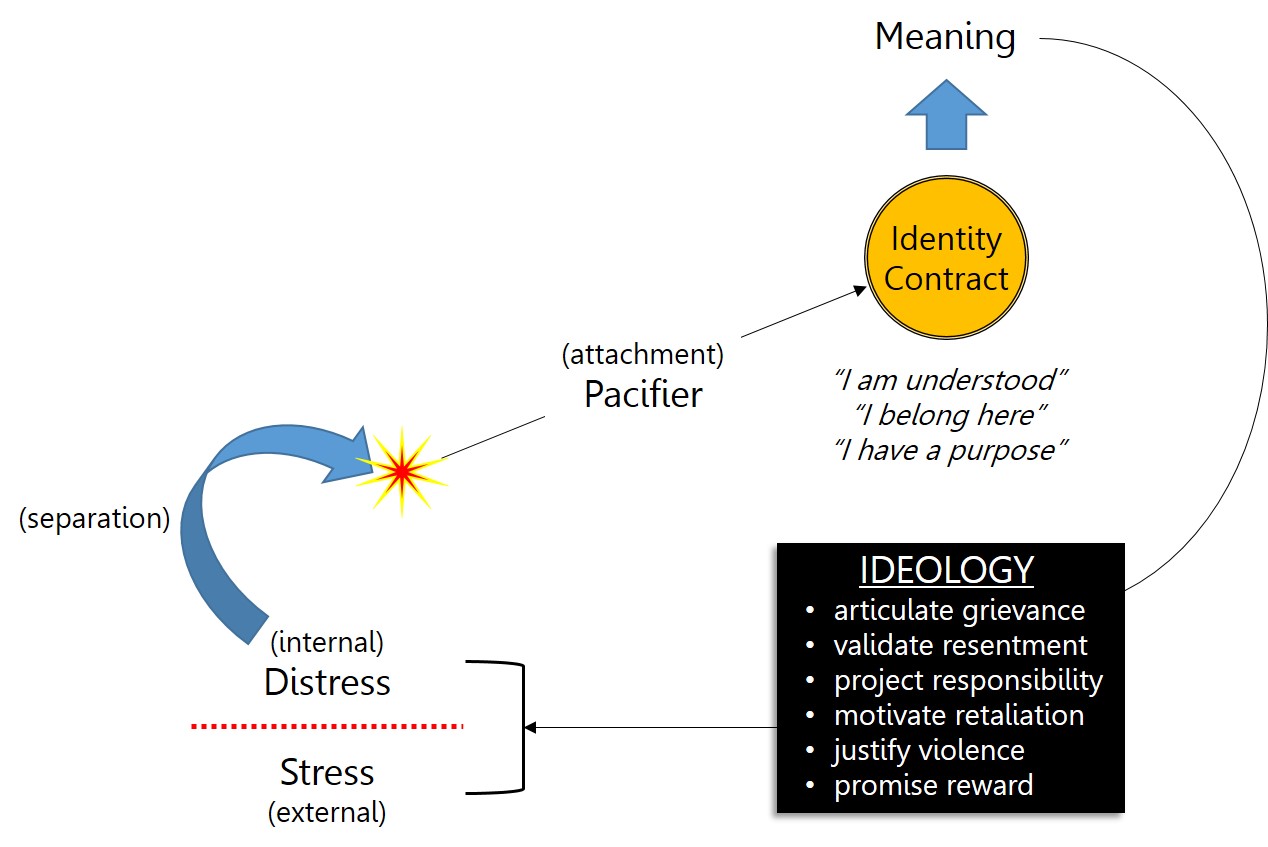
In this post-theistic age, conviction becomes our greatest threat to genuine community and world peace. Individuals compelled by conviction to sacrifice themselves and persecute (or kill) others are ready to bring down the apocalypse in defense of their truth. At this point, ideology takes over in a kind of “demonic possession,” locking an otherwise creative intelligence inside a closed circuit of cross-referencing dogmatic claims and motivating violence as a demonstration of devotion.

To the degree that theism proclaims the literal (i.e., metaphysical) reality of what was originally a literary (i.e., mythological) figure, an absence of empirical evidence requires it to be increasingly self-validating. In other words, its “truth” becomes more about passion than reason, more about persuasion and intimidation than existential insight and real-life relevance. For a fundamentalist the mere suggestion that the personal god of Scripture is a narrative construct and not an objective being is tantamount to atheism and worthy of damnation in the deepest hell.

For a post-theist, however, this same observation is profoundly liberating, but not because it sets us free from superstitious belief and for a future without god (a-theos). Rather it is liberating because it helps us appreciate the need for the technical mediation of symbols, stories, and sanctuaries in the longer event of our spiritual awakening, on our way to becoming fully human. Just as the developmental process of maturity doesn’t require the self-responsible adult to engage a campaign of debunking childhood myths and disproving the objective existence of Neverland, a post-theist feels no need to debate the metaphysical reality of gods and demons, heaven and hell, immortality and the afterlife.

Post-theism affirms the vital importance and relative place of theism in the scheme of human spiritual development. The god that was earlier worshiped and obeyed must gradually be absorbed by our rising aspirations, as we step into our roles as taller powers to embody a more generous and farther reaching empathy. The real “success” of theism is when the virtue of god glorified in our sanctuaries is actively manifested by us in the streets. With the personified ideal of patience, mercy, compassion, kindness, and forgiveness (as in the early Christian equation of god and love) now internalized and made flesh in us, we can take full responsibility as caretakers of earth and one another.

With growing challenges these days at all levels of concern – personal, political, and planetary – the need for us to break the chains of conviction which separate us and bravely honor the bonds of empathy that make us one is as urgent as ever.