The Experience of Myth

heaven_hellA growing consensus regarding the sacred narratives of religion, called myths, is that we must take them literally or else toss them out as bad science and obsolete fictions. Those who would rather not fuss with interpreting the myths are content to simply believe them, and those who can’t with intellectual integrity believe the myths are content to leave them be. In either case the deeper insight contained in them is ignored and rendered mute.

It’s difficult for some to open their minds to the possibility that myths might not be records of miraculous events and metaphysical realities, but not ignorant superstition either. But what other choice do we have? Things either happened just as the myths say they happened (or will happen) or they didn’t (and won’t). Either reality is arranged according to the metaphysical architecture testified to in the myths (with a literal heaven and hell, for instance) or it’s not – right?

Actually, the answer is no: this simplistic either-or logic is exactly wrong. In fact, as I will try to show, the mental orientation responsible for casting our alternatives in such a dualistic fashion is part of what the myths intend to expose and help us overcome. I say “intend” and not “intended,” because myths are living narratives and not mere curiosities of the past. The challenge in being human is essentially the same today as it was thousands of years ago, and myths are transcultural maps that reveal the paths ahead – one that leads to heaven and another that leads to hell.

If it sounds as if I have just slipped into a metaphysical reading of myth with my reference to heaven and hell, I want to assure my reader that this is not the case. To explain, let’s begin where myth itself was born, in the state of persistent ambiguity called the human condition. The prefix ambi translates as “both,” and ambiguity refers to how our situation – the human condition as it impinges on me here and you there, wherever we happen to be – sets us at a place where the path can go in one of two directions.

On the one hand, this ambiguity might collapse into opposition and eventual conflict: the “both” are seen as fundamentally opposed, unconnected, divided, and separate. If the process of our individual ego formation was particularly difficult and we came into personal identity under conditions of neglect, abuse, deprivation, or other trauma, our path might naturally fall to a lower course where everything is cast into antagonism. We are now in the realm of lower consciousness, a realm of distrust and suspicion, of hostility and retribution. This is hell.

When we fall into lower consciousness, as the mythic Adam fell out of his garden paradise, our ego becomes possessed by the passions of insecurity and aggression, intent above all else on getting our share and guarding what is ours. In hell, everyone lives in a state of desperate isolation, tormented by insatiable craving and captive to our own self-destructive compulsions. Our relationships are in chronic conflict, as we are incapable of opening ourselves to one another in empathy and love.

On the other hand, the ambiguity of our human condition might resolve into paradox and communion. In this case, the “both” are seen as fundamentally related, connected, united, and whole. Just as the path into hell might feel more natural to us if our ego identity was forged in adversity, the rise to a higher course is likely easier when our sense of self had been nurtured into formation by more provident higher (i.e., taller) powers. We are now in the realm of higher consciousness, a realm of trust and compassion, of generosity and freedom. This is heaven.

When we rise into higher consciousness, as the mythic Christ (whom the apostle Paul named the Second Adam) rose from the garden tomb, our ego completely transcends the deadly entanglements of insecurity and conviction. We are truly free to give of ourselves, to share what we have with others without concern for returned favors. In heaven, everyone lives in a state of inclusive community, offering our contribution to the greater good and truly caring for one another. There is enough for everybody, and goodwill abounds.

The timeless myths can help open our awareness to the critical turning-point of this present moment, to the choice we have in every new situation. We are familiar with the popular misreading of myth, where believers look forward to heaven in the next life, when their enemies and unbelievers are condemned to suffer forever in hell. Supposedly this is scheduled to happen after we die. But who is it, really, that dies?

In all the major wisdom traditions it is ego that must be transcended – released, surrendered, and overcome; specifically the “I” who believes everything turns around “me” and owes me what is “mine.” As Jesus says in the Fourth Gospel:

Very truly, I tell you, unless a grain of wheat falls into the earth and dies, it remains just a single grain; but if it dies, it bears much fruit. – John 12:24

We make choices every day that either cast us down into the hell of lower consciousness, into opposition and endless conflict; or raise us up into the heaven of higher consciousness, into paradox and sacred communion with all things. To live in heaven, we must “die” to selfish ambition, drop our holy convictions, and even give up our desperate longing to be saved.

Those who try to make their life secure will lose it, but those who lose their life will keep it.    – Luke 17:33

The sacred narratives of religion are neither literal records of miraculous events and metaphysical realities, nor bad science and obsolete fictions of a superstitious past. They speak a timeless message, but only when we are ready to hear it.

I guess this is as good a time as any to listen.

The Great Triathlon of Religion

Triathlon

In a triathlon competitors race for the finish through three different physical challenges: swimming, cycling, and running. Each challenge requires its own skill-set, and as any triathlete will attest, the transition from one leg of the race to the next can be the most perilous part. The three phases of the race are not ranked in order of sophistication or difficulty; running, for instance, is not somehow “better” than swimming – although an individual athlete may prefer, or feel more capable at, one challenge more than the others.

The idea came to me recently that religion might be understood on the analogy of a triathlon. For all the many forms it takes religion falls into three main types or paradigms: animism, theism, and post-theism. There are numerous forms of theism, for instance, but theism itself is a type of religion which all its various forms embody. And just as one leg of a triathlon is not regarded as inherently better than the others, neither is one type of religion better than the other types.

It may be tempting to elevate the importance of the final leg because it’s where the race is won or lost, but we know that an athlete crosses the finish line in record time only because he or she made it successfully through the earlier challenges. All the glory may be focused at the finish line, but a triathlon is not only a foot race. Similarly, the type of religion that I call post-theism is where our spiritual formation is fully realized, but our progress through animism and theism are essential to that fulfillment.

Hangups and setbacks along the way can complicate the process considerably, and in spiritual development (just as in a triathlon race) those hangups especially will introduce additional challenges that might even prevent further progress. For now, though, let’s put the three legs of religion’s triathlon on the board for a sense of the distinct challenges, of the phase transitions from one challenge to the next, and of the broad continuity overall.Animism

Animism begins in the water, which is an apt metaphor for the nature of reality as experienced in and by the body. Animal urgencies and survival needs link us into the vibrant Web of Life, which pulsates inside and all around us. Dynamic currents in the water providently support us, even as they threaten to pull us under. Nature is paradoxically gracious and violent, generously abundant yet ruthlessly selective.

In early human clans, a totem ancestor was honored as both food source and provider, as the one on whom their survival depended as well as a crossover figure through whom their human origins were traced. The totem ancestor embodied the more generally appreciated fact that all things in the Web of Life are related and interdependent.

If part of what religion does is facilitate a solution to an outstanding dilemma as regards our human condition, then “the problem” which animism seeks to resolve is the fact of death. As a body-centered paradigm, animism finds this solution in the life-cycles of nature. As new life springs forth from the ground, as fresh shoots emerge from dead stumps, and as newborns begin another turn in the great rhythm of life, we can find renewal by participating in these sacred events.

At this early stage, there is not yet the idea of individual immortality where some indestructible center of identity migrates from one life form to another. The wonder and celebration is of the way in which the hidden currents of life animate, connect, and advance through the generations.

Theism

With theism religion advances into a much more complicated social experience. The small family clans that had frequently relocated in sync with the changing seasons or migrating animals of the hunt gradually joined with other clans to form more settled villages. Agriculture and farming allowed for much larger populations. Social roles and specialized responsibilities multiplied. And the new challenge presented itself.

Theism is a type of religion that evolved and came to depend on various technologies of mediation (depicted in the bicycle). Symbols represented the sacred, stories (or myths) provided narrative background for interpreting these symbols, and sanctuaries were designed for the ritual performance of stories in a communal context. As much as possible, the liturgical cycle for these ritual ceremonies coincided with the earth seasons and great agricultural festivals.

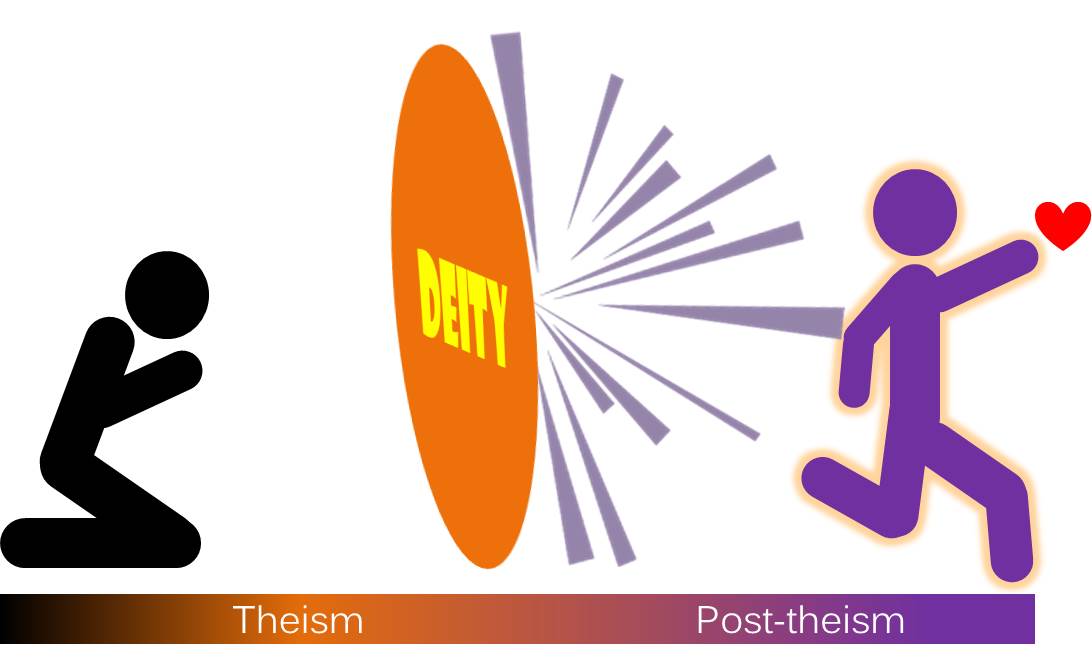
Another essential feature of theism is its personification of the provident mystery in terms of a patron deity (or deities). The deity is represented symbolically (in icons and idols), his or her character is developed in mythology, and the deity’s presence is invoked in the sanctuary for proper worship by devotees.

An important role of the patron deity, besides providing for the community in exchange for worship and sacrifice, is to authorize a moral code and motivate obedience. Most of these rules concern social behavior and how members should get along. “The problem” for theism has to do with rule violations and the resulting guilt. Its solution involves a process of atonement whereby proper relationship is restored.

Post-theismReferring to theism as “ego-centered” does not imply that it is selfish – not necessarily; only that its primary concern is with the social construction and maintenance of personal identity (the “I” who performs my given roles. A persona was the mask an actor wore in a Greek theatrical production, making it possible to “speak through” the identity of a stage character).

As the religious orientation of what I call a protected membership, theism encounters destabilizing threats on two fronts. Socially, as its local population becomes increasingly diverse and pluralistic, the agreement of lifestyle and belief across its constituency weakens. And at the level of individual psychospiritual development, an awakening of mystical intuition strains to transcend the boundaries of personal identity.

“The problem” presented here, then, is centered in the conflict between conviction (passionate, uncompromising beliefs) and empathy, which is how this transpersonal reorientation is experienced. By definition, empathy is an ability to understand the situation of another from inside, as it feels to them. This insider perception is made possible by a shift in consciousness from ego to soul, or from identity to communion.

Post-theism intentionally steps through the rules and roles by which identity is managed in order to engage reality in its oneness, its wholeness, its holiness. It takes up its cause “after god” (post + theos) without the need to dispute god’s existence, lampoon his devotees, or disparage their beliefs. The positive contribution of theism to the longer course of human development can be honestly affirmed, even as the post-theist celebrates a more inclusive, less anthropocentric (human-centered) vision.

In light of my analogy of a triathlon we can perhaps better appreciate how religion has served the function of connecting us to reality during each major stage of our evolution as a species, and how it has served the longer purpose of our fulfillment through the ages, across cultures, and in those who can trust its deeper wisdom.Religion as Triathlon


Stuck On God

Low_High TheismThe rise of theism and the reign of god correlates exactly with the emergence of our separate center of identity as human beings, with what is known as ego consciousness. In other words, the provident forces active in the universe were personified as humanlike (as personalities) at the same time as humans were coming to self-consciousness as standing out somehow from the spontaneous instincts of our animal nature.

The opportunity – and to some extent the survival necessity – of living together in larger and more sophisticated social groups required constraints around our natural impulses and inclinations. Certain drives, reactions, and behaviors had to be domesticated, tempered and refined for life in society, while others were ruled out as unacceptable for members. It was in fact this shift of concern from survival to membership that prompted the creation of an authority structure which could impose and reinforce this tribal morality, presided over by the patron deity.

Whereas animism – the form of religion preceding theism – had been more about maintaining (succoring, celebrating, and reciprocating) a relationship with the provident forces active in the universe (i.e., the power in the storm, the fruiting tree, the spirit of the bear and other totem animals, etc.), theism made these secondary to the moral function, as conditional blessings and rewards for obedience to god’s will. The exact correspondence between the “will of god” and the system of morality was interpreted to mean that the rules of society had originated with god, and not the other way around.

I’m deeply interested in this correlation between theism and humanism (which of course includes egoism), of how the conception of a supernatural ego (the patron deity) served to authorize and justify a moral system in which human beings could further evolve. The challenges and opportunities of society, in the way it pulled us out of communion with nature and into the role-plays of identity and membership, was (and still is) a necessary stage on our way to becoming fully actualized.

My diagram above illustrates the career of the patron deity, ascending with our growing need for moral orientation in society, reaching its peak in what might be called “high theism,” and then descending – or as I will argue, dissolving – into a new mode of spirituality where god is no longer regarded as separate, “up there” and over all. The terms underneath the arcing career of the patron deity (obedience, worship, and aspiration) represent the primary investments of theism in its function of upholding the “sacred canopy” of morality (Peter Berger).

I’ve also divided the arc of theism and its patron deity into “early” and “late” phases, both still focused in the activity of worship where the deity is exalted and glorified in the congregation of devotees, but sharply distinguished by a shift of accent from obedience (early theism) to aspiration (late theism). In early theism the preoccupation is on the task of shaping behavior to the values and aims of society, or more specifically to those of membership.

God’s will and command are represented as putting constraints on our natural impulses, inducing guilt or inspiring altruism as the case may be. Because the patron deity speaks against something in us that must be overcome, or alternately calls out of us behavior that is still to some degree unnatural, god is positioned in early theism as strictly outside and apart from us. We still need to be told how to behave, and this moral instruction implies a source of authority outside ourselves.

In late theism we can hear the message shifting from “Do this, or else” to “Be perfect as your father in heaven is perfect” – to take an example from the teachings of Jesus, whose spirituality marked a key transition beyond the conventional theism of his day. Here we move from objective commands to the more subjectively oriented virtues of moral life. Along the way, god is becoming increasingly more patient, compassionate, gracious, and forgiving than he was in his early life. Correspondingly the focus in theism shifts from obedience (i.e., following rules and doing what we’re told) to aspiration, where the challenge is to become more like god.

The culmination of late theism would accomplish the complete assimilation of god into a fully awakened and self-actualized humanity. While from a naive perspective this might look just like secular atheism, the difference between them in the quality and depth of spiritual life is profound. Whereas atheism seeks to dismiss or argue god out of existence, post-theism affirms the patron deity’s role even as it releases and transcends the need for his separate existence. Secular atheism throws god out, and with him all moral authority; post-theism takes god in and intentionally promotes the spread of inclusive community, unconditional forgiveness, and reverence for life.

Theism of one form or another is necessary (but not sufficient!) to a fully developed human being. (I should remind my reader here that every family system is a form of theism, with its higher (or taller) powers supervising the emerging identities of a new generation.) Problems arise when the proper arc of theism and its patron deity is prevented from advancing; functionally (or I should say dysfunctionally) it gets stuck in its early phase. Obedience is a persistent preoccupation, which is correlated with a deep mistrust of oneself and others. God is worshiped as the rule-giver, moral supervisor, end-time judge and executioner.

As theism fixates itself on our need for correction – to be straightened out, made clean, redeemed from sin, and ultimately rescued from final destruction – it effectively holds the human spirit captive and unable to progress. (This is the dogmatic, authoritarian, and militant religion that atheists rightly reject.) Tangled in its dragnet of obligations, believers are given no liberty to think outside the box or reach beyond the circle to a larger mystery. The higher virtues of human nature are closed off from us, relegated to second position in the character of god and heavily qualified by his supreme demand for repentance, righteousness, and retribution. Ego remains in control.

But we must advance. Forces of an arrested and corrupt theism around our planet today must not dissuade the waking (and growing!) minority from growing fully into god.

We have a job to do.

A Once and Future Religion

What if I don’t believe in a metaphysical deity who is running The Show? What if I don’t take the Bible literally? What if I regard heaven and hell as mythological constructs rather than actual places? What if the soul for me is not a separate and immortal center of who I am? What if I see religion as a system for coordinating the multiple concerns of human existence, instead of a holy regime revealed from above and established for all time. What if I don’t believe that ‘everything happens for a reason’? What if I am not waiting for Jesus to come again, or trying to convert others to my way of life?

What if I believe that a religion is right or wrong, true or false, depending on the quality of consciousness, breadth of compassion, and persistent kindness it inspires in its adherents? What if I’m of the opinion that a religion (any religion) might follow or fall off the path of salvation; and that ‘salvation’ is about coming together, getting healthy, and becoming whole – not escaping and leaving behind the mess we’re in.

And then again, what if I choose to regard this so-called mess of a world as a perpetual twilight of peace, love, joy, and hope?

You might call me a pitiful contradiction.

It’s impossible, you say, to have peace without god, to know genuine love without believing church doctrine, to experience real joy unless it is fixed on something outside the world, or to live with any hope unless my destiny is secure in the next life.

Once upon a time – and still once in a while – religion, its god, the community of faith, and the individual believer worked all together in support of a way of life that honored the sacred thresholds of birth and death, that cultivated an intimate relationship between our pressing needs and a provident universe, that opened human hearts and minds to the present mystery of reality, and that inspired us to look deeply into that mystery with wonder, gratitude, and responsibility.

But then it happened – and happens still – that religion became oppressive and its god an idol, that believers turned into prisoners (convicts) of their beliefs (convictions), and all the sacred rhythms that once coordinated and connected the varieties of human experience collapsed into empty ritual, rigid doctrines, blind tradition, and heavy obligations. The sacred myths that, in the communal act of telling, once generated a fictional performance space for the transformation of consciousness, were screwed down into writing and taken as eye-witness reports of supernatural facts.

For the longest time religion was a vibrant force in human society, not a violent one. It was the generator of ultimate meaning, not a propaganda factory of apocalyptic fears. It brought people together rather than drive them apart. Religion was about sacred grounding and holy communion, not terrorism and holy wars. It healed our brokenness and raised us to new life. It affirmed the cosmos as friendly and Earth as our home. Religion deepened our faith, challenged our tendency toward self-interest, and encouraged our compassionate outreach into the Web of Life.

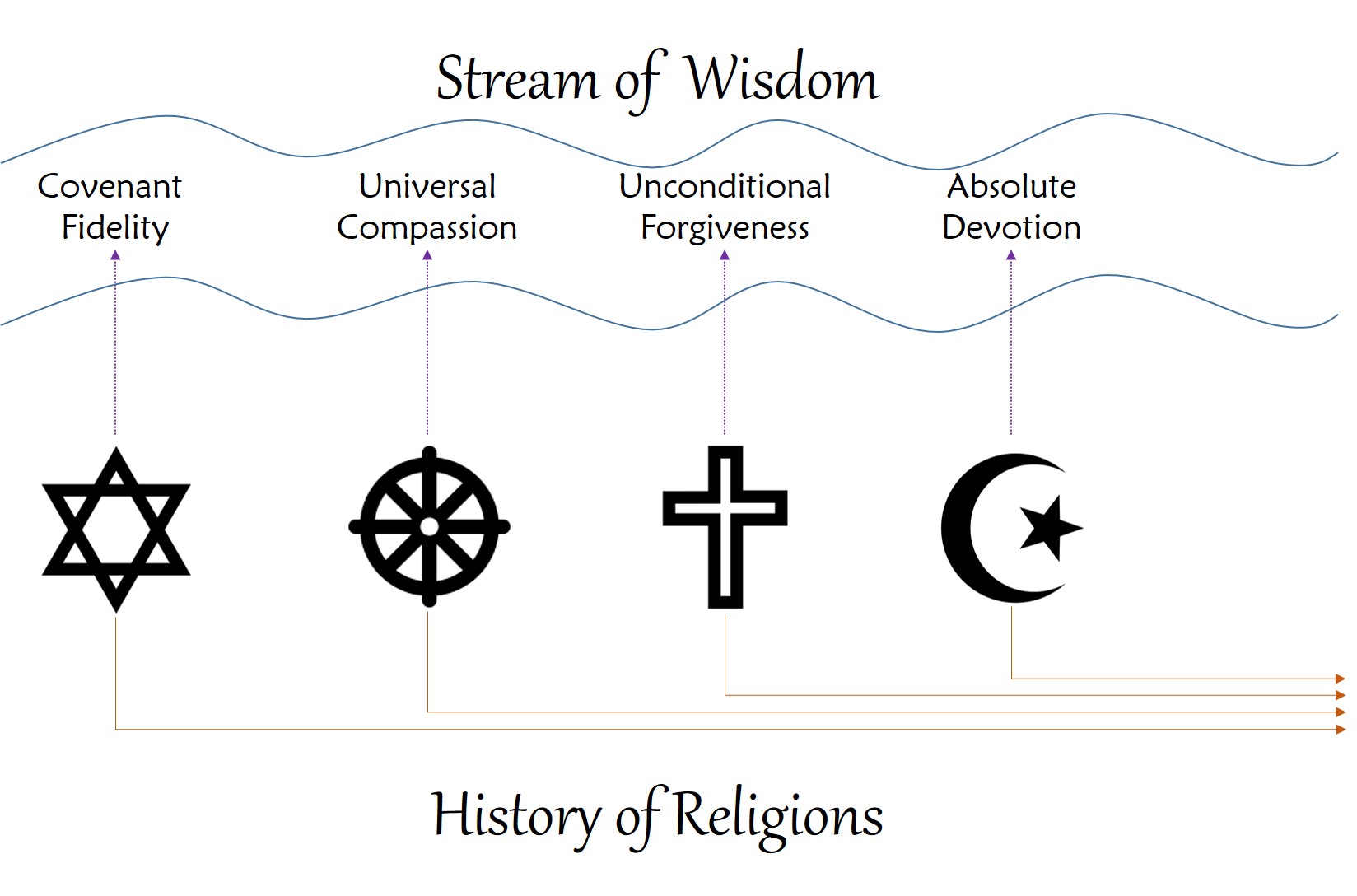
It did all of this before god (animism), occasionally during the reign of gods (theism), and now after god has passed beyond definition (post-theism), gradually waking in the lives of millions around our planet today whose religion is loving-kindness.

This is my belief.flower

The Simple Message

“Plug in. Open up. Reach out.” What if the message of a one-world religion was as simple as that? Obviously the meaning of those words would need to be unpacked before believers scramble on board. There is no magic in merely repeating the words as you break bread, ring a bell, prostrate yourself, or whirl in circles. Religion has really never been about some special power in ritual performances, but rather how these rituals focus attention, unite members of the community in shared intention, and provide thereby a sacred entry into deep time where everything is celebrated as moving in a purposeful direction.

It’s been about connection, as the root religare implies (to tie back or link together). Just because some religions have degenerated into reactionary, separatist, and violence-prone idiocracies (a rule of spiritual idiots) isn’t a sound reason to reject religion itself out of hand as the same. The occasion of bad science or bad politics doesn’t give us good reason to cast science or politics on the cultural junk pile; instead we redouble our commitment to keep science aligned with empirical facts and politics oriented on the welfare of society.

With so many blatant examples of bad religion all around us, I want to call us back to its essential function, summarized in the simple message of “Plug in. Open up. Reach out.” All religions will find the secret to a renewed inspiration and relevance as they realign themselves once again to the vision of reality conveyed in this message. So let’s take a few minutes to unpack what it means.

Web_GroundPlug in

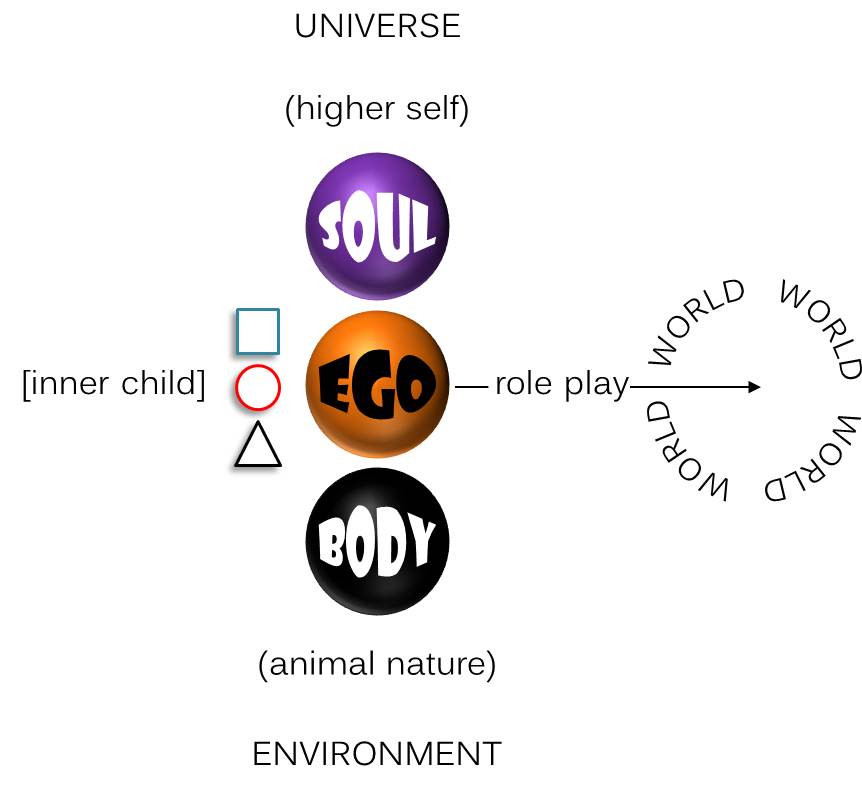
A human being has both an inner life and an outer life. Our inner life, called our soul, trails deep inside to the very root of consciousness. In that deep place within each of us, finally inaccessible even to our own searching mind, consciousness rises out of and recedes again into a mystery that all religions acknowledge as an elusive presence. Before they put words to it and dress it up in symbols, stories, and doctrines, this presence is intuitively known as the very Ground of Being, the creative source in which our existence finds its genesis and provident support.

Reach Out

A human being also has an outer life, called our body, which extends far outside the boundary of our skin – although for the sake of convenience we commonly regard it as a physical object. In truth, however, our body is of the same substance (homooúsios) as the earth and contains the saline of its oceans, metabolizes the light of the sun and has stardust in its cells. It is not a separate thing at all; in fact, our body belongs to a vibrant Web of Life as large as the universe itself. The very nature of our body shares in the interdependence of cosmic reality.


The inner life of our soul and the outer life of our body make human beings a fascinating duality. Outwardly we are connected to the Web of Life and dependent upon its sacred balance of energies, while inwardly we are rooted in the Ground of Being and cradled in a present mystery. These two aspects of our existence, outer and inner, are what religion has long helped us hold together. By coordinating our deeper communion with Being and our wider fellowship with Life, religion (as religare) keeps us whole.

Open Up

But there is yet another aspect of human beings, besides the inner and outer, that introduces a wonderful complication to this enterprise of unifying our experience of reality. What we call ego is our identity as members of this or that human tribe (family, community, culture). Because every social group of humans is unique according to its history, traditions, customs, concerns, values, beliefs, and aspirations, every individual ego – which, of course, carries its own unique set of inclinations, moods, and motivations – is unique as unique can possibly be.

Egos must be shaped to the aims of the group so they can take the responsibility of promoting its peculiar construction of meaning known as ideology. One problem with ideology is that it tends to codify our human insecurities into compensatory convictions of absolute truth. If our tribal existence is particularly imperiled by vanishing resources and competition with a neighboring group, for instance, an idea something like manifest destiny will soon rise in our minds, providing all the justification we need to secure what is ours by right.

It’s at this stage in the game where religion constructed the notion of a patron deity, whose role is to authorize the moral order, incentivize internal reform, justify external campaigns of war, and characterize the virtues to be cultivated in the lives of devotees. These protected memberships served, and still serve, as social incubators of identity. Members are believers, believers are aspirants, and what they aspire to is represented in their deity. Submission, devotion, and obedience train their collective energies on a common ideal which they confess together as the one and only way.

As I said, inevitably (and by design) the constructed identity of an individual ego will carry the social investment of its culture. Family patterns of abuse, neglect, or discrimination – but of healthy nurturing as well – work themselves into the operating system of our personality. I would dare say that all of us, simply because we had to find our way through this broken maze of childhood, enter our own maturity with some deep-set insecurities about ourselves, other people, the world around us, and the prospect of happiness. As a consequence, we play it safe and keep ourselves closed to the greater reality.

An insecure identity, contracted in self-defense and working itself into nervous exhaustion, is that much removed from its own inner life and Ground of Being. Indeed the mere suggestion that “I” (ego) might surrender completely and lose myself in union with the soul’s grounding mystery is contemplated with horror. But outwardly, too, the self-involved ego is ignorant of and careless about the body and its vibrant Web of Life. Reaching out too far and opening its horizon of understanding to the fragile balance of life would take focus away from its precious contract of “me and mine.”

And that’s where the real contribution of “true religion” lies: in challenging us to open up and to drop the illusion of identity. Only then can we plug in to the Ground of our being and reach out to the Web of Life. Only then will we be whole.

This is the simple message.

The Harmony of Intelligence

mood_mode_modelI recently offered up the idea of our “quadratic intelligence,” of four distinct types of intelligence in us that open up and come online in developmental stages, each one engaging us with a dimension of reality. I pointed out how Western psychology and education theory have only recently come to realize that our earlier notion of an “intelligence quotient” (IQ) was really measuring only one of these types and not intelligence as a whole.

The ensuing scholarly “discovery” of emotional intelligence (EQ) and spiritual intelligence (SQ), of how both of these bring deeper support and expanded horizons to the rational intelligence so highly prized in our STEM (science, technology, engineering, and mathematics) culture, is challenging us to adjust our categories around what it means to “be intelligent.” In addition to these three types of intelligence, I suggested that we complete the set with a fourth: visceral intelligence (VQ), which is more or less equivalent to what we already know as the autonomic nervous system.

I took my reader for a quick ride up the channel, starting in the unconscious internal state of the body (VQ), connecting emotionally to the environment outside the body (EQ), parsing and classifying the object of experience into a rational system of meaning (RQ), and breaking out of this logical box into the spontaneous intuition of a higher wholeness (SQ). A successful breakthrough of spiritual intelligence to some extent depends on an equanimity of emotional and rational factors – not so engaged (EQ) or detached (RQ) that genuine transcendence is prevented.

In this post I want to clarify this theory further into its distinct modes of intention and how they work together in the full harmony of intelligence. “Mode” is derived from the root mod, which refers to a way, manner, form, or style in which something exists or behaves. I hope to show how our human way of being and manner of life grows more distinctively human as we ascend through the network of our four intelligences.

Visceral intelligence (VQ) represents a mode of intention that anchors consciousness in its deeper ground. The internal state of our nervous system seeks to hold the body in a dynamic equilibrium where an electro-chemical conspiracy of events sustains us in life. Out of this provident ground arises consciousness itself, which must preserve its anchor in the body, and through the body to the living earth.

A step up from the largely autonomic processes of our internal state brings us into emotional intelligence (EQ) where the mode is to engage with the environment around us. Emotional engagement begins very early in life and serves the function of connecting our internal state (VQ) to the realm outside the body, adjusting state as necessary and motivating behavior that is adaptive. Another derivation of mod is “mood,” referring to this matching of internal and external, internal state to external situation, in a generalized temperament that bridges the two realms.

From emotional intelligence we move into rational intelligence (RQ, formerly IQ) where the mode of intention shifts from engagement to detachment. Obviously this mode serves us well when our objective is to grasp something for what it is in itself rather than how it may be affecting us personally. Western science has perfected this modus operandi of detached observation in its experimental method, which has enabled us to take control of our environment in remarkable ways.

Our characteristically Western preference for rational operations over emotional feelings when it comes to what we believe we can really count on for a truthful experience of reality, has led to the unfortunate consequences of environmental degradation, inter-human violence, and neurotic disorders. We have become adept at constructing thought “models” – yet another term with roots in mod, involving our conceptual ability for abstract representation – as our emotional programs remain snagged in adolescence and early childhood.

The healthy balance of emotional and rational modes of intention is how I define equanimity – a high value in many wisdom traditions around the world. Importantly equanimity is not about suppressing or subtracting from our animal nature, but rather harmonizing its deeper impulses in a mode of conscious life where passion (EQ) and reason (RQ) complement and support each other. I would agree that equanimity is all too rare in society today, where part of ourselves seethes in raw emotion as the other part analyzes everything (literally) to death.

This is exactly where our widespread lack of “ego strength” (a related idea to equanimity) has us stuck: collapsing spontaneously into mental chaos (borderline personality), swinging wildly between emotional extremes (bipolar mood), and splitting into a variety of subpersonalities that contend for the seat of control (dissociative identity). Absent a secure center of self-conscious autonomy (ego), these inner demons take us over – especially when we are stressed, anxious, or frustrated, which is to say more and more of the time these days.

When I identify the intentional mode of spiritual intelligence with transcendence, I want to guard against any tendency to separate it from our embodied life. As I see it, it’s been a mistake of rationalism to represent the soul as metaphysically alien, existing apart from the body as its resident ghost. Transcendence, here, should not be interpreted as going beyond the body and leaving it behind. What we transcend are the rational constructs by which we define and classify reality, and believe one thing or another.

To grasp all at once the unified mystery of existence requires us to “go beyond” what we think we know. The tightly interlocked system of meaning that we spin around ourselves like a spider’s web may answer our needs for security, identity, and significance, but it also separates us from the present mystery of reality. This veil must be pulled aside for the sake of mystic communion with reality as such. It is in that higher mode of intention that we realize All is One.

If we had equanimity and ego strength, and were firmly anchored in the provident ground of life, the invitation of spirituality to step through the illusion of meaning and into oneness would be accepted with joy and celebration. The centerpiece of this illusion is our self-concept as separate and fully autonomous individuals, immortal beings on our way through to something better on the other side.

Genuine spiritual freedom is about getting over ourselves.

Quadratic Intelligence

RQBack before the mid-twentieth century, educational psychologists grabbed hold of a notion that human intelligence could be measured. The so-called “intelligence quotient” was hailed as a way of diagnosing an individual’s intellectual aptitude; not just how smart he or she was but how capable the individual was of getting smart.

Inevitably, given the fact that Western science and psychology was riding the Cartesian-Newtonian wave of rationalism and the promise of mathematical reasoning (proving so successful in science, technology, and engineering), the IQ test favored operations of analysis, computation, logical abstraction, and problem solving.

Those who scored high on the IQ test were matched with better education (who wants to waste resources on just average or below-average abilities?), more opportunities, and higher paying jobs. After all, we need smart people running The Show, not mediocre intellects and irrational idiots who will certainly botch things up and send us all hurtling into oblivion. Parents would proudly publish the exceptional IQs of their children on bumper stickers and any chance they got.

In light of more recent discoveries and advances in psychology and neuroscience, I propose that the classical “IQ” be renamed “RQ,” for rational intelligence, since the category really only measures one type of intelligence and not intelligence overall.

EQIn 1995 Daniel Goleman published a theory of “emotional intelligence,” which he claimed underlies these rational-mathematical operations with social and interpersonal competencies that orbit closer to the core of the self. Studies had been going on for some time, researching the benefits of emotion regulation in infants and young children.

These studies convincingly demonstrated the critical importance of emotional intelligence. Goleman made his case that emotional intelligence matters “even more” than IQ when it comes not only to academic success but to a general proficiency in life.

In the meantime, Goleman’s “EQ” (shorthand for emotional quotient) has slowly made its way into the conversation of education theory, resulting in some changes in how teachers teach, how students learn, where the curriculum can be improved, and why an “enriched” learning environment is essential to successful education. Despite these changes – and by no means have they been deep and systemic changes to the dominant paradigm – our schools continue to favor IQ over EQ when it comes down to rendering a diagnosis (called a grade) on individual intelligence.

Because I work in higher education, this whole topic fascinates me. I can see far-reaching implications for a broader notion of intelligence – if only education theorists, school administrators, and classroom instructors are willing to challenge long-standing assumptions. As change is often costly, a major challenge will be identifying new funding sources and resource channels. As far as changes to the public education system are concerned, because state legislatures typically under-support teacher salaries, school facilities, curriculum development, and technology updates, the changes we’re talking about are going to be hard-won.

SQIn 2000 Danah Zohar and Ian Marshall published Spiritual Intelligence: The Ultimate Intelligence, which the authors argued adds a third dimension to the already recognized IQ and EQ. Spiritual intelligence (SQ) gives individuals the ability to transcend the emotional and logical constructs of meaning where our beliefs about reality are held, expanding awareness into higher (and deeper) dimensions of reality as well as creative possibility.

The authors carefully distinguished between spiritual intelligence and religious belief, explaining that while doctrines might be rational descriptions of an experience (i.e., a product of RQ), dogmatically holding and defending them can be evidence in fact that spiritual intelligence is not (or no longer) active.

Rational intelligence, even when balanced and enriched by emotional intelligence, can still be very much about short-term and proximate values, while spiritual intelligence opens awareness to the Big Picture and Long View where we can contemplate our existence and the consequences of our actions on a much larger scale.

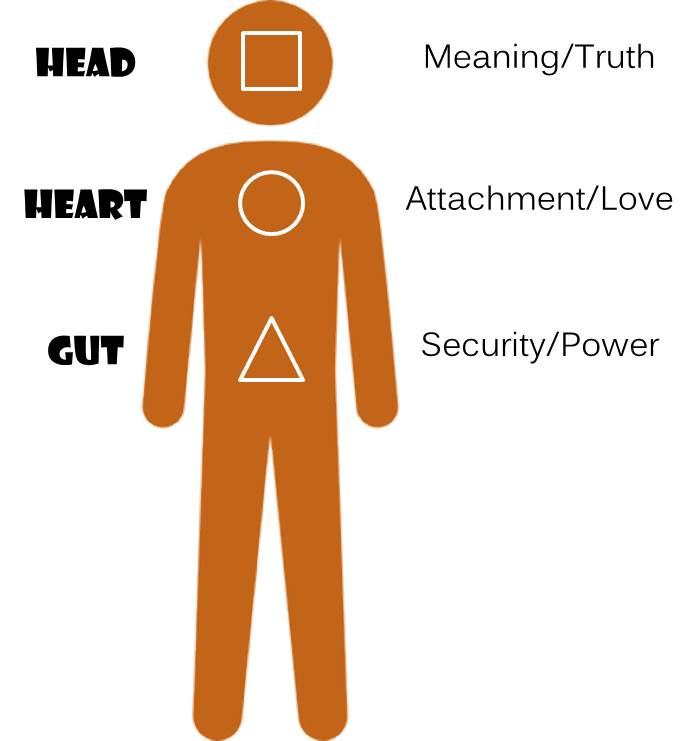
Zohar and Marshall proposed that the addition of SQ to EQ and IQ made for a complete and comprehensive model of human intelligence. But something still seems to be missing. What about the autonomic nervous system, which is continuously regulating our body’s internal state and matching it to the ever-changing life situations unfolding around us? What about what we commonly call “gut responses” and our animal intuition? The drives and reflexes of instinct, though carrying on below the threshold of conscious intention or control, certainly represent a distinct type of intelligence.

VQ

Our visceral intelligence – what I’ll name VQ – is much deeper and more ancient than the three others. It manages our underlying mood, our rest and arousal, the tonal energy state of our internal organs, muscles, and skin. It is the survival and evolutionary intelligence of our animal nature.

Coming back to education, it is clear that the internal states of students and teachers – whether they are calm, present, and grounded, or agitated, anxious, or bored – will have predictable consequences on learning as it rises into conscious feelings (EQ) and articulate thoughts (RQ). Much of present-day education is focused on the transfer of rational knowledge and skills from experts (teachers) to novices (students), for the most part disregarding the quality of EQ rapport between both or the VQ internal state of each.

So let’s put it all together, in what we might call the “quadratic intelligence” of human beings (from quad, meaning four). Our greater system of intelligence, then, is four-dimensional, and each type (VQ, EQ, RQ, and SQ) engages us with reality in a unique and special way.

Quadratic Intelligence

In the model above, a human brain is facing you, which means that the right and left hemispheres are opposite to yours. Popular theory identifies autonomic processes (VQ) with the brainstem, emotional feeling (EQ) with the “right brain,” and rational thinking (RQ) with the “left brain” – which isn’t altogether wrong, just too simplistic to be useful in any rigorous sense. Our brain is more a nested hierarchy of neural projections, circuits, and networks, having evolved through distinct stages of development represented in the brainstem (a “reptilian” stage), an outlying limbic system (the “old mammalian” stage), and a cerebral cortex with its distinct lobes of specialized processing.

My model suggests that EQ and RQ (which actually develop and come online in that order) are deeply reliant on VQ for the supportive internal state they need to function effectively. And, as Goleman says, since RQ is at its best when EQ is operating empathically underneath and alongside it, we are getting the sense that these first three intelligences are profoundly interdependent.

By telling stories and concocting theories (RQ) we can alter how we feel about ourselves and the world around us (EQ), effecting deep changes in our prevailing mood (VQ). On the balance, however, most of the time our passions (EQ) and reasons (RQ) are taking their cues from the energetic tone of our nervous state (VQ) and composing interpretations of reality that match it.

But where does spiritual intelligence (SQ) fit into the model? Should we simply follow the trajectory of development from VQ through EQ to RQ and assume that SQ is just a further extension of our rational intelligence? Since RQ is about organizing symbols in meaningful patterns, we might expect that SQ will capitalize on this propensity for constructing meaning and “talk about” spiritual (i.e., metaphysical) things like gods, souls, heaven and hell.

But not so.

SQ is positioned in my model between and above EQ and RQ, transcending both passion and reason to a point of higher awareness where a larger and longer horizon is beheld all at once. This is the perspective of wisdom. I agree wholeheartedly with Zohar and Marshall that spiritual intelligence is not to be identified with an individual’s religious commitment or theological fluency. Instead of getting tangled up with religiosity, SQ is what gives one the ability to see past our idols, myths, doctrines, and beliefs to the present mystery of reality (or Real Presence of Mystery).

By grounding us in being-itself – most immediately by a meditative practice of some kind that calms the body (VQ) and opens a clearing at the center of awareness – our spiritual intelligence enables us to rise above and break past the convictions that the religions frequently exploit to their advantage by compelling conversion, pushing membership, persuading donations, organizing crusades and justifying terrorist campaigns in God’s name.

We realize in an instant that All is One, that we’re in this together, that a shared and hopeful future ordains us with the responsibility of living for the good of the whole.

Life Without Hope

Over the years I have come across authors who decry hope as an unnecessary setup for human unhappiness. They fault it for pulling the focus of concern away from present reality and projecting it into a fantasy of the future that never quite arrives as expected. Perhaps because so much creative energy has been invested by humans in unproductive wishful thinking, which presumably includes religious pining after Paradise, these well-meaning critics of hope suggest that we’d all be better off without its distractions and disappointments.

I get their point, in one sense. Hope is a setup of sort, and what human beings hope for rarely “comes true.” And yes, hope can siphon precious energy away from the challenges of real life, sometimes even persuading us to let opportunities pass or even trash what’s real for something better later, on the other side. Because baseless, unrealistic, and otherworldly hope has been used as an accelerant of violence (in the name of future hopes) as well as a justification for emotional detachment from the pressing issues of contemporary life, the solution is to discredit it in the hope that we will live more fully, and more responsibly, in the present.

But as I have a sympathetic affection for our inherently conflicted species, I’m going to take a different slant on this matter of hope. Seeing as how depression is the malady of our modern age, could it be that living without hope – or, following the sage advice of these authors, forsaking hope in the interest of a more reality-oriented mindset – is at the root of our problem? Maybe we shouldn’t confuse hope with mere wishful thinking, with longing for something away from, different than, or after the challenge presently upon us.

As animal organisms, humans are anchored by physical needs to the living earth. When these basic needs are met – assuming that our pursuit of them hasn’t gotten tangled up in the complications of emotional insecurity (which is a generous and entirely unrealistic assumption, I know) – the satisfaction we feel is a key ingredient in the happiness we seek. Happiness is more than the satisfaction of our needs, but I’m ready to say that it isn’t possible unless our survival and health are supported in some adequate degree.

Perhaps it was to seduce us into satisfying our basic needs, that nature sprinkled the fairy dust of pleasure on the things we require to live, reproduce, and flourish as a species. This, I will say, is the second key ingredient to happiness. We don’t need pleasure to live, but the pursuit of it tends to get us involved in doing what is necessary for life to continue. If apples weren’t sweet to the taste, if sex didn’t bring convulsions of ecstasy, or if reading a good book was utterly devoid of pleasure, there’s a decent chance we wouldn’t bother with them.

If satisfaction is mostly about our physical and developmental needs, then pleasure might be the evolutionary bridge from an existence oriented on survival to one that’s virtually preoccupied with enjoyment. The pursuit of pleasure is probably at work in our tendency as sensual-emotional beings to be both gluttonous consumers (it feels so good, we just can’t stop) and wasteful stewards of resources (when we get sick or bored of it, we just leave or throw it away). Entire industries prosper on our relentless, at times reckless and imprudent, desire for pleasure, enjoyment, and indulgence in what feels good.

So is that enough? Can we close our theory of happiness on these two key ingredients – need satisfaction and the allure of pleasure? If we just put up a strong moral fence to prevent theft, murder, exploitation, and bad business – and throw in some incentives for recycling and getting out to vote – human beings should be happy, right? No, that’s not right. Why? Because humans also require hope to be happy.

I will define “hope” as Holding Open a Positive Expectation for the future (see what I did there?). Most likely it has to do with the part of the brain most distinctive to our species, the prefrontal cortex, which gives us, among other things, an ability to grasp the Big Picture and take the Long View on things. This part of our brain isn’t fully online until sometime in our early to mid twenties, but once it is online our happiness depends henceforth on our belief in a promising future. Holding open a positive expectation for the future can keep us going when we are languishing physically, scratching the ground for satisfaction, having to cope daily with chronic pain or the absence of what once brought us deep enjoyment in life.

Young children are often idealized for their spontaneous and innocent engagement with present reality. They don’t worry about tomorrow. They don’t get caught up in their plans for the future, making strategies for what they want their lives to be like in some distant future, and then worry over what they can’t control. Oh, to be like that again! Please, just lop off my prefrontal cortex and let me revel in the limbic fairyland of my freewheeling imagination.

promised landHope doesn’t have to be either the escapism of wishful thinking or palliative therapy for a life in general decline. Holding open a positive expectation for the future is an essential human activity, and is, I would argue, the third key ingredient of happiness.

By holding the future open, we add cognitive aspiration to the emotional inspiration and physical perspiration of daily life. In believing that today is even now opening up into tomorrow, that this world and our life in it are already passing into the not yet of what’s still to come, we are liberated into our responsibility as co-creators of the New World.

And if, like Moses peering into the Promised Land but unable to enter, all we can do is hold the future open for our children and their children, hope is ultimately what makes life meaningful.

A Religion That Matters

Two SystemsMy last post ended with the suggestion that what we call religion might best be understood as the way we manage the balance of love and power in our lives. The two systems of supremacy and communion which act like great attractors in the patterns of culture throughout history, also pull on our individual lives, causing us to lean more one way than the other in our personal choices and lifestyles.

The question I’m exploring is whether it is legitimate (and useful) to speak of this management of power and love – the particular set of rules, disciplines, methods, and practices we employ to “hold it together” (from the Latin religare) – as our religion. If the answer is yes, and I think it is, then the salient features that get packaged together in our conventional definition of religion – sacred stories, communal rituals, devotional practices, belief in a supreme being, and the hope of an afterlife – end up as secondary to its principal function.

This would help explain not only why religion looks so different from culture to culture (i.e., its features are more locally dependent), but also why all religions can be classified as either oriented on supremacy (the love of power) or communion (the power of love). Even within a single religion (e.g., Christianity), this balance of power and love can shift from one generation to the next, from one community to another, even as the surface features remain ostensibly the same. What we find is a change of focus in the myths, doctrines, liturgy, and morality as one system recedes and the other moves into dominance.

At the heart of religion (as I am redefining it here) is the priority and challenge of trust, which is where power and love are held in balance or fall apart. In a sense, the whole two-system “mega-system” of supremacy and communion comes down to how we manage – cultivate, nourish, repair, and renew – the trust we have in reality, the earth, each other, and ourselves. This is the sacred bond that holds everything together. It will serve us well to appreciate what’s at stake in the management of trust.

As my diagram illustrates, the systems of supremacy and communion interact along two parabolic arcs that converge in “trust” and diverge again into their opposing values. Farthest out from center are the oppositions of virtue/competition and equality/cooperation, which is where the peculiar accent of a religion will be most obvious.

It’s important to remember that virtue is not about “being good” in the moral sense, but refers rather to the unique power (character strength, creative talent, uncommon intelligence) that makes the individual something special. In a supremacy system, priority is given to the discovery and development, typically in competition with others, of what makes us exceptional. On the other side is equality, where exceptions are downplayed in the interest of what makes us similar, of what we have in common. This common ground becomes the basis of cooperation and partnership in a communion system.

We can understand how major ideological differences would be easier to defend and maintain the farther out from center we identify ourselves. In a sense, it’s safer out there: we can stay in our heads and keep our distance from those “glory seekers” or “bleeding hearts” on the other side of the scale. But our religion only works for us at that point where we find ourselves face to face with “the other” – the neighbor, the stranger, the enemy. The question of whom we can trust, whether we can (or should) let down our guard and open ourselves to the other, take a risk and be vulnerable for the sake of a genuinely human-spiritual interaction – that’s where it really matters.

Jesus understood this with laser clarity, it seems to me. What you may believe about God, or whether you even believe in one; whether or not you are a confessing member of a church, temple, synagogue, or mosque; whether you can recite scripture or pray before meals; whether you are preparing your soul for immortal beatitude in the next life or just living from one day to the next – none of this really matters if you close yourself off from others, if you refuse to build trust where it’s missing, or repair trust where it’s damaged or broken.

Ironically (and tragically) much of religion today has become a means of escape, not just from this coil of mortality at the end of life, but from the proving circle of exposure, vulnerability, and risk where so much is at stake. Our churches and denominations are protected memberships where we can sit alongside like-minded believers, feel confirmed in our truth, and carefully plan our engagement with the world outside. But if my theory holds, none of this is religion that matters. True religion – if I can dare use the term – has nothing to do with either monastic escape or strategic outreach to “save” the world.

Lest my readers who are former churchgoers, enlightened nonbelievers, or independent post-theists are thinking that religion can and should be left behind, I’ll remind you of my working definition, which has to do with the way you manage the balance of power and love in your life. How you cultivate trust and negotiate its challenges, how you use your influence to nourish connection, how you fulfill your responsibilities in the covenant of relationship – that is your religion. Leaving the church and giving up on its god doesn’t set you free from religion; it may indeed have been a necessary step in getting you more seriously invested in a religion that matters.

The Two Systems

I’ve decided that my purpose as a writer is not to persuade readers to my position on some topic, as much as it is to inspire (or at least provoke) creative thinking around things that matter. After all, my blog is devoted to contemplating creative change across culture, and persuasion is more about converting others to your beliefs than it is getting them to conduct a reality-check on their own.

So, I want to return to something I wrote about two years ago, and which, in the intervening time, has become even more relevant. It has to do with the paradoxical tension between two great systems that interact in every culture, in every community, and in each one of us. Our fear of conflict, which is probably fueled by ignorance concerning the creative potential in tension, along with our lazy preference for simplistic and dogmatic solutions, too frequently motivates us out of zones where genuine transformation might occur.

We feel almost a moral obligation to come down on one side or the other, calling one system good and the other evil. Of course, such judgment automatically makes enemies of anyone who might favor the side opposite to ours. With some urgency, then, I want to make the point that romanticizing one system and renouncing the other only shifts an otherwise creative tension into a mutually destructive antagonism. Western culture has been particularly good at that, and the absolute (fixed and irreconcilable) dualism in the metaphysical foundations of our worldview has worked itself up to the surface in an exploding taxonomy of neurotic disorders and sectarian movements through the centuries.

My objective is to show the extent in which the two systems are inextricably involved in our culture, our politics, our religions, our relationships, and our personalities. We might even look outside the specifically human realm and observe these two systems interacting in nature and throughout the cosmos as a whole. This was the great insight of the sixth-century BCE Chinese philosopher Lao-Tzu whose Tao Te Ching is a profound reflection on the dance of Yin and Yang across the manifest universe.

My word-tags for these two systems are “communion” and “supremacy,” and the forces they hold in tension are the power of love and the love of power, respectively. Already we might feel ourselves leaning into one and away from the other depending on our temperament, gender, morality bias, and situation in life. And while I want to respect our individual preferences, my real purpose here is to open the frame wide enough so we can appreciate their interdependency as creative forces in ourselves and society at large.

Two SystemsLet’s first look at the particular values that orbit together in each of the systems, and then I’ll come back to the term at the center of my diagram. Supremacy, or the love of power, emphasizes influence and responsibility, competition and virtue. Communion, or the power of love, places a stronger accent on connection and relationship, cooperation and equality. Notice how the terms in my diagram are arranged in such a way that they comprise two arcs, coming so close as to almost merge, then turning away from the center-line and farther into values more obviously identified with one side or the other.

We need to be careful not to break this tension and push everything into an absolute dualism, as has happened so many times in the West. For instance, while it may seem obvious that “competition” is the complete opposite of “cooperation,” in reality (just as Lao-Tzu noticed) there’s is a little of each in the other. Some of our most challenging and enjoyable games put us in a contest where we must cooperate with an opponent in order to compete for a goal. There’s nothing wrong with wanting to win, but we can’t win unless we play by the rules and respect our opponent as a partner in the process.

The opposition of “virtue” and “equality” is one that has swung Western politics for thousands of years. For their part, the Greek philosophers Plato and Aristotle leaned more toward virtue, which they defined as excellence or outstanding strength of character, rather than equality and the degenerate forms of democracy it tended to produce. Absolute equality amounts to a torpid neutrality where the insistence on sameness drowns out and dissolves away anything unique, special, or outstanding that might bring honor to one and not the rest.

Some feel that this push for equality in everything today is flattening out the virtues of the “American character,” effectively neutering the self-reliant and pioneering frontier spirit that made our nation great. But then again, as pioneers became settlers, and settlers became colonists, the exploitation of inequality (of whomever didn’t have land or a gun or a penis) did as much to make our nation as our supposed virtues. This only points up once again the need for balance.

The two systems of supremacy and communion interact as complements to each other, one tempering the potential excesses of the other, and both necessary to the health of the whole – of the whole shebang (cosmos), a whole culture, a whole community, a whole partnership, and a whole personality. While each system arcs away from the other and into its singular values, there is a point where they both come so close as to almost fuse into one. I wonder if our tendency toward extremes, driving us to neurotic breakdowns and dogmatic orthodoxies, is a symptom of our idiocy when it comes to understanding and cultivating genuine trust.

What I have in mind in using this term ranges from trusting others to trusting ourselves, having confidence in the creative process and surrendering to the provident mystery within, between, and beyond us all. This doesn’t have to come together in a formal religion, or even as belief in the existence of a god “out there.” But however we work it out, however we manage (or mismanage) the balance of power and love, that is our religion.