Second Birth

The higher religions share many things in common, even as devotees strive so desperately to promote what makes theirs distinct and superior to the others. These common elements are emphasized and celebrated in the more mystically oriented currents, while the orthodox mainstreams either downplay them or interpret them tightly around their core doctrines.

Mystics of all religions tend to resonate with the myths, symbols, and ideals of spiritual life regardless of cultural origin or theistic attachments. They seem to have an ability for seeing through the historical conditions and local inflections that make one religion so different from the others. And while this depth-vision of theirs commits them to a stance that is commonly condemned as heretical (which it is), blasphemous and atheistic (which it isn’t), mystics aren’t really so interested in challenging doctrines as they are in seeding human transformation.

An example of something you’ll find across the higher religions is the metaphor of a “second birth,” which is said to conduct the believer into a new mode of being characterized by expanded awareness, a transpersonal orientation, and a profound intuition regarding the unity of existence. Whatever it may be called – metanoia (new mind), satori (true sight), buddhi (awakening), or the more common enlightenment – this idea of breaking through to a more grounded experience of reality (the way things really are) is the central insight.First_Second Birth

In the present post I offer an interpretation of this “second birth” experience, using the terms that have become important in my ongoing explorations into human transformation: body, ego, and soul. Critical to my use of these terms is an effort to redefine them as names for distinct “mental locations” of consciousness rather than separate parts of a human being.

Body and soul, for instance, are not from two different realms and yoked for the length of an earthly lifespan, only to uncouple and go back to their separate realms. Instead, and more in line with a postmodern reading, “body” and “soul” name distinct mental locations from which consciousness engages the surrounding sensory-physical environment (as body) and its own grounding mystery within (as soul).

Ego introduces a third term, which I take as literally introduced (inserted) into the primary duality of body and soul. Indeed the popular separation of body and soul as opposing forces is actually an ego delusion. By inserting itself between the mental locations of body (outward oriented) and soul (inward oriented), ego pushes them apart (as parts) and then gets caught in its own illusion.

Interestingly enough, this illusion – and to the extent that an individual is utterly entranced by it, this delusion – is a necessary step in human development. Society (aka “the tribe”) must work to shape an animal nature into an obedient member of the group, with all its roles and rules for getting along. Some of those impulses just need a little domestication, while others require stronger sanctions. But the individual submits for the most part, since security and belonging are the coveted benefits of membership.

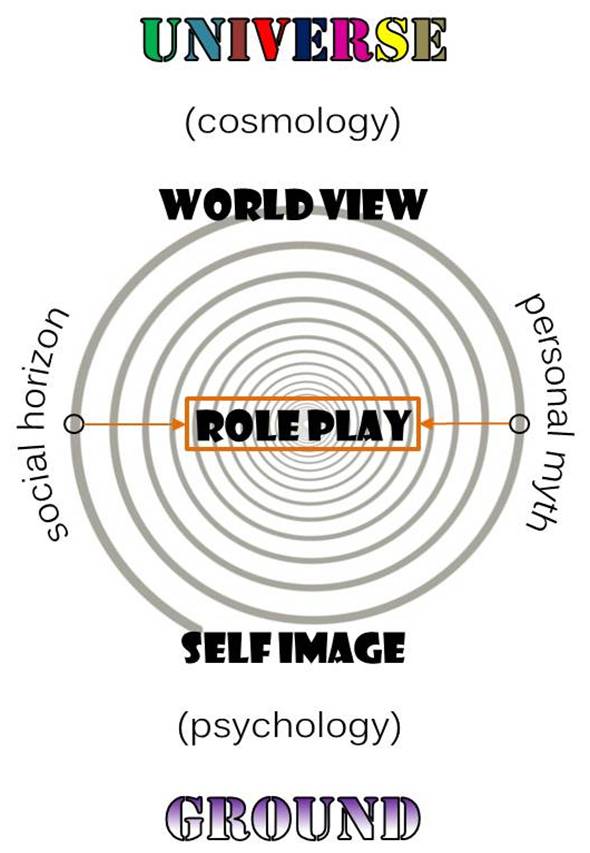
My diagram above illustrates this insertion of the ego in that cultural workspace of the tribe, where nature is socially conditioned and personal identity is constructed. A physical (or “first”) birth delivered the individual out of a maternal womb and into a tribal womb, in which a sense of self (ego identity) will form. The demanded constraint on animal impulses and a socially required modicum of self-control are what eventually establish an ego identity above the body (often represented as a rider atop its horse).

We can distinguish at least two levels or phases in this process of identity construction, the first taking place inside a family system into which the individual is born or adopted, and the second involving cultural influences farther out. A family is more than just a group of people who live together and share a household. It is a present manifestation of deep generational codes, prevailing moods, and social reflexes that move individuals to behave in ways they don’t fully understand or feel capable of altering.

What we call “family patterns,” then, are the deep emotional conditioning that bind members in relationships of attachment and antagonism, perpetuating various co-dependencies and dysfunctions that make every family so wonderfully complicated. This correlates directly to the fact that ego identity is emotionally based, and it also explains why family patterns are impossible to fully understand.

Even if these primary relationships are abusive, the emotional bonding they provide can hold the individual captive – just as the entire family system is captive to its patterns – and unwilling to leave. What else is there? Where might a young child go for a better life? Outside the family is an even more dreadful danger: the loss of identity. We need to remember that the family is a second womb, and that escape of a “preterm” ego would result in a kind of social extinction, which is why it hangs on.

With time the individual engages the larger culture of his or her tribe. Long-standing traditions and conventions of a society are invariably rooted in a mythology of patron deities, cultural heroes, and legendary figures who secured the present world-order. These stories, together with their anchoring images and ritual observances, are summed up in my notion of “symbol systems” (see the diagram).

A tribe’s symbol system functions as a lens on reality, but also as a filter to keep out (or keep hidden) any threat to security, identity, and meaning. The intellectual horizon of meaning itself is maintained in the cultural worldview – projected, authorized, managed, and repaired by all those with a vested interest in its maintenance, which is everyone on the inside.

But the same spell of delusion is in force at this level as what we find entrancing the family deeper down, only in this case it is more intellectual than emotional. It grips down on the mind as powerful convictions concerning ultimate things: good and evil, life and death, sin and salvation. The intellectual certainty carried in orthodoxy has an anchor-line descending into the dark foundations of emotional security, which is where orthodoxy’s real authority lies.

Even when a doctrine no longer makes sense intellectually, due perhaps to a shift in worldview and a loss of specific relevance, a conviction will remain strong – indeed, becoming even stronger than ever precisely because of its opacity and sacred mystique. Since it’s so difficult to understand, it must have been revealed by god, so who are we to question it or set it aside?

By now you should be able to feel the full enclosure of this tribal womb where ego is conceived and develops. Hemmed in emotionally by family patterns (which of course the individual internalizes and will perpetuate in his or her own future family), as well as hemmed in intellectually by the symbol systems of culture, ego identity now has a fully constructed web to inhabit. With ego formation complete, the stage is finally set for a “second birth.”

But not so fast. Those deep emotional fixations and god-given intellectual convictions will not let go so easily. Let’s not forget what will need to be surrendered should the spell be broken. What could life possibly be like without security and certainty – and without the identity that these together define? This would amount to an “ego death” for sure! For many, the security of knowing the hell they are in today, along with the predictive certainty that it will be waiting for them tomorrow, becomes an inescapable contract of identity.

The tribe is also working hard to keep its construction project under control. Friendly warnings and more stern reprimands are issued to the one who asks the wrong questions, challenges the orthodox answers, or dares to look behind the curtain at what’s on the other side. The threat of condemnation and excommunication are all too frequently enough to send the ego back to its seat.

But it is here, in the throes of emptiness and disorientation, that a few (compared to the multitude that obediently fall back in place) find the grace and courage to step through the veil. Attachments and fixations are surrendered. Convictions break open and release the mind. It is finally understood that the so-called security of hell is really no security at all, and that the so-called certainty of heaven is really a distraction from something infinitely more precious and real.

New mind, true sight, awakening, enlightenment: the once-dreaded breakdown turns out to be a breakthrough to a higher mode of being. The human spirit is liberated from its cage of identity, the caterpillar becomes a butterfly, ego gives way to soul. Metaphors such as these endeavor to translate the experience of a “second birth” into the static nouns and verbs of language; but the experience itself is ineffable, beyond words.

Only after dying to ego and being resurrected as soul can the individual look back to see that those same symbol systems, which seemed so categorical from inside the tribal womb, are now transparent to a universal mystery. Gods and demons, saviors and villains, heaven and hell, sin and salvation, insiders and outsiders – each of these familiar components is part of a single drama that we carry within ourselves.

Or perhaps we should say, it carries us.

This was its design all along. Produced by the mythopoetic imagination and coming out a spiritual intelligence deeper and more ancient than the little ego can fathom, this entrancing web of illusion turns out to be the necessary architecture for our creative evolution. It is a bridge spanning the separation of body and soul – which, I should remind you, doesn’t really exist.

Pushing on Belief

A human being creates a world like a spider spins a web. As an innate impulse of the mind, this need to construct meaning is irresistible, and the prospect of living without meaning – of living a meaningless existence – is widely regarded as a fate worse than death. We are ready to give up on life, and willing to take the lives of others, when our meaning is lost or threatened.

Like other propensities and reflexes of our deeper nature, this impulse to make meaning carries the authority of reality. That is to say, we can easily assume that the meaning we construct and the habitations of meaning (or worlds) we live in are a property of the way things really are, independent of us and inherent to reality itself.

This assumption has been part of the “mental lens” of our mind as a species for many thousands of years, and it is responsible both for our cultural progress around the planet and the natural disasters following in its wake. It’s only been very recently that we have begun to realize that how we see reality is much less about the way things really are, and more about our need for security, identity, purpose and significance.

Constructivism is a philosophical approach to understanding meaning as a product of human nature rather than a fixed property of reality itself. Meaning is made, not discovered in the traditional sense of finding it “out there,” buried beneath the facts or dropped out of heaven and waiting to be found.

Of course, this means that constructivism is itself a construct of meaning. It does not presume to offer any kind of “final theory” or last word on the subject. Indeed, if this approach is valid (and I believe it is), then a final theory or last word is a self-contradiction – unless we are referring to the theory that finally takes out our species, signaling the end to a nuclear age and the likely extinction of life on Earth.

What needs to happen in order for that scenario not to happen is that we individually learn how to be more responsible creators of the worlds we inhabit. How can we step out of the naiveté that is accelerating us to the edge of extinction – ironically for the sake of our precious meaning – and into a more adult mode of creative authority?

Part of the answer is that we need to understand the relationship of meaning to belief, which is the insight of constructivism. Another part of the answer moves deeper into an understanding of how beliefs form and then fuse together into the webs of meaning we live in and are all too willing to die or kill for. Let’s start with the question of what it means to believe something.Pushing BeliefBy definition a belief (from the root meaning “to love or hold dear”) is an emotional commitment to a judgment you make about something. Some judgments are tentative and provisional until you make an emotional investment in them, which effectively personalizes these judgments and makes them meaningful to you.

When someone makes a statement and you don’t believe it, you are withholding emotional investment from that statement and choosing not to take it personally. Very likely you are simultaneously forming a judgment about the person who just made that statement, investing yourself emotionally in a conclusion about him or her. You have constructed a belief.

A belief, then, is a conclusion or a closing-down on something with your mind in order to render a judgment about it, together with some degree of emotional commitment to its truth. Some beliefs might be true, while others must be true. These different emotional values determine where a particular judgment resides in your belief system.

As my diagram above illustrates, a belief that holds less emotional commitment (and which only might be true) is called an opinion. Because you take them less personally and their truth-value is not essential to your web of meaning (or “world”), you likely enjoy sharing your opinions with others and hearing theirs in turn. With a lower charge of emotional commitment, opinions are characteristically flexible, experimental, and easily modified or abandoned.

Whenever someone presses on your belief system by engaging you in conversation about a topic you find interesting but not essential to your life’s meaning, you can be open-minded and tolerant where your perspectives don’t quite match up. Your conversation partner might know more about the topic than you, and you can accept what he or she has to say without getting offended, even modifying or updating your opinion as the conversation progresses.

But then this person, with whom until now you’ve been receptive and open-minded, says something that you find incredible, offensive, or blasphemous. You have a history with this particular belief and you take it much more personally. The umbrage or horror you feel, along with the felt need to debate the statement and defend your truth, indicates that this belief is more deeply situated in your web of meaning and has a lot more riding on it. In pressing on this belief, the other person has poked deep enough to activate a conviction.

Convictions don’t allow open-minded dialogue. As the word suggests, a conviction is a belief that incarcerates thought and holds the mind hostage. Whereas once upon a time you may have held this belief as an opinion, over years of anchoring other opinions to this one and thereby making it more essential to your life’s meaning, it now holds you captive.

The certainty it provides is really a rationalization of how secure the conviction makes you feel, and security is not something you want to risk. Pulling on that thread might cause the entire web to tear and unravel, which could result in a global crisis of meaning and world-collapse. Your strategy, whenever a conviction gets poked, will either be to lash out in retaliation, debate your challenger into submission, move quickly to safer ground, or dismiss your opponent as ignorant, impious, and simple-minded.

In fact, you are deluded, and the same can probably be said of your opponent as well. The nature of your delusion lies in the degree in which you have stopped actively thinking and instead given your mind over to the closed loop of a mental script. You can tell when this intellectual bypass is occurring by how irrational you become in defending your conviction. Again, by this time the argument is not about how reasonable, coherent, or evidence-based your belief might be, but about how much is at stake in its truth for you.

By closing down active thought and conscious engagement with the way things really are, convictions separate your mind from reality. An unavoidable consequence is that your life’s meaning is always several steps (or several decades) behind the way things presently are. When we move our consideration to the societal level, this means that entire traditions and cultural worldviews can be hundreds or thousands of years out of date, promoting mandatory belief systems (or orthodoxies) that are wildly out of touch with the concerns and opportunities of contemporary life.

You might think that a belief system is composed only of lightweight, variable opinions and these deeper-set, mind-locking convictions. But there is a third level of beliefs, which are difficult to talk about for the simple reason that they are invisible to your normal conscious operations. This invisibility of your assumptions has nothing to do with secrecy or sophistication, but is rather a function of their role as primary support structures in your web of meaning.

While opinions can be shared and exchanged in your circle of friends, and convictions are either recited in unison among fellow believers or strenuously defended against ideological opponents, assumptions typically never make it to the surface of conversation. Like the lens of your eye which filters and skews the visual information coming in, assumptions are the unquestioned beliefs that determine your most rudimentary mental grasp on reality.

Should someone challenge one of your basic assumptions of meaning, if it even registers at all – and quite often the mind is mentally deaf and blind to such profound challenges – it will likely strike you as literally incredible and not open for discussion. You will probably blink incredulously and shake your head as if to dislodge the strange idea, then abruptly change the subject or quietly walk away.

The key insight of constructivism is an example of just such a challenge to our core assumptions, with its suggestion that meaning is what human beings “make up” and is really a kind of necessary delusion that our nature (and sanity) requires. To press on belief to the point where such assumptions are poked will predictably agitate an all-or-nothing response. Most often it is nothing, so you just dismiss the challenge and move on.

Of the three types of belief comprising your web of meaning, assumptions change least and most slowly – and it should be obvious why this is so. Because many assumptions (probably the vast majority) were adopted and set in place very early in life – indeed, your deepest assumptions were installed into the default state of your autonomic nervous system and preceded the acquisition of language, putting them beyond words (ineffable) and direct conscious access – the very groundwork of what you are is at stake in their preservation through time.

But assumptions can change. Even more importantly you can change assumptions, however longstanding, that have been separating you from the present mystery of reality in unhappy, maladaptive, or pathological ways.

Instead of only playing it safe at the surface where opinions come and go, or occasionally digging deeper into the convictions that electrify the cage around your mind, you might tap open a few of those sacrosanct assumptions that are restricting your soul and keeping you from being fully present to life in this moment.

As you learn to let go and just relax into the grounding mystery, you will find that meaning isn’t all it is made up to be.

The Rupture of Meaning and The Life to Come

Normal everyday operations of your computer at home or work takes into your system a slow accumulation of data in the form of user preferences, security patches and protections, new applications and saved files, internet tracking and downloads – all of which, unless periodically consolidated and cleaned up, will end up oppressing your computer’s memory capacity and slowing its processing speed. Everything gets encumbered and takes longer to respond as your poor computer is trying its best to coordinate all those bits and bytes while still following your commands.

Assuming an adequate operating system is buried somewhere under all that code, what needs to happen is a periodic adjustment where files can be discarded or compressed, programs can be updated to run more efficiently, and that accumulated weight of junk data can be scraped away like barnacles from the hull of a ship. Of course it’s always a good idea to sweep your system for malware (worms, bugs, viruses, and spyware) since that stuff can be terminal (pun noted).

As a metaphor of life, this need to regularly clean out and update your computer system translates directly to the theory of constructivism. This theory holds that human beings are meaning-makers and, further, that meaning is in our minds, not in reality. As distinct from the physical environment where we live, our “world” consists in the overlay of values, associations, and references that our minds spin like a spider’s web across and beyond the given facts of existence. The picture we get from constructivism, then, is of multiple layers (or worlds) of meaning that human beings spin around themselves as persons, partners, families, teams, organizations, tribes, societies, and cultures.

Let’s briefly explore this construction of meaning as it advances across an individual lifespan. This will prepare us to better understand the life transition that I name the “midlife reset,” when this accumulated meaning ruptures and our mental system needs attention.Life StagesThe above diagram illustrates a human lifespan, represented by a magenta-colored arrow arcing from left (past) to right (future). Consistent with a more general theory I’ve been developing, depending on where you are in the lifespan, the segment of time on your left also corresponds to deeper evolutionary layers of your “operating system,” while the segment on your right signals possibilities (and new layers) still to come online.

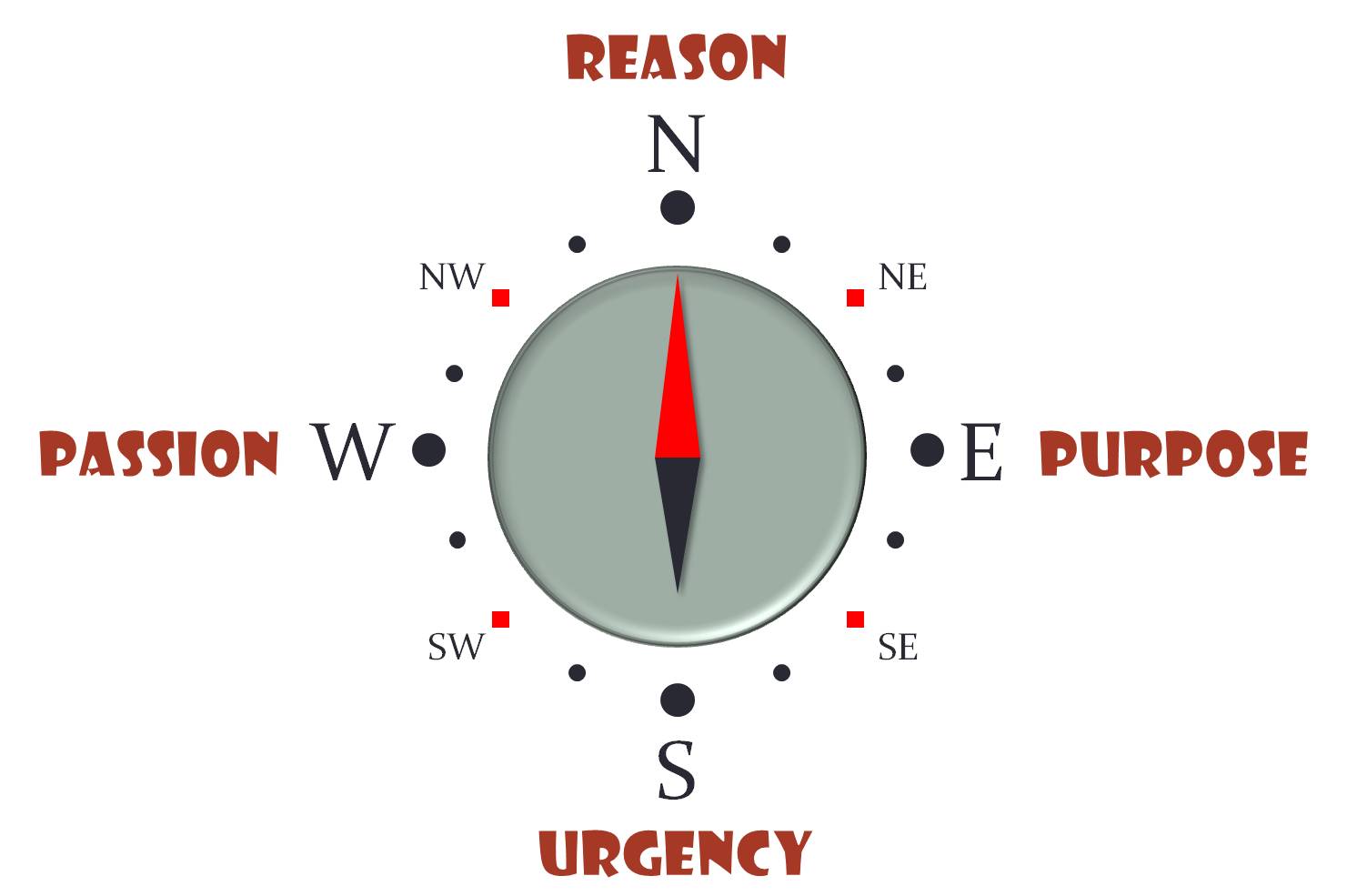
In the womb and following our birth, individual consciousness is completely “embodied,” which is to say that it is fully immersed in the animal urgencies essential to staying alive. It will be many months before we are capable of thinking about our experience – using words, formulating thoughts, making abstractions, and drawing conclusions. In those earliest days and months we are responding to life as it happens, intent all the while on the degree in which the provision of reality matches the urgency of our need.

The word “passion” derives from the same root as “passive” and is related to “patient,” referring to one who is in a basically receptive and reactive attitude with respect to what’s going on. Our passions (or to use the more modern term, our emotions) have evolved around the challenge of situational adaptation, giving us an ability to meet external objects and events with an attitude that befits the situation and will motivate an adaptive response from us. Desire/Hope, Despair/Sorrow, Disgust/Anger, and Distress/Fear are the four powerful emotional programs that simultaneously simplify and complicate our lives.

You’ll notice that central to my diagram and pivotal to the turning arc of time through the lifespan is what I’m calling “faith.” This shouldn’t be confused with a religion’s orthodox collection of truth statements, or doctrines. Here faith refers to something much deeper and much more important than doctrines; it is the individual’s primal mode (or mood) of being, carried in the nervous system as a resting state of basic trust and openness to reality. And since the nervous system is not digital (“on or off”) but analog (“more or less”), each of us embodies an existential mood located somewhere on the continuum between very secure (grounded, calm, trusting, composed) and very insecure (unsettled, restless, wary, anxious).

It should be obvious that an individual’s foundational mood or mode of being will be determined to a great extent by the nature of his or her early life experience. A hospitable womb and nurturing home environment will elicit more positive passions (confidence, joy, hope, optimism) and help to set a mood of resting assurance that is open and trustful. Negative events such as neglect, privation, abuse or abandonment will have the opposite effect, closing the nervous system against reality for the sake of survival. This passion-faith axis is where the individual’s general outlook on life is set, as happy, depressed, hostile, or phobic.

Farther along the arc of development brings the activation of a more cognitive (thoughtful, intellectual, rational) approach to things. Reason is about causality, relation, intention, and purpose, and with this capacity, significantly assisted by the acquisition and growing mastery of language, our mind goes to work constructing meaning. A key insight of constructivism, as already mentioned, is that meaning is a product of the mind rather than inherent to reality. What is and what happens are the givens of reality; what it means depends on a mind to ask questions and come up with answers.

We construct meaning under the supervision and guidance of our tribe, and great care is taken so that our individual worldview is congruent with the collective worldview of our primary group. The intended outcome is a deep and broad agreement between our minds, an agreement that insures a conservative advancement of the larger cultural heritage wherein our identities are mutually defined and managed.

We are expected to graduate through a series of life accomplishments, completing each assignment at the right time and in the proper order. Lollipops, gold stars, ribbons, trophies, certificates, diplomas, degrees, bonuses, promotions, licenses, property, real estate, social status, and finally dependents of our own that we will support and shape into “one of us” – all along the way we are making agreements, constructing meaning, and loading our operating system with more data. It is generally true that the first half of life is oriented outward in pursuit of accomplishments that our tribe insists are critical to our success, happiness, and good standing in the community.

And then something happens. Our system takes longer and longer to boot up. Our decisions (like key-commands) get bogged down in lag time. Even more concerning, the pursuits and accomplishments that had previously inspired our personal commitment and sacrifice feel increasingly like an exercise in futility. This is a crisis of meaning, and its principal symptoms – as reported in memoirs, case studies, and popular literature – are feelings of emptiness and disorientation: Nothing (or very little) seems to matter, and it feels like everything is reeling off course.

Welcome to the Midlife Reset.

This rupture in life’s meaning forms a fracture that typically reaches down into the foundations of security. Consequently for many this amounts to a “faith emergency” where reality no longer feels provident or trustworthy. To a once-confident theist it can seem as if god has vanished into nonexistence, leaving him or her utterly bereft and forsaken. A percentage of them will conclude (accurately) that the god they believed in never really did exist as they assumed, that he was a figment of their imagination, a mere figure of myth, a construct of the mind, a convention of orthodoxy. This realization leads some into a disenchanted atheism, others get pulled into a desperate and dogmatic fundamentalism, while a few step through the veil in search of a relevant spirituality “after god” (post-theism).

The shift or life transition pressing in at this point of the Midlife Reset was interpreted by C.G. Jung as a radical reorientation, moving through the harrowing yet necessary phase of disorientation, from an outward investment of consciousness to an inward reorientation on something more esoteric (“inner”) and reality-based. We can characterize this as a breakthrough from a life dedicated to worldly accomplishments, to a new life in quest of genuine fulfillment – for the path that will lead to a more grounded experience, a more authentic presence, greater well-being, and a deeper love for life.

Ultimately this is preparation for engaging life in a more “soulful” way, less concerned with proving ourselves and getting ahead, than simply being ourselves and sinking deeper into the grounding mystery of existence. Wisdom seeks to reconnect to the faith that may have gotten buried beneath the accumulated “junk data” of convictions, beliefs, and opinions. In taking up a practice of mindful meditation, physical discipline, or creative art we can successfully clarify attention to the degree that our practice becomes a selfless vessel of spiritual life.

If reason is involved in meaning-making, then wisdom is what we come to know about life after our assumptions, preferences, judgments, and expectations have been dropped or stripped away. It’s not that we stop thinking about or responding passionately to what’s going on around us. Putting a judgment on something (or someone) and boxing it up in meaning may be a way we can learn something about ourselves, but the neatly labeled package only separates us from what is really real and unique in each situation. Wisdom picks up essential lessons from life without having to haul along the heavy megabyte files containing countless bits of nonessential or even corrupt (exaggerated, embellished, or misremembered) information.

My diagram might suggest that a more soulful, spiritually grounded, and liberated life is only available to us in our later years. But in fact the turning-point of what I’ve called the Midlife Reset can come at just about any time. Presumably (in keeping with my theory) it coincides with an accumulated critical mass of irrelevant meaning (junk data), which would make an early incident very unlikely and much less common. It’s also possible that it never comes: the conditions are right for awakening to occur but the individual “successfully” resists, or else reverts to old certainties with a new-found devotion.

In the end, perhaps the most desirable outcome is that we are able to rest again in the provident mystery of reality.

Creative Authority

A friend in an engagement community that I weekly attend asked recently, “What, exactly, goes into this idea of ‘creative authority’?” – an idea (or ideal, really) that occupies a strategic position in the theory of human fulfillment that I’ve been working to clarify in a conversation on post-theism.

It is critically important that post-theism not be defined as a reactionary movement, as an effort to throw off theism and its antiquated god for the sake of something like secular materialism or atheistic humanism. Quite the contrary, post-theism holds a vision for what life is like after (“post”) theism – not after theism has been discredited and finally abandoned, but when it has served its evolutionary function and releases the self-transcending human spirit into a new existence as an enlightened partner and co-creator in the great community of life.

Before I offer a response to my friend’s question, let’s quickly recall where “creative authority” fits into my broader theory of human fulfillment. We started life fully immersed in an animal nature (body), with all its biological requirements and urgencies keeping consciousness oriented outward to the resources we need. Gradually, and with success in satisfying our basic needs, awareness began to open inwardly as well – not just to this pang or that urgency inside the body, but deeper into a sense of our grounding in a provident mystery. This sense of provident grounding is registered in the nervous system at an unconscious, visceral, or “gut” level, which is why I call it animal faith.

Immediately with our birth our tribe went to work shaping our identity (ego). Through guidance, directives, feedback, and discipline we were given clear (but sometimes not so clear) messages about what it means to be a good boy or girl, a member in good standing, a person of value. Because the foundations of identity are constructed early on and are primarily emotional in character, I call the construct of identity itself our inner child.

With sufficient animal faith underneath us, supported by the caring and responsible influence of our tribe, identity can achieve a level of healthy development known as ego strength. Key attributes of ego strength are a stable personality, balanced mood, and a unified sense of self.

This is where things really get interesting, since social security, group membership, shared purpose, and personal value are like four sides of the box containing a meaningful existence. Why would we ever want to leave? Where else would we possibly go anyway? Outside the box is meaninglessness, nihilism, absurdity, and certain despair – or at least the heresy of someone else’s meaning. This is a necessary part of our programming.

An essential part of this project of identity construction is the tribe’s representation to the youngster of what a “good person” looks like – not in physical appearance necessarily, but how a good person behaves, how they treat other people (insiders and outsiders), what values they hold, how they handle conflict and common challenges of life.

Beyond merely listing these features in something like a bullet-point format, this ideal of a good person is represented in the role models of parents and other respected adults, but also in stories that depict super-human, supernatural superegos who are engaged to the tribe as divine protectors and providers.

Theism is a religious system that orients the individual to taller powers (adults) and higher powers (gods) that exemplify the character of a “good person.” These role models are intended to inspire similar developments in youngsters and devotees, but typically in theism the deity demonstrates the virtues in their more or less pure form. (We must not forget that this is a “dramatic” demonstration, since the god lives only in the fictional space of sacred dramas or myths.)

The deity, for example, who is worshiped for having shown compassion to the tribe when they or their ancestors were lost and without hope, exemplifies this degree of loving concern and will typically have expectations (in the form of injunctions or commandments) on the community to aspire toward a similar level of compassion for others in need. In this way, worship, as the exaltation into collective aspiration of the deity’s praiseworthy virtues, flows naturally into morality and obedience for the tribe.

We should acknowledge a flow in the opposite direction as well. The particular historical concerns currently pressing upon a tribe’s existence will “select” those divine attributes most needed in the moment, or possibly even alter the portrait of god in story and theology in order to provide some timely justification. Neglect of the needy, persecution of outsiders, and violence against unbelievers are either dug up from the mythological archives – you can always find a verse for that in the Bible – or else insinuated into the script of orthodoxy from the local church pulpit.

A similar dynamic as what we find in parental role models with their children is also present in theism proper: When a virtue demonstrated by the exemplar is imitated successfully by the aspirant (child, devotee) and internalized – which means integrated into the individual’s ethical character and way of life – an external representation is no longer required and can be transcended. Because the virtue (say, of forgiveness) now informs life from within as an authentic expression rather than from outside by imitation, we might say that the individual has progressed to a post-parental, post-theistic mode of being.

True enough, there are complications that can slow this process down and even arrest it altogether, but in this post I want to pretend as if development has advanced according to design – and by “design” I mean according to the inherent tendency of a human being to mature into a self-actualized adult.

When this sequence of obedience, aspiration, internalization, and authentic expression reaches fulfillment in the stable, balanced, and unified personality, ego strength is achieved and the individual is finally capable of a new mode of being and a higher way of life. Earlier concerns over belonging and recognition, security and freedom, of maintaining membership in the tribe as a person of value, are no longer the preoccupations they once were.

Consciousness has shifted to a new and higher mental location, one that supports a realization of deep communion and universal participation – or more simply stated, the realization that All is One. At this point the tribe has given up custodial possession of the individual (as ego), and the individual begins a new life “after god” (the lower-case ‘g’ referring to the patron deity of the local tribe). This higher mental location for consciousness is what I understand by soul – not “the real me” inside a body or just a new (spiritual) name for the ego, but the individual’s existence as grounded in mystery and connected to all things.

A perfect word for this new arena of life, combining deep communion and universal participation, is community – from com (with, together) and unity (as one). Here the awakened soul understands, by direct intuition and not hearsay, that the separation so important to establishing a clear identity for the ego was really a delusion of consciousness at that level. In some sense, the entire tribe is under this same spell, which is probably why spiritual awakening is frequently described as the breaking of a trance and coming to see things as they really are.

So this is what I mean by “creative authority”: the individual taking for him- or herself the authorial rights to a new story. Siddhartha’s new story was the dharma of his Four Nobel Truths and the Eightfold Path. Jesus’ new story was his gospel of forgiveness and solidarity with the poor. Martin Luther King, Jr’s new story was about a world where our children won’t be judged by the color of their skin but by the content of their character. Each of them stepped intentionally and courageously into creative authority, come what may.

With that, I can finally respond to my friend’s question about what creative authority entails. In the diagram below are listed five virtues that I find in the dharma, gospel, and Dream stories just mentioned; but they are also well represented across countless others. Since the diagram depicts the path of human fulfillment organically, as growing up from a body-centered mode, through an ego-centered (and theistic) mode, and into a soul-centered (post-theistic) mode of being, my visual display of these five terms is meant to be interpreted in a similar bottom-up fashion.

Creative Authority_virtuesContemplative

Even though “contemplation” is commonly used in the West as a synonym for “meditation,” I want to avoid this confusion. While a meditation practice is essential for descending the inward path to the grounding mystery of being, contemplation is closer to the idea of “mindfulness.”

Creative authority is contemplative in the way it holds a mindful perspective on reality. This includes a big picture and long view on one’s place in the great community of life. Contemplatively the individual acknowledges that s/he is both a participant in and a manifestation of oneness.

The opposite of contemplative mindfulness would be something like conviction, where one’s beliefs about reality actually separate the mind from reality. A conviction is a belief that holds its owner hostage. Contemplation, on the other hand, opens the mind to the present mystery of reality.

Empathetic

With “reality in mind,” creative authority is open at deep levels to the connectedness of things. As a cell in the great body of community, an individual feels the dynamics of well-being or deterioration in the connective tissue of relationships. Empathy is similar to “sympathy” and “compassion,” but adds to these a degree of rational understanding to the direct and spontaneous feeling.

In the profession of counseling today empathy is what the helper needs in order to truly help the one who is suffering. Drawing on the big picture and long view afforded by contemplation, the helper can offer perspective and recommendations that have a larger context in mind. The helper is careful not to jump down into the dark hole of suffering for the sake of merely providing some company in the misery, but instead confirms genuine care and understanding while holding open the horizon of possibility and hope.

Responsible

Whereas in the ego realm of the tribe responsibility is about following through on what’s assigned or expected, for creative authority this element of obligation is transcended. The self-actualized adult doesn’t act or refrain from acting because of what someone else (human or divine) might think. In this way, the motivation of responsibility is not externally coerced but rooted in empathy, coming directly out of a grounded and connected life.

Within a much broader and deeper context than ego consciousness is capable of grasping, soul-centered responsibility understands that “the right thing” is not always what feels good, gets rewarded, or even promotes individual self-interest. Sometimes, in fact, doing the responsible thing involves transgressing on tribal rules (or divine commands) that perpetuate inequality, prejudice, bigotry, oppression or violence against others. The resulting “conscientious guilt” – willingly bearing the indictment for the sake of a higher good – is something the individual must learn to live with (and care less about).

Benevolent

I said just now that the soul-centered responsible adult commits his or her life to a higher good, which is to say that this individual wills the good, chooses the path of well-being, and puts it into action. Benevolence continues the organic progression of creative authority – as one who mindfully holds the big picture (contemplative), deeply understands what is going on (empathetic), uses his or her influence for the benefit of the whole (responsible), and now wills that greater good into an intentional way of life.

Most likely the ego was instructed in the importance of having “good will” toward others. The so-called “golden rule” of Do unto others what you would have them do unto you, and the biblical mandate to Love your neighbor as yourself (quoted by Jesus but originating in the Jewish book of Leviticus), are typically limited in their practical application to the in-group where ego is a member.

Jesus’ exhortation to Love your enemies and do good to those who commit evil against you (Matthew 5:44) represents a decidedly post-theistic direction, which neither the patron deity of the Judaism of his day nor the patron deity of later Christian orthodoxy was capable of fulfilling. Theism will always have “outsiders,” who necessarily live and perish outside the saving mercy of (the insiders’) god.

Forgiving

This, I suppose, is where the real test lies. How far does the benevolent life of creative authority reach? Where is the edge, where is the boundary that defines the extent of lovingkindness? For the ego there must be a limit, past which it is not only dangerous and foolhardy, but positively blasphemous to go. If god will finally cast his enemies into everlasting torment – even if it is out of a reluctant obligation to condemn the sinner – who am I (asks the ego) to presume that god might be outdone?

I have made a case that this was precisely the message (new story, gospel) of Jesus, summarized in the simple yet revolutionary appeal of “unconditional forgiveness” – loving anyway, doing good anyway, choosing benevolence over retribution, letting go of the past and moving into a shared future. (For more on that, see “Jesus Against Christianity“)

Forgiveness, as “letting go,” concerns more than just our relationships with others, even if that’s where it is most difficult and most urgently needed. Releasing the past allows the individual to take from it the valuable lessons that constitute wisdom, without having to drag an unexamined life behind him or her like – in the wonderful metaphor of Robert Bly’s – “a long, black bag.” We forgive so we can be free to grow and learn and fulfill our creative authority in the great community of life.

Growing Into God

Atonement_ApotheosisThe developmental aim of a human being is to become a well-grounded, fully centered, and creative authority; a caring, autonomous, and responsible adult. According to this definition, an adult is more than just a “grown up,” someone who has reached a certain age and stage of physical maturity. As I’m using the term, adult refers to an individual that has attained a level of self-actualization and fulfillment of the species. What the species holds in potential is thus actualized, or actively expressed, to some degree in the adult individual.

This process of self-actualization is illustrated in the above diagram, and in a moment I will take you on a quick tour. Anticipating the primary focus of this blog post, however, I want to direct your attention to a crucial point where the very natural adventure of becoming an adult (as I’m using the term) frequently gets hung up and held back. Here we find two words with a deep history: atonement and apotheosis. Atonement describes a procedure by which the individual sinner – using traditional Christian language – is reconciled back to the deity and, importantly, to the covenant community. (The patron deity and his tribe always go together in theism as co-evolving counterparts.)

Apotheosis is less familiar, although it too is deeply rooted in myth, politics, and religion. In the Latin (Roman Catholic) West and its Protestant step-children, apotheosis never officially made it into Christian orthodoxy – and it’s not hard to guess why.

While the term names a politically self-serving proclamation by a Roman emperor of his deceased predecessor’s deification, apotheosis in religion also refers to a human being’s progress into God; not merely getting closer to the deity in prayer and devotion, but growing into God to the degree that the human being is sanctified, glorified, and awakens to divinity. That’s why it couldn’t be allowed into orthodoxy – at least in the great Western branch (and countless splintering twigs) of Christian orthodoxy.

The Western traditions (Roman Catholic and Protestant) picked up on the Jewish-biblical theme of atonement and made it the fulcrum of orthodoxy. Humanity’s sinful condition separates us from god, and the process of returning to right relationship (called reconciliation) is conceived as a juridical transaction involving exoneration from guilt by the satisfaction of a penalty and the judgment of god (or his ordained church officials) that the sinner is forgiven (called justification). The benefit is a clear conscience, but more importantly it means restoration to good standing with god and the covenant community.

It’s this idea of being brought back to a position temporarily forfeited by the rupture of sin – or perhaps permanently forfeited if proper atonement is not made – that is particularly interesting, especially when contrasted with the progressive, forward-moving, and transformational notion of apotheosis whereby the individual advances to a heretofore unrealized state of being.

There are reasons why atonement rather than apotheosis became the fulcrum of Western Christian orthodoxy, which I won’t dig into right now. Most likely this preference was driven by such factors as religious persecution (which tends to unify the victimized community), the strong juridical theme in Jewish mythology (Yahweh as king and judge; salvation as being set free of debt and guilt), and the fact that early Christianity grew up in the Roman era with its overriding governmental, judicial, legal and military obsessions.

But let’s go back for that tour I promised, showing how this tension between the pull-back of atonement and the forward aim of apotheosis is relevant to understanding the threshold between theism and post-theism.

The hero of our story – the one we’re all so concerned about, whom I name Captain Ego – gets started on the adventure by restraining and redirecting natural impulses of the body into behavior that is socially compliant and proper. With considerable help from the tribe in the form of guidance, feedback, and discipline, individual identity (ego) gradually establishes a center of self-control, social recognition, and personal agency.

But before that center gets established, the individual needs to secure strong bonds of dependency and trust with the provident powers responsible for his or her care. The ensuing condition of attachment sustains the individual – this gestating sense of self – in a web of support where he or she feels safe, accepted, and comfortably enveloped. (There is probably a deep visceral memory of what it was like in the paradisal garden of mother’s womb that compels the infant’s quest for oneness.)

Of course, there’s no going back. Besides, the ego is compelled by a second drive, which is to separate itself from this comfortable anonymity and stand out in freedom, to be recognized as special and unique. This imperative is what’s behind that signature feature of Western civilization: its individualism, its infatuation with stand-out celebrity, unprecedented achievement, and heroic glory. As you can tell, this pursuit of freedom and self-importance stands in direct opposition to the ego’s need to fit in and belong.

Welcome to the inherently conflicted adventureland of personal identity.

Further progress into adulthood – that is, into the human fulfillment represented in the self-actualized adult – will need to continue with this formational process as the individual awakens to his or her higher self (soul). Earlier identifications will need to be transcended – such as belonging to this tribe and holding these titles or awards – which inevitably is confronted with resistance from society. This is who you are. You are only a person of value and respect because of your standing as one of us. You need to stay here and obey the rules!

A certain guilt is induced with disobedience. And here we’re not talking about ethical violations such as deceit, theft, and murder, which are genuine threats to human community; but rather the kind of disobedience where an individual sets down the masks and steps out of the roles that define identity, in order to assume creative authority in his or her life.

Before the developmentally opportune moment (what in Greek is called kairos, the critical opportunity for action), such forays into a more authentic life will convict the individual with a guilty conscience. But when the time is right and the individual is possessed of sufficient courage to bear the consequences of his or her choices, a guilty conscience will give way to conscientious guilt, willingly accepted in civil disobedience. Conscientious guilt is the price of identifying with goals, principles, and ideals that represent realities and possibilities beyond the sacred conclusions and status quo of the tribe.

Siddhartha (the Buddha) breaking a hole in the wall of the caste system to allow for the liberation even of outcasts, Jesus (the Christ) reaching out to include sinners and the ritually impure, Martin Luther King, Jr. instigating boycotts and leading peace marches against race and class inequality – these are historical examples of individuals who accepted conscientious guilt in pursuit of aims they regarded as more noble and necessary to true human progress.

As a final measure, the tribe might appeal to its patron deity and the precepts laid down by orthodoxy. How can you arrogantly believe that there is more to life than what we have for you here. We are the chosen ones. This is the covenant community, obedient to god and blessed in turn with eternal security. You’ve grown up under the grace and clear directives of our patron deity. You have enjoyed the benefits of membership all these years. And now you are ready to throw it all aside, turn your back on god and us for the sake of your own selfish fulfillment? Excommunication and everlasting torment in hell are what you are really choosing – just be clear about that!

And this is just where atonement works its magic – if it can persuade the waking soul to instead submit to the prescribed procedures of confession and repentance in order to be pardoned and reconciled back to where a true believer rightfully belongs. Things inside run more smoothly when we all stay in our proper place and do what we’re told. Heaven is up, hell is down, and the devil is locked outside. You barely made it back, but good for you!

Or else, this is just where apotheosis makes its fateful move. With the courage not of convictions but of an evolutionary purpose taking root and springing forth from within, the individual draws strength from the grounding mystery and enters more fully into the realization that all is one. It is no longer “me and mine” or “us versus them,” but all of us together, sharing this moment in faith, holding the future open with hope, releasing fear for love.

We are growing into God.

By God, What Do You Mean?

Real progress in religion is hampered by the fact that its primary concern is such an enigma. What people name “God” – or better, what they mean when they use this term – is nearly impossible to pin down. This is partly due to the inherent difficulty in defining something that admittedly has no boundaries or limits. But perhaps an even stronger factor has to do with the indefinite nature of experience itself, like a moving stream in continuous change.

When these two factors (a supposedly boundless object and the dynamic subjectivity of experience) are forgotten, religion becomes a seedbed of dangerous conviction and spiritual oppression. Once orthodoxy is convinced that it has the last word on God, there is no end to what it might muster, justify, or condone in promoting and defending its truth. Well, there actually is an end, once there’s nothing left to burn.

As an outspoken critic of religious orthodoxy and its god – and now I’ve shifted to the lower case, for reasons to be explained shortly – I try to maintain a sharp distinction between our names for God and that which we are presuming to name. Our unique capacity as a species for meaning-making makes us susceptible to falling under our own spell, where we start to believe that reality is as we imagine it to be. (Of course, crucial to this trance-state is forgetting that we have imagined it!)

In this post I will offer an understanding of religion’s primary concern, specifically exploring how experience, meaning, and truth come together (or fall apart) in this often baffling enterprise. An operating assumption throughout is that our names and representations of God – in other words, our various gods – can never fully or finally capture the reality under consideration. If we can agree on this (and not forget it), then perhaps some constructive dialogue is possible.

Even if our depictions of God are different, and significantly so, at least we can learn to appreciate our different depictions as depth-soundings into the marvelous complexity of human experience. Why do we have to put our depictions (as art, story, or doctrine) up against each other for competition and superior standing? Why not celebrate this diversity, claiming it as proof that God is more (and other) than any of us can imagine?

I think I know why.God Spectrum

God as Divine Absolute

It’s interesting how, at the higher levels of theological reflection, God is depicted in such abstract terms and extrapolated to such infinite degrees, that most (if not all) of our differences are logically eliminated. It no longer matters whether we’re talking about the ultimate reality according to Jews, Christians, Muslims or even Buddhists. Once you bracket out the traditional names for the Absolute (referring to what is utterly independent and unconditioned), the reality under consideration is identical.

The reason for this remarkable similarity has to do with the inevitable effect of pushing definitions into infinity (e.g., the Divine Absolute as omniscient, omnipresent, omnipotent), which is to erase them or stretch them so far that they no long define anything. By definition, so to speak, the Absolute is beyond definition. Whatever qualities are attributed to it are necessarily amplified to an infinite degree – exploded into everything and beyond.

As the Divine Absolute, God is everywhere. If God isn’t in this tree or that cloud, or even in my enemy; if God is only in heaven or on earth, but not in hell – then there is a location where God isn’t, which logically means that God is not everywhere after all. If we are going to reflect on the logical perfection of the Divine Absolute, then anything that is in the nature of God will be without limits, that is to say, infinite. That’s why, at this level of reflection, the differences among our traditional gods dissolve away, leaving only The Unlimited which includes everything but is not dependent on anything for its existence.

This capacity for higher-order thinking is a fairly late development in our individual maturation, coming only after we have gained the cognitive functions and language skills to support what Piaget named formal operations, the ability for symbolic and abstract thought. I like to think of this as the “logical refinery” where concepts drawn from experience are stripped of their situational “dross” and changed into pure ideas, or ideals. God, at this level of abstraction, is not a being belonging to this or that tradition, but absolute and limitless Being, that which transcends yet includes existence itself.

Now obviously that’s not where most people are interested in spending their time and intellectual energy. Besides, a logical abstraction like the Divine Absolute is not something that does much to stir devotion or confirm the validity of your creed. Even worse, if it doesn’t produce religious apathy (who can love an abstraction?), there is a danger that serious theological reflection will lead to heresy. (The omnipresent God is in hell? Unacceptable!)

God as Patron Deity

That’s perhaps why more of us stay in the groove of our religious tradition – belonging to a faith community, going to worship and bringing up our children in the “right way,” studying the scriptures and denominational confessions, believing and behaving as we ought, doing our best to please, flatter, and placate our Patron Deity. The down-shift from a Divine Absolute to a Patron Deity is a step into full engagement with a personified representation of God who has had a long history with “our people” – the insiders, the elect, the chosen ones, the saved.

Patron Deity is a more or less technical term taken from the kind of relationship said to exist between the deity and devotee. This relationship is transactional and supported by the mutual exchange of submission for protection, obedience for reward, worship for blessing. Where exactly is the Patron Deity encountered? The answer is difficult for many believers to accept: In the myths, or sacred stories, in which the deity’s character is first introduced and subsequently developed. In other words, the Patron Deity is a narrative construct – the central construct – of a tradition’s mythopoetic (myth-making or storytelling) imagination.

Our modern Western loss of this mythopoetic imagination, which was the tragic cost that attended our “gain” in a reductive, objectifying, hard-facts-oriented worldview, required that we “interpret” (rather than recite, embody, and perform) our sacred stories as factual eye-witness reports of supernatural realities and miraculous events of long ago. Yahweh, the resident Patron Deity of the Bible, now must be regarded as existing outside the stories (since story has lost its power), somewhere “out there” or “up there” – in any case, no longer exactly here.

In the opinion of many, it is a blatant statement of atheism to even suggest that no one (anywhere, ever) has encountered the Yahweh depicted in our Bible. But in making the statement I am not denying the existence of God, only insisting that the personified representation of righteousness, potency, judgment and mercy – this particular Patron Deity, Yahweh – lives only in the Bible. If it sounds like I’m saying that God is nothing but a fictional figure stuck in the pages of a book, this only exposes how far the modern mind has fallen out of mythopoetic consciousness.

Most of us need to go back to early childhood to recapture a dim memory of when stories weren’t just leisure-time entertainment but our full-time occupation. The world we lived in wasn’t made of objective facts. Instead it was suffused with invisible creatures, heroic challenges, time travel, and numerous branching storylines that we might spontaneously follow into our next adventure. Our world was a narrative construct spun out of stories. The characters we encountered, while not literally existing, were real to us – more real than any dead-heavy fact could ever be.

Yahweh started his career in the imaginarium of the ancient Near East, among a few tribes of habiru that had settled in the Sinai peninsula. The sacred stories they told brought Yahweh to life, and Yahweh in turn brought their world into existence.

God as Holy Presence

So far, then, we have distinguished two very different meanings of God: the theological abstraction of the Divine Absolute, and the mythopoetic character of the Patron Deity. One more step closer to the ground brings us into special settings where God is encountered as a Holy Presence. The sacred precincts of institutional religion (temples, churches, mosques, and cathedrals) are artificial constructions where worshipers gather to call on the Patron Deity and join themselves once again to the timeless realm of sacred story. Typically some kind of ritual performance mediates this crossover from the broken time of ordinary life into the deep time of sacramental experience.

Before temple buildings and architectural sanctuaries, people were likely to have such experiences in natural zones like groves, meadows, grottos, seashores, riversides and mountaintops – places where “something more” seemed to come through, activating their sense of wonder, amazement, awe, or even trepidation. This something more should not be confused with something else. The particular name for God at this level – Holy Presence – is often and too quickly reduced to a being (the Patron Deity?) who adds the something more by coming in from elsewhere. As a spiritual intuition, however, this Presence is not added but “unveiled” (or revealed) as always and already there.

In my diagram above I leave open the question (with curving arrows) of whether the experience of Holy Presence precedes and inspires the mythopoetic imagination, giving rise to the Patron Deity as a personification of the something more; or if established stories of God are engaged in ritual performances that successfully conduct the worshiper into the sacred time and Holy Presence of the Patron Deity. In all likelihood, the answer is “both.”

This dynamic reciprocal support between the Patron Deity and Holy Presence is where conventional religion settles into orbit. Ordinary members are neither interested in, nor do they have the patience (and time) for abstract theological reflection. It’s sufficient to give agreement to doctrines of God’s infinite nature and power and love (etc.) without bothering to chase such statements to their logical (and heretical) conclusions.

Indeed your average believer will likely harbor some suspicion towards the “scholars and academicians” who stretch the concept of God beyond what our minds can comprehend. Their preference is for a theology that maintains allegiance to the Patron Deity of their tradition and demonstrates the prestige of their orthodoxy over others. More important than an intellectual exploration into God is the security of knowing that God is here when they need him, and will reward them for their faith and obedience in the life to come.

God as Grounding Mystery

Another direction that conventional believers won’t typically go is downward – which is actually a decisive step inward, to the Grounding Mystery of being-itself. This is where mystical spirituality lives, and its signature experience is essentially the same across (really underneath) all the world religions. It’s similar to theology in the way it pushes language to its limits, but instead of pushing out, mysticism pulls language in to its metaphorical foundations. Rather than an infinite being, God is being-itself, the power-to-be in everything that exists.

God as Grounding Mystery is the source and support of all things (as suggested in the metaphor of ground). You will not find this Ground by looking outside yourself, however. As the generative wellspring of existence, the only path into the Grounding Mystery is within: inward and away from outward attachments, beneath and past the center of your personal identity (ego), down into the place which is no place, where your being rests in and is released to the provident mystery of reality. If language is useful in labeling, classifying, qualifying, and explaining the outer realm, it is gradually surrendered to a silent wonder and profound tranquility, as there is nothing (no thing) for it to grab onto.


While my explanation of the distinct levels of meaning for God began in the abstractions of theology and stepped down from there, essential to my theory is the claim that it all really begins in the ineffable (wordless, indescribable) experience of the Grounding Mystery. This is, after all, where our existence is rooted and anchored, where each of us takes in our life and lets it go again, where I am and you are: the only place we can ever be.

This is the only place we can ever really be.

A Dangerous Certainty

BES CycleIt’s good to pause every so often as you are trying to make a point, if only to ensure that your latest statement is consistent with what got you going in the first place. You might well be making a worthwhile claim, but if in the meantime you have wandered so far off the path and run out of breadcrumbs, your audience will grow tired and let you go.

My starting point was the question about the role of religion in human development, and how religion itself evolves with the advancement of individual consciousness over the lifespan. One of my basic claims is that individual consciousness engages reality at three distinct mental locations, each location opening out to a realm of experience corresponding to this point of contact.

Thus body, ego, and soul are not pieces or separate parts of a human being, but mental locations where individual consciousness opens out to the animal, personal, and spiritual realms. I’ve done my best to head off the tendency of regarding these so-called realms as metaphysical planes of existence. Alas, metaphysical realism is a sticky trance to shake off. Another gross misreading identifies the ego-soul (a disastrous conflation that leads to numerous corruptions) as “the real me,” literally throwing off the body like a cheap coat or temporal costume.

Body is our animal nature, animated by the life-force (anima), and the mental location where consciousness is involved in animality (i.e., in the dynamics of animal life). Ego is our personal identity, which is acted out through a variety of personae (social roles and masks), and serves as the executive center of our personality. And soul is our spiritual presence, the inner wellspring of spirituality and deep ground of the human spirit. Their associated realms comprise the sensory-physical (body), socio-cultural (ego), and intuitive-esoteric (soul) – as long as I can rescue the term “esoteric” (literally inner) from the secret-knowledge (gnostic) spiritualists and crackpot metaphysicians.

As the above diagram illustrates, these three mental locations are oriented respectively on the three concerns of life (body), self (ego), and being (soul), with each concern attracting secondary concerns and values into a coherent system of motivation and behavior. We are interested in different things depending on where (at what mental location) we are engaging reality at the moment. It’s also important to see that this arrangement of concerns is not static, but rather evolves dynamically over the course of a lifespan.

Infancy and early childhood is a “body-dominant” developmental period that gives rise to an “ego-dominant” period in later childhood and adolescence, which may in turn break through to a “soul-dominant” mode of being. To a certain degree the success of each of these transitions is a function of how well things went in preceding periods. A body that wasn’t providently supported in early life, for instance, will become an insecure base for the developing personality.

As a way of compensating for and coping with a jittery (and alternately exhausted) nervous system, the ego will adopt a neurotic style to get its needs met. Examples of such adaptive strategies are the common passive-aggressive, phobic-avoidant, explosive-aggressive, and obsessive-compulsive neurotic styles. (For a deeper dig into these and other neurotic styles, see http://wp.me/p2tkek-cU.)

The neurotic styles are “adaptive” not because they support higher health and wholeness, but because they help our juvenile personality resolve the body’s underlying insecurity by taking control – “acting childish” in some way. Throw a tantrum and a higher power will pay attention and try to pacify you: that’s how you get your way. Of course, the effectiveness of such tactics drops off dramatically as we enter the adult sphere of relationships and responsibilities.

Needless to say, ego formation is a complicated business and none of us comes through the gauntlet without some emotional bruises, scars, hooks, and quirks to show for it. One way that we compensate for insecurity is by gripping down on what we believe – about ourselves, others, or god; about the way it was, is now, or will be. Cognitive certainty, as unshakable confidence in the absolute truth of our statements about reality, doesn’t really address the insecurity knotted up inside us. But with time and practice we can eventually fall under the spell of our own convictions.

In my post “God Above and The Ground of Being” I took a closer look at the phases through which personal identity develops, along with the type of religion (theism) that orients, guides, spurs and attracts its development. Those phases are labeled in the diagram above: the dawn of identity in storytelling (imagination, fantasy, role-play), through the midday of ceremony where the broken time of secular life is ritually joined to the deep time of sacred story, and at last entering that twilight phase of orthodoxy, with its blessed certainty concerning the ultimate nature of things.

While this cognitive certainty (or dogmatic orthodoxy) might serve as adjustment therapy for the insecure ego, it is dangerous indeed in the way it blocks progress into a more spiritually grounded existence. Holding fast to belief may calm anxiety and shush our doubts, but it also pumps more energy into something that needs to be dropped and left behind: the ego itself. As a legitimate mental location of consciousness, ego engages us with the realm of tribal membership, conventional morality, and social recognition. It’s here that we work out who we are and hope that God Above is pleased with us.

But what happens when the deeper impetus of our human development, which must ultimately transgress the boundaries of social identity to engage the soul and its grounding mystery – what happens when this gets held up and pulled back into the ego? My word is inflation: the ego becomes even more dogmatic, conceited, bigoted, and defensive. At this point, its counterpart in God Above starts to take on the character of a judgmental, glory-seeking, and vengeful deity. Coincidence? I bet you can look down through history to those periods when God Above was especially stern, vindictive, unforgiving and merciless, and you will find insecurity and ego-inflation running rampant among his devotees.

This is where orthodoxy, that twilight phase of theism, is ready and willing to burn down the world for the sake of its truth. It has no qualms consigning unbelievers (technically any who don’t agree with it) to everlasting torment, driving out heretics, and crucifying those who challenge its authority. Even as its own are starving for relevancy inside, a dying theism will throw all its resources into buildings, publicity, and “outreach.” (I feel I’m on the verge of a rant, so I’ll stop there.)

Don’t get me wrong, as a system of religious support and orientation theism promotes human fulfillment – or I should say, healthy theism does this. As long as egos are around and people live in societies where membership means something, theism and its patron deity are here to stay.

In the best of all possible worlds, orthodoxy wouldn’t exist. Believers would be encouraged to the edge of certainty and allowed to contemplate the mystery that can’t be named. They would be challenged to let go of their need to be right, to let go of their need for assurance, to let go even of their god.

And with a gentle push, they would learn that they can fly.

God Above and The Ground of Being

It’s interesting how the evolution of life, the development of a species, and the maturation of individuals within a species all tend to proceed from simpler to more complex forms and stages of existence. The human embryo carries vestigial gills and a tail from our prehuman ancestors. In a not entirely dissimilar fashion, children grow into mental abilities following the same sequence as our species over many thousands of years. What we see at one level (life, species, individual) is evident in the other levels as well.

Culture is the construction zone where the degree of advancement in our human species gets transmitted from individual-level breakthroughs, into the collective consciousness of society, and back again to the individual in the form of innovations in the traditional way of life.

In the interest of social cohesion and stability, a preferred path of change would be able to keep some of what has been (as tradition), as it moves forward into what will be. The role of institutions can be understood in this sense, as conservative and stabilizing structures in the flow of cultural change. The very definition of religion, from the Latin religare meaning “to connect or tie back,” identifies it as an institution in this sense – indeed as the conservative and stabilizing structure in culture.

When the European Enlightenment got the intelligentsia excited about the possibility of throwing off the superstitions of the past to embrace a future of science, religion was the obvious and easy target. Without a doubt, there was much about the institution of Christendom that wouldn’t listen and constructively respond to new discoveries and developments going on at the ground level of human experience.

As the official Church condemned new theories and excommunicated the brave souls who dared contradict its now-archaic orthodoxy, the best (and perhaps the only) recourse for many was to simply push the whole outfit into the ditch and move on with progress. The modern West turned its attention to factual evidence and the technical possibilities of this world, content to leave spirituality, religion, and God Above in an early chapter of its new autobiography: The Enlightened Man’s Emancipation from Ignorance and Myth.

The Christianity we all know (and fewer of us love) is a type of religion known as theism, for the way it is oriented on and organized around the belief in a supreme being who is large and in charge. Our fortunate birth and prosperity in this life, followed (hopefully, if we get it right) by beatitude in the hereafter, is our Pilgrim’s Progress supervised by God Above.

We happen to be living in the twilight of theism, during a late phase known as orthodoxy. At this point it is primarily about believing the right things, and doing whatever it takes to defend and propagate “the one true faith” around the world. By now, for a large majority of Christian true believers, the present mystery (we can even call it the real presence) of God has receded permanently behind something much more pressing and important – and manageable: the right opinion (ortho+doxa) about God.

At the end of the day it’s all a very heady enterprise and increasingly irrelevant to everyday life. People are leaving the Church in droves, with the Enlightenment campaign of atheism once again on the rise. As a counter-measure, the engines of orthodoxy are locking into gear and plowing full steam ahead, until Jesus comes again or all hell breaks loose (rumor has it these might be the same event).

Fundamentalists, ultra-conservatives, and right-wing evangelicals are certainly not helping their cause, as bright and reasonable people who continue their quest for a grounded, connected, and personally relevant spiritual life are leaving the crazies to their end-game.

I spend more time than I would like trying to explain how the impulse to cast theism out with the dirty bathwater of dogmatic and dysfunctional religion, while certainly understandable to some extent, is not the real solution to our problem. For one thing, the theistic paradigm and its role in society should not be simply identified with any of its historical incarnations.

In other words, a corrupt version of theism is not necessarily a reason to reject theism itself outright. It happens that every institution is prone to desperate measures when threatened by the natural course of change. In this way, an institution is the cultural equivalent of an individual ego – a conservative and stabilizing construct of identity that resists becoming what it isn’t used to being.

What follows is a perspective on theistic religion, exploring its development through distinct phases starting with its rise out of animism and following through its twilight into post-theistic forms of spirituality. My model for this developmental schema is not only based in the evidence of archaeology, but, just as important and even more useful, on the phases stretching from early childhood to maturity in the living individual today.

Evolution of ReligionEarliest theism, just like early childhood, was lived in a world constructed of stories. There was no obvious boundary separating “fact” from “fiction,” the given facts of reality from the make-believe of fantasy. Theism was born in mythology (from the Greek mythos referring to a narrative plot, which is the structural arch that serves as the unifying spine of a story).

Its gods began as literary figures personifying the causal agencies behind the order and change of the sensory-physical realm. Myths were not regarded as explanations of reality (as a kind of primitive science), but instead were performances of meaning that conjured the gods into being with each rendition.

It’s difficult to appreciate or understand this phenomenon as we try to grasp it with adult minds, but perhaps you can remember how it was for you back then. The fantasy world of myth doesn’t merely fade into the metaphysical background when the story concludes. Rather, that world exists only in the myth and is called into expression every time the myth is performed afresh.

We modern adults entertain a delusion which assumes the persistence of reality in the way we imagine it to be, even when our stories (at this later stage known as theories) aren’t actively spinning in our minds. The paradigm-stretching frontier of quantum physics is confirming how mistaken this assumption is, and how much we really understood (though perhaps not consciously) as children.

At some point in late childhood and early adolescence the individual recognizes that real life requires an adjustment from imaginary friends, magical time warps, and free-spirited performances of backyard fantasy, to the daily grind of household chores and lesson plans.

A more complex and complicated social experience means that opportunities for reigniting the creative imagination must be “staged,” that is, relegated to a consecrated time and location that will be relatively free of interruptions. Here, in this sacred space, the stories will be recited; but in view of limited time, only the major scenes and signature events are called to mind.

The required investment of time, attention, and energy in social responsibilities will not return the degree of enchantment and inspiration an individual needs to be happy. There needs to be a place for mythic performance and reconnecting with the grounding mystery. Besides, the mythological god can’t be left hanging in suspended narrative when it’s time to get back to the grindstone.

Theism had to adapt along with this emerging division between sacred and secular (temporal, daily) concerns. It did this by creating a special precinct where the majority could enter and observe an ordained minority dress up, recite the stories, and enact mythic events linking their broken time (divided and parsed out among countless duties) back to the deep time of an eternal (timeless) life.

Just as the holy precinct of ceremony served to connect a profane existence “outside the temple” (Latin profanus) to the sacred stories that weaved a tapestry of higher meaning, the god who originally lived in those stories was relocated to a supernatural realm overhead, standing by and watching over the business below. Even if the stories weren’t actively spinning, people could take comfort in knowing (technically believing) that he was in his place and doing his job.

On a designated day the community gathered in the temple, and at just the right moment an official would sound a bell, light a candle, unveil an icon, or recite a scripted prayer invoking (calling in) the presence of the god. At that very moment, all were in agreement (at least those paying attention) that the deity would descend from his abode in heaven and receive their worship.

A ritual enactment of sacred story would typically culminate at a point where the congregation was invited to step into deep time once again. Afterwards a signal was given bringing the ceremony to an end, and the people would depart to their workaday worlds.

With a growing population and the inevitable pluralism that comes with it, getting to the chapel on time becomes more of a challenge for a lot of people. How can theism survive when the ceremonies and sacred performances start losing attendance? What happens when god above no longer has an official invitation to condescend to the supplications of his gathered assembly of devotees?

This is what happens: former true believers give up their denominational affiliation and do their best to continue on their own. They will still look up when they speak of god, point to heaven and cross themselves when they score a goal, and perhaps bow their heads and say a prayer before breakfast.

Once in a while they might make their way back to the chapel (maybe on time) to observe a performance of one of the really big stories. As they watch, a dim memory of childhood enchantment will stir somewhere deep inside them and they will feel the magic once more.

How can theism hold on when its ceremonial system – the land and buildings, the gold-plated symbols and silken vestments, the professional staff of ordained ministers, and the hard-won market share of rapidly defecting souls – is sliding into obsolescence and bankruptcy? The answer brings us to the third and final phase in the lifespan of theism, the twilight of institutionalized religion known as orthodoxy.

The enchanted storytelling of early childhood gives way to staged ceremony in young adulthood, which in turn and with further reduction eventually gets packaged up into neat boxes of truth called doctrines. An obvious advantage of this reduction of theism to doctrines lies in its handy portability, in the way it can be carried conveniently inside the head and transferred into more heads by rote memorization and Sunday School curricula.

If the first phase of theism (storytelling) featured the bard, and the second phase (ceremony) depended on the mediation of priests, this third phase (orthodoxy) belongs to the theologians. They are the experts who tell us what to believe about god and other metaphysical things.

Since theism at this point has become a rather sophisticated set of beliefs, the best (and perhaps only) way to impress their importance on its members is to make the doctrines necessary to what more and more people are lacking and so desperately looking for: security and longevity – specifically that odd fusion of security and longevity defined in the doctrine of everlasting life.

As time goes on, this notion of a future escape from a life burdened by fatigue, boredom, and absurdity grows more attractive, until the true believer is willing to give up everything – or, if necessary, to destroy everything – for its sake.

In the Age of Orthodoxy people still speak of the god above, of the miracles of long ago, or of a coming apocalypse and future rapture of the saints, but you’ll notice that the critical point of reference is consistently outside the present world. Celebrity hucksters and pulpiteers try to fill the vacuum with staged demonstrations of “faith healing” and prophetic clairvoyance, but the inspiration is cheap and unsatisfying. Mega-churches and sports stadiums become personality cults centered on the success, charisma, theatrics, and alluring ideal of their alpha leaders.

In a sense, this transformation of old-style sermon auditions into entertaining religious theater represents a final attempt of theism to push back the coming night. There’s no getting around the fact that orthodoxy just isn’t that interesting, and as it rapidly loses currency in the marketplace of relevant concerns, more and more people are saying good-bye to church, to organized religion and its god-in-a-box.

As a cultural transition, the crossover from managed religion to something more experiential and inwardly grounded corresponds to that phase for the individual, when a deeper thirst for life in its fullness forces him or her to push back from the table of conventional orthodoxy and its bland concoction of spiritual sedatives.

In the twilight of theism, people are starting to give voice to their doubts, but also, increasingly, to their questions, their long-buried intuitions, and their rising new-world aspirations. They want more than anything to be real, to be fully present, and deeply engaged in life with creative authority.

This inward turn is the critical move of post-theism. It’s not about pulling down orthodoxy or refuting its god, but rather simply letting go and quietly sinking into being. Quietly is a reminder that words at this point are like hooks that can snag and slow one’s descent, running the risk of turning even this into another religion with its own esoteric orthodoxy.

The ego and its constructed word-world of meaning need to be left behind so that consciousness can softly settle into the still center of contemplative awareness. Here all is one. There is only this.

Here is born (or reborn) that singular insight which inspired us to tell stories in the first place. Now, perhaps, with a lifetime of experience and some wisdom in our bones, we can tell new stories.

It’s always been and will always be here and now.

Do You Know Anyone Like That?

Mythic Quest CycleIn “The Mythic Quest of Captain Ego” I offered a model that helps us track individual identity through a gauntlet of developmental challenges that both shape the ego and continue to influence it throughout the lifespan by way of deep patterns called archetypes. These archetypes belong to larger clusters that correspond to the formative phases of birth (the perinatal cluster), early childhood (the developmental cluster), and a critical passage that is unlocked only to the degree that these earlier challenges were relatively successful, opening into an experience of the grounding mystery of being itself (esoteric cluster).

It is at this threshold, in fact, where ego (identity) is surrendered to soul (communion), that theism as a paradigm of religion gives way to post-theism. Indeed, if we can better understand how it goes (or gets blocked) for the ego, we will have in hand a key insight into the evolutionary purpose (and common pathologies) of theism as well. This is because theism and ego are coeval (of the same age and equal duration). How it goes with ego, so it goes with theism – and vice versa. In this post I will explore the healthy and dysfunctional forms of both.

Before I begin, however, perhaps that last statement – about ego and theism developing together – needs to be explained. The essential idea is that ego, as the executive center of the personality, has its counterpart in the deity who is executive-in-charge of the tribe and its world. “Tribe” is here playing a mediating role, shaping the individual’s identity as “one of us” according to the moral ideal represented in the patron deity. At this stage (in theism) the game is all about clear roles and rule-bound relationships, as the arena where the social constructs of identity, membership, and obligation are set in place.

The patron deity serves a dual function as the sovereign authority behind the tribe’s moral code, and as the focus of worship and aspiration in its members. In obeying their god, individuals are cooperating for the common good, while in glorifying the divine virtues of grace, mercy, compassion, patience, wisdom, forgiveness (etc.) – and seeking all the while to be like the deity in these ways – they are gradually growing toward that ideal. Along the way, what had been addressed as outside the self (i.e., the patron deity) is slowly internalized, as it were, until the individual is able to drop the identifier of “me and mine” altogether and simply be one with everything.

It happens, and all too frequently, that ego development gets hung up (or blocked), which, if the hang-up is fairly widespread across the tribe, can have a distortion-effect on the deity as represented in art, story, theory and doctrine. As a people regress, so does their patron deity. Just as in positive development the deity contains dormant or newborn virtues of a morally advanced community, when its official custodians (the priests and theologians) slip or get pulled into degenerate vices such as dogmatism, bigotry, vengeance and cruelty, the deity undergoes a similar makeover and soon the tribe as a whole falls into its gravity.

Ego StrengthSo what is a healthy ego and deity, and what are their contrasting pathologies? First we should recall that ego-formation comes about, initially at least, through a process of restraint-and-redirection, as the impulsive drives and animal urgencies of the body are trained into socially appropriate behavior. Of course, the underlying urgency of biology and instinct doesn’t just stop doing what nature requires, which means that ego is first gained and thereafter suspended just above the borderline separating the personality from this primordial (deeper, darker) animality.

Added to this responsibility of managing the animal impulses of the body – at least the small percentage of milder inclinations that can be controlled – is the task of establishing a center in the personality where moods can be kept in balance. As distinct from urges and impulses, moods are global and sustained internal states that work to match an organism to its environment and motivate behavior that is adaptive to the challenge at hand. Because circumstances change and new challenges are always presenting themselves, particularly in the social arena where ego is at home, the personality needs to adjust quickly.

A third factor of ego strength is its ability to hold the personality together as a whole. Various and sometimes divergent streams of affect (feeling), motivation, thought, and disposition need to be supervised, coordinated, or reconciled for the sake of maintaining a unified self. There are times when a certain stream comes close to breaching the ego’s hold, which, if successful, could result in guilt, embarrassment, or personal injury. As the executive center, ego serves the important function of self-integrity.

In summary, then, healthy ego development – and let’s remember that this will be true of the divine ego of the patron deity as well – is demonstrated in a stable, balanced, and unified identity. The personality is kept from falling through the floor into animal urgency, it is able to maintain a center of emotional composure, and it is held together under a governing director who monitors all things “me and mine” (our Captain Ego). From this stable, balanced, and unified platform, an individual is capable of leaping out into a larger reality, transcend the self entirely, and consciously join the present communion of all things – which is the mystical experience of spirituality.

Against this profile of healthy identity we can more easily describe the different types of pathology that afflict both ego and the patron deity.

You should probably know that I am deeply skeptical over the modern confidence in naming and classifying so-called mental disorders. Biological psychiatry and diagnostic psychotherapy have invented a complicated web of clinical disorders without a clear definition of mental order. Critics of this enterprise – and it is a wonderful conspiracy of inventors, drug manufacturers, and insurance companies, served by a cadre of well-compensated physicians and therapists – are highly doubtful that health and suffering can be so cleanly divided into “normal” and “abnormal.”

With that said, my description of pathology in the ego and theism’s deity is not intended to deny the legitimate cases where something is really, and deeply, wrong with the brain (in ego’s case). While I have chosen the names of a few outstanding and “popular” pathologies for my purpose, I readily concede that there are times when biology has “gone wrong” and a patient needs medical (drug and/or surgical) intervention. But such cases are much rarer than is commonly believed, which is part of the delusion that the conspiracy is intent on perpetuating.Ego PathologySo here we go. When the boundary separating ego from the lower animal urgencies is not very strong, the personality is not able to control the border and keep spontaneous impulses in check. Consequently the identity system will unpredictably collapse and be overtaken by sudden urges or reactions, making the person behave in socially inappropriate ways that end up damaging relationships. Do you know anyone like this?

What I’m calling borderline personality, then, is not so much a clinical disorder as an extreme variance in identity formation where ego strength is insufficient to keep the personality above the surface of animal urgencies. Individuals who lack a stable ego often suffer from loneliness from having offended their former friends, and a chronic restlessness in never knowing when the floor might fall out from beneath them.

What happens when the missing part of ego strength is the center that would otherwise hold a person’s moods in balance? Wide and erratic swings, and not only of the familiar “manic” to “depressive” poles. Wild fluctuations in mood inevitably land the individual in situations where the body’s internal state is completely incompatible with his or her present circumstances. Because moods are more global and enduring than the momentary feeling responses that naturally occur in the course of normal experience, a bipolar person can be so totally possessed by a mood that he or she is insensitive to the surrounding cues.

The bipolar personality is also socially disruptive, but in a different way from the borderline personality. While the borderline issue puts everyone on the edge of not knowing when the next outburst or collapse is going to happen, bipolarity trains those around the individual to withhold confidences and responsibilities from him or her out of concern that they won’t be followed through to completion. Do you know anyone like that?

Finally, when ego strength is unable to hold the personality together as a unified system, the numerous undercurrents of identity, attitude, motivation and behavior that might normally be allowed expression by Captain Ego in appropriate social environments and situations, can simply and unexpectedly “show up.” Roberto Assagioli, the Italian founder of psychosynthesis – stressing the necessary work of constructing a healthy self, as opposed to Freud’s strategy of taking apart the sick self with psychoanalysis – referred to these relatively self-contained minor identities within the dominant personality as “subpersonalities.” They are normal components in the normally complex personality system.

But when the ego is too weak to maintain a unified self, the personality “dissociates,” giving way to any one or a number of these subpersonalities. Observers of this phenomenon are often perplexed at how so-and-so is suddenly “an entirely different person” than he or she was just moments before. This isn’t about impulses breaking through the floor, but rather coherent substreams of alter-identity that take over in a social situation.

(At one point, this was named “multiple personality disorder” by psychiatry, but it later got relabeled as “dissociative identity disorder.” I’m suggesting that it is far more normal (or better, common) than the clinical designation will admit.)

Now that we have a model of ego strength before us, along with an understanding of the major pathologies that compromise it, I will return to my original suggestion. Just as there is a developmental partnership between the healthy ego and its patron deity, where the external causality and higher virtues represented in the deity are gradually internalized by the caring and self-responsible ego, so we should expect to find instances where ego pathology (borderline, bipolar, dissociative) is reflected in depictions of God – for example as temperamental, capricious, and internally divided (think of the subpersonalities of Yahweh in the Bible as threatening and wrathful, or as compassionate and forgiving).

Do you know a religion like that?

The Mythic Quest of Captain Ego

As an advocate for post-theism I give frequent attention to the question of how it differs from theism. I’ve made the point that the “post” in post-theism should not be interpreted to mean that theism is being left behind for a more preferable secular atheism. Whereas atheism takes its very existence from the debate over whether or not god is to be taken literally, post-theism (at least the variant of post-theism I’m interested in promoting) presses beyond the debate to consider how our representations of god in art, story, and theology either support or arrest our spiritual evolution.

Central to my argument is the claim that a distinct concept of god, personified in myth as one who watches over and provides for us in exchange for our worship and obedience, is not only conducive to our moral development (and therefore in the interest of our tribe as well) but also awakens in us the higher virtues of compassion, responsibility, benevolence, and forgiveness. A longitudinal review of a religion’s mythology (i.e., its library of sacred stories) reveals an unmistakable development of its principal literary figure (i.e., the deity) in this same direction. In other words, the mythological god sets before the community a moral exemplar and stimulant to what we are in the process of becoming.

And whence do these stories arise? Do they come to us by a vertical drop out of heaven or from a period in history when people actually witnessed metaphysical realities, supernatural interventions, and miraculous events? This search for origins and evidence is really exposing the fact that the stories have already lost their power. When multiple narratives cross and weave the very fabric of your worldview, the literary god who lives in the stories functions as a causal agent in the way everything holds together. Once the background assumptions in the myth lose currency, however, or fall out of alignment with present-day theories of the universe, the literal existence of that god suddenly becomes a question for debate.

Because we have lost (or outgrown) our ability to simply inhabit our stories and engage the god who lives in them, the only way theism can hold on is by insisting that its myths are not myths at all, but rather factual reports of things long ago, far ahead, or otherwise outside the world in which we live. So you have no choice but to either take it literally, as orthodoxy requires, or else toss it all on the pile of outdated cultural junk.

Post-theism, on the other hand, encourages a fresh exploration of myth and its resident deity. But rather than reducing mythology to the stories different tribes tell about their gods (comprising the various religions), it insists that we not leave out of consideration the third component of theism, ego, around whose evolutionary destiny this whole thing turns. Beyond being a mechanism of societal cohesion and control, theistic religion has our individual formation, awakening, liberty, and transcendence at heart – at least this is what I aim to show.

Let’s track the hero adventure of this quirky social construct of identity known as ego (or “I”). Depending on where in this adventure we decide to insert ourselves for a look, everything, from its internal state and sense of self, its dependency and regard for others, its perception of time, and its mental model of reality as a whole, will be construed according to a few basic energizing concerns. These concerns are, we might say, the pressure points where individual consciousness confronts reality with its most urgent and timely need.

I see these as formative periods when the linkage (religare again) of consciousness to reality is having to be renegotiated, in the passage through self-consciousness and into what lies beyond. For the sake of simplicity, I will focus on just three such formative periods. It seems to me that these three stages of transformation provide a way of viewing ego development as consisting of trimesters (though not all of equal duration) and culminating in the transition of consciousness to the more spiritually grounded (and selfless) experience we call soul.

PerinatalThe transpersonal psychologist Stanislav Grof has conducted a lot of research into the basic images, metaphors, and mythic themes that inform non-ordinary states of consciousness. Particularly intriguing are the deep and universal images with roots in our pre-personal memories of our mother’s womb and the birth experience.

A kind of paradisal garden prevailed in utero where the biological requirements of our body were instantaneously met. In that environment our consciousness registered a feeling of undifferentiated oneness, blissfully absent the pang of need.

(Already nearly a century ago, Romain Rolland, in a personal letter to Sigmund Freud, encouraged the good doctor to investigate what he named an “oceanic feeling” of oneness with reality, which Rolland believed may lie beneath all religions. Freud adopted the term, but proceeded to reduce it to “narcissistic elation.”)

Then the time came for our “eviction.” The walls around us began to contract and we were forced down a narrow passage with no foreseeable exit. We know from obstetrics that the birth experience is stressful on a fetus: falling out of the bliss state and down a constricting tunnel constitutes, following Grof’s theory, our first experience of trauma as a human being. Occasionally the birth canal and pelvic girdle of the mother are such that a safe passage is difficult or even impossible, which amplifies the distress considerably.

The light at the end of the tunnel introduces the newborn to a strange reality, very different from the one left behind. Instead of an oceanic state of warm satisfied comfort, the infant is jostled about in a dizzying kaleidoscope of flashes, shadows, and odd shapes, accompanied by the intrusion of harsh sounds and fluctuating temperatures. For the first time, need forces itself into consciousness with the inaugural gasp for air and sharp pangs of hunger. This is definitely “east of Eden,” the beginning of life in exile.

When we look out across the mythology of world religions, this pattern of Bliss-Fall-Exile starts showing up everywhere. Even when we survey the so-called secular literature of poetry, novels, and even non-fiction writing, this same archetype of a three-part transition into a state of separation and loss (along with a longing to return to “the way it used to be”) is remarkably widespread. The reason is that this archetype – this “first form” or primal pattern – is really down there, in the earliest strata of our perinatal memory.

DevelopmentalFollowing our expulsion from Eden and finding ourselves in exile, our next challenge involved two more archetypes – Mother and Father. While for many of us these terms match up to our actual biological parents, this isn’t necessarily the case.

“Mother” names the provident power in whom we found nourishment, comfort, warmth, and emotional bonding. She was our secure base, the one place we could go for the reassurance that “all is well.” Our first attachment (after the Fall) was to Mother, and she provided the safe place where we could simply relax into being.

“Father,” contrastingly, was our first Other, whose presence was as an Outsider. His existence called to us from across a chasm of otherness and issued the challenge to step out into our own developing individuality. The secure base represented in the enveloping embrace of Mother needed to be left behind, if only momentarily, in order to prove ourselves capable and worthy of recognition. Father was the pat on the back when we succeeded in a task, as well as the voice who encouraged us to give it another try when we fell short.

Obviously I am invoking the developmental archetypes of Mother and Father in their ideal forms. In actuality no mother is the “perfect mother” and no father the “perfect father.” Consequently ego’s adventure through this phase of the journey is for most of us complicated by fears of abandonment, rejection, criticism – and of the failure that will surely subject us to these dreadful ends. A general insecurity drags on us like gravity, causing us to hesitate when we should better move ahead, or foolishly leap before we take the time to carefully look where we are likely to land.

There can be little doubt that these developmental archetypes are beneath some of the earliest metaphors of God in religion: mother earth and father sky. In the middle of their embrace, our ancestors experienced the provident mystery of reality. Soil and fruit were gifts from mother earth; sun and rain were gifts from father sky. Life itself was sustained in the love they shared, in the way they cooperated for the provision of what early humans required to survive and prosper.

Even in the Bible, reflecting a time when this divine partnership was replaced with the notion of an exclusive sky god – our Father in heaven – the maternal qualities of the earth were still celebrated in song and poetry, as Yahweh’s good and bountiful creation. As time went on, however, and a metaphysical dualism took over late Judaism and early Christianity, the earth was increasingly depersonalized and degraded into a mere resource for humans to exploit. Along with the earth, woman and the body, too, were demoted in value, regarded as the footholds of sin and death.

This is where the mythic quest of Captain Ego is currently stuck, in my opinion. Because our consciousness (speaking collectively) is caught in the web of neurotic disorders – fixated on security (Mother) or overly ambitious for esteem and self-importance (Father) – we are unable to advance on the path to genuine fulfillment. Some of us have, or are in the process of making our way through this impasse. Thankfully, some of those who succeeded cared enough to return with insights and guidance for the rest of us. They passed along their wisdom, and where it hasn’t been corrupted and twisted back into an orthodoxy of world escape, sectarian fundamentalism, or redemptive violence by their so-called followers, we can find help in their teachings.

EsotericThis final set of archetypes I call “esoteric,” not because it is secret knowledge but rather because it involves a decisively inward turn (Greek esoterikos = inner) of consciousness. The esoteric teachings of religion take us directly into mystical spirituality, where the initiate is led along a descending path toward an experience too deep for words. In order to make the descent, ego must drop through a series of levels by letting go of the various convictions, beliefs, expectations, and attachments that give it identity, that together define who “I” am.

Of course this also means that ego needs to “let go of god” – or its idea of God. In the process, theology, which is only a theory of God, falls apart and dissolves away, releasing awareness at last into the ineffable mystery of being itself, or what some mystics name “divine presence.” This divine presence is not the “presence of god,” as if the deity who was somewhere else a moment ago is now here with me. It is pure presence, the Real Presence of mystery, the present mystery of reality. This is what is meant by the “post” in post-theism, referring to the experience of presence after ego has let go of its god.

A number of mystics speak of this experience of the grounding mystery as a kind of return to the envelopment of bliss we enjoyed before this whole adventure got underway. In his interview with Bill Moyers (“The Power of Myth”), Joseph Campbell is invited to contemplate the implications of saying “not that Eden was, but that Eden will be.” (Eden is the Hebrew name for the garden paradise in Genesis.)

After a pause Campbell replies: “Eden is.”