An Update for Religion?

One of the biggest complaints I have about much contemporary religion is that it obligates believers to accept (whole or in part) worldviews which are thousands of years old and wildly outdated. This isn’t my problem only, as modern thinkers (and thoughtful believers) have struggled with the relevance issue for several centuries now. For a short while we tried to divide reality into “natural” and “supernatural” realms, relegating the preoccupations of religion to the supernatural side and leaving the rest for science and everyday life.

This “partition effect” worked – but again, only for a very short while. People could go about their work-a-day business Monday through Saturday, and then check their common sense at the door before entering church on Sundays. Once inside, the archaic mythology underpinning their rituals, hymns, doctrines, confessions and prayers was accepted as truth. Jesus came down from heaven, paid the penalty for our sins, was raised to life again and went back to heaven. Soon he’ll be coming again. Inside the church it all made sense.

But outside the church this vocabulary became increasingly strained in its fit to the concerns and challenges of daily life. The remarkable successes of a more secular (this-worldly) orientation, with its principal values of reason and critical thinking, controlled observation and evidence, rationality and sound logic, were making religion’s defense of the supernatural, an external god, historical miracles, and an infallible tradition of truth harder and harder to accept, much less understand. True believers found it necessary to cut themselves off from mainstream culture and establish protected communities where traditional ways could be enforced.

Today, this cut-off is going on inside the personality of true believers who don’t necessarily want to give up the conveniences and opportunities of contemporary life for a backwater monastery in the woods. They are able somehow to read with enthusiasm on Thursday the latest discoveries of astronomy as they commit themselves on Sunday to the three-story cosmos of the Bible. Biblical fundamentalists around the world download the latest smartphone applications and invest in the stock market as they look into the clouds for the imminent return of Jesus.

For the sake of sanity, many are picking up their common sense on the way out of church and not going back. Some regret losing the community and occasional inspiration they enjoyed there, but the sacrifice of intellectual integrity is just not worth it anymore. The failure of their religion to stay current with evolving ideas, new discoveries, and advancing values is making it necessary to leave it behind. If at the historical threshold of modernity it was the demand for Reason that emptied churches, in our generation the search for Relevance is doing the same.

So let’s engage a conversation on the topic of relevance, which is defined as “connected to the matter at hand” – in this case, the matter of living meaningfully and productively in a world described by science, characterized by pluralism, and increasingly organized around the global values of security, sustainability, fair trade, and human rights. Where does religion fit into the picture, if it even has a place anymore? To answer that question I need to tell a story, one that helps us see what relevance religion may still have, and where it goes wrong.

Truth Systems

The beginning of religion is not in supernatural revelation. Remember, this partition effect is a peculiarly modern strategy designed to safeguard the old metaphysics (an external deity, immortal souls, heaven and hell) from the incursions of science and common sense. Even the myths are not the proper origins of religion; they come later, as secondary reflection and artistic expression of a more primal experience.

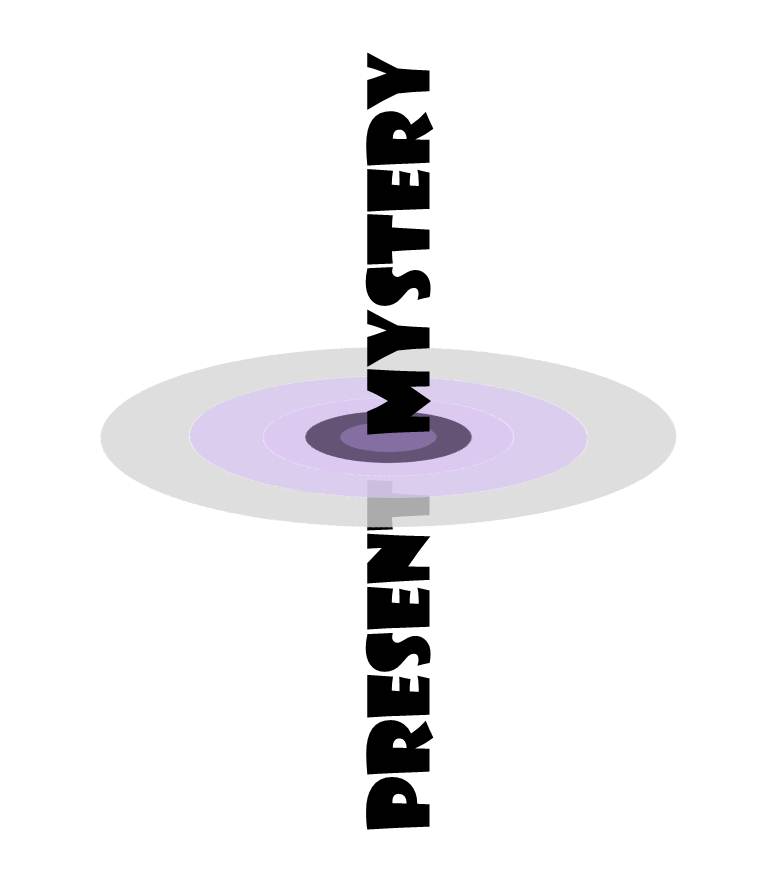
The essence of this primal experience is what we (ought to) mean by faith – the full surrender (or trust) of one’s existence to the provident support of reality. While this absolute trust might translate into a confident hope for tomorrow’s provision, the deepest truth here has to do with a present-moment uplift of what the mystics call the ground of being. This uplift is experienced in the faithful rhythms of our breath, our heartbeat, and the background hum of consciousness. Certain meditative practices assist in the centering (or contemplative) descent along an interior axis of focused attention, where the practitioner breaks into an inner space of expanded awareness, profound peace, and calm presence.

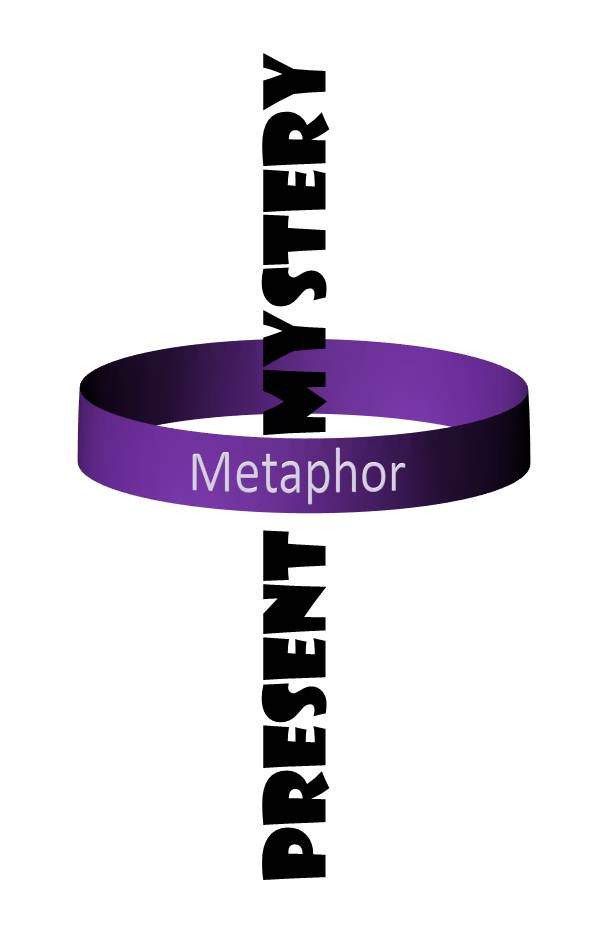
This experience of Real Presence (or present reality) transpires below the brain regions involved in language and objective thought, which makes it inherently “beyond words” or ineffable. The grounding mystery is therefore not some thing we can talk about, even though we may refer to it metaphorically as ground. At this level it is purely about the experience, not what it means. An individual “has faith” to whatever extent he or she is able to be fully present, let go of self, and sink deeply into communion with being-as-such.

Now, if this doesn’t sound anything like the religion of our churches (and temples and mosques), that’s because it isn’t. Faith and the mystical experience are the spring that brings living water to the surface of life in the world. Religion is the system of utilities that carries this spiritual refreshment and perspective into the relationships, commitments, and business of daily life. By a network of symbols, rituals, and stories, religion organizes a society and keeps it “linked back” (religare) to the provident support of the grounding mystery.

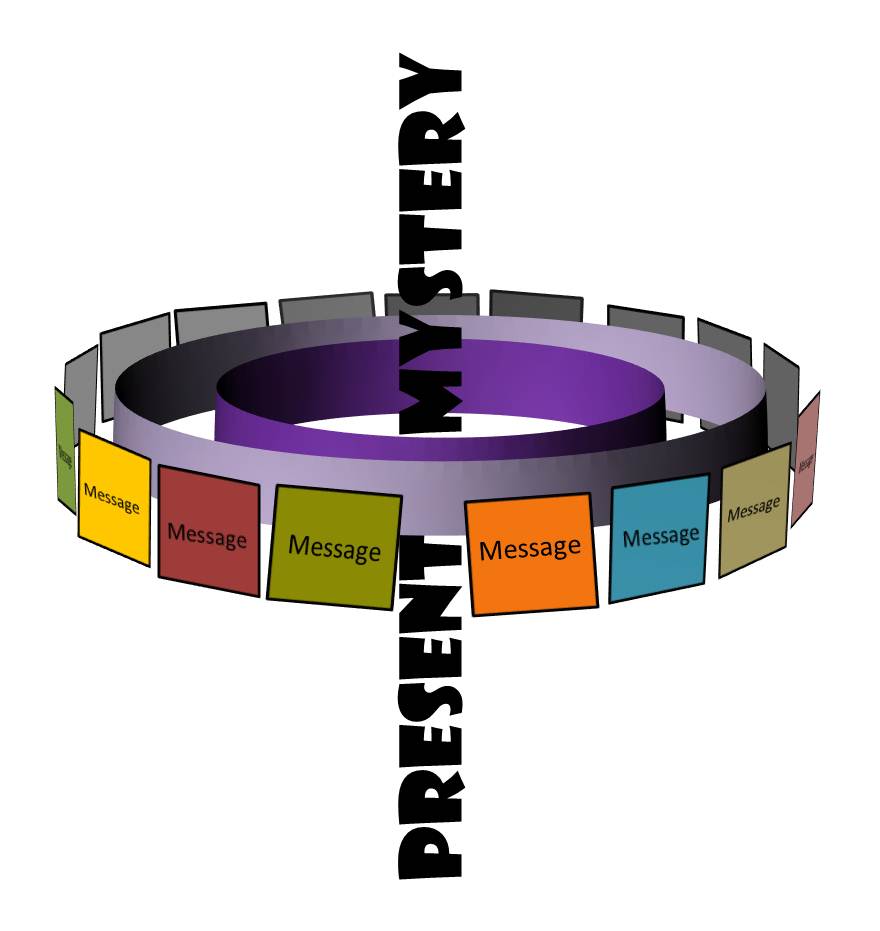
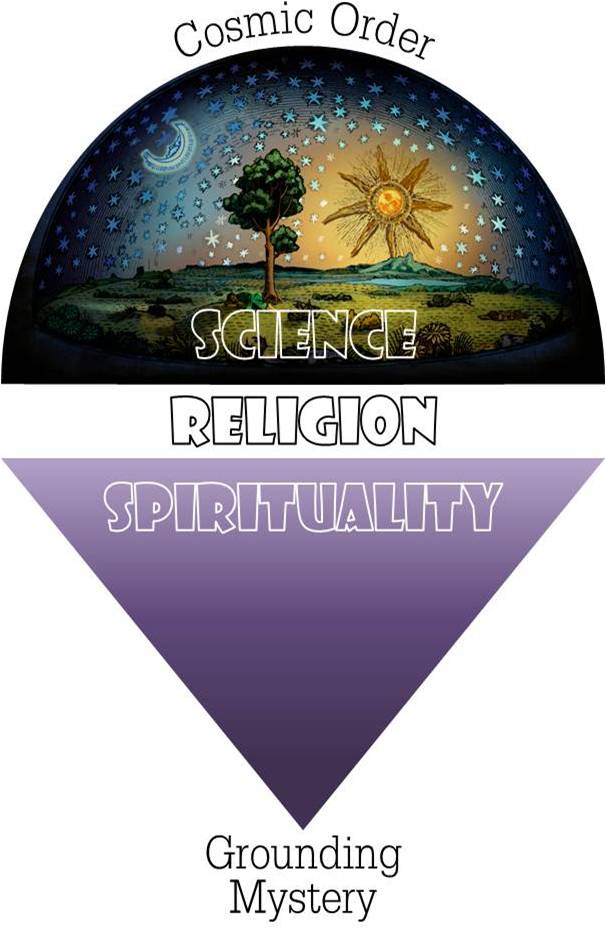
In my diagram above, a vertical line connects the faith experience and our knowledge of the universe. (Ignore for now the fact that this line is ruptured in the middle by something called belief and orthodoxy; I’ll come back to that.) An unbroken vertical connector suggests a strong link between the ineffable ground and the qualified universe – or in other words, between the silent communion of faith and the numberless distinctions (qualities) we can observe in the extended context of our environment.

This connection is the likely source of our word “universe,” which refers to the single-turning unity of everything. The very concept of universe, then, is itself an expression and representation of an insight grasped by intuition in the deep experience of faith. Its oneness isn’t evident to the senses; indeed our sense awareness is stretched across a boundless diversity of seemingly unrelated phenomena. But faith – and again, by this I mean deep and total self-surrender to communion with the present mystery of reality – confirms that all things are manifestations of the one grounding mystery. It all turns together and is essentially one.

A long time ago perhaps, the human view on reality (our sense of the universe) was like a holy picture in stained glass: the radiance of being (the grounding mystery) shone out through multiplicity of beings. Science and spirituality were the outlook and insight, respectively, of a holistic intelligence. The stories (myths) of religion were relevant narratives that nourished the communion of outer and inner life. Gods were depicted as personified agencies behind the events of nature, inviting humans into a relationship of reverence, stewardship, responsibility, wonder and celebration.

Over time and with new discoveries our understanding of the universe changed. It got bigger and more complicated, but simultaneously simpler to explain by virtue of mathematical logic and an experimental method. The inward turn of contemplative meditation continued to support our need for mystical communion and mindful balance, but advances in science placed a growing strain on the traditional stories and assumptions of religion. Religion fell behind. Under the added strain, it gripped down with stubborn insistence on the truth of its myths and consequently fell still farther behind.

Eventually, in the interest of a productive and relevant life in the world, the claims of religion were relegated to their own realm, sufficiently outside the range of evidence and practically useless to the secular concerns of society. Thus partitioned, it was left to the clerics and theologians to decide which doctrines were absolutely necessary for a successful escape from this (now fallen and sinful) world to an everlasting security in the next. These necessary doctrines were neither articles of knowledge nor genuine expressions of faith, but rather beliefs, which means that they required an emotional investment in order to carry any meaning.

To believe is to pretend that something is so, to proceed as if it is the case. Because our knowledge of the universe is and will always be incomplete and provisional, we humans frequently find ourselves in the position of having to make judgments on the basis of insufficient information.

Philosophy and science have learned the wisdom of regarding such judgments as hypotheses, explanations treated as predictions, to be tested against careful observation in the field. By checking the facts, a prediction will either be disproved or advanced for further testing. An explanation that survives such scrutiny – preferably under controlled variables and across numerous trials – is awarded the status of knowledge.

Once upon a time, the beliefs of religion did fit into our general knowledge of the universe and our place in it. But as our world-picture changed, the mythological accounts couldn’t update as quickly. Patron deities either needed to be (1) left in the past when their myths and corresponding worldview were relevant, (2) reconsidered in light of evolving knowledge and new experience, or (3) recharged by a forced allegiance to orthodoxy (“right belief,” authorized by those in control). Believe it anyway, because if you don’t, you can’t be saved.

Faith was gradually (and almost imperceptibly) redefined from the act of full surrender to the provident mystery of reality, to a set of beliefs or tenets – the “true faith” of this or that denomination. Orthodoxy became a well-defended and airtight fortress of belief. (I’ve put the word in a box above to illustrate the point.)

But whatever is airtight is also out of touch, at risk of losing currency and dying inside. What can religion do? So much has been sacrificed, so much committed for the sake of the institution and its future. To pull down the curtain and give up on the supernatural would mean “the death of god,” would it not? To re-read the myths with a sensitivity to metaphor would require us to listen deeply to the same intuitions in ourselves that first inspired our ancestors to story them forth. It might mean that we need to tell new stories, different myths, sacred narratives that are relevant to our situation today.

It might be asking too much. We shall see.

God On The Brain

I don’t typically talk much about the brain in Tracts of Revolution, where it’s more about how spirituality, religion, philosophy and science offer frequently contradictory (but possibly at some deeper level, complementary) accounts of reality. This three-pound organ and its central place in our ongoing efforts to live happy and meaningful lives is, however, my veritable obsession in another blog of mine, called Brain Tracts. Perhaps this brief excursion into the neuroscience of God will entice you to check it out.

Mental Theater

In order to beat down the grass a bit and make a path to this grand topic of God, let’s begin by talking about what your brain is doing right now. Throughout the day your brain is entertaining a series of loosely chained scenarios, as you move in and out of the various environments and situations of daily life. One of its important contributions is the faithful representation inside your mental theater of what’s going on outside and around you. As you drive your car on the road, sit behind your desk at work or school, or engage a conversation with friends, your brain attends to (or bends toward) the stimuli coming across its sensory outposts – the classic five (or so) gross senses of your body.

Gathering together these numerous strands of sensory information, your brain projects this composite representation on the screen of your conscious awareness. Whether it’s an apparently seamless and dynamic movie unfolding there or a “still shot” of something you are studying with concentrated effort, the focus of your attention is your mental object. As it flashes up there on the screen inside your mental theater, it is only information. In my attempt to make it as uninteresting and impersonal as possible, I will simply name it: “IT.” IT is what you are focusing on right now.

Now, your brain isn’t just a fancy mechanism for collecting and processing sensory information from the environment – although that in and of itself is pretty amazing indeed. Your mental object might instead be something you are recalling from yesterday or five years ago; or again, IT might be something you’re making up on the fly, as it were, by the wonder-working power of imagination. Perception, recollection, and imagination are thus the three channels by which your brain brings your mental object (IT) to the screen of present attention.

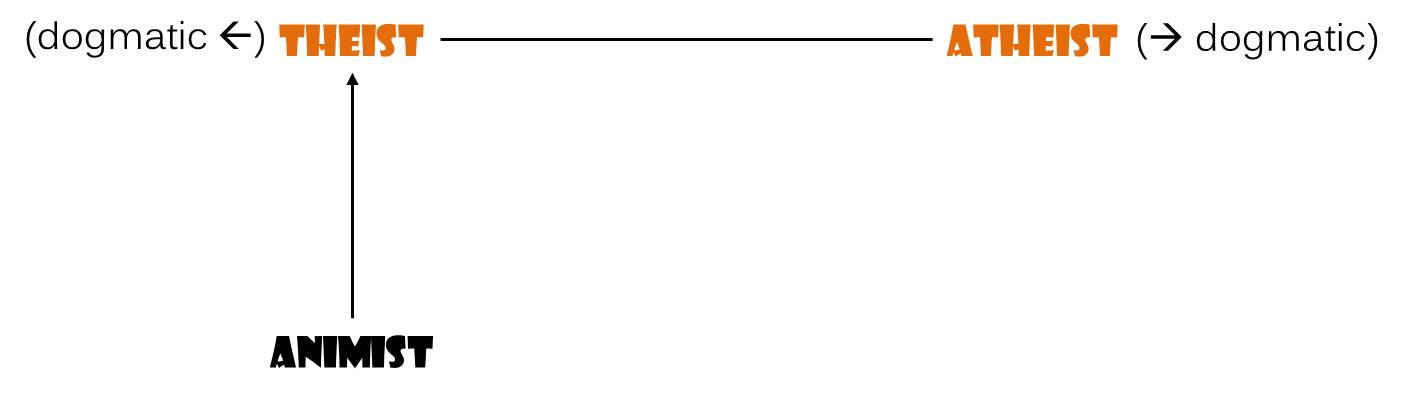
The debate between theism and atheism over the existence of God gets predictably hung up at this point, with one side (the atheists) refuting it on the claim that this particular mental object has no basis in the sensory-physical realm of our senses and was simply made up (imagined) by superstitious storytellers. Theists will typically counter by appealing to sacred writings that record and inerrantly preserve the actual (miraculous, supernatural) experiences of people many centuries ago. The responsibility of faith today is to trust these accounts as a reliable witness to the objective truth of God’s existence.

In my opinion, this debate is tired, boring, and pointless. The theists are misreading their sacred texts by taking the stories of God literally, and the atheists are playing right into it by taking the theists literally. For a way through the stalemate, we need to go back to the brain.

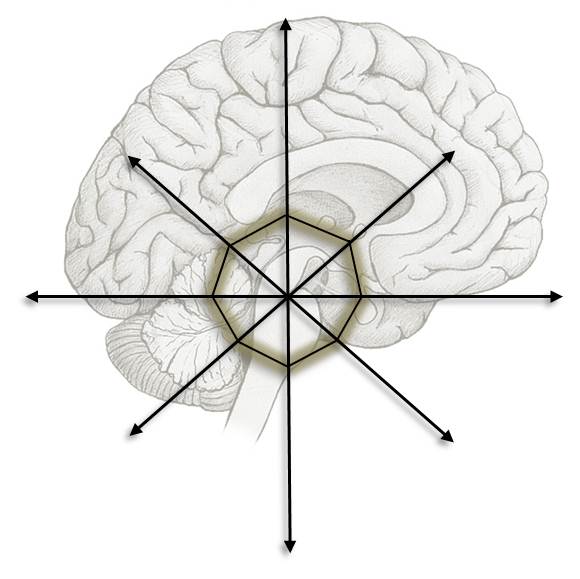
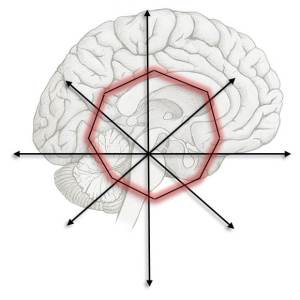
Lower BraintractYour brain is “wired” into your body through a complex nervous system that reaches out to your muscles, organs, glands, tissues and cells. I call this a braintract – specifically your lower braintract, since you have an upper one as well (which we’ll get to in a bit). With brain-imaging technology and carefully controlled experiments, neuroscience has discovered that your brain is constantly monitoring the stream of experience flowing below the threshold of conscious attention. This spontaneous engagement with the stream of experience is called intuition (or at least that’s what I’m calling it), and it’s where your brain is “picking up” all kinds of subtle impressions of what’s really going on.

Of course, “stream of experience” is only a metaphor – although I hasten to add that the word only here should not be taken to mean merely or nothing but a metaphor. Metaphors are image-words used to convey something that cannot be grasped in objective terms. Many of our most powerful experiences in life are of things that have no separate existence of their own but are nonetheless real to us by virtue of the unmistakable and frequently overwhelming feelings they evoke. Any attempt to extract such metaphors from the moving stream of experience and strip them of feeling ends up destroying them along with the connection to reality they provided.

I have argued that religion began as a way of contemplating the present mystery of reality. Its deepest and earliest metaphor is the ground of being – the providential support and creative source on which all depends, moment to moment. The feeling of this ground is registered in your nervous system, generated out of a syndrome of countless synchronized events transpiring in your cells, glands and organs. The present mystery of reality is grasped intuitively and “known” spontaneously in the rhythms of your breath, your heartbeat, and the nerve cycles of consciousness.

Religion thus began with a metaphor that conveyed a profound and essentially ineffable experience of reality as the rising support of being-itself. Quickly enough – for the next task of religion is to tie the concerns of daily life back to this deeper support – it further clarified the ground metaphor into the natural incarnations known intimately by every newborn mammal: mother and (to a lesser extent) father. The earliest representations in religion of the present mystery of reality were the generative provision of Mother Earth and the supervisory protection of Father Sky (or heavenly Father) – both archetypes (or “first forms”) of the grounding mystery.

It’s important to understand that these primordial representations (and earliest mental objects) of reality were not of a being in the earth and another being in the sky. As archetypes of the ineffable mystery of being-itself (i.e., the ground metaphor), they translated a deeply intuitive experience and established a relationship to reality that acknowledged our natural dependency and communion with the universe.

Upper Braintract

So far my theory explains the origins of our concept of God, beginning in the spontaneous engagement with the stream of present (and preconscious) experience. This intuition of reality as provident support and creative source was first grasped and communicated in the ground-of-being metaphor, but pretty quickly got translated into the specific incarnations of Mother and Father – and by extension, Mother Earth and Father Sky.

Once your brain fastens the focus of attention on a mental object, it sends this information via your upper braintract to your mind where its meaning will be determined. Your two braintracts are constantly working in parallel, with the lower braintract (your body) converting the information in your brain (the mental object) into an energy-state of feeling, and the upper braintract (your mind) translating it into a narrative composition (story) of meaning. Your mind is a storyteller and perpetually busy constructing narratives around your mental object, which serve to frame a context, establish causality, project possible scenarios, predict outcomes, and generally link the mental object into a web of associations that makes it mean something.

Storytelling is recursive elaboration on a mental object, or what is commonly called reflection: the bending-back of your mind on a work-in-progress, weaving strands of identification and significance around it, like a spider bundling up a trapped fly in sticky fibers. As the mind cannot help but construct meaning when your brain presents it with a mental object, telling stories (including theories, hypotheses, explanations, reports, excuses and lies) is its primary business.

Coming back to religion and its concept of God, this business of storytelling is how humans make sense of their experience and link everything back (Latin religare) to the grounding mystery. Yes, this is mythology – not fallacies, deceptive tales, or bad science, but dramatic narratives connecting our life-world and daily concerns to the provident reality supporting and supplying our existence in this moment. The many deities of religion are personifications of hidden agencies in the rhythms of life and death, the landscape and its resources, the seasons and catastrophes that shape our experience in the world.

The danger of telling stories about the gods (these hidden agencies) is in our mind’s need to perform further recursive elaboration on these elaborations – constructing the god’s genealogy and sibling relations, reputation and character, sovereign will and inner thoughts – all of which may encourage the belief in his or her separate existence. As the archetypes of Mother Earth and Father Sky reproduced into the countless offspring deities of the regional and tribal myths, the actual origins of God were forgotten and the literary gods became literal beings. The stage was thereby set for the theist-atheist debate. Who’s right? Neither one.

Braintracts_full pic

If – and I grant this is a BIG if – we can look through our deities, descend along the winding path of our sacred stories and deeper into the intuitive experience that got everything started, we will be able to relax our grip and loosen up. It all began with the waking of consciousness to the provident uplift of life in this moment. You’ve never left it, despite your long and tired journey in its quest.

One day you will close your eyes and unwind completely into a mystery beyond name and form.


Becoming Human

The challenge for religion today – one of its many challenges – is to offer an understanding of the human being that is relevant to contemporary life, compatible with our present model of reality, prescient of where our evolution as a species may be leading, and in deep agreement with that stream of enduring insights concerning the fundamental nature of things which Aldous Huxley called the perennial philosophy.

In actual fact, however, religion – particularly so-called popular religion – is failing us on all four points. It is increasingly losing currency as a way of providing real guidance for today, locked in a stalemate between complacency and terrorism. In one of the supposedly more advanced societies, courts are jammed by legal efforts to throw aside scientific theory for biblical myth in deciding what our children should be taught in school.

As far as a vision for the future is concerned, popular religion is exploiting our inherent insecurity as a species by promising true believers a final escape from this corrupt world. And many of the deep discoveries of our long adventure have been all but forgotten if not rejected outright as myth, magic and New Age. Instead of discovery, which involves a process of looking deeply into things, religion today campaigns for truth as revelation from above and outside of things.

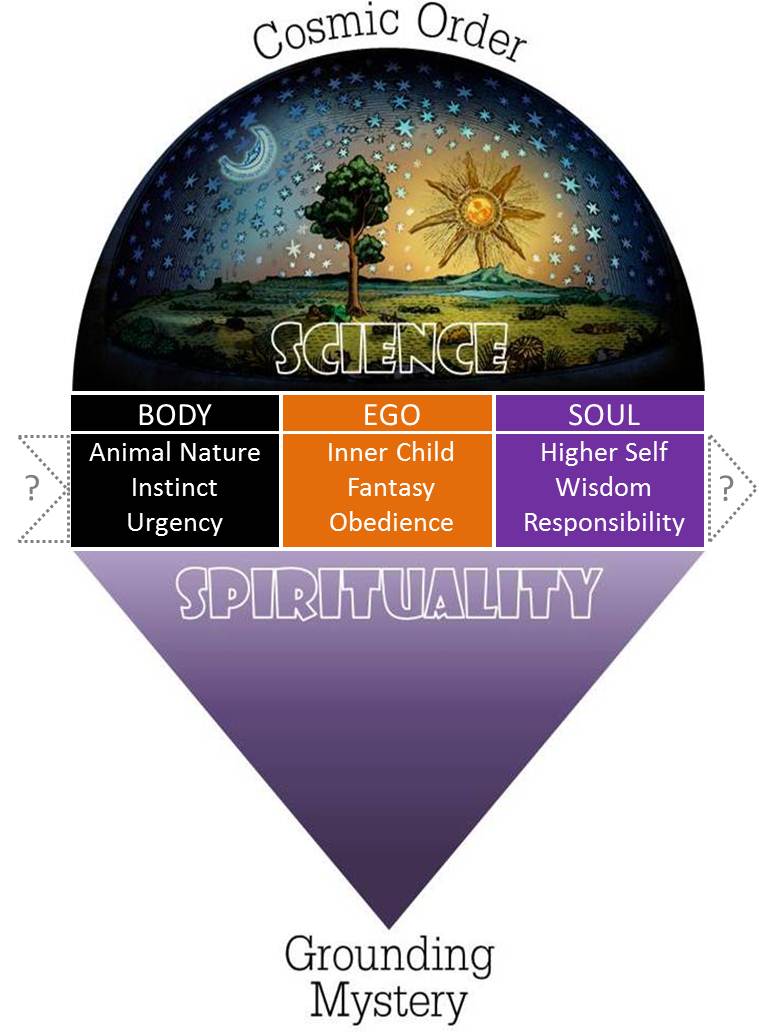
My efforts aren’t the last word, obviously. But they are dedicated to the task of continuing our human quest with these four frontiers in mind – daily life, our model of reality, the human future, and that fund of deeper insights carried across the cultures and millenniums of our collective history. Just because I challenge traditional notions of god, truth, immortality and salvation, it’s probably easy for someone to conclude that I must be an enemy of religion, when in fact I am one of its outspoken advocates. Not of this or that religion, but of religion as the system of sentiments, theories, ideals, values and practices which link us back (religare) to the present mystery of reality.B_E_SThe illustration above provides a way around our current impasse, where much of popular religion holds the human spirit hostage to outdated ideas, long-abandoned worldviews, and adolescent moralities of reward and punishment. My diagram is intended to be interpreted dynamically rather than statically; that is to say, as representing the progressive transformation of human beings over time, instead of a snapshot of what we are and always have been.

We know that individual human beings develop as they mature, but their development might not result in maturity. It often happens that development gets arrested around neurotic fixations and emotional attachments, holding back at least part of the personality in “infantile” or “adolescent” attitudes and mindsets.

We can, of course, use this same lens to appreciate where entire societies and cultural systems get hung up and held back as well. Real problems come when this arrested development degenerates into a pathology of profound insecurity and holy conviction, producing a readiness (even eagerness) to kill and die for the truth in our possession. When we are prepared to trash this world for the sake of a better one elsewhere – whether it be the suburbs, a neighboring planet, or heaven after we die – we carry the principle of destruction inside ourselves. It’s only a matter of time before we turn this paradise into ashes and need to move on to the next promised land.

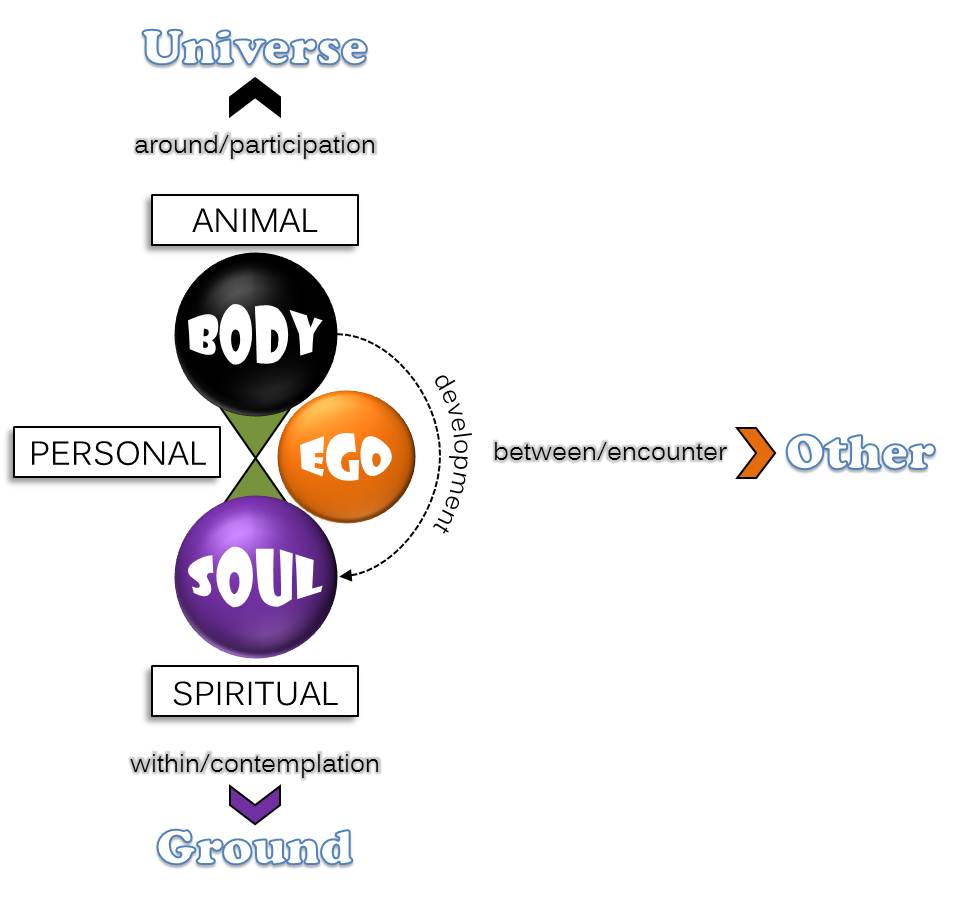
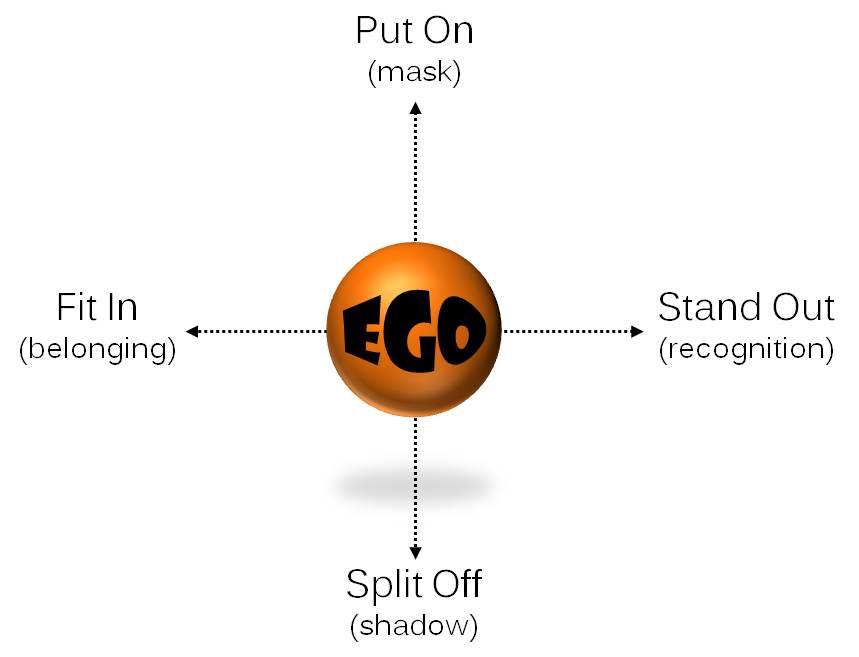
Across the horizontal axis of my diagram is a depiction of the sequence by which human individuals and cultures develop. Going up along the vertical axis are three centers of consciousness and the rising transcendence of distinct stages that provide different perspectives on reality. These mental locations of awareness engage peculiar sets of concerns, values and aims. As we evolve from one stage to the next, the task is to carry forward and upward our gains in development, integrating them somehow in a holistic and meaningful vision of human destiny. Let’s take these centers and stages one at a time and see where this fit-and-flow design can lead, but also where it has gone bad.

A human being is a biological organism, a complex organization of molecules, cells, tissues and organs conspiring together in a pulsing symphony of life. The deep history of this symphony stretches into a pre-human past, modifying along the way a basic template by adapting it to changing conditions of its environment. This is our animal nature, compelled by instinct and guided by reflex to seek out niches of safety, resource, and opportunity over the long course of many millions of years. As a providential arrangement of protoplasm and vital urges, our body is carnal (flesh) and incarnates the energy of magnetism, matter, and light.

The body is our mental location in the natural realm, with a set of concerns, values, and aims organized around the singular priority of survival. Our most powerful instincts are dedicated to keeping us alive, bonding us to our group, and passing our genes into the next generation. Thankfully the fulfillment of this survival mandate hasn’t required much careful consideration and deliberate choice; unconscious drives simply get it done.

Whatever number of decades brings you back to early childhood, an exponential factor of that time span suggests a distant era when our species was beginning to transcend mere survival concerns in the interest of functioning cohesively as a tribe. Successful reproduction presents us with the challenge of raising children in a social context, in such a way that our offspring eventually can assume identities compliant with the pressing needs and occupational roles of the group. Through this process of socialization, an animal nature is disciplined into a personal ego – into a person with a separate and special identity, but still “one of us.”

As the next-higher mental location of consciousness, ego provides a perspective on the landscape of cultural meaning, consisting of the artifacts, traditions, assumptions and conventions that support a sacred canopy called a worldview. Personal identity is thus a socially constructed point of reference where consciousness is shaped and bent upon itself as self-consciousness, reflecting back on the individual an image of “who we are.” The dutiful ego is expected to do its part, promote the values of the tribe, and contribute meaningfully to the commonwealth.

A culture’s sacred canopy is woven of narrative threads called stories. They are not simply reports of fact – what would the point of that be? – but imaginative representations and entertaining plots (from the Greek mythos) that serve to articulate a cross-referencing web of significance. The productive power of this web is fantasy, the very same power that pretended and animated your world as a child. Fantasy is not a weak attempt to describe reality as we see it; rather it is a literally fantastic project in meaning-making, constructing a habitat for the mind. I call the part of our personality responsible for the ongoing defense and repair of our worlds, the inner child. It is spontaneous, playful, and dependent on the support of others; but it can also be neurotic, insecure, and prone to tantrums.

Now, I would say that the form of popular religion summarized at the start is stuck exactly here – at the stage of development where humans are heavily invested in the identity project of ego. Just as your inner child operates according to a model of reality perhaps decades out of date, many present-day religions are still trying to manage meaning inside a worldview thousands of years old and equally outmoded. We need to engage the present reality of our situation, but it’s like performing brain surgery with a paleolithic flint chip.

Jesus, the Buddha, and others have tried to help us see that the source of our suffering is self-preoccupation – the emotional cravings and dogmatic convictions that disable us spiritually. We cannot really know freedom, love, and truth until we learn to let go, open up, and reconnect in more creative ways.

Transcending ego brings us to the mental location of soul, where “me and mine” no longer entrance us. I am of the opinion that this higher self of the soul is a distinguishing mark of maturity. It is not about identity or even meaning. Soul doesn’t fuss with the question “Who am I?” but rather seeks authentic life beyond the masks we wear. It is our spiritual self – the creative spirit in us that contemplates the mystery, celebrates life, and consecrates the precious value of each passing moment. Whereas ego separates us from reality by its veil of meaning, soul reaches through the veil to realize oneness with (communion) all things.

The set of concerns, values, and aims organized around this priority of communion constitutes what is meant by wisdom. Instead of the urgency of survival or the project of identity, wisdom is about living in view of the ever-expanding context of daily life. We make choices and take action, the consequences of which ripple out into our relationships, leach into the soil and water, choke the atmosphere and threaten life. These rippling rings of effects and side-effects should be evidence enough that we are not separate from anything but rather one with everything.

And so, becoming fully human is a destiny still calling to us from the other side of meaning.

Edge Religion

By definition religion is a force for social cohesion. In “linking back” (religare) the many divergent concerns of daily life to a metaphor of ultimate reality, it provides a system of values and constraints that serves to hold a community together. This metaphor isn’t just a name for something already known objectively, but is the vehicle of language that first names the mystery and represents it, locating it amidst and beyond the necessary activities of everyday experience. It is what we call God.

In this view, God (the unnamed mystery) isn’t something that comes to us from somewhere else, even if god (the metaphor) might well encourage the assumption. Whenever we talk about something, we understandably assume that there is some thing we’re talking about. Our talking about it makes this thing better known to our minds. By qualifying and explaining it, we are as it were throwing a net of definition around it and bringing it closer to us. The mystery with which religion is (or at least originally was) chiefly concerned, however, is not a mysterious object to be explained and thereby rendered meaningful. It is rather the deep support and radiant presence of reality felt in the providential uplift of conscious being, of life in this moment.

The God-metaphor, then, or what I simply refer to as “god” (with a lowercase ‘g’), is a product of our imagination, a reflex of the mind to put labels on reality, push it into the distance where we can regard it as “this” or “that,” and then grasp it as an object of understanding. As metaphor (from meta + phorein, to carry across), our representation of God facilitates the experience of mystery across the threshold and into the web of language, where it can be expressed as meaning. Further articulation of meaning is accomplished through the media of art and story, where the metaphor takes on dimension and weight, opening up various ritual ways for us to link daily life back to the present mystery of reality.

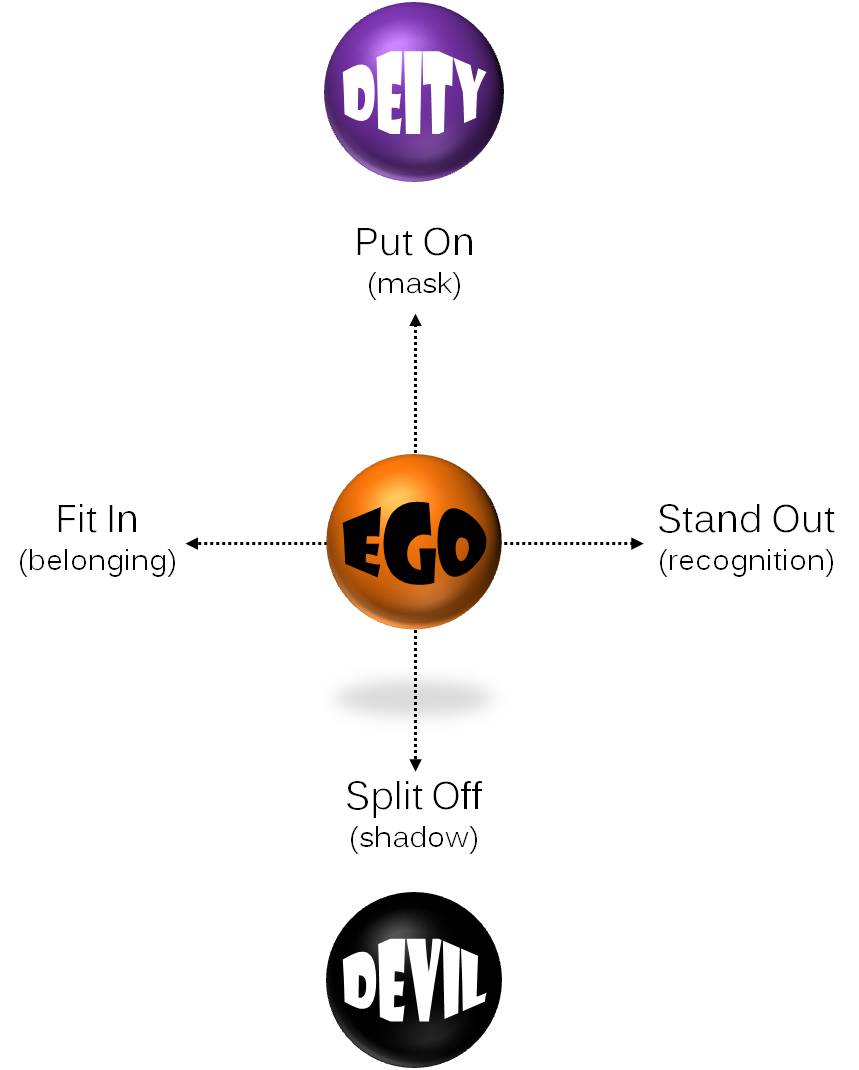
So now we can add to our starting definition of religion as the link-back of everyday concerns to a metaphor of ultimate reality, by saying that this is primarily a ritual (ceremonial, sacramental, liturgical) system of social behaviors. In coordinating tribal life in this fashion around a metaphorical representation of the present mystery, social cohesion is successfully maintained. And because it is designed to bring individuals into agreement over their shared identity and specialized responsibilities to the group, I will call this form of religion “conventional theism” (from theos, god with a lowercase ‘g’). It’s been around for many, many thousands of years, and is still the dominant form of religion in our day.Conventional TheismThe illustration above provides a way of understanding conventional theism as coordinating the hearts and minds of individuals, and individuals with the larger group, around the orthodox representation of God (or god). I don’t mean for the balloon with the word “deity” imprinted on it to be taken as a lampoon, but merely to pick up on the point made earlier, that god arises out of the metaphorical imagination and is eventually (if it gains widespread agreement) tethered to the frame of community life as the focus of worship and belief.

Insofar as the deity is made in our image – that is to say, in a way that reflects back to us the personality traits, character strengths, and waking virtues of our own higher nature – it serves to inspire us to life above our animal instincts and juvenile impulses. As we contemplate in our minds and glorify with our hearts this chosen metaphor of God, it represents to us a better part of ourselves that is to some extent still in our developmental future.

Yahweh’s career across the time arc of the Bible demonstrates this dynamic perfectly, beginning as a warrior deity to a band of near-eastern nomadic tribes; taking his place as Lord and Creator in the era of national settlement; reaching out in compassion to the poor and marginalized during the downfall of King David’s dynasty; and resolving at last – around the time of Jesus but most clearly in the life and teaching of the Nazarene – to lift the curse of guilt from his enemies by a unilateral and unconditional forgiveness. If you should put early-Yahweh and late-Yahweh side by side, you would have to conclude that the two were different gods – so great was the evolutionary distance traveled by his community of faith over the course of centuries.

Such an evolutionary view of religion, tracking the developing metaphor of God as a reflection of our spiritual awakening and moral progress in community, must beg the question: Does a time come when the metaphor has served its purpose and is no longer needed? Are there more “mature” approaches to the mystery and our own life adventure, which could help religion stay current with our evolving spirituality? I suggest there are, and even now some forms of conventional theism are beginning to invite these voices of what I call “edge religion” into the conversation.ReligionAnd so I will make yet another appeal on behalf of post-theism – not as an alternative to theism, but rather its natural fulfillment as a system for social cohesion and spiritual guidance. By definition, post-theism explores the frontiers of faith development “outside the box” of conventional religion, but without abandoning the box and trashing its patron deity. The structural support and moral orientation provided by conventional theism is, I will argue, still important and necessary to the formation of faith as individuals (especially the very young) are in the process of having their identities constructed in community with others.

But there comes a time when, for many, the conventional representation of God becomes too small, too confined by doctrines, and increasingly irrelevant to daily life. These are folks who typically begin asking questions and challenging the usual answers inside the box. They are searching for a spiritually grounded way of being in the world, one that can help them continue to evolve in their faith. They aren’t interested in disputing the existence of god, and more of them today are refusing to be converted back to the religion of their youth. Consequently they wander outside the box foraging for spiritual sustenance, sometimes feeling guilty for wanting more (or something else), and often struggling with the loneliness of no longer having a community.

But there is hope. As I said, some theistic religions and denominations are providing space for these “edge dwellers” – and they have something of great value to contribute. Basically they come in two varieties, and it’s not unusual to find both strains of post-theism in the same individual. They represent the mystical and ethical edges of conventional religion, although they have no interest in merely recovering that familiar warm feeling in worship or sifting through the commentaries of church doctrine. They bring tools.

Let’s recall the significance of that balloon tethered to the frame of conventional theism. It is the preferred metaphor of God, the orthodox representation of the present mystery within and all around us. It calls to us – reminding us of who we are, where we belong, how we should behave, and why we are here. But when (not if) the individual’s spiritual capacity and depth of experience is no longer promoted by the god we all know, something needs to be done with that balloon.

Those post-theists who are mystically oriented wield the tool of a straight pin. They help us to realize – on the likely chance we have forgotten – that our representations of God are constructs of our minds, a convenience of language in providing handles on reality. These metaphors are not simply labels affixed to a literal being “out there” and separate from us, but rather spring from the inner life of the soul where we rest in the provident mystery of Life itself. Popping the balloon is not intended as sacrilege or “atheism”; it is what’s required if we are to experience the ineffable presence, the unnamed and unnameable ground of Being.

Ethically oriented post-theists are often motivated out of a concern that the so-called “will of God” has become too predictable, too much an endorsement of our petty ambitions and self-serving moralities. They bring scissors. By snipping the balloon string, these revolutionaries want to return freedom, unbounded generosity, and creative license to our metaphor of God, which means that we need to release our patron deity into the infinite sky, into the God beyond god. Only when God is no longer “our god” will religion be able to reach out to the stranger, love the enemy, and include everyone without judgment but rather in celebration of community.

We will never be without religion. However religion will be without more and more of us until it welcomes those on the edge and listens to what they have to say.

Contents Under Pressure

Religion

The phenomenon of religion has evolved with the rise of human culture, perhaps going back millions of years to our hominid ancestors. Its function has always been to “link together” (religare) the separate concerns and activities of daily life in a coherent way by orienting it all around a single transcendent focus. “Transcendent” here doesn’t necessarily mean supernatural or metaphysical, but simply above and beyond the field of temporal attachments.

Theism is the standard and conventional form of religion, as it coordinates tribal life around a metaphor representing the provident power(s) behind the world as we know it. As a constructivist, I hasten to add that the so-called “world as we know it” is really a construction of our own minds – not the given sensory-physical realm outside us, but the layers of value, meaning, and significance that we weave around it. Like spiders we spin our web of language across the universe and call it home.

The deity of theism – an agency of intelligence, personality, and will that might be represented in any number of human or nonhuman forms – is how religion depicts the provident power(s) on which our lives depend. Instead of being revealed to us through the clouds, as someone coming to religion from outside might assume, this deity is actually a kind of creative reflex of the mythic imagination. The many stories (myths) that together form the narrative fabric of human meaning (our worldview) are not eye-witness reports of supernatural encounters, but rather poetic-literary portrayals of the present mystery that gives us life, supplies our need, and receives our last breath.

As societies grew larger and more complex, the tribal practice of reciting traditional stories and ritually participating in the life of god required institutional support. Certain individuals were elevated to positions of honor and authority by virtue of their familiarity with the deity. Or perhaps it was the other way around: individuals with social clout and community influence took on the mantle of high priest and presented themselves as ordained mediators between god and the people. As the sacrament of storytelling and ritual enactment became difficult to manage for a growing population, it was found that community agreement could be more efficiently achieved by converting this sacramental experience of god into a system of orthodox beliefs about god.

My illustration above intends to show how, with the addition of an authority structure and an “official” orthodoxy, religion gradually pushed the providential metaphor of the deity out of its literary habitat (as the principal figure of sacred story), into a supernatural space outside the world, and farther away from the relevant concerns of daily life.

And this is where we are today – arguing over whose deity is the one-and-only, trashing the earth, suppressing freedom and creativity, and thrusting our species to the embattled edge of oblivion. But don’t worry, if you’re on the right side your soul will be safely delivered to a better place far away.

So whereas once upon a time religion could do its job by connecting individuals to one another in community and anchoring the community to a reality celebrated as provident, it slowly but surely removed its members from communion with the Real Presence of mystery and became instead a tinderbox of spiritual frustration, small thinking, moral regression, and redemptive violence.

In the meantime this dysfunctional religion invented its own myth – now no longer in the traditional sense of a sacred story grounding us in a provident reality, but rather a narrative deception about our human fall from grace and into the hopeless condition of sin. The consequent “gap” between earth and heaven, nature and supernature, human and divine is characterized by rampant depravity and ignorance, veritably crying out for the authority and orthodoxy that religion itself provides.

The earth, our bodies (particularly woman’s) and our life in time were reconstructed in this myth as fallen, corrupt, and condemned – unless saved (purified, separated, and redeemed) according to the prescription laid out in holy doctrine. If the times happen to be especially stressed and insecure (as they appear to be now), the program of salvation becomes an emergency exit from a world believed to be in the process of irreversible collapse. Over a matter of just 3,000 years or so, religion invented a myth of estrangement where humans are fated to perdition without the saving intervention of “the one true faith.”

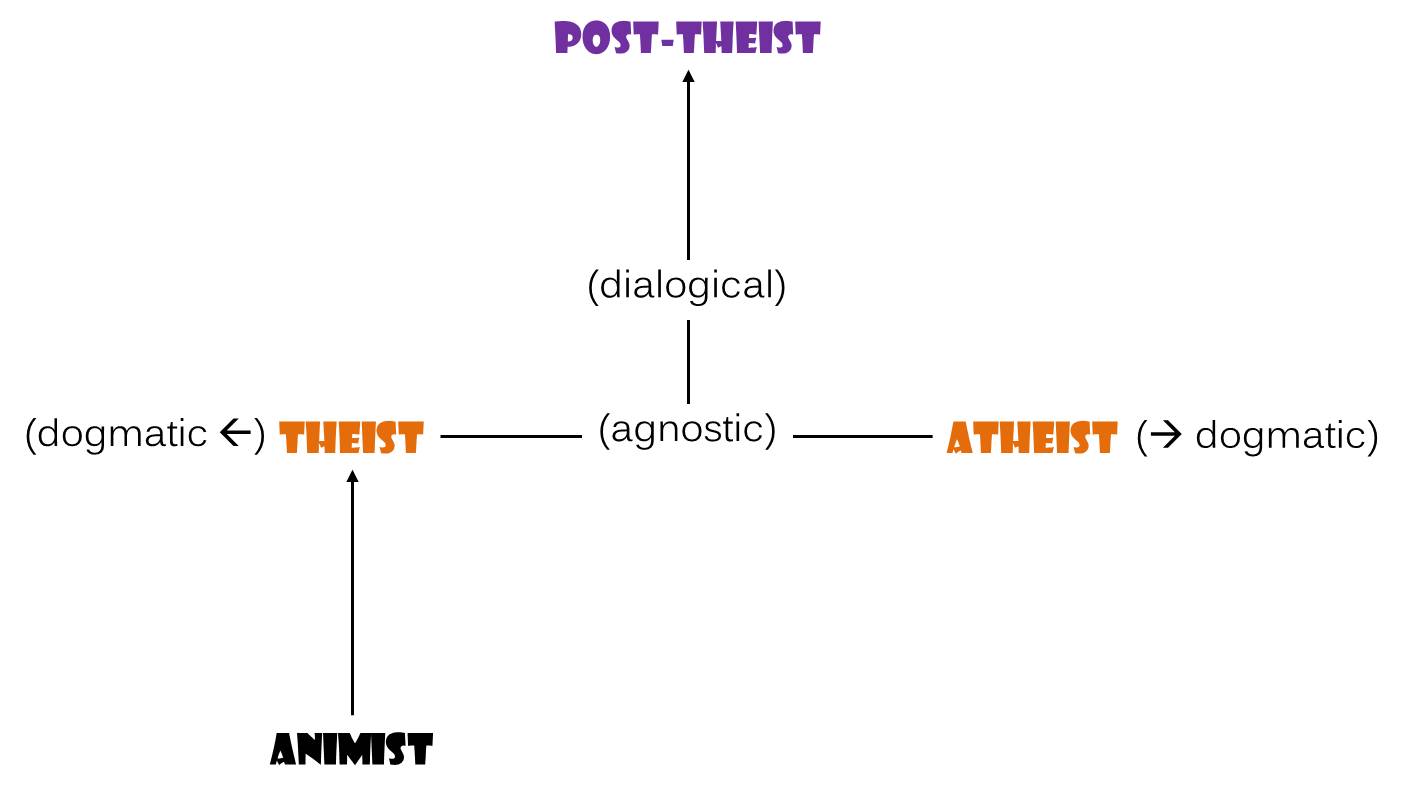
As a counter-voice of sanity, a growing number have been calling for the dismantling of theism, insisting that belief in god at this advanced stage in our history is not only unnecessary, but irresponsible. And not just irresponsible, but intellectually and morally backwards. While “atheist” used to be a label for one who refutes the existence of (a) god, it evolved over time into an outspoken defiance of god out of allegiance to human values. Today atheists join hands in solidarity against the abuses of religion, leaving its god to exist or not exist as a matter of indifference.

In my defense of post-theism, I have frequently heard from conventional theists and atheists alike that my position is just a convoluted form of atheism. I’m really a closet atheist but just afraid to admit it to myself. To suggest that the mythological gods of religion are literary figures (in story) and not literal beings (in reality) is effectively denying the existence of god, is it not?

Actually, the “after god” of post-theism is very different from the “no god” of atheism. While atheism commits itself to arguing against the literal existence of god (or living as if it doesn’t matter), post-theism regards the literary existence and mythological career of the deity as highly relevant to an understanding of our evolution as a species.The literary deity inspires us, calls to us, and places demands on us in order to actualize what is presently dormant, unacknowledged, or repressed in us.

Yahweh, the biblical god of Jews and Christians, does not have to be real to be important. To say that Yahweh never spoke the universe into being, parted water, or raised Jesus from the dead in any kind of (as we might say) scientific-objective sense might sound as if I’m refuting his existence and seeking to undermine the religions founded on these doctrines – but I’m not. The literal existence of Yahweh is literally beside the point and outside the plot (mythos) where his truth as metaphor is found.

As a constructivist I regard every picture of reality, even the scientific one, as a construct of our minds. Religious myths and scientific theories are merely two kinds of storytelling, the one (science) weaving narratives that explain the physical universe confronting our senses, as the other (religion) does its composing out of a more internal intuition of the present mystery that sustains us. Science joined the conversation around the campfire quite late, when religion had already been about the business of myth-making for many thousands of years. Its more detached and mathematical approach to things did in fact compete with religion’s sacred fictions of fabulous characters and miraculous deeds, convincing a growing number to abandon these tales as so much primitive superstition.

In the illustration above, the entire institution of religion rests on a foundation of spiritual experience – what I call the experience of mystery or the present mystery of reality. We are in this stream (a better metaphor than foundation, which suggests something fixed and unchanging) all the time, but we can only be aware of it now, in this very moment, for in the next moment this mystery will present itself to us afresh. Out of this experience of Real Presence, along with an exquisite awareness that it sustains us providentially in this moment, arise the metaphors of the mythic imagination.

The deity is born, and just as suddenly we find ourselves engaged in a dialogue with the primordial support and deeper intention of our existence. Post-theism is the contemplation of what’s next (“post”), as we continue to grow Godward.

Live Like You Are Dying

Let me start out by saying that I have a friend who is struggling with mortality. I have several friends, actually. One thing we all have in common is that we are getting older, and as we get older we are growing more aware of the Dark Gate just over the horizon. Once you realize that your sand won’t ever go back up the hour glass, some serious reckoning is in order. This happens to be terrifying my friend at the moment.

If I can’t make new friends as I go along, my present company will slide intractably down the gradient of entropy and eventually there will be none of us left. Perhaps some day in the still more distant future someone will stroll by my gravestone, or a descendant might stumble across my name while researching our family tree. Where will I be at that time?

Long, long ago an answer to this question was that I somehow carry on in a shadowland of departed souls. Importantly, “soul” back then didn’t refer to a resident ghost that inhabited a body for a time but afterward continued to live apart from it. Soul was more like an animating force – fluid, dynamic, breath-like – than a nonphysical entity.

We can only imagine what went through the minds of primal human beings (perhaps our hominid ancestors) as they gathered around the corpse of a friend or family member. What had just hours before been breathing and talking and living like the rest of us, is now ashen and rigid. Where did that center of affect and agency – that unique personality we knew and loved – go?

paleolithic grave

The primitive practice of burial was probably motivated out of concern for sanitation, odor control, and hiding remains from scavenging animals, but there may have been an element of reverence as well. The mystery surrounding this once-living personality was not to be casually dismissed. Some kind of subterranean extension of the burial hole was envisioned, where all deceased members of the community somehow “live on.” As far as the archaeological record suggests, this seems to have been an acceptable (and widespread) belief, sufficient to allow the folks above ground to carry on with the demands of daily life.

Fast-forward many centuries, and now the postmortem status of the departed personality might be one of three possibilities depending on how important, virtuous, or depraved a person was during earthly life. Good people were taken up into heaven for their reward, bad people were condemned and thrown into hell, while the average and “undecided” cases persisted in something like the old shadowland, but understood as a transitory waiting room, not a final destination. Of course, to be “taken up,” “thrown down,” or tabled for later discussion presumes the existence of someone who executes this action, which is what we eventually find in the pantheon of deities throughout the higher cultures.

We really need to explore what could be called the “archaeology of human psychology” to understand the mechanism responsible for this rather dramatic shift in theories of postmortem existence. What we see over the intervening centuries (10,000-1,500 BCE) is the gradual but steady rise of ego consciousness – the ascent out of tribal sympathies of a separate sense of oneself as an individual. This important separation of the individual ego from the group continued on an earlier separation of the group from the earth, as the maintenance of society began to require more human energy and attention. Specifically what it did with respect to the topic at hand is encourage a notion that I (ego) am separate from my body.

Death of the body, at this later stage of development, didn’t pull a personality into the shadowland (as in primitive thought), but was increasingly regarded as a “disencumbrance” of mortality – getting rid of or being set free from the bag of meat that snags us in time and would otherwise drag us to a dreadful end.

heavenAs religion began to reconstruct itself around the death anxiety of the ego, traditional commitments of keeping communal life in rhythm with the cycles of nature were given up in favor of a program for saving the soul from the ravages of time – safe forever with god and other believers in heaven. This program not surprisingly included strong sanctions against “carnal” desire and the pursuit of pleasure for pleasure’s sake; such was the way of woman and the devil. The soul – which by now had become essentially synonymous with the ego personality – must be kept pure or “cleansed” of its attachment to the body through repression and ascetic practices.

Consequently we have inherited these two horns of my friend’s dilemma: Either we blink, wake up in heaven and are happy ever after, or we rot in the ground with the worms. Which one do you want? Religion is betting on (and abetting) your fantasy of living forever.

But this dilemma does not exhaust our choices. In actuality there is no choice. I will die, and so will you. All evidence strongly suggests that your last day on earth is your last day, period. So is this a vote for the worms? When my body starts to lose its peripheral functions, the decline has begun; when its rudimentary functions fizzle out, I’m done. Is accepting this an act of existential resignation? If my death is the end of me, does it mean that nothing matters and there’s no point in caring about anything?

My admittedly over-simplified tour through ten thousand years of religion’s changing opinion on this question of mortality and the afterlife was for the purpose of showing that the escalating anxiety around death is actually a product (or more precisely a by-product) of religion’s steady hijacking by the neurotically insecure (separate, exposed, estranged, trapped and “fallen”) ego. The seduction was slow, but over time ego became the orthodox impostor of the soul, now immortalized and destined for disembodied bliss (or perdition unless you get your act together) somewhere else.

Because it is so obvious that ego consciousness came about and was not there in the opening millenniums of our evolutionary history as a species should encourage a healthy skepticism regarding the glorious fantasies of meaning, identity, salvation and immortality that have since been spun like a web around its nervous and wonderfully conceited existence. You just have to give the assignment of creating their own religion to a group of self-conscious and inwardly tormented adolescents, and soon enough you’ll have something that looks strikingly similar to a number of world religions today.

The truth is that we are human beings, evolving creatures of this magnificent and possibly exceptional planet, outwardly oriented in the turning complexity of our physical universe and (at least potentially) oriented inwardly to the creative source of our own spiritual life. The ground of your being is provident and gracious and deeply mysterious, beyond words and much deeper than who you think you are (ego). This inward path and resting place in the present mystery of reality is named soul, and what your soul wants more than anything is to relax into being – surrender, loosen up, and unwind completely into Oneness.

Death will be our last chance to fully relax and let it all go. Now is the time to practice …

Supremacy and Communion

Quick, before you start thinking too much, give your spontaneous response to the following question.

Which of the two combinations of geometric shapes do you find more appealing?

Sup_ComNow that I have your attention (though perhaps for only one more paragraph), let me do a little “psychic reading” of your life.

SupremacyThis preference means that you hold power at a higher value than love. Not that you don’t love or know how to love, but that you value influence over belonging, winning over sharing, competition over cooperation, control over freedom, management over creativity, hierarchy over holarchy, capitalism over communism, and you tend to live your life down from the top rather than out from the center.

If this is you – maybe not on every check-box but across a majority of the subvalues just listed – then your organizing principle in life is supremacy, the love of power. The archetypal symbol of power is the triangle or three-dimensional pyramid. This shape is well-based and centered along a vertical axis, rising up through distinct levels or “ranks” of value. Triangles and pyramids are cultural symbols of superior strength and lock-tight stability. They have a vibrational value that is highly energetic and resistant to entropy, which is the tendency of any system toward equilibrium.

CommunionThis preference means that you hold love at a higher value than power. Not that you don’t have power or know what to do with it, but that you value belonging over influence, sharing over winning, cooperation over competition, freedom over control, creativity over management, holarchy over hierarchy, communism over capitalism, and you tend to live your life out from the center rather than down from the top.

If this is you – again, across most of the listed subvalues – then your organizing principle in life is communion, the power of love. The archetypal symbol of love is the circle or three-dimensional sphere. This shape is balanced around a pivotal center-point, radiating outward from there along a continuum of concentric (nested) bands. Circles and spheres are cultural symbols of inclusion and dynamic wholeness. Arthur Koestler’s term “holarchy” refers to a holistic arrangement of smaller wholes, rather than of parts or pieces.

Supremacy and Communion sound like they should be diametrical opposites, opponents in a battle for … supremacy (oops, did I give myself away?). In reality, however, they are complementary principles, which is why I have combined them in the different icons. They are, if you will, the Yang and Yin of the Tao, respectively. Neither one (according to Taoism) exists without the interplay of the other, although certain aspects of reality – such as individual personalities – will tend to demonstrate and prefer one to the other at various times.

Going a bit further on that insight, we can expect that anyone who strives for only one principle to the exclusion of the other will (1) be out of alignment with the nature of reality, (2) grow increasingly neurotic, and (3) become a danger to the rest of us. By “alignment with reality” I mean in accord with the true nature of things: firmly grounded but flexibly connected, resilient yet adaptable, dedicated yet open to change.

So as you look at yourself with these principles in mind, can you recall times when your preference for power or love made you overlook or dismiss the other? Individuals, families, communities, nation-states, and the emerging global network of regional economies frequently fall to the error of promoting one principle at the expense of the other. The world cultures are presently ascending into values of supremacy – pushing on each other, contending for resources (perceived as limited), gripping down on minorities, and closing their borders.

Love without the complementary balance of power lacks initiative, leverage, and the courage to stand up for what is right. But power without the counterbalance of love often rides roughshod over the feelings, dignity, and genuine needs of others. You can probably see this playing out in the history of your family, tribe, and religion as well. Christianity, for instance, has cycled through a number of alterations between communion and supremacy, often pursued to damaging extremes.

Certainly Jesus was an advocate of communion, with its values of kindness, compassion, goodwill and forgiveness. Some Gospel narratives have him confronting (power) his disciples on their competition for rank and authority, telling them that true greatness is in reaching out and serving others (Mark 9:33-37). It didn’t take long, however, for the movement he left behind to swing toward supremacy. Too soon, he was reconstructed in the emerging orthodoxy as Lord, Judge and Executioner, battle general of the Crusades and divine sponsor of Christian exceptionalism around the world.

Before we make the true “essence of Christianity” into a slush-pond of sentimentality and glorified suffering, we need to remember that in its better days this religion did inspire the establishment of hospitals and schools, not to mention the modern rise of liberal democracy where at least on principle every citizen is given rights and the power to vote. But once again, without the check-and-balance of communion to keep these efforts directed toward the good of all, runaway supremacy in our businesses, schools, and courtrooms is steadily pulling apart the fabric of community.

It’s easy to stand back and criticize the abuses around us. Rather than exercise power in the interest of putting our institutions back into alignment with the true way of things (the Tao), more and more people are throwing wrenches into gears, digging up dirt on the competition, polishing their rifles, or just giving up in disgust. The solution won’t be love OR power, but love AND power – benevolent strength and relentless kindness. How different would things be if we had the wisdom to guide us through the adversities we face?

But don’t leave me yet, because nothing much will change unless we make this deeply personal. If you earlier identified yourself as preferring supremacy or communion, and then were honest enough to look at where in your life you’ve leaned too far into your preference (and what damage it has caused), then our challenge is to restore balance in our individual lives first.

If the thought comes back to you later in the day, ask yourself whether it’s making a difference.

God Beyond Belief

In his popular lectures on the topic, Joseph Campbell would frequently start out with a definition of mythology as “other people’s religion.” Curiously the assumption of insiders is that the depiction of their god in the sacred stories of scripture came by supernatural revelation, while stories of other deities outside their tradition are quickly dismissed as just mythology.

A purely objective consideration of myth across the religions will not be able to distinguish which stories were “revealed” (by god) and which were “produced” (by humans). The god of our Bible is not less violent or more merciful than gods we can find in stories elsewhere. But even in the polytheistic age of the Bible when other gods were acknowledged if not honored and worshiped, we find this tendency to regard other people’s religion as generated out of ignorance rather than by illumination.

So let’s stay with the Bible for now, and ask why so many believe in the existence of Yahweh*, the patron deity of Jews and Christians. The popular assumption, once again, is that they believe in Yahweh’s existence because the Bible (the principal resource of Judeo-Christian mythology) contains historical accounts and eye-witness reports (encounters, sightings, and auditions) of the deity. Yahweh created the cosmos, liberated the Hebrews from Egypt, revealed himself to the prophets, and sent his son for our salvation. These things are taken and accepted as facts – historical, objective, and supernaturally validated.

Creation

What I’m calling the supernatural validation of biblical stories can be analyzed into three closely related but independent claims. First, the Bible is an inerrant resource for our knowledge of Yahweh. Every word – or in a softer variant of the inerrancy doctrine, the intention behind every word – is the revelation of Yahweh to those he elects to save. To prove Yahweh’s existence by appealing to the Bible as his infallible revelation to us is an argument of obvious circularity, so we hasten on to the next claim, which is that the Bible records literal accounts of Yahweh’s self-revelation to people much like us.

This is how to escape the fatal circularity of the inerrant Bible argument: Because the stories of the Bible are factual reports of events in history, however miraculous and supernatural, the real anchor for our knowledge of Yahweh’s existence and character is human experience. Prophets and visionaries, but also average folks like you and me, were granted the privilege of divine visitations and apocalyptic visions. They were actual witnesses; their accounts were taken down with perfect accuracy and provide us with what we know about Yahweh. If the biblical stories were not grounded in actual events outside the Bible, they would be nothing more than … well, myths.

Even with that critical move, however, believers are still on shaky ground, for how can we know that these historical “revelations” were not really hallucinations of something that wasn’t there? So-called ecstatic experiences (e.g., clairvoyance, glossolalia, out-of-body experiences, “hearing voices”) are observed among patients in mental clinics and state hospitals around the world today. I suppose it could be argued that these are the true charismatics of our age, though tragically misunderstood and wrongly diagnosed. But who’s to say that those visionaries behind the Bible were not mistaken or mentally disturbed?

To answer – and effectively silence – this question, the third and final claim for the supernatural validation of our knowledge of Yahweh is that these visionaries didn’t just “see things,” but that he showed himself directly to them. Authorization for the orthodox doctrines concerning god’s nature, character, attributes and accomplishments therefore transcends both the Bible and human experience.Ascension

The argument is thus that (1) Yahweh exists (out there as a separate being) and (2) revealed himself to people much like us, who then (3) recorded their experiences and facts about Yahweh in the inerrant resource of our Bible. Even though Yahweh isn’t speaking out of burning bushes, parting water, multiplying loaves, or raising dead people back to life anymore, the faith of a contemporary true believer is measured by how willing he or she is to simply trust that the same deity is out there, watching over us, and getting ready to ring down the curtain on history.

But what if Yahweh doesn’t exist – and by “exist” I mean out there as a separate entity, “above nature” (supernatural) and metaphysically real? What if no one has ever encountered this deity in the realm of actual human experience? What if the Bible isn’t a factual record of extraordinary encounters and miraculous interventions?

What if, that is to say, Yahweh is a literary character, the principal actor and prime mover in the collection of stories that shaped the worldview of Jews and Christians – but not a literal being?

Of course there are people today who claim to have had personal experiences of the biblical deity – or any number of countless other gods and goddesses, spirit guides, angelic or demonic beings, fairies and departed souls. Perhaps because we want to hold open the possibility of higher dimensions to existence, or because we can’t conclusively disprove their reality, or maybe we don’t want to come across as judgmental, simple-minded or faithless, we let the popular discourse continue unchecked. Who knows, but perhaps these individuals are genuinely gifted. Could they be seeing and hearing things from which our ignorance or skepticism prevents us?

Someone has to say it, so I will: No.

Metaphysical realism – belief in the existence of independent realities outside the sensory-physical universe – was the inevitable consequence of mythological literalism. When the myths lost their tether to sacramental celebration, ritual reenactment, and the contemplation of mystery, they floated up and away from daily life to become “timeless” accounts, ancient records, and long-lost revelations. But before they were taken literally, while they were still serving as drama-poetic expressions of experience and the narrative structure of meaning, myths were fictional plots bearing the life-orienting metaphors on which human security, community, and the shared search for significance depend.

The stories of the Bible are indeed myths (from the Greek mythos, a narrative plot), not to be taken literally but engaged imaginatively. Much of the worldview they promote and assume is out of date with respect to our current science, politics, ethics, and spirituality. At the time of their composition, the biblical myths were very similar to those of other tribes and traditions, but with Yahweh (rather than some other deity) as the metaphor of the community’s dependency on the earth, its place among the nations, its origins and destiny, and its moral obligations.

As human culture evolved, so did Yahweh. Indeed, one of the principal functions of a deity is to model (in example and command) the preferred behavior of his or her devotees. The storyteller is sometimes at the leading edge of this evolution, as when a minority voice among the prophets began representing Yahweh as unimpressed (even offended) by the sacrificial worship of his people, demanding instead their care for widows, material help for the poor, and inclusion of the marginalized. Later, Jesus of Nazareth gave the wheel of evolution another turn when he began to tell stories of Yahweh’s unconditional forgiveness of sinners (love for the enemy).

At other times, those telling the stories and thereby controlling theology were motivated by less noble, even base and violent impulses. Yahweh’s wrath and vengeance as represented in the myths subsequently provoked and justified similar behavior in his devotees. Depending on what you are looking to justify in yourself or get others to do, chances are you’ll find Yahweh endorsing it somewhere in the Bible.

I’ve defined myths as fictional plots bearing life-orienting metaphors and shaping our view of reality, with the deity chief among these metaphors. Rather than looking outside the stories for facts that might establish their truth, I’m arguing that we need to look deeper inside the stories to the human experience of mystery and our quest for meaning that inspired them.

Theism insists on the objective existence of god, while atheism rejects it. Post-theism is our growing awareness that the argument, one way or the other, just might be distracting us from the real challenge at hand.


*In reading the name Yahweh, and throughout the continuing scriptural tradition, a title (Adonai, The Lord) was used in its place as an expression of reverence.

The Lullaby of Belief

Look out into the galaxies, into a seemingly infinite darkness splashed and speckled with nebulae and stars beyond number. Cosmologists estimate that our universe is somewhere between 12 and 15 billion years old, born from an energy burst in which the primary structures of matter were forged and then flung, stretching the horizon of space-time as it expanded. I read recently that if you were to take two straight pins, hold them out at arms length and cross them together, the point of their intersection would conceal as many as 1,500 galaxies, each galaxy home to many billions of stars, and many of these stars suns to their own planets.

SpaceWhere are you in this cosmic context? Such speculation can make you feel insignificant, until you realize that all of this has somehow worked together, over all those eons and across all that distance, to be aware of itself in you. Scientists investigate the conditions that must have obtained for life first to emerge on our planet. What were the chances that the oxygen excreted as waste by primordial single-celled organisms would eventually inflate an atmospheric dome where aerobic symbians and the teeming populations of animal life would flourish? Not very great. In fact, given the narrow margins and multiple variables that make Earth hospitable to life, your existence is something of a fluke.

If you were to take a mystical slant on this mystery rather than a scientific one, you might be able to look down into yourself, deep into your biology, through helical strands of organic chemistry and beneath the table of elements, poke your head through the space-time fabric of energy strings and quantum fields, and eventually come to an astonished realization that this present mystery of reality is provident. Whatever it is (and there really is no saying), this mystery is the very ground of your being, the life-spring and gracious support of all that you are.

It is a popular mistake to think of the soul as a metaphysical resident riding patiently inside the mortal vehicle of the body – popular not only in being widespread across the religions, but also because it provides reassurance to the neurotic ego (impostor of the soul) that it will not die but live forever. For lack of empirical evidence, science has generally dismissed this notion of the soul as a carryover of superstition or a projection of wishful thinking. And so it should, not in order to pursue its “atheistic agenda” but rather because this popular belief is neither scientifically substantiated nor spiritually respectable.

What we call “body” and “soul” are nothing more (or less!) than the outward and inward orientations of  awareness. Your body isn’t just a piece of meat, and your soul isn’t who you really are. Who you are is your ego – this socially constructed center of identity that puts on and takes off the variety of roles your tribe has programmed you to play (though you quickly forgot you were pretending to “be someone”). This skill in wardrobe change is likely what encouraged the view of the body as merely another disguise, the final costume to be dropped at the end of this earthly life.

brainYour body – just listen to how this comes off sounding like a possession of some sort! – is your place in the sensory-physical marvel of our universe. Looking up into the night sky, it is the complex aperture of your living eye that takes in the faint twinkling lights from across the black vault of outer space. An optic nerve carries these impulses to the visual centers in your brain where they are transmitted along networks of nerve cells, propagated through ion-charged channels, and float as chemical messages across 100 billion twinkling lights of inner space.

The material substance of your body derives as stardust from that primeval energy burst some 14 billion years ago. Your genetic line traces deep into the evolution of life, down through its very recent human expression and back into the trees, to the amphibian marsh, and out into the sparkling sea where an auspicious arrangement of organic chemistry first began to capture sunlight and store it away. Primordial sea salt still runs in your blood and conducts electricity through your cells.

Your soul isn’t just along for the ride. It is where consciousness breaks past the attachments and defenses of ego, descends through longer and more relaxed frequencies of awareness, until it dissolves entirely into the provident support of its own ground. We could call it your essential self (from esse, being), but only if we were careful not to separate it from the living organism of your body. The body and its realm (the sensory-physical universe) is properly regarded as trans-personal, beyond (and around) the ego-centered personality, while the soul and its realm (the intuitive-mystical ground) is entero-personal, within (and beneath).

Cycle of BeliefScience and spirituality are thus two ways we touch the present mystery of reality, outwardly and inwardly. Neither mode of experience is terribly interested in what it means. Meaning comes later; or more precisely, it is subsequently constructed as we try to make sense of our experience. In the spontaneous moment of engagement with reality, we are typically transfixed in wonder, not thinking about it but somehow aware of it all at once. As we stand under the starry canopy or surrender deeply to being, our wonder turns into a quest for our place in it.

Our quest for meaning is articulated in questions, about who we are, how it began, where it’s going, and (perhaps most urgent of all) why we are here. These questions are invitations to answers – meditations, stories, and theories that bend the outgoing line of inquiry back like a boomerang to the contemplative mind. Answers give us the orientation we seek, serving to validate our questions and provide conclusions we can use to build out the larger meaning of our life.

Once a conclusion has been reached, the original urgency of our questions as well as the inspiration of our quest effectively come to an end. As the word suggests, a conclusion is a closure, a period to silence the question mark. Once a conclusion is settled on, our mind uses it as foundation and scaffolding to higher-order questions – and so on we go.

If we were paying attention we’d take into account the various ways that the present mystery of reality – the way things really are – spills over the rim of our neat conclusions. Since meaning is a mental construct and not a property of reality itself, a wider and deeper exposure to life requires stronger commitment to our conclusions, a degree of emotional investment in their truth that can hold them in place despite serious erosion of their credibility. A conclusion that persists only (or mostly) because we need it to be true is called a belief.

Both science and spirituality are committed to investigative methods that subject belief to the scrutiny of actual experience, whether by means of controlled experiments or meditative disciplines. In that zone between, however, where the tribe, its deity, and the socially conditioned ego conspire to promote and defend our beliefs, meaning becomes fairly quickly outdated. The lack of experiential support and this rapid recession of relevance then call for more commitment to keep everything in place, until we reach the point where our emotional dependency on things being just this way makes us forget that we have been pretending all along.

Over time – years and decades for the individual, generations and centuries for the tribe – beliefs slip out of sight and gradually become the unconscious assumptions of our worldview. Instead of the fresh answers to questions they once were or the emotional investments they later became, these assumptions are now carried along (from sumere, to take up) as the mental filter that screens out not only contradictions and discrepancies to what we believe, but the present mystery of reality itself.

When religion lost its roots in mystical experience and the spiritual reflex of wonder, its ostensible purpose was altered, from waking human nature to the grandeur of existence and our evolutionary ideal as a species, to perpetuating former revelations and keeping believers comfortably asleep. What probably started as a celebration of existence and communal participation in the cycle of life and death eventually became a bastion of security and a program for getting out alive. Today its deepest assumptions are grossly incompatible with the present discoveries of science and spirituality, and its convictions – where emotional commitment to belief is so extreme as to make the mind a prisoner (convict) to its own absurdites – are pushing us to the brink of self-destruction.

The way forward begins right where we are. It is time to wake up.

Sinking into Being

If you are somewhere in your forties there’s a good chance that you are experiencing a major life-shift. You might be engaging this shift in a spirit of fully conscious participation, but more likely you have noticed it creeping outside your windows at night and scratching at your screen door. Things that once motivated you to get up early and stay up late now barely hold your interest. The compelling sense of heroic purpose that had ignited your passion to change the world is starting to feel contrived and maybe even a little sickening. You keep waking up from a disturbing dream, only to slowly realize that the dream is your life.

Or maybe you realize it all at once. Your career slides over the edge. Your marriage starts to pull apart at the seams. Your doctor finds a mass, or you unexpectedly lose a loved one. When it happens that fast, this life-shift I’m talking about can cause your entire world and sense of self to come unhinged. Something has changed, and there’s no going back to the way things were. If a way forward is even possible, you start to feel that it might not be worth it. It just might be over. There’s nothing left.

Your friends look concerned. You must be depressed, so they try to pick you up. Get some sleep. Take some pills. Have another drink. Don’t be so melancholy – you’re bringing the rest of us down! Maybe you’re thinking too much. Lighten up.

But if your friends are in a similar existential place in life, chances are really good that you’re going to sink for sure.

What’s going on? Of course it’s hard to say with any categorical certainty, but the things happening inside and around you could be very natural – even to some extent inevitable. Here’s one way of looking at it.skimmers_sinkersIn the first half of life you are busy preparing for and then enthusiastically carrying out the imperatives of your culture. Your upbringing and years of education fling you out across the surface of life in pursuit of happiness and success. If you have sufficient ambition, you are expected to get far. Along the way you are rewarded for your achievements and given recognition in the form of gold stars and lollipops, ribbons and trophies, diplomas and promotions.

The better you are at getting ahead and keeping up with your competition, the stronger and more meaningful these social reinforcements become. You are expected to get a job, find a partner and get married, raise a family and invest in the commonwealth. So you put on the suit, grab your coffee, and head out the door.

On it goes: day after day, week after week, month after month, and year after year.

For the first forty-five years or so you are a Skimmer, arcing through the world like a skipping stone on a pond. The fantasy of worldly success, exaggerated even more by the nagging fear of failure, throws you across a long series of experiences, tracing a line that by default becomes the plot of your life story.

Then you blink and a couple of decades are gone. Your kids are stepping into their own lives and not calling you as often. The work on your desk starts to feel tedious and boring. You look in the mirror, and to your shock someone has pulled the flabby skin of an older person down over your head.

The bars on the merry-go-round are beginning to slip your grasp. Hang on! you’re told. Young ambitious career chasers (and comparatively better Skimmers) are getting interviews for your job right now. Try to keep up!


Now you find yourself with a few close friends, drinking wine and struggling to make sense of this heavy exhaustion you feel. Something is shifting, but what? In a way, the world has let you down. The seductive fantasy of identity, purpose, and success is flickering on the screen – a screen you had regarded a clear window on reality for so many years. It’s as if the axis of your life orientation is flipping 90° from horizontal to vertical, dropping you like a stone.

Consider this your invitation to life in its fullness. You are at the threshold of something that no one so far has been able to fully comprehend or explain. Those who risk faith in this deeper mystery have found the grace to slow down, let go, and sink into being. They are Sinkers, which according to the value system of Skimmers makes them drop-outs.

Sinkers are on the quest to live more intentionally. They seek inner fulfillment rather than outer accomplishments and social validation – another value that can sound to Skimmers like a gospel of selfish gratification, when it’s really the exact opposite of that. Life that is “filled full” has nothing missing; it is complete and whole, just as it is in this moment. There’s no need to make it count, make it meaningful, or make it yours.

Another thing about Sinkers is that all the cultural pretense of who you think you are, what other people think about you, and the persistent illusion of identity (ego) itself falls away. Up at the surface, of course, this pretense is making the world-go-round go round and round. But down here, the only way to be is real – authentic, fully present, and completely liberated from all things “me.”

So if life is starting to feel uncomfortable, if the glamor and shiny incentives are just not exciting anymore, and you’re not sure you’ve got any more “skips” in you, take heart. Nod your head and thank your friends for their sincere concern and earnest words of encouragement. Sure, you still have undiscovered talents. You’ve made a difference, and there’s more for you to accomplish out there in the world.

Don’t be afraid. What’s happening is what must happen. It is the way of things. You needed to wake up sometime. So now stay present, release your expectations, and allow yourself to gently sink into being.

Have faith and relax … all the way down.