The Seduction of Identity

Paradigms

The average person is obsessed with identity. We come through childhood with all the instructions and labels that have been put on us by our tribe, and we can spend our entire adulthood trying to justify and live up to them, reverse them and prove them wrong, or we simply allow these programs to push us along without much self-awareness. It could also be said that the average person is tormented by this obsession, since there really is no way of breaking free.

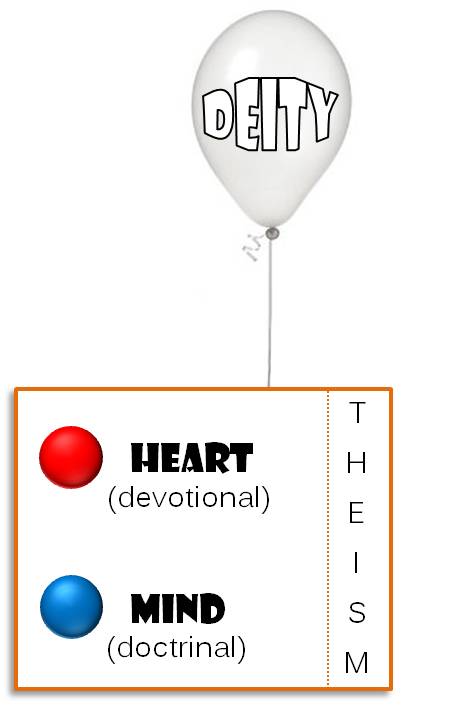
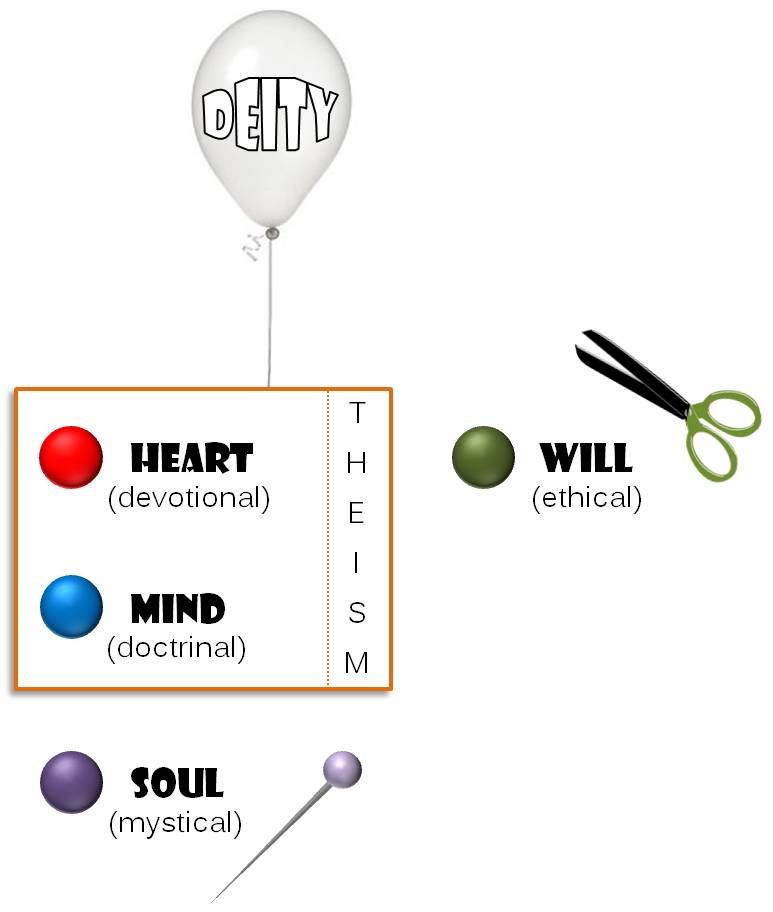
Conventional culture and religion have accommodated this ego fixation. We invest more and more in protecting the security of who we are, and the whole “meaning of life” has become for many the hopeful prospect of securing immortality in heaven when they die. Theism – the belief that (an) identity stands apart from and above reality as its maker and manager – both reflects and reinforces this preference of glorifying ego as our highest concern.

As a product of “social engineering,” the ego of personal identity is shaped and directed in ways that promote the collective identity of our tribe. This is not necessarily conducted with intention, but rather insinuates itself into the more or less automatic routines of parenting, education, politics and civil law. We are told to be “good” children, “good” Americans, “good” Christians – which means compliant with the tribal structures of family, nation, and religion. To be out of compliance (naughty, criminal, heretical) is to risk the forfeiture of our identity, and by extension the culturally supported meaning of life.

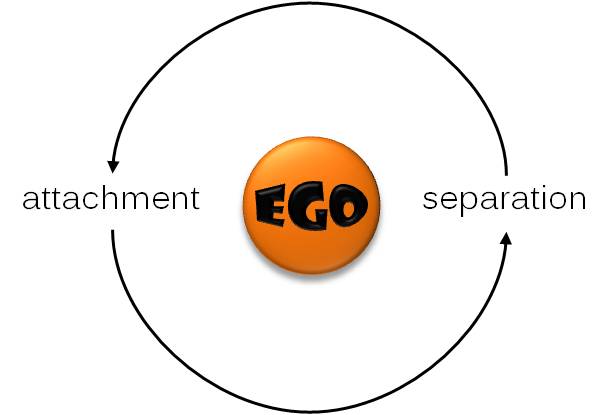
To either side of this narrow ridge of personal identity (as illustrated above) are two distinct paradigms for answering a more philosophically interesting question: not who you are as a person, but what you are as a human being. These two paradigms – which we can call “science” and “spirituality” – are not necessarily competing frameworks of research and explanation, despite the fact that they are popularly regarded as such. The real tension, however, is between the cult of identity and the paradigms on either side.

Science

According to the scientific paradigm, ego (personal identity) is not an object of study in and of itself. Because the ego cannot be dislodged from the multiple lines of social influence that define it, science treats it as a byproduct (technically an epiphenomenon) of something else rather than a separate existence in its own right. Social science has made great progress in seeing the ego as a nexus of cultural meaning and social control, interpreting personal identity as a function of its environmental (tribal) context.

In addition to expanding out into the cultural context for an understanding of what a human being is, science is also investigating the biophysical foundations of personality. Ego can be analyzed into the conflict between the instructions of society and the animal impulses of the body, as Freud did. It might also be broken down into genetic and temperamental factors determining an individual’s mental order and orientation. Drug therapy is a treatment protocol based on this notion of identity (personality, ego, and mental health) as a secondary effect of the physical conditions underlying it.

For the fun of it, I’m going to make up a word and say that science (all science) is the empirical quest for the “cómponence” of things. Everything that exists has a “cómponential” nature, which is simply to say that it is a component (part) in a larger order and is itself made up of smaller and deeper components that might be further analyzed. Because there are no egos that exist apart from bodies, science proceeds on its commitment to explain personal identity in terms of the body – its deeper cómponence as well as its participation as a component in the social system.

As you would expect, devotees in the cult of identity criticize science as “impersonal” (which it can be) and on an offensive campaign to undermine religion (which it isn’t). The problem, of course, is that because popular religion has taken on the immortality project of the ego as its driving mission, the scientific challenge to the belief in a metaphysical and everlasting center of identity is rightly regarded as a threat.

Spirituality

Just like science, spirituality seeks to understand and celebrate what it is to be human. Although there are teachers and esoteric schools that capitalize on our disillusionment with popular religion, they typically take up the immortality project and merely cast it under another set of metaphysical claims. This might amount to a return to paleolithic rituals, ancient secrets, and exotic doctrines, but it remains organized around the disguised status of the believer as divine and destined for higher planes of bliss.

My use of the term spirituality is not in reference to special revelation or the supernatural. Like science, spirituality is a quest for what is really real. If it begins this quest from the position of identity, spirituality quickly leaves behind the obsessions and ambitions that captivate the ego. Instead of proceeding in a biophysical direction, however, it moves along a psychospiritual (and transpersonal) path of investigation, exploring the threshold between individual self-consciousness and the provident reality to which it belongs.

Recent efforts in psychotherapy have managed to bring the topic of spirituality and religion back into the clinical conversation. Religious values and beliefs are recognized once again as important to the mental health of some clients. The emerging therapeutic models, though, are mostly classical theories of the mid-twentieth century with an “annex” of spiritually-oriented strategies attached – just in case.

Again, spirituality (and science) asks not “who” you are, but “what” you are. What is a human being? A characteristically “spiritual” phrasing of the question might be: What is the nature of being in its manifestation as a human. This is the question of essence (from the Greek esse, being).

Being doesn’t merely name the fact of existence, but refers to the act of existing (from the Greek existere, to stand out). The existentialist theologian Paul Tillich translated it as “the power to be” or being-itself. As a human being you stand out, just as you are. Instead of digging into your componential nature as science will do, spirituality takes you as “just this” – not something else, and nothing less than the present mystery of reality.

As a human manifestation of being, your existence isn’t a final term, however, for you share this power-to-be with other manifestations, human and nonhuman. If you are a manifestation of being in human form, and that thing over there is a manifestation of being in (horse, tree, rock, cup, cloud,               ) form, then what is this power manifesting as you both? Spirituality names it “ground” or “the ground of being.”

This power is nowhere other than in its manifestations. But it is more than any single manifestation simply because it exists or “stands out” over there as well. Reality is present here in human form as you, and it is present over there in another form. I’m putting an accent on this matter of location (here and there) because existence is always situated somewhere. The ego may seek to escape here-and-now for something better elsewhere or later on, whereas the soul seeks communion with the present mystery of reality.

In contrast to ego religion and its otherworldly aspirations, spirituality engages the present situation with full attention and total freedom. It doesn’t crave to be anywhere else or hide from the accidents and conditions of mortality. Trouble, affliction, and bereavement will come, but your faith in the provident support of reality in this moment enables you to be present in the situation with generosity, compassion, and gratitude. It’s not that you do nothing, but that you bring the full force of your soul (Ghandi’s satyagraha) to the challenge at hand.

As we would expect, the cult of identity is suspicious of spirituality as well. Nothing good can come from setting aside your petty agendas, nervous attachments, and ulterior motives – can it? Life will lose its meaning if you take a deep breath and open up to the real presence of mystery – right? If the human adventure isn’t really about getting somewhere else later on, then all we’re left with is … this!

Breakthrough.

Naming Mystery, Talking about God

God talk

Religion didn’t just fall out of the sky fully assembled but evolved over many thousands of years. It emerged as a way of securing the everyday world of human concerns to the deeper mystery supporting all things. The experience of this mystery – what I call the present mystery of reality, or Real Presence – is engaged spontaneously and at a level below the reach of articulate thought. For this reason it is properly named “mystical,” available only to contemplative attention and essentially ineffable (beyond words).

If you observe anything for very long, the subject-object screen separating you from the thing observed can sometimes fall away to the realization that both you and that thing are grounded in one reality. This breakthrough to oneness doesn’t negate what makes you different from that thing, but instead helps you see beneath the difference to your co-presence in being. You are being in human form, and that other thing is being in a different form, but it is being-itself presenting (or presencing) as both.

Now, this doesn’t sound very religious. It would be some time before our minds developed the philosophical acuity to think into such abstraction. In the dawning age of religion, the first efforts at representing this experience of mystery were perhaps through rhythm, song, and dance. Gradually icons, artistically crafted images in paint, wood, clay, and stone, qualified the mystery in visual terms.

Such sensory-concrete images were eventually transmuted into conceptual metaphors and put into the framework of narratives called myths (from the Greek for plot). Elemental metaphors (personifying the forces of nature), theriomorphic metaphors (represented in animal form), and finally anthropomorphic metaphors (taking on the features and personality traits of humans) provided ways of converting an ineffable mystery into something increasingly more personal and relational. The myths of religion tell of the exploits of this or that deity, how the tribe is related to, dependent upon, and/or commissioned by the will of the deity.

If you’re coming to religion and enter by way of its metaphors, stories, and beliefs, it is easy to assume that the myths are depicting a deity which actually exists, out there in the external dimensions of metaphysical space. If a religion really gets locked into a literal reading of its myths – effectively forgetting the true “genealogy of god” – this insistence on regarding God as a separate being can become an insurmountable block to spiritual awakening and freedom. It is also a principal motivator of violence against others who don’t believe in “our god.”

If Yahweh (the patron deity of Jews and Christians) made the universe, intervened on behalf of Hebrew slaves, spoke to the prophets, and miraculously lifted the dead Jesus back to life, then why doesn’t he do similar things for us today?

Typically, literalists will guard their orthodoxy by laying the responsibility on us, saying that our age has become sinful, perverse, secular and faithless. Consequently god has abandoned us to our wicked ways and withdrawn into heaven, or we have lost the ability to feel, see, and hear god. It might also be that everything god has to say has been said, everything needing to be done has already been accomplished. Now all we need to do is believe.

For your own good you are admonished to heed the “experts” – teachers, pastors, clerics, bishops and theologians who are professionally committed to the tradition and its orthodox heritage. Don’t question the Bible, don’t challenge the preacher, and by all means don’t try to work it out for yourself. The end of the world is at hand and you can’t afford to rely on your own judgment. If your soul is to one day see the bright streets of paradise, you’d better listen up and stay in your seat.


I’ll let you in on a secret.

A large number – perhaps the majority – of those professional custodians of religion don’t believe what they preach, not really. Many of them came to their credentials by way of denominational training that likely included a critical study of Christianity, its historical place among the world religions, as well as the evolution of the Bible and its competing representations of God. From the pulpit they proclaim with authority what they privately doubt and discuss over coffee in their closed circle of peers.

I know. I lived in those circles for nearly two decades.

What these professionals know is that God is more than what can be said. The discrepancy between our representations (god) and the reality (God) they qualify is so impossibly vast that our images, thoughts, and talk about God are like scratchings at the surface. “Standing on a whale, fishing for minnows,” as a Polynesian saying goes. Our concept of God is our first idol.

But don’t tell the people. They can’t handle the real truth, so we spoon-feed them from the cramped little boxes of stale theology we push to the side during the rest of the week.

If God (the real presence of mystery) is more than our words and images can express, then we also need to admit that the reality of God may be other than what we believe. In short, we just might be clinging to an idol that entirely misrepresents the present mystery and is actually preventing us from a genuine experience of God’s presence.

The transcendent God is transpersonal – beyond personality, more than we think, other than the patron deities we worship, obey, and promote. It’s important to understand that we are not talking about the hidden nature of a god out there whose actual personality is inscrutable to us. God’s transcendence is another way of saying that our representations of God are merely qualifications on something that cannot be named or known objectively. You don’t leave behind the patron deity in order to look still farther out for a bigger and better god.

Acknowledging the transcendence of God means letting go of your beliefs about god in the interest of coming again (or for the first time) to the Real Presence of mystery here and now. First your grip is relaxed, then the screen falls away. You wake up to the realization that the creative source and gracious support of all things is all around you, right here with you, and rising up from deep inside you – just as you are.

Jesus Against Christianity

The biblical deity Yahweh has a deep history going back to the habiru, which is a generic term used in reference to a migratory population of nomadic tribes that swept down from the north into the Fertile Crescent roughly between 1800 and 1100 BCE. These northern invaders were resisted as outlaws by the settled cities and agricultural villages they flooded into, and at least in Egypt during the rule of Ramses IV some were taken into slavery.

Egypt

Yahweh was the patron deity of habiru (Hebrews) who inhabited mountains of the Sinai peninsula. His specialty was violence. In exchange for the obedience, sacrifice, and worship of his devotees, Yahweh provided protection and victory in their raids. Over time a number of neighboring habiru formed a federation that would eventually cross into Canaan and take possession of the land. On the way, many indigenous peoples and innocent citizens would be slaughtered or displaced, fulfilling a destiny promised to the invaders by their god.

Whether you are an invader or a native, your response in encountering “the other” tends to be very different. When religion grows out of the conditions of diversity, people work intentionally to build rapport, accommodate each other, and form cooperative relationships. In such regions, religion itself will be a rather pluralistic phenomenon, with perhaps many deities represented across a geographical region – an example being the ancient Indus Valley where “Hinduism” has flourished for millenniums.

But when religion comes in from outside a cultural context, bringing with it alien values and imperatives, the confrontation with difference is typically aggressive, invasive, and violent. Either “the other” will need to be converted – that is, bent into agreement with the invading orthodoxy – or subjugated (which can include oppression, exploitation, marginalization or extermination). Even though dialogue and cooperation may be possible, the prevailing impulse is either/or, in-or-out, good versus evil. The irony is that “good” in this case is identified with invasion, conversion, and violence in the name of god.

Most people are unfamiliar with this backstory to the religion of the Bible and its patron deity. As Judaism – taking its name from a southern tribe (Judah) of the federation that “settled” Canaan and held the first capital city (ancient Salem, renamed Jerusalem) – advanced its international presence, a mythology evolved to help establish this presence inside the arena of regional empires. The myth cycles of Creation, Covenant, and Conquest reconstructed history in a way that elevated Yahweh to supremacy and designated his people (the community telling these stories) as chosen and special.


What interests me is the extent to which this invader mentality (with its imperative to move in and then displace or destroy the other) got encoded into the Bible and became a driving impulse of Western culture. Some important recent authors (Walter Wink, John Howard Yoder, William Herzog, and Jack Nelson-Pallmeyer among them) have named this impulse “redemptive violence” – the use of violence as Yahweh’s preferred means of bringing about human salvation. The important extension of this code, of course, is that Yahweh’s preference motivates and justifies the violent behavior of his devotees.

fist

As Yahweh’s career progressed with the establishment of Christianity, this impulse continued to drive Western expansion – first in the evangelistic mission to the Gentiles, then under the administration of Constantine, and later into the missionary excursions and New World migration of the Americas. As it went on, this impulse also grew more violent, until with the English colonists and European settlers an entire native civilization was all but wiped out in the name of Manifest Destiny (our god-given right to possession).

It’s also important to understand that a patron deity (such as Yahweh) serves a dual role in the psychological development of his or her people. Firstly the deity is a projection of what concerns the security and ongoing survival of his tribe. In this way, our god validates and reinforces our present identity. God hates his enemies and therefore so must I – although the projection is really working the other way around: I hate my enemies and therefore so does my god.

The second role of the patron deity is to represent in ideal what is still only dormant (or latent) in his devotees. As a general trajectory across the world’s cultures, deities tend to develop in the direction of mercy, grace, compassion, and benevolence. That is to say, the ideal of a liberated and morally enlightened humanity is “forecasted” (projected into the future) in the narrative depiction of the deity. In the Bible, for instance, we can observe the gradual maturation and softening of Yahweh into a more loving and universally generous god.

As the literary character of Yahweh was evolving, he increasingly took on an “ambivalent” or schizoid nature. One moment he could reach out in tenderness, and in the next with merciless wrath. By the time of Jesus, this bipolar tendency had inspired various sects and divisions within Judaism. It seems that Yahweh could turn any which way he was needed. His benevolent side was perhaps his dominant function, but he also possessed a stern and violent shadow.

In some traditions this shadow was split off into a malevolent and diabolical counterpart (Satan), while in others it was reconciled as something of a reluctant obligation in god to condemn sinners. God had made the rules, humans disobeyed the rules, and Yahweh was constrained by his own morality to destroy those who failed or refused to repent.

What did Jesus have to say about it?


Because the First Voice of the historical Jesus is buried beneath and tangled into later Christian mythology, it’s not easy to tease out the “red letter” thread of his original gospel. But once you catch hold of it, the power of his message begins to resonate with certain sayings, stories and primitive recollections in the Gospels. The force of it can be summarized as “unconditional forgiveness,” or loving the enemy, and it runs in direct opposition to redemptive violence throughout.

open hand

As I have tried to expound on this radical message of Jesus in other posts (e.g., “Jesus, Forgiveness, and a Brave New World“), I’ll just make a few remarks on it here. Basically, Jesus advised that the only way into a human future of freedom, community, and lasting peace is to “let go” of (literally forgive) our neighbor’s guilt. The “good news” (gospel) according to Jesus is that God has already done this for us: nothing is holding us back but our own attachments to shame, fairness, proper reckoning, and moral satisfaction.

There is sufficient textual evidence to suggest that Jesus did more than merely accentuate Yahweh’s “good side” over his violent propensities – his right hand over his left, as it were. Instead he proclaimed, and lived out as if it were true, that God has only love for all people. The only way to love our enemies is to forgive, which is to let go of what you have against them by moral rights (their guilt) and return good for evil. This is why the qualifier “unconditional” is so critical to an accurate understanding of Jesus’ revolutionary teachings on the power of love.

As it happened, his revolution was short-lived. The code of redemptive violence was so deeply insinuated into the cultural DNA of the Bible that his followers soon reconstructed his death (and for the most part disregarded his life and teachings) into a transaction of vicarious suffering for the sake of our salvation. By dying on the cross, he was supposed to have paid the penalty for sin and satisfied Yahweh’s need for retribution. His torture and death, in other words, were necessary to the final solution.

Christianity, as it continued to develop and expand its empire, eventually became the embodiment of what Jesus had sought to transcend and leave behind.

The Judeo-Christian West has a long record of redemptive violence. I read recently that one out of five adult Americans today are either incarcerated, awaiting trial, or on probation. The most charitable nation on earth also has the largest percentage of its population in prisons. The religion that has the most to say about love and how “God is love” is also the most outspoken about retribution and people getting what they deserve.

If the revolution intended by Jesus has any hope of taking hold on a large scale, more people will need to see the irreconcilable contradiction between Christianity’s current message of salvation and his original gospel. It’s not enough to simply lay fresh tile on a faulty foundation. We need the courage to call redemptive violence when we see it in ourselves and in each other, but we need even more courage to extinguish this impulse and make a way for love instead.

As If

  1. God has a plan and is in control.
  2. Everything happens for a reason.
  3. You have an immortal soul, but …
  4. Don’t trust yourself.
  5. A better place awaits those who obey God.

I do not mourn because his soul is very much alive. God has a plan for each person. Mine was to hide in this boat and shed some light on our actions.

This is what Dzhokhar Tsarnaev wrote while hiding from authorities in a boat, after he and his brother had successfully carried out their mission of bombing the Boston marathon. Dzhokhar’s brother Tamerlan died on his way to the hospital from gunshot wounds by pursuing police and from being dragged under their own get-away car.

We Muslims are one body: you hurt one you hurt us all. Know you are fighting men who look into the barrel of your gun and see heaven. Now how can you compete with that?

Now we might spin this into an exposé of Islamic fundamentalism. But if we did, it would only be to put a buffer of dissociation between an ideology that motivated these young men to violence in God’s name, and the more respectable theism of American Christianity. Of course, in the process of pushing this ideology away and condemning it as against what God is really all about, we protect ourselves against the possibility of a revelation – also known as disillusionment.

It can be expanded and morphed into countless variations – as it is among the world’s many religions – but this ideology consists of just five beliefs. A belief is when we pretend to know something, but don’t realize that we are pretending. In our trances of conviction and in the name of our delusions, human beings commit atrocities against other people, life on earth, and future generations. It doesn’t really matter what name you attach to the delusion; the essential mechanics of the phenomenon are the same across the board.

As we look at the five statements that make up this dangerous ideology, it should be obvious that they can be turned in the interest of emotional comfort or unconscionable violence. What decides the difference? If these were diametrical opposites the answer would be easy. The purpose is to calm anxiety, promote peace, and connect us meaningfully to the world around us. But could it have another purpose as well?

An unresolvable fact of our life in time is that things come at us randomly. Kind people suffer and mean people flourish; and yes, mean people suffer as kind people flourish. Televangelists can pump the notion that God favors those who are obedient, generous, and forgiving (although that last one doesn’t get as much airtime), but actual experience and just a little honest reflection will easily pry the lid off that deception. Still, it’s comforting to know (or pretend to know) that someone is watching over us and will someday give us what we deserve.

When, exactly? There’s no telling, but you can rest assured that if it doesn’t come in this life, God will bless you richly in the next. For a lot of people, just knowing (or pretending to know) that we don’t really die but merely continue on after the eye-blink of death in everlasting perpetuity is sufficient to reconcile them to the hardship, trauma, and bereavement that are inevitable in this life. That makes this bearable. We can put up with a lot here, with the assurance that it will all be better there.

For the Tsarnaev brothers, the promise of an after-life reward provided more than enough motivation to rip off limbs and kill innocent bystanders. Even the prospect of dying for their cause wasn’t a deterrent – if anything, it was a stimulant to what they did. God’s plan involves the triumph of his religion, which will come about either by the conversion or destruction of unbelievers. God is in control and is moving human events in the direction of a preordained destiny. Whatever happens along the way, you can know (or pretend to know) that it’s all happening according to plan.

Every statement in the above set has a metaphysical anchor, except one. The existence of an external deity who has a plan and is in control, whose reasons may be inscrutable (and therefore beyond question), and who will reward our obedience and sacrifice with endless beatitude in the next life – the hook for each one of these beliefs is importantly just (or far) outside the horizon of direct experience or presentable evidence. This is frequently used as an argument for their authority, strangely enough.

Religion is about metaphysics, and metaphysics can only be known by revelation. Charismatic prophets, inerrant scriptures, and orthodox doctrines all give warrant to the validity of our faith. Don’t worry over the fact that you haven’t encountered the personal deity as he is depicted in the sacred stories. It happened, and that’s all you need to know (or pretend to know). Besides, who are you to question it? Your sinful nature, mortal ignorance, personal stupidity, or undeveloped faith (multiple choice, and “all of the above” is the best answer) preclude you from any kind of claim to authority.

So we can see that none of the other statements of this dangerous ideology would stand up or hold water if confidence in our own experience, intelligence, and insight were not disqualified beforehand. If you can be dissuaded from trusting yourself – or better yet, if distrusting yourself can be accepted as obedience to divine revelation – then you are absolutely dependent on the external authority of religion.

But as Alan Watts often asked: If you can’t trust yourself, is it really a good idea to trust this distrust of yourself? This is typically where orthodoxy warns us to stop asking questions.

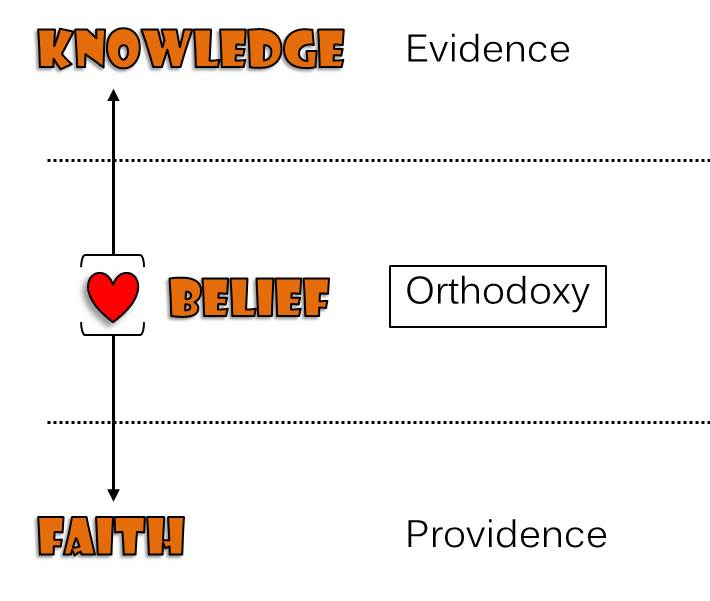
When we believe something, we pretend to know – and then forget or never wake up to realize that we are acting “as if” we know. But isn’t this what we mean by faith? Don’t we need faith to believe in an external deity, his overarching plan, our own immortal souls, and a life after this one? The answer is “No.” All you need is the willingness to believe these things, but that isn’t faith.

PeaceIt is possible to question, doubt, and disbelieve almost every statement in the ideology under consideration and still have faith – a mystically deep, spiritually grounded, and truly relevant faith. Almost every one. But when you lose or give up trust in yourself, you really can’t trust anything else.

Faith is full release to the present mystery of reality, experienced as provident in this beat of your heart, this breath in your lungs, this thought in your mind, this moment of being, this passing opportunity of life. All of this rises up from within and all around you as support, grace, and real presence.

Until we are given permission to trust ourselves, or take it back from those who are withholding it from us, more and more people will suffer the consequences of our convictions. We will continue to take our gods as real, read our myths as literal accounts, claim the infallibility of our beliefs, and be ready to surrender everything – common sense, reason, peace, and life itself – for the sake of what we only pretend to know.

God and Ground

There is a very interesting paradox at the heart of healthy religion. Our notions of God – just looking across the landscape of world religions, and then deeper into the private religion of individuals – are practically innumerable and infinitely diverse. God is represented as a personality, a force of some kind, a supreme intelligence, or as an utterly abstract perfection.

But this isn’t the paradox I have in mind.

A paradox is something that is “contrary to” (para) “opinion” (doxa) or beyond belief, in apparent conflict with how something is commonly understood. The paradox at the heart of healthy religion has nothing to do with the countless and often contradictory ways that human beings represent God. To think of God as masculine and feminine, for instance, is not a paradox but simply a more inclusive and holistic consideration of the divine personality.

The real paradox in religion has to do with the representation of something that is inherently unimaginable, with all our talk (theology) about a mystery that is essentially ineffable (beyond words). What I’m calling healthy religion acknowledges this paradox and respects it for the corrective effect it has on our tendency to get locked too tightly around what we think God is. Unhealthy religion, on the other hand, fails to acknowledge it and even seeks to invalidate the paradox by insisting that its doctrines are final and infallible.

God and GroundLet’s look inside this paradox in order to understand and appreciate its creative tension. The illustration above depicts this “contained contradiction” at the heart of healthy religion. At the bottom is an icon representing the idea of what is essentially beyond representation – what I have taken to calling the real presence of mystery. This isn’t merely stating that reality is a mystery to our minds, but that this mystery rises up and presents itself to us in the manifold nature of things; as this, that, and the other.

The icon suggests a swirling and dynamic creativity, spinning out the complex arrangement of existence all around us, as it simultaneously turns inward to a place of singular and undifferentiated oneness. This is the generative source of being; not just another being but the power of being itself. If these terms seem inadequate, we shouldn’t be surprised. We are contemplating something that is not a thing; it cannot be made into an object of thought or boxed up inside any definition.

Because this present mystery is the generative and foundational support of everything else, a favored metaphor among mystics is the “ground of being.” Everything we can sense and know moves through cycles of birth and death, emergence and dissolution, coming-to-be and passing away. Like waves on the surface of an ocean, the multiplicity of apparently separate beings, each rolling through the period of its individual lifetime, is really the dynamic action of a fathomless sea presenting itself as this, that, and the other.

The “wave” under consideration here is you. If you could take the opportunity and look deep, very deep within yourself, you would find not just more “me” but something else. Not something separate and apart from what you are, but not some indestructible center of identity either. It is presence – real presence, the presentation of a mystery rising up in this provident moment in you, as you, but also in everything else around you. As you are able to let go and fall into the gracious support of this mystery, all concern for “me and mine” dissolves away, and only a profound awareness of communion remains.

As I said, healthy religion encourages individuals to descend by this inward path into the presence of God and communion with all things. The “of God” represents religion’s final words before the soul plunges into the depths where language is no longer effective; but neither is it necessary. The word mystery comes from the root “to close,” which is gentle reproof of our tendency to open our mouths with incessant commentary on something that can’t even really be named. Our instinct for meaning takes time and practice to restrain in the presence of mystery.

But religion doesn’t just leave you there. There are also unhealthy forms of mysticism, which simply revel in communion with the present mystery but lack any interest in exploring its connections to everyday life in the world. In my experience, these unhealthy forms of mysticism characteristically denigrate the ego and renounce the realm of daily concerns. They try to press the wave flat, so that only the infinite ocean remains.

While the ocean is more than the waves at its surface, the waves are nothing less than the ocean itself. Your identity – the separate “who” that you are – is distinct from your essence which unwinds into the depths of being itself. Identity (ego) is a product of social conditioning, the place in your personality where consciousness has been bent back into self-consciousness by the disciplines of your tribe. For this reason it is commonly called the “conditioned self.” Ego is the ‘I’ who is “one of us,” an insider, both product and agent of the collective.

“Patron deity” in religion refers to the representation of God as a personality who stands in a reciprocal relationship with devotees, providing something in exchange for their worship, offerings, prayers and obedience. It is more than just an “idea” of God, then, and goes beyond mere belief. Reciprocity is the key. Devotees are aware that their patron deity calls them to something, puts a demand on them, or promises a reward for their fidelity, commitment, and sacrifice.

It’s important to understand that the patron deity is a literary figure, not a literal one; a figure of story, art and imagination rather than an actual separate being (out there, up there). Especially in a religion where sacred stories have been reduced to factual records, such a statement will be regarded as heresy, disbelief, ignorance or a loss of faith. There will also tend to be a corresponding lack of spiritual depth, and not much appreciation of mystery.

In healthy religion, the tribe orients and guides ego through the course of development, from the impulsive stage of childhood, through an imperial phase of adolescence, and eventually into the responsibilities of adulthood. The transition between childhood and adulthood – not a formal stage but rather a phase in development known as “growing up” (adolēscere) – is where ego frequently gets stuck. During this time an individual can come to fervently believe that “it’s all about me.”

The imperial ego is predictably self-absorbed, strives for superiority, seeks glory, and is jealous for the exclusive love and worship of others. Interestingly, every religion has to evolve through its own adolescent phase, where the patron deity is depicted and praised in exactly these terms. The earlier depictions of a more maternal and provident nature are rather dramatically rejected (or demoted to secondary attributes) in the exaltation of a supreme lord and king. If the evolution of religion can successfully transcend this self-centered phase, believers will eventually be empowered to take up a more stable, responsible, creative and benevolent attitude in life.

What I’m calling the patron deity, then, is complicated by the fact that it stands in a paradoxical relationship to the grounding mystery of reality, but at the same time represents progress (or arrest) in the spiritual awakening of its devotees. Just a quick survey of the Bible, for instance, reveals a “growth chart” in how its patron deity (Yahweh) gradually advanced from a jealous demand on the obedience of insiders, into a compassionate interest in outsiders and those who suffer, and opened fully at last into an unconditional love for the enemy (articulated as forgiveness in the teachings of Jesus).

Along the way, Yahweh’s devotional community (as a function of its individual egos) advanced accordingly – or I should say, along a slightly slower curve behind the guiding light of his ideal. At times it has gotten hung up. Concerns over natural resources, national security, who’s in charge, and the uncertainty of the future have occasionally provoked individual egos (and consequently entire tribes) to twist up inside themselves and grip down in fear. At this historic moment, in fact, we are in the midst of a regressive hiccup through our adolescent phase, as fundamentalists of various brands hunker behind ramparts and prepare for war.

If we can appreciate – which of course means that we must first acknowledge and accept – that our patron deities are representations-in-transcendence of what is going on (or turning off) in ourselves, then there is a chance that we will be able to not only survive the current regression into conviction and violence, but finally wake up to the real presence of mystery in ourselves, in each other, right here and now.

The Quadratics of Transformation

This is a blog about creative change. My posts on the whole have been exploring creative change along several distinct trajectories – personality and life experience, spirituality and religion, individual and community. Working the angles on transformational change has gradually clarified what I now take as the essential dynamics of what’s involved in the transformation of anything whatsoever. I’m going to call it the “quadratics of transformation.”

Behind its more technical mathematical definition from intermediate algebra, “quadratic” derives from quadratus, the Latin word for square. In the ancient world, the geometric form of a perfect square represented stability, symmetry, and wholeness. The four elements of earth, air, fire and water, for instance, were taken as the deep structure of reality itself. As I use the term here, quadratic transformation refers to the fourfold dynamic that plays out in transformational change – the way a given identity resists or undergoes alteration in form as it evolves over time.

QuadrixWe might take anything as our example, but let’s put a human being at the center of the Quadratic as our particular identity for consideration. As we follow the vertical axis upwards, we engage the context in which that person exists. Also called its environment or setting, we will use the more interesting term SYSTEM as a reminder that this person participates in a larger context of forces and conditions. From the perspective of our identity-in-focus (a person), the system is external – outside, around, enveloping and inclusive of identity itself.

If we start again with personal identity, we can take the vertical axis downwards, which moves us deeper into or within the person. Here we find internal forces and conditions such as the individual’s self awareness, his or her self-image, and a very interesting configuration of intelligence, talent, orientation and neurotic styles. When it comes to personal transformation, the tangles, fixations, and hooks in this internal configuration of the self represent a covert factor in the dynamic of change. Going “down” into the self pushes us deeper into its GROUND.

As we shift attention to the horizontal axis, we move to the left (in the Quadratic) where we are confronted with the power of HABIT. This refers to the routines and patterns that persist through time, somewhere along the sliding continuum into unconscious, reflexive, automatic and compulsive activity. By definition habit is conservative, keeping routines (including assumptions, preferences, and behavioral responses) that have been “working” to some extent. This so-called success of a routine might actually interfere with the individual’s personal achievement or pursuit of happiness, but still be conserved for its value in coping with stress.

Opposite to habit in the Quadratic of Transformation is the force of PURPOSE, which is progressive in the sense that it looks to what’s next or farther in the future and moves the person in that direction. In contrast to a rock, which is just about all habit, a human person has more potential to change (to grow and advance) – that is to say, the person has more purpose than the rock. Purpose here does not refer to a metaphysical plan or “mission from above,” but to the intention of identity, how creatively it leans into its options and stretches toward fulfillment. In human beings, purpose takes shape in strategies, goals, and the choices guided by intended outcomes.

So transformational change is the interplay of these four factors: a surrounding context (system), factors internal to the “self” (ground), the conservation of routines (habit), and an intention for the future (purpose). Eliminate just one of these quadratic factors and transformation will not happen. A weak or “shaky” internal ground makes identity unstable. An inadequate system (poor or missing resources) will put it at risk. Habit that has fallen out of date or is stuck in a blind repetition compulsion stifles creative freedom. And the lack of intention or directed purpose effectively forecloses on the future. Instead of transforming, identity will collapse on itself, become exhausted or obsolete, get stuck in its own ruts, or miss opportunities for progress.


Relevance to Parenting and Education

In the field of education the Quadratics of Transformation can be immensely helpful in optimizing learning and supporting student success. Instead of simply pushing information at students, educators might become more deeply involved in the process of activating intelligence, promoting aptitude (rather than merely assessing it), and working with the unique quadratics of individual students.

In order to succeed in life and reach some degree of self-actualization, a human person needs a strong internal ground of faith, self-confidence, openness to experience, and encouraging self-talk (e.g., “I can do this!”). Such internal strength serves as the basis for resilience, adaptation, and the ability to exploit failure for the wisdom it can teach. Too many people struggle with a paralyzing sense of self-deficiency and unworthiness. Creative educators work early on to help establish in their students (and parents in their children) a provident foundation of self-efficacy.

In recent years, especially with the discoveries of neuroscience into how the brain develops, the value of “enriched environments” of learning has gained acceptance. Beyond just surrounding the student with an interesting variety of instructional media, student development is greatly enhanced as the individual becomes increasingly aware of his or her place in a larger system of resources and co-factors of learning. As a participant in a broader and richer context of knowledge, agencies, tools and services, the student can appreciate the excitement of learning as a cooperative achievement.

If they are reached soon enough, children can be taught the fundamental skills of effective learning and academic achievement. This goes beyond memorizing the alphabet and math tables, into techniques of setting up the problem, forecasting outcomes, identifying the steps, and constructing a strategy. These skills are gradually established as habits of effective learning and problem-solving through consistent practice. Routines become habitual and require less and less attentional effort as they are performed with consistency. Creative parents and educators understand the prime importance of helping youngsters practice and conserve the proven habits of success.

It’s difficult to reach a goal if one hasn’t been clarified and anchored in the future. When individuals are very young they need to borrow the prefrontal cortex of their adult advisors (parents, teachers, coaches), which is the region of the brain most involved in discriminating options, predicting possible outcomes, taking the long view, and making calculated decisions. Evolution has generated a very interesting situation for humans, where children need to rely on adult skills and abilities far into their development (late into the second decade of life).

If educators are fixated on instruction and assessment – unconcerned with education proper (educare refers to leading the student out into a broader or better understanding) – teaching will not awaken in students the aspiration toward higher ideals or the strategic intelligence for realizing them. Parents too, of course, can get overburdened and distracted by the stress of their responsibilities, interfering with their ability to model or encourage their children to look ahead and live with purpose.

If parents and educators can take a more holistic approach to bringing up our children, we can work together to support their development into internally grounded, intelligently connected, fully skilled and innovative leaders in life. The Quadratics of Transformation is a methodological tool that can help us better help our children.

Philosophy of Tears

Any theory of what life ultimately means, if it means anything at all, must take into account the reality of loss. We can contemplate things at some high level of abstraction, safe in the refuge of logic and ideas, or we can grapple with what’s really going on in life as we live it. And life includes a lot of suffering.

Obviously the Buddha realized this before I did, although I’m not quite ready to jump on board with his diagnosis and treatment plan. He believed that “life is suffering” (dukka), but that it doesn’t have to be this way. Suffering is eradicable; if we understand its cause, we can conceivably fix the problem and live without suffering (or at least with less).

His theory was that we suffer because we attach ourselves to things and people that are by nature impermanent (anicca). Our desperate need (craving, tanha) for them to be a certain way in order to make us feel safe, powerful, important or whatever, locks them inside expectations that are hopelessly unrealistic. As they change or inevitably fail to meet our expectations, we are left hurt, disappointed, and profoundly discouraged.

Siddhartha left his wife and child in order to pursue enlightenment, which he found through the discipline of extinguishing desire and relinquishing every attachment to this passing world. The ultimate reality he came to realize was representable only by the symbol of a candle flame (desire) blowing out (nirvana). An absolute quiescence and undisturbed tranquility was the consistent result of his meditative effort; unattached and untroubled. This, he thought, should be our goal: liberation from suffering.

The Greek school of Stoic philosophy taught something similar. By gaining detachment from the things that change and fall away from us, a certain equanimity can be attained that will make the philosopher immune to anxiety and disappointment. This was believed to be a superior state of existence – something like the gods who hover just outside the flux and frustrations of mortal life.

A certain quality of intellectual transcendence (and emotional disengagement) has infiltrated just about every part of the high culture of the West. Experimental science, colonial politics, and other-worldly religion have all benefited from this ability of ours to detach from our feelings, our bodies, and our sympathetic connection to each other and the earth.

The title of this blog post is intentionally ambiguous. Is it about the tears real human beings shed in response to the hardships and losses of life? Or does it refer to tears in cloth, ruptures in the stitch-pattern that holds fabric together? As my readers might guess, the answer is “Yes.”Dynamics of LoveLong before the rise of medieval love poetry and the Arthurian knights, Jesus of Nazareth was the first Troubadour. He didn’t teach escape from suffering through renunciation and detachment. He didn’t instruct his disciples to extinguish desire and separate their minds from the complications of mortal existence. In a variety of ways, he encouraged his friends to get into life, reach out to others, and look for God in everything. Suffering is not to be idolized or pursued for its own sake, but I hear him saying that unless we are willing to take on the full burden of existence our lives will fall short of fulfillment.

So let’s begin with love, which is another name for the dance of attraction, copulation, ecstasy, and communion that spins the atoms and electrifies the cells of all living things. When two people meet, this interplay of forces carries on at both conscious and unconscious levels. The inherent intelligence of the universe is toward relationship, cooperation and oneness; if we can loosen up our definition a bit, then love is this intelligence. It’s what moves us to open up, reach out, and connect ourselves to another person. I will name this aspect of love, desire.

To his credit, Siddhartha discriminated between desire as such and selfish craving, extinguishing the latter as he sought to direct the former along the eightfold path of a virtuous life. But even at that, his program for liberation tended to steer around the tangles of everyday interpersonal love. This may be due to the fact that our closer relationships intrude on that inner fortress of security, self-defense, and secret motives we call “myself.” Just declaring it an illusion (anatta, no self), a kind of reaction formation that has no reality apart from the peculiar way it flinches and contracts against the conditions of existence, is not terribly helpful.

When we look into it, the mystery of interpersonal love is perhaps most apparent in the dynamics of trust. Here we must be more or less willing to allow another person into the vulnerable and less defended parts of ourselves. This is what love requires, which means that we must open ourselves to the possibility of getting hurt, exploited, abandoned, or betrayed. If we struggle with shame or self-doubt, this requirement to let down our guard may be more than we are able to manage.

Our ability to trust another person and allow him or her into our life is a function of self-confidence, which in turn has roots in what I have elsewhere called existential faith – the act of releasing oneself to the gracious support of a provident reality. This is where deep inner peace can be found, in the “letting go” of self and simply relaxing into being. If we lack this internal grounding, then we might try to make up for it in our relationships. Where there needs to be healthy trust, instead we turn our desire into demanding and unrealistic expectations on our partner to be just as we (so desperately) need him or her to be.

But if there is this inner peace – this faith-full release of to the deeper mystery of being-itself – then trust will happen and we will allow the other person into our lives. Desire, in turn, will move us into the dance of longing and embrace, bringing us together as one. It is here that we find true joy.

Desire motivates us to reach out to another person, to connect, to mingle, to entwine the branches of our separate lives into a shared pattern of meaning unique to our relationship. The distinct anchor-points in this connection are where we hold on. What I’m calling joy, then, is the experience of fulfillment we have as we share ourselves with another person and discover an expanded life together. In the very word fulfillment is this idea of capacity (“filled full”), expansion, and self-transcendence.

Now if you’re with me so far, the foregoing has been a set-up for the real point of this post. When we love another person and merge our life together with theirs, the time will come when one or the other “passes on.” I don’t only mean that we physically die, but that we change. We may change our minds, our life direction, our values and ambitions. Perhaps we want something else out of life and decide to move on. Or maybe our loved one does die. However it happens, those anchor-points that had tied our lives together suddenly become tears in the fabric of life’s meaning.

If you want real joy in life, then you need to learn how to love another person. That may not sound very Buddhist, but it certainly is Christian – in the sense of being right in line with the life, teaching, and philosophy of Jesus. A more Stoic or ascetic perspective would counsel against the quest for joy in life, since the place we find it (in love) will only lead to suffering. In our grief we long to have our lost love back in our life. To avoid this suffering, you should keep yourself from the entanglement of love.

A philosophy of life worth anything at all needs to embrace suffering. It must be willing to take on the grief of a fully human existence. We want joy, and so we need to learn how to love; but in loving we will eventually come to grief. True enough, we can renounce suffering as unnatural, as not part of “The Plan.” We can imagine a future day when nothing changes, everyone lives forever, love is uncomplicated, and joy never ends.

For now, however, we have an important choice to make.

What Death Leaves Behind

My father is trying to find his balance now, after 56 years of leaning into his best friend and life partner. It’s not easy. The reality of my mother’s recent passing – or I should rather say, the hole she left behind – catches him unexpectedly and pulls him into convulsing grief, yearning to have her back. It strikes me, as it hasn’t before, that the real pain of death is not in what it takes from us, but in the absence it leaves behind.EmptyChair

When we lose the warm presence of someone we have loved for so long, memories call to us from the fading edge of awareness.

It’s tempting to remember, to go back to a time when she was here with me, tilting her head and smiling, or slapping her knee with a round tumbling laugh. I vividly recall my last conversation with my mother – what she said, how she looked, what she was wearing. It feels good to stay there, in that gauzy space in my memory.

I don’t want to leave.

But then. Why can’t the world just stand still long enough for me to collect myself, to mourn my loss and cherish what I had? How can those millions of people rush by so insensitively, so carelessly? Don’t they know? Can’t they see this absence, this hole that I keep falling into?

The Buddha said that we suffer because we attach ourselves to things and people that are by nature impermanent and passing away. We hold on to what we love and it becomes part of us. As time goes on we hopefully learn how to adapt and accept things as they change. My love for my mother evolved over the years I knew her, getting deeper and stronger and more complicated as we shared life together.

My clutch as an infant gave way to an apron-string dependency in early childhood. Then I tethered my adolescent identity to her (and to my father), orbiting in tightening circles or flying farther out according to how supported or misunderstood I felt. In my adult years, we both were wrapped into our separate adventures, touching base from time to time by phone and sharing the occasional holiday as a family. Even though I didn’t get to touch and kiss her very often, the presence of my mother at least somewhere in my world provided me with an ineffable sense of security.

Her death has left behind this vacancy. My father is overcome with emotion as he vacuums over the spot where her hospice bed had been. An empty chair across the kitchen table has him weeping over his morning oatmeal. You know how a wall that once held a painting keeps a shadow in its absence? It’s like that – a reminder of something that isn’t there anymore. His vacancy is different from mine, even though they were once occupied by the same living person.

One of my daughters has a favorite book of my mother’s. In the margins are faint pencil checks marking passages that had caught her attention; here and there a crumb from her morning toast is lodged in the seam. Young fingers slowly sweep the pages – imagining, remembering, wondering, longing. Something so ordinary is suddenly the only one of its kind.

I find myself getting frustrated over an inability to focus on things that held my fascination but a couple of weeks ago. Certainly she knew I loved her. Did I tell her often enough? What does that even mean: enough?

The world still wobbles out of balance. Sorrow rises and rolls like a black ocean, lapping over the rim of my fragile composure. So love leads to suffering? I hurt more the harder I hold on? Sounds right. But I’m not quite ready to let go. I need to live with this absence for just a while longer.

Why don’t you pull up a chair and tell me your story?

The Spirituality of Dropping Out

In recent years there’s been a lot of talk about purpose and the importance of living a “purpose-driven” life. In Christian circles especially, the message has been that knowing god’s purpose for you and living with a mission-in-mind is what it’s all about. This has turned out to be a “best-selling” proposal, as apparently many people are looking for purpose in life. Whether specifically religious or not, we like to think there’s something we can do or jump on board with to give our lives direction and meaning.

But what is purpose, and what does it mean to have one? For most of us it’s probably identified with being useful or having a function. We are reassured in knowing that god has a use for us, that we fit into his design scheme and have something we can wake up to each day. If there was no grand purpose to existence, then life would be meaningless. If this moment in life isn’t hooked into a forward trajectory of end-values, then there would be no reason to go on.

And if there happens not to be a god up there directing our lives toward the goals of prosperity, salvation, and a better setup later on, then we’re screwed. In previous posts I’ve made the case for god as a construct of meaning, and purpose as a positive illusion that keeps us sane and tilted to the future with hope. It hasn’t been my agenda to discredit these things – I’m neither an atheist nor a nihilist – but only to explore their importance to the general guidance and inspiration in what may be regarded a meaningful life.

In this post, however, I want to say something about the even greater importance of “dropping out” of meaning from time to time. While religion – the meaning, the message, the morality and the mechanics of what is going on at the surface – is concerned with keeping people plugged into the mission, our soul (and spirituality) really has no interest whatsoever in “making it,” fitting in, or “getting there.” Instead, what we seek at the deepest level is what I name the present mystery of reality, or real presence.

Let’s unpack this a bit more so we can see the difference between a “purpose-driven” life and one that is “presence-seeking.”

skipping stoneIn the illustration above, daily life is represented as a skipping stone on its trajectory through time. The stone itself is the “I” of ego, the construct of personal identity that carries the imprint of my earliest relationships and the role assignments of my tribe, along with the peculiar neurotic styles that defend and compensate for my emotional wounds. Ego suffers under the delusion of substance – that “I” have reality and matter more than anything, though it’s nothing but a reflex of contractions, preferences, attachments, and convictions.

As I said, none of us get very far along in life without our share of bumps, bruises and emotional wounds. Ego is the part of me that I want you to see: my glow, my charisma, my accomplishments and lofty goals. I am careful to play this to the audience so they will regard me highly, approve of me and give me accolades, and maybe (if I’m lucky) envy me for my magnanimity. I am a handsome actor.

Underneath me – or rather, on the underside of ego – is my shadow. This includes those parts of myself that I don’t want you to see, the parts I’m ashamed of or unsure about. At the pain-center of my emotional wounds, inside the ring of self-defense and coping strategies, is a sense of vulnerability and “not enough.” If I can keep these hidden, or maybe outwardly project their opposites into a moral crusade of some kind, then I’m safe.

But here’s the thing. Every time I arc closer to reality, the reflection of my shadow on the water’s surface confronts me with a challenge to acknowledge and confess what I’m up to. As I approach the real presence of mystery, this forsaken and repressed part of myself comes closer to the threshold of self-awareness. When I make contact with reality, this negatively charged shadow repels me into another launch – and off I go for another arc across the pond of life.

Behind me, then, is the momentum in this game of “Outrun the Shadow” that I’m busy playing. If my ego-and-shadow duality is sufficiently polarized, this push from behind will exhaust itself into a fall only to be recharged the moment I barely touch what is repulsive and unforgivable in myself. So I contract with renewed purpose – with the necessary look-away from the present moment and my internal conflict, along with the requisite conviction concerning the high importance of the end I am pursuing. Onward Christian soldier.

Look right there, at the very point where momentum flags but before the ego is flung out again. This is something we habitually overlook in our skipping course through life: Let’s call it intention. What is intention? It is related to purpose, but isn’t end-focused like a purpose-driven life is said to be. Very simply, intention is not living for a purpose but living with purpose – or as we commonly say, living on purpose.

Whereas “purpose” in the conventional sense gets tied to future goals and making forward progress, intention doesn’t have an outcome in mind, no end-point in the future, but rather represents the opening of awareness to the depth of life in this moment. It descends along a vertical axis into present-moment experience, into the present mystery of reality. The real presence discovered here is not a something from somewhere else; it is not a being, but being-itself, the power and freedom to be here and now.

From the surface perspective, the one who “drops out” of the official program of a purpose-driven life is a loser, a quitter, a defiant and godless mystic. He or she stops fussing and stressing over the “many things” that the rest of us are trying so hard to manage. Instead of working to please god, fit in his plan, and accomplish his mission, the mystic enjoys a deepening communion with the present mystery. He or she surrenders ambition, letting the neurotic tangle of personality unwind and dissolve away. No future salvation for this one; it’s a pity.

From below, however, the spirituality of dropping out is really about dropping in – into the here-and-now, into this body, this breath, into this quiet presence of being. In this deeper place, the ego boundary that had separated me from the rest of reality suddenly transforms into a threshold connecting me to everything. What had put me against reality now joins me to it – but not ‘it’ … just this.

Religion at the surface attaches incentives of rewards or penalties to the obligation of reaching out and helping others. A spirituality of the depths knows that self and neighbor are really one – an awareness that opens out into compassion, benevolence, generosity and forgiveness. There really is nothing to hold onto, nothing to defend, nothing to chase after, and nothing to lose.

When I rise from this contemplative state, put on my costume of identity and step back into the game, others will get a sense that the game is changing.

A Case for Healthy Religion

My aim in this post is to offer an understanding of religion that can help us appreciate its importance while providing criteria for constructive criticism. Many today are applauding the decline of religion as a necessary precursor to our postmodern “enlightenment.” Religion is based in superstition, organized around power and privilege, corrupt at the deepest level, bigoted, narrow-minded, and prone to violence.

So they claim.

If I happen to agree with every one of those charges, why would I care to offer any kind of defense of religion? I want to be clear that I will not be defending any particular religion, but religion itself – the function it is meant to serve in society and in the evolution of humanity. The question of whether religion might continue to serve this function or if its time has passed will be left to the reader’s opinion. Here at least is how I see it.

Chakra_tree

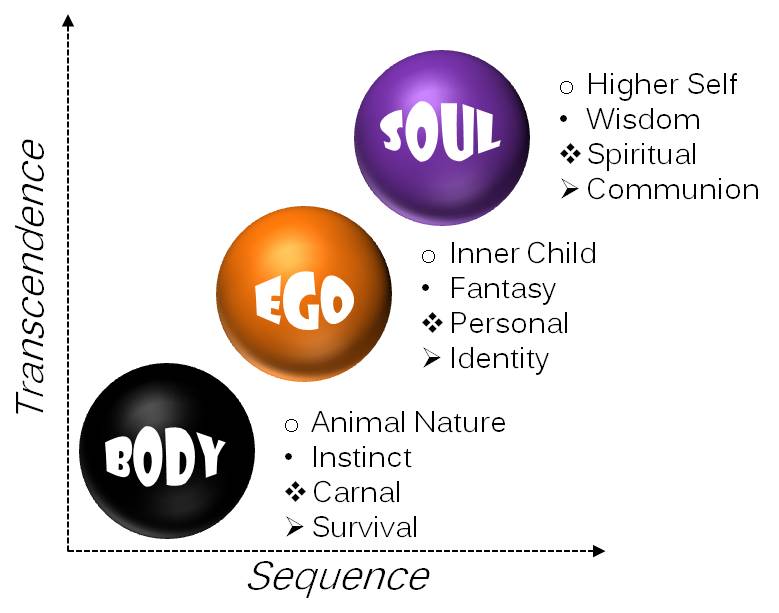
The above diagram carries forward the main idea of a previous post (http://wp.me/p2tkek-ku), proposing a view of the human being as an ascending axis through three centers of consciousness. Corresponding to the gut-level is our concern for security. I call this the elementary dimension, as it has to do with our basic life support and survival as living organisms. Our nervous system sets the internal state of our body according to signals from the environment that indicate providence or negligence in reality. Consequently we will carry a visceral state of calm or distress, relaxed attention or high alert, faith or anxiety.

Religion begins – or at least it once began – in this deep visceral response of faith to the gracious support of a provident reality. This is not a conscious decision or even a voluntary act, but an intuitive and spontaneous release in the autonomic nervous system to the grounding mystery of being itself. The etymology of “religion” (re + ligare) refers to something that ties back, re-connects or holds together what is or might become separated. In this case, the developing self-consciousness of an individual finds a link back into the deep support of reality.

In religion, such practices as centering prayer and meditation cultivate this descent into the present mystery of reality (also called the real presence of mystery). This is the mystical path, and no genuine religion can get started or stay healthy without it. Mystical faith should not be confused with the distinct beliefs that identify the different “faiths” or faith traditions. It is not about definitions or statements of orthodoxy. Since the experience of God and not beliefs about God is the primary concern at this level, mystics are frequently persecuted in religions that over-value theology.

As religion develops and consciousness ascends from its grounding mystery, the concern shifts from security to intimacy. As things naturally tend to go, a provident reality during infancy (and earlier in the womb) translates into secure bonds of protection, nourishment, and reciprocity with our higher powers. This moves us from (but not out of) the elementary and into the ethnic dimension of our human experience.

The science of interpersonal neurobiology is revealing just how important these intimate bonds are to our emotional development, particularly as it involves the “entrainment” of the infant’s right hemisphere to that of its mother. In this way, her emotional composure and caring presence – in short, her faith – train a matching state in her child. As time goes on, the child adores (gazes longingly at) the mother and imitates her behaviors with its own. She is serving as the child’s supreme higher power and devotional ideal.

Every religion orients its devotees on a deity of some sort, which is a representation in story, symbol and art of the community’s focus of worship and aspiration. This relationship is understood and encouraged as interpersonal, even without direct evidence of the deity as a separate personality. References in scripture and sermons to “who” god is, how god “feels,” and what god “wants” reinforce this idea of religion as a mutual exchange – of our worship, obedience, and service for God’s protection, blessing, and prosperity.

My particular interest in this devotional path has to do with the way it elevates our focus to the salient qualities or virtues of the deity. Much as a young child gazes upon its mother and emulates her in attitude and behavior, so the perfected virtues of the deity are first glorified, then obeyed (i.e., imitated), and finally internalized by the devotee.

A study of religion in this regard will reveal how consistently an advancing virtue such as forgiveness is first attributed exclusively to god, then commanded of believers, and at last awakens in them as a more or less spontaneous expression of the human spirit. This transition might be represented metaphorically, as it was in Christianity, by the internalization of the deity – in this case, the risen Jesus who indwells a believer.

If this apotheosis (becoming more like god) begins in devotion, it must eventually work its way out in new behavior, in the way believers conduct themselves in the world and toward others. This is the ethical path, which moves us out of the sanctuary and into the street. Ethics is about responsibility, following through on commitments and holding values with integrity. It’s not only about intention and effort, but looks to the consequences of action to determine its virtue. Whether or not you feel like helping your neighbor or forgiving your enemy, it is the right thing to do because it builds and repairs human community.

The ethical path, then, ties us back to others and our shared context. It is where the “fruit” of our faith and love show up as patience, kindness, and peaceful resolutions. Jesus said that the inner character of a person will be evident in the “fruits” of his outward behavior. It’s not what a person says or even believes, but what she does that really matters, especially when no one is watching or keeping score. Healthy religion promotes greater responsibility for oneself – contrary to the popular notion of “giving everything over to god” – as well as a heightened conscience into the impact of one’s actions on others and the environment.

In the very next moment following our experience of the grounding mystery, our mind is busy trying to make sense of it. By stitching together metaphors, analogies, concepts and associations, it constructs meaning around an essentially ineffable (word-defying) reality. The vaster web of meanings that we spin across our lives and thereby make them “mine” is called a world. I have one, you have one, and in many places our two worlds touch and overlap. But they are different as well – and importantly different, as each world revolves around our individual identities (i.e., our separate egos).

All the while that our nervous system is calibrating to the provident nature of reality, during the early years as we aspire to the personality models of our parents, and farther out into the life roles and responsibilities of adulthood, we are mentally engaged in constructing our (hopefully) meaningful world. What we think and believe is not entirely self-determined, however, as we carry the collective worldview of our tribe and culture as well.

In religion, the doctrinal path is what connects and re-connects our construct of meaning into a lively dialogue with others. Our definition of God, for instance, is nothing like a literal depiction since God is a mystery that cannot be defined. Its purpose is to serve as a common sign in our shared dialogue concerning ultimate reality, a kind of placeholder in language for something we cannot directly point to. As long as our definitions are compatible, we proceed on the belief that we are talking about the same thing (which is really no thing).

But there comes a time – for me it came during my early twenties and then again in my mid-forties – when the meaning of life and our definitions of God feel inadequate and contrived. I suspect that these are phases when the “habit” (as in the costume of a monk or nun) of our world doesn’t fit like it once did. It loses relevance or currency; the seams split and the hem starts to fray. Life can begin to feel boring or flat (as in two-dimensional) and the agreements that earlier made for overnight conversations now put us to sleep. What’s the problem? Paradoxically, too much meaning.

Religion starts to fail when its language about God (theology) in no longer translucent, that is to say, when the words, doctrines, and theories are taken literally instead of as names and allusions to a present mystery beyond meaning. Twenty-somethings and mid-lifers are especially sensitive to the light going out in religion. While everyone else is squinting their eyes or squeezing down on the fading glow, these individuals are wanting to update the glossary and get back to experience.

If there’s hope for religion, if there’s a chance for religion to be healthy again, then it will need to respect these iconoclasts (image-breakers) and return to the place where it all started. At least this much can be said: healthy religion is mystically grounded, devotionally focused, ethically engaged, and doctrinally relevant.

So what’s your preferred path? What voice do you bring to the conversation? More importantly, what are you waiting for?