What Death Leaves Behind

My father is trying to find his balance now, after 56 years of leaning into his best friend and life partner. It’s not easy. The reality of my mother’s recent passing – or I should rather say, the hole she left behind – catches him unexpectedly and pulls him into convulsing grief, yearning to have her back. It strikes me, as it hasn’t before, that the real pain of death is not in what it takes from us, but in the absence it leaves behind.EmptyChair

When we lose the warm presence of someone we have loved for so long, memories call to us from the fading edge of awareness.

It’s tempting to remember, to go back to a time when she was here with me, tilting her head and smiling, or slapping her knee with a round tumbling laugh. I vividly recall my last conversation with my mother – what she said, how she looked, what she was wearing. It feels good to stay there, in that gauzy space in my memory.

I don’t want to leave.

But then. Why can’t the world just stand still long enough for me to collect myself, to mourn my loss and cherish what I had? How can those millions of people rush by so insensitively, so carelessly? Don’t they know? Can’t they see this absence, this hole that I keep falling into?

The Buddha said that we suffer because we attach ourselves to things and people that are by nature impermanent and passing away. We hold on to what we love and it becomes part of us. As time goes on we hopefully learn how to adapt and accept things as they change. My love for my mother evolved over the years I knew her, getting deeper and stronger and more complicated as we shared life together.

My clutch as an infant gave way to an apron-string dependency in early childhood. Then I tethered my adolescent identity to her (and to my father), orbiting in tightening circles or flying farther out according to how supported or misunderstood I felt. In my adult years, we both were wrapped into our separate adventures, touching base from time to time by phone and sharing the occasional holiday as a family. Even though I didn’t get to touch and kiss her very often, the presence of my mother at least somewhere in my world provided me with an ineffable sense of security.

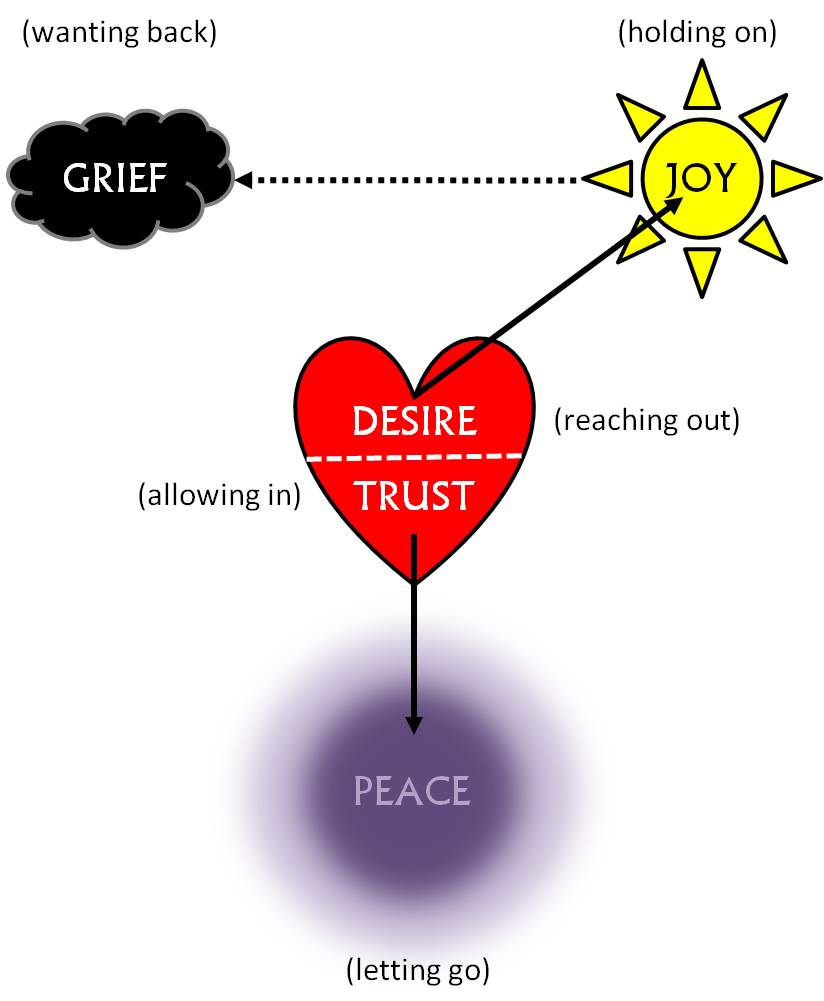
Her death has left behind this vacancy. My father is overcome with emotion as he vacuums over the spot where her hospice bed had been. An empty chair across the kitchen table has him weeping over his morning oatmeal. You know how a wall that once held a painting keeps a shadow in its absence? It’s like that – a reminder of something that isn’t there anymore. His vacancy is different from mine, even though they were once occupied by the same living person.

One of my daughters has a favorite book of my mother’s. In the margins are faint pencil checks marking passages that had caught her attention; here and there a crumb from her morning toast is lodged in the seam. Young fingers slowly sweep the pages – imagining, remembering, wondering, longing. Something so ordinary is suddenly the only one of its kind.

I find myself getting frustrated over an inability to focus on things that held my fascination but a couple of weeks ago. Certainly she knew I loved her. Did I tell her often enough? What does that even mean: enough?

The world still wobbles out of balance. Sorrow rises and rolls like a black ocean, lapping over the rim of my fragile composure. So love leads to suffering? I hurt more the harder I hold on? Sounds right. But I’m not quite ready to let go. I need to live with this absence for just a while longer.

Why don’t you pull up a chair and tell me your story?

The Spirituality of Dropping Out

In recent years there’s been a lot of talk about purpose and the importance of living a “purpose-driven” life. In Christian circles especially, the message has been that knowing god’s purpose for you and living with a mission-in-mind is what it’s all about. This has turned out to be a “best-selling” proposal, as apparently many people are looking for purpose in life. Whether specifically religious or not, we like to think there’s something we can do or jump on board with to give our lives direction and meaning.

But what is purpose, and what does it mean to have one? For most of us it’s probably identified with being useful or having a function. We are reassured in knowing that god has a use for us, that we fit into his design scheme and have something we can wake up to each day. If there was no grand purpose to existence, then life would be meaningless. If this moment in life isn’t hooked into a forward trajectory of end-values, then there would be no reason to go on.

And if there happens not to be a god up there directing our lives toward the goals of prosperity, salvation, and a better setup later on, then we’re screwed. In previous posts I’ve made the case for god as a construct of meaning, and purpose as a positive illusion that keeps us sane and tilted to the future with hope. It hasn’t been my agenda to discredit these things – I’m neither an atheist nor a nihilist – but only to explore their importance to the general guidance and inspiration in what may be regarded a meaningful life.

In this post, however, I want to say something about the even greater importance of “dropping out” of meaning from time to time. While religion – the meaning, the message, the morality and the mechanics of what is going on at the surface – is concerned with keeping people plugged into the mission, our soul (and spirituality) really has no interest whatsoever in “making it,” fitting in, or “getting there.” Instead, what we seek at the deepest level is what I name the present mystery of reality, or real presence.

Let’s unpack this a bit more so we can see the difference between a “purpose-driven” life and one that is “presence-seeking.”

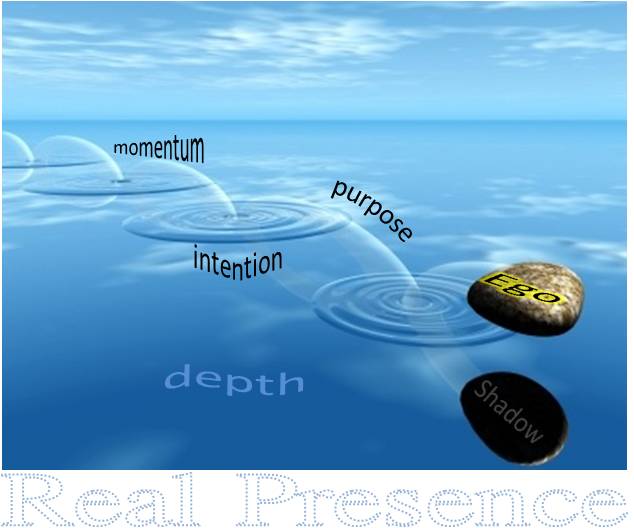
skipping stoneIn the illustration above, daily life is represented as a skipping stone on its trajectory through time. The stone itself is the “I” of ego, the construct of personal identity that carries the imprint of my earliest relationships and the role assignments of my tribe, along with the peculiar neurotic styles that defend and compensate for my emotional wounds. Ego suffers under the delusion of substance – that “I” have reality and matter more than anything, though it’s nothing but a reflex of contractions, preferences, attachments, and convictions.

As I said, none of us get very far along in life without our share of bumps, bruises and emotional wounds. Ego is the part of me that I want you to see: my glow, my charisma, my accomplishments and lofty goals. I am careful to play this to the audience so they will regard me highly, approve of me and give me accolades, and maybe (if I’m lucky) envy me for my magnanimity. I am a handsome actor.

Underneath me – or rather, on the underside of ego – is my shadow. This includes those parts of myself that I don’t want you to see, the parts I’m ashamed of or unsure about. At the pain-center of my emotional wounds, inside the ring of self-defense and coping strategies, is a sense of vulnerability and “not enough.” If I can keep these hidden, or maybe outwardly project their opposites into a moral crusade of some kind, then I’m safe.

But here’s the thing. Every time I arc closer to reality, the reflection of my shadow on the water’s surface confronts me with a challenge to acknowledge and confess what I’m up to. As I approach the real presence of mystery, this forsaken and repressed part of myself comes closer to the threshold of self-awareness. When I make contact with reality, this negatively charged shadow repels me into another launch – and off I go for another arc across the pond of life.

Behind me, then, is the momentum in this game of “Outrun the Shadow” that I’m busy playing. If my ego-and-shadow duality is sufficiently polarized, this push from behind will exhaust itself into a fall only to be recharged the moment I barely touch what is repulsive and unforgivable in myself. So I contract with renewed purpose – with the necessary look-away from the present moment and my internal conflict, along with the requisite conviction concerning the high importance of the end I am pursuing. Onward Christian soldier.

Look right there, at the very point where momentum flags but before the ego is flung out again. This is something we habitually overlook in our skipping course through life: Let’s call it intention. What is intention? It is related to purpose, but isn’t end-focused like a purpose-driven life is said to be. Very simply, intention is not living for a purpose but living with purpose – or as we commonly say, living on purpose.

Whereas “purpose” in the conventional sense gets tied to future goals and making forward progress, intention doesn’t have an outcome in mind, no end-point in the future, but rather represents the opening of awareness to the depth of life in this moment. It descends along a vertical axis into present-moment experience, into the present mystery of reality. The real presence discovered here is not a something from somewhere else; it is not a being, but being-itself, the power and freedom to be here and now.

From the surface perspective, the one who “drops out” of the official program of a purpose-driven life is a loser, a quitter, a defiant and godless mystic. He or she stops fussing and stressing over the “many things” that the rest of us are trying so hard to manage. Instead of working to please god, fit in his plan, and accomplish his mission, the mystic enjoys a deepening communion with the present mystery. He or she surrenders ambition, letting the neurotic tangle of personality unwind and dissolve away. No future salvation for this one; it’s a pity.

From below, however, the spirituality of dropping out is really about dropping in – into the here-and-now, into this body, this breath, into this quiet presence of being. In this deeper place, the ego boundary that had separated me from the rest of reality suddenly transforms into a threshold connecting me to everything. What had put me against reality now joins me to it – but not ‘it’ … just this.

Religion at the surface attaches incentives of rewards or penalties to the obligation of reaching out and helping others. A spirituality of the depths knows that self and neighbor are really one – an awareness that opens out into compassion, benevolence, generosity and forgiveness. There really is nothing to hold onto, nothing to defend, nothing to chase after, and nothing to lose.

When I rise from this contemplative state, put on my costume of identity and step back into the game, others will get a sense that the game is changing.

A Case for Healthy Religion

My aim in this post is to offer an understanding of religion that can help us appreciate its importance while providing criteria for constructive criticism. Many today are applauding the decline of religion as a necessary precursor to our postmodern “enlightenment.” Religion is based in superstition, organized around power and privilege, corrupt at the deepest level, bigoted, narrow-minded, and prone to violence.

So they claim.

If I happen to agree with every one of those charges, why would I care to offer any kind of defense of religion? I want to be clear that I will not be defending any particular religion, but religion itself – the function it is meant to serve in society and in the evolution of humanity. The question of whether religion might continue to serve this function or if its time has passed will be left to the reader’s opinion. Here at least is how I see it.

Chakra_tree

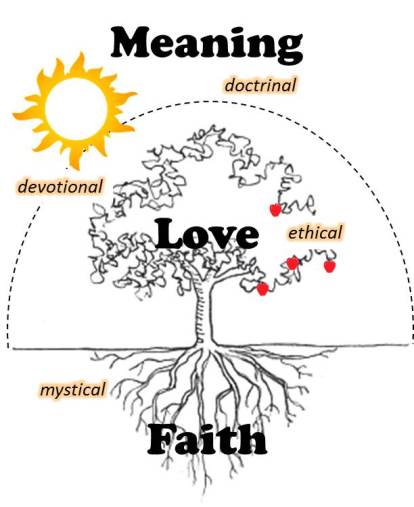
The above diagram carries forward the main idea of a previous post (http://wp.me/p2tkek-ku), proposing a view of the human being as an ascending axis through three centers of consciousness. Corresponding to the gut-level is our concern for security. I call this the elementary dimension, as it has to do with our basic life support and survival as living organisms. Our nervous system sets the internal state of our body according to signals from the environment that indicate providence or negligence in reality. Consequently we will carry a visceral state of calm or distress, relaxed attention or high alert, faith or anxiety.

Religion begins – or at least it once began – in this deep visceral response of faith to the gracious support of a provident reality. This is not a conscious decision or even a voluntary act, but an intuitive and spontaneous release in the autonomic nervous system to the grounding mystery of being itself. The etymology of “religion” (re + ligare) refers to something that ties back, re-connects or holds together what is or might become separated. In this case, the developing self-consciousness of an individual finds a link back into the deep support of reality.

In religion, such practices as centering prayer and meditation cultivate this descent into the present mystery of reality (also called the real presence of mystery). This is the mystical path, and no genuine religion can get started or stay healthy without it. Mystical faith should not be confused with the distinct beliefs that identify the different “faiths” or faith traditions. It is not about definitions or statements of orthodoxy. Since the experience of God and not beliefs about God is the primary concern at this level, mystics are frequently persecuted in religions that over-value theology.

As religion develops and consciousness ascends from its grounding mystery, the concern shifts from security to intimacy. As things naturally tend to go, a provident reality during infancy (and earlier in the womb) translates into secure bonds of protection, nourishment, and reciprocity with our higher powers. This moves us from (but not out of) the elementary and into the ethnic dimension of our human experience.

The science of interpersonal neurobiology is revealing just how important these intimate bonds are to our emotional development, particularly as it involves the “entrainment” of the infant’s right hemisphere to that of its mother. In this way, her emotional composure and caring presence – in short, her faith – train a matching state in her child. As time goes on, the child adores (gazes longingly at) the mother and imitates her behaviors with its own. She is serving as the child’s supreme higher power and devotional ideal.

Every religion orients its devotees on a deity of some sort, which is a representation in story, symbol and art of the community’s focus of worship and aspiration. This relationship is understood and encouraged as interpersonal, even without direct evidence of the deity as a separate personality. References in scripture and sermons to “who” god is, how god “feels,” and what god “wants” reinforce this idea of religion as a mutual exchange – of our worship, obedience, and service for God’s protection, blessing, and prosperity.

My particular interest in this devotional path has to do with the way it elevates our focus to the salient qualities or virtues of the deity. Much as a young child gazes upon its mother and emulates her in attitude and behavior, so the perfected virtues of the deity are first glorified, then obeyed (i.e., imitated), and finally internalized by the devotee.

A study of religion in this regard will reveal how consistently an advancing virtue such as forgiveness is first attributed exclusively to god, then commanded of believers, and at last awakens in them as a more or less spontaneous expression of the human spirit. This transition might be represented metaphorically, as it was in Christianity, by the internalization of the deity – in this case, the risen Jesus who indwells a believer.

If this apotheosis (becoming more like god) begins in devotion, it must eventually work its way out in new behavior, in the way believers conduct themselves in the world and toward others. This is the ethical path, which moves us out of the sanctuary and into the street. Ethics is about responsibility, following through on commitments and holding values with integrity. It’s not only about intention and effort, but looks to the consequences of action to determine its virtue. Whether or not you feel like helping your neighbor or forgiving your enemy, it is the right thing to do because it builds and repairs human community.

The ethical path, then, ties us back to others and our shared context. It is where the “fruit” of our faith and love show up as patience, kindness, and peaceful resolutions. Jesus said that the inner character of a person will be evident in the “fruits” of his outward behavior. It’s not what a person says or even believes, but what she does that really matters, especially when no one is watching or keeping score. Healthy religion promotes greater responsibility for oneself – contrary to the popular notion of “giving everything over to god” – as well as a heightened conscience into the impact of one’s actions on others and the environment.

In the very next moment following our experience of the grounding mystery, our mind is busy trying to make sense of it. By stitching together metaphors, analogies, concepts and associations, it constructs meaning around an essentially ineffable (word-defying) reality. The vaster web of meanings that we spin across our lives and thereby make them “mine” is called a world. I have one, you have one, and in many places our two worlds touch and overlap. But they are different as well – and importantly different, as each world revolves around our individual identities (i.e., our separate egos).

All the while that our nervous system is calibrating to the provident nature of reality, during the early years as we aspire to the personality models of our parents, and farther out into the life roles and responsibilities of adulthood, we are mentally engaged in constructing our (hopefully) meaningful world. What we think and believe is not entirely self-determined, however, as we carry the collective worldview of our tribe and culture as well.

In religion, the doctrinal path is what connects and re-connects our construct of meaning into a lively dialogue with others. Our definition of God, for instance, is nothing like a literal depiction since God is a mystery that cannot be defined. Its purpose is to serve as a common sign in our shared dialogue concerning ultimate reality, a kind of placeholder in language for something we cannot directly point to. As long as our definitions are compatible, we proceed on the belief that we are talking about the same thing (which is really no thing).

But there comes a time – for me it came during my early twenties and then again in my mid-forties – when the meaning of life and our definitions of God feel inadequate and contrived. I suspect that these are phases when the “habit” (as in the costume of a monk or nun) of our world doesn’t fit like it once did. It loses relevance or currency; the seams split and the hem starts to fray. Life can begin to feel boring or flat (as in two-dimensional) and the agreements that earlier made for overnight conversations now put us to sleep. What’s the problem? Paradoxically, too much meaning.

Religion starts to fail when its language about God (theology) in no longer translucent, that is to say, when the words, doctrines, and theories are taken literally instead of as names and allusions to a present mystery beyond meaning. Twenty-somethings and mid-lifers are especially sensitive to the light going out in religion. While everyone else is squinting their eyes or squeezing down on the fading glow, these individuals are wanting to update the glossary and get back to experience.

If there’s hope for religion, if there’s a chance for religion to be healthy again, then it will need to respect these iconoclasts (image-breakers) and return to the place where it all started. At least this much can be said: healthy religion is mystically grounded, devotionally focused, ethically engaged, and doctrinally relevant.

So what’s your preferred path? What voice do you bring to the conversation? More importantly, what are you waiting for?

Life in Three Dimensions

A human being is intended to live in three dimensions. I’m not referring to the three dimensions of ordinary space, and by “intended” I’m not suggesting that someone out there (i.e., god) has designed us with this specifically in mind. More along the lines of the genetic entelechy (inner aim) that drives and guides a living thing toward the ideal of maturity, my theory is that the individual develops – and our species is evolving – into a three-dimensional life according to the entelechy of our human nature.

So what are the three dimensions? Let’s start with life in one dimension. One-dimensional life is driven purely by unconscious instinct and guided by the urges and reflexes that keep an organism connected to the life-supply. I’ll name this the “elementary” dimension as it concerns what the organism of our body needs to stay alive and grow. It is basic and necessary and doesn’t require us to think, choose, or make decisions. Thankfully, you don’t have to decide when to breathe or how you will digest your food. It’s all taken care of automatically by the unconscious code in your cells, glands, and organs.

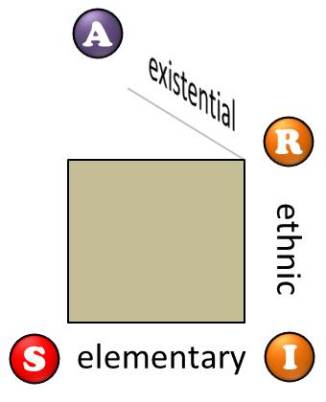
A human being has an animal nature, which by definition anchors us firmly in the elementary dimension of life. Your body is constantly seeking (though unconsciously, that is, below your conscious attention or control) situations where your biological needs are satisfied. I’ll call the general condition where these needs are connected to the life-supply security (‘S’ in the diagram below).

When you were still in the womb, and especially just after you were born, your nervous system was picking up signals and forming an internal impression regarding the provident nature of your environment. To the degree that its basic needs were met, your body established an internal state of security – a visceral (gut-level) sense that reality is safe, supportive, and favorable.

Generally speaking, wombs are more secure environments than the space outside the womb, but every human being has to undergo this “fall from paradise” and hopefully reestablish connection to the life-supply. For the rest of your life, your body and nervous system will continuously monitor reality for how providently it supports your needs. Outside of Eden the supply flow from resource to your need fell short of the instantaneous satisfaction that an umbilical cord provides. So already in your first hour after birth the pang of craving and anxiety broke the spell, causing you to cry out for caring attention.3D

If your caregivers were indeed attentive and responded to your cries with the support you needed, then this twinge of insecurity was resolved and you could relax into being. But no parents are perfect, nor could they be there at the very moment when your need declared itself, which is why all of us get hooked by anxiety to some extent. If we have difficulty as adults relaxing into being (or having faith in reality), then it’s not entirely our parents’ fault because they weren’t completely off the hook themselves (double meaning intended).

The quality of attachment to your caregivers can be measured in terms of intimacy (‘I’ in the diagram to the right). This refers to how close, warm, loving and supportive these bonds were, making it an extension of security. Because humans beings have a social instinct, this pursuit of intimacy occupies the critical crossover point between the first and second dimensions of existence. These attachment bonds served as your biological environment outside the womb, and so they are strongly correlated to your sense of security …

But your parents were also the first higher powers (or taller powers) who began the process of installing in your spongy brain the cultural codes of your tribe. This is what it means to say that intimacy is a crossover point between the first and second dimensions, from the elementary to the “ethnic” (referring to a primary human group). A human being cannot survive without social support. Those early intimate relationships not only satisfied your physical needs to some extent, but they also forged the emotional and interpersonal foundations of your identity (ego, or social self).

As you continued to grow into this second dimension, your tribe gradually trained and equipped you to take on specific roles and responsibilities (‘R’ in the diagram above). To the degree that society is a role play, your occupation and performance within this interactive system was a shared investment of everyone involved. You were expected to abide by the rules that dictated exactly where in the play your part came up (what I’m calling occupation) and how you were to carry it out (performance).

Eventually, after numerous roles on a variety of social stages, you were encouraged to take up a more or less permanent occupation in the world of work. As is the case with all your roles, there was a subtle but very persistent pressure on you to identify your self with this work role. The more successful this identification is, the more you are willing to lose and sacrifice on its behalf. Obviously this makes the exit transition of retirement problematic for individuals whose self concept is completely tied to their job or career.

And this is where most of us are currently stuck: in the second dimension, struggling to keep our relationships intact as we daily go to work and trade our creativity for a paycheck. A two-dimensional human being is not a totally fulfilled human being, however, which is why so many of us are frustrated, bored, and chronically depressed. The entelechy of our nature compels us to break through to a third dimension, but our present condition has such a grip on us that the upward thrust of our inner growth slams against the ceiling of the conventional world.

The “grip” I speak of is also known as the consensus trance, the contraction on consciousness exercised by the assumptions, expectations, and concerns of society. A tribe maintains order by its success in managing the mental limits of its members. If you feel stuck in the second dimension, it’s not for lack of effort on the part of your tribe in providing the intoxicants, prescriptions, distractions, amusements, excursions (as long as you come back!) and fluffy retirement package for sticking it out.

Few people wake up from this trance. Sleep-walking through a life of mediocrity is just easy enough to postpone a breakthrough. Religious orthodoxy spritzes a little more hallucinogen into our minds to keep us from causing a disturbance: Just wait. Your reward in heaven will make it all worthwhile.

But there are a few – and you may be one of them – who do wake up. They start by asking questions such as “What’s the point?” “Who really cares?” and “Why should I give away one more day of my life to something that doesn’t really matter?” Or they come to certain conclusions like “I’ve been living inside a mass delusion my whole life!” and “Life is short, and then you die.”  The truth of this is indisputable: you will die someday, and you don’t know when.

It could be tomorrow.

If tomorrow is your last day, how does that awareness affect what you do with today? Quite often when people ask themselves this question they break into a new realm of awareness, into what I’ll name the “existential” dimension of a human being. The fleeting character of life and the role play of society inspire in them a focused quest for the really real. This is the search for authenticity (‘A’ in the diagram”) and an authentic life, for the genuine ground of reality.

Finding it around you and inside yourself does not constitute an easy answer to your quest(ion) after the really real. You will still die, and it could be tomorrow. But now – and that’s a key existential word – you have the opportunity to be spiritually grounded, deeply centered, fully awake, and completely alive. As each moment unfolds like a flower, you draw its beauty and fragrance into every cell. Even if it’s painful and more like a thorn, you can be there and touch reality with open awareness.

The existential dimension of life is therefore about being present and responding in wonder, mindfulness, and gratitude to the present mystery of reality. It doesn’t throw off responsibility, renounce intimacy, or abandon security; but it may motivate you to quit your job for something more creative and true to your soul, leave a relationship that’s abusive or dead, or take a risk for the life you really want.

There are no guarantees.

According to reports, those who have awakened to authentic life don’t often win the affections of their two-dimensional contemporaries. Sometimes they have ended up on the street, in exile, or on a cross. But if you could go back for an interview and ask them whether it was all worth it, to a person they would no doubt respond with something like, “Are you kidding?!”

The Other Side

Just weeks ago I reported the devastating news our family received, that my mother had been diagnosed with an aggressive and already widespread pancreatic cancer. I contemplated what it would mean to lose the one who carried me into this world and cradled my early life, as only mothers are able to do. I wondered what it would be like on the other side of this loss.

Now I’m learning.

My son was born on my brother’s birthday – the young man who had lost his life twenty-seven years ago under the waves during a triathlon on the morning he was to walk across the stage to accept his master’s diploma. And now my mother has passed on the same day as my older daughter was born. Deliveries and departures – perhaps it’s a reminder that birth and death are warp and weft of one cloth. The finitude of our condition prevents us from holding the full tapestry all by ourselves. We need the grace of companionship and a supportive community to see the larger meaning of our human experience.

My mother was a searching soul, but not restless. She kept her mind open, but still held strong beliefs – about the present grace and mystery of God, about the beauty of human nature despite its limitations, darkness, and odd quirks. And about herself. She admitted to me that she had struggled with self-doubt all her life. This from a person who had presented countless spiritual retreats, written book studies on the works of well-known authors, and ministered alongside her husband of nearly 56 years, himself a pastor and gentle soul of unimpeachable character.

It had been an effort for my mother to step into the fear in order to follow through on her spiritual calling. But she did it. And the many, many people who were forever changed by the touch of her spirit are in some sense children of her faith. More than ever before, she has become a guide in my own journey of faith through the triumphs and tangles of this short, very short life.

Yes, this life is a witness. My mother, in her passing, has left behind a beautiful presence even in her absence – soft and fierce, patient and forgiving, longing and quietly at peace. What will I do with that space, with that presence? Is it even possible to pick up with my life as it was yesterday, or even earlier this morning?

She taught me to listen before I speak, to observe the flower rather than pluck it from its stem, to love people for their brokenness – not in spite of it. This is wisdom that can only come out of a brokenness that was found by a grace and strength from beyond. My mother wasn’t perfect, and never claimed to be. Later in life she discovered the joy of salvation in the wonderful, really unbelievable fact that we are all loved anyway.

Having released her anchor in this world, I feel that my mother’s word of encouragement to me now would be Let it come. Look for the hand of God. Love what spirit brings into your life. And when the time comes, let it go with gratitude. None of it’s yours, but it is all a gift.

Thank you, mom, for teaching me how to dance. I won’t forget.


Life in Perfect Freedom

Recently in my blog bibletracts (bibletracts.wordpress.com) I’ve been exploring the meaning of resurrection. The timing is right for two reasons. First, the liturgical year of the Church is now approaching the season of Easter, the Christian holy day set aside to celebrate the resurrection of Jesus. Secondly, because resurrection is fundamentally misunderstood when its meaning is fixed to something that supposedly happened to someone nearly 2,000 years ago. Treating it as a fact of history only apparently takes it seriously, when in reality a literal reading cuts the energizing nerve of resurrection altogether.

Biblical literalism is a one-dimensional reading that takes the Bible at face value. The attraction is that it effectively eliminates the potentially corrupting intervention of interpretation. There is nothing to interpret – it’s all right there on the surface, in what it says. A decided advantage to other approaches is literalism’s permission (and forgiveness) not to think critically.

But a literal reading of the Bible is then faced with the need to choose between contradictory texts: Who killed the giant Goliath, for instance, David (1 Samuel 17:51) or Elhanan (2 Samuel 21:19)? As well as inconsistent “reports”: Did all of Jesus’ disciples abandon him at his arrest (Gospel of Mark), or did a few stay with him to the very end (Gospel of John)?

The energy it takes to cleverly maneuver such obstacles in order to justify a literal reading gets tied up at the surface, so to speak, when the reader might break through to deeper meaning. “Deeper meaning” doesn’t get us closer to facts (which is a modern delusion) but closer to the experience – the encounter, insight, crisis, or realization – that inspired the production of meaning in the first place.

Why should we want to treat the resurrection as anything other or beyond the historical miracle of Jesus coming back to life? The absolute and exclusive nature of this historical claim is typically used to set Christianity apart from other religions and to sanction its own errant denominations. If we loosen our grip on the resurrection as an historical fact, won’t we also lose our standing as the one true religion?

That’s assuming validity to the claim that Christianity is the one true religion, or that it’s even meaningful to speak of a “true religion” in the first place. As I’ve worked that one over in a previous post (http://wp.me/p2tkek-f3), I want to move more specifically into an exploration of the originary experience of resurrection and its expanded architecture of meaning.

Architecture of Meaning

Let’s start with the resurrection taken as a miracle, which refers to a supernatural intervention suspending or breaking into the nexus of historical cause and effect. As miracle, the resurrection was a unique event that happened many centuries ago, whereby God intervened on the natural course of events and raised the dead Jesus back to life.

As long as we don’t look any more closely at it, the resurrection-as-miracle is free to sit there in a mental vacuum without much context or background. Again, this is precisely where it is most useful to our efforts in staking an exclusive claim on truth.

But where do we learn about the resurrection? We didn’t witness the historical event ourselves, nor did we get the news from a living first-hand witness. Instead, we find it in a story.

Orthodoxy tries to protect its claim at this point by insisting that the so-called stories are really eye-witness accounts of historical facts. Or if they are not exactly eye-witness accounts (no one claims to have seen Jesus coming out of the tomb), then the authority of the Bible as “God’s word” makes them just as good or better. That leaves us with the resurrection as an absolute (stand-alone) fact, and the story of the resurrection a literal account. Done and done.

As far as the story is concerned, we are faced with the challenge of determining which “account” is the most literal. The Gospels don’t match up in full agreement on such details as who discovers the empty tomb, how the news gets out, and whether anyone sees Jesus (presumably risen) afterwards. Maybe these details don’t really matter. But then again, if it’s supposed to be God’s word to your ears and the proof is in the miracle, then errors in detail make the whole thing a little less reliable, don’t they?

A closer look at the story of the resurrection reveals an emptiness or openness at the key location where the decisive proof is supposed to be found. The abandoned and now-vacant tomb is not exactly proof of a resurrection. “He is not here” is all that can be said at this critical moment in the plot. In the narrative section just before this point we see Jesus hanging dead on his cross, and in the subsequent section we see Jesus alive again – though interestingly not in the earliest Gospel (Mark).

The orientation and balance of the Gospel narratives around this turning-point of the tomb suggests that the resurrection story is more than just a factual report. At this point (in this discussion but also in the Gospel story) we begin to get the sense of the narrative as not merely describing the mechanics of a miraculous event long ago, but as speaking to us from somewhere deeper within. We are being invited into the myth.

Although its career began in the simple idea of a narrative “plot,” myth is a term used in literary theory to identify a certain kind of story. A myth is not necessarily a story about the gods, but one that serves to orient our human concerns and aspirations inside an ultimately meaningful universe. It was only after we reached the presumption that our myths were factual reports that myth in general got downgraded to misleading fiction, deliberate deception, and erroneous beliefs (as in “The 10 myths of weight loss”).

The true meaning of a myth has really nothing to do with the objective accuracy of what it says, but rather with its power to touch, awaken, and direct human consciousness to the deeper mysteries of life and death.

In the Gospel myths the storyline has been elaborated in slightly different ways around this threshold symbol of a tomb. The action plot of the story moves through (or over) this threshold to the “other side” where the jubilant announcement is heard: “He is risen!” As threshold, the symbol occupies not only this horizontal axis of the temporal plot, but a vertical one as well, inviting our descent from overt meaning into a deeper register of awareness. Now the tomb begins to resonate in relative isolation from the narrative background and action sequence, serving to carry or “bear across” (metaphorein) our contemplative focus from surface meanings into the depths of mystery.

Meaning is our mind’s effort to qualify the mystery of being alive and living toward death. If all that elaboration at the surface is to  orient our existence inside an ultimately meaningful universe – and be meaningfully relevant – then some acknowledgment must be made of this one inescapable fact. And yet, perhaps by putting our focus on the end of our life’s sentence we are missing the real insight here.

Each moment comes and goes. The present arises, passes away, and rises again. From quarks to quasars and throughout the fragile web of life stretched in between, existence moves according to a rhythm of emergence and dissolution, rolling into waves and unwinding again, holding on and letting go. We see this all around us, but when it comes to contemplating our own final release we tense up and grip down in fear.

In actuality we are progressing through an indeterminate sequence of losses – that is to say, if our ambition is to hang on and make it through.

But what if we could let go? What would happen if we could find the courage to surrender ourselves to the provident grace of this moment, into the spacious emptiness of this present mystery? Beliefs, which are really conclusions from the past, would give way to faith, the ever-present act of resting fully in the Now. No longer would we (barely) live as hostages to our convictions, taking life in the name of truth. Instead, our peace would be timeless, our love boundless, and our joy would have no end.

This is how Jesus was said to live. When he died, those who understood him best knew that it wasn’t over. To the degree he had offered his life out of the spontaneous generosity of each moment, no tomb could hold him for good.

Flow in the Creative Life

I am of the opinion that a human being desires. Before this desire gets directed along a particular channel and attached to a specific object, it is life in its purest form. Life, desire, creativity and spirit – these are deeply synonymous terms in the vocabulary of what it is to be human.

Think of desire as the current that activates and inspires our experience at different levels. Oriental philosophy offers the idea of chi or energy and the various chakras or activation points along the vertical axis of the spine. Each center opens out to reality at a unique frequency of intelligence and concern. When the chakras are fully aligned and activated, an individual experiences “flow,” fulfillment and well-being.

The West has its own chakra system, although it hasn’t been developed to the degree of detail and sophistication as in the East. Typically these activation points go by the names “mind,” “heart,” and “will” – where mind thinks, heart feels, and will moves you to act. Medieval philosophy in many ways is best understood as a sustained contemplation and dialogue on these three energy-centers in human experience.

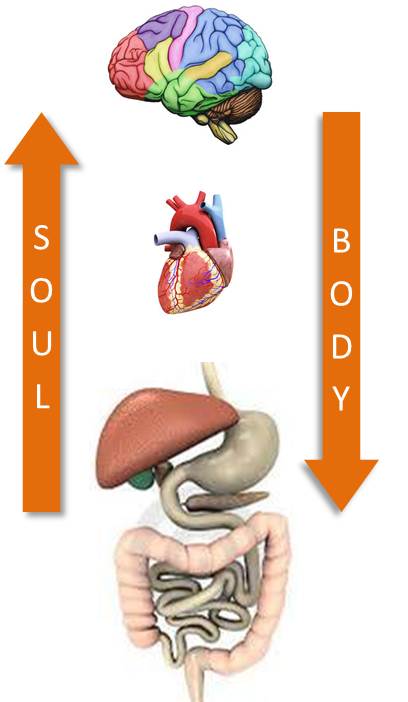
For their part, soul and body are not regarded as additional centers but refer rather to the deep interior (soul) and animal nature (body) of a human being. It was only later that a third dimension was clarified – not a “power” or energy center but what I have elsewhere characterized as a standpoint in reality – named ego. This is the socially constructed and self-conscious identity of an individual person.

As a construct, ego lacks the “substantiality” of the soul and body, and for that reason it would be acceptable to say – with Siddhartha Gautama (the Buddha) – that it doesn’t even exist. It’s a project and projection, a rather neurotic contraction of defenses, attachments and delusions.

In the language of liberation, awakening, and the creative life, ego is our primary obstacle. It’s what needs to “die” – in the words of Jesus (the Christ) – so that our deeper life can rise up and find its wings.

Back to the energy centers. This idea has become particularly interesting to me of late, as I reflect on creativity, desire, and spirit. I am appreciating more how the truly creative individual is one whose mind, heart and will are perfectly aligned and fully activated. In order to work out the implications of this, let’s look more closely at each of these Western chakras.

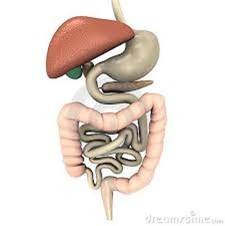
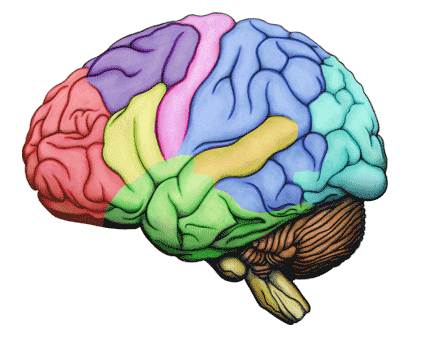
For our purposes I will use the organs of the brain, heart and gut as visual representations of mind, heart and will. And even though we are born with all our organs intact – with the brain nevertheless continuing to mature still into our third decade – I am going to begin this reflection at the gut level and move upwards, following the direction of development.

GutWhy is it that you feel sick to your stomach or have issues with your intestines when you feel distressed or threatened? Your gut is a system of organs working together to metabolize nutrients and remove toxins. When stress hormones are released into the bloodstream, your gut gets thrown into high gear so that you can have all the energy you need to get out of danger.

Your gut is the energy point where you feel either securely grounded or dangerously at risk of not getting what you need to stay alive. At this level of intelligence, reality needs to be experienced as provident and supportive, something greater in which you can trust and have faith.

Of course, the indisputable fact that you are alive is proof enough that you live in a provident universe. Not only “this place,” but this planet, this solar system, this galaxy, and the entire cosmos are conspiring at this moment to provide what you need to stay alive and flourish.

  • Key words here are: Providence, Support, Security, Trust and Faith.

When you have the assurance of this, the energy flow of desire is allowed to ascend the axis to points above. If it’s uncertain, or if you were raised in a home where there was lots of deprivation, neglect, abuse and repression, then the energy that should be ascending gets stuck in your gut. You can expect your health and happiness issues to be centered there.

HeartBut let’s say you are faithfully grounded in a reality that is provident and supportive. This sense of security is like a gate that lets desire continue on its upward circuit. Next it comes to your heart.

Why is it that when someone close to you decides to leave or is suddenly taken away, you feel “brokenhearted”? Why do so many people suffer from heartache? Your heart, more than any other organ, is connected to every other organ and outpost in your body. By its very nature it is about cooperation. When the connection between your heart and another organ is lost or obstructed, that organ will die.

Your heart is the energy point where you feel either intimately connected or coldly removed from the web of mutual interdependence. At this level of intelligence, reality needs to be experienced as relational and loving, something in which you can belong and find love.

A distinction between Western and Oriental cosmology is that while the latter regards the multiplicity of separately existing things as an illusion, Western philosophy and science affirm it as foundational to what the universe is. A corollary of this idea is the view that being is essentially relational and dynamic rather than monistic and unchanging.

  • Key words here are: Relationship, Communion, Intimacy, Belonging and Love.

When you have the assurance of this, the energy flow of desire is allowed to ascend the axis to the next point above. If it’s absent or doubtful, if your experience has involved more than your share of exploitation, rejection, betrayal or dysfunctional relationships, then the energy that should be ascending gets stuck in your heart. Your health issues might be centered here, in the physical consequences (or early symptoms) of losing your passion, compassion, and communion with life.

BrainBut let’s say you do feel a strong sense of belonging and healthy rapport in your relationships. This sense of intimacy is like a gate that lets desire continue on its upward circuit. Next it comes to your brain/mind.

Why is it that a lack of clarity in your efforts to make sense of something gives you a headache? Why are people so ready to trade their lack of meaning and purpose for a psychiatric diagnosis and treatment plan? Your brain is your “executive” organ, the seat of conscious awareness, and the worktable in your construction of meaning. Its dual responsibilities are to regulate the internal processes of your body and articulate the neural platform of your mind (thinking self).

Your brain is the energy point where the certainty of your life’s meaning is managed. With its unique cognitive powers you are constantly sounding a transcendent reality for echos of significance. At this level of intelligence, reality is scanned for patterns, rhythms, and correlations, which are then analyzed, synthesized, and fantasized into a cross-referencing system of meaning known as your world.

What you seek is understanding, and as you are busy with the process of constructing meaning, various checkpoints along the way (conventionally called “facts”) challenge your brain to update its world-picture.

Key words here are: Transcendence, Meaning, Certainty, Understanding and Truth.

Now, if the ascending path of desire has gotten tangled up and caught on hooks farther down, leaving only a trickle of energy by the time it reaches this point, your personal meaning can become extremely rigid, awkwardly outdated, and curiously dogmatic. When your intellectual guidance system is out of sync with the actual coordinates of reality, you should expect headaches – physical and otherwise.


Okay, so there you have my interpretation of the Western “chakra system.” Human creativity is an inverse function of the “impedance” in this flow of energy/desire/spirit through the primary centers of the gut, heart and brain.

The more impedance – that is to say, the greater degree in which this creative flow gets “hung up” and pulled off center into the various ailments, demons, and neuroses of our predicament – the less creative we are. (I suppose it’s obvious to also say, the more destructive we tend to become.)

The creative life is grounded in the provident mystery of reality. It flows outward into communion with all things. It strives to ask better questions, ones that will deepen understanding and open up a larger vision for our lives.

I think this model has a lot to commend it. Philosophy, theology, politics, business, commerce, art, science, medicine, ethics – we stand a chance of getting our cultural system back on track and centered again.

And just to think, it all begins with you and me.

Take care of yourself.

Check-point: The Future of Religion

Today, as the living stream of spiritual life grows increasingly frustrated behind the rigid walls of conventional religion, more and more people are looking for a way through. While a large number keep this struggle to themselves, willing to accept the problem of relevancy as a fault of their own, others are beginning to speak out.

Many are leaving church on their own accord; others are being asked to leave.

Of course, similar things have happened throughout Church history: revivals, protests, and reformations are how religion stays current and meaningful in changing times. For the most part, orthodoxy has managed to accommodate our spiritual development, translating age-old doctrines and philosophical assumptions into present-day convictions.

Until recently, that is.

As church leaders experiment with new technologies and orchestrate an experience that is consumer-oriented and entertaining, churches and denominations continue to decline in membership. Charismatic preachers and sentimental praise songs are still an attraction and have their effect, but our deeper spiritual quest is going unanswered. Instead of vibrant insight into the present mystery of reality, we are handed the reheated leftovers of tradition.

Readers of this blog are already familiar with my criticism regarding these attempts at Sunday morning entertainment and retooling orthodoxy for another go-around. The problem of declining membership is centered not in the method of delivery but in the message being delivered. We are in the midst of a shift where religion needs to empty its buckets for a fresh refill from the moving stream of spiritual life.bucket

A mystically grounded faith – that is, an existential trust in the real presence of mystery – has always been the place in religion where this refreshment of meaning happens.

However, because orthodoxy is innately suspicious of the mystical experience, the present-day solution to the problem of relevancy amounts to painting old buckets and calling them new. The water inside – if there is any left – is staler than ever.

Mystery. At the heart of reality is a present mystery. This mystery is immediately accessible yet transcendent to our minds, always within our reach but forever beyond our grasp. It is the very ground of being, not out there somewhere but deep “in here” – inherent to existence and profoundly internal to consciousness.

It is the source and suchness of all beings; not another being, but being-itself. The present mystery of reality is continuously passing yet eternally Now. This moment is the narrow gate to communion with God.

Meaning. In itself, the real presence of mystery is ineffable; it can only be encountered, entered, and experienced. Putting concepts around it – or scooping it up into mental buckets – gives it form and makes it meaningful. But every image, symbol, metaphor or concept constructed by the mind is only an artifact of our intelligence, not the mystery itself.

Meaning-making is what the mind does. Drawing inferences and associations into the realm of daily concerns is how our minds translate mystery into meaning, experience into something more useful.

Self. A human being is a form of consciousness with the capacity to look outward on the present mystery as it manifests itself to our senses in our surroundings, as well as inward to the mystery of our own depths. Referring to these two orientations of awareness as “body” and “soul” has frequently led to their differentiation into opposite (and opposing) parts of the self.

Forcing this split of body and soul is a third mental location of human consciousness, known as ego (or “I”). Ego is not a primary orientation of awareness, but is rather a social construct consisting of gender instructions, role assignments, moral agreements, and cultural expectations defining what it means to be a member of the tribe.

In ego formation, the animal instincts of the body are disciplined and domesticated. For societies where this training is particularly harsh, repressive and shaming, the ego can psychologically dissociate from the body and mistake itself for the soul – but now as a metaphysically separate thing, an immortal personality detached from the life of the body.

Deity. Whereas the familiar moniker “God” (with a capital ‘g’) is useful in talking about the various ways that human beings cross-culturally represent the real presence of mystery, “deity” (also “god” with a lowercase ‘g’) refers to the portrait in art, myth, theory and doctrine of that never seen but much talked about guarantor of tribal authority.

Mystics seek the ineffable experience of real presence, while priests are social functionaries who perform on behalf of their deities, collecting the offerings from the congregation and dispensing favors of membership and the assurance of salvation.

Despite my satirical exposé, I nevertheless see a vitally important role for the patron deity of theistic religion. As The Voice of temperance, equanimity, fidelity, mercy, compassion and forgiveness, god’s command and personal example (as rendered in myth and exposited from the pulpit) serve to raise the moral aspirations of believers to the divine ideal.

As the mythological god becomes, with the advancing spiritual development of his mythographers, less vengeful and more benevolent, so too does the worshiping community grow into a more enlightened moral presence in the world.

Salvation. As human culture has evolved, the representation of our principal dilemma and its solution has changed accordingly. Earliest cultures were centered in nature and the body, and death was the obvious problem. Salvation (the solution) was not everlasting life in another world, but ritual renewal, seasonal rebirth, participating in the rhythms and priming the life cycle with appropriate sacrifices.

Gradually cultures became more socially centered, that is to say, increasingly preoccupied with tribal order, membership, and authority. As you might guess, this was the Age of Ego, when the urgencies of the body needed more than ever to be managed and the resources of nature exploited in the interest of social stability.

It was at this point that the control system of morality, dictated by the patron deity and enforced by his ordained deputies, created the very ideas of transgression, sin, and guilt. Thus did salvation become redefined as repentance and the reconciliation of sinners to god.

Most recently – but still going back 2500 years or so – a second shift occurred, corresponding this time to the awakening of a more mystical sensibility. The problem in this case was precipitated by the foregoing “solution,” where ego and the tribal deity came to oppose the body and nature – controlling them from outside, as it were – resulting in a pathological dualism.

Brokenness, division, separation and estrangement: not the enmity between sinners and god of the earlier phase, but a rupture in consciousness caused by the ego in its very formation is what needs to be resolved. Salvation, then, is the process of dropping attachments of “me” and “mine,” and releasing oneself in full surrender to the present mystery.

SunTruth. In light of this, the spiritual life becomes a quest for truth. Not a truth or even the absolute truth in doctrinal terms, but The True, the really real, life deep and abundant, authentic existence, radiant being.

Obviously this is not something that anyone (or any religion) can scoop up in conceptual buckets and carry to market. Truth, here, is not an article of knowledge but the depths and transforming power of an experience.

This is our way through. Theists don’t need to become atheists and leave their religion behind. Indeed, arguing for or against the existence of god (note the lowercase) is really a pointless exercise anyway.

The urgency today is for religion to catch up to the progress of spiritual evolution on our planet.

Radiant Being

Look around and rest your gaze on something nearby. What do you see? A coffee cup. A potted plant. An old paint-peeled wooden fence outside the window. 

What if I told you that you are mistaken?

The things you just named are only concepts – meanings that your mind is putting around what you see. “Coffee cup,” for instance, only exists in your mind. As a concept, it links this thing into a web of associations primarily having to do with usefulness. This thing holds coffee and you can drink from it. It is an example of a semantic category that only makes sense within a general context of human purpose.mug

Constructivism holds that meaning is constructed by our minds and does not exist independent of a particular form of intelligence (our own) that is linguistic, conceptual, categorical and descriptive. Coffee cups wouldn’t exist if the intelligence that created and uses them never did.

But what about things that aren’t artifacts of human craft and technology?

That plant in the pot over there – certainly it exists independent of your mind, right? Look again.

“Plant” is also a concept that you are putting around that thing. It’s there on the “table” because it adds color to the “room” you’re in, as well as a hint of life in an otherwise artificial and sterile environment. The concept of “plant” and all its associations makes that thing meaningful.

But what is that thing without the concept of plant around it?

My word for it is mystery, which is about as nondescript a concept as our mind can manage before starting to spin a web and turning it into something for us. The present mystery of reality is concealed behind our conventions of meaning.

Once in a while this real presence breaks through the concepts we put around it, and when it does, our minds are typically stunned into a state of wonder, fascination, astonishment and awe. Another word for this real presence of mystery is radiant being or glory. In those moments of revelation (when the veil of meaning is pulled aside) the fullness of reality shines forth.

The practice of meditation can help us enter this state of present awareness where the radiant being and glory of reality is witnessed. Not a “coffee cup” or a “potted plant,” but this – the present-moment suchness of … this.

True enough, at some point we will need to exit this ecstatic state of mind and get back into that very complicated web of meaning called our world. We tend to be more comfortable there, more confident in what we think we know, more in control of what’s going on.

Ego much prefers to look in a mirror than through a clear window.

And what is ego but a tangled knot of personal preferences and convictions, ambitions and defenses, occasional embarrassment and tenacious conceit? Ego is our self-concept, the concept that has been put around our essential suchness. It is the conditioned self as distinct from the essential self, commonly called the soul.

Of course, once this essential self and concealed glory of the soul is named, it’s almost impossible to resist its further definition into something separate from the body – metaphysical, immortal, and belonging to another realm. When this happens, the soul is identified with the ego – as “my true identity” or “who I really am” – and a mystical realization is quickly and fatally corrupted into a heavy sediment of religious dogma.

An unfortunate consequence is that a genuine experience of mystery gets shrouded by concepts and shredded into meaning. What might have expanded into a “new mind” (metanoia) with “no-self” (anatta) to take control and make it meaningful, instead gets pulled into a neurotic orbit around me and mine. The grace and glory of radiant being is compressed into words, spun into creeds, and enforced as saving doctrine upon the minds of true believers.

When it comes down to it, ego craves tight spaces and there is no tighter space than the inside of a fervently held belief. Ironically, while ego-centered religion aggressively advances its message of escape, it makes itself a hostage of its own convictions.

If the human spirit longs for freedom and expansion – and I think it does – this constricting force of religion is largely responsible for the spiritual frustration driving our present civilization into a deepening spiral of tribal violence and rampant consumerism.


Whoa! Back to that coffee cup.

Take another look. What do you see? Suchness. Mystery. Real presence. Radiant being. Glory. This is the present mystery of reality. It is not a “cup,” just a means of carrying “coffee” so you can make it through the reading of this blog post.

Pick it up. Feel its weight and balance in your hand. Observe its color and contours. Tap it lightly and listenSurrender your labels and concepts. Forget about what this thing is for, what use it has to you. Instead of closing your mind down on its meaning, allow attention to open out to its mystery. Give up the idea for a moment that this thing is here for your sake.

When you release the present mystery of anything from the constraints of meaning, you’ll be surprised at how centered and grounded it reveals itself to be. When you can let go of your conditioned self – although admittedly this can be terrifying when you’ve been playing safe inside its narrow space – the glory of your human nature can touch the radiant being all around you.

The glory of that present mystery in your hands calls to the mystery of your own being. As the concept drops away, so too does the part of you that craves the illusion of security, control, and distance that meaning can provide.

The early Greek Christian bishop Irenaeus once wrote, “The glory of God is the human being fully alive, and the life of a human being consists in beholding divinity.” Although orthodoxy would take off in a very different direction, this confession, this mystical witness to the glory of radiant being, is, as they say, on the books.

Now that’s a satisfying cup of coffee.