A Chance for Democracy

After the National Democratic Convention was over, Donald Trump called it “horrible” and “depressing,” that it was the most depressing thing he’d ever seen. By now, Trump is well known for his hyperbole, which is one of the outstanding and most obvious symptoms of his binary mindset, lacking an ability to intellectually entertain complexity and paradox in the nature of things – which arguably is the nature of things.

I would call him a “limbic thinker,” one whose reasoning is driven by emotion (processed in the more primitive limbic system of our brain), whose worldview is charged by dualism, conflict, and division.

Soon after Trump took the Whitehouse I made the declaration that capitalism had won a decisive victory over democracy – the twin seedbed traditions wrapped around each other in the double-helix of American DNA. Since its beginnings, the American experiment has been this Yang of individual prosperity, private property, and self-interest, pulling against the Yin of communal wellbeing, equal rights, and engaged altruism – capitalism versus democracy, an economic ideology against a political one. For most of our history their dynamic balance has shifted to one side or the other of center.

But with Trump’s election, capitalism and its associated values wrested executive control from this delicate balance of powers.

If we were to regard America as a corporate individual, then the “What’s in it for me?” of our emotional Inner Child took control from our adult Higher Self which honors the obvious fact that “We are all in this together.” If this self-interested impulse had earlier been managed by the ideals and responsibilities of shared governance, under a president whose Inner Child is in charge the tense yet creative balance of these very different ideologies finally snapped.

America itself collapsed from a more cerebral capacity for holding the paradox of alternative visions, to a limbic intolerance for compromise and an apocalyptic urgency to push “the other” out of the circle.

We shouldn’t be surprised by the consequences. Life in adult community requires mutual respect, dialogue, deep listening, cooperation, and working for solutions that benefit both sides and have the wellbeing of everyone in mind. And when these more mature commitments are put offline, what should we expect? Nested ecosystems that thrive only by virtue of their diversity have been steadily undermined and hijacked by primitive (and childish) cravings for a simpler and presumably safer world of one kind, one color, one creed.

To Trump, Joe Biden’s dream of light, hope, and love is nothing but a nightmare. It’s like putting a child in a room of adults who are sharing different perspectives, challenging each other’s views, digging for common ground, and reaching beyond their respective beliefs for a bigger vision that includes everyone. The child’s this-or-that, either-or, all-or-nothing emotional (limbic) processor would be quickly overwhelmed, prompting either his retreat into private fantasy or a disruptive outburst that might hope to break the unbearable tension and resolve his anxiety.

The long debate between American democracy and American capitalism is a lot like that room of adults where the values of communal life and individual freedom, the greater good and personal happiness, a transgenerational longview and the more nearsighted aspirations of a single lifetime are exchanged over biscuits and tea or glasses of wine. Each side has its convictions and misunderstandings, but their shared responsibility to a peaceful coexistence keeps them open to each other and searching for a balance they can not only live with but also live for.

If there’s a secret to American democracy, it’s that our leaders have been mature enough (with exceptions) to hold as sacred the ideals of a perfect union and the unalienable rights of the individual, of our need for community and our obsessions with identity. These are obviously not just saying the same thing in two different ways, but are rather saying two very different things that can be complementary despite pulling in opposite directions.

American democracy is our commitment to the work of managing their balance.

Instead of conceptualizing democracy and capitalism in absolute terms, as entering the arena (or courtroom) from opposite and independent sides, we should better see them as conceptual abstractions from a shared continuum of interdependence.

The fact is, they don’t – and can’t – work without each other, and their respective visions of life are unrealizable apart from the counterbalance each carries in the conversation. Communal wellbeing and individual properity are the inextricably deep principles whose opposition is the matrix of every ecosystem, in both cultural and natural realms.

Take away the individual’s drive for self-improvement and competitive success, and you will cut the fuse of healthy community. Equally, yet oppositely, if you remove the social constraints and transpersonal ideals of community, those very standards of improvement and success will cease to matter, and the “victorious” individual will sink into a despairing isolation.

It is possible to stand out so far above the rest that you are all alone, just as you can hide inside a relationship and never find your true self.

If there’s a chance for democracy this November, it won’t be by casting aside self-interest – and casting Donald Trump out of the Whitehouse – but by redrawing the boundary that defines our sense of self. When Trump and our Inner Child feel threatened by the otherness of others (i.e., what we don’t identify with and can’t understand), we tend to push them away and put up a wall.

If you happen to be rich and can afford a wall, then good for you. Just know that it won’t be good for you for very long.

As we’ve been challenged to do over and over again in the history of our nation, we also have a more adult option, one that involves expanding our horizon of identity and definition of self so as to include the other – even the otherness of others. We’re not just Americans: Democrats or Republicans, capitalists or communitarians, white, black or brown. We are human beings and siblings of one family. We share this planet in a web of life with countless cousins, suspended together for a brief interval of time between a common ancestor and our own imagined descendents.

So we gave it a shot. For four long years we stepped aside as adults and let the Inner Child take over. Now it’s time to get back in the game, straighten up the place, and restart the dialogue.

Evolutionary Faith

Even though I’m an amateur blogger, I like to pay attention to which posts my readers are visiting more often. Presumably more visits indicates a greater interest in a particular topic or idea, and I like to think there’s an opportunity for advancing the dialogue together. Among the things I write about, the topics of faith, spirituality, and religion seem to be most interesting – to my readers as well as to me personally.

I know that some would prefer to drop the whole set and get on with life in the modern age, seeing how much confusion, bigotry, persecution, and suffering have been perpetrated for their sake and in their name. But I’ve argued for a long time that these three forces in human history and experience cannot simply be dismissed just because they happen to be problematic.

Indeed, they are problematic precisely because they are so critically important and essential to our continuing human story.

Back in the 1970s James Fowler, a Professor of Theology and Human Development at Emory University, set about exploring the nature and development of faith, which he broadly defined as the act of relating to reality (“the universal”) and creating meaning. Fowler worked closely with Erik Erikson’s psychosocial model of development, which was and remains the standard theory in the field. His definition of faith cuts beneath the popular notion of it as either a more or less fixed set of religious beliefs (e.g., the Christian faith) or a willingness to believe something without evidence or logic to support it.

Fowler’s idea of faith as a basic orientation to reality and life in the world is therefore nonreligious in any formal sense, and much more experiential.

In his research, Fowler identified six stages of faith – seven including a “pre-stage” condition which he named undifferentiated or “primal” faith. Out of this undifferentiated state the developing individual’s mode of engaging reality and making meaning evolves – through childhood, into adulthood, and beyond. As in Erikson’s psychosocial theory, Fowler found numerous points where development can get arrested, delayed, or fixated, resulting in a kind of spiritual pathology that slows progress and compromises the individual’s successful transit to fulfillment or self-actualization.

My diagram correlates Fowler’s stages of faith with the historical development of religion through its three main types: animism, theism, and post-theism. A way of understanding this correlation would be to see individual faith as the prompt (inducement or drive) for changes in the character of religion at the cultural level; but also reciprocally, in terms of the way a society’s religion supports, shapes, and promotes (or stunts) the faith development of its members.

Finally, the big picture is revealed by those Yin-and-Yang poles of “communion” (mystical oneness) and “community” (ethical togetherness), which I recently explored in my post Human Progress. Once a separate center of self-conscious identity (ego) is established, reality can be engaged by going (1) deeper within ourselves to the grounding mystery of being, but also (2) by going farther beyond ourselves to the turning unity (universe) of all things.

The first path is a via negativa, releasing and subtracting all that goes into our individuation as separate individuals until only an experience of ineffable oneness remains: the mystical path. Stretching out and beyond us is a via positiva, affirming our unique existence and joining it to others in the experience of diversified togetherness: the ethical path.

Just seeing the dialectical continuum of communion (Yin) and community (Yang) there in front of us reveals the evolutionary principle working its way through Fowler’s stages of faith. From its genesis in the undifferentiated or primal experience of oneness where consciousness rests in its own grounding mystery, our engagement with reality progresses through ego formation and, finally, to the breakthrough realization that All is One – all of it together, including us. Our orientation in reality and the meaning of it all shifts, sometimes dramatically, from one paradigm to the next.

In the space remaining, I want to focus in on the three stages of faith that correlate to theism, the type of religion that is organized around the priorities of personal identity (deity and devotee), group membership, and a morality of obedience. Theism itself can be analyzed as evolving through three distinct phases: early, high, and late theism.

Early theism corresponds to the “mythic-literal” stage of faith, where the founding stories of world creation, tribal formation, heroic achievement, special revelation, and the consummation of history are taken quite literally, as setting our orientation in space and time.

In high theism, faith takes on a “synthetic-conventional” mode and the pressures of conformity motivate us to match our attitudes and outlook to the general view of our group. This is typically when the transcendence of god (the deity) is emphasized in worship and devotees are exhorted to worship god in humble submission, as they aspire to be more godly in their daily lives.

Because high theism has a tendency of getting locked into its arrangements of power and authority, it can often and actively work against the prompt of “individual-reflective” faith. As the individual awakens by a deeper curiosity and critical reason to doubts and insights that seem to challenge the tribal orthodoxy, religion can become a repressive force using guilt, along with the threat of excommunication and everlasting punishment, to bring the heretic back into its fold.

But it can happen that theism actually stimulates and encourages an individual’s quest for a relevant and secular (this-worldly) philosophy of life. The metaphorical foundations of theology (“god-talk”) are not only admitted but celebrated, and those sacred stories (myths) which had provided the incubator for our emerging identity back in childhood are now reappropriated as poetic lenses into the creative paradoxes of body and soul, self and other, humanity and nature.

Late theism need not be regarded as the “death” or “eclipse” of theism, but can rather be understood as the transition into an entirely new expression of spirituality and type of religion.

Post-theism – literally “after theism” – is about the farther reaches of human nature and the further stages in the development of faith. Fowler’s “conjunctive” faith actively brings together the heretofore disconnected and alienated aspects of our life: the shadow in our personality, the enemy we had worked so hard to keep at a distance, and the many variations on the theme of Truth that play out across the world cultures.

A “universalizing” faith beholds it All as One, seeking to live in and creatively cultivate genuine community, by such intentional practices as covenant fidelity, universal compassion, unconditional forgiveness, and absolute devotion to the wellbeing and fulfillment of all.

And So It Goes

It’s been a while since I’ve reflected on what makes grownups act like children, but with the US presidential campaigns kicking into high gear, this seems like a good time. Our conventional idea of an “adult” is a person who is rational and reasonable, reflective and responsible, who is emotionally centered, well-adjusted, and gets along with others.

We have a general expectation that children will grow into adults and act less like children as they enter maturity.

And our expectation is disappointed, again and again, not just by other people but even ourselves. Something happens that is hard to explain; and when it’s over we prefer not to spend time reflecting on what the hell just went down. Once the dust has settled, we’d rather move on and try to forget about it.

But then it happens again … and again, and again.

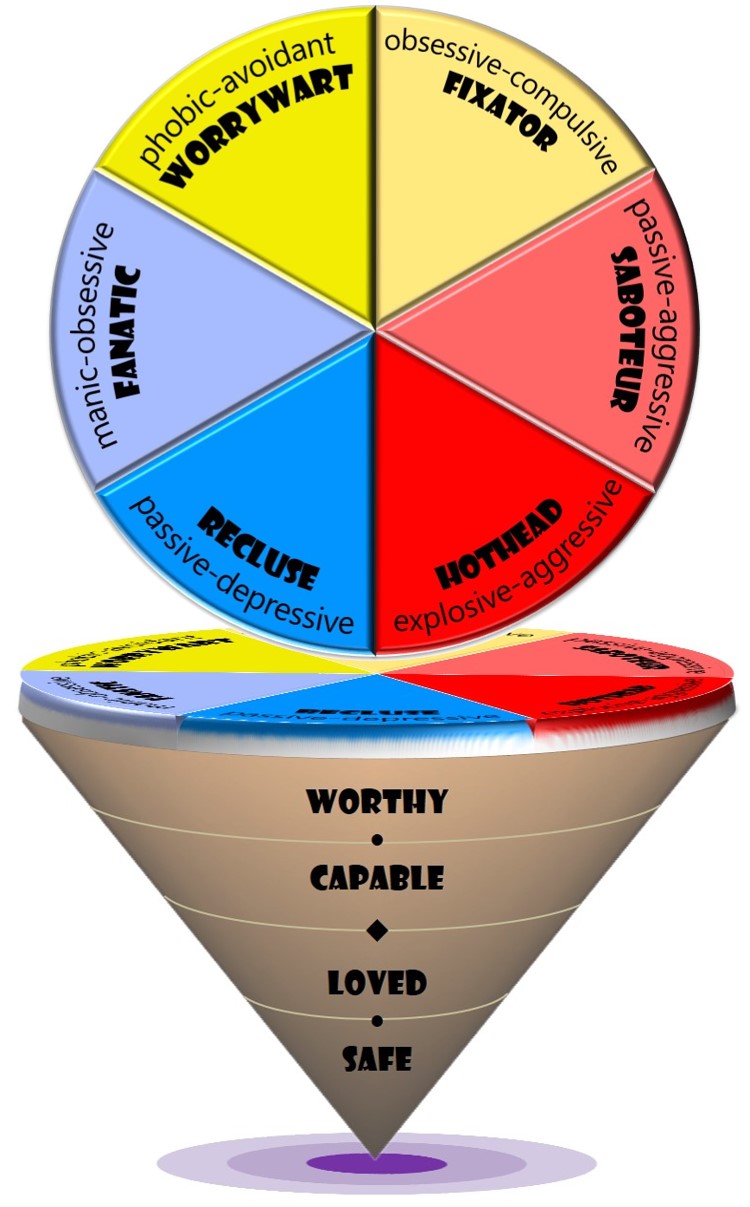
These strange behavioral episodes are what I call Neurotic Styles. Think of them as coping strategies we learned when we were children, ways of working around the dysfunction and deficiencies in our family system. From infancy and onward through the early years of childhood we needed to feel safe, loved, capable, and worthy – what I have named our “feeling-needs” or “subjective needs.”

The taller powers responsible for our health and wellbeing were either first-time parents who didn’t know better, distracted parents who didn’t notice, absent parents who weren’t around, or abusive parents who violated our need to feel safe, loved, capable, and worthy. Even the most attentive and caring parents slip up once in a while.

But it wasn’t all on them. We had our own selfish impulses and impossible demands that every conscientious parent has to somehow manage and train into socially acceptable behavior. We might have been particularly ungovernable, which would have taxed their patience and parenting skills, provoking responses that added new layers to the mess.

After all, domesticating an animal nature into a well-behaved socialite was no simple process – and never has been.

Our subjective needs were not negotiable. We couldn’t just skip over our need to feel safe, loved, capable, and worthy. Because they are about our need to feel a certain way in our nervous system and emotions (together generating our mood), it is possible that our external circumstances were fully adequate but still not enough because we had become so discontent, distressed, or depressed.

If there was in fact a sufficient supply of loving care provided to us, we might have had the additional demand that our parent (or whomever) make us feel safe because of some deeper insecurities we were carrying. This value-add of our anxiety motivated us to reach out and grab on to the other person in neurotic attachment, which are not conditions where love can take root and grow.

So our insistence that the other person make us feel safe actually interfered with our need to feel loved. See how that works – or doesn’t?

That behavior strategy of replacing love with attachment so we can feel safe is one common example of how we used our power to manipulate others. We may also have used our power to flatter and impress others in a misguided pursuit of feeling loved. Or we discovered that we could use our power to intimidate or seduce them and get what we wanted.

These are various “power plays” which, when successful enough and repeated on subsequent occasions, eventually got coded into our behavioral repertoire. They became our Neurotic Styles. Other Styles have less to do with manipulating other people than engaging in behaviors that helped us manage our anxiety, stay vigilant to potential threats, or retreat into ourselves for safety.

The important thing to understand is that, at least to some extent, these strategies worked in satisfying our feeling-needs, even if our family system wasn’t all that provident.

We were children back then: small, dependent, vulnerable, and weak in comparison with our taller powers. In order to get our needs met we found our way around. Our individual set of Neurotic Styles were incorporated into our developing personality, and we used them whenever we felt the situation warranted – although they were not really consciously selected so much as “triggered” by events around us.

But here’s the problem. Our personality as children was a complex of playful imagination, magical thinking, emotional reasoning, and these Neurotic Styles. Today this same complex lives on beneath higher processes of instrumental reason, logical thinking, and adult self-control – that is, until our “button” is pushed.

When that happens, our Inner Child breaks out and deploys a tactic of childish behavior, which may have worked when we were children but now only manages to turn heads, roll eyes, and convince others that we aren’t safe to be around.

For the past four years, Donald Trump’s Inner Child has manipulated the Grand Ole Party, a good swath of the American population, and undermined the establishment of democracy itself. In one interview after another, he shirks responsibility and passes blame, ignores or outright dismisses empirical science and objective data, loses his temper and calls people names. He seduces others into his inner circle and then excommunicates them with dishonor if they should dare contradict or challenge his opinion.

As the campaigns ramp up to November, the stress of it all – our tipping toward fascism, the ravaging waves of COVID-19 and continuing collapse of our economy, the rise of bigotry, prejudice, and violence on our streets, along with the now unmistakable (and undeniable) signs of unraveling ecosystems across our planet – all of it is making us feel threatened and helpless.

Our Inner Child is peaking out from under the covers, hoping that some taller power will arrive with a reassuring promise to protect us from the monster.

This is precisely when we need to get our own Higher Self into the game. There is real work to be done, including the repair of some serious damage to our race relations, community welfare, ethical integrity, and self-confidence. In November we must elect a fully functioning adult to presidential leadership, one who is self-possessed and genuinely concerned for the wellbeing of our families, neighborhoods, cities, states, nation and international commons, including the fragile yet still resilient web of life on our planet.

For this to happen, we need to be adults and do our part.

Adventures On The Way

I make the case frequently in this blog, that our development as individuals and evolution as a species has the aim of preparing us for the liberated life in community. The liberated life is not really “about” the individual set free from all constraints that might hinder his or her personal fulfillment, but rather that the individual is liberated from all neurotic self-concern and empowered with creative authority to live for the wellbeing of all.

Just as the evolution of life leads to increasingly complex ecosystems where “all is one,” we have every reason to believe the same for ourselves.

The path to getting there, however, is fraught with hangups and pitfalls. Even given an internal aim (Aristotle’s entelechy) in humans for the liberated life in community, we have managed to bungle things up to such a degree that now, after 200,000 years of “modern” human (homo sapiens sapiens) evolution, we are still a long way from its realization in any but a very few.

Tragically, as quickly as these inspiring exceptions have arisen in our collective history as a herd, the rest of us have pulled them down, cut them up, burned them at stakes or pinned them to crosses. Only afterwards do we give them honor – when honoring a memory is safer than honoring a living example and joining the cause. Where exactly they are going and how the rest of us get stuck is the topic of this post.

My diagram illustrates the path of our human adventure, where we have been busy forming stable societies, cultivating the healthy self-conscious awareness of individuals, and following the lead of those enlightened few along the Shining Way to genuine community.

Let’s take a few moments to contemplate the distinctive wisdom of this higher state of communal life.

  1. In genuine community individuals are fully self-conscious and deeply invested in the wellbeing of others.
  2. They understand that what they do to, and for, the Whole comes back on themselves, for good or ill.
  3. They are committed to a shared vision of peace, freedom, compassion, justice, and goodwill.
  4. Whether as individuals, partnerships, teams, organizations, or in larger “markets” of the human enterprise, they respect the fact that no one, no generation or other species of life, can flourish apart from the Whole.
  5. Accordingly they take responsibility, individually and as a community, for the consequences of their choices across the entire web of life and its concourse of generations.
  6. As a community, their ultimate concern is with raising up children who are spiritually grounded, well-centered, and mindfully engaged with reality and in their life with others.
  7. Each individual accepts creative authority in the co-construction of meaning and strives to create a world that is provident, welcoming, and radically inclusive.

Wouldn’t that be something? It’s encouraging that we can imagine what it would be like, since even if the path from vision to reality is long, at least it’s conceivable. The best (and truest) religions have kept vigil near this ideal, providing inspiration and guidance for whatever slow progress we have been able to manage. But even religion has largely lost its way, where instead of inspiring virtue it has fomented violence, and instead of offering guidance for a more humane and liberated life in the world, it has become an escape route for a believer’s abandonment of the world.

To understand how this happened to religion – but more importantly, since religions are only human constructions, how this happens to you and me – we need to pause our reverie on the liberated life and take a closer look at the process leading up to the point where individuals are empowered to transcend themselves and join each other in genuine community.

You and I came to life with a new generation of higher primates known as homo sapiens. We did not drop in from somewhere else, and neither is our species separate from Earth’s magnificent web of life. Evolutionary science has confirmed with overwhelming evidence and beyond all doubt that our human animal nature has descended – and ascended – from the 3.7-billion-year-old matrix of biological life on this planet.

Its tidal rhythms and ancient sea brine still pulse through our veins. The gill slits of a primordial ocean-dwelling ancestor are still visible in the human fetus.

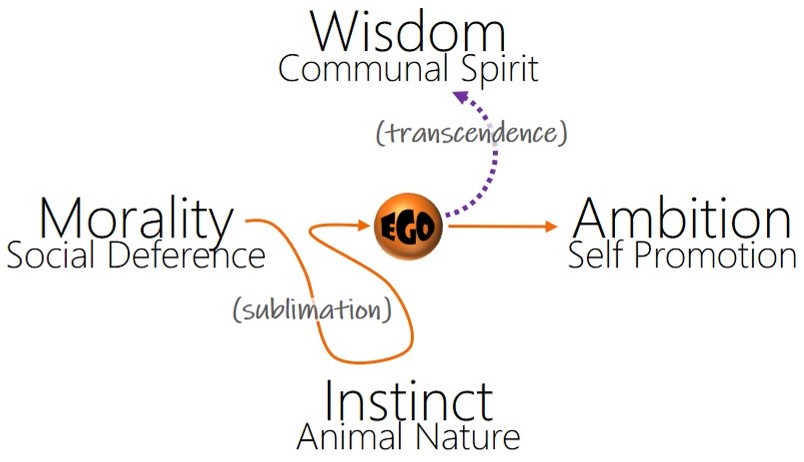
We also carry in our animal nature powerful codes of behavior called instincts. These too have evolved for the purpose of securing survival and a chance at procreation. Our animal instincts are not interested in being polite and waiting our turn. When the urge comes, our body has evolved with a compulsive need to gratify it. We arrived on the scene thanks to the many before us, both human and pre-human, who were successful to that end.

This instinct-driven animal nature is what our tribe had the responsibility of shaping and steering into a well-behaved member of society. It did this through a process of sublimation, where the code of instinctive behavior is overwritten with a new directive that works to restrain the impulse and then redirect it into an expression which is socially acceptable. That override of social constraints is what we know as morality, with its principal goal of conditioning and downloading a set of rules (“shalts” and “shalt nots”) that would predispose our social deference to the authority of taller powers.

To close off any potential uprise of rebellion in us, we may have also gotten the message that behind the authority of our taller powers was a Higher Power, who was not to be questioned but fearfully obeyed and devoutly worshiped.

In some cases, depending on the household and tribe where we came into the light of a self-conscious identity (ego), this shaping and motivating force of morality exercised more repression than restraint. Instead of a healthy interest in the social scene, we brooded a dark self-image of insecurity, shame, depravity, guilt, distrust and resentment. What should have developed into “ego strength” under the provident influence of caring and responsible adults, deformed instead into a personality riddled by anxiety, saddled with depression, neurotically attached, and chronically discontent.

If that diagnostic profile doesn’t accurately describe you, then you can be thankful. But you should also know that none of us get through the gauntlet of early childhood without our share of insecurity and its complications. Many of those complications are caused by a craving for whatever can fill our gnawing emptiness, contending at the same time with a persistent fear that it won’t be enough. This polarity of craving and fear is at the root of our word “ambition” (ambi = two), as a drive that exhausts its own energy and undermines its fulfillment.

The wisdom teachings invite us to reframe our ambition – this insatiable craving for what cannot satisfy us – using the principle of paradox.

Also with roots in the idea of duality, paradox is a form of “both/and” thinking. Paradoxically, the emptiness we have been trying to fill is also (both/and) the grounding mystery of our existence. In the separation of self-conscious identity (ego: “I”) from the sentient life of our animal nature, the vacancy we leave behind – simply because “I” am not there – is not a void but the very ground of our being, a generative (life-giving) emptiness and not a sucking drain.

The other essential paradox we need to understand is that our hard-won identity is both the end (as in finale) of our development as separate individuals and the beginning of our liberated life in genuine community (literally “together as one”). Our ego is embraced yet transcended; we “die” to our separate self and are “resurrected” into the communal spirit of a transpersonal reality.

The metaphorical language used here has obvious roots in the mythology of world religions, where the full paradoxical nature of the human journey has been explored and celebrated for millenniums.

A Promise to Each Other

A leader – I would like to say “by definition” – is one who cares about other people. There are plenty of self-styled leaders out there who don’t really care about others, or even much care for them. They are into leadership for the recognition, power, and influence, and if they have to interact with others, it’s only with the objective of promoting themselves, not serving others or a Greater Good.

President Trump is our best example of a so-called leader who doesn’t really care about people. For Trump, they are either behind him or in his way.

Trump’s election in 2016 was the outcome of at least three factors: an impatience for change among the American people, their idolatrous fascination with celebrity and wealth, and a deep childish insecurity that Trump’s campaign had successfully exploited in his run-up to November.

I explored that last one in my post A Nation of Children. There I brought out of the corner and into the light a part of our personality called the Inner Child. This is an emotional complex of feelings, attachments, magical thinking, and adaptive strategies which comes into formation during those early years of childhood. Back then we were underlings inside a theistic universe ruled by taller powers who sometimes weren’t all that provident. Their own insecurities – amplified by the stress of being parents and having less-than-perfect role models in their taller powers farther up the ancestral line – made it necessary for us to find ways of getting our needs met in spite of them.

Our Inner Child – really, no matter how happy and well-adjusted we happen to be now – operates by a different set of rules from the one that guides and informs our Higher Self (aka the rational adult our families and communities need us to be).

True enough, there’s all that innocence, curiosity, playfulness, and spontaneous trust that we praise as childlike; let’s call that the “bright side” of our Inner Child. On the “dark side,” however, are other characteristics: shame, self-doubt, selfishness, and calculated distrust that are rightly called childish. It was our dark side that Trump exploited for his election, and his strategy has continued, not only unabated but exacerbated, in the more than three-and-a-half years since.

The dark side of our Inner Child needs to divide an often confusing and unpredictable reality into the sharp dualities of good and bad, right and wrong, “for me” and “against me,” insiders and everybody else. This helped us negotiate an early home environment of abuse, disruption, neglect, and mixed messages. Even if it wasn’t all that bad for us growing up, there’s still a good measure of insecurity that we picked up on our adventure of separating into the self-conscious individual we are today.

When we feel stressed, pushed into a corner or put on the spot before we’re ready, our security strategies get activated and can easily force offline our adult capacities for contextual reasoning, fair consideration, critical thinking, problem solving, and self-control.

In order to get his way, Trump has poked, pushed, threatened, blamed, humiliated, intimidated and antagonized – and all with remarkable success. He has entranced the Republican party, rolled back protective regulations, tipped the table of wealth in his favor, repealed basic civil and human rights, demonized liberals and Democrats, alienated ethnic and gender minorities, circumvented essential protocols and safeguards of democracy, undermined the credentials of a moral society, incited violence between Americans, and invited interference by foreign countries in our national elections.

Now, we want to say that he did all these things without our consent. But we put him in office, didn’t we? Well, maybe not a popular majority of us, but enough of us did. And of those who did vote for Trump the first time around, I’m arguing that it was our Inner Child and not our Higher Self that pulled the lever that day.

We (those who voted for him) allowed him to weaken our faith in ourselves and each other and to put our hopes on him instead, that he would be the one to carry us through. He persuaded us to first question and then withdraw our compassion for one another. And then he played on our resultant self-isolation by convincing us that we were small and impotent – yet deserving and better than everyone else. The part of us that felt this way looked on Trump as the one we had been waiting for all along, and we eagerly gave him the keys to our destiny.

So we should all be able to agree that Donald Trump doesn’t care about other people, unless they are useful to him in getting what he wants. He doesn’t care about other people because he doesn’t understand them. He can’t identify with their human experience because he’s not in touch with his own.

A clear and direct line of awareness has roots in one’s empathic (introverted) familiarity with experiences of pain, hunger, separation and loss, which in turn enables a sympathetic (extroverted) understanding of those same feelings in others.

This is the psychological basis of compassion, where one is able to identify with another and is moved by goodwill to bring comfort, encouragement, and aid to the other in need. Trump’s lack of empathy and self-understanding is what’s behind his inability to have compassion for and truly understand other people.

I am arguing that Donald Trump needs our compassion – have you ever felt unloved and misunderstood? – but he doesn’t deserve our vote this coming November. I’m pretty sure that America and the world would not survive another term with him in office. Maybe the Republican party can promote a real leader in his place, who knows?

Either way, when the day comes, let’s show up to vote with our Higher Self. Can we promise that to each other?

Human Progress

In The Power of Myth Joseph Campbell says that “Heaven and hell are within us, and all the gods are within us.” He read the world’s mythologies as “magnified dreams” (ibid) projecting through metaphor and fiction the inner potentialities and evolutionary adventure of the human spirit. Even if the Hero of this journey typically returns home with boons (treasure, technology, virtue, or wisdom) for the society that he or she left behind in accepting the call, Campbell’s Jungian lens skewed his interpretation in favor of individual-psychic over communal-ethical values.

In a sense, what I’ve been working on in this blog is a model of human evolution and personal development that follows the Hero back home – but then continues the journey into the work of creative change where relationships are transformed and a New Reality comes into being. I call this New Reality “genuine community.” Not to be mistaken as just another synonym for the group, community represents a qualitative shift from the interpersonal to the transpersonal, where partners step into an altogether new mode of being-together.

But getting to that point involves a lot of formational work for the individual, which Campbell analyzed into a dozen or so elements that make up the Hero’s Journey. My diagram illustrates its major moves as well as normal complications that can pull ego formation off course and into the weeds. I’ve set the entire cycle over the image of Taoism, where the polar principles of Yin and Yang are honored for their respective contributions to the dynamic whole of reality.

It should make sense as we get into it, so let’s be on our way.

We begin – and now by “we” I mean each of us on our own Hero’s Journey – in a condition where consciousness is immersed in, contained by, and dependent on a kind of fluid matrix of countless relationships and interactive forces. This is the womb of our antepartum existence, although we can’t be said to “exist” (from Greek existere, to stand out) quite yet due to the fact that we cannot survive outside this protective and provident universe.

But it’s also true that even outside our mother’s womb we continue to depend for our survival and development on what surrounds and contains us.

This helps us understand the prevalence in mythology of a paradisaical womb-state of the first humans at the genesis of time; but also why the birth experience is represented in both religious myth and some transpersonal schools of Western psychology as the paradoxical moment when we fall out of oneness and into the realm of duality – where a liberated life awaits.

And because the actual birth experience is serving as a metaphor of our possible deliverance or awakening from the dark (unconscious, inscrutable, and ineffable) conditions of oneness which presently encompass us, our access to this “pre-ego” state of consciousness persists as a major theme in many mystical teachings and meditative practices.

Again paradoxically, the undifferentiated state of oneness (or communion) is both that from which consciousness seeks freedom, at the same moment it is also the ground and wellspring of consciousness itself.

Psychologically speaking, we need to “fall” out of oneness and into our own separate existence as individuals before we can find our way to genuine community. Even as we move out of communion – that is, out of the envelope of oneness in quest of ego identity – its web of provident conditions continues to sustain us, albeit below the threshold of our conscious awareness. (In More Than You Think I name this our “sympathic mind.”)

In other words, while the “separation consciousness” of ego is recognized (in Buddhism and Christianity, for instance) as the alienated state of our human condition prior to salvation (Buddhist enlightenment, Christian atonement), our breakthrough to that higher state of consciousness is made possible by our primordial fall from oneness.

A more “negative” view of ego formation identifies it not just with our fall from oneness, but also – and we might add inevitably – as the separatist principle that gets us hopelessly entangled in our fallen state. My diagram illustrates this further fall, which mythology depicts as a realm of perdition, estrangement, and profound suffering, as a tightening spiral that diverges from the proper path of the Hero’s Journey and pulls us down.

The insecurity of our separation is experienced psychologically as anxiety, and this in turn motivates us to latch onto whatever promises to make us feel better (i.e., less anxious). This attachment, however, becoming an object of our desperate need for succor, cannot satisfy the demand but instead only magnifies our frustration and drives us deeper into the despairing exhaustion of depression.

I happen to believe that this debilitating spiral of anxiety, attachment, frustration, and depression is the neurotic complex at the core of our modern mental health (and spiritual) crisis.

If we were fortunate to have been raised in a sufficiently provident home environment by good-enough taller powers, our personal identity and sense of self can find their center in a position of ego strength. Through our fall out of primordial oneness, consciousness has found a stable stage “east of Eden” (outside the garden paradise) where we are unique and self-conscious individuals.

Even if our early life wasn’t all that provident, we can still find our center and gain liberation from the spiral of suffering by coming in touch with our true self. This is what Carl Jung called “individuation”: the integration of personal identity around a center of ego strength.

This is also where the question “Who am I?” plays such a crucial role in our Hero’s Journey. Because what we identify “as” (e.g., tribe, class, sect, race, or species) is correlated to what we identify “with” (other members of our tribe, class, sect, race, or species), this question has the potential of breaking open those smaller identities we may have taken on as part of our security strategy.

We come to understand identity as a function of our affiliation with the human family (Judeo-Christian), all sentient beings (Buddhist), the web of life (native American), and even with the universe itself (e.g., the New Cosmology of Thomas Berry and Brian Swimme).

As this larger and more inclusive identity begins to reshape our perspective, it also transforms our values and inspires a new way of life – in community. The undifferentiated consciousness at the beginning of our journey, which fell into separation and duality and gradually found itself (by healthy development or salvation) properly centered in ego-consciousness, breaks out and circles back to unity consciousness where “self” and “other” are together as one.

Our journey doesn’t end with this new awareness and self-understanding, but continues with our consideration of “the other” in the choices we make, as we live with greater intention for the prosperity and wellbeing of all.

The View from Where You Are

The power of language as a tool for constructing meaning and making sense of things is painfully evident when we lack the words to build narratives and fashion lenses for taking our perspective on reality. One of the consequences of religion’s fall from relevance is that its historically deep toolbox of symbols and terms has also been left in the ditch.

If by chance religion’s aboriginal preoccupation is more than the metaphors and poetic fictions that have, time and again, distracted its attention into rabbit holes of literalism, fundamentalism, obscurantism, sectarianism, and terrorism, then the loss of its tools amounts to a serious – perhaps even catastrophic – setback for humanity, even as we gain a certain liberation from those pathological forms.

One of the important challenges for post-theism lies in this search-and-recovery for insights of authentic spirituality from the debris field of religious history.

It’s not necessary to revive a dying religion in order to pick its pockets for the genuine experience that may have gotten it started so long ago and infused it with life for a time. Religions are historical phenomena, and like everything else in time they will inevitably change and one day pass into extinction.

Spirituality, on the other hand, is concerned with our human experience of a timeless truth, of the present mystery of reality as it opens to us, here and now. It has more to do, then, with our perspective on reality and engagement with it – not as “something else” but as the essential nature and encompassing grandeur of being, and of our own very being.

Religion involves the subsequent task of relating this primary experience of being alive and immersed in a mystery we cannot fully grasp, to the ordinary and mundane features of everyday life. Such “linking back” (Latin religare) is the basic design and purpose of religion, constantly working against its tendency of obsessing over the linkages and losing sight of the primal mystery itself.

In this post we will try to refresh this view on and engagement with reality. We won’t talk of gods or saviors or special revelations granted to a privileged few so many millenniums ago. Religion is typically focused on the past and future, spending the present “religiously” reciting prayers, telling stories, and getting ready for the coming departure.

And yet, this very present is where the true mystery might be found, buried under the surface of all that religious business, to use one of Jesus’ favorite metaphors, like a priceless treasure hidden in a dirt field.

So then, there’s no better – really, no other – place to begin than right where you are. And where is that, exactly? If you say right here and now, in this spacious center of the essential mystery, you would of course be correct – in a way. It’s true that you are always here and now (where and when else might you possibly be?), if by “you” we are referring to this individual human being that you affectionately name “I, myself.”

But the one who takes this assignment and performs the roles of your identity in the world is something other than your essential nature as a human manifestation of being.

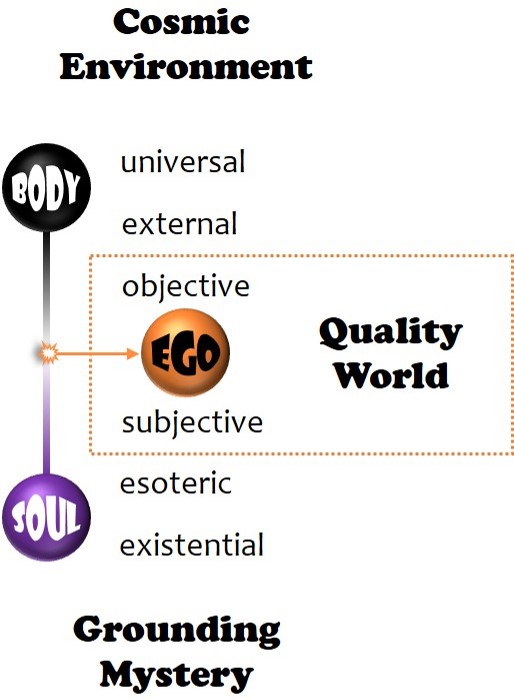
Ego (Latin for “I”) is a separate center of self-conscious identity which was gradually split off from your essential nature through the process of socialization. Its unique location is really nothing more than the roles and scripts, instructions and feedback, preferences and beliefs that were assigned to you by your tribe. The conspiracy of these factors constructed a kind of negative space, as the soapy film separates and defines a bubble from what’s around it, into which you withdrew and slowly became conscious of yourself as “one of us.”

This process of ego formation also included a massive stage production of context, backdrop, setting and a supporting cast, for which I will use William Glasser’s term “quality world.” Your quality world, then, is equally as real – or we should say “unreal” – as your ego identity, given that both are social constructions. It all seems very real to you, this objective “world” around you and the subjective “self” who is playing on stage. But none of it really is.

This, by the way, is where religion does its work of keeping all of that daily and lifelong drama connected to the timeless mystery of being, by its choreography of symbols, sanctuaries, stories, and sacraments (ritual enactments of sacred stories).

You might live your entire life inside this elaborate construct of ego identity and its quality world, never suspecting that “something more” lies beyond its boundaries. In fact, each of its primary correlates – “self” and “world” – is delimited by a threshold that opens outward or inward to this “more.” Beyond your quality world is an external realm, not “thrown over” (ob-jective) your identity as its context of meaning, but literally and altogether outside (ex-ternal) of meaning.

Before a name is put to something, before a value is assigned, and prior to the overlay of story that decides what it shall mean, external reality simply is – unconcerned with your identity, quite apart from your mind, and transcendent to your thoughts.

A second threshold separates your “thrown-under” (sub-jective) identity from the inner mystery of your existence as a human being. At the risk of becoming instantly irrelevant, I will use the term esoteric (from Greek referring to what is within) for this inner realm far below identity and the stage of your quality world. I don’t mean to suggest that it is some kind of secret stash of erudite metaphysical doctrines, which is what “esoteric” has come to mean in religion.

It is instead deeper than words and doctrines can reach, which is to say that this inner grounding mystery of your existence is ineffable – undefinable, inexpressible, unspeakable.

The mystery unfolds each moment in rhythms of life and cycles of consciousness as they ebb and flow, rise and fall, gather up and softly relax again into the ground of your being. Descending into the esoteric realm of your inner life, and now passing through it, you enter the existential dimension where you “stand out” (Greek ex-istere) from the quantum field of pure potentiality, which in the mystic traditions is called “the abyss” since it is paradoxically source and solvent of your existence, both the generative wellspring and dark fathomless depths of No-thing.

Having plumbed the esoteric and existential registers of your inner life (or soul), we can now swing back outward and upward, through the external realm of things as they are and into the universal dimension where it all “turns as/into one” (uni-verse). But whereas your descent of the grounding mystery required you to release your makeshift identity (ego) and the theater stage of your quality world, this ascent into the cosmic environment involves not subtraction but your addition as a participant in its turning unity.

And with all the countless other additions – you’re not the only one up here, you know – the web of relationships expands infinitely outward, shifting into exponential effects where 1 + 1 = 3.

Welcome to the view from where you are.

Seduction of the Mindless Life

The exact age at which we begin making intentional choices in life is up for debate, but there are good reasons for putting it somewhere between three and five. This is about the time when language acquisition has provided us with a lens for organizing the world around us, and with a mirror for reflecting back to us an image of ourselves. From that moment onward, life is no longer just happening to us but rather presents us with options, different doors and alternative paths that we must choose.

But to say that we must choose our life presents us with an apparent contradiction, since just as making a choice presupposes some degree of freedom, the necessity of making a choice seems to instantly cancel that freedom out.


The exact age at which we stop making intentional choices in life can also be debated, but I would put it somewhere in our early thirties. We’ve made a significant number of choices by that time, and through the years a good minority of them have settled into the habits and convictions that move us mindlessly along the cattle tracks of daily life. It wouldn’t be an exaggeration to say that by the time we are young adults, many of us are living prescribed and automatic lives.

This would all amount to a very tragic and extraordinarily pessimistic view of life, if it weren’t for the fact that we allow it to happen. Not only do we allow it to happen, but we hasten the process which will eventually have us locked inside the cage of a mindless life.


You might like to know why we do this, and I shall give you an answer. But first I have some questions for you.

If you were to guess, what percentage of your everyday behavior conforms to routines that were set months, years, and even decades ago? These background routines got their start after you first chose to act or respond in a certain way. Then you repeated the sequence across numerous similar situations until you no longer had to think about it. They migrated to the back of your mind and took control of your behavior.

Now let’s be clear, habits are basic to human life. If you had to make a fresh choice every time and clarify the steps all over again, the skosh of random access memory in your conscious attention would be terminally preoccupied with those minutiae. You’d never be able to learn anything, at least nothing very involved or complex.

Over your lifetime you have practiced and repeated many behaviors that eventually became habits, which, by liberating your conscious attention from that more rudimentary level of control, made it possible for you to tackle and learn more sophisticated skills.

What tends to happen, though, is that even these more sophisticated skills soon become habits. And now you’re bored; or you’re restless. Maybe you are restless and bored. That, my friend, is the precondition for all kinds of interesting mental disorders, from anxiety to depression.

But let’s come back to my questions.

Here’s another one: If you were to guess, what percentage of what you think you know about anything conforms to beliefs that were fixed in place months, years, and even decades ago? By a dynamic similar to the formation of habits, you might hear a statement from someone else or in a media broadcast, and then the following week you hear it again. Randomly through the day you recall what you heard and you think about it, again. With each repetition, whether external (you hear it again) or internal (you recall it again), that sound byte gains credibility in your mind.

As it becomes more familiar and you give emotional support to its supposed truth, that bit of doctrine becomes your belief.

As before, we need to acknowledge the crucial function of beliefs in human life. They are the mental equivalent to those motor routines of habit, in this case constructing propositions that serve to arrange your thoughts on a topic and render a judgment. As prefabricated judgments, or prejudgments (aka prejudices), beliefs save you time from having to think and consider and work out what something means to you. If your mind originally constructed (or borrowed) your belief about something, the mere repetition and persistence of that belief gradually gave it control over your thoughts, at which point it became a conviction.

Just as habits serve as background routines for new skills, convictions can simply be taken as true and thence serve as foundational beliefs of your worldview.

And wouldn’t you know it, but having your mind locked in a box where you don’t really need to think anymore results, not in a more complete understanding of reality as you may have hoped, but instead in a kind of mental hall of mirrors where this belief is cross-referenced with that belief, but very little of it touches the reality of everyday life.

Now to the question of why we do it. What on Earth would motivate us as young adults to surrender our free will for the cage of a mindless (and correspondingly meaningless) life? I’ve already hinted at something else in play, beyond the gradual takeover of consciousness by the normal accumulation of habits and convictions. Is there something seductive about the cage that lures us inside?

The answer is, Yes; and what we find so alluring is the escape it affords from the freedom and responsibility of choosing our way through life, moment to moment.

Employing that same strategy of liberating energy for higher-order challenges, human consciousness has evolved over many millenniums through an ascending hierarchy of pressing needs. Our primitive survival needs for air, water, food, and shelter have about them an unmistakable urgency. Later these needs were superseded by the social needs for connection, belonging, membership, and identity.

Very much later, our shared life in society began to stretch open and transform by the energy of still higher needs, which can be named spiritual, including our need for serenity, presence, communion, and wellbeing.

This is admittedly a gross simplification of human history, but it does serve to clarify what I mean by the “pressing need” of urgency. All of those distinct registers of human need – survival, social, and spiritual – are pressing and urgent precisely because they are critical to our fulfillment as human beings. In our evolutionary ascent through those registers, the habits and convictions associated with our survival needs had to break open in order to release the creative energy that our social needs would require. We had to learn how to share our resources, how to care for others, and how to repair damaged relationships.

And now, here we are: The spiritual needs are pressing us to change, to transform yet again, this time to choose our higher selves. It is urgent that we take responsibility for our lives and start living them on purpose, with purpose, and for the purpose of becoming fully human.

The human spirit cannot live in a cage. It is time to take our leave.

Beyond Ourselves

Every human society has a moral order it expects its members to uphold and obey. Evolution pushed us as a species into group sizes large enough where animal instincts were no longer sufficient guidance for this new and emotionally complicated situation, and we needed something “from above” to govern our behavior with each other.

While instinct is unconscious and compulsive, driving us to behave in certain predetermined ways, this higher government of rules, values, duties, and aims requires our thoughtful consideration, mutual agreement, and willing cooperation.

So whereas other species can live more or less spontaneously from their animal nature, humans, by virtue of the way sentient mind (or consciousness) bends back reflexively upon itself in self-conscious awareness, need a secondary system of codes to help us negotiate the challenges, opportunities, and obligations of social life.

In this post I will make an even more radical argument, proposing that our higher nature as spiritual animals – that is, as animals with a capacity for contemplative, creative, and transpersonal experiences – depends for its full realization on our successful passage through the moral order of our tribe. And obviously a successful passage will necessarily reflect how conservative, liberal, and enlightened this morality really is.

In its conservative aspect, morality anchors our emerging identity in the heritage of our people, with its traditions for gathering, celebrating, and maintaining community. In its liberal aspect, morality increasingly sets us free to choose and take responsibility for our own lives. And in its enlightened aspect, morality opens consciousness to the transpersonal realm where we understand ourselves (and each other) as belonging to a vast communion of life.

A telling symptom of our current moral crisis is the mutual condemnation of conservatives and liberals in their fight for control. But another symptom is far more ominous, and is to some extent a consequence of all that locked-horns animosity between those fighting to keep things the same and others who want them to change.

Distracted and exhausted by the debate, we can’t get over ourselves to thoughtfully consider where our moral development might otherwise lead us, if we could only lift our meditation to the bigger and longer view. Consequently our morality is not enlightened, and instead of inspiring better versions of ourselves, it is provoking our animal aggressions, driving us to destroy the very foundations of moral society upon which our fulfillment as a species depends.

Let’s rewind things a bit in order to better understand just how vulnerable we are as self-conscious individuals to the exploits and machinations of others who want to control us.

When we are infants and young children, our taller powers have the responsibility of teaching us, training us, shaping us, and installing in our mind the beliefs that will form our sense of self and the world around us.

This emerging ego (Latin for “I”) has no substance of its own but is purely a construct of all these codes, restraints, social prompts, and subjective feelings, spun together in a conspiracy of personal identity.

Our tribe fashions this construct of identity by conditioning us to identify with particular roles, role plays, and staged settings where our interactions with others play out. Just one more step beyond all these theater stages of social life brings us to the outer horizon of our personal world.

This is not just another name for objective reality, for our personal world is just as imaginary (made up and projected outward) as the identity we have taken on. “Who I am” (ego) and “where I belong” (world) are correlates of each other, and neither can be understood without reference to the other.

An important dynamic of this correlation of ego and world is tethered to the problem of security. When we feel insecure, we tend to make our world smaller by contracting its horizon to a more manageable size. By identifying with a smaller range of “me, mine, and other people like me,” we reduce our exposure to what might harm us.

Anxious egos inhabit small worlds, and the more insecure we feel, the more exclusive and isolating our world must become.

But with every successive collapse of our world horizon, we relinquish as well whatever influence we had in those larger realms of communion. Eventually our insecurity can motivate us to shrink our world so small and to contract so far into self-isolation – all in the hopes of keeping ourselves safe, mind you – that we feel utterly powerless and alone.

This happens to be the tactic of authoritarian demagogues like president Donald Trump, who exploit our ego insecurity by painting the world around us as dangerous and threatening, exhorting us to shrink our horizon of identity to the point where we are finally powerless to resist but can only watch as our resources, our rights, our freedoms, and our dignity get taken away.

A revolutionary discovery that signals our spiritual awakening, but which frequently comes as an unsettling shock of disillusionment, is when we see this identity construction of ego-and-world for what it is. Whether it’s our corrosive anxiety that drives us to the edge of revelation, or rather as a function of a positive ego strength that has prepared us to transcend ourselves for a larger and more inclusive experience, the illusion of personal identity begins to lose its enchantment.

If we are not, really, the roles we play and the masks we wear; if our in-group loyalties and shared convictions are social constructions (perhaps cultural hallucinations) and lack any basis in reality, then what’s left? Is this the “nothing matters” of nihilism that our orthodoxies warn us against?

The answer to the question of what’s left after the spell of ego-and-world is broken is … everything! When the construct that separates consciousness into self-consciousness, and further isolates self-consciousness into smaller and more exclusive identities – when this is released and transcended, we can finally see that we are not separate and alone after all.

Rooted again in the grounding mystery of life – but let’s remember that our separation was only a delusional episode – we can now clearly see, lovingly connect, and creatively act with the whole universe in mind.

The Arc of Spiritual Evolution

Times like these challenge us to examine the path that got us here, orient ourselves in the current situation, and consider our possible futures ahead. Racial tension, police brutality, the erosion of democracy, the degradation of our planet, the widening divide between rich and poor, and, just now, a coronavirus pandemic that is shaking the world economies to their foundations – all of it is conspiring in a perfect storm of apocalyptic proportions.

Alarmists and dooms-day prophets want us to believe that these are the End Times, and they are urging everyone to change their ways and get on the right side.

Half of what they are saying is correct: If we don’t change our ways, things are likely to only get worse and the world as we know it will be destroyed. Our lack of understanding when it comes to the nature and dynamics of living systems has prevented us from seeing how each of those vectors mentioned above is not merely correlated with the others, but is itself a symptom of the same underlying pathology.

Where I think they have it wrong, however, is in their prognostication of these “last days” as marking the terminal end of history and our human residence on Earth. True enough, the current upheaval is perhaps unprecedented in the history of our species, in being disruptive (breaking the routines and structures of daily life), protracted (still unfolding with no definite end in sight), and chaotic (the ‘perfect storm’ outside our control) – and all at once. With all of that going on, it’s easy to conclude that its conclusion will be hopeless and final.

When you feel powerless to do anything about the situation you’re in, giving up is the easiest thing to do.

I don’t want to suggest that our times aren’t so bad, that we just need to look on the bright side of things. They are bad. Many people are suffering and dying, and our planet itself is careening through seismic and systemic shifts that are pushing entire species into extinction almost daily. If ‘bad’ means painful, harmful, difficult, and serious, then these times are bad – maybe worse than they’ve ever been.

So am I just whistling in the dark?

I’m not ready to give up just yet because of one variable in particular, one factor in play that can make the difference between a final catastrophe and a breakthrough to something new – not just in terms of a unique arrangement of catastrophic leftovers, but as a next stage in our evolution as a species. This creative element is the human spirit.

And so, in what follows I want to dig deeper and reach higher into our spiritual intelligence and imagine a possible future for us, together.

When I speak of the human spirit, I don’t mean something that is separate from our animal nature, like a metaphysical soul riding inside our mortal body. Rather, I mean to identify an evolved type of intelligence (SQ) that has emerged with our developing brain and nervous system over the millenniums of hominid evolution, along with its construction of symbol systems that are the foundation of our world cultures and their webs of meaning.

Our spiritual intelligence gives us a way of engaging with the environment, each other, and ourselves that really does set humans apart from the rest of Earth’s species. And yet, one of its astonishing virtues is in how it enables us to understand the essential interdependence of life, the unity of existence, and our communion with all things. My diagram identifies a four-dimensional vision that our spiritual intelligence makes possible.

I will suggest that a successful transit through the disruptive, protracted, and chaotic change of these times requires a full activation of the human spirit; and further, that this moment is a decisive phase in the spiritual awakening of our species.

The terms of this vision – faith, love, purpose, and hope – are familiar to us. Nevertheless, or maybe because that is so, we will have to carefully define these terms and refresh their meaning. Their overuse and abuse in religion, business, and everyday life makes it necessary, every now and then, to trace them back to their metaphorical roots.

Deeper Faith

In the West, faith is understood as a willingness to believe something that lacks evidence or seems to contradict commonsense logic. “You’ve got to have faith” has come to mean “just believe it anyway” – that something is true or will come to pass, even (or especially) if nothing presently substantiates your belief. Under this definition, faith has frequently been used as encouragement to suspend or set aside thoughtful consideration and dismiss all evidence to the contrary.

In its deeper history, however, faith has nothing directly to do with beliefs. Essentially faith is trust, a letting-go or release of our ego identity to the deeper support and generative source of being, represented in religion by the metaphor of God. From ego (the separate center of “I”) we drop into the contemplative experience of embodied mind, and from there into an open space of boundless presence.

The deeper we go, the less ego there is, and the more immediate our awareness of resting in the present mystery of Being itself.

Wider Love

When faith deepens to the point where no separate “I” remains, our communion with everything else as manifestations of the same essential reality awakens in us a compassionate regard for these others “as myself.” With the judgments and contractions of ego identity gradually relaxed and released, our own boundary opens ever wider to include more and more of what had earlier been perceived as “not me” or even “against me.” Another way of phrasing this is to say that the boundary which had formerly separated our identity from others now becomes a threshold for compassionate engagement.

Our current crisis is providing us an opportunity to reverse ego’s inclination to contract and withdraw where we seek smaller zones of safety and control, and instead to transcend those security limits in the interest of reaching out to, connecting with, and including the other.

Higher Purpose

The idea of purpose and having a purpose is used in religion as a way of personalizing “god’s plan” for one’s life. According to this conception, god is in control of everything and has predetermined (predestined according to Calvinist doctrine) all things for his glory. Our lives will make more sense, work better, and end up in the right place as we are willing to commit ourselves to god’s plan and purpose for us.

But because theistic religion is focused on the identity and destiny of individual believers – that is to say, on ego – the impulse to contract inside smaller and safer identities where our insecurity can be better managed (or so we believe) tends to hyper-individualize this notion of purpose in theism and the societies it has influenced.

As I’m using the term here, higher purpose is not another name for “god’s plan and purpose for my life.” Higher denotes larger horizons of space and time, and purpose is more about intention than objective. In other words, it’s more about living on purpose than achieving goals or accomplishing a mission. A wider love by definition includes more, and as we are enabled by a deeper faith to transcend our separate identity for a larger communion, our investment of caring attention and mindful behavior (i.e., intention) shifts into that higher and larger – transpersonal – field of concerns.

Longer Hope

Our time horizon, referring to how deep into the past and far into the future the awareness of our present situation extends, is necessarily as small as our ego insecurity will allow. When it’s “all about me,” and this “me” has contracted inside an identity that is separatist, defensive, and insatiably discontent, our time horizon is very small indeed. We don’t identify ourselves with a family, a people, a species, or with a larger community of life.

Our relevant past goes back only as far as we can remember, and only to those events and experiences that have shaped our individual (ego) sense of self. And as the retrospectus of our life is what sets the forward range of our life’s prospectus, we simply cannot see beyond our own death into the longer destinies of our family, our people, our species, and of life on Earth.

It should be clear by now that hope is not wishful thinking, a kind of closing the eyes and “hoping for the best.”

Instead, as we consider our possible futures from the elevation of a transpersonal higher purpose, taking in the full communion of our life with others and grounded faithfully in the present mystery of reality, hope is what enables us to envision a future that includes us all, one that will be an inheritance of wellbeing for future generations.


This critical moment in human history and in the history of our planet has placed us at a choice point. On one side is the option of persisting in our current way of life, continuing to push our agendas and promote our beliefs. But let’s not forget: this is precisely the path that’s brought us to this point.

On the other side is the option of breaking through and moving beyond our current mindset, into a new way of being together. When the routines and structures of daily life break down, when the stress of change seems unrelenting, and when it’s no longer possible to simply return to the world as it was, transformation is our way through.