Spirituality for Everyone

One of my objectives in this blog, to be perfectly honest, is to help others understand spirituality as essentially distinct from orthodox religion and esoteric spiritualism. It is not, as religions commonly are, an establishment of conservative morality and an echo chamber of archaic superstitions. But neither is it a secret tradition of metaphysical revelations and paranormal powers, protected and passed on to new generations of illuminati by obscure rituals.

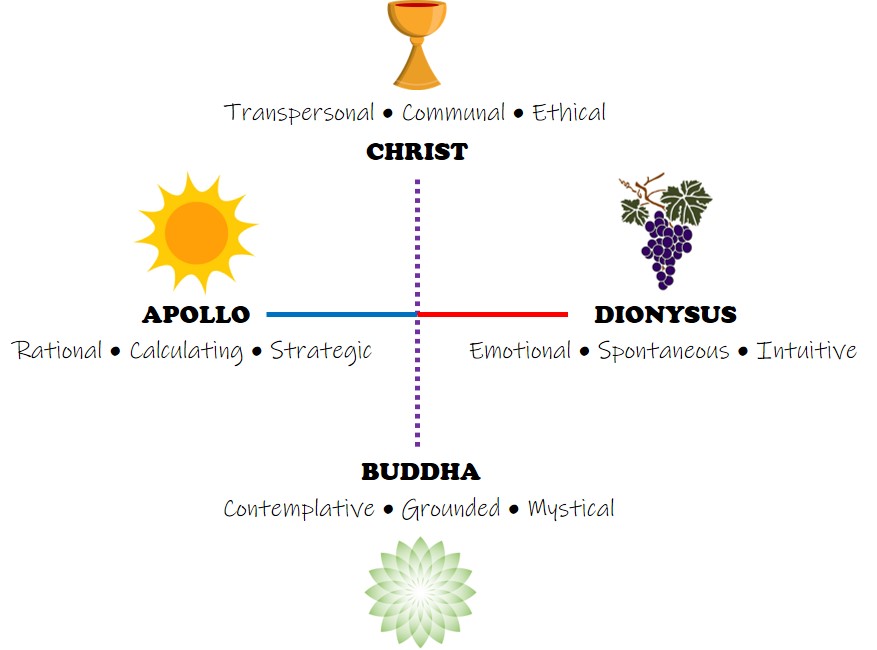
As I see it, spirituality is intentional living by the activation of your spiritual intelligence (SQ). Unique to this strand within the quadratic intelligence of our species is a capacity for grounded awareness and unity consciousness, to plumb the depths of your being and participate in the higher wholeness of all things. Such intentional living is very naturally productive of health, happiness, and harmony – what we all desire as human beings.

It’s understandable if theologians and mystagogues might regard my efforts with suspicion, since the goal here is to show everyone – not just true believers and illuminati but each and every one of us – that spirituality is fundamentally a way of life, and one that is open to all.

If orthodox religion and esoteric spiritualism are concerned about membership – belonging to the right tradition, believing the right things, and behaving in the right ways – proper spirituality is interested in primarily one thing: breaking through to the liberated life.

An important feature of this particular type of spirituality, which is best labeled “post-theistic,”* has to do with its emphasis on the developed personality and its executive center of identity, called ego (from Latin for “I”). Instead of regarding the ego as “against god,” in need of rescue to heaven, or as the immortal divinity of your true self, post-theistic spirituality treats it as a healthy symptom and leading indicator in the process of your becoming a unique individual person.

An axiom of spiritual wisdom acknowledges that All is One. In its own way, Western science has confirmed this truth, registered somewhat covertly in its name for the cosmic totality of all things: Universe, literally “turning as one.”

This includes, of course, each of us and all of us together – human and nonhuman, living and nonliving, you and me, the clouds and the stars beyond.

We might call this the Fact of facts, the one sure thing, regardless of whether you contemplate it in rapturous wonder or bumble along in complete ignorance of its truth. And this is where spirituality – or at least your spiritual intelligence – comes into the picture. By virtue of its evolved capacity for grounded awareness and unity consciousness, your spiritual intelligence makes it possible for you to experience your life as both a manifestation of the oneness and as participation in the allness – in the All that is One.

So, while we can agree conceptually that “All is One,” it’s also necessary to understand that you can live your entire life without verifying this Fact of facts in your own experience. Your spiritual intelligence might remain dormant, undeveloped, or suppressed, leaving the depth and unity of existence screened outside your awareness.

Merely subscribing intellectually to these ideas, holding them religiously as doctrines, or confessing them in unison with a standing congregation of fellow believers isn’t a substitute for an awakened spirituality.

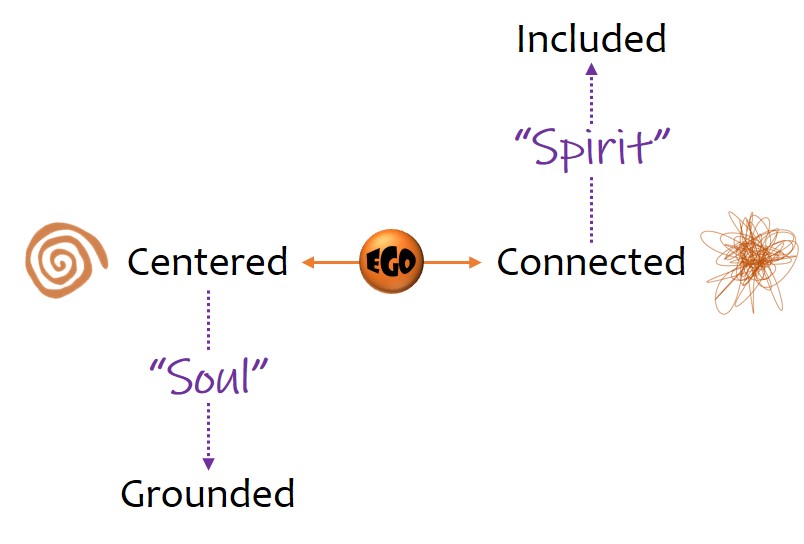
A central tenet of post-theistic spirituality affirms the ego – your separate center of self-conscious personal identity – as serving a critical function in the activation of your spiritual intelligence. The drop into a contemplative experience of oneness (what I call the grounding mystery) and the leap into a transpersonal experience of allness (or higher unity) presuppose a set location in consciousness from which the drop or leap is taken.

This location is your ego.

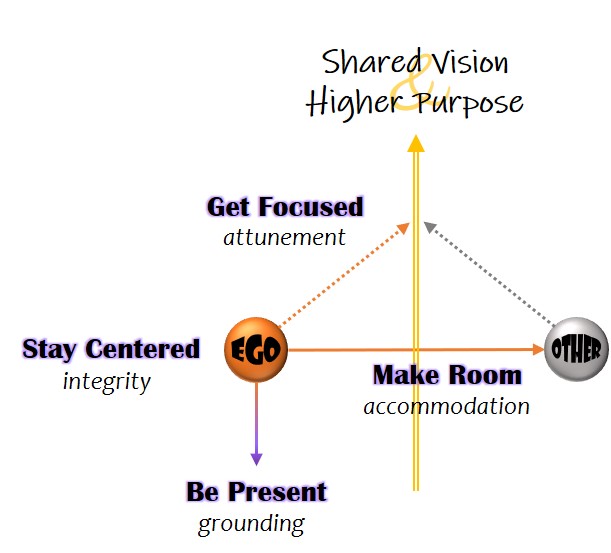
For a proper reading of my diagram, keep your eye on the center axis. The formation of your ego and contruction of a personal identity entail a gradual contraction of consciousness, out of the undifferentiated (and relatively speaking, unconscious) oneness, or communion, in which you are immersed, like a fish in water. With your self-center established, you are able to participate in the shared consciousness (or “togetherness”) of relationships, or what is properly named community – literally “together as one.”

The difference between community and communion is an experiential one: in community your ego is included and transcended in a higher wholeness, while in communion your separate center of identity is released for a deeper oneness where differences and distinctions begin to dissolve away.

I like to think of this duality of higher wholeness (community) and deeper oneness (communion) as the Yang and Yin of the All-as-One, the ultimate reality of Tao.

If everything went reasonably well in your early years of ego formation – with good-enough parents and a provident home environment – your emerging personality, with the executive ego at its center, achieved a sufficient degree of integrity. In this context, integrity is a measure of how stable and unified your personality is by virtue of possessing a secure center of identity. It is from this center that a contemplative release into communion is possible, leading to deeper experiences of solitude.

Ego integrity also affords your personality a necessary freedom from other people and the world around you. You no longer need to emotionally cling to or lean on something outside yourself for security, which sets you free to engage others and the world around you with intention rather than in reaction or by compulsion. Relating to others on such a non-attachment basis allows for attentive and compassionate engagement, where genuine dialogue between partners can take place.

In other posts I refer to dialogue – literally the mutual construction of meaning by partners in relationship – as the high calling of genuine community. Together-as-one, partners create a shared world based on respect, compassion, service, inclusion, and goodwill.

That’s spirituality for everyone.


*Interpreting spirituality against the backdrop of religion and its three main types (animism, theism, and post-theism) provides important context for a constructive approach to religion itself.

What Do You Want? (The Pyramid of Human Desires)

Let me start with a bold declaration. Each of us – every human being – wants to be healthy, happy, and in harmonious relationships with others and the world around us. Of course, we pursue many other things, like sex, wealth, power, status, and immortality, but these are only derivative and secondary as compared to our desire for health, happiness, and harmony.

Our desire for health is probably beyond argument. No one wants to be sick or injured, to live with chronic pain or terminal illness. True enough, we don’t always (or even very often, consistently) do those things that support and promote our health – and by this I primarily mean our physical health. We may have grown up in a household where junk food was a staple and portions were not controlled.

So even if we don’t do, or even know what and how to do what would make us healthy, we still want to be healthy.

When it comes to our desire for happiness, this too might be indisputable except for the fact that we all seem to hold different definitions and pursue it in ways that are in many instances radically divergent. And if a certain percentage of humans are unhealthy, it would seem that an even higher percentage are unhappy – by which I don’t mean just momentarily anxious, frustrated, disappointed, or grieved, but chronically (even in some cases clinically) so.

All around us is news of tension, conflicts, violence, and suffering, generating unhappiness on large scales: Bad people doing evil things to hurt other people who don’t deserve it. We have only to look into our own lives, however, to understand that this kind of consequential unhappiness – unhappiness that follows as a consequence of other things – is not the full picture. In fact, these very things are themselves clear symptoms of an underlying and antecedent unhappiness.

People hurt other people and cause unhappiness because they are already unhappy themselves, and are either trying to make themselves happy by taking control and manipulating others, or else by spreading their unhappiness to others in hopes of feeling less lonely in their own misery.

In the list of things every human being wants – health, happiness, and harmony with others and the world around us – is an implied hierarchy of value: the Pyramid of Human Desires.

Health is most basic and provides a foundation for the others. When we are healthy, our energy and attention can be turned toward things that interest and inspire us, things that excite us to learn and challenge us to grow, things that motivate us to live generously and take personal responsibility.

These are things that support and promote our happiness in life. To be clear, we don’t (and can’t) find happiness in these things. In other words, our unhappy craving will not find satisfaction in them if we pick them up and gobble them down with the expectation that they will make us happy at last, or lastingly happy.

Similarly, when we are happy, the way we engage with others and the world around us is more harmonious than when we are not happy. If instead of coming to others and the world around us with a preexisting cultivated sense of happiness, we try to find our happiness in others and in the world around us – because we don’t have it yet or know what it really is – we will cause damage and harm to others as well as to ourselves.

The harmony we seek, in other words, is dependent in many ways on our ability to cultivate happiness and share it with others.

This would suggest that large-scale and chronic conflicts among humans and human groups (races, tribes, sects, nations, and parties), along with the widespread suffering they cause, can be traced in their causality to a failure in managing our own individual happiness. We mistakenly believe that something or someone outside us will make us happy – or perhaps merely less anxious, frustrated, disappointed, or depressed – and acting on this mistaken belief is what generates (or at least perpetuates) our tensions and conflicts with others and the world around us.

Which brings us back down the Pyramid, to the desire for and commitment to our health. Each step downward confirms a second principle in play, to the one just reviewed in going up.

Just as harmony with others and the world around us provides a salutary context for happiness in life, so does the cultivation of happiness sustain in each of us a chronic mood of inner calm and centered awareness. The science of psychosomatic health verifies just how essential is our chronic mood – and by that is meant the baseline internal state and emotional energy of our nervous system – to our general physical health. Many dysfunctions and diseases of the body can be understood and best treated as signs of an underlying systemic (i.e., psychosomatic or “mind-body”) imbalance.

Before we can effectively address and resolve the conflicts among us, we need to bring to this work the gift of our own happiness and a deep commitment to the cultivation of inner peace. The wisdom traditions of the world have taught this for millenniums. If you take a second look at this shared depository of spiritual wisdom, you’ll soon begin to see the Pyramid of Human Desires (health, happiness, and harmony with others and the world around us) bringing it all into focus.

The Wisdom Code

I agree: It’s hard being you.

Your whole life you’ve been trying to figure this thing out, but still you’re left with unanswered questions and pressing concerns. It’s not clear that you’ll be able to “crack the code” before your time is up.

It sure seems that humans would have reached a deeper understanding by now, after thousands of years of suffering and searching for the answer.

Well, we have.

After taking a few minutes to review what’s been discovered and preserved in the perennial wisdom traditions of our species, we’ll need to come back for an explanation as to why, with such clear insight harbored in our collective consciousness for so long, we nevertheless persist in our pretense of ignorance.

Here’s what we know. You – or your “I” (ego) who is searching for truth – are an agent of your tribe, of the society that holds your membership. Your daily life in the world amounts to a carousel of roles that you play, as you step in and out of various role-plays.

Every one of the roles you play is a social construct.

You weren’t born a manager, a nurse, a student, a party member, or religious believer. Even among your casual acquaintances, you step into relationships by first assuming a role, however informal, which identifies you to others in the role-play and conveys your status, credibility, and reputation.

Once again, it’s important to see that you weren’t born with these roles. They are not products of nature, but constructs of culture. They were constructed for the purpose of securing your membership in society and making you an agent of its “system,” by which is meant its network, worldview, ideology, and way of life.

What’s more, you didn’t just “put on” or “step into” these various roles without first getting certain things under control. What things? Let’s summarize them as the drives and desires of your animal nature. The instinctual intelligence of your body has been evolving over generations of prehuman and hominid species, and its primary concern is with your survival, need satisfaction, and successful reproduction.

It should be no surprise that your natural drives and desires care not one bit about all those cultural conventions of identity.

But your society does care, since all those cultural conventions of identity are essential to its efficient operation. The drives and desires of your animal nature couldn’t simply be allowed instant gratification in the polite and civil company of others. Hold it, and quickly find a bathroom. Hang on and take care of it on your own time. And as for that, you better keep it to yourself and off-stage, because that will get you in trouble around here.

All these control measures were put in place in order to domesticate your animal nature, to condition you into a well-behaved member of society. Some of that primal energy was thereby redirected and refined into the roles of social identity mentioned earlier. Even though you are basically a human animal, this process of domestication slowly shaped you into a person with deep emotional investment in the role-plays of your tribe.

We should also note that your society is somewhat unique among all other societies of the world. Belonging to American society is a very different experience from belonging to, say, Bengalese or Samoan society. This is not only explained by the conditions of geography, climate, and race, but also by the fact that each society is organized around and oriented on a rather unique set of ideals.

Devotion literally means to make a vow and dedicate oneself by a sacrifice of time, effort, or some other more tangible value symbol (like a lamb or bull in archaic societies) to something regarded as having superior value and power – what we are calling an “ideal.”

These ideals exemplify and inspire what a society regards as ultimately good, true, beautiful, and eternal. Somewhere in your early education you were introduced to the ideals of your society – in the form of moral injunctions (thou shalt and thou shalt not), nursery fables, and all the stories of heroes, saints, saviors, and celebrities in your cultural mythology.

The preservation of this mythology, as well as the disciplined reflection on its meaning and personal devotion to its transcendent ideals, has been one of the primary functions of religion throughout human cultural history.

It seems inevitable, however, that every society will tend eventually to confuse its depictions of ultimate reality with the ideals that those depictions were originally intended to represent.

This is when an ideal becomes an idol. The corruption of devotion into idolatry occurs when a representation of utimate reality, which had once served as a mediating metaphor or image of what cannot be imagined, comes to obscure and then replace its transcendent referent as an object to be glorified and worshipped.

In the middle of all of this, there remains the question that individuals just like you have been struggling to answer for thousands of years: “Who am I?”

By a quick review: Your society imposed controls on the drives and desires of your animal nature, controls which you eventually internalized and took over in your ego. Besides putting restraints on your instincts, society also trained your devotion on certain idols and ideals that represent ultimate reality.

And then, in the provision of roles for your life in society, you proceeded to take on a variety of personas – performing, playing-at, and pretending to be what others expected of you.

But who are you, really?

In other words, who (or maybe better, what) is so busy playing at being somebody special on this stage or that? If you are nothing more (or other) than the personas you are playing on stage, you are – or predictably will soon become – anxious, frustrated, exhausted, and depressed. According to the perennial wisdom traditions, we all get caught in this sticky web of forgetting our true self.

It is our socially conditioned trance state, the illusion we mistake as reality. Magnified to the extent that we all submit to its spell, this condition is what Wisdom names “the human condition.”

In his important work, Parker Palmer clarifies the dynamic tension between “role” and “soul” – soul referring to your inner life and true self. When you forget and neglect the grounding mystery of your true self, in chasing after the acceptance, approval, and recognition of others, you are forsaking the deeper reality of who and what you are.

Across the many branching streams of the one River of Wisdom, this is the essential message: at once an expression of sincere empathy, a strong word of urgent warning, and some really good news about the liberated life – which is always closer than you think.

A Republican Reckoning

The profound disruption and near destruction of American democracy under the presidency of Donald Trump is something we will probably need a decade or more to fully assess. Electing what many thought was a successful businessman with a deep understanding of investment and negotiation strategies turned out to be a serious misjudgment of his business acumen, true intelligence and moral character.

A majority of Americans watched in disbelief as Trump systematically dismantled US institutions, political alliances, trade agreements, civil rights, and environmental regulations. Looking behind us now as we transition to a new administration, the wreckage is strewn across our nation, from sea to shining sea.

One of the most perplexing things about these past four years – at least to me – has to do with how many in the Republican party seemed to throw themselves at the feet of Donald Trump.

They didn’t just look away when he demeaned women, disrespected minorities, attacked congressional Democrats, bullied other global leaders, and promoted the values of white supremacy. Many Republicans cheered him on, adding their insults to the injuries. They stood by as he conspired to undermine our election and its result.

My intention here is not to accuse Republicans of being Republican – that is, of standing firm on the ideals of Republican political philosophy. Instead, I want to explore the question of why so many Republicans were willing to abandon those very ideals for the sake of something that is in fundamental contradiction to what being Republican has long been about.

For reasons I will try to make clear, Democrats seemed to enjoy immunity from Trump’s viral influence, which is why I will name the Republicans who went over to him “Trumplicans.”

My diagram illustrates four continuums of democratic ideals which have been central in the historical dialogue of Democrats and Republicans. The utility of a continuum as a heuristic device is in the way it allows us to appreciate differences as positional values along a spectrum of virtues mutually shared.

It’s not that Democrats advocate for “equality” (treating everyone the same) and dismiss the importance of “merit” (rewarding individual excellence), or that Republicans champion merit and argue against the importance of equality. For both parties historically, equality and merit have been recognized as strategic priorities of a healthy democracy, but each party ranks them differently.

In similar ways, “charity” (service to others) and “liberty” (individual freedom) form a continuum whereon a variety of positions might be taken – not either/or but more-or-less. “Affiliation” (forming bonds with others) and “Autonomy” (standing on one’s own) are likewise polar ideals that generate a spectrum of ratios in-between. Finally, “cooperation” (working together) and “competition” (seeking to win) are not really mutually exclusive opposites (think of sports), but rather complementary or paradoxical opposites, with their various admixtures making for healthy human interactions.

For my purpose here, which is to understand why so many Republicans gave up their political identity and became (willingly or unwittingly) Trumplicans, I want to focus on the side of each value continuum that Republicans have promoted more actively – although I must stress again that both parties have had a shared commitment (with different priorities) to all eight ideals.

As a priority value of Republican political philosophy, merit emphasizes the special talents, exceptional achievements, and unique contributions of individuals. Such things set these individuals apart from the average, “meriting” the recognition of society in the form of accolades, celebrity, and financial reward. Because they are so closely associated in the reward system of a meritocracy, wealth has frequently been mistaken as a symptom of merit.

Many societies besides our own have fallen to the assumption that wealth is a sign of an individual’s native talent, honest work, moral virtue, and even divine election.

Once the mistake is made and wealth replaces merit, a relentless pursuit of profit over all else quickly takes over. “What’s in it for me?” drives every negotiation, every investment, every relationship, and every choice. The relentless pursuit of profit will make one willing to compromise on long-standing ideals, violate once-sacred values, and attack anyone who gets in the way. Trumplicans believe, with Donald Trump, that profit should have the first seat and the last word, in all of life.

Another historical priority of the Republican party, liberty, elevates individual rights to keep and defend our property, say what’s on our minds, believe in and worship what we want, and live our lives relatively free from restraints, regulations, and the control of government. The Revolution that officially started the American Experiment was a revolt against a monarchy that sought to mandate our religion, tax our wealth, and make us subservient to the Crown.

The banner of Liberty! was our inspiration, and our nation’s leaders committed the work of democracy to its cause and protection.

But in this case, too, the worthy ideal of liberty and its associated vigilance over oppressive regimes or the unwanted control of others in our business can motivate us to actively seek ways to game the system and negotiate an exemption for ourselves. If a liberal democracy depends on legislated mechanisms like taxation and assessment for the revenue it needs to maintain itself, we will still do our best to minimize, defer, suspend, or avoid having to pay our fair share. We reason that, as many are paying into the system, we shouldn’t have to – particularly if the amount being “taken” from us (as an absolute rather than a proportionate value) is so much greater.

Autonomy literally means “self-rule” or “self-control,” and it was not only a key driver in the settlement of the New World, but also figures prominently in human psychological development – playing in creative opposition to the interest of forming bonds and joining groups (affiliation). Without the healthy achievement of autonomy, we cannot gather sufficient ego strength to hold our own in the world. Taking control in our lives – developmentally from our parents, politically from an English monarchy – serves to establish within ourselves a center of conscience, judgment, freewill, and self-determination.

For most of us, this path to healthy autonomy was rather rocky, with self-doubt and insecurity chronically urging us to give up on its pursuit, or else try to take it aggressively and prematurely. The result was vainglory, which can be difficult to distinguish from, and can easily slide into, clinical narcissism and megalomania.

When our center of self is not well-established, we try to compensate by getting attention, stealing the spotlight, and insisting on our superior – “no other president in the history of this country” – genius, talent, achievement, and success.

Finally, a Republican identity favors competition over cooperation, which is understandable when we tie it to the cluster of autonomy, liberty, and merit. In all these ideals the individual – and we can expand the concept to include an individual team, an individual class, an individual race, or an individual nation – is regarded as competing with other individuals (teams, classes, races and nations) for rank, privilege, resources, or whatever happens to be the prize.

A clean win is often not enough to satisfy Donald Trump and his Trumplicans, however. Domination, and if at all possible the humiliation of an opponent, is where the real victory lies. Not just to win a competition, but to overwhelm the competition, to beat them down with embarrassment and shame, so they look up to you from their pathetic state as “The Supreme Champion, best ever anywhere” – that’s what really makes the victory sweet.

But of course, complete domination, while it may soothe the insecurity inside our vainglory, also extinguishes the fuse of competition by destroying our opponent in the process.

With all that said, it’s important to reaffirm the validity and historical importance of the Republican political philosophy. All the priorities it has advocated for are essential to the health and vitality of American democracy – as long as they can stay in constructive dialogue with those of Democrats.

Admittedly it is not easy to respect and defend values that pull in the opposite direction of our own, but this is the secret to constructive dialogue and the genuine community sustained through its intentional practice.

Wisdom’s Long Journey

The spiritual wisdom traditions teach that every human being is somewhere in the process of waking up, that we are each emerging from a long, deep sleep. We’re not yet fully awake, most of us, but a new way of being – what Paul Tillich named the New Being – is even now available, and it’s calling us, calling on us to step into the liberated life.

The main organizing plot of this good news is indeed the foundational myth of Wisdom herself, pictured frequently in feminine form, evolving across three distinct “vehicles” or modes of existence: first as an animal, then as a person, and finally as creative spirit. The larger story is an account of Wisdom’s journey, and also therefore of our own human transformation through time.

But if you think it’s all about you, that only means you haven’t gotten far enough in the story yet.

The larger story of Wisdom’s journey and human evolution is unfolding even now in your own brief lifetime. In fact, the spiritual wisdom traditions insist that until you can see your own life in the myth of Wisdom, your apprehension of its truth will only be a conditioned and veiled understanding – it won’t be anything more than a religion.

So let’s take a closer look at you – not merely your “I” who is busy playing at being somebody special, but all of you, the full reality and potential of what you are. That fullness is represented in Wisdom’s three modes of existence, her distinct manifestations, according to the larger story.

You, too, began life in animal form. As a newborn infant, your animal nature was the vehicle of consciousness, the primary facility of your experience of life and engagement with reality. Deep in your physiology are behavior codes called instincts, with ancient histories reaching back millions of years and across numerous species.

These present codes are themselves evidence of their success in securing the survival and reproduction of your pre-human and human ancestors.

Your animal intelligence – the wisdom of your body – is intuitively aware of the deep reciprocal nature and interdependence of things: of its own urgencies for food, water, oxygen and energy, and the provident supply of these by its physical environment. Rather than thinking of your body as an organism apart from its environment, science has helped us to understand it as an “energy exchange” facilitating a constant back-and-forth flow in the dynamic balance of life.

In your animal form, especially back in those early days of life, you had no sense of yourself as separate from everything else – not yet. Your experience of life and engagement with reality was energetic and spontaneous, compulsive and reactive.

Slowly, however, consciousness began to ascend into self-consciousness and you found yourself on a new plane of existence, at a different center of awareness and mode of life. You were becoming a person. While the upward thrust of this emerging sense of yourself is inherent to the process of becoming fully human, its shape and character were determined to a great extent by the influence of your tribe – first your family of origin, and then, expanding outward, of the larger society that held your membership.

This personal mode of existence is what we call your ego, which is Latin for “I” – the one referenced earlier as playing at being somebody special. Now, what I say next may come as a shock, and it typically takes a fair amount of time, reflection, and courage for someone to comprehend its implications.

But here it is: Your personal identity – not the upward thrust but its shape and character – is a social construction and entirely without substance or reality.

Think of it this way. Identity is always a function of identifying with something: “I am (a) ________.” In the early years your tribe filled in those blanks for you. “You are one of us. This is who we are as a people. This is what we believe. This is how we live. These are our values. This is what it means to be a member in good standing.” And so on. All of those identifications were gradually weaved together into a canopy of meaning that became your world.

Yes, your world is also a social construction, a construction of so many veils suspended between consciousness and reality, for the purpose of clothing your ego with identity and meaning.

Just as with your animal mode of existence, so your personal mode as an ego playing at being (pretending to be) somebody special is a polarity of two dimensions. We’ve already mentioned your world, which is the objective dimension of identity. The term objective literally means “thrown over” (like a canopy) and is commonly confused with other terms like external or factual. As we are using it here, objective only makes sense as a corollary of ego – of the one whose world it is.

Because your world is shared in large part with others (that is, with other egos), it seems to exist independently of you, as the way things really are. But that is an illusion, and believing it makes you a victim of delusion.

The other side of the polarity in personal identity is what you call your self. It is the subjective dimension, literally “thrown under” (or beneath) who you are playing on stage. As your tribe was busy shaping your identity and filling in the blanks, you were taking it all in – experiencing life and engaging with reality as the so-and-so you were pretending to be.

Earlier we referenced the myth of Wisdom as the larger story of our human transformation through time. The spiritual wisdom traditions hold our sacred aspiration, along with the necessary insights and meditative skills, of completing the journey and breaking through to the liberated life of spirit. It is precisely at this juncture of the journey, however, where you are doing your best to meet the expectations of society and be a “good _______,” that the path gets complicated.

This is also where many get stuck and might spend the rest of their lives, asleep in identity.

Let’s come back to you. Your tribe gave you both clear and confusing messages about what was accepted and expected from you. Think of how much time and effort – all the desperate and anguished effort – you invested in seeking the approval of others. You needed their validation; your very identity depended on being recognized by them as so-and-so, as somebody special. Another thing to understand, however (and this should not come as such a shock), is how unfair, unrealistic, even outright manipulative and abusive some of those demands were.

But you weren’t old enough to know better, and your need to belong was irresistible, so you agreed (though not always consciously) to be what others accepted and expected of you. And even though some of those demands were unfair and abusive, you began to withhold and pack away parts of yourself that didn’t fit your society’s templates of identity.

The result was a shadow in your personality, a side of your self that was forbidden (by society) and hidden (by you), kept off-stage and out of the play.

This is where many are stuck – and where many more have expired over the long history of our species: trying to fit in, desperate to stand out, holding themselves back, burdened by guilt and shame, just about ready to surrender the whole exhausting pursuit of being somebody special.

Here, finally, is our third revelation, which really amounts to an apocalypse – literally an insight that “blows off the cover” and pulls down the veil of your illusion. This moment, where you are ready to give up on the entire project of being somebody special, is what Jesus and other wisdom teachers have called the “narrow gate” to freedom and the liberated life. It is the breakthrough from a personal mode of existence to a spiritual (contemplative and transpersonal) one.

In the myth of Wisdom, this is often depicted as a new birth, a resurrection from death, the butterfly abandoning its cocoon, a waking from sleep, the free flight of wild gander against a blue sky.

Now, if you are especially attached to your personal identity, entangled with your shadow and a hostage to your world, the prospect of breaking free will likely seize you with terror. True enough, proceeding into the apocalypse can be profoundly disruptive, and it will undoubtedly strip off and away all your attachments. In human history, this is where ego has opted for self-inflation over self-transcendence, for everlasting life over an authentic, liberated life here and now.

But if you were to drop the charade and get over yourself, the awakening of consciousness to a soul-centered mode of existence would enable you to look back at this moment as but a blink of an eye – so light, so quick, so easy.

What you’ll find on the spiritual plane of awareness are two transformative insights, correlated according to the polarity of your soul. On one side is a realization that breaks beyond your world, and on the other a realization that breaks within your self.

Beyond your world and its canopy of meaning, All is One; this is the holistic truth of our universe, the higher wholeness of all things, which of course includes you. Within your self and its delusion of substance, is the present mystery of being-itself; this is the essential truth of your ground, deeper than words can reach but simultaneously rising in you and as you this very moment.

There is a paradox of wisdom that should be apparent in all of this: The liberated life requires you to drop the chains that tether your identity, and still you might choose the security of your chains to the wild freedom of spirit.

Spiritual Exercise

Close your eyes, take a deep breath, and feel yourself relax into your body. The “drop” of consciousness into the biorhythms, life-force, and material gravity of your body begins from a place where a lot of your time and attention is invested. It’s a place of chronic anxiety and exhaustion, of curating and managing a personal identity inside a busy social arena.

We’ll come back to that place after a while, but for now just “breathe and be” in your living body. Don’t observe your body from some elevated perch; in other words, don’t make your body into an object of study. Simply breathe and be, feeling your breath come and go, rise and fall. In the background you may also hear the soft “hum” of consciousness as it idles in your nervous system.

Notice that “down here” in your body you are fully present in the here and now. All that fuss up at the surface has been left behind, as your awareness rides gently in the rhythms of life. If you rest here long enough, tuning your mind to this grounding mystery of being, you’ll begin to sense the boundary between your body and the reality around you begin to open up and dissolve away.

We know from science that your body is not separate from the physical environment in which it has evolved. Events and conditions of external reality translate near-instantly into reactions, perceptions, and changing internal states of your nervous system. Material nutriment, water, oxygen, and light “out there” is metabolized into cell structure and living tissue; into glands, organs, and organ systems; into the organism of your living body.

Organism-environment is the reciprocal dance and mutual transformation of matter and life.

One metaphor that captures this idea – this experience you are having right now of the fluid communion of your body and its environment, is a web. The descent of conscious awareness from the surface where you manage an identity on the stage of social role-plays, brings with it the revelation that everything is connected and interdependent – a web of communion.

From science again, we know that this web of communion is very ancient, with each new generation of life a contemporary manifestation of a long line reaching back millions, even billions, of years into the early history of our planet. Every speck of matter comprising your body derives from primordial stardust. The design code of your DNA and the instincts that drive your unconscious behavior are inherited from primitive ancestors, from long before the emergence of humans.

Because so much of your daily life is tied up there at the surface, an occasional descent into your body and its web of communion seems a welcome respite. Long ago, however, our human ancestors lived here all the time. Time itself didn’t stretch between a “past” and “future,” as it does for you, but instead revolved through cycles that synced with the rhythms of life in the body. Their place and participation in the web was respected by them as a sacred privilege.

Their religion, called animism, was centered in the body and focused on the ritual responsibility of honoring and renewing the bond between “human” and “nature.”

Over many thousands, even millions, of years human consciousness continued to evolve, facilitated and accelerated by the influence of language, symbolism, storytelling, technology and culture. What eventually arrived, in fact, was the very same center of self-conscious identity that you released at the beginning of this meditation, when you dropped into the “breathe and be” of your embodied experience. Well – not the exact same center, since each person’s center of identity (or ego) is unique and separate from all the others, as well as from everything else.

So let’s go back up to the surface.

Life up here is a staged affair, and interpersonal transactions follow according to certain prescriptions of identity: roles to fill, parts to play, rules to observe, and masks to wear. (Our word “person” derives from the Latin persona, referring to a stage actor’s mask through which (per) she would speak (sona) her lines.) When consciousness inhabits one of these roles, it becomes self-conscious as So-and-So in a socially prescribed role-play with other so-and-sos.

With this invention of identity and its countless roles, society was able to evolve and further facilitate the growing complexity of human populations. A virtually infinite number of social interactions was now possible – as many roles and masks as could be invented. The perception of time was no longer circular and rhythmic, but instead became linear and terminal as a projection of the individual’s sense of himself as arriving on stage and finally exiting the stage.

The more invested and involved humans got in this identity game, however – and you can attest to this from your own experience as a person – the less aware and mindful they became of the body and its web of communion. Performing roles and managing a personal identity entails a kind of disembodiment of consciousness and its individuation as an ego (Latin for “I,” the actor). So while the body continued as it had for many millions of years, the social complications and anxieties at the surface syphoned more and more consciousness into the business of trying to be somebody special.

This second great cultural shift in human evolution, from a nature-and-body-centered experience to a society-and-ego-centered one, brought with it a new type of religion as well, called theism.

Now religion wasn’t so much concerned over harmony with nature, but grew increasingly invested in the management of traditions, institutions, and ideologies that preserved and enforced the moral codes of culture. Theos, the god or deity who stood behind and above this moral order, was conceived and projected as a “superego” (the “I” in the sky) whose will directed all things and whose ordination legitimated human authorities on earth.

We don’t need to go much deeper into theism, but it should be obvious how hand-in-glove the notion of “god above” is with the separation of consciousness into a personal identity and its social role-plays. Just as your ego is separate from your body and harnesses the impulses of its animal nature for the sake of acceptance, approval, recognition, and social status, so the deity in theism ensures that the “body politic” of society is obedient to its moral mandate.

A second function of the deity in theism is to exemplify the virtues of moral character, and to motivate devotees in the imitatio Dei (the aspiration to be like god), to be more patient, gracious, faithful, compassionate, and forgiving – to name a few of the outstanding virtues of god, as depicted in myth and theology. To be “like god” in this regard is considered the highest calling in healthy theistic religions.

Throughout the history of theism, a few individuals have reported an experience of “waking up” from the spell of belief and seeing through the veil that separates personal identity from ultimate reality. They speak of a hidden wholeness, a higher Truth, and a universal Spirit beyond the fractured lens of ego consciousness.

They have also consistently challenged the conventional belief in god’s objective existence, which for obvious reasons has made them enemies of theistic orthodoxy. Their religion is properly called post-theistic.

Standing here, centered in your personal identity and unconcerned with either promoting or defending yourself to others nearby, distant, or long dead, the universe invites you back into its web of communion.

But whereas down there in your body the experience was of an undifferentiated oneness (the fluid transformations of matter and life), up here and looking out from the position of your individual ego you can see that All is One: a differentiated togetherness. The “mystical” (ineffable, intuitive) communion felt deep in the grounding mystery of your embodied life is revealed from this perspective as the “transpersonal” (consilient, integral) community of all things.

There. With that you have completed one rep of this spiritual exercise. Keep working out.

Big Picture, Long View, All of Us

I write this on the day after the close of US elections and ballots are still being counted. Each party is positioning lawyers to dispute or defend the integrity of our election process and its outcome. Americans on both sides are looking through the lens of victory or defeat, as to what it will mean for their future and general wellbeing.

Many of us are trying, but not always successfully, to negotiate the narrow ridge between nervous exhaustion, from our worry over things we can’t control, and compassion fatigue, from the deep angst we feel for the human need and suffering all around us.

So we sit in goggle-eyed paralysis, staring at our televisions and waiting to hear what our reality will be.

I’ve written numerous posts over the past four years and more, trying to put a contextual frame around the strange phenomenon of Donald Trump’s rise to power, and how he has managed to steadily dismantle the institutions that have anchored our democracy for so long. I noted, for instance, how Trump’s 2016 victory marked a decisive ascendancy of capitalism over democracy – the twin seedbed traditions of our American Experiment.

I also offered an explanation in terms of how Trump has poked our insecure Inner Child, persuading us to give up our freedoms and responsibility as citizens.

Just this morning it struck me again how much Donald Trump, the wealthy white capitalist, represents America itself. Not that he cares much about us or has our best interests in mind, but how much he exemplifies, as a kind of symptomatic projection, our national character. Other countries of the world have long regarded the United States less as a bastion and defender of liberal democracy, and more a gassy bubble of rampant consumerism, neurotic self-interest, and moral schizophrenia.

By virtue of occupying a resource-rich continent flanked by wide oceans to the east and west, and without threatening superpowers to our north or south, we’ve been able to afford a relative isolation in abundance, luxury, and excess.

We haven’t really felt the urgency of living with a bigger picture in mind, of having to look farther into the future than our own retirement plans, or taking into consideration the needs and welfare of others who are not American – or human. What’s in it for me? really does drive many of our decisions and actions in business, in politics, and in everyday life.

The historical tension in our nation between the values of conservative stability and those of progressive change, embodied and played out in the competition and debate between Republicans and Democrats, has been critical to the success of the American Experiment – so far.

When we throw into this mix the additional complication of trying to promote the values of capitalism (economic self-interest, individual prosperity, and private property) and those of democracy (engaged altruism, communal wellbeing, and equal rights), the situation starts to feel a little like that Mason Jar of fruit flies in our seventh-grade science experiment.

Then, let’s add the volatile elements of race, class, and religion – all of which tend to generate strong reactions as pluralism increases, the lid is screwed tight, and our national Mason Jar is given a shake.

So what needs to happen? I think we need to take a moment for some serious national self-reflection. Even if he wasn’t elected by the popular vote, Donald Trump as President says something about what’s been going on across our nation and deep inside our national character – and likely will for some time to come.

If we are in fact driven primarily by self-interest, and if our operative notion of self is limited to individual egos and single lifetimes, then four more years of what we’ve had will be damaging and possibly catastrophic for all of us.

Who exactly is this “all of us”? Well, that depends on how big our picture is, on how much and how many others are included in our perspective. Does our picture of America include the diverse races and religions, genders and orientations, ages and abilities, worldviews and lifestyles that share this ground and coexist under this sky?

It also depends on how long our view is, on how far into the future our vision is able to reach. Are we considering the longer-term consequences of our actions, the collateral side-effects of our choices, or the future generations that will inherit the positive benefit or negative fallout, as the case may be?

“All of us” can mean everyone like me or everyone in the room; everyone who thinks the same way, who holds the same beliefs and sees the world as I do.

But what if the “self” in self-interest includes not just beliefs, but also other minds? Not humans only, but all sentient beings as well? Not just living things, but the water, air, soil and climate that support life on our planet? The biblical mandate to “love your neighbor as yourself” should read, “love your neighbor as your self”; in other words, expand your sense of identity so as to include your neighbor in your definition and self-regard.

Expanding beyond that even, there is no absolute boundary that might finally separate “me” from the rest. All is one, and we are all in this together. That’s thinking like the universe.

How would our choices and actions be different if we considered our options with a bigger picture and longer view in mind? What if “all of us” really was ALL of us?

5 Steps to Ridding the World of Democracy

Back when I was a church pastor, I gave a sermon that offered an analysis of the strategy used by the conservative alliance of political and religious leaders to get rid of Jesus. He had been stirring up hope and excitement among the rabble, announcing the arrival of a New Reality that would break their yoke of oppression.

For obvious reasons, he had to go.

Conservatives of any persuasion are committed to maintaining the status quo – conserving or safeguarding the inherited values, beliefs, worldview and way of life enjoyed by those who are comfortably getting by. Of course, this is also in the interest of a privileged few in seats of authority and with entitled access to wealth, healthcare, education and good jobs.

Anyone who dares to criticize and challenge the moral legitimacy of such an arrangement is asking for trouble.

Jesus criticized and challenged the politico-religious axis of conversative powers, and he got the trouble he was asking for.

To them, his message of the in-breaking power of a New Reality was nothing short of apocalyptic, in the way it threatened to pull down the idols of empire and orthodoxy. Getting rid of him could not be accomplished by a single aggressive strike, since Jesus had a popular following of some considerable size and they didn’t necessarily want to incite a revolution.

So this is how they did it.

Step One: Dismiss the Message

“Can anything good come from Nazareth?” The New Reality that Jesus’ proclaimed was just another utopia dreamed up by a disgruntled peasant from the Galilean outback. In a sprawling empire, there’s going to be a few who just can’t seem to accept the way things are and find their place in it. They would rather daydream about an ideal world than learn how to live in the real one.

Step Two: Deride the Messenger

“He is out of his mind.” But Jesus persisted, and this made it necessary to redirect their strategy at him personally. Not only was his message unrealistic, but he was himself a self-styled prophet who wandered the hills and city streets peddling a crazy fantasy. He spoke in parables and paradoxes – riddles just provocative enough to stupify his audience and keep them curious.

He was a cross-eyed clown-magician for the simple-minded.

Step Three: Discredit the Messenger

“Isn’t this the son of a carpenter?” Laughing off Jesus and his pathetic company didn’t have its desired effect, and his following only continued to grow. So instead of painting him as a buffoon, his conservative opponents began to attack his pedigree, as someone whose family tree would not be expected to bring forth a serious leader.

Jesus came from the wrong side of the tracks, the son of someone who didn’t matter.

Step Four: Disparage the Messenger

“This man welcomes sinners and eats with them.” If exposing Jesus’ unremarkable and average background wasn’t enough to undermine the devotion of his followers, then a more aggressive smear campaign was in order. Consistent with his “good news” (gospel) of a New Reality where divisions of race, wealth, power, and morality are transcended by a community of compassion, generosity and goodwill, Jesus spent his time with social outsiders and moral outcasts.

How can anyone with a conscience associate with someone like that?!

Step Five: Destroy the Messenger

“And they began to look for an opportunity to put Jesus away.” In a civil society, before a movement goes too far and upsets the status quo, the steps for shutting someone up and dispersing his or her fan base might be regarded as “coarse and unkind” – but still be allowed to play out in the press, from the pulpit, on the airways, and in social media.

With each step, the water in the kettle gets a little warmer – not enough to trigger the frog’s leap of escape, however – until the temperature reaches a critical point where it’s no longer tolerable but has rendered the frog incapable of doing anything about it.

One of the dichotomies inherent to a liberal democracy is its aspirational commitment to freedom and progress on one side, and on the other a natural tendency, characteristic of all human groups, to fall into routines and become increasingly protective of the status quo.

The true spirit of democracy is for that reason unwelcome in a society which has settled into its traditions and authority structures, to the extent that beliefs and value-judgments once held consciously slip into position in front of the mind as pre-judgments (aka prejudices), determining how its members perceive and respond to the world around them.

All of this came back to me over the past four years, as I observed how candidate and then president Trump regards his democratic opponents – the true proponents of democracy in America. Included in this company are both Democrats and Republicans (as well as other minor parties) who are committed to the process of creating a system of governance dedicated to the advancement of individual freedom, civic responsibility, servant leadership, and equal representation under the law.

Those who speak on behalf of these democratic principles are typically handled by Trump using the same five-step process outlined above, just as the politico-religious conservative alliance dealt with Jesus in his day.

It’s proven to be the most effective method of dictators for luring otherwise sane and decent folk under a spell, where they are finally willing to abandon their interest in freedom for the despot’s promise to protect them from “disasters” which are sure to come with the changes of progress.

Moving our focus from the lessons of history to what’s transpiring right now in our own country, we can see how Trump has been pulling large numbers of professional Republicans and American citizens under a kind of spell. Like that frog in the kettle, we have followed him step-by-step through the program, with each additional step seeming to be not such a gross departure from what we’ve already been willing to concede, casually accept, and quietly ignore.

This image has an empty alt attribute; its file name is candle.jpg

Finding ourselves nodding in agreement with his character smears and name-calling, we might next be content to look away as one more candle in our less-free democracy is snuffed out.

Tomorrow’s Religion

Let’s begin with a definition. Religion is a more or less systematic framework of values, beliefs, commitments, and practices that serves to orient a human being in reality, connect her with others, and inspire the lifelong pursuit of wellbeing and fulfillment.

I’m taking the term on its etymological cash-value – the Latin religare means “to link together” – rather than its popular definition as believing in the existence of god or cultivating a fascination with the supernatural. Such misconceptions of religion have been invented for the surreptitious purpose of setting it apart from the realities of everyday life and ultimately dismissing it altogether as irrelevant nonsense.

But if we go with my straightforward definition of religion, then two important observations follow. The first is that religion is an essential formality of our life as human beings in the way it provides structure around and gives expression to our deeper intuitions, communal affections, and higher aspirations.

Whether or not you “believe in god” or “go to church,” you have a religion – some framework of values, beliefs, commitments and practices that serves to orient you in reality, connect you with others, and inspire your lifelong pursuit of wellbeing and fulfillment. It may not be very intentional or all that effective, but you have one nonetheless.

Secondly, given that our human future hangs in the balance and depends in no small way on how mindful, compassionate, and responsible we are with respect to our planet and each other, it should be obvious that our future will be as long and prosperous as our religions are properly grounded and successful in fulfilling their mandate.

If our religions are not so grounded and successful these days, it is incumbent on us to bring them back into alignment – seeing as how they are human constructions and manifestations of our own psychospiritual condition.

The essential formality of a healthy religion can have the salutary effect of shaping consciousness and guiding our development in provident ways, but a “sick” religion will only make its adherents sicker still.

All around us these days we can see how widespread this sickness is: moral complacency and fanatical devotion, small-minded dogmatism and militant sectarianism – these are symptoms of the same underlying spiritual disease.

In this blog I give a lot of attention to the challenge of understanding where we are individually and as a species on the trajectory of evolution, and particularly to the role of religion in facilitating our progress. Regardless of the fact that many religions today are insular and regressive, my interest is in how religion itself evolves – or needs to evolve, if it is do its job and not pull the world down upon our heads.

The very busy diagram above spreads out the canvas of our big picture. Ascending along the diagonal axis are the major eras and levels in the architecture of our universe: beginning 14 billion years and 3 minutes ago with the flaring-forth of quantum energy in what we quaintly name “The Big Bang”; telescoping through the formation of matter, the emergence of life, the ignition of sentient awareness (mind), and the differentiation of self-conscious identity (ego); reaching fulfillment finally in each individual’s breakthrough awakening to the transpersonal spirit of community.

With all of that in front of us, I will devote the rest of this post to that phase transition in the upper left, where the religion of theism, which is centered on the relationship of ego and deity (superego, or the “ego above”) in the social context of group membership, transforms into the religion of post-theism.

I need to remind my reader that the post- in “post-theism” is not concerned with the debate over god’s objective existence, but is instead critically engaged with what our theological constructions of god say about us, and what hint they may provide regarding our prospect of a liberated life after, beyond, and on the other side of (post-) theism and orthodoxy.

Arranged to the left of those three major types of religion (animism, theism, and post-theism) are the “stages of faith,” as formulated by James Fowler – with a slight revision of the stage that marks, according to my scheme, the transition from theism to post-theism.

For its part, theism develops through three distinct phases. The first phase (“early”) is focused on the tribe’s founding myths (world creation, ancestral heritage, stories of heroes, saints, and saviors). A second phase (“high”) is oriented on the devotional cult, the moral code of obedience, and the ordination of earthly authorities.

Eventually it may advance into a third (“late”) phase where the individual takes up the work of constructing a personalized worldview and philosophy of life, one that is relevant to his or her experience and no longer satisfied with borrowing on the experiences (or purported experiences) of others.

Late theism can be particularly stressful and traumatic for the individual whose faith development is needing a religion suitable to his or her psychospiritual progress. In what I earlier called “sick” religion, the response of theism to the individual’s emergent aspirations is that of closing down, using shame, guilt, or the threat of excommunication to coerce him or her back into the fold.

Tragically many give in, if only because they don’t necessarily want to lose the fellowship, but also because their vision of a post-theistic spirituality is as yet unclear.

We happen to be at a point in our history, and on the trajectory of evolution itself, where an unprecedented courage is required – at least on a broad view, since a relative few have already achieved the breakthrough – for each of us to persist on our adventure into the farther reaches of human nature.

What I’m calling a “dialogical-conjunctive” faith (Fowler’s stage is named conjunctive) takes into account the wide diversity of belief systems, worldviews, and ways of life sharing the planet with us. These are brought together (“conjunctive”) for a comparative understanding and mutual exploration, in the interest of co-constructing a larger horizon of meaning (“dialogical”) that can appreciate the differences, even as it provides for their radical inclusion.

Having surrendered our idols of orthodoxy, we can now descend by a contemplative-mystical path into our own grounding mystery, as we ascend together by a transpersonal-ethical path into the liberated life of community.

Secure in Delusion

One of the charming yet potentially devastating traits of our species is in the way we lose touch with what’s real, even preferring illusions to what’s right in front of our face. And yet, the condition of fully believing our illusions – called delusion – creeps over us so gradually that we actually have no idea the extent to which our mind has been separated from reality.

The steps or stages by which our delusion progresses are not a mystery, however, and your hope for the liberated life depends on how deep your understanding of it is able to go.

Let this black dot represent reality – what’s right in front of your face. Its existence, as distinct from its appearance or your perspective on it, is independent of whether you notice it, what you might think about, or what belief you hold regarding it.

As we say: It is what it is.

Before you were even born, your nervous system was collecting data from the environment in order to regulate your body’s internal state accordingly. Once outside the womb this adaptive work ramped up, matching your internal state and behavioral response to the conditions and events around you.

If these conditions and events were “provident,” meaning that they provided what you needed to live, connect, and to grow, your nervous system was regulated to a default mode (or mood) of calm, centered attention. If they were not so provident, but instead hostile or painful, your default mood became that of anxious irritability.

Delusion got started way back there in your early hours and days of life. If your nervous system detected a less-than-provident reality around you – perhaps because your caregivers weren’t attentive, nurturing, or even all that present when you needed them – this subjective insecurity served as a filter of your perceptions.

Your anxiety screened out some sensory information, as it allowed in and amplified other information. An anxious nervous system is adaptively hyper-vigilant to any signs that confirm its default state. Already your attention was recalibrating according to this basic mood and making some things more important (i.e., more real) to you than other things – if those other things even got through the screen at all.

Your insecurity motivated you to reach out for whatever could help you feel less anxious. Not only did you stay vigilant to possible dangers, but you also grabbed on and held tight to whatever could pacify your anxiety. For this reason, I call them “pacifiers,” and your relationship to them was one of “attachment.”

This is profoundly (i.e., deeply) different from the healthy normal bonding of an infant and its mother. What we’re talking about is neurotic attachment: a compulsive attempt to feel secure by clinging to something outside yourself.

You are (more or less desperately) trying to find security in a relationship, when its proper source is “up” from your nervous system and the preconscious experience of provident support.

Neurotic attachment splits your motivation into two opposing lines: a craving for what can make you feel secure and the fear of not getting it, of losing it, or of it not delivering on your demand.

The self-defeating nature of this split motivation is at the root of our word ambition, where ambi means “both.” A fear of not getting what you want intensifies your craving for it, which only makes your expectation all the more unrealistic and irrational, amplifying your insecurity rather than resolving it.

At this point, your mind starts to close around a small set of absolute beliefs formatted along the lines of “I can’t be happy without, unless, or until” such and such is the case. It can be something as mundane as a new toy, or as abstract as an imaginary object of religious doctrine.

Just as a legal conviction throws the convict in a jail cell, so does an absolute belief incarcerate your mind – which is why we call it a “conviction.” It becomes impossible to even think outside the box of what simply must be true, since so much depends on it being so.

Notice how little of reality, represented by our black dot, is visible any longer. Almost by definition, your convictions have separated your mind from what’s real.

Since all that matters to you is what impinges on your ambitions for security, everything else must be screened from awareness. A mind that is closed inside its convictions must actively suppress or deny any facts or information deemed irrelevant to this pursuit.

The philosopher Alan Watts coined the term ignórance, where the accent makes it an act of willfully ignoring something or other. Because all that matters is what confirms and will hopefully resolve your deep insecurity, you must turn attention away from all that is by definition irrelevant.

Your carrying capacity of consciousness has been reduced to “what’s in it for me.”

By now the delusion is fully established. Trapped inside your convictions and driven by a craving for what nothing outside you can satisfy, this has become what Arthur Schopenhauer called “the nightmare from which I am trying to awake.” Your only hope is for some relief from the burden of existence, maybe in the next new and shiny thing, a suicidal exit, or perhaps everlasting bliss in the life to come.

So then, stop believing it.

The prison door of your convictions is not locked, but you will need to leave them behind for a truly liberated life. Not by argument, renunciation, or conversion to another belief system, however, but simply by bringing attention to the breath and warm presence of your body.

Here and now is the best place to begin again.