Saved From What Isn’t Real

“A human being is a part of the whole, called by us ‘universe,’ a part limited in time and space. He experiences himself, his thoughts and feelings as something separate from the rest – a kind of optical delusion of his consciousness.”

Albert Einstein

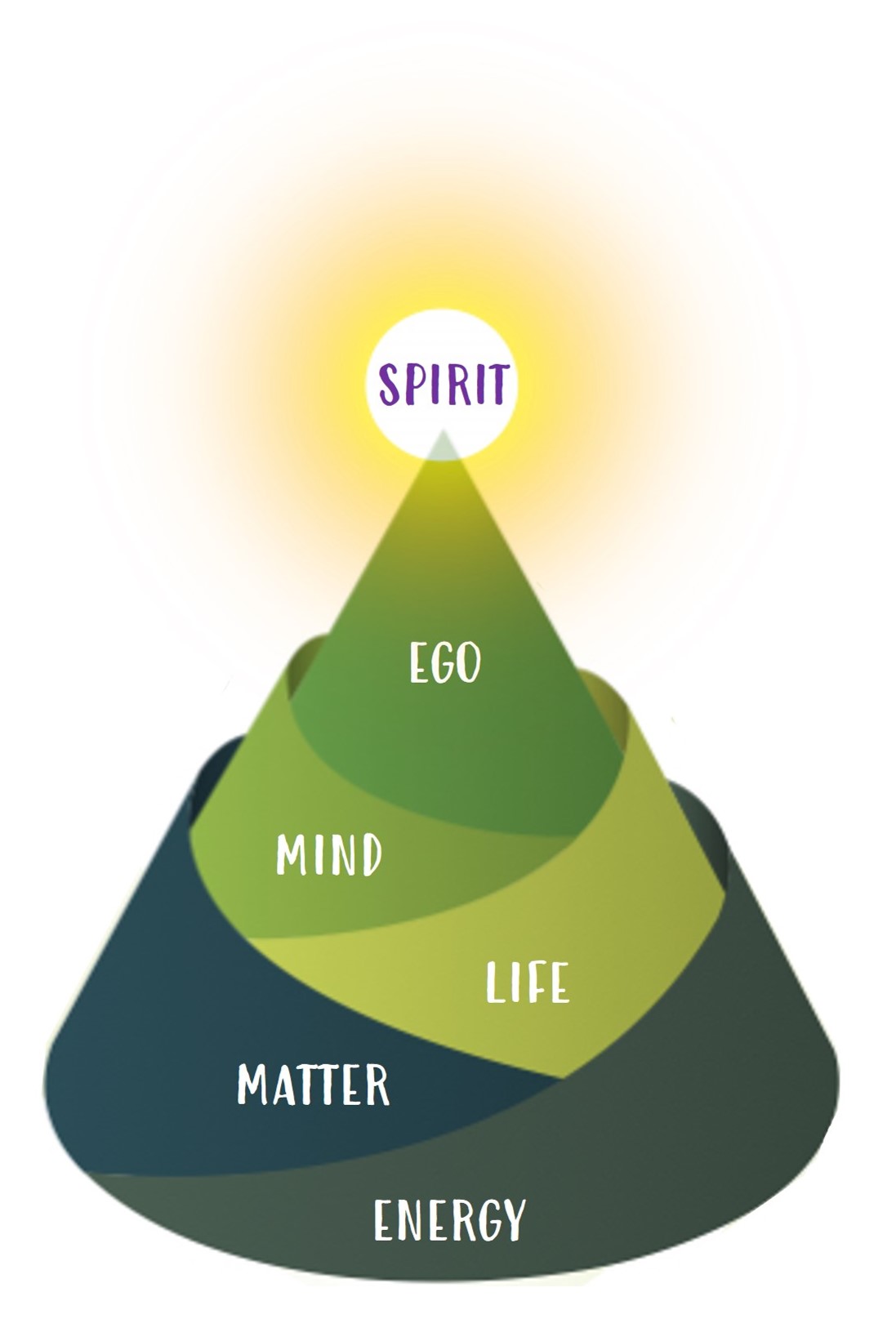
Imagine that the triangle illustrated above represents and contains all of existence. Inside are subtle distinctions, not absolute divisions, across the great hierarchy of beings that comprise this universe.

Instead of reading this hierarchy as a static scheme of human superiority and exceptionalism, however, as if living beings were added to and stacked on top of some material substrate, and human beings were added to and stacked on top of an animal substrate, we need to view it organically and through an evolutionary lens.

Living beings represent an evolutionary breakthrough among all beings, just as human beings emerged by a series of neuroanatomical breakthroughs in animal biology and advances in social intelligence over the course of many millions of years.

But human beings are still living beings, and living beings belong to the realm of all beings. Just as a growing tree projects its lifeforce through the extension of branches and leaves rather than adding pieces to what’s already there, so has the universe “grown” into a living and self-conscious community of beings.

Inside the triangle universe everything is connected and All is One – which is the mystical intuition behind our word universe, referring to the “one song” or “turning unity” of existence itself. The celebrated genius of Albert Einstein was inspired by his sense of belonging to the Universe, and it is doubtful that he would have formulated his theories of General and Special Relativity had he not contemplated this insight into the mystery of cosmic unity.

It’s the second part of his quote that I want to explore here, however, since it reveals why we tend to regard his remark on cosmic unity as so noteworthy. Einstein doesn’t offer to explain how this “optical delusion of consciousness” comes about, only that it is the condition of our feeling alone and disoriented in the Universe.

Human evolution unfolded within the broader evolutionary stream of life, advancing by adaptive mutations in neuroanatomy and further developed by social accommodation of these mutations, eventually bending a naturally extroverted attention back upon itself in self-conscious awareness.

The effect of this reflexive back-flip in consciousness was an experience of being turned into an object of awareness, and then, turning back out from there, confronted suddenly with a multitude of objects separate from itself.

We’ll go deeper into the phenomenology of egoism shortly – this experience of becoming somebody separate and special. But we need to remind ourselves again that the triangle above is meant to represent and contain everything that is real. If the process of ego formation is depicted in my diagram as taking place outside of Reality, the point is not that we are now in another dimension of Reality, but that we have entered something that seems real to us but really isn’t.

According to the spiritual wisdom tradition of Sophia Perennis, this illusion is not generated by conditions in Reality, as when radiating heat waves on desert sand or an asphalt highway produce the appearance of a lake in the distance. Instead, its effect is more like when two mirrors are positioned facing each other at just the right angle to produce a “tunnel” that’s not really there.

In other words, it’s not something out there (e.g., heat waves) tricking us into a mistaken belief, but consciousness itself that is spinning the illusion of a separate identity (ego = “I”) and then mistaking it as real.

In the window above, this “illusionarium” where ego takes form and finds itself – only to feel lost among the countless separate beings – self-conscious identity is depicted as a cluster of bubbles floating outside of Reality. If my reader should protest that, according to the premise already stated, my triangle contains everything in existence and allows for nothing outside it, then I shall wholeheartedly agree.

That is the point: The bubble is not an objective illusion but a subjective hallucination – a delusion. It is entirely in the mind, not in Reality.

Around the bubble representing ego consciousness and the subjective hallucination (or “optical delusion”) of a separate identity, a spinning wheel of arrows let’s us in on the consequences and repercussions for the individual. Retracting into our own center of personal identity and separating from Reality to that exact extent makes us increasingly insecure and anxious. On our own (or so it seems), we feel isolated and exposed.

The anxiety that comes with our separation and exposure is managed somewhat by the social validation we receive by personating roles that ensure our conformity to the group. To the degree we feel at risk of losing their approval, we will put on any identity and hide behind any mask that makes us more acceptable to others.

Pleasing, placating, flattering and impressing those taller powers and key-holders to acceptance and belonging gradually becomes our singular ambition.

Inevitably this mentality of “what’s in it for me?” tightens into a spiral of conceit where our feelings and needs (mostly our subjective feeling-needs) are all that matter. One last quarter-turn of this Wheel of Suffering closes our mind inside convictions and completes the separation of self-conscious identity from the way things really are (i.e., from Reality).

If we should think of god inside our illusionarium, it is as another being, separate like ourselves but much greater, who is capable and caring enough to save us from our misery. This god is depicted in my illustration as another bubble (a literal and objective Super Ego), with an aura of glory to set him (or her) apart as superior to all the others.

Perhaps the most important function of this projection of ours, this “Egod,” is in justifying our convictions and giving supernatural warrant to violence against others, the planet, and even ourselves.

The spiral shape superimposed on the ego inside its bubble of delusion anticipates the predestined fate of one who is locked so deep inside the convictions and costumes of identity that all contact with Reality is lost. Depression is where our energy, interest, desire and hope are crushed in resignation and despair: A life of pretense and “brand management” just isn’t worth living.

Is there a way out? Yes, but not by leaving the body and flying off to a god who is equally a product of our delusion.

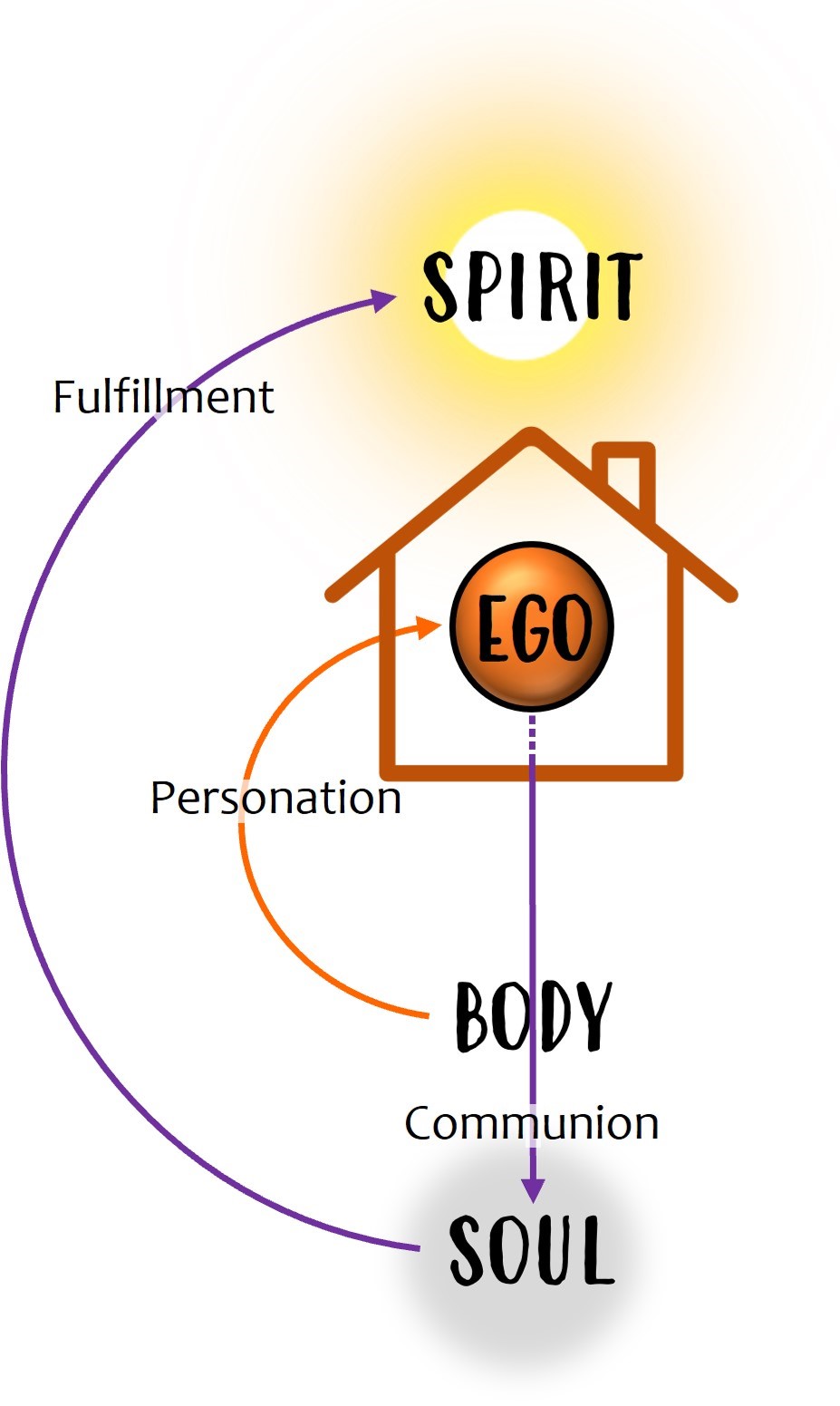
Instead, by dropping the charade of becoming somebody special and returning to the body that is “part of the whole, called by us ‘universe’,” we come back to the true Mystery of God as the Power of Love among human beings, the Spirit of Life in living beings, and as the Ground of Being in all beings.

Salvation is about coming back in present awareness to what we are.

A (More) Meaningful Life

A mentor and friend of mine passed away recently. He was 79 years old and a one-time member of a church I served back in my ministry days. He and his wife were good friends with another couple who were founding members of that same congregation.

The supernatural orientation of religion, its tendency for getting tangled up with in-fighting, and the curious hypocrisy of many believers had kept him from getting too deeply involved over the years.

When his friends invited him and his wife to a small group study I was facilitating, he found the topics of conversation not just interesting but surprisingly relevant to his life. It was hard to believe at first how far the Christian Church had fallen out of alignment with Jesus the wisdom teacher, ethical revolutionary and social activist.

Jesus felt to him like a kindred spirit, more like a man with a vision for a New Humanity than a god-in-disguise with plane tickets for a chosen few.

My new acquaintance struck me as one who was intentionally engaged in the business of living a meaningful life. As I reflect now on his example, on the legacy he left for me and others, five principles surface in my memory.

These Five Principles articulate a more general philosophy of life that regards meaning as an act of intention (which the ‘-ing’ might imply) whereby we purposefully project around ourselves a mental and moral habitation of value, order, and significance known as our quality world.

Rather than going out to find meaning, this approach surmises that meaning in life – even the meaning of life – is a creative product of active intention and intentional action.

This reference to intention already suggests that meaning is not “out there” just waiting to be found, but both depends on and is a symptom of a certain proficiency in the skills for making life meaningful.

The Five Principles for living a (more) meaningful life that come to mind as I remember my friend and mentor should be understood as a methodology, a consistent approach, set of priorities, and practical rules for living. I’m sure he wasn’t perfect at it, and neither should we expect perfection from ourselves or each other.

As we get stronger with these Five Principles, however, life is sure to grow more meaningful.

1. Question Everything

Instead of allowing himself to settle into certainty and lock his mind behind the bars of conviction, my friend was always asking questions. Whether he posed his questions out loud to others or just worked them over in quiet meditation, this principle of interrogating claims, motives, sources, facts and assumptions put him in good company with the Skeptics of classical Greek philosophy who insisted that Reality is not what we think or believe.

Because our knowledge claims are not plucked directly from Reality but constructed in our minds, we can always get a little (or a lot) closer to the way things really are.

This deconstruction process may come across to others as quarrelsome, disrespectful, or even sacrilegious, but only in the degree they have abandoned the quest for Truth to become devotees of idols. My own irritation over having a belief questioned by this visitor’s skeptical curiosity exposed a tendency in me that would take years to overcome.

I’m still working on it.

2. Consider Different Perspectives

Once we can break free of conviction by the realization that Reality is not what we think or believe, we begin to develop an appreciation for the variety of angles, opinions, and perspectives out there. Because my friend and mentor was a generation older than me, and because his background experiences and lens on life were so different from mine, his participation in our small group confronted me with the challenge of accommodating a different way of looking at things.

It was an illuminating – and at times bracing – reminder that my claims on Truth were also a matter of perspective, one among many.

Even if we aren’t granted the opportunity to articulate and clarify our perspective in juxtaposition to someone else’s vantage-point of understanding, we can still practice this principle by asking ourselves whether there are other ways of approaching a topic or question of life. Just giving time to imagining what those different approaches might be serves to loosen our grip on the perspective we currently hold.

When practiced in the company of others who see things differently than we do, our perspective has a chance to stretch open for a larger frame on Reality and a longer view on Life.

3. Think It Through

If I call my friend a rationalist, it would not be to suggest that he could only think in binary terms of black and white, this or that, like the zeros and ones of computer code and the digital logic he built his business on as a software developer and entrepreneur. In the spirit of my earlier comments, I might prefer to call him a rational skeptic: someone who used his thinking intelligence to question and test and refine his perspective on things – and help others (like me) do the same.

The practice of thinking things through is about much more than merely reciting our beliefs to ourselves and defending them to others.

It involves tracing out the implications of what we are considering, what its broader associations are, how similar or different it is relative to other beliefs we currently hold, and what relevant impact or practical consequence might likely follow upon our agreement with it.

Such rational skills are vanishingly rare these days, resulting in more people getting swept up in social media echo chambers, lured into conspiracy thinking, and making snap judgments based on how they feel in the moment.

4. Cultivate Close Relationships

If we are fortunate to be on a bed when we die, what will matter most to us is not our dogmatic beliefs or material possessions, but the loved ones who gather in witness. My mentor was a dear friend to me and my family because we shared an appreciation for life as a journey between our first breath and last. We walk with others for a time in sacred company and then take them with us in our hearts.

My circumstances in his last days did not afford the opportunity for a final farewell, leaving me to fondly reflect now on the meaningful times we had together.

I’m not saying that relationships are the only things that matter in life, but as our journey began in a union followed by a separation, we may hope to rest in the end among a communion of loved ones before we separate a final time.

Even if this isn’t how it goes for us, the company of kin and close friends along the way is the magic that both deepens and lengthens the meaning of our life.

But here’s the thing: there’s a formula to this magic. It doesn’t just happen on its own. When my friend was with me, I felt his presence. He genuinely wanted to know how I was doing and what I was up to. A consummate storyteller, he could deftly recall an experience of his own that resonated with something I said, throwing light on a challenge I was facing, helping me realize that I wasn’t alone.

5. Honor the Mystery

One way I might describe my departed mentor and friend is that he was a rational skeptic with mystical sensibilities.

The term ‘mystical’ shares a root with another term, mystery, referring to a reality or dimension of Reality that transcends our words, our thoughts, and even our minds. In the presence of this Mystery we can only be silent – literally close our mouth (Greek muein) in humble recognition of the fact that words and thoughts naïvely presume to define what is indefinite, boundless, elusive and ineffable.

This is another reason I might describe my friend as a rational skeptic, and not a hardcore rationalist for whom everything must be logically graspable and boxed inside the categories of knowledge. He appreciated terms like grounding Mystery, the present mystery of Reality, and Ground of Being as naming something that can’t be named, a Presence that isn’t a problem to be solved but a depth and grandeur to be honored.

If contemplative silence is our most appropriate response to this Mystery, then perhaps the best way to honor it in life is to question everything.

And so we have come full circle.


I miss my friend. He leaves behind a loving family and companions who will continue his legacy, bringing his searching spirit, inspiring example, and love of life with them into their own quality worlds.

Because of him, we can all live more meaningful lives.

A Case for Human Progress

A “meditational hologram” – that’s what I’m calling what you see above. More than a mere infographic, it arranges things in a way meant to guide a deeper meditation. A large Diamond in the background, a diamond-shaped formation of smaller diamonds in the foreground, and the zig-zag pattern of arrows at midfield, all provide distinct lines of sight into the same mystery – the mystery of human consciousness.

Those smaller diamonds in the foreground represent four threads of intelligence that comprise the braid of consciousness in humans, what I name our Quadratic Intelligence.

Mind (rational intelligence: RQ), Will (visceral/volitional intelligence: VQ), and Heart (emotional intelligence: EQ) are arranged along the horizontal axis, suggesting facets or faculties of consciousness. Soul and Spirit are not different threads of intelligence but rather distinct nodes on the same thread of spiritual intelligence: Soul (SQ1) the mystical-contemplative node (or pole of the SQ continuum), and Spirit (SQ2) the communal-transpersonal node.

The entire meditational hologram is framed by four terms that name the frontiers of our human journey, starting out from the “I” (ego = the orange-colored disk or sphere in the middle of everything) that looks out from its separate center of personal identity.

“I” can look in to Oneself or out to Another, release and descend to the deeper oneness of the Ground, or connect and transcend to the higher wholeness of Community.

It can also happen that ego gets stuck in its own neurotic spiral of insecurity, feeling alienated and exposed in its separation, which in turn compels the production of compensatory strategies that end up obscuring the natural clarity of the three faculties. Convictions close the Mind, Ambitions entrap the Will, and Obsessions captivate the Heart – all preventing the light of awareness from penetrating to the Diamond’s interior (Soul) and suppressing its outward shine or brilliance (Spirit).

From ego’s perspective, however, these compensatory strategies are more or less desperate attempts to resolve the insecurity that attaches to its very existence. The unpleasant side-effect, however, is an unstable bipolar dynamic between anxiety and exhaustion, with the latter pole frequently pulling everything into a melancholic state of depression, despair, and suicidal ideation.

In the space remaining, I want to explore an element in my meditational hologram that was only a recent discovery for me. As I explained in Clarity and Brilliance, the faculty of Will, having been squeezed to the side by Western psychology and absorbed into its preferred cognitive paradigm, played a secondary role in my own scheme of Quadratic Intelligence (VQ, EQ, RQ and SQ).

When I realized that the Will is our faculty of action, and that it drives action not only at the level of our coordinated behavior in the world but also in the cells, glands, organs and organ systems of the body, its equivalence with our volitional intelligence (VQ) became clear to me.

Not only did this move take the Will from the sidelines of psychology, but it placed it at the very center of my model. The only remaining step in my theory was to draw a distinction between the autonomic and unconscious actions transpiring in the body, and the conscious, intentional, and purposeful behavior of the embodied ego.

So, using the convention I had employed to differentiate between Soul (SQ1) and Spirit (SQ2) in our spiritual intelligence, it was helpful now to distinguish between unconscious-autonomic (VQ1) and conscious-intentional (VQ2) zones of our visceral intelligence, further clarifying this distinction by naming the deeper zone “visceral” proper, and the upper zone “volitional.”

The threshold demarcating this difference is indicated in my hologram by a dashed horizontal line through the faculty of Will. Its position in the hologram overall suggests that these threshold dynamics might play a pivotal role in the whole system, and even have a determinative influence on the integrity of consciousness itself.

Thanks for your patience. We have finally arrived at the special focus of this post.

Associating the threshold between VQ1 and VQ2 with ego formation makes a case for regarding it as serving a critical role, not only in individual development but in our evolution as a species.

In Helping Each Other Fly I reflected on the strategic value of skills as hyper-intentional behavior which is not instinctual but must be learned. The initial invention, ongoing acquisition, and gradual perfection of skills became the foundation of human culture – the complex system of technologies, routines, institutions, ideologies and traditions that effectively liberated our young species from the instinctual field of survival concerns, perhaps as early as 2.5 million years ago.

Without an ego – without a separate center of self-conscious personal identity, subjectivity, agency and perspective – this entire project of developing skills and creating culture would not have been possible. Personal identity is itself a social construct engineered for the task of domesticating an animal nature into a well-behaved, responsible, and productive member of the tribe.

Through the process of training, shaping, instruction and assignment of each new generation, society conserves and advances the project overall. These skills range from controlling our sphincters and using the toilet, to tying our shoes and operating machinery, but also how to think well, manage our emotions, get along with others, resolve conflicts, and foster community.

If someone doesn’t teach us these skills, inventing them on our own would be equivalent to starting the history of human culture all over again.

We need the effective learning alliance of wise and caring parents (and teachers) together with devoted and hopeful children (and students) to ensure a continuity of skills from generation to generation, and the steady progress of our evolutionary journey as a species.

If no one teaches us how (skill) to respect and welcome others of different backgrounds, lifestyles, and moral values from our own, it’s likely that our insecure ego will be overrun by feelings of anxiety, suspicion, hostility and aggression. We may master the technique of how to load and shoot a gun, but our ability to negotiate social differences and live in community will be tragically underdeveloped.

Such are the conditions – weapons in hand, no love in our hearts – that put civilization at risk, threatening to pull down the whole project of human culture and a civil democracy.

Without the achievement of ego strength and self-control, history will throw us back millions of years to start again – if we can only manage to survive.

Next Steps

Wouldn’t you love to have a map for this journey of your life? Some chart, some tool – something that could help you get oriented in Reality and moving in the right direction? We’re not talking about a step-by-step itinerary prescribing every move, turn, and stop along the way. That would take the adventure out of it.

There’s something about having to find your way, and not just follow someone else’s, that makes the journey a true adventure.

We find just such a map in the wisdom traditions of the world, which originate from the wellspring of spiritual insight (seeing into the true nature of things) and comprise a network of tributaries flowing into a Great Sea of Enlightenment. As the religions have fought over water rights and whose buckets (conceptual categories) will hold and define this living stream, Sophia Perennis has carried on in its work of awaking, liberating, and renewing the Human Spirit for millenniums.

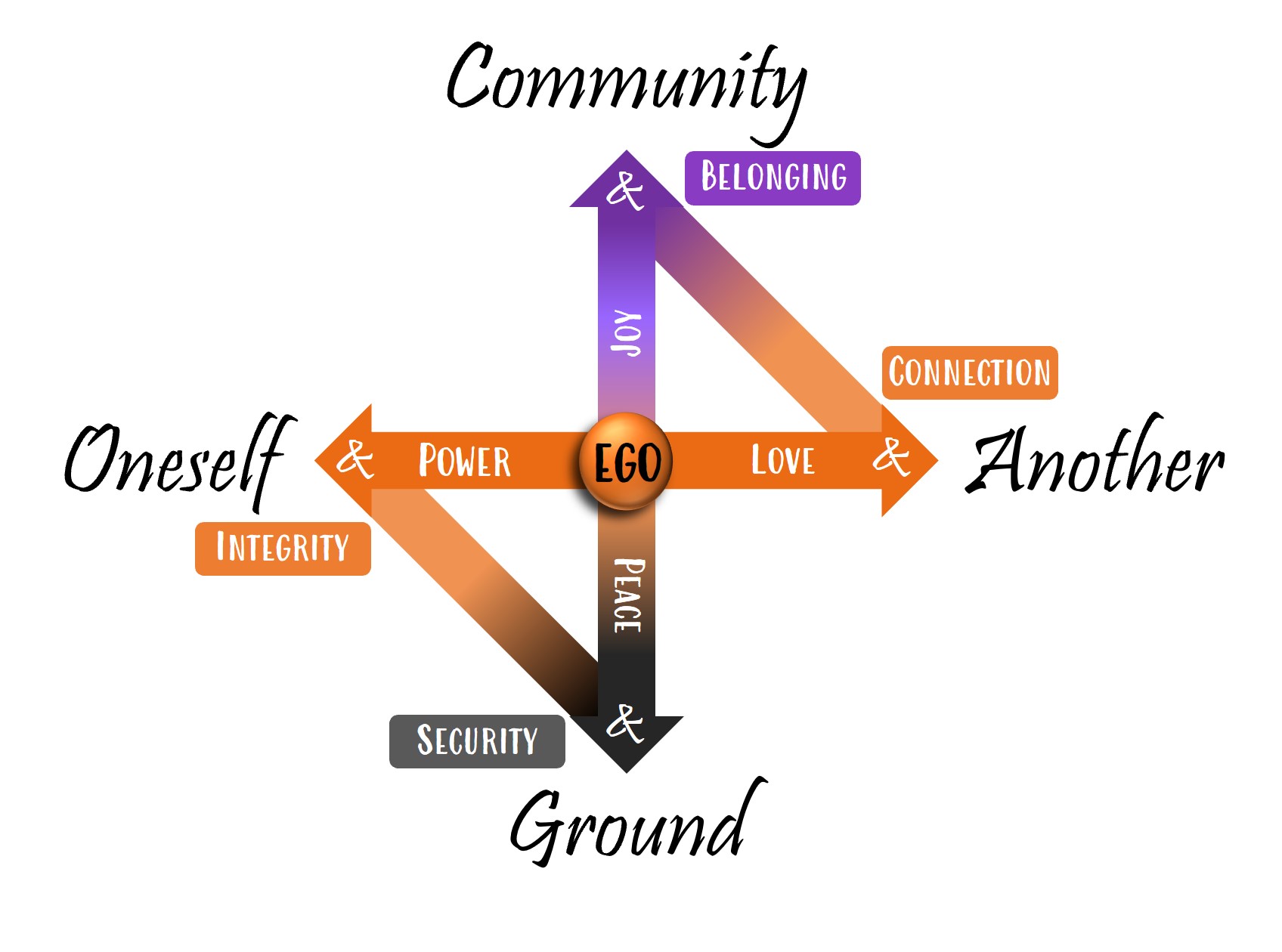
The diagram above is a simplified illustration of this map of the human journey, again not so much a prescription for where we should go but a layout of the terrain and the different directions we can go, depending on what kind of experience we are seeking. An important metaphor from the wisdom traditions visualizes this journey as more a way or method than a pilgrimage with a preset destination.

In that light, human salvation is less a distant arrival point (e.g., the heavenly paradise of religion), than it is the healing, wholeness, and wellbeing that arise from intentional living, when we are mindfully engaged in the Here and Now.

As with all helpful maps, this one orients us with a “You are Here” locator designated by the notorious term “ego,” which, innocently enough, refers to the place in each of us where consciousness flexes back upon itself in a self-conscious identity.

While it is true that the great historical wave of human suffering originated with the breakthrough to an individual self-conscious experience, the emergence of ego consciousness also opened up new frontiers of spirituality.

From this central point, seemingly alone in the middle of Everything, four such frontiers open up to us, each one leading into a distinct realm of discovery, challenge, and opportunity.

Oneself

The path on the left leads into the character, personality, and temperament of the individual – into “oneself.” This is an endlessly fascinating realm filled with funhouse mirrors that reflect back distorted images, along with countless passages, rabbit holes into dark tunnels, and tight mazes where it is easy to get lost.

On the path into Oneself we see the image of a spiral threatening to pull consciousness from its introspective adventure and into a neurotic pattern of self-preoccupation. Such obsession with our own need to feel safe, loved, capable and worthy (our so-called subjective or “feeling-needs”: the collection of funhouse mirrors just mentioned) is what generates the preponderance of psychiatric suffering across our species today.

Our anxiety drives us to attach to what or whom we need to save us, which of course they cannot do. This agitates our frustration, causing us to grip down even harder – or else drop to our knees in submission, hoping that our gestures of flattery, adulation, or appeasement will motivate their intervention on our behalf.

Over time, the resulting entanglement and codependency have us completely hemmed in and we might remain in this self-induced hostage condition for many years – even a lifetime.

The not-so-clear but very present danger of this neurotic spiral shouldn’t steer us away from the truly enchanting frontier of Oneself, however. Temperamental traits, patterns in the personality, and habits of character that formed as we responded to our circumstances and chose our way through life: all of it holds the potential of greater insight into who we are and why we tend to lean into or away from Reality as we do.

The modern science of psychology is itself evidence of how at once intriguing and baffling we humans are to ourselves.

Ground

A second frontier, accessible from this back country of Oneself but also approachable by a more “vertical” and inward drop away from the center position of ego, is a mystery of what the wisdom traditions name the Ground – the grounding Mystery, Ground of Being, Real Presence, or the Present Mystery of Reality.

The alternate route, through the threads and tangles of personality, has frequently led some to conclude that the frontiers of Oneself and Ground are really the same – when they are not. Their difference is a matter of whether the ego is conducting the quest, through a webwork of its own making, or instead needs to be released and left at the surface for a kind of existential “trust fall” into the very Ground of our being.

This is the essential, and etymological, meaning of “faith.”

Interior probes of our personality can bring us to the brink, perhaps, but at some point the center of self-conscious awareness must itself be surrendered, leaving no one (none, no thing, Nothing) but an ineffable and boundless Presence.

Mystical spirituality is a disciplined cultivation of communion with the Ground, playing at the threshold or drop-off where words dissolve, theology (“god talk”) becomes nonsense, where thoughts untie from the thinker, and only a pure awareness remains. Not surprisingly, mystics the world over have not been well-received by the custodians of religious orthodoxy. In many cases, they have been excommunicated, persecuted, condemned and put to death – only later honored or even worshiped as revealers and avatars of Truth.

Another

Returning to the “You are Here” station of ego, a third path takes us into the frontier of interpersonal life, the social arena, and where we encounter “an other” (Another). The otherness of Another shows itself only through the veils of personality, as the hidden subject behind the presented object of the person before us. An interior self, a center of feeling, thought, intention and will, is back there somewhere, arousing our fascination, curiosity, fantasy, suspicion or fear.

The development of our own personality and sense of self, of our ego and personal identity, was shaped in the field of early attachments and alliances.

Personal identity and its ego-in-charge would simply not be possible without this interplay with partners, allies, rivals and opponents who are on their own journeys of ego formation toward becoming somebody special.

Just take all of those complications and neurotic potential that we barely acknowledged in each of us (Oneself), and now throw it into the fray of interpersonal and social interactions, and what you have is an exponential dynamic of actions causing reactions causing counter-reactions, all together producing an amplifying effect across the web of human relations that seems always on the verge of blowing up or shaking apart.

And yet, somehow we need each other.

Community

For what? The answer to this question takes us into our fourth frontier, called Community. Not just another word for the addition of more Others to the scene, community names the synergistic and transformational process whereby much of that same chaotic energy just mentioned gets harnessed and channeled into a higher wholeness.

Individually we are empowered to rise above our own roles and identity contracts for the sake of joining with others in transpersonal fellowship and harmony.

Notwithstanding my earlier concession that the human journey is less about a destination (where we are going) than a way or method (how we are going), this whole scheme seems guided by an aim towards ever more inclusive, compassionate, virtuous and enlightened – in a word, provident – forms of community.

As individuals commit themselves to living more grounded and centered lives, reaching out to each other with acceptance and love, the strength of their bonds and the synergy in their differences will continue to create communities that nurture, inspire, guide and liberate the Human Spirit for still more to come.

It’s there we learn that waking up and becoming whole, together, is what the human journey is all about.

Helping Each Other Fly

Whereas all other animal species on Earth evolve naturally toward the mature and fully self-actualized ideals of their distinct genotypes, the fulfillment of human potential requires a mediating system of inventions and conventions known as culture.

Without culture humans are incapable of realizing the full potential of what lies within us.

And yet, it is also the case that culture can be a dark and destructive force which extinguishes the Human Spirit in so many of us. The talent and creative intelligence that seeks to be discovered, developed, and expressed instead goes undiscovered, or worse it gets suppressed by abusive or incompetent parents, teachers, trainers, and coaches.

The old argument between those, like Thomas Hobbes, who regarded culture as a civilizing influence upon a savage animal nature, and others, like Jean-Jacques Rousseau, who saw it as having a corrupting influence on a native innocence, has been exposed as based on a false dichotomy.

It’s not human nature on one side and human culture on the other, but a human nature expressed and further developed through the mediation of culture. Human culture is technically an “exaptation” that human nature produced by virtue of its creative intelligence, and then used that creation to support, drive, and inspire the prolific output which has expanded and accelerated ever since.

Culture quickly became a kind of scaffolding for human progress, to the point where now human survival is nearly impossible without it.

It’s certainly true that the higher we climb into this scaffolding of culture and the more reliant on its support we get, the weaker our animal instincts, native intuitions, and “natural wisdom” also tend to become. Like Darth Vader in Star Wars who was unable to live without his breathing mask and protective suit, humans have grown existentially dependent on the artificial habitats and support of culture.

But this post is not intended as another dystopian scenario of our human fate. I will invite my reader to climb back down with me, closer to that generative threshold of human creativity where our native intelligence as individuals was originally coaxed and guided into learning the foundational skills of culture.

Almost by definition, a skill is an ability that must be learned and typically also taught, then practiced towards mastery.

Humans don’t know how to perform a skill by instinct. We may be naturally predisposed with a talent or knack for it, but its performance is something that requires instruction, training, coaching, and consistent practice to even stand a chance of approximating the level of proficiency known as mastery.

And because learning a new skill depends on other humans (even with today’s addition of instructional AI), this “learning alliance” is where the process can really take off – or fail.

My question, then, is about successful skill instruction, acquisition, and mastery.

What makes for a strong and productive learning alliance? Whether we’re talking about parents and children, teachers and students, coaches and players, therapists and clients, physicians and patients, trainers and trainees, what is the path by which human nature gets lifted into culture’s scaffolding of skills and thus equipped for the higher flourishing of our species?

The above illustration depicts a piano lesson in session. A student sits at the piano as an instructor stands behind her, commenting and advising on the recital underway. The “path” in question is laid out schematically like a circuit, using a magenta-colored line with numbered nodes to indicate key junctures where a learning alliance facilitates, or otherwise impedes, the creative flow.

1. Internal State

Human nature shows up to the session in the animal biology of both the student and teacher. This node is positioned in the “gut” or viscera where the body’s internal nervous state is registered and managed. The optimal internal state for learning is coherent, composed, and calm, making it more likely that each partner of the learning alliance can give their attention and effort to the challenge at hand.

An anxious, agitated, or depressed nervous state, on the other hand, does not support mindful intention and effective learning, but is instead susceptible to distraction, forgetfulness, disengagement and performance errors. What is called a grounded state identifies the optimal psychosomatic (mind-body) alignment where an individual is centered in present awareness, mindfully attentive to Reality and fully embodied.

An effective learning alliance is rooted in the grounded internal states of both teacher and student.

2. Interpersonal Rapport

Neither partner has any direct control over the other’s internal state. Still, the evolutionary design of their nervous systems gives each a natural ability (not a skill) to sense, react, adapt and influence the other. In an effective learning alliance, a “teacher” traditionally has the greater responsibility for managing the communication and other conditions that are conducive to a calm, focused, and engaged session. Under such conditions the student is more likely to learn what she needs to know and know how to do.

Many students are naturally nervous in facing the challenge of learning something new. Their natural curiosity is often counterbalanced by a self-conscious awareness of the fact that they don’t yet know nor can they do very expertly what the teacher may be expecting.

A skillful teacher takes responsibility by affirming effort, recognizing progress, and encouraging improvement – all the while assuring the student of their unconditional confidence and patient support.

3. Technical Mastery

Progress to skill mastery can take a while, particularly for more complex skills like playing the piano. But with calm internal states in both teacher and student, and a positive interpersonal rapport between them, the implementation and correction through consistent practice makes the approach to mastery much more likely.

The student will typically be expected to practice on her own between lessons, demonstrating her growing competency and exposing where she needs to improve on her skill each time.

The learning pathway for a new skill moves through distinct phases: (1) a mimetic phase where the student mimics or mirrors what the teacher is modeling; (2) a practice phase where specific moves and routines are repeated over and over again; and finally (3) a performance phase, by which time the mechanics of the skill require less conscious attention and effortful control, liberating the new “master” for a flawless rendition, fresh improvisation, and even creative innovation.

4. Creative Transcendence

This ascending progress, where the technical mastery of skills at one level serves as the foundation for the learning of skills at higher levels of cultural engagement and production, is what has lifted our human potential to new heights over the long millenniums of time. Along the way we have become more connected, more involved, and even more creative. All of our knowledge, technologies, and skills have united us into a single global community.

The cultural scaffolding of skills has elevated us to a level of diversity awareness and inclusion never before possible. We have created new dimensions of identity, new architectures of intelligence, new technologies of communication, and new possibilities for self-transcendence. We seem to be just on the cusp of a new communal way of being that is mystically grounded, socially engaged, and ethically enlightened.

And just now, wouldn’t you know it, we are starting to devote less attention, invest less time, and accept less responsibility for managing the healthy learning alliances on which creative culture and human fulfillment depend.

Maybe it’s not too late.

A Journey Better Shared

There are just a handful of ideas from the collective wisdom tradition (Sophia Perennis) of the human race that truly transcend the historical conditions of time and place. The tradition itself is a massive undertaking, free of committees and bureaucratic management, to conserve and further develop groundbreaking insights into evolutionary advances for our species and the planet.

As a counter-offensive to the destructive impulses and shortsightedness of our species, Sophia Perennis has helped perhaps more than anything else to keep us together and working things out.

This post will bring the handful of ideas into a system, making a case for regarding this system as a useful framework in understanding the human journey. While the historical conditions of time and place have an undeniable influence on our individual development and wellbeing, these more general dynamics can help us appreciate the essential (deep) and universal (broad) principles in play, when or wherever we happen to be.

My diagram lays out these ideas using a graphing tool of ‘X’ and ‘Y’ axes, where the horizontal (‘X’) axis corresponds to eras of time in the human journey, and the vertical (‘Y’) axis intersects three distinct planes of consciousness – the subpersonal (“below” ego), the interpersonal (“between” egos), and the transpersonal (“beyond” ego). The human journey is divided into three eras, which I will provocatively designate as trimesters of human transformation, with each trimester correlated to the ascent of consciousness through its three planes.

I could keep trying to explain my approach, but let’s just jump into it.

The first trimester of our human journey begins in an extremely dependent and vulnerable condition. A human newborn is utterly incapable of feeding, cleaning, moving, or defending itself. This absolute dependency on external circumstances and the infant’s taller powers activates an inherent capacity of its nervous system, calibrating the body’s internal state according to how provident, or otherwise, reality is perceived to be.

When the liberal Protestant philosopher-theologian Friedrich Schleiermacher (1768-1834) defined faith as the experience of “absolute dependency” on the provident reality of God, it was this most basic human experience he was referencing. Back then, no one knew much about brains, nervous systems, and the subpersonal intelligence of the body in matching and meeting the conditions of life with a nervous state and behavior that are maximally adaptive.

Schleiermacher was sufficiently self-aware to realize how foundational this capacity is to a human being’s general outlook, attitude, and wellbeing. Yet, because Christian orthodoxy was already deeply committed to a definition of faith as a set of beliefs rather than the inner release of trust to the present and provident Mystery of reality, his insight was brushed aside as too subjective and psychological – too “liberal.”

Nevertheless, it is his understanding of faith as existential trust that is more consistent with the larger wisdom tradition.

In the above illustration, faith (the virtue of the first trimester of our human journey) is connected by a slanting line to peace, drawing an essential equivalence between the adaptive response of existential trust and the experience, on the subpersonal plane, of a deep inner calm. Faith and peace are dynamic correlates, then, in the early stages of human transformation.

We must acknowledge the fact that not everyone’s nervous system matches up to a provident reality of caring taller powers and a nurturing early environment. Some are born into situations of neglect, scarcity, abandonment, or abuse – which activate a very different adaptive response in the body: not the trusting release of faith, but instead a nervous contraction away from a dangerous, unpredictable, and hostile reality. Their internal state is one of chronic anxiety and fearful vigilance, not a calm and composed inner peace.

For now, however, our meditation will stay focused on the optimal achievements along our journey, using these as contextual guidelines for appropriate therapy and support when things don’t go perfectly – which, as a widely acknowledged fact of our human condition, they never do.

So we follow the next arrow up from the subpersonal (i.e., the body’s internal state) to the interpersonal, where experience opens out to relationships with other persons. This is the plane of consciousness centered in the self-conscious experience of ego – the “I” who wears masks of identity, takes on roles and joins in the role plays of society, and more or less obsesses over becoming somebody special.

The wisdom teachings don’t denigrate the ego for being a mere construct of social engineering. They regard it rather as a means to something more, a mechanism of sorts for centering personal identity and making connections with other persons across the various scales of belonging, association, and membership.

When the individual is grounded in a state of inner peace, the primal response of existential trust can be directed outward to others, where it serves as the dynamic core of loving relationships.

Both visually and dynamically, the entire system of virtues turns on this hub of interpersonal love. It is the crucial second trimester of our life journey and occupies – we could rightly say it preoccupies – the central plane of interpersonal consciousness, where we are confronted with the challenge of getting along and loving each other.

Wisdom teachers all around the world and throughout history have preached and practiced the critical importance of love – for oneself, for our neighbor, and even for the enemy – to the wellbeing and final salvation of humanity.

When individuals are connected in healthy bonds of love, mutual goodwill, and ethical responsibility, the resulting community (literally “together as one”) has the effect of generating within and among them a Spirit of joy.

This communal Spirit, frequently written using the uppercase ‘S’ to honor the mystery of its being not merely a sum but the product of individuals transcending their personal identities and interpersonal agreements for a transpersonal experience of higher wholeness, is celebrated across the cultures as a kind of divine ecstasy, the flourishing and fulfillment of our true nature as human beings.

As the metaphorical roots of the word suggest, Spirit (ruach, pneuma, spiritus) is the “breath” that animates us, the “wind” that moves among us, and the “air” that surrounds, uplifts, and unites us together as one.

The last arrow in my diagram follows the flow from joy to hope, bringing us into the third and final trimester of our human journey. Notice, too, that we are dropping back down to the interpersonal plane of consciousness. This is consistent with the teachings of spiritual wisdom, which declares that the cultivation of love in the joy of genuine community is the secret to humanity’s ultimate hope.

Human destiny is bright so long as our vision includes everyone and everything, as we hold open a positive expectation for a world where love can only grow.

A Reconciliation of Religion & Science

The overstory of cultural evolution features a complementarity of visions known as religion and science, which in the last 2,500 years or so have been competing for dominance, with religion on a dramatic decline in the West since the 1800s – but starting long before. Many will argue that this decline of religion in the West is a sign of our spiritual decadence as a culture.

This argument comes off too much like that oft-used tactic of corrupt authority: blaming the victim.

Religion becomes irrelevant and then comes down with coercion and threats to enforce compliance. All the while, its members are disengaged and quietly leaving out the back door. A good percentage of those that remain are either there for the kindred society it provides, the warm familiarity of its customs and beliefs, or else because they are convinced that it holds the only point of access to the ultimate glory they seek.

In this blog I have been making a case for seeing much of religion’s troubles as self-inflicted, brought on by its own dogmatic unwillingness to meet and advance with the evolving spirituality of its people – and of our species generally. If the role of religion is (1) to facilitate the spiritual development and liberation of human beings, and (2) to provide for the creative engagement of spirituality with the real world and its challenges, then religion is failing on both counts.

Religion started losing ground way back when the enterprise of philosophy – the disciplined pursuit of wisdom based in a grounded understanding of the universe and our place in it – dedicated itself to building a system of knowledge free of magic, superstition, and orthodoxy.

What began as “natural philosophy” soon became science, a headwater that quickly differentiated into numerous tributaries: physics, geometry, biology, astronomy, and dozens more as the centuries went on.

All of this sprang from a newfound confidence in sense experience, critical and contextual reasoning, experimental methods, and methodological doubt (holding a claim in question until it can be validated or disproved by evidence and logical thought) – all anchored to a growing sense of the individual’s capacity for finding the truth by more natural lights.

Ideally, religion would have encouraged this progress to a more rational and reality-oriented way of being, just as a parent should encourage and support their child’s development into more formal operations of thought, ego strength, and intellectual autonomy.

In the same way that a parent doesn’t insist on controlling the behavior and beliefs of their adolescent with a dogmatic “Because I said so!” it is critical for religion to know when, and how, to step back and then reengage its members in accordance with their evolving faith, expanding curiosity, and developing intelligence.

This moment of breakthrough is wonderfully illustrated in the so-called Flammarion engraving (see above), which may date back to the early modern period (15th-16th century). It depicts an explorer who suddenly, it would seem, is able to see through the veil of a world where his life’s security, orientation, and meaning have been safeguarded – up till this moment.

On the other side of this veil he beholds a cosmic system of elements, physical forces, spheres and wheels; no deities, archangels, or heavenly abode are to be seen.

Not, that is to say, what he was told to expect.

That realm beyond the veil is the universe of science; the veil and its enclosed world, the domain of religion – at least in its theistic mode. Theism is a type of religion oriented on a patron deity (or deities) who provides protection, support, and final salvation to his (or her) people in exchange for their worship and obedience.

Its rise over the longer history of religion correlates exactly with the ascendancy in human consciousness of the self-conscious personal ego. The patron deity plays the role of celestial superego to a growing multiplicity and potential anarchy of human egos on the ground, so to speak, each in pursuit of their own happiness. As moral administrator and archetype of virtues, the deity incentivizes proper behavior and inspires the activation of virtue in his (or her) devotees.

When natural philosophy began to lift the veil of meaning to discover a reality not populated by god and his angels, this revelation itself was the signal of a transformation in human consciousness.

Solar gods and lunar goddesses, heavenly fathers and earth mothers were drawn aside on physical stars and moons, the boundless vault of outer space and blue marble of our precious home planet.

Those earlier mythological references had accomplished their work of attuning human consciousness to a provident universe: the generative source, dynamic web, and shared destiny of all things. With a deep feeling of belonging, that they were safe and supplied what they needed to flourish and live meaningful lives, theism had served humans well.

But the time had come for some to step out into a larger reality and learn how to live on the other side of (post-) theism and its richly embroidered veils of mythology. With a well-grounded faith, a sacred reverence for life, and their ethical virtue sufficiently awakened, religion should have been ready to facilitate the progress of this generation of seekers into a post-theistic spirituality and worldview.

Just as the parent needs to help a child emerge from under the protective firmament of dependency to face reality as it is, to take on life as it is, so theism needed (and still needs) to not just allow but encourage and inspire the spiritual liberation of its “children.”

Whereas theism, especially in these latter days, tends to be unifocal in defending a literal reading of its myths and laying claim to absolute truth, post-theistic religion accepts and embraces responsibility for cultivating faith in its children, awaking compassion in its youth, and ordaining the higher self of adults for the task of interpreting the stories and updating its metaphors of God.

In this way, post-theistic adults can lead and guide the spiritual evolution of believers all the way through.

When theism elected to hold its ground rather than adapt and accommodate the transformation in consciousness that was underway, it created conditions for the spiritual decadence of Western culture. Without the intentional structure of a post-theistic guidance system in place, many would-be post-theists were either pushed out, or, for the sake of staying true to the longing within themselves, chose to leave, forced from their community to find their way alone.

What theism hasn’t understood all this time is that a post-theist is never alone, having attained the realization that Everything is connected, All is One, and We’re all in this – together.

In large part, those who stayed inside were either still in need of what theism provided, or else, locked up in their own convictions and driven by a spiritual frustration, saw themselves as its heroic crusaders against a god-forsaken and sin-sick world.

Veils can be convenient to hide behind.

Free to Shine

In Clarity and Brilliance I offered a way of conceptualizing the dynamic integrity of human consciousness across its four types of intelligence: rational (RQ = mind), emotional (EQ = heart), visceral (VQ = will), and spiritual (SQ = soul/spirit).

The validity of these four is well-established in the psychological literature, with our spiritual intelligence most recently accepted into the empirical and academic discussion, now free of its supernatural and metaphysical preconceptions.

Using the analogy of a diamond, I employed the terms “clarity” and “brilliance” to help us appreciate the integrity of intelligence and how consciousness is (or can be) amplified, developed, and expressed in the human being. We have to qualify this with a “can be” since, in many of us, this flow of consciousness is actually impeded by neurotic, even pathological, complications. We’ll come to these after a bit.

“Clarity” refers to the transparency that each facet offers to the diamond’s interior depths, while its “brilliance” describes the effect of focusing and magnifying the light from these depths into a resplendent outward radiance. A clear diamond is also a bright diamond.

Clarity is looking in, brilliance is shining out.

So too with consciousness and its three “facets” or faculties of mind, heart, and will. When these are transparent to the inner depths of soul, consciousness is focused and intensified into the outward expression of spirit. This can be depicted more abstractly using the cross design of ‘X’ and ‘Y’ axes, where the three faculties are arranged along the horizontal (‘X’) axis and spiritual intelligence forms a continuum along the vertical (‘Y’) axis, with soul down-and-within and spirit up-and-around.

This entire system should be understood psychospiritually. Instead, in its early efforts to legitimate itself as a scientific (i.e., not “superstitious”) enterprise, Western psychology detached the horizontal axis of faculties from the recently discredited and unscientific vertical continuum of spiritual intelligence. It then further dissected the faculties into separate centers, or, which became the mainstream paradigm, absorbed the heart and will into a more broadly cognitive theory of mind.

Twenty-first-century psychology is more open to a psychospiritual approach, now that spiritual intelligence (SQ) has been validated in the research. Psychologists can agree, if not with the supernatural worldview and metaphysics of religious true believers, then with more of their scientific peers, that humans universally seek existential grounding in reality, as well as transpersonal community with others and all things – perhaps even with the cosmos itself.

These are not mere wishful fantasies or forgotten sensations of prenatal life, as Freud believed, but aspirations or spiritual longings that are deeply rooted in human nature.

In this post I will merge my “diamond” model of consciousness with the Five Aspirations of a human being. The coincidence of there being five aspirations or spiritual longings that drive us through life, and also five distinct nodes of our quadratic intelligence – rational, emotional, visceral, and two for the esoteric/contemplative and ecstatic/expressive poles on the continuum of spiritual intelligence – only recently clicked for me.

But it’s enough of a revelation that I wanted to upload it to the cloud of superconscious wisdom, just in case someone else, somewhere else, and perhaps at some other time, might download and help it to advance.

My diagram brings forward the diamond image, associating each faculty or node with one of the five aspirations. Thus:

  • The soul centers our longing for inner peace.
  • The mind centers our longing for deeper meaning.
  • The heart centers our longing for genuine love.
  • The will centers our longing for higher purpose.
  • The spirit centers our longing for creative freedom.

In the healthy and self-actualizing human being there is a deep sense of grounding in reality, which registers in the nervous system as a calm inner peace. Free of distress and securely based, the faculties of mind, heart, and will can develop and function with clarity, opening to life in the world with clearheaded and kindhearted goodwill.

The clarity of these faculties focuses awareness into the deep interior of the soul, where it is cultivated, amplified, and then projected outward as spirit in creative freedom. A clear (or open) mind, heart, and will provides for a relevant engagement with reality, one that is in touch with what’s going on, sensitive to the wonders and mysteries, challenges and opportunities it holds.

It’s when we put this dynamic of consciousness on its course of normal human development that the complications mentioned above start showing up.

If for whatever reason an individual lacks the grounding of inner peace, this insecurity has the effect of “clouding” the faculties with distortions that interfere with their proper function – dysfunctions which arise in the effort to manage insecurity and prevent an overwhelming flood of panic and despair.

Rather than opening in curiosity and seeking to understand, the mind closes down on its own beliefs, finding a false sense of security inside a defended enclosure of conviction. Instead of opening to others and to reality itself in lovingkindness, the heart gets locked into obsession and neurotic attachment. And in this clouded and distorted state, the will gets stuck in the ambition of “what’s in it for me?”: desperately craving something but at the same time afraid it won’t work out or be enough.

Conviction, obsession, and ambition are all compensatory mechanisms for managing – or more accurately, coping with – the subjective insecurity (anxiety) that comes with ego formation and standing out as somebody unique and special.

Because the development of personal identity entails a differentiation of self-consciousness from the ground of consciousness itself, even a normal ego experiences some degree of exposure and alienation which registers in the nervous system as generalized anxiety.

Given that normal ego development brings some anxiety along with it, and now with a better understanding of how the mind, heart, and will lose their transparency to the depths of soul as they get trapped in their own coping strategies, we can sympathize with how humans “manage” to so magnificently muck things up for ourselves.

We can also see the wisdom in the various methods and techniques that humans have devised over the millenniums for cultivating a more grounded existence. When we have inner peace, we can live free of conviction, obsession, and ambition – free to create a life of deeper meaning, genuine love, and higher purpose.

We can be free to shine and share in the Spirit of true community.

Human Rising

If you live by your convictions, you are a prisoner (a convict) to your beliefs and have difficulty thinking outside the box (your prison) and being open to mystery, to the present mystery of Reality, to Reality, or just to what’s real.

It’s important to you – we might even say it’s mandatory – that Reality, just like your mind, is locked down inside clear categories, on a grid of values that are absolute and unchanging.

If instead you live by your aspirations, there is a longing in you for fulfillment, which shouldn’t be confused with happiness but refers rather to an experience of realizing your potential and becoming more fully human. Humanity has been evolving for many millenniums, and your own development has progressed through stages of growth, awakening, and self-actualization since birth.

The truth is, both of these forces are at work in you. One works to define you and the world around you, adding layers over time of identity and the habits of judgment and belief that hold your identity together and keep your world intact. The other works to transform you, along with the world around you, by activating the inner capacity and evolutionary aim of your human ideal.

To the degree that convictions lock things in place and aspirations break things open, these two forces are antagonistic to each other. Much of your pain or joy in life is how this antagonism plays out.

To really get our minds around this, take a look at the illustration above. Vertical and horizontal axes are arrows coordinating an upward and forward movement, to signify a larger organic process in play: growing out of the ground and following the inner aim of its ideal – in this case, a mature and more fully self-actualized human being.

The horizontal arrow moving from left to right correlates to the actual past and possible futures of development. And you – or your “I” (ego) in this conversation – are at the center, corresponding to the experiential present.

Coming to you from the left (or past) is the storyline of your development as a character – the main character of your personal myth. Just as earlier chapters of a story serve to define the characters who develop and interact with each other, your life up till now is the record of conditions, events, and choices that have conspired in the construction of a personal identity – who you are and how you present yourself to others.

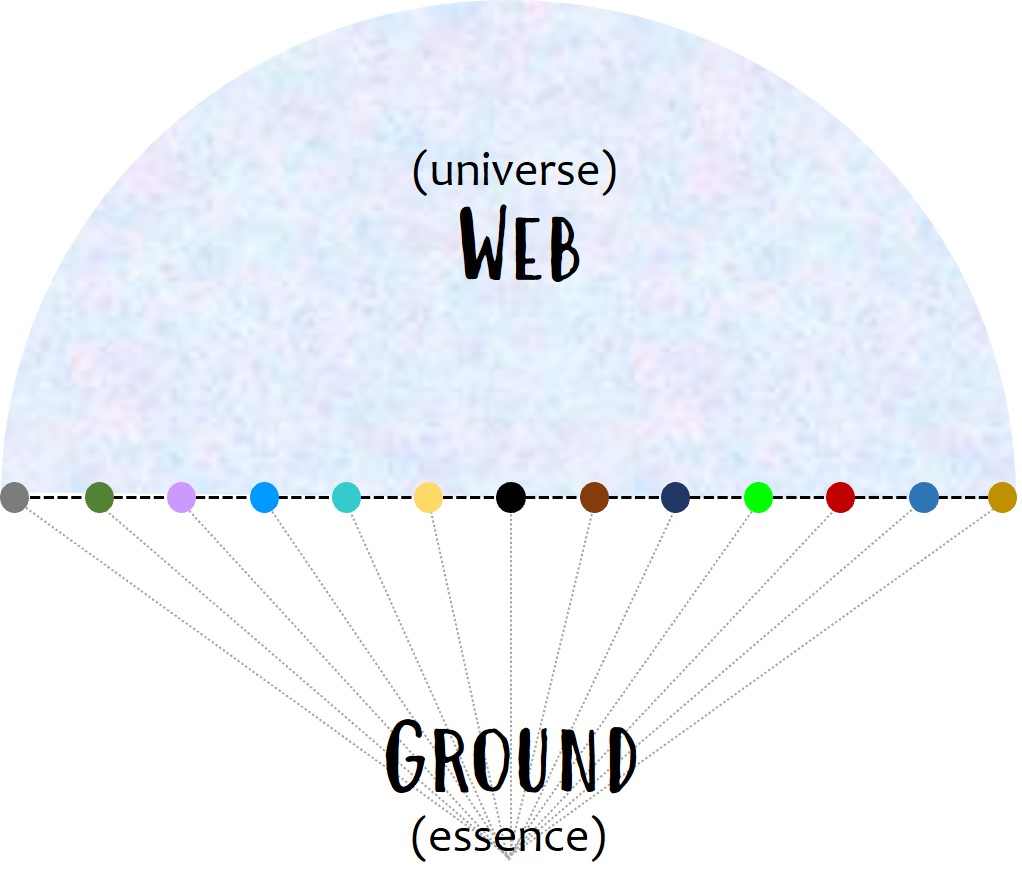
Now, to help us understand what’s going on as we move to the right, let’s turn our attention to the vertical axis, from the temporal (horizontal) to a contextual orientation. Your existence is grounded in Reality and is a product or manifestation of other forces – not biographical this time, but generally biological. This is not about who you are as a personality but what you are as a living, sentient human being.

Your existence is “generated” up from this ground, which is why we call it your existential ground, the generative Source and Ground of Being. Simultaneously with your emergence from this ground, you have been surrounded by and involved in a larger web of beings and forces, on the broadest contextual scale known as the universe: the “turning-as/into-one” of everything there is.

The transcultural wisdom tradition known as the Perennial Philosophy or Sophia Perennis acknowledges this universal web as a vast community of beings: not a chaotic mess but a cosmic order; not a random arrangement only, but a harmonious whole – a community in the true sense of the term.

This community manifests in a highly sophisticated and complex way among human beings. Life and consciousness have evolved in you to the point of achieving self-conscious awareness, in the ego (“I”) that puts on masks and plays the roles of identity. Over time and across countless role plays your identity has taken on the habits of character, that star of your personal myth mentioned earlier.

Now, it’s important to see that in order for you to participate in and consciously belong to human community, you (along with others) need to become a self-conscious person with a character of your own. In other words, genuine community, which is transpersonal in nature, depends on the pre-existence, so to speak, of persons, of separate egos playing the game of identity.

Community, therefore, is not a mere collection of egos, but a higher wholeness (com+unitas: together as one) that forms as individual egos are able and willing to “get over themselves” for a life in mutual harmony. There is no possibility of going beyond (trans-) the personal without a personal ego already in place.

This is a main reason why philosophies that denigrate the ego as something to be denied, renounced, or extinguished actually impede human progress toward genuine community.

What these philosophies are reacting to is not the ego of normal human development, but the neurotic ego which refuses, and is to some extent unable, to go beyond the drama of personal identity for a transpersonal experience of unity.

Many don’t understand that the way through is not by attacking and defeating the ego, but rather by helping it become sufficiently centered and strong to be capable of getting over itself.

My illustration displays two orange lines (the color code of all things ego-related in this blog), a solid line beneath your ego and a dashed line above it. The solid line makes the point that consciousness cannot descend into its ground without first releasing the masks and roles of personal identity, along with the separate self-conscious ego that defines itself by them.

This may be where the error lies with those philosophies of ego-renunciation, in their confusion of the necessary release with an aggressive rejection of the ego.

The psychospiritual benefit of dropping out of ego consciousness and into the grounding mystery of what you (really) are is in the creative freedom it affords, for getting over and going beyond the limitations of personal identity, of your character and the convictions that otherwise hold your spirit captive.

With that freedom you can cultivate the spiritual aspirations that will fill your sails and take you to the farther reaches of human nature, and (through that dashed orange line) into the higher wholeness of genuine community and the liberated life.

Democracy at (the) Stake

The foreperson on the grand jury for Georgia’s State prosecution of election interference by Donald Trump and others is recently in the news, giving interviews to whomever will listen (and it seems everyone is) over her excitement for having the privilege to serve in that capacity. When asked, she confessed that she did not vote in the 2020 Presidential election.

Wait, what?

Obviously, interfering with elections is on a whole different scale than not supporting elections by choosing not to vote. But in both actions it is clear that democracy is at stake – we can even say that democracy is at “the” stake, against the wall, on the gallows (choose your metaphor). Democracy is government by participation, under the leadership of representatives we pick to be there.

That’s how it’s designed to work.

Whether the ballots we cast are illegally stolen or not counted; whether we are prevented from casting our legal vote or make the choice ourselves not to participate, democracy is on its way out.

People with good sense and who care about equality, freedom, equity and inclusion need to understand that ideals and values such as these must be worked for, defended, and consistently promoted in their actions and choices.

A frightening number of current representatives, however, are showing by their rhetoric that these ideals and values are not in their picture of a future America. In fact, if they have their way, America will be a nation under autocratic control, of racial and gender inequality, of codified inequities permanently locking out the lower classes from access to a better life, and with high walls of exclusion against every person, thing, and idea that doesn’t fit obediently inside their box.

The walls of their box are forged of fear, not faith; of anger, not hope; of self-interest and not “a more perfect union.”

By regularly stirring the pot or throwing more logs on the fire (choose your metaphor), these anti-American politicians, along with their handlers and supporters, are continuing to cast doubt on the integrity of elections, thus undermining the trust of Americans in the entire process.

Must-winners are inevitably sore losers, and sore losers tend not to be fair players.

If they can discourage or otherwise convince voters who don’t support them or believe in what they stand for to stay home on election day, then their comparatively small base of devotees will prevail over the general will of the people.

And that is how democracy dies.

Interfere with elections, overthrow election results, or persuade opposition voters that their votes won’t matter and not to bother showing up: choose your adventure, but the result will be the same. There is no effective will of the people if that will is not registered, recorded, counted, and protected.

For a while, there will still be opportunities to participate in democracy – by serving on a jury, for instance.

But eventually these won’t really matter, either, since by then something other than a constitutional justice system will be deciding who’s in, who’s out, and who deserves what.

As a young person, the Georgia State grand jury foreperson might hold the belief that democracy “just is,” like a backdrop to daily life and its more immediate concerns. As long as the economy is working and the lights stay on, the political side of things can be left for others to run and worry about.

As we enjoy our freedoms, we don’t often consciously appreciate all that goes on and all that had to happen – the collective work and sacrifice of thousands – for us to be free. It’s easy to believe that the environment, atmosphere, and “spirit” of freedom is and will always be around us, as we chase our economic dreams.

It was partly this preferential interest in the values of capitalism over the values of democracy that got Donald Trump as close he came to winning the popular vote in the 2016 election. Trump was a celebrity icon of how to bend, and if necessary to break, democratic principles (along with ethical standards) in pursuit of economic gain.

Even before Trump, fewer Americans were showing up to the polls to cast their vote. He just found a way to exploit that political indifference – or maybe it’s ignórance: willful ignorance – to his advantage.

The “American Dream” is really a hybrid of economic and political aspirations, for the freedom to make a better life for ourselves and to turn our diversity into genuine community. Individual prosperity and communal wellbeing shouldn’t have to compete for our attention and loyalty. They both require commitment and sacrifice in order to be realized, and it could even be argued that one cannot be fully realized without steady devotion to the other.

From the very beginning of this Experiment, Americans have wanted only enough politics and law to keep the playing field safe and fair. An outstanding characteristic of American ideology is in how we tend to view community and communal values through the lens of individualism and our own pursuit of happiness.

Even in our typical use of the term, community amounts to little more than an aggregate of individuals, rather than, as the word literally denotes, to a qualitative shift toward communion as individuals are able to transcend their personal interests for the sake of unity and a greater good. If we take any steps in the direction of community, we do it according to a calculus of “what’s in it for me” versus what’s best for us all.

I’ve made a case elsewhere for regarding democracy – not just the will of the people, but a vision for how individual wills can work together and create genuine community – as perpetually endangered in a nation where personal ambition is valued above communal (or transpersonal) wisdom.

Maybe Trump and “Trumplicanism” is just a temporary slip on the slope of democratic progress. But hopefully it has taught us that taking responsibility for democracy and doing our part makes a difference. We may not get our 15 minutes of fame for doing it, but it really does matter.

In every election, democracy is at (the) stake. By choosing not to participate, we are also hastening its demise.