All the Way Through

Treatment for anxiety will be a multi-billion dollar enterprise this year, up from previous years and expected to continue its rise for the foreseeable future. We want the inner peace of a relaxed body and calm mind, but we settle – actually we pay a lot – for feeling a little less anxious, if it can be managed.

If our anxiety can’t be managed, we are at risk of falling into depression, which is chasing the trendline of anxiety disorders like a dark demon, ready to swallow victims who can’t stay ahead of it.

The successful treatment of any malady begins in a proper understanding of its causes, conditions, and course of development, along with whether and to what extent it may be a compensatory or comorbid factor in a still larger system.

In the case of anxiety and depression, we know already that they typically coexist in a bipolar pattern: cramping up in nervous agitation, then crashing down into exhaustion where our thoughts circle the drain of hopelessness and despair. In treating one side of the pattern, symptoms often worsen on the other, drawing the patient into a web of medications, with added prescriptions aimed at mitigating the negative side-effects of the primary drugs.

And so on.

In this post I will offer a framework for understanding anxiety and depression from the perspective of wisdom spirituality. I don’t presume to diagnose my reader’s mental illness, nor am I recommending that anyone abandon their current treatment plan. It’s just a different way of looking at our pandemic of bipolar suffering, with the goal of understanding its place in the larger system of human experience, development, and transformation.

Wisdom spirituality identifies a polarity in human nature. Not the bipolar pattern of anxiety and depression, but a tension inherent to being human. One side, or pole, of this tension is represented by the path of development culminating in human fulfillment, in the actualization of our individual and species potential.

Such a quality of life can be compared analogously to the free flight of a butterfly that has emerged from its cocoon, and is known as spiritual liberty or the liberated life.

It is not a life that is trouble-free, gliding as it were above the labors and frustrations of a caterpillar’s existence.

Spiritual liberty is not about being always happy and never sad or afraid, but allows rather for a creative embrace – and release – of every sensation, feeling, and judgment. It is about being fully alive.

The path to spiritual liberty – again, not to immortality or world-escape, but to a fully awakened and liberated life – flows from a grounded faith, through mindful presence, into the experience of communion with others and all things, ultimately finding wings in the fulfillment of our essential Self.

By essential Self (with the uppercase “S”) we mean not merely the soul in a body but the body-soul essence of a human being, the animal with a perhaps uniquely evolved capacity for contemplation, empathy, creativity, and self-transcendence.

This Self of our essential nature stands in paradoxical relation with a second nature, that of our conditioned self (with the lowercase “s”), whose path of development focuses on the formation of an executive center of self-conscious identity called ego.

As a product of social engineering, the design intention of our ego is to identify us with a tribe, as “one of us” who behaves and believes in a way that ensures group cohesion and sympathy with the herd.

As “one of us,” part of this project in ego formation serves to induce a sense of individuality that psychologically separates us from our body, which becomes increasingly an object of control, ornamentation, and sensuality. Ego also differentiates us from others who engage with us in role plays of social interaction that give our life meaning.

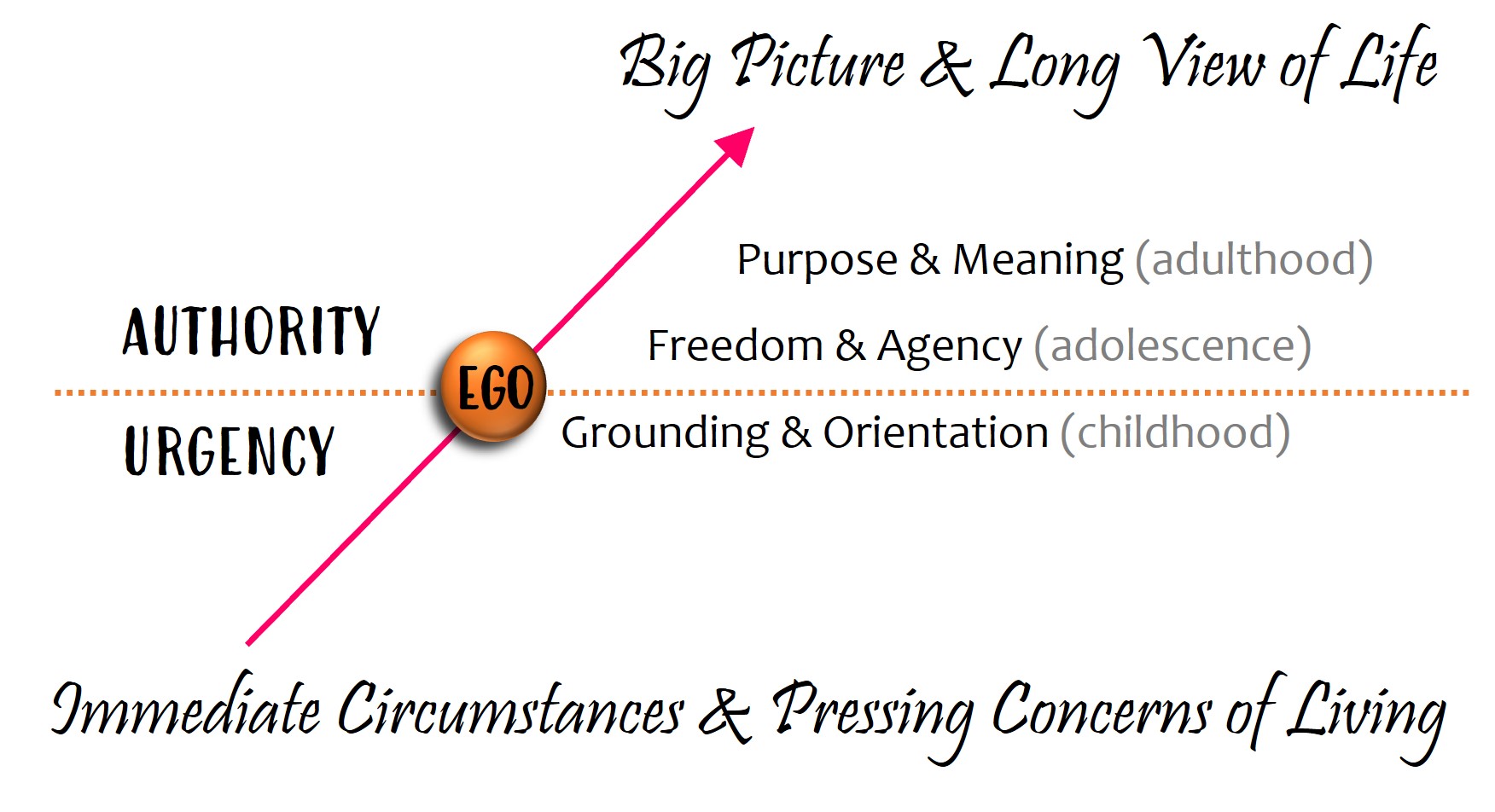
My diagram illustrates the two paths: the first, of our essential Self developing toward spiritual liberty; and a second, of our conditioned self differentiating an identity that provides access to a meaningful life in society.

This is where we can begin to appreciate a tension in the polarity of being human and becoming somebody.

The tension starts already as our essential aptitude for a grounded faith has to share space with a subjective insecurity (or anxiety) over the gradual separation into a centered identity of our own. Part of us wants to, and still can, release in faith to the provident ground of our existence. But this other part must follow the authoritative influence of a tribe that needs us to get in line and do our part.

It’s at this point that the polar tension of the two paths becomes impossible to ignore.

While our essential Self seeks to be present and open authentically to Reality, our conditioned self is already busy in the work of personation, referring to the somewhat anxious pursuit of identity by trying on masks (Greek personae) and stepping into roles that will qualify us for the social acceptance, approval, and recognition we crave.

With respect to our essential Self, personation is the process of covering over, even suppressing and denying, our authentic nature for the sake of becoming somebody who fits in and stands out.

Now, according to wisdom spirituality, the paradoxical relation of these two paths has evolved with the aim of bringing us to the place where we are empowered to surpass ego identity for a larger transpersonal experience. It is indeed a foundational insight that helps us understand the bipolar pattern of anxiety and depression, but more importantly helps us see our way through to spiritual liberty.

When our neurotic insecurity hides inside and behind masks of identity, an experience of communion – our participation in a dynamic web of higher wholeness – is foreclosed and we are locked down by the conceit of “me and mine.”

In the worldwide anthology of principles, parables, koans, and proverbs, wisdom spirituality often speaks of the necessity for a truth seeker to “die” as a caterpillar and shed their cocoon of identity, in order to find a New Life beyond the masks and roles, and even more importantly beyond the ego who is pretending to be somebody behind all those masks and roles.

But it’s hard to let go and leave behind our conditioned self, even for the promise of an experience we can hardly imagine, much less accept as a real possibility for us.

And because others of our tribe are equally insecure and attached to the pretense of identity, reinforced by generations of dogmatic orthodoxy dismissing or outright condemning spiritual liberty as rebellious, blasphemous, and sacrilegious, our conceit can get further impounded behind convictions that close our mind to everything outside the box.

What I’m calling “spiritual depression” is not a special subtype of the garden-variety clinical depression so prevalent today. It is not unique to religious folk or to those who identify themselves as “spiritual but not religious.” Spiritual depression is the deep, dark place we find ourselves after we have pushed away (or withdrawn from) everything that doesn’t fit inside our box, along with anyone who suggests that most of what is real and true is outside our box and can’t be owned.*

This depression is spiritual because it signifies something more than a deficiency in the balance of neurotransmitters in our brain, or an autoimmune disorder of psychosomatic illness, or even a breakdown in our construction of meaning.

It is spiritual because it is our human spirit that languishes and slowly dies inside a cage that was forged, ironically, to “save” our life.

It should be obvious, then, how this bipolar cycling of anxiety and depression “works.” We are anxious because the process of becoming somebody requires us to separate ourselves to some extent from our own existential ground and from the others around us.

And while personation is developmentally about putting on an identity that conforms to the world of tribal values and concerns, our insecure conceit (or conceited insecurity), compounded by a repressive tribal morality, can drive us deeper into our cocoon – so deep, in fact, that we can’t find our way out.

How would wisdom spirituality counsel us at this point, if our current treatment protocols and intervention methodologies only keep us spinning in bipolar cycles between anxiety and depression, and back around again?

Relax. Set the mask aside for now. Open your wings and be free. If you’re not there yet, just keep going – all the way through.

It’s in our nature to fly.


*This explains the odd phenomenon where dogmatic Christians are forced to deny the real Jesus, who felt it was his mission to break open boxes and acknowledge God as a mystery beyond the constructs of theology and the convictions of believers.

Provident Organizations

What’s going on when we read a best-seller about some innovative and industry-leading company, and then ten months later get the news that it’s falling apart and on the verge of bankruptcy? Obviously there’s some lag time between the research and when the finished book hit the shelves, but did the wheels come off that quickly? Really?

More likely, a toxic process was already metastasizing inside the corporate culture, carefully hidden from public view but felt by insiders long before.

You may be familiar with how it feels.

An organization is a social organism, a living thing in its own way. Which means that, like all living things, it has a lifespan and evolves through cycles of growth, stability, decline and death – or rebirth, if its members and leaders are paying attention and visionary enough to see new life on the other side.

One of the telltale signs of a culture becoming toxic, in fact, is an onset of dysfunctional leadership, where leaders lose the vision and start doing things that cause or contribute to organizational pathology. What kinds of things?

  • Requiring their approval on everything
  • Micromanaging their direct reports
  • Calling out and punishing creative risk-taking
  • Closing off feedback channels
  • Clutching credit and recognition for themselves

Instinctively, perhaps, a leader inside a toxic culture grows increasingly fixated on his or her own status, power, and job security, and less concerned about the organization they were hired to lead and serve.

Self-protection takes over, and self-transcendence – getting over themselves, thinking about the social organism and acting in the interest of its greater wellbeing – is no longer a priority.

A healthy organizational culture, on the other hand, is “tonic,” referring to a tonal strength that develops with stretching. Tonic cultures are flexible, adaptive, resilient and, as any stretching routine has the aim of increasing range of motion and establishing (or recovering) a new center of balance and control, more capable of responding creatively to the unexpected.

As regards leadership, tonic leaders are those who work consistently to keep the organization strong, centered, and sound (another derivation of the tone in tonic).

So, do pathological organizations produce dysfunctional leaders, or is it the other way around? Our modernity-conditioned preference for mechanistic models of unilinear causality tempts us to think it must be one or the other. But we have to remember that we are dealing with social organisms here, living systems and not machines.

The correct answer to our question is that pathological organizations and dysfunctional leaders are “comorbid” in toxic cultures, just as a dysfunctional heart (leader) is both cause and symptom of cardiovascular disease (in the organization).

In tonic cultures, leaders fiercely protect a safe and supportive environment where members can feel grounded, centered, connected and included in a “higher wholeness” that is purposeful, relevant, and worthwhile.

They are encouraged to take creative risks without fear of being punished if they fail. Whereas the switches, circuits, and gears in machines require regular maintenance and service, the spirit or lifeforce of an organization needs to be properly nourished, regularly exercised, and sufficiently rested to be healthy and strong.

The opposite of a pathological organization, then, is a “provident organization.” There should be a formal process for creating provident organizations, along with a badge that designates its collaborative accomplishment by leaders and members. In the future, companies, agencies, and teams will proudly wear their badge because it means they are being intentional in the work of building sustainable corporate and social cultures where everyone feels safe, supported, valued, and appreciated for their contribution to the whole.

When Gallup surveyed thousands of employees worldwide, a shocking 79 percent (in 2021; 87% in 2012) reported feeling “disengaged” or “actively disengaged” in their workplace.

The world of business reeled from the news.

Just imagine how employee disengagement translates into a damaged morale, plunging profitability, and market disadvantages. No wonder we are struggling! many leaders griped. These employees of ours are unmotivated and don’t care. They’re probably just sitting at their desks, surfing social media or taking naps. 

What did many of these leaders do? They implemented positive motivational incentives like recognition awards, and negative incentives like more frequent performance reviews, mandatory re-training, probations and threats of termination.

And what did that do? It confirmed but also amplified the experience employees were already having, of working in environments where it’s not safe to take risks, where open and inclusive community is not allowed, and where micromanagement suffocates the creative freedom and higher purpose in their work.

Many of these disengaged employees were not being lazy, but self-protective.

For many, disengagement is a coping strategy for moderating anxiety and preventing burnout. The effect of dysfunctional leadership and its various mechanisms for applying pressure to perform only makes the problem worse.

As a consequence, organizations become increasingly pathological, leaders grow more dysfunctional, and the whole thing rapidly collapses. Terminations, layoffs, downsizings and reorganizations are conducted in a panicked attempt to forestall bankruptcy and avoid terminal extinction.

It is precisely when members are starting to disengage that leaders need to resist their own self-protective impulses and “get over themselves.” Self-transcendence in leadership is enabled by a leader’s faith in his or her team and a corresponding vision of how they can, all together, meet the challenges and find opportunities in what’s before them.

In other words, the path to rebirth and new life for the organization does not involve bracing against reality and pressing down on employee performance, but stretching and re-centering the organization in a grounded sense of community and shared purpose.

As a social organism, an organization might have its anatomy represented in an “org chart,” but its life and wellbeing are a function of the flow of spirit or lifeforce through, across, and among those who fill that chart and personify it with living human beings.

We are coming to better understand the degree in which competitive success in the market is sustainably supported by a communal and cooperative spirit inside the provident organization. Only tonic cultures can flourish, adapt, and transform over time, by the inspiration and guidance of leaders who believe in their members and value human fulfillment over the bottom line.

The Four Human Force Fields

At some point along life’s way we feel an attraction, or perhaps metaphorically we hear a calling from beyond the boundary of what we know and who we are. Paradoxically, the source of this attraction or calling is not “out there” exactly, but “in here,” deeper within ourselves, a Beyond in the midst of our world, from the very Ground of our being.

It could be more of a push than a pull, more urgency than inspiration. Something inside of us is pressing forward and seemingly upward, toward a higher realization of what we might become. The Greek theologian and early Christian humanist Irenaeus of Lyon (c. 130-202 CE) understood it as the process, both evolutionary and redemptive, of our becoming more “fully human and fully alive.”

Think of the complications and certain self-destruction that would follow as a consequence of a caterpillar’s refusal to cooperate with the process of metamorphosis that intends to transform it into a butterfly. Or imagine what would happen if a seed insisted on “holding it together” and desperately clamped down on the vegetal life-force pressing for release.

If they possessed a will and self-interest of their own, and used these to fight the process of transformation, the butterfly and the plant wouldn’t be realized, and what is being “saved” by their willful resistance would suffer and rot inside. In striving to save their life, they would end up losing it instead, forfeiting fulfillment for security, liberation for identity, the predictable existence of a worm or seed for the higher mystery of what their nature intends to become.

Luckily for them, caterpillars and seeds don’t possess a self-conscious will that could refuse to go with the larger and longer life-process eventuating in butterflies and trees.

We might consider it unlucky that humans do, since so many of us willfully resist the evolutionary and redemptive force that would empower us to become fully human, fully alive.

Paradoxically, however, it is precisely this tragic liability, this freedom to choose against our higher nature, that is also a glorious gift. Therewith, we possess a unique ability to feel the attraction and hear the calling, but also to participate in the process, to consciously “let go” to our uplifting transformation and actively participate in it – even steer its course to some extent.

This may be why we have religion and caterpillars or seeds don’t.

My diagram above carries forward a model of human development that I’ve been working on for some time now. The larger process follows a zig-zag pattern starting at the bottom, zigging to the left, zagging to the right, and finally reaching completion at the top. Rather than being a terminal line, however, we should think of this as a system of dynamic interactions flowing up, down, and from side to side.

I propose that we think of the four points or stages along the way as “force fields,” each with its own energy, values, actions, and concerns.

As the purpose of this post is to better understand the forces in play at that moment when we feel the antagonism between our waking transpersonal butterfly and our self-conscious caterpillar self – that may only be dreaming of becoming a butterfly, I will aim our meditation on that more imminent zone of transformation.

We all start our journey as newborns fully immersed in the force field of Primal Instinct, where the animal nature of our living body attends to what it needs to survive and grow. Most of this activity is unconscious and compulsive, neither requiring nor even allowing our conscious control and direction. Its instincts are biologically ancient, driven by energies and guided by an intelligence that cares little, if at all, about what other’s think or what other plans we may have in place for the day ahead.

It’s not long before our family and larger society begin shaping us to the Tribal Conscience – who we are, what we believe, where we belong, and how we should behave. It is inside this force field of human development that we start to become somebody: a self-conscious actor of roles that we are given and roles we fall into, which eventually, with practice and social reinforcement, define our personal identity and connect us to the role plays of life in our tribe.

Having a mind of its own, the collective consciousness of society is dedicated to keeping us inside its protected membership, as “one of us.”

Inevitably, however, and following the impetus of our human development, we start to orient ourselves more on our own pursuit of happiness – or on what we believe will make us happy – than on the norms and expectations of our tribe. We are entering the force field of Personal Ambition.

Actually, our ambitions, or better I should say ambition itself was already being engineered and exploited in early childhood, through behavioral incentives used by our taller powers to motivate proper behavior and conformity to Tribal Conscience. It would only be a matter of developmental time before the twin motives of desire and fear (the ambi- in ambition) would move beyond stickers, spankings, lollipops, and timeouts, in service to our becoming somebody, managing an identity, impressing others, and (dammit) finding happiness.

We are all a little insecure as a consequence of growing up in a somewhat dysfunctional tribe, under taller powers who had their own issues. But even if everything in our background was perfect, the developmental achievement of forming an ego and becoming somebody unique and special, separate in our own way from everybody else, brings along with it a gathering sense of our isolation, exposure, and estrangement.

It’s this anxious vulnerability that more repressive and authoritarian tribes use to lure or compel naturally self-insecure teenagers back into the fold of “true believers” where they belong.

My diagram of the four force fields in human evolution, development, and redemption has a thin dashed arrow descending from Communal Wisdom back to Tribal Conscience, to indicate a progressive influence over time of a self-actualizing humanity on the collective consciousness of a people.

I’ve done it elsewhere and don’t have the space to defend it here, but my returning reader should recognize this as the threshold in religion where its constructs of God (mythological metaphors, artistic images, theological concepts) mediate between our minds and the present Mystery of Reality.

In contemplating these constructs, devotees begin to imitate, internalize, and then actively personify the divine virtues represented to them.

It’s been a slow process, to be sure, that has gotten hung up or thrown off course time and again.

As more individuals are willing to not just “let go and let god,” but to let go of god (the religious construct) for an experience of God (the present Mystery), religion itself can advance into wiser, more liberated, generous and more inclusive versions of itself over time.

This highest force field is much ignored these days, as more and more of us are preoccupied with our individual pursuit of happiness – or, more honestly, with our failing efforts at managing the frustration, anxiety, and depression that get in our way.

We don’t understand that these are really messages, letting us know that gripping down and hanging on is not The Way.

Three Mandates of Education

A majority of college students surveyed say they are going to college to “get a job.” Now, we have to be careful here, since surveys only report back on what survey designers believe is relevant information. Do these surveys of college students ask them about their personal development, unique aspirations, and where college fits into their life plan?

If such options are included among the multiple-choice survey questions, it’s still likely that college students will select “get a job” anyway, and not necessarily because they really believe it.

The education process is generally a boring affair, a gauntlet of bookish instruction, ineffective teaching techniques, and stressful standardized assessments that actually paralyze creative learning.

Given that the academic experience so far hasn’t engaged their interests, passions, talents, or aspirations, why would students expect any difference at the college level? As it has been about passing checkpoints and graduating to the next thing all along, the next thing after college would be a job. Therefore, the ultimate purpose and final aim of education is employment.

Check.

If that’s true, we’re all screwed. And if it’s not true but students still believe it is, this can explain why 80 percent of college students change their majors and 50 percent of college graduates get jobs outside their degrees.

If education is just about getting a job, then it’s not working.

In this post I will put a new frame around education, one that acknowledges its usefulness in preparing graduates for productive work in society, but also affirms other priorities which are equally essential, if not more so. Two other priorities in particular must be included in a proper understanding of our topic. All of them together comprise what I’ll call the Three Mandates of Education. To whatever degree our current education process falls short on one or more of these mandates, it isn’t doing its job.

The Cultural Mandate of Education

Instead of starting with the Mandate of Education that aligns, more or less, with today’s widespread belief regarding its purpose, beginning with its Cultural Mandate will help us address the limits of this very belief. With respect to its influence in the management and evolution of human culture, education plays, or should play, the paradoxical roles of conserving tribal customs and spurring social progress.

Today’s depleted and anemic view of education is quickly becoming, if it hasn’t already become, just such a “tribal custom” – referring to an established way of acting, thinking, or regarding the world around us. As more members adopt this way of behavior and belief, it soon becomes inherent to their shared identity. Setting aside any judgment over whether a particular custom is ethically enlightened, its function in conserving and stabilizing a people’s shared identity is essential to every human culture.

However, every human culture is also a living organization, with its own growth dynamic and progression of life-cycles.

In paradoxical opposition to the conservation of cultural identity through traditions of tribal custom, education is also the engine and “propeller” of social progress. From this vantage point, tribal customs should be under constant review for their proper alignment with and relevance to a society’s “growing edges” of diversity, equity, and inclusion. Longstanding customs aren’t necessarily rejected and tossed aside if they happen to lack alignment in this respect.

But a healthy culture must be willing to reconsider, reform, and possibly reject any customs that perpetuate prejudice and resistance to a more ethically enlightened community.

It isn’t obvious to many, but today’s tribal custom or conventional belief, that the only valid purpose of education is to help the graduate “get a job,” is biased against diversity, equity, and inclusion – against social progress. When we factor in the cost of education, the access it requires, and the way standardized assessments favor those students and admissions applicants with a knack for cramming and recalling information on tests, there is little question that our current education process excludes large demographic segments of the population.

The Economic Mandate of Education

Because today’s education system isn’t geared for diversity, equity, and inclusion, we must give it a failing grade – to use its own diagnostic rubric. In essence, education ought to provide the instruction, training, and development that empowers citizens for productive work and gainful employment. Like a responsible parent, a social system needs to provide support to those who are unable or not ready to support themselves, as it empowers the latter to gradually take on more responsibility for themselves.

This Economic Mandate of Education is vital to the health, prosperity, and sustainability of society. In empowering its citizens to become productive members, education literally capitalizes on the talent, creativity, and “workforce” of each generation, while providing them with meaningful avenues for making their own unique contributions to the commonwealth.

Education thus is about much more than “getting a job.”

Instead, it is, or ought to be, about helping students reach vocational clarity: a focused understanding of their unique “calling” (from the Latin vocāre), direction, and purpose in life.

The most reliable clue on the path to vocational clarity is an individual’s interests, which are like the “sun” to an internal “solar system” of other important factors, such as curiosity, desire, passion, talent, and intelligence. To better fulfill its Economic Mandate, education would intentionally and systematically implement a process, beginning already in the late elementary and middle school grades, of assessing each student’s interests.

With this information, instruction could be differentiated and properly “scaffolded” to empower creative learning and talent development.

In high school, this growing vocational clarity could be guided to an understanding of careers and career clusters that best match the student’s interest profile.

By the time they entered college, fewer students would be stuck in the tribal custom of believing that their purpose in being there is to “get a job.” They would instead be focusing their study and training in preparation for a career that will be interesting, purposeful, productive, and fulfilling. With such a process in place from middle school to college, we could confidently expect fewer college students to change majors, and more college graduates to find work aligned with their degrees.

The Humanistic Mandate of Education

Implicit in our reflections on the Cultural and Economic Mandates of Education is a deeper awareness of, and respect for, the student as a human being and not just a data cluster, tracking statistic, or identification number in the system. Of all the mandates, this one is not just in danger of being lost, but has arguably already been entirely forgotten.

What does it mean to acknowledge the student as a human being?

A human being is more than a worker or future employee, and also more than a citizen of society or a member of some tribe. We are admittedly verging on the domain of spirituality here, but it cannot (or shouldn’t) be avoided just because so-called “spirituality” in our day has become this oozy, fringy and far-out collection of free thought.

In the context of education and its Humanistic Mandate, spirituality concerns the inner spirit of a human being and its evolutionary aim of creative authority: personal responsibility, self-transcendence, higher wholeness, and the liberated life.

Creative authority in particular is perhaps the best summary term for the principle that drives, guides, and inspires human fulfillment, and is the proper aim of the New Humanism. It’s not about human exceptionalism or a chauvinistic preference for human interests across the larger Web of Life.

In the New Humanism, “human” and “nature” are honored in their essential unity, “self” and “other” are nurtured in compassionate fellowship, and “body and “soul” are celebrated for their complementary engagement with the provident Universe around us and the grounding Mystery within.

Education literally means “to lead out,” and in this context its mandate is about leading (awaking, activating, empowering, and guiding) the human spirit through its evolutionary path to fulfillment.

In addition to conserving tribal customs and stimulating social progress, but also beyond preparing individuals for productive work and gainful employment, education must honor and serve the human spirit in every student, addressing but also listening to what it has to say.

Drift, Sink, or Sail?

Your life is like a sailboat. The “boat” of your life needs to be buoyant and watertight, with sufficient integrity to withstand the force of waves against it. And the “sail” needs to be tall enough to catch the wind, as well as broad enough to harness its force. A sailboat with no sail can only drift about, and without a seaworthy vessel it will eventually sink. It needs both.

And so does your life.

In this post I will translate the analogy of boat and sail into your paradoxically equal priorities of security and fulfillment in life. Without security you are vulnerable to “sinking” into depression – that is, after anxiety has compromised your capacity to withstand the variety of pressures and assaults a normal life brings your way. And without fulfillment, you are adrift amidst the random conditions and changing circumstances around you. Life will feel like “one damned thing after another.”

Security and fulfillment are paradoxical in the way they pull your attention in opposite directions, and yet play with/against each other in the full picture of a life well-lived.

I have done it myself, and observe many others doing what I call sacrificing fulfillment on the altar of security: abandoning our aspirations in the interest of just staying afloat. Security feels more urgent than fulfillment, and if one has to be set aside or postponed for the other, “drifting” is preferable to “sinking.”

But here’s the thing: life is inherently insecure. “Pressures and assaults” at its surface are never-ending; just as you get one issue under control, three more pop up and demand your attention. If you suffered some damage previously and took in some water, you tend to be more vigilant around those areas where integrity has been compromised. Lots of us are just doing our best: bailing out and patching leaks, staying low in our boat to keep from capsizing and going under.

And because this is the nature of life, we can spend our whole life fixated on the trouble we’re in.

Before we take a few precious minutes to consider what else life might be about – that whole thing about a sail, the wind, and your need for fulfillment – it will help to clarify the basic elements of security. Of course, you can worry and fret over anything, but at least these things are relevant concerns when it comes to managing the persistent insecurity of existence.

The first element of security is safety, referring to your need for protection against the buffeting waves of life. Here we find another interesting paradox, in the way a strong boat holds out the water while at the same time resting upon it.

To be safe and feel secure, this dual aspect of adversity and providence, along with the corresponding skills of “withstanding” and “surrendering” to the reality of life, reveals an essential bit of wisdom. If you should invest all your effort in keeping life from hurting you, your inability – or more accurately, your habituated unwillingness – to release yourself to the greater mystery of being alive makes you increasingly inflexible and depletes your resilience.

We might say that safety is about holding your own but also trusting the Process.

It can take a while to learn this skill, and if your early family environment was both protective and empowering, you likely already have it within yourself – although you might not employ it as often as you could. If your infancy and early childhood did not equip you with an ability to withstand life and surrender to it, the good news is that it’s not too late to learn how.

The second element of security is belonging, which refers to a sense of inclusion and being at home in a reality larger than yourself. This has a pretty obvious connection to the dynamic of releasing, surrendering, trusting, and resting which is essential to feeling safe. With belonging, this action of release opens out to an expanded awareness of that in which you belong.

Staying with my analogy, there is a sense in which your boat “belongs” in the water – not underwater, certainly, but also not merely on top and separate from it.

Similarly, you belong in a family, a human community, a web of life, and a provident universe. Belonging is more than just sitting inside this hierarchical arrangement; it is also about connecting, relating, and participating in its higher wholeness.

Third, and completing the set of elements basic to security, is self-esteem. This shouldn’t be confused with egoism, conceit, or the interesting personality complexes that form around a core of insecurity and the desperate need to control how others see you.

Self-esteem simply refers to your need for a positive and empowered sense of self, the sense that you are worthy, that your desires and gifts matter, and that you have something worthwhile to contribute. Always feeling like you have to prove yourself to others, exhausting yourself in the effort to please them, placate them, flatter or impress them, are all symptoms of a deficiency in self-esteem.

The healthy combination of safety, belonging, and self-esteem is what provides you with the security you need to successfully manage the pressures and assaults of life. Holding your own against the sea while resting in its provident support; understanding that you are part of something greater that both bestows and invites the dedication of your unique gifts – with this very practical wisdom, your boat is strong and ready to sail.

Granted, with a seaworthy vessel you could merely continue drifting on the waves, but why would you when there is so much to life around you and out there?

It’s time to raise your sail: to start thinking about where you’re going and why it matters.

A sail is not designed to displace water but to catch the wind. An entirely different set of values to the security needs down below require your attention now. These values, or ideals, are the Five Aspirations of your human spirit. They inspire and motivate every human being to desire, seek, and strive after fulfillment. Fulfillment is not just another word for “happiness,” but involves reaching full capacity and realizing the full potential of your human nature. Fulfillment.

I have explored the Five Aspirations in another post, so we won’t go too far into them here. Suffice it to say that, when your basic security needs of safety, belonging, and self-esteem are adequately satisfied and you can devote your attention to the art and adventure of sailing, the quality and enjoyment of your life is amplified exponentially.

It’s not to say that you will never feel insecure again; you will because you are an ego on a human journey.

The point is that, with a healthy realism and responsibility for the integrity of your boat, you have more creative freedom to explore deeper meaning, to clarify your higher purpose, to cherish genuine love, and cultivate inner peace.

Raise your sail and catch the wind! There’s more to life than just what’s going on inside your little boat.

Why Does It Matter?

Is life what happens to us, or is it more about our response to what happens? Are we really hapless patients in the process, reacting to the events and conditions of our life only after they have befallen us?

No doubt, that’s how it often feels. We barely have enough freedom to raise our attention above this relentless swirl of causality to consider where it’s taking us.

This common belief is not just a postmodern twenty-first century phenomenon. The evidence would suggest that it’s a universal and longstanding opinion of our species. By “evidence” I am referring to the perennial philosophy or wisdom tradition that’s been around for millenniums.

There would be no need for such an ancient and running collection of principles, precepts, and practices designed to help us take creative authority in our lives, if we and the thousand generations before us didn’t struggle with this question of freedom, purpose, and the ultimate meaning of life.

In The Power of Myth I anchored this question to the mythic archetype of Youth (ages 10-25), when we are constructing an identity, hopefully with the providential support of a family and community that are, on balance, more spiritually awakened. Such support earlier on (birth to age 10) would have served to establish in us a foundation of security and the corresponding faith in Reality as provident.

When we have around us a community that knows what it’s doing, and that has our personal wellbeing and human fulfillment as a top priority, we come to appreciate our responsibility in making life meaningful.

But many, perhaps most of us don’t emerge from our youth with this sense of creative authority and personal responsibility. And while it may be tempting to lay the blame for this on broken families and dysfunctional communities, that would only perpetuate the false belief that life is what happens to us.

Perhaps that is why the wisdom we need cannot be found in fresh supply inside the cultural depositories of religion. Just as its source is outside our institutions and orthodoxies, the timeless truths of Sophia Perennis flow in the borderland beyond conventional belief.

What is it that we need to learn? If we’re not helpless victims of life as it happens, what can help us take a new and better view on the meaningful life that seems to elude us?

Meaning is constructed in the choices we make.

In the illustration above, a path extends ahead and into the future. From a foreground vantage-point we can see that this path is composed or made up of individual stones, which will represent the many choices we make as we move along.

I’m not suggesting that we choose everything that happens. There are countless events and conditions, both inside and around us, that we have no control over, much less awareness of. I can even agree with the hardline determinists to some extent, who insist on something of a lockstep causality generating our physical universe and the “explicate order.”

Despite all of that, each of us is also taking in perceptions, assigning value to what we perceive, deciding what it means, and reacting behaviorally to our perceptions and to our own mental constructs of meaning. This flow or sequence of events isn’t determined in the same way as the physical universe, which is why those individual stones of the path are not meshed together like gears in a machine.

A strategic achievement in creative authority is gained in taking responsibility for the “gap” between what happens to us and our perception of it, between our perception and the value we assign to it, between our value assignment and the meaning we construct around it, and between this belief and our behavioral response.

Even if we can’t yet detect the gap separating one step and the next in real time, later reflection can usually identify where in the process we actually did have a choice.

We may resolve to do it differently next time. But without ongoing reflection and an intentional commitment to a new direction, the old chain reaction will likely take over and reinforce the belief in our own helplessness.

Meaning is a way of life.

What we are really struggling with is not the presence or absence of a gap between the stones paving the path of our life, but rather the practiced habit of doing things a certain way, over and over again. This is where our perspective shifts from the discrete choices we are making in the foreground, to the “way” or pattern that is formed, reinforced, and repeated over time.

We have moved from choices to character – not leaving choices behind us but acknowledging how our choices become habits, and how our habits form an identity and way of life.

We sometimes think of character as this unchanging, immortal core of identity that we carry within ourselves. But the fact is, character comes into shape and takes on force as our choices, beliefs, and behavior coalesce into a more or less consistent identity – much as the character in a story grows more familiar and predictable with the narrative progression.

Changing our way of life is less about converting to a different ideology or lifestyle, than it is taking personal responsibility for our choices and using our creativity to author a better story, one more aligned with our spiritual aspirations for deeper meaning, higher purpose, genuine love, and inner peace. That’s what I mean by “creative authority.”

Meaning in life is articulated in our philosophy of life.

Such talk of spiritual aspirations invites a further shift in focus, from the specific choices we are making, through our character and way of life formed over time, and ultimately to the vision we hold of a life well-lived. More than just an explanation or theory of life (which strictly speaking is biology), our philosophy of life serves to clarify what truly matters – not only to us but to others with us, and all of us together amongst the rest of life on planet Earth, for generations to come.

It’s not about getting rich, or how to win friends and influence people, but instead focuses our devotion on those ideals, aims, principles, values and practices that promote a reverence for life and advance communities of inclusion, freedom, justice, and equality.

It is still ahead of us, perhaps far ahead, but we can begin realizing our vision in the choices we make today.

Living Religion

After rescuing spirituality from dysfunctional religion, its proponents have sometimes gone way to the other extreme, turning spirituality into a catch-all for anything mystical, metaphysical, magical and spoon-bending. In their rejection of religious tradition, institution, and orthodoxy, they “rescued” something of a shapeless blob of experience, which has been branded in countless ways and sold for huge profits to sometimes desperate, somewhat disoriented seekers.

The end result is a graveyard of dead and dying religions, but also this magic ooze that can be turned into whatever the willing consumer wants it to be.

Now, I’m not suggesting that the conditions and circumstances warranting such a rescue effort aren’t real. Much of religion has lost its soul. For a couple generations at least, it has been trying to compensate for a steady slide into irrelevancy, exhaustion, and rigor mortis by investing aggressively in megachurches, entertainment productions, and celebrity leaders. The pose that such religion strikes for us, however, feels a little too much like the stuffed and rigid products of taxidermy collecting dust on the shelf.

What we have, then, is a dead or dying religion on one side, and this oozy whatever-you-want-it-to-be spirituality on the other. I have been making a case for some time now for seeing healthy religion and a vibrant spirituality as inseparable, as the temporally relevant expression of an eternally (i.e., timelessly) creative essence. Just as we can’t take the life out of a living thing and set it aside as we dissect and examine its now lifeless body, neither can spirituality live outside and without the structural support of religion.

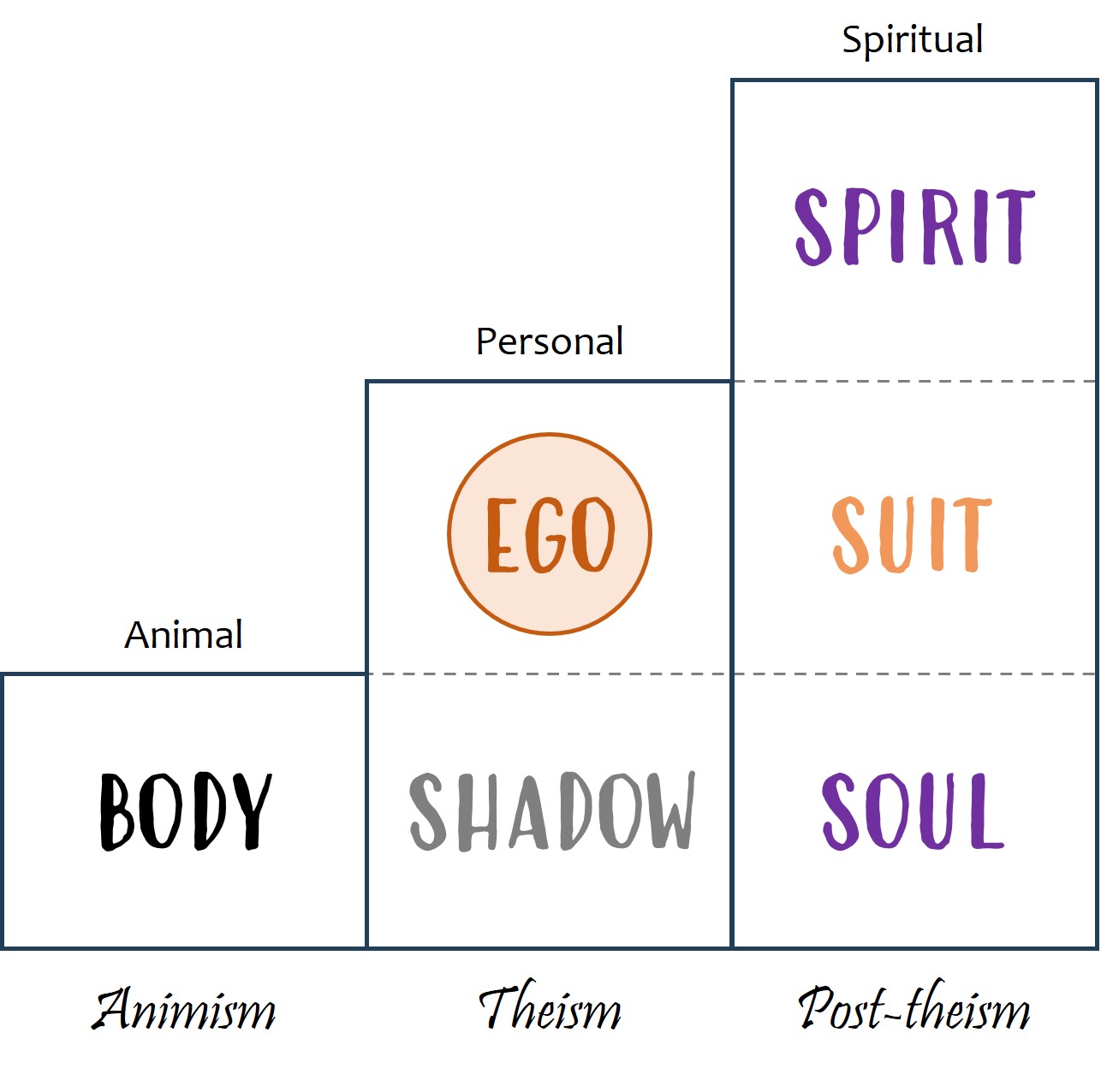
Spirituality is the “soul” to religion’s “body,” and despite the wildly popular but erroneous belief that one can exist without the other, the truth is that they are the Yin and Yang, respectively, whose entwining interaction is the Tao which cannot otherwise be named or known.

Our ego can be forgiven for wanting to identify itself with the immortal soul and eventually gain its escape from the mortal body. The important thing to understand, however, is that this division and separation of body and soul is the ego’s fantasy, a delusion it has projected into the nature of reality and into our own human nature.

This projection is a kind of therapeutic prescription for a death anxiety it has no obvious way to effectively address or resolve.

Ego doesn’t (“I don’t”) want to die, so it dissociates itself from the temporal body, conceives of the body as just a temporary residence, and identifies itself as that which will (it must!) continue on after the body dies. Such an “immortality project” (Ernest Becker) or “Atman project” (Ken Wilber) only deepens and magnifies the death anxiety, however.

Once it gets going, the fantasy can be all but impossible to break. But when it does break, we suddenly come to know the truth, and this truth sets us free.

The decline and death of religion is historically correlated with this gradual dissociation of ego from the mortal body, its self-identification as an immortal soul, and its mindless degradation of all the systems, processes, principles and mysteries that conspire together, as Yin and Yang, in the Tao of Reality.

Once we invented the dualism of body and soul, it would be just a matter of time before the “body” of religion and the “soul” of spirituality had to come apart, each destined for its own kind of extinction.

Is there any good news here? Anything we can do to repair (re-pair) religion and spirituality, body and soul, time and eternity, human and being?

Of course there is, and it’s been with us for thousands of years. It just so happens that religion has placed it on the Index of things that true believers must avoid, and that contemporary so-called “spirituality” has almost completely dissolved into its oozy solvent of metaphysical oddities.

We are talking about the Perennial Philosophy or Sophia Perennis, an underground stream of spiritual wisdom that has inspired, nourished, and refreshed our human quest after the ultimate Truth of things. This Truth is acknowledged in Sophia Perennis as transcendent of the religions themselves, but nonetheless (and paradoxically) immanent in and inclusive of all things – including the religions.

The above meditation image, or mandala, illustrates the basic principles of this holistic and dynamic vision of Reality using the familiar design of the Tao.

Consciousness goes “out” to wander, explore, dance and play among the ten thousand things. It also goes “in” to be still, to rest in Being, return to its Source, and find inner peace. We need both. If we should invest all our attention in just one side of this Yang-Yin polarity, the outer will become a rigid empty shell and the inner an oozy shapeless goop.

So we are back again to our contemporary dichotomy of religion without a soul and spirituality without any shape.

The domain of religion is the outer realm, where the expression of experience in the form of symbols, stories, sanctuaries and sacraments constructs the frame for an overarching meaning to life. This should prompt the question of what kind of experience gets the process going in the first place. The answer brings us into the domain of spirituality, an inner realm where the essence and depth of consciousness reaches along dark roots into the grounding mystery of Being.

The multitudinous symbols of God in religious mythology and iconography are not artistic replicas of divine beings encountered in the outer realm, but rather artistic representations of a present Mystery sensed in the inner depths of Being.

The overarching meaning and the underlying mystery are not two separate things – until religion gets too attached to its doctrines, to the point where these formal expressions of meaning are defended as the absolute truth and final word, the one and only way of salvation.

As advocates for Sophia Perennis, the mystics and teachers of spiritual wisdom have patiently but insistently reminded true believers that the essential depths of Mystery can never be “solved” into meaning. The Mystery they speak of – so far as anyone can speak of the ineffable – is not epistemological, a problem for thought, but ontological, a matter of being.

Only as we can remain rooted in awareness to the inner mystery of being-itself will the meaning we construct around ourselves be, and remain, relevant to the life we are living. And the way we do this is our religion.

The Quest Mandala

By now, a returning reader is familiar with my “dancing” style with things I regard as essential to understanding the human journey. I prefer to keep words flexible and their contextual frames almost always moving, which makes it hard to pin me down and hold me to account. I don’t do this to evade responsibility for what I write, but because the things I write about are fluid, dynamic, and imbued with mystery.

My purpose in writing is not really to educate or convert a reader to my opinion. I write because I like to dance.

So let’s take another turn with the question of why we are here on this human adventure. Science can provide explanations for how we got here, but it’s the task of spirituality to clarify the why. This doesn’t mean that we have license to fly off willy-nilly into astral planes and metaphysical esoterica. We should stay in our bodies with our feet on the ground, even as we ponder the higher reaches of our human nature.

It doesn’t make sense to me that the evolutionary aim of our existence would require us to deny or discard what makes us what we are.

We will position ourselves at the center of the dance floor, which in the mandala above identifies us as an embodied, self-conscious mind – or ego for short. We begin in this position not because it’s where the human journey starts, but because this is where we first wake up to the adventure and realize that we need to figure some stuff out.

As “who I am,” ego is both for-itself and for-others, meaning that “I” am a unique person whose self-image is reflected back to me in the mirror of other persons.

Ego centers me in myself and connects me to you. Integrity and empathy, autonomy and affiliation, agency and communion: the polarity of experience that comes into play with ego development can be considered from various angles. Centering the self and connecting to others is the critical contribution of ego to the longer human quest. This dynamic of centering and connecting reveals the true meaning of power.

Our quest consciously begins as we wake up in this performance space between our centered self and our connection with others. Because this “middle realm” is frequently fraught with insecurity, attachment, shame and self-doubt, however, there is a strong chance we can get stuck here.

The naturally creative polarity of self and other cannot hold the balance, but instead snaps to the bi-polar extremes of possession or submission, taking power for myself or giving it all to you.

Now, you should be able to see this bi-polar swing between possession and submission as a defining pathology in human history, and probably in your own life story as well. I can see it in mine, for sure.

But instead of how we typically deal with pathology in Western medicine and psychotherapy, which is to cure it or cut it out as soon as possible, a better approach would be to regard it as a clue to how we can better manage the balance and use its energy for progress in the direction of greater health, wellbeing, and fulfillment.

By becoming more skillful in the equal priorities of keeping our center and making connections, the axis of our quest can pivot 90° to the vertical orientation. From our center we can drop and descend into the deeper realm of Being, to the quiet clearing of soul where we are grounded in the present Mystery of Reality (or Ground of Being). Ego’s quest for a proper balance of power (integrity + empathy) opens the path to soul’s quest for inner peace.

This axial shift from ego concerns to the soul’s aspiration for inner peace helps us understand the distinction between religion and spirituality, and perhaps also the popular self-identification on polls as “spiritual, but not religious.” I say ‘perhaps’ because in a large number of cases the distancing from formal religion is motivated by clerical abuse, dogmatic oppression, manipulative guilt, or a cumulative irrelevancy.

For these individuals, religion is a code-word for what they managed to escape and never want to go back to.

Spiritual is thus another way of saying that they still have inclinations for things divine and supernatural, but want nothing to do with all the traditional and organizational baggage. Their current preference is for a mixed-bag, when-I-need it, grab-and-go variety of religion, although they don’t want to call it that.

Many of them remain stuck in the middle realm, having pulled out of organized religion and its congregation of like-minded believers, into a private religion of their own where they can be in control and decide what it is.

That’s not what I mean by spirituality here. In this context it refers to that pivot to the vertical axis mentioned earlier, not out of, against, or away from religion, but beyond it; beyond ego to the soul, beyond the balance of power to inner peace. Here, spirituality is not about “me” and what “I” want. Indeed, “I” and “me” have been left up there in the middle realm, so to speak, for a deeper experience of contemplative solitude and grounded presence.

This vertical orientation opens a path upwards as well: with, through, and beyond our interpersonal connections with others, to the transpersonal (or communal) realm of spirit.

Our empathic and compassionate engagement in service to the higher wholeness of community fulfills our human quest for love. Again, just as a strong center provides the stable release-point from which consciousness can drop into the deeper realm of soul, so a strong connection with others provides the stable launch-point from which consciousness can leap into the higher realm of spirit.

Ultimately, which is to say, with respect to the highest aim and purpose of our human journey, it is the generous, joyful, ecstatic, and inclusive experience of genuine community that we long for. In the balance of power, and with our roots deep in the ground of inner peace, the synergy of love flows through us and out into the worlds we are creating and re-making each new day, together.

Deep Within and All Around

One of the more obscure concepts in mystical spirituality to explain, and arguably the most important for understanding what it’s all about, is the Ground of Being. The Christian theologian Paul Tillich popularized the term in the mid-twentieth century, but it has been foundational to the perennial tradition of spiritual wisdom for nearly 3,000 years.

Even Tillich’s assertion that God is just a theological nickname for the Ground of Being had already been made by Johannes (Meister) Eckhart in the early 14th century. It wasn’t received well by orthodoxy back then, either, and hasn’t been for as long as dogmatists have preferred talking about god (the theological construct) to experiencing God (the present Mystery).

At the same time as the orthodox Church was launching external crusades against other religions, it was also pursuing an internal campaign against mystical spirituality and its “Ground of Being.”

The effort continues to this day.

As a consequence of the orthodox rejection of mystical spirituality, it was driven into a variety of esoteric “secret societies,” pushing it even farther from the reach of ordinary spiritual seekers.

It wasn’t long before these esoteric sects had developed orthodoxies of their own, with hierarchies of authority and strict requirements for membership. The age-old metaphor of ultimate reality as the “Ground of Being” is still trapped inside an arcane symbolism and cryptic vocabulary. This is purportedly to protect the Mystery, when really all it does is bury the Mystery under needless nonsense.

Because theology, or “god-talk,” is such a nuanced and complicated language, it is common to assume that mystical spirituality must be even more so. If theologians talk about something (a supreme being) that is “out there,” how much more challenging it must be to talk about a present Mystery that is said to have no objective existence!

In this post I will use the convention of capitalizing the ‘G’ in God when speaking of the Ground, and employing the lowercase ‘g’ for the many theological constructs that we imagine to exist – even if that construct is the one supreme deity of monotheism.

Actually, it is much easier to understand mystical spirituality than orthodox theology, and for one very simple reason, which is that while theology talks about a god whose existence is always up for debate, spirituality speaks of a present Mystery that is Existence itself.

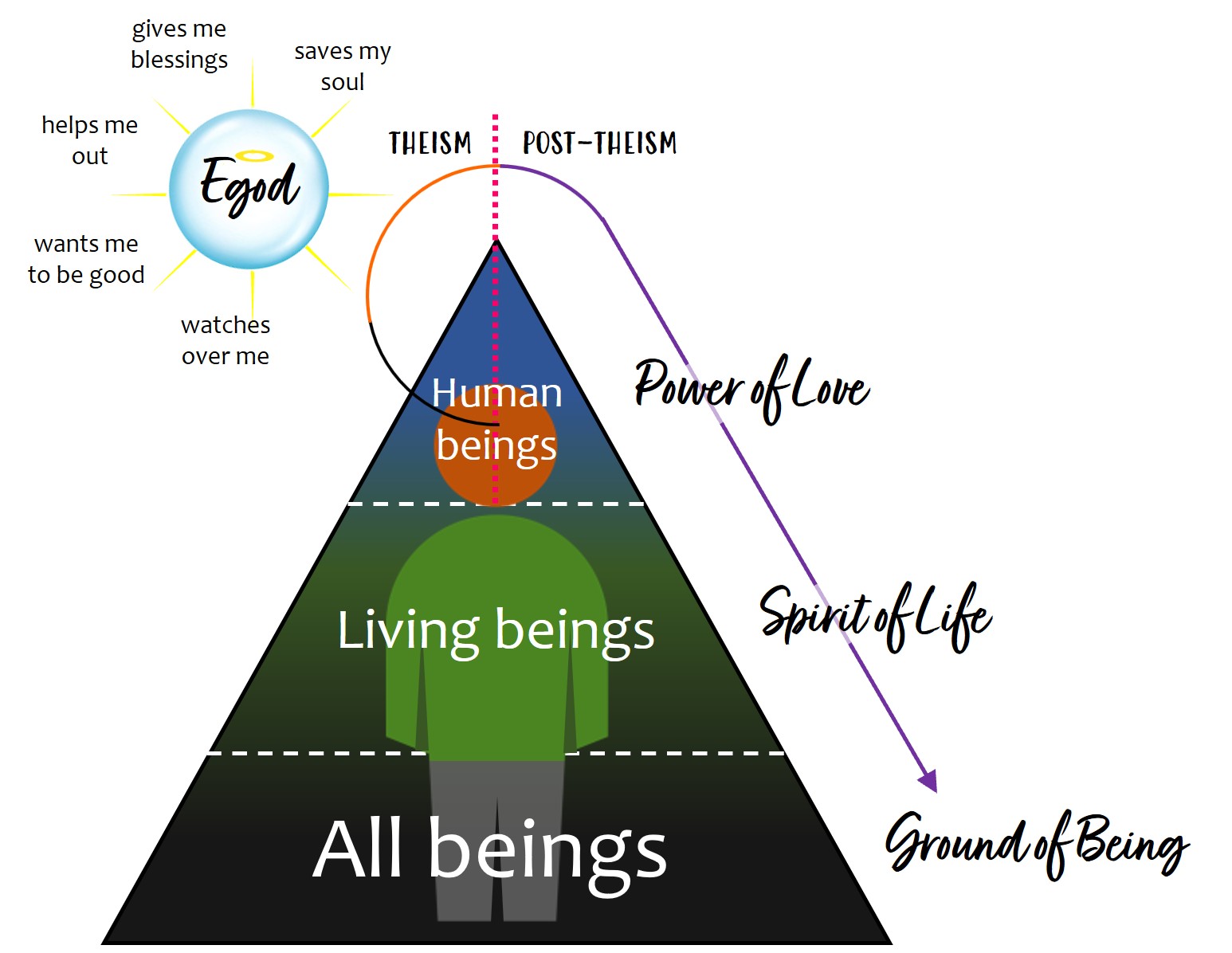
The Ground of Being is not one being among (or above) all others, but the source and power of be-ing in all things.

Using its popular nickname, God, we can say with Paul Tillich that there is no such thing as God, for God is not a thing. This is slightly, but importantly, different from saying that there is no such thing as this or that god. It is historically around this distinction that misunderstandings and conflicts have arisen.

The illustration above is useful in helping us appreciate what mystical spirituality is really saying when it identifies God with the Ground of Being. Let’s pretend that the large circle generates and contains everything there is. Whatever kind of being we may observe in this universe – a star being, a cloud being, a bird being, a tree being, a dog being, or a human being – is a specific and formal manifestation of Being, of a power actualized in its special form.

The revelation expressed in the term “human being” has been all but lost to us, but the insight is still there. A human being is a human manifestation of Being, or the power of be-ing in human substance and form.

In my simplified image of the universe, I have placed you in the very middle, as a self-conscious human being, or ego (Latin for “I”). Your ego is where the consciousness of your sentient body and mind is conscious of itself as a center of thought, feeling, will and agency.

Let’s have the color orange represent objective consciousness, which is your awareness of the countless objects around you (all of those other beings), as well as of yourself (as an object of self-conscious awareness).

Looking out and around yourself, all you can see is what your objective consciousness apprehends. All of it has objective existence from the vantage point of your ego. From that vantage point each thing or object, including you, stands out as separate and distinct from all the rest.

But notice, too, that everything is rooted in the larger circle, which in my illustration represents the Ground of Being. When you observe a star or a tree, you are noticing the attributes of a specific form and manifestation of Being, while its essence remains hidden – not behind or inside it as ‘something else’, but as the form itself. What you see is paradoxically the “visible concealment” of its deeper essence.

The be-ing of a star, the be-ing of a tree, and the be-ing of a human is colored purple; this dimension of its existence is not available to objective consciousness.

A final element in my illustration is a sphere surrounding your center of self-conscious identity, encapsulating it as it were. This is your world, referring to the construct of meaning that you project around yourself.

Your world is not the universe. If the physical environment around your self-conscious embodied mind is the ecosystem, the world is your egosystem. Everything inside your world has value, meaning, and identity relative to your ego. Your egosystem is also where the lowercase god is found – not outside but inside your world, which really means inside the stories and imaginarium of your egoic mind.

Another important distinction identifies the lowercase god as a literary being, a fictional character in myths, but not a literal (i.e., factual and objective) being. The lowercase god is a projection of your mind, but also a symptom of what’s going on in there: of your need for security, control, recognition and esteem.

This observation of mystical spirituality has given orthodox religion sufficient reason to condemn, persecute, and murder mystics through the ages. The mystics have always been more interested in what God means than in whether or not god exists. Indeed, the obsession with god’s existence has kept many believers from the spiritual nourishment they seek.

In healthy religion, the lowercase god is an acknowledged metaphor and symbol of the Mystery beyond name and form: the Ground of Being.

By now it should be clear that the Ground of Being is not “out there” or under your feet, in the way that the literal and physical ground is under your feet.

Looking out with objective consciousness, all that you see is the “hidden Ground,” Being hiding in (and manifesting as) the myriad beings around you. Pluck one of them from the web, take it apart and break it down to its most elementary particles, and you will get no closer to the Ground. All you will have is an exponentially multiplied number of smaller objects, each revealing and concealing the Ground in its individual form.

Is there anywhere you can turn to experience the Ground of Being without the veil of objective existence?

With this question we come at last to the foundational practice of mystical spirituality, which is about dropping out of objective consciousness and releasing your center of personal identity.

Remember, you too are a manifestation of Being, concealed behind a personal identity and enclosed by the construct of your world. In surrendering all that makes you one being among many, along with all your quirks, convictions, and masks of identity, objective consciousness is allowed to dissolve into an experience of the present Mystery of reality, the Ground of Being.

In some traditions of mystical spirituality, this shift is designated as a descent from, or “death” of, egoic self-consciousness, and the awakening, or “resurrection,” of spiritual Self-awareness.

As an ego, you are one among many beings; deep in your soul, you are One with the Ground of Being.

So then, who are you really?

The Power of Myth

I keep coming back to the ideas of “mythic themes” and the “four ages of life” in this blog. They are in the background of just about everything else I think and write about. My ancestral heritage for this stream of thought includes Mircea Eliade, Carl Jung, Joseph Campbell, and Northrop Frye – all pioneers on the frontiers of archetypal psychology, cultural and personal mythology, and the power of story in the construction of worldviews and the meaning of life.

In the interest of keeping this post tolerably short, let’s jump right into our topic, which I will name The Power of Myth using the title of Bill Moyers’ popular interview series with Joseph Campbell back in the 1980s.

The diagram above features the arc of our individual lifespan divided into four Ages, each Age identified with one of the four mythic archetypes of development: the Child (Birth to age 10), the Youth (ages 10 to 25), the Adult (ages 25 to 60), and the Elder (age 60 to our Death). In the background of each period or Age of Life we see what I’ll call the “developmental axis” of that Age: childhood as the Age of Faith, youth as the Age of Passion, adulthood as the Age of Reason, and our later years as the Age of Wisdom.

Each of the Four Ages represents a relatively stable period of growth and maturity, centered on its axis (faith, passion, reason, or wisdom) and providing a correspondingly stable worldview to engage with reality – but also to put some mediated distance between ourselves and reality for the meaning we need. The thresholds and transitions between Ages generate some degree of stress and upheaval as our axis is needing to shift for a more existentially relevant engagement with reality.

Trauma, adversity, and setbacks during a particular Age of Life can result in the carry-over of “unfinished business” into the next, along with the coping and compensatory strategies we used during those unsettled phases just to make it through.

I call these strategies “neurotic styles.”

So while my diagram offers a clean and uncomplicated view of the Human Journey, it is not so clean in real life. Nevertheless, the value of such heuristic devices as diagrams and theories is in the way they help us discern patterns in the persistent ambiguity of what’s going on.

So far, we have the Human Journey progressing through four Ages of Life, each one centered on its own axis and contributing a dimension of experience to the full picture that we somehow need to become fully human.

Living without faith, passion, reason, or wisdom is not, as we might say, in the design intention of an awakened and self-actualized human being.

A deep inner surrender to Being (faith), an emotional investment in life (passion), a commitment to truth-seeking (reason), and an understanding of how to live well and be whole (wisdom) are all essential to our human fulfillment.

The remaining elements of my diagram identify the narratives that shape, drive, and inspire our Human Journey, and serve to differentiate Campbell’s “power of myth” into distinct themes and storylines.

In the Age of childhood, a mythic theme of grounding, orientation, and security shapes, drives, and inspires our experience. More than anything else, we need to know that reality is provident, that we are safe and belong. Faith releases inwardly to the Ground within, as trust and wonder open us to the Mystery beyond.

Stories of grounding and orientation center on the security of a home place which may be lost or put in jeopardy, but only for a time, before safety is restored and everyone lives happily ever after.

The Age of youth moves us out from our shelters of safety and onto the high adventure of identity, purpose, and freedom. Our world suddenly seems to become a performance stage where everyone is watching us and we are trying out roles for their approval, or else acting out against social standards for the recognition we seek.

If we happen to carry insecurity from childhood, a pressing and anxious need for acceptance may compel us to forfeit our pursuit of freedom. Our purpose, tragically, can be reduced to pleasing, placating, flattering and impressing the people whose acceptance we so desperately need.

This trade-away of freedom and purpose for the sake of winning somebody’s favor and approval is a common trap used to recruit youth by evangelical Christian groups and other cults.

Those who fall into the trap may take decades finding their way out of a piety of submission and obedience to a god who is morally scrupulous, impossible to please, and only conditionally forgiving. Behind it is very likely a chronic insecurity from childhood.

Adulthood is the time when many choose a life partner, build a family, start a career, while still enjoying occasional mini-adventures called vacations. Love, sacrifice, and devotion are now the storylines we use to weave our world, around an axis of reason. It’s more important than ever that our life makes sense and gives us a “reason” to engage our roles and routines with commitment and responsibility.

For love’s sake we willingly sacrifice our pursuit of other options and devote our attention, time, and energy to cultivating the healthy bonds and anchors of meaning.

At midlife, or around the age of 40, the conventional nature of our life roles and routines can suddenly feel empty and pointless. We may be tempted to think that our rescue from this aridity will come by exchanging our partner, job, or residence for a different one, when what is needed is a breakthrough to a deeper appreciation and gratitude for the life we have.

In a sense, the trajectory of life concern is needing to shift from the horizontal plane and our place in the world, to a vertical revelation of depth, presence, and the undeserved gift of just being alive.

At last we enter the Age of Life as an elder. Around this time we are beginning to lose our parents and older relatives, think about retirement, and experience the gravitational pull of mortality. While in our youth we could casually ignore the reality of death all around us, in our later years it is quite literally in our face.

Storylines of suffering, hope, and vision transform our worldview into a beautifully ironic picture, with its double vision of an Eternal Now in the midst of life’s passing.

Whereas otherworldly religion will offer its comforts of a promised life in the hereafter, spiritual wisdom opens awareness to a “peace that surpasses understanding” in the heart of this life and in the very shadow of death.

Throughout cultural history, it has been the special gift of elders to both challenge and encourage younger generations to take in the larger and longer view of life – in full acknowledgment of the fact that while we are all in this together, each of us is only here for a brief moment in time.

In our era of therapy, this longstanding and far-reaching framework for understanding the Human Journey remains ever relevant. Just step into it at the temporal point of your life and listen to what it has to say.