The Anatomy of Belief

We rightly give attention to scrutinizing a belief’s claim and its object, i.e., what it asserts (or claims) about something or other (its object). As a perspective on its object, we should be able to check reality for evidence to determine whether the object is well-grounded. Once confirmed, we can then move on to consider the claim it is making regarding the object.

That’s how things could go.

Oftentimes, however, we get caught up in the argument and forget to reality-check the claim our belief is making. This happens frequently in religion. For example, virtually the entire edifice of Christian orthodoxy is a construction of claims about objects whose existence cannot be checked against reality.

The obligation to “believe it anyway” is built into the construction project itself, since doubting or denying any part of it will bring down the whole assembly. It all hangs together in the air, as it were, and falls into a heap when any part of its suspension system is cut.

What we tend not to understand when it comes to belief is how much of its power in our lives is less about truth – evidence and reason – than in how it orients us in the world, connects or separates us from others, and gives us something to live and die for.

I’m not talking about a belief’s object and claim here, but something else. Well, not actually something else, but rather the intrinsic structure of belief itself, what I’ll call its anatomy. There’s what a belief asserts and the object of its assertion, but there’s also its essential design as a mechanism of conversion whereby human consciousness is filtered, focused, and directed into the concerns of daily life.

As far as we know, humans are the only animal species on Earth that has evolved beyond a reliance on sensory intelligence, inherited instincts, and the learned habits of our local group.

The subsequent weakening of these channels, concentrated as they are in the zone of urgency where our immediate circumstances and the concerns of daily living are dominant, made humans both existentially vulnerable and highly motivated to construct new shelters of security, orientation, identity and meaning – “worlds,” as we have come to know them.

Beliefs are the building blocks of worlds, and there are as many worlds as human egos who need them.

Following the scientific principle of “cómponence” – a word I coined for the idea that things are made up of other (smaller) things, and in turn join with more things to make up other (larger) things, with our Universe being the largest order of cómponence – we can see that the beliefs making up our worlds are themselves made of more elementary components.

In this post I will analyze these components with the purpose of “cracking the code” of how and why we humans hang on to our beliefs, even (maybe especially?) when they lack certain evidence, rational coherence, and practical application to our existential situation.

My illustration above depicts the internal building blocks of belief, itself a building block in the larger construction of a world (principle of cómponence). The vertical stack is not to suggest that each “block” in the “building” of belief is essentially identical to the others. In fact, what I aim to show is that each block in the anatomy of belief is unique unto itself and adds a distinct energy to the stack.

All together, they make belief the most influential force in human experience, across human cultures, and consequently on planet Earth.

While the impact of belief is most impressive in the way it makes humans behave, our analysis will begin at the other end of the stack – up “in the air,” as it were, in the busyness of thinking.

This is where most of the debate regarding the truth of belief, its focal object and claim, has been preoccupied and is frequently frustrated. In the activity of thinking is where ideas are formed or planted, fusing into schemas and stories that eventually spread across the mind like viral memes across the internet to form an enveloping perspective on reality – our worldview or simply our world.

Our storied world serves as a narrative context providing the security, orientation, identity, and meaning we humans need. As my earlier example of religion shows, it’s not so important that our world is grounded in reality or even that it’s all that rational, since its principal function is to envelop our vulnerability and satisfy those emergent human needs.

The endurance of evidence-free and irrational beliefs in many religious worldviews only reinforces the point that truth isn’t what ultimately matters.

Our thinking activity, its narrative products and the perspective they provide, has a “downward influence” in the way they affect how we feel and shape our more persistent attitudes in life. At this level in the anatomy of belief we have moved from what is often called “objective truth” (evident + rational) to “subjective truth,” in how it makes us feel.

Once the power of belief has taken root here, arguments seeking to expose its lack of grounding or logical coherence can actually have the opposite effect of strengthening its hold on believers.

A believer’s emotional commitment to the subjective truth of a belief is amplified to the same degree it is threatened.

By this time, the question of objective truth is a needless distraction and the “truth” in how it makes us feel takes over. Attitude is an emotional position we take with respect to something, real or imagined, and it links even deeper into the nervous system to engage our motivation toward, against, or away from the object at the center of our attention (i.e., what we’re thinking about).

Wanting is another word for desire, and desire is the motivational drive operating in our cells, our organs, and in the animal nature of our body itself.

Returning a final time to religion, it’s this anchoring of even the least provable and most irrational of beliefs to the believer’s desire for everlasting life that keeps them ever relevant – even if they have no practical application whatsoever to the concerns of daily life.

The drive in our cells, organs, and nervous system is compulsive and unconscious, and when belief finds roots here, it is almost guaranteed tenure.

Finally we arrive at the element in belief where it crosses the threshold from inside our psychophysiology and into the reality outside our skin. This is where our “talk” becomes our “walk,” where our faith gets to work.

If the question of objective truth (evidence + rationality) is about checking our belief against reality before we let it settle into our mind or keep residence there, this outgoing gate is where our behavior might be checked against the rights and interests of others, as well as by the ethical standards of communal and planetary wellbeing.

We might wish that everyone could just keep their beliefs to themselves, but then we wouldn’t really be dealing with belief. Regardless of what we think we believe or how we feel about it, our behavior is the most convincing evidence of what we actually believe.

Hypocrisy is the most glaring “sin” of our day and age.

How we live on the earth, how we treat one another, how we protect, cultivate, and advance the human aspirations that will continue to shape the worlds of our collective future – that is where belief really does its work.

The Spiral Path

Many teachings on wisdom spirituality assume that their audience is comprised of individuals who are ready for a revelation or breakthrough.

In fact, many are only interested in home improvement and not an entirely new living situation.

In a sense, conventional religion is something of a compromise in this regard. Somewhere in there are golden nuggets of potentially transformative insight, but which have been toned down and domesticated for mass consumption.

For the decade and a half that I was in professional Christian ministry, this domestication of Jesus’ original gospel – his “good news” of human liberation – became increasingly difficult for me to accept.

My tradition had long ago taken the protein and spice out of Jesus’ recipe for what he called New Life by the Power of God. Boiled soft and diluted with sugar water to make it more palatable, Christian orthodoxy is now a weak stew of doctrines that preserves hardly a hint of his real life and revolutionary message.

To understand how this change came about in Christianity, we need to recognize that something like it has happened – and will continue to happen – in all forms of conventional religion, as the inevitable effect of packaging and marketing truth so as to not disrupt the status quo.

Jesus and others like him were not interested in “home improvement” – that is to say, in making conventional life a little easier or adding a touch of fresh paint to the same old walls.

Conventional life is all about the roles, rules, and routines that keep everyone in their place and the social role-play rolling along its safe and familiar grooves. The rewards for doing your part and staying in line, moving up in the ranks of righteousness and then moving on to heaven when you die, are enough to make people believe they are doing their best.

Let’s take a moment to develop this picture more fully. The point I want to make is not that conventional religion is corrupt and either needs to be tossed out or replaced by something else. Instead it’s that everything conventional – religion, morality, business, and daily life – is by definition formed on the beliefs, agreements, and habits that constitute the shared world of a people.

The wisdom tradition of Sophia Perennis, where Jesus numbers among the “faculty,” is focused on the path that leads out of this Great Delusion and into a more grounded, authentic, liberated and fulfilling life. What are the basic framework and design features of a conventional existence – the Great Delusion, as I’m calling it?

The key dynamic of conventional life takes hold early as a family and its larger tribe begin the process of grooming, shaping, and instructing the animal nature of their youngster with the moral rules and cultural codes for becoming a well-behaved member of society.

The primal consciousness of our body doesn’t have a natural interest in using the toilet, putting our plate in the dishwasher, or waiting our turn. Such behavior had to be conditioned into us – along with countless other examples of what a “civil order” may require.

Central to this task of domesticating an animal nature is a process called personation, referring to the gradual adoption of roles and masks (personas) that identify us to our tribe, but also identify us with specific segments of the population – with the beliefs, values, preferences, and ways of life that differentiate one subgroup from another.

This can get very specific, down to clothing and hair styles, membership and status symbols, to the esoteric credenda and rituals of secret societies.

Once this process is complete and we are fully personated, primal consciousness – or really just a very small portion of it, like dipping your bucket in a fast-flowing stream – has been coaxed, sequestered, and installed inside the suits of tribal identity, as the “I” (ego) who has this name, that address, these responsibilities, those friends and enemies.

In conventional society, from the general role-play to those exclusive groups, cults, and denominations where identity is smaller, more tightly defined and heavily guarded, it can feel as if our journey is complete.

Find your place in society and do your part. That’s it. Do a good job and you will be remembered well. Maybe you’ll be rewarded with a gold star in heaven when it’s all over.

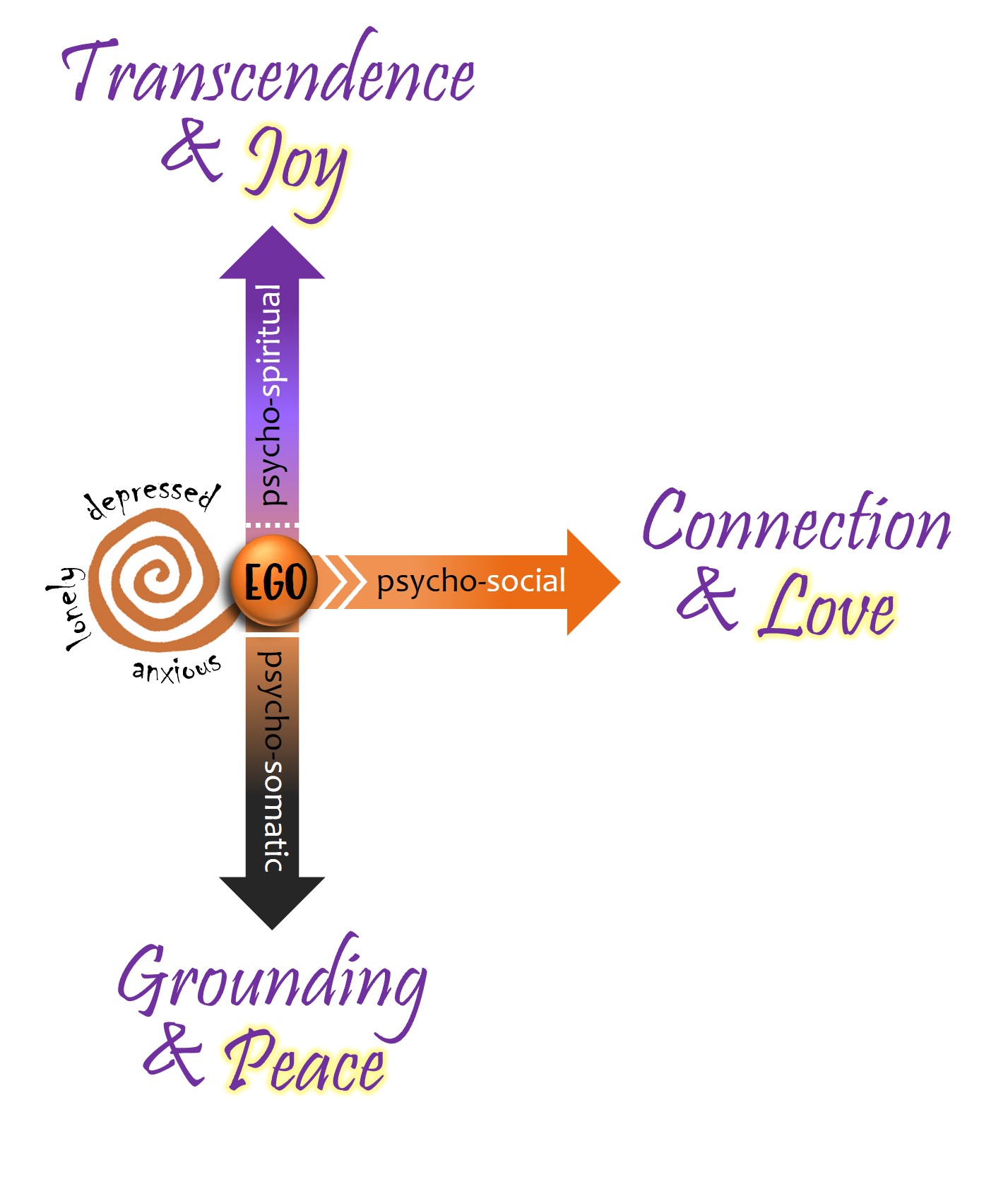
As illustrated in the diagram above, however, our domestication to conventional society and managing an identity are just part of a larger and longer journey – a fuller human journey.

What the wisdom teachers see is what most of us suffer to learn, which is that the very formation of identity separates us from the depths of consciousness, life, and being itself. That bucket of water pulled from the living stream was isolated for the purpose of filling a suit and serving a role.

But it came at a price. Our ego is inherently insecure and vulnerable to feelings of exposure, shame, loneliness, anxiety and depression.

Now, conventional religion can help with that, with its shelter of belonging, its program of moral direction and support, the assurance that comes in believing that we know the Truth and are among the chosen saved.

It shouldn’t surprise us that conventional religion is consistently the most vocal, even violent, enemy of human enlightenment and liberation. Its job is to keep us safely inside and sufficiently preoccupied with the promises and complications of membership, not even thinking to look outside the window – or even realizing there is a window onto Something More beyond.

So, while the priests, pastors, imams and other custodians of tradition are committed to keeping us inside and in line, the wisdom teachers invite us to “get out of the house” and discover Reality.

Of course, we can work together to build a bigger house, one with vaulted sky lights and a larger floor plan to welcome (and make members of) others whom we had been excluding, neglecting, or ignoring.

The fact remains, however, that a “megachurch” is still a church, and every church is its own kind of conventional society.

Progress on our journey to enlightenment, liberation, and fulfillment does not necessarily lead outside the house as much as underneath it. Not digging through the floor, but by dropping from the center of identity (ego), into the primal consciousness of the body, and deeper still to the grounding mystery named soul.

Not “my” soul, for this mystery is not something ego owns or can ever hope to manage.

Body and soul are together the expressive and essential dimensions of our authentic Self. One is a biogenic converter of the primal lifeforce into the metabolic energy electrifying our cells, fueling our instincts, and powering our mind, connecting us to the Web of Life all around us. The other is a centripetal attractor drawing consciousness inward to its own depths and generative ground.

This inner drop from our social anchor of identity up on stage is the mystical path to communion, where body and soul are experienced as complementary aspects of the same mystery – not the warring dualism envisioned in some religions, or the crap bag and alien light as taught in others.

The communion of body and soul – or we should say, the realization and intentional cultivation of this communion on our inner journey of liberation – brings awareness into our deeper centers of sentience, life, and being, each of which corresponds to a larger horizon of participation: all sentient creatures, all living things, Mother Earth and the universal cosmic environment itself.

We might compare this path to communion with the emergence of a butterfly from its cocoon: watch as it gently unfurls, slowly exercises, and gradually finds the balance of its new wings. Perhaps we can think of body and soul as the two wings which we must learn to use in coordination: the “soul wing” finding deeper centers within ourselves, the “body wing” reaching to larger horizons of wholeness beyond us.

When we compare this fully grounded and far-reaching authentic Self to the conventional identity we once inhabited – what is often named the conditioned self, the differences are so dramatically evident as to make a comparison almost impossible.

An obedient and true-believing conformist has transformed into a courageous and truth-seeking creator. A person who daily struggled to manage life on the stage has become a free spirit, fully human and finally divine.

In the full circuit of this Spiral Path, we return home with boons for the community: the Sword of Truth, the Balm of Compassion, and the Lamp of Wisdom. Perhaps we can inspire others to get out of the house and share a bit of what we discovered on the Way.

Breaking Through

The diagram to the right is an abstract illustration of Reality. That horizontal line of different-colored spheres at the center represents the plane of individual existence. Each sphere is a distinct being.

Pick a color: that’s a rock being. Across the way is a tree being. Next to them are a dog being, a bird being, a cloud being, a star being.

Get the idea?

Obviously, this is an extremely simplified and abstract depiction of Reality. Its usefulness is not about realism or descriptive accuracy, but only in the way it sets the stage for a deeper contemplation of Existence, particularly of your existence as a human being.

We’ll get there shortly.

Keep in mind that every individual being is represented on the horizontal line or plane at the center. We can also regard it as a threshold and take a step upward, lifting our attention to that arching dome above the line. From our original plane of orientation, this move takes us outward from the individual being and into a realm of connectedness, relationship, and participation.

Each being is connected, directly or indirectly, to all other beings in Existence.

Our common word for this universal Web of connectedness is Universe, referring literally to the “single turning” (uni-verse) totality of Existence. Outward and all around each individual being, the Universe isn’t something else or something other than the participative unity of all beings.

Now let’s drop below the threshold plane of rock beings, dog beings, star beings and the rest, where we can see more lines descending vertically from each individual being. This move takes us inward to the essential Ground of each being, to the power of be-ing, the power-to-be that generates and supports it from within.

If we’re not careful, lazy distinctions among the words we are using can lead to confusion, which has produced profound fallacies in many traditions of spirituality. What we are naming the essential Ground is not something else, just as the Universe is not something outside or other than the participative unity of all beings.

In this case, though, we are not moving outward across the Web of connectedness and relationship, but rather inward to the grounding mystery and power of be-ing, which manifests here as a rock or there as a dog. Ground is the within-ness or essence of each existing being, not another being separate from it and from the plane of existing beings.

You won’t find a being’s Ground by going outside to the external reality underneath it, like the physical ground beneath your feet. That’s the Universe again. The essential Ground is always and only within.


With that general picture in place, let’s sharpen our focus on your unique nature as a “human” being.

You also, of course, have the same dual orientation as all other beings – out-and-around to the universal Web of connectedness with all things, down-and-within to the essential Ground of being itself.

For this next stage in our contemplation of Existence, we have zoomed in on you as one being on the plane of existing beings. In your case, however, that horizontal threshold between what’s around you and what’s within you has been split lengthwise and wedged apart by the insertion of a larger sphere centered on the smaller one of your basic nature as a human being.

Altogether, the whole ensemble has the appearance of an eye, with the pupil of your ego (your “I”) looking directly back at us.

You have been endowed by Nature with the neuroanatomical equipment and corresponding capacity for self-conscious awareness. This means that not only are you conscious of your sentient experience, of what’s coming through your senses, but you are also aware of yourself as the subject having this experience.

From this new center of orientation, you piece together and project around yourself a mental map of Reality as it concerns you. Known as your worldview or simply your “world,” its outer boundary is what interfaces with but also squeezes to the margin that universal Web of connectedness, or Universe – which is quite factually all around you and includes you.

And yet, if something in the Universe isn’t mentally tagged as relevant to your concerns, it can be screened out of your awareness altogether.

So let’s make a few more fine distinctions. While the Universe is external to your consciousness (i.e., outside your mind), your world is a mental object of your consciousness (i.e., inside your mind). The character of your objective world is drawn from your personal experiences, from what you were taught growing up, from today’s news, from the creative power of your imagination, as well as from your anxieties, hopes, and expectations.

Your anxieties, particularly, are the product and symptom of an existential insecurity associated with standing on your own separate center of personal identity, inside a world that closes you off from what’s really real (i.e., from Reality).


All of that business of creating a world in your mind, projecting it around yourself as a theater of meaning, constructing an identity to inhabit your world, and striving to become somebody special – that is the Great Delusion.

It might be easy to confuse or equate your subjective self with the essential Ground of your being, or your objective world with the universal Web of Reality, but such equations only conspire to trap you inside the Great Delusion.

Personal identity is centered in your subjective self, which must be surrendered and released for a descent into the deeper oneness of your essential Ground. This is a breakthrough to inner peace and the Power within.

Correspondingly, personal meaning is bounded by your objective world and must be surpassed, pulled aside like a veil and transcended on your way to reunion with the universal Web and its higher wholeness. This is a breakthrough to communal joy and the Truth beyond.

Now, if you are ready for the most wonderful paradox in this entire meditation, here it is:

These breakthroughs in consciousness are predicated on your prior captivity to the Great Delusion.

Without a centered self, there is nothing to drop away from and go within. Without a bounded world, there is nothing to break past and get beyond. You have to become somebody before you can get over yourself.

The liberated life is on the other side of what defines and confines you.

A New Vision for Education

Higher education has been struggling to address some chronic issues for a while now, but it just can’t seem to find effective solutions. Here are the statistics: 50 percent of degree-seeking college students don’t make it to graduation or transfer, and 75 percent of those that do, end up getting jobs outside their degrees.*

On a statistical basis alone, these numbers are good grounds for an argument against the value of a college education.

Why would anyone waste time, effort, and money on something that doesn’t get them where they want to go? When I visit classrooms, I do my best to talk students out of wasting their time and money on college.

That’s right.

If students enroll in college but don’t have a clear sense of why they are there and where it’s leading, they’re wasting time and money and might better choose to drop out – or get help, which most don’t.

Many of them stumble into college out of high school by the momentum of parental or social expectations. Having completed a K-12 compulsory education where taller powers had decided and managed their progress through the system, they now find themselves in a place where education is voluntary. Taller powers are still standing by, but now more for advising and intervention than prescribing what’s now and what’s next.

So, the new college student takes a look around, reviews the available programs and course catalog, and chooses a degree. On the basis of what criteria? Quite often their choice is motivated by such factors as what other students are doing, the advice (or ultimatums) of their parents, what degrees are broad enough to feel safe, what industries are currently growing, or what jobs pay the higher salaries.

After all, you go to college to get a job, and you go to your job to make money – right?

At some point these students are required to declare a major field of study, which is supposed to set their focus and ensure they are taking the requisite courses for their degree. While the college is glad to take their tuition, it also needs them to finish a program and thereby add to its success data.

Retention, persistence, completion, graduation – such statistics are what accreditation agencies and external funders look at to determine whether a college is meeting standards and doing its job.

Needless to say, when 50 percent of degree-seeking students don’t complete a program, and when 75 percent of those that do complete a program end up getting jobs outside the degrees they just spent a significant amount of time, effort, and money to obtain, the numbers are both exasperating and embarrassing to college administrators.

A third persistent statistic would shed some light on what’s going on, if colleges hadn’t long ago thrown up their hands in resignation. Year after year, on nearly every college campus in the country, 80 percent of students change their major – multiple times.

It’s just what students do, runs the common response of educators.

They choose one major, discover things about the program curriculum they don’t like or find intimidating, learn more about the job prospects after graduation, start second-guessing their choice, come across information about other degrees and careers, and decide to change their major.

Not just once or twice, but multiple times.

Educators essentially put the blame on the students: That’s just what students do. They change their majors. We can’t change that (as they think inside the paradigm of intervention).

The next step for many students – somewhere in that 50 percent who don’t make it to graduation or transfer – is out of college altogether.

There’s also a good chance that those who do make it to graduation but end up getting jobs outside their degrees just came to their disillusionment on a delayed schedule. Their degree and major terminated in a career that didn’t really interest them after all, and so they found their way into something else. That’s nearly three-quarters of graduates. Seventy-five percent.

My experience in higher education has led me to take a new look at these statistics and what they really mean. Those 75-percent stats on either side of graduation are driven, I have come to believe, by something hidden in plain sight, behind that third statistic about students changing their majors.

It’s not “just what students do.” They are doing it, to be sure, and it may seem as if it’s inevitable. But it’s not.

The phenomenon of changing majors should be anticipated to some extent as students learn more about college programs, more about themselves, and more about the dynamic world of work. My observation, however, supporting students as a manager of career services on a college campus, is that a large number of them don’t have a clear understanding of themselves.

We can present students with all kinds of external options and incentives, but if they lack a clear and centered self-understanding, the choices they make are not likely to stick.

  • Changing majors multiple times is a likely symptom of confusion, which is itself a mental and emotional state that every human experiences from time to time.
  • Confusion can quickly generate anxiety, a feeling that things are about to go terribly wrong unless something is done very soon.
  • But urgency-driven action is often frantic and sporadic, producing unwanted results or bad outcomes and adding frustration to the anxiety.
  • If this goes on for long enough, exhaustion and discouragement will set in, perhaps eventuating in disengagement and dropout.

As a student’s doubt over their current choice of major begins to rise, so does their confusion, which in turn generates anxiety. It’s their drive to relieve this anxiety that motivates many students to pick a different major. They are suddenly certain that this is the answer, and their certainty saves them – or so they feel – from the suffering of doubt and anxiety.

The critical distinction here is that the student’s hastened certainty is more a therapeutic escape from anxiety than the clarity of direction they really need.

Clarity of direction, or vocational clarity, is what college students need most. Without it, that cascade of negative states and its futile escape measure are bound to repeat and persist – until the more drastic decision to drop out is made.

With a clear sense of their calling (vocare), purpose, and direction in life, students (really, every human) can hold a bigger picture and take the longer view on their lives. With that larger context in mind, they are able to make better choices and commit themselves with greater confidence to paths of higher purpose and deeper meaning.

This implies, of course, that students are giving careful consideration to their own interests, talents, intelligence, curiosity and passion, and then making relevant lines of connection to potential careers and college programs that offer the most promising pathways for their ongoing learning, discovery, and development.

In my experience working with students, the most effective way of reaching vocational clarity is by means of an interest assessment and career exploration process.

By clarifying their interests and exploring careers where their top interests are centered in the work environment and professional responsibilities, students can begin visualizing viable futures that excite them.

Ideally, the interest assessment and career exploration process would be administered already in high school. Even earlier, and the profile of each student’s interests could be used to differentiate instruction and empower their unique talents and intelligence – focusing pedagogy not on how smart they are, but on how they are smart.

By the time they exit the K-12 program of compulsory education and step onto a college campus, the student’s growing vocational clarity would guide them in choosing the right program, picking the right major, securing internships, staying engaged and doing their best all the way through.

We can also confidently predict that after graduation they would enjoy work in fulfilling careers. Colleges would be doing their job, so students can find theirs.


*Individual college or university data will vary, falling slightly or farther on either side of this nationwide average in each case.

Intentionally Human

In Next Steps I presented the “map” to a more authentic and fulfilling human experience, according to the perennial tradition of wisdom spirituality (Sophia Perennis) which has been active now for several thousand years across numerous cultures and religions.

The spirituality and its map are the shared product and collective property of homo sapiens, and while the religions are true or false depending on how clearly aligned they are with its underground stream of wisdom, the stream itself is essentially without religious identity.

It’s not necessary to join a religion to have access to Sophia Perennis, for it is already there in the collective higher consciousness of our species.

Indeed, religious membership can often make its access more complicated and virtually impossible. The religions frequently argue and fight over “water rights” and whose containers (i.e., myths, images, and doctrines) are superior. Stuck in their convictions and locked in conflict, the liberating vision of Sophia Perennis may be entirely forgotten.

That earlier post dropped a pin at the map’s center as a point for orientation: our ego. In mythology, this is represented by the Hero whose adventure and identity range across the archetypes of seeker, wanderer, captive, fugitive, exile and warrior. Once we can see ourselves in the Hero, the idea of a map as less a set of instructions than the layout and topography of our own human quest for life in its fullness makes intuitive sense.

From that middle position – existentially alone in the middle of Everything – our adventure can proceed in four distinct directions:

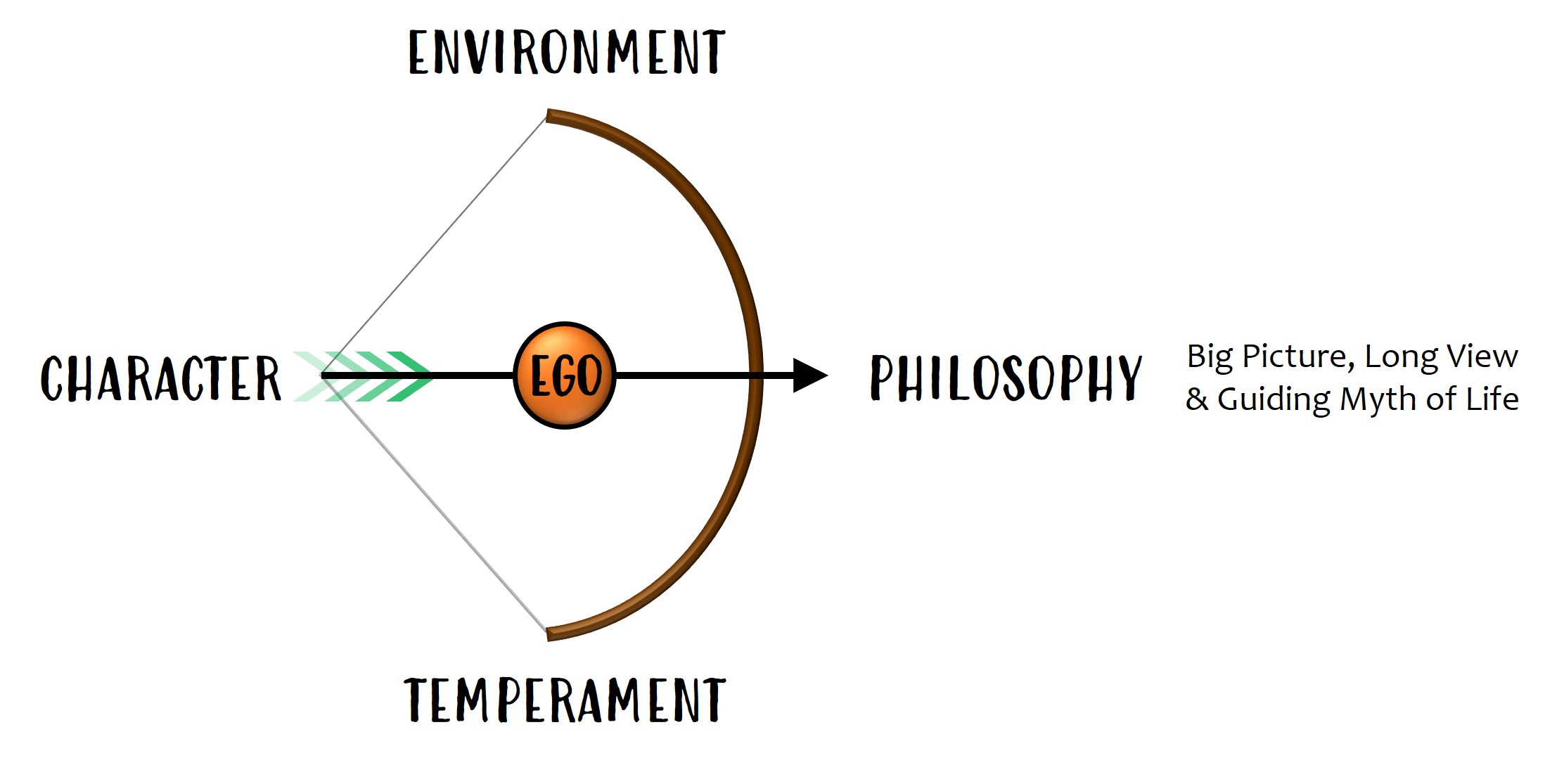
  1. Inside to our unique personality, character, and temperament (“oneself”);
  2. Outward to the social stage and engagement with “another” (actually many others);
  3. Within to the grounding mystery (“ground”) of our existence in the here and now;
  4. And finally, beyond by a transpersonal leap into the higher wholeness of “community.”

If you were to ask why, given such a clearly demarcated map for the human journey, it is so much more complicated in real life than this scheme might lead us to believe, the answer is that each of us gets “lost” in our own way. You might be a hopeful seeker one day, a confused wanderer the next, and a depressed captive by week’s end.

That earlier depiction of the map included an image of a tightening spiral on the path leading into oneself. This represents all the ways that ego insecurity can spin the personality into neurotic attachment, chronic anxiety, churning frustration, nervous exhaustion, and finally debilitating depression. Its centripetal contraction can effectively close the ego off from Reality, pulling it so deep into its own delusion and suffering that nothing else is real.

While it is characteristic of our Western approach to such challenges to isolate the problem and then try to medically relieve or surgically remove it, the approach of Sophia Perennis is instead more holistic, addressing the systems in which the problem is found.

Returning to the map a second time, we find additional terms which together serve to clarify a web of virtues that generate the wellbeing and fulfillment (i.e., life in its fullness) we long for as humans. By restoring alignment and balance among the interdependent elements of the system, overall health and wellbeing can be established. This favorable balance gives ego the freedom it needs to conduct its adventure with creative intention.


Let’s move around the map along its distinct paths to get a better understanding of these virtues and their dynamic balance.

It is by a slow process of differentiation that a small portion of the body’s deeper animate consciousness gets siphoned into an encapsulated center of self-conscious experience – the ego itself. The varying difficulty or success of this formational process registers in the nervous system of the body as an internal state of in/SECURITY.

Because ego formation is largely managed by our tribe, the devotion and competency of our taller powers generate the conditions that prompt an adaptive response and chronic mood in our body. Our sense of Reality as provident is the feeling of security, and to whatever degree our early perceptions are otherwise, anxiety will be our corresponding mood instead.

Later in development with an ego securely centered, we will be able to drop out of our conditioned identity into deep state of inner PEACE. What was in the beginning a calm and trusting composure of the body’s internal state (security) supporting our self-conscious experience from below, so to speak, opens at this later stage to welcome our intentional release into its quiet and boundless presence within.

With a foundational mood of security in place, ego can proceed in the work of regulating, coordinating, and unifying the distinct lines of affect and motivation in the personality – “subpersonalities” as they are sometimes called (Roberto Assagioli). As executive center, ego manages these otherwise divergent subpersonalities and anchors our personal POWER, referring to our capacity for self-control, free will, agency and purpose.

Gradually we learn how to stand in our own center and “be somebody.”

This adventure of consolidating a personality and “putting on” an identity is not carried out in a social vacuum, however. In fact, personal identity is also the product and symptom of a another system in need of balance, between the power in oneself and our LOVE for another. Our personal power is developed and calibrated inside the contextual dynamics of interpersonal relationship.

We need others to recognize and reflect back to us who we are becoming.

The path outward to another invites us into CONNECTION, then, that both tempers and defines our identity. More than that, each connection further awakens and develops our empathy along with other ethical sensibilities. We learn that love is more than mere affection and agreement; it also includes patience, generosity, compassion, service and sacrifice on behalf of another.

The altruistic nature of love seeks to devote our power to commitments which are conducive to the health, happiness, and wellbeing of others.

From the perspective of Sophia Perennis, this longer human journey from the gradual formation of an ego, through its construction of identity in the balance of power and love, has the ultimate aim of creating community. More than a mere aggregate of individual egos, community here refers to a higher wholeness brought about by the transpersonal leap beyond “me and mine” or even “us and ours,” into an experience of “all of us together as One” (com-unitas)

The wisdom teachings inspire an understanding of this higher wholeness as a nested hierarchy (Arthur Koestler’s “holarchy”) with egocentric (self-centered), ethnocentric (group-centered), Homocentric (human-centered), biocentric (life-centered), geocentric (Earth-centered) and cosmocentric (universe-centered) horizons, ultimately including all beings.

In such a vision, our sense of BELONGING is a spontaneous intuition expressed as joie de vivre or a delight in being alive. This is the JOY of the Spirit that some religions anticipate in the future consummation and “superconscious harmony” (Teilhard’s “Omega Point”) of all things.

This comprehensive vision of existence and of the human journey is based on the insight of there being an intention in our nature – as well as in Nature herself – pressing purposefully toward fulfillment. Our experience at any point in the adventure will be, to some significant extent, a function of how awake and attuned we are to its current and calling.

At the very least we should affirm that the Universe itself, here in its human manifestation, is an intentional system.

Author of Meaning

I’ve been interested in human nature, psychology, and development for a long time. My preference is to consider each of these through the lens of evolution, asking all along what a fully evolved and self-actualized human looks like. Most posts in this blog on creative change come at this question from one angle or another.

In this post I offer a simple, but hopefully not oversimplified, conceptual model for understanding our human adventure into maturity and fulfillment.

To make it interesting, I’ll use you as our human subject. Let’s get started.


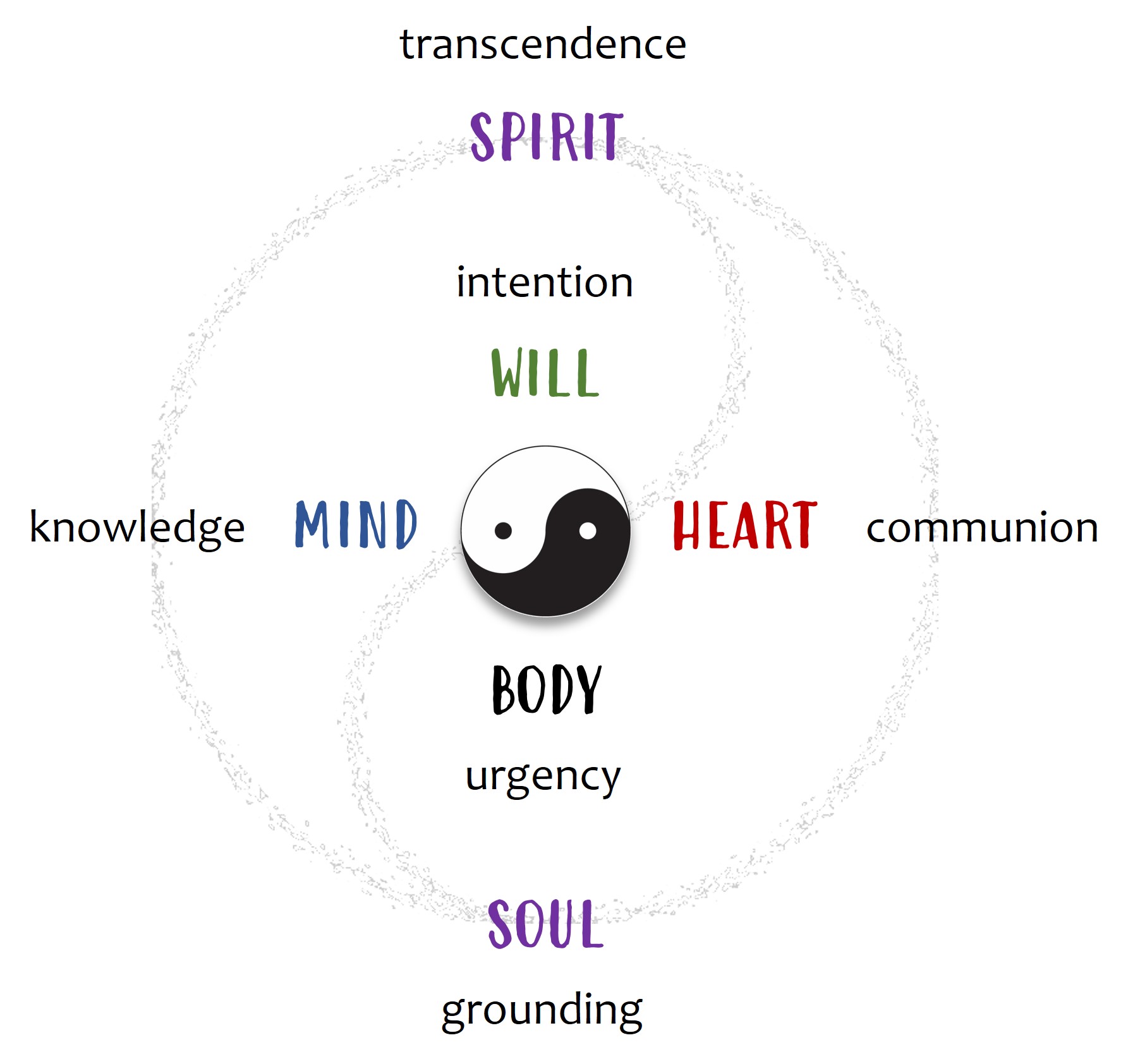
You have a lower, primal, or first nature in an animal body that is fully immersed in what I will call the zone of urgency. This zone includes your immediate circumstances, what’s constantly going on around you, and also the pressing concerns that impinge on your experience one moment to the next.

To qualify this zone as one of “urgency” merely acknowledges the fact that consciousness at this level is fully dedicated to keeping you alive.

Given everything that must be regulated, coordinated, and negotiated in just keeping you alive, there’s a lot going on in this zone of urgency. So much, in fact, that it can demand almost your entire bandwidth of attention and energy.

If you happen to be prone to anxiety, the immediate circumstances and pressing concerns of living can at times be overwhelming. Not only is so much going on, but so much can go wrong that you have an impossible time getting a grip on it all.

All of those stressors (external factors, many beyond your control) trigger your nervous system into distress, where a bunch more things can go wrong.

The thing about anxiety and worry is that there is no end to it. There’s always something else, or something more adding to what you are already fretting over. Because your nervous system and energy reservoir are limited in their capacity, eventually all this tension drains your supply and dumps you into a state of nervous exhaustion.

When this nervous exhaustion pulls your mind down into it as well, you can be diagnosed as suffering from depression (literally the feeling-state of being “pressed down”). Maybe you don’t get diagnosed with clinical depression but are among the many millions of humans who have discovered that even a broken night of sleep can be just enough (though barely) to replenish your energy reservoir for another day of unproductive worry.

As I said, there are many, many people today who give just about everything they have to the work of barely managing their unhappiness from day to day. Sure, there are occasional thrills, passing pleasures, and maybe weekend bouts of intoxication, but the general tone of experience in this zone of urgency is fairly dark and gloomy.

Prescription meds might lift the shade a little, but these also invite other complications – and more things to get anxious over.

Let’s be clear. The vast majority of other animal species on Earth also live in the zone of urgency, navigating and reacting to their immediate circumstances, motivated by their pressing concerns of living. Staying alive, seeking safety, finding mates, rearing young, acquiring what they need to … stay alive – such are the preoccupations of this zone.

A major difference between them and you lies in your tendency to get locked up in anxiety and depression.

Actually, this tendency of yours is a sign of your capacity for something more. That debilitating cycle of anxiety and depression is what predictably happens when you either forget or fail to discover the power in yourself which we call the human spirit.


As a human being, you are (we might say) destined by your higher nature to seek after more than merely surviving the day. And because you have this power in you, this irrepressible longing and aspiration, any coping strategy you might use to manage living in the zone of urgency will only add frustration and duration to your suffering.

Ultimately, your higher nature desires a big picture and long view of life that makes it worth living. I call this the zone of authority because a life worth living is really a product of your creative storytelling. And in this important sense your authority is about authorship, engaging your authorial power as a human being to clarify your purpose and compose the meaning of your life.

Life in the zone of authority is very much, then, both a symptom and expression of the human spirit in you.

A big picture and long view provides the narrative context and motivational lens for a liberated, more enjoyable life. That term, “liberated,” is especially significant here, in the way it sets the contrast between the lower zone of urgency and this upper zone of authority.

Down there you have very little freedom, but are instead compelled by urgency to react, which then forces you into another pinch-point where you have to react again (and so on). You may try to avoid or procrastinate on something and feel a bit of momentary relief, but the urgency will be back very soon – with extra hammers and hooks.

Many people don’t have a reference point for understanding the kind of liberation they might enjoy in the zone of authority. For the longest time, humans imagined this kind of life through the gods of mythology – fictional projections, really, of their own aspirations for purpose and meaning, of the longing for a “god’s-eye” view on life and the liberty to live as they might choose.


Your own ascending path from the zone of urgency to the zone of authority follows (or has followed) a few predictable stages of developmental achievement. In the diagram above these stages are associated with the major eras of childhood (birth to age 10) and adulthood (beginning around age 25 after the brain’s higher centers are fully online), with the transitional phase of adolescence (“becoming adult”) in between (roughly age 11 to the early twenties).

In order to one day enjoy life in the zone of authority, you first needed your parents and other taller powers to satisfy your existential need for grounding and orientation. Such a foundational assurance and inner release to a provident Reality is the true meaning of faith.

Faith is what gradually enables your calm and centered presence amidst the immediate circumstances and pressing concerns of living (zone of urgency).

Only with this deep faith that you are okay, that Reality has your back and provides what you need most right now, can you find freedom from anxiety and break the chain of reaction that has held you back for so long.

During the developmental phase of adolescence you further centered this freedom within yourself and began to take control – not over everything going on around you, but of your own words and actions, your thoughts and feelings, even to some extent your wants and needs.

This centered sense of control, freedom, autonomy, initiative, and responsibility is known as agency. It is one of the telltale signs of successful “adulting.”

Now, with this freedom and agency you could further develop, refine, and extend your creative authority. Remember, the big picture and long view of life is largely yours to design.

For thousands of years, especially before it got taken up and absorbed into the various disciplines of modern science, philosophy – literally the “love of wisdom” – provided emerging adults with questions, proverbs, parables, principles and practical advice for keeping their stories aligned with Reality (i.e., truthful) and conducive to human (both personal and communal) wellbeing.

As you can see, none of this is really new. And yet, as you take this opportunity to clarify your purpose and create a meaningful life, in a real sense your whole world begins again.

What If

Can you imagine our situation on this planet if humans lived with compassionate stewardship of our place in the great Web of living beings? If we today could draw on a spontaneous intuition of our common heritage with other species and our shared dependency on the Spirit of Life?

As fellow earthlings and offspring of Life, we would feel, think, plan and live with the whole Web in mind. Animated by the same life principle, this Spirit of Life, we would seek the collective wellbeing and promote the flourishing of our human and non-human neighbors. We would honor and preserve the delicate balance among Earth’s material, microbial, fungal, botanical, and animal species – not that they are “here for us” but rather “here with us,” sharing this planetary home.

Just as we wouldn’t pump and dump pollutants into our own water wells, food gardens and living spaces without expecting them to show up in our bodies, we would not mindlessly discard our industrial byproducts and consumer waste into the terrestrial commons.

Indeed, had we been living with reverence for the Spirit of Life all along, there’s a good chance we would have developed truly sustainable Earth-friendly economies and technologies by now.

If we lived with compassionate stewardship of our place in the great Web of living beings, the flourishing diversity of life rather than its deterioration, endangerment, and extinction would be evident all around us.


Can you imagine the situation if we lived with kindhearted goodwill towards other human beings – at home, on the street, in our workplaces, and on social networks? If we could treat others with the same respect, kindness, charity and forgiveness as we might expect from them? If the Power of Love inspired and directed our engagements with neighbors, with strangers, and even with our enemies?

The Power of Love is often regaled in poetry as, in Dante’s example, “the force that moves the sun and the other stars” – that is to say, as a cosmic principle swinging and fusing together the whole shebang.

In this context, however, Love’s power is focused more in the connection between and among human persons. While it certainly has roots in the electrochemistry of nervous systems and emotional dynamics of interest, attraction, empathy, and affiliation, the Power of Love comes (or can come) to its greatest clarity and brilliance in the interpersonal space between and among individual egos.

As individuals develop and mature, they differentiate unique centers of identity from which to look out and act on the world. Those deeper and more primitive registers of neural and emotional activation mentioned earlier eventually get channeled through this self-conscious center of identity (i.e., the ego) to another self-conscious center of identity, generating a transpersonal effect between and among us – the Power of Love – beyond and including the persons involved.

We can connect with others in this way only when we are securely centered in ourselves. If we happen to lack a secure center of personal identity, our interactions with others tend to get complicated. Unhealthy attachment, co-dependency, manipulation, power plays, intimidation and violence are various ways we work our insecurity out on others.

So, to imagine how the situation might be different today if the Power of Love were honored and practiced between and among human beings, we might have to picture something very different from our current state of affairs.


Finally, can you imagine our situation if each and every one of us was inwardly established in the Ground of Being? If we possessed the ego strength and inner freedom to drop out of our separate identities and rest in our essential nature as human manifestations of being?

To cultivate such a grounded presence, we would simply release all the roles, agreements, habits and beliefs that define us as separate and special. Because our self-conscious center of personal identity is itself a construction of such roles, agreements, habits and beliefs, dropping into Reality is a simple matter of letting go of who (we think) we are and being present again to the Now and Here – which from ego’s perspective is nowhere and utterly inaccessible.

The Ground of Being is also no thing, and therefore nothing to the separate ego.

The Ground of Being is not found by looking outside ourselves, by peeling away the layers of appearance or digging below the surface of what we see. It is within us, not something (some thing) “down there” and underneath it all, but as the generative Source and essential nature of our existence as (in descending order) self-conscious, sentient, living, and material manifestations of Reality – the energy of be-ing.

Dropping away from the inflated balloon of ego allows consciousness to descend deeper into this essence of what, rather than who, we really are. Social status and reputation are released. Personal identity and our conditioned self are released. Beliefs and the thoughts that weave our beliefs into judgment and worldview are released.

Finally, the self-conscious thinker unwinds and dissolves away. From the relaxed edge of Life’s pulsing rhythms, consciousness opens to the dark and silent mystery of Being itself. What’s left is boundless presence and a profound inner peace – a peace that surpasses all understanding.

Just imagine.


In this brief time, dear reader, we have been engaged in a post-theistic meditation. You’ll notice that we didn’t mention religion, although the meditation itself, along with the quality of intentional living it inspires and supports, is itself a kind of religion: linking our self-conscious center of identity back (Latin religare) to the Spirit of Life in our body and all around us, to the Power of Love between and among persons, and to the Ground of Being deep within and far below who we think we are or are trying so desperately to become.

We didn’t talk about god, either – at least not as a figure of mythology, a concept of theology, an article of orthodoxy, or an object of worship. And yet, in a way that is most true to the religious quest, God was the focus of our meditation all along.

Making Our Way

In this blog, I am intent on doing my part toward correcting and clarifying the conversation around religion. Instead of identifying it with one or another of its historical examples, I’ve urged the importance of defining religion itself as a system of symbols, stories, sacraments and practices that link us back (Latin religare) to the universe, to one another, and to our own grounded existence in the here and now.

The need for such reconnection is brought about by the formation of a separate center of personal identity, our ego, which generates the delusion of standing apart (me) from everything else (not-me). Because the construction of identity is a necessary stage in the full development of a human being, we need a way back to Reality where everything is connected and All is One.

Religion, of whatever brand, is our Ariadne’s Thread out of the winding labyrinth that lures us deeper into the illusion of who we think we are.

So, however we come back to Reality, that is our religion.

A much more serious problem arises, however, when we forget or lose sight of the fact that our pursuit of identity takes us away from what’s real. In today’s conventional religions of theism, where a devotee’s focus is on the projected image of a deity regarded as separate and supreme, our lost connection with Reality has taken a pathological turn into conviction, extremism, and violence.

True believers are excluding, persecuting, and killing “in god’s name” those who don’t agree or live differently.

If believers could understand that their concept of God (i.e., their god) is only that – a construct of the mythopoetic imagination engaged with the ultimate mysteries of Being, Life, and Love – they might look through it to what’s real and really see that All is One.

But they can’t. The conspiracy of mythological (or biblical) literalism and dogmatic orthodoxy has imprisoned them inside a collective delusion, persuaded that their final salvation depends on what they believe and getting it right.

Coming back for the larger vision shows very clearly that “salvation” will not be found in separating ourselves from others, gaining liberation from our bodies and escaping to another world when we die.

Ironically, we need to be liberated from the religion organized on our pursuit of becoming somebody. Having become somebody, we should be able to get over ourselves – but we’re stuck.

The diagram above distinguishes the major types of religion and critical stages of human psychospiritual development. Perhaps a view of the larger scheme can help us appreciate the significant contribution of theism, as it also provides context for the positive anticipation of what theism can break open into – not a breakdown to atheism but the breakthrough of post-theism.

With each major type or stage, the language of religion necessarily shifts, and with it our basic way of engaging with Reality. These shifts are indicated in the columns moving to the right and upwards with time.

Animism is the religion of Nature and our body-centered experience. There is no separate personal identity as yet, no “I” (ego) that stands apart in its own locus of control, agency, and will. Consciousness is fully embodied, immersed in the instincts and urgencies of animal life, attuned to the rhythms and cycles of natural time. Life is the animating force in our body, evident as well in the myriad living beings all around us.

Essential to the religion of animism, as well as to its associated stage of early childhood development, is this sympathetic intelligence of Life pulsing through it all.

The work of religion at this stage is to guide and facilitate our reverent participation in the great Communion of Life. Absent the self-conscious orientation of ego, our response is more spontaneous, playful, and imaginative.

By late childhood or early adolescence, consciousness has taken a position of reflexive self-awareness, from a center of personal identity that puts on and acts out a variety of roles (or suits) connecting us to age-relevant role plays of our tribe.

From the location of ego in my diagram, we curate a wardrobe of suits (identities) that secure the social acceptance we need and the approval we crave. This simultaneously produces a shadow in our personality consisting of natural talents and animal propensities that others – especially our taller powers – can neither accept (repression) nor expect from us (ignórance).

The obsession with becoming somebody and finding social validation of our identity, but also with pushing the deviant or unacceptable parts of our nature down and out of sight, helps explain many common features of theism.

  1. An authoritative higher power in the deity, whose mediators (priests, pastors, and other clerics) supervise the faith, service, and sacrifice of believers.
  2. A moral frame in which a “good person” and “right action” are defined in terms of what pleases god and fulfills god’s commands.
  3. The righteous exemplar of a saving advocate (Savior) who stands in opposition to a diabolical adversary (Satan) that threatens to pull devotees into the darkness of sin and damnation.
  4. A fixed and absolute boundary separating insiders from outsiders, the “chosen few” from atheists and other enemies of god.

Such is the framework basic to theistic religion. The names and characters are different from one religion and culture zone to the next, but the elements of this framework are universal across all its forms.

Now, if our development gets stuck here, held captive by dogmatic convictions and protected memberships, the consequence will be spiritual frustration. This will either turn inward to become depression, or outward as fanatical aggression against everyone and everything that is not on our side.

The sharp rise in religiously motivated violence and terrorism, while not intrinsic to theism per se but a sure sign of its corruption, is why many today are choosing for atheism.

We need to understand that identity is not essence. Who we are striving to become is a superficial pursuit when compared to what we already are and have been from the beginning: a human being, or a human manifestation of being.

When our animal nature is honored and respected for what it brings to the construction project of identity, the shadow will be less repressed and volatile, making it much easier when the time comes to detach from our roles and from the ego as actor.

The time comes as the cocoon of theism begins to wear thin and Reality starts shining through.

A post-theistic spirituality returns to the body as our grounding mystery, dropping away from the attachments and social agreements of identity and into the mystical depths of Soul. The shadow we so feared is now befriended as Keeper of our Light (“light bearer” = Lucifer in Christian mythology). Actually it was fear that created our shadow in the first place, and can still bring it back from time to time.

And because we can hold on loosely to who we are, we are free also to join ourselves to the great Community of Spirit – the higher wholeness that, paradoxically, our ego prevented us to some extent from seeing but now provides an intentional way in.

God for Everyone

If you believe in a god who loves you, perhaps in a “heavenly Father” who is loving, gracious, compassionate, and merciful, a divine or supernatural personality who is happy with your obedience but gets angry or disappointed when you mess up or fall short, what you likely have there is not God but an idol, at the very least a human construct.

An idol is any human artifact – be it a fictional character, artistic image, theological concept, or just this free-floating idea of god in your mind – which is regarded as a literal or factual depiction of God.

Now, this gets a little tricky, so let’s be careful here.

What makes this human construct an idol is not merely the presumption behind it, that a character of myth, for instance, has this temperament or that disposition. The human imagination is a “factory of idols,” as the Reformer John Calvin insisted, not because it conjures up images and uses these to entertain itself and represent Reality, but because it so easily misappropriates its own constructs (god) for the mystery (God) it is contemplating or presuming to talk about.

Just that quickly, God as Ground of Being, Spirit of Life, and Power of Love is reduced to a separate being who lives somewhere out there and (hopefully, at least for now) loves you. A depiction or concept eclipses and takes the place of an ineffable Mystery and in the process becomes an idol.

Because no idol can encompass or adequately represent what is essentially beyond representation, your fervent devotion, dogmatic defense, and evangelistic witness on behalf of this idol of yours agitates something deep inside you – a growing insecurity and rising doubts over the likelihood that you just might be holding onto something that isn’t God and not real after all.

But now you can’t let go. You’ve invested too much and renounced so much more in service to your idol. Psychologically what happens next is that your inner insecurity and well-grounded doubts get amplified by the desperation you feel over attaching yourself to a counterfeit, to something that isn’t ultimately real.

Robertson Davies helped us unpack the inner workings of religious fundamentalism (or fundamentalism of any kind) with his observation that “fanaticism is overcompensation for doubt.” The aggression and violence of a religious fundamentalist are his attempt to stifle the realization that he is mistaken by intimidating or, if need be, even eliminating those who challenge his convictions.

Simply not agreeing with the convictions of a fundamentalist will be taken by him as a challenge and threat, poking at his deeper insecurity and suppressed doubts.

The theory of religion advanced in this blog identifies three major stages or types in its longer evolution through human history. These stages or types translate to the level of individual development as distinct paradigms of faith: a body-centered faith (animism), an ego-centered faith (theism), and a soul-centered faith (post-theism).

In more traditional societies where the norms, customs, and rituals of shared life are faithfully conserved from one generation to the next, the initiation of children into a theistic worldview is facilitated by a coordinated mythology of stories that represent God (Love, Life, Being) in personified form (god) – as in the example of a “heavenly Father” in Judeo-Christian theism.

Such metaphorical representations are neither embraced nor scrutinized by children for their factual accuracy. The psychology of a child hasn’t yet developed to the point where a dividing line between fact and fantasy (or fiction) is established. They simply listen to the story in rapt attention and imaginatively engage with its settings, characters, actions, and events. The story “does its work” on them.

For a child, the god depicted in sacred stories is not an idol but the Mystery of Love, Life, and Being represented in personal form. Again, they are not yet capable of distinguishing between the presentation (god) and what it represents (Mystery/God). With their “mythic-literal” faith orientation (James Fowler), the stories are simply taken at face value (i.e., literally) and the characters come to life in their creative imagination.

The Power of Love is personified in the god, gradually clarified in the cycle of sacred stories*, and finally perfected in the child’s imagination to become a creative force in his or her own character and attitude toward the world.

There is no factual realm outside the story as yet, which will later on force a distinction between what’s inside the story and what’s real, what really was or is outside the story.

A healthy theism supports and facilitates the successful formation of self-conscious identity (ego) in children by orienting their imaginations and developing their personal character on the “Super Ego” of god. They are assured of god’s presence, protection, providence and love, which instills in them a profound trust (faith) in Reality as benign and responsive to their needs. A tribe’s patron deity is presented to children as someone who cares for them and wants them to be caring, good, and kind in turn.

In Egod and the Future of Faith I coined the term “Egod” to label this reciprocal dynamic of ego-as-god’s-reflection and god-as-ego’s-projection. While this dynamic easily can, and often does, spin off in pathological directions, it is basic to the formation of faith in children.

Damage occurs when the managers of theism – parents, priests, pastors and teachers – impose their own undeveloped, deformed, and diabolical concepts of god on the new generation.

In later development, when they have acquired the intellectual capacity for distinguishing between fantasy and fact, between the god in stories and the Mystery of God (or the present mystery of Reality), adolescents are ready to look through the stories like embroidered veils or cathedral stained-glass windows, to the light-source beyond.

Healthy theism will encourage this reappropriation of myth as metaphor by affirming the poetic and artistic (i.e., constructed) origins of its god: This is how we represent the Mystery among us (Love), all around us (Life), and deep within ourselves (Being). It’s just a picture, a way of thinking and talking about what is beyond thoughts and words.

When I earlier suspected you of idolatry, dear reader, I assumed you had either grown up inside an unhealthy form of theism that motivated you by guilt to lock down on one concept of god or another; or perhaps you came to theism later in life and took its metaphorical depictions literally – not in the naïve mythic-literal manner of a child, but as eye-witness accounts of supernatural realities and miraculous events, according to the dictates of dogmatic orthodoxy.

And now you’re stuck with them.

But maybe that’s not true. Perhaps you do have an appreciation for the mythopoetic imagination and the metaphorical nature of religious “god-talk.” Whether your faith was shaped inside a Christian, Moslem, Sikh, Jewish, Hindu, Buddhist, Pagan or some other theistic tradition, today you can see through the veil to the light-source beyond.

You celebrate the Power of Love that draws human beings into communities of compassion and goodwill. You honor the Spirit of Life that animates and pulses across the great Web of living beings. And you contemplate the Ground of Being deep within yourself, where ego consciousness and the concerns of identity unravel, dissolving into a quiet and profound sense of inner peace.

Love, Life, and Being: God for everyone.


*A chronological reading of books in the Bible (according to the order in which they were produced) shows a gradual but steady progression in its god’s capacity to love – preferentially, conditionally, inclusively, universally, and finally unconditionally.

Trumplicanism and the Christian Wrong

Recently conservative Christians of the so-called Evangelical Right met with Republican politicians to rally for their cause. It strikes me that neither partner in this alliance is really what they say they are.

The Republican party has been pulled off-center and dismembered by the influence of a reactionary and extremist element, which Donald Trump exploited in his 2016 bid and win of the presidency.

Interestingly, his appeal was not really political – except insofar as he represented an alternative to the political corruption that his base believed was rampant in Washington. The attraction of Trump was in the fact that he was a capitalist and not a politician, a celebrity businessman and not a political insider.

Trump’s voter base largely consisted of working class folk, many of whom were struggling to make ends meet. Government-funded social welfare programs were assisting even poorer Americans in distant cities and of different skin colors than their own, but their taxes were paying for it. The vision of a democracy that protects the rights of its citizens and provides public goods for their health, safety and enjoyment seemed (and still seems) to be biased unfairly against those who can take care of themselves.

The message of capitalism – that by self-reliance, personal ambition, ingenuity and hard work every individual can improve their status and quality of life – resonated more with the values and resentments of Trump’s voter base.

After all, it’s what inspired the New World settlement and American Revolution at the beginning. The “American Dream” is only political as an afterthought, and the earliest versions of democratic government in the young nation were meant to serve and safeguard the economic ambitions of its citizenry.

If you can’t make it work for yourself, then you either have to work harder, lean on your friends, take out a bank loan, or go back to the place you came from.

Donald Trump’s ostensible riches made him an idol of what these “true Americans” dreamed for themselves. And his coarse, racist, misogynistic, pugilistic brand of white nationalism appealed and gave permission to their outraged sense of entitlement. He would open the way to prosperity and Make America Great Again.

So they gave him their vote, and Trump proceeded to hack away at the regulations, rights, liberties and other protections that earlier democratic administrations had put in place.

It makes sense that most Americans and many U.S. politicians would have stronger capitalist than democratic sympathies, given our history and how things got started. These two traditions – one individualistic and the other communitarian, one favoring liberty in pursuit of private wealth and the other favoring equality in the interest of a more perfect union – have never lived in easy agreement.

Before Trump, the political paradigm had managed, or at least had tried its best, to hold the two traditions in balance, letting the engine of capitalism move the nation forward into prosperity as the wheel of democracy guided the ship toward its vision of community.

Once in office, Trump effectively shredded the star chart and put the engine in full throttle. Unfortunately – but again, not surprisingly – a significant number of Republican politicians affirmed and aided his efforts, to the point where they were ready and willing to break democracy and steal his re-election.

That’s how the Republican party degenerated into a gang of “Trumplicans,” self-interested political leaders who use their influence to stay in power and please their base.

A vision and plan for “all of us” isn’t even on their minds.


Then there’s the so-called Christian Right, an evangelical special interest that sees government through the lens of a biblical theocracy, with the president as “god’s son” and America’s messiah. They profess to be Christian, but there is very little about them that aligns with the life, message, and moral vision of Jesus.

  • Jesus was a poor brown-skinned homeless person. They are typically middle to upper-class white landowners.
  • Jesus dedicated his life to healing and helping people in need. They seek to reduce or even eliminate social welfare programs.
  • Jesus taught a message of prodigal love and radical forgiveness. They condemn and reject others who don’t fit their profile of righteousness.
  • Jesus criticized the political and religious leaders of his day for conspiring to oppress the human spirit. They sidle up to politicians for the power and privilege they feel they deserve.
  • Jesus died in solidarity with those who had no power or position in society. They accrue status and wealth for themselves because they can.
  • Jesus held a vision of universal salvation by the power of love. They contrive manipulative schemes that promote their love of power.

It’s remarkable to me how far outside and against the gospel (good news) of Jesus the Christian Right really is. In front of the camera and on social media they spew bigotry, hostility, and conspiracies against their opponents – with occasional references to “God,” “Jesus,” the Bible and a “Christian nation.”

Back in his day Jesus himself called out such people as hypocrites, ‘whitewashed tombs’ with an out-facing righteousness but filled with the stench of spiritual decay.

In Against Democracy I explored the ideological opposition of Christian orthodoxy (the official Church tradition of “correct beliefs”) to the core principles of democracy, as yet another way to understand the vulnerability of Christian believers to autocratic movements, leaders, values and ideas.

The belief in a god-king (i.e., divine autocracy or theocracy), combined with beliefs in the inherent depravity of human nature and a future rescue when we will leave this fallen world and all our problems behind us: such convictions foster a deep resistance to democratic ideals, so deep in fact that most Christians can’t even articulate and certainly won’t acknowledge it.

Those in the so-called Christian Right can thus be regarded as the true devotees of Christian orthodoxy – not true to Jesus and his vision, ironically, but true to the religion that coopted and turned him into something almost exactly the opposite of who he really was and what he was all about.

It’s why so many of them believe that Donald Trump is their present-day messiah, so persecuted and misunderstood, god’s agent of a new theocratic order where Democrats, drag queens, homosexuals and other vile sinners will be finally vanquished.

It’s also why Trumplicans and the Christian Wrong are not just bedfellows, but in many cases one and the same.