Our Longing for Perfect Love

Our Longing for Perfect Love

Love has been a human fascination probably for as long as we’ve been reflecting on things that matter most in life. The early Christian movement was so bold as to even identify it with God – not in terms of a god who is loving, but as the supreme Reality behind, within, and beyond everything (“God IS love,” 1 John 4:8).

In its subsequent history, the Christian Church would abandon this profound insight into the divine nature of love for a realpolitik that could justify its ambitions for world domination. Perhaps it is in the very design dynamics of organized religion, that the love of power in hierarchical authority should take the upper hand to the power of love in basic human fellow-feeling.

Jesus himself lived in devotion to the power of love. In the end, however, it was the love of power at work in the political ideology and religious orthodoxy of those who resisted his message that put him away, launching the early messianic movement in his name.

In other posts I refer to this ideal power of love in human relationships as “genuine” love, with its connotations of authentic and real, distinguishing bona fide love from cheap knockoffs and sugary substitutes. Here I am using the adjective “perfect,” but not in the sense of something absolute, transcendent, or meticulously airbrushed of every imperfection.

The word “perfect” has surprisingly little to nothing in its original meaning of the flawless ideal, but rather refers to what is finished or brought to completion. Perfect love, then, is love that has been cultivated into the full flower of relational harmony and communal wholeness. It is decidedly not the “perfect partner” contemplated in mythology, conjured in our dreams, and pursued on dating apps.

There is no perfect partner; and yet, perfect love can be nurtured between and among very imperfect persons.

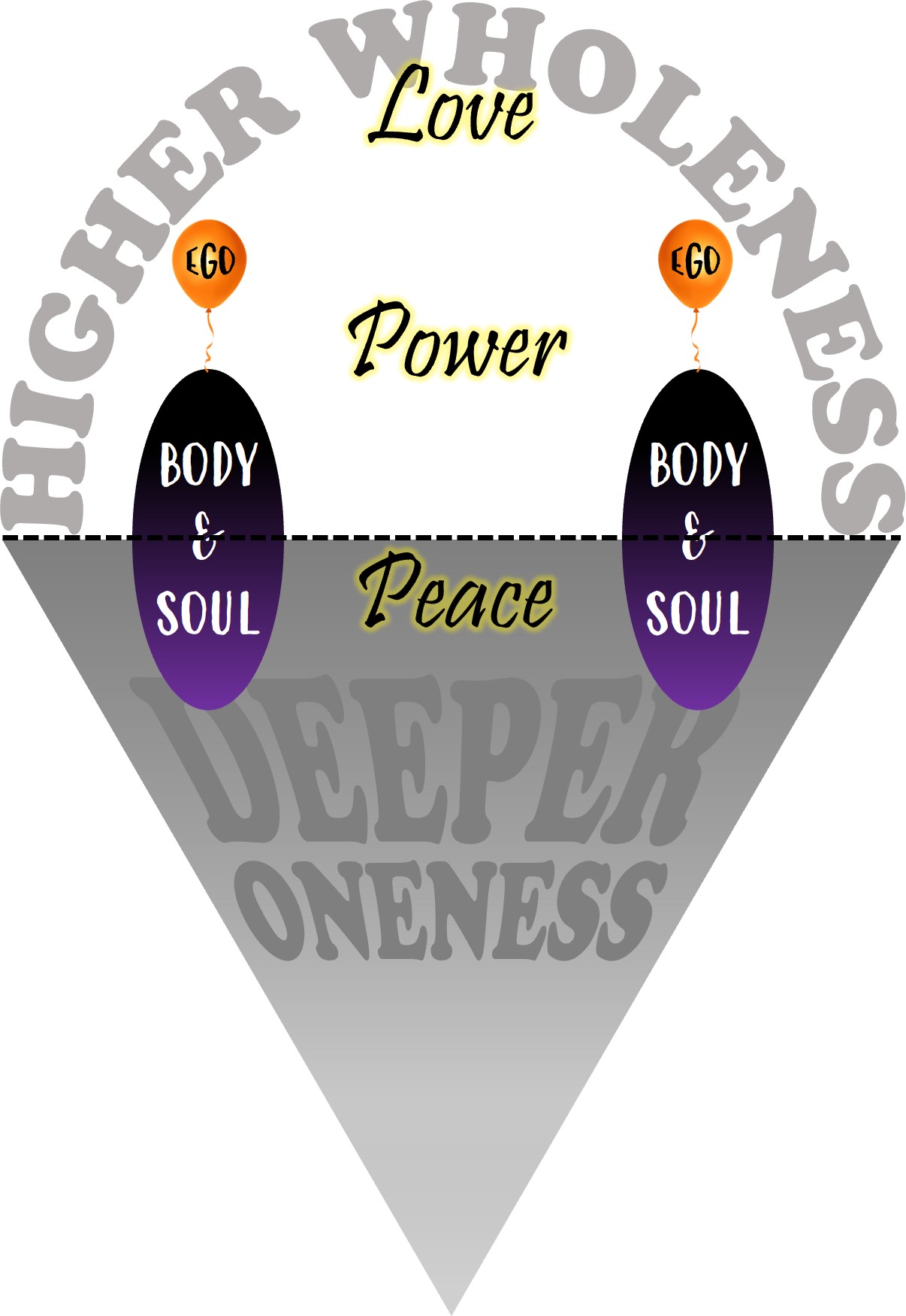
Once again, the principal difference in these competing concepts of love has to do with whether our perspective is centered in the (personal) ego or the (human) spirit. Our longing for perfect love is an aspiration of the human spirit, anchored by an intuition of essential oneness in the depths of Being itself. This deeper oneness is axiomatic in the spiritual wisdom tradition of Sophia Perennis.

All things originated and are presently rooted in this grounding mystery of Being. Which also means that everything is connected, not just externally by the logistics of cause and effect, but internally through the more subtle vibrational field of communion.

In fact, communion has been our experience from the beginning, far below and prior to self-conscious awareness.

With the rise into ego consciousness, this intuition of communion was lost – symbolized in the myths as a fall or exile from an original paradisal state. Rather than interpreting the tethered detachment of self-consciousness from the deeper animate consciousness of the body as a move in the wrong direction, however, we can appreciate it as the necessary precondition of just about everything uniquely and profoundly human.

Ego provides the position from whence conscious awareness can drop into inner peace, rise to higher purpose, probe for deeper meaning, and connect in perfect love.

Ego formation opens up the frontier of interpersonal relationships – which, it should be obvious, are not possible without egoic personalities – and it is here that the human spirit’s longing for perfect love can find fulfillment.

Perfect (complete, finished, and fully actualized) love is where the communion of deeper oneness is refracted though individual persons and across the divide of what makes one unique and different from another, transforming it into the distinct frequencies of compassion, kindness, generosity, goodwill, trust, fidelity and forgiveness.

Such a flourishing of perfect love remains only a spiritual longing if it happens that the egos on stage are neurotically insecure, codependently attached, and consequently incapable of transcending their individual fixations for the higher wholeness of genuine community. It’s here that we find all those counterfeit forms of love, so many lures on the hook of self-indulgence.

The spiritual mystery is this process whereby the deeper oneness of communion transforms into the higher wholeness of community, facilitated by the “conductor” of a stable, centered, balanced and self-transcending ego.

The perfect love of community is only possible to the degree we can get over ourselves.


Other Posts in This Series:

Our Longing for Deeper Meaning

The Path to Deeper Meaning

Like being, “meaning” (as we will be using it here) is a gerund word-form that got its start in reference to an action or process “carried on” (the literally definition of gerund). The -ing gives it away, in this case, and calls into question our usual habit of regarding meaning (as well as being) as a noun, a peculiar kind of object that we might catch in a net and tack to our pinboard.

If meaning is not an object, then what sense is there in searching for it? As if we might dig it up and drop it into our travel bag for a more meaningful life. “Man’s Search for Meaning” (V. Frankl) is a popular trope; everyone wants it and can’t seem to get enough.

The idea that meaning is something out there just waiting to be found likely has its roots in religion.

As god’s creation (so goes the myth), the whole cosmos appeared out of a divine intention and now stands before us as a work of art, imbued with meaning, as it were. For many religious believers, the universe is meaningful because god meant for it to exist. The created order is a product of god’s design and everything in it has a place, a purpose, and a meaning.

Meaning is out there and all around us; we just need to find it.

With the rise of science, this religious sensibility came under suspicion. Setting aside the tendency in theistic religion toward fanatical forms of devotion, its dogmatic insistence on the literal existence of god – arising historically as a self-defensive reaction to the methodological skepticism of science and the spread of a secular worldview – has had the effect of pushing underground the more essential concerns of faith, spirituality, and the nurturing of human aspirations.

Scientific skepticism (skeptos refers to what can be seen, touched, or at least measured) does not find meaning in the universe, certainly not as an inherent value added by a god whose existence is unsupported by the evidence or required in theory.

Inside and underneath consciousness are organic processes of the lifeforce; inside and underneath the lifeforce are electrochemical, elementary, and quantum forces – but no meaning.

It just doesn’t show up. For this reason, meaning is neither a substantial property nor a natural feature – certainly not a supernatural feature – of the universe.

In the last 150 years or so, Western philosophy and psychology have developed on the discovery that meaning, in the form of ideas, values, beliefs, ideologies, and worldviews, is a human construction. Known as constructivism, this theoretical approach now informs everything from advertising and marketing, to religion and politics, to intercultural learning and community organizing, to mental health therapy and social influencing.

The constructed nature of meaning shines new light on our human susceptibility to superstition, so-called “alternative facts,” brainwashing, conspiracy thinking, and truth distortions in the social media echo chamber.

If meaning is something we just “make up” (literally construct), and if god is no longer in the picture as supreme arbitrator of what’s true or false, then those with the largest networks and strongest amplifiers will decide what the masses believe.

For millenniums now, the spiritual wisdom tradition of Sophia Perennis has propounded on the insight that meaning is in our minds and not in Reality. The vast and enveloping system of worldviews, mythologies, knowledge and beliefs – including those mythological gods and even scientific knowledge – is a massive projection out of the human mind.

As compared to the present mystery of Reality, it is all an illusion; and to the degree we take it for Reality, a delusion.

The instant we put a name on something and give it a definition; tell a story or conceive a theory to explain it; grasp it with our mental concepts and file it away in the archives of knowledge – in that very first instant, our mind drapes the Mystery with a veil of meaning. Indeed, with each step we are adding more veils and more layers of meaning between our mind and Reality.

This can go on until the drapery of meaning becomes so dense and opaque, that the Light of The Real no longer gets through.

It is our ego’s need for security, identity, recognition and belonging that drives us farther behind these veils of meaning. The insecurity of standing apart from the body (psychologically speaking) and alone in the middle of Everything makes of meaning a comforting illusion. Having lost sight of The Real, we grow increasingly vulnerable to broken logic and gullible to baseless claims. Before long, we are so far into delusion that we’re ready to believe anything.

The human spirit cannot live in delusion, however, and it regards the illusion of meaning as something to be penetrated and swept aside in the interest of touching Reality.

Deeper meaning is not more meaning; indeed, more meaning only has the effect of further separating our mind from the present mystery of Reality. According to Sophia Perennis, we have a choice between more Reality or more meaning.

The seduction of meaning is obvious. On the other hand, a relentless pursuit of Reality leads to self-authenticity, personal honesty, social credibility, vocational clarity, and creative freedom.

Our longing for deeper meaning in life compels us to always look through meaning to the present mystery of Reality; and if our veils are blocking the Light, to take them down or push them aside for the sake of seeing and touching the really real for the first time once again.

Reality is ineffably perfect and perfectly meaningless – just as It is.


Other Posts in This Series:

Our Longing for Higher Purpose

The Path of Higher Purpose

With the breakthrough to ego consciousness, our human species entered the illusion of having a separate existence from the rest of Reality. Paradoxically, the transformation that pitched our self-conscious identity into exile also, and in the same moment, opened new frontiers of spiritual awareness and experience.

Whereas the historical religions have tended to dwell on the “fall” and “loss” associated with our exile, the spiritual wisdom tradition has been focused on exploring these frontiers for a fuller understanding of human potential, wellbeing, and fulfillment.

From the perspective of Sophia Perennis, the achievement of ego consciousness and an ego-based identity is not yet the high point in human evolution, but neither was it an existential tragedy as many religions claim.

A self-conscious personal identity (ego) is only the penultimate step or stage on the way to what we are intended to become.

If regarded as the ultimate step, the one completing our long story of human evolution, then it certainly is a type of tragedy. The consequent experiences of alienation, estrangement, loneliness, anxiety and depression cannot be the “higher purpose” of our existence.

But again, in contrast to much popular religious doctrine, our salvation – literally our healing and wholeness – will not come by either extinguishing or “saving” the ego, but rather by stepping through its illusion of a separate existence into harmony and communion with What Is.

In the language of Western psychology, we are here talking about the faculty of Will. Both human evolution and child development take a decisive turn – the “breakthrough” mentioned above – as an individual learns to restrain the animal impulses and primal instincts of the body, in the interest (or “for the purpose”) of adjusting behavior to the social landscape of tribal expectations and its moral frame.

By sublimating these “wild” (i.e., natural) impulses into a “domesticated” and well-mannered way of behaving, the Will facilitates a critical crossover of the threshold leading to a uniquely human experience.

The tribe directs this crossover/breakthrough by providing various roles that serve to define and shape how a social insider ought to behave. Over time, with consistent practice and discipline, consciousness becomes self-conscious as this or that social role: “I am” the role, the one who others expect to see, who has a place on the stage and a part to play.

The actor (ego) identifies with its persona (or personifies the role) and therewith becomes somebody special.

To make an important distinction, while the emergence of ego (self-) consciousness marks a shift from compulsive urgency in the body to moral intention on the performance stage of society, this is not yet the “higher purpose” contemplated in the spiritual wisdom tradition. With Nietzsche, we might say that moral intention (and morality generally) is still a captive of tribal values and its command structure of obedience.

Higher purpose involves a second-order liberation, a “transvaluation of values” by an intention toward creative authority, genuine community, and human fulfillment.

Through this lens, the vision and teachings of mystics and prophets the world over and throughout history can be seen as a single, transcendent ideal of the human spirit. It also helps us better understand the inevitable resistance and condemnation from the side of those tribal moralities and their imperative of obedience.

To wake up from the consensus trance, stepping through the veil of personal identity and into the higher wholeness of unitive consciousness – well, that can’t be tolerated on the performance stage where everyone is expected to stick to the script. This is why many of our spiritually brighter lights in history have so often suffered persecution and death at the hands of “righteous” true believers. The sentence is characteristically carried out “in god’s name.”

Having some sense of this human aspiration for higher purpose, the religions will typically personify it as “god’s plan for my life,” requiring a believer’s complete obedient submission. When it is “god’s will” that devotees behave and believe according to some orthodox prescription, it should be clear that we are still stuck in the role-play – however holy and righteous it happens to be.

Because the religions in modern times devolved into protected memberships of moral obedience, the human longing for higher purpose has gotten hamstrung and pinned down by something that ought to have been preparing it to fly.


Other Posts in This Series:

Our Longing for Inner Peace

The Path to Inner Peace

Wisdom tells us that “world peace” will only come about as each of us cultivates inner peace, a peace deep within ourselves, in the very ground of our being. To the degree we are not at peace within ourselves, we will be at odds and in conflict with others and the world around us. Like all other animals with nervous systems, humans perceive and react to what’s going on “out there” through the filter of how we are “in here.”

The inward path and spiritual aspiration for inner peace have been significantly distorted and misunderstood in religion’s slide down the slippery slope into metaphysics – or we should more accurately say, into metaphysical realism. Metaphysics generally refers to the study of essence (being) and the inner nature of Nature, Life, and Mind. Being, or be-ing (the power-to-be), manifests itself in each existing thing and throughout the manifold order of beings.

Metaphysical realism assumes, and often dogmatically claims, that this “ground of being” is something else, something other and apart from the realm of individual beings. Erase every being in existence and the ground of being would continue to exist. It’s an easy equation to make at this point, where this separately existing Ground is the god of religion who created all things in the Beginning, called together his elect and established the one true religion, and will rescue his devout believers to heaven in the End.

A danger in all mythologies of this sort lies in our susceptibility to become blind to their metaphorical depth and transparency and take them literally as referring to actual things, to real metaphysical entities: metaphysical realism.

When it speaks of the ground of being, or the grounding mystery within, Sophia Perennis stays true to experience and counsels the meditator to let consciousness descend past the zone of ego commentary, fantasy, and conviction. For it is only from ego’s position of separate identity that anything is regarded as something else and essentially other, which predisposes ego to regard the grounding mystery also as other, as some thing to think about, talk about, and keep at a distance.

The path to inner peace is an interior descent of the sentient life and animate consciousness of our body. It requires that we allow awareness to drop away from ego, from its managed identity and personal world at the surface.

Because the process is not about ego’s descent of the grounding mystery of being, but rather a release and surrender of all the attachments, personas, ambitions, beliefs, and thoughts that compress to form its self-conscious center of identity, the inward path to peace is “egolytic,” making progress by gradually dissolving the ego (the suffix -lysis means to loosen and disintegrate).

The human spirit is not an antagonist of the body. Metaphysical realism has promoted the familiar dualism of an immortal (pure) soul temporarily trapped inside a mortal (corrupt) body, but the spiritual wisdom traditions don’t agree. Beneath the separate center of who we are (ego and identity) is the grounding mystery of what we are: a human manifestation of being.

With each deeper stage in our descent of the Ground, the “container” of awareness doesn’t get smaller but instead expands to larger and larger (ad infinitum) horizons.

A supreme paradox of inner peace is that, as our human spirit descends by the inner path to the grounding mystery deep within, rather than retreating into an isolated solitude, consciousness opens out to a boundless presence where All is One.

Now the creative work toward world peace has a chance.


Other Posts in This Series:

Thresholds

In Higher Nature I explored the major stages of human development as they correlate to our experience of wellbeing and fulfillment over a lifetime.

Wellbeing is a more stage-specific value of how aligned our development is to where we ought to be at that point, while fulfillment measures our degree of self-actualization with respect to the Human Ideal, referring to the higher aim of our nature.

By way of a quick review, the major stages and developmental standards are as follows:

  • Infancy, early childhood, and the standard of animal faith
  • Late childhood, adolescence, and the standard of ego strength
  • Maturity, adulthood, and the standard of creative authority

Human fulfillment is a cumulative effect of these three stage-specific developmental standards building on each other over the course of a lifetime.

In tracking this upward growth in wellbeing toward fulfillment, I identified a deeper dimension called the ground, where animal faith is first established. At the upper end is a higher dimension called a world, the “house of meaning” suspended in a mythology of stories that we compose in exercising our creative authority.

Ground (or the grounding mystery) and world (or the quality world) are thus the deeper and higher dimensions that set the range for our developing personality. At its center is the ego, an executive faculty that serves the critical functions of managing self-control, personal freedom, and social responsibility. With the achievement of ego strength we are able to cooperate in and contribute to the conventional life of our tribe.

It’s important to understand that our ego is in large part a cultural construct, along with our personality and the various identities we are assigned to play on the performance stages of society. (Person and personality derive from the Latin persona, referring to the character mask of a theater actor – the identity that he or she inhabits and personifies on stage.)

Human wellbeing and fulfillment develop and evolve inside this uniquely human realm of experience: supported from within by the body’s animal faith, and sheltered inside a house of meaning made of stories – a world spun by our own creative authority.

Whereas we have appreciated the significance of faith for thousands of years, as evidenced by its central value in all religions, the discovery that humans make meaning by telling stories and creating worlds came much later, with the dawn of science.

Obviously we had been exercising our creative authority long before that, but only as a few skeptics (so called for their stubborn commitment to sense-based knowledge) started to realize that there is something outside and beyond our worlds, naming it the “real world” or Reality, did things really begin to shift.

Around the same time in history another class of explorers, called mystics for their introspective fascination with the inner mystery of consciousness and its ground, discovered a still deeper mystery below its threshold.

As these contemplative psychonauts descended the interior depths of consciousness – starting by detaching from the self-conscious center of identity (i.e., the ego) up on the stage and unwinding through the visceral rhythms of the body – they came to a dark edge beyond which awareness cannot “see.”

Some named it emptiness, nothingness, the Abyss: that which takes back what is given from the ground.

What we might call the curriculum of mystical spirituality cultivated the contemplative skills of letting go, dropping out, falling away, and coming to Nothing. The benefits of this regular practice for life back on the stage include a profound humility (from humus, ground), a more lighthearted engagement with life, greater resilience through hardship and loss, and a spirit of unconditional forgiveness for oneself and others.

The revolutionary discoveries of skeptics and mystics, subsequently developed into the complementary enterprises of science and spirituality, would come to present major challenges to conventional life in the “house” on its “ground.” And because religion, at least for most of its history, was the cultural institution that had stewardship of the house on its ground, these challenges came against it the hardest.

Many of the dysfunctions and deformations of contemporary religion have their origin in its resistance and aggressive refusal to validate the breakthroughs of science and spirituality.

Today’s religions still have little room or patience for skeptics and mystics.

Once Reality is exposed beyond our world – or in another way of saying it, as our world is parted like a veil on a “real world” devoid of meaning – the personal and social responsibility in our creative authority as storytellers is magnified a hundredfold.

At the very least it reminds us that the “truth” of our world, in the stories we tell and believe, can no longer be merely a matter of how much they mean to us and how they make us feel. With this newly discovered relativity of meaning – different worlds carry different meanings – truth now becomes a matter of how transparent or reality-oriented our words, stories, and worlds happen to be.

Beyond this postmodern and newfound commitment to truth-telling, our responsibility as world creators also challenges us to create worlds that are more hospitable, humane, and inclusive.

Instead of competing with each other over whose world is god’s word – or whose god is the true or only god – we can devote our creative authority to the communal work of making our world a place where those coming up and others coming in can know they are safe, loved, and belong.

Higher Nature

Where are you on the human journey? I’m not asking how far into the journey you happen to be or how close to the end you are in chronological terms. This isn’t a question of what you have experienced or how much of the world you have seen. The human journey refers to an evolutionary path whereon each of us is discovering or waking up to our higher nature as a human being.

So where are you?

Obviously, it is impossible to answer that question without some understanding of what our higher human nature is or might be. In this post I will offer just such a standard model which can be used to assess where we are individually, as well as where we are as a collective average across our species today.

My objective is not diagnostic but inspirational: As we get a better sense of where we are on this path to becoming fully human, we will have a clearer view of what is possible – of what still lies within us and ahead of us.

The basic ideas in my standard model are both borrowed and new.

  • From the philosophy of George Santayana I’ve taken the concept of animal faith, defined a bit differently but still essentially the same as in his thought.
  • From the mainstream of self psychology comes the notion of ego strength, a critical achievement in personality development and identity formation.
  • Finally, creative authority is largely my own term intended to summarize many of the virtues recognized worldwide and throughout history as the high marks of human awakening, liberation, and enlightenment – of coming into our “higher Self.”

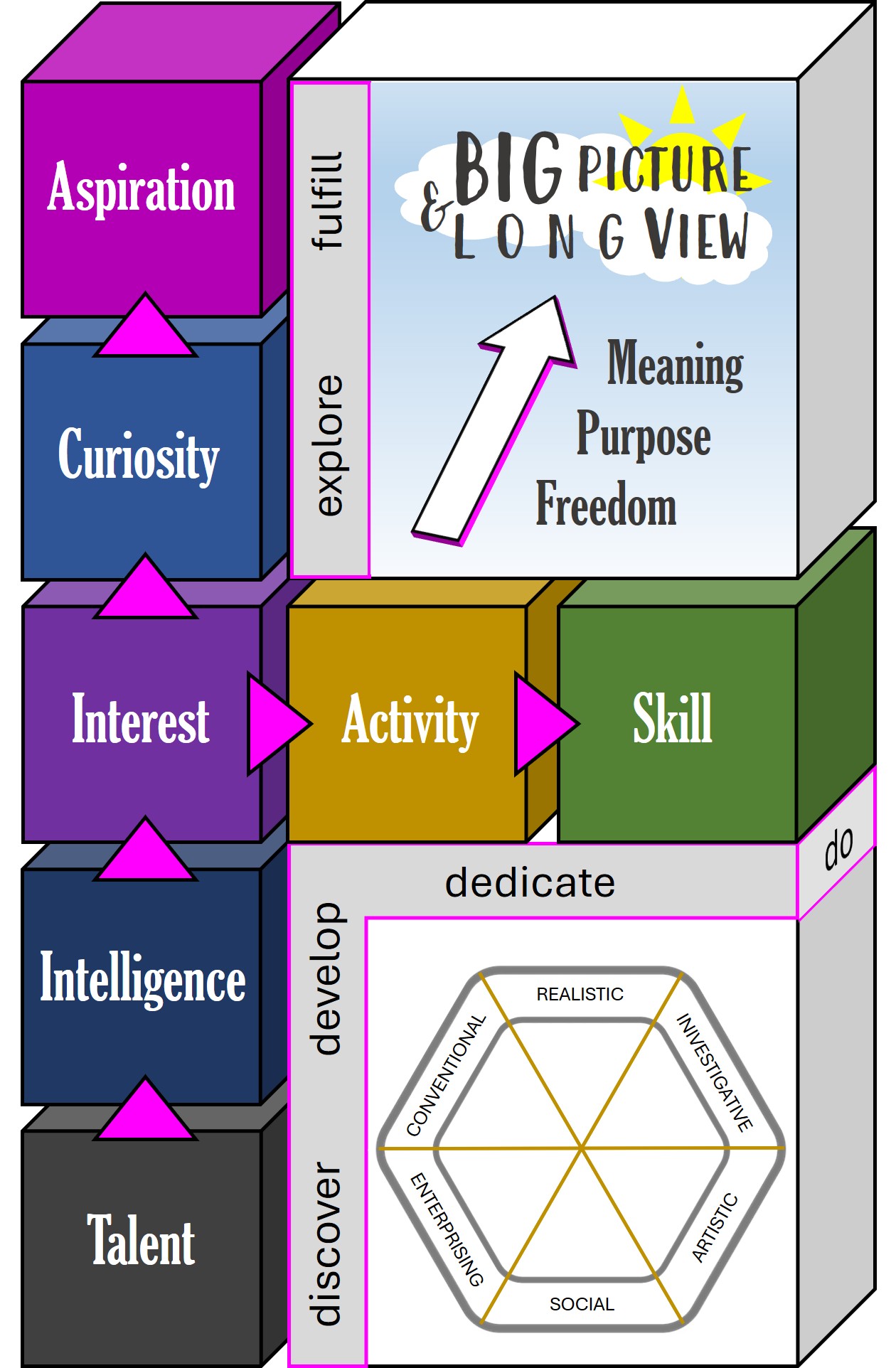
My model arranges these three concepts into developmental and evolutionary stages progressing sequentially through time, with each stage also serving in the spatial sense as a relatively stable location (or ‘platform’) at which human consciousness engages with reality and gains a new perspective on life.

Two more terms capture this nuanced distinction in the concept of stage. Fulfillment refers to the overall progress in development and evolution relative to what we might call the ‘epigenetic aim’ of human nature (the Human ideal). A second term, wellbeing, refers to the degree of self-actualization achieved at each stage of development.

It should be obvious that neither term is being confused with happiness, which is a more subjective and circumstance-dependent quality of experience.

As we explore the model, try to be as honest as you can in assessing where you are on the human journey – not just what stage you happen to be on (or transition between stages), but how you “measure up” to the standard of human wellbeing and fulfillment. Again, even though one’s degree of wellbeing and fulfillment have a direct impact on personal happiness, try to keep their distinction in mind as we go along so as to minimize the risk of reducing your progress on the human journey to how you may feel today.

Infancy, Early Childhood, and Animal Faith

Ideally a human infant is brought into the world by caretakers and providers who do their best in cuddling, nurturing, protecting, and responding competently to its basic needs. Even in unfavorable circumstances and conditions, responsible ‘taller powers’ can be highly effective at instilling in the newborn and young child a deep visceral sense that Reality is provident and benign (i.e., essentially good).

This inner release in basic trust (c.f., Erik Erikson) to the present mystery of Reality is what George Santayana called “animal faith”: a precognitive and unconscious (spontaneous) assurance that Reality is as it is perceived. Santayana’s concept, however, is more of an extroverted confidence (outward oriented, to the environment) than the introverted intuition (inward oriented, to the ground of being) that Erikson identified as so foundational to human development.

Erikson’s “basic trust” is what I mean by animal faith – “trust” being the etymological root of the widely misused term faith, and “basic” going deep into the nervous system and visceral network of our human animal biology.

Your default internal nervous state today, set somewhere on a continuum between serenity and anxiety, holds the “echo” of your earliest experiences of Reality as managed and mediated by your taller powers.

Animal faith, standing opposite on the continuum from anxiety (Erikson’s “basic distrust”), is the standard of wellbeing in the early months and years of childhood. If today you have a relaxation and meditation practice that helps you cultivate a deep sense of inner peace (serenity), the benefit of your intention is in strengthening animal faith. Dropping from your center of self-conscious experience (ego) and into the sentient-animate consciousness of the body is a principal objective of meditation practice.

Late Childhood, Adolescence, and Ego Strength

As your personality developed on the foundation of animal faith, a portion of consciousness was gradually siphoned, sequestered, and shaped into its own center of self-conscious experience called ego. Animal studies give strong evidence that consciousness of oneself as a separate individual is a product of socialization, and hence depends on the coordinated influence on development by the herd, troop, family, clan or tribe.

We’ve already acknowledged the profound impact of taller powers (caretakers and providers) on the depth and degree of animal faith in your physiology. As we would expect, the inner fortitude or fragility of your animal faith continued to have its effect on the degree of success in your development of a stable, centered, and reality-oriented ego (Latin for “I”).

Ego strength is actually the opposite of egoism – or we should better say that egoism demonstrates a deficiency in ego strength.

When animal faith is compromised and the default state of the nervous system is set more to the “anxiety” than the “serenity” side of the continuum, the ego picks up and incorporates this insecurity in habits of neurotic attachment, selfish ambition, and dogmatic belief (close-minded conviction) that serve as refuge, but also quickly become a prison.

A secure, centered, balanced, and well-adjusted personality is the standard of wellbeing in this “middle trimester” of the human journey. With a self-confident and socially responsible identity in place, you can respond appropriately to the challenges and opportunities that come your way.

Maturity, Adulthood, and Creative Authority

Being securely centered in yourself (by virtue of ego strength) enables a positive and productive degree of freedom in living your life. An important aspect of this freedom is not having to cling to others for safety (attachment), chase after the promise of happiness (ambition), or close your mind inside fixed beliefs (conviction). On the positive side, your higher freedom opens the channel of creative authority whereby you can take responsibility for the world you live in.

“World” here is not a synonym for Reality or what is sometimes called the real world. In this context, your world is the construct of assumptions, beliefs, agreements, values, habits and expectations that conspire to shape your view on Reality.

Because a world construct is a collection of stories – in the technical sense, a mythology – that hangs like a grand tapestry between the mind and Reality, waking up to your creative authority is tantamount to coming to the realization that your world, as well as your identity in that world, is to a great extent, if not entirely, your creation.

You are its author, which means that you and you alone have the power to change the story and thereby change your world.


Where are you on your human journey?

If animal faith was compromised early on and subsequently complicated the successful achievement of ego strength, you likely find the prospect of creative authority a bit intimidating – maybe overwhelming.

The good news is that there are things you can do (and things you should stop doing!) to cultivate faith, strengthen your center, and exercise your authorial rights in creating a New Story.

Feel free to start any time.

“Me, Myself, and I”

We live in an “age of identity.” We’ve been in it for a while now, beginning way back before historical records even. In other words, it’s not just a “modern” thing. The Age of Identity began with the breakthrough to a self-conscious experience, when the last hominids poked their heads above the threshold of a body-bound consciousness, blinked their eyes and realized they were naked, therewith becoming the first humans.

Our species is pretty much obsessed with personal identity: turning over (and over) the question, “Who am I?”

At the core of this obsession is ego – the self-conscious “I” that sits above the body and apart from everything else, a what seeking its who. Ego’s emancipation from a purely sentient-instinctual life is facilitated by a tribe of “whos” that collaborate in shaping this naked newcomer into “one of us,” a properly well-behaved member of civil society.

By a combination of blocking, coaxing, training, modeling and instruction, a proto-person is gradually transformed into a full person. Our word ‘person’ comes from the Greek prósōpa and Latin persōna, referring to the character masks that actors wore in playing roles on the performance stage. “Speaking through” the mask, a performer personifies a character from myth, legend, history, current events or pure fiction, bringing it to life, as it were, across the changing theatrical scenes.

In the context of a play, an actor is pretending to be (“playing”) the character.

A persona is merely the role that ego (the actor) puts on in the interest of stepping into and joining a role-play. A major difference, however, between the stage actor and an ego in everyday life is that, whereas the stage actor takes off the mask and steps out of the role when the performance is over, an ego that has been fully personated by the tribe is now completely under the spell of identity and honestly believes “I am” what it has been pretending to be.

The attraction and instrumental value of a persona lies in its function as a point of entry, a placeholder, a mode of status and reciprocity in the interpersonal realm of social relationships. It confers on the performer a certain degree of recognition, acceptance, approval and respect – what we might call the social benefits of personal identity.

An otherwise naked and exposed self-conscious ego is now clothed, connected, and identified as somebody special.

Lest we make the mistake of attributing identity to the ego itself, it’s critically important to see that on its own and all by itself, ego is nothing more than naked self-conscious awareness. Identity is found and curated through personas and the characters they equip ego to play on the social performance stage. Without personas and off stage, “I” (ego) am, quite literally, nobody but an actor looking for work in a role-play that will define who “I” am.

An interview with the actor will reveal that ego does indeed have some sense of itself off stage, but this happens to be more of a shadow than a legitimate identity. When it reflects and dares to contemplate this subjective side of “myself,” what is hiding or concealed there are aspects of the embodied personality that didn’t get invited to the stage, were cautioned against showing up in the early years, or were systematically repressed for violating the tribe’s moral frame.

Just as the persona of identity is the “me” ego wants others to see, its shadow collects the parts of “myself” that “I” had to throw behind the closet door and effectively disown in order to fit in, find acceptance, and be somebody special in the eyes of others.

The shadow, with its forbidden, disowned, and forgotten “light,” shows up in mythology under the guise of the Adversary (“Satan”) and the Light-bearer (“Lucifer”), characters who work in opposition to (the ego’s) god or as god’s “left hand.”

Psychosomatically the shadow hides in symptoms of autoimmunity, neurasthenia (the “nervous exhaustion” of bipolar anxiety-depression), and borderline personality disorders that swamp and threaten to reclaim the ego from below. Psychosocially the shadow gets projected onto others (individuals and groups) who are consequently judged and persecuted (or dutifully avoided) as dangerous, “bestial,” and evil.

In proportion to the degree that social approval necessitates self-denial, the shadow of identity grows that much darker and formidable. Ego’s “myself” is despised and debased. leading to a point where some combination of introjected shame and outward-projected hostility becomes the word and will of god. From then on the game is locked. Salvation is redefined from a process of being healed and made whole, to a final escape from the body and this sinful world.

It should be obvious that our meditation so far has been concerned with the so-called ‘conventional’ world, where the emergence of a self-conscious experience and the shaping of personal identity on the social stage have conditioned just about everything a person fears, cares about, and pursues in life.

Conventions are the common codes, mutual agreements, shared beliefs, and collective habits that define a world. A self-conscious personal identity, playing out to the stage through personas and pushing into the shadow whatever doesn’t fit the moral frame, knows only this world – but not Reality (aka ‘the real world’).

In the meantime, our deeper human needs for communion and grounding, along with our higher needs for connection and belonging, are neglected.

More accurately, these deeper and higher human needs are intentionally ignored, since fulfilling them would require waking up from the spell and parting the veil on this social illusion of personal identity and its conventional world. Which is why ego’s religion and its god work so diligently to preserve the trance and keep everything (read: everyone) in its place.

This is where wisdom spirituality, by its descending-mystical and ascending-ethical paths, threatens the world order.

Wisdom calls on the self-conscious ego to drop (metaphorically “to die”) into the deeper oneness of being-itself (communion and grounding), and to transcend (“go beyond”) the conventional ‘good and evil’ of tribal morality for the higher wholeness of genuine community, with its inclusive ethic of compassion, fellowship, generosity and goodwill (connection and belonging).

The guilty conscience which had been effective in keeping ego in its proper place is now willingly, passionately, exchanged for conscientious guilt over breaking the moral code wherever it happens to be oppressing the Human Spirit and keeping anyone from the fully awakened and liberated life.

Set the Tiger Free

The Human Spirit in us needs freedom, and what it seeks or aspires to is inner peace, perfect love, higher purpose, and deeper meaning. Think of the Human Spirit as a wildly creative force of genius that empowers our awakening, liberation, and fulfillment as a human being – to become fully human and fully alive.

For a tragic majority of us, the Human Spirit is like a beautiful and powerful wild tiger locked inside a cage. Without freedom, it cannot be creative. All it can do is pace inside its cage, back and forth and around in circles, drained of its fierce energy and now only a vestige of its essential nature: frustrated, exhausted, and depressed.

The true longing of the Human Spirit is for a life of inner peace, perfect love, higher purpose and deeper meaning – not to languish here in this hell.

Those four aspirations – for peace, love, purpose and meaning – are aligned with the four types of intelligence, or threads of consciousness, in a human being; what I name our quadratic intelligence.

  • Our spiritual intelligence (SQ) is centered in the Soul and seeks or aspires to inner peace.
  • Our emotional intelligence (EQ) is centered in the Heart and seeks or aspires to perfect love.
  • Our volitional intelligence (VQ) is centered in the Will and seeks or aspires to higher purpose.
  • Our rational intelligence (RQ) is centered in the Mind and seeks or aspires to deeper meaning.

This braid of threads is unique to humans, as far as we know, and each thread in the braid is integral to human consciousness. These don’t operate on their own but rather form a complementary system, with each thread of consciousness and center of intelligence contributing its own frequency to the whole.

The generator at the core of this system, energizing the distinct pathways of its complex circuit, is the Human Spirit.

In this blog, I have been developing the framework of a New Humanism – not one that regards “Man as the measure of all things,” that chooses secular values over sacred ones, or argues for our need to break from religion and be done with mythology. Instead, it honors the human being as storyteller, meaning-maker, and world creator, who is (all of us) on the journey to becoming fully human and fully alive.

Categories of the supernatural, metaphysical, esoteric, and otherworldly are used very sparingly, if at all, so as to avoid their unnecessary distraction from the proper focus of our meditation. Even god can be a distraction if we take it literally and start looking for it (or deny its existence) in the objective world.

The New Humanism is not atheistic but post-theistic, concerned with the evolutionary project of human progress, awakening, liberation, and fulfillment.

What we are naming the Human Spirit, then, is nothing more – and certainly not less – than the lifeforce and adventure of consciousness in ourselves as human manifestations of Being.

Every living thing arrives, develops, matures and actualizes its nature along a trajectory with an aim toward what the organism is intended to be – what we might call its species ideal. Humans have an evolutionary inner aim as well, what the philosopher Aristotle called an entelechy.

Early life events, the provident or less favorable conditions of its environment, along with genetic vulnerabilities and the accidents of dysfunction, disease, and random casualty, can foreshorten an organism’s normal lifespan and thereby interfere with its fulfillment.

For human beings, the provident or less favorable conditions of our early environment are especially critical in determining whether and to what extent the Human Spirit in us can flow to the intelligence centers of Soul, Heart, Will and Mind.

When the Human Spirit is locked in a cage, our aspirations for inner peace, perfect love, higher purpose, and deeper meaning are frustrated, resulting in the exhaustion and depression that are so prevalent today. The lifeforce and creative energy that would otherwise activate and empower our progress toward fulfillment, is instead trapped inside a psychic structure built by our ego for its domestication.

Paradoxically ego’s refuge is Spirit’s prison, and it soon becomes our personal hell.

Here’s how we do it.

Each of the four walls of our cage is made of neuropsychic “material” that fuses with the other walls to make an enclosure where we feel safe, loved, capable and worthy – the four subjective (or feeling-) needs of ego. The very process of ego formation entails a siphoning and sequestering of the Human Spirit into a separate self-conscious personal identity, a separation that brings with it a certain inevitable degree of insecurity.

It’s the depth and severity of this inevitable insecurity that determines how rigid and small our cage needs to be. To the insecure ego, a smaller space feels safer.

Already in our infancy, we begin attaching ourselves to objects, people, and specific conditions that can help calm our anxiety and connect us, in their own ways, to a Reality from which our own emerging ego is in the process of separating us. The reflex reaction of our insecurity, then, is to form attachments, each charged with the inarticulate expectation that it should make us feel safe and more secure.

The Human Spirit is blocked (i.e., locked in a cage) by our attachments, preventing its creative freedom from activating our Heart’s aspiration for perfect love.

To the insecure ego, attachment is love; the wisdom teachings, however, are very direct in calling out this equation as delusional. Notwithstanding their available counsel, we eventually discover from our own experience that neurotic attachment leads to codependency, entanglement, and the terminal foreclosure of healthy relationships.

Neurotic attachment is compelled by two opposing drives: a desire to feel safe, loved, capable and worthy; and a fear that our demand won’t be met, that it won’t work out or be enough, or that the goal of our pursuit will elude us. This dual-drive of desire and fear is the inner dynamic of ambition (ambi = two or both), and its spiritually damaging effect is illustrated in our metaphor of the tiger (the Human Spirit) pacing in circles inside its cage.

These pacing circles, however, are really a psychodynamic spiral where the fear drive in ambition injects increasing degrees of desperation into the desire drive, making our efforts more frantic and our expectations even more unrealistic. Exhaustion and depression are the predictable outcome of turning compulsively, and hopelessly, in circles.

This downward, drain-circling dynamic in ambition is the antithesis of higher purpose, which is the true aspiration of our Will.

One more wall and the tiger cage is complete. As the spiral of ambition tightens and our attachments consistently let us down, the unresolved insecurity deep in our body and soul forces the Mind to form convictions (symbolized in the diagram by a block or box) that keep us from having to face Reality.

As the word implies, conviction makes the Mind a “convict” to its own beliefs, which we defend as absolute truths beyond question, doubt, or debate. This becomes the final – and for the Human Spirit, fatal – factor in separating our anxious ego from Reality.

Here, with us nervously clutching our attachments, chasing down the drain of ambition, and our convictions walling-out the Present Mystery of Reality, ego finds meager relief and a momentary refuge – but not for long.

In the meantime, the Human Spirit paces and turns inside this cage we’ve made, waiting for us to wake up from our delusion.

Hopefully, it won’t be much longer.

Post-theism and the River of Fire

In the nineteenth century a German philosopher and proto-psychologist named Ludwig Feuerbach argued that theology, or god-talk (theo+logos), is really a projection outward and upward of our higher human nature. We spontaneously imagine our own dormant virtues as existing separate from us in the deity, and then we aspire to be like god, which gradually “awakens” these virtues in ourselves.

Advocates of atheism believe they find a prophet in Feuerbach (whose name means “river of fire”) taking him to mean that god is nothing more than a construct of the human imagination projected above the world to compensate for our human insecurity, ignorance, weakness, and mortality.

In point of fact, the idea that we create god in our image had been around since the time of Xenophanes the Greek (6th century BCE), who asserted that if horses could draw they would draw god as a horse.

However, neither Xenophanes nor Feuerbach was rejecting the ultimate reality of God, a Supreme Principle or Present Mystery “in which,” as professed by the 6th-5th century BCE philosopher-poet Epimenides of Crete and later quoted by the Christian apostle Paul in the 1st century CE (Acts 17:28), “we live and move and have our being.”

If we could agree to consistently distinguish this Supreme Principle and Present Mystery of Reality from the rich variety of ways we humans represent it to ourselves in myth, art, and theology – of God beyond our gods – the long and tiresome debate between theists and atheists could finally be transcended and left behind for a more constructive dialogue.

Our gods are indeed figments of the imagination, but the Mystery they are conjured to figure-forth is not separate and apart from us.

This isn’t to say that we are gods, only that our gods belong to us. As we are willing to take ownership and responsibility for our creations, a god stands the chance of fulfilling its design aim in the imaginarium of human spirituality. This design aim is what intrigued Feuerbach, but he realized that in order to engage in such critical reflection, our gods would first need to be liberated from their presumably objective, and necessarily delimited, existence.

The importance of Feuerbach to our understanding of post-theism cannot be overstated. Again, his case wasn’t against theism (or Christianity, his home religion) but was rather one for moving beyond the misguided debate over god’s existence and toward a fuller understanding of the role that god plays in the longer spiritual evolution of our species.

If post-theism can be said to have a preoccupation, it is with this understanding and the liberated life it makes possible. Feuerbach believed this was, and is, the “essence of Christianity.”

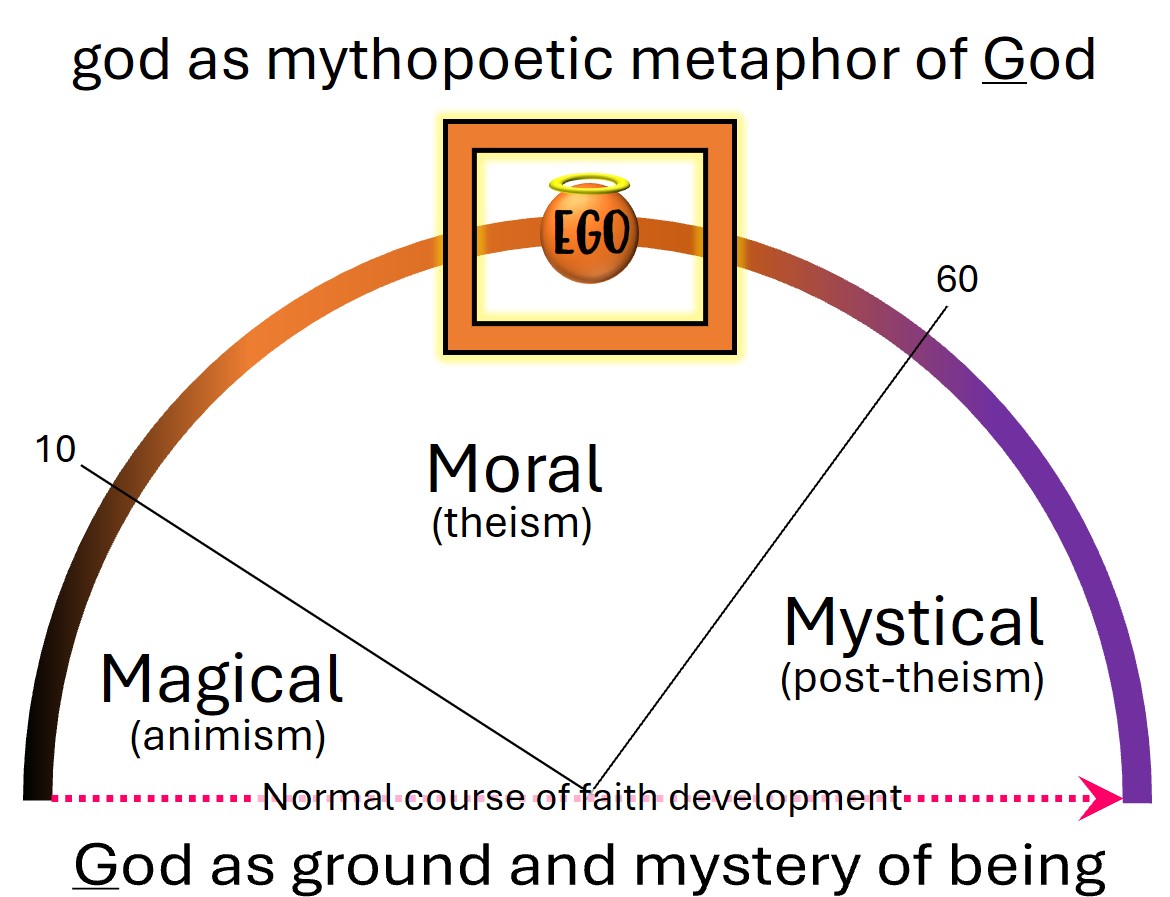
My diagram provides a frame for critical reflection on god’s meaning and purpose, of the relation of our theological constructs to ultimate reality, as well as the role they play in human fulfillment – of our becoming fully human. In organic fashion, we will begin at the bottom, in the Ground that is ultimate reality, manifesting in, as, and throughout all things, particularly right here, in and as a human being: a human manifestation of Being.

The Ground is both generative source and foundational support, coming up from deep within and establishing itself on ascending stages of a material, vital, sentient, and self-conscious human existence. (Indeed a self-conscious, or egoic, existence is unique to humans as far as we can tell.)

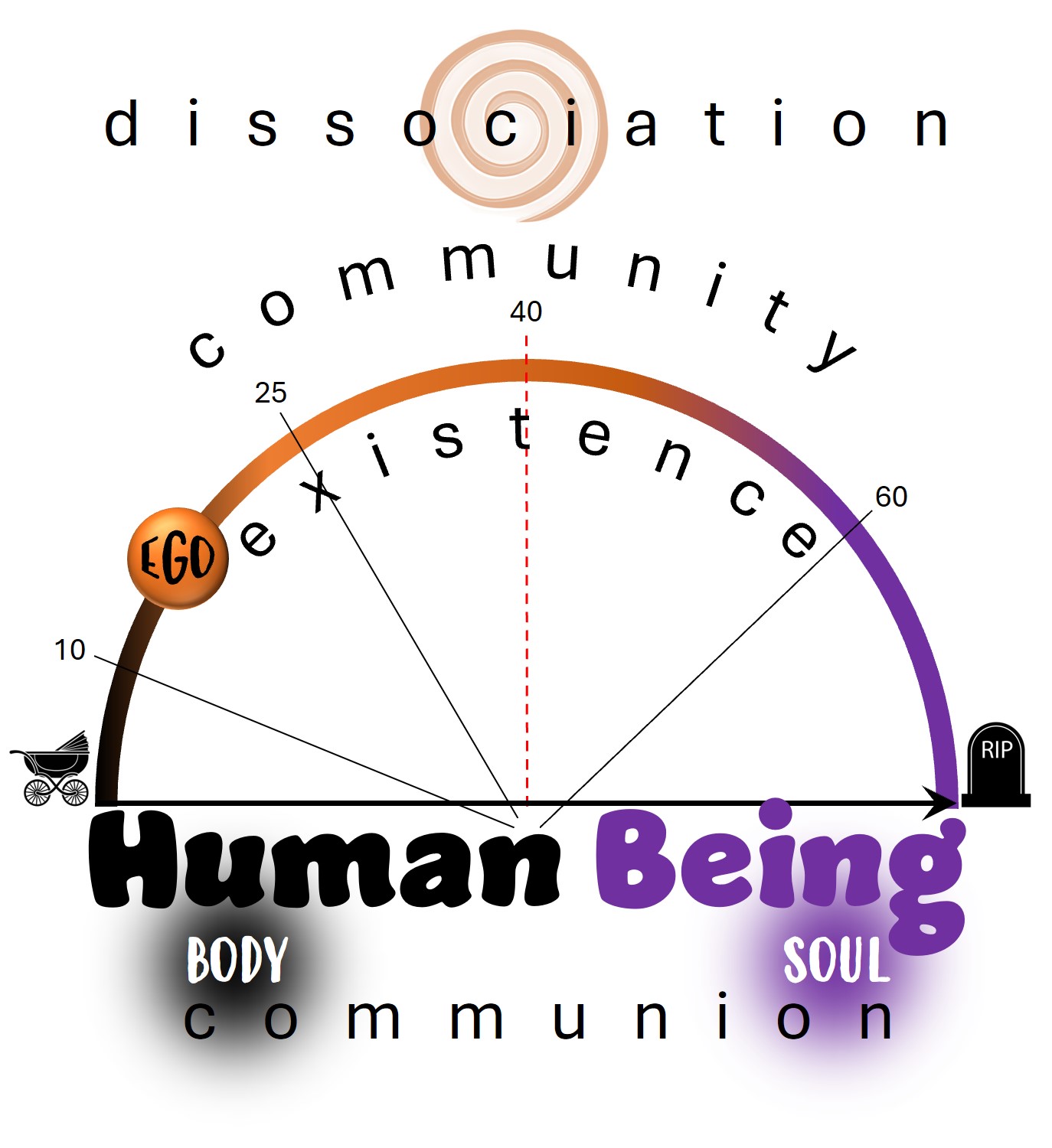
The “human” aspect of our human being looks outward through the body and into the sensory-physical realm; the “being” aspect of our human being looks inward through the soul, into the intuitive-mystical realm.

In my diagram I have positioned body and soul just above or below the threshold of existence (a dashed horizontal line) to indicate their distinct outward and inward orientations of consciousness.

The center of our individual self-conscious identity is named ego (Latin for “I”), pictured as rising from the body and into its own separate position apart from both body and soul. This is the state of separation, hamartia (sin) or dukkha, that the higher religions diagnose as our “human condition.”

From the perspective of modern developmental psychology we understand this as the process by which the young child gradually gains mastery through self-restraint (e.g., toilet training and later holding their temper), increasingly sophisticated motor skills, moral obedience and social cooperation.

The “price” for this progress in personal identity is a growing sense of separation, exposure, and insecurity – the familiar fall from paradise and loss of communion that we find in world mythology.

According to Feuerbach and post-theism, this is where god, as a construct of the mythopoetic imagination, is “encountered” – and we should say it this way because the mythopoetic process and its product confront the mind, as it were, from below the boundary of directed attention.

In the myths again, we find all sorts of deities: a “god of” this or that, gods that first inhabit and then supervise the diverse domains of human concern: nature, city, government, morality, ancestry, home, and personal life.

These are only roles, however, which serve to mediate the dormant and developing virtues of human personality through the masks of god. Their higher purpose, as it relates to human spiritual evolution, is to attract, inspire, awaken, and empower these same virtues in the religious devotee.

In exalting and glorifying god in worship, which is the central obligation of theism, a devotee makes these virtues of god the focal aspirations of his or her life.

Personified in the god, the higher virtues of spiritual life are exemplified in ways (e.g., the words, deeds, and character of the deity as depicted in myth and liturgy) that call on the devotee’s obedience and imitation.

Not a god, but God beyond god. Not a god who loves, perhaps selectively and conditionally, but the power of Love embodied (however imperfectly) in the god and shining through, inspiring and empowering an awakened commitment in the devotee to an ever more loving way of life.

This power to attract and inspire the devotee’s commitment to the imitation of god is the “aspirational logic” that leads to a more awakened and liberated life.

My diagram identifies a cluster of virtues that are more or less universally personified by the god(s) of theism, and which interestingly, though perhaps not surprisingly, grow more clear and distinct as religion has advanced into its high, late, and post-theistic stages.

In addition to the virtue of love, the gods are generous (i.e., they personify the virtue of generosity), wise (they personify the virtue of wisdom), capable (they personify the virtue of power), and creative (they personify the capacity to create).

All together, these five virtues of god offer a complete portrait of the realized potential in a human being. As a devotee’s relationship to god progresses from obedience, through worship, and finally to aspiration, the virtues personified in the deity are gradually awakened and fulfilled in the aspirant, who is now free to live the virtuous life on the other side of god.

Ultimately we step into our creative authority to make meaning and change the world, or to make new worlds that are bigger and brighter for those coming up behind us.

The Mythology of You

There’s a part of you that really wants to be somebody special. Admit it. We all do – at least all of us did for a good part of our life. It’s the Hero Journey that figures so prominently in world mythology, which Joseph Campbell interpreted brilliantly in his seminal work The Hero With a Thousand Faces.

Realizing that the Hero is not just some heroic figure of myth or history but a personified metaphor of what in each of us is on the adventure of becoming somebody special, and then eventually getting over ourselves, helps “crack the code” of mythic meaning and human fulfillment.

But here’s the thing: We have to see ourselves in the Hero and understand that the Hero is really us, or more precisely, what in each of us is on the Journey to a fully awakened and liberated life.

It seems fitting, then, to title this post The Mythology of You.

To help orient us in the Hero Journey, I offer the illustration above. At its base is your essential nature as a human being; not who you are quite yet, but what you are: a human manifestation of being. You are a member of a highly evolved animal species informally named human – etymologically “upon, or from, the ground” (i.e., not indigenous to the sky or sea but to dry land).

Some early myths trace human origins to this ground (humus), which in the Beginning a god clutched and fashioned into our first ancestor, Adam (“from the earth”).

Relative to the separate center of self-conscious personal identity (ego) – which, since we are tracing the course of your journey through time beginning at birth, is not yet in our picture – your essential nature as a human being is the ground (or grounding mystery) that supports your Hero adventure from underneath.

This communion of body-and-soul is the essential mystery that ego breaks from, immediately forgets but remembers nostalgically while off on its adventure, and longs to return home to at Journey’s end.

We need to take another moment here and clarify that, as a human manifestation of being, your body is the extroverted counterpart of an introverted soul; the one outwardly engaged in the web of life, and the other inwardly reposed in being. Being here is not another word for an entity, object, or thing, but refers instead to the generative power-to-be (be-ing) that is presently manifesting as human, tree, bird, star (and so on), across the vast universe.

The circuit of your Hero Journey takes its departure from the body, undergoes its adventure of becoming somebody special (the ordeal of trials and temptations that Campbell expertly lays out), and eventually returns home, but now with the boons of an awakened and liberated life.

While myth provides the pattern of a full-circle successful Hero Journey, however, your (and my) destiny is not so certain.

In this post we will identify a few of the common complications that keep the Hero from completing the entire Journey.

The circuit of the Hero Journey (back to my diagram) is traced by a circular arrow divided into three segments, with each segment color-coded according to the primary energy driving it. A black arc drives outward from the body and into the early formation of a self-conscious personal identity (ego). At this stage, the principal work of socialization was in training you to develop self-conscious restraint over some very natural urges, impulses, and reflex responses to your environment.

Clamping an urge long enough to get to the toilet, waiting your turn by standing in line, curbing the impulse to retaliate against another’s offense, and (at a higher, more sophisticated level) adjusting your behavior into compliance with the social expectations around an assigned role – all are examples of the same principle of self-restraint. The objective is to pull back and redirect, or in some cases push down (suppress), the natural inclinations of the body in the interest of constructing a well-adjusted personal identity.

The primary motivation for submitting to all this social discipline is to fit in: to be accepted, to be loved (however conditional that love might be on your obedient behavior), and to belong.

Your apex concern on this Hero Journey is ultimately to stand out and be recognized as somebody special. You should be able to feel a tension between these two motivational needs of fitting in (belonging) and standing out (recognition): it is one of the profound complications that every Hero must negotiate.

Fit in too much and you dissolve into anonymity; stand out too far and you risk alienation. Becoming somebody special must somehow balance these two competing, yet creatively complementary, drives.

For some, the early home environment was not a safe or loving place, making them chronically anxious and insecure. Nevertheless, still being vulnerable and dependent as infants and young children, their persistent need for safety and love compelled a neurotic attachment to their taller powers, which in turn complicated (or completely undermined) the formation of a centered personal identity.

A desperate drive to fit in overpowered the complementary but opposite drive to stand out, trapping them in chronic anxiety, fear, and self-doubt.

Standing out is about getting recognized for who you are, what you can do, and for your value to the tribe or team, company or organization to which you belong. Developing and using your talents for the good of the group goes a long way in ensuring your place in the social order.

The developmental achievement of what’s known as “ego strength” carries your inner sense of security into a self-confident expression of personal power, creative authority, responsible risk-taking, and productive fulfillment.

On the other hand, chronic social anxiety and a nagging self-doubt might drive the Hero to so over-identify with a role that their entire supply of self-esteem is expected from there, generating further frustration and anxiety over not being good enough or better than someone else. The challenge now is to prove their worth by being perfect or the best at what they do. Until then, nothing counts. Instead of positive recognition, they feel in constant danger of exposure, of getting called out for not being good enough.

Farther on your Journey, and having played many roles along the way, you reach a point – a threshold in human transformation – where the drive to be somebody special loses urgency and you understand how much of your life so far has been about playing roles, managing a personal identity, and living up to the demands and expectations of others.

These ‘others’ may be living or dead, nearby or far away, real or imaginary, up in heaven or in the grave – it doesn’t really matter. The voices inside you (the inner parent, inner coach, inner critic, inner demon, or inner god) always had something to say, but now they’re not as loud or don’t seem to matter as much as before.

Crossing this threshold of transformation is a fairly rare event, actually, due to a combined effect of your tribe’s success in convincing you that you are the role, the suit, the mask – the somebody special on the performance stage you’ve worried over and worked so hard to become; that along with your own insecure attachment to their acceptance, validation, and approval.

But you have made it here and are now ready to take that decisive step across the threshold.

This is the invitation for the Hero to let go, just as we might imagine a butterfly responding to the call of Nature to leave its cocoon and take wing. For our Hero, the critical move is to drop all attachments to personal identity (contracts, roles, suits and masks) and allow consciousness to return home to the grounding mystery of body-and-soul.

The difference now, however – and the true inner aim of the Hero Journey itself – is that you are a fully awakened and liberated butterfly, no longer the sleepy caterpillar that curled up inside its cocoon of personal identity way back when.

You became somebody special so that you can now get over yourself. Welcome home!