Fate and Destiny

Some people argue that the human condition is determined by factors deep in our DNA, in mechanisms of survival, adaptation, and extinction embedded in the genetic code of our species. These biological determinists call us back from getting caught up in fantasies of human transformation and thinking we can break free from the bonds of Fate.

Those who say that temperament is Fate – temperament referring to the genetic inheritance of human biology – have neighbors across the halls of academia who add the co-determining factor of environment to the picture. They point out that genes are switched “on” or “off” in response to external conditions and events.

The temperament of individuals caught in chronically unsafe, inhospitable, or hostile circumstances will adapt by becoming more anxious, reactive, and vigilant. Genes and their host organisms don’t survive in a vacuum, but are constantly reading and reacting to their environments.

These neighboring theories are actually siblings in natural science, of the empirical approach to knowledge that resolves only to work with the reality outside our minds. Concepts, hypotheses, explanations, and prophecies – all constructions of mind – must either be drawn inductively from experimental observations or get down to the facts as quickly as possible to prevent drifting away into creative (i.e., idle) speculation.

Together, temperament and environment can be seen as the internal and external dimensions, respectively, of human Fate.

Using that term doesn’t mean that the factors on either side cannot be altered somewhat through various interventions. We’ve known we can alter the external environment for thousands of years now; culture itself is both the product and fallout. And very recently we have discovered how, if not yet to what extent, we can change the genetic instructions in our DNA and possibly reengineer human biology itself.

What most scientific accounts leave out of the picture are the very things that make the human adventure so interesting: our subjective experience as persons, our individually unique perspectives on reality, our universal need for security, belonging, orientation and significance, and the sense each of us has of a Mystery at the center of Everything – however dim and nearly forgotten.

Such interests and concerns were historically the province of spirituality, nurtured under the supportive guidance of religion for thousands of years.

The diagram above shows the axis of scientific dimensions, internal temperament and external environment, intersected by a second axis with its poles in things that don’t lend themselves to objective examination. An image of a bow-and-arrow suggests that the real dynamic of human transformation is to be found here.

Having identified the first axis with Fate, with factors that seem largely outside our control, I will associate this second axis of the bow-and-arrow dynamic with what in earlier ages was known as Destiny. This is more than just where things are “destined” to end up, which once again is what we typically mean by Fate.

Destiny has always had a more optimistic and hopeful ring to it than Fate.

If Fate is the way things are, Destiny is how things might go if they were to somehow transcend, break away, or be released – like an arrow from its bowstring – from the constraints of Fate.

Humans are the species of Destiny, one among many with the unique capacity of intelligence to look beyond the limitations of temperament and environment and imagine what isn’t here now, maybe never was, but one day might be.

This visionary talent has enabled us to create maps of optional futures, inventing the various genres of earthly utopias and apocalyptic dystopias, heavenly paradises and torture-chamber hells, solar explosions and cosmic winters, or just the winding-down of our own retirement, old age, and inevitable death – which can sound again more like the knell of Fate than the ring of Destiny.

The spiritual wisdom traditions used to be our imaginarium for contemplating these optional futures and a higher purpose of human existence. Their mythologies and guiding metaphors offered lenses into hidden dimensions, not in Reality so much as of our own mind, that placed us in contexts where our life, choices, and actions matter on some larger scale.

By spreading before us possible futures of apotheosis or apocalypse, fulfillment or collapse, salvation or catastrophe, an escape from time by a series of escalating cycles through progressive lifetimes or by a sudden “blink of an eye,” spirituality, through its mediator and mouthpiece of religion, enabled us to take in a bigger picture and longer view of life.

Historically the disciplines of morality, art, and philosophy (the “love of wisdom”) were first conceived in the fertile womb of religion.

Today, despite the fact that many religions have lost their roots to the mythopoetic imagination and are defending their myths as so much supernatural journalism (e.g., the biblical literalism in Christianity), humans are still possessed of this longing to see through the narrow channel of Fate, between their environmental conditions and temperamental dispositions, into a vision of how their beliefs, values, choices, and commitments – in short, their creative authority – are together the determining factor in human Destiny.

Let’s take a closer look at this dynamic axis of human Destiny, represented by the drawn string and poised arrow in the diagram above. A principal role and responsibility of religion, as already mentioned, was historically to cast a vision before its people, optional futures that depended to some extent on human beliefs, values, choices, and commitments.

In the sport of archery, the very notion of getting focused and taking aim assumes at least a fair chance of “missing the mark” entirely – a favored metaphor in religion (Greek hamartia) for falling short or flying wide of our Destiny, represented by the will and character of its mythological god, the imagined exemplar of what humans are meant to be and become.

Remove the target entirely and there is nothing to take aim at: no objective goal, directional path, consistent intention or longer purpose to guide and attract our human aspirations. Without a guiding myth, that is to say, humans are trapped in the narrow channel of Fate with a dead-end future.

This presence or absence of a guiding myth which unfurls a bigger picture and longer view of life where human freedom matters has major consequences for the shaping of character, referring to the enduring habits of belief, attitude, and behavior that develop through repetition over time.

According to this definition, a newborn has no character to start with, but gradually constructs one by repeating and thereby reinforcing a characteristic, self-consistent, and increasingly predictable way of engaging with Reality – what is also called a “way of life.”

Character is a “third force” that many determinists leave out of their diagnoses of the human condition. Are we determined by genetics and nature, or by environment and nurture? The consensus has been both to some degree. But there is this other determinant: the force of character that draws back the string of desire, longing, and aspiration, with an intention of launching us into the future – actualizing its picture into reality.

Obviously, if there is nothing very attractive or compelling up ahead, so far as we can see, our habits of character will get oriented to a rather pointless existence, forming beliefs that nothing ultimately matters, attitudes that are dark and despairing, issuing in behaviors more reactive, desultory, and careless as time goes on.

What’s the remedy to this depressing account of our human condition? A new guiding myth, a bigger picture, and a longer view that draws desire deeper into our human potential, aiming our aspirations in the direction of what we still have in us to become and achieve.

The interesting thing about this co-determinant of human character is its instantaneous and adaptive responsiveness to whatever optional future we entertain in our mind and energize by our choices, in each apparently minor moment of every day.

We tend to become the persons and get the worlds we imagine. Our time is ripe for a New Philosophy of Life.

A New Look at Religion

I’ve said it many times in this blog: Religion is not the problem; bad religion is the problem. Religion that has gotten locked up in itself is the problem. Religion that has lost its roots and lifeline to the Source and Mystery whose discovery had sparked a vision and launched a movement perhaps centuries ago – that’s the problem.

In this post we will trace this lifeline of religion as if it never lost its way.

For obvious reasons, we won’t be taking any of the existing religions for our subject, but religion itself: the response and manifestation of that primordial experience of Mystery.

Every actual religion falls off-center from time to time, and some have faltered far afield from the wellspring of their original discovery, becoming dry, brittle, and lifeless – and then may come a renaissance as the almost hollow and rotten thing finds new roots. Because every existing religion has such a complicated history and some have just died away, we will follow the trajectory of religion according to its design intention.

If the design intention of an apple tree is to flourish and produce apples, then what is the developmental aim of religion as such?

You might protest that I am engaging in fantasy, for a religion that is healthy, flourishing, and productive just doesn’t exist – and never has existed. At some point they all get mired in dogmatic convictions and perfunctory traditions, killing the faith and spiritual intelligence of their people. A few hostages find the courage to get out – by increasing numbers these days.

That’s the inevitable fate of every religion (in your opinion), so it’s a waste of time imagining how things could go differently.

I guess all I can do is ask you to suspend judgment for now and hear me out. Just as you wouldn’t toss aside the methodology of science because of some “bad apples” who play at science but not in a sincere or serious manner, I think we should refrain from dismissing religion itself on the basis of a few (or numerous) pathological examples we can find.

And I agree with you: they are all around us.

What I want to explore is a kind of methodology of religion, a more general theory and practice for proceeding on the road to fulfilling its intrinsic purpose. The aim and purpose of religion – let me just put it out here right up front – is fourfold:

  1. To focus and ground us individually in the Present Mystery of Reality;
  2. To center and connect us to one another in moral community;
  3. To situate and orient our community in the larger context of time and space; and
  4. To inspire and guide our progress toward human fulfillment, awakening each of us to the possibilities of our true nature.

You’ll notice that this methodological framework of religion does not specify what members should believe, how they become members, or the process by which an individual advances through the various stages of faith and membership.

True to the etymology of the Latin term religare, religion serves to link our self-conscious center of identity (the ego) back to its Ground, to our Community, to the Cosmos, and to the human Ideal.

My diagram depicts three distinct religions, each its own color and with its own unique history, customs, and beliefs. The boundary of each religion defines it, separates it from the surrounding field, but is also where that religion engages with the world in attitudes ranging from outreach and welcome, superiority and suspicion, renunciation and exclusion, even – when the religion has completely lost its soul and spiritual compass – to persecution and violence against nonbelievers.

The differences among these religions were not intended in the beginning to separate them from each other, but are rather products and symptoms of special conditions that developed in response to, and in the creative effort to make meaning of, an originary experience at the spiritual wellspring. Each religion’s doctrinal (belief) system and devotional (worship) practices are also relatively unique for this reason.

Even today, the inherited myths, shared rituals, core beliefs, and guiding vision of each religion provide the conditions for a present breakthrough in awareness to that same timeless realization.

Let’s name the field represented by each bounded community and tradition of faith its zone of genetic integrity. Truth in this zone has to do with the authentic witness a religion offers to its originary experience. Not whether its myths are factual accounts or its god is objectively real, but the degree in which the religion provides a clear channel to that experience and links an individual ego to those four dimensions of ultimate concern: Ground, Community, Cosmos, and Ideal.

So far, perhaps, I have begun to reconstitute a respectable definition of religion that even skeptics and atheists might accept.

But now we need to shift our attention from the local zone of genetic integrity, to a vertical axis that leads to the Ground of Being in one direction (within, downward, and deep), and in the other direction (around, upward, and beyond) to the Global Commons where all religions must learn to coexist and cooperate in the one world they inhabit together.

We’ll name the descending line of each religion, illustrated in my diagram as a spiral staircase, its mystical path. The spiral design corresponds to a proven truth, that the deeper insights and experiences in religion are cultivated through such disciplined (repeated, even ritualized) practices as meditation, mindfulness, and contemplative prayer.

In contemplative prayer, a practitioner or devotee might begin (top of the spiral staircase) in what is conceptualized as a “conversation with god.” As they descend deeper into the practice, however, this “I-Thou” polarity dissolves into a Present Mystery below the range of concepts, thoughts, and thinker alike.

This deeper realization is often conceptualized in terms of “communion with God,” where the case change indicates a breakthrough from thinking about god (the literal definition of theology) to an experience of God, beyond name and form.

Every religion must carefully protect and “religiously” perfect its tools and practices of mystical descent to the Ground of Being within, in order to preserve a clear path to the spiritual wellspring of Mystery. As a consequence of getting fixated on secondary and tertiary concerns like ranks, roles, and rules, leaders and devotees can lose sight of the center altogether, and thereby forget their point of entry to the Ground of Being within.

Returning to the zone of genetic integrity and now moving outward from the center to its threshold boundary, also brings us up the central axis and into the Global Commons where religion engages with the larger world. This ascending line is religion’s ethical path, leading through the disciplines of constructive dialogue and creative visioneering, where it participates with other religions and global stakeholders in the Great Work of a “global ethic” (cf. the important initiatives of Hans Küng).

This global ethic is based on the shared values of covenant fidelity, universal compassion, unconditional forgiveness, and absolute devotion in service to human liberation and planetary wellbeing. (See my posts The Progress of Wisdom and Curriculum Spiritus for a deeper exploration of these four principles.)

These days especially, the truth of religion is a measure of how involved and committed it is to this Great Work of an ethically enlightened global community. If the relative isolation of religions, once upon a time, allowed them to focus on concerns internal to the zone of genetic integrity, today such ignórance (willful ignorance) is no longer sustainable.

Despite all its bad examples, a strong argument can be made – I’ve endeavored to put in place the framework of such an argument here – for seeing religion as a key (even the key) to a brighter future for all of us.

We need to be linked back to the ultimate concerns of being human, here and now, if we are to have a future at all.

Human Wellbeing

Some of us are obsessed with our health, others with success, and most are actively chasing happiness. But who among us is intentionally cultivating wellbeing? Or is that term just a synonym for one of the others – maybe the fusion of all three?

Maybe we’re stuck in confusion.

If not confused, then we might actually be fragmented – not mixed up but pulled to pieces, dismembered, in all the different directions that postmodern life demands. Looking around ourselves at the current state of society, it sure seems that division is a driving factor. West against East, Red against Blue, White against Black, rich against poor, “natives” against immigrants.

When these divisions become rigid and walled-off from each other, conflict and calamity are sure to follow. It’s only a matter of time.

Before we get to work building gates in our walls or breaking them down, however, Wisdom would have us first heal the divisions within ourselves as persons.

Healing divisions is not a matter of opening borders or building bridges that might facilitate the blending or smoothing-away of differences. A lasting solution will not involve snipping the tension generated between the opposite poles, or eliminating the poles themselves. Instead, we have to learn how to cultivate harmony by balancing the tension and seeking wholeness.

The set of insights, practices, and disciplines that enable us to find and manage this balance are the secret to human wellbeing. Beyond health, success, and even happiness, wellbeing refers to the condition of being well, or, deeper into the etymology of that word, being whole.

But what does it mean to be whole?

Why don’t we start walking into this question and see where it takes us? The illustration above will serve as a mandala of sorts. At the center of the entire system is the taijitu of Taoism with its swirling balance of Yin and Yang, the archetypal polar principles that push and pull, dance and spin into existence the realm of Ten Thousand Things – the ancient Chinese name for our Universe.

Our interest here will be to understand the internal tensions that must be balanced and brought into harmony for personal and human wellbeing, which in turn is foundational to the health, success, and happiness we seek.

My diagram will function as a map of the distinct centers and strands of consciousness that comprise the essential nature of a human being. The wildcard factor of ego is not explicitly pictured, but sits at the center of Will. The willful ego is what makes each of us unique and has the effect of either amplifying our (self-conscious) sense of wellbeing, or else throwing the whole system into confusion, conflict, and neurotic suffering.

Chasing after, latching on, and gripping down on what we expect to make us happy is, in Buddhism, the tanha (craving) that leads to dukkha (suffering).

Let’s begin, then, with the centers and strands of consciousness that lie closest to the taijitu symbol in the middle. On the vertical axis we see the centers named Body and Will, which co-anchor the strands of urgency and purpose.

The Body is itself a complex system of networks, tissues, organs, glands, cells and molecules which facilitate the countless urgencies that generate and sustain its lifeforce. In this context, urgency does not equate to emergency, but refers rather to the “urges” – needs, appetites, drives, desires, impulses, rhythms and reflexes that ensure healthy function, growth, and repair.

Breathing, for example, is an urgency that brings oxygen into the lungs and bloodstream, as it expels carbon dioxide which would otherwise reach toxic levels and cause cell death.

Opposite to the Body and its urgencies is the center of Will. Both centers are about action, but while the urgencies in the Body are mostly autonomic and unconscious, the Will is devoted to conscious control, personal agency, and intentional behavior. Purpose is our summary term for these types of voluntary action. Elsewhere I have distinguished these two centers and strands as visceral intelligence (Body: VQ1) and volitional intelligence (Will: VQ2).

Doing anything “on purpose,” “with purpose,” or “for a purpose” assumes a certain degree of freedom from the compulsory urgencies of simply staying alive. Whereas the deliberation that precedes a chosen action involves Mind and Heart in conversation (as we’ll see shortly), making choices and taking action is the unique contribution of Will.

It is helpful to think of Will as a horse and ego as the rider. In healthy development they work together, with the rider steering the horse into experiences that are wholesome, productive, and useful.

When the rider is distracted, confused, lost, or asleep in the saddle, however, the horse has no constructive guidance and things can quickly fall out of balance, veering farther off course.

Shifting to the horizontal axis now brings our focus to the centers of consciousness named Mind and Heart, which correspond respectively to the strands of knowledge and communion.

In this context, knowledge is “about” something and based in an objectivity that draws a strong distinction between Mind and its object. This objective distance between the Mind and what it knows – or more accurately, what it thinks it knows – is the salient feature and “secret power” in Western science. The knowledge catalog about Reality it has recorded through the centuries is truly astonishing.

Offering a counterbalancing effect across the larger system of consciousness is the Heart center and its intelligence for communion. If knowledge builds on the distance afforded by objectivity, communion is the experience of connection where objectivity dissolves, feeling overrules logic, and a deeper bond is formed.

Not objectivity but intimacy: knowledge about is counterbalanced by communion with the other. The union (being one) in “communion” draws the com- (with) into stronger ties of partnership and mutual identity.

All together, these four centers and strands of consciousness – Body/urgency, Will/purpose, Mind/knowledge, and Heart/communion – enable us to construct the world in which we live and navigate a life of meaning.

To complete the picture, however, we need to add two more centers on the strand associated with spiritual intelligence (SQ), which are named Soul (SQ1) and Spirit (SQ2). Only recently has spiritual intelligence been the subject of serious research, resulting in its finally being added to the “braid” of human quadratic intelligence: VQ1/VQ2, EQ (emotional), RQ (rational), and SQ1/SQ2.

Spiritual intelligence has nothing to do with being religious, going to church, or subscribing to some denominational orthodoxy.

While we should hope that every religion is a product of spiritual intelligence, many of them actively work to limit or even disable it in their members.

Soul is the center that keeps you rooted in the present, grounded in Reality, far below all of that world construction and role-play business going on at the surface of society. Your Soul provides grounding for deep solitude and inner peace, drawing the Heart’s communion more inward to an ineffable oneness in Being. In return, Soul supplies to the Heart an integrity and freedom that prevent it from slipping off-center and collapsing into unhealthy attachment.

At the center of Soul, according to Eastern philosophy, Reality as Ground is “nondual”: neither one thing or another, but Nothing (sunya, no thing), within and prior to the differentiation of things. Neither here nor there, but NowHere.

Meditation techniques enable the practitioner to descend through the Body’s urgencies to this quiet place of inner peace: Here and Now.

At the far upper pole on this strand of spiritual intelligence is the center of Spirit, where we have a similar counterbalancing effect with Soul as that between Body and Will, Mind and Heart. Whereas the Soul dwells in the grounding mystery of Being, Spirit soars like a bird or butterfly (favorite metaphors from the spiritual wisdom traditions) through the open air above the field where our personal identities and quality worlds crowd into each other.

Transcendence refers to the act of “going beyond” me here and you there, to the higher wholeness of both (and all) of us together, where the diversity of our unique identities is celebrated and adds strength to the Whole.

At this center of consciousness, according to Western psychology, Reality is “transpersonal”: elevating awareness beyond the boundaries of personal identity and categories of knowledge by which the Mind constructs meaning, creating new synergies of inclusive community. Methods of dialogue enable partners to ascend through their separate frameworks of meaning and belief, in a mutual quest for the higher perspective of Truth and a shared understanding.

All of these distinct centers and strands of consciousness are in you, naturally coordinated by the evolutionary aim of human wellbeing.

Start noticing their power in you. Cultivate a sensitivity to their creative tension and balance. When you get knocked off the path or lose your way, let them bring you back into alignment and refresh your commitment to being whole, seeking harmony, and living the liberated life.

Relax, You Are Probably a Post-Theist

The transition from theism to post-theism is typically stressful and traumatic for someone who believes that god actually exists. Even though they have never observed or encountered a deity like the one represented in the sacred stories – and neither, by the way, has anyone else – the very idea that God is not what they believe can be profoundly disturbing.

Aseity refers to something that has no cause or origin outside itself; it is self-caused. A new use of this term applies it to the god found in the stories of mythology.

A believer doesn’t ask where god came from, and certainly not who made it up – the first mythmakers. Pressing such questions too hard is criticized as sacrilegious, until it is condemned as atheism and prosecuted as apostasy. One must simply believe, accepting that the deity in the stories and the stories themselves have always been and have no origin.

Young children do not scrutinize a Bible story as to whether or not it actually happened or if the characters are real. They simply take the story as told and it takes them inside an imaginarium of distant places and fantastic events. The character or literary persona of the mythological deity (i.e., the god of myth) becomes more clear and distinct as the narrative plot (Greek mythos) progresses. There is no thought or need to check objective reality for validation of an actual deity like the one inside the story.

The importance of theism to the work of establishing faith, nurturing connections, forming identity, and orienting the individual inside a world of shared meaning is widely underappreciated in the research.

If we simply define it as a social system of taller powers (parents and other adults) and/or higher powers (gods and other immortals) who supervise and provide for the needs of their children (believers commonly refer to themselves as children of god), theism can be acknowledged as a human universal – an inescapable paradigm of every individual’s experience, at least through adolescence.

In theistic mythology, iconography, and theology (conceptual god-talk), the analogy of god as father or mother serves to project the parent-child dynamic of dependency, obedience, providence, and authority beyond the sphere of the local human family and into the tribal-historical, local-geographical, or even cosmic-universal environment.

The higher power serves in roles directly aligned with those of parents in the family: protecting, providing, nurturing, training, instructing, and modeling the virtues of moral character for their children to emulate.

The difference in moral character between a child’s real parent and a devotee’s imagined god is a difference in degree rather than kind. A parent’s love is normally preferential, episodic, inconsistent, and conditional, whereas god’s love is praised for being perfect – unfailing, unconditional, and all-inclusive.

To the extent that the moral character and actual performance of a human parent are not perfect, the divine character and behavior of god as depicted in the sacred stories provides a bridge and inclined ramp for the devotee’s higher aspirations.

Just as every human child grows up to observe and to some extent suffer the imperfections of their parents, however, a time comes when the believer must account for the obvious fact that god does not always protect, provide, or come through on his promises for the victory and prosperity of those who worship and obey him.

Similar rationalizations may be employed in the interest of letting the taller/higher power off the hook. An inscrutable will, an unknowable plan, or a tricky reversal of normal logic where loss, misfortune, and calamity are administered or allowed by god for a deeper or deferred benefit to the one who remains steadfast: a stronger faith, fewer worldly cares or attachments, or the promise of everlasting glory in heaven after death.

That last hook particularly has been an effective “lock on the door” of theism for those insiders (devotees, believers, children of god) who are beginning to realize that the sacred stories of religion are not factual accounts, and that their central character actually does have a cause and origin.

Deep down and for some time already, they had to come to terms with the fact that nowhere in Reality have they observed or encountered the deity they were taught to worship and obey.

These closet doubters may be told that god is not found by those who lack faith, that god rewards those who persist in their belief despite a lack of evidence, or in the face of evidence that directly contradicts what they believe. What had been a lively and intriguing literary figure in their early childhood must now be newly confessed as a literal being who lives outside the stories and above the world, watching and keeping accounts for the Day of Reckoning.

*Click* goes the deadbolt.

You may be one of these who suspected at a formative stage in your intellectual and spiritual development (on average between the ages of 11 and 25) that the personal god in Bible stories and Sunday sermons was not without cause or origin – or at least that he didn’t exist in the real world of causes and origins. That god’s aseity was a naïve assumption which got planted in the fertile soil of your uncritical imagination in early childhood.

Hopefully it did its job in helping you feel safe, loved, capable and worthy, pulling you up by your aspirations not to be god but to be like god in the way you lived and managed your own little world.

But now, at the critical age when external reality, objective facts, and the responsibilities of ordinary life are redirecting your attention and preparing you for adulthood, it is becoming apparent that either god exists as he is depicted in the Bible and Church orthodoxy, or he doesn’t and must be left behind in the stories.

This has come to be the crisis of theism, which leads either to an atheistic rejection and escape from theism and its god, or to a fundamentalist regression that pulls the waking butterfly back into a cocoon of convictions and dogmatic mind control.

What is really needed at this critical threshold of intellectual and spiritual transformation, however, is neither a rejection of god’s literal existence nor the doubling-down of belief in it.

Instead, a post-theistic reflection on the meaning of god can simultaneously affirm its origin in the human mythopoetic imagination, and, by breaking the spell of aseity, open up something hitherto hidden in plain sight under the disguise of the personal deity.

The diagram above illustrates these other dimensions of insight and experience that become available once a believer has grown through the literary god and beyond the literal god, into the realization of what that god represents. On “the other side of” (post-) theism and its god is an expansive range of experiences that can quite abruptly break into consciousness.

A quick explanation is that god is now recognized as a symbol and metaphor of God, where the case change indicates a shift from the mythopoetic construct (god) to the Present Mystery of Reality (God) it was all along intended to represent.

What can we say now?

  • That the Present Mystery of Reality is the Ground of Being accessed by an interior path of contemplation and release. This is the deep provident support that the god of theism personifies to us, the existential basis for faith-as-trust, deep security, and inner peace. Because this Presence is Mystery, our experience of it is mystical – ineffable, below the reach of words, thoughts, and thinker alike.
  • That the Present Mystery of Reality confronts us as Other, an alterity (otherness) with a transcendent center utterly apart from our concepts, beliefs, expectations, and attachments. In this sense the Mystery is absolute – pure, free, and wholly Other – drawing us farther out of ourselves and into relational encounters with “the other.”
  • That the Present Mystery of Reality pervades, encompasses, and includes us, as well as All of existence. This virtue is represented in the god of theism who welcomes, forgives, accepts, and embraces everyone, inspiring new bonds of love and understanding that co-generate a communal spirit of unity.

If any of this resonates for you, then you can relax because you’re probably a post-theist. If it’s all somewhat disturbing, then you might be on the very threshold of the transformation described here.

Have faith and take courage. Join the movement. There’s a lot of life out here.

No Such Thing as “Christian” Nationalism

Ever since the emperor Constantine (306-367 CE) declared Christianity the Roman State religion, and especially after his successor to the throne, Theodosius I (379-395 CE), made Christianity the only true religion of the empire, Christians themselves have been enthusiastically taking on the role of Antichrist.

Of course, most of them accuse other elements of society of being enemies of Christ and his religion. In America it’s been immigrants, liberals, secular (this-worldly) humanists, LGBTQ and people of color that have been opposed and condemned by the Christians. From the time the first Puritans landed in the New World (as immigrants!), their delusion of being a Christian nation has persisted.

Just recently it has metastasized throughout the American body politic.

The “Christian” identity of these nationalists is based on a profound contradiction, however, representing a complete and total rejection of just about everything Jesus taught and stood for.

This contrast is only stark to the degree that our portrait and understanding of Jesus and his gospel (his message of “good news”) can be saved from the orthodoxy of Christendom. What he eventually became in the doctrinal system of official Christianity was something diametrically opposite to who he was in real life.

Ironically, in real life Jesus was a harsh and unrelenting critic of religious nationalism – of the idea popular among contemporary Jews that God, truth, and salvation belonged to them as a nation, and to them alone. All others would need to either convert and join the fold, or stay outside and stand condemned.

This same exclusionary politico-religious ideology would later under the theocracy of Constantine’s empire, the Romano-Euro-American evolutionary line of Christian nationalism, forge its condemnation into active persecution, organized crusades (ostensibly “for Christ”), and political legislation against The Other.

Any identification of God with a temple or throne – or with even our mental constructs (or gods) of the Mystery that is within, among, throughout and encompassing all things – was held in suspicion by Jesus.

The danger is ever-present that such institutional placeholders and representations might become idols, mechanisms of control and oppression. A caste system inevitably forms, granting privilege for those at the center and top to impose their agendas on everyone else at the bottom and farther out.

Just that quickly a genuine spiritual insight can become a belief presuming to contain it, then a conviction that locks it in, and finally a deadly delusion that kills the curiosity which had discovered it in the first place. The very articulation of experience in dogmatic formulations takes us out and away from the present Mystery of reality, into the embroidery of meanings we drape over it.

If God is that present Mystery – and Jesus said as much – then all our beliefs, doctrines, and ideologies are at best only veils that obscure, but which often turn into walls that keep God (the Mystery) out in defense of our “truth” (i.e., our gods).

Because God is the Mystery within, among, throughout and encompassing all things, no single individual, sacred tradition, or holy nation can ever lay claim to it. It doesn’t belong to anyone. We can live closer or farther in awareness from this Mystery, a proximity that can be measured in terms of how authentic, inclusive, and unconditional our love for others happens to be.

Jesus was committed to living in the presence of Mystery and inviting all others to join him, and it was this very audacious spirit of love that convinced his opponents that their god wanted him dead.

With a refreshed portrait of Jesus now before us, it should be obvious how contrary his self-transcending and inclusive ethic of love is to the dark spirit of so-called Christian Nationalism. Those today trying to advance its program of ethnic cleansing, moral repression, the legal disenfranchisement of minorities, and a one-party democracy (i.e., an autocratic dictatorship) are decidedly not Christian, if that title refers to one who is committed to the same principles, values, and aims that inspired Jesus and informed his gospel.

Christian Nationalism of some sort has been the going game since the late Roman Empire, so we will be wise not to treat it as some kind of superficial rash on the surface of American society. It is in fact deep in the cultural DNA of Christendom, a code implanted nearly two thousand years ago when kings, bishops, and politicians saw the strategic utility in fusing religious conviction and political ambition to an orthodoxy-induced amnesia regarding Jesus and his erstwhile Way of Love.

The Great Reversal in the history of Christian orthodoxy was in how it took an itinerant preacher-activist of the all-inclusive and liberating power of love in human affairs, and made him into a liege lord of divine vengeance against outsiders and enemies of the Church.

The only effective treatment for the pathology of Christian Nationalism involves showing its proponents how different, how opposite, they are to the life, teachings, and spirit of Jesus the Christ. If the denomination they use in identifying themselves – Christian means “a disciple of Christ” and his Way of Love – they need to either reject the anti-Christian values of Nationalism, or continue as nationalists and admit they are not Christian, that they don’t know much about Jesus or even really care.

Frankly, the Way of Love that Jesus proclaimed evokes fear and trembling in those who cling with increasing desperation to shrinking identities. As the world’s diversity of colors, cultures, customs, and creeds grows to the doorstep of their convictions, any call to open the door and embrace the reality of it all is just too much to ask.

Most -isms are reactions of withdrawal and defense against some encroaching reality that threatens to mix things up and change the rules.

If the rules are rigged in your favor, then you don’t want things to change. If the demographic and moral real estate of your nation is shifting away from the tidy categories you’re used to and have staked your identity on, you want things back the way they were.

American nationalism can fight Jesus’ ethic of inclusion, or paste his name and hang his cross on their own brand of realpolitik. Either way, there really is no such thing as Christian Nationalism.

Life on the Ladder … and Beyond

Spiritual wisdom traditions of East and West have distinct accents in their respective characterizations of what awaits the individual who is finally ready to break past the constraints of personal identity and a conventional life. Conventional refers to the system of assumptions, habits, values, and agreements that define the worldview and way of life for members of a society.

Invariably, conventional systems are theistic by design. Taller powers (parents and other adults) supervise, manage, and direct the experience of children, as higher powers (deities and other imaginary immortals) govern the grownups. The whole thing is designed around the central project of constructing personal identity and ensuring its compliance with convention.

Personal identities and their resident egos are not products of natural evolution but rather constructs of social engineering.

An individual must be domesticated and shaped to the conventional worldview and way of life. Their animal nature has to be trained, disciplined, and instructed away from its primal instincts and redirected along new (conventional) channels of moral obedience.

Gradually, if all goes according to plan these goads and brakes of morality will be internalized as the individual’s conscience (i.e., the inner parent and voice of god). Its promptings and judgments will henceforth serve to keep the individual in line with what society deems right behavior of a good person. For the righteous – defined as a right-behaving good person – await the rewards of social approval and honor in this life, everlasting beatitude and glory in the next.

And this is where they can stay, safe in the fold and looking forward to their time in greener pastures.

Conventional society works as long as everything goes according to plan. Raise up the children, facilitate their adoption (formal confession) as children of god, assign the roles and enforce the rules of god’s will as they work and raise up children of their own to add to the righteous fold.

Sure, you’ll have deviants and apostates along the way, but they can be dealt with by such moral mechanisms as shame, chastisement, excommunication, punishment and damnation.

For thousands of years it worked like this, until a certain kind of deviant started showing up more frequently across noncontiguous conventional societies. In both East and West of the early first millennium BCE these outliers began thinking and talking differently about personal identity, conventional life, human potential, and the nature of ultimate reality.


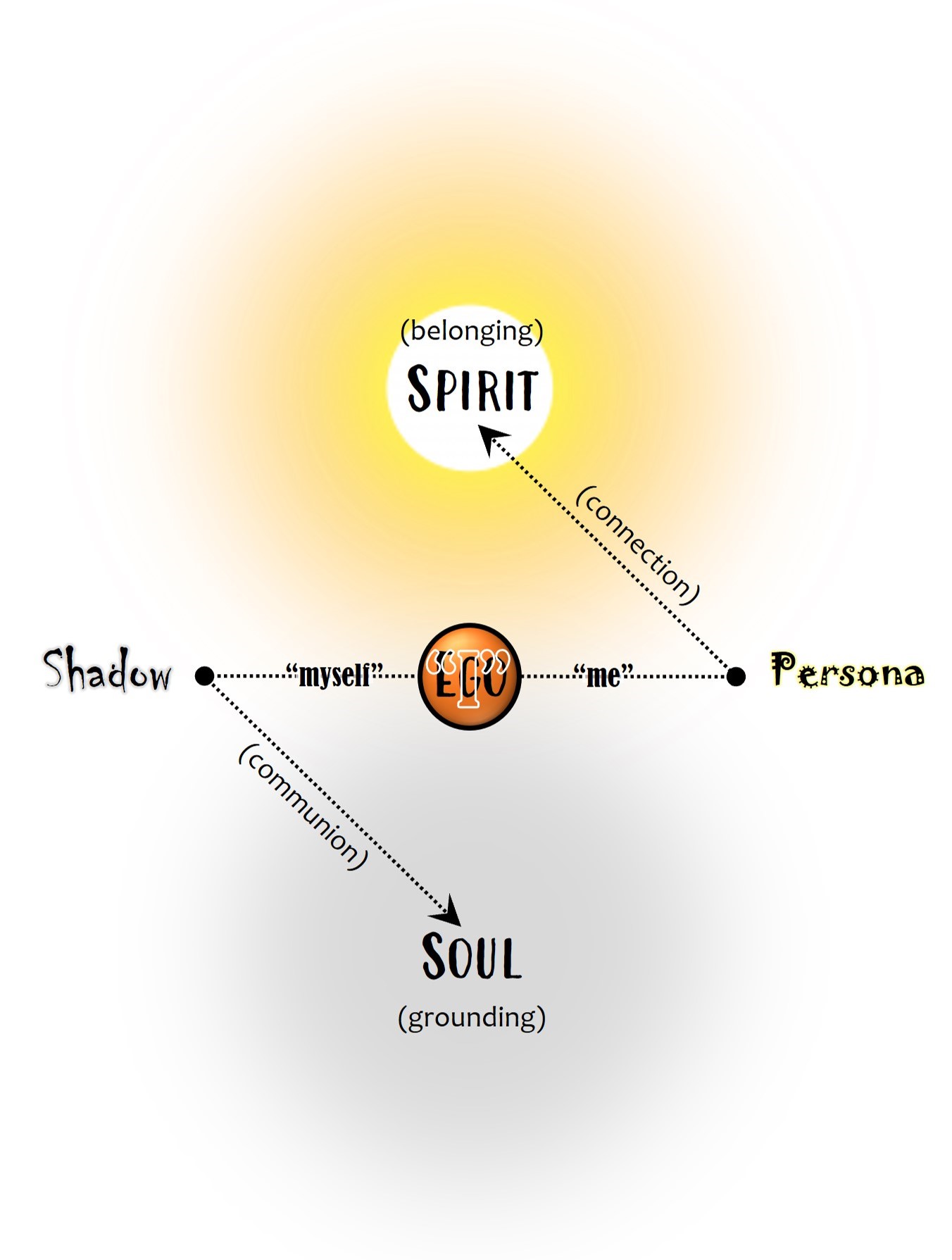
Personal identity consists basically of an actor (ego: “I”) wearing a mask (persona: “I am   “) that identifies them to an audience of other actors (society). It’s important to underscore the point that this ego-and-mask (or suit) ensemble is not something an individual is born with. Indeed, its construction requires that a center be established apart from the body, upon which a self-conscious vantage can be gained.

Such a developmental achievement requires social scaffolding to motivate and support the individual’s ascending progress in personal power: beginning with impulse control and advancing through emotional stability, cognitive flexibility, performance integrity (staying true to character), and moral commitment to social values and expectations.

The goal for the individual, now having become somebody, is to fit in and do their part for the good of all – “all” referring more or less exclusively to the in-group of fellow actors.

To capture this idea of identity as social construction, the illustration above depicts a ladder upon which the ego is making its climb – or perhaps it has gotten stuck on one of the rungs mentioned in the previous paragraph. In that case, the individual may be hung up in the complications of dysfunctional power: low self-control, imbalanced affect, closed-minded conviction, role confusion, or a weak conscience.

Getting stuck on the ladder of personal identity is a main reason why societies collapse, divide, and disintegrate.

Individuals who lack ego strength combine their neurotic insecurities for an exponential effect that can amplify across society and cause its destruction. Before the city gates close and its streets go silent, however, individuals will fall into chronic episodes of anxiety and depression, meaninglessness and despair, until all hope is lost and the human spirit within them goes dark.

Let’s be clear: it is not inevitable that the construction of personal identity should get tangled up in the complications of dysfunctional power. It’s also possible – especially in conventional societies with theistic structures that are more enlightened, provident, liberal and nurturing – that this whole enterprise of becoming somebody in conventional society serves to prepare the individual for a breakthrough to the liberated life.

This is where those distinct accents of East and West come into the picture. From ego’s centered position on the ladder of personal identity, the individual can release and descend into the deeper registers of consciousness: down through the attachments of identity, past the mirrors of self-conscious reflection, dropping along the vital rhythms of the body and into the quiet clearing of mystical presence and inner peace we call soul.

This deeper oneness is nondual, as the Eastern traditions maintain, far below ego in the grounding mystery of Being where there is no this-and-that, but only This: the nameless, formless, boundless, ineffable Mystery.

From that same position on the ladder of identity an individual might otherwise choose to connect and ascend into the higher registers of consciousness: up through the attachments of identity, past the oppositional categories of self and other, insider and outsider, rising along the unifying currents of love and into the inclusive fellowship of communal life we call spirit.

This higher wholeness is transpersonal, as the Western traditions maintain, high above ego but also including our individual differences in mutual respect, open dialogue, and unconditional acceptance.

These nondual-mystical and transpersonal-communal pathways are the Yin and Yang of a post-theistic spirituality. It is our hope for becoming fully human and finally free.

The Crux

All lifeforms on Earth are limited to lifetimes, some longer than others and some shorter. A few last only days, while a few others stretch into centuries. You’re about average, with a life expectancy of 80 years or so. Does that upset you?

Nature has equipped all forms of life with a developmental aim and “maturity clocks” that mark thresholds when it’s time to grow and stop growing, to reproduce and quit bearing young, to strive for existence and eventually succumb to extinction.

It seems that for all species but our own, these maturity clocks work instinctually to ensure that individuals actualize their natural potential and bring new generations to life in time.

An evolutionary breakthrough occurred millions of years ago when microorganisms called mitochondria were enveloped by other cells. Rather than assimilating these captives, however, the mitochondria were incorporated into cell biology as energy factories, thus catapulting the evolution of life to a whole new level of symbiotic complexity.

Several thousand years ago came another breakthrough, this time in our human lineage. With advances in social differentiation and cooperation, humans began to adopt identities that would allow them to participate in rather complex social role-plays.

By putting on these roles and masks (the Latin word is persona, from which our word person is derived), humans created conditions for the rise of self-conscious awareness.

Their careful attention to social cues in others, confirming varying degrees of recognition, deference, and respect, individuals became acutely aware of themselves as actors. This acting center of social identity is what we call the ego (Latin for “I”), and it wasn’t long before this separate center of self-conscious personal identity had insinuated itself in every human society across the planet.

Given ego’s place in the continuing evolution of humans toward ever more complex systems of social organization, we can appreciate this new arrangement of the social actor in a human body as the cultural equivalent of the much earlier mitochondrion revolution in cell biology and the evolution of Life on Earth.

Along with this remarkable and unprecedented advance into a separate center of self-conscious personal identity, however, came the awareness of the body’s mortality. Despite the intensely engaging carnival atmosphere of the social stage, in putting on and taking off the roles and masks of identity, a self-conscious individual was inescapably tethered to a biological lifeform that would one day die.

And this was terrifying.

One way of dealing with this new death anxiety was to get so completely distracted into the social role-play and identity management that it could be sufficiently ignored. At any rate, death could be imagined as a still long-distant future event, not requiring any further thought – for now.

But it wouldn’t entirely go away.

It was the innovation of a few storytellers, likely at midlife, who conceived the meme – referring to a self-replicating idea that quickly spreads through a society’s collective consciousness – of personal immortality. Capitalizing on the obvious fact of ego’s transcendent position with respect to the body, they first imagined and then believed that an individual’s center of personality might – no, must! – survive death.

Soon enough, elaborate departure narratives were devised to assure individuals of their postmortem continuation in life on the other side of death.

In the following centuries, these departure narratives would grow increasingly sophisticated and fanciful, depicting alternative destinations of heaven and hell, to be assigned according to the individual’s obedience to religious authority in this life, each with its own rings and levels of reward or punishment.

The great irony here is in how the emergence of a self-conscious center of personal identity, which signaled an advance in human social evolution, ended up generating profound anxiety and making individuals vulnerable to the schemes of one immortality project or another.

If these schemes provided a kind of shelter of distractions, they also had the effect of closing the human spirit inside and sedating its evolutionary impetus.

In the diagram above, a body’s mortal timeline is overarched by the adventure of ego. A separate center of self-conscious personal identity takes its rise sometime in early childhood, and returns to the body in late adulthood, just as the lures of social recognition start to lose their luster. Contrary to the promise of religion’s departure narratives, however, the personality goes with the body.

That is to say, it will go out like a candle.

If this sounds sacrilegious and depressing, it is only because the meme of personal immortality has insinuated itself so deep into our collective unconscious that anything less than everlasting life for the ego just feels offensive and wrong. When the body dies our light goes out? Anyone suggesting as much must be a heretic and a sinner – at the very least misguided, and perilously so.

This is where we have to reframe the whole point and trajectory of ego consciousness.

Our challenge is not to save ego from the body’s inevitable end, but rather to clarify its evolutionary aim in the larger picture of human destiny. This evolutionary aim according to the spiritual wisdom tradition of Sophia Perennis, which has been contemplating the matter for as long as humans have been wrestling with the question of what we are and where we are going, is only penultimately about social role-plays and managing an identity.

Ultimately – that is to say, in the final analysis and at the highest level of consideration – humans are destined for the liberated life in a planetary community of compassion, goodwill, justice and inclusion.

To his theistic audience, Jesus envisioned this ethically enlightened human destiny and called it the “kingdom of God.” It wasn’t up in heaven or in some post-apocalyptic future, but right here and now, coming up from within us and taking root among us, uniting us all in a Spirit of freedom and love.

As illustrated in my diagram, the elevated position of ego, transcendent of the body but not independent from it, provides a location from which consciousness can release and descend into the grounding mystery of Being itself. The dashes and subtraction sign (-) in and near the vertical arrow dropping from ego are making the point that this descending path involves a surrender of all the ideologies, memberships, ambitions, attachments, roles, and masks that define identity.

From the same location of ego’s position, consciousness can also connect with other persons and ascend together with them into the higher wholeness of transpersonal community. A solid upward arrow and addition sign (+) indicate that this higher realm of community takes up and includes each person’s uniqueness and the diversity represented in their differences.

Here we are not locked to our roles but can use them to contribute, add value, and participate with each other in the creative ways of a higher purpose.

So we can see that ego consciousness did not evolve just to be rescued to another world and a life everlasting, but instead to open pathways to the depths of Mystery within us and the conspiracy of love lifting us together as One.

It’s here that we become fully human.

Your Inner Family

In True Self in the Real World I analyzed the social construction of identity in order to show that the person we play on stage and the stage itself are neither true (self) nor real (world). True Self and the Real World are, in fact, screened from our awareness by a conditioned preference for becoming somebody special.

It’s more accurate to say “becoming” rather than being somebody special, given how the fulfillment of our ambition is constantly eluding us. We can always be more special – recognized, accepted, approved, and admired by more people, or by more important people.

And in our pursuit of this impossible goal, we end up pushing down and hiding away parts of our true Self that others aren’t ready to see or don’t want to.

Putting on suits (roles) and playing to the expectations of society, all the while sticking more of our light inside the closet so as not to risk being judged, ridiculed, or rejected: this is where we can spend our one brief lifetime, never coming into contact with our soul-centered identity (true Self) or the Reality beyond our beliefs (real World).

In the present post we will go deeper inside this delusion, to a particular interaction on stage that, more than any other, is the cause behind the felt need to hide our light. I’m talking, of course, about the Family Triad of Mother, Child, and Father, which is the most primitive and universally constant theme in world mythology, where they are appreciated as archetypes (“first forms” or original patterns) that most powerfully shape our human experience.

To prove this point, I will refine our focus for the following meditation, from a general reflection on the universal human experience to the experience you are having and where you are on the journey right now. Admittedly, what follows also applies to me and to everyone else, which is what makes this dynamic universal.

The objective, however, is for us to understand it at the general level so we might convert these insights into intentions for living a more liberated and luminous life.


“Once upon a time” (so begins your personal myth) you were a Child. Using the standard archetypal configuration of the Family Triad, you were born of a mother and to a father, coming out of one and taken in by the other. Likely with little awareness that they were local incarnations of the Mother and Father archetypes, your actual mother and father stepped instinctively into their respective roles.

As archetype, Mother is the Source, Ground, and Womb of life. She is the power of unconditional love and abundant generosity. In Her you found security, comfort, and nourishment, a safe place to surrender completely and relax into being. After forgetting your lines in the school play or falling off your bicycle, She welcomed you into Her embrace with the assurance that “It’s okay. Just relax and let it go.”

As Her counterpart, Yang to Her Yin, Father is the archetypal Other, the mysterious Outsider, a Beyond-in-the-midst, the One who confronted you from His transcendent center of otherness. He is the lure, the love of benevolent power. From Him you felt challenged and encouraged to try new things, to step into the proving circle and test your abilities, demonstrate new skills, and exercise your will. After forgetting your lines in the school play or falling off your bicycle, He exhorted you to “Brush it off. Face your fear and try again.”

Now, it’s not highly likely that your actual mother and father channeled their archetypes with consistent perfection. There’s a decent chance, in fact, that they fell short more times than not, partly because archetypes are ideals designed to attract and focus aspiration, not goals to be achieved.

The other reason your actual parents “missed the mark” (the definition of an ancient archery term, sin) was that they were dealing with, and compulsively playing out, the consequences of having had parents of their own who were sinners – and on up the generational line to the original mythic couple, El the Sky Father and Eden the Garden Mother (see Genesis 2:7ff), who didn’t get it quite right with their children either.

Our purpose here is not to place blame, but rather to understand how the degree in which your actual parents embodied or obscured the archetypal Mother and Father had the effect of motivating you to let your light shine, or else hide it in the closet.

If your parents were distant, demanding, hard to please or abusive, then you learned how to stay out of sight and keep the parts of you they would not accept off-stage and packed away.

That was your adaptive strategy in childhood – again, individualized to some extent given the unique history and special circumstances of every actual family. Now as an adult and living your own life, you still are not free and clear, for the child you once were is now your Inner Child.

Those same strategies for gaining acceptance, earning approval, winning praise, and staying vigilant to reduce the risk of losing any of those things, are what I call neurotic styles: episodes where your Inner Child rants, rages, whines, sulks or shuts down when you don’t get your way.

When that happens, it’s because another pole in this bipolar personality dynamic, called your Inner Parent, gets activated and goes to work issuing judgments, threats, and accusations against your Inner Child. Instead of self-compassion you hear self-criticism. Instead of self-encouragement you hear self-recrimination. You’re no good. You’re not worthy. You are unacceptable. You have nothing important to contribute, so keep silent.

Remember, you are saying these things to yourself by a socially programmed habit which follows a script that is likely many generations old.

Your actual mother and father were also agents, in a way, of their own generation’s philosophy of parenting and its views on discipline, family roles, and identity. It was inevitable that you would internalize your early experience as this inner dialogue between a part of you that takes the role of Parent and another part that takes the role of Child.

At some point you open the closet, snap the threads of threat-and-fear, accusation-and-shame, judgment-and-doubt that weave the heavy shroud of your shadow, and take back the light it has held for so long. In a Spirit of renewal and wholeness, you rise into your Higher Self and begin to live a more liberated life.

It is time.

True Self in the Real World

It sounds a bit odd, but even though you’ve been around for a while, it’s possible that you are just now waking up. To use one of my favorite metaphors, it takes some time asleep inside its cocoon before the butterfly is ready to emerge.

I’ve placed you there in my diagram, right at the center … I was going to say “where you belong,” but you don’t really belong there.

This just happens to be where you are waking up, after years of working diligently – if often confusedly – on becoming somebody special. It’s critically important to understand that your ego, this separate center of self-conscious personal identity, is not all that you are.

It’s not even your true Self.

In other posts I have gotten down into the dirty details of how an individual’s separate center of self-conscious personal identity is formed, but this one will stay at the level of an overview. There are forces and dynamics that fade out of the picture when we poke and dig into the nitty-gritty.

True enough, our successful navigation of those finer points is essential to our liberation from where we happen to be stuck. All those deeper elements comprise larger patterns, however, and sometimes we need to zoom out to really appreciate and understand how it all works – and why occasionally, or perhaps chronically, it doesn’t work so well.

So we will begin by making a clear distinction between the separate center of self-conscious personal identity that you are currently managing on the social stage, and your true or authentic Self.

As you will see, this conditioned and domesticated self (lowercase ‘s’), which we will label “ego” (Latin for “I”), has a corresponding habitat in a world – the domicile or “house of meaning” where its domestication is facilitated and a personal identity is installed.

Therefore, just as we must distinguish between your conditioned self and your authentic or true Self (uppercase ‘S’), the spiritual wisdom tradition also distinguishes between your personal world (lowercase ‘w’) and the real World (uppercase ‘W’), or Reality for short.

Both your conditioned self and your personal world are social constructs, made up and put together for the purpose of providing you an identity and the orientation you need to make it in this world – referring once again to the lowercase ‘w’ world that you share in common with other members of your tribe.

This conventional world is equally a social construct, even though in ordinary language we often confuse it with the real World (i.e., Reality).

To help organize these important ideas, my diagram illustrates the distinctions just introduced, presented as a dynamic pattern of polarities. A horizontal line or axis identifies the primary dualism at work in the formation of your conditioned self and personal world. The vertical axis is not a straightforward intersection with this self-world, but rather follows a zigzag pattern, zigging down to the contemplative pole and zagging up to the transpersonal pole of your authentic Self.

This will make more sense as we step through it together. Let’s return to the horizontal axis and give attention to your ego there in the middle of everything.

As already mentioned, your separate center of self-conscious personal identity is a social construct designed for the purpose of managing an identity inside a world of personal and shared meaning. In other words, your conditioned self did not come into existence at conception or birth, but instead formed gradually over time under the considerable influence of your local tribe.

A principal function of a personal identity is to connect and coordinate your interactions with other tribal members in the social role-play. To the right of ego in my diagram is a full-length mirror holding the reflection of somebody special. See the halo? That’s you being a good boy or a nice girl, a star athlete, a stunning beauty, or a Fortune 500 CEO of the Year.

Congratulations.

All of these identities are in italic text to remind us that the categories, definitions, and values are social conventions. “Good” and “nice” (etc.) are shared standards of a society, qualified by its moral frame and conserved from one generation to the next through parental discipline and cultural education.

One society’s moral frame is different from the moral frame of another society, sometimes in significant ways. Additionally, the same social tradition will move through different moral frames over its history, although these changes tend to be less revolutionary and more incremental.

There are exceptions, of course, and our present period seems to be one where the inherited moral frame is undergoing either a radical remodel or a complete collapse. Something new will emerge, but at this point it’s difficult to envision what it will be.

Anyway, back to you.

Associated with that full-length mirror and its image of somebody special looking back at you is the suit that identifies you to others in the social role-play. It might help to think of culture as the theater, society as the stage, and the various role-plays as tribal and interpersonal scenarios that transpire in the local settings of daily life.

Everyone has a role and plays a part – even the bystander, dropout, and outcaste who is shunned or ignored by the other actors. Each of them wears a suit that identifies them with a particular or more general role-play.

As you were zipped into suits assigned to you by your tribe, or maybe tried on some styles as a way of experimenting with identities, others recognized you by your role, and their reaction came back to you like a reflection in the mirror. In this mirror reflection of social responses to your role and how well you played it, you picked up clues to help you make adjustments, change tack, or maybe give up trying.

The reinforcement you were looking for were signs of recognition, acceptance, approval – and ideally admiration, but this is typically harder to win. “Accepted and expected” summarize the set, referring to the domestication objectives of fitting in (what’s accepted) and stepping up (what’s expected).

Your conditioned self is designed with a compulsive need to belong, to be “one of us.”

Depending on how nurturing, generous, inclusive, and forgiving your tribe was, your experiments with identity and gradual improvements in performance resulted in what self psychology calls “ego strength” – a centered and balanced personality with demonstrated integrity and resilience across a wide range of social situations.

Even though this isn’t your true or authentic Self, ego strength in your conditioned self is a critical achievement of development on your longer human journey.

If, on the other hand, your tribe wasn’t so nurturing, generous, inclusive and forgiving, the work of fitting in and stepping up was more challenging. In order to win the acceptance and approval of others in various social role-plays, the mirror reflection in their reactions made it clear that certain “energies,” talents, inclinations, preferences, and behaviors did not comply with the moral frame.

If you wanted to belong, then ironically you would need to keep those things off-stage and consequently leave some of yourself out of the role-play.

Better yet, locked behind a door.

That image of a door to the left of ego represents the closetful of things in your temperament and personality that had to be denied, censored, and suppressed in the interest of being somebody special on the social stage.

Along with a few animal impulses and morally deviant fantasies, included among these rejected (and eventually forgotten) parts of yourself are talents and other natural gifts that were either too unique or too threatening to the status quo for others to recognize and accept.

So you threw them on a pile and locked them behind the door, where the whole collection became what self psychology names your shadow.

The fact that the “shadow principle” is regarded in society and conventional religion as an antisocial, malevolent, and diabolical force (e.g., personified in the Devil) is really the function of a preceding fact, which is that every society tends to demonize what it fears, can’t accept, or is unwilling to include.

Interestingly, our conventional names for the personified shadow principle – Lucifer and Satan – carry a mythological insight into its dual character: (1) as the depository and keeper of your rejected light (Lucifer means “Light-bearer”); and (2) as a force that can destroy you from inside if you insist on pushing it behind the door (Satan means “Adversary,” or one who turns against).

“If you bring forth what is within you, what you bring forth will save you. If you do not bring forth what is within you, what you do not bring forth will destroy you.”

Jesus in the Gospel of Thomas, 70

As you can see, your conditioned self is in a very interesting space – a kind of existential dilemma, really – with its irrepressible need to belong and be somebody special (mirror and suit), while compulsively cramming your light into a closet (door and shadow) – or using a related metaphor from the teachings of Jesus, hiding your light under a bushel basket.

The spiritual wisdom tradition teaches that the way to your authentic Self, or soul, leads through your shadow and deeper into the grounding mystery of Being. You need to take back your light and use it to illumine the contemplative path, “zigging” inward to a Peace that eludes definition – or “surpasses all understanding,” in the words of the apostle Paul in his letter to the Christians in Philippi (Philippians 4:7).

In your soul or inmost Self there is no drive or interest in becoming somebody special, for you are perfectly content in just being.

Your authentic Self also invites you to “zag” upward, above and beyond the role-play stage and your personal world. The real World (or Reality) is not divided into insiders and outsiders, parties and castes, colors and creeds. Up there, everything is connected and All is One. Such divisions are merely social conventions, constructs of language, ideological fictions – and ultimately deadly delusions.

Your authentic Self, as spirit, breaks through this cocoon of identity and meaning, gliding above personal attachments and interpersonal conflicts on the wings of a transpersonal freedom.

Ascending the Cosmic Mountain

The illustration above captures in a single image a grand view of the Whole Shebang. It is the dialogical product of our two traditionally complementary systems, science and spirituality.

Unfortunately, the metasystem of religion which historically served to hold these two in coordinated balance and mutual support, made the fateful mistake of defending a literal reading of its myths against what it regarded as threats from both sides.

Scientific observers and empiricists were making discoveries that would eventually replace the three-layered cosmos of earlier times with an expanding universe of unimaginable dimensions. At the same time, spiritual contemplatives and mystics were exploring new depths of the inner life and finding there a grounding mystery more present and real than the gods themselves.

In its defense, religious clerics and scholars began locking religion down to an orthodoxy and liturgy that effectively closed off external Reality and the inner Ground from believers. The consequence was a centuries-long “dark age” as science and spirituality continued on their paths to enlightenment and liberation, but religion succumbed to intellectual hypoxia (starved of fresh air) and spiritual sclerosis (becoming rigid and dysfunctional).

Today, with conventional religion on a dramatic decline in membership and attendance, we are seeing a renewed dialogue between science and spirituality. The modern veering-away of science into reductionist materialism and of spirituality into esoteric metaphysics, absent the counterbalancing support and correction that healthy religion might have provided, has resulted in decreasing enrollments on both sides as well.

A new type of religion is now gaining a worldwide following, one that is Earth-based, life-centered, human-focused, and community-oriented. This religion – and the term is justified in recognition of its conscious intention of “linking back” or connecting (Latin religare) us to one another, each of us to our inner Ground, and the community to our home planet – doesn’t have a priesthood, a ritual system, an institutional structure, or even a credo.

This religion can even flourish in traditions that have not cut themselves off from science or spirituality, that embrace their role in nurturing a faith which can finally see through and beyond its preferred concepts of God.

It is therefore, and by definition, ‘post-theistic’.

A grand view of the whole shebang, as illustrated above, is the dialogical product of science and spirituality, finally rescued from their respective quagmires of reductionist and metaphysical distraction, reconciled at last in a contemporary post-theistic paradigm.

The cone image also has the semblance of a mountain, with various ridges having formed in its upward thrust to an illuminated peak. This idea of ‘formation’ nicely captures the spatial and temporal dimensions we need in order to appreciate the universe as not merely the product of cosmic events but as an ongoing evolution in time, a single-turning event of the largest scale (uni-verse).

The bottom regions of the cone, or cosmic mountain, represent the earliest events and deepest forces in the universe. A primordial “flaring-forth” (big bang) of quantum energy began the process of crystallization which produced the basic structures of matter. As the material realm expanded and cooled, these elements combined into new molecular configurations and further condensed into the compounds of planets with their local environments and atmospheres.

On our own planet of Earth, material conditions gave rise to organic properties and gradually to organisms with the capability of capturing, converting, and storing energy for their own special use. Soon – over many millions of years! – organisms would develop powers to restore, repair, reproduce and replace themselves with new generations of life.

As these primitive forms of life connected in symbiotic networks for resources and protection, the emerging webs of differentiation shifted the living realm into higher, more complex systems, creating the need and capacity for self-regulation, sensorimotor intelligence, and ambient awareness – thus giving rise to the realm of mind (i.e., sentient life).

Countless species of plant and animal life multiplied and filled the earth.

In one particular animal species, our own human lineage, mind further differentiated for the work of regulating the interior body, reacting and adapting to its environment, and orienting the individual inside its own projected dome of concerns, preferences, values, and meaning.

To effectively get around and flourish inside this world-projection, the individual required a center of personal identity and affiliation that could keep it connected to the tribe. The external monitoring, guidance, and motivation provided by the group was gradually transferred inside the individual and established as the ego (Latin for “I”) of a personality, referring to a collection of “masks” (personas) and roles it uses to engage in the various role-plays and interpersonal transactions of social life.

This activation of a subjective center for self-monitoring, self-guidance, and self-motivation gave rise to a game-changing but chronically tormented mode of self-conscious experience.

Ego formation brought our human journey into the steep and treacherous mindscape of profound insecurities, neurotic disorders, self-destructive behaviors, conflicting beliefs and worldviews, spiraling self-obsession, as well as debilitating cycles of anxiety and depression.

We are starting to understand that, just as the principles of differentiation, individuation, and participation in the earlier stages and deeper regions of the cosmic mountain conspire(d) to create conditions for the emergence of higher complexity, so is our self-conscious ego and personal identity (i.e., our individuated self) just the precursor to a transpersonal leap of participation in something higher still.

In the past, this is where science would shake its head and walk out on the dialogue with spirituality. It’s important to note once again, however, that it was the mythological literalism of a religion which refused to evolve, that turned the metaphor of breath or wind (Latin spiritus: spirit) into an independent divine being, rather than a word-image for the dynamic flow of creative freedom and genuine love between and among self-transcending egos.

Spirit is a communal metaphor of connectedness, reciprocity, fellowship, solidarity, and inclusion.

It is community.

It is tempting to see spirit as always and already deepest within the cosmic mountain, just waiting for its time to emerge. Science can’t go along with that, and for good reason: Spirit isn’t some thing, but rather the participative unity of individual egos in transpersonal fellowship. We can observe it scientifically and even measure its effects, but we will never isolate it in a laboratory or find it wandering about on its own.

To say that …

  • energy “gave rise” to matter, or that matter “emerged” from energy;
  • matter “gave rise” to life, or that life “emerged” from matter;
  • life “gave rise” to mind, or that mind “emerged” from life;
  • mind “gave rise” to ego, or that ego “emerged” from mind;
  • ego “gave rise” to spirit, or that spirit “emerged” from ego (or better, that it emerged from the transpersonal fellowship of egos)

… in each case we are referencing conditions which are favorable and conducive in generating a synergy that “bumps” things into a higher order of complexity and creative transformation.

What we bring individually to the spiritual phenomenon of community is a grounded faith, a centered presence, a welcoming attitude, a compassionate interest and unconditional generosity.

We draw from the wellspring of soul within and give ourselves to the dance, to the work of forming an ever more perfect union.