The Great American Divide

dem_repIn the 2016 Presidential debates two candidates stand before us: one a super-rich white businessman, and the other a female politician (also wealthy and white). So while the differences between them could be much more significant (a middle-class Latina against an Asian-American Buddhist, for instance), in the process of the debate I am struck by how the deepest difference between our candidates coincides with a profound fault-line through the center of our nation. It’s not male versus female, white versus black, or even rich versus poor.

Back in my seminary days I had the assignment of researching the agreements, compatibility, and contradictions between American ideology and the gospel of Jesus. Needless to say, while I could find numerous points of agreement (even complicity) between American ideology and Christian orthodoxy, favorable touchpoints with Jesus’ message and way of life were very hard to find. He was not a big fan of empire or orthodoxy, nor of the egoism that drove both of them against his communitarian vision. His ‘campaign’ was on behalf of human liberation, and of a life awakened in love for others.

Orthodoxy and empire cannot allow for the creative authority of individuals. Jesus was killed because his gospel ran counter to the religio-political domination system of his day.

But as I looked deeper into the American psyche it became evident to me that our national history has been a tale of two visions, which are not only incompatible but run in opposite directions. On one side are the principles of democracy as set forth in the Declaration of Independence (1776) and embodied in The Constitution of the United States (1789), committed to the sacred and self-evident truths of dignity, liberty, equality, and community.

The Constitution’s “We the people” very clearly takes the perspective of all citizens, together as one voice. (Granted, neither blacks nor women were explicitly included in this democratic collective at the time, but the Constitution would later be invoked on their behalf as well, demonstrating its essentially inclusive spirit.)

On the other side of the American Divide are the perhaps equally sacred ambitions for privacy, property, and financial profit, as laid out in the Bill of Rights (1794, Constitutional Amendments 1-10). True enough, these Rights were articulated with the principles of democracy in the background, but they really aren’t about democratic aspirations at all. Their cause is with free-market capitalism,

an economic system in which investment in and ownership of the means of production, distribution, and exchange of wealth is made and maintained chiefly by private individuals or corporations, especially as contrasted to cooperatively or state-owned means of wealth. (Dictionary.com)

If America is a Land of Dreams, these are dreams about breaking out of poverty, making a living, and getting rich. The individual has a right to property and wealth, which must be protected by all means against unnecessary taxation or confiscation by the government. (Hence also “the right to bear arms.”)

It could be argued that democracy and capitalism name two fundamentally different enterprises of a society (its government and economy) and have really nothing to do with each other. And yet, as seedbeds for a general philosophy of life these two value systems advance contrary ideologies. One (democracy) looks at the individual through the lens of community life, while the other (capitalism) looks at society through the lens of individual self-promotion.

Side by side, democracy and capitalism seem like they should get along. After all, haven’t they coexisted since the beginning of our American Experiment? Yes, but their apparent compatibility has been about as natural as Hillary Clinton and Donald Trump sharing the stage.

The candidates speak very different languages, for the clear and simple reason that Clinton speaks the language of democracy while Trump speaks the language of capitalism. One is centered in the responsibilities of liberty, equality, and community; the other stands passionately on the rights for privacy, property, and profit. One is a proponent of all of us, together. Her opponent speaks mainly for those at the top, as well as for the large number who dream of getting there one day.

In this election, perhaps we are finally having to come to terms with the Great Divide in our character as a nation.

Thoughts on the Apocalypse

apocalypseIn popular religion and culture ‘apocalypse’ refers to an end-of-the-world scenario where the order and stability of life as we know it breaks down, stars fall from the sky, evil powers are unleashed, and zombie herds ravage the few unlucky survivors. Even in ancient religions we can find this dystopian picture of catastrophic destruction and world-collapse, signalling the finale of temporal existence. The curtain comes down and the lights go out.

Or do they?

There is good evidence that the Persian prophet Zoroaster may have been the first to treat the Apocalypse as a future event rather than a mythological device announcing a phase transition from one mode of consciousness to another – which I will explain shortly. Zoroastrianism inspired similar prophecies in late Judaism and early Christianity, leading up to our own evangelical end-timers as its present-day descendants.

Zoroaster divided reality into two absolute and opposite principles: Ahura Mazda, the personified principle of light and righteousness, versus Angra Mainyu, the principle of darkness and evil. The human situation was thus characterized as caught in a cosmic-moral conflict, with each principle vying for our devotion and allegiance.

Zoroaster’s division in the very nature of reality was the cosmological projection of a psychological shift in human consciousness, in the formation of that separate center of personal identity which we know as ego. Instead of the seat of immortality that Zoroaster presumed it was, contemporary schools of ego psychology are approaching agreement in their regard of it as a social construction – not immortal or even all that self-consistent over an individual’s lifespan.

Ego formation is the process whereby a human animal is shaped by his or her tribe into a person, a term tracing back to the Latin persona and Greek prosopa, referring to a mask actors wore on stage to ‘personify’ the characters of a play. By constructing an identity and assigning roles for the individual to play, the general role-play of society could be carried off with functional success. Intrinsic to this process of identity-formation was the individual’s gathering sense of him- or herself as a separate center of affection, perspective, and agency.

Standing in its own unique (but socially invented) space, an ego must identify itself with certain things and against others, in commitments that are mandated and closely managed by the tribe. Around this center of personal identity everything seems to fall very naturally into pairs of opposites – outside/inside, above/below, behind/ahead, right/left, self/other, mine/yours, us/them, good/evil. And since the individual’s obedience to the moral code of the tribe is so essential to the tribe’s cohesion, it was Zoroaster’s genius to invent a cosmology that turned around – and in turn motivated – each person’s moral behavior.

How does dividing reality into opposing principles of good and evil motivate moral obedience? By making the ego immortal, Zoroaster made it all very personal, since the question of the individual’s postmortem destiny was now suddenly relevant and unavoidable. He preached that only obedient and righteous believers (those who believed his myth and its message) would enjoy an everlasting bliss in the paradise of Ahura Mazda, while doubters and sinners would be tormented in hell forever.

Apparently his motivational system worked, for many submitted themselves to the moral code and its unforgiving orthodoxy. The priests and prophets who spoke for Zoroaster and his god used the promise of paradise and the threat of perdition to keep their congregations in line and under control.

And so it was as well in late Judaism (cf the Book of Daniel) and early Christianity (cf the Apocalypse of John), down to our own day (Seventh Day Adventists, Jehovah’s Witnesses, and that strange celebrity cult of TV evangelists). But whereas the Apocalypse of John (aka the Book of Revelation) was written for first-century Christians under Roman persecution, with figurative references to current events and personages in the effort to encourage their faith and lift their hopes, today it is interpreted against our current world situation, but more for the effect of demonizing enemies and justifying bigotry than bolstering a commitment to the nonviolent way of Jesus.

End-time religion is a multi-billion dollar industry, which is odd considering how its message is about the world ending tomorrow. The more insecure people feel, the more likely they are to buy into schemes that promise relief, escape, or a decisive end to their trouble.

I’m not really arguing that the Apocalypse is a bunch of hog-monkey, only that taking it literally is. It bears repeating that Zoroaster (along with his Jewish and Christian descendants) was not the originator of this idea of world-collapse and history’s end; it was in the collective planetary consciousness of world cultures both before his time and outside his sphere of influence. He’s the one who took it literally, made it imminent, immortalized the ego and pitched the whole thing into a moral contest for the individual’s postmortem destiny. Prior to and outside of him, the ‘end of the world’ carried very different implications – very different.

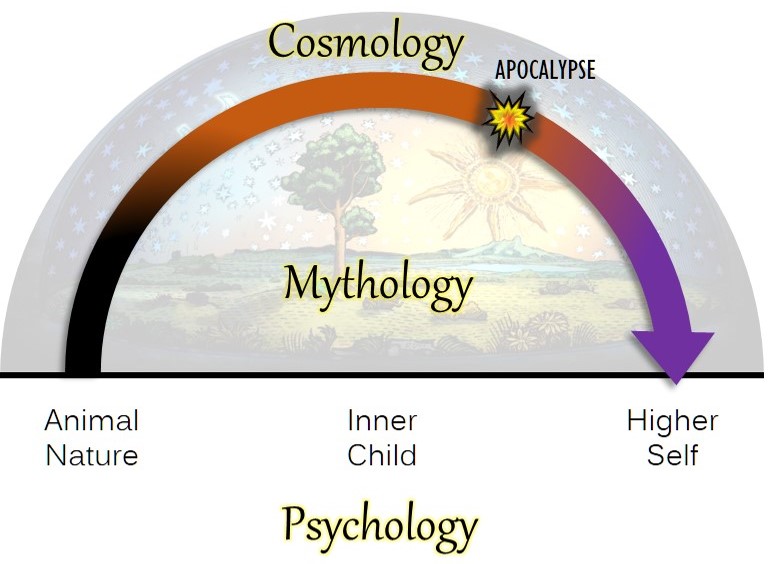
My diagram illustrates the relationships among a people’s mythology (the collection of sacred stories by which they orient their lives), its background cosmology (current theories regarding the structure of reality), and the psychology (including stages of consciousness) that gives rise to the whole affair. In other posts, I’ve written about the consequences of dogmatically perpetuating a mythology that has fallen out of date with respect to our current understanding of reality. A prime example is the way that early Christian myths, which were composed upon a reality conceived as a three-story, vertically oriented structure, eventually lost credibility as science revealed an outward-expanding cosmos. (Jesus ‘coming down’ and ‘going up’ just doesn’t make as much sense anymore; and where exactly is heaven, if not above the clouds?)

This connection between psychology, mythology, and cosmology might actually help refine our definition of religion – not this or that religion, but religion itself. As the system that ‘links back’ or ties together (from the Latin religare) human consciousness (psychology) and the greater universe (cosmology) by means of sacred narratives (mythology), religion gives us (or once gave us) a way of holding everything together as one coordinated and meaningful whole. The Western advance of science disturbed this marvelous unity-of-experience when it challenged the traditional cosmology. And the stubborn reaction of Christian orthodoxy in denying these scientific discoveries and insisting on the literal truth of its outdated myths only precipitated our slide away from a relevant spirituality.

As I said, from inside mythology the Apocalypse will be seen as near or far in the future. Those whose consciousness is still centered in a mythopoetic (storytelling) mode of experience will look out on reality through the lens of sacred fictions. They are oriented on the archetypes, characters, exemplars, and ideals designed to urge their imitation, obedience, and aspiration through the course of their coming of age.

From the body-centered psychology of animism and well into the ego-centered psychology of theism, the great myths frame their sense of self and reality.

In ancient cultures the Apocalypse was in part a statement regarding the transient nature of existence, along with an imperative on the tribe to ritually renew itself at key points and thresholds along the way. The observable winding-down nature of time required periodic rites of renewal to keep things going. Many of our religious holidays have their roots in seasonal festivals and sacred ceremonies when the cosmos would be wound back up and order restored.

But at a certain stage of psychological development, as a rational and reality-oriented intelligence is waking from its incubation beneath the warm emotional covers of mythopoetic consciousness, the stories are recognized as cultural creations and not necessarily as representing the way things really are. For the individual this means that one’s adult higher self is stepping out of an earlier mode of make-believe (the now inner child), in order to acknowledge a reality on the other side of the mythological enclosure, of what we’ve known as ‘my world’ and ‘our world’, that is, the shared world-view of our tribe.

And this is the world that comes to an end with the Apocalypse. In other words, what had been interpreted from inside the myth as a future event for the world as we know it, is, psychologically, the moment of realization when an individual begins to understand the world for what it is – a narrative construction of meaning. Such a realization is one-part liberating discovery and one-part shattering disillusionment. The mythological enclosure is gone, and now the present mystery of reality breaks in. It’s not that we’re done with story at this point, only that we are now aware, as we once were not, that our constructions of meaning are exactly, and only, that.

Our challenge and opportunity becomes one of working out a relevant spirituality and way of life, together, as the curtain comes down and the lights go on; after our world ends, and on the other side of god.

The Galilean Rocket Man

Rocket ManAfter his natural life and rather sudden death, Jesus the Galilean started on a mythological career which carried him all the way to the top-floor corner office of the universe, as none other than God Incarnate. A surprising majority of those who confess to be Christian have little knowledge of how a backwater itinerant teacher eventually became the Second Person of the Holy Trinity. The obvious reason for this ignorance is rooted in their belief that Jesus was God Incarnate from the very beginning, just as Christian orthodoxy says. In other words, the story starts there.
But the advancement in our knowledge since the fourth century, when Jesus was officially promoted to his fully-divine status, makes such a confession today a matter of willful ignorance. Discoveries from the study of history, cosmology, sociology, mythology, psychology, and the development of Christian doctrine itself have to be deliberately ignored for the sake of ‘keeping the faith’. In this case, faith becomes a matter of believing it anyway, as if intentionally sweeping aside all evidence, rationality, and common sense against the claims of Christian orthodoxy is somehow a demonstration of spiritual virtue. All it really demonstrates, however, is that individuals prefer the security in what they believe to the risk of being wrong.

Having served in professional ministry as a church pastor for fifteen years I am well acquainted with this phenomenon, technically known as fideism – the exclusive reliance on faith as a substitute for rational thought and reality-testing. Many believers don’t realize how they are being gamed by a system that constructed its most prized doctrines in the head, but cautions parishioners against using theirs.

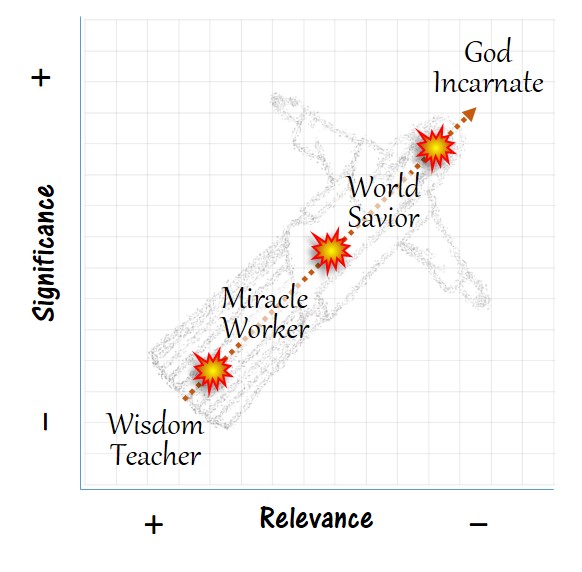
This rise of the Galilean Rocket Man progressed by stages, like a rocket breaking through the stratosphere as it disengages and drops off the weight of parts no longer needed. By the end of his mythological career Jesus had become the most significant item in existence – nothing less than God himself, the supreme Lord of the universe. At the stage just before this one he had achieved the status of World Savior, whose crucifixion and resurrection saved the world from sin, the devil, and death itself – or we should say, he saved those who can believe this.

Earlier still, before the focused effort of orthodoxy got underway, Jesus walked the storyland of the gospels as a Miracle Worker healing the sick and bending laws of nature. Actually he was one of many highly honored and well-remembered holy men in and before his time. It was common practice to represent such figures in narrative scenarios, short stories, and hero legends giving miraculous performances in exhibition of their unusual powers. To suspend or transform conventional reality, even if only in storyland, served to keep the holy man alive in the memory of his disciples and descendants.

It would be a tragedy for Christians to remember the one who worked miracles, saved the world, and took his place as god, but not give serious reflection to what he had to say or how he lived. Granted, it is not easy to sift the authentic message of the historical Jesus from the embellishments of hero worship, myth-making, and emerging orthodoxy in the Bible. But the tragedy turns into a double catastrophe when those who profess to be Christian follow the Rocket Man into heaven and completely eclipse the vision he had for life on earth. As long as they have assurance of joining him when they die or witnessing his return in the meantime, what he said and how he lived before his mythological ride into abstraction has little relevance to them.

Am I saying that Jesus isn’t (or wasn’t) God Incarnate, savior of the world, or a wonder-working miracle man? Yes, at least not in any literal or factual sense. If he is or did all those things he is worshiped for, then he is and did them inside the mythopoetic construction of an early Christian worldview – a vertically oriented three-story cosmos, a fallen human condition in need of rescue from above, and the popular portrayal of important historical figures as possessing supernatural powers. Look around. Our view of reality today (i.e., our contemporary scientific worldview) is very different.

Interestingly enough, we do still flock by thousands to watch celebrity faith healers and charismatic self-proclaimed prophets perform miracles – right before our credulous eyes. Something inside us knows that it’s a put-on, but we fail to pause and ask why these faith healers don’t have an office inside local hospitals where so many more of the suffering and ill could benefit from their extraordinary gifts.

Because so much of Christian identity is invested in an outdated cosmology and in a mythology taken literally, the religion will continue to decline, breaking into numerous sects, cults, and extremist factions on its way to extinction. And along the way, more damage will be done. The way out of this tragic predicament is to take one more step down to earth with the Galilean Rocket Man – out of mythology and the abstractions of orthodoxy, and back to the vision and way of life of a Wisdom Teacher.

You’ll notice that I didn’t say ‘the’ Wisdom Teacher. That’s because as a teacher of wisdom, Jesus was not, as we say, one of a kind. I realize that may sound disrespectful, irreverent, and even blasphemous to many Christians. But in the great stream of wisdom teachings which has been coursing through the world cultures for thousands of years, the personal identity of a teacher is much less important than the clarity, depth, and real-world relevance of the wisdom he or she has to share. As a Wisdom Teacher Jesus was one of many. But as is true of all the others, his unique personality, family background, life experience, and historical situation conspired to bring this wisdom to bear on the concerns of his time in a highly individualized way.

Wisdom is about the challenge and opportunity of being human, profoundly (i.e., thoroughly) mortal yet grounded always in an eternal now. How can we live out this life with integrity, authenticity, mindfulness, and compassion – for ourselves, for others, and for the whole community of life? How can we step beyond fear, suspend judgment, and be more genuinely present in the moment, wherever and with whomever we find ourselves? Jesus had some very timely things to say, but the wisdom he shared is timeless.

Before he became the Rocket Man of Christianity, Jesus the Galilean was a human being. That was his true glory.


In my diagram above I have distinguished two terms often used interchangeably: significance (vertical axis) and relevance (horizontal axis). As the root-word suggests, significance (from sign) is value we can point to. We talk of ‘high’ significance to acknowledge such value as up and above common or ordinary values. When Jesus got promoted to the status of God Incarnate, his significance was made absolute. But in the same stroke he also became utterly irrelevant, for relevance has to do with timely, real-world value. If Jesus was/is God Incarnate, what practical difference does that make in daily life? On the other hand, as a Wisdom Teacher Jesus is very relevant but not highly significant – that is to say, his value is not ‘up there’ or outside our situation in life, but in the very heart of it.

The Supreme Paradox

Supreme ParadoxI’ve written before on what I call the Matrix of Meaning, referring to a deep code of primary concerns and narrative motifs that generates the very fabric of our worldview. A sense of self and reality is the central construct in our personal myth, orienting us on the pressing challenges and emerging opportunities in our journey through life. The Matrix is deceptively simple in design, but the patterns of meaning it can produce are beyond number. Your life story and personal worldview are very different from mine, but the same Matrix of concerns and motifs is behind them both.

My first-time reader needs to know that I am a constructivist and employ the term ‘myth’ in its more technical (rather than popular) sense, as a narrative plot that holds the body of a story together and drives its action. Although we may have authorial liberties regarding the style and idiosyncratic features of our personal myth, the deeper structure is determined by what the ancient Greeks personified in the goddess Ananke, or Necessity. In other words, how you respond to adversity, hardship, pain and loss is unique to you as an individual, but the inevitability of suffering is universal for human beings. This was the Buddha’s First Noble Truth.

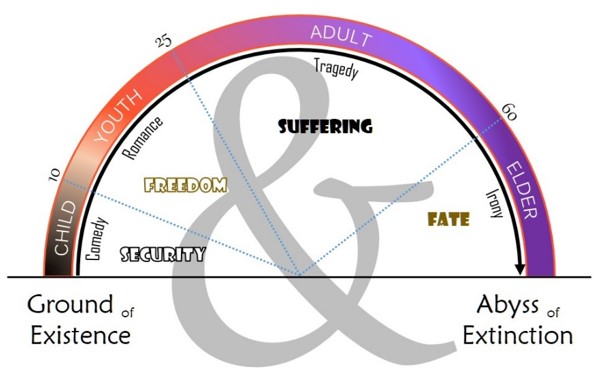
My diagram depicts the Four Ages of individual development, and these, too, are universal archetypes in mythology: the Child, the Youth, the Adult, and the Elder. I’ve indicated the average years over a lifetime when we transition from one to the next, but these shouldn’t be taken as hard predictors. The developmental challenge of a given Age might not be successfully negotiated, in which case our neurotic hangups around its primary concern will be carried into the next challenge, compounding our difficulty in making it through. Indeed, the fact that none of us gets out of childhood without some insecurity throws light on the question of why the human journey can be so damned complicated.

Northup Frye’s four literary types are also included in my diagram, each one corresponding to an Age and its driving concern. Comedy is the up-swing to ‘happily ever after’. Romance follows the heroic quest for an ideal. Tragedy descends the plunge-line of misfortune. Irony provides a double-vision between what is said at the surface and what is meant underneath. Our personal myth will predictably move through these distinct narrative frames, forcing us to adapt our construction of meaning to the shifting focus of our life in time. Although many have tried, any attempt to impose a frame of comedy over the reality of suffering only ends up forfeiting a potentially life-changing insight behind a veil of denial and make-believe. Needless to say, otherworldly religion is especially good at this.

The multicolored arc across my diagram represents the progression of consciousness through an ‘animistic’ body-centered stage (color-coded black), through a ‘theistic’ ego-centered stage (orange), and farther into a ‘post-theistic’ soul-centered mode of life (purple). Only a small minority are willing, or even able, to release personal identity (ego) for a deeper mystical realization and larger ethical vision. The rest of us fall in line with the status quo, take refuge inside our convictions, and succumb to the consensus trance. This is when theism can become pathological and our god starts looking like a glorified version of ourselves – a moody, judgmental, and self-righteous bigot.

My purpose in touring through the diagram in such detail is to lift into view the paradoxes in play throughout. The security of early childhood is in polar tension with the suffering that comes on as we mature. Much of suffering has to do with the loss of attachments that anchor identity and meaning for us, but which also represent for us a reality that is safe and supportive. Security and suffering, as primary concerns coded into the Matrix of Meaning, are paradoxically related. It’s not security or suffering, but the tension between security and suffering that drives our construction of meaning. Similarly, freedom and fate are polar opposites, making the interplay of our control in life and the conditions outside our control a second creative opposition. Freedom and fate only seem to exclude each other, while real wisdom involves learning to live inside and with their polarity.

This consideration of the paradoxes inherent to the Matrix of Meaning, and how these concerns compel us to make meaning that is at once relevant to our situation in life and capable of orienting us successfully throughout our journey, brings me to what I’ll call the supreme paradox. I refer my reader back to the diagram, specifically to that arrow arcing across from left to right. This represents the arc of our lifespan, tracking through the Four Ages (if we live long enough) from birth to death.

Especially during the first half of life, and most critically in those early years, we experience the uplifting support of reality in our growing body, a nurturing family system, and a wide world of opportunity. Such a conspiracy of virtuous forces instills in us a deep assurance of reality as the ground of our existence. We are the living manifestations of a 14 billion year-old process, a flower of consciousness emerged from this magnificent universe, the cosmos contemplating itself in wonder. Surely this is the root inspiration of true religion: the ineffable sense of being sustained by a provident reality, coming to be and living our days under the watchful intention of a mystery we cannot fully comprehend. All the mythological gods who provide us with nourishment, protection, guidance, and solace are metaphorical personifications of this provident ground of existence.

There are other gods as well, who begin peeking in as our exposure to reality becomes more complicated and challenging. These are dark forces – tricksters, shadowy forms, and unseen solvents that slowly erode the foundations of our neat and tidy worlds. Yes, reality is the provident ground of existence, but it is also the inescapable abyss of extinction. Coming-to-be and passing-away are the paradoxical reality of our life in time. We may want only a reality that supports and promotes our rise into identity, safekeeping our existence forever and ever, but that’s not how it is.

As Carl Jung pointed out many times and Lao Tzu made the central insight of his reflections on the way (Tao), light and dark are not absolutely exclusive of each other. Rather, they swirl together, pulling and pushing, blending and separating in the dance of reality, generating the ten thousand things and dissolving them simultaneously into the ineffable secret of the Tao which cannot be named.

Liberated to Serve

Back In There

I promised myself that I would pick up where I left off in my last post, which was at the point of having broken through the consensus trance that holds individuals under the spell of groupthink. As I explained, consensus trances are seductive forces in your life because they provide the (feeling of) security that you’ve needed from the moment you were born. (See Life Outside the Consensus Trance for background.)

To the degree that your family system wasn’t safe and nurturing, you compensated by attaching yourself to whomever or whatever could keep you from falling headlong into the abyss – referring to the dark and fathomless urgency of your anxious state. You could survive and stay clear of this eventuality so long as the object of your attachment didn’t abandon you, become displeased with you, or change from what you desperately needed her (or him or it) to be for your sake.

To keep her close, you unconsciously adopted her general mood in life, her outlook on reality, the particular beliefs she held, and the manner in which she engaged with (or disengaged from) the world around you. So there you were: secure in the familiarity of each other, co-dependently attached, and firmly locked inside the convictions of what you both knew for certain. This mutual bond operated as a collective consciousness (even though there may have only been the two of you at first), wrapping the construct of your shared world around you like an illusion, which it was. And your inability to distinguish between the way things appeared to you and how they were in reality meant that you were under a delusion as well.

From this quiet nursery scene, the same mystifying trance spread outward as you got older – not out into reality, but farther across the social landscape with the enlarging horizon of your carefully managed world. Strangely your adolescent and adult relationships seemed to repeat many of those early behaviors, especially whenever you felt unsure of yourself or threatened by something unfamiliar, or when your defenses got worn down by the daily stress of life. If you were attached to abusers as a young child, you found yourself irresistibly attracted to abusers in your adulthood. Whatever neurotic style had helped you adapt to those dysfunctional family dynamics back then, so that you could get at least some of what you needed, tends to turn on and take over when you find yourself under pressure today.

So my definition of the consensus trance adds to Tart’s characterization of the shared delusion of groupthink across the various memberships in which our personal identity (ego) is managed, to include also the persistence and reactivation of earlier trances when our views of self and reality were just starting to emerge. If the consensus trance of a particular partnership or tribe only held its pattern by virtue of present conditions alone, it would be much easier to break (if we cared to). But in fact, these patterns, and the curtain they drape over awareness, are energized by much older and deeper (i.e., more primitive) impulses – reaching back behind our rational higher self to our emotional inner child, and even into the visceral urgencies of our animal nature.

Our full liberation from the consensus trance will involve an awakening of spiritual intelligence, to the ‘power within’ and the ‘truth beyond’ the self-world construct of personal identity. The critical question, of course, is how. If we are so far under the spell, how do we stand any chance of being set free? Well, we might ‘graduate’ or take our exit from a web of relationships in the normal process of growing up and moving on. Or something can happen that shocks us momentarily from our trance state: a crisis or setback can disrupt the pattern, or a primary attachment might call it quits, walk out on us, or pass away. We need to remember, though, that even in such instances the insecurity and cravings that held us in that particular co-dependency will likely drive us to find another just like it.

The good news is that we don’t have to wait for a shock event to wake us up. Meditation practices of various kinds have been used for centuries with the intention of assisting consciousness past the construct of personal identity. As this construct has two principal aspects, self and world, a practice of ‘getting over yourself’ can proceed along an inward descent (the mystical turn) whereby self is released to its grounding mystery (‘the power within’), or along an outward ascent (the ethical turn) that lifts awareness beyond “my world” to the higher wholeness of a universal order (‘the truth beyond’). This higher inclusion prompts us to reconsider how we ought to live, given that we are part of a much larger web of life.

It is wise not to wait for the jolt of disillusionment, but instead to cultivate a more or less disciplined daily practice that will gradually strengthen the ego to the point where it is no longer the neurotic center of everything. When you go back to the partnerships and tribes that hold your identity contracts – those masks and performance scripts that define your place in the role-play of social interactions – you will be a more stable and creative influence than before. You won’t take everything personally. You’ll be able to catch the retributive reflex before it springs back against the insult or criticism that someone else just slapped on you, opening a space in the exchange where you can do something outrageous, creative, and kind instead.

The challenge for anyone waking up from the consensus trance is focused in finding creative ways to stay awake. Prepare yourself for the scolding glances and more direct resistance from those who are still under the spell. No one that is comfortably asleep enjoys the flood of light when bedroom curtains are flung open to the morning sun. You are not superior to them. You are not better than they are.

Who knows, but maybe your liberation has now placed you in position to be a servant of their freedom. Yes of course, you could take your light and get as far as possible from the frustrations of this or that relationship. Or you might work out your salvation in a way that shares your light with the rest of us, helping us as well get just a little farther along the path.

Life Outside the Consensus Trance

QI and Trance

The psychologist Charles Tart coined the term consensus trance in reference to the shared assumptions and agreements that hold social organizations inside the rules of groupthink (Irving Janus, 1972). As an aspect of what he named a consensus reality orientation (CRO), it reflects the tendency we all have in adjusting our perspective and aspirations to what ‘the rest of us’ believe is valid or plausible.

Why do we so quickly dismiss insights and ideals that others in our relational webs don’t understand or approve? Granted, there is an obvious benefit to all involved (including us) when some of our harebrained ideas and odd inclinations are not adopted by the group. What a very strange world it would be if everything we conjured up in our daydreams and private thoughts automatically became coin of the realm.

But in this case I’m thinking more about those times when a truly winning notion dawns in our minds or a genuine discovery with transformative potential turns up in meditation – and we get punished, scolded, or shushed. It might even be something so noble as a desire to engage our relationships with greater mindfulness and honest love, but our different energy disturbs the routine and upsets expectations.

Individuals who are caught inside a consensus trance prefer the predictability of those routines. The definition of reality that everyone accepts, albeit unthinkingly, provides an enclosure where they feel secure. Even if (mind you) those routines actually perpetuate conflict and suffering, this familiarity makes them preferable to the insecurity of not knowing what to expect.

A quick review of what I presented in my most recent post will help us better understand how consensus trances get to be such compelling forces in our lives. We come into existence as infants kept alive by virtue of a visceral intelligence (VQ) operating autonomically below conscious awareness or control. This particular strand of our quadratic intelligence has but one overriding mandate: to keep our body alive. It manages the metabolic process of converting external resources (e.g., oxygen, food and water) into its own animal energy, and then converting this energy by an aerobic process into adaptive behavior. Key words in identifying our VQ’s driving preoccupation are security and control.

Our early years are really at the mercy of the family system into which we are born. Since no family or single caretaker is perfect – and can’t be expected to be, nor faulted for not being so – we all carry a bit of anxiety in our nervous system (the special province of VQ). This is simply because our survival and safety needs could not be promptly satisfied the instant their urgency declared itself. Such anxiety is another name for insecurity, registered as the default setting of our resting mood and positioned somewhere between mild apprehension and frazzled hypervigilance. In the emergence of religion, our insecurity is likely what motivated those earliest ritual petitions to a provident reality.

As emotional intelligence takes its cue and starts opening up to our surrounding conditions, this deep insecurity seeks compensation through relationship with what D.W. Winnicott called “transitional objects.” Not only cuddle blankets and pacifiers, but even our primary caregivers were pressed into service. By attaching ourselves to these things we had the inarticulate expectation that they would calm us down by making us feel safe, loved, and perfectly content. Key words in identifying our EQ’s driving preoccupation, then, are attachment and belonging. Mommy and Binky were attachments, and we belonged together.

As time went on, this EQ dynamic of attachment and belonging got translated farther out into the world of peer groups, romantic partners, social classes, political parties, and organized religions.

A bit delayed but coming to play as we acquired a code system of words (e.g., dog), schemas (dog-bone), and stories (the dog buried the bone), rational intelligence (RQ) began constructing a worldview that could orient and connect us to a more complex reality. While we learned many words and heard many stories (even made up some of our own), certain words and stories were weighted with special significance by our taller powers – who, after all, were in control and had authority to decide whether or not to deliver on our emotional need to belong.

Very naturally, our personal worldview became a constructed copy of theirs. Together we looked from inside our tribal system and out upon a reality that we could name, impose with our values, and claim to know. Key words in identifying RQ’s driving preoccupation are meaning and knowledge, making sense of it all by fitting reality into our logical boxes and mental frames. Step into any social system, from nuclear families to global cultures, and pretty soon you’ll start to get a picture of how its members construct meaning and certify knowledge – and, if you pay especially close attention, how they steer the mind away from discrepant views.

From that fairly brief description of the process whereby individuals develop their sense of self and reality, only a slight sideways step will land us deep in the tangle of a consensus trance.

Close-minded worldviews (RQ) envelop and safeguard passionate attachments (EQ), which in turn compensate for a profound and chronic insecurity in the individual nervous systems (VQ) involved. Indeed, a deeper and more severe anxiety (insecurity) corresponds to – we can confidently say it will inevitably produce – absolute convictions which members are willing to defend at all cost. (I say ‘willing’, but the psychological fact is that they lack the freedom and authority to choose otherwise.)

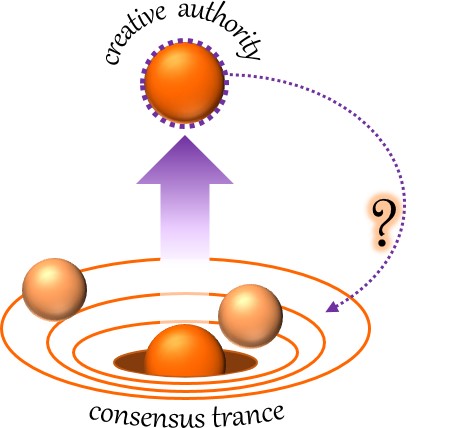
The upward sweeping arc of an orange arrow in my diagram traces our developing sense of self and reality as it comes to pivot around a separate center of personal identity named ego. Ego occupies a central position within the web of relationships that defines its tribe. Instead of regretting its arrival on the scene – which is actually a slow-and-steady construction process – and making ego the source of all our problems in the world today, we need to draw a critical distinction between a healthy ego (possessing the virtues of ego strength) and a neurotic ego. The latter is what conspires in the consensus trance.

A neurotic ego is profoundly insecure, codependently attached, and a fiercely defensive convict of those beliefs (aka convictions) shared in common with its equally neurotic alter (other) egos. In this condition and fully entranced, egos play out the scripts they inherited (codependency scripts are commonly transgenerational) or picked up in the urgency of staying in the game. Thankfully the trance condition that we regard as ‘normal’ or ‘ordinary consciousness’ is not so neurotic and even possesses sufficient strength so as to allow for the possibility of breaking-through, or what is referred to across the wisdom traditions as ‘waking up’ or simply ‘awakening’.

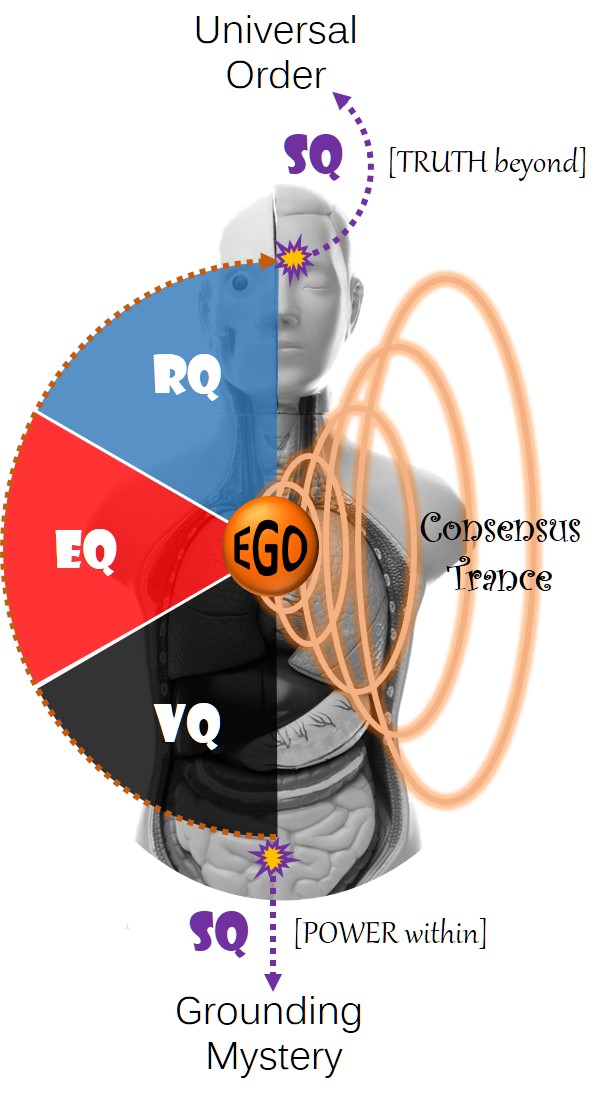
In my diagram this breakthrough is represented at two points, one below (or deeper within) the self, and the other above (or farther beyond) the self. I have elsewhere distinguished these two points and the paths they open up as the ‘mystical turn’ (releasing self to the grounding mystery) and the ‘ethical turn’ (including self in the universal order), respectively. Because the mystical turn (at least as I’m characterizing it) engages in meditation practices that assist awareness in sinking into its visceral center of power, the grounding mystery can be identified as ‘the power within’. At the other end, an ethical turn elevates awareness into its rational center of truth and inspires a radical reconsideration of morality (how we should live) in view of ‘the truth beyond’ our self-serving values.

The benefits of such practice and reconsideration should be obvious. By breaking through to life outside the consensus trance we can free ourselves from the spiritual stupor of ordinary consciousness, going on to enjoy the flow of a fully functioning quadratic intelligence. In short, we can finally become fully human.

But then … we need to go back in there! My next post will be about the challenge of staying awake and living creatively inside the webs of relationship we call our individual worlds.

Get Over Yourself

FlowWhile all the other creatures on this planet, so far as we know, develop their full potential and achieve ‘self-actualization’ in a single lifetime (given the opportunity and provident conditions), only we human beings have managed to undermine our own evolutionary progress. Why and how we do this has been a fascination of mine for some time, and over the years a theory has come together that offers an explanation. While many of the elements aren’t necessarily original with me, the unifying system is something that brings together and breaks through the limitations of other approaches.

Not surprisingly I have come with another diagram, and my returning reader will recognize all the component features from previous posts. What’s new here is not so much in the details as in the gestalt, in the whole picture of things apprehended all at once. You’ll find the familiar color codes associated with our four strands of quadratic intelligence – black for our visceral intelligence (VQ), red for emotional intelligence (EQ), blue for our rational intelligence (RQ), and purple for spiritual intelligence (SQ) – along with orange which signifies the dynamics of personal identity, or ego.

The four types of intelligence are arranged in a manner that reflects the developmental sequence in which they come online and start making significant contributions to our sense of self and reality. We begin at the bottom with the autonomic functions of visceral intelligence; open up very early to emotional engagement with our taller powers (caregivers, guardians, and teachers), siblings and playmates; and around age ten come into our rational faculty with its skills in logic, critical thinking, and conceptualization.

Even though it’s frequently in adulthood that individuals awaken to their spiritual intelligence, you’ll notice that I’ve positioned it in a way that transects the other three (instead of stacking on top). This is meant to suggest that while it certainly has (or can have) a profound influence on our sense of self and reality from very early on, the most important work of spiritual intelligence must await that crucial stage when our separate center of personal identity (ego) is strong enough to be transcended – not renounced, dismissed, or canceled out, but surpassed. Without sufficient ego strength, consciousness is unable to break past the neurotic self-preoccupation that compels us to grip down on ‘me and mine’.

Now that we’re on the ego, let’s take a moment to work out some of those details. I take the view which regards personal identity – this ego who is the center of self-esteem, world perspective, and moral agency – as a social construct and not an entity in the proper sense. Through discipline and instruction the tribe shapes our identity to be compatible (and compliant) with its shared beliefs and way of life. The nature of this shaping process anticipates and responds to the activation sequence of our quadratic intelligence.

Referring back to my diagram, you’ll see that I’ve placed key themes and concerns at each level corresponding to the developmental phases when they are dominant. Thus, in the earliest phase our visceral intelligence is dominant, making security, power, and control primary concerns that shape our deepest (preverbal) impressions of self and reality. Because even the most perfect family system cannot deliver instantaneously on our every need, we all carry some insecurity within ourselves, which we mitigate by attaching to whomever or whatever can calm us down. Attachment, love, and belonging come to overlay (and compensate for) those deeper concerns, continuing the process of our personification (or becoming a person).

By the time rational intelligence is ready to come online a lot has happened down below, in the calibration of our nervous system (VQ) and the adaptation of a relational style (EQ). We become better able to articulate the world that’s been forming around us and the perspective opening up from where we stand. Meaning, truth, and knowledge matter now to us as never before. It’s important to remember that the self-world construct – ‘who I am and what’s around me’ – is part of a social role-play, a cultural pretense of the highest magnitude that has been (not wrongfully) labeled by some, like the Buddha, as a delusion that holds our true nature under a spell, the so-called consensus trance.

Trances are all the more seductive according to the depth of our insecurity and the magnetism of attachment that we hope will compensate for it. In fact, the rational requirement for a coherent and reality-oriented philosophy of existence is all too quickly relinquished for the sake of maintaining membership in a club, class, or cult that promises to keep us safe inside the fold. This is when beliefs once held by the mind come to hold the mind captive (as a convict) to convictions that are placed beyond doubt, beyond question – beyond the probe of reasonable inquiry.

And there we have a picture of where most of us daily live: professing and defending a worldview (meaning) that protects the codependent relationships (attachment) which help us manage the profound (deep and ineffable) insecurity registered in our nervous system. With respect to that, spiritual intelligence stands little chance of awakening. If anything, its mystical intimations and transpersonal longings will be translated into doctrines of supernatural realities and afterlife destinies. Tragically many individuals today are trapped inside long-outdated (irrelevant) orthodoxies, for the sake of which they will sacrifice everything – rationality, property, fulfillment, and life itself – their own and that of ‘the enemy’.

But I can’t leave it there, with the majority caught in their convictions and the planet teetering on the brink of mass extinction. A few of us are fortunate enough, thanks to supportive families, open-minded and generous communities, our own dogged persistence toward an authentic life, and to the sheer grace of resources and opportunities made available in the moment, to arrive with sufficient ego strength that enables us to break through the self-world construct of personal identity. We don’t beat ourselves down as damned, helpless rejects, but simply let go of who we think we are, relaxing into the grounding mystery of being itself and rising into our creative authority among the countless beings that share (and manifest) this universe together with us.

When this happens – and I’m not one who believes it happens once and forever, but is rather a mode of experience that awaits our readiness to let go and our willingness to make the leap – an alignment of power, love, and truth opens us to the reality beyond ourselves. This is when ‘flow’ happens, when what we call the human spirit pulls deep on its faith in existence and reaches out to the wisdom of a universal order, where All is One.

Each of us is rooted in an unfathomable mystery and participates, whether aware or ignorant, in the turning unity of all things.

The Rhetoric of Democracy

Political Rhetoric

In fifth-century BCE Athens, the birthplace of Western democracy, the political scene was an ongoing contest between the ‘rule of a few’ (oligarchy) and the ‘power of the people’ (democracy). By Plato’s time democracy had generated more problems than it could resolve, motivating the philosopher to reject it outright as a viable model for government. Its fatal flaw, in his opinion, was in the way it put ordinary people (demos) at the mercy of politicians whose deceptive rhetoric made them believe things that weren’t true, and vote on promises they had no intention of keeping.

Ordinary people – today we might refer to it as ‘popular psychology’ – don’t live their lives by the light of clear reason as much as they follow the inclination of their strongest passions. Without training and practice in logic, argument, and critical thinking, the average voter lacks the necessary skills for teasing apart sincerity and balderdash, straight truth and clever spin, the hard way through and the easy way out.

Why in the world would we risk the enterprise of government and the future of its citizens by surrendering our fate to the most persuasive stumper?

Plato himself was in favor of what he called the ‘philosopher king’, a monarchy ruled benevolently under the wise guidance of an enlightened leader. Apparently his low opinion of ordinary folk was offset by an equally idealistic fantasy of a fully self-actualized sovereign lord. Nevertheless a benevolent dictator would still be preferable to the rule of a few (oligarchy) from the wealthy class whose policies inevitably serve their own interests rather than those of the general citizenry.

Just because you are rich and enjoy high status doesn’t mean that you are also wise, altruistic, or even all that smart.

And yet, the American story is full of great rhetoric in the speeches and writings of individual men and women whose ideas (and promises) changed the course of history. Think of the politicians and rebels, the reformers and revolutionaries, the mavericks and visionaries, the anonymous tracts and famous authors who pictured alternative realities and challenged the orthodoxy of their day, in words that stirred ordinary people to accomplish great things.

Just because popular psychology is vulnerable to agitation, inspiration, and persuasion doesn’t necessarily mean that the rhetoric of democracy should be censored.

Politicians and other individuals seeking positions of influence in society will not stop using words and conjuring images with the purpose of moving their audiences into agreement with their visions and in support of their leadership. Every speech is a construction designed on the linguistic magic of manipulating feelings, beliefs, and motivations. The words themselves, of course, but also the tone, volume, and cadence of speech; repetitions, alliterations, and metaphorical associations; body posture, gestures, and facial expressions – all of it is fashioned and delivered to make an impact and provoke some kind of change in the audience.

Instead of censoring or (as Plato would have it) outlawing rhetorical flourishes from our political candidates, we might do better to understand what it is inside us, the audience and potential voters, that gets so quickly pulled in and taken along. In the best of all possible worlds our politicians would speak to our genuine needs and interests, to our deeper virtues and higher aspirations, rather than yanking our chains to support their agendas.

I propose that my theory of Quadratic Intelligence can shed light on this question about what ‘the people’ really want and need. Once we have some clarity on that score, we will be able to tell when a candidate is trying to take us for a ride or put us under a spell – preferably before the magic goes to work on us. My diagram above illustrates the four types of intelligence (hence quadratic) that have evolved as a system in each of us, connecting them to regions of the body where they seem to be centered. For a more in-depth discussion of each type, check out The Harmony of Intelligence, Quadratic Intelligence, and What’s Your QIP?

When politicians warn us that immigration is undermining our economy, how terrorists are conspiring inside our borders, and how our security as a nation is being compromised, they are speaking to our visceral intelligence (VQ). More accurately we should say that they are using words interpreted by our rational intelligence (RQ) for the purpose of provoking strong feelings in our emotional intelligence (EQ) so as to effect a change in our nervous system (VQ) that will move us to action.

Visceral intelligence is centered in our gut, which is why the politician’s warning is experienced as upset in our stomach and intestines. This is where the resources of our environment are converted into the energy our body needs to live. VQ monitors this balance and lets us know when we might be losing the safety and life support we require. Of the four intelligences, this one is the most primitive, and when it gets poked or yanked everything higher up gets put on standby until the crisis can be resolved. Because the body’s visceral intelligence has primacy in emergency situations, the politicians know that poking our need for security will get us to pay attention to their message.

For a majority of voters, perhaps, concerns over safety and survival are not as worrisome as the daily reminder that life just isn’t going their way. Our emotional intelligence (EQ) is more attuned to what’s happening around us, to the degree in which our circumstances are either open or closed to our pursuit of happiness. To define happiness as the feeling that things are going our way does not automatically make it a selfish pursuit. Things ‘go our way’ when our relationships are positive and supportive, when we are making progress toward our goals, and when our desires, on balance, are fulfilled more than they are frustrated.

One pernicious bit of rhetoric works to convince us that something is missing from our lives, that we can’t really be happy until the void is filled. Given that our happiness seems to rise and fall on the rhythms of pleasure and fortune, politicians can easily exploit our readiness to look outside ourselves for the key to lasting happiness. (Indeed, panhandlers and snake oil salesmen perfected this technique long ago.)

They bait us by ticking down a list of things that aren’t tipped in our favor and then ask, “How can you be happy, with all this going against you?”

By this time the charm is set and we have taken the hook. That’s right! we think to ourselves. How have I been managing without this person in office?

Plato was correct in his observation that ordinary people make most of their important decisions in life on the basis of how the options make them feel. In many cases our best interest would be better served if we could just detach ourselves from the passions and exercise a little more reason instead. This ability to detach, discriminate, critique, compare, analyze, extrapolate, and consider things from a more objective standpoint is made possible by our rational intelligence (RQ).

Frankly, rhetoric of any kind is less about convincing us through the logic of argument than it is about moving us emotionally in support of its conclusion.

Rational intelligence works out our need for meaning – that things and life make sense in the bigger picture and longer view. We shouldn’t be surprised if most of democracy’s rhetoric rarely attains this level of clear-thinking consideration. If the big picture is invoked at all, it will usually be in the interest of constructing a rational frame around an emotional or visceral issue. Cut back on emissions and develop clean energy technology because our coastal cities will be underwater within a decade if we don’t – that kind of thing.

But remember, your average voter doesn’t push levers or pencil in bubbles according to sound theory or even the evidence we have in hand. (Who conducted those studies anyway?)

If the rhetoric of democracy prefers to play closer to our animal urgencies and powerful moods than to the shining logic of higher reason, it hardly ever manages to touch the dimensions of our spiritual intelligence (SQ). This is probably due to the fact that most politicians and ordinary people fail even to acknowledge its presence, much less give it priority in their lives. Of course I’m not referring here to our religious affiliations, since religion can be as dissociated from spiritual intelligence as anything else we do – oddly enough, even actively repressing it in many cases.

Our spiritual intelligence makes it possible for us to break free of our personal perspective – that is to say, of the perspective on reality that is tied to our separate center of identity as egos – and re-enter the oneness of being. If this sounds like a bunch of metaphysical gobbledygook, we must know that our separate identity is merely a delusion of consciousness, a construct that exists only in the performance space of a role-play (society) where we hope one day to be somebody and make something of ourselves.

This is in fact the (insubstantial) part of us that politicians work to recruit for votes: the part that declares, “I AM a Republican” or “I AM a Democrat,” “I AM for this” and “I AM against that.”

When we break past the delusion of a separate identity, our spiritual intelligence opens consciousness to the grounding mystery within and to the sacred universe beyond. Ego drops away as awareness descends to its Source (what I call the mystical turn), whereas in going outward it is transcended in communion with the Whole (the ethical turn). We come to understand that we are manifestations of one reality, along with everything else, and together we belong to the same.

Taking full responsibility for our place in the greater community of life is what I mean by creative authority.

Rhetoric is simply the ability to use language effectively. It doesn’t have to be deceptive or biased or tied to a party platform. Indeed the “rhetoric of democracy” might be about using language to focus our longings and lift the human spirit, to inspire a greater love for each other and for our planetary home. And ultimately, perhaps, to awaken us to the fullness of what we are here to become.

The Human Path

Full Picture EvolutionHuman beings are on an evolutionary arc, progressing individually and as a species toward a ‘self-actualized’ fulfillment of our unique nature. With all the criticisms I have already directed against the personal ego – that conceited blowhard who craves validation, praise, glory, and immortality – it might come as a surprise for me to acknowledge it as the legitimate center around and in relation to which the whole project turns.

Cloud beings, tree beings, dog beings, monkey beings: all of these are distinct manifestations (cloud, tree, dog, monkey) of a single mystery (being). But none of them have created religions designed to awaken and elevate their own deeper natures, to leverage their evolutionary leaps into higher modes of life and contemplate their communion with the universe. The haven’t because they can’t, and they can’t because they lack a separate center of personal identity from which such a grand perspective might be taken and such a magnificent program of self-transformation conceived. They lack egos.

As far as we know, only human beings have egos.

My main issue with the ego has to do with its habit of hijacking our individual development and evolution as a species, pulling it off course into a tangled thicket of odd fixations. Even religion has gotten recruited into its service, idealizing our tendencies toward pettiness, vanity, judgmentalism, and out-group aggression in a deified image of ourselves. As religion degenerates into a hierarchical system of social control, it ceases to function as a program for the transformation of human beings into self-responsible creative agents.

Especially in its absolutist theistic forms, religion is rightfully rejected as a sick and dangerous fever of neurotic self-obsession.

These arrests and setbacks in the development of ego and its religion do not warrant our blanket condemnation of them, however. Indeed if my general theory is correct, then the dismissal or termination of ego (and its religion) runs the risk of subverting the larger project of human fulfillment. To the degree that we are successful in eliminating them (convinced we are finally progressing beyond them), the absence of ego and its religion could bring our career as a species to an unhappy end.

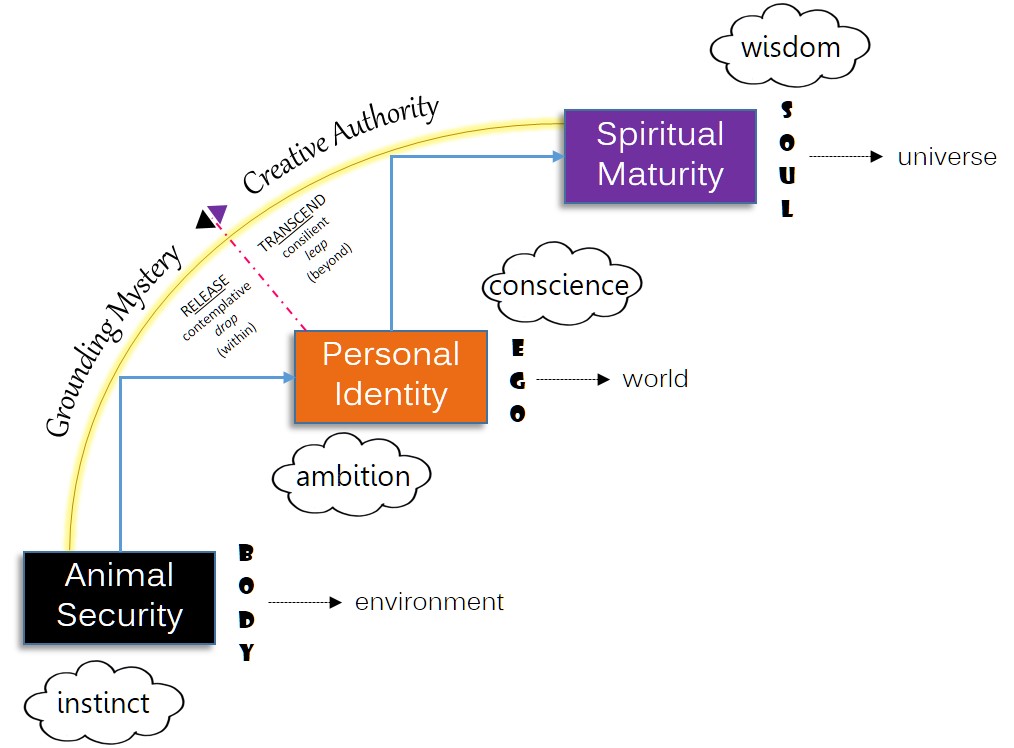
Directing your attention to my diagram above, let’s keep our eyes on that feature in the middle labeled ‘personal identity’. Rather than being the perfection and end-all of our development as individuals, the achievement of a separate center of identity (ego with its personal world) is really a middle stage between an animal prehistory submerged in instinct and a spiritual higher state awakened in wisdom. As Freud helped us see, ego management is a rather tense affair, as the individual tries to balance the ambition of ‘me and mine’ against the conscience of a tribal ‘us and ours’.

Somewhere in that tension the individual ego needs to maintain membership (as ‘one of us’) while also honoring the inner promptings of the higher self. If a tribe supports the emergence of creative authority in the individual, then a transformative breakthrough of this order will be encouraged and celebrated, rather than condemned as it often is in repressive social systems.

This is typically where that deified superego of the tribal deity is used by the group to denounce, quash, and uproot the ‘sin’ of vainglorious self-regard – a character trait which, oddly enough, is protected as belonging by exclusive rights to the deity.

But the ego brings its own resistance to the project of human transformation. A good number of those ambitions are formed around the drive for security, a frequency of nervous state that correlates to an environment perceived as safe and supportive. Because none of us gets through infancy and early childhood without some insecurity, our focus gets set on attaching ourselves to those anchors and sources of security that will keep things from falling apart.

As we go, we construct our web of personal meaning (i.e., our world) around these anchors and sources, incorporating them into our identity and way of life.

It’s no wonder, then, that what I earlier called the inner promptings of our higher self, to break through the attachments that comprise for us the emotional structure of reality, might be strenuously resisted by the ego. To the degree that animal security finds significant compensation in personal identity, further progress of development into spiritual maturity will be felt as heading in exactly the wrong direction. Such a ‘breakthrough’ would be tantamount to a ‘breakdown’ of security, control, order, and meaning – the very death of ego!

One strategy often used in justifying ego’s resistance involves lampooning spiritual maturity as not only heretical, but as also a blatant refusal of personal responsibility. For ego to maintain membership in the social system of attachments, an individual needs to uphold certain moral obligations and subordinate his or her own needs to the will of the group. Any sign of the individual’s loosening allegiance to tribal rules and orthodoxy – asking too many of the wrong questions, expressing doubts and misgivings, pushing on boundaries or challenging assumptions, feeling empathy for outsiders and voicing an interest in the broader concerns of life on earth – such potential disruptions of the consensus trance are quickly discouraged as forsaking what is true, right, and good.

When an individual possesses sufficient ego strength (where the personality is stable, balanced, and unified) and the time is developmentally right, an access point will open from the realm of personal identity, to a mode of conscious life momentarily free from the constraints of ‘me and mine’/’us and ours’.

Once the breakthrough is gained, an upward turn along the arc will involve a self-transcending leap beyond identity, while a downward turn from this same point proceeds by a self-releasing drop beneath identity. This inward-and-downward turn is also the mystical turn where consciousness sinks back contemplatively into the grounding mystery and ineffable source of our being. The upward-and-outward turn is the ethical turn where consciousness rises into our creative authority as agents of a higher wholeness, consilient leaders on the advancing wave of evolutionary change.

My stair-step diagram could be interpreted as anticipating a future state of spiritual maturity where ego (that troublemaker) has been finally outgrown, discredited, and permanently left behind – along with its religion. But by now it should be clear that according to this theory ego plays a much more integral role in the longer project of human self-actualization.

Even though it is purely a social construct (and substantially unreal, as the Buddha noted), the delusion of our separateness (which is a function of ego consciousness) is the very thing all higher religions provide insights and techniques for breaking through.

What’s Your QIP?

Quad Intel GridOne of my innovations in the field of human psychology is the notion of Quadratic Intelligence. Expanding on recent theory and research has helped us beyond the early 20th-century notion of intelligence as only our (IQ) competency in reading, writing, and arithmetic – the so-called academic set. Opening the definition of intelligence so as to include emotional (Goleman, 1995), spiritual (Zohar & Marshall, 2000), and less conscious body processes has liberated discourse on the subject from a crippling Western bias where intelligence equals computation, logical operations, and problem-solving acumen. My insight has to do with seeing these four types of intelligence – Rational, Emotional, Spiritual, and Visceral – evolving together as a system, unfolding in sequence (V-E-R-S) and interacting dynamically throughout human development.

Before we move into the diagram and take a look around, one other general comment is in order. Not only has the West tended to favor rational processes over others, but it also has a long tradition of ‘impersonating the soul’, by which I mean that the center of spiritual intelligence, or soul, has been taken as another name for the separate center of personal identity, commonly called ego (Latin for the first-person singular “I”). This is likely a complication of our deep history in theism, where the formation of personal identity as represented in the deity and managed in the devotee is a prevailing focus of concern.

An unfortunate consequence of this confusion is a tendency to associate spiritual intelligence (SQ) with ‘psychic’ abilities, out-of-body experiences, metaphysical visions, and special access to the supernatural. It has also perpetuated an unhealthy dualism that conceives the human being as a body with a soul or a soul inside a body – in either case a deeply divided being.

A sick religion that capitalizes on this dualism is obsessed with getting the captive soul safely to its heavenly home, free and far away from the mortal body. Just about everything connected to our physical life as animals – our drives, appetites, proclivities, and secretions – has been put under one taboo or another, as despicable vices that threaten to drag us into hell.

So when I speak of spiritual intelligence I am referring to that strand of quadratic intelligence that gives human beings our distinctive creative ability – to imagine, compose, invent, and in various ways transcend the boundaries of our present situation. Soul, then, is not an immortal entity riding temporarily inside a mortal frame, but the very center of this creative intelligence. By extension, spirituality is not only about breaking out and escaping our limitations, but transforming them by virtue of a new perspective, attitude, and mode of life.

What I call ‘creative authority’ is this very mode of life whereby individuals take responsibility as creators of the identities, worlds, and relationships that either facilitate or frustrate the realization of their own higher selves and those around them.

Just as our thinking mind is no more important to what we are than our feeling heart, neither is our spiritual soul any more special and sacred than our animal body. While our consciousness may be characterized by an inherent duality – introverted to the intuitive-mystical realm within and extroverted to the sensory-physical realm without – we are fundamentally indivisible in our essential nature as spiritual animals.

After insisting on the integral unity of our quadratic intelligence I can move on to make the point that each of us develops and demonstrates the four types in individual ways that are unique to our genetic temperament, early upbringing, surrounding culture, pressing concerns, and evolving character. This is where my diagram comes in.

Let’s start with a question. From the following four options, which term best describes your preference for orienting and navigating your way through life: strategy, inspiration, sympathy, or common sense? Here are the definitions.

Strategy

You prefer to make plans, set goals, and work through a sequence of tasks that lead where you want to go. This preference suggests that you tend to favor reasonable and creative approaches to the challenges and opportunities of life. If you self-identify as preferring strategy, then you might further refine this preference as leaning more to the rational (RQ) or spiritual (SQ) side. In other words, strategy could be more about detaching from your subjective feelings and staying on course with a prescribed plan, or the value might lie more in how it enables you to transcend the way things are and bring about a ‘new reality’. The unifying idea is the way strategy clarifies and prescribes an overarching purpose in what you do.

Inspiration

You seek out experiences that ‘breathe in’ (inspire) greater joy, beauty, and wonder that will enrich your life. This preference suggests that you tend to favor creative and passionate endeavors which connect you to something much bigger than yourself. Depending on how you lean into inspiration it might be more about this feeling of engagement (EQ), or perhaps you would describe it in terms of an inner release and going beyond (transcending) the bounds of ordinary awareness (SQ). It isn’t necessary to postulate a supernatural or metaphysical source behind the experience of inspiration. It simply represents the cooperation of your emotional and spiritual intelligence in taking in ‘something more’ – the whole that is more than the sum of its parts (think of the artistic image that ‘comes through’ the patterns of color in a painting, or the gestalt that rises through the harmonies of individual instruments of an orchestra).

Sympathy

I’m using this word in its classical sense, as a resonant response between and among things of similar nature. It certainly takes on an emotional character in the realm of human relationships, in the way individuals are ‘moved’ by the mysterious forces of attraction, empathy, and aggression to match each other’s mood. If sympathy is what orients and motivates you through life, then you tend to go with ‘how things feel’ or ‘what feels right’ in the moment. Leaning more on the side of EQ, this is typically experienced as a refined feeling that may prompt secondary reflection, whereas a stronger anchor in the unconscious reactions of the body (VQ) will evoke a more spontaneous behavioral response. Sympathy is the emotional and visceral basis of our more ‘elevated’ intuitions of compassion and empathy. As distinct from them, sympathy is something we feel in our heart and sense in our gut, often as an ineffable reaction occurring prior to any conscious reflection or ethical resolve.

Common Sense

Our ‘common senses’ refer to the five sensory-physical modes of perception – sight, hearing, smell, taste, and touch. If this is your preference for orienting yourself in reality, then these sense-data serve as the foundation of reliable knowledge. Just as your visceral intelligence (VQ) anchors consciousness in the organic urgencies of life (e.g., the compulsive urge to breathe), your physical organs of perception tether attention to what we might call the realm of the obvious. The modern school of philosophy known as ‘common sense realism’ (Thomas Reid) shows how this preference can lean strongly to the rational (RQ) side, where even the detachment of our logical mind only infers and constructs from the information apprehended first through the senses. If you are a common sense realist, then you likely insist that truth must derive from, and ultimately come back to, the reality of perceivable facts.

My Quadratic Intelligence model allows us to appreciate the multifaceted nature of human intelligence, and helps as well in the need to expand our definition of it beyond one type of intelligence or another. The concept of preference (strategy, inspiration, sympathy, or common sense) can also rein in a tendency to arrange these types of intelligence in a (personally biased) hierarchy of importance. For example, although spiritual intelligence comes online later (i.e., farther into maturity) than visceral intelligence (which is active in the very beginning of fetal life), this doesn’t make it ‘better’ or more essential to what we are as human beings.

Indeed there are plenty of examples where our spiritual ability to go beyond (transcend) what is given has inspired individuals to abandon their connection to everyday reality for apocalyptic and otherworldly speculations, which are then professed as divine revelations by these ‘visionaries’ who use them to draw notoriety, influence, and profit.

You might struggle at first in closing down on just one preference over others. As well you should, since all of these are at least potentially active in your quest to make sense of reality, connect meaningfully to those around you, and become fully human. Consider arranging all four preferences in an order that reflects your personal Quadratic Intelligence Profile (QIP). Such an exercise might suggest areas that could use more attention and training, to develop yourself in a more well-rounded fashion – although a ‘perfect balance’ among the four preferences should probably not be a goal.