The Shining Way

Religion tends to be different from a mere philosophy of life in its claim to offer a way through, out of, or beyond what presently holds us back or stands in the way of our highest fulfillment. In the genuine traditions of spirituality, such a solution avoids the temptation of either an other-worldly escape on the one hand, or on the other a do-it-yourself program where individuals must struggle to make it on their own. It’s not only a perspective on reality that religion provides, then, but a way of salvation – a path in life that leads to and promotes the freedom, happiness, connection and wholeness we seek as human beings.

Our tendency today is to regard the various religions as spiritual retail outlets, each putting its program on offer in competition for the consumer loyalty of shoppers – in recent decades called seekers or the unchurched. As we should expect, each name-brand religion has terms and conditions that are unique to its history and worldview. In addition to its characterization of what we need to get “through, out of, or beyond,” each religion has its own individualized set of symbols, key figures, sources of authority, and moral codes that members are expected to honor.

Muhammad and the Quran are not featured in Christianity, and neither are the teachings of Jesus or Christian atonement theories studied in Buddhist temples. The halacha and mitzvah of Moses are not among the devotional aspirations of a Native American vision quest, nor is zazen practiced in Islam. When we view the religions according to what makes them unique and different from each other, the way of salvation seems like it must be one choice among many.

In face of such confusion, perhaps secular atheism has it right: Do away with religion altogether and the world will be a better place for us all.

If you care to study religion more deeply, however, you will understand that it (in all its healthy varieties) is a sociohistorical expression of something much more profound. Here the terminological distinction between religion and spirituality is helpful, so long as we can resist setting these against each other, as when religion becomes “organized religion” and spirituality gets relegated to one’s individual quest for inner peace or mystical insight.

Religion and spirituality go together – and always have – in the same way as the vital life of a tree goes with the material structure of its roots, trunk, branches and leaves. Our own inner life is always (and only) inner to an outer mortal body. These are not two things that can be separated, but two aspects of one reality distinguished in a fuller understanding.

The questionable doctrine of the immortal soul notwithstanding, this dynamic unity of two aspects (inner essence and outer expression) cannot be divided. Not only do “inner” and “outer” imply each other logically (i.e., in thought), they are inseparably united ontologically (i.e., in being) as well.

It’s not as if the inner life of a tree can exist outside and without the support of its physical system. Nor can the inner life of soul persist absent the body; it is inner only to a whole self, not as one part that can be separated from another part. In the same way, religion without spirituality is dead, but spirituality cannot exist without embodiment in religion. Religion comprises the symbols, stories, beliefs, rituals, and practices that embody the spirituality of individuals in community. Such expressions or outer forms can be highly relevant and effective in what they do, serving to channel the essence or inner life of spirituality into our shared experience.

But these forms can also fall out of alignment and lose relevance, as when the model of reality (cosmology) serving as backdrop to early Christian myths shifted by virtue of scientific discovery from a three-story fixed structure to an outwardly expanding universe. This cosmological shift gradually rendered the sacred stories – of angels descending, a savior ascending, the Holy Spirit descending, the savior descending again, and the company of true believers ascending at last to be with god forever in heaven – literally nonsense. Or at least nonsense if taken literally.

Unfortunately, when religion is sliding into irrelevance, believers, at the admonition of their leaders, can start to insist on the literal reading of sacred stories. If the savior did not literally (that is, factually) go up to heaven and will not literally come back down to earth, and very soon, what becomes of these stories, the canon of scripture, and to the entire tradition of faith? Since a “true story” must be based in fact, and facts are properties of physical reality, then these stories must be literally true or not at all. When this error in narrative interpretation finds a footing in religion, the whole enterprise starts to close in on itself and the lifeline to a deeper spirituality is lost.

If we were to open the religions again to the wellspring of spirituality we would witness a renaissance of creativity, meaning, and joy across the human family. The culturally unique elements would be appreciated as eloquent “styles” in the expression of our inner life as a species, flourishing in fertile niches of geography, history, tradition, and community.

The metaphorical narratives of mythology is where spirituality first breaks the surface into cultural expression. By looking through these narrative expressions, deeper into the unique and culture-specific elements, we can discern what I will call the “Shining Way” of salvation. Again, I’m not using this term salvation as a program of world-escape but instead as a guiding path towards our fulfillment and well-being as individuals, communities, and earthlings. As I’ve tried to unpack the finer details in many other posts of this blog, here we will only take in the big picture and broad strokes of this Shining Way.


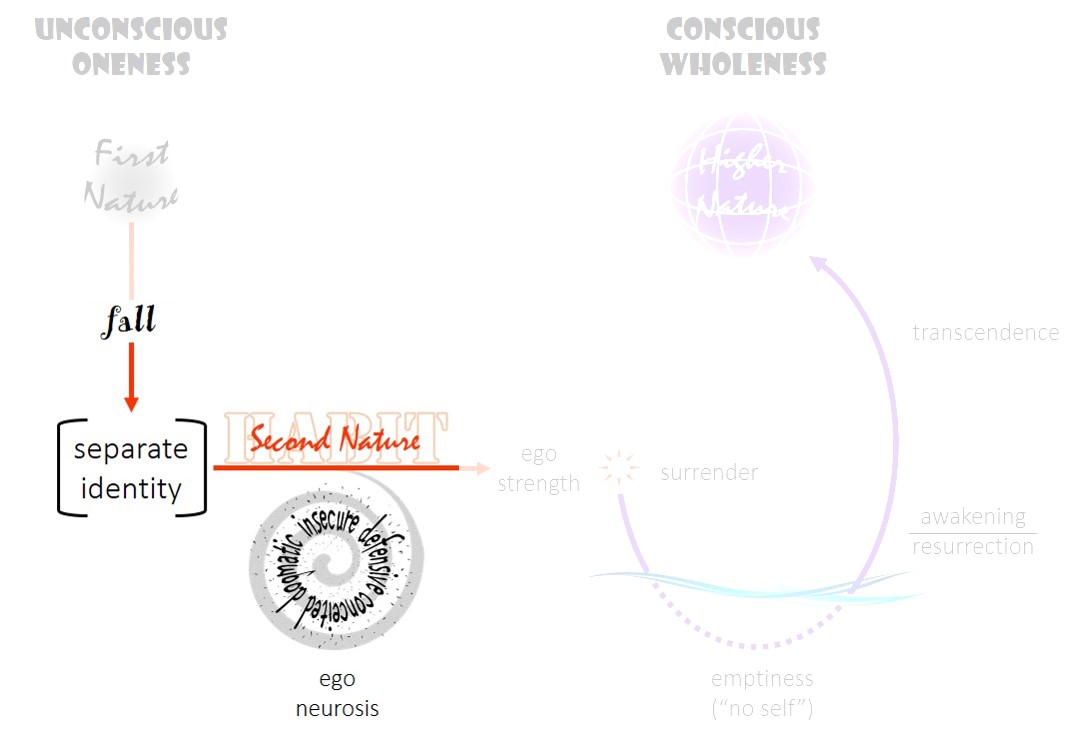
We begin life in a state of unconscious oneness, where our individual consciousness is yet undifferentiated from the provident environments of mother’s womb and the family circle. This is the state depicted in myth as a garden paradise, where every requirement of life is spontaneously satisfied and reality is fully sufficient to our needs. Consciousness is completely anchored in the synchronicity of the body’s urgencies and the enveloping rhythms of providence. We call this our ‘first nature’ since it is what ushers us into the animal realm of instinct, survival, and the life-force.

It was out of this unconscious oneness that our individual identity gradually emerged and gained form. What we call our ‘second nature’ consists of the habits – the routines of behavior, feeling, and belief – that our tribe used to shape us into a well-behaved and obedient member of the group. This is a period of growing self-consciousness, of sometimes painful experiences of separation from the earlier state of immersion where we felt enveloped and secure.

In mythology it is that fateful transition away from oneness and into a separate center of personal identity known as ‘the fall’. Paradoxically it is at once both a loss and a gain, a fall out of unconscious oneness and an exciting entrée to a self-conscious existence.

As our second nature, ego ideally develops increasing strength, particularly through the formative years of childhood. Again ideally, we will arrive at a point where our personality is stable (based in a calm and coherent nervous state), balanced (emotionally centered), and unified (managed under an executive sense of who we are) – the key indicators of ego strength.

I have to insert that ominous qualifier ‘ideally’ because ego consciousness doesn’t always advance in the direction of our creative authority as individuals. If our mother’s womb and early family circle were not all that provident – subjecting us to dangerous toxins, stress hormones, abuse or neglect – and because we inevitably make some poor choices of our own, ego can get stuck in a closing spiral of neurotic self-obsession.

As I have explored in other posts, theism is a form of religion that features the super-ego of a patron deity who authorizes a tribe’s moral code and serves as its literary model in the character development of devotees. Theism is a necessary stage in the evolution of religion, just as ego formation is a necessary stage in human development. But just as ego needs to eventually open up to a larger transpersonal mode of consciousness (we’ll get to that in a bit), a healthy theism must also unfold into a larger post-theistic perspective.

Ego and patron deity co-evolve, that is to say, and when ego formation goes awry, theism becomes pathological. Now you have a social system that is both a projection of ego neurosis and a magnifier of it throughout the collective of like-minded believers.

A neurotic ego is deeply insecure, defensive around that insecurity, conceited (“It’s all about me”), and unable to think outside the box of belief (i.e., dogmatic). Not surprisingly, these traits find their counterpart in the portrait of god among pathological forms of theism. Ironically, while these forms of theism tend to glorify separation, aggression, and violence in their concepts of god, on the Shining Way of salvation these are seen as the source of our greatest suffering.

But let’s get back to the good news.

When ego strength has been achieved in our second nature, we are able to surrender our center of identity for a larger and fuller experience of life. In Christian mythology, this release of the personal center is represented in the scene where Jesus surrenders his will to a higher calling and commits his life on the cross into the hands of a compassionate and forgiving god.

NOTE: I’m keeping the action in the present tense because the myth is not primarily an account of the past, but rather an archetypal representation of the Shining Way. As archetype, Jesus in early Christian mythology is not merely a historical individual of long ago, but represents humanity as a whole. He is, as the apostle Paul recognized, the Second Adam or New Man, the turning point into a new age.

When we surrender our center of personal identity, consciousness can expand beyond the small horizon of “me and mine.” What we come to is not a larger sense of ourselves but, as Siddhartha observed, an awareness of ‘no-self’, an experience of consciousness dropping the illusion of separation and ego’s supposed reality. What the neurotic ego would certainly regard and strenuously resist as catastrophic oblivion is experienced instead as boundless presence.

Such insight marks the breakthrough to unity consciousness and is represented in myth as the Buddha’s earth-shaking affirmation under the Bodhi tree, and as the resurrection of Christ from the dead.

According to the Shining Way, liberation from the habits and conditions of our second nature leads us by transcendence to our higher nature. We have progressed in our adventure, then, from a primordial unconscious oneness, through the ordeals and complications of self-consciousness, and with the successful release of attachments we come at last to the conscious wholeness of body and soul, self and other, human and nature.

If we’re going to work this out, we will have to do it together. There is no other way.

The Weights of Truth

Most of us, most of the time, don’t really grasp the fact that we are continually constructing the meaning of life. A naïve perspective assumes that meaning is something ‘out there’ in reality to be searched out, discovered, and assimilated into our view of things. So, even though constructivism has been in our cultural consciousness now for well over a hundred years, the overwhelming majority of us don’t accept it as a valid statement concerning the nature of meaning and our mind’s role in making life meaningful.

In our day particularly, rationality has gone out of fashion. Our social agreements and personal beliefs are based on other sources and foundations, not so much on whether our explanations and reasons are very reasonable.

It’s of critical importance, then, that we take some time to dig into this question of truth and how we construct the meaning of life. As a tool I have designed what I call “weights of truth,” organized as a pyramid of sources and foundations, with each level building on ones underneath it and in turn serving as a basis for those higher up. By “weight” I mean that we tend to rely more (deeper levels) or less (higher levels) on the various sources and foundations; that is to say, we give them more or less weight in our construction of meaning.

Let me start by defining each weight (or level), and then we can come back to look at how this relates to a couple enterprises of culture that frequently contradict each other – at least in our time. Science and religion don’t have to compete for our loyalty, and for the longest time they actually complemented each other in constructions of meaning known as the distinct worldviews of human culture. After we have clarified the various weights of truth, I’ll make a case for how science and religion might once again cooperate towards a larger and more relevant meaning of life.

Experience

When the individual senses, perceives, or undergoes something we say that he or she has an experience of it. As we all know, these senses and perceptions are not always (or even all that frequently) reliable representations of reality. There is a subjective quality to experience that makes it finally impossible to verify whether two individuals in the same situation are really undergoing the same thing. Experience is notoriously mercurial and inescapably biased. And yet we rely on it all the time to determine what is true and meaningfully relevant in what’s going on.

Included in this category are the profound and essentially ineffable assumptions we carry from our prenatal, newborn, and early childhood period. Way back then our brain was calibrating our body’s internal state according to its sense impressions of the environment. Mother’s womb, the family circle, and our material surroundings conspired to form in us a nervous state that would maximize our chance to survive and grow. A warm, nurturing, enriched, and supportive environment strengthened a sense of reality as provident, benign, and friendly. In contrast, a toxic, hostile, and abusive environment signaled our nervous system to assume a state of anxiety, hypervigilance, and chronic distress.

I give the greatest weight to experience precisely because everything else in our construction of meaning is built upon this baseline nervous state formed in our early days and years of life. As already suggested, its ineffability – the fact that we can’t fully find the words to articulate how we’re feeling at this level – is due to its formation prior to our acquisition of language. Consequently, experience is where the articulate mind sinks into the literally unspeakable urgencies of the body. To us, this is very simply (and indisputably) the ways things are. As we look out on reality, our nervous system is filtering out and focusing in on whatever confirms a visceral sense of what truly matters.

Testimony

By testimony I mean the words and witness of other people. It is positioned deep among the weights of truth because our worldview, as a construction of meaning, borrows heavily on the authority of those we depend on and admire. For reasons that don’t need to be explained, our baseline nervous state in early life seeks and finds confirmation in what our taller powers tell us about the nature of reality. Taller powers who abuse or neglect us are more likely to hold beliefs that represent life as “nasty, brutish, and short,” just as provident taller powers tend to speak of reality in more positive and optimistic terms. In this way, their nervous state literally spoke to our nervous state and we joined the trance.

In essence, testimony is less about the factual accuracy of what is said than the trustworthy character of a witness. That’s why testimonies in the courtroom are validated or impeached on the basis of how honest and truthful a witness is made out to be. Particularly in religion, the unimpeachable authority of witnesses who attest to revelations whereby a higher truth was made known to them is a powerful shaping influence on the worldview of believers. They – or more accurately, their words as preserved in scripture and tradition – either confirm what believers already sense or hope is true, or else the authority of their witness might persuade nonbelievers to convert.

Rhetoric

The power of language in shaping thought, evoking feeling, and confirming or persuading belief is what we call rhetoric. The ancient tradition of Greek rationalism elicited suspicion in the philosophical establishment towards those (called Sophists) who used language to stir the emotions and entrance an audience, rather than challenging students to think in clear and distinct ideas. Rhetoric goes very naturally together with testimony, since it’s not typically the rationality of what someone says that pulls us over to their side, so much as how they say it.

Thus charisma, speech-craft, pitch, volume and the cadence of words spoken (along with posture, gestures, and body language) are most often what persuades us, more so than the coherence, soundness, or realism of what is said. Indeed, if we have to determine the truth-value of someone’s testimony, we will check it against how trustworthy the person is before we bother checking the facts. It may well be that our susceptibility to rhetorical entrancement goes back to the sing-song voice of our mother that so effectively calmed us down and put us to sleep.

Evidence

Evidence is how reality presents itself to our senses. We detect something ‘out there’ and focus our perception in order to establish its objective status. Evidence is not how something feels to us or what it seems to be like, but what it is as determined through our observations of it. Despite this virtue of objectivity, however, we still find it necessary at times to distinguish between strong evidence, which is based in the way things really are, and false evidence that can lead us to believe something that isn’t really a fact at all.

For example, before Copernicus the cosmology of most people took the observation of the sun arcing across the daytime sky as evidence of Earth’s stationary position at the center of everything. They really were seeing the sun moving, although what they saw wasn’t really the sun moving. It was false evidence, and it took Copernicus, Galileo, Kepler, Brahe, and a few other astronomers to finally convince most of us that in reality it’s the earth that moves around the sun. Western science has been a wildly successful enterprise in exposing false evidence and verifying strong evidence.

Logic

My last weight of truth in the construction of meaning is logic, another element of language but more about the connection and coherence among the thoughts that words represent than the craft and persuasive power of speech. We can regard science as a research discipline (or system of disciplines) that is constantly working towards the most rational explanation of empirical observations gained through specialized instruments and meticulous observation in the field or laboratory. The terms rational and empirical acknowledge the two principal traditions of philosophy (rationalism and empiricism) that have shaped our Western mind and worldview.

In other words, science isn’t and cannot be only about evidence – just the facts, as we say. It too, like religion and culture in general, is involved in the process of constructing meaning. Digging up fossils, splitting atoms, and organizing data must eventually flow into an exercise of theory-building, which is itself a special kind of storytelling but without the spell of rhetoric. No doubt, the success of science has everything to do with its commitment to doubting experience, setting aside testimony (e.g., “We believe it because Copernicus said so!”), completely replacing rhetorical flourishes with mathematical terminology, and bringing only the strongest evidence into theoretical patterns and predictions that can withstand rigorous controlled experiments.


Science and Religion in the Construction of Meaning

At the beginning of this post I alluded to that complicated relationship between an enterprise (science) dedicated to keeping our constructions of meaning as logical and evidence-based as possible, and one (religion) that is much more interested in reality as the provident, creative, and benign mystery in which we have our existence. For millenniums these two enterprises – one looking out and around to the turning unity of all things, and the other looking within and beneath ego to the grounding mystery of being itself – collaborated in the construction of worldviews that guided the lifeways of both indigenous tribes and great civilizations around our planet.

Instead of a Great Chain of Being as proposed by esoteric philosophies, I am suggesting that what really held these constructions of meaning together and made them work was something closer to my weights of truth and the continuum of meaning they comprise.

But when the theoretical framework of reality as articulated by science started to shift toward stronger evidence and more rational explanations, the sacred stories of religion couldn’t adapt as quickly. They continued to assume a three-story universe in the background of their sacred narratives, while science was revealing a very different cosmic order. In the attempt to save its myths, religion insisted on their basis in fact (evidence), drawing on the words of infallible witnesses (testimony) who had walked with gods, encountered angels, and touched the savior with their very hands.

Today many devotees and true believers are trying desperately to keep science in service to religion, arguing for creationism, supernatural agencies, historical miracles, and a world beyond this one. But it won’t work – it can’t work, for the straightforward reason that its claims are rapidly losing currency, credibility, and relevance in contemporary life. It could be argued that our dogmatic insistence on the truth of obsolete and collapsing constructions of meaning is what is driving religion to fanaticism these days, at the same time as many disillusioned former believers are quietly slipping out of the sanctuary.

By positioning religion deeper in the pyramid of weights I am making a case for interpreting its mythology as poetic art, representing in metaphor an experience of the present mystery of reality, and preserving its testimony through the tradition of generations. Rather than journalistic accounts of supernatural beings and miraculous deeds from a golden age of salvation history, its sacred stories serve to orient human existence – right now – in the great web of life and the adventure that each of us must take on, of waking to our higher nature and giving back in gratitude.

Forgiveness and Our Way Forward

Human beings are an unfinished species, both in the sense of having some rough edges and in having a potential that is not yet fully actualized. At different times in history our immaturity has pushed us to the ledge of suicide where we almost gave in to an either/or, all-or-nothing wager on destiny. Thankfully the better parts of ourselves pulled us back for a second thought.

Today we live in one of those times.

Most likely it isn’t disease, starvation, or over-population that will be our undoing. One thing that our growing population is forcing on us, however, is the challenge of learning how to get along and work together for the maximal benefit of all. As our living quarters become more crowded and the crowd becomes more diverse, we are confronted as never before by our differences. Strangers and outsiders have always threatened our neat, closed horizons of identity and mutual trust. We can get along with what we know, with others like ourselves. But with those we don’t know, or who have a different worldview and way of life from ours – what are we to do with them?

The great traditions of spiritual wisdom developed their distinctive visions around this challenge of getting along, particularly at the flashpoint of our differences. Whether it was the ideal of covenant fidelity introduced by Judaism, the universal compassion that awakened Siddhartha and became the central insight of Buddhism, the radical message (gospel) of unconditional forgiveness that Jesus lifted into our collective consciousness, or the ideal of full surrender to the divine will beyond our constructs of god that brought Muhammad to his knees – the initiating provocation in each case was a quest for the way of salvation, for a way that leads to genuine community.

Obviously I’m not using “salvation” in the popular sense, as a program of deliverance, escape, and everlasting security in the next life. The word literally refers to a process (spontaneous or gradual) whereby injury is healed, health is restored, division is repaired, hope is renewed, and wholeness is actualized.

If salvation in the history of religion has been mythically and metaphorically represented as being set free, made clean, pardoned from guilt, and saved from certain perdition, the deeper energizing concern has always been over the forces within us and between us that keep us out of paradise, locked up in our suffering, and tragically short of our higher ideal.

As long as human beings have been around we’ve lived in societies – from small clans and larger tribes, to neighborhoods and nation-states. And so, for that same period of time we have had to learn how to get along, work through our differences, and contribute creatively to the formation of genuine community.

I’ve used that term – genuine community – a few times now, so it demands some definition. What I mean by it is a certain qualitative and transformational shift that happens when individuals in partnership make an empathetic connection and experience a deeper communion. Out of this grows a shared intention, a cooperative spirit, and a common vision of their life together. In other words, community is not just a synonym for “assembly” or even “congregation, and it doesn’t just happen. Instead it must be created – cultivated, nurtured, fortified, and regularly renewed.

And that’s where forgiveness is important.

I should really say, that’s where forgiveness is essential, since without it a strained or broken relationship cannot heal and continue to grow. Let’s take a closer look at what happens when the bond of trust at the heart of a healthy partnership is ruptured. Or maybe the partnership was never healthy to begin with. How can you – we might as well make this personal – be an instrument of salvation where there presently is abuse, betrayal, misunderstanding, or estrangement? Although none of us is off the hook as perpetrators in causing harm to others, for now we will pretend that you are the victim.

Whenever you are injured, offended, or betrayed, you will notice – if, that is, you can manage a little introspection – that two impulses arise simultaneously in you. One is the impulse of anger: You didn’t deserve this, it’s not right, that other person is guilty and should pay the price for his or her sin. I’ll call this the vengeance impulse, and as it rises within you in reaction to what’s been done to you by that other person, your anger is preparing to fight back and get even.

The other impulse is fear, which I will call the avoidance impulse. You don’t want the hurt to happen again, so your survival strategy marks a quick departure and takes long detours to keep it from happening again. As long as you maintain your distance and avoid crossing paths with your enemy, you stand a chance of staying safe. Because getting even will likely provoke further assault and additional suffering, your fear might be regarded as the wiser of these two impulses. Just cut this person out of your life. Push him away, leave her behind. You deserve better.

The thing about vengeance and avoidance that you need to understand is that they don’t lead to community. In fact they are serious digressions from what I earlier called the way of salvation.

Getting even or running away actually destroys the conditions in which genuine community can flourish. Think about it. When has the retributive reflex, where vengeance “pays back” hurt for hurt, worked out to the satisfaction of both sides involved? The vengeance impulse will wait for its opportunity – whether it’s tomorrow, next year, or three generations from now. The score will be settled: that’s just the way vengeance works. And running away or hiding out? How can individuals learn to live in community if they are living in separation?

This is the question that Jesus pondered. For our future to be long, prosperous, and happy, human beings can’t keep trading violence or seeking refuge from each other. We have to get along. We must learn how to create genuine community. And everyone needs to be included – the stranger, the outsider, especially our enemy. It was his focus on this particular relationship between enemies that inspired Jesus to understand, profess, and exemplify a new way.

This is the way of unconditional forgiveness. And even though his message got buried underneath centuries of Christian orthodoxy that took his movement in the exact opposite direction, this gospel of Jesus is finally being heard again.

Let’s come back to the very moment when your friend, or someone you trusted, became your enemy. No doubt, our most significant enemies are not those on the other side of the world, but who share our bread, our bed, and maybe even our genes. We opened ourselves up to them and made ourselves vulnerable. We trusted them, and they took advantage of our trust. There you are. What will you do next?

If you let your anger or your fear determine what you do next – whether you allow vengeance to make you into a combatant or avoidance into a defector – you will be giving power to your enemy, for the simple and straightforward reason that your identity in that moment is defined by what they did to you. Your attitude, character, and behavior will be decided in reaction. If you get even, it is in reaction. If you pull away, it is in reaction.

In either case, you are allowing your enemy to define you and limit your options. Fight back or get out. What other choice is there? This is where Jesus saw a third option.

Not as a reactor and giving power to your enemy, but by getting centered in your true nature as a creator. Picture that flashpoint immediately following the moment when the injury, offense, or betrayal takes place: let’s just call that “the space” between you and your enemy. As a creator, your challenge is to step into that space, stand your ground, and demonstrate love.

The ‘standing your ground’ part sounds as if you should be preparing for a fight, but that’s not what Jesus meant. When he counseled his disciples, “If someone slaps you on the right cheek, turn your other cheek to him as well” (Matthew 5:39) he was not suggesting that they should just submit themselves passively to violent treatment by others. For a right-handed assailant to slap your right cheek, he’d have to use the back of his hand. This is how an aggressor intends to humiliate you and put you in your place. In order to “turn the other cheek” you would have to straighten up again and face your assailant, asserting yourself as his equal.

It is well known that Mahatma Gandhi found inspiration for his nonviolent resistance to British rule in this very passage from the teaching of Jesus. Later, Martin Luther King, Jr., himself a Baptist pastor who was additionally empowered by Gandhi’s more recent example, took it to the urban streets for the sake of race equality and human rights.

The message of Jesus was not a glorification of weakness and suffering; his was a gospel about power – specifically about the power of love.

So you step into that space, stand your ground, and then demonstrate love. I say “demonstrate” because chances are, you probably don’t feel much love for your enemy. He just hurt you; she just betrayed your trust. Your anger and fear are both very real. The point here is not that you should have gooey compassion and warm fuzzies towards the one who just “slapped you on the right cheek.” To demonstrate love is to act out the behaviors of love – even if you don’t feel very loving. What are those behaviors? You probably already know:

Love is patient; love is kind; love is not envious or boastful or arrogant or rude. It does not insist on its own way; it is not irritable or resentful; it does not rejoice in wrongdoing, but rejoices in the truth. It bears all things, believes all things, hopes all things, endures all things. – 1 Corinthians 13:4-7

In the spirit of fake it till you make it, demonstrating love in such ways eventually brings about two very interesting outcomes. First, your anger and fear dissolve away, and in their place arises a creative force that has no equal in all the universe. This force is the bond of partnership, community, and wholeness. A second outcome is that you will completely “disarm” your enemy. Where he was inwardly preparing for your vengeance or avoidance, your forgiveness removes the fuel for his fire, and it won’t be long before he loses all confidence in his power over you.

Forgiveness, then, starts in letting go (the literal meaning of the Greek word) of anger and fear. Jesus taught that it is really not about pardoning sin or absolving guilt. It may be the case that your enemy doesn’t even see the need to repent, and perhaps doesn’t care enough about you to make the effort. Forgiveness doesn’t always lead to reconciliation. He may need to be held accountable for the damage he’s done, but it won’t be about appeasing your anger. You may need to move out of the relationship and get on with life without her, but it won’t be as a victim of fear.

You are free, and that’s what matters. Genuine community is where individuals are learning to live together, in the freedom that love makes possible.

Spiritual Intelligence

Spiritual intelligence (SQ) has nothing to do with religious orthodoxy, how much you know about metaphysics, or whether you possess super-normal abilities like yogic flying, seeing into the future, or bending spoons with your mind. Maybe it’s because I can’t do any of those things, that I define spiritual intelligence without appealing to special gifts. As I use the term, spiritual intelligence refers to our largely uncultivated virtue of consciousness which enables us to experience the depth and unity of existence.

This mode of consciousness is uncultivated not because it is buried in esoteric metaphysics or requires years of intensive meditation to develop, but rather for the comparatively more simple reason that our attention is tied up with other things. Specifically with things having to do with the construction, maintenance, and promotion of our personal identity, also known as ego.

But lest we think that any hope of awaking spiritual intelligence depends on our success in beating down, cancelling out, or otherwise eliminating ego consciousness, it’s imperative to understand that our spiritual awakening requires ego strength, not its diminishment.

A healthy ego is energetically stable and emotionally balanced, serving to unify the personality under an executive center of self-control. Because so many things can compromise the achievement of ego strength – early trauma, childhood abuse, a dysfunctional home environment, chronic illness – many of us end up somewhere on the spectrum of ego pathology, as what is generally called a neurotic ego.

Characteristics of this condition include insecurity, anxiousness, compensatory attachments, binary (either/or) thinking, inflexible beliefs (convictions), and difficulty trusting oneself, others, or reality as a whole. Perhaps not surprisingly, individuals who struggle in this way are often attracted to religions that insist on our sinful condition, our need to be cleansed or changed, and that promise a future glory for the faithful.

As I said, while only a small percentage of us are completely incapacitated by ego pathology, all of us are faced with the challenge of working through our hangups and getting over ourselves. In what follows, I will assume a sufficient degree of ego strength, enough to provide a stable point from which we, by virtue of an activated spiritual intelligence, are able to drop beneath and leap beyond the person we think we are.

My diagram presents a map of reality, along with the different ways that consciousness engages with it. The nested concentric circles represent the various horizons corresponding to distinct evolutionary stages in the formation of our universe. Thus the largest horizon, that of energy, was earliest and also includes all the others, as they represent its further (and later) transformations.

Energy crystallized in material form, physical complexity gave rise to life (organic), the life process gradually evolved abilities of detection, reaction, perception, and feeling (sentience), which after a long journey eventually developed the faculty of self-conscious awareness (egoic). This is the transformation which is heavily managed by our tribe, in the construction of personal identity and moral agency.

Identity is a function of what we identify as, and what, or whom, we identify with. Personal identity will always be located inside a social membership of some sort, where the individual identifies as “one of us,” and in turn identifies with other insiders and their common interests. The tribe shaped our emerging self-conscious awareness so that we would fit in, share our toys, wait our turn, and not rock the boat.

Our life has meaning by virtue of the stories that form our character and weave personal experience into the larger patterns of social tradition and cultural mythology. If we assume that the construction of a secure identity is the end-game of human development, then this is where we will stay.

Things can get complicated here because some tribes need their members to fervently believe that this way is the one and only way. Everything from religious orthodoxy to consumer marketing is dedicated to making sure that individuals are fully invested in “me” (identify-as) and “mine” (identify-with). As long as they can stand convinced that the tradition holds their key to security, happiness, and immortality, members who are under the spell of a consensus trance will be ready to sacrifice (or destroy) everything for its truth.

The global situation today is compelling many a tradition to pull in its horizon of membership, so as to include only those who possess certain traits or have surrendered totally to its ideology.

And yet, because human beings do harbor the potential for spiritual awakening, any effort to cap off the impetus of their full development will end up generating a spiritual frustration in the individual, which will ripple out from there into the membership as discontent, suspicions, and conflicts arise.

My diagram illustrates personal identity (ego) as occupying the center of everything and sitting at the apex of evolution, where consciousness bends back on itself in self-conscious awareness. As long as the individual is fully wrapped up in the adventures of Captain Ego, the rest of reality – that vast depth and expanse which are essential to what (rather than who) we are – goes unnoticed.

Underneath and roundabout our self-absorbed condition is the present mystery of reality. As the Polynesian proverb goes: Standing on a whale, fishing for minnows.
In reality, our existence is the manifestation of a grounding mystery (or Ground) which plunges deep and far below that little outpost of self-conscious awareness at the surface. This ground of being will not be found outside the self but only within, for the deep structure of reality itself is present also in us. Underneath and supporting ego consciousness is a sentient nervous system. Beneath and upholding that is the living organism of this body, rising gently in waves of vital rhythm. Still farther down – and, remember, deeper into – the life process are the crystalline lattices of matter. They in turn bind up and dissolve again into the vibrant cloud of quantum energy.

You’ll notice how the ever-deeper release of our meditation opens to us an experience of ever-greater capacity, the essential depths and fullness of what we are as human beings. Notice, too, that we don’t have to exert a vigorous discipline on the ego in order to get it out of the way. We simply need to let go, so that consciousness can be released from its surface conceit of personal identity and drop into the ineffable (wordless and indescribable) mystery of being-itself.

This is one aspect of an awakened spirituality: We experience the internal depths of all things by descending into our own. Everything below that magenta horizontal line, then, is deep, down, and within – not just of our own existence but of existence itself.

Above the line is out, around, and beyond the center of ego consciousness – beyond who we think we are. As we go down, then, awareness is simultaneously opening out to the turning unity of all things. The horizon of personal concerns gives way to a more inclusive sphere of sentient beings. As we identify as a sentient being, we also identify with all sentient beings.

This down (within) and out (beyond) shift of consciousness is what awakened Siddhartha’s universal compassion; he understood directly that suffering (pain, striving, frustration, and loss) is the shared condition of sentient beings everywhere.

Continuing in this down-and-out fashion, the descent of awareness into the organic rhythms of our body takes us to the still-farther horizon of all living things. And within/beyond that is the horizon of matter in motion, the revolving cosmos itself, which finally surrenders to the quantum energy cloud where this whole spectacle is suspended. So at the same time as consciousness is descending into the ground of being, it is also ascending through the system of all things, the turning-together-as-one (literally ‘universe’). Inwardly we come to experience the full capacity of our being, as outwardly we transcend to the awareness that All is One.

These are not logical deductions, mind you, but spontaneous intuitions of our spiritual intelligence. It sleeps in each of us, waiting for its opportunity to awaken and set us free.

The Price of Ignórance

We know for a fact that the pesticides we spray on our crops end up in our grocery stores. We know that rampant consumerism is unraveling the delicate web of life on our planet. We know that collateral losses of civilian casualties make wars criminally unjust. We know that teaching students what to think and not how to think is sterilizing their innate curiosity and creativity. And we know that exploiting the time and labor of our working class is eroding society from within.

But we do these things anyway.

When we go ahead and do something that we know is damaging the living systems we depend on for health, happiness, and a better future, we are demonstrating a willful disregard for the greater good. Alan Watts called it ignórance – where the accent signifies a deliberate intent to act (or not act) when we are fully aware that the consequences are (or will be) detrimental to the well-being of others and even of ourselves.

Genuine ignorance is when we don’t know what we need to know. Ignórance is knowing what we need to know but acting as if we don’t.

And yet, it must also be that something essential – some critical degree of understanding – is absent from the active knowledge set informing our way of life. Maybe this missing element is less about a comprehension of facts than an intuition of something else. I’m using intuition here as referring to understanding gained by direct insight rather than through a discursive process of logical reasoning or drawing inferences from available facts. To see into something means to grasp its inner essence or its place in some greater whole. Such intuition is spontaneous, and the insight it brings typically changes how we see everything else as well.

Our age is unprecedented for the amount of knowledge we possess – or at least for the amount of information we have access to. We can get facts on just about anything by searching the cloud with a smart phone. Whereas not long ago our questions would have stirred curiosity and wonder, maybe inspiring us to imagine what the answer might be or do some research ourselves, today we can get 160,000,000 search results in less than a second. 160,000,000! Who really needs to think anymore?

We’re at a place, however, where our ignórance is sending us, together with the entire planet, to the brink of disaster. Toxic chemicals in our food are switching the genetic code of our bodies and programming them to self-destruct. Byproducts of consumerism are choking the atmosphere, poisoning rivers and oceans, burning rich topsoil into sand, melting the ice caps, swamping seashores, and disrupting global weather patterns. Standardized testing and the industry of turning students into graduates has turned many students into depressed failures instead.

We haven’t been doing these things forever, but it’s as if we can’t not do them now since the landslide of consequences is moving too fast to jump off.

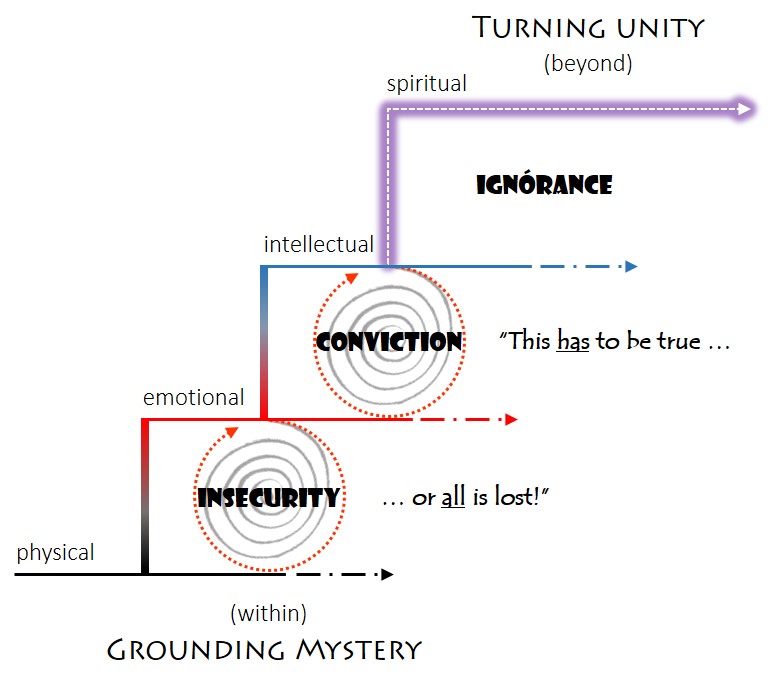
Behind our ignórance are convictions, beliefs about ourselves, others, and the nature of reality that are so closed and rigid as to hold our minds hostage. Something inside us knows that these cramped quarters are far too limited to contain the whole truth, not to mention what can’t even be rendered in language because it’s too fluid, dynamic, and impossible to pin down. But we’ve already made the agreement to trade away our access to reality for the security that convictions promise. The problem is that they can’t deliver on this promise, and no matter how tight and small our convictions become, the insecurity persists.

My diagram illustrates the four strands of human intelligence, what I name our Quadratic Intelligence. These strands come online during distinct critical periods, with physical (VQ) development leading the way, followed closely by the awakening of emotional (EQ) and then, later on, intellectual intelligence (RQ). A fourth strand of spiritual intelligence (SQ) is held open as a possibility, but depending on how things go at earlier stages, many of us may never enjoy the inner peace, creative freedom, and higher wisdom it makes possible. The reason for this will help us get beneath our convictions – which, remember, lie (sic) behind our ignórance.

The first challenge of existence was for our nervous system to match our external conditions with an internal state. A safe, stimulating, and resource-rich environment was matched with an internal state of security, confidence, and curiosity. Conversely, a harmful or resource-deprived environment was matched with an internal state of anxiety, which made our nervous system reactive and hypervigilant. This match of internal state to external conditions is all about calibrating sensitivity and motivating behavior that is adaptive. Anxiety motivates avoidance behavior, reducing exposure to danger and risk, which is nature’s way of helping us stay alive.

When the nervous system is set at higher levels of insecurity (i.e., anxiety) we tend to be overly sensitive to signs of threat. What might otherwise be a display of normal behavior in another individual is misperceived as guile, pretense, or aggression. An adaptive response in this case would be mistrust and suspicion, keeping distance and always ready to head for the exit.

For obvious reasons, an anxious nervous state severely affects the early development of emotional intelligence. We tried to manage our insecurity by clinging to things and people that made us feel safe, pushing away what was unfamiliar and different.

The above diagram depicts an in-turning spiral between the physical nervous system and our emotional intelligence, sucking the psychic energy of consciousness off its intended upward path and into a strangling vortex of insecurity. In some cases the anxiety can be so intense that we are sure our extinction is imminent. But most of us are just insecure enough to work hard at keeping our attachments close by.

So what happens when a large portion of our energy and attention is tied up in the things, people, and life arrangements that help us manage our deeper insecurity? The answer is that we form strong beliefs around them. Beliefs so strong, in fact, as to prevent us from thinking outside the box. Thinking is concrete, binary (either/or), and inflexible, crimping down on latent abilities for abstraction, paradoxical (both/and), and inclusive thought.

But then, in order to carry on with our mind in its box of convictions, we have to learn how to willfully disregard all evidence, logic, and common sense which suggests that what we’re doing is causing harm, or at least is counterproductive to what, deepest down, we really want for ourselves, our children, and the human future.

That’s the price of ignórance.

The Pursuit of Immortal Glory

The universe is a great Web of Life. You might argue that because so much of it is uninhabitable (dead rocks and nuclear furnaces) we should keep our discussion on the topic of life focused solely on our home planet. But we must remember that Earth is itself a product of the Universal Process which began some 14 billion years ago, and even if our planet was the only place where life exists across the entire 96 billion-light-year diameter of the observable cosmos, we are logically bound to the conclusion that the universe is alive. And conscious. And holding this thought, right now.

The Web of Life, then, extends out into the cosmic surround, includes the whole earth, the vibrant system of living things called nature, and your body as an organismic member of this system. Your body can’t survive apart from the support of nature, nature can’t continue without the favorable conditions of Earth, the earth wouldn’t exist had not the universal process conspired in the way it did for our planet to get formed and flung around its home star.

You may feel separate and all alone at times, but that’s something else, not your body.

I have placed you in the above diagram, nestled in the Web of Life as an embodied and natural earthling, a child of the cosmos and latter-day descendant of stars. For now we’ll focus on the purple figure outlined in black, ignoring everything behind you and to the right. Black is my color code for your animal nature, which is extroverted in its orientation to the environment (nature, Earth, cosmos) as you reach out for the shelter, resources, and connections you need to live.

Purple represents your inner awareness, oriented inwardly to the grounding mystery of consciousness. Also called the Ground of Being, it is how our provident universe is experienced from within, so to speak, in the uplift of existence. This grounding mystery of being can only be found within as you detach attention from the sensory-physical realm and allow awareness to drop past “mine” (property and attributes), “me” (the felt object of self), and “I” (the center of personal identity), into the deep and timeless present.

Consciousness has no object at this point. Ground is merely a metaphor reflecting the experience of mystery as both source and support of existence in this moment.

This duality of outer and inner orientations of consciousness, one through the body and out to the Web of Life, and the other through the soul and deeper into the Ground of Being, is what constitutes your essential self as a human being. You are a human animal (body) with a capacity for contemplating the inner mystery of being (soul). Because your highly evolved brain and nervous system make this dual orientation possible, you and your species may be the only ones with an ability to contemplate your place in the provident universe.


I should be clear that it’s not entirely by virtue of your advanced nervous system that you are able to break past the boundaries of personal identity for a larger (Web) or deeper (Ground) experience of reality. You need a center of personal identity (color coded orange in my diagram) in place to make such transpersonal experiences even possible. We call them transpersonal precisely because they are about going beyond the personal center of identity and its limited frame of reference. The center is who you think you are, and the frame is a construction of meaning where your identity belongs. It is your world.

Things get interesting at this point, and not just a little complicated, since ego formation is not an instinct-driven process, but instead depends on your tribe. The construction of identity and its frame of reference (world) is accomplished over the first three decades of your life. During that time your tribe is selecting or suppressing temperamental predispositions according to its standards of a ‘good boy’ or ‘nice girl’. As time goes on, the incentives for compliance evolve from candy or spankings, to grades, degrees, bonuses, and promotions. The goal is to shape you into “one of us,” someone who belongs, follows directions, and will do anything for the sake of honor.

Even though your personal identity is a social construction, your tribe still had to work with (and on) an animal nature that really doesn’t care very much about rules and expectations. A strong instinct for self-preservation needed to be reconditioned so that you could learn how to share and make sacrifices. Impulses connected to elimination, aggression, and sexual behavior had to be brought under control and put on a proper schedule. The means for accomplishing all of this is called social conditioning, and the primary psycho-mechanism for its success is the ego.

Somehow your constructed identity needed to be sufficiently separated from the animal urgencies of your body, but without losing the tether to your embodied essential self.

This is where, in the deeper cultural history of our species, religion progressed out of animism and into theism. The higher power of a patron deity not only served to give supernatural sanction to tribal morality, but it functioned also as a literary role-model. I say ‘literary’ because patron deities live only in the storytelling imagination (aka mythology). Every deity is a kind of personality construct, a literary invention and projected ideal reflecting back to the tribe those character traits and virtues which the community aspires to emulate. In exchange for their worship, sacrifice, and obedience, the patron deity bestows favors and rewards (e.g., success in childbirth, bountiful harvests, increases in wealth, and beatitude in the next life).

If we look closely at the patron deities of name-brand religions today, we can identify three qualities common to them all. Underneath and behind the tribe-specific virtues, its devotees honor their deity as immortal, supreme, and absolute. In the pictorial language of myth these translate into a depiction of the deity as separate, above, and outside the ordinary world of everyday concerns.

An even closer look will reveal these qualities as the driving aspirations of ego as well.

In the need to establish a separate center of personal identity, ego must first be differentiated from the body. Because the body is mortal, ego must be – or aspire to become – immortal. Notice that the ego’s status with respect to the body is ‘not’ (im-) mortal, a simple negation without any meaningful content. In addition to being separate from the body, ego takes its position above the body (the literal root meaning of the word ‘supreme’) and manages things from up there. Finally, as a final move of separation, ego begins to regard itself as essentially independent and outside the realm of bodily concerns – just like the deity.

According to my theory of post-theism, the intended outcome of theism is the internalization of the patron deity’s ‘godly virtues’, to the point where its projected ideal is no longer needed. The individual assumes creative authority in his or her life, taking responsibility for modeling the virtues of maturity, ego strength, and community interest. This is especially important to up-and-coming theists (the younger generation), who need taller powers to show them how to be and what to do.

Throughout this very fascinating game we can’t forget your essential self. The construct of identity can now serve in the transpersonal experiences of empathy, communion, and wholeness. If we can survive ego’s pursuit of immortal glory, these are the promise of our human future.

The Way of Dialogue

One sure mark of maturity is our ability as individuals to engage others in constructive dialogue. This term is not meant as a synonym for mere conversation, argumentative debate, or the pursuit of agreement in how we see things. To communicate with others of a different perspective means at least that we are able to listen, ask questions, understand, and reach an empathetic connection with them.

Needless to say, genuine dialogue is rarely taught and practiced these days, and is steadily disappearing as an art-form of healthy human cultures.

Just now at this period in history, our globe is deeply divided. A vast majority of the human population holds a different perspective from ours on the nature of reality, the hierarchy of values, the meaning of life, and how best to live. Whereas once upon a time we could entertain a meaningful conversation with someone of a different perspective because we shared with them certain backgrounding assumptions of a common culture, our global situation today breaks beyond the cultural commons and is forcing us to engage difference of a more radical sort.

In order to understand and start developing our skill for constructive dialogue, we need to resolve some confusion regarding its family resemblance to other forms of human interpersonal engagement (conversation, debate, negotiation) and then dig deeper into the dialogical process itself. For reference as we move along, I’ll refer to the diagram above.

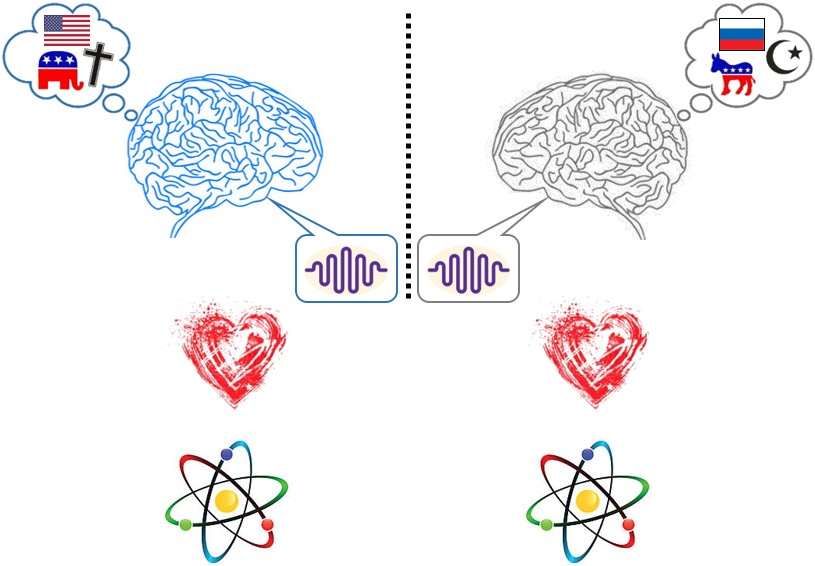
The top part of my diagram illustrates the dilemma of confronting someone of a different perspective. A vertical (but broken) line separates the two, right down to the divergent meaning of the words they are speaking to each other. Assuming our interlocutors are speaking the same language (e.g., English), the words they use likely carry meaning that doesn’t match exactly. They may both speak of “freedom,” for instance, but their constructions of meaning around that idea might be literally worlds apart. This should remind us that words are not just sounds in the air or logical operators of propositional thought; additionally they are elements in our articulation of meaning, basic building blocks in our determination of what really matters.

Each opposing side might be speaking similar words, then, but be interpreting those words in a very different way. In the thought bubble behind each brain in my diagram are certain highly charged symbols that represent a few of the lines currently dividing our human experience on this planet. And of course, there are many others.

Depending on whether you are an American or a Russian, a Republican or a Democrat, a Christian or a Muslim, how you spin a word – that is to say, the meaning you assign to it – will be expressive of that particular identity.

Let me say right off that I am not suggesting that American, Republican, and Christian go together as a set (and similarly for the other side). While the differences directly across the way tend to be more mutually exclusive, it is possible, say, that you are an American Democrat who is Muslim, or a Russian Christian who favors strong republican government. It’s much less likely that you would be an American Russian (although you could be a Russian with American sympathies), identify as both Republican and Democrat (but you might be a Republican who supports domestic government programs), or a Christian Muslim (however, there are some who mix their own eclectic religious identity from different brands and traditions of world religion).

A key aim of constructive dialogue is what I earlier called empathetic connection. This requires understanding, which in turn is dependent on taking turns and listening carefully to what each other says. In the end, dialogue can be considered “successful” when partners come to appreciate each other’s humanity.

Argumentative debate – or its degenerate form so popular these days: bigoted accusation – doesn’t have this goal, as its purpose is to present the superior and persuasive position on a topic. Polite conversation will typically leave the matter of a partner’s humanity suspended in the background as less provocative opinions are exchanged. And whereas negotiation looks for potential points of agreement and compromise, dialogue strives for a place underneath our different worldviews, ideologies, opinions, and even of words themselves.

Before we go there, I need to acknowledge one thing that can derail the whole effort. Actually, this thing I’m speaking of is what prevents dialogue from making any progress at all. It has to do with the very interesting phenomenon where a belief once held by the mind ends up taking the mind hostage. If you are American or Russian, Republican or Democrat, Christian or Muslim (or whatever membership holds your identity), that self-identification obligates you with certain value-judgments and opinions about the way things are.

As beliefs, they provide orientation and guidance for living your life.

It can happen, however, and for various reasons, that a given belief stops operating as a meaningful preference in your interpretation of reality, and becomes instead the only way of looking at it. Now, what formerly had been held by your mind comes to hold your mind prisoner, like a convict behind bars. This often happens during a conversion experience where an individual is rather suddenly overtaken with the certainty of a competing truth. Or it might come on gradually as the habit of belief slowly pushes all variances out of view, leaving just this one – “the way it is.” However it happens, the result is what we call a conviction.

I made the case in Deliver Us From Conviction that this phenomenon, where a belief takes the mind captive, is the principal threat to our human and planetary future. All the other problems we face – nuclear armament, global warming, market bankruptcy, international and intertribal warfare, human rights violations around the planet or interracial conflict at home – are driven by convictions, beliefs that have made us into their convicts.

A conviction forecloses on all questions and rules out every doubt. There is no “other” way.

The way through this impasse is dialogue. But obviously, if we are to have any hope of making progress, each of us needs to examine the degree in which conviction is a driving force in our lives. The following steps of constructive dialogue can assist in this self-examination, and hopefully inspire us as well to choose its path in our dealings with difference in others.


Even the foregoing reflections on the nature of ideology, membership, and identity as the backgrounding influences behind our beliefs and the words we use to articulate them, might have already helped us loosen our grip on what we believe to be true. Notice that I didn’t say that we should let go of our truth-claims, but merely refresh our relationship to them as constructions of meaning. They are human creations after all, and we advance our cause considerably when we can remember ourselves and each other as creators.

Let’s start digging, then.

Beneath the words we use to articulate our constructions of meaning (i.e., our beliefs) are the feelings we have around them (symbolized by a heart in my diagram). Even though belief fuses a proposition of language with an emotional commitment to its truth-value, dialogue challenges us to loosen this bond sufficiently so we can notice the deeper feelings in play. You may have a strong commitment to a number of beliefs, and while they may be very dissimilar at the propositional level (e.g., the objective existence of god and the fundamental disparity in a proposed healthcare reform bill) your feelings are what make the belief in each case important to you – quite apart from the question of whether, really, it has any anchor in actual fact.

That’s not to say that belief statements should be scrapped, or that our constructions of meaning are secondary to how we feel about them. In fact, the strength of feeling associated with a particular proposition or article of belief is less about how firmly it ties into objective reality (whatever that is), than how deep its roots reach into our needs as persons and human beings.

In other words, we feel strongly about ideas that impinge critically on our existence, security, livelihood, close relationships, personal well-being, and opportunities for the future.

In my diagram such concerns are represented by an atom, symbolizing matters of life, desire, love, and joy.

The dialogical process is a timely reminder that underneath our different perspectives and beliefs each of us experience life in very similar ways, and, still deeper down, that our needs and those of the other are fundamentally the same. How have we forgotten that before we are American or Russian, Republican or Democrat, Christian or Muslim (or whatever horizon of identity we might choose), we are human beings?

Every major awakening of spiritual intelligence in history has turned on this foundational insight – both obvious and strangely obscured – of our common humanity: with our neighbor, a stranger, an outsider, and even with our enemy.

Yes, it takes time, effort – and patience. But once we can look through our different constructions of meaning to the feelings we attach to them; and then down through these feelings to the human needs we all share, the project of building genuine community and world peace will surprise us in its transforming effect. Once we are delivered from our convictions, the creative human spirit is set free.

It only takes one individual to open the way. Why not you?

3-Dimensional Leadership

In the discussion around leadership, a good deal of attention is given to behavioral, ethical, and relational qualities that effective leaders possess and demonstrate. Great books and programs on excellence in leadership are abundantly available, and some of us are retrieving them from the shelves just now when good leaders seem harder to find. I recently coined a term – “Trumpence” – which I define as doing whatever it takes to put yourself first. Most of us would probably agree that putting yourself first is not the highest and surest mark of genuine leadership.

What makes a leader? Are leaders made? Or is leadership more about the auspicious timing between a situational vacuum and the right set of talents, vision, courage and determination in someone who senses in it a calling to make a difference? Can a society cultivate leaders from among its membership, or does it have to wait, more or less passively, for them to rise up of their own accord?

Human beings carry the genetic instructions for living creatively, courageously, and compassionately – a combination of virtues (not mere moral values but productive powers of life) that I equate with that otherwise elusive idea of the human spirit. In our nature we hold the potential to be aggressive or sympathetic, sensitive or willful, reactive or tolerant, observant or intrusive, curious or intuitive – or I should say, more or less these things, as each pair constitutes a spectrum of possibilities for expression.

In this sense we might say that an individual is a ‘born leader’, meaning that he or she seems to be a product of nature, a gift for our times from the generative depths of our species. The above-named traits are not inventions of culture but endowments of nature that nevertheless can be ‘nurtured’, shaped, or suppressed by social conditioning.

It’s helpful to distinguish between temperament and personality when it comes to leadership. Whereas temperament refers to an individual’s genetic inheritance (the various spectra of heritable traits), personality shifts our attention to the social project of ego formation. From the Latin persona, personality refers to the unique way that one’s temperament is filtered through the restraints, bypasses, and outlets of behavior deemed appropriate by society. What we see in a newborn is not personality but temperamental expressions, and from the very beginning we are shaping what gets expressed, and how much, through the mechanisms of social feedback.

Gradually what emerges from all this social conditioning is a separate center of personal identity, also known as ego. A human being has been formed into a cooperative member of the tribe, a ‘somebody’ who both fits in and stands out in appropriate degrees. As products of social engineering, leaders are fashioned and appointed to positions in society where they are needed. It stands to reason that times of strife and hardship might motivate the social selection and reinforcement of genetic traits that make for more aggressive, willful, and intrusive leaders – those who will ‘take the lead’, overcome obstacles, and defeat enemies. When they are effective and successful, we honor and celebrate them as tribal heroes.

So far, we have considered two dimensions of leadership: temperament and personality, genetic inheritance and social conditioning, natural endowment and cultural instruction. A good part of the contemporary discussion on leadership stays between these two horns of ‘nature versus nurture’. Are leaders born or are they made? Both ‘born and made’ seems the right answer, but there’s another dimension we need to consider.

In many posts I have argued that the formation of a separate sense of identity can either be our neurotic end or the critical passage to our fulfillment as a species. As long as ego remains inside the cage of tribal expectations and orthodox convictions, an individual cannot attain to that level of personal maturity named ego strength. This is where a stable and balanced personality, unified under the confident self-possession of a fully-formed ego, is finally capable of taking creative authority in his or her own life.

Two-dimensional leaders are functionaries of the social order, performing in roles that the tribe deems necessary. They aspire to be heroes, or at least recognized by others for their praiseworthy performance. Awards, promotions, honors, and degrees are just the social conditioning they need to persist in their efforts. Many aspire to be role models for up-and-coming leaders, demonstrating excellence in their field.

With the rise to creative authority, an individual begins to live out of a higher center. Not only natural endowment and cultural instruction, but self-determination increasingly becomes a driving force in how he or she lives. Before we explore what is unique to this third dimension of leadership, I need to qualify the idea of character.

I am using the term in its narrative sense, as when we speak of a character in story. In my post Personal Myth and the Anatomy of Character I identified four traits of a strong narrative character. Grounding refers to the degree in which a character seems to belong in the narrative setting rather than hovering above or merely drifting through it. Memory is how consistent a character is through the scene sequence of a story. Integrity is a spatial equivalent to memory, referring to the way a strong character holds its identity across different situations in the narrative. And a fourth trait of character in fiction, volition, identifies the extent to which action proceeds from its own center of will instead of just happening in reaction to circumstance.

Narrative characters who possess grounding, memory, integrity and volition are not only strong elements of great stories, they are what we find most interesting. What I call creative authority is essentially the ‘rights of authorship’ that an individual must eventually assume in composing his or her personal myth: a story of identity, meaning, and purpose.

The developmental achievement of ego strength is the leading indicator of an individual’s readiness to assume this authority. This is the point where 3-dimensional leadership begins, as the individual makes choices, takes action, and accepts responsibility for the life he or she wants to live.

We should keep in mind that just because a person may be acting in an apparently self-determined manner, a conceited, brazen, and undiplomatic character style almost always belies insecurities deeper down. Trumpence, in other words, is really an attitude of entitlement embrangled in an insatiable craving for self-importance. The counterfeit leader compensates his (or her) neurotic ego through self-inflation rather than transcending self in service to the maximal benefit of all concerned.

Our times call for leaders who are 3-dimensional: human beings who are socially attuned, whose intuition of wholeness and creative courage can inspire the highest in all of us.

The Human Journey

In my previous post The Four Ages of Life I offered a model for understanding spirituality as a deeply interior experience that evolves through the lifespan. The entire arc progresses – or more commonly, meanders – through Four Ages, different in duration but organized in such a way that each one builds on those before it, carrying forward also their shortfalls and incorporating them into the developing whole. A stage model is nothing new, but as far as I know the specific themes that I associate with the Four Ages comprise a unique theoretical arrangement.

By following the progress of spirituality – instead of, say, physical maturity, emotional, intellectual, or ethical development – I am also hoping that this scheme of Four Ages of Life will open a constructive dialogue on the topic of religion. I’ve made a case elsewhere, and many times, that religion should not be identified only with the organized brands evident around us (Christian, Buddhist, Jewish, Muslim, etc.).

As a system of utilities (stories, values, practices and beliefs) which connects us to the grounding mystery within, to others in community, and to the turning mystery of our universe, religion is everywhere. But most importantly it’s how you put it all together. You may borrow from the tradition, mythology, and symbols of a name-brand world religion (or more than one), but however you keep the concerns of existence, meaning, and daily life aligned together in a working system is your religion.

Another application of my Four Ages model has to do with that gold standard of transpersonal psychology known as self-actualization (A. Maslow). The conventional understanding of self-actualization regards it as a rather distant goal of psychological development, where the fulfillment of lower needs (survival, safety, belonging, and self-esteem) provide conditions for a breakthrough beyond the limited experience and perspective of ego.

The fact that self-actualization is defined as the salient marker of transpersonal consciousness restricts its meaningful application to that point (and beyond) where an ego is securely in place, since ‘going beyond’ (trans) the personal presupposes a separate center of identity as the person we are.

Instead of a later-in-life achievement, self-actualization could be measured as the degree in which an individual is realizing his or her human capacity at each Age of Life. In addition to a transpersonal variety, then, we can also give attention to pre-personal self-actualization – achievements in the progress of spirituality that precede the formation of a personal identity. In that case, a young child might be self-actualized not in terms of wisdom but of faith.

And not only pre-personal, but even personal modes of consciousness could be interpreted according to whether and what degree one’s ego facilitates the realization of his or her human capacity at that time in life.

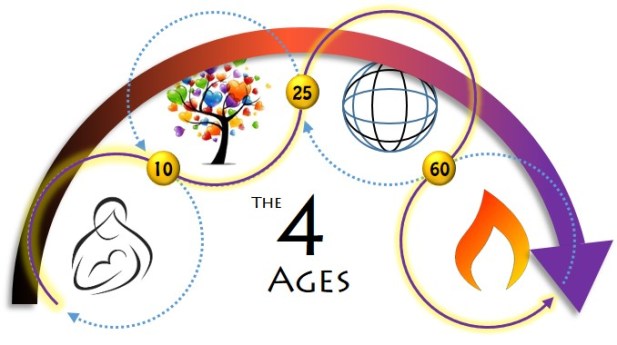
The above diagram pulls forward the lifespan arc model of my previous post, but with an important change. Besides conceiving the different Ages of Life in terms of chronological periods of time, each Age is depicted as a circle (or cycle) turning continuously in its own phase space. In other words, even after you have become an adult and are building out the meaning of your life, the dynamic of Faith continues to turn deeper below. Just because the critical period for a trusting release to reality is behind you doesn’t mean that the primary concern of that Age of Life isn’t continuing to affect everything about your adult engagement with reality now.

In the same way, each previous Age of Life continues to shape the development of spirituality over the lifespan.

You should notice a purple meandering line coursing across the Four Ages, making for a less schematic trajectory than the arc in the background. If you follow the meandering line, you’ll notice that its forward progress moves through alternating clockwise and counterclockwise revolutions of the Ages themselves. This is meant to suggest that, while progress is propelled by a gearing-together of our four themes (faith, passion, reason, and wisdom), it is possible for us to lose forward momentum and get ‘stuck’ inside the centripetal spin of one or another.

We’re back to the example where insufficient faith in reality keeps us obsessing over concerns around security and trust. So, even though our chronological age indicates where we perhaps ought to be in terms of our developing spirituality, complications and difficulties earlier in life can persist in holding us captive.

This allows the model to be individualized according to our unique path through life. More free-moving here, a little hung up there. Advancing toward self-actualization in this aspect, but somewhat impeded in another. If we use a simple value metric such as 1=low, 2=moderate, and 3=high to identify our degree of self-actualization in each of the Four Ages, we end up with a series of numbers (e.g., 2-3-2-1) that represents our “self-actualization profile.” The purpose would not be to compare ourselves with others, but rather to bring to light where our human journey to fulfillment needs creative attention.

It could be that traumatic events or inhospitable conditions of life early on got us hung up with anxiety over whether reality is resourceful, responsive, or reliable in any profound sense. A low value here would likely interfere with our self-actualization in subsequent Ages of Life. An insecure and defensive juvenile ego might completely eclipse a transpersonal intuition of oneness beyond the construct of identity in our later years (Age of Wisdom).

I’ve argued that the obsession in some forms of theism with glorifying the (divine) ego and saving the (human) ego from extinction actually prevents the progress of spirituality in those religions from our soul’s true destiny, which is to release ourselves to the present mystery of reality. Despite such teachings in the tradition regarding the necessity of dropping the illusion of a separate self or dying to our seed-form so that the fullness of life can spring forth, a persistent concern with personal identity and what we deserve only intensifies the conceit and strengthens the illusion.

Obviously it’s rather shortsighted to lay all the blame for our ego fixations at the doorstep of dysfunctional theism. An entire society, from religion to politics, from art to morality, from commercial interests to domestic initiatives, from its management of resources and consumption of goods to its disposal of toxins and waste, can be caught in the delusion of ego-grandiosity.

The human journey begins in the uplift of a provident mystery, comes to unique expression in our personal aspirations, and finally passes through the veil of meaning where All is One.

Where are you on the path?

The Four Ages of Life

four-ages_r

The big money in mental health research goes toward the problems and disorders that interfere with normal functioning, personal happiness, and human fulfillment. Volumes of theories, diagnostic manuals, and expensive interventions are devoted to correcting what’s wrong with us, or, if the cause is unknown, at least relieving the symptoms of our suffering.

Critics have noted that the conventional notion of a mental “disorder” is problematic in that it presupposes something (mental “order”) of which we have no clear understanding. This leaves the market open for a proliferation of so-called disorders – as many as need to be invented – and their matching medications.

The science behind the trend of reducing mental health (and health generally) to molecular biology and the pharmaceutical interventions that can fix us tends to dismiss spirituality as not only less than helpful on the matter, but as so distracted into its own crystal ball of unfounded metaphysical claims and spooky practices as to be utterly irrelevant. In the minds of many, science accomplished our liberation from spirituality, as it trained our attention on things that actually exist. As they define it, spirituality is a holdover from our benighted and superstitious past. In the verse of Alexander Pope: “God said, Let Newton be! and all was light.”


In numerous posts I have worked at correcting this widespread but erroneous characterization of spirituality. For sure, there’s a lot of metaphysical malarkey out there, and good people have fallen for it again and again. Angelic visitations, divine revelations, psychic readings, and miraculous powers are found in sacred myths, folk tales, and personal testimonies around the world, but such things shouldn’t be confused with spirituality. They are adornments of religion, not its true essence.

As a symbol system and way of life, religion might be organized around such mythical characters and events, but its primary function is in providing social structure for the expression of a deeply interior experience.

Now, it might sound as if I’m thinking of this deeply interior experience as something esoteric, in the sense of secrets kept hidden from the uninitiated and simple-minded by those who really know the truth. Typically this secret knowledge involves the translation of popular myths and symbols into a vocabulary of metaphysical abstractions protected by an occult tradition of rituals, creeds, and hierarchies of authority. Esoteric religion is thus an underground version of what’s going on at the surface of conventional society, but with the veil of ignorance purportedly removed. It’s not really a deeply interior experience at all, just another kind of religion carried on by an elite few.

What I mean by spirituality has nothing to do with supernatural realities, metaphysical realms, or secret knowledge. It is the deeply interior experience of being human: of existing, striving, and becoming fully human, more fully alive. Genuine and true religion is the structural expression of this adventure in the life of society, linking the individual ego inwardly to its own grounding mystery, across the social synapses of community life, and outwardly to the turning mystery of the universe.

In its better days, religion facilitates the progress of spirituality and our construction of meaning. At its worst, it blocks progress and even represses the creative spirit. Unfortunately, many have identified religion with its degenerate forms and historical periods of corruption, concluding that we are better off without it.

It’s this idea of spirituality as a deeply interior experience that grows, develops, and evolves over time which I will expound on here. If we think of human nature as actualizing through distinct periods, then each period corresponds to some aspect of our full capacity which is activated (or suppressed) during that stage. (In the interest of space, I won’t go into what happens when spirituality doesn’t progress and the reasons why. My reader is invited to check out other posts in this blog which delve into the hang-ups that get institutionalized in pathological religion.)

The Age of Faith

In the beginning – and I’m using that phrase for its resonance with Creation myths – we were carried in the dark waters of our mother’s womb and eventually delivered through a narrow passage into another dimension. We were vulnerable and dependent, relying on her (or her surrogates) for the satisfaction of our every need. In the nursing embrace we gained a base of security, and her supervising care instilled in us a sense of reality as resourceful and responsive – in a word, as provident.

This is also the earliest, and deepest, stage of spirituality. To some greater or lesser degree, all of us have (and continuously seek) this experience, which is named faith. It’s critically important that we distinguish such an existential faith – this open trust and absolute surrender to reality – from the catalog of beliefs that any given religion might regard as orthodox (“correct opinion”). Faith in those first days and early years of life was indeed closely associated, if not identified, with the existence of our higher (or taller) power. This may explain why existential faith, as I have described it, is frequently confused with belief in the existence of god.

What we carry with us from that primordial experience is not a set of opinions, orthodox or otherwise, but again a deep interior sense that we are supported in a provident reality. Our ability to relax, trust, release, and open up to What Is will continue to influence everything about our life going forward. Without faith we are groundless, without a sense of support, cut loose and adrift in an absurd and uncaring universe.

This isn’t something that religion itself can give, but religion will tend to translate the dominant or majority experience of its members into a more general worldview and way of life. By cultivating a community that is more grounded and intentional in its care for the very young, religion can foster the activation of faith in all its members.

My diagram suggests chronological markers that define the time periods and developmental thresholds of spirituality. This earliest stage, from prenatal life to the end of the first decade, is what I’ll call the Age of Faith. The prominent themes of spirituality here are grounding, providence, security, trust, and openness to reality.

The Age of Passion

From roughly age 10 to 25 is the second critical period of spirituality, the Age of Passion. This is when our openness to reality involves us in exploration, experimentation, and discovery. It’s also the age when the social construction of our identity undergoes significant trials and temptations. If we’re tracking along with world mythology, then this marks our Exile from the Garden of protection and infantile dependency, to the desert of self-conscious isolation and the jungle of sexual urgency. From here we might look back at what we lost and wish for it again, which is how some religions frame the challenge.

Whether it’s by a method of ego glorification or ego renunciation, the solution in either case exposes a fixation of this period on the separate center of personal identity.

Everything seems to turn around our needs and desires. In calling this period the Age of Passion, I am acknowledging the natural and very healthy way that consciousness regards all of reality as “staring at me,” as “judging me” and “making me feel” one way or another. While the word passion might have connotations of an extroverted drive for excitement, its root definition has to do with undergoing something, being “done to,” and suffering as a patient who is passive (“hold still!”) under treatment.

The Age of Reason

After 25 and until we’re about 60 years old spirituality progresses through the Age of Reason. This is typically when we are finishing our qualifications for a career and starting a serious job, finding a life partner and managing a family. By design, it is the time of Conquest and Settlement, when we take creative authority in making meaning, clarify a life purpose for ourselves, and expand our horizon of influence.

Faith and Passion continue to give us grounding and make life interesting, but it becomes increasingly important that our place in the greater scheme of things is relevant and contributes value to the system(s) in which we belong. This is the time in our development when, in the interest of intellectual integrity and rational meaning, many of us step out of organized religion to work out for ourselves a personal philosophy of life.

Religions don’t help when they intimidate us and condemn our quest for relevance as jeopardizing our place in the community or, worse still, in heaven after we die.

But the logical coherence, theoretical integrity, and practical application of meaning is not at all the acid or opposite of a passionate faith – although it does have exactly this effect on a belief system (orthodoxy) based in outdated models of reality and antiquated moral standards. Any belief system that is not rational, reality-oriented, and relevant to our times should either be reinterpreted, remodeled, or set aside.

The Age of Wisdom

There comes a time, however, when our most cherished constructs of identity and meaning need to open, like parting veils, to the present mystery of reality. In other posts I have characterized this threshold between the Age of Reason and the Age of Wisdom as bringing about an Apocalypse – a collapse of our world, a burning away of the canopy we had erected over ourselves for security, orientation, and significance.

The timing of our disillusionment with the years when we are starting to disengage from the consensus trance of school, career, parenting, and managing a household is probably no accident. Just as the carousel is winding down, our inner spirit is ready to drop out.

By ‘dropping out’ I really mean dropping in – out of the illusion of our separate existence and deeper into the present mystery of reality, into the Real Presence of mystery. Wisdom is not a function of accumulating knowledge, but is rather the breakthrough realization that nothing is separate from everything else, that All is One, and that We’re All in This Together. Oneness is not a matter of intellectually comprehending the totality of all facts, but of intuitively understanding that facts and thoughts, self and universe, the grounding mystery within us and the turning mystery all around us, are one reality.

What we do to the Whole, we do to ourselves. What we do to our neighbor, we do to ourselves. We are not separate from the rest. We are one.

Welcome to the Age of Wisdom.