Life Without Hope

Over the years I have come across authors who decry hope as an unnecessary setup for human unhappiness. They fault it for pulling the focus of concern away from present reality and projecting it into a fantasy of the future that never quite arrives as expected. Perhaps because so much creative energy has been invested by humans in unproductive wishful thinking, which presumably includes religious pining after Paradise, these well-meaning critics of hope suggest that we’d all be better off without its distractions and disappointments.

I get their point, in one sense. Hope is a setup of sort, and what human beings hope for rarely “comes true.” And yes, hope can siphon precious energy away from the challenges of real life, sometimes even persuading us to let opportunities pass or even trash what’s real for something better later, on the other side. Because baseless, unrealistic, and otherworldly hope has been used as an accelerant of violence (in the name of future hopes) as well as a justification for emotional detachment from the pressing issues of contemporary life, the solution is to discredit it in the hope that we will live more fully, and more responsibly, in the present.

But as I have a sympathetic affection for our inherently conflicted species, I’m going to take a different slant on this matter of hope. Seeing as how depression is the malady of our modern age, could it be that living without hope – or, following the sage advice of these authors, forsaking hope in the interest of a more reality-oriented mindset – is at the root of our problem? Maybe we shouldn’t confuse hope with mere wishful thinking, with longing for something away from, different than, or after the challenge presently upon us.

As animal organisms, humans are anchored by physical needs to the living earth. When these basic needs are met – assuming that our pursuit of them hasn’t gotten tangled up in the complications of emotional insecurity (which is a generous and entirely unrealistic assumption, I know) – the satisfaction we feel is a key ingredient in the happiness we seek. Happiness is more than the satisfaction of our needs, but I’m ready to say that it isn’t possible unless our survival and health are supported in some adequate degree.

Perhaps it was to seduce us into satisfying our basic needs, that nature sprinkled the fairy dust of pleasure on the things we require to live, reproduce, and flourish as a species. This, I will say, is the second key ingredient to happiness. We don’t need pleasure to live, but the pursuit of it tends to get us involved in doing what is necessary for life to continue. If apples weren’t sweet to the taste, if sex didn’t bring convulsions of ecstasy, or if reading a good book was utterly devoid of pleasure, there’s a decent chance we wouldn’t bother with them.

If satisfaction is mostly about our physical and developmental needs, then pleasure might be the evolutionary bridge from an existence oriented on survival to one that’s virtually preoccupied with enjoyment. The pursuit of pleasure is probably at work in our tendency as sensual-emotional beings to be both gluttonous consumers (it feels so good, we just can’t stop) and wasteful stewards of resources (when we get sick or bored of it, we just leave or throw it away). Entire industries prosper on our relentless, at times reckless and imprudent, desire for pleasure, enjoyment, and indulgence in what feels good.

So is that enough? Can we close our theory of happiness on these two key ingredients – need satisfaction and the allure of pleasure? If we just put up a strong moral fence to prevent theft, murder, exploitation, and bad business – and throw in some incentives for recycling and getting out to vote – human beings should be happy, right? No, that’s not right. Why? Because humans also require hope to be happy.

I will define “hope” as Holding Open a Positive Expectation for the future (see what I did there?). Most likely it has to do with the part of the brain most distinctive to our species, the prefrontal cortex, which gives us, among other things, an ability to grasp the Big Picture and take the Long View on things. This part of our brain isn’t fully online until sometime in our early to mid twenties, but once it is online our happiness depends henceforth on our belief in a promising future. Holding open a positive expectation for the future can keep us going when we are languishing physically, scratching the ground for satisfaction, having to cope daily with chronic pain or the absence of what once brought us deep enjoyment in life.

Young children are often idealized for their spontaneous and innocent engagement with present reality. They don’t worry about tomorrow. They don’t get caught up in their plans for the future, making strategies for what they want their lives to be like in some distant future, and then worry over what they can’t control. Oh, to be like that again! Please, just lop off my prefrontal cortex and let me revel in the limbic fairyland of my freewheeling imagination.

promised landHope doesn’t have to be either the escapism of wishful thinking or palliative therapy for a life in general decline. Holding open a positive expectation for the future is an essential human activity, and is, I would argue, the third key ingredient of happiness.

By holding the future open, we add cognitive aspiration to the emotional inspiration and physical perspiration of daily life. In believing that today is even now opening up into tomorrow, that this world and our life in it are already passing into the not yet of what’s still to come, we are liberated into our responsibility as co-creators of the New World.

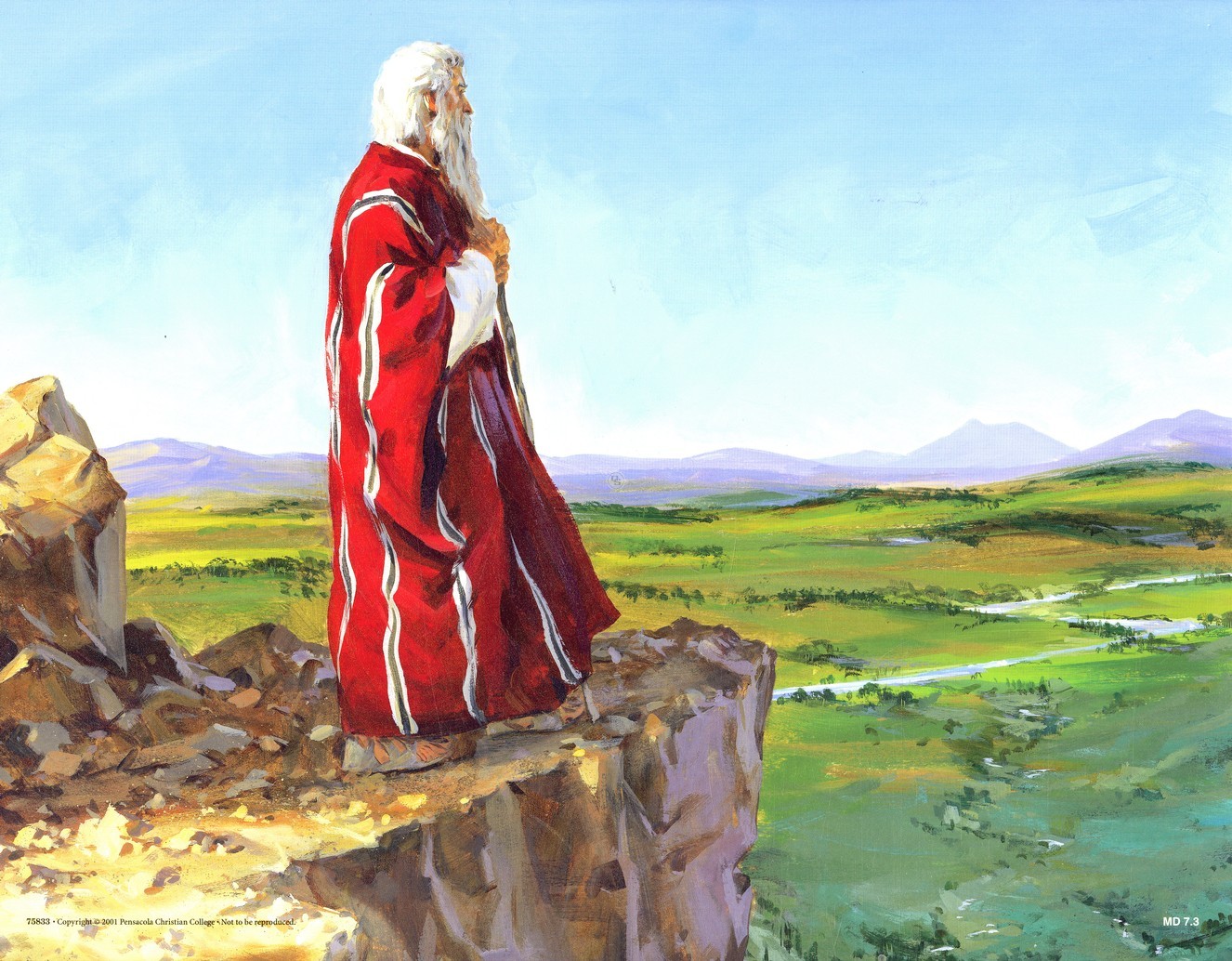
And if, like Moses peering into the Promised Land but unable to enter, all we can do is hold the future open for our children and their children, hope is ultimately what makes life meaningful.

A Religion That Matters

Two SystemsMy last post ended with the suggestion that what we call religion might best be understood as the way we manage the balance of love and power in our lives. The two systems of supremacy and communion which act like great attractors in the patterns of culture throughout history, also pull on our individual lives, causing us to lean more one way than the other in our personal choices and lifestyles.

The question I’m exploring is whether it is legitimate (and useful) to speak of this management of power and love – the particular set of rules, disciplines, methods, and practices we employ to “hold it together” (from the Latin religare) – as our religion. If the answer is yes, and I think it is, then the salient features that get packaged together in our conventional definition of religion – sacred stories, communal rituals, devotional practices, belief in a supreme being, and the hope of an afterlife – end up as secondary to its principal function.

This would help explain not only why religion looks so different from culture to culture (i.e., its features are more locally dependent), but also why all religions can be classified as either oriented on supremacy (the love of power) or communion (the power of love). Even within a single religion (e.g., Christianity), this balance of power and love can shift from one generation to the next, from one community to another, even as the surface features remain ostensibly the same. What we find is a change of focus in the myths, doctrines, liturgy, and morality as one system recedes and the other moves into dominance.

At the heart of religion (as I am redefining it here) is the priority and challenge of trust, which is where power and love are held in balance or fall apart. In a sense, the whole two-system “mega-system” of supremacy and communion comes down to how we manage – cultivate, nourish, repair, and renew – the trust we have in reality, the earth, each other, and ourselves. This is the sacred bond that holds everything together. It will serve us well to appreciate what’s at stake in the management of trust.

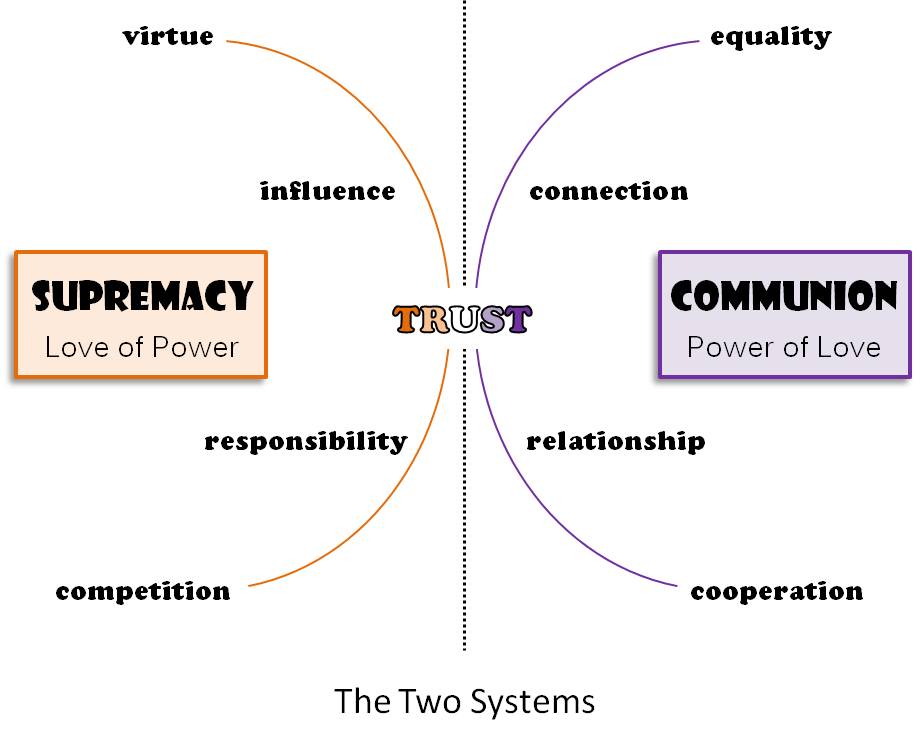
As my diagram illustrates, the systems of supremacy and communion interact along two parabolic arcs that converge in “trust” and diverge again into their opposing values. Farthest out from center are the oppositions of virtue/competition and equality/cooperation, which is where the peculiar accent of a religion will be most obvious.

It’s important to remember that virtue is not about “being good” in the moral sense, but refers rather to the unique power (character strength, creative talent, uncommon intelligence) that makes the individual something special. In a supremacy system, priority is given to the discovery and development, typically in competition with others, of what makes us exceptional. On the other side is equality, where exceptions are downplayed in the interest of what makes us similar, of what we have in common. This common ground becomes the basis of cooperation and partnership in a communion system.

We can understand how major ideological differences would be easier to defend and maintain the farther out from center we identify ourselves. In a sense, it’s safer out there: we can stay in our heads and keep our distance from those “glory seekers” or “bleeding hearts” on the other side of the scale. But our religion only works for us at that point where we find ourselves face to face with “the other” – the neighbor, the stranger, the enemy. The question of whom we can trust, whether we can (or should) let down our guard and open ourselves to the other, take a risk and be vulnerable for the sake of a genuinely human-spiritual interaction – that’s where it really matters.

Jesus understood this with laser clarity, it seems to me. What you may believe about God, or whether you even believe in one; whether or not you are a confessing member of a church, temple, synagogue, or mosque; whether you can recite scripture or pray before meals; whether you are preparing your soul for immortal beatitude in the next life or just living from one day to the next – none of this really matters if you close yourself off from others, if you refuse to build trust where it’s missing, or repair trust where it’s damaged or broken.

Ironically (and tragically) much of religion today has become a means of escape, not just from this coil of mortality at the end of life, but from the proving circle of exposure, vulnerability, and risk where so much is at stake. Our churches and denominations are protected memberships where we can sit alongside like-minded believers, feel confirmed in our truth, and carefully plan our engagement with the world outside. But if my theory holds, none of this is religion that matters. True religion – if I can dare use the term – has nothing to do with either monastic escape or strategic outreach to “save” the world.

Lest my readers who are former churchgoers, enlightened nonbelievers, or independent post-theists are thinking that religion can and should be left behind, I’ll remind you of my working definition, which has to do with the way you manage the balance of power and love in your life. How you cultivate trust and negotiate its challenges, how you use your influence to nourish connection, how you fulfill your responsibilities in the covenant of relationship – that is your religion. Leaving the church and giving up on its god doesn’t set you free from religion; it may indeed have been a necessary step in getting you more seriously invested in a religion that matters.

The Two Systems

I’ve decided that my purpose as a writer is not to persuade readers to my position on some topic, as much as it is to inspire (or at least provoke) creative thinking around things that matter. After all, my blog is devoted to contemplating creative change across culture, and persuasion is more about converting others to your beliefs than it is getting them to conduct a reality-check on their own.

So, I want to return to something I wrote about two years ago, and which, in the intervening time, has become even more relevant. It has to do with the paradoxical tension between two great systems that interact in every culture, in every community, and in each one of us. Our fear of conflict, which is probably fueled by ignorance concerning the creative potential in tension, along with our lazy preference for simplistic and dogmatic solutions, too frequently motivates us out of zones where genuine transformation might occur.

We feel almost a moral obligation to come down on one side or the other, calling one system good and the other evil. Of course, such judgment automatically makes enemies of anyone who might favor the side opposite to ours. With some urgency, then, I want to make the point that romanticizing one system and renouncing the other only shifts an otherwise creative tension into a mutually destructive antagonism. Western culture has been particularly good at that, and the absolute (fixed and irreconcilable) dualism in the metaphysical foundations of our worldview has worked itself up to the surface in an exploding taxonomy of neurotic disorders and sectarian movements through the centuries.

My objective is to show the extent in which the two systems are inextricably involved in our culture, our politics, our religions, our relationships, and our personalities. We might even look outside the specifically human realm and observe these two systems interacting in nature and throughout the cosmos as a whole. This was the great insight of the sixth-century BCE Chinese philosopher Lao-Tzu whose Tao Te Ching is a profound reflection on the dance of Yin and Yang across the manifest universe.

My word-tags for these two systems are “communion” and “supremacy,” and the forces they hold in tension are the power of love and the love of power, respectively. Already we might feel ourselves leaning into one and away from the other depending on our temperament, gender, morality bias, and situation in life. And while I want to respect our individual preferences, my real purpose here is to open the frame wide enough so we can appreciate their interdependency as creative forces in ourselves and society at large.

Two SystemsLet’s first look at the particular values that orbit together in each of the systems, and then I’ll come back to the term at the center of my diagram. Supremacy, or the love of power, emphasizes influence and responsibility, competition and virtue. Communion, or the power of love, places a stronger accent on connection and relationship, cooperation and equality. Notice how the terms in my diagram are arranged in such a way that they comprise two arcs, coming so close as to almost merge, then turning away from the center-line and farther into values more obviously identified with one side or the other.

We need to be careful not to break this tension and push everything into an absolute dualism, as has happened so many times in the West. For instance, while it may seem obvious that “competition” is the complete opposite of “cooperation,” in reality (just as Lao-Tzu noticed) there’s is a little of each in the other. Some of our most challenging and enjoyable games put us in a contest where we must cooperate with an opponent in order to compete for a goal. There’s nothing wrong with wanting to win, but we can’t win unless we play by the rules and respect our opponent as a partner in the process.

The opposition of “virtue” and “equality” is one that has swung Western politics for thousands of years. For their part, the Greek philosophers Plato and Aristotle leaned more toward virtue, which they defined as excellence or outstanding strength of character, rather than equality and the degenerate forms of democracy it tended to produce. Absolute equality amounts to a torpid neutrality where the insistence on sameness drowns out and dissolves away anything unique, special, or outstanding that might bring honor to one and not the rest.

Some feel that this push for equality in everything today is flattening out the virtues of the “American character,” effectively neutering the self-reliant and pioneering frontier spirit that made our nation great. But then again, as pioneers became settlers, and settlers became colonists, the exploitation of inequality (of whomever didn’t have land or a gun or a penis) did as much to make our nation as our supposed virtues. This only points up once again the need for balance.

The two systems of supremacy and communion interact as complements to each other, one tempering the potential excesses of the other, and both necessary to the health of the whole – of the whole shebang (cosmos), a whole culture, a whole community, a whole partnership, and a whole personality. While each system arcs away from the other and into its singular values, there is a point where they both come so close as to almost fuse into one. I wonder if our tendency toward extremes, driving us to neurotic breakdowns and dogmatic orthodoxies, is a symptom of our idiocy when it comes to understanding and cultivating genuine trust.

What I have in mind in using this term ranges from trusting others to trusting ourselves, having confidence in the creative process and surrendering to the provident mystery within, between, and beyond us all. This doesn’t have to come together in a formal religion, or even as belief in the existence of a god “out there.” But however we work it out, however we manage (or mismanage) the balance of power and love, that is our religion.

Telling Stories, Coming True

As a constructivist I regard meaning as something human beings create (construct) rather than search for and find in reality. While this has often come across as a radical and dangerous opinion, the idea that meaning might not be fixed and absolute is evident in our daily experience. The very same event or occasion can support numerous and even contradictory interpretations of what it means.

We used to think that uncovering the bald facts underneath all these competing perspectives would give us “the truth” – its actual, essential, and eternal meaning. When we dug our way to this shining core of meaning – this supposed absolute, universal, and timeless truth – what we found was something that didn’t make sense without an explanation. In other words, we learned that language, words, and narrative are what we use to make something meaningful; without this human projection, reality is quite literally meaningless.

To get at what’s behind this engine of meaning, this creative imagination that compels human beings to spin patterns of causality, identity, and significance, I’ve offered the notion of a “matrix of meaning” – something like a great loom upon which our minds compose the meaning of existence and construct the worlds we live in. My concept of the matrix incorporates the work of Joseph Campbell (The Hero with a Thousand Faces), Northrup Frye (Anatomy of Criticism), Erik Erikson (psychosocial stages of development), and James Joyce (specifically his idea of a “monomyth,” the single underlying plot that structures and informs all stories, or at least those worth telling).

I’ve integrated the theories and insights of these authors into a framework of Four Ages of a human being, as carried in the perennial philosophy, which is a persistent and cross-cultural wisdom tradition that has seeded world religions and spiritual revolutions for thousands of years. Instead of promoting an orthodox “theory of everything,” the perennial philosophy encourages us to engage the present mystery of reality at our location in the evolutionary stream. Not male versus female, young versus old, insider versus outsider, or modern versus something else, but as an individual human being, right where we are.

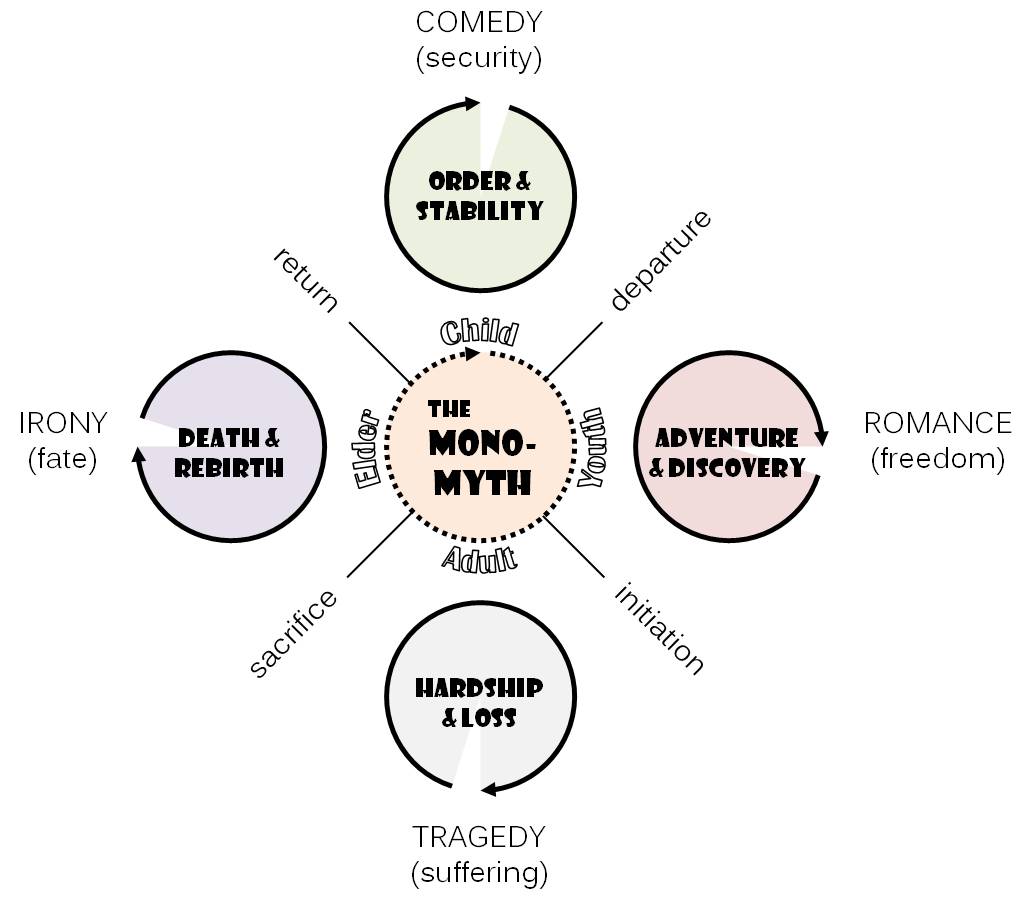
monomythThe diagram above illustrates this unitive theory of human nature and development according to the perennial philosophy, again with some clarifying insights from modern-day theorists. Let’s take a walk through the model and consider how it all fits together.
The Monomyth

At the center is a reminder from the work of James Joyce regarding what he called the “monomyth” at the heart of all great stories. It is the “one plot” worth telling and writing about; everything else in story supports and serves the integrity and advancement of this plot. Joseph Campbell named it The Hero’s Journey. Instead of seeing it as a kind of abstraction from the granular details of many individual stories, the monomyth is better appreciated as the structuring principle of narrative consciousness itself.

I want to use Joyce’s term to name the “one plot” every human being is busy composing, with help from his or her family, community, and larger culture. It’s not something we sit down and write, like a screenplay of our lives, but is rather the shape of life – or the shapes life takes on – as we move through the major phases of our development as individuals.

We all start from home and depart on a journey that inevitably takes us into initiations where our character is authenticated and disillusioned. In our search for deeper meaning and higher purpose we arrive at a point where security and control (if we still have these) must be sacrificed – given up but not thrown aside – for the sake of creativity, communion, and fulfillment. Upon our return we find that the business at home invites a double vision, allowing us to perceive a precious and eternal reality in the passing little things of life.

This monomyth is like a hologram of fractal geometry, where the larger holistic pattern (the circuit just summarized) is replicated at more refined levels which play out in distinct narrative modes – what Frye named comedy, romance, tragedy, and irony. These modes correspond to the primary concerns that preoccupy human beings at the different stages (the Four Ages) of life: security in childhood (birth to age 10), freedom in youth (years 10 to 30), suffering in adulthood (years 30 to 60), and fate in later life (age 60+).

Comedy

Comedy turns the monomyth around a focus on security, usually where some higher (taller: adult) power is in charge, everything is in its place, and life is just boring enough to arouse curiosity in the protagonist (most often a child) about what’s outside the door, over the wall, or down the rabbit hole. True to the mytho-logic of the monomyth, the comfortable security of home will typically be thrown into jeopardy as the youngster loses his or her way, or gets captured by some wicked thing. The nature of comedy, however, ensures that a successful escape will be made and the frightened hero or heroine returns safely home again.

Romance

Youth is the Age when the palace grounds seem limiting and oppressive: It’s time for adventure! The narrative mode of romance is not only about the lure of perfect (and even more irresistible, forbidden) love, but how the protagonist – and let’s not forget that we’re talking about ourselves – longs to explore (and transgress) the boundaries on freedom. He or she goes out in search of something, encountering obstacles and opponents along the way. The resolution to getting cornered or captured is not about making it safely back home, but rather overcoming the evil force and taking destiny in hand. Romance is the narrative mode most associated with heroes in popular culture.

Tragedy

Our thirties are the favored time for stepping into careers and starting families: We are Adults at last. But with this transition we are also crossing into a landscape of deepening shadows. Responsibilities put limits on our time and energy, and our passion for life gets tethered to mundane commitments and deadlines. At some point – what I call the midlife reset (around age 45) – we can become positively overwhelmed by feelings of emptiness and disorientation. A decline in fitness and creeping challenges to our health, not to mention an increased frequency in our confrontation with death (older relatives, parents, and even close friends), force us to set aside many of our youthful dreams and ambitions. Suffering simply cannot be escaped, bravely ignored, or permanently medicated out of awareness.

Irony

The crossover into the Age of Elder might see us becoming gnarled, bitter, and cynical. Or else, if we can follow the lifeline of our monomyth, a spiritual wisdom might ascend within us, even as our animal vigor is ebbing away. For so much of our life we had reached for light and run from shadow, held on to life as if death was the enemy, chased Utopias (“no place”) in future deals, better opportunities, greener grass, brighter lands, and otherworldly paradises. Now we understand – or are understanding more keenly – that light and shadow, life and death, good and evil, joy and grief, passing time and timeless eternity are many aspects of a single, profound, and ineffable mystery.

The narrative mode of irony provides a way of contemplating existence at two levels (or more), where we no longer have a need to split reality into opposites and flatten out its paradoxes. A spirit (or the stomach) for not only tolerating such a communion of opposites but even celebrating it as the Golden Way (gospel, dharma, tao) into life in its fullness requires that we be at a place psychologically where the orthodoxies of Flatland no longer constrain us.


When we are ready we will see that the Cross of dereliction is also the Bodhi tree of enlightenment; the hemlock in our cup is also the wine of new life. Death and rebirth (or resurrection) are misunderstood if we insist on arranging them in temporal sequence, as life after death. The dark principle, Lucifer, whom we frantically try to push behind us and out of our life, holds the light (Lucifer means “light bearer”) we’ve been too afraid to accept as our own.

Across this matrix of meaning stand the great paradoxes of the wisdom teachings: security in suffering, freedom in fate. Grasped as a higher pattern, the monomyth offers us guidance as we construct meaning and compose our personal story. The truth of our story lies not in the facts, but in its power to carry a vision of what is still to come.

Settling for Less

Evolutionary theory offers an explanation of how our human species emerged and adapted from simpler, more primitive life forms, and then proceeded to evolve, more psychologically and technologically than biologically, through a series of cultural revolutions. In the modern period, as individual development across the lifespan was more carefully studied, some theorists noted how individual stages of development seem to follow the same sequence as the evolutionary phases in human emergence.

Accordingly, primitive human culture was psychologically similar to early childhood today, where societies lived more in their bodies and closer to the guiding influence of animal instinct and the rhythms of nature. With the rise of the more advanced city-state came new concerns regarding national identity, the differentiation between insiders and outsiders, and the management of roles across the social scene – very much like an individual today during that embattled period between childhood and maturity called adolescence (literally “becoming adult”).

In the evolutionary history of human culture, just as in the developmental history of individuals today, the process of becoming a self-actualized human being has gotten hung up around fixations on security. In ideal (or good-enough) situations where basic needs are met and individuals internalize an assurance of reality as provident, security is adequately established and the higher challenges of maturity can be engaged. When this doesn’t happen, however, the need for security persists as a preoccupation, overriding and “out-competing” subsequent opportunities along the way to self-actualization.

Maturity_Development

The above diagram illustrates this “schedule of opportunities” in human self-actualization (which I also call fulfillment), along with the various ways that progress gets arrested when security is compromised. The schedule is comprised of four stages, which can be thought of as advancing steps that provide important stability for what is to come. Thus security itself is the stable foundation for healthy love. This in turn provides support for the adventure into freedom, which then serves the individual’s sense of higher purpose in life.

With each advancing step, more of the individual’s destiny is put into his or her own hands, where courageous and creative choice shapes the future. Along with this growing responsibility, however, comes increased risk, putting more in jeopardy – in the form of rejection, disorientation, and failure – as the path unfolds. You should be able to empathize with those who forfeit love or freedom or purpose for the sake of “playing it safe.” For all I know, you may be one of them. Most likely, we all struggle with this to some extent.

When the need for security during infancy and early childhood is compromised, the individual’s nervous system gets set at a higher “idle speed,” raising vigilance and sensitivity to signs of trouble. Of course, it’s likely advantageous to be hyper-aware of external threats or problems as they arise. But ordinary life is never without stress, which means that such individuals frequently overreact and end up making things worse for themselves. What might have simply floated down the stream of experience instead triggers alarms and initiates avoidance/protective/aggressive measures that can actually create a problem of pressing urgency.

In relationships a primary adaptive strategy that an insecure individual will commonly use is called attachment – not the quiet, oxytocin-infused tranquility of the nursing bond, but a neurotic gripping-down on one’s partner for the assurance that reality is safe, provident, predictable, and under control. As you might guess, no relationship can deepen and grow in positive ways when one or both partners are clinging to the other with such frantic intensity. The natural course of flux and change provokes high anxiety that pathologically interferes with the need of the partnership to evolve.

Whereas healthy relationships provide a necessary support for the individual’s forays into experimentation, autonomy, and personal choice (freedom), a critical shortage of internal security will often motivate him or her to surrender freedom to another’s control. This is what I mean by submission: putting oneself under the will and command of someone or something else in hopes that this external power will hold everything together and make it all right. Again, while a dependent and helpless newborn needs to surrender to the providence of caretakers, later on, by the time an individual ought to have developed some healthy autonomy, such security-seeking submission only fosters the conditions for co-dependence, exploitation, and abuse to occur.

Finally, deep-seated and chronic insecurity will undermine the individual’s liberation into a life of purpose – by which I mean a life lived with purpose, on purpose, for a purpose that is uniquely his or her own, and which is experienced as a high calling of universal import. My word for this neurotic alternative to a holy purpose is obedience, fittingly derived from the root-word for “servant or slave.” Just as with the other terms, we need to distinguish a normal and healthy kind of obedience from one where free will and personal responsibility are effectively canceled out and replaced by simply “doing what you’re told.”

A self-actualizing adult human being is not necessarily one who constantly challenges the rules and expectations of society, but neither does he or she blindly fall in line with what external authority dictates (including also the status quo, or what “everyone else” is doing). Just because some authority demands conformity with a certain way of thinking, believing, or behaving doesn’t mean that it’s true or right or just. And just because “God says it” in the pages of scripture doesn’t put it beyond debate or doubt or conscience.

This last point brings me to my chief complaint against theism: not in the way it personifies and locates God as the patron deity of one or another tribe of true believers, but how it promotes attachment, submission, and obedience in its devotees. Theism today has become for many a shelter of security where love is reserved for insiders, where individual freedom is discouraged or condemned, and where being “purpose-driven” amounts to living by the rules and doing what god wants you to do. Never mind that the job description is conveyed through a long line of all-too-human brokers, each borrowing on the authority of others long dead, out of this world, or metaphysically inaccessible to the rest of us.

Considered developmentally, theism ought to help establish in the individual a deep security in the grounding mystery; orient him or her on a personified ideal of love, freedom, and purpose; and consistently challenge the believer to “be like unto god,” to the point where the divine character is fully internalized and incarnated in daily life. Then (and really only then) can self-actualized parents, teachers, and community leaders conspire benevolently in demonstrating providence to the very young, encouraging faith and lifting up a new generation of holy human beings.

The Flow of Being

Tree MandalaThe most important discovery we can make as human beings – infinitely more important than how to win friends and influence people or think and grow rich – is that we exist. While that may sound much less interesting than the quest for wealth, status, and fame, the discovery of our existence – the full mystery and glory of being alive – makes everything else pale by comparison.
Reflect for a moment on this most obvious of facts: You are a human being.

Human names the animal species to which you belong. Your gene lines stretch back generations, even thousands and millions of years, to earlier and more primitive life forms. The theory of evolution does not say that you are descended from monkeys, but rather that your species and other primate species share a common ancestor, some prehistoric mammal that lived in trees and foraged jungle floors, and before that climbed ashore from a primal sea, and before that worked alchemy with sunlight and salt water to harness energy as life.

Human also names the peculiar way you are related to the planetary environment. The vital urgencies of your body in its need for oxygen, water, nutrition, rest, and reproduction nestle you naturally in provident time grooves of daily, monthly, and annual rhythms where resources can be found. You breathe in oxygen and exhale the carbon dioxide byproduct of respiration, which the plants and trees around you breathe in for photosynthesis, exhaling oxygen for you to breathe in again.

Your senses connect you to vibrational fields of light and sound, gradients of temperature and molecular mass, variant densities and textures of material form. Gravitational interactions of the sun, the earth, and its moon hold you gently on the planet’s surface as together they swing in great arcing orbits through space. Lunar and tidal forces tug on your bloodstream and hypnotize you as you stand at the ocean’s edge. The very weight of your body is a function of its location aboard our solar system as it flings across the cosmic arena.

Considered merely on that level, where as a human animal you participate in a Provident Universe, with everything conspiring in such a way that you are here, breathing, reading these lines and contemplating your place in it all, the fact of your existence is astonishing and marvelous beyond words. It’s important to remember that you are not a “patient” in all of this, only a passive consumer of its abundance. You are one of “the many” that together comprise our universe, an individual expression if its providence through the contributions of your body and mind, receiving from its supply and offering your unique gift.

But you are also a human being, which moves our consideration in the opposite direction – not outward to the Provident Universe, but inward to the Grounding Mystery of existence itself. The extroversion of your animal body is thus counterbalanced by the introversion of your spiritual soul, although it should be clear that neither of these, body or soul, belongs to you or exists apart from the other. Together they are what you are.

The descending path of inward contemplation pulls attention away from the sensory-physical environment (from environ, what is “around” you) and opens it to a dimension of existence paradoxically empty of content but full of presence. Your access to this inner space is not sensory but intuitive – what is sometimes called your “sixth sense,” an awareness that draws on the Grounding Mystery below individual qualities and surface distinctions, which is also why we name it mystical-intuitive.

The “myst” in mystical and mystery derives from the Greek muein, originally referring to the imperative on a novitiate of a holy order to “close the mouth” – that is, to remain silent and simply observe in an attitude of reverence. At this level of depth there is nothing that language can “stick” to, nowhere that even thought can take hold; it is ineffable, indescribable, noetically elusive, beyond words.

And yet, the Grounding Mystery is the creative power of being in you, incarnating itself as you. As Alan Watts used to say, just as your eye cannot see itself and your teeth cannot bite themselves, neither can your mind reach down and grab the Grounding Mystery since you are not separate from it but essentially of it. As we read in the Upanishads, “Thou art That!”

We use the metaphor of ground because it carries the ineffable experience of mystery into language and meaning, just as the fertile soil germinates and supports living forms at the surface. However, because the Grounding Mystery defies all attempts to make it into an object – a being among and alongside other beings rather than Being-itself – we can also appreciate why Buddhists name it sunyata: emptiness, no-thingness, the infinite capacity in all things but not itself a thing.

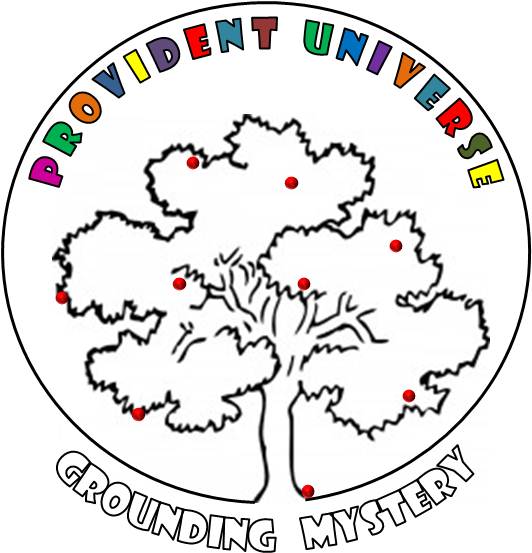
So, as a human being you are outwardly engaged and reciprocally involved in the Provident Universe, at the same time as you are inwardly rooted in and a manifestation of the Grounding Mystery of being. These are not two realities but two aspects of one reality, what I call the present mystery of reality. As the illustration above shows, a tree (or you, or anything else) actualizes the ineffable Ground in its own being and opens outward to a local habitat, to the vibrant community of life, to the biosphere of Earth, and to the cosmic order.

The tree in my illustration is bearing fruit as its individual contribution to the Provident Universe, but also as evidence of its “self-actualization” and existential fulfillment. Of course, inside the circle are the innumerable other forms of existence which I cannot adequately depict, each one expressing outward from its depths in the Grounding Mystery and into the cosmic community where everything “co-arises” (another important Buddhist term).

You should be able to envision the “flow of being” surging into form, expressing through the myriad gifts or contributions of the ten thousand things, putting on the glory of heaven and earth. “Singing mountains and clapping trees,” as the biblical prophet put it (Isaiah 55:12).

And here you are. What is your gift?

Moving Into Wholeness

My last post ended with the controversial statement that a religion which is organized around the goal of getting the individual ego safely to heaven is really a delusion from which we need to be saved. It is widely assumed that religion generally is about everlasting security in the next life, including all the obligations – moral, doctrinal, and devotional – a true believer must satisfy to be worthy of its reward. “True religion” (if I can dare use the term) is actually our path out of this delusion.

It’s insufficient, of course, to define true religion exclusively in this negative fashion – as breaking the spell, escaping the trance, exposing the delusion and leaving it behind. If a system in service of the ego, by which I mean the individual human ego as well as the Absolute Ego it projects as its god, interferes with our spiritual progress as a species, liberation is only a preliminary step – however strategic and urgently needed it is. We need to further ask: “So what? To what end?”

Central to my larger argument is a perspective on personal (ego) consciousness as a critical stage in our ongoing evolution as a species (and development as individuals), but as only a stage and not the goal. When religion, which had long been dedicated to keeping our inner being (soul) and outer life (body) in holistic balance, got distracted and then utterly derailed by the rising preoccupation with social identity (ego), this shift marked a “fall” of consciousness out of communion and into a state of self-conscious estrangement.

The entire scheme of mythology was subsequently reoriented on “the hero’s journey” and final atonement with the Absolute Ego of god. Personal salvation became the whole purpose and litmus test of “true” religion. If you ask true believers to contemplate for a moment what their religion would be if the award ceremony of heaven were out of the picture, certainly a large majority of them would protest: “Then what’s the point?”

This religion of ego, ego’s god, and personal salvation is precisely what Jesus (and Buddha before him) sought to leave behind. His parables and social conduct introduced a shock to the morality of his day – as they still would in ours – and effectively shook off the trance for a few who got the message. “It’s not about you,” he said in so many words. “Get over yourself.” 

And that is exactly what the ego seeking salvation cannot do.

So if it’s not about me (or you) and we need to get over ourselves, just what will that mean? Again, getting over ourselves is a requirement if we are to see what’s beyond us. But then the program needs to advance from disillusionment (breaking the spell) to a new vision of reality. Jesus (and Buddha) had a lot to say about that as well, but it only makes sense in the way he intended when consciousness has been liberated from the tightening spiral of “What’s in it for me?”

The diagram below is my attempt to map out the major components, trajectories, and possibilities of human fulfillment – of our evolution as a species in the way it prepares for and then “leap frogs” our development as individuals. For the sake of orientation in my diagram, we’ll begin at the bottom, zig-zagging left and then right as we move upward to the intended culmination of a life lived in conscious communion with others and all things – what Jesus called “the kingdom of God.”

Ego Quad

Human beings have a need to know, intuitively more than intellectually, that reality can be trusted. When conditions inside and outside the womb are provident and nurturing, our nervous system settles into a baseline state of calm and spontaneous release to What Is. This ability to relax into being, to let go and rest in reality, is precipitated by the real support that reality provides and is gradually strengthened (or compromised) as new challenges arise. Security may be the way things objectively are, but the individual (fetus, infant, child, adult) needs to feel that reality can be trusted in order for it to become the foundation we call “faith.”

If all goes well, security will undergird the next developmental opportunity, which involves the internalization of control. “Autonomy” doesn’t mean complete independence from external resources or absolute control over everything going on inside. It rather refers to an established center of freedom, perspective, intention, and choice in which the individual has some creative control. Autonomy isn’t the end-goal it has become in some Western therapeutic traditions, but its developmental achievement is arguably essential for progress to maturity.

And because it doesn’t always go well, we should pause a moment to reflect on what typically happens when security is compromised and autonomy fails. A reality that in general cannot be trusted will compel a coping strategy called attachment – not the healthy attachment between infant and mother, but a neurotic attachment where the insecure individual “submits” emotionally to someone or something with the expectation that security will be found there. Inevitably submission pulls development off a healthy path (to autonomy) and takes it hostage to codependent relationships, repressive ideologies, and damaging addictions.

A personality that is held captive by its “idols of security” will tend to take on an inferiority complex where shame – the conviction of being deeply flawed, stained, depraved and unworthy – attracts a dark shadow of helplessness and hopelessness. If it gets dark enough, the individual will go to any length to justify and promote the idol’s absolute authority – and violence is never out of the question.

As you might guess, I am of the opinion that much of the “redemptive violence” committed in the name of god and religion – human sacrifice and substitutionary atonement, persecution of minorities and heretics, acts of terrorism and holy wars – has insecurity and shame at its roots.

But let’s move on.

Assuming a healthy establishment of autonomy with the executive ego in control, an individual is prepared for higher experiences beyond the self. Think about such transcendent experiences as inspiration, creativity, compassion, and love, and notice how each one “gets over” the ego for the sake of a higher truth of some kind. Indeed, if an individual is only calculating the prospect of personal advantage or reward in these experiences, they will simply not be available.

However, just as before, we need to say something about what happens when security and autonomy are not in place, yet the impetus of transcendence is nevertheless lifting the ego in that direction. What results is a pathology which seems to be the inverse of an inferiority complex, where the ego becomes inflated with conceit, glory-seeking, and self-importance. This is the lesser known superiority complex, and while it seems to be caught up on issues utterly opposite to feelings of shame and inadequacy, ego inflation is really just another coping strategy for the insecure personality.

Even if grandiosity is discouraged by religion in its members, the superiority complex can still be celebrated (and justified) in the patron deity who blusters and brags about being the best and greatest, the one and only, who deserves and demands all the worship, praise, and glory. As Absolute Ego, the deity who so comports himself is serving to sublimate otherwise deplorable behavior for human beings into something they can validate and promote through their god.

The way Yahweh carries on in some Bible stories has to make you wonder.

Before we take our final step of ascent in my diagram and contemplate at last the “so what” of true religion, I want to quickly comment on the telltale marks of ego strength, along with their opposite pathologies. Ego strength is a necessary and desirable achievement of healthy development and shouldn’t be confused with egoism, which is actually a symptom of its absence. In other words, personal identity (ego) becomes stuck on itself when it is weak – insecure, manipulative, and craving attention.

A “strong” ego by contrast serves to stabilize the personality, balance its moods, and unify its numerous substreams of impulse, affect, and perspective – what Roberto Assagioli named “subpersonalities.” When these strengths are not present, the individual can be flooded by rising urgencies in the body (borderline personality), swing uncontrollably between emotional extremes (bipolar), or get overrun from within by divergent attitudes and motivations (dissociative identity). I’m doing my best to save these terms from their classification as “clinical disorders” so that we can acknowledge and deal responsibly with them in normal life.

At last we can consider where all of this might be leading, assuming that our zig-zag progress from security to autonomy has gone reasonably well – which is not a safe assumption, as I’ve tried to show. So let’s just pretend that we are not caught in the trance of personal salvation, but have seen the vision and heard the invitation to our intended fulfillment. What sort of experience is that?

My word is communion: the awareness, the participation, the commitment, and the responsibility of living together as one. Importantly, the prefix “com” when added to the base word “union” prevents the couple, several, or many from dissolving into homogeneity where individual distinctions are annihilated. The valued gains of autonomy and ego strength are not canceled out in communion but instead are connected to other centers, in those higher experiences mentioned earlier: inspiration, creativity, compassion, and love.

That is where our liberation finds its fulfillment.

Communion doesn’t need to be defined in exclusively human terms of course, even though our most pressing challenge is in the realm of interpersonal relationships. Jesus understood the challenge as especially critical and urgent in our relations with our “enemies,” which doesn’t only – or even most importantly – mean our adversaries across the ocean, the picket line, or the political aisle.

The enemies we really need to love most are the ones who daily let us down, betray our trust, exploit our insecurity, abuse our generosity, and don’t even seem to care. They are our family members, our neighbors, our former friends.

But that’s another topic – kind of. 

The Trance of Who You Are

Whether you are a theist or an atheist, the amazing fact that the universe is so providently arranged as to support the ignition and evolution of life, to the point where you and I are here sharing this thought, ought to inspire wonder, gratitude, and praise. This is where religion began – at the confluence of astonishment and thanksgiving. Its role in human culture for millenniums has been to choreograph society by a system of sacred stories, symbols, and rites, with the purpose of fanning the embers of inspiration and uniting the community in worship.

Really, it doesn’t matter whether you’re a theist or an atheist, because the rapture of wonder and gratitude of which I’m speaking is not invested in any claim regarding the existence of Someone behind and in charge of it all. The sacred stories, called myths after the Greek word for a narrative plot, did early on begin to tell of agencies with elemental and personified form who conspire to put on the Big Show. This wasn’t an effort to explain the universe, as later interpreters would mistakenly assume, but to confirm what we still today – theists and atheists alike – can acknowledge as the gratuitous intention at the heart of a cosmos that is our home.

Our body is the evolutionary extension of matter into life and consciousness, not self-sufficient but outwardly oriented to the web of resources it requires to survive and prosper. This extroverted attention of the body engages with the sensory-physical reality around us, converting light waves into visual pictures, pressure waves into audible sounds, molecules into sensations of smell and taste, texture and weight (etc.) into how something feels in our hands. With an emergent intelligence capable of assembling all of this into an aesthetic unity of experience, our body serves as the perceptual vantage point in our contemplation of the universe.

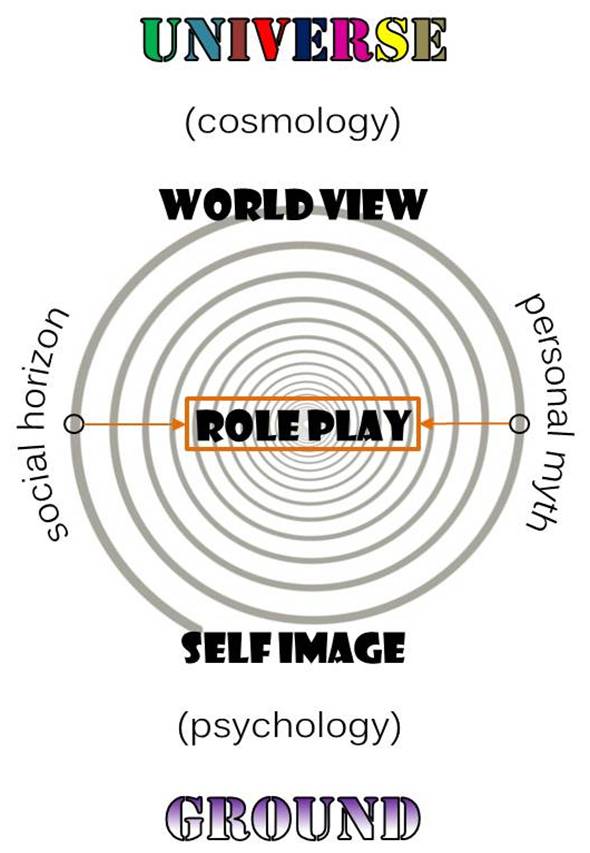
When we open our frame of attention to everything around us, the view we entertain, along with our understanding of its fit-and-flow design, is known as our cosmology. And whether we interpret it mythologically or mathematically, we are not merely questing after and entering into dialogue with a universe “out there.” As we are inextricably involved in what we observe, our contemplation is itself an act of the universe.SpiralThat is to say, we are not only participants in the provident order of reality; we are manifestations of it as well. While the animal urgencies of the body naturally orient it outward to the resources it needs, a spiritual intuition conducts consciousness in an opposite direction, inward to its own grounding mystery. This aspect of ourselves is equally as primordial as our body, but its introverted orientation puts us in touch with reality prior to and beneath the threshold where it spreads out as the sensory-physical universe.

The mystical-intuitive depth of our own existence is what is meant by “soul” (Greek psyche) – not some thing living inside our body, the “real me” trapped inside this mortal coil, but the deep interior of consciousness, the ground of being itself. Whereas the myriad qualities of the universe beyond us inspire a cosmology of appropriate complexity and sophistication, the ineffable nature of this grounding mystery within us actually quiets our attempts to describe it, calling us to mystical silence instead.

In this way, the best religion will sponsor the research of its members in two directions simultaneously: outward into the most relevant and up-to-date cosmology, and inward to a mystically grounded psychology. The congruency of these two realms – outward and inward, body and soul, universe and ground – is portrayed in myth, revealed in symbols, and celebrated in sacred performance. Science and spirituality have always been the twin fascinations of religion, with its purpose taken up and fulfilled to the extent that it keeps us meaningfully engaged with the present mystery of reality.

The frustration of religion’s essential purpose – this dialogue of body and soul, self and community, society and nature – was introduced long ago with the emergence of a competing ambition, too preoccupied with its own agenda and pressing needs to care as much for the big picture.

Over time, ego’s self-involvement would come to command the focus of just about everything from religion to politics, commerce to lifestyle, philosophy to art. The archaic and long-standing function of religion in reconciling consciousness to the provident universe and its own grounding mystery underwent a profound change as its purpose got reassigned to individual salvation.

What we’re talking about here is the arrival and subsequent influence on culture of the personal ego – that opinionated, flamboyant, self-conscious, willful, ambitious, and deeply insecure center of identity called “I-myself.” Ego’s advent required a greater amount of social energy and attention, as its impulses were more likely to be misaligned with either the body’s instinct or the soul’s wisdom. A moral system of prohibitions, permissions, expectations, and responsibilities had to be created in order to keep its competing inclinations compatible with the general aims of tribal life.

It’s a mistake to assume that ego just appeared out of nowhere. If we observe ego development in children today, or do our best to remember our own adventure into personal identity, we will understand that it really is a lengthy construction project where the tribe (through the agency of parents, guardians, instructors, and other “taller powers”) shapes the personality according to specific social roles. In this way, cultural definitions of the well-behaved child, the good student, the proper husband or wife, the commendable employee, the model citizen, and the true believer are “downloaded” into the operating program of personal identity.

At first, the roles and associated rules need to be imposed on the young child and reinforced through consistent discipline. With maturity, however, the individual will self-consciously enter into numerous identity contracts with the tribe where rewards are not so immediate as gold stars or pats on the head, but may be sublimated, delayed, or even deferred to the next life. Eventually religion took on a role of its own as moral supervisor, mediator of atonement whereby sinners could be rehabilitated to good standing in the community, and keeper of the keys to whichever final destiny the ego deserved.

All of this effectively pulled consciousness out of dialogue with the provident universe and its own grounding mystery, into a spiraling trance where the individual is bound to tribal orthodoxy, trading freedom now for security later, but also forfeiting the living communion of body and soul for ego’s final escape to divinity.

Spiritual teachers like Siddhartha (the Buddha) and Jesus (the Christ) understood that deliverance from this trance of who you are is the true salvation.

How Do You Lean Into Reality?

Compass MandalaWho among us can resist the invitation to identify ourselves on some grid or scale or chart of personality characteristics? As long as we don’t have to feel as if we are being stuffed inside a box or stabbed to a pin-board, classified and labeled as only this, the exercise can be endlessly fascinating. There’s nothing ego enjoys more than gazing into a mirror. The mystery of what we are, underneath who we think we are, lures us into contemplation, willing to check boxes or circle numbers that promise to unveil “the real me.”

There is a strong industry in personality testing designed to help us understand ourselves, get along with others, and find the secret to a happy (or happier, since it’s never enough) and more successful life. To be honest, Americans probably top the chart when it comes to vanity and self-obsession. We spend more money and effort on improving ourselves – enhancements, reductions, tucks, infusions, exotic therapies, and best-selling self-help programs – perhaps mostly because we’ve been conditioned to measure ourselves against the perfect fakes of celebrity culture.

So, I appreciate you stopping at my booth to see what I have to offer. You’ll be glad to hear that I have no questionnaire for you to fill out or pre-cut “types” for you to try on. What I offer is a simple way to identify how you lean into reality and make sense of life. Similar to the popular personality type-finders, we will begin with some key terms that distinguish major ways that all human beings engage with the Big Show. What It’s All About will vary across interpretations according to our individual preferences, inclinations, and concerns – that is to say, how we lean into reality.

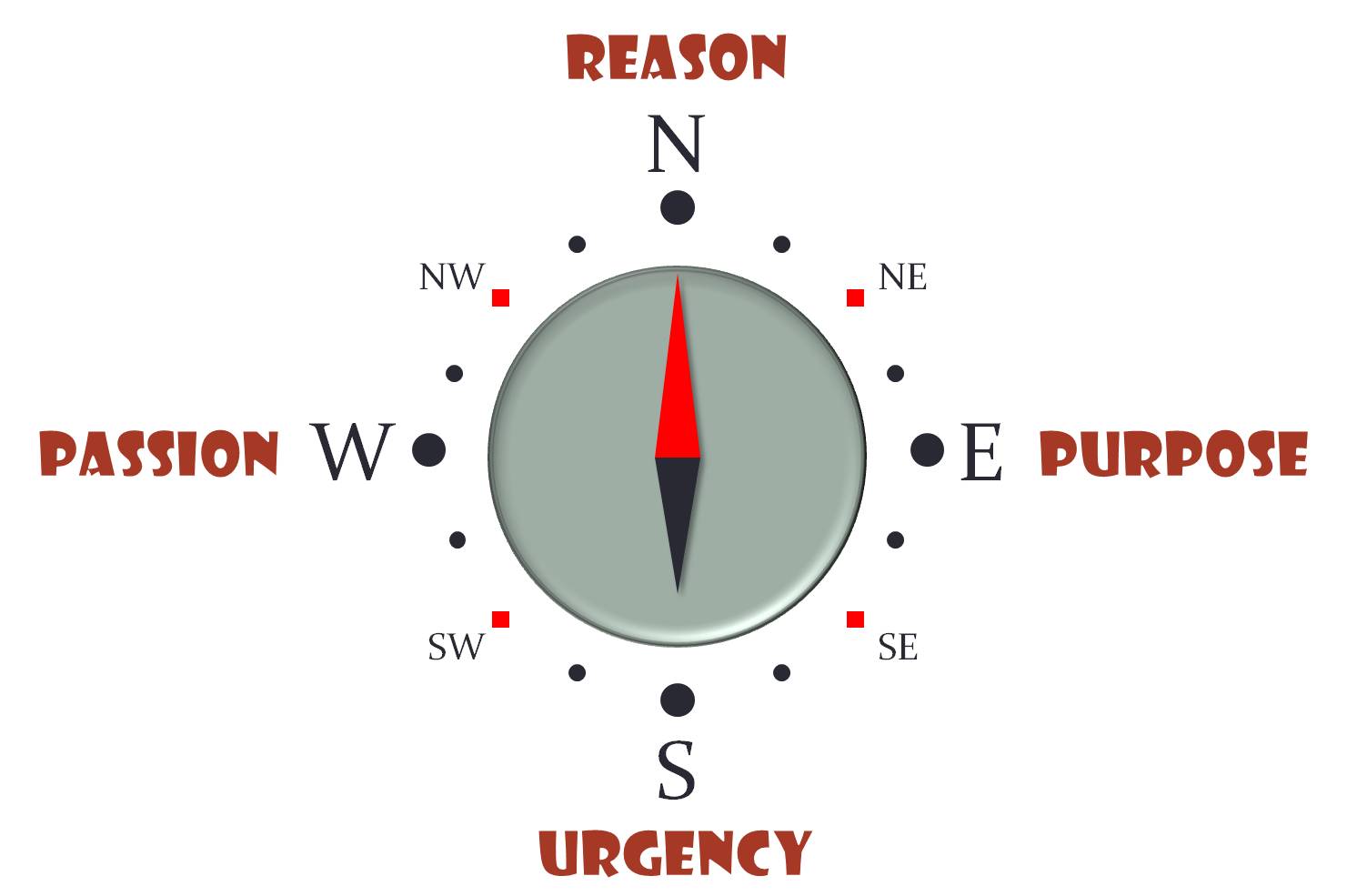
My use of a compass analogy (see the illustration) is intended to make the point that we lean into reality not only by virtue of the way we have been wired and conditioned, but also in response to the situational and developmental challenges that life brings our way. Regardless of where you’re going, a compass can provide reference and orientation, although it can’t tell you where to go or how to get there. It will faithfully tell you where north is, without insisting that you always (or ever) travel in that direction. In the same way, my compass model can help clarify your preference for leaning into reality, but it won’t point you to a goal and prescribe your path.

Let’s begin with some definition around the cardinal terms of my compass model.

Reason (North)

You might be someone who leans into reality with Reason, which means that you have a preference for rational, logical, and objective modes of engagement. To look for the “reason” in things is to search for causes, patterns, principles and ideas that correlate and unify the myriad data-points of experience.

Urgency (South)

Standing opposite of Reason is Urgency, which is all about what needs to happen NOW. Urgency is rooted in urges, in the pulsing, throbbing, and driving desire of life itself. If you lean into reality with Urgency, you have a preference for embodied, visceral, and instinctive modes of engagement.

Passion (West)

If you lean into reality with Passion, your preference is to be moved – attracted, enticed, inspired, provoked – to an experience of intense feeling. Passion doesn’t typically initiate the experience it seeks, but opens to reality in an attitude of expectancy, excitement, and romantic adventure.

Purpose (East)

Standing opposite of Passion is Purpose, which is more about intention than objective. In other words, leaning into reality with Purpose – or as we say, “on purpose” – speaks to a kind of mindful engagement with what’s going on, at least as much as where it’s going or whether a goal is reached.


You might notice how the cardinal terms on my compass match up in interesting ways to the geographical orientation of world cultures, with northern zones tending to be more rational, southern zones more sensual, western zones more romantic, and eastern zones more meditative. Once again we need to be careful not to pigeon-hole entire cultures and ethnic groups, just as we want to keep our options open as individuals. But the correlation is at least a curious one.

As you consider these four general preferences, you will probably realize that one term alone is insufficient in representing how you lean into reality. For instance, you might see yourself as oriented by a combination of Reason and Purpose, in which case your preference would be more of a northeast (NE) style (or EN, if Purpose is stronger than Reason) than a straightforward North or East. Or maybe you tend to combine Passion and Urgency, in which case your preference would be more of a southwest (SW) style (or WS, if Passion is stronger than Urgency) than a straightforward South or West.

My personal observation is that if we strictly identify ourselves by one cardinal preference alone, the term opposite to it on the compass will often haunt our happiness and success as a menacing “shadow” principle. This doesn’t imply that it is sinister or diabolical, necessarily (although it can show up in such guises as the Trickster, Devil, or Adversary), but only that its status as a denied or excluded part of ourselves forces it to break in where it’s not welcome. The psychologist Carl Jung believed that such unreconciled splits within ourselves are ultimately behind the conflicts we have with each other.

The ideal, I suppose, would be a dynamic balance among all four orientations. By that I don’t mean that we should strive to occupy the center of my compass, in an imperturbable state of absolute neutrality – which is a pretty good definition of what it means to be dead. Rather, a dynamic balance would mean we still have our preferred way of leaning into reality, but that we are not so “convicted” (held captive) by it that we can’t shift and adapt our mode of engagement to creatively meet the challenge of a new situation.

Finally, there is the question of how this idea of leaning into reality and the four cardinal preferences might help us better understand why we click or clash with the other people in our lives. Does an “opposite type” (across the compass) or an “adjacent type” (in a position next to ours) make a better life partner, coworker, teammate, or friend? Or should we be looking for associates just like ourselves, who hold essentially the same beliefs, values, and motives as we do?

Personally, I don’t vote for that last one.

Grief Into Gratitude

Today marks the first anniversary of my mother’s passing. In one sense it is difficult to believe an entire year has gone by. I’ve only lived fifty-two revolutions of annual time: Nine months were lived inside her, fifty years were lived outside her, and now one year has gone by without her in my life. If I let myself sink down into that vacancy, grief quickly floods in and I can feel as bereft as I did one year ago today.

My mother was not the first family member I’ve lost; my paternal grandmother, maternal grandfather, older brother, brother-in-law, mother-in-law, maternal grandmother, aunt, uncle – I am connected to each loss by a trail of grief as unique as was that individual’s impression on my life. Contrary to a popular notion regarding loss and “recovery,” I don’t really think that grief is something one gets over, or even gets through.

It’s like a deep pool of dark water that fills the depression a loved one leaves behind, down inside of us as an intimate feature of our soulscape.

At first, the depression is traumatic – perhaps abrupt and unexpected, or timely and merciful, but still wrenching in its own way. I wanted the world to stop long enough for me to get my bearings and come to terms with the loss of my mother. I didn’t want to go back to work, pick up with the daily routine, or jump back on the carousel of “life as usual.” The hole was a deep void, an insufferable rupture in my security, identity, and meaning. It would have been easy to stay down there, crouching on the edge in disbelief and desperately wishing I could have her back.

I suppose that’s how many of us end up falling into depression.

Just this morning my dad and I were reflecting on how time doesn’t heal (contrary to the familiar proverb), but healing takes time. Another passing year won’t necessarily find me any farther down the road to “recovery” – whatever that means. Distance in time from an event of significant loss might allow us to get distracted with other things, and thus think about it less, but we carry the hole inside us nonetheless.

We might try to mask the pain or push it away, but chances are good that our soul will lead us back for the emotional and spiritual healing we need. Sometimes we need to reconstruct our faith in God, abandoning those Sunday School convictions for something more honest and relevant.

At this point, I don’t agree that grief is something we should recover from, as if I should hope to get back to the way my life was before I lost my mother. Grief is the profound sorrow we feel when something or someone precious to us is suddenly gone forever.

Our lives are changed by the losses we suffer; there is no going back to the way we were.

With the help of others, like my father with whom I have talked twice daily since then, that low-and-empty place slowly began to fill with memories of my mother. Her laugh, her quirky mannerisms, that thoughtful tilt of her head, how she loved to help others if she could, even if it meant sitting with them in silence at the drop-off of their personal pain and loss. I became more aware of how much of her is in me, and how much of herself she invested in the people around her. There are ripples of influence and aftereffects of her spirit that live on in her absence.

So that’s how it feels to me now. The vacancy, even the depression, left behind with my mother’s passing has slowly become a deep pool of dark water. When visiting that place, I remember her, reflect on how much she meant to me, and am filled with gratitude for her life.

The pool is still deep and the water remains dark, but it has become a quiet sanctuary of thanksgiving.