The End of Religion

Ego StagesIn my efforts to define what I mean by ‘post-theism’ (as distinct from other uses of the term you might find out there), it’s been critically important not to confuse it with straight-up atheism on one side, or on the other with clever spins on the ‘post-‘ idea that contemporary Christian theism is attaching to the ’emerging church’ movement (for example). My construction is intended to name a stage of religion that comes decisively after theism, as a transformation beyond it that holds the promise of facilitating human spiritual evolution to the next level, without getting hung up in debates over the existence of god.

This type of post-theism acknowledges god as a construct of the mythopoetic imagination, not as a literal being but rather the principal figure in sacred stories – more properly, then, as a literary being. Our representations of god serve the purpose of orienting us in an intelligible universe (regarded as the creation of god), inspiring us to worthy aims (identified with the will of god), and guiding our ethical development as persons into virtues of community life (glorified in the character of god). The ultimate aim, ethically speaking, is for the devotee to so consciously internalize and intentionally express the virtues of god’s character that the need for an objective ideal is permanently transcended. Human evolution continues from that point, on the other side (after: post) of god.

It helps considerably if we don’t treat theism as one thing, as a singular religious phenomenon which must either be accepted or rejected en bloc. Its development out of primitive animism arches over many millenniums, and its career has been one of steady progress (with frequent setbacks) into a spirituality and way of life more mystically grounded, ethically responsible, and globally connected than before. These very developments now threaten the more tribal forms of theism which are losing relevance faster than ever despite their appeal to insecure and extremist types. In this post I offer a lens for understanding theism in its development, tracking its ‘leading indicator’ in ego’s rise to maturity – and beyond.

The major phases of theism correlate to the career of personal identity (ego) in the human beings responsible for it as a worldview and way of life. (We still need to be reminded of the fact that religions are human inventions created for the purpose of linking concerns of daily life back to the present mystery of reality, represented and personified in the construct of deity.) We can conveniently analyze ego’s career into an early, middle, and late phase, where personal maturity in a stable, balanced, and unified self (the markers of ego strength) is the aim. My theory simply regards these distinct phases as stages, in the sense of platforms that provide the developing ego identity with shifting orientations in and perspectives on reality.

As a constructivist it should be clear by now that I see personal self-conscious identity (ego) as something that is not essential to our nature as human beings, which is to say that it is not in our given nature as products of evolution. Instead, it is socially constructed in the cultural workspace of our tribes. The taller powers (our parents, other adults and older peers) shape us into who we are, as a central node in the complex role-play of tribal life. We then perform our various roles according to the rules, values, and expectations (i.e., the morality) of the social groups in which we have an identity.

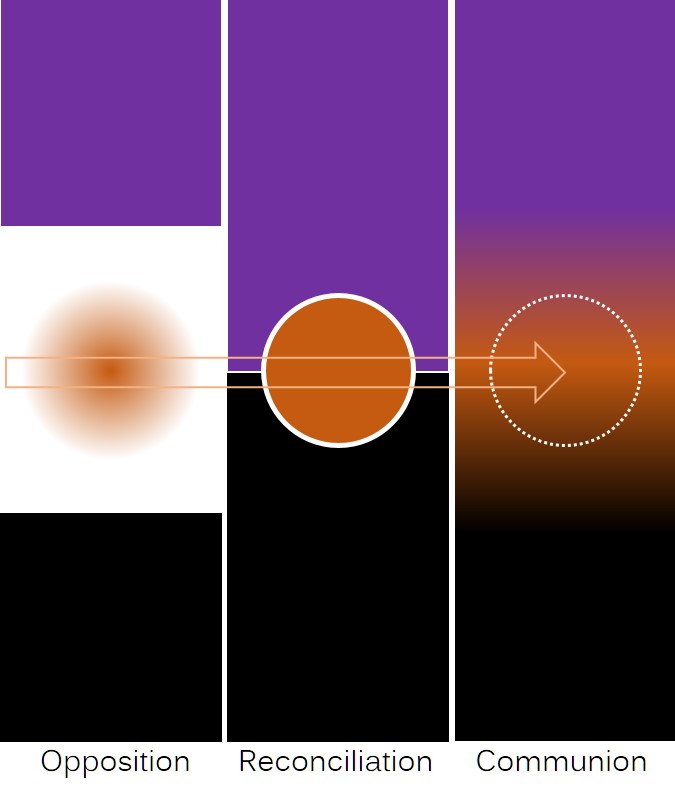
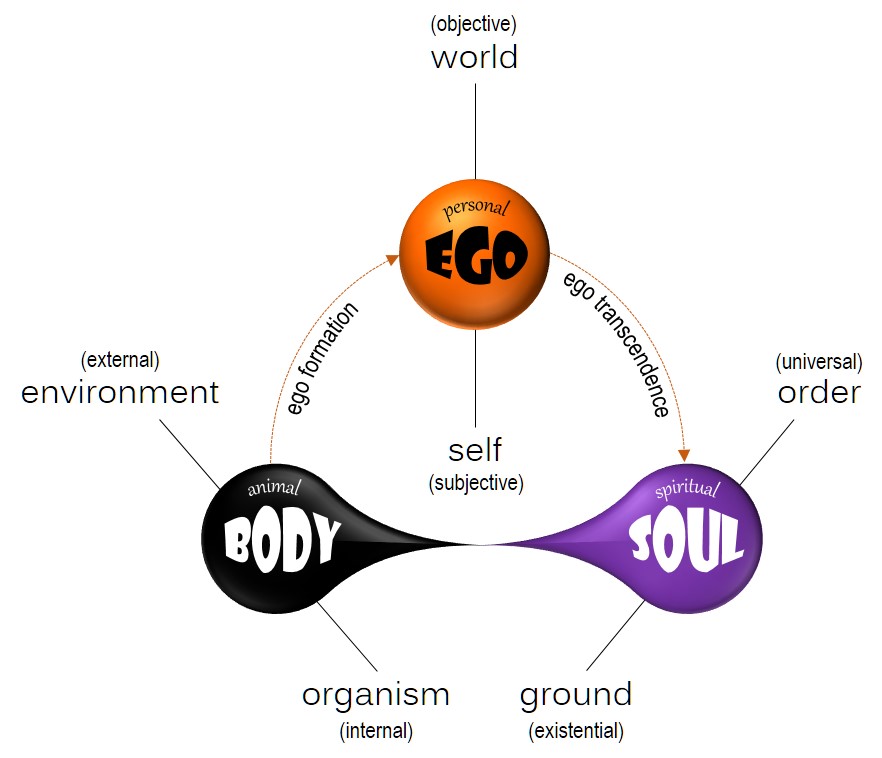
In the diagram above, this construction of ego identity (color-coded orange) is tracked in its slow progress through the essential aspects of our nature, body (coded black) and soul (purple). Depending on where we take our perspective in ego’s development, the relationship of these two aspects to each other is differently construed – in terms of ‘opposition’, ‘reconciliation’, or ‘communion’. These terms are thus offered as key concepts in our understanding of ego’s development, as well as that of theistic religion.

In the opposition phase, our separate center of personal identity (ego) is not very well defined. The very imposition of ego, however, causes a split in consciousness where an inner subjective realm is gradually divided from an outer objective realm, or ‘soul’ from ‘body’. Whereas soul and body in our essential nature are simply the introverted (intuitive-spiritual) and extroverted (sensory-physical) aspects of an evolved consciousness, our executive center of personal identity throws them into opposition. Now ‘I’ (ego) have a soul and a body, and the challenge becomes one of constructing a meaningful relationship between them.

This is where we find all those wonderfully complicated and emotionally charged stories (myths) about the separation of matter from spirit, of body and soul, giving account of how we happened into this conflicted state in which we presently find ourselves. It might get worked out into a fabulous mythology that puts god in opposition to the world as a bodiless and transcendent entity existing apart from our fallen carnal nature. Elaborate rituals must be invented, and then spun back to the people as revelations, that can provide a necessary atonement for resolving the negative conditions of our ignorance, guilt, and selfishness.

As personal identity continues to develop, these opposing forces of body and soul are gradually reconciled – brought together in a healthier marriage rather than striving in conflict. While traditionally interpreted in light of the older orthodoxy of opposition, Paul’s reflections on the person of Christ as one in whom ‘god was reconciling the world to himself’ (2 Corinthians 5:19) – that is to say, as one in whom body and soul were fully united in his essential nature – might be seen as evidence of this shift in perspective where ego (the Christ ideal) has progressed beyond a body-soul opposition and more into its own stable center of identity. At any rate, there is no doubt that Paul helped to move theism past the opposition of Two (god and humanity) and toward a synthesis into One (a deified humanity or incarnate deity).

As an aside I should note that Christian orthodoxy for the most part has ignored, and perhaps even willfully rejected, a theism of reconciliation for a reinstatement of the older theism based in opposition. Jesus came to be regarded not as the ‘New Man’, in line with Paul’s meditations, but as the key player in a transaction of salvation whereby our guilt was paid off and god’s wrath against sin was appeased. Even though humanity’s criminal record was expunged, god and the world remain essentially separate from each other.

This derailment of Christian orthodoxy from the intended path of theism’s evolution has, I am arguing, prevented the religion from progressing into its post-theistic phase. Despite the efforts of Jesus, and Paul after him, to move theism past the oppositions of god-versus-world, soul-versus-body, self-versus-other, us-versus-them, into a new paradigm where such divisions are transcended and made whole, Christian churches today remain locked in a pathological dualism. But we still need to consider what a full embrace of its post-theistic destiny would look like.

In my diagram, the distinct and separate ego has reached the point in its development where ‘me and mine’ no longer limit a fuller vision of reality. While a sense of oneself as a person continues to be in the picture, the sharp division of body (black) and soul (purple) gives way to a blended continuum of animal and spiritual life. We are ‘spiritual animals’ after all, and now our awareness and agency as persons can move us into a new but still self-conscious mode of being. My name for this mode of being is communion, literally ‘together as one’. There is no god on one side and the world on another. No souls separate from bodies awaiting deliverance to a postmortem paradise. No ‘us’ on one side and ‘them’ on the other.

We are all one together. Nothing, really, is separate from the rest. The realization of this oneness, however, depends on our ability to appreciate ourselves (and all things) as manifestations of the same mystery. Such a profound appreciation – Jesus and other luminaries called it love – will fundamentally change how we live.

Journey Back to Reality

BreakthroughJust as soon as I make a case for the necessity of religion, it’s time to insist on our need to transcend it. If my atheist friends squirm at my insistence that we all have a religion – a system of beliefs, attitudes, values and practices that links the separate ego back to reality – my friends who are believers will shake their heads at my suggestion that we need to leave it behind. Why take the time to defend religion (not one or another religion, but religion itself) when the point is to go beyond it?

A popular notion of religion conceives it as a means to an end, as a way through this world to another one. We trust that our religion will answer those really big questions and ultimately save our soul when the body gives out and our life on earth is over. Even a slight acquaintance with the history of religion should disabuse us of that fantasy, as the ‘soul rescue’ model came on the scene only very recently and is based on a dualism of body and soul which is probably less than 3,000 years old.

For the greater part of its history religion has focused human concern on the challenges and opportunities of life on earth. Essentially it is about assisting human beings in the evolutionary work of “cultivating faith, nurturing love, and constructing meaning,” of reconnecting to reality and becoming real. Why we might need to become real is more obvious when we understand the extent in which ego formation (the development of a separate center of self-conscious identity) removes us from the spontaneous stream of life experience and from the present mystery of reality.

The rise of personhood and individuality is a slow arc across human cultural history, and religion functions to keep it from detaching pathologically from the mystical (contemplative), ethical (communal), and universal (cosmological) dimensions of our existence. Few critics of religion today recognize just how important it was during the formative stages of human evolution, not to mention how important it continues to be as our destiny unfolds. Just because certain aspects of religion, and even entire religions, may change or disappear as we progress doesn’t mean that religion itself is expendable.

The question is not whether but how ego consciousness today is linked back to the grounding mystery within, to the living community of persons, and to the larger context of life on earth. Does our religion ‘work’ to this extent, or not?

My diagram summarizes the ‘journey back to reality’ that healthy religion is intended to facilitate. The place to begin is at the bottom-right, where looped purple and black chain-links remind us of the essential nature of human beings as spiritual animals. We are not souls in bodies or bodies with souls, but sentient animals with a rich inner life. Our body is oriented by the senses in an extroverted fashion to the physical environment, while our soul opens consciousness to its own inner depths. In the dialogue of inner and outer, mediated by metaphor and story (myth), we perceive the oneness of all things and our place in the order of existence.

Shifting over to the bottom-left and slowly swinging upward in the diagram introduces another piece of the puzzle, in that developing center of self-conscious identity (ego) mentioned earlier. If ‘spiritual animal’ is what we are as human beings, ego identity is a quest for who we are – where we belong, to whom, as a member of which tribe, in what occupation, and so on. Early on, the tribe is most active in shaping our animal nature into a well-behaved dependent – a ‘good’ boy or girl who observes the rules of the game. Certain base impulses have to be restrained, or else channeled in ways that conform to the morality of tribal life.

Our fundamental relationship to the body is established at this stage, as either something we can honor and enjoy, or instead feel unsure and ashamed about.

The first separation in ego formation, then, is a separation of self-consciousness from the sensations, drives, and urgencies of the body. Ideally there is a general sense of security, where the emerging ego feels supported and valued as a member. But even in the well-adjusted individual some anxiety persists around the question (inarticulate at this point) of whether it’s really safe to trust, making security a chronic concern for the ego. We see this, for instance, in the infant that clings to its mother for safety and nourishment, unwilling to let go for fear of not having what it needs to survive. Attachment, then, is how ego compensates for insecurity, by latching onto whatever promises the unconditional support it has lost in the process of separation.

Every ego thus carries an inherent self-contradiction: the separation necessary for establishing its own center of identity amplifies a deep insecurity, which ego then seeks to overcome by attaching to an external anchor – be it mother, family, nation, wealth, status, deity, heavenly reward, or whatever. The deeper the insecurity, the stronger and more desperate the attachment: a condition that interferes with and can completely undermine the process of healthy ego formation. This self-contradiction is usually resolved (perhaps only justified or explained away) by the construction of meaning that our tribe erects around us. As an obedient and honor-seeking member of the group, we should be willing – better yet, eager – to sacrifice everything in service to its idols and ideals.

Insofar as religion can become a closed orthodoxy and a hierarchy of top-down control, it was inevitable that this natural course of human evolution (i.e., the rise of ego consciousness) would generate a crisis – and a worldwide one. Wherever the rising force of personal identity and individual freedom confronts a regime of moral repression and thought control, something needs to give.

It’s important to understand, however, that because ego is inherently insecure to some extent, the framework of meaning it comes to inhabit and defend as its personal world is not wide open to reality, but just as small and simplified as it needs to be. In my diagram, a ladder of ego development leads up into a more or less coherent worldview (symbolized by a sphere) held inside a set of beliefs concerning ‘the way it is’ (symbolized by a box around the sphere). Even a healthy personality, exhibiting the telltale signs of ego strength (stable, balanced, and unified), is separated from reality by its world construct.

We don’t need to demonize the ego and make it the cause of all our trouble, as some world religions have done. The goal of ‘salvation’ (referring to the process of being set free and made whole) is not to cancel or reverse what ego formation has accomplished, but rather to transcend personal identity and reconcile consciousness to reality once again. I say ‘once again’, but in fact the connection this time is conscious and intentional, whereas its pre-egoic state was unconscious and spontaneous.

By definition, nothing is separate from reality, which means that ego’s separate identity is actually (in the words of Albert Einstein) “an optical delusion of consciousness.” This is what needs to be transcended.

Having made our way to the top of my diagram, we can now follow the path of our journey back to reality. To really see things as they are, the veil of meaning that separates us from reality (or to use a related analogy, the mental labels we affix to things and other people) must be pulled aside. What is revealed, then, is perfectly meaningless: reality in all its glory, the pure radiance of being. Truth is always beyond meaning, and our meanings are true only insofar as they accurately represent the way things really are. And yet, even the most accurate representation is still just a representation; the present mystery of reality transcends all media of thought, language, art, and theory. It is ineffable.

When we are liberated from the constraints of belief, prejudice, and unrealistic expectations, other persons can be respected as free individuals rather than as emotional attachments that protect or ‘complete’ us. Such open and sacred regard for others, expressed as empathic care for their health and well-being, is what we call love. Genuine love and community is a dynamic of freedom, trust, kindness, and honesty between individuals. It isn’t ‘blind’ at all, but profoundly clear-sighted. Attachment is what makes us blind to others, regarding them only as we need them to be – how reassured, desirable, important, or threatened they make us feel.

If truth is the way things really are behind the meanings we impose on them, and if love refers to a genuine human connection that is free from neurotic attachment, then power, as the opposite of insecurity, has to do with our conscious connection to the grounding mystery within. Paul Tillich expanded the notion of being (taken as a verb rather than a noun) as ‘the power to be’, interpreting existence (from existere) as the place where reality manifests (or ‘stands out’) in this or that thing.

Much of mystical spirituality might be characterized as an inward descent of consciousness, dropping past the identifications of ego, into the deeper registers of inner life until the wellspring of being-itself is reached.

Our quest for identity sets the stage, as it were, for our journey back to reality. As the quest is our preoccupation during the first half of life, the journey will (or perhaps I can dare say, should) serve as the orienting metaphor for a spirituality of the second half. Yes indeed, we will occasionally get hooked into the drama of ‘me and mine’ – much more frequently than we would care to admit – losing our way time and again. But soul seeks truth, not meaning. It celebrates love, not possession. And it rests quietly in being, in the secret source of power.

A Father’s Heart

My present relationship with my father began a little more than two years ago, when we lost my mother. Since then we have talked on the phone morning and evening, just about every day. I suppose the combination of my being more temperamentally similar to my mother, and my father’s steady fulfillment of his family role as provider and disciplinarian, had made him seem more distant – not absent or uncaring, but more other, the counterpart to her enveloping nearness. Throughout my early life, he was like that promontory on the seacoast which provides a fixed point for the orientation of ships rising and falling on the waves.

I think there’s something archetypal about a father, as there is about a mother. Whereas she is the encompassing reality out of which we need to be delivered in our quest for identity, he represents in his otherness the ideal and future goal of what we are becoming. Our fathers might not exhibit the ethical character that inspires our own positive moral formation – although my father truly did – but simply in their otherness they stir our longing to stand out and be somebody. This might help explain why some young men who grow up without a positive role model in their fathers are at higher risk of becoming sociopaths and extremists.

Sometimes I wonder if my father’s role in our family system as the lawmaker and disciplinarian kept me from seeing the sentimental and softer side of him. Maybe his life story as a firstborn son and obligated farm hand, eventually serving as a church pastor in a denomination that was strongly patriarchal, shaped his own development away from the more tender and expressive virtues. No doubt, who we are and how we are in the world is to some extent determined by our situation in life and the responsibilities we are asked to shoulder. Even given that, I realized later on that how I saw my father was also limited by my own needs, ignorance, and insecurities.

Just last month my father’s only sibling and last remaining family member passed away, leaving him with the solitary task of sifting and sorting through legal documents, family memorabilia, and other of my uncle’s personal effects. He’s remarked more frequently of late how tired and ‘shaky’ he feels, driving back and forth from Michigan to Iowa and having to make decisions over the disposition of property and the family farm. He is struck at times by how little is holding him here anymore, after losing his parents, a son, his wife, friends along the way, and now his only brother. As the anchors of love and commitment are pulled up from his world, he feels increasingly adrift and alone in life.

In the midst of it, however, his faith remains strong, which I’m sure is the deep core of his character stability that has always impressed me. While his theology – the vocabulary and discourse he uses to make sense of his faith – is not identical with my own, I resonate with my father’s sense of a provident mystery that is present with him even in his loss and grief. We are not separate from reality after all, and ultimate reality (what we name God) is not ‘something else’ but rather the essential ground in which, as the Apostle Paul says quoting the Cretan philosopher Epimenides, ‘we live and move and have our being’. In his quiet moments, my father finds reassurance that he is not really alone.

At first, our frequent phone conversations were my way of keeping in touch and sharing the grief of losing my mother. It was distressing to picture him there, sitting by himself on the edge of the bed or staring through tears at his morning oatmeal. I wanted to be with him, to give what comfort I could offer. Over time, however, it was his faith that ministered to me. He seemed softer, more vulnerable; and in his vulnerability, more genuine and present in the moment. Our connection grew stronger, and I found myself looking forward to the next chance we’d have to talk.

Someday I want to be like my father.

Why is it so easy for us to take what is precious for granted? When our loved ones are alive and with us, how do we dare let a day pass without telling them how much they mean to us? Why does it take losing them to remind us? I will not wait, not another day. After all, the day might not come.

Dad, I love you. Thank you for being a rock for me, and for helping me find my way.Promontory

Does Your Religion Work?

The question is not whether religion will one day be only a memory of our brutal and superstitious past as a species, or else singularly responsible for our future catastrophic self-destruction. A lot of people feel that we would be better off without it. In their perspective religion is unnecessary baggage crowding the mental space we could be using for more relevant and practical concerns. We can’t deal rationally with these things until we abandon superstition, come to our senses, and work together for real solutions.

A returning reader is familiar with my less categorical appraisal of religion. I can be critical of every tradition and denomination with respect to how easily it gets tangled in our neurotic obsessions with glory, guilt, sex, violence and death. But at the same time I am constantly in search of what we might call ‘religion in essence’, as distinct from its countless historical manifestations. From the etymology of the term we can define religion as the system of attitudes, beliefs, values and practices that works to link us back (Latin religare) to reality, resolving the separation inherent to the rise of ego consciousness.

Personal identity is a process of social construction that gradually establishes an executive center in the ego – actually a deputy center, subordinate to the authorities of family and tribe. Ego stands above the body and apart from others, and if development has been particularly difficult or traumatic, it becomes estranged from its own inner life (soul) as well. When this condition of separation is severe enough, a profound insecurity can overtake the personality. The essential function of religion is to provide the means for ego to reconnect with reality – internally with its own grounding mystery, relationally with others, and transcendentally through a meaningful world-picture (or cosmology).Faith_Love_Meaning

Distinguishing essential religion in this sense from its various manifestations – inspired or deluded, genuine or dysfunctional as the case may be – gives us a useful model for assessing the relative health of our own. Whether or not you believe in god, say your prayers, go to church, or hold out hope of an afterlife, the real litmus test of any religion has to do with how effectively it connects you to the grounding mystery within, to others who share the world with you, and to the universe that surrounds you.

My shorthand for these dimensions and associated practices of life is illustrated to the right. I’ll unpack each term more thoroughly in a bit, but for now I’ll restate my general thesis in the following way.

Religion is the system by which human beings cultivate faith, nurture love, and construct meaning. However you do that, is your religion.

Faith

We begin with faith because its presence or absence sets the tone for everything else. From the time we were still in our mother’s womb, our nervous system was picking up clues as to whether reality was provident and supportive, or instead hostile and dangerous. This was long before we had an ego and prior to our acquisition of language. Consequently the deep impression registered in our nervous system was both unconscious and ineffable.

In the context of essential religion, faith has nothing to do with beliefs – orthodox or otherwise. The roots of the word reach far below the articulate mind and its propositional truths, into the matter of trust, surrender, and release. I prefer release because it keeps the dynamics of faith centered internally, where to trust (in) anything we must first let go and open up to what is beyond us.

Its opposite is not heresy or intellectual doubt, but anxiety – more accurately existential anxiety, a profound dis-ease concerning the nature of reality. Our nervous system is gripped with tension, skittish and hyper-reactive, which sets us up for nervous exhaustion. This anxiety is the cause of so much that goes wrong in religion.

Because faith is our trusting release to the grounding mystery of being itself, it’s not something that can be measured or manipulated. It is our spontaneous ability to surrender control, relax into being, and rest in the moment. The good news is that it’s an ability we can develop by intentional practice.

Love

We might expect that a deeply grounded faith will translate in positive ways to our relationships with others, and this is indeed the case. The ego is established in its own separate center, which suggests that reaching out for affection, intimacy, cooperation, and reconciliation is where our religion is really tested – and where many fail. A deficiency in faith (i.e., excessive anxiety) makes us suspicious of others and unable to trust them, so when they let us down as they inevitably must, our core impression of reality is confirmed. Around it goes, in a self-reinforcing loop.

Because ego-formation moves our center of personal identity into its own separate position, the real work of religion lies in caring for others, respecting their interests, understanding their needs, forgiving their faults, and helping them thrive. In short, the real work of religion is about love. We should be able to say with confidence that any religion which fails to cultivate the power of love in human relationships, even more when it arouses and justifies hostility towards others, is neither healthy nor true. This insight is what motivated Siddhartha to eschew metaphysics and Jesus to renounce orthodoxy, revealing the way of liberation as consisting in loving-kindness.

Meaning

The age of postmodernity coincides with the dawning realization that meaning is not something we find in reality, but construct for ourselves. Words are human creations, and the sentences, stories, and worldviews they make up really are made up. If there’s a crisis of meaning these days, it’s not that life has let us down but that we are doing a bad job making life meaningful.

At the highest level, our religion inspires a view of the full horizon of existence, a unified theory of how the Whole Thing moves as one. In prehistoric and ancient times such theories were dramatic narratives, which we know as myths. As we approach modern times, these stories become more mathematical than narrative in structure, and personal elements are strictly excluded. A downside of this shift from sacred stories to scientific theories is our difficulty in seeing ourselves in the bigger picture. If we reduce mind to brain, brain to body, and body to nothing but dead matter, where is the self? Where is the human spirit? How is it possible to say that we belong to the universe?

One more quick drop down to the level of faith will help us appreciate how the meaning of life is really a creative project of our shared life together, and how the quality of our relationships is directly a function of how deep and strong is our individual faith. Faith, that is to say, encourages love, and love engages us in the collaborative pursuit of meaning.

That’s when you know your religion works.

Terminal Education and the Death of Culture

Terminal EducationYouth is being wasted on education. More and more young people are becoming victims of what can be called ‘terminal education’, which is not about lifelong learning and opening minds to the world – not anymore. Increasingly the education process is a conveyor-belt affair, where naive and optimistic youth are moved through a series of stations along the way to a long life of work.

Many of them don’t make it, and it’s not entirely their fault.

Feeling the pressure of limited resources and a fluctuating job market, college administrators are remodeling the process of education into a production-line for making graduates who are expected in turn to fill jobs and strengthen the economy. A stronger economy should mean more resources eventually coming back to the college, right? It might work that way if our colleges weren’t turning out such dismal figures when it comes to academic achievement, graduation rates, and job placement for their graduates.

There are really two systemic problems with our current education system, one of which is the terminal orientation of the process (the main focus of this blog post). Underlying this problem, however, with a history equally as deep, is the way our system over-accommodates students in their struggle to succeed in school. Rather than working to empower in students the determination, best effort, perseverance, and resilience that lead to meaningful achievement, schools already from the elementary level have been lowering the bar, so as to reduce the risk of failure.

Are they doing this because they feel badly for the struggling students? No, these accommodations are being provided so that students will produce the academic outcomes (grades, grade point averages, and standardized test scores) that increase institutional eligibility for external funding, updated technology, and higher quality teachers.

Generally the rule is that accommodations cost more the later such interventions are needed, so by putting accommodations in place early this threat can be averted. Unfortunately what happens is that students are pushed up a grade without the intellectual skills and emotional resources to succeed there.

When it’s time for college, they’re not ready – not by a long shot. But colleges need to show robust enrollments, so they end up falling in line with the accommodation train. Remedial classes, academic interventions, prerequisites for credit classes, and even special accommodation for students who can produce a diagnosis from a growing list of learning disorders – all of it necessary if the year-end report is to show an institution’s market value.

Maybe the underpreparedness of students is part of the reason that education has become terminal. If all your time and resources are tied up in simply getting them to graduation, what’s left for the work of opening minds, igniting passion, nurturing creativity, and developing human potential? Not much. And frankly, the students themselves don’t seem to want it. Never mind that they have no inkling of what ‘it’ even is, having rarely been empowered in the love of learning.

A depleted system produces deficient members, whose deficiency further depletes the health reserve of the system: this is the kind of reinforcing feedback loop that inevitably ends with extinction.

I suppose that’s one meaning of the word ‘terminal’.

But another meaning, and the one I want to focus on here, describes how education today is aimed at very specific and measurable outcomes, and ultimately on the need of students to find gainful employment.

Why are you planning to go to college? Because I need to find a job. And of course, before I can find a job I need to earn a degree. For the degree, I have to get decent grades. In order to get a grade I have to take a class. And before I can take a class, it’s necessary to choose a college and be accepted.

Why are you doing this again? To find a job. When I get a job, it will all be worth it and my education will finally be over. Done. Finis.

It shouldn’t surprise us to learn that many students don’t make it. In my diagram above, the likelihood of success at each step diminishes the farther along students get, as indicated by the thinning arrow. With each step the definition of success also becomes less clear, as illustrated in the fading shade of text. Additionally, the consequence of failure grows more severe as students move through the stations: withdrawing from a class is not as serious as dropping out of school, and the disillusionment that comes when your degree fails to unlock a career can be personally devastating.

‘Plan B’ is another way of saying that things didn’t work out as you hoped they would.

If all this focus is placed on the terminal outcome of finding a job, there is little inherent value acknowledged in the process of education itself. It’s not really about learning how to think and solve problems, developing talent and unleashing creativity, or opening minds to the mysteries of life and promoting the self-actualization of human beings. And yet it is these things which have been the seedbed of human culture for millenniums, not ‘getting a job’.

Terminal education is both a symptom and a warning that our culture is losing its spirit.

Thankfully it’s not too late to turn things around.

College is more than a pipeline of graduates into the workforce, and the deepest value of education is probably something that can’t even be measured. For at least four years (in the conventional scheme of things) young people are growing into their adult selves, learning how to get along in the world, pushing open boundaries, tapping the inner springs of their native intelligence, discovering passions and exploring their dreams.

A higher education – but really, at every grade along the way – needs to have one eye on the economic landscape and changing demands of the job market, with the other on its sacred stewardship of the human spirit.

Unfinished Business

Unfinished BusinessI guess I write a lot about what I feel is most urgently needing our attention these days. Current events are interesting because they’re in the news and on our minds, but popular engagement with the news of the day tends to skim the surface of what’s really going on. It’s not nuclear proliferation, terrorist plots, melting ice caps, or the next election that we should be figuring out, but the deeper forces that are presently driving and shaping our reality.

We need a psychological model that reveals the truth about ourselves without reducing us to mindless matter, on one side, or elevating us to metaphysical dimensions, on the other. Importantly it should provide an honest accounting of both the promises and liabilities that attach to our human nature, in a way that makes sense in a secular and global age. The elements of my model are not new in themselves, but I offer definitions and relationships among the elements that are novel – and, I hope, relevant to the current challenges we face.

My diagram above draws an arc of development from a body-centered (early) phase, through an ego-centered (middle) phase, and reaching fulfillment in a soul-centered (late) phase. I’ve joined body and soul in something of a tensive image, stretching between the animal and spiritual aspects of our essential nature. A simple statement of this essential nature is that we are ‘spiritual animals’, animals with a capacity for imagination, creativity, contemplation, transcendence, and communion.

We are not ‘souls in bodies’ or ‘bodies with souls’, but rather a marvelous duality of consciousness that is at once centered in life (body) and grounded in being (soul).

Before we hitch a ride with ego along that rising and falling arc, let’s spend a little more time getting to know the body where its hero journey begins. In other posts I have characterized body as naturally extroverted, that is, as flexing consciousness outward to the surrounding environment and continuously regulating its own internal state (as an organism) according to those external cues and conditions. The body’s own internal urgencies operate for the most part below our conscious awareness and almost entirely outside our conscious control. We might regard the body itself as a highly evolved energy exchange between external resources and these internal urgencies, between the provident conditions of the environment and its own metabolic demands as a living organism.

Ego formation (the rising arc of personal development) entails some decisive negotiations with the body’s animal nature, a process that is motivated and supervised by our tribe. The expected outcome of this process is a centered identity that sees itself as belonging to ‘us’, obediently performing roles that contribute to the welfare of the group. What we call morality is the set of rules, values, incentives, and deterrents that constrain us to behave like a ‘good boy’ or ‘nice girl’ and eventually as a compliant member of the tribe.

Psychologically ego formation is also where reality starts to divide in two, with an objective (‘thrown-over’) world on one side, and a subjective (‘thrown-under’) self on the other side of this line. World here is not a synonym for reality, as we sometimes speak of ‘the real world’ as a factual and nonfictional realm beyond us. As I use the term, world refers to the construct of symbols, language, meaning, and morality that ego, with the help of its tribe, builds around itself. Much of it is (in fact) fictional, in the sense of being a narrative construction of metaphors and stories that form a cross-referencing web of meaning where an individual feels secure.

Self is also a narrative construct made from strands of memory, preferences, beliefs, and ambitions that connect into a relatively continuous braid of character which ego identifies as ‘me’. As a construct, self is no more real than the world in which ego finds refuge and significance. Personal identity, therefore, represents a separate project from the deeper evolutionary one of becoming a mature and fully actualized human being. Indeed, the project of identity-formation can seriously impede and even completely undermine human progress in this larger sense.

Instead of an ego that is stable, balanced, and unified – together comprising a virtue known as ‘ego strength’ – development gets arrested in one or more spectrum disorders (borderline personality, bipolar mood, or dissociative identity).

Getting stuck here – arrested, hooked, fixated – is what lies behind so much suffering that individuals chronically endure and proceed to inflict on each other. Rather than operating from a position of creative authority where the adaptive compatibility between self and world affords the freedom and responsibility to be oneself, neurotic insecurity closes the mind inside rigid convictions and condemns the individual to a prison of shame and conceit, impotence and aggression, profound doubt and fundamentalist certainty, all or nothing.

Increasingly desperate bids for security turn into deadly campaigns for supremacy; or else, which in the long run amounts to the same thing, a final relief from torment through suicide.

A critical deficiency in ego strength prevents an individual from being able to ‘go beyond’, or transcend, the self-and-world construct for the sake of a larger and more authentic experience. Creative inspiration, mystical contemplation, empathic communion, genuinely open dialogue – such experiences are unavailable to the personality which is trapped inside itself.

These experiences, sought and celebrated in healthy cultures, are only possible as ego succeeds in letting go, dropping out, and moving beyond the conventional structures of meaning, deeper into the present mystery of reality.

And thus we have arrived at our consideration of soul, as that introspective turn of consciousness to its own grounding mystery. Even here, however, ego might attempt to take control and claim the inner life of soul as merely another name for subjectivity, for the permanent core of personal identity. I’ve suggested in other posts that this error of mistaken identity is behind the widespread religious doctrine of personal immortality. It’s essential to note, however, that the grounding mystery within is neither the ego, its personality, nor the self of ‘who I am.’

Despite the obvious popularity of the idea across cultures, the invention of personal immortality marks a serious corruption in our proper understanding of the soul.

When ego is transcended – not negated, rejected, renounced, or subjugated, but released and surpassed in a more inclusive, holistic, and unitive experience – consciousness sinks into its own grounding mystery and proceeds thence (or perhaps simultaneously) outwards along the expanding horizons of sensory awareness to the breakthrough insight that All is One. From deep within, far below the surface concerns of our historical situation, we find the grace to relax into being, open ourselves to reality, and ponder our place in the turning rhythms of a universal order (or universe).

This is the birthplace of philosophy, according to its original intention as the ‘love of wisdom’. Only as we achieve liberation from the centripetal (shrinking and tightening) constraints of personal identity can we appreciate the astonishing truth that, in us, the universe is contemplating itself. If we can be faithful in this practice, those chronic and intractable problems that are currently threatening to undo us will simply unwind and fall away.

Matter, Life, Spirit

Matter_Life_Spirit

One of the challenges we face as we advance deeper into a secular and global reality is how to redefine the terms ‘spirit’, ‘spiritual’, and ‘spirituality’ so they can have relevance to life today. While they carried metaphorical meaning in a mythopoetic reality, and were converted into a supernatural and metaphysical realm above or apart from the historical reality of empirical facts, in our increasingly this-worldly (secular) and interconnected (global) realities of today, their meaning is in question.

Many people with an interest in spirituality but not so much in organized religion continue with those old out-dated supernatural and metaphysical references. Spirit (along with soul) is still regarded as ‘not of this world’, separate from our embodied existence, temporarily inhabiting our bodies (or trapped inside), haunting the outer boundaries of science and ordinary life.

One common way of including spirit (etc.) in our contemporary worldview is to see it as a further stage of evolution. Similar to the way life emerged from inorganic matter, so spirit awakened and eventually came forth from life. Such an evolutionary perspective has some obvious advantages over the ancient (historical) view of spirit as something added from outside, or as a higher and more perfect state of being from which we fell once upon a time.

But the evolutionary model has its shortcomings as well, chief of which is the assumption that spirit is something with objective existence, separate from and outside its organic and material substrates. So separate and outside, in fact, that popular conceptions of spirit envision it as occupying its own metaphysical realm, above (super-) nature or behind the sensory-physical screen.

One of the earliest metaphors of spirit (breath, as the invisible life-force that keeps our bodies alive) perhaps encourages the idea of its objective (out there) status and is likely behind the widespread belief that when a body expires, its spirit leaves to go somewhere else to live.

Such commonsense metaphysics notwithstanding, our metaphor of spirit as breath actually supports an opposite idea, which is that it represents not some entity moving in and out of bodies but rather the invigorating life-force within. Whereas life is expressive and out-spreading, spirit is how the universe opens inward to the deeper registers of being. Life is the astonishing product of evolution, the ‘roll-out’ of organic and sentient species, while spirit is the equally astonishing capacity of life for involution, particularly in the species of homo sapiens, where the light of consciousness is turned upon its own inner depths.

I realize that in refusing the lure of metaphysics and choosing not to regard spirit as something outside or behind the realm of physical life, I am taking a significant departure from the common path of religion. I do this not to be contentious, and certainly not because I am sympathetic with reductionist theories that leave us with nothing but ‘atoms in the void’. It might sound at first as if my denial of spirit – and of the god-symbol used to represent it – as a separately existing reality apart from that of our physical life is a vote for atheism, but this is not the case at all.

As my returning reader knows by now, I am an evangelist for post-theism, which moves the conversation past the stalemate of theism and atheism in order to explore the nature of spirituality after (on the other side of: post-) our conventional representations of god. A study of religious history reveals the indisputable development of god from intuition into metaphor, from metaphor into symbol, from symbol into concept, and (fatefully) from literary figure (in the myths) into a literal being (up there, out there). Along the way god becomes progressively more humane, that is, less brutal and more gracious, less temperamental and more reasonable, less demanding and more forgiving.

This progression in god’s development makes perfect sense from a constructivist point of view, where the whole business is interpreted as one long project in cultural meaning-making. Our representation of god serves a purpose, and when this purpose is fulfilled our task becomes one of stepping fully into our own creative authority. In this sense we ‘grow into god’, not in becoming gods but by actualizing the (projected) virtues represented in god and gradually moving past our need to orient on a transcendent ideal. Obedience gives way to aspiration, and aspiration matures in self-actualization.

Spirit, then, does not ‘live inside us’, as in the classical conception of the indwelling soul, but is rather the deep creative center and inner ground of being where human opens inward to being and the universe becomes aware of itself in us. Even though my model presents it as a later-stage development, spirit is not something added to or housed inside the physical chassis of our living body, but (again) refers to the capacity of consciousness to contemplate its own grounding mystery.

In three moves, we (1) shift attention from the sensory-physical realm, (2) turn inward to the ground of being where we come to an ineffable intuition of oneness, and then (3) open again to the surrounding field with the profound appreciation that ‘All is One’.

This deeper (spiritual) vantage point, or what I also call the ‘mental location’ of soul, is the abiding place of genuine spirituality. It allows us to cultivate a mysticism of wonder (or one-der) and work it out into a relevant cosmology and way of life. Our challenge today is to set aside the old metaphysics which are no longer congruent with our current science and psychology, or compatible with the ethical challenges we face as a globally connected species.

We take our place at the source and allow its inspiration to guide us in constructing a habitat of meaning (i.e., a world) that incorporates what we presently know about the universe and our own creative responsibility within it. If we are on the threshold of a spiritual breakthrough of some kind, it will have to lead us deeper into life and closer to one another.

Mental Bypass in Religion

Intuition_Understanding_ConvictionHow did something with its origins in a mystical intuition of reality’s essential oneness become such a violent force of division in the world? If religion began as a system of symbols, rites, and sacred stories with the purpose of linking the business of daily life back to the grounding mystery of being, where did it start to lose its way and become a program of separation, deliverance, and escape from this world?

Or to make it more personal, what makes an individual who believes in ‘the god of Jesus Christ’ or in Jesus as ‘my personal Lord and Savior’ act in such ways as to utterly contradict the core teachings of Jesus himself?

That last question is probably the easiest to answer. A misalignment of Christian behavior with the teachings of Jesus most likely has to do with a difference in consciousness between Jesus and the professing (but hypocritical) follower. It’s not simply a matter of imitating the actions of Jesus or parroting his words; his words and actions manifested a certain degree of enlightenment, empathy, and courage. That’s where the difference lies. It’s not that he was god and we aren’t, or that he was perfect and none of us can be.

Very simply put, Jesus was spiritually grounded and lived his life by the mystical intuition that All is One. To phrase it with more of an ethical focus: We’re all (in) this together.

And probably most of his professing followers aren’t, and don’t.

It may have been this depth of grounding and spiritual clarity that eventually got misconstrued into the metaphysical doctrines of his heavenly origins and divine nature. At any rate, the Jesus of Christian orthodoxy went in an entirely different direction. He became a virgin-born world savior, supreme object of worship, patron of generals and kings, and the one who will eventually come again to judge the quick and the dead. This is the Jesus in whose name Christians have destroyed indigenous cultures, waged war on unbelievers, drowned witches, burned heretics, and condemned homosexuals.

An entirely different direction.

Much of religion today has become identified with emotional convictions of one kind or another. This is the type of belief sponsored by orthodoxy. It’s not about articulating a profound mystical intuition into an intellectual understanding where its relevance to life in the world can be worked out. Instead it is locked inside very specific turns of phrase, tied to proof texts, cross-referenced, embedded in confessions and creeds and recited together with the standing congregation. Its lack of relevant (real-life) meaning is compensated by a fervent passion that ‘it must be so’, since a Christian’s present identity and post-mortem salvation depend on it.

A returning reader will be familiar with my low regard for conviction, as the point where a belief once held by the mind turns the table and becomes its prison. What initially may have served to frame a perspective on something eventually closes down to just ‘this way’ of seeing it. Nothing outside the frame is validated, no alternatives can be considered, no other answers to the question or solutions to the problem. Creative thinking comes to an end. When it happens in religion, wild metaphors that may have once carried an experience of mystery across the threshold into meaning now lay dead in their cages. At this point, without a lifeline remaining to its own spiritual depths, thought becomes rigid, dogmatic, and heartless.

Emotional conviction is perhaps the chief symptom of religion’s collapse. This is not to say that Jesus himself, for example, didn’t carry a great deal of passion into his teaching and way of life. Indeed, his ethical precept of ‘love your enemy’ – which is how he translated the mystical intuition of oneness into a social revolution – generates a mixture of inspiration and anxiety in any reasonable person just contemplating it.

The point is that his passion, and his passionate action, came out of an intellectual understanding of the spiritual basis and strategic purpose of unconditional forgiveness.

We can imagine two of Jesus’ disciples, soon-to-be founders of two distinct traditions of Christianity, holding a conversation after he is gone. “We must love our enemies because Jesus told us to, and we need to stay with his program,” one says to the other. “Although, we might need to qualify what he probably meant by ‘enemy’, since there are some people in this world that are simply impossible to love and frankly don’t deserve it.”

“You’re missing the point,” says the second disciple. “Jesus could love his enemy because he understood that our separation from others is a lie we impose on reality, when in truth we are all one. Forgiveness and love follow rather spontaneously upon the realization that what we do to others, we do to ourselves. We don’t do it because Jesus told us to, but because we are all in this together.”

Whereupon the first disciple proceeded home to begin the work of orthodoxy, and the second carried on with the work of converting truth into love.

Reality Shift

Reality ShiftsA somewhat naive understanding of human evolution and individual development assumes that with each advancing stage, former ones are simply outgrown and left behind. We know, however, that this is not how nature evolves. Earlier and more primitive structures are not abandoned, and neither do they merely lie inert beneath the exciting progress higher up. Instead they get incorporated into the emerging design, differently managed or re-purposed in light of a greater functional complexity.

This matters a lot when it comes to the interpretations of our own progress as individuals and a species. The naive approach has treated our mythological past, for instance, as over and done, leaving us free to face reality (finally!) as it is. Scientific theories relentlessly pursue objective truth, while the ancient myths may entertain us but in the end only obfuscate our view of what’s real. We need more facts, not superstition. The presumption is that our ancestors and other distant cultures stumbled around in ignorance, whereas we now clearly see the way things really are.

A closer look reveals that earlier versions of ourselves – whether bygone generations or former decades in our own lifetime – continue to operate underneath and behind whatever ‘executive functions’ are currently at the helm. In developmental psychology we commonly speak of our ‘inner child’ which refers to an infantile and juvenile subpersonality (Assagioli) that sometimes takes over when we’re tired, sick, hungry, stressed, or threatened. But we should also take into account a still more primal animal nature that lurks in the unconscious and is governed by instinct. These deeper and developmentally earlier versions may not determine our engagement with reality as they once did, but a mature adult must learn how to incorporate ‘gut feelings’ and playful spontaneity in a more socially responsible way of life.

Most likely our biggest limitation has to do with the fact that each advancing stage in development reconnects us with reality in a new way. Or we might say that each stage in development initiates a shift in reality itself, for the straightforward reason that our mode of engagement with reality must be included in what is meant by the term. Along the path of human evolution, then, our species has confronted a new reality at each turn. And across the arc of our evolution these developmental advances have carried forward former versions of ourselves, still operating at deeper and less conscious levels.

I propose that human beings have evolved through three major ‘reality shifts’ and that we are currently on the cusp of a fourth. This is similar to the well-known ‘paradigm shift’ concept made popular from the history of science (T. Kuhn), except that as a constructivist – maybe even a radical constructivist – I want to make it about more than a mere shift in the (mental) “framework containing the basic assumptions, ways of thinking, and methodology that are commonly accepted by members of scientific [or other type of] community” (Paradigm in Dictionary.com). When our framework shifts, everything about our way of engaging with reality also shifts, which means that because reality necessarily includes our way of engaging it, reality itself shifts as well.

Mythopoetic Reality

The first reality shift, and the one that launched our species on its cultural trajectory, is what I’ll call the mythopoetic. Poiein is Greek for ‘to make’, and mythos translates as ‘a narrative plot’ or story; so a mythopoetic reality is one where our engagement with existence is facilitated by the narrative construction of stories. I don’t agree with a popular definition of myth which dismisses it as ‘primitive science’, our first bumbling attempts to explain what’s going on around us in the natural world. Rather, myths articulate and embellish upon foundational metaphors that represent our deepest impressions and intuitions of the grounding mystery, or what I also call the provident ground of being itself.

It’s important to understand that a story-shaped reality has no ‘outside’ – no nonfictional or purely factual realm independent of the mythic imagination. This reality is sustained in the activity of narrative performances where stories are acted out in the tasks of daily life, with the turn of seasons, on special occasions, and around the shared concerns of a community. Whatever may lie beyond the boundaries of a particular story-world is not a ‘mere fact’ but is characterized according to its proximity and potential value to what’s going on inside the story – such as the chaos acknowledged in many ancient myths, dragons lurking at the edges of medieval maps, or the boogeyman in a child’s closet.

As that last example suggests, early childhood is when each of us lived in a mythopoetic reality. We were continuously pretending – daydreaming, fantasizing, dressing up, role-playing, embarking on one adventure after another. In those years we had no interest in, let alone an understanding of, the factual reality that would later become the bedrock truth of our adult experience. That time in our lives – whatever we can remember of it – is probably our best entry to an understanding of what prehistoric story-telling culture was like.

Historical Reality

At some point in the evolutionary past, as well as in our own personal past, the sacred canopy of mythopoetic reality came down – or at least fell just far enough to expose another reality on the other side of our stories. I will call this the shift to historical reality, a shift reflecting the progress of human consciousness beyond the security, meaning, and hope we had earlier found in our myths. For a memory of what it was like, we need to recall that strange mixture of exhilaration and anxiety we felt in adolescence.

The exhilaration came as our perception of time expanded beyond the ‘once upon a time’ and ‘happily ever after’ frame of the story-world, into a causal stream seemingly without beginning or end. As the boundary of our mythopoetic reality blew open to reveal a limitless field of possibilities, the opportunity as well as temptation for all things exotic beckoned to us. On the other side of that exhilaration, however, was an anxiety over our sudden ‘nakedness’ – a niggling self-conscious sense of being stared at. Both of these powerful moods (exhilaration and anxiety) announced the emergence of a separate center of personal identity, or ego.

This separate self provided a new vantage point on a reality without limits (except for those repressive rules imposed on us by authorities), arranged and revolving around ego at its fixed center. It is in this reality and corresponding version of ourselves that an irresistible impulse to throw off constraints and ‘become as the gods’ – free, powerful, and beyond accountability – acquired the drag of guilt and shame for our offense. You should be able to hear a strong theistic theme here, which resolved the problem of separation by a process of atonement and reconciliation.

The dawn of historical consciousness is accompanied by a disenchantment with the mythopoetic reality of early life, which comes as a consequence of ego’s separation from its own grounding mystery. Whereas the mythic imagination continues to operate farther below, the executive ego – or what I also name Captain Ego – is having to take into account a factual realm altogether independent of it. This forces upon ego a need to decide the truth status of those stories, and a few alternatives become obvious.

One answer is that the myths are simple stories of an era when we believed such things. Now we know better and should dispense with them in the interest of progress. A second option, related to the first, might regard the myths as amusing tales that provide a fascinating look inside a less enlightened period.

Another possibility is that myths are descriptive reports of miraculous events and supernatural things revealed in the far-distant past and recorded for our benefit, but of events and things not presently accessible to our senses. This is the option that led to converting the literary (or mythological) god into a literal being, and invented the idea of a supernatural realm above and outside historical reality.

Finally, a fourth answer to the question ‘wherefore the myths?’ would be to explore them as metaphorical clues to our deeper spiritual life. Of the four options, this one is by far the least popular; ego has a hard time with metaphors and anything deeper than its own personality. The doctrine of personal immortality, another invention of this reality shift, dismisses all notions of a spirituality that threatens to swallow up, go beyond, or dissolve away the permanent self.

Secular Reality

The shift to a secular reality came about as the inherited system of supernaturally oriented beliefs rapidly lost relevance to the challenges and opportunities of daily life. This coincides with a shift in consciousness from the insecure and self-conscious ego to a more ’embodied’ and this-worldly (Latin saeculāris) orientation. Such an orientation, while portending the end of supernatural religion and biblical literalists (option 3 above) everywhere, is energetically embraced by many atheists and mystics alike.

‘Humanist’ is probably the best term for describing the emerging value system of this reality shift, as the larger cause for human rights, individual happiness, and personal well-being informs and qualifies more of what we do. The weight and promise of our current situation calls for a clear view of the facts and a more broad-based social responsibility. We don’t look outside the world to a supernatural heaven, an end-time deliverance, or even a metaphysical underground to which we might escape the task before us. The resources and solutions we’re looking for must be found inside – within ourselves, our communities, and in our shared world – this world.

As odd as it sounds, the shift from historical to secular reality makes possible a renewed appreciation for life’s sacredness and what I call the Real Presence of mystery. A reverence for the earth’s elemental forces and exquisite beauties, for the fragile yet tenacious life-force evident all around, a reverence which had been intrinsic to the enchantment of mythopoetic consciousness but was later eclipsed by the rise of the historical ego, returns now, but in a consciousness that better understands its creative responsibility within the whole. Such a heightened sensitivity to the value and promise of what’s inside awakens empathy, inspires compassion, motivates cooperation, and reconciles consciousness to a reality that is more interconnected.

Global Reality

A fourth reality shift, simultaneously ascending within us and descending upon us by a conspiracy of technologies (travel, the Internet, communications, business and trade) opens awareness to our place in a global system. We are really just starting to understand the dynamics of systems – about the interactive forces that hold things together (integrity), connect individuals in higher forms of complexity (synergy), and pull everything down toward more stable states (entropy). (For more on these, see The Consilient Leader.)

As we better understand the nature of systems and our own place in the ecosystem of planet Earth, reality invites our engagement at a new level. Of course, we’ve always belonged to systems, but as consciousness opens up to our responsibilities and creative authority within the systems we inhabit, a new set of values begins to guide our choices, goals, and commitments. Living in a global reality doesn’t allow us to make decisions and take action only around individual self-interest, or even that of our local tribes.

Consequences flow out in waves of rippling influence, not by the linear cause-and-effect of billiard balls. What’s more, the most serious consequences come back on us by intricate feedback loops, slow amplification, and long delays that we cannot predict or control. But when they come, everything in the system is affected. Perhaps the most obvious example of this seeming ‘suddenness’ of catastrophic consequences is the phenomenon of global warming. The buildup of so-called greenhouse gases has been on a slow rise for many decades. But now, all of a sudden, polar ice caps are melting at an alarming rate and sea levels are rising, entire species are going extinct, and convoluted weather systems are bringing upon us one disaster after another.

In my diagram above I have positioned a human stick figure with one foot in secular reality, and the other in global reality – or almost there. This is to make the point that, for the most part, our species is only beginning to grasp the bigger picture, deeper truth, and longer view of our place in the universe. We may hold this intuition in our mythic imagination, but it remains buried beneath an obsession with identity (ego) and a chauvinistic secular humanism. Even now, any incentive for altering routines and convictions must appeal to a concern for ourselves and future generations, rather than a genuine reverence for life and responsibility to the whole.

Global reality is where the evolution of consciousness has reached a point of the universe becoming aware of itself – in us. Instead of this higher awareness setting us apart from the other species, its aim is to inspire us to care more responsibly for the planetary community of life.

The Examined Life

It was Socrates who said that “the unexamined life is not worth living.” He is a key figure in the history of Western consciousness and its growing fascination with the self. At that time, Socrates and others were searching out the individual’s place in the comic and moral orders; only later did the obsession collapse into the neurotic variety that sits at the center of our present consumer culture. Our neuroses notwithstanding, the Socratic axiom is still good advice.

In fact it may be what keeps our strange species from wiping itself out.

In that spirit, I will step through a theoretical model of what makes us human, hopeful that a more accurate and honest self-understanding might not only prolong our stay on this planet but contribute significantly to a future of peace and well-being.

The best place to begin is with what I call our essential nature as human beings. ‘Essence’ here doesn’t refer to some absolute and unchanging reality underneath or behind what is evident to our senses. From the Greek for ‘being’ (esse), it simply speaks to what something is, not as isolated and standing apart from everything else, but just as it is, centered in itself.Model_Step 1With that in mind, I propose that our essential nature as human beings is best captured in the term ‘spiritual animal’. Other similar-sounding titles have been used in the past, such as ‘rational animal’ or ‘political animal’ (both from Aristotle), and ‘symbolic animal’ (Cassirer). But each of these is based in some capacity of higher intelligence that may be ‘higher’ in humans though not entirely unique to us. Besides, whether we are rational, political, or symbol-using animals, the qualifier in each case says more about what sorts of special things human beings do (or can do), not what we are.

As a spiritual animal our consciousness is dually oriented: inwardly to the inner recesses of contemplative life and outwardly to the sensory-physical environment. Spiritual names the inward-oriented, introverted power of consciousness which has prompted the intuition of our essential oneness with reality (within us). This intuition is profound and ineffable, and it lies at the mystical origin of all (dare I say it?) true religions. Animal not only identifies our membership in a ‘kingdom’ of life, but as an adjective it names the outward-oriented, extroverted power of consciousness which supports the perception of our essential relationship to all things (around us).

If I use the classical terms ‘soul’ and ‘body’ in connection with this dual orientation of human consciousness, I need to be especially careful not to separate them into opposing ‘parts’ of our nature, where the next step traditionally was to identify with one (soul) against the other (body). So let me stress the point that our essential nature as spiritual animals is a duality in the orientation of consciousness, not a dualism of a mortal body and an immortal soul only temporarily bound together for this earthly life. Our essential nature, in other words, possesses an indivisible integrity: we are body-and-soul, not bodies with souls or souls with bodies.Model_Step 2To this essential nature something else is added, and this I call the conditioned self, or ego. Ego is distinct from the spiritual soul and the animal body – remembering that these are orientations of consciousness and not separate parts – by its character as personal. From the Greek, our adjective ‘personal’ refers to a mode of consciousness that is socially constructed, shaped in the role-play of human relationships, and providing the individual with a mask of identity (actually numerous masks) through which we speak (persona) and interact with others.

A personality is really a rather loose association of distinct drives, attitudes, and dispositions, with each motivational strand capable of breaking the surface and running the show for a time. The psychologist Roberto Assagioli called these distinct strands ‘subpersonalities’ and regarded the ego as an executive manager of sort, with the (socialized) responsibility of keeping each in its place and a general order overall. Through the process of ego formation, this executive center of personal identity gradually assumes control and conducts the personality according to the moral constraints and expectations of society. When the personality has achieved stability, balance, and unity under ego’s effective management, the developed virtue is known as ego strength.

This adventure in ego formation is illustrated at the cultural level in the ascendancy of theism. As the patron deity represents those virtues of character expected of a devotee, god also stands behind and legitimates the disciplinary system that enforces morality. An individual’s subpersonalities, then, have their social equivalent in the many tribal members, each of whom might at any moment attempt to break out and take over. For its part, the patron deity plays the role of ego for the group, asserting the dominant will and keeping order. In a way, Freud’s concept of the superego, not just as the voice of tribal morality over (super) the individual but as a divine ego projected above (super) the group, fits into this picture well.

From the perspective granted by our separate ego, body and soul can easily (and mistakenly) be seen as “mine.” We can’t forget, however, that this separate center of personal identity does not actually exist; it is merely a social construct, a representation of ‘who I am’ in this or that tribal context. The longer purpose of ego formation is not simply to establish a personal identity, but rather to empower sufficient ego strength in the individual so that he or she is capable of ‘going beyond’ the self in such higher experiences as love, inspiration, communion, and wholeness.Model_Step 3Ego transcendence ultimately makes it possible for individual consciousness to find reconciliation with our essential nature. As long as our effort and attention are preoccupied with amounting to something, defending ourselves, and holding our own, this invitation to the unified life cannot be fully accepted. In fact, without sufficient ego strength – a deficit which can come about as a consequence of childhood abuse and the lack of positive social support – the prospect of self transcendence can strike deep anxiety in the already insecure ego. (This is the anxiety exploited by sick religion and channeled into bigotry, conviction, and violence in god’s name.)

With sufficient ego strength, however, we are able to go beyond ourselves in a healthy and holistic way, dropping deeper into the grounding mystery within and opening to the provident universe all around. This realization of oneness – that I am both a manifestation of and a participant in the present mystery of reality – promises to transform our way of life in profound ways. We can note, for instance, how Siddhartha Gautama, Jesus of Nazareth, and countless other revolutionaries in consciousness challenged the moral conventions of their time and opened the minds of their contemporaries to the sacred mystery at the heart of reality.

The examined life is indeed worth living.