The Responsibility of Thinking Well

Anderson: “The best way to keep an audience from seeing the weakness in any plot is to step up the sense of menace; the maxim of hack screenwriters is that when things get slow you put a bear on the beach.”

There is a narrow bandwidth of intelligence where an individual is able to think critically, skeptically and rationally. While this capacity for reason is a natural endowment of human beings, the skills that are necessary to develop it must be learned and practiced in a social context. Optimal learning occurs somewhere between urgency and boredom.

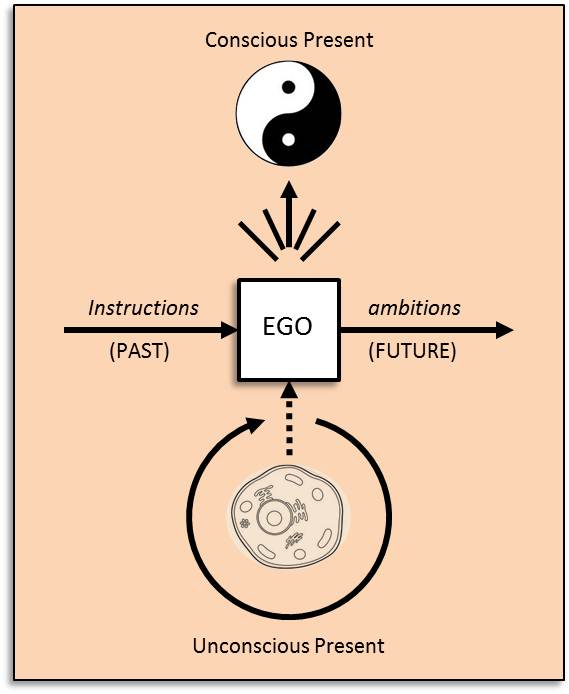
This bandwidth of reason is narrow, but it can be widened with training and discipline. The individual needs to learn how to be “reasonable” even in emergent and high-risk situations, when the stress-response would otherwise kick in and take over. This natural reaction in the body has evolved for the purpose of survival and has millions of years of “practice” behind it. When it kicks in, the energy flowing up to the light bulb in the attic gets shunted to the boiler room in the basement.

It’s not time to think. Pausing to consider your options or take in a larger perspective could forfeit your opportunity for getting out alive. Stress hormones activate a complex syndrome of physiological events in your body, and you just react. Your nervous system locks into a channel that diverts energy away from longer-term projects of digestion, cell repair, and immunity, directing it instead to your visceral organs and exercising muscles to enable a successful escape.

That’s the upper extreme.

At the lower extreme of this bandwidth of intelligence called reason is boredom, and ultimately dormancy – sleep. While situations of urgency will interfere with your ability to think critically, skeptically and rationally, situations of boredom can prevent the kind of concentration of mental focus that reason requires. If the topic lacks sex appeal or real-life relevance, this focus quickly dissolves and the mind falls to a baseline of daydreaming reverie.

Human beings are meaning-makers, and the primary way we make meaning is by telling stories or listening to others tell them. As constructs of language, stories are like gymnasiums where we learn how to swing, tumble and vault through the thought-ways of our culture. Fairy tales, folk legends, heroic epics and the great archetypal myths form a nested hierarchy of narratives that shape consciousness and open the mind to larger, more inclusive realms of human concern.

Reason is trained and strengthened in this gymnasium of cultural mythology. Over time, it graduates from fairy tales to more abstract and sophisticated stories (theories) in its orientation to reality. Graduating doesn’t necessarily entail that you suddenly become intolerant of stories about talking animals and faraway fantasy lands. But once your reasoning intelligence is active, these earlier engagements must be seen in a new light and from a different angle.

The three attributes of reason mentioned above are that it is critical, skeptical and rational. Critical thinking involves being able to tell the difference (kritikos, to discern) between the meat and potatoes of story, between its argument or main point and the style of its presentation. When we are very young and reason is still getting its grip on the monkey-bars of language, the proportion of potatoes to meat must be carefully arranged so as not to overwhelm the plot or main point with too much secondary material (adjectives, references, details and digressions).

As critical thinking continues to develop, we gain an ability to separate not only substance and style in the story itself, but to distinguish between the story as an artistic expression and its author as artist. Who wrote this? What type of story is this, and what was the likely occasion for the writing? Who is the intended audience, and where does the author intend to take the reader/listener? Obviously this kind of discernment involves leaving behind the initial enchantment of the story, in the way it caught us up and carried us along when we first read or heard it.

Reason is also skeptical (from the Greek, meaning to examine or look closely). Just because it’s there in the story doesn’t make it reliable information about the nature of reality. The “looking closely” of skepticism reinforces the point that the ultimate criterion for judging the reliability of story is one’s own experience. If the story was authored by someone who lived a long time ago, critical thinking will seek to determine the type of story it is. If it’s purported to be some kind of factual reporting or eye-witness account of events, then skeptical thinking will evaluate its claims against the (sensory) evidence available to us. In the absence of such evidence, we are left with the question of the author’s grasp on reality and the trustworthiness of his or her supposed testimony.

A skeptical attitude doesn’t require that we dismiss as untrue everything that may have happened in the past or to other people. But outside of our direct experience we are left with only degrees of probability. Even if the piece of historical writing contains its own fail-safe claims to divine revelation or doctrinal inerrancy, as is commonly the case in the holy scriptures of religion, reason will assign only a relative value of reliability. Reasonable certainty must not be confused with emotional conviction, where it must be true if only because we need it to be so and believe with all our heart.

Finally, reason is rational. Ratios and rations have to do with relationships and portions, which makes rationality about putting things together and making the patterns that support higher meaning. Something is rational when it is logically coherent, holds together, and makes sense. A story about supernatural beings or magical creatures may not pass the bar of skeptical judgment, but it still can be completely rational in the way it offers an internally consistent and logical portrayal of narrative events.

Now, back to the first point, about the narrow bandwidth and cultural dependency of reason. Without a clear and persistent commitment to reasoning and to being reasonable in our orientation to reality, popular culture must find ways of keeping us interested and engaged. It does this by putting “a bear on the beach,” which keeps our attention riveted on the stressor as it distracts us from our need for longer plots and larger patterns. Global security threats and end-time prophecies put us just on the edge of panic (upper extreme), as the glossy photos and celebrity gossip keep us from falling asleep (lower extreme).

It’s not too late for reason. Even faith needs to be clear-sighted and sensible to avoid being hijacked by fear or rendered irrelevant. Good people of faith must be good thinkers as well.

Life Without Hooks

De Mello: “Put this program into action, a thousand times: (a) identify the negative feelings in you; (b) understand that they are in you, not in the world, not in external reality; (c) do not see them as an essential part of ‘I’; these things come and go; (d) understand that when you change, everything changes.”

In both East and West you can find a high value placed on detachment. In the East this detachment is more contemplative and mystical in orientation, while in the West it has been more speculative and experimental. Despite these different cultural “accents,” however, each type is well represented in both East and West.

Of whatever type, detachment represents a decision at some deep level not to get emotionally “hooked” in reality – as it seems or how it feels. Mystics and scientists are fellow researchers in this way, choosing not to allow their feelings to filter or prejudge what’s really going on. From one angle this can sound as if a vital part of human experience is being subtracted and dismissed. Who really lives this way?

Nobody. It’s important to understand that this detachment is more a discipline than a lifestyle. The point must also be made that we’re not talking here about people with severe affective disorders, who lack an emotional engagement with the world due to a brain dysfunction or because separating themselves emotionally from their experience was the only way they could cope with early trauma or abuse.

We are talking about “the rest of us” – the billions on this planet presently who get triggered and hooked every day. You make me mad. I miss my dog. God loves me. These are all emotional judgments I use to arrange reality into a world around me. I have a world, and you have a world.  What’s on the other side of our worlds, beyond them as the unnamed mystery of reality, hardly interests us. It rarely even occurs to us.

Emotional feeling might attach us to reality, but the place where we get hooked is no longer reality just as it is. It feels a certain way (“to me”) or has a certain meaning (“for me”) because I am here. My interest in it makes reality instantly personal and uniquely mine.

Most people would probably concur, as this relates to how IT feels – IT being what I am hooked into at the moment. But meaning … well, that’s “out there,” separate from us, just waiting to be discovered. Right?

Not so fast.

Wherever I’m hooked to reality, a kind of duality emerges. On the “me” side of the experience is how it feels (sad, delightful, scary, annoying, etc.). This part of my experience is personal, subjective and “biological” – in that these are all measurable reactions in my body. The particular emotional state of arousal is really a syndrome of numerous biological events in my cells, glands and organs. When I’m in a state of fear or desire, reality has the character of being scary or seductive, but it’s all happening inside of me.

On the other side of my hook is an expansive association of meanings – how IT connects to other hooks of my past and present. Once upon a time I set that hook over there (or my ancestors did) and then forgot I did it. Now it’s just a part of the way things are. This hook gets connected to all those other hooks, and together they comprise the illusion of a seamless fabric of meaning called my world.

The awareness that human beings “construct” meaning rather than simply “discover” it out there in reality is a very recent realization. If it is discovered, then it’s as a mental or material artifact of human creativity. We come upon hooks left on reality all the time. The worldview of a given community or culture is actually a more complex hooking-together of many personal worlds, through many generations of time. That it goes on into apparent infinity gives the impression of timeless permanence.

The Buddha said that if we can’t learn to manage our cravings we will continue to latch on to reality, and then suffer when it pulls away from our hooks. It’s always pulling away, if only because our hooks of feeling and meaning are organized around “me” and reality isn’t. Whereas the orthodoxy of his day insisted that we are caught on the wheel of suffering for as many turns as it takes to get our act together, Siddhartha taught that it’s our craving for all things “me” that keeps us stuck there. Extinguish the flame of craving (the “blow-out” of nirvana), and liberation just happens.

Jesus, too, had much to say about hooks and our need to forgive or “let go” of the places in our relationships, particularly with “my enemies,” where the pain of injury and misunderstanding keeps us gripping down in self-defense. While orthodoxy claimed that the one sinned against (god/me) is free to forgive in response to a satisfying repentance of the sinner/enemy, Jesus flipped the whole thing around. When asked how many times we should forgive “the one who sins against me,” he advised his disciples to stop counting and waiting around for repentance. Forgive first.

In some ways, Siddhartha and Jesus were “postmodern” in the way they deconstructed the metaphysical assumptions behind their respective cultural mythologies. The Buddha (“awakened one”) overturned the idea of a permanent soul and its endless cycles of rebirth, while The Christ (“anointed one”) pulled down the doctrine of a vengeful god and his insatiable demand for propitiation. They are both honored and worshiped as world redeemers because they showed how letting go of “me” allows for a larger experience of peace, freedom and joy.

Yet we continue to hook in and hold on, if only because it’s the primary impulse of our ego to do so. The significance of my world is an extension of my identity (ego), and my identity is a function of where I hook in for security. What would it be like to live without hooks, or with fewer hooks than we presently do?

No doubt, everything would change.

Light and Shadow

Robinson: “Faced with the shadow, the unacceptable, [the response of the West] has been to reject and exclude it. The dark has been detached from the image of God or the Christ and projected on to a Devil or Antichrist viewed as the embodiment of evil per se – though at the beginning of the process, as in the book of Job, it was not so: Satan was among the agents of God and seen as doing his work, the hand of the Almighty, albeit his left hand.

“This process comes to its climax in Zoroastrianism, post-exilic Judaism, Islam, and not least in Christianity, where the Devil came to occupy a uniquely powerful, even obsessive, position. The absolutizing of evil in a totally malignant Being has been the dark side of the absolutizing of the good in ethical monotheism. Evil is utterly banished and excluded from God.”

An inability to hold a creative opposition together results in dualism, where the internal tension strains through a bi-polar phase and finally breaks apart into a split reality of warring opposites. With one eye – let’s say the right (and all that it means to “be right”) – we see what is good, orthodox and acceptable. With the other – the left (Latin sinister, French gauche) – we see what is evil, deviant and unacceptable.

Conventional theism regards this dualism as based in metaphysical realities. On the right (correct) side is a company comprised of gods, angels, saviors, saints, and buttoned-up true believers; on the left (errant) side are devils, demons, fiends, sinners, and pants-down heretics. These opposites can have no part in each other, and in the end one or the other must win.

But why stop there? Historically on the “right” side are also males, the logical mind, and the self-righteous ego. And on the “wrong” side are females, the emotional body, and the sex-obsessed id. In other words, while the out-lying branches present a view where one side is held separate and apart from the other, following this tree of metaphors back to the trunk reveals each as a part of the same reality.

Post-theism takes a step back from metaphysical realism and tries not to get caught up in the passionate testimonials that claim to have encountered good or evil in its pure form. I’m suspicious that such a metaphysical dualism – a division in the very nature of reality itself – is actually rooted in a more home-grown dualism within ourselves.

If I can’t accept a basic part of what I am – and in the West it has tended to be my impulsive, carnal, pleasure-seeking animal nature – then it (Freud’s Id) must be split off, pushed down, depersonalized and disowned. This is the part of me that had to be managed, disciplined and domesticated in the early years of my socialization, as this animal nature was being converted into a polite and well-behaved member of my tribe.

It wasn’t socially acceptable to crouch down and relieve myself in public. I had to “hold it” and go find a restroom. In some circles it’s not socially acceptable for girls to play rough or for boys to dance. Whatever we needed to do to ensure the protection, provision and approval of our “higher powers” – even if it meant casting off some natural passions and talents, we did it.

But if a part of what I am has been shushed, punished and excluded long enough, it’s going to show up somewhere. Robinson’s point is that it shows up in our metaphysics, in our mythology, in our religion, and in our ethics. It emerges from under ground either as out-and-out deviance and rebellion, or else in the prejudice and bigotry of our moral convictions.

The mythological god is where this psychosomatic dualism gets projected and sanctified. If god hates sinners and deplores what is evil, then why should we be any different, right? If god is constrained by some reluctant obligation to condemn unbelievers – even though he supposedly loves all of us unconditionally, mind you – then why should I forgive my enemy? How can I, if even god can’t?

It seems to me that there is a whole semester of Jesus’ teachings, particularly on the topic of forgiveness and love for the enemy, that has been pushed out of the curriculum of orthodox Christianity. This “first voice” of Jesus will not be heard as long as the dualism of light and dark, good and evil, right and wrong, rules and urges, “us” and “them” persists.

We worship in god what we glorify in ourselves, and we persecute in each other what we can’t accept in ourselves. As more and brighter light shines on the cultured ego, the shadow behind it grows darker and more ominous. A passionate pursuit of righteousness may really be a sublimated fear of our repressed urges. We only appear to be chasing after godliness; in fact, we are running from our own shadow.

This internal strain of the ego trying to break free of the id serves a purpose, so I’m not suggesting that it’s completely neurotic. The social expectations of the tribe need to prevail over the animal impulses of the body if the individual is to take his or her place in polite society. Certainly, the primal energies dedicated to physical survival, sexual reproduction, and pleasure-seeking have to be guided into channels that are conducive to community life.

So the tension and interplay of “good” and “evil” is inherent in our human development. But when this tension becomes intolerable and the whole thing cracks apart into warring opposites (absolute dualism), reality goes apocalyptic. Relationships break up as individuals break down. As this continues, any hope for peace and community, reconciliation and love, health and happiness falls over the edge.

Interestingly enough, buried in our own fairly ancient mythology is an image that offers a way back to wholeness. Lucifer – that captain of devils who keeps whispering to us from behind the hedges of our Victorian garden-morality – is so named because he bears the light we have lost. He’s the part of us that we keep pushing away from ourselves and condemning in each other.

In order to get our light back, we need to face him, not cross ourselves and run away.

At the Threshold

Anderson: “As we become aware of the social construction of reality – consciously, publicly aware – the boundary erodes between the kind of fiction we call art or literature and the kind of fiction we call reality. History becomes another kind of storytelling, personal and social life becomes another kind of drama.”

Reality is a present mystery – ineffable and inconceivable, yet here-and-now. Always here and now.

“World” is our name for the mental construct that human beings spin like a web over the unnameable mystery. There are many, many worlds – as many as there are individual humans on this planet, busy making up the stories that provide the orientation and context they need to live meaningful lives.

The term “social construction of reality” can be misleading, in the way it suggests that reality is a product of social engineering. Early sociologists employed this term for its obvious impact, exposing the fact that our minds are storytellers and spin-masters, and not passive blank slates or transcendent observers as modernists had believed.

In the interest of clarity, I prefer the term “world” as a reference to this ongoing construction project of the mind. It’s not reality that is socially constructed, but our worlds – our representations of reality, our mental models of it, the myths and theories we make up. Granted, a world is a social construction of reality, but reality itself is not constructed. It is a present mystery, the real presence of mystery, always within our reach yet forever beyond our grasp. It IS – just that. What it is can only be represented, and the moment representation begins worlds come into being.

Postmodernism began with disillusionment, as people slowly (or suddenly) began to realize that our worlds belong to us as their creators. In earlier times, when by military conquest, commercial trade, or missionary outreach a dominant culture would come in contact with a different worldview and way of life, the strange stories and rituals of “those people” were generally dismissed as superstition. The invaders were in possession of the truth. Their myths were not bizarre fictions but the revealed world of god.

Their world was reality; there was no mystery, only meaning.

As a way of appreciating this evolutionary process of disillusionment, we can distinguish between premodern, modern and postmodern stages of cultural development. Rather than as measurable periods of historical time, I’m using these terms to distinguish different states of mind, in this slow realization of our role as meaning-makers and world creators.

In premodern times, human societies existed in relative isolation. Worlds, as constructions of reality, were like canopies of meaning elevated overhead and staked to the ground at the geographical boundaries of tribal territory. Individuals would be born, spend their lifetime, and go to be with the ancestors – all inside and underneath this single coherent world-canopy.

The modern stage began as the edges of this cultural canopy were lifted and attached to poles, allowing a world to be carried or stretched over a larger territory. This was the age of explorers, conquistadors, traders and missionaries, who encountered “those barbarians” and proceeded to exterminate, colonize, or convert them to the truth.

There are still many today who remain fully “illusioned” or entranced in this modern mindset. As Joseph Campbell put it, according to this mindset “myths are other people’s religion.” We alone have the truth. No world-and-reality distinction here. Our world is reality, the way things really are.

Postmodernism, then, is a mindset where this distinction starts to become evident. But more than that, it is accepted as something more than just a transitory feature of our lives. In other words, it’s not just a “philosophical fashion” that characterizes our times, but rather constitutes a transforming breakthrough in our self-understanding as a species.

Postmodernists are not necessarily better or more advanced than modernists, but their disillusionment does tend to promote a humbler attitude in how they hold their worlds against the backdrop of reality. This further translates into greater tolerance, respect, curiosity and understanding when it comes to their regard for the worlds of other people.

The modernist conviction that once motivated true believers to become martyrs or murderers in defense of their truth just doesn’t have the same entrancing power anymore – at least for the waking minority. An appreciation of your world as an illusion, albeit (we hope) a meaningful one, helps take off the pressure of having to fight for validation and supremacy.

Life becomes more freely creative, more interesting, and more fun.

But then there’s that part about taking responsibility for the worlds we create. It’s not all fun and games. After all, meaning is a basic psychological need of human beings. It provides orientation and context in our quest for security, identity and significance. Without meaning a person will fall into a hole of meaninglessness called depression. Down in that hole, nothing seems to matter – because it doesn’t.

Disillusionment – also known as awakening, realization and enlightenment – can be exhilarating at first, but then the “dis” starts to pull at the seams of your illusion and stretch the fibers of your sacred canopy. Not knowing where, or even whether, this unraveling will stop, there is an overwhelming temptation to roll over and go back to sleep.

This explains why the phenomenon of fundamentalism is correlated to the rise of postmodernism. It is its shadow, the dark counterpart of fear, dogmatism and violence that strives to pull us back under the covers. Fundamentalists profess their myths as the supreme truth, even though the primary subject as portrayed in the narratives has never been experienced by anyone.

This is a dangerous time in our history as a species. As we stand together on the cusp of creative change, chances are greater than ever that some of us will resort to desperate measures in their attempt to “save the truth” of their world and way of life. Such convictions hold our higher intelligence captive (as a convict) to deep insecurities that must be acknowledged and transcended.

Just know that there are many more like you – even now waking to the light. Find them. For your sake and theirs, find them.

Dropping Illusions

De Mello: “You must drop it all. Not physical renunciation, you understand; that’s easy. When your illusions drop, you’re in touch with reality at last, and believe me, you will never again be lonely, never again. Loneliness is not cured by human company. Loneliness is cured by contact with reality. Contact with reality, dropping one’s illusions, making contact with the real. Whatever it is, it has no name. We can only know it by dropping what is unreal.”

Awakening is used across the wisdom traditions of the world as a metaphor for salvation – which, of course, is still another metaphor. Many metaphors in this class have to do with being set free from something that is pulling us down and holding us back, as our dreams at night hold us captive to scenarios conjured up from the subconscious imagination. While asleep, the experience we’re having isn’t real, as compared to the physical world of the bed in the room in the house that Jack built.

And then there are dream episodes where you are running from danger or falling in love, which at least one part of your brain can’t distinguish from the peripheral sensations of your bedroom. Your heart races as stress hormones are released into your bloodstream. You thrash about and may start weeping in the middle of your dream. Awakening to the real world involves getting out of the predicament in your dream (the particular scenario that has you so worked up), then getting out of the dream itself, and finally waking up from sleep to become aware again of the real world around you.

But let’s not stop there. After all, what is this so-called “real world” you have awakened to? A comfortable bed in a room designed for sleeping (and other stuff), as part of a house in a neighborhood of a city in a state of the country where you are a citizen. Your country has a language and a history that are rooted in a still-larger culture, going back many generations and centuries. You and your fellow citizens live together inside a system of law, politics, morality, commerce and other basic values that constitute a more or less coherent worldview.

Keep going. This worldview – we might say, by definition – is only a view on the world, and not the world itself. Everything, from the bed you dream in to the canopy of tribal  mythology that holds everything in place, is a cultural artifact. A worldview is constructed much as furniture is made, but out of words, values and meanings rather than wood, metal and fabric. Even the bed isn’t “just” a material thing, but an object built by design for a specific purpose. It, too, is “made up.”

And then there’s the world – the thing that your worldview is only a view of. What is the world? From the root-word wer-ald, literally “man age,” world refers to the envelop of significance that human beings pull around themselves for security, identity and purpose. Your wer-ald co-exists with you as long as you’re alive, for the length of your age.

So even the so-called real world is meaningful only in reference to human beings. It’s also an artifact, a kind of boundary term that allows your made-up world to gradually and imperceptibly merge with reality. You have a world, I have a world, and we share a good part of a cultural world – although our local tribes may espouse very different, even conflicting beliefs about what it all means.

As a metaphor, then, awakening is a process of liberation from illusion. On this definition, not only is the dream scenario an illusion – or a play of imaginary representations, constructs of the mind – but so is the dream. And so are the many layers of cultural artifacts, from the bed you wake up in, to the role-play of your life in society, to the character and history of your people, and even to the mythological god who validates and supervises the whole thing. Illusions all.

One level “up,” so to speak, might seem more real than the one(s) farther down, but it’s still only a representation – a re-presentation, a secondary presentation, a mental construct, a mere image standing in for the real thing (or so we believe). So what we have is a nested stack of representations: dream scenarios inside of dream states inside of role plays inside of tribal dreams inside of cultural dream states inside the real world that god built.

Just so we can draw a boundary around all this illusion, let’s say that everything on the far side of representation is “metaphysics” or “revelation,” and leave that to the prophets and crack-pots who claim to speak for god.

I suppose it’s up to each of us to decide how much illusion we are willing to accept as truth. You’ve got to get on with your life somehow, right? We might expect a fully awakened human being, one who is entirely free of illusions, to be a world-renouncing party-pooper. Pretty much good for nothing when it comes to what the rest of us are so worked up about.

But renouncing the conventional world for one that is supernatural, metaphysical, or monastic is merely swapping out one illusion for another. Just because you switch from a functional language about garage doors to a liturgical language about god almighty doesn’t necessarily mean you’re any closer to reality.

So what De Mello means by “dropping illusions” must be something else besides turning your back on this world for the sake of a heavenly reward elsewhere and later on. Maybe it’s not even possible for our minds to apprehend reality, since the moment they grab hold and slap a label on it, the construction of meaning is already well underway.

Maybe the best we can do is try to live in full acknowledgement of our nature as meaning-makers, storytellers, spin-masters and illusionists. Perhaps dropping illusions is not about renouncing them, as it is stepping through them with a waking awareness to the real presence of mystery.

The Two Eyes

Robinson: “By drawing the insights of another center into as it were the gravitational field of one’s own, so that they come to form part of that ‘universe’ revolving round its single center, one is deliberately seeking escape from the tension of living with both poles at once. But truth may come from refusing this either-or and accepting that the best working model of reality may be elliptical or bi-polar, or indeed multi-polar.”

Let’s start with something straightforward and uncontroversial: An individual is an identity organized around a center and contained by a boundary.

The boundary of an individual not only separates and protects it from external reality, but also provides a threshold for engaging with that reality. If the individual is a “self,” then everything in external reality is “other.” This self-other (S-O) axis is the key to understanding the so-called Western view of reality. It is about “going out” and making relationships with others, which makes it extroverted, active, and social in orientation.

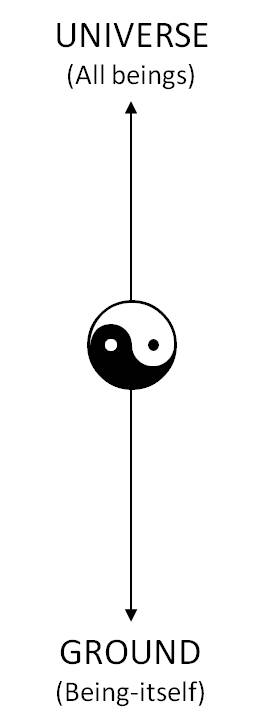
The center of an individual is inside, even deep inside. Centers are not about separation but integration, integrity and internal balance. If the identity of a self is organized around its center, then deeper into the center gets closer to what can be called its “ground.” This self-ground (S-G) axis is the key to understanding the so-called Eastern view of reality. It is about “going in” and experiencing union with the ground, which makes it introverted, contemplative, and mystical in orientation.

I qualified these different views of reality by designating them “so-called” Western and Eastern, but this supposed geographical distance can cause us to overlook the fact that they are both represented in each individual person. You are a self that relates outwardly to others and inwardly to your own ground. Instead of analyzing you into opposing parts – as in the familiar body-and-soul dualism – it is more helpful to regard you as a duality of orientations, outward (S-O) and inward (S-G).

Interestingly enough, just as entire cultures can be dominant in one orientation or the other, the same is true of individuals – wherever and whenever they live. Some are more extroverted, active and social, while others are more introverted, contemplative and mystical in the way they are oriented in reality.

We need to say “more” one way or the other, because every individual has both orientations, although one is likely to be preferred over the other. Your individual preference is almost certainly encouraged and reinforced by the cultural preference of your tribe. In this way, the West shapes an Occidental orientation and the East shapes an Oriental one. Of course, there are introverts in the West and extroverts in the East, but they probably feel a little bit like left-handers in a right-handed society. They can get along, but it does require continual adjustment.

Robinson is exploring the potential for dialogue between these two different orientations. It’s not just about getting, say, a Buddhist from Bangkok together with a Christian from Cleveland. That level of dialogue might be educational and constructive – but only eventually. If either the Buddhist or the Christian hasn’t been engaged in a dialogue between his or her own “Western” and “Eastern” eyes, dialogue at the table will be more like a debate, where somebody’s got to be right.

If you and I don’t appreciate as well as strengthen our two eyes, we can become monocular – rigidly attached to our preferred orientation and intolerant of its counterpart in ourselves or each other.

We need to have “one eye” on reality outside ourselves, on the Other. This is the reality we connect to with our bodies. It’s “out there” and separate from us, confronting us with difference, with otherness. Obviously, the religious system of theism is based on this idea of encountering the Other. But whereas popular theism is carried on the belief in an objective and separate being dressed up in the garb of mythology, its more respectable roots are likely in this primary experience of reality as Other.

We also need to have “one eye” on reality inside ourselves, on the Ground. This is the reality we connect to with our souls. It’s “in here” and essential to us, inviting us into the depths of our inner being. The varieties of mystical religion are based on this idea of union with the Ground. But whereas some popular forms of gnosticism can spin off into bizarre metaphysics, a genuine mystical approach disregards all this monkey-chatter and simply revels in the ineffable experience of oneness.

I’ve mentioned the conventional terms of “body” and “soul,” but if the spiritual adventure of our species is to move forward to the next phase of its evolution, we will need to let go of them as names for parts of ourselves. You don’t “have” a body and soul; rather you are these. And for sure, it’s time to drop the notion that you are a soul inside a body. That a time will come when your soul is released from the mortal coil of your body and live forever somewhere else.

This “dualism of parts” has been hampering our spiritual development for a long time, endorsing a neglect of the body, an abuse of the earth, a suspicion of others, and a persistent ignorance of our own wholeness – even our holiness – as complete yet paradoxical beings.

Perhaps a postmodern spirituality can retool the definitions of body and soul, away from the language of parts-in-opposition, toward a language of complementary orientations. In that case, body is your orientation in reality that connects you to others, to the otherness of things, to reality-as-Other. It is not a part of you, not something you have. It is YOU as situated in a community of others, confronted with difference, and finding your way through it all.

Soul is your orientation in reality that connects you to your inner ground, to the oneness of your being, to the ground of being-itself. It is not a part of you, or the “real you” temporarily housed inside a body. It is YOU as rooted in mystery, below the quirks and contradictions of personality, inwardly aware and wordlessly present.

Our challenge as individuals is to acknowledge this dual orientation in ourselves. Certainly acknowledge our preference for one orientation over the other, but then engage a disciplined dialogue between our “two eyes” – outward and inward, active and contemplative, social and mystical.

Reality gets that much larger and deeper when we open both eyes.

Holding On and Letting Go

Anderson: “People of power and position are not the only ones who resist threats to a belief system; so do ordinary people who have internalized that belief system and take it to be absolute reality. The collapse of a belief system can be like the end of the world. Even those who are most oppressed by a belief system often fear the loss of it. People can literally cease to know who they are.”

One of the working threads in my current conversation regards (a) world as a human construction of meaning. There are as many “worlds” as there are mentally functioning human beings on this planet, and each individual migrates through numerous world-constructs in an average lifetime.

A world is not reality, but only a representation of reality. It is “made up” of our recurrent thoughts, persistent opinions, personal and family stories, as well as the overarching myths of our culture that can bridge many generations. Inside these enclosures we feel relatively secure, conserve an identity (or several identities), search for significance, and work out our purpose.

Another, but less inclusive term for what we are calling a world is belief system, which tends to take the discussion in a more cognitive direction. Beliefs are judgments and conclusions that nevertheless still require an emotional “boost” to cross any gaps in logic, insufficient evidence, or lack of direct experience. From the root-word meaning “to hold dear,” belief is less about knowledge than commitment.

We are emotionally attached to our judgments about reality. It gets even more complicated when we realize that many of our beliefs are nothing more than emotional commitments to other beliefs. We need them to be right, or else all hell might break loose. At least our worlds might fall apart, which is probably worse.

Anderson makes the point that “ordinary people,” as distinct from those in positions of power and privilege, are just as defensive of the worlds that make their lives meaningful. We could also add those of lesser fortune, who labor and strain under the weight of oppression. If you see yourself as a victim of evil-doing, at least you have an identity equipped with its relevant concerns, coping strategies, aspirations for freedom and “the good life,” along with your own retinue of fellow victims, enemy-oppressors, and occasional benefactors.

The fact is, we need our worlds just as much as our worlds need us to create them. Problems arise when we forget that we’re making it all up and start insisting on our world’s absolute truth. The postmodern discovery is that every world is a project (coming out of us), a construct (built and arranged around us), and a representation (of reality). While our amnesia regarding its origin and status as so much pretense may be adaptive to some degree, our insistence on the absolute truth of our belief systems is where all wars, most divorces, and many mental illnesses likely begin.

After the birth of what I am calling the “postmodern discovery,” many believed that the time had come for humanity to advance beyond the need for belief systems altogether. But that turned out to be just another emotional judgment (belief) of an emerging worldview – another phase in the evolution of worlds, despite the elevated self-consciousness of its perspective.

It seems to me that the real challenge is to occupy our worlds in humble awareness of their nature as fabricated, provisional and necessarily short-sighted views on reality. Psychologically we can’t live without them. But in the interest of our health and longevity as a species, and of the health of our planet, we need some combination of courage and compassion to reach through the emotionally charged boundaries that separate us from each other.

When our worlds do collapse – either completely as in the phase-transitions to a “new mind,” or only partially as we slowly outgrow earlier convictions – the experience can be nothing short of apocalyptic. What had provided security and a place to stand feels as if it is falling away from under our feet. What had provided us with orientation and a sense of direction suddenly comes to pieces above our heads.

Because who we are is so deeply implicated in how we see reality, the breakdown of our world amounts to a loss of identity.

Just as post-theism entails transcending or going beyond the objective existence of the mythological god, so too does this evolutionary moment require that we loosen up and let go of our egos as fixed identities. Such self-transcendence needs to happen if we have any hope of staying in touch with what’s really going on, with the really real, with reality.

Letting go is scary, and it’s not without risk that we release what has given us security for what might lead to fulfillment.

This is where the old guard is typically called in. Tribal authorities, holy tradition, sacred scriptures and the mythological god are all being summoned in  defense of our out-grown worlds. We don’t want to lose what we have, even though it has already lost much of its relevance to our daily lives. So we close our eyes and hunker down, and call it faith.

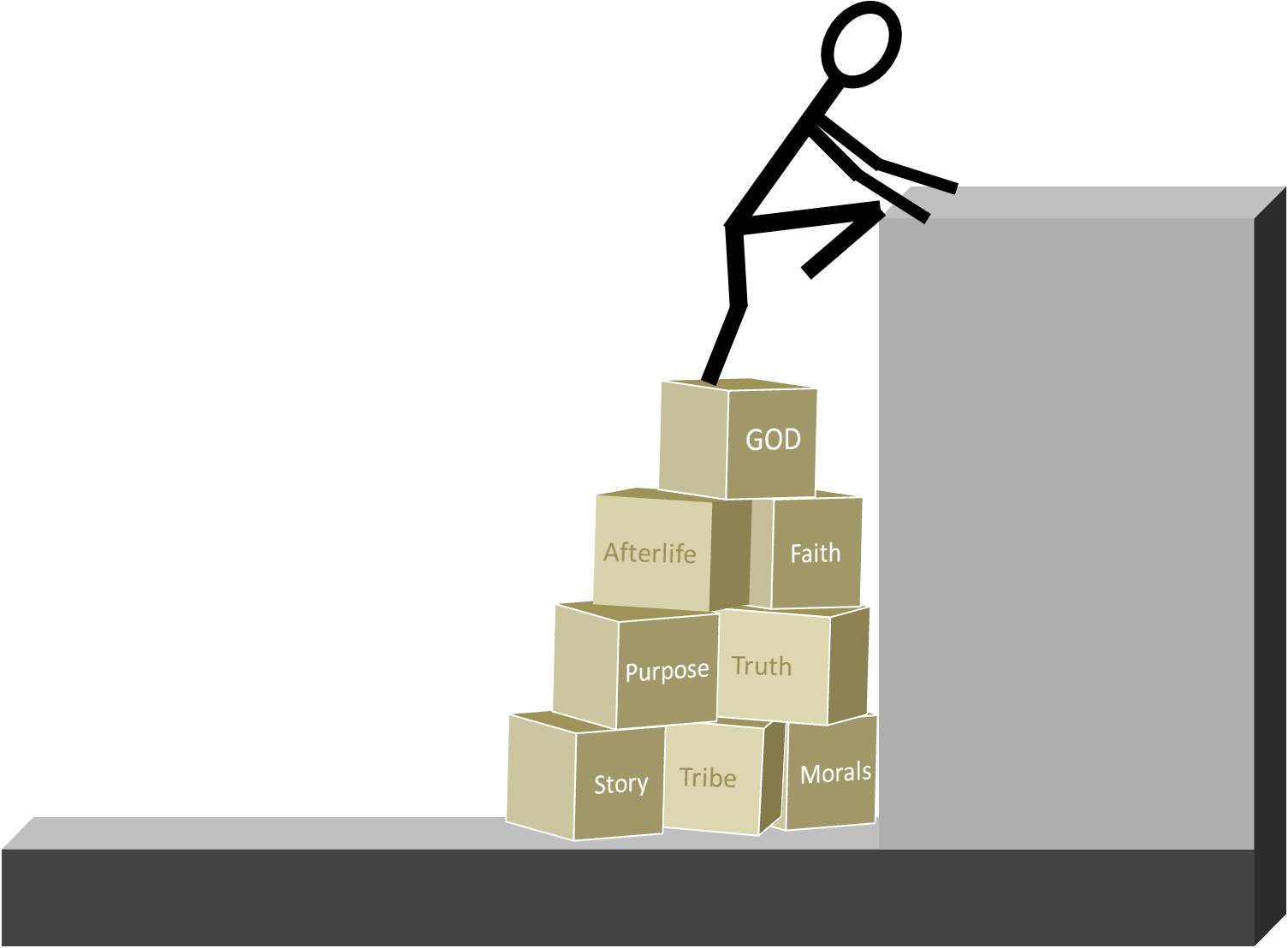
If we take the step from this fixed position, we want our foot to land on another fixed position – somewhere we can lean into and put our weight, something that’s stable and certain. But both stability and predictability are features of belief systems, not actual experience; of worlds, not reality.

The present mystery of reality is dynamic, and actual experience is much more fluid than our rigid belief systems can comfortably admit. And yet it’s a mark of both maturity and faith when we can climb to the edge of our worlds and leap from what we think we know, into what is beyond belief.

The View from Down Under

De Mello: “The trouble with people is that they’re busy fixing things they don’t even understand. We’re always fixing things, aren’t we? It never strikes us that things don’t need to be fixed. They really don’t. This is a great illumination. They need to be understood. If you understood them, they’d change.”

“Problems” motivate our efforts to fix them. A problem means that something is wrong – at least in our everyday way of speaking. A math problem, interestingly enough, is not broken but waits to be solved or figured out. If you come out with the wrong answer, then you’ve got a real problem.

My favorite one-word synonym for reality is mystery – as in the present mystery of reality, or the real presence of mystery. This mystery is the deeper ground beneath/within us, as well as the greater whole around/beyond us. At the personal level this mystery turns up as you and me, doing our best to figure things out.

All of this could inspire contemplation and wonder, but what we seem to bump up against most often are problems. Whereas reality is a vibrant web of causes and conditions, effects and forces that seems to go “down” and “out” to infinity, our personal worlds are simple by comparison. Even though we want to believe – or do we have a need to believe? – that the mystery of our own lives is a problem to solve or perhaps even “fix,” chances are good that many of our problems are self-created. To paraphrase Nietzsche: If all you have is a hammer, everything you see is a nail.

De Mello invites us to consider a different way of approaching reality – not with our tools but with intelligence. Specifically with a contemplative intelligence, one that takes in the Big Picture, sinks through appearances, and ponders the mystery in its depths. There will always be time to “figure it out” or “fix it up” the way you want it – or maybe there won’t, who knows?

But if we’re busy constantly trying to fix what we think is wrong or broken, the genuine mystery of being alive in this moment and somehow connected to all things passes by our blinders. The deeper ground and greater whole become invisible to us. Can we reach the point where they eventually become inaccessible to us as well – so tangled in problems that we lose our sensitivity to the mystery?

Our worlds have problems, but reality is a mystery. It’s when a natural force like a tornado comes into our world and upsets the arrangement, leaving damage and injury in its wake, that it becomes a problem. From a distance the weather phenomenon is fascinating and awesome. Just don’t come too close to me and mine.

Relationships have conflicts, and if these conflicts go on too long, we might say they’re broken and need fixing. I suppose it’s possible that many of my chronic troubles with others have to do with deeper or larger patterns that I don’t understand. It’s easier to point the finger of blame – at the other, of course. What if relational conflicts are really (that is, in reality) places where we come together at our differences, but just don’t understand the higher Tao that’s playing your Yin against my Yang?

As a constructivist, I appreciate the way in which our worlds provide the security, identity, significance and purpose we need to make life meaningful. Also as a constructivist, I accept these as “positive illusions” – things we need in order to keep our sanity and express our creative nature as a species.

We make it up, find problems in what we make, and spend our time and energy fixing the problems. It’s inevitable, I suppose.

What would happen if we took a more contemplative approach to our lives? Spending less time reacting to the problems we create – which only tends to generate more problems – and more time understanding our own creativity and its roots in reality, could make a real difference.

Understanding something doesn’t necessarily mean that we can explain it. The two metaphors are intriguing: explanation refers to “folding out” or opening up what is hidden in the deeper layers, while understanding involves “standing under” something and seeing it from the opposite angle of ordinary perception. The undersides of many things can be rather shocking.

Explanation is a kind of diagnosis, a necessary step toward fixing what’s wrong or broken. Moreover, it’s analytical, surgical and reductionistic in the way it spreads out the innards of something for closer examination. Once the frog is fully dissected, of course, all you have is frog parts. The living mystery is not just the parts in working order and functioning properly. It’s something more, something else, which vanished when Kermit went kaput.

This is not to say that explanation has no place in our quest for knowledge. Western science and philosophy have built up quite a library over the centuries – picking reality apart, cutting it up, breaking it down, charting its innards. We have come to know a lot about the composition of things, how they can be re-engineered, genetically modified, and synthetically replicated to do more for us.

But what if the real problem is our present discontent, our greed for more, a chronic frustration that fuels unrealistic expectations and set us up for disappointment? The deeper the disappointment, the harder we poke. The harder we poke, the more inflamed things become. Smaller problems multiply from the Big Problem.

Perhaps we need to get a different perspective on things. Before we start pulling them apart to fix them, let’s try to understand what’s really going on.

Easter Reality

Religious high holy days are anchored deep in myth and symbol. These are times when true believers – as well as the larger number of unaffiliated and “occasional pilgrims” – step into the sacred stories and reflect once again on the miracles of old. Too many of them probably do this out of family obligation or annual custom, gazing on the holiday symbols with the wondering eyes of their youth.

The following day, however, they will be back at it – back at life in the real world. No miracles here. No angelic visitations, virgin births, voices from the clouds or revived corpses in the news. It used to be that these and other miraculous events were regarded as signs, still very much set in story and not encountered in contemporary life, pointing to a higher realm of being that supports this one.

Signs are significant because they signify things. Meaning is all about reference – this pointing to that, one thing leading to another, and all of it making sense in the Big Picture. Once upon a time (here I go telling a story) people lived inside a Big Picture, and mythology served the valuable function of pulling them back from the daily distractions of secular life and reorienting them in a single coherent system of meaning.

I say “once upon a time” because people today generally don’t live their lives with a Big Picture in mind. If there is one, it’s the rather cold and indifferent cosmos of science, now somewhere on an unfathomable timeline between BANG and FIZZLE (or maybe CRUNCH). For quite a while, as modern religion was losing its market share in the intellectual landscape of the Western mind, church leaders blamed science for the vacancies in their pews. Empirical skepticism (“I’ll believe it when I can measure it”) was accused of producing secular atheism (“God can’t be measured, and therefore doesn’t exist”).

But here’s what really happened.

The sacred stories began losing currency, not because they were scientifically discredited, but rather because they became increasingly irrelevant to daily life. And as the symbols lost their power to signify, the metaphors closed up on themselves and degenerated into “miracles.” Consequently the Big Picture that had oriented human beings for so long fell apart. Now – occasionally, on high holy days – we pause to fetch from the wreckage those dim reminders, those alien curiosities from another age.

So what becomes of these articles of religious nostalgia? If symbols need stories, and stories need other stories; and if all these stories (the collective mythology of a culture) comprise the Big Picture that once made life meaningful, what purpose is there in dusting the icons, pressing the vestments, and singing the hymns if we don’t really know it as our truth?

I didn’t say “believe it,” for we can make ourselves believe just about anything. There are a lot of true believers who talk a lot about god, read their Bible religiously and do their best to take it literally. If the biblical god doesn’t bust through the starry canopy and talk to us as he once did, it’s only because we live in the Last Days and he is busy preparing for the Final Judgment.

As for Jesus, Christmas got him into our world and Easter got him back out. It all happened a long time ago, but he’s coming again. Just you wait. In the meantime – and it is a mean time – we have to keep the faith, resist the devil, legislate for (our) religion, and guard our stuff.

I saw a bumper sticker the other day: “God – Guns – USA.” Now that’s a very small picture, which can be found all around the planet today. Just insert another god and a different tribe, and that truck might be driving down the road in Syria or Kenya or North Korea.

What can Easter mean in a time when evidence of god is lacking but the testimony for god is all too out-spoken and dogmatic? Just because it’s “in the Bible” doesn’t automatically make it relevant. After all, the Bible is testimony, not evidence. Furthermore, it’s a very special kind of testimony – not exactly the eye-witness accounts as many true believers defend it these days, but creative testimony, poetic testimony.

As mythology, the Bible wasn’t written as retrospective journalism on objective miracles and actual encounters with a supernatural personality. Rather, it issued from the creative imaginations of people just like you and me, inspired by the realization that their lives (just like ours) opened up to a greater mystery.

In those moments, in those places, and in the company of those rare and illumined ones who seemed to live in unbroken awareness of this mystery, the everyday world was touched, elevated and glorified with a higher significance.

Jesus came with a message about compassion, charity, and unconditional forgiveness. He not only talked it but he walked it as well, living it out in his dealings with others – in the company of his friends, in his encounters with strangers, and in the presence of his enemies.

It wasn’t long before the authorities caught wind of his growing reputation and grew uneasy over his dangerous influence on the people. Dangerous because he was waking people up from the trance of personal self-interest, religious orthodoxy, and militant nationalism.

The authorities were nervous that this trouble-maker might shift the axis of control that protected their privileged position as deputies of god and brokers of salvation. They quoted scripture in self-defense, accused Jesus of going against tradition, and at last succeeded in charging him with heresy, atheism and disturbing the peace (also known as the trance-state of spiritual sleep). He was executed and his followers disbanded.

But then, maybe among a small band of his discouraged survivors, memories were recalled and weaved together in stories. In recalling his words they remembered his message, and as his message reignited their hearts they realized that his vision was still short of fulfillment. The spirit of Jesus was not gone but now lived in them. The torch of his cause was theirs to carry forward.

An empty tomb and abandoned grave clothes are not evidence, but only the absence of evidence. They are signs, metaphors, and symbols opening out to a greater mystery. They say, “Not here.” But where then? Exactly where is Jesus alive?

Up in heaven, if you believe in heaven. In the sacraments of the Church, if that’s your thing.

I would say that if what we are calling the spirit of Jesus is not evident in the way we live and treat each other, then we’re still waiting for Easter.

Inner Dialogue

Robinson: “Each of us, if we are in any way integrated, has a center from which our lives are lived, and our ‘world’ is what is enclosed within the circumference of that circle. Yet often we are more conscious of the edges than the centers, corresponding to the bounds of an animal’s territory which it stakes all to defend. The edges may be hard, the boundaries barricaded, while the centers are relatively unformed. The effect of dialogue is to bring to consciousness, and therefore to strengthen, our centers – so that where we stand will often in the process become clearer and firmer. But we do that by being prepared to soften our edges, to open up the frontiers, and let down our defenses.”

Human beings are world-builders. By now it should be clear that we are using this term in reference to the habitats of meaning that give humans the illusions of security, identity, significance and purpose. These are regarded as illusions simply because they are language-dependent and not found as “facts” in reality. As spiders spin webs out of their own bodies and then depend on their webs for survival, each of us spins a world around ourselves and calls it home.

At the center of my world is “me,” this self-identified maker of meaning. Underneath me are the various supports that hold me up and define who I am. Gender, family, class and tribe are the primary roles that locate me in society and give me recognition as a member. Together we inhabit a shared world called culture, which is a web that stretches across generations and geographical regions and is reinforced by sacred stories called myths. These stories anchor our common identity in a prehistory of ancestors, founders and heroes, as well as in a supernatural realm of gods, saviors and saints.

The movement of postmodernism was energized by the discovery that beneath our web-worlds is a reality much less “solid” than we thought. The foundation of divine providence, for instance, or even something as seemingly rock-bottom as matter itself, are shown to be just deeper constructs of language. The security we feel in being held up by something loving and reliable (matter and mother have a common origin) is perhaps an irresistible need of ours, stemming back not just to our individual infancies but into our existential condition as a species.

And what about the boundary of my world? What’s beyond that? If I don’t think about it too much I can persist in the illusion of a significance and a purpose that continue to infinity. God’s in control, everything happens for a reason, and all things work together for good. It’s a mark of faith not to ask questions, or so we’re told.

But eventually we bump up against … not reality, but other worlds. I am confronted with your very different way of representing reality, and if mine was merely a representation and not the way things really are, I might be worried. We can have differences, but they will have to be superficial, minor disagreements. When push comes to shove, I can’t compromise on my convictions. Not that I won’t. I can’t – there’s too much at stake.

John A.T. Robinson is perhaps best known for his 1963 book Honest to God, in which he challenged the mythological literalism of the Bible and urged his readers to consider the possibility that the divine reality is not merely something bigger than we can imagine, but might even be something other than what we can imagine. Robinson took his inspiration from the likes of Paul Tillich and Dietrich Bonhoeffer, both of whom advocated for a divine mystery beyond our religious conceptions and doctrinal convictions.

The present mystery of reality is not meaningful but beyond the meanings we construct and attach to it. Our dogmatic and aggressive defense of meaning belies an insecurity often unacknowledged – except where we readily point it out in our opponent. If we could relax a little at our edges and meet each other with more honesty, humility and faith, we might realize that our meanings are a lot less absolute and unchanging than we pretend they are.

But as Robinson explains, the condition of our boundaries – how flexible or rigid they are, how open or closed, how responsive to mystery or reactive to difference – is a function of how integrated we are inside. Internal balance, contemplative clarity, intellectual coherence and spiritual grounding are all terms that relate to our center, where each of us is rooted in the present mystery of reality. If we neglect this dimension of our life and become disconnected at our roots, the natural concerns of survival and evolutionary fitness will become combative obsessions at the edges.

Now in this book (Truth is Two-Eyed), Robinson is exploring what he calls an “inner dialogue,” where the spider in the middle of the web – our self-identified ego and the meaning we spin into our separate worlds – opens up (or down) through its own center and into the real presence of mystery.

With “one eye” we see this relationship of self to mystery in terms of communion, between an “I” and a “Thou.” Importantly, this Thou is not the personified god of mythology and doctrinal orthodoxy, but an irreducible “Other” or otherness at the heart of our human experience of reality. This is the Western Way.

And with our second “eye” we see the present mystery of reality less as an interplay of I and Thou, than as a single undifferentiated Oneness playing both parts of the relationship. We are not so much confronted by reality as immersed in it, saturated with it, and essentially the same as it. This is not the same as saying, “I am god,” for the I and Thou are both manifestations of one mystery. This is the Eastern Way.

Robinson is inviting us to consider spirituality as a dialogue of “meeting” (Western Way) and “merging” (Eastern Way), communion and absorption, as our response to the mystery and our identification with it. We can engage this dialogue outwardly, at the table with Christians and Buddhists, for instance, where different constructs of meaning (worlds) seek to understand each other.

But this outer dialogue is not likely to produce the kind of mutual respect and profound appreciation we so desperately need on this planet unless we are each engaged in the inner dialogue of a deep, contemplative  spirituality.

Just relax. It’s going to be all right.