Stepping Back For the Big Picture

beyond-egoFrom time to time it’s important to take a step back from the detail work of theory-building in order to catch hold of the big picture of what you’re doing. I’ve offered up some wide-ranging ideas on such topics as consciousness, spirituality, post-theism, and human self-actualization, and now I’ll try to bring together the major sight lines of a larger vision.

Backing up conceptually as far as we can brings us to the origins of our present universe. Contemporary cosmology (study of the cosmos) is coming ever closer to a grand unified theory (GUT) that can account for the flaring-forth of energy into the most basic constituents of matter – in an event (or ‘singularity’) popularly known as the Big Bang. Since the fabric of space-time is thought to have emerged at this point, there is no way for scientists to determine when (i.e., at what moment in the past) this occurred, but they have calculated the age of our universe to be somewhere around 14 billion years old.

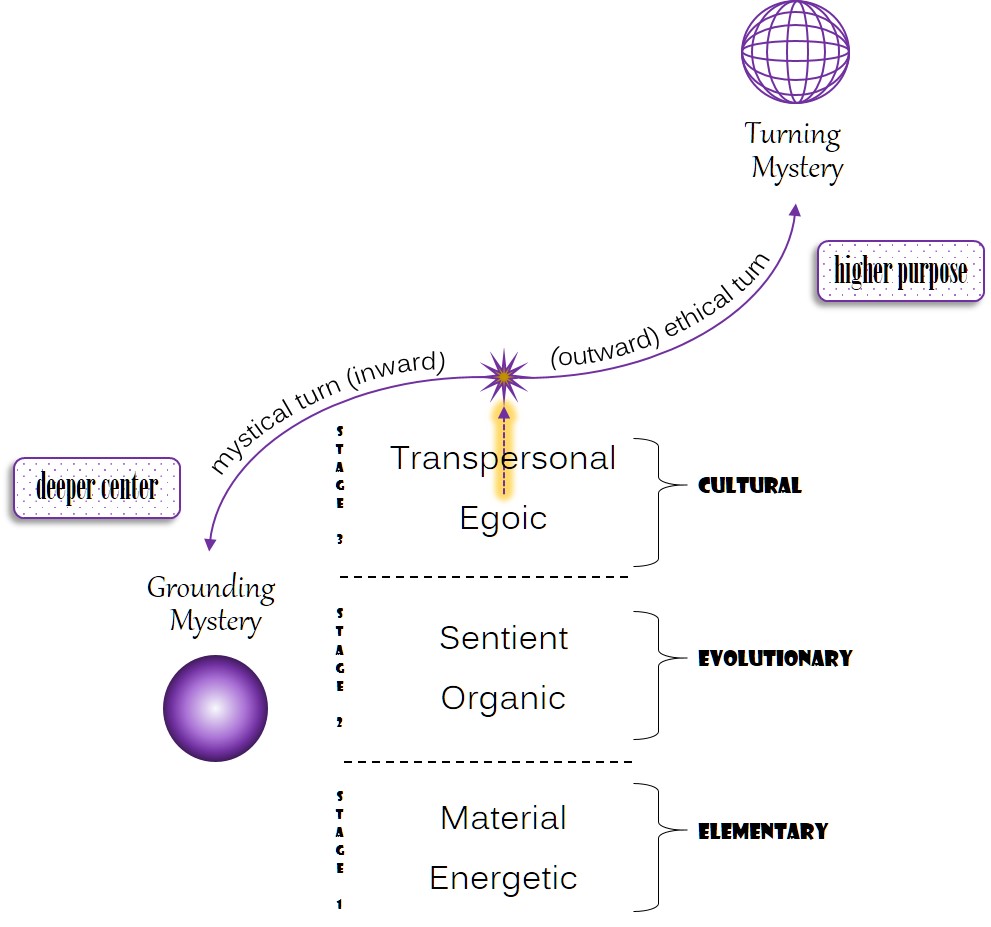
In my diagram I have represented this primordial transformation of energy crystallizing into the subatomic latticework of matter as the elementary stage of the universal process (or ‘universe’ for short). As I will continue to use this convention of stages, it’s important to understand that I don’t regard a stage as merely a formative period in the historical past that has been left behind. In addition to thinking of it as a previous era in the course of change, I’m using ‘stage’ in its spatial connotation as well, as a supporting platform for ongoing progress. In other words – and this should not come as a surprise – the elementary stage in the rise of our present universe is still very active, providing the energetic and material support to what we’ll look at next.

Stage 2 of the process (comprised of levels 3 and 4) is named the evolutionary stage, since this is when (and where) life first emerges. Technically speaking, the term ‘evolution’ should be reserved for the adventure of life (on our planet and possibly elsewhere) and not for the quantum dynamics at work in the energetic transformations of matter. Life introduces something unique and unprecedented in the way it ‘rolls out’ (or evolves) into more adaptive and complex organisms over time. Organic names the basic life-force, while sentient is how the evolution of life has gradually produced organisms that are more aware, responsive, and engaged with their environment.

At Stage 3 is where a uniquely human form of consciousness makes its appearance. Ego is Latin for ‘I’, referring to that separate center of personal identity which is both a construct of social engineering and the agent of social development. Our animal nature as human beings tracks downward into the instincts and urgencies of survival, while ego ‘sets the stage’ for a transpersonal breakthrough to spirituality and higher wisdom.

A critical condition of this breakthrough experience is provided in the developmental achievement of ego strength, evident in a personality that is stable, balanced, and unified. This threshold (at level 5, egoic) is where a lot of my blog posts focus in, since a lack of ego strength – presenting in a neurotic tangle of insecurity, attachment, and inflexible convictions – is at the root of much of our suffering. I’ve frequently pointed out how some forms of religion, particularly of the theistic type, use this neurotic tangle to promote dogmatism, bigotry, redemptive violence, and otherworldly escapism.

Let’s assume for now that ego strength is achieved. What’s next? The transpersonal level opens in two distinct paths of spirituality, one leading inward to what I call the grounding mystery, and the other outward to the turning mystery. The grounding mystery (or more philosophically, the ground of being) is not something else underneath it all, but the creative source of consciousness within us. In other words, you don’t go looking for it out in the world – or rather, you might try to find it in the world but your quest will come to frustration. This is why the mystical turn utilizes a variety of practices and methods for conducting an inward descent of ego release to the mystery within.

A second transpersonal path takes an ethical turn, beyond ego but this time in the direction of an ascending involvement in ever-larger horizons of participation. In this case, personal identity does not drop away, as on the mystical path, but instead serves our upward leap into genuine community where ego doesn’t dissolve but connects in relationship with others. Historically, the quality of this connection proceeds in correlation with our cultural representations of the divine ideal (summarized in such virtues as creativity, benevolence, equanimity, and wisdom), which it has been the responsibility of organized religion to depict in myth, art, liturgy, and theology. (For the reasons given earlier, this responsibility of religion hasn’t been fully understood or consistently fulfilled.)

As it follows these two distinct transpersonal paths, spirituality advances our quest for a deeper center and a higher purpose. Just as our center in sentience is deeper than our center in personal identity, progress in this direction also opens our ethical considerations to a correspondingly larger horizon – beyond just ‘me and my own’ to all sentient life. The higher purpose in this case is not a set of orders legislated from above (we have already moved into post-theism at this point), but the more far-reaching principles that concern our life together with all living things on this planet. What is our responsibility to the greater community of life?

My general theory regards the cultural stage of human evolution as trending inevitably into transpersonal realms of awareness and action. While still only a relative few have achieved this breakthrough – whether held back by their own neurotic entanglement or by social institutions (e.g., family, class, religion) that are getting in the way – all the signs are indicating a planet-wide spiritual awakening. The counterforces will not likely fade away gently, however, but can be expected to redouble their efforts in holding us captive.

Insecurity, selfishness, hatred, and terror cannot be overcome by violence. We must transcend them, which we do by acknowledging them, understanding them, and then simply letting them go.

Staying Safe, Playing Small

map-of-egoOne of the odd and wonderful things about us humans is how an extended period of juvenile dependency, which makes us impressionable to social shaping like no other species, also leaves us exposed and vulnerable to all kinds of social abuse. What could open the path for creative evolution and human progress often ends up shutting us down inside neurotic hangups and rigid convictions. Odd and wonderful, but tragic as well.

My diagram is fairly complex, but hopefully not overly complicated. Let’s take a tour by starting with that smaller break-out frame to the bottom-right. Since we were very young, each of us has been on a vigilant quest for three things: security, attachment, and meaning. I reversed their order from how they are presented in the break-out frame to acknowledge their developmental sequence in our early formation.

Our deepest and most pressing concern is for an assurance that reality is provident, that what we need to feel safe, included, and nourished is actually there for us when we need it. If it is, then our sense of security functions to open us further to reality. But if we don’t feel secure, our generalized anxiety motivates us to compensate somehow for the missing assurance, which we engineer by attaching ourselves to others with the demand that they keep us safe and satisfied.

I’m using the term attachment in a way more consistent with the Buddhist notion than how it’s used in Western developmental psychology, where it commonly refers to the close and intimate bond between infant and caregiver. But let’s keep both definitions together as representing a deep paradox we have all experienced time and again: our closest relationships are often ‘the ties that bind’ us and prevent our necessary freedom and growth.

To the degree that attachments compensate for a deeper insecurity – which they are incapable of resolving, by the way – the meaning that we construct around ourselves and those we depend on to manage our anxiety tends to be small, rigid, and closed. It’s small because we can’t risk extending our horizon beyond what we can see and control. Our meaning is rigid in that it lacks flexibility and real-time relevance. And it is closed, which is to say that our mental box excludes discrepant information and alternative views, as it inhibits healthy doubt and intellectual curiosity.

Each of us, then, lives inside a narrative construction called a world, and our world both reflects and addresses our historical quest for security, attachment, and meaning. Whether our quest went well or badly in childhood, even now as adults we inhabit a world built on those early emotional codes. Inside our world is where we came to a sense of ourselves as somebody special, with an identity of our own. Despite having reached physical maturity as an adult, this deeper and more primitive part of our personality – what is named our ‘inner child’ – still comes out and takes over whenever we get poked, hooked, or stressed.

Let’s move from the break-out frame to the center of my diagram, where a larger representation of that same box is displayed. At the top and bottom of the world frame are two important insights to keep in mind. First, every world is an exercise in make-believe. (I put the word “make” in parentheses to indicate our widespread unwillingness to admit that we are doing it.) In another post I defined belief as pretending to know something and then forgetting that we’re pretending.

In other words, we act ‘as if’ our judgments about reality are straightforward descriptions of the way it really is, when there is always an element of our need or wish that it be that way.

It’s easy to forget that reality is not made up of words, or that our words – however connected and stretched into broad fabrics of meaning – are not the reality we presume to define. Reality itself, or what I call the present mystery of reality, is just that, something that eludes our mind and its dragnet of language. Of course, so far as we have closed ourselves up inside a small, rigid, and closed frame of meaning (or world), this realization will be vigorously resisted. If meaning is relative and our world is make-believe, then perhaps our identity is a fantasy as well!

Hang on to that thought.

Those who share our world – or, more accurately, whose constructions of meaning significantly overlap and fuse with our own – are just as committed to the conviction of its truth. We are exactly the somebody special we believe we are, and each of us has our place and plays our role in the web of social interactions that contains and validates our identity. Every scenario is a role-play, every player has a role, and each role comes with a script that seems to drive our behavior without us even thinking about it.

And that’s precisely the point: this thoughtless and scripted performance of social role-plays is what keeps our world turning, as it keeps us under its spell.

Welcome to the consensus trance. The word ‘trance’ is in parentheses because no one wants to admit that much of our life in society (and even in privacy) is lived in a state of robotic stupor, enacting programs that have been installed in our brains.

Moving our attention to the center of the frame we find ego, that separate center of personal identity who’s the star of our show. One aspect of personal identity faces the other – other egos, objects, and even the whole shebang of what’s going on (so-called ‘objective reality’). Particularly in our social interactions – which, we must keep in mind, are role-plays in make-believe – ego takes on what we might call ‘modal identities’, referring to who I am in this or that social context. The Latin word persona (“to speak through”) describes the mask a stage actor would wear in personifying a character in a play, usually equipped with a small fluted mouthpiece to amplify volume and aid in voice projection.

A persona might also be thought of as a kind of socially approved deception. As long as we perform our roles according to script and in conformity with the consensus trance, we can lead others to believe that we are the roles we play. Because others who share our world are already susceptible to being duped in this socially acceptable way, we sometimes take advantage of the opportunity by leading them to believe something about us that is neither honest nor true. (As we are not typically eager to confess this, I’ve put the word ‘deceive’ in parentheses.)

While our ego’s persona (one of many) displays and projects only what we want others to know about us, there is a corresponding but opposite aspect that stays out of view – or at least we try hard to keep it hidden. This is what Carl Jung named our shadow, and its dark shade covers not only the things we don’t want others to see, but also things about ourselves we have neglected or ignored. In addition to those inclinations and tendencies in ourselves that had to be pushed down and out of sight (i.e., repressed) so we could be accepted and included – and which, as Jung insisted, are frequently projected onto others who then serve as our enemies and scapegoats – there are deeper treasures like creative intelligence, artistic talents, and dormant potential that go undiscovered.

Now it should be obvious that when we are profoundly insecure, co-dependently attached, and held hostage by our convictions, the parts of ourselves we are repressing and the social deception we have to carry on just to stay in control (or so we believe) conspire to cut us off from others and from our true self. You might think that since everyone is playing along, what’s the harm?

As it turns out, the harm of staying safe and playing small is significant indeed. According to the spiritual wisdom traditions, the serenity we’re seeking as human beings, and which conventionally gets confused with the security we can’t get enough of, is only accessible by a descending path of surrender through the self. The grounding mystery is only found within, as we are able to release our need to be somebody special and simply relax into anonymous being.

And the harmony we long for, which gets confused with a quality of attachment that is not even possible, calls us to transcend the demand that others play to our script and take the ascending path to genuine communion instead. What I like to call the turning mystery of unity is beautifully exemplified in the nature of our universe (“turning as one”), but it can be found wherever individual egos can get over themselves and join in togetherness.

If we can’t – or won’t – surrender inwardly to the grounding mystery and transcend outwardly to the turning mystery, the consequence is that we end up sacrificing fulfillment on the altar of security; we forfeit community for the sake of our attachments; and we come to despair inside a world that is far too small for our spirit.

The Universe as Your Self

self

A coworker recently confessed to a change of mind on the question of whether people are fundamentally generous or selfish. The election of a new US president who is an outspoken advocate of capitalism, and equally outspoken with his opinions against certain demographics and protecting the biosphere, has made her wonder if maybe the darker side of people now coming out is closer to the core of human nature than a consequence of our conditioning. She has held a brighter view on the topic, but perhaps that was naive.

As existence in the global context of international affairs and climate change becomes less secure, our tendency is to pull in the horizon of what contains our centered experience of self. When we were newborns there was no horizon, no outer limit and containing boundary, but neither did we occupy a centered sense of self. The ensuing social construction project of identity that was managed and supervised by our tribe effectively pushed us into our center and set the horizon wherein our identity would have value and clout.

Essentially identity is a function of identifying-with, and our handlers (parents, teachers, and other taller powers) shaped us with both good counsel and moral prejudices as we linked our identity outward. Depending on our actual conditions of life, along with this mixture of wisdom and bigotry, we established our sense of self and set out to make our way in the world.

In reflecting on my friend’s ethical conundrum – whether human beings deepest down are generous or selfish (in classical terms, good or evil) – it strikes me as one important place where spirituality comes into play. By that I am not referring to whether or not one is religious in the conventional sense, by belonging to a faith tradition or believing in god. As I use it, spirituality names a more or less disciplined way of being where certain practices and habits nurture a deep sense of one’s grounding mystery, serving to inspire an individual response (and responsibility) to the higher wholeness (or community) of life.

When we are centered in the grounding mystery – my name for that gracious uplift of existence in the present moment sensed in the provident support of each breath – our horizon of identity expands and we realize that we belong to a much larger experience. Even more than belonging to it, we are manifestations of it.

We experience this expansion of self to the degree that we are able (and willing) to drop the smaller identity contracts defining our personal ego. If we happen to be neurotically insecure, defensive, ambitious, and caught in our convictions, the challenge of letting go of this self and dropping into a larger experience of reality will be too much. As Jesus said to a rich young man who almost got it, “You are not far from the kingdom of God.”

This experience of liberation is not something we can render adequately into words, which is why the mystical traditions that cultivate it prefer to keep silent on the matter. (Both ‘mystery’ and ‘mystical’ are derived from the Greek root muein, meaning ‘to close’ the mouth in speechless wonder.) But we can come at it conceptually with a contemplative tool something like my diagram above. Let’s give it a try.

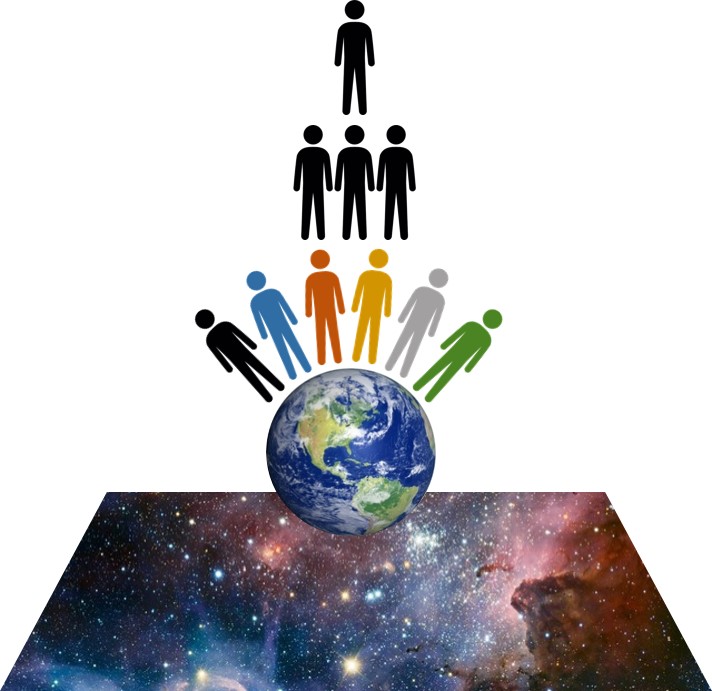
You, an individual and separate center of personal identity (ego), are there at the top. Congratulations. At this level you stand alone, unique with your personality, autobiography, attachments, and special circumstances of life. As we step down a level, you become aware of belonging to a class of others similar to you. Maybe this is your family or gang of familiars who share your skin color, ethnicity, economic status, moral values, or whatever. The point is, even though there are more of you, your personal identity remains fairly provincial and small.

Of course, beyond the field of local attachments, common beliefs, and shared lifestyle there are many others – and many different types of others. In my diagram the different colors of human form represent the remarkable diversity of humankind: living in different places, different cultures, and carrying on in very different ways. But they are all human, which means that if you cared to, you could allow your horizon of identity expand so as to include everyone else, regardless of what makes them different from you.

‘Human’ rather than some set of subcategories has become the horizon of your self-identity. Now “love your neighbor as yourself” makes better sense as “love your neighbor as your self.”

But what if we didn’t stop at the horizon of our human species, however much larger that boundary of inclusion is than the contracted ego? The next step downward in my diagram holds an image of Earth, representing the riot of life in all its variety on our planet. We need to remember that humans weren’t dropped onto the earth from outside; instead we emerged from the earth as one strand in its evolution of life. In a very direct and concrete way – that is, not merely metaphorical – humankind is an expression of Earth energy, a product of its planetary process, a manifestation and latter-day articulation of ‘geo-intelligence’.

Engaging our grounding mystery at deeper and more elementary levels, we begin to realize that being human doesn’t separate us from the community of life on our planet, which necessarily includes the animal, vegetal, fungal, microbial, and inorganic substrates. Our new ethical mandate now becomes, “Love the earth as your self.” Considerations of our human future must take the planet into account, along with the countless species that are also expressions and contributing members of its biosphere.

In the words of Chief Seathl (or Seattle), “This we know: the earth does not belong to man, man belongs to the earth. All things are connected like the blood that unites us all. Man did not weave the web of life, he is merely a strand in it. Whatever he does to the web, he does to himself.”

Why stop there? Earth, too, is a product of a 14-billion-year process called the universe – the single (uni) turning (verse) mystery of all things. So if the earth formed inside this universal process; and if life emerged out of the earth; and if humans evolved within the streaming adventure of life on our planet; and, last but by all means not least, you came to consciousness as a unique human individual, then the horizon of your centered experience of self includes it all!

You are the universe – again, not the contracted personal ego caught in its delusion of separateness, but your deeply centered experience of self. So, love the universe as your self.

Capitalism Wins

capitalism_democracyFor the first time in American history, capitalism defeated democracy in our choice of a president. I don’t mean that president-elect Donald Trump wasn’t elected by a democratic process (although our electoral college scheme is oddly undemocratic), but that he is not for democracy. His personal worldview and lifestyle do not demonstrate the principles of individual liberty, inclusive community, and human rights. He doesn’t believe in dialogue and compromise. He doesn’t listen carefully or reason well. He lacks compassion for the working poor, the refugee, the differently oriented and otherwise aligned. Trump is a capitalist. We might even say that he’s a celebrity capitalist.

In The Great American Divide I tried to tease apart the two traditions of democracy and capitalism in US history. Our national experiment in democracy has been strained and challenged from the beginning. I’m not treating democracy as merely one form of government among others, but as also a social vision, a deep set of political aspirations that connect – at least in our imaginations if not yet in fact – toward “a more perfect union,” where the individual is understood through the lens of community, as sharing responsibility for the common good. Democracy is fundamentally about ‘the people’, their freedoms individually as well as their obligations to one another.

To throw capitalism into a contest with democracy sounds at first as if I’m committing a serious category error. Democracy is about politics and government, whereas capitalism is about economic opportunity and commerce. You can’t compare apples and oranges, as we say. But actually both democracy and capitalism are what I called seedbed traditions, each holding a set of values and investments for a preferred reality that it hopes to actualize. It doesn’t matter that one is about political process and the other is about economic pursuits.

Whereas democracy looks at the individual through the lens of community, capitalism sees community – or strictly speaking, the collective – through the lens of the individual, of what I desire and deserve, what’s in it for me. This is not to say that democracy disregards the individual, only that it understands the individual as belonging to a social organism, the body politic. It’s really about us – all of us, together. Depending on where you begin, with the individual or with the community, your lens on reality is very different. Your understanding of yourself, of your neighbor, of the larger world around you, and of ‘the good life’ will move you toward one pole or the other.

Frankly, even our founding fathers probably valued capitalism over democracy. Many of them wanted as little government as possible, so as not to interfere with every individual’s ‘pursuit of happiness’, which in their minds was contingent upon our rights to privacy, property, and financial profit. Stay out of my space, keep your hands off my stuff, and get out of my way: this isn’t really about us, all of us, together. But it has been ‘the American way’ from the beginning. It’s how the other nations see us.

Screw ’em. Why should we care what they think?

Peel back the political veneer of Western culture and you’ll see it more clearly as a juggernaut of capitalist ambitions. As our science opens up new frontiers of knowledge, advances in technology enable us to accelerate our pursuit of more – drilling deeper, pushing farther, growing faster (and getting fatter), casting our junk onto the pile so we can have the latest and best. We need to stay ahead of the competition. A rampant capitalism looks only to the prize of its envisioned success, unconcerned for the most part over the collateral damage, systemic side-effects, and long-term consequences of the pursuit.

Happiness is out there and ahead of us, right?

Whether you were for Hillary Clinton or not, the election of Donald Trump was decidedly not a vote for democracy. We can probably all agree that government has gotten too large in some areas, that it’s been sticking its nose in places it doesn’t belong. The framers of the Constitution were wise and well-intentioned to limit its interference on our life and liberty. In some ways, too, our government has become a big part of the problem. Maybe this represents a course correction for the American Experiment. Both Republicans and Democrats – as parties historically committed to government by the people and for the people – have agreed to democracy’s rights and responsibilities, to its privileges and obligations, to its vision of a people united.

Unfortunately the Republican party didn’t have a candidate survive to the end who could represent them, so they settled for Donald Trump. For the next four years and beyond, our nation will be a capitalist enterprise before it is a beacon of democracy. We will spend and tax, exclude and evict, bullying our way through the global china shop.

Trump has been declared, and now we have to play the hand we were dealt.

In the Beginning

In the Genesis myth of chapter one, the breath (spirit) of God hovers over the primordial waters – the one element in creation that is co-eternal with God (so technically not a creation). God says, “Let there be …” and therewith issues forth light followed by the rest of the cosmic order: the dome of the sky with its sun, moon, and stars; the salt seas, freshwater rivers, and rain stores above the clouds; then comes the fertile disk of earth itself with its flora and fauna and, at last, the first humans standing squint-eyed in the radiant splendor of it all.

Now if we take the view of biblical literalists, the truth of this marvelous account lies in its factual accuracy in describing the origins of the universe and our place in it. We must think of it, that is to say, as referring to an event in the past – the very earliest past, to the beginning of time itself, whether 6,000 years ago (according to a strict literal reckoning) or fourteen billion, as proposed by modern science. Regardless, it happened long ago, and here we are.

The problems with taking the Bible literally this way are numerous, but perhaps the most serious problem is that it makes the Bible into something it isn’t. When its stories are read as eye-witness records of miracles and metaphysics, they lose their power as sacred fiction and become falsifiable. Not only scientific scrutiny, but rational logic and adult common sense must be given the privilege of testing the claims of a literal Bible. In that case, the evidence and arguments against its truth (as factual accuracy) are fully persuasive, leaving a literalist no choice but to reject science, rationality, and the obvious so the Bible can stand alone as revelation.

There is another way, which actually returns to the Bible some of its authority as holy writ. Before I demonstrate what I mean, by using the Genesis myth referenced above, we need to remember that these sacred stories were not originally rendered in writing and kept in books, but instead were composed and recited for audiences in settings of ritual performance. An often overlooked consequence of transcribing oral narratives into written documents is that the present-time immediacy of a live storytelling audition gets reduced and flattened to mere words on a page. Furthermore, the sacred act of storytelling – of bringing scenes and characters to life – is utterly eclipsed, leaving only the scenes and characters of another time and place, fixed and passive under the distancing control of the reader’s eye, susceptible to being skipped or reviewed as interest demands.

So really we should imagine an ancient ritual ceremony where the story of creation is being performed in real time, with the storyteller speaking and gesturing before a congregation in raptured imagination. What is this myth revealing, if more than factual information about how the universe came to be? One thing, certainly, is that everything starts with God, or better, with that ineffable mystery of intention and causality to which this dry and overused name refers. We’re hearing about – or are we hearing directly from? – the primal source and creative intelligence behind the world as we know it. Yes, but not about or from something else, not a supernatural or metaphysical being – back there, up there, out there.

I propose that this story is sacred because it reveals us to ourselves, as the world creators we are. My returning reader is likely familiar with my term ‘creative authority’ as referring to the achievement of self-actualization, something of an apotheosis of maturity where an individual takes responsibility for the authorship of his or her own personal myth (i.e., identity) and construction of meaning (i.e., world). Up to this point the authority has been in other hands, those taller powers (parents, guardians, and other tribal handlers) who conspire to shape youngsters into compliant members of the group. At maturity – or hopefully not long afterwards – the individual needs to step out of dependency and into self-responsible authority as a creator.

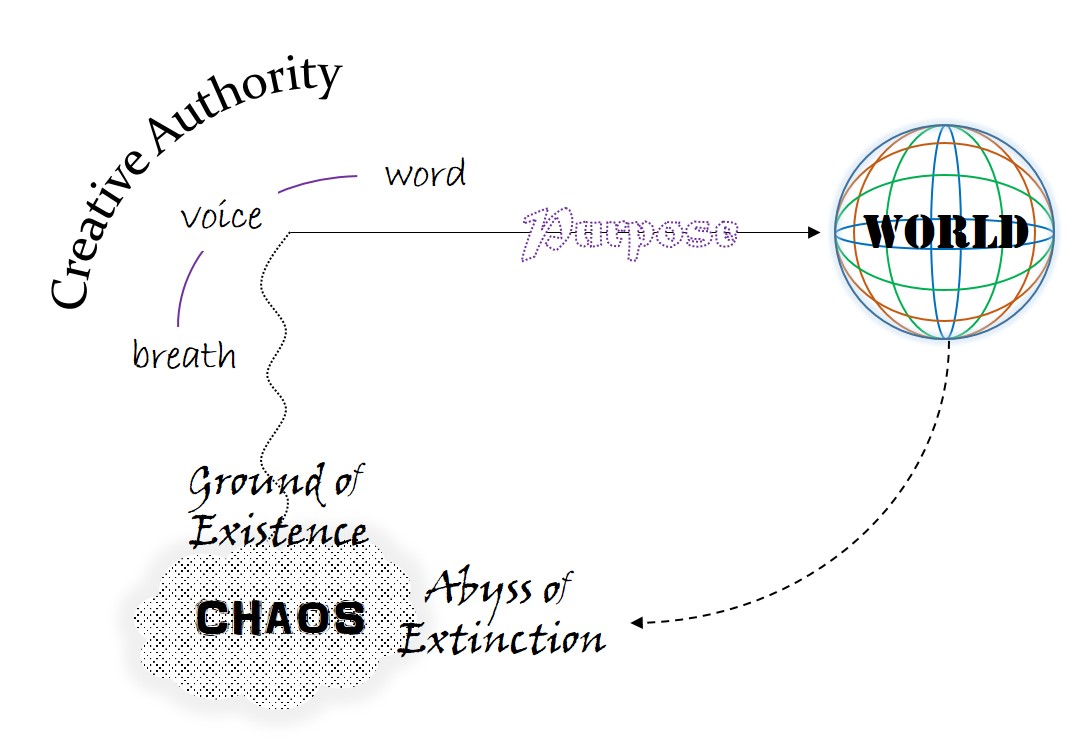
What I’m suggesting is that the one who first composed the creation myth of Genesis was not doing it for the quasi-scientific purpose of explaining how the universe came into being. Obviously he or she was not an eye witness of the events described (humans don’t show up until day six), but neither is it necessary to assume that our storyteller was simply repeating what had been revealed by divine messenger. We can reasonably suppose that he was in full possession of his faculties, that she was conscious of what she was doing. That leaves us with a decision between deliberate deception (but only if we must take the story literally) and artistic insight into the creative process. I’m going with the latter.creative-authority-flowWe need to be reminded (and then double-check the text for ourselves) that according to our myth the primordial waters is the one thing God did not create. (This insight resonates with the theory of Thales of Miletus, in ancient Greece, who was likely a contemporary of our storyteller.) The ‘formlessness and emptiness’ that preexists creation can be found in many myths worldwide, and it is generally taken as a metaphor of chaos – not the mixed-up confusion of random things, but rather the formless vibration of energy, analogous to the quantum reality of contemporary physics.

This indeterminate potentiality of chaos rises into pattern and form in its aspect as the ground of existence, in energy manifesting as this or that, crystallized in the latticework of matter, order, and meaning. But chaos is also a solvent into which these same patterns and forms will eventually disintegrate, and this is its aspect as the abyss of extinction. As ground, chaos is generativity and fullness; as abyss it is dissipation and emptiness. Should we seek security from its abyssal aspect behind our walls and defenses, the devastating outcome will be that we lose access to our grounding mystery as well. In other words, creative authority (as well as artistic creativity) requires that we stay open to chaos and learn to trust the process.

Our goal and ongoing task in any case is to live a life of purpose, which means living intentionally and taking responsibility for our choices. (It should be obvious how different this notion of purpose is from the evangelical Christian idea of a ‘purpose-driven life’, where a believer must surrender his or her will to the perfect plan of god.) And this is where three related terms come into the picture, which have not only an impressive representation in the Bible but are also found throughout the mythologies of ancient cultures: breath, voice, and word.

Word

These three terms, in fact, name what we might think of as the three ‘moves’ in world creation – remembering that the construction of meaning is the end product of this creative process. It will help if we start with the product (the world-construct) and work in reverse along this sequence of moves. Word refers to speech and to the instrument of language itself, as the medium that enables the mind to facilitate the translation of experience into meaning. Pure (immediate) experience is meaningless until the logical units and categories of thought that filter, arrange, and frame it into significance are imposed.

Our worlds are constructs of language – conventions, narratives, mental models – that we must continually validate by spinning the scripts that keep them suspended in our imaginations. If we should lose track of the script, as in amnesia where the neural circuitry supporting it gets bumped off-line and we forget who we are, we find ourselves in a very unpleasant place – or rather, we can’t find ourselves without a context, and that’s precisely the point. This language-dependent nature of our world is a more recent rediscovery that inspired the postmodern school of constructivism.

Voice

But it’s not merely words on a page that keep our worlds suspended, but the stories we tell ourselves and others. That’s why ‘voice’ and not ‘text’ stands upstream from ‘word’. Voice is the sounding instrument that produces the word, but it cannot be reduced to the mere sound of words. Indeed, whereas words are public and shared packets of information, a voice is exquisitely individual and unique. In the Indian psychosomatic chakra system, the throat chakra is the center of personal power and self-expression. This is not about hitching onto someone else’s meaning or borrowing another’s truth, but giving ‘voice’ to one’s own perspective and will.

It’s important to realize that in the Genesis myth God didn’t merely do or say something a long time ago, but is depicted (in the act of storytelling) as speaking forth, vocalizing, and articulating the structure of reality in this very moment. The cosmic order comes into being and holds together by virtue of God’s active and sustained speech; the world is words sustained in the act of speech.

Breath

Our third and final move upstream in the creative process brings us to the very edge of chaos, to the threshold where the urgency of life in each breath that our body requires is channeled through the voice and into the words that construct our world. In ancient languages, the often refined idea of spirit (Hebrew ruach, Sanskrit prāna, Greek pneuma, Latin spiritus) has etymological roots in this very body-centered power of the breath to animate, inspire, pacify, and empower. Breath keeps the body alive while it serves our higher aspirations for meaning – in which, strictly speaking, the body has no interest whatsoever.

A more embodied notion of spirit as breath serves additionally to keep it from leaving the body for heavenly, metaphysical, or esoteric abstractions, where it has been coined by religious orthodoxies and secret societies, time and again, into something they can claim exclusively for themselves. Even a traditional reading of the Genesis myth will tend to identify the spirit that was hovering over the surface of primordial waters with a deity who is separate and far superior to what we are. In such cases the story is enervated and its revolutionary insight into our nature as world creators is locked away.

Let’s not forget, however, that worlds are constructs of meaning; that meaning is a production of words; that words are sound-bytes of speech; that the speaking voice is a channel of the breath; and that breathing is our grace between life and death.

“In the beginning” is always now.

Fuel, Food, and Faith: A Meditation on Our Human Future

fuel_food_faithAs our presidential candidates lay out their visions and identify what they believe are the major issues on our national and global horizons, I thought I would publish a short list of my own. Obviously there are many, many things we could be doing differently – and many different things we probably should be doing – as we look to the future and contemplate the big picture of where we are headed. My list holds just three, but I think that together they constitute an axis for a revolution of creative change.

Fuel

The vast majority of us who enjoy the convenience of flipping switches or turning keys and having power delivered instantly where we need it, don’t typically worry about the source, supply, purity, and sustainability of the energy we use – that is, until something interrupts on our demand. It’s one of those things that make it possible for just about everything else to operate, and it’s these many things (devices, tools, machines, vehicles) that get our attention when they stop working. But where the power comes from (source), how much of it is available (supply), to what degree its production and use generates pollutants (purity), and how long its supply can be expected to last (sustainability) – such questions only rarely cross our mind.

Most of the machines we have come to depend on around the globe are powered by fossil fuels, combustible material derived from the remains of former living things. Fossil fuels (oil, coal, natural gas) are typically deep underground, which means that they are subject to property and access rights, and require expensive equipment to reach them. And who owns the land? Not the homeless poor or working classes. Governments and wealthy corporations – those who make the laws and lobby for special exceptions – coexist as a system and conspire together in shaping the economy in service to their interests.

Inevitably, the governing and wealthy classes prefer things to stay the same (hence they are conservative as a rule), since the way things are supports their privilege and control. Despite the fact that fossil fuels are a limited fuel source and highly toxic to the atmosphere and environment, production continues unabated. In fact, new stores are being drilled and mined to meet the growing worldwide demand. What are we supposed to do, stop driving our cars, lighting our homes, or pull the plug on manufacturing? The current energy grid is designed to power our many machines, and more machines are being manufactured every day, and these depend on the grid to work.

Alternative fuels – e.g., solar, wind, wave, and hydrogen – represent a virtually infinite source, widely available, perfectly clean, and sustainable far into the future. Already today, the technology exists for harnessing energy from the sun and powering our homes, neighborhoods, even entire cities. There is no more plentiful energy supply, available from nearly every location on Earth. Thankfully this technology is making it to the market, however slowly, partly through the efforts of fossil-fuel corporations that are expanding their production portfolios, and partly despite the best effort of others to stop it. A reduction in consumer use (driving less, using public transportation, biking and walking when we can), along with a commitment to purchase cleaner technologies and invest in the companies developing them, is critical to our big-picture and long-term future.

Food

Earth is an incredibly fertile and fruitful planet, and life has been able to adapt and evolve in its oceans, forests, deserts, tundra, prairies, mountains, marshes, lakes and streams. Even at our present population size of 7 billion, the earth’s bounty is more than sufficient to feed all of us. The problem, once again, is not really in the short supply of what we need, but in the political and commercial systems that prevent nutritious food (and clean water) from getting to those who need it.

The privileged classes (and the government their money buys) exploit and exhaust Earth’s food resources, supercharging the soil with fertilizers as they sterilize it with pesticides and herbicides. As a consequence of such practices, the mass yield at harvest increases dramatically while its nutritional value plummets. As huge amounts of methane (a greenhouse gas) are released into the atmosphere from livestock, these chemical toxins leech into the groundwater and lace our fruits, grains, and vegetables, slowly sickening us with cancers and other so-called auto-immune diseases.

The poor quality of highly processed and modified foods means that we have to eat more as we continue to fall below our nutritional needs. Eating more, of course, involves taking in more calories, and excessive calorie intake leads to weight gain, metabolic fatigue and dysfunction, and ultimately to diabetes and other disease processes. A growing interest in organic farming and whole foods is a promising trend, but a simultaneous return (think of it as a homecoming) to the natural intelligence of our body and its deep preference for nutritious and energy-rich foods will be necessary as well.

Faith

Other members in my weekly Wisdom Circle gathering are reasonably suspicious of the term ‘faith’, and they guard against what they anticipate will be my attempts to pull them back into the religions they left behind. It’s critically important to distinguish the doctrinal orthodoxy or belief system of a religion from the question of whether and to what degree an individual is able to relax into being and trust in the provident nature of reality.

I’m not speaking of Providence in the old-style Puritan sense, referring to the watchful protection and abundant provision of a god above or ahead of us. Instead, the provident nature of reality is based on the straightforward and obvious perception that our life, consciousness, creativity, and aspirations are not separate from the universe but manifestations of it. You and I are living expressions of a provident reality, as evidenced in the fact that its 14-billion-year process has brought about the conditions (on this planet, at least) for us to evolve and flourish, as part of a great community of life.

The faith I’m speaking of is not the property of any religion and has nothing to do with belief in god. As an inner release to the grounding mystery of being, faith opens us to existence and is our surrender to the deeper and larger process moving through us. Other words, such as oneness, communion, presence, grace, and peace, serve equally well – or poorly, insofar as the mystery they name is ineffable. When faith is active, we enjoy an inner peace and can reach out without a need to grasp, control, or manipulate others and the world around us. We can instead be present, attentive, mindful, caring, and generous.

When faith is inactive or missing, however, a profound dis-ease troubles us. We feel unsupported by reality, which in turn compels us to attach ourselves to anyone and anything (including ideologies) that promises some reassurance, relief, or escape. Of course, nothing outside us can compensate for inner insecurity. When we were infants, the intimate connection between safety and nourishment that we experienced in the nursing embrace perhaps encouraged a strong correlation in our minds between faith and food. This cross-wiring of our nervous system explains why we often seek comfort more than real nourishment in what we eat, and why the marketing of ‘comfort food’ is so wildly successful in our Age of Anxiety.


My axis of terms – Fuel, Food, and Faith – is arranged in that order to confirm what should be obvious to us all. If we can’t move to cleaner energy sources and break free of our dependency on fossil fuels, our planet’s warming climate will turn soil to sand, shrinking the area of tillable land worldwide. If we can’t farm food that is wholesome and nutritious, we will need to eat more and more of it, compromising the global supply and bringing upon ourselves a growing number of health complications. But if we can’t transform the politics that drive the decisions and divide us along lines of wealth, race, gender, and creed, the brighter future we hope for may be out of reach.

Our politics will change as people change, as we learn how to cultivate inner peace. The future of humanity starts now, with you and me.

Between Heaven and Hell

3-realms

The essential function of mythology is to link together individual consciousness (psyche; psychology) and the larger order of existence (cosmos; cosmology). Its collection of sacred stories provides the orientation, guidance, connection, and support that we need for success in the project of constructing meaning and living well. Because this project is profoundly (i.e., deeply) social, the myths were never ‘mere stories’ on the shelf for leisure reading, but great epic narratives to be recited and performed in the context of community life.

That is, until fairly recently.

As the advance of science inevitably altered our model of reality, the sacred myths which had draped and adorned this framework fell steadily out of relevance, and then soon afterwards, out of fashion as well. Without an alignment between our narrative constructions of mythology and our changing understanding of the universe, the sacred stories either had to be updated accordingly; discarded and forgotten; turned into allegories of hidden (metaphysical) secrets; or taken literally as journalistic accounts of supernatural revelations and miraculous events.

Another option would be to more directly engage the challenge of linking consciousness and existence in order to create a relevant mythology for our time. It likely won’t be about a literal heaven and hell, but rather about outer space and inner ground, the global neighborhood and sustainable community, planetary stewardship and a more perfect union.

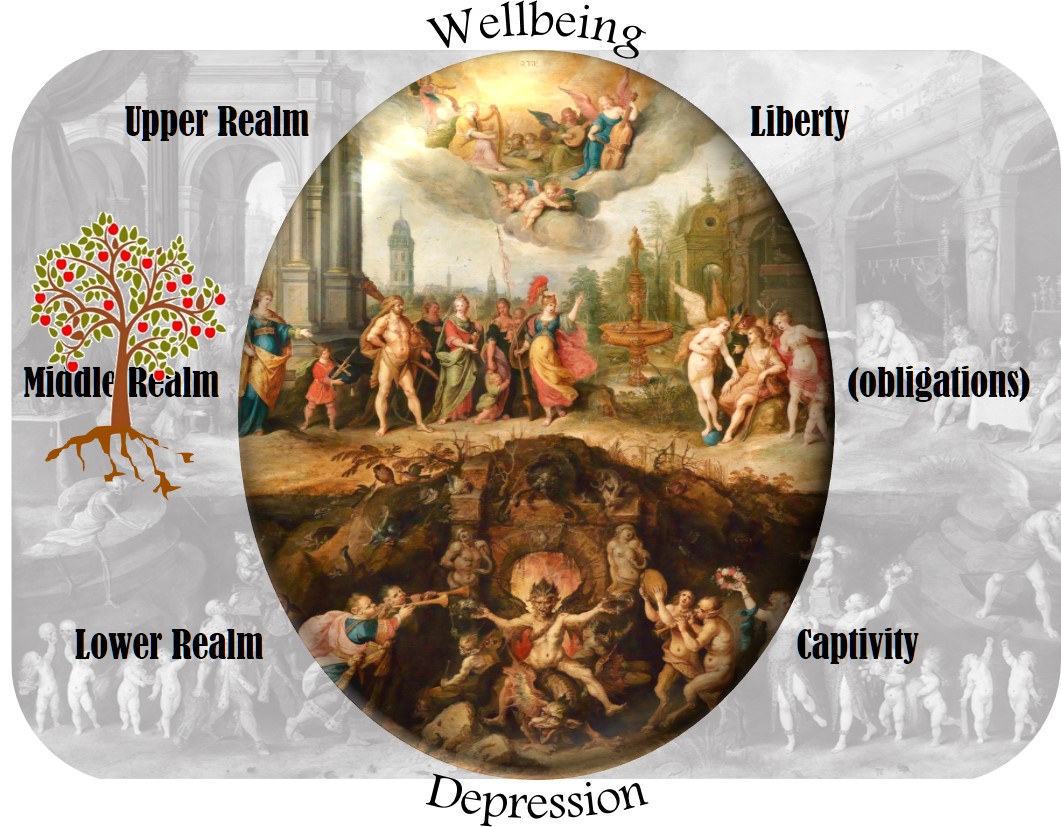
To help in this effort, I offer an image for our consideration. The diagram above incorporates a medieval painting of the three realms – heaven, earth, and hell – a mental model widely held throughout the ancient world as depicting the structure of reality. The specific divine, human, or demonic personalities inhabiting these three realms, along with the sacred storylines (myths) that crisscrossed and weaved them together, differed, of course, from one culture and historical period to the next. My intention is not to explore and interpret the individual myths, but only to use this structural design of three realms in a way that might contribute meaningfully to a mythology for our secular and global age.

Just as the ancients understood, our experience unfolds in the middle realm of daily life. Our attention, energy, and effort get directed into those activities and concerns that conspire toward a general sense of meaning. Although we possess an animal nature in our body and its primal instincts, the special concern of human consciousness is with the affairs and challenges of our life together in community. This is where our identities are shaped and instructed with the tribe’s worldview and cache of wisdom for how to make it in the world.

Ego consciousness – the separate center of personal identity whose dual ambition to belong and be recognized, to fit in and stand out at the same time, generates both external and internal conflicts – is thus the principal denizen of this middle realm.

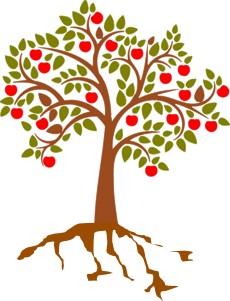
In another blog of mine, less philosophical and more therapeutic, I provide a simple yet highly useful schematic of 5 Domains for looking at life as a whole but also moving into the details for making the changes we desire. A recent post, titled Creators and Reactors, offered the image of a tree as a way of understanding the 5 Domains and their holistic integration.

tree

A deep inner peace (tree: roots; domain: SPIRITUALITY)

nourishes vital strength (tree: trunk; domain: HEALTH), which in turn

supports genuine love (tree: branches; domain: RELATIONSHIPS), which

opens out in positive virtue (tree: leaves; domain: CHARACTER), and ultimately

produces a life of creative purpose (tree: fruit; domain: LIFEPLAN)

Each of the 5 Domains holds a relatively small set of basic obligations that must be fulfilled on a regular basis in order to optimize the quality of life in that domain. For example, an optimized spirituality requires that we give time to quiet reflection and finding our way to that still place at the center of our existence (which I call The Clearing) through such meditation practices as mindful breathing, contemplation, and centering prayer. A calm body and centered mind are conducive to an inner release to the grounding mystery and its ineffable intuition of oneness.

Without such practices – or worse, through the uncontrolled spin-out in frantic or mindless activity – our spirituality doesn’t get the investment it needs to be the nourishing root system of our life.

The middle realm, then, is where we either take responsibility for the variety of obligations across our 5 Domains, or otherwise neglect them, ignore them, avoid them, and put them off till ‘later’. But here we are: faced with the things that need our attention, standing at a ‘Y’ in our path. Depending on the choice we make at this point, our consciousness and quality of life will either shift upward or downward, into an upper realm or a lower realm, heaven or hell.

Once again, I am not using these terms as references to different locations in the universe, and not even as metaphysical dimensions of reality. Instead, they are meant to indicate distinct registers of consciousness – moods, motivations, attitudes, and perspectives (in short, mindsets) – that link psyche and cosmos by very different stories and contrary mythologies.

So that we can end this post on a positive note, let’s begin with the descent into hell.

Hell

When we are irresponsible with the obligations of wellbeing, not taking care of the things that elevate our quality of life across the 5 Domains, our general picture begins to degenerate into something quite unpleasant. Remember those simple practices of spirituality that deepen our sense of inner peace? When we neglect or avoid them, the opposite of inner peace takes its place: insecurity. Instead of releasing our separate identity (ego) to the grounding mystery within, we desperately struggle to keep from falling into the abyss of extinction.

Let’s play this all the way out.

Our spiritual insecurity signals the body to release stress hormones, keeping us hypervigilant and defensive, but also suspending metabolic and immunity functions in the interest of emergency action. And when we’re all neurotic and knotted up in this way, how does it go in our relationships? Not well. We tend to be reactive, suspicious, distrustful, and self-absorbed. We also pull other equally neurotic partners into our life, forming dysfunctional and codependent attachments that serve to confirm and reinforce our general anxiety over the state of things. The problem here is that our character continues to be shaped and instructed in this negative social milieu, which means that we become takers and consumers, grasping for our share and ripping into anyone who threatens our stash. Finally, as it concerns our lifeplan and vision for the future – well, there’s just no energy or time for that. Holding off the next catastrophe has become our full-time obsession.

I think that’s a pretty good description of hell, don’t you? The urgency of a life out of balance and collapsing upon itself; a hostage of our own convictions, a captive of destructive forces, bound by fear and feeling stuck in a hole that just keeps getting deeper. Hell is the deepest of all depressions.

Or … we might choose the other way.

Heaven

Taking responsibility in the obligations of wellbeing means that we don’t wait around for someone else to live our life or save us from our problems. We do what is necessary and required in order to optimize our quality of life in all 5 Domains. We cultivate inner peace, make healthy choices, love others (even those who oppose us), serve the greater good, and relentlessly pursue a more perfect union.

Heaven really isn’t that far away. Indeed it’s been right here all the time, just waiting for us to enter. As Jesus says in the Gospel of Luke, “The kingdom of God is within/among you” (Luke 17:21). All the great wisdom teachers of history are in fundamental agreement on one thing: When we know the truth, the truth will make us free.

Change Your Lens, Change Your World

phoropterMost of us have had the experience of getting our vision diagnosed by an optician. A fancy instrument, called a phoropter, is maneuvered in front of our face and positioned on the bridge of our nose. As the technician clicks various lenses over each eye and we try to read some letters or view a scene, we are asked to judge which of two clicks makes the picture more distinct. Eventually we arrive at the specific power of refraction that will compensate for the weakness and astigmatism of our unaided eyesight.
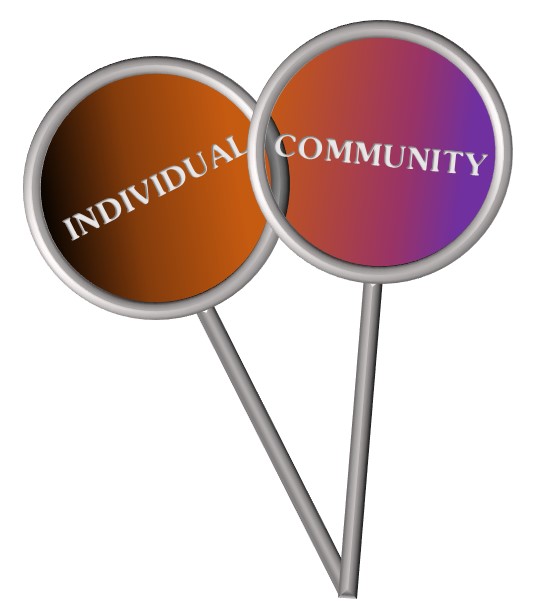
If we think of the phoropter as a metaphor for culture and the way it clicks various lenses between our minds and reality, we have a useful illustration of constructivism. The basic idea is that our minds do not merely look for and find meaning in reality, but instead they make meaning by constructing a model of reality and using this model as a frame for draping the stories, theories, judgments and expectations that constitute our personal worlds. I’m using ‘worlds’ in the plural because each of us manages a world unique to us (so we all have one), and we also progress through a variety of distinct worlds (or worldviews) over the course of our lifetime.

In a recent discussion with others in the wisdom circle I attend, we were reflecting on the different worlds of the Democratic and Republican parties in the United States, and the profound differences between our Western world and the worlds of other cultures and nations. From the ancient Greeks we inherited our accent on the individual as a separate and irreducible center of identity, dignity, sentiment, and agency. Perhaps as an effect of the fact that the Greco-Roman culture overarched a wide region of numerous indigenous societies, the detached and self-standing individual became the locus of supreme value. After the ‘dark age’ of medieval Europe, this priority of the individual reasserted itself with the Renaissance ideal of the hero-artist.

lensesOther cultures, both ancient and contemporary, view reality through a different lens from that of Western individualism. Instead of looking at the collective through a preference for the individual, they define an individual through the lens of community. It’s not that the individual is unimportant; rather, the individual only makes sense as a function of the whole. Self-sacrifice on behalf of one’s community takes precedence over competition among individuals for self-advancement.
Not only might competition of this sort be discouraged in community-oriented cultures, such a mentality and behavior will likely be condemned, even punished by banishment from the group. A Western individual is apt to condemn this attitude in turn as both repressive and ignorant, since a community exists for the sake of individuals and not the other way around.

Not all Westerners are individualists, and we could surely find many individualists within the more community-oriented cultures of our day. The point is not to draw a geographical or even a cultural boundary between the two types, but to reflect for ourselves as to which lens holds priority for us. As we view reality and construct our worlds, which lens is in front of the other? Our first lens (the one in front) will automatically filter and qualify the other, as the core beliefs by which we construct our worlds and live our lives.

The answer is probably more complicated than my question leads us to think.

When the individual is before (i.e., in front of the lens of the) community, typically the rights of the individual will take precedence over his or her responsibilities to the community. In my recent post The Great American Divide I suggested that capitalism, as one of the seedbed traditions beneath the American world(view), is based on a philosophical preference for the individual over the community. According to this view, a community is essentially a collective of individuals seeking economic opportunities that will support and promote their personal ambitions. This is not to say that capitalism necessarily breeds selfishness in its devotees, but Adam Smith did affirm ‘rational self-interest’ as one of its driving forces (competition being the other).

A preference for the individual over community keeps the tether of moral values firmly staked to a concern for the benefits and risks to the self. If altruism plays any part, then it’s in the form of what the communitarian philosopher Philip Selznick calls ‘bounded altruism’ (The Moral Commonwealth, 1994). Here the outreach of individuals extends to familiars and fellow members, but not to strangers or outsiders. The reciprocal turnaround of value back to the individual needs to be fairly short in order to justify one’s investment, charity, or sacrifice on behalf of others. Generally speaking, commitments of this kind to strangers or outsiders do not bring reciprocal value to the benefactor – a liability for which American capitalism offers compensation in its provision of tax write-offs for donations.

On the other hand, when community is before (i.e., in front of the lens of) the individual, a responsibility to the greater good sets constraints around individual rights. This doesn’t mean that individuals can be arbitrarily stripped of property and freedoms whenever it serves the collective interest, which is how individualists often paint the problem. Granted, when the collective is really little more than an aggregate of individuals under the control of a dictator or special-interest bureaucracy, the individual – particularly those at the bottom or outside the circle of power – is, we might say, perfectly expendable. History has shown this time and again.

So obviously we need to be more careful in the way we define ‘community’. It is decidedly not merely a synonym for the collective, that essentially disconnected aggregate of individuals mentioned above. A community (literally “together as one”) represents a qualitative shift in consciousness where the self-other reciprocity and competition of capitalism is transcended (included and surpassed) in the experience of empathy, advocacy, and communion. The individual is not subtracted or subordinated, but rather honored and lifted into this higher consciousness of community life.

Again, in my post The Great American Divide I made a case that democracy, as the second seedbed tradition beneath our American worldview, is based on a philosophical preference for the community over the individual. For Jefferson and other framers of the US Constitution, this order of priority meant that individuals are not essentially competing units of self-interest; rather they are self-transcending agents in the synergy of ‘a more perfect union’. With its emphasis on our individual responsibilities to the community, this tradition of American liberal democracy insists that our rights as individual citizens are only defensible within a larger culture where individuals work together for the common good.

So what I earlier called the ‘great American divide’ turns out to be a fundamental dilemma posed to each of us. As we step into our creative authority, it is up to us to decide which of these lenses has priority to the other. Each commitment provides some counterbalance to the other, and in their tension is where we must construct a life of meaning.

The Will of the People

The biggest problem for Republicans these days is that their 2016 presidential candidate is not a Republican. He is by name, of course; Donald Trump’s name is on the GOP ticket. But Trump apparently has little understanding of or regard for the principles of civility and decency, cooperation and respect, dialogue and compromise, ethical leadership and responsibility, temperance and self-sacrifice on behalf of ‘we the people’ – in other words, little understanding or regard for the foundations of liberal democracy.

As the circus approaches election day, even Republicans are offended and embarrassed, poised now to renounce their candidate in the interest of our nation’s future. How did he get this far? How was it possible that a dozen or so much more qualified contenders got pushed off the stage – a few of them viciously maligned and forced (or so it must have felt) into some mud-slinging of their own? A few reputations and political prospects were not only injured but maybe even permanently wrecked in the fray.

I have a theory.

In evolution there is a force at work that Darwin named ‘natural selection’, which has to do with the ongoing necessity of living things to maintain their ‘fitness’ in the interest of survival and reproduction. A later proponent of evolutionary biology, Herbert Spencer, coined this idea into the phrase “survival of the fittest,” referring not simply to the strongest and most aggressive individuals who can bully their rivals and out-compete for females, but to any organism that can successfully adapt to its environment and find a provident niche where it can thrive. By putting this requirement on living things, nature has raised a gradient against the likelihood that genetic mutations and individual deviance will survive and reproduce, unless it can win this struggle for fitness.

In economics there is another force, which the Scottish philosopher Adam Smith saw at work in free-market capitalism, where rational self-interest and competition in business conspire toward ‘the wealth of nations’. As individuals and industries compete with each other for market share, the cost value ratio of what they offer to consumers keeps the quality of their goods or services from slipping out of favor. This is another kind of selection, and fitness here allows a commercial enterprise to survive and maybe spawn a new generation of innovations. Smith wasn’t praising selfishness in business but rather an interest in building one’s own competitive edge in delivering genuine value.

And in politics there is yet another force, which in liberal democracy has been called ‘the will of the people’ or ‘the general will’. The idea here is that the collective effect of individuals voicing and voting for what they want is a clarified expression of what is best for the body politic. In representative government the people elect officials who carry the responsibility of defending and promoting the majority interest of their constituencies. Not everyone gets what they want, but a broad base of shared value is eventually established where the security, freedom, and each individual’s pursuit of happiness can (at least in theory) be protected.

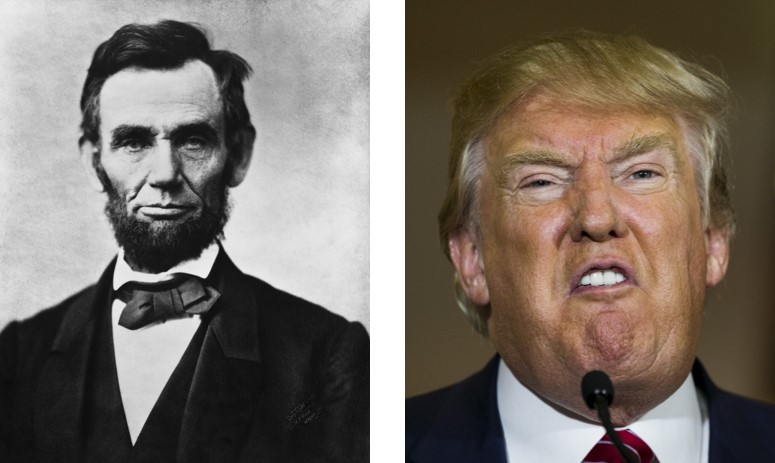
Now over many decades the Republican Party has been steadily undergoing a transformation of character, from the republic-defending, ethically centered, and unifying efforts of Abraham Lincoln, to what we have in Donald Trump. (Just put those two individuals side-by-side in your mind for a moment and you should start to feel the twisting vortex of cognitive dissonance.) Along the way, the Grand Ole Party sidled up to various special interest groups, some endeavoring to forward a few constitutional rights that are more period-specific than they want to admit (like the right to bear arms against the encroachments of a hostile government), and others seeking to bind our nation to a religious orthodoxy that historically has condemned the advances of science, the liberalization of morality, the creative authority of individuals, and the rise of inclusive community.lincoln_trumpThere is a deep underground reservoir of repressed insecurity, resentment, and bigotry in our national unconscious, which has been kept below a thin threshold of civility – at various times not so successfully. As things progressed for liberal democracy, many of these inner demons made their way into legislation while others got projected onto whatever scapegoats we could find. Unfortunately this repressed shadow attached itself to the Republican Party, altering the platform from a philosophical avant-garde for individual freedom and social responsibility, to something just short (maybe) of institutionalized racism and bully politics. This is not Lincoln’s party, and it’s not what Americans aspire to be.

My theory is that this mysterious force called ‘the will of the people’ orchestrated the steady elimination of worthy GOP candidates and left us with this one very crass and blatantly bigoted contender for the presidency, for the purpose (not conscious, mind you) of pushing the Republican Party into extinction. If there is to be a resurrection at some point, Republicans will need to get their house in order.

Personal Myth and the Anatomy of Character

characterThe diagram above illustrates my newly refined definition of religion, as a cultural system that links together (from the Latin religare) individual consciousness (or psychology, represented in the purple triangle) and the larger order of existence (or cosmology, represented in the dome overhead) by means of sacred stories (or mythology, represented in the moving wave between them) that serve to orient us in space, guide us through time, connect us to one another, and support us across the adventure of life.

Once again, I am speaking here of religion itself, not necessarily of this or that religion, numerous examples of which have indeed lost this unifying function and fallen out of relevance in our day. I’ve explored in other posts what happens when religions misread their myths by taking them literally, defend outdated models of reality, and neglect (or even condemn) the inner depths of mystical awareness. They die, but continue on in fundamentalist orthodoxies, megachurch celebrity cults, metaphysical roadshows, or militant end-time sects.

Effective and relevant religion will provide the orientation, guidance, connection, and support that individuals and communities require throughout the full course of human development. Ultimately this will also include breakthrough realizations of a ‘truth beyond’ our conventional beliefs, and of a ‘power within’, deeper even than that cherished center of personal identity (i.e., ego) which religion itself (as theism) had earlier made the focus of salvation. This post-theist excursion into a more experiential, communitarian, and globally-minded spirituality is where the evolutionary design of our human nature is headed.

In a recent post I suggested that the narrative device of Apocalypse, which can be found in all developed mythologies, is not referring to a future cataclysm of world-collapse, but instead represents a self-conscious awareness inside the mythopoetic (storytelling) process itself, of their status as sacred fictions. Outside these narrative constructions of meaning is the present mystery of reality, the terminal end of our stories and thus of the storied world itself.

If mythology has done its work – referring to the orienting, guiding, connecting, and supporting functions mentioned earlier – then we are ready for a psychological breakthrough to a more rational, responsible, and reality-oriented way of life.

My term for this liberated mode of experience is ‘creative authority’: when the individual not only sees through the constructions that had earlier draped both reality and consciousness with veils of meaning, but goes on to take responsibility as the principal author of his or her own personal myth and its associated world. If it sounds like we’re returning to life under the shroud, I must emphasize the key insight of this breakthrough realization, which is that the individual is now a self-conscious storyteller.

In other words, we have entered the ‘ironic mode’ (Northrup Frye) where the storyteller is aware of the fact that he or she is spinning narratives across a mystery that cannot be named.

This brings us to the interesting challenge of composing our own personal myth. The art of storytelling (or myth-making) is millenniums old, which means that we have a vast library and useful tools at our disposal for the project before us. In this post I want to reflect on the features of well-developed character, using this term in its literary and not so much its moral (or moralistic) sense. A character is thus a narrative personification, an identity in story who strives (Greek agon) for (as protagonist) and against (as antagonist) the plot in its unfolding. A ‘good’ character (again, not in the moral sense) is one that evinces certain traits and makes the story particularly interesting.

Our work as self-conscious storytellers of our own personal myths will involve constructing an identity for ourselves that possesses four traits in particular: memory, integrity, grounding, and volition.

Memory

In any good story, character is an identity that becomes stronger (i.e., more definite and self-consistent) over time. A character’s memory has to do with how recognizable it is with respect to what we’ve already come to know about him or her in the story up to this point. The story’s audience starts to anticipate how a character will respond by virtue of how he or she behaved in similar scenes or challenges earlier in the narrative. With growing confidence in a character’s memory, they are better able to trust his or her performance.

As we take responsibility for the construction and management of our personal identity, each of us should consider the fidelity of our character to the person we have been. This is not to suggest that we simply repeat the mistakes of our past, or that spontaneity and fresh departures are out of the question. Even if we should undergo a conversion of some sort, the memory of character will deepen our understanding and empathy for others, adding dimension and complexity to the person we are. This is an aspect of what is known as wisdom. Alternatively, neglecting the character trait of memory can make us insensitive to others, even projecting on them the dark energies of our own repressed and forgotten shadow.

Integrity

If the character trait of memory is what establishes consistency through time, then integrity is about consistency across space, or across the landscape of life situations and social engagements. A narrative character who changes dramatically from one engagement to another leaves the audience unsure as to ‘who’ will show up next. In psychology this lack of consistency across situations is evidence of ‘dissociative identity’ (formerly ‘multiple personality’), where a personality lacks sufficient ego strength to coordinate and unify otherwise diverging streams of subconscious motivation and demeanor.

In the early years of ego formation when we were being shaped, instructed, and managed by our tribe into a compliant member of the group, identity contracts dictated our role in each social situation. Now, stepping through the Apocalypse and into our own creative authority, we can take ‘authorial control’ over the person we want to be. We can join the role-play, fully aware that it is just a social convention in make-believe. Or we might take a stand for a more authentic, self-honest, re-imagined and creative way of being together. This is what Jesus called the kingdom of God.

Grounding

A ‘grounded’ character in story doesn’t simply drift above the moving scenes, essentially detached from the situational dynamics of time and setting. He or she has the feel of belonging, of being rooted in that narrative world and not just an alien passing through. In this sense the story isn’t merely ‘about’ the character, but unfolds around and through the character’s individual evolution.

My returning reader will recognize this idea of grounding from my frequent references to ‘the grounding mystery’, that inner depth of spiritual life where our personal identity sinks and dissolves into an ineffable sense of being. Of course, if ego is caught in a neurotic tangle of insecurity and self-defense, any suggestion of sinking and dissolving into something else will be vigorously resisted, and inevitably misunderstood. Creative authority requires that we ‘loosen up’ and release ourselves to the deeper process, so that we can carry that ‘power within’ into the affairs of our daily life in the world.

Volition

Our fourth and final character trait picks up with that last sentence – as we take action and work out the evolving plot of our personal myth. In story, the action of a ‘weak’ character will be determined by external events and circumstances, whereas a ‘strong’ character chooses and determines it for him- or herself. Volition (from the Latin vol for will) is about a character taking action rather than reacting, moved by an internal drive or desire. The better stories in mythology, literature, film, and stage are those that are driven by strong characters whose action seems to proceed from their center.

As we break through from a mode of role performance (acting out the instructions and expectations of our tribe) to one of role transcendence (using our role in a more purposeful and creative way), we are able to construct a personal myth that supports the life and genuine community we really want. We don’t pick up a mask of identity (a persona) because someone else tells us to, because a tradition (or consensus trance) calls for it. We can live out of our own center, for values and aims that others might not find agreeable. Our action is not about defiance or transgression, but instead arches toward a deeper, higher, or longer goal.


More and more of us are ready for the responsibility of writing our own story, of composing our own personal myth. Our tribe and culture have done their part, for better or worse, and now it’s our turn. We have finally come to realize that our identities and the worlds we inhabit are really nothing more than narrative constructions, meaningful fictions of our personal and interpersonal life.

It is time to step into our own creative authority, take leave of the gods, and become fully human. This is life after the Apocalypse.