Soulful Religion

A very long time ago, way back in the dim prehistory of human cultural evolution, “primal religion” functioned to keep our run-away brain connected to the cycles and rhythms of the natural order. At that point, the tribe was still a human group organized around the necessities of sex, territory and nutritional resources. These cycles and rhythms represented the pulse of life that no primitive society could afford to fall out of sync with. Woman, more grounded and in touch with natural cycles than her male counterpart, was a figure of wonder and reverence. She was regarded a nature being, an embodiment of the generative force beneath all things.

The man, while still dependent on the cycles of need and provision, activity and rest, harvest and the hunt, was the more aggressive proponent of technological advances (invention of tools) and mastering the environment. His talent was in his powers of detachment, abstraction and control – mental progress that increasingly removed him from the wisdom of nature, woman, and his own body. This is the stage in history – no longer in the circular turns of natural time but now on the abstracted “time line” of identity and conquest – when ego became the new obsession. Not embodiment but role-play, not natural wisdom but technical reason, not cooperation but competition, no longer participation in a larger providential order but finding the way out.

What has been called “conventional religion” is where this ambition of world-escape is the prominent feature. The patron deity dwells beyond this world and condescends to the worship of the devoted in elaborate and expensive buildings, according to liturgies and traditions managed by (mostly male) custodians. Our god is great – exalted, majestic, and worthy of praise. We worship him and give him what he deserves, because one day we expect him to give us what we deserve for all our sacrifice, moral obedience, and unshaken conviction. One day we will live forever in heaven, without the drag of our bodies, singing hymns on golden streets in the perfect everlasting city.

In this post-conventional age, if it’s meaningful to talk of “soul” at all, it can no longer be as a synonym for ego. While ego is the “I” of personal identity, shaped by and reflecting the social influence of my tribe, soul is that in me which is more than “me,” that seeks a higher wholeness, fulfillment and well-being. Whereas conventional religion sanctifies the split of “I” from “it” (the body) in an afterlife envisioned as an unending celebration of disembodied egos, a religion of the soul will consecrate this quest for wholeness, communion and real presence.

Soul doesn’t look to the future for salvation. In fact, this fixation on and desperate hope for a future way out is now precisely the “problem” that soulful religion must find a way to resolve. As long as we persist in the male initiative to detach from, dominate, and finally escape the realm of nature, woman, and the body, our situation on this planet will continue to deteriorate. Unfortunately, as the conditions for life on Earth are compromised and degraded by human activity, the temptation for escape becomes all the stronger. The resurgence in conventional religion in what we know as fundamentalism can be understood as the urgency many feel to get back to the truth, take control, and secure our escape out of this doomed situation.

If soul awakening is the inevitable course of human evolution, then we should expect resistance from the ego, its tribe, and this escapist ideology. I’m reminded of the challenge in therapy, in helping a client get “incarnated” again, to come back to a body presently racked with symptoms from a lifetime of unhealthy habits, physical self-abuse, and an underlying body shame. Who wants to go back to that? What purpose could there possibly be in going into the pain, rather than medicating or distracting ourselves away from it? Our impulse is to run from “Lucifer” – a name for the devil that everybody’s looking out for these days, whose name means “light bearer” – instead of facing him and taking back our light.

The good news is that soul awakening is our evolutionary intention as a species. Just as an apple tree “apples” – as Alan Watts would often say – a human being develops according to an intrinsic ideal that attracts and guides this development towards maturity and fulfillment. With its fantasy of detachment, control and everlasting life somewhere else, ego not only makes coming back to the body unappealing, but it also stands in the way of what might be called true salvation. From the root-meaning “to heal and make whole,” salvation involves a return to this present moment, to the place where you are, to this body you are, to the earth that is our home.

This is the division in our being that must be healed – before it is too late. Soulful religion is carried out on the basis of some very simple practices, like breathing, calming down, getting grounded and expanding your awareness beyond the neurotic cluster of self-interest. A very long time ago we did these things naturally, instinctively, and for the most part unconsciously. During the “age of ego” and the escapist methodologies of conventional culture and religion, we gradually forgot how to breathe and be fully present, as we lost touch with the living wonder of our body. Now some of us are relearning how to do these things. Or if that sounds too much like the ego taking control and setting out to achieve a goal, then we are learning how to release ourselves to the natural wisdom of human be-ing.

Soulful religion doesn’t look to the future for salvation, and neither does it put faith in the truth of doctrines. The wholeness we seek at the level of soul – and the mystery that opens to us from this standpoint in reality – is not about being right or belonging to the right church. Soul understands that all our efforts at being right have divorced us from what is left, which is everything else. The real path of salvation will bring together left and right, woman and man, body and ego, them and us, for the sake of the Greater Whole.

This is where the responsibility of being human takes on new urgency.

Human Being

If language had developed along a slightly different track, in addition to speaking of human beings we might today have acquired the habit of referring to “dog beings” and “tree beings,” even “rock beings” and “cup beings.” This fascinating word, being, is mistakenly regarded as a noun when it’s really more a verb: be-ing, the act or process of existing.

Being is the dynamic and particular demonstration of existence, manifesting here as human, there as tree, and as a cup on the table (table being) before me. It’s interesting to ponder why language has retained this formal reference to ourselves as human beings – as the manifestation of existence in human form.

If we had come to regard this wonderful diversity of beings more explicitly in our language, would we today have a different shared understanding of and appreciation for the way all things are grounded, connected and involved in this one magnificent act of being called the universe? As cohabitants of this universal order, would our tribal values, personal choices, and individual lifestyles have taken a different course, landing us in a very different cultural space from where we are today?

Culture itself is a complex system of uniquely human creativity whereby the organic energy (life) of our animal nature (body) is harnessed, redirected, and converted into the social currency of identity (ego), collective meaning, and shared purpose. The organic energy that animates your body is not your personal property, but merely a cresting wave of life as it has emerged on this planet.

In its peculiar form, this animal manifestation of life has a deep heritage of instincts. You can think of them as impulses, reflexes and drives that have evolved over many millions of years to protect and promote the vital urgencies of life as it rises in the organism you are. This “urgency” represents the place where your life is absolutely dependent on the support and resources of the natural environment.

The part of your brain responsible for regulating the syndrome of urgencies that is your biological life does its business far below your conscious awareness or direction. It lives in the unconscious present.

If life itself is not your personal property, the tribe works on you to cultivate an identity and mindset – equipped with a distinctive vocabulary of “I, me, mine” – that regards this body as “my body, belonging to me.” As you occupy this standpoint in reality, it makes sense to speak in personal terms. Although your personality is rooted in genetics and a deeper animal temperament, its fuller development is a social construction.

Your personal preferences, interests, values and concerns are unsurprisingly similar to those of other tribal members. As the tribe instructs your language and language structures thought, your worldview and way of life will tend to be compatible with membership. It feels as “natural” as using your dominant hand for daily tasks. Your tribe’s way of leaning into reality was instructed into you from an early age; it just seems “right.”

Human societies tend to favor “insiders” over “outsiders” as bearers of value and meaning. This insider preference not only translates into a politics of “us” and (versus) “them” on the personal level, but it has also forced a somewhat pathological separation between identity and embodiment, ego and body, technical control and the natural order, human beings and “only” dogs, trees, and rocks.

Most religions construe salvation as a rescue mission – getting ego out of the body and safely to heaven. But from the standpoint of the soul, this only magnifies the real problem, which is that we are divided within ourselves. Of course, “I” (ego) want to live without pain, without stress, and without the burden of mortality … forever and ever.

When ego (the social construct of personal identity) took on this role of a lifetime as impersonator of the soul, the wholeness that is the true meaning of salvation (salvus = to heal, make whole) and the higher quest of our spiritual life was forfeited, or at least postponed. As long as the principal goal of religion continues to be rescuing “me” from my body and this sinful world, the soul’s quest will be frustrated.

I am suggesting that the evolutionary goal of “true religion” is actually the opposite of what it has become in conventional religion. Rather than accomplishing a rescue mission – whether it is permanent (everlasting) or only temporary (as in the hopelessly confusing orthodox Christian notion of resurrection, where the already-saved ego is reunited with its body for final judgment) – salvation for the soul is about coming back to the body.

In a kind of “reincarnation,” the once-split and internally conflicted human being is reconciled and made whole – in this life.

A human being is a distinct expression or manifestation of being-itself. Over there, being is expressing as a dog, as a tree, and as a cup on this table. Each manifestation of being (human, dog, tree, etc.) carries this deeper ground into the nature, form, properties and attributes of its unique expression. From the standpoint of ego, where personal identity (as “me”) is a socially supported preoccupation, this talk of a ground of being threatens to dissolve away what makes me special.

And yet, the experience of absolute release to the present mystery of reality is a celebrated moment of realization for mystics everywhere. This is where you understand intuitively (not by logical argument) that “it’s not about me.” There is an intention to your existence, an evolutionary aim in what you are, which is to become fully human.

As long as captain ego is gripping down on “me and mine,” this otherwise very natural flow of human energy will be cut short of fulfillment. Let’s not be surprised any longer that frustration and stress, anxiety and depression, conflict and violence are destroying our health, international community, and the biosphere of this planet. We should expect more of the same if nothing changes within ourselves.

So come back to the present moment. Your body has been here all along. Breathe in. Breathe out. Reach in to the ground and touch the source. Reach out to the universe and be at home.

You are a human being, so be fully human.

The Path to Wholeness

According to the conceptual model that I’ve been developing, the familiar designations of body, ego and soul refer to distinct mental locations, or standpoints in reality. Traditionally, the dualism of body and soul has dominated the conversation, with ego sneaking into the meeting relatively recently. Soul was identified early on as the “true self,” with body its temporary container. Now ego has become another (albeit more psychological than spiritual) name for the soul.

This confusion of terms, along with the tendency in metaphysical realism to make the soul into a “separate thing,” and the tendency in scientific materialism to reduce the soul first to the ego (personality) and then to the body, leaves one to wonder whether re-definitions are even advisable at this point. Perhaps we should simply scrap the traditional vocabulary and move on.

Such frustrations as this are common in transitional periods of culture, when the vocabulary that supported an earlier (but increasingly outdated) worldview is still being pressed into the service of constructing meaning. Of course, archaeologically it is expected that by stepping back into the mind-space of ancient languages we today can reconstruct how earlier cultures saw the world. But we also need to make sense of reality for our time, and we are stepping into a decidedly postmodern period of history.

So in the interest of reinterpreting the traditional terms of body, ego and soul for a relevant postmodern conversation, I am offering this notion of standpoints in reality. Another spin through this vocabulary revision might help put things in perspective.

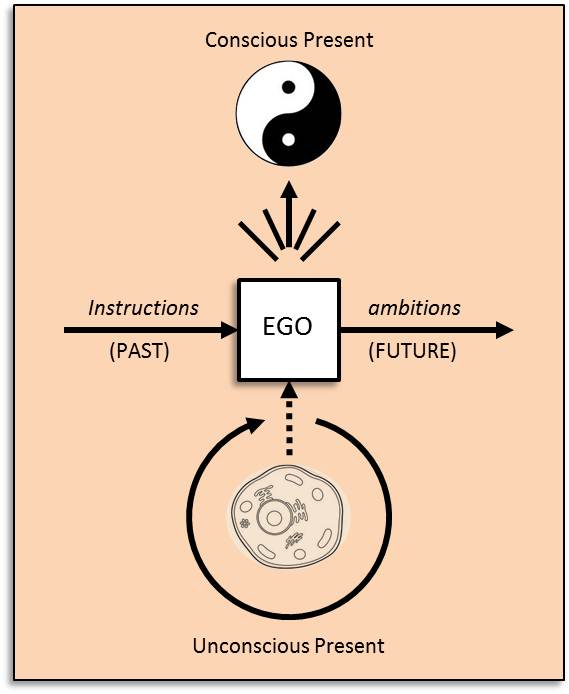
BESThe diagram to the right is intended to be read from the bottom-up. I’ve arranged it this way to acknowledge the organic and evolutionary nature of the topic under consideration – i.e., what is a human being? Living things tend to grow “up,” which means that human development can be understood as progressing through phases of growth, perhaps even according to specific “stages” of relative completion along the way.

If a stage can be thought of in the spatial sense, as a specific location where one can stand and take a perspective on things (as on a theater stage), then we are very close to my notion of a “standpoint in reality.” Each stage or standpoint (body, ego, soul) provides a unique mental location where a human being engages reality. The present mystery of reality is thus revealed to us as three distinct realms: sensual/nonpersonal, social/interpersonal, and spiritual/transpersonal.

Body is represented in my diagram by a circle, or more accurately a cycle. The body functions as an energy converter, taking up the vibrational oscillations of inorganic (air, water) and organic matter (food), dismantling and re-engineering it into more energetically “open” packages of living cells.

The body’s own biological clock moves through the revolutions of daily activity and nightly rest, and every level deeper into its organic interior is characterized by this same dynamic of cycles. All of this is occurring right now far below conscious awareness or direction, which is why I call it the “unconscious present.”

With an evolutionary history of millions of years, the body is animated by powerful urges and instincts. The very fact that I’m here right now is a credit to the success of these drives and reflexes in my pre-human and human ancestors. It stands to reason that I should be able to trust this animal intelligence for continued evolutionary success – if it weren’t for the additional fact that I’m involved in a tribe.

Ego is represented by a horizontal line moving left-to-right, which stands for the developmental project of constructing an identity – a “one of us.” The tribe must work with the body’s animal nature, in the interest of training and channeling its instinctual energy into behavior that supports (or at least doesn’t interfere with) social order. Sometimes this means working against its urgencies and impulses, putting restraints in place to keep it under control.

This process of imposing restraints, incentives, and permissions on an animal nature in order to shape a self-conscious identity (ego) is summarized in the term “instruction.” The most important part of constructing this “one of us” involves instructing it with the rules and values of our tribe (family, clan, club, culture). This is Nietzsche’s “morality,” and while he didn’t appreciate the way it can frustrate human freedom and stunt human creativity, some such system of constraints is necessary for a peaceful and productive coexistence.

Identity, then, is instructed. All the way from the language we are taught, the clothes we wear, the toys we play with, and the gender we express; from the family and work roles we take on, the degrees or certifications we pursue, and the destinies we chase after – who we are seems to commit us to specific ambitions in life. The judgments and preferences of our tribe gradually become internalized and situate us firmly in the mental location of “us.”

Because ego is a product of past instructions and a project of future ambitions, the present moment is nothing but a vanishing threshold between its twin obsessions. And if early socialization involved neglect, abuse, or repression, then the personality might host a significant “shadow” of insecurity, shame and resentment. The shadow tends to pull the ego into earlier configurations of itself where the personality got hooked or held back.

When the personality gets hooked in this way, ego might compensate – sometimes with considerable assistance from the tribe – by projecting the shadow forward and ahead of itself, into moral crusades against those who express outwardly what it can’t accept in itself. Since the shadow can also include talents ignored or left undiscovered, ego can become a relentless critic of those more courageous and/or successful.

As each of us is aware, the social realm of ego and tribe can be endlessly fascinating. Because dualism – past/future, shadow/mask, self/other, right/wrong, and good/bad – is woven into the very structure of identity itself, an entire lifetime can be spent sorting it all out. A spiritual consequence of this is that the individual may very rarely, if ever, become consciously present to the mystery of reality.

As I said, the present moment is inaccessible to the ego, whose identity is stretched between past (instructions) and future (ambitions). About the only way ego can add value to time is by extending it indefinitely into the future. As its developmental antagonist, the body, is time-bound and mortal, ego took to itself the virtue of everlasting life.

But everlasting life is just “more life, without end.” In order to experience true immortality, the individual must break past ego altogether. In the standpoint named soul, reality is experienced as the timeless ground and always-present universe of being.

The ground invites awareness by an inward path into the depths of being-itself, beneath and prior to the separation of ego. Mindful breathing is a widely practiced meditation technique that brings conscious attention to the softness and gentle rhythms of the body. Drop your concerns, set thoughts aside, let go of “me,” and just sink into this present moment. This is the “narrow gate” – invisible to the ego – that opens to an ineffable and unqualified mystery.

The universe elevates and expands awareness beyond the ego by a different path. Spiraling out, around, and beyond “me” is a wondrous and apparently infinite community of beings. In this moment I am connected to all things, and all things are turned into one (“uni-verse”). It is astonishing just to consider a provident universe, where conditions are just right (at least in this corner of reality) to support the emergence of life and the evolution of consciousness.

Attention itself is a miracle.

In the standpoint of soul, this present moment is all there is. Grounded and connected, ego is transcended and all personal references are left behind. Here and now, I am whole and all is one.

Soul and Reality

In my last post, I introduced the idea of body, ego, and soul as “standpoints in reality” – not as pieces of a human being, but rather as different mental locations where we can take a perspective on things. Body is organismic and biological, providing us a standpoint in the physical realm. Ego is tribal and personal, giving us a standpoint in the social realm. And soul is psychological (from the Greek psyche, soul) and spiritual, offering us a place in the presence of mystery, in the present mystery of reality.

Instead of breaking these aspects of the self into separate and warring opposites – ego against body, body versus soul – seeing them as distinct access points in our experience of reality can help us transcend the arguments over which one is “the real self” and contemplate instead human being in its wholeness. Rather than identifying ego with the soul, and then dissociating both from the body so “I” can elude the finality of death and live forever, we can appreciate how each contributes to the marvel of what it is to be human.

I reflected on how ego develops out of a simple identification with the internal state of the body. “I am happy” or “I am sad” are among the first ways a young child is taught how to declare him- or herself to the world. This affect (pronounced with the accent on the ‘a’) is where a child’s experience of the world is registered: “The dark closet makes me afraid”; “You are making me angry.” Behavior is then the output channel of this affect, in the way it motivates the youngster to run and hide, or push and pout.

Many people get stuck at this level of development. They remain in the I-am-angry-and-can’t-help-but-push-you-down mode of life. A significant number of them seek out professional help because they are hostages to affect and can’t stop doing things that are counterproductive to happiness. A truly helpful counselor will teach the client how to reflect on these powerful affect states. Instead of simply acting out the affect in behavior and only making things worse, the client can learn how to separate identity (ego) from emotion (affect→behavior) and use this freedom to choose more desirable outcomes.

The “liberated ego” can thus become a springboard into still higher experiences, which the wisdom traditions around the planet have named Love, Communion, Being, and Bliss (among others). It’s important to understand that these are not merely synonyms for “happiness.” The ego wants to be happy, but the soul seeks after something much higher than personal happiness. To get there, ego (I, me, mine) must be transcended, gone beyond. If it stays in charge, the personal self (ego) will be in the way.

As I suggested last time, a shift from the standpoint of ego to that of soul opens the self up to a much greater experience. Engagement with reality at this higher level is not impersonal (as it is for the body) or personal (as it is for the ego), but transpersonal – again, beyond the personal. This is where affect differentiates into feeling and thought. These are the Yin and Yang, respectively, of the soul’s experience. Their “tension” is not combative but creative, like the tension in a string that produces a musical tone.

The wisdom traditions refer to these higher faculties of the soul as “heart” and “mind.” Once liberated from the urgencies of the body and the self-interest of the ego, heart and mind are free to contemplate the present mystery of reality. If I were to describe in one word what each of these faculties of soul contributes to the experience I would say that mind/thought represents reality and heart/feeling participates in reality. Let’s see how this plays out.

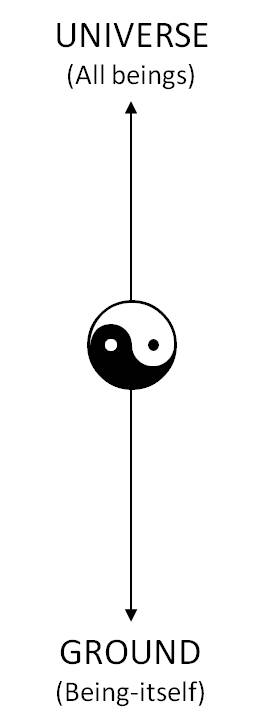
Ego, under the direction of the tribe, constructs a world, which is less a representation of reality than it is a projection of what is needed to help us feel safe, loved, capable and worthy. In its service as a faculty of the soul, mind represents reality apart from what I (ego) need it to be. Two favorite ways of representing reality across the wisdom traditions are as “ground” and “universe.”

Representations of Reality

Insofar as mind is dependent on language to name and describe something (the present mystery) that is ineffable, it has offered up these two metaphors for contemplation. Ground is the generative source and deep support that stands underneath all things. Existence – which literally means “to stand out” – properly refers to everything above the ground, so to speak.

The ground itself, then, does not exist in this sense. It is pure being, the internal essence of all things, the be to their ing, the creative power of being-itself. No words can describe it, because language can only qualify what exists and the ground is beneath all qualities. Even the name “ground” must finally be released. In contemplating the mystery as the ground of being, the mystics advise us to stop talking.

As a representation in thought of the real presence of mystery, ground inspires the heart to a certain exquisite kind of feeling. This is not crude emotion, where affect drives behavior. Rather, this feeling registers our participation in the mystery that cannot be named but only surrendered to in complete self-abandonment. In letting go of qualities and attachments, the self can sink into the “solvent” of being itself. The feeling of participation gives way to the bliss of unqualified union or oneness.

Another worldwide representation of reality is universe. This is not to be confused with a term such as “cosmos,” which is a more-or-less scientific name for the vast order of things (cosmos is Greek for order) that can be analyzed into galaxies, stars, planets, moons, minerals, elements, atoms and quarks. Universe is another metaphor, like ground, and not merely a designation of order. As metaphor, universe is a concept of pure thought, a representation by the mind of the mystery all around us.

Literally universe means “turned into one,” which is precisely what this concept does for the soul. It provides a way of contemplating the comprehensive unity of all things – inclusive, interdependent, balanced, turning as one. The soul seeks after wholeness, and the representation of reality as universe offers a simple – though admittedly infinitely complex – image for contemplation.

Notice how “ground” and “universe” stand at opposite ends of a vertical continuum. Ground is in and down; universe is out and up. Ground is beneath us, whereas universe is all around us. Ground is unqualified being, while universe is qualified to an infinite degree. Finally, ground cannot be said to exist, but the universe is the totality of existence.

Contemplating reality in the representation of universe inspires a different sort of experience for the heart. Participation here does not lead to a feeling of dissolving into pure being or oneness, but rather of being elevated into an expansive community. Whereas the former experience is that of sinking into no-thing, the latter is realizing your connection to everything.

In thought, then, the soul represents the present mystery of reality as ground and universe, as the underlying oneness and overarching all-ness of existence. Depending on which representation is the focus of contemplation, the feeling of participation will be distinct and complementary. This interplay of feeling and thought, of heart and mind, of Yin and Yang, is how the soul touches the mystery and finds salvation.

Standpoints in Reality

My “Conversations” with recent philosophers, theologians, and mystics over the past year have helped me reconsider some terms we commonly use in the investigation of what makes us human. The longer history of higher thought has continuously required us to make distinctions in what we had earlier grasped as “one thing.” The words individuum and atom once named basic and unbreakable units of reality. Now we have created numerous and sometimes competing disciplines for exploring the many parts of the individual and the atom.

Of course, these many parts can become disconnected in our minds, giving rise to further specializations that eventually leave us with so many scattered pieces that we might abandon all hope of ever recapturing a sense of the whole. This “sense of the whole” is what Abraham Heschel meant by wonder. Somehow, after or on the other side of all this mental business of dividing and defining reality into its many pieces, we need to pause and re-member – put them back together so we can appreciate the unity of being.

In that spirit, I want to pause and reflect on that fascinating bit of reality called a human being. And I want to engage this reflection in light of the philosophical commitments of perspectivism, constructivism, evolution theory and metaphysical nonrealism. These were commitments of my Conversation partners, and they are major features of our emerging postmodern worldview – which is still being worked out, by the way.

A human being is a trinity of body, ego and soul. Each of these terms names a particular standpoint in reality, a certain mental location, as it were, where we can take a perspective on things. They are not pieces of a human being – as if one could be removed, lived without, or left behind with a human being still intact. Rather they are aspects or dimensions, distinct ways by which our existence as human beings is expressed and extended into reality.

Standpoints

I’ll begin with the body, for that is where we all begin. Also called our “animal nature,” body is the organismic basis of life. It is a complex organization of vital impulses that I call “urgencies” – urges which have evolved around the need to convert energy from the environment (sunlight, water, nutrients) into biological fuel. As a biological organism, the body has evolved ways of adjusting itself and adapting to its surroundings so as to maximize the efficiency of this energy conversion.

As a dynamic energy converter, the body is an organic intelligence that carefully balances its own internal state with the changing conditions of its environment. This orchestration of maintenance (state) and adjustment (reaction) keeps a human being in providential niches where life can be sustained and supported in growth.

If all that sounds coldly impersonal, that’s because it is. We now know that body precedes the personality and serves as the biological basis to the formation of ego. Ego, then, is a second standpoint in reality, extending out of the body and engaging the world at a higher level. This doesn’t make it better or more essential to what makes us human – although it seems right to acknowledge ego as an evolutionary stage beyond the vital urgencies of the body.

Ego refers to the socially constructed identity of a human being. In order to become “one of us” at the tribal level, each human being must gain sufficient liberation from the urgencies and compulsions of biological life. The tribe helps this to happen, by giving the child an alternative set of directives, which Nietzsche called “morality.” Morality is necessary to the formation of identity, providing a counter-force to the animal instincts and redirecting (but also repressing) these impulses into socially acceptable behavior.

The body’s internal state serves as the subjective reference of the ego’s stand-point in reality. If the body is anxious, the ego says, “I am afraid.” If the body is incited to aggression, the ego says, “I am angry.” If the body is satisfied and content, the ego says, “I am happy.” The “I am” in each case exposes a tendency of the ego to identify with the body’s internal state.

Otherwise, the ego might say something like, “I feel afraid” – which demonstrates an ability to distinguish between a subjective feeling and its underlying biology. This ability to separate affect and behavior provides an important gap that the ego enjoys as freedom – the freedom to choose a course of action (or restraint) above the compulsions of the body’s animal nature. Not everyone is successful arriving at this point, as evidenced in the proliferation of neurotic disorders where the individual gets stuck in overwhelming affect states and compulsive behaviors.

But if – and this is a very big if – an individual is able to gain sufficient liberation from reactive impulses and adequate moral guidance from the tribe, another standpoint in reality is made available. This is what we call the soul.

My challenge here is to understand soul without relying on metaphysical realism. It is becoming less meaningful and relevant these days to regard the soul as some kind of ghost in the body, which can carry on perfectly well (or even better) without the burdens of mortality. Metaphysical realism treats the soul as a thing, separate from and independent of the body. This thing is believed by many to not only survive the body, but to live forever. As we should expect, the tribe has exploited this belief for the purpose of enforcing the moral conformity of the ego.

Just as ego uses the body’s internal state as the basis of identity, soul is a still-higher standpoint in reality where feeling and thought differentiate out of this subjective affect. The ability mentioned earlier, of distinguishing between “I” and “this feeling I have,” is a sure sign of the individual’s transcendence of ego. But again, transcending only means “going beyond,” not leaving behind.

Once lifted above the need to either protect or promote identity (ego), affect can differentiate into even subtler experiences, which have produced great works of art and other cultural achievements of our species. Feeling and thought are the Yin and Yang of the soul, with each creative expression adding spread and height to the growing tree of wisdom. They complement each other, deepening and expanding in creative partnership.

Only ego sees them as opposites, where one must win and the other lose.

Soul joins the dance, where the push and the pull, the rise and fall, the silence and the sound come together, only to spin out again. In that moment – yes, in every moment, but now in full mystical awareness – the soul is in the presence of mystery. This is the place of inspiration (feeling) and enlightenment (thought), where all the “parts” are suddenly seen – in a sustained flash of intuition – as rooted in a common ground, as diverse fruits of a single tree.

No Use for God

What NextReligion is to spirituality as meaning is to mystery, as god is to ground, as belief is to faith, and as body is to soul – if we can resist the old habit of making the second term of each pair into some separate and metaphysical “thing.” These pairs are paradoxical, not antagonistic or merely “coexistent.” Spirituality finds “body” and expression in religion, not inside it but as it. Faith as release to the grounding mystery of existence is translated and becomes “useful” as timely (relevant) and meaningful belief.

Misunderstanding and complications arise at the very start (or shortly thereafter), in our impulse to label and define what is essentially unnameable. When that happens, mystery becomes (is turned into) just another name for what we don’t understand – yet. Faith becomes Christian, Muslim, or Buddhist faith, then “the” (one true) faith, which really means the set of beliefs that is supernaturally revealed or fully enlightened.

God is a name, an idea, a representation of something that isn’t a thing. The ground does not “stand out” (ex-ist) in the field of identities and relationships, but is merely another name (a metaphor in this case) for that out of which everything else stands, and back into which it will all eventually return. That grounding mystery is experienced in those moments when you can let go of meaning, let go of thought, and let go of “me.”

Faith is yet another name, a noun that is really a verb, a way of be-ing and living in communion with the present mystery of reality.

As I have tried to explain post-theism, some have heard me advocating for a new kind of postmodern atheism. It sounds to them as if I’m rejecting god and wanting to discredit religion as so much mythological literalism and metaphysical malarkey. There is that. But at its best, religion can be a helpful servant to spirituality, and god can be a relevant representation of the grounding mystery. The problem is that religion is not very often at its best.

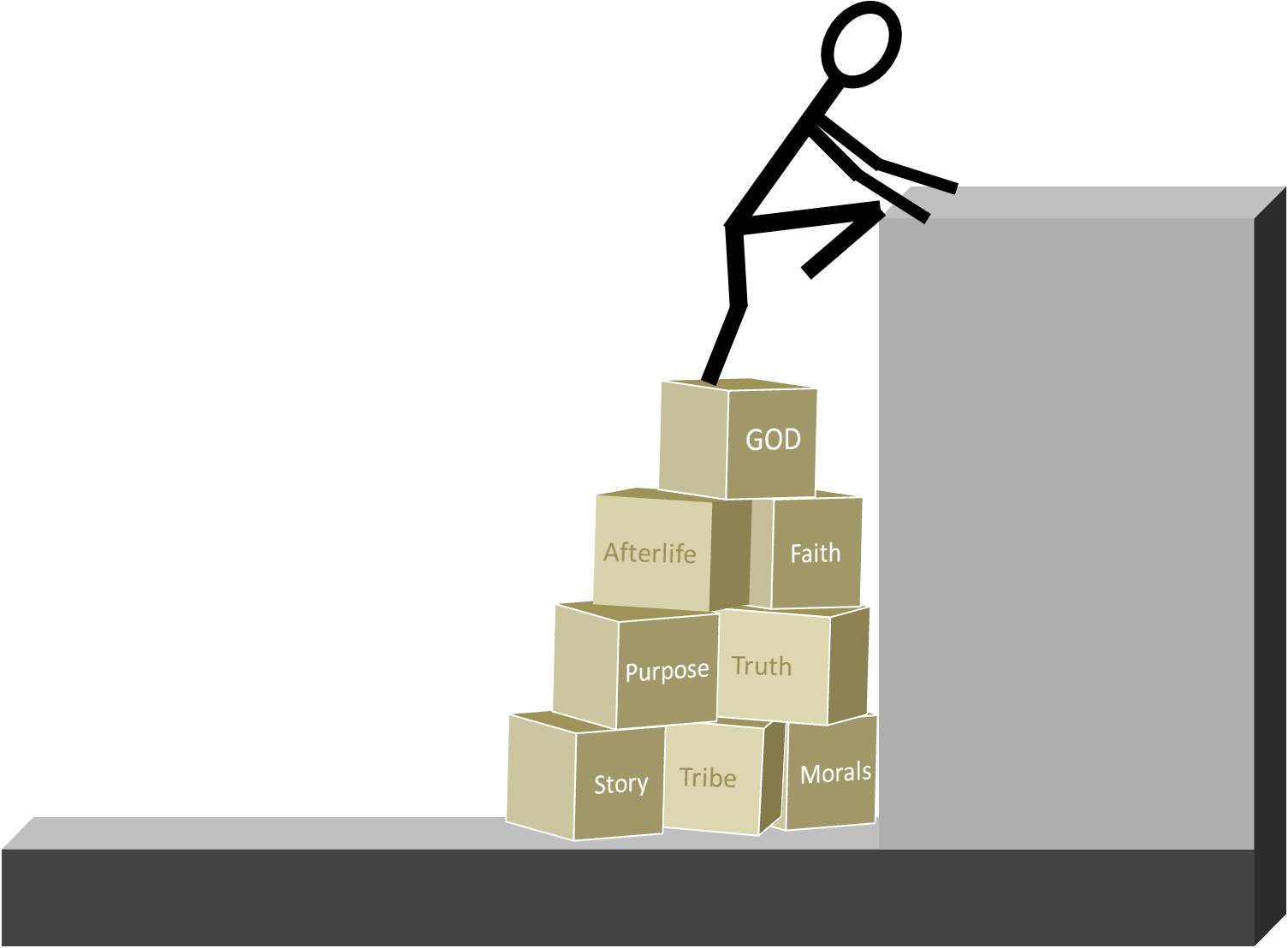
You can’t resolve the errors in religion by digging deeper into its scriptures and refining its doctrines. It’s not about clarifying your concept of god, or making it “big” enough to contain all the attributes that a perfect and supreme being should properly have. No matter what you might try on that side of the threshold of the paradoxes mentioned above, you are still only straightening up and rearranging boxes.

Spirituality comes before religion, though not in the temporal sense of “before.” It inspires (breathes life into) religion, but it can’t connect to your life without the “system of utilities” that religion provides. In religion god is useful for making the world, providing for our needs, giving us purpose, supervising our progress in morality and settling the score at the end. God can become so useful, in fact, that we lose sight of his/her “first use,” which was to re-present the mystery and give us a way of relating ourselves meaningfully to it.

Religious formation can be thought of as the development of a “vehicle” for the evolution of human spirituality. As life evolves through the adaptation of an organism to the conditions and challenges of its environment, so does spirituality evolve through the ability of religion to stay grounded and adapt to the changing circumstances. “True” religion – if I dare use the term – is one that is spiritually rooted in the timeless mystery and usefully current to the concerns of our time.

While religion has a thousand uses for god, spirituality has none. It should make sense by now that I am not arguing for atheism. Indeed atheism and its “opponent,” theism, are both on the religion side of things. Together they constitute a warring dualism rather than a creative paradox, as they both (at least in the context of their debate) effectively ignore the grounding mystery that cannot be named (or unnamed). I see religion and religion’s god as very useful, but they are not ultimately the concern of faith.

As the developmental vehicle of human spirituality, religion began with the question, “What will we name this mystery, and what does it mean to us?” Through the course of its long history, religion has been very busy – naming, mythologizing, coordinating, instructing, sanctioning, authorizing, proselytizing, defending, condemning, justifying abuse, violence and exploitation in the name of its god. Many, many people have left religion because of its violations of ethical sensibility, its sometimes ruthless control tactics, the way it tries to motivate conformity through fear, and its frequent dismissal of reason and rational inquiry.

Although I strongly support anyone wanting to get out of a corrupt and abusive religion, it’s not this corruption that presses me to explore the promise of post-theism. As long as identity is our preoccupation and ego is controlling the game, we will continue to see dogmatism, bigotry, and violence in our religions and across the cultures. I suppose that some of the more articulate and outspoken atheists really just want to remove the baby so we can throw out the bathwater.

Post-theism doesn’t really care about denying or defending god, however. Instead it is interested in spirituality after religion – but not temporally after, since spirituality will always need embodiment in and as religion. The “after” here is more about the intention and developmental aim of religion, in the way it directs the deeper experience of spirituality into the utilities of daily life. And then what? For what purpose?

I would say, for the purpose of providing a springboard for a leap back into mystery. Beliefs must be dropped, religion must be transcended (gone beyond), and god must be left behind. We cling to our god with the same energy that we defend our ego. Religion assists in the formation of ego by projecting its god as counterpart and ideal. At some point – and I am arguing, we are at that point right now – we need to be strong enough to leap beyond even ourselves, into the grounding mystery.

We are standing now on a vantage-point at the far end of an arc through time. Religion, tribe, ego and god have been useful in getting to the point where we can now look back – and down – through this complicated formation and discern a light shining up from below.

As paradoxical as it sounds, we must arrive at the point again where we have no use for god.

What (your) God is Saying (about you)

Post-theism is not atheism – let’s get that out of the way at the start. To ask about what comes after god is not the same thing as denying the existence of god. But then again, denying the existence of god does not necessarily mean that one is refuting the reality of mystery – or the “real presence” of mystery, as I’ve been naming it in this blog.

How I conceive of that mystery – that is to say, how I represent it conceptually, metaphorically and artistically – is different from how I experience it, let’s say, mystically. The experience of mystery transpires below language, as it were, prior to and transcendent of my mind’s ability to name it and give it meaning. This is why the mystics say it is ineffable, undefinable. The Tao that can be named is not the eternal Tao.

When you’re a metaphysical non-realist like I am, then post-theism is about more than just asking how god is other or bigger than our representations. It’s inquiring into what comes after our representations of mystery have run their course. Experience begins with mystery, but the mind quickly goes to work making it meaningful by naming it, qualifying it, and then fitting this representation into the long-term construction project of its world. If this outgoing arc can return eventually to the present mystery where it began, then the mind’s world-project stands a chance of keeping current – even meaningfully relevant.

But this is not how it typically goes. Instead we get attached to our representation, to our meaning. We get defensive when someone questions it, and we have a history of becoming violent in our ambition to convert others to it. It’s probably natural that we become emotionally invested in our work and its product. After all, mystery is; but we need meaning, or else everything seems – well, meaningless. People have been searching for meaning, living for meaning, dying for meaning, and killing for meaning for many thousands of years.

The experience of mystery (or the mystery of experience) prior to meaning is qualitatively different from the experience of mystery after (post) meaning. On the far end of that arc, some of our representations simply fall out of relevance or just plain burn up on reentry. But other representations can start to take on a radiance and become epiphanies of their source. They are at once reminder, symptom and anticipation of what was, is, and is to come.

The image of an arc is intended to represent the curve of time, which also suggests a progression through various phases, stages, and incarnations along the way. Some elements don’t advance, but rather remain behind after serving their role. Perhaps they are dis-covered (dug up) later on as curiosities of former ages.

One day they will discover god.

Our gods are useful. I would even argue that they are developmentally necessary to our evolution as a species. But what happens when a god no longer inspires and awakens our “higher self,” but instead ties us back to our developmentally arrested “inner child”? Our representations of mystery, as they take shape in our myths, iconography, and theological doctrines, have a lot to say about their creators.

Wouldn’t it be interesting to know what your god is saying about you?

Neurotic StylesIn another blog of mine, I recently introduced the Mandala of Neurotic Styles as a way of understanding what I call our little “grooves of nasty” – those sometimes bizarre behaviors that jump out of us when we get triggered or hooked. How they come about and why they are so damned persistent, are questions I explore in that blog (see Braintracts). For now, I simply want to use this construct of neurotic styles as a lens for looking at god.

Our gods are representations, not the eternal (timeless) mystery itself. They serve a role in our development – several roles, in fact. Deities supervise and explain the universe. They secure our membership in a tribe of true believers and provide us with a sense of purpose. They receive our worship and grant us blessings in return. They authorize the rules of morality and reward our faith and obedience. They also depict the higher virtues like patience, mercy, compassion and forgiveness, that are slowly (even now) coming awake in us.

A post-theistic appraisal of this would consider our gods – particularly in the last role just mentioned – as evolutionary ideals of our waking human potential or higher self. We represented god as compassionate, for example, at a time when what we might call “the intelligence of compassion” was beginning to open human consciousness to reality in a way that enabled us to perceive and participate in the suffering of others.

To worship a god of compassion is also to elevate (or glorify) the virtue of compassion – holding it up, as it were, as an ideal to pursue, celebrate, and actualize in our own way of life. It remains up there and out there, ahead of us on our evolutionary arc, as long as compassion stays partially dormant and unrealized in ourselves – or is actively suppressed.

The god of many Christians today illustrates – in the mythology of the Bible and in their denominational theologies – an explosive-aggressive neurotic style. He can be patient up to a point, but once the line is crossed, you’d better watch out. The much feared “wrath” of god; his outrage over the “sins” of idolatry, sexuality, and unbelief; his tireless vengeance on his enemies – what exactly does this reveal?

Since the representation isn’t real – that is to say, since god doesn’t really exist up there or out there – we turn our question to those who made him up. Why are believers still hanging on to this god, this celestial Hothead? Post-theism answers: Because they don’t know what to do with their own anger. They are hooked into a neurotic style of explosive aggression. Just listen to the fiery rhetoric of their religious and political convictions.

When in the grip of an explosive-aggressive episode, a Hothead will cast fire upon the earth, curse and condemn all who do not stand with him, turn over tables and smash plates against the wall. If you could interview him at the vent of his fury, he would tell you that it feels good to just let it out. Once upon a time it probably worked to get what he wanted – attention from his mother, influence with his playmates, intimidation of his rivals.

After all these years, he still gets hooked from time to time. Frankly, he doesn’t know what else to do with his frustration when things don’t go his way. But don’t challenge him on it. Don’t you dare suggest that violence isn’t a solution. His god will throw you in hell, and that’s for sure.

Open-Box Theology

Theology is reasoning (from logos) about god, or simply the study of god. Even simpler, theology is our theories about god, how we talk about god, the words we use to make sense of god. Theology is god-talk.

If there is a clear distinction between religion and spirituality, it comes down to this business of talking about god. While religion involves doctrines and prayers, confessions and apologetics, scriptures and commentaries, commandments and formal teachings, spirituality is the quiet contemplation of living in the presence of mystery.

To say “of mystery” is only a concession to the requirement of our minds to give “it” a name. The primary business of the mind is to make meaning, and it does this by dipping its bucket in the living stream, whereupon the dynamic and moving mystery that is the stream gets captured, extracted, isolated and contained.

The stream in a bucket: you just have to hear that a second time to realize how ridiculous it sounds.

But if we’re going to reflect on our experience of mystery, make sense of it, and communicate it to others, we have to understand that we’re dealing with buckets and not the stream itself. Buckets are used in meaning-making. The stream is prior to meaning. It is there – but “where,” exactly, can a stream be said to be? – after we walk away with wild mystery still sloshing out and onto our shoes.

It’s not easy to admit, but mystery is outside of meaning. In a word, it is meaningless.

By naming it “god,” we instantly catch the mystery into a system of human utilities. God becomes useful for explaining how things came to be, useful for orienting tribal values and concerns, useful for motivating “proper” behavior. At some point (though interestingly not very early in the history of religion) god became useful for saving the soul from the ravages of time and the consequences of sin.

Religion, then, might be seen as this system of utilities whereby our experience of mystery is made relevant and useful to our needs (both genuine and neurotic). Metaphors germinate into myths, myths inspire rituals, rituals expand into moralities, and moralities give cohesion to tribal life and shape our identities. In this way we channel the mystery into meaning and make our worlds.

The metaphor of a bucket is a helpful one, I think, when trying to understand the relationship between spirituality and the variety of ways it is “put to use” as religion. The fact is, not everyone’s religion is that close to the stream anymore. We’ve taken our portions far inland, deep into our tribal life – or rather, our ancestors and forbears did a long time ago. What we have are not so much buckets of water as boxes of belief that have been passed down through the generations.

Our theological property is carried and “handed on” from one generation to the next; this is the dictionary definition of the word tradition. We have our “god boxes”  that contain theological portraits drawn from the metaphors, myths and commentaries of our tribe. Christians, Jews, Muslims, Buddhists, Sikhs, Pagans – all of us inherit the boxes that represent our patron deity. Or if that name is too limiting, then the focal principle or personality around which our world of meaning is arranged.

In Tractsofrevolution I have been advocating for the need to move beyond (post) our gods and return to the stream for refreshment and perspective. This isn’t a “fundamentalist” return to the way it used to be – which is really the way we never were – but a circling back to the origins of religion in the experience of mystery. My argument is not for breaking the idols and doing away with god, but for keeping an “open-box theology” as we work to construct a world where we can live peaceably together.

An open box is still a box. Not to be confused with atheism, post-theism acknowledges our human need to make sense of the mystery. Furthermore, there is a critical correlation among ego, tribe and the mythological god that is necessary for the healthy development of identity – or so I have argued. A tribal representation of god serves the important developmental role of giving security and validation to the tribe’s present existence, as it inspires and attracts (in the way of an evolutionary ideal) the latent potential of a still higher humanity.

An open-box theology can understand this – or at least it is open to dialogue about the implications of saying that our gods are really just part of a larger experience and a longer adventure.

Closed boxes, on the other hand, are like IEDs along the evolutionary road of humanity. They no longer connect the true believer back to the living stream of this present mystery. What energy they do seem to have is not animated from inside, but rather charged from without by the fervent devotion of “the faithful.” What they lose in relevance – as they must with the passing of time and the progress of humanity – they gain in conviction.

Religion shouldn’t be about “convicting” people (making them convicts of belief) but liberating them, opening them up and moving them forward. Open-box theology allows that to happen by keeping us engaged with the here-and-now, which is where we will rediscover the real presence of mystery, the living stream of an authentic spirituality.

Post-theism, like postmodernism, is not merely asking about what comes “after” god or modernity. The “post” prefix here is seeking after what is beyond these crucial stages in our life on this planet. We can’t just throw our gods to the side or abandon the values of critical reason, self-reliance, and personal responsibility. We need to consider what they have prepared us for. How can we leap from this stage into the next creative phase of our evolution?

Whatever the next phase is, we know it will require a new and more enlightened sense of community – with each other, with the earth, with our separate pasts and our future selves.

The Time We Have Left

The moment-to-moment phenomenon of experience is difficult to pin down and is probably impossible for us to fully understand, for the paradoxically simple reason that we are always in it. We can’t get the detachment and observational distance to see it objectively. There is no perspective on experience itself since experience is the place where all perspective is grounded.

But my conversation with Anthony De Mello, Walter Truett Anderson, and John A.T. Robinson has at least clarified terms that can help us slow down the process of experience and make some important distinctions.

Throughout our conversation, De Mello has spoken to the dual nature of awareness, in the way that experience looks within the self to its ground (the S-G axis), and beyond the self to the other (the S-O axis). Lying beneath the self-conscious ego (or simply “self”) and prior to it developmentally, ground is preconscious and “below” the reach of words, making it ineffable. Looking out, on the other hand, reveals a vast field of otherness, putting self in relation with an-other (countless others, in fact).

This is where language is useful: in the work of naming, classifying, defining and explaining this relational field in terms that are meaningful to the out-looking self. Of my three conversation partners, Anderson is the one who examines this construction of meaning from multiple angles – art, advertising, politics, psychology, science and religion.

Although he makes the unfortunate mistake of confusing our construction projects with reality – as others before him in the study of “the social construction of reality” had done – Anderson helps to pull aside the curtain on the wizard at work. For the purpose of constructing a meaningful world, the self (with assistance and guidance from the larger culture) weaves a complicated web around the primary concerns of security, identity and significance.

We spin our world, forget that we did it (and are doing it now), and proceed to assume and defend it as “the way things really are.” But it’s even more complicated than that: because identity is co-constructed with the world it inhabits, even our self concept is something we make up. What we might have thought was a stable place to stand as we put together and repair our world is not stable at all, but is continually adjusted and repositioned like scaffolding according to the work at hand.

All of this could leave us feeling rather nihilistic – that what we call reality is really nothing at all. Behind all the words, values and stories we string across the Void, there is no reality to speak of. Just emptiness, nothingness, no-thingness.

The key difference between the postmodern position of metaphysical nonrealism that I support and out-and-out nihilism is that nonrealism remains open to the mystery of a reality we can’t speak of, while nihilism is ready to throw out the baby (the real presence of mystery) with the bathwater (language and the meanings we project on reality). There is nothing logically or conceptually inconsistent with acknowledging a presence that can’t be named.

And yet, perhaps only mystics (or the mystic within each of us) can suspend the impulse to name the mystery. Meaning-making is in our nature and probably can’t be permanently suppressed without serious repercussions like depression, despair, and insanity. So the question becomes, What do we name the mystery? and How can we talk about it?

This is where Robinson’s “two eyes on truth” becomes relevant – especially when we consider the opportunities and potential consequences of inter-religious dialogue. Religion is frequently where our metaphors, stories and beliefs about the way things really are find supernatural authorization and proceed to become absolute, infallible, and inerrant. With only one eye on reality, our line of vision is flat and narrow, lacking an ability to appreciate background, context, paradox and transcendence.

One eye looks inward to the ground of being (S-G), as the other opens out to the otherness round about (S-O). One is introverted, contemplative and mystical, while the other is extroverted, active, and relational. The first one hesitates to speak in the face of mystery for the sake of prolonging the experience of real presence. The second one can’t stop talking, for the simple reason that talking about reality pushes it away far enough (so to speak) where we can begin making sense of it.

Talking about anything entails making it into an object of thought, and what we gain in meaningfulness comes at a cost of removing us from the stream of direct experience. But the mind needs meaning like the body needs blood, and so we talk. Robinson makes the point that healthy religion must honor the balance between silence and speech, experience and meaning, being quiet in the presence of mystery and engaging in god-talk.

Awareness, meaning, and dialogue: My three partners in conversation, then, complete a compelling picture of our human experience of reality and how we go about making sense of it. Together they offer an interesting model for guiding us into our shared future on this planet – if there is a chance of it being long, creative and prosperous for all involved.

We need to be more psychospiritually attuned with our own experience in the moment (De Mello), more intentional and honest in our construction of meaning (Anderson), and more committed to opening both eyes to the present mystery of reality (Robinson). If we can strengthen these disciplines within ourselves, our interactions with others – especially with those who stand in a very difference “world-space” than we – will bear fruit in understanding, compassion, community and well-being.

So I suppose we’re about as far away from realizing this vision of our future as we are willing to pick up these disciplines for ourselves, in our own walk through time on this planet. I can’t stand back and wait for you to get on with it, so don’t you stand back and wait for me either. Let’s become more serious practitioners of being and take responsibility in the time we have left.

There are generations coming up behind us. They deserve a chance.

The Possible Human

Anderson: “Contemporary civilization without ball games and movies would be as incomprehensible as medieval civilization without the Church. Our social reality is shaped by those myths and structures, our personal lives informed and sometimes inspired by them.”

In the early flush of modernity, when the codes of the physical universe were being unlocked right and left at a breathtaking pace, many thought that we were finally past the age of superstition and religion. With god no longer needed to explain how things originally came about or presently hold together, our interest in all things spooky and divine could be left behind. We had grown up and were fully enlightened at last.

The sociologist Peter Berger coined the term “plausibility structure” for the tightly bonded system of myths and symbols, rituals and authorities, traditions and morals that support a more or less coherent worldview (what he called a “sacred canopy”). Education for any society involves constructing the mental framework inside young minds that will filter information coming up from within (intuition) and in from outside (sensation) according to what the worldview allows as plausible (likely, logical, conceivable).

Our cultural deliverance from ignorance was widely celebrated as a breakthrough at last, to the direct (unfiltered) grasp of reality itself. Now we had our hands on the “facts,” without the need for childish fictions or an immature dependency on “papacy” – the authority-line connecting papa to the pope to the patron deity calling the shots. Myth gave way to history, superstition to science, a picture-book faith to mathematical reason.

Protestant Christianity came of age during this truth-rush of modernity. In order to save their religion, as the plausibility structure of Catholicism was coming down around them, Protestants turned the Bible into a history book, replaced images (think of icons) with words (think of The Word), and shifted the fulcrum of meaning from ritual ceremonies (sacraments) to orthodox precepts (doctrines).

What had been publicly managed by a complex institution of ordained authorities got pulled apart and repackaged into a variety of denominational identities, each espousing a slightly (or significantly) different set of beliefs necessary to salvation. Less about “us” and more about “me”; less about now and more about later – when my soul gets to heaven and I receive my reward for getting it right.

Back to science, which was boldly going where no one had gone before – deeper and farther out into the mysteries of matter, expanding knowledge and dispelling superstition. It took a while longer (into the twentieth century), but eventually it became apparent that the theories supporting the scientific worldview were also fictions. Even the idea that science was a worldview – a perspective, an angle on reality, a limited vantage-point with its own operating assumptions and not simply “the way things really are” – came as a shock to the system.

The steady rise of this realization is the story of constructivism – understanding and coming to emotional acceptance of the “fact” that we can’t live without “myth,” that human beings construct meaning rather than discover truth out there in reality. By replacing cathedrals with stadiums, popes with commissioners, saints with superstars, and heroes with celebrities, we are not necessarily any more enlightened or advanced.

The “truth” of any plausibility structure may have less to do with how it matches up to reality, than how effective it is in providing inspiration and guidance to the rising arc of our evolution as a species.

I realize that “rising arc” and the very idea of evolution are themselves metaphor and fiction. But that’s really the point. We need to consciously accept that the meaning we construct is what makes our lives meaningful. Our sense of security, of orientation, identity and purpose are the design objectives of the worlds we make up. The more we have of these things, the more meaningful our lives are.

But where does it all lead? I don’t mean far off in the distance, at the end of time, but later today, after we push ourselves away from the computer and step back into our life? What values will we live by? What choices will we make? What ambitions will motivate us to action? How will we behave towards those we meet? Whether we worship world saviors or sports stars, what kind of life does our devotion inspire and justify?

From an evolutionary standpoint, the behavior of an individual organism is where the fate of the species is decided. It’s not about how advanced and sophisticated our philosophy is, but the lifestyle it produces in our choices, sacrifices and commitments. In addition to the forward movement through time (survival, reproduction, prosperity), evolution also opens “upward” (so to speak) into the complexity of consciousness, the capacity for subjective feeling, rational intelligence, a wider compassion and unconditional forgiveness.

This is where the truth of our plausibility structures can be measured, it seems to me. Do they support a life of meaning? Do they inspire us to reach out and connect in ways that are peaceable and benevolent? Do they inspire us to transcend the neurotic limitations of our ego and foster genuine community with our neighbor? Do they help make us more human?

Viewed from the inside, every plausibility structure (from sprawling cultural worldviews to the comic stand-up’s one-liner) makes sense to the degree that its terms mutually reinforce each other in meaningful cross-reference. This is truth as coherence. If language didn’t hold together in this way, nothing would make sense.

Then there’s truth as correspondence – how accurately our plausibility structures match up to and correctly describe/explain external reality. This is where the constructivist suspicion comes into play: that our stories and theories may be more about us (i.e., the author) than the way things really are out there.

Yes, it feels for all the world like we are depicting things as they are, but then again, every portrait assumes a point of view and reflects the author-artist’s perspective (from here, not over there). It’s all an on-going exercise in making meaning.

Finally there’s truth as actualization. As we are able increasingly to let go of the dogmatic assumption that our stories and theories “tell it like it is,” we might become more open to what they reveal about ourselves and the “possible human.”

We tell stories to put our children to sleep at night. Now more than ever, we need stories to help us wake up to a New Day.