What Made America Great

The recent assassination of conversative activist and influencer Charlie Kirk has once again stoked the fires of opposition in American society.

Some who stood with Kirk on the same moral, religious, and political issues, believe that his murder was an attack on the truths they hold dear.

Others, who regard him as a right-wing extremist that energized the fumbling 2024 campaign of Donald Trump by bringing him the youth vote, in turn blame him for the state-sponsored bigotry and hostility against Democrats, immigrants, people of color, and transgender individuals.

We might feel challenged in such a tense political atmosphere to declare ourselves on one side or the other. After all, identity is a function of identifying with something – a party, a sect, an ideology, or a movement.

An all-in fanatical identification can quickly provide us with motivation to eliminate anyone who doesn’t share our allegiance.

In our desperation, we may feel that the only way forward is by violence.

At this moment, the Trump administration is vowing to “hunt down” all radical liberals who oppose the current government and its ambition to Make America Great Again. Trump’s early reflex of blaming the radical Left for Kirk’s murder has not been verified under investigation.

In this post, I will not take a side for or against what Charlie Kirk believed and professed. It’s not that I don’t hold different beliefs from his – I surely do, on many topics, from Christian nationalism, sexuality and the Bible, the nature and meaning of God, gun rights, reproductive rights, civil rights; the list goes on.

It’s easy to take Kirk as an advocate and agitator for a certain set of beliefs and then put ourselves on either side of the line, for him or against him.

When we do this – when we make this moment about sides and who is right, about who has the right to define God, control the government, and determine how others should live – it’s only a matter of time before someone uses violence in an attempt to shift the balance of power.

We fundamentally misunderstand what Charlie Kirk represented in American life if we try to pull him to one side or the other of this conflict zone. What then? What was it that Kirk represented, if something more (or other) than his personal convictions and stance on polarizing issues?

I call it a social commitment to civil debate, and it’s what originally made America great and kept it great. Recently, however, the practiced skills of argumentation and a commitment to the rules of civil engagement have been usurped by sloganized convictions and a readiness to close down and bring violence upon those who don’t agree with us.

Convictions are beliefs so ironclad and inflexible that their algorithm (the logical chain or ‘script’) holds the mind hostage, like a convict. Any belief will eventually become rigid and absolute when it’s not given the light, free range, and fresh air to stretch itself against Reality and the opinions of others.

A mind that cannot think outside its box of beliefs has lost contact with Reality and is susceptible to baseless conspiracy theories and getting lured into extremist thinking.

American democracy began in the social commitment to civil debate. The much-invoked but frequently misinterpreted First Amendment Right to free speech was not originally about speaking our minds and telling others what we think, but rather joining others in public forums of civil debate where ideas and opinions can compete for agreement based on the rational virtues of sound logic, valid reasoning, factual transparency, common sense, ethical integrity, and pragmatic value.

The 18th-century British monarchy allowed for little public debate, where subjects might assemble to speak against its oppressive regime and articulate their aspirations for a new order, the “more perfect union” of a (future) constitutional republic.

Autocracies cannot afford to let ordinary people (i.e., their ‘subjects’) sharpen and clarify personal belief in the thoughtful public exchange of ideas.

America’s founders and framers made this Right the First Amendment because everything else would turn on the social commitment of its leaders and citizenry to civil debate. Partly an expression of the Enlightenment culture but also rooted in Renaissance humanism, they shared a deep confidence in the human spirit, along with high hopes that when individuals feel respected and included in the forum of disciplined debate – not having to fear ridicule, rejection, or persecution for their beliefs – every opinion will be lifted a little nearer to the light of Truth.

Still, for the founders and framers America was destined to be more than a robust culture of enlightened debate. The transcendent ideal on which their hearts and minds were oriented – the apotheosis of the American Experiment itself – is the shared wisdom, mutual devotion, covenantal fidelity, and harmony of wills named community.

For us to get there, it is imperative that we conceive (or reconceive) the ultimate aim and purpose of public debate as not winning, but understanding one another.

To “stand under” another – an ideological opponent, say, or just someone who sees things differently from us – requires that we engage in deep listening, reaching past our separate positions and opinions, to the common ground we share as human beings. Whereas beliefs logically degrade into polarized extremes, particularly given how we construct our personal and tribal identities around them, human needs and aspirations are universal.

As earthlings and children of the universe (or God if you like, although our concepts of God – our gods – too often divide us), we are all possessed of a longing for wholeness, harmony, kinship, and belonging – in a word, community.

The American founders and framers knew that American destiny as a vibrant community of different backgrounds, beliefs, values, and voices would only be possible insofar as its citizens were not just free to debate their differences, but also challenged to listen more deeply and look more closely at their common human denominator.

Only then could their differences be embraced and lifted into a higher wholeness. This social commitment is what made America uniquely great.

What was just described – this way of engagement involving deep listening, mutual respect, and a relentless pursuit to understand the human needs and aspirations beneath and informing our personal (political, moral, religious) beliefs – represents a significant, transformational, step beyond debate.

Called dialogue, its intentional method is at the heart of genuine community.

Today, violence once again threatens to pull us even further apart. Charlie Kirk’s call to civil debate is in danger of getting drowned out by war cries and threats of vengeance. Our differences are being artificially amplified in an effort to polarize American society into violent extremes.

Perhaps at some level it was Kirk’s more principled method of using words to articulate his beliefs rather than a gun to eliminate his opponent, that desperate and thoughtless individuals find so intolerable – because for them it is inconceivable.

Donald Trump’s own tactics of attacking his opponents, calling them “evil” and vowing to destroy them, is likely the major force on his supporters in foreclosing on debate and opting for violence instead. They exercise their Second Amendment Right to delete our First Amendment Right.

It’s easier to pull a trigger than make a coherent case for what you believe and have to defend it.

Ultimately, we as a nation need to renew our social commitment to civil debate. In accepting the challenge to voice our beliefs in the public forum – giving our reasons, refining our logic, and breaking open our convictions for the light we need to think clearly – we have a chance of becoming the community our founders and framers envisioned.

Free From the Cage We Made

Perhaps the greatest irony of the human experience – and this goes back now thousands of years – is how chasing the prize of personal identity ends up putting us in a cage. The slow rise of ego (or self-) consciousness over the millenniums of human history brought with it a growing insecurity due to the separation required for us to be conscious of ourselves, and not merely conscious of what’s going on.

The separate center of self-conscious personal identity, or ego (“I”) for short, was a necessary exaptation to the challenges and opportunities of a more complex social reality than our hominid ancestors had previously known. Specialized functions and a broader field of differentiated roles elicited in the individual an awareness of needing to be good at (i.e., accepting of, compliant with, and skilled in) performing a role, or set of roles, in order to fit in and stand out as somebody special.

To fit in is to have a place, to be accepted, feel secure, and belong.

Our deeper, pre-human, history shaped this survival need so that the herd would keep us alive. There is safety in numbers, which is why, when we feel exposed or threatened, many of us seek refuge in anonymity: becoming invisible reduces our chances of getting picked off and dragged away.

Human biology is equipped with instincts dedicated to our survival, and these operate below the threshold of conscious awareness so as to preclude any delay or risk that would come with having to deliberate over a course of action.

Competing with this more primitive drive to be safe and feel secure is our ego’s need to stand out – to be recognized, seen by others as unique, capable, and worthy.

Because the roles assigned to us are basically functional and generic, we want to impress those watching and in charge with our performance. Their approval – and, even better, their admiration – is likely to translate into added rewards and status promotions. Standing out is inherently risky, however, where a lackluster performance could provoke criticism and possible rejection.

So this is how we end up in a cage. A distinctly egoic (self-conscious) need to stand out competes with an instinctual (unconscious) drive to fit in.

While the progression threshold of human evolution has been moving our species into social environments where a differentiation of roles is increasingly necessary to the advancement of culture, this more primal instinct serving our need for security tends to coil itself around our identity, limiting our creative freedom as performers.

This competition of aims between the body (instinct: survival) and the ego (identity: self-esteem) is what makes our human experience so complicated, stressful, and conflict-ridden.

If all went by design, each of us would step into our own center of self-conscious personal identity (ego) under the provident authority of taller powers (parents, teachers, coaches, mentors and other adults) who are secure enough in themselves to be unconditionally devoted to our healthy development and wellbeing.

Under the care and by the guidance of these provident taller powers, we would grow to become:

  1. Securely connected,
  2. Positively motivated,
  3. Open-minded, and
  4. Fully accepting of what comes.

Can you imagine such a world? I’m sure you can. But just as surely, you would agree that the world we’ve got is something else.

If there’s a legitimate definition to what is sometimes called ‘original sin’, it would be based on the fact that no parent or taller power is secure enough in themselves not to pass some of that insecurity to their offspring. To get a sense of why this is the case, we would need to go another generation back in time, to the taller powers who shaped them.

And so on, generation by generation, all the way to the mythically famous first couple raising their boys East of Eden.

Now, Adam and Eve’s taller power was actually their Higher Power – Yahweh, Ancient of Days, the world creator and future desert warlord. Apparently, He had a few insecurities of His own, which were passed on to His human children back there in the Garden.

Healthy identity development requires a provident foundation of loving support. When we have that to a sufficient degree, our body settles into a baseline nervous state of relaxed calm, which in turn allows the emerging ego to regard our situation and other people in an attitude of basic trust.

When a foundation of loving support is not there, the body senses danger and adjusts our nervous state to be more cautious and reactive. This vigilance translates into attachment behavior where we grab on and grip down on what we expect will make us feel more secure – or at least less insecure.

This is how what William Glasser named the “quality world” of healthy identity becomes a cage and takes us prisoner. Here’s the progression:

  1. Insecurity drives attachment behavior, where we clutch our pacifier (i.e., whatever makes us feel better) >>
  2. Attachment fuels the twin drives of ambition, craving relief but fearing it won’t work out or be enough >>
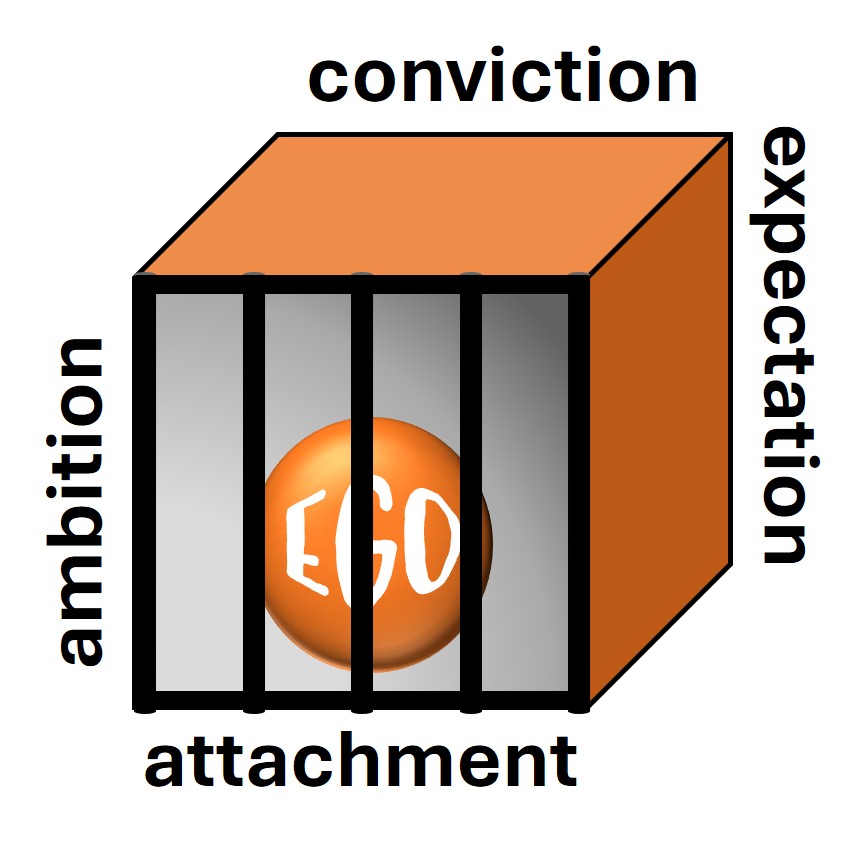
  3. The fission of craving and fear forges a rigid and inflexible (i.e., absolutist) conviction to defend us against Reality >>
  4. Conviction produces the expectation that things go the way we need them to, or in a way we can predict, prepare for, and control.

There you have it: 1-2-3-4. The four walls to the cage we find ourselves inside.

Because the steps into our miserable condition are mapped directly onto the path of healthy progress toward a centered identity, ego strength, and our own creative authority, it’s common to think that ego is the problem.

The “solutions” to this supposed problem of ego have been of two main types: either (1) deliver the ego from its cage by some feat of salvation, or (2) extinguish the ego and call it all an illusion. Admittedly oversimplified, these are the Occidental (western) and Oriental (eastern) programs, respectively.

A deeper and more ancient tradition of spiritual wisdom, serving originally as the wellspring of both of these alternative visions, is known as the Perennial Philosophy or Sophia Perennis. This wisdom tradition endorses neither the deliverance nor extinguishment models, but instead invites us to merely wake up and see the cage we are in.

Bring the light of conscious awareness to each of its four walls to understand the cage and how we got here – and voila! we are free.

What ‘pacifiers’ are we clutching for security? Throughout our lives, these will range from baby binkies, blankets, and teddy bears, to trophies, certificates, diplomas, and professional titles. Hold each one in thought and say to it directly, “Once upon a time, I gave you the power to make me feel secure and happy. But you can’t do this for me, so now I am taking back my power.”

Almost instantly we can feel a shift in our ambition. As we lift each pacifier into the discriminating light of awareness and consciously take back our power, the craving subsides along with the anxiety that had been energizing our worry, second thoughts, and self-doubt. It is as if our will has been unshackled from the floor.

Without the neurotic drives of craving and fear forging our judgments concerning what’s real, what matters, and who is right (“Me!”), our mind is no longer a captive (or convict) of our beliefs. Now, instead of conviction, our mind is free to open out in curiosity to the Reality that our judgments had closed out for so long.

And then what?

Whatever happens next doesn’t have to meet our expectations for us to respond creatively to the opportunities before us. Another benefit, since disappointment is inversely proportionate to the expectations we place on Reality (others, the world around us, and life itself), holding fewer expectations – which is importantly different from merely lowering our expectations – allows us to behold and fully honor whatever shows up.

When we wake up and truly understand our suffering, the cage simply vanishes and we are free.

E Uno, Plures. E Pluribus Unum.

When Benjamin Franklin, John Adams, and Thomas Jefferson agreed on the phrase “Out of many, one” (in Latin e pluribus unum) for the Great Seal of the United States, their idea was of the new nation as a manifold unity of individuals. America’s diversity would be the secret to its success – particularly as that diversity is harnessed in a synergy of shared values, reciprocal commitments, mutual responsibilities, and common aspirations.

The “One out of many” refers to a higher wholeness that doesn’t merely absorb and neutralize their differences, but instead lifts them into a complex of relationships where each is affirmed, embraced, and included in the whole. In this way, the American nation would be a political fulfillment analogous to planet Earth and its diversified web of life. Their vision was not just interpersonal (between persons), but transpersonal (beyond the person).

Ever since then, “e pluribus unum” is displayed on the Great Seal – though very rarely, and only on much smaller scales, has it been actualized in the broader American experience.

It seems that the more diverse our American population becomes, the larger and more unwieldy the project grows of making these many into one. “Intersectional identity” rights seem to be pushing us apart, as every factor of distinction demands special recognition and protection. It’s become less about what we might have in common than what makes us different, dividing us further into majority and minority classes that can’t understand each other and couldn’t care less.

A solution to this drift toward chaos that is typically offered by a majority group involves simply imposing a standard on everyone and then instituting some type of “affirmative action” that requires a more balanced representation. The composition of a company workforce, a voting district, or a political administration should resemble the population it serves. By enforcing diversity at the table, it is hoped that the unity we long for will happen on its own.

But it hasn’t happened on its own. The higher wholeness of unum (unity) isn’t merely a matter of adding up differences into a sum that reflects everyone.

What’s missing? The way to genuine community is neither through desegregation, affirmative action, a simple majority vote – nor, going in the opposite direction, will it come about through erasing our differences or defining minorities out of existence.

Ours is a distinctively “western” challenge. The ancient Greeks were the first to conceive of the individual as an “atomic” unit, a basic element that cannot be split or further reduced. The way forward for them would lay in figuring out how these atoms of individuals can cooperate as an assembly of irreducible quanta, which became a driving principle informing Greek science and the Athenian experiment in democracy.

If the individual thing (atom, element, object or person) is foundational, then every truth and all possibilities will be arithmetical – adding, subtracting, multiplying, and dividing whatever is there to be counted.


Looking farther to the East, we find another principle at work, one informing an alternative cosmology, politics, medicine, and morality to what found favor in the West. The many individuals – in Chinese philosophy, the “ten thousand things” – are not regarded as atoms in the void, to be combined and assembled in various configurations. Instead, each existing thing (atom, element, object or person) is a manifestation of deeper oneness.

Eastern philosophy doesn’t start with the solitary, irreducible unit of individual existence. Instead – or perhaps we should say, more essentially – it looks into the individual to the grounding mystery of Being. This Ground is not reached by splitting things into pieces, and then these pieces into even more basic components, until some fundamental bedrock reality is reached.

The grounding mystery of deeper oneness is the undifferentiated, unmanifested Nothingness (no-thingness) out of which all things arise and in which they have their being.

Could this insight from the East help us in the West break through our “arithmetical impasse” – the barrier to higher wholeness reinforced by our effort to make harmony by merely adding more parts or changing their arrangement? What wisdom do we find here?

As we gaze across the astonishing diversity of our American population – generations, races, sexes, genders, classes, creeds, abilities and needs – any pursuit of a more perfect union (e pluribus unum) must begin by meditating deeper into the grounding mystery within. As our contemplation descends in this direction, that multitude of distinctions comes to resolve with the insight of our essential humanity – not our common humanity, but in the existential mystery of human be-ing (Greek esse).

Each of us is grounded in this mystery, which is not merely beneath our differences but shines out of the deeper oneness of what we are.

E uno, plures: Out of one, many.

This larger, dialogical (East-West), vision considers the “many” on a horizontal plane, with the “one” of higher wholeness all around and including the many, like the expansive sky above, and the “one” of deeper oneness within the many, as the unfathomed ocean lies beneath and takes form in the myriad waves at its surface.

The unum above is holistic, universal, and inclusive. The uno below is nondual, essential, and absolute. E pluribus unum is the dynamic complexity of togetherness (i.e., community), while e uno, plures beholds the grounding mystery in the unqualified depths of solitude.

Our western fascination with the individual, along with our liberty to exist just as we are, has generated a socio-political landscape where merely getting along, much less working together in service to communal wellbeing, is a fast-fading dream.

Our only way forward, in hopes of fulfilling that dream, invites us to live with greater awareness of the deep mystery within ourselves, and of our existence as fellow humans and sentient beings on this planet, rolling through brief cycles of time upon an eternal sea of Being.

Mything Pieces

According to its etymology, religion refers to the process and cultural enterprise of putting together, linking back (Latin religare), or re-membering our wholeness as human beings. In reality, we never lost this centered integrity. And even now, despite our common – arguably universal – affliction of feeling off-center, dismembered, estranged, and alienated from our original nature, we are whole; not already, but still.

Nevertheless, this affliction of feeling alienated from what we essentially are – what is also known as suffering (dukkha in Pali, chatá in Hebrew, hamartia in ancient Greek) – is basic to the human condition.

While some errant traditions of religion reconceived it on the goal of delivering the afflicted personality out of the conditions of suffering, the longstanding mandate of what might be called “true religion” has always been to provide support, guidance, solidarity, and inspiration for the Human Journey through life.

Religion’s primary medium and technology for assisting in this Way is story, and a special kind of story known as myth. Over the long history of every human culture, mythology refers to the collection of myths that account for (i.e., provide a contextual understanding and explanation of) human suffering, as they also show the Way home to wholeness – the original meaning of salvation.

Whether the characters and events of myth actually exist or ever really happened is irrelevant to its truth, which instead speaks to the power of sacred story to wake us up and set us free.

The Way home to our wholeness is this process of waking up and realizing what we are.

In this post we will explore the matrix of archetypes, themes, motifs, and insights that generate the myths we live by. If one way to think about religion is as a mythology of sacred stories by which a community or culture orients itself in Reality, we can also classify religion thematically according to the coordinated timing of its stories with the progression threshold of human development in time.

Simply put, our progress in becoming more fully human not only benefits from but requires an anthology of myths linked together (religare) in a sequence across our lifespan, generated out of the matrix in which we live and move and have our being. The more conscious and intentional we are in putting our thoughts, beliefs, actions, and aims into accord with its principles, the healthier, happier, and more harmonious our life tends to be – because we are living from the center of our wholeness as a human being.

Before we take a closer look at the matrix of myth and its principles – those archetypes, themes, motifs, and insights that shape our human journey – it’s necessary to acknowledge another force field which can attract, or better, distract our focus of intention from what we essentially are.

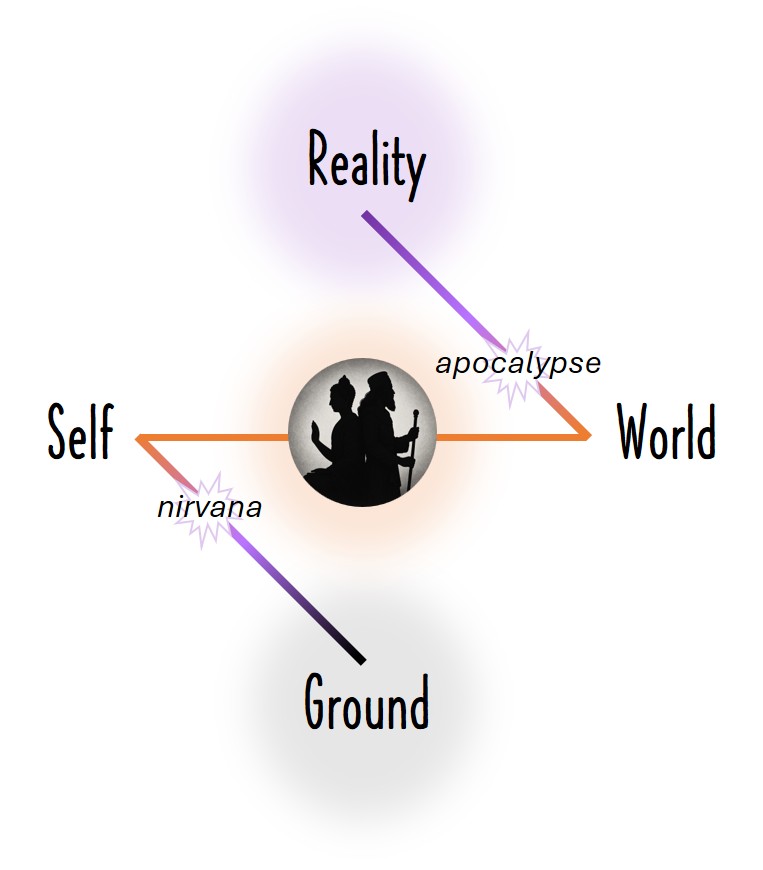
This is the World, where we as self-conscious actors manage our personal identities in a shared quest for meaning and purpose on its social performance stage.

Importantly, ‘World’ is not a reference to what we sometimes call “the real world” (or Reality), but instead – quite literally, in its stead or as a construct of imagination (an imaginarium) that encloses and separates us from Reality – serves as the multi-stage theater to our personal quest for identity, meaning, and purpose.

The very concept of person, personal, and personality is itself derived from ancient theater, where it literally referred to the character mask through which (per) an actor would speak (sona) their lines in a play.

Needless to say, our personal quest for identity, meaning, and purpose takes a lot of time and energy. Without some deeper sense of what’s really going on – of what we earlier called our Human Journey to the realization of wholeness – the World’s myriad distractions can get us tangled up in things that aren’t even real.

This is why an intentional discipline of some kind, by which the guiding principles of mythology can be consciously accessed and appropriated, is so essential to our human wellbeing and fulfillment.

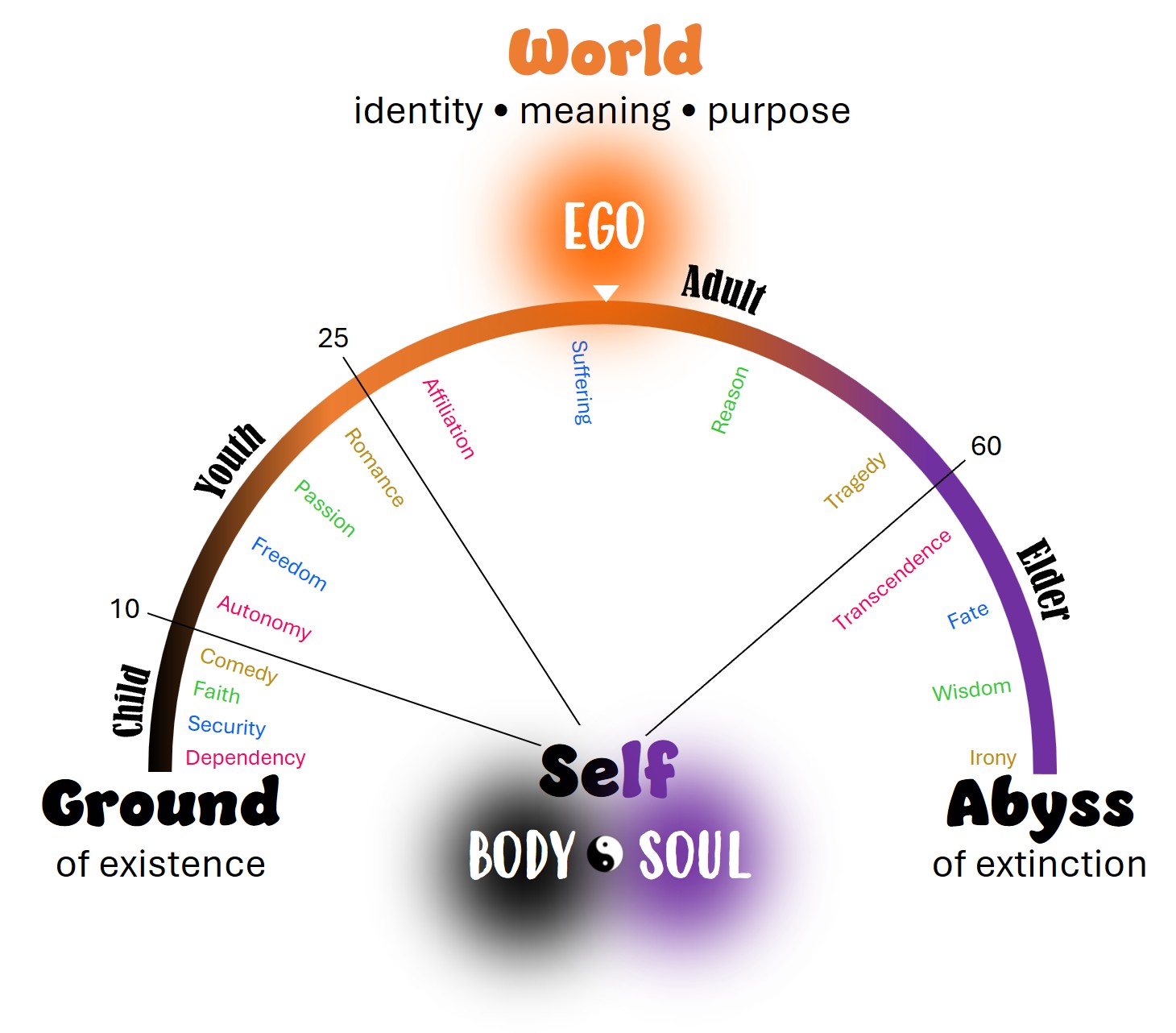
We won’t have time in this post to explore all twenty principles of the matrix in detail. It will be sufficient to gain an understanding of its organizing logic and thematic variations. What we see in the illustration above is the arc of a human lifespan, extending over time through a gradient of colors ranging from black (body-centered) to orange (ego-centered) to purple (soul-centered). Its continuum of consciousness (body-ego-soul) is further divided into four ages, represented in the mythic archetypes of the Child (birth to age 10), Youth (age 10 to 25), Adult (age 25 to 60), and Elder (age 60 to death).

In world mythology, a character’s age in life (Child, Youth, Adult, or Elder) is the clue to what possibilities of human nature are being represented and explored.

Each Age of Life is a “mything piece” of the Whole Story, and the logical structure of each piece plays out consistently across the entire lifespan. In the illustration, the structural elements are also color-coded to help us appreciate this consistency and how the mythology of all four mything pieces unfolds through their distinct “chapters.”

The way to read the elements is across the arc starting upward from the bottom-left with a group associated with the Child archetype. Thus in childhood we are in a state of dependency, oriented by our need for security, nurtured (hopefully) in an attitude of faith or trusting release, and find our most relevant truth in the literary genre of comedy – in the up-swing of “happily ever after.”

Childhood’s gift is an inner assurance that Reality is caring, responsive, and provident.

This parental Reality is depicted mythologically in early forms of theism as Father Sky (the “heavenly father” of early Christianity) and Mother Earth.

In Youth we are moving into a state of autonomy and oriented by a need for freedom. Our predominant attitude in this Age of Life is passion, as we develop strong and enduring feelings about ourselves, other people, and the World around us. The genre of story we find most compelling is romance, featuring the heroes and heroines who follow their hearts into brave adventures of defiance, discovery, conquest, and love.

The passions of youth galvanize the ideals and stereotypes through which we will continue to view the world.

As an Adult our journey takes us beyond adolescent ambitions and into webs of affiliation, where we begin to anchor our identity to the people, places, and things that make our life meaningful. Inevitably (just as the Buddha predicted) the impermanence of all these investments and our insistence on holding onto them leads to suffering.

We no longer find the conventional prescriptions effective or satisfying, but seek instead for the reason – a deeper meaning and higher purpose – in tragedy, which is the genre of story that addresses the unavoidable eventualities of bereavement, failure, hardship, and loss.

Finally, in late life as an Elder, the matrix of myth invites us to transcendence, to “go beyond” the givens of fate while learning to live more humbly and mindfully inside its limits. The insights that arise as we slow down and learn to behold the Eternal Now in the passage of time are seeds of wisdom, by which a more holistic understanding of life may be attained. This double-vision, between what is fading at the surface and what is shining in the depths, makes irony the genre of story that speaks most directly to our experience.

Dying is not itself the conundrum, but how to live life fully in the shadow of death.

What difference would it make if we were to intentionally put these “mything pieces” of our Human Journey into a single overarching narrative? Would we worry less? Would we spend less time looking for Something That we already have, Something That is still within us because we never really lost it?

How Things Seem

Reality is our code-word for What Is. If something is, it is real or has reality. We often speak of Reality as what stands beyond, or on the other side of, our veils of meaning – of what’s on our minds or only in our imagination.

But what if there were no human minds or imaginations to hang veils in front of Reality?

Obviously, nothing would be said about It, nor could anything be known – at least as humans think we know Reality. With no humans around to sense It, perceive It, process perceptions and form opinions, theories, stories and beliefs about Reality – just imagine. No, check that.

Perhaps the most appropriate name for this ineffable something-that-is-no-thing is the Present Mystery of Reality.

We capitalize the term to remind ourselves that Reality is not this or that particular thing, or even the sum total of all particular things. With Paul Tillich we can say that Reality is the power to be (or be-ing) in all that exists. It is here and now (Present) but cannot be named or known (Mystery), except by the slanting picture language of metaphor.

Without human minds and imaginations, of course, there would be no metaphors or the experience of meaning they make possible.

Once self-conscious human persons poked their heads above the sea of sentient consciousness enveloping the earth, Reality suddenly split into two distinct realms: a realm “around me” and another “within myself” (my self).

The center of self-conscious personal identity from which these dual orientations are taken is named “I” (ego in Latin).

Whereas thousands of generations of many millions of sentient species before humans had perceived Reality via their sense receptors and nervous systems, Reality for them was not – and still isn’t – divided as it is for us, between around and within.

Such a split orientation is only possible as reflexive awareness (proto-ego) is sufficiently inflated with the possession of myself that it breaks above the surface of pure sentient consciousness to become self-conscious as me, “out here” in the middle of everything yet paradoxically feeling all alone.

Now, you might think that existing (literally “standing out”) above the sea of spontaneous sentient experience is some kind of catastrophe that shouldn’t have happened so many millenniums ago – but also a million times each day around the planet, as two-year-olds wake up to themselves as separate egos.

You wouldn’t be alone in thinking that.

A majority report among the world religions insists that our human rise into a separate center of self-conscious identity (ego) was actually a fall from (or out of) a more perfect state, and that things got worse for us after that, not better.

As a consequence of this fall from grace (aka paradise or Pure Spirit), humans are mortal, insecure, and selfish. If something isn’t done, we are going to fall even farther down – or get thrown there by a god who can’t manage, or perhaps doesn’t care enough, to save us.

Interestingly, this religious diagnosis of the human condition – minus the offended and exasperated deity at the end of the story – is in essential agreement with our earlier account. Whether our separation into self-conscious identity is the outcome of an emergent rise from something deeper or a disintegrative fall from something higher, both metaphorical accounts can be true.

Before the religions invented heaven and hell, and then later flipped things to the horizontal timeline, a vertical fall-into-separation was how the ancient tradition of Sophia Perennis depicted the human condition.

At the beginning of the First Axial Age (800-200 BCE), a new paradigm of emergence from below started rippling across the higher cultures of East and West. Its more ‘organic’ model would serve in the West as the theoretical foundation of the Life sciences and their eventual consilience in a unified theory of evolution.

For this reason, it is easier for modern Western scientific minds to envision the separation into self-conscious identity as a rise rather than a fall. Still, there are many modern Western religious minds who prefer the Fall metaphor – although for them it’s not metaphorical but an historical event that occurred around six thousand years ago, according to their literal reading of the Bible.

Let’s not get hung up in the difference. Remember, the Present Mystery of Reality is unqualified, ineffable, and meaning-less – until human minds and imaginations begin draping their veils of meaning over it.

To help you appreciate how the two accounts (fall and rise) are really complementary perspectives taken from the vantage point of your self-conscious ego, I will ask you to get centered in your own personal identity. Acknowledge when you have reached the place from whence you can look “around me” as well as (but not simultaneously) “within myself.”

This place is named “I” (ego), and your entire quality world turns on it.

Notice I didn’t say that Reality turns on your ego. That’s a privileged position reserved for the superego of religion’s god, which, as you have probably already figured out, is an important character embroidered on its sacred veils of meaning.

From this location of ego, everything around you appears as a multiplicity of random, disconnected things. Because you are looking out through space, each particular object or cluster of objects seems to be contained in a vacuum and set apart from other objects. The space between things is, in its own way, a kind of evidence that each thing is separate from everything else.

What you don’t realize is that the separation evident all around you is really an effect and function of the fact that your “I” (ego) had to withdraw to its own unique and separate center in order to exist (stand out). You see things as separate because you, in your ego, have separated yourself from it all.

In Reality, all things are connected in a harmony of higher wholeness, as a system of reciprocal interdependent relationships. You also are included and fully belong to this All-that-is-One.

Now turn your attention to the complementary orientation and look “within myself.” This move may be more challenging than the one of going out and beyond (i.e., transcending) your ego to the inclusive wholeness of Reality. Instead of an experience of being united with everything “around me,” this second path requires consciousness to release and drop away from the outpost of your ego, deeper “within myself” where “I” cannot go.

Here the experience is a communion of deeper oneness, sinking and dissolving into the Source of your existence, what Sophia Perennis names the Ground of Being. Deepest within, Reality is Nothingness (no-thing-ness) and you are Nowhere (now-here). In following the descending roots from mind into body, and from body into soul, awareness finally arrives at the terminus – and simply lets go.

Sophia Perennis 3.0

As an infant and very young child, you were an animist. Experience was centered in your Body – technically the BodySoul, referring to your essential nature as a human (Body) being (Soul), although at that time the intuitive and introspective powers of your Soul were operating below the range of conscious attention.

BodySoul is the complementarity of consciousness – the ‘Tao’ of your essential nature – with an extraverted and outreaching (more life!) principle of ‘Yang’ in communion with an introverted and inreaching (deeper ground) principle of ‘Yin’.

By two years of age you were on your way to becoming a theist, learning the language of your tribe and finding your place on the social performance stage. Experience now re-centered in your emerging Ego, referring to the self-conscious actor (ego: “I”) who experiments with identity by pretending to be somebody in a variety of roles.

These personas (a term taken from ancient theater for the character masks through which an actor would speak their part) adapted you to the interactive environments of your family and fantasy life. Theism is a type of religion that is socially situated and oriented on the special authority of higher powers – analogs of the taller powers (i.e., parents and other adults) who managed and supervised your theater of identity during childhood.

The religion of theism at the sociocultural level follows the same developmental progression as it did for you growing up. Its initial orientation (early theism) is on god’s authority and will, where devotees are expected to obey, follow the rules, and do what’s right. Theism constructs and clarifies its concept of god using the media of stories (mythology), images (iconography), and ideas (theology).

As constructs of the human mythopoetic imagination, the gods of theism are metaphors of provident authority and personifications of higher power, fashioned on the archetypes of your mother and father in childhood.

You didn’t remain in that posture of obedient dependency, however. As you continued to develop, the relationship to your taller powers also evolved. It’s not that their will and authority no longer mattered, but something else started to shine through – at least we can hope it did, to some degree.

This something else is what we call virtue, referring to their charisma as role models or exemplars of goodness, generosity, integrity, compassion, understanding, and wisdom – to list just a few of the higher character virtues attributed to the gods of theism.

Indeed, these six virtues in particular serve as leading indicators along the arc of human higher evolution. Societies in which theistic religion clarifies these six virtues in its representation of god tend to be far healthier, happier, and more resilient than those with religions that don’t.

This shift or expansion from an early focus on god’s authoritative will to a developing appreciation of god’s virtuous character, marks the progress to high theism where the dedicated effort of a devotee – just as it was for you in middle childhood – advances from a motive to please, placate, flatter and impress the powers-that-be, to an attitude of admiration and worship.

Instead of standing above them in the position of authority, gods of high theism grace the sanctuaries, shrines, and altars of worship, standing before their devotees, inviting praise and veneration of the virtues they personify.

It should be emphasized that high theism has not eclipsed the more Body-centered concerns of animism and early theism – the need of the child/devotee to feel safe, to be seen, and to belong. These needs remain, but they are now, with this shift to more Ego-centered concerns, taking a secondary position to the “higher calling” of becoming – and garnering respect as – a certain kind of person.

In worshipping a god of love, love itself is glorified. What is lifted up before the devotee gradually becomes an aspiration, a fervent desire to be like god.

What happens, psychodynamically speaking, when a virtue such as love, which is perfectly personified in the deity, is glorified in worshipful admiration, to such a point of ardent focus and aspiration where the devotee longs to be like god and love as god loves? The answer, in the context of religion, is that theism – the type of religion oriented on god – begins its final forward shift in development and enters the phase of late theism.

Looking back on your own late childhood and early adolescence, can you recall a time (or period of time) when the virtues you admired in your taller powers started to take root mysteriously inside you as well? It wasn’t just that you were perfectly imitating their example, but rather those very seed-qualities were beginning to awaken in you.

Those virtues – the six we are holding in mind: goodness, generosity, integrity, compassion, understanding, and wisdom – are transpersonal, which is to say they lie at a depth beneath your personality and reach farther beyond your individual ambitions, anxieties, and prejudices.

In late theism, the center of experience and concern “drops” from the Ego to the Soul – technically the BodySoul, though now, in contrast with animism (or pre-theism), the intuitive and introspective powers of the Soul have at last become conscious. Theists of this late phase find it more relevant and meaningful to speak of god less as above them (an authority to obey) or before them (an exemplar to worship) than within themselves, as a presence to be realized (i.e., made real or manifested) in their daily lives in the world.

Are we stepping toward atheism here, or have we inadvertently stumbled into the sinkhole of humanism? Is the end of our path a life without religion and devoid of spirituality?

No. In fact, atheism only makes sense as theism insists on the literal and objective existence of its mythopoetic construct (god). Such a stance already indicates a loss of metaphorical imagination and spiritual freedom. And a chauvinistic humanism, where only human values and interests are respected, is itself a symptom of alienation from the ground of being within us and from the web of life around us.

Late theism and its spirituality of “god within” very naturally spreads its wings into post-theism, where the realized virtues of goodness, generosity, integrity, compassion, understanding, and wisdom conspire to create the provident environments that will support and nurture the faith of those coming up behind you.

In finally breaking through to the liberated life, you help make it more likely that others will one day find their way here as well.

True Story

On one side are believers, who read the story of Jesus’ incarnation, crucifixion, and resurrection as an account of revealed journalism. Everything in the narrative happened just as described, to the exact detail.

How not? It’s the Bible, after all.

On the other side are atheists and the general population of nonbelievers, including devotees of other religions with their own stories and scriptures. The story of Jesus might be interesting and even inspiring to some extent, but that’s all it is.

What if the story of Jesus – specifically that three-part structure of incarnation (entering the human world by way of a virgin birth), crucifixion (giving up his life and dying on a cross), and resurrection (raised to new life and higher freedom) – isn’t an historical account or ‘just a story’?

What other choice is there? It either happened or it didn’t, right?

What if the story of Jesus didn’t originate with an itinerant teacher in the Galilee region of first-century Palestine? Not that it took its facts from some other historical figure, maybe in another part of the world, but that its truth is not about facts we can measure and record.

Could it be that the tripartite story of Jesus has had such magnetic power over people down through history and all around the world because it taps into something deeper than historical facts?

Fair warning to my reader:

We are stepping into the mythic realm here, where stories reveal and activate something essential in the human being, something archetypal and potentially transformative.

Rather than treat the story of Jesus as an analogy of things metaphysical, long ago, or far away, I will draw associations to the universal path of human development and our archetypal quest for the liberated life.

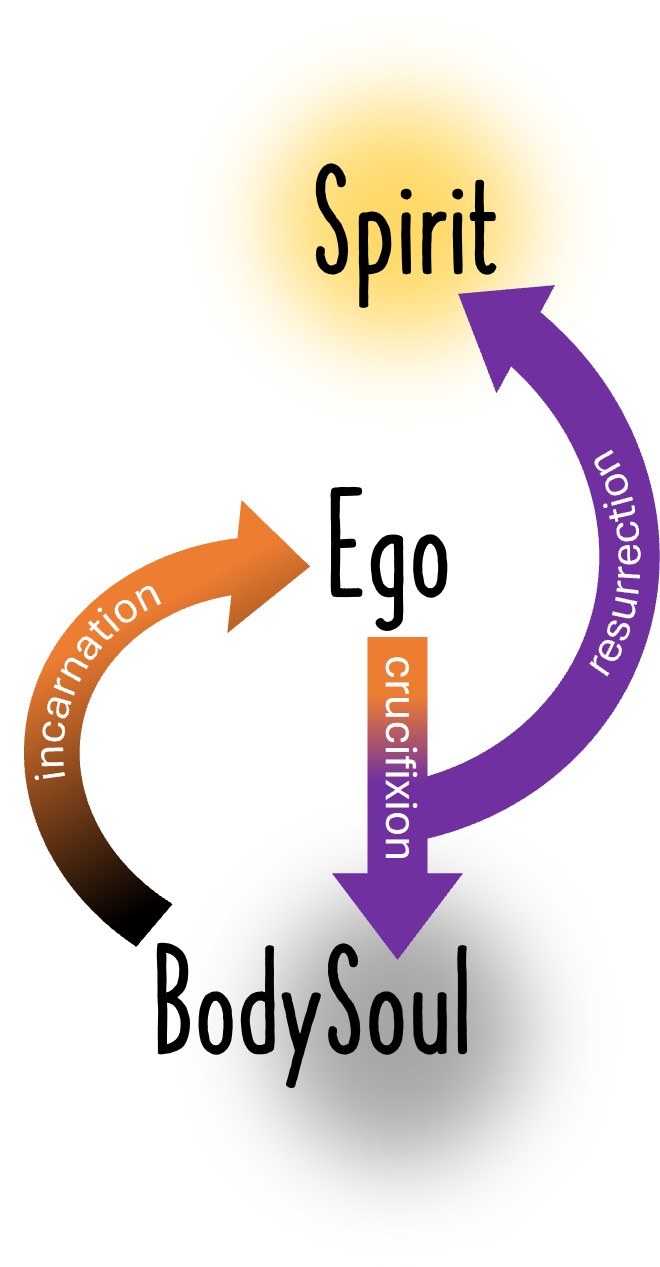
An archetype is a “first form” or generative pattern that drives and shapes our individual formation according to its exemplar. In this case, I am suggesting that we take the tripartite structure of Jesus’ story (incarnation | crucifixion | resurrection) as archetypal of our own human journey and potential transformation.

In the illustration above, the major aspects and dimensions of human consciousness are labeled. Starting at the bottom (in what the wisdom traditions name the Ground) we see the complementary dynamics of Body and Soul, written as “BodySoul” to remind us that our conventional way of dividing human nature into a body and a soul is historically late and a corruption of the originary insight.

BodySoul is the grounding mystery of our nature as human manifestations of being – as human beings. In us, consciousness is turned outward through Body to the larger web of life and, complementarily, inward through Soul to the deeper ground of being. It is from (or out of) our essential nature as BodySoul that each of us eventually takes our place in the world, as an Ego (Latin for “I”) playing roles on the social performance stage.

It’s important to understand that the modicum of consciousness channeled into the roles and tasks of managing a self-conscious personal identity neither originates with nor belongs to our Ego. It must draw current from the BodySoul in order to manage a meager circuit of its own, which it does by rehearsing the various scripts of identity that tell the story of “Who I am.”

In the archetypal language of myth, self-consciousness (Ego) is “born of a virgin,” which is to say it is not the product of two but a differentiation of One, of the prima materia or “First Mother” of BodySoul. The Christian concept of incarnation is very intentionally representing Jesus/Ego as arriving in the world by a kind of vertical entry rather than through the temporal chain of sexual reproduction.

We know from science that while the genetic traits of temperament are passed along from one generation to the next, Ego identity is not inherited but assumed (or “incarnated”) by the individual personality in the process of socialization.

The adventures of becoming somebody (i.e., an ego-centered identity) are infinitely amusing, but it can also be incredibly exhausting. Human beings didn’t evolve with the ultimate aim of personating roles and playacting on the social performance stage – notwithstanding the benefits of membership, recognition, and celebrity that might lock in our character and make us feel we have “made it.”

According to the worldwide spiritual wisdom traditions collectively known as Sophia Perennis, our true and higher aim is to become fully human, just as every other living species grows and develops toward its epigenetic Ideal of maturity and fulfillment (Aristotle’s entelechy).

Human consciousness – or we might better say, the evolution of consciousness in our human species – will not find fulfillment or be satisfied managing an identity on the social stage. No matter how lofty the role and how meaningful it makes our life seem, personal identity is still only somebody we are pretending to be.

There comes a time when something inside us turns our aspiration in a different direction: not out to the world, but inward to the grounding mystery of being.

As it plays out in the story of Jesus and is interpreted archetypally, crucifixion represents the surrender (as sacrifice, an act of devotion) of Ego to the BodySoul, of the personality to spirituality. In Christian terms, it is the historical Jesus dying into the eternal Christ. Medieval paintings (Pietàs) of the dead Jesus cradled in the arms of his mother Mary, still miraculously a virgin, poignantly render this deeper mythic meaning.

When consciousness is released from the roles, attachments, and distractions of managing a personal identity, it descends to awaken in the BodySoul. As the apostle Paul reflects in his letter to the churches in Galatia, “I have been crucified with Christ and I [ego] no longer live, but Christ lives in me.” Such an awakened present awareness is only possible to this degree after we have “died” to (i.e., detached and released from) the persona of our identity in the world.

In the gospel stories, Jesus speaks of the necessity for a seed to “die” so that the vegetal lifeforce of the plant can be unbound.

Likewise, it is necessary for the one who seeks authentic life to loosen their self-definition in order that the deeper truth of what they are can be set free.

“On the third day,” which is to say, after the surrender of Ego is complete, the newly activated spiritual intelligence rises with a fresh, expansive freedom. Resurrection, rising or being raised up, tracks the path of transformation from the BodySoul to Spirit. Whereas BodySoul is the grounding mystery of our being in deeper oneness, Spirit (from word origins meaning breath or wind) is dynamic, free-range, and communal, lifting awareness into the experience of higher wholeness and genuine community.

So you see, the story of Jesus is really about you. It’s your choice whether it comes true.

Necessary Delusion

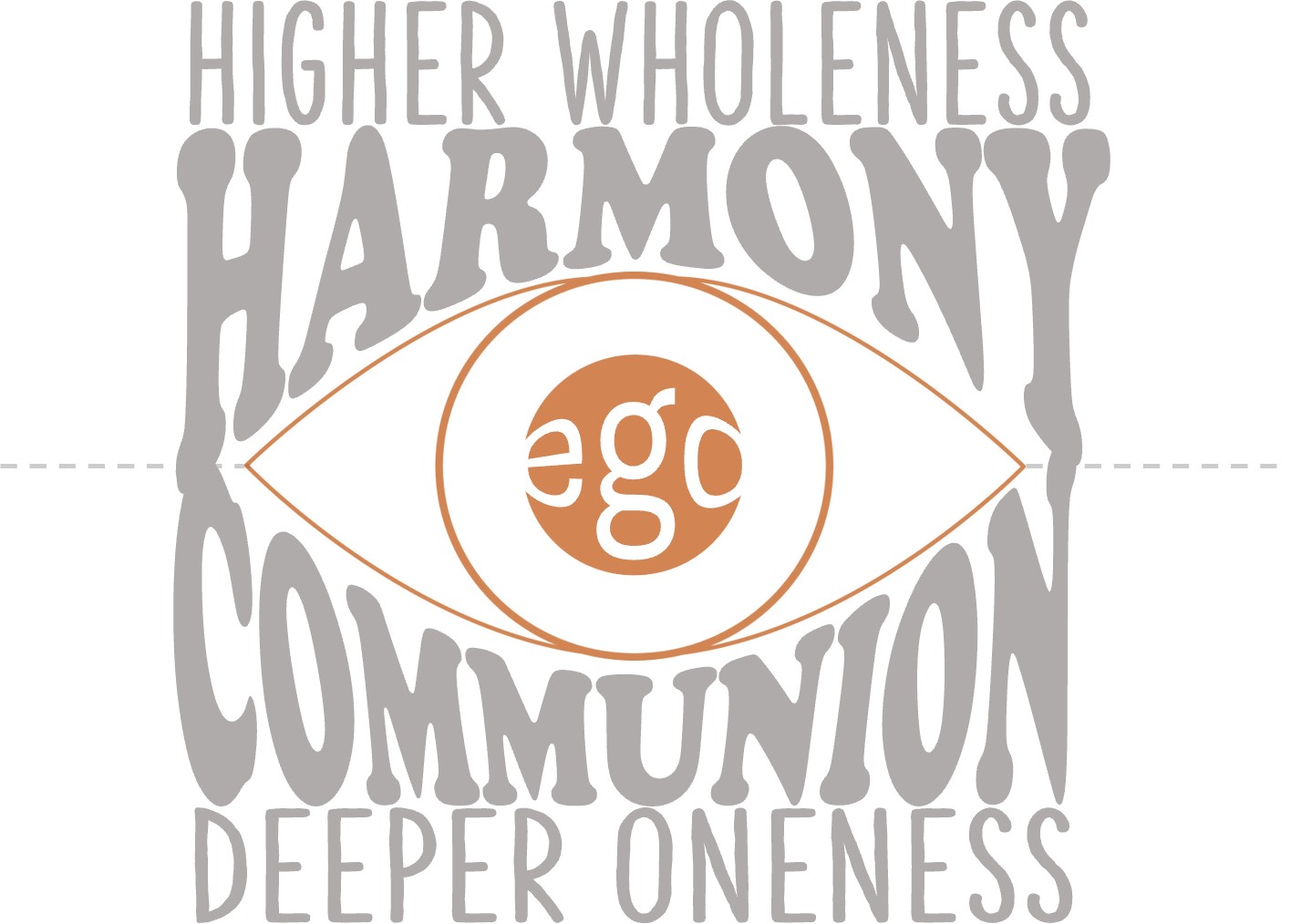
Check this out. Everything around you includes you in its higher wholeness, and what is within you grounds you in deeper oneness. Harmony and communion are the special terms designating these distinct dimensions of Reality – around and including you, within and grounding you.

The concept of harmony requires you to be centered in yourself. It’s from your center that you can connect and interact with other centered beings. Just as the harmony of an orchestra is only possible as each individual instrument contributes its own sound to the symphony, harmony as a concept of wisdom spirituality acknowledges the critical importance of being yourself as you participate in the higher wholeness that includes you.

Communion is a deep-within concept rather than an all-around one. The com- (with) still centers you in yourself, but the -union is where distinctions begin to dissolve away. To speak of it in terms of oneness instead of wholeness is to put the accent on a more essential Reality, like that of an ocean beneath the waves, rising into their myriad forms and receiving them back again.

In wisdom spirituality, communion refers not to your relationship with something else (another “wave”) but rather to the “ocean” of Being that rises into the person you are – material, organic, sentient, self-conscious (egoic) – and receives you back again in each moment of your existence.

So if you are included in higher wholeness and grounded in deeper oneness, why are the experiences of harmony and communion so vanishingly rare and seemingly impossible to sustain?

The answer is not that there is something wrong with you, or even that you are all that unusual. If we should pin the reason on the psychological fact of your ego-centered identity, we need to be careful not to make ego into an enemy. Neither good nor bad in itself, your ego is a necessary achievement in your development as a person with freedom and agency.

Working to suppress the ego, to hogtie or otherwise limit its critical function of centering and managing your personality and behavior, ends up pushing normal development into disorders of various kinds.

If you occasionally (or frequently, even chronically) feel separated from the harmony and communion of Reality, what you need is not deliverance but understanding. Indeed, a major theme in wisdom spirituality is focused on seeing – really seeing, with insight – the truth of your situation; taking your view from the position of “standing under” it.

The illustration above plays on the sound-alike phonemes “eye” and “I” (ego) in order to bring this truth into focus. The open eye inserts a division in Reality between above and below, which translates for the self-conscious ego into what’s “around me” and what’s “within myself.” It should be obvious that without the eye/”I”, these distinctions wouldn’t exist and there would only be What Is – with no angle of perspective or context of vision.

The split in Reality between “around me” and “within myself” is actually a delusion of your self-conscious ego. Remove that eye/”I” from the field, and the distinctions of around and within immediately disappear. Without a separate center of self-conscious personal identity (ego), there is no “me” from which point everything not-me can be regarded as surrounding (and including) “me.” Just as obvious, without an “I” to take in the subjective line of view, consciousness is without a position from which it might contemplate the grounding mystery within (manifesting as) “my self.”

It is given this dual vision of your ego – out and around to the harmony of higher wholeness, down and within to the communion of deeper oneness – that we are justified in calling it a “necessary delusion.”

The worldwide spiritual wisdom traditions collectively known as Sophia Perennis or the Perennial Philosophy have long maintained that your separate center of self-conscious personal identity is a critical stage in the fuller journey of human evolution. If ego’s developmental achievement has introduced the risk – or rather, the likelihood – of humans experiencing insecurity, alienation, loneliness, and estrangement, the remedy of what the religions call “salvation” will not come about by ego-annihilation or supernatural rescue.

Only as the delusion of your separateness is understood, and then used as a platform from which consciousness can drop-and-dive into deeper oneness, or leap-and-fly into higher wholeness, is your true healing (salvus) even possible. It’s neither in deliverance nor renunciation that human fulfillment and the liberated life are to be found, but only as your ego is sufficiently fit to facilitate the inward drop and outward leap of consciousness.

The power of delusion is ended in the very moment of understanding.

This dual vision and strategy in the practice of spirituality form the major plotline (Greek mythos) of Sophia Perennis. Its wisdom and guidance have helped many millions of people around the world just like you, and over many centuries.

The truth of its teaching is nothing esoteric, if by that we are referring to the secret knowledge of an elite illuminati dressed in robes and chanting liturgies by the glow of candlelight. But neither is it summed up and cataloged in the orthodoxies of popular religion, where right belief is sold (quite literally) as the ticket to heaven.

There is no need to join a religion or believe in a god. The purpose and goal of spirituality, if it can even be said to have a purpose and goal, is to fully awaken to the magnificent mystery of being alive.


With a deep refreshing inhale, gather your focus to a self-conscious center – but don’t grab on. Feel the lifeforce rise in your body; let your senses touch the infinite horizon of all things. From your center of “I,” exhale and let awareness drop away, sliding gently into the communion of deeper oneness.

Down here in the grounding mystery of Being, the surface distinctions of your identity have completely dissolved away and there is only This.

Words lose their definition, thoughts unwind, and “the thinker” is perfectly still.

Take in another slow, deep breath. Now place your intention in the toe-hold of the present moment and let awareness rise up, out, and beyond the “I,” as if on wings, into the harmony of higher wholeness. Up here in the universal order of beings, you are included and belong – not for who you are or what you bring, but just because that is the Way (Tao in Chinese).

How about that? The long journey to becoming somebody special, with all its twists, turns, and setbacks, has harbored the inner aim of helping you eventually get over yourself.

Are you ready?

Spiritual Fitness and Our Human Future

Just as we might go to a gym to work out, or into the hills for a hike, we have a basic understanding that improving our fitness requires immersing ourselves in environments where the activity is sufficiently strenuous but not too much to manage.

Of course, if we never exercise, our muscles will lose tone and start to atrophy. Nature’s law is Use it or lose it.

The same principle holds true for our emotional, volitional, rational, and spiritual fitness as well. If we don’t “exercise” these faculties of human intelligence, they will become weaker to the point where they are not only ineffective but also begin to undermine or interfere with the others.

In this post, we will consider some of the consequences of an underdeveloped or atrophied spiritual intelligence. The “fitness environment” for our spiritual formation is called religion, whose word origin is in the metaphor of “linking together,” where we can almost see the cables and pulleys of gym equipment.

My returning reader knows that by religion I’m not necessarily or exclusively thinking about the familiar brand names and their numerous sects or denominations.

Essentially, religion refers to the system of stories, symbols, routines, practices and beliefs that ‘link’ our self-conscious experience to the ground within us, to our community and its history, to Nature and the web of life, and to the cosmic context of our Universe. However we manage the “cables and pulleys” of our life in time as human beings is our religion.

The familiar (name brand as well as off brand) religious features of deities, sanctuaries, liturgies, holy days, scriptures and orthodoxies are secondary components to what religion is in essence.

Without some kind of religion – informal or institutional – our spiritual intelligence cannot develop and function optimally.

A major challenge facing humanity today is a consequence of religion’s decline in the modern and postmodern eras. This has much to do with the inability – more frequently, the willful resistance – in the various traditions of theism to remain relevant to the context and concerns of contemporary life.

When theologians insist on the literal truth of their myths and the objective-factual existence of their god, intellectually attuned church members and citizens of the global scientific milieu just cannot pretend it’s for real.

More are choosing to leave and fewer are deciding to join.

One of the primary interests of post-theistic religion is in cultivating a spirituality that is relevant – but also vibrant, creative, relational, practical and morally responsible. The emerging post-theistic cultural landscape might still feature denominational churches, seminary campuses, and centers of outreach.

But the mindset of dogmatic belief and the missionary atmosphere of “saving lost souls” for heaven will be a vanishing exception instead of the rule.

Instead of doing away and living without religion, humanity’s future will depend on how intentional we are in linking our lives to those four dimensions identified earlier: to the ground of being within, to other persons in community, to the web of life on Earth, and to the Universe itself. At the moment, the recession of organized religion is leaving more and more of us without a proper “fitness environment” to exercise our spiritual intelligence.

For some context to help us better appreciate what’s at stake and what we can do about it, my diagram illustrates the model of human intelligence I have been developing in this blog on creative change. Named our Quadratic Intelligence for the four distinct faculties, centers, and threads of intelligence that together comprise its “braid,” my model offers a way to appreciate them as a system working together.

In this post we will give the rest of our time to understanding the virtues and benefits of a well-developed spiritual intelligence, as we also consider some evidence of its current neglect and atrophy. The distinctive contributions to the quadratic system of our visceral-volitional intelligence (VQ1 Body and VQ2 Will), our emotional intelligence (EQ Heart), and our rational intelligence (RQ Mind) are explored in more detail elsewhere in this blog.

In the middle my diagram is the center of our self-conscious identity, or Ego, whose very existence (existere = to stand out) entails a separation from the Body and its present reality – a cause of deep insecurity and neurotic suffering.

This is the very separation, by the way, that religion evolved to address and overcome with its system of “cables and pulleys” (religare = link together).

Our spiritual intelligence is conducted by a faculty along a thread uniting two poles or centers: SQ1 Soul and SQ2 Spirit. As suggested in the illustration, our spiritual intelligence serves the healthy functioning of faculties in closer proximity to the Ego (centering our human needs for presence, connection, meaning, and purpose). It does this by grounding us in deeper oneness or communion (SQ1 Soul), as it simultaneously elevates our sense of belonging to a higher wholeness or harmony (SQ2 Spirit).

Whereas those more ego-proximate needs are felt as “mine” and “part of who I am,” the effect of grounding is to dissolve the Ego while belonging transcends it. In healthy spirituality and personal development, the well-practiced routines of grounding serve to cultivate faith, fortitude, equanimity, and inner peace. At the other end of the spiritual intelligence continuum, our amplified sense of belonging activates gratitude, wonder, generosity, and joy.

Place those virtues and benefits of spiritual fitness – faith, fortitude, equanimity, peace, gratitude, wonder, generosity and joy – alongside what we see across our human situation today, and the consequences of being spiritually out of shape are immediately evident.

  • Not faith but anxiety
  • Not fortitude but fragility
  • Not equanimity but agitation
  • Not peace but discontent
  • Not gratitude but entitlement
  • Not wonder but conviction
  • Not generosity but greed
  • Not joy but depression

This list of spiritual maladies ranges from anxiety to depression – the very bipolar macrostructure of mental disorders that seem to be multiplying every year.

The worldwide spiritual wisdom traditions known collectively as the Perennial Philosophy or Sophia Perennis caution us against merely treating symptoms, or trying to fix a weakness in one faculty of intelligence by building up the others. We might try to think (RQ) our way through an emotional tangle (EQ), for instance, or make a goal (VQ2) to be present (VQ1). The result of our effort is predictably more pain, more dysfunction, and more suffering.

Our spiritual intelligence holds the promise of a more authentic, abundant, and liberated life.

It’s time to get to the gym.

Four-Square Spirituality

Ego sucks.

I don’t mean that as a judgment, but as a simple statement of fact. I happen to believe that our separate center of self-conscious identity – ego (Latin for “I”) for short – represents a transformational breakthrough in the evolution of human consciousness, and we need it to get around in the world.

However, its breakthrough comes at a cost, which is that for ego to even exist (also from the Latin ex=sistere meaning to “stand out”), it must siphon its share of energy from the essential supply of consciousness known as the Human Spirit.

That’s why it is simply a statement of fact to say that ego sucks.

I offer the graphic above as a heuristic, or teaching tool, for helping to clarify the picture of where ego sits in relation to the Human Spirit in each of us. What I just named the “essential supply of consciousness” in humans is elsewhere in this blog explored as our quadratic intelligence.

The quadratic model itself draws together important traditions and theories of research, each tradition focusing on one of the four threads of intelligence:

  1. Visceral intelligence (VQ) – Sigmund Freud’s Id
  2. Emotional intelligence (EQ) – Daniel Goleman
  3. Rational intelligence (RQ) – cognitive psychology
  4. Spiritual intelligence (SQ) – Danah Zohar

Together, these four threads comprise the “braid” of our quadratic intelligence. Identifying this braid with the Human Spirit may seem like a bold move, given the long history in religion of equating Spirit and Soul. But in the still-deeper history of the spiritual wisdom traditions, collectively known as the Perennial Philosophy or Sophia Perennis, their distinction is paramount.

In the present post, we will opt with the wisdom traditions in regarding Spirit and Soul not as separate parts or things-in-themselves, but rather as essential distinctions in the dimensional wholeness of human consciousness.

It should make sense as we step into it, so let’s get started.


In the graphic above, each thread in the braid of our quadratic intelligence is identified with the faculty that centers and hosts its distinctive activity. Thus:

  1. Visceral intelligence (VQ) is centered in the Body which is our locus of Power
  2. Emotional intelligence (EQ) is centered in the Heart which is our locus of Love
  3. Rational intelligence (RQ) is centered in the Mind which is our locus of Truth
  4. Spiritual intelligence (SQ) is centered in the Soul which is our locus of Peace

Let’s take a moment to acknowledge the extent to which these four aspirations (as we might call them) for Power, Love, Truth, and Peace have shaped our human experience over the long millenniums of history.

Our tendency to fuse these aspirations to concrete and temporal achievements, attainments, and possessions in life is the contribution of ego, which lacks the capacity to even comprehend how aspiration might be an objectless longing of the Human Spirit.

In this post we won’t go too far into the complications introduced by ego. They are designated by four terms enclosing it in the illustration: insecurity (leads to) attachment (which forges) convictions (that in turn fuel) ambitions for the achievements, attainments, and possessions it believes will bring happiness – or at least less insecurity.

But those ambitions only generate more insecurity, sending ego round-and-round the cage in a perpetual spiral of exhausting discontent.

This characteristic of ego has caused some to conclude that our liberation from its cage will only come as ego is successfully suppressed, extinguished, or altogether eliminated from the picture. The futility of such an approach lies in the fact that any attempt to control the ego is an ambition of the ego itself, which only squeezes the frantic spiral even tighter and frequently leads to depression.

Then we go to therapy or the pharmacy to find out what “I” (ego) must do to get unstuck!

Let’s set that sucking sinkhole aside for now and focus instead on the Human Spirit and its four faculties (threads and centers) of intelligence. Back to the graphic above, we should take a little more time clarifying what we earlier named the four associated aspirations – Power, Love, Truth and Peace.

What are these experiences, and how are they related? We’ll take them briefly one at a time.

The Human Spirit’s aspiration for Power is centered in the Body. We are not talking here about power-over something or someone else, which is typically how ego regards it. Very simply, the Body’s Power is the lifeforce in its cells, tissues, and organs, focused through the urgencies of survival, the drives of instinct, and in the will to live, grow, and flourish as a living animal.

The generator of this lifeforce lies in the visceral organs of the Body, which is why the thread is identified as visceral intelligence (VQ).

Our aspiration for the experience of Love is centered in the Heart and its thread of emotional intelligence (EQ), which evolved for the purpose of giving animals the ability to respond, learn, and adapt to their environment. Love also includes interest, desire, affection, tenderness, kindness and care – all distinct frequencies of our longing for harmony, community, and wholeness.

The physical organ of our heart is where such feelings are centered.

Truth is the aspiration of the Human Spirit centered in the Mind. In the evolution of animal life, the species that developed an ability for creating mental maps, making conceptual distinctions, and using logical thought in the construction of meaning outperformed those without it.

Processing impressions and experiences of the world through a set of more or less rational beliefs allows for an abstract, generalized, and comprehensive worldview, freeing the “rational animal” from having to rely only on instinct (VQ) and situational learning (EQ).

Here, Truth is a measure of the transparency of belief.

The Greek word for Truth, aletheia, literally means to uncover or reveal, referring again to the degree in which a mental construct (or belief) in the Mind serves to focus, clarify, or amplify our knowledge of Reality. Whereas ego frequently gets locked inside our beliefs, in which case they are called convictions (convict = a captive or prisoner), the Human Spirit, as Mind, longs to see through them to the really real.

Another way of defining conviction is as a belief with no transparency, that actually blocks (or covers) our view of Reality.

The thread of spiritual intelligence (SQ) has only recently found acceptance in the scientific literature, and only after theorists were able to set aside and get past the metaphysical realism that has grown around the Soul under the stewardship of religion.

More accurately, we should regard Soul as the faculty of the Human Spirit that engages consciousness with the inner mystery of Being. It is neither inside nor separate from the Body, as many religions teach, but adds its thread to the quadratic braid, anchoring to the deeper oneness of Reality and hosting our aspiration for inner Peace.


So far, our expedition around the four faculties of the Human Spirit has been fairly schematic, defining each and moving from one to the next. What’s left now is to get a sense of how the Human Spirit flows through these distinct centers and threads of intelligence for the holistic experience properly named spirituality.

We will leave the more thorough definitions for another time, but in the space that remains let’s turn our attention once more to the graphic illustrating what I will now call “four-square spirituality.” Crossing the boundaries between our four faculties and their respective aspirations are four channels, each of which facilitates the flow of the Human Spirit’s circulatory system.

  1. The channel and spiritual practice of grounding connects and facilitates the flow between Body and Soul. In grounding, Power and Peace come together.
  2. The channel and spiritual practice of compassion connects and facilitates the flow between Soul and Heart. In compassion, Peace and Love come together.
  3. The channel and spiritual practice of understanding connects and facilitates the flow between Heart and Mind. In understanding, Love and Truth come together.
  4. The channel and spiritual practice of equanimity connects and facilitates the flow between Mind and Body. In equanimity, Truth and Power come together.

And so it flows, continually.

Spirituality is thus the committed discipline of four essential practices: grounding, compassion, understanding, and equanimity. In cultivating these practices, the Human Spirit enjoys greater and greater liberation, wellbeing, and fulfillment.

Perhaps time will grant us a future opportunity when we can explore these four practices of spirituality in more depth. At least for now, the profound difference between the neurotic spiral of ego’s religion and the holistic balance of a vibrant and active spirituality should be plainly evident.

Stay tuned.