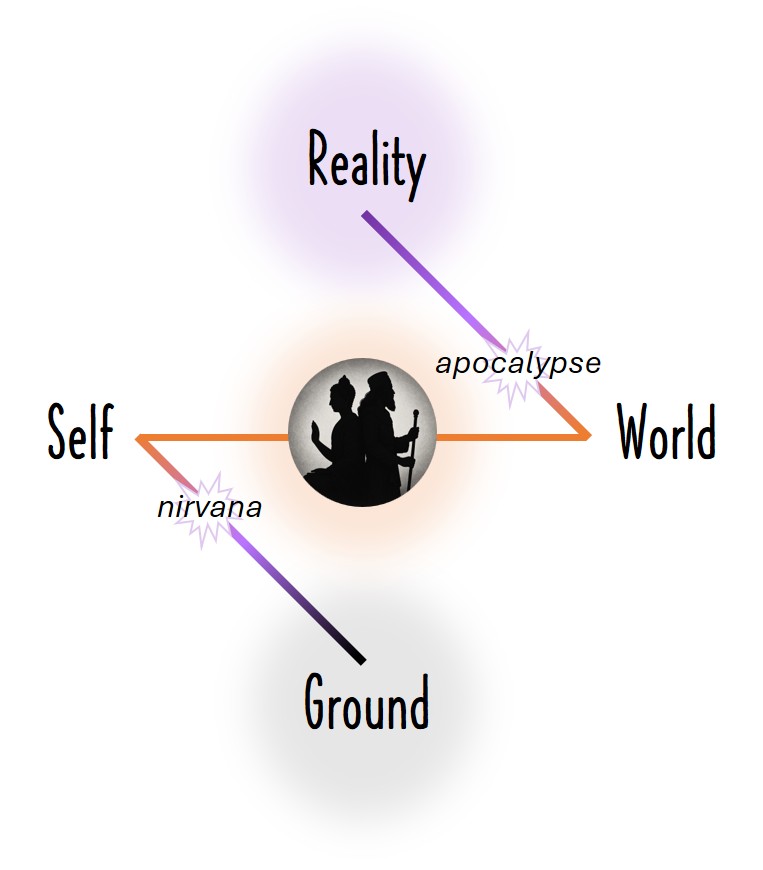
It took a couple of centuries into the first Axial Age of the higher cultures (800-200 BCE) for the shocking realization to set in. In sixth-century Persia it came together in Zarathushtra’s idea of apocalypse, which regarded the world as a richly embroidered veil of illusion that must be pulled aside in our quest to behold the full radiance of Reality.
Cataclysmic world-ending events were edited into the more ancient Iranian myths, registering this radical insight as well as surfacing for the first time a conscious acknowledgement of the world as a narrative construction of the human mythopoetic imagination.
Have you ever wondered who the first mythmakers were, and how aware they must have been of creating worlds in the stories they told?
Much later and into our own day, the idea of apocalypse would be mistaken for a future event that believers needed to prepare for, in order to ensure the safe deliverance of their immortal souls to a heavenly paradise. In the meantime, religion discovered that the anxious fantasies of believers over their everlasting destiny could be stoked and manipulated in the interest of securing membership and enforcing obedience to its laws and doctrines.
Around the same time as the idea of apocalypse was dawning in the middle east, still farther east in present-day India a disillusioned prince named Siddhartha Gautama discovered a portal within himself to deeper oneness. Entering the portal was facilitated by a meditative discipline that effectively extinguished the flame of his ego consciousness – of the “I” at the center of his personal desires and fears, of his hopes, ambitions, and beliefs – in a spontaneous moment of boundless present awareness he named nirvana.
Ancient Hindu religion had evolved with India’s caste system, where lower social classes clung to the hope of ascending to higher ranks with each reincarnation depending on how diligent they could be in the duties attaching to their roles in society.
Religion, that is to say, effectively kept things as they were.
Just as happened with the notion of apocalypse, so too would Siddhartha’s (the Buddha: “awakened one”) metaphor of nirvana later get misinterpreted as referring to a metaphysical realm separate and apart from the self. Elaborate methods would be devised and elite communities of monks dedicated to the work of accessing and cultivating the virtues of Buddhahood.
What Zarathushtra and Siddhartha had discovered – Zarathushtra by pulling aside the veil of a world that only seems real; Siddhartha by his realization of self as nothing (no thing) but a transient wave on an infinite ocean of no-thingness – can be compared by analogy to something you and I experience every day … though without being aware of it.
Approximately fifteen degrees outward from the midline of vision for each eye there is a hole in our visual field, a ‘blind spot’ that registers the point on each retina where the optic nerve to our brain ties in to gather data. At that exact retinal point there are no light receptors, which gets recorded as a gap (actually two gaps, one from each eye) in the sense-data that our brain constructs into its perceptual representation.
This representation is what we actually see, not what’s really out there. Furthermore, we don’t see our blind spots because our brain papers over the holes with data of its own.
In the diagram above, Siddhartha and Zarathushstra are back-to-back at the center: Siddhartha is facing inward to the self, as Zarathushtra faces outward to the world. My returning reader knows that the color orange, as in the aura surrounding the two figures, represents ego consciousness and the self-conscious center of personal identity, which looks in to the self and out at the world.
Recalling our analogy, Siddhartha has become aware of a point in the self where there are no “light receptors,” an emptiness in the self that drops into a deeper oneness and inner peace. The flame of personal identity – ego insecurities, attachments, ambitions, and convictions – has blown out (nir-vana) and nothing but a boundless presence remains.
This Ground is nothing (no thing) but the ineffable source and support in all things, the grounding mystery of being-itself.
With his back to Siddhartha and facing outward to the world, Zarathushtra has detected a blind spot in our world-picture, exposing its construction as an neuro-artifact of the mind. What we see isn’t what’s out there and separate from us, but merely a mental representation made of a patchwork of stories – the mythology of our people and the myth of our own personal identity.
All of it serves as a sacred canopy of significance, and yet it is still only a veil against the radiance of Reality. To behold the Truth of What Is, the veil must be pulled aside, our cover of security, identity, and meaning taken away (apo-kalýptein), and our world ‘destroyed’.
Reality is everything (every thing) existing together in a harmony of higher wholeness – not a mere assembly or random collection, but all of it together as One.
Both Zarathushtra and Siddhartha were early proponents in the breakthrough of spirituality beyond the conventional limits of religion. Whereas conventional religion – back then and still today – is centered on the egos of deities and devotees in protected memberships of shared allegiance, the thrust of spiritual awakening eventually seeks to transcend ego altogether.
Whether it is Zarathushtra pointing out the difference between meaning (world) and Truth (Reality), or Siddhartha exposing the gap between identity (self) and essence (Ground), the result is that religion’s ordained illusion is broken and the human spirit is finally set free.
Descending the self and transcending the world are not thereby to become charters of new religions, replacing the traditional practices and beliefs of conventional religion. Ideally, Zarathushtra and Siddhartha are welcomed in and invited to share what they have learned, however odd and confounding it may sound to believers at first (and for a while).
The insights they offer might be instrumental in fertilizing the spiritual awakening and transformation in whomever has “ears to hear” – that is to say, for whom the moment of liberation is at hand.
Sadly though, the usual reaction to someone who questions the reality of our world and challenges us to drop the charade of identity is to push them out the door and get back to reciting our creeds.
 Tracts of Revolution