Drift, Sink, or Sail?

Your life is like a sailboat. The “boat” of your life needs to be buoyant and watertight, with sufficient integrity to withstand the force of waves against it. And the “sail” needs to be tall enough to catch the wind, as well as broad enough to harness its force. A sailboat with no sail can only drift about, and without a seaworthy vessel it will eventually sink. It needs both.

And so does your life.

In this post I will translate the analogy of boat and sail into your paradoxically equal priorities of security and fulfillment in life. Without security you are vulnerable to “sinking” into depression – that is, after anxiety has compromised your capacity to withstand the variety of pressures and assaults a normal life brings your way. And without fulfillment, you are adrift amidst the random conditions and changing circumstances around you. Life will feel like “one damned thing after another.”

Security and fulfillment are paradoxical in the way they pull your attention in opposite directions, and yet play with/against each other in the full picture of a life well-lived.

I have done it myself, and observe many others doing what I call sacrificing fulfillment on the altar of security: abandoning our aspirations in the interest of just staying afloat. Security feels more urgent than fulfillment, and if one has to be set aside or postponed for the other, “drifting” is preferable to “sinking.”

But here’s the thing: life is inherently insecure. “Pressures and assaults” at its surface are never-ending; just as you get one issue under control, three more pop up and demand your attention. If you suffered some damage previously and took in some water, you tend to be more vigilant around those areas where integrity has been compromised. Lots of us are just doing our best: bailing out and patching leaks, staying low in our boat to keep from capsizing and going under.

And because this is the nature of life, we can spend our whole life fixated on the trouble we’re in.

Before we take a few precious minutes to consider what else life might be about – that whole thing about a sail, the wind, and your need for fulfillment – it will help to clarify the basic elements of security. Of course, you can worry and fret over anything, but at least these things are relevant concerns when it comes to managing the persistent insecurity of existence.

The first element of security is safety, referring to your need for protection against the buffeting waves of life. Here we find another interesting paradox, in the way a strong boat holds out the water while at the same time resting upon it.

To be safe and feel secure, this dual aspect of adversity and providence, along with the corresponding skills of “withstanding” and “surrendering” to the reality of life, reveals an essential bit of wisdom. If you should invest all your effort in keeping life from hurting you, your inability – or more accurately, your habituated unwillingness – to release yourself to the greater mystery of being alive makes you increasingly inflexible and depletes your resilience.

We might say that safety is about holding your own but also trusting the Process.

It can take a while to learn this skill, and if your early family environment was both protective and empowering, you likely already have it within yourself – although you might not employ it as often as you could. If your infancy and early childhood did not equip you with an ability to withstand life and surrender to it, the good news is that it’s not too late to learn how.

The second element of security is belonging, which refers to a sense of inclusion and being at home in a reality larger than yourself. This has a pretty obvious connection to the dynamic of releasing, surrendering, trusting, and resting which is essential to feeling safe. With belonging, this action of release opens out to an expanded awareness of that in which you belong.

Staying with my analogy, there is a sense in which your boat “belongs” in the water – not underwater, certainly, but also not merely on top and separate from it.

Similarly, you belong in a family, a human community, a web of life, and a provident universe. Belonging is more than just sitting inside this hierarchical arrangement; it is also about connecting, relating, and participating in its higher wholeness.

Third, and completing the set of elements basic to security, is self-esteem. This shouldn’t be confused with egoism, conceit, or the interesting personality complexes that form around a core of insecurity and the desperate need to control how others see you.

Self-esteem simply refers to your need for a positive and empowered sense of self, the sense that you are worthy, that your desires and gifts matter, and that you have something worthwhile to contribute. Always feeling like you have to prove yourself to others, exhausting yourself in the effort to please them, placate them, flatter or impress them, are all symptoms of a deficiency in self-esteem.

The healthy combination of safety, belonging, and self-esteem is what provides you with the security you need to successfully manage the pressures and assaults of life. Holding your own against the sea while resting in its provident support; understanding that you are part of something greater that both bestows and invites the dedication of your unique gifts – with this very practical wisdom, your boat is strong and ready to sail.

Granted, with a seaworthy vessel you could merely continue drifting on the waves, but why would you when there is so much to life around you and out there?

It’s time to raise your sail: to start thinking about where you’re going and why it matters.

A sail is not designed to displace water but to catch the wind. An entirely different set of values to the security needs down below require your attention now. These values, or ideals, are the Five Aspirations of your human spirit. They inspire and motivate every human being to desire, seek, and strive after fulfillment. Fulfillment is not just another word for “happiness,” but involves reaching full capacity and realizing the full potential of your human nature. Fulfillment.

I have explored the Five Aspirations in another post, so we won’t go too far into them here. Suffice it to say that, when your basic security needs of safety, belonging, and self-esteem are adequately satisfied and you can devote your attention to the art and adventure of sailing, the quality and enjoyment of your life is amplified exponentially.

It’s not to say that you will never feel insecure again; you will because you are an ego on a human journey.

The point is that, with a healthy realism and responsibility for the integrity of your boat, you have more creative freedom to explore deeper meaning, to clarify your higher purpose, to cherish genuine love, and cultivate inner peace.

Raise your sail and catch the wind! There’s more to life than just what’s going on inside your little boat.

Why Does It Matter?

Is life what happens to us, or is it more about our response to what happens? Are we really hapless patients in the process, reacting to the events and conditions of our life only after they have befallen us?

No doubt, that’s how it often feels. We barely have enough freedom to raise our attention above this relentless swirl of causality to consider where it’s taking us.

This common belief is not just a postmodern twenty-first century phenomenon. The evidence would suggest that it’s a universal and longstanding opinion of our species. By “evidence” I am referring to the perennial philosophy or wisdom tradition that’s been around for millenniums.

There would be no need for such an ancient and running collection of principles, precepts, and practices designed to help us take creative authority in our lives, if we and the thousand generations before us didn’t struggle with this question of freedom, purpose, and the ultimate meaning of life.

In The Power of Myth I anchored this question to the mythic archetype of Youth (ages 10-25), when we are constructing an identity, hopefully with the providential support of a family and community that are, on balance, more spiritually awakened. Such support earlier on (birth to age 10) would have served to establish in us a foundation of security and the corresponding faith in Reality as provident.

When we have around us a community that knows what it’s doing, and that has our personal wellbeing and human fulfillment as a top priority, we come to appreciate our responsibility in making life meaningful.

But many, perhaps most of us don’t emerge from our youth with this sense of creative authority and personal responsibility. And while it may be tempting to lay the blame for this on broken families and dysfunctional communities, that would only perpetuate the false belief that life is what happens to us.

Perhaps that is why the wisdom we need cannot be found in fresh supply inside the cultural depositories of religion. Just as its source is outside our institutions and orthodoxies, the timeless truths of Sophia Perennis flow in the borderland beyond conventional belief.

What is it that we need to learn? If we’re not helpless victims of life as it happens, what can help us take a new and better view on the meaningful life that seems to elude us?

Meaning is constructed in the choices we make.

In the illustration above, a path extends ahead and into the future. From a foreground vantage-point we can see that this path is composed or made up of individual stones, which will represent the many choices we make as we move along.

I’m not suggesting that we choose everything that happens. There are countless events and conditions, both inside and around us, that we have no control over, much less awareness of. I can even agree with the hardline determinists to some extent, who insist on something of a lockstep causality generating our physical universe and the “explicate order.”

Despite all of that, each of us is also taking in perceptions, assigning value to what we perceive, deciding what it means, and reacting behaviorally to our perceptions and to our own mental constructs of meaning. This flow or sequence of events isn’t determined in the same way as the physical universe, which is why those individual stones of the path are not meshed together like gears in a machine.

A strategic achievement in creative authority is gained in taking responsibility for the “gap” between what happens to us and our perception of it, between our perception and the value we assign to it, between our value assignment and the meaning we construct around it, and between this belief and our behavioral response.

Even if we can’t yet detect the gap separating one step and the next in real time, later reflection can usually identify where in the process we actually did have a choice.

We may resolve to do it differently next time. But without ongoing reflection and an intentional commitment to a new direction, the old chain reaction will likely take over and reinforce the belief in our own helplessness.

Meaning is a way of life.

What we are really struggling with is not the presence or absence of a gap between the stones paving the path of our life, but rather the practiced habit of doing things a certain way, over and over again. This is where our perspective shifts from the discrete choices we are making in the foreground, to the “way” or pattern that is formed, reinforced, and repeated over time.

We have moved from choices to character – not leaving choices behind us but acknowledging how our choices become habits, and how our habits form an identity and way of life.

We sometimes think of character as this unchanging, immortal core of identity that we carry within ourselves. But the fact is, character comes into shape and takes on force as our choices, beliefs, and behavior coalesce into a more or less consistent identity – much as the character in a story grows more familiar and predictable with the narrative progression.

Changing our way of life is less about converting to a different ideology or lifestyle, than it is taking personal responsibility for our choices and using our creativity to author a better story, one more aligned with our spiritual aspirations for deeper meaning, higher purpose, genuine love, and inner peace. That’s what I mean by “creative authority.”

Meaning in life is articulated in our philosophy of life.

Such talk of spiritual aspirations invites a further shift in focus, from the specific choices we are making, through our character and way of life formed over time, and ultimately to the vision we hold of a life well-lived. More than just an explanation or theory of life (which strictly speaking is biology), our philosophy of life serves to clarify what truly matters – not only to us but to others with us, and all of us together amongst the rest of life on planet Earth, for generations to come.

It’s not about getting rich, or how to win friends and influence people, but instead focuses our devotion on those ideals, aims, principles, values and practices that promote a reverence for life and advance communities of inclusion, freedom, justice, and equality.

It is still ahead of us, perhaps far ahead, but we can begin realizing our vision in the choices we make today.

Living Religion

After rescuing spirituality from dysfunctional religion, its proponents have sometimes gone way to the other extreme, turning spirituality into a catch-all for anything mystical, metaphysical, magical and spoon-bending. In their rejection of religious tradition, institution, and orthodoxy, they “rescued” something of a shapeless blob of experience, which has been branded in countless ways and sold for huge profits to sometimes desperate, somewhat disoriented seekers.

The end result is a graveyard of dead and dying religions, but also this magic ooze that can be turned into whatever the willing consumer wants it to be.

Now, I’m not suggesting that the conditions and circumstances warranting such a rescue effort aren’t real. Much of religion has lost its soul. For a couple generations at least, it has been trying to compensate for a steady slide into irrelevancy, exhaustion, and rigor mortis by investing aggressively in megachurches, entertainment productions, and celebrity leaders. The pose that such religion strikes for us, however, feels a little too much like the stuffed and rigid products of taxidermy collecting dust on the shelf.

What we have, then, is a dead or dying religion on one side, and this oozy whatever-you-want-it-to-be spirituality on the other. I have been making a case for some time now for seeing healthy religion and a vibrant spirituality as inseparable, as the temporally relevant expression of an eternally (i.e., timelessly) creative essence. Just as we can’t take the life out of a living thing and set it aside as we dissect and examine its now lifeless body, neither can spirituality live outside and without the structural support of religion.

Spirituality is the “soul” to religion’s “body,” and despite the wildly popular but erroneous belief that one can exist without the other, the truth is that they are the Yin and Yang, respectively, whose entwining interaction is the Tao which cannot otherwise be named or known.

Our ego can be forgiven for wanting to identify itself with the immortal soul and eventually gain its escape from the mortal body. The important thing to understand, however, is that this division and separation of body and soul is the ego’s fantasy, a delusion it has projected into the nature of reality and into our own human nature.

This projection is a kind of therapeutic prescription for a death anxiety it has no obvious way to effectively address or resolve.

Ego doesn’t (“I don’t”) want to die, so it dissociates itself from the temporal body, conceives of the body as just a temporary residence, and identifies itself as that which will (it must!) continue on after the body dies. Such an “immortality project” (Ernest Becker) or “Atman project” (Ken Wilber) only deepens and magnifies the death anxiety, however.

Once it gets going, the fantasy can be all but impossible to break. But when it does break, we suddenly come to know the truth, and this truth sets us free.

The decline and death of religion is historically correlated with this gradual dissociation of ego from the mortal body, its self-identification as an immortal soul, and its mindless degradation of all the systems, processes, principles and mysteries that conspire together, as Yin and Yang, in the Tao of Reality.

Once we invented the dualism of body and soul, it would be just a matter of time before the “body” of religion and the “soul” of spirituality had to come apart, each destined for its own kind of extinction.

Is there any good news here? Anything we can do to repair (re-pair) religion and spirituality, body and soul, time and eternity, human and being?

Of course there is, and it’s been with us for thousands of years. It just so happens that religion has placed it on the Index of things that true believers must avoid, and that contemporary so-called “spirituality” has almost completely dissolved into its oozy solvent of metaphysical oddities.

We are talking about the Perennial Philosophy or Sophia Perennis, an underground stream of spiritual wisdom that has inspired, nourished, and refreshed our human quest after the ultimate Truth of things. This Truth is acknowledged in Sophia Perennis as transcendent of the religions themselves, but nonetheless (and paradoxically) immanent in and inclusive of all things – including the religions.

The above meditation image, or mandala, illustrates the basic principles of this holistic and dynamic vision of Reality using the familiar design of the Tao.

Consciousness goes “out” to wander, explore, dance and play among the ten thousand things. It also goes “in” to be still, to rest in Being, return to its Source, and find inner peace. We need both. If we should invest all our attention in just one side of this Yang-Yin polarity, the outer will become a rigid empty shell and the inner an oozy shapeless goop.

So we are back again to our contemporary dichotomy of religion without a soul and spirituality without any shape.

The domain of religion is the outer realm, where the expression of experience in the form of symbols, stories, sanctuaries and sacraments constructs the frame for an overarching meaning to life. This should prompt the question of what kind of experience gets the process going in the first place. The answer brings us into the domain of spirituality, an inner realm where the essence and depth of consciousness reaches along dark roots into the grounding mystery of Being.

The multitudinous symbols of God in religious mythology and iconography are not artistic replicas of divine beings encountered in the outer realm, but rather artistic representations of a present Mystery sensed in the inner depths of Being.

The overarching meaning and the underlying mystery are not two separate things – until religion gets too attached to its doctrines, to the point where these formal expressions of meaning are defended as the absolute truth and final word, the one and only way of salvation.

As advocates for Sophia Perennis, the mystics and teachers of spiritual wisdom have patiently but insistently reminded true believers that the essential depths of Mystery can never be “solved” into meaning. The Mystery they speak of – so far as anyone can speak of the ineffable – is not epistemological, a problem for thought, but ontological, a matter of being.

Only as we can remain rooted in awareness to the inner mystery of being-itself will the meaning we construct around ourselves be, and remain, relevant to the life we are living. And the way we do this is our religion.

The Quest Mandala

By now, a returning reader is familiar with my “dancing” style with things I regard as essential to understanding the human journey. I prefer to keep words flexible and their contextual frames almost always moving, which makes it hard to pin me down and hold me to account. I don’t do this to evade responsibility for what I write, but because the things I write about are fluid, dynamic, and imbued with mystery.

My purpose in writing is not really to educate or convert a reader to my opinion. I write because I like to dance.

So let’s take another turn with the question of why we are here on this human adventure. Science can provide explanations for how we got here, but it’s the task of spirituality to clarify the why. This doesn’t mean that we have license to fly off willy-nilly into astral planes and metaphysical esoterica. We should stay in our bodies with our feet on the ground, even as we ponder the higher reaches of our human nature.

It doesn’t make sense to me that the evolutionary aim of our existence would require us to deny or discard what makes us what we are.

We will position ourselves at the center of the dance floor, which in the mandala above identifies us as an embodied, self-conscious mind – or ego for short. We begin in this position not because it’s where the human journey starts, but because this is where we first wake up to the adventure and realize that we need to figure some stuff out.

As “who I am,” ego is both for-itself and for-others, meaning that “I” am a unique person whose self-image is reflected back to me in the mirror of other persons.

Ego centers me in myself and connects me to you. Integrity and empathy, autonomy and affiliation, agency and communion: the polarity of experience that comes into play with ego development can be considered from various angles. Centering the self and connecting to others is the critical contribution of ego to the longer human quest. This dynamic of centering and connecting reveals the true meaning of power.

Our quest consciously begins as we wake up in this performance space between our centered self and our connection with others. Because this “middle realm” is frequently fraught with insecurity, attachment, shame and self-doubt, however, there is a strong chance we can get stuck here.

The naturally creative polarity of self and other cannot hold the balance, but instead snaps to the bi-polar extremes of possession or submission, taking power for myself or giving it all to you.

Now, you should be able to see this bi-polar swing between possession and submission as a defining pathology in human history, and probably in your own life story as well. I can see it in mine, for sure.

But instead of how we typically deal with pathology in Western medicine and psychotherapy, which is to cure it or cut it out as soon as possible, a better approach would be to regard it as a clue to how we can better manage the balance and use its energy for progress in the direction of greater health, wellbeing, and fulfillment.

By becoming more skillful in the equal priorities of keeping our center and making connections, the axis of our quest can pivot 90° to the vertical orientation. From our center we can drop and descend into the deeper realm of Being, to the quiet clearing of soul where we are grounded in the present Mystery of Reality (or Ground of Being). Ego’s quest for a proper balance of power (integrity + empathy) opens the path to soul’s quest for inner peace.

This axial shift from ego concerns to the soul’s aspiration for inner peace helps us understand the distinction between religion and spirituality, and perhaps also the popular self-identification on polls as “spiritual, but not religious.” I say ‘perhaps’ because in a large number of cases the distancing from formal religion is motivated by clerical abuse, dogmatic oppression, manipulative guilt, or a cumulative irrelevancy.

For these individuals, religion is a code-word for what they managed to escape and never want to go back to.

Spiritual is thus another way of saying that they still have inclinations for things divine and supernatural, but want nothing to do with all the traditional and organizational baggage. Their current preference is for a mixed-bag, when-I-need it, grab-and-go variety of religion, although they don’t want to call it that.

Many of them remain stuck in the middle realm, having pulled out of organized religion and its congregation of like-minded believers, into a private religion of their own where they can be in control and decide what it is.

That’s not what I mean by spirituality here. In this context it refers to that pivot to the vertical axis mentioned earlier, not out of, against, or away from religion, but beyond it; beyond ego to the soul, beyond the balance of power to inner peace. Here, spirituality is not about “me” and what “I” want. Indeed, “I” and “me” have been left up there in the middle realm, so to speak, for a deeper experience of contemplative solitude and grounded presence.

This vertical orientation opens a path upwards as well: with, through, and beyond our interpersonal connections with others, to the transpersonal (or communal) realm of spirit.

Our empathic and compassionate engagement in service to the higher wholeness of community fulfills our human quest for love. Again, just as a strong center provides the stable release-point from which consciousness can drop into the deeper realm of soul, so a strong connection with others provides the stable launch-point from which consciousness can leap into the higher realm of spirit.

Ultimately, which is to say, with respect to the highest aim and purpose of our human journey, it is the generous, joyful, ecstatic, and inclusive experience of genuine community that we long for. In the balance of power, and with our roots deep in the ground of inner peace, the synergy of love flows through us and out into the worlds we are creating and re-making each new day, together.

Deep Within and All Around

One of the more obscure concepts in mystical spirituality to explain, and arguably the most important for understanding what it’s all about, is the Ground of Being. The Christian theologian Paul Tillich popularized the term in the mid-twentieth century, but it has been foundational to the perennial tradition of spiritual wisdom for nearly 3,000 years.

Even Tillich’s assertion that God is just a theological nickname for the Ground of Being had already been made by Johannes (Meister) Eckhart in the early 14th century. It wasn’t received well by orthodoxy back then, either, and hasn’t been for as long as dogmatists have preferred talking about god (the theological construct) to experiencing God (the present Mystery).

At the same time as the orthodox Church was launching external crusades against other religions, it was also pursuing an internal campaign against mystical spirituality and its “Ground of Being.”

The effort continues to this day.

As a consequence of the orthodox rejection of mystical spirituality, it was driven into a variety of esoteric “secret societies,” pushing it even farther from the reach of ordinary spiritual seekers.

It wasn’t long before these esoteric sects had developed orthodoxies of their own, with hierarchies of authority and strict requirements for membership. The age-old metaphor of ultimate reality as the “Ground of Being” is still trapped inside an arcane symbolism and cryptic vocabulary. This is purportedly to protect the Mystery, when really all it does is bury the Mystery under needless nonsense.

Because theology, or “god-talk,” is such a nuanced and complicated language, it is common to assume that mystical spirituality must be even more so. If theologians talk about something (a supreme being) that is “out there,” how much more challenging it must be to talk about a present Mystery that is said to have no objective existence!

In this post I will use the convention of capitalizing the ‘G’ in God when speaking of the Ground, and employing the lowercase ‘g’ for the many theological constructs that we imagine to exist – even if that construct is the one supreme deity of monotheism.

Actually, it is much easier to understand mystical spirituality than orthodox theology, and for one very simple reason, which is that while theology talks about a god whose existence is always up for debate, spirituality speaks of a present Mystery that is Existence itself.

The Ground of Being is not one being among (or above) all others, but the source and power of be-ing in all things.

Using its popular nickname, God, we can say with Paul Tillich that there is no such thing as God, for God is not a thing. This is slightly, but importantly, different from saying that there is no such thing as this or that god. It is historically around this distinction that misunderstandings and conflicts have arisen.

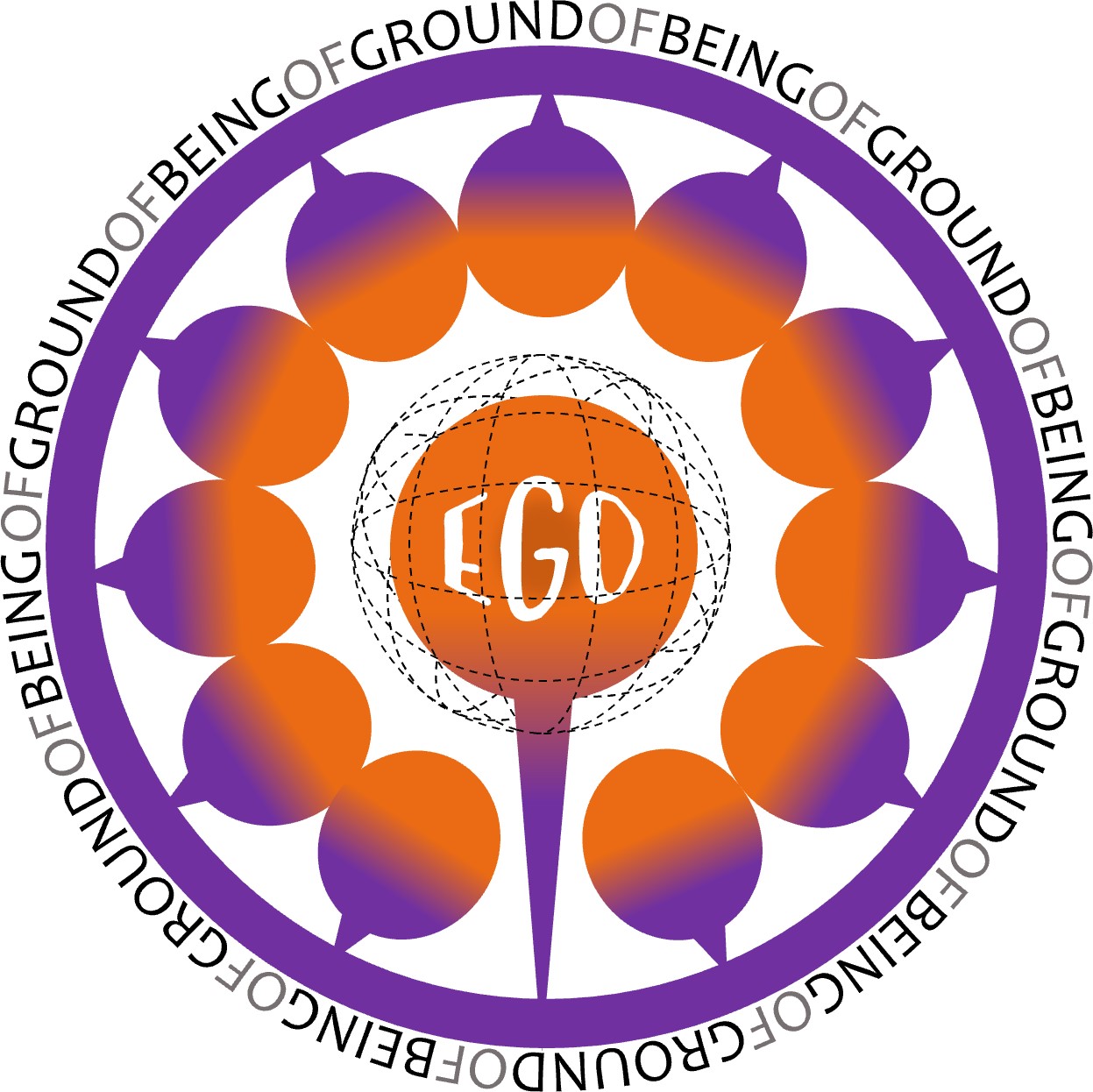
The illustration above is useful in helping us appreciate what mystical spirituality is really saying when it identifies God with the Ground of Being. Let’s pretend that the large circle generates and contains everything there is. Whatever kind of being we may observe in this universe – a star being, a cloud being, a bird being, a tree being, a dog being, or a human being – is a specific and formal manifestation of Being, of a power actualized in its special form.

The revelation expressed in the term “human being” has been all but lost to us, but the insight is still there. A human being is a human manifestation of Being, or the power of be-ing in human substance and form.

In my simplified image of the universe, I have placed you in the very middle, as a self-conscious human being, or ego (Latin for “I”). Your ego is where the consciousness of your sentient body and mind is conscious of itself as a center of thought, feeling, will and agency.

Let’s have the color orange represent objective consciousness, which is your awareness of the countless objects around you (all of those other beings), as well as of yourself (as an object of self-conscious awareness).

Looking out and around yourself, all you can see is what your objective consciousness apprehends. All of it has objective existence from the vantage point of your ego. From that vantage point each thing or object, including you, stands out as separate and distinct from all the rest.

But notice, too, that everything is rooted in the larger circle, which in my illustration represents the Ground of Being. When you observe a star or a tree, you are noticing the attributes of a specific form and manifestation of Being, while its essence remains hidden – not behind or inside it as ‘something else’, but as the form itself. What you see is paradoxically the “visible concealment” of its deeper essence.

The be-ing of a star, the be-ing of a tree, and the be-ing of a human is colored purple; this dimension of its existence is not available to objective consciousness.

A final element in my illustration is a sphere surrounding your center of self-conscious identity, encapsulating it as it were. This is your world, referring to the construct of meaning that you project around yourself.

Your world is not the universe. If the physical environment around your self-conscious embodied mind is the ecosystem, the world is your egosystem. Everything inside your world has value, meaning, and identity relative to your ego. Your egosystem is also where the lowercase god is found – not outside but inside your world, which really means inside the stories and imaginarium of your egoic mind.

Another important distinction identifies the lowercase god as a literary being, a fictional character in myths, but not a literal (i.e., factual and objective) being. The lowercase god is a projection of your mind, but also a symptom of what’s going on in there: of your need for security, control, recognition and esteem.

This observation of mystical spirituality has given orthodox religion sufficient reason to condemn, persecute, and murder mystics through the ages. The mystics have always been more interested in what God means than in whether or not god exists. Indeed, the obsession with god’s existence has kept many believers from the spiritual nourishment they seek.

In healthy religion, the lowercase god is an acknowledged metaphor and symbol of the Mystery beyond name and form: the Ground of Being.

By now it should be clear that the Ground of Being is not “out there” or under your feet, in the way that the literal and physical ground is under your feet.

Looking out with objective consciousness, all that you see is the “hidden Ground,” Being hiding in (and manifesting as) the myriad beings around you. Pluck one of them from the web, take it apart and break it down to its most elementary particles, and you will get no closer to the Ground. All you will have is an exponentially multiplied number of smaller objects, each revealing and concealing the Ground in its individual form.

Is there anywhere you can turn to experience the Ground of Being without the veil of objective existence?

With this question we come at last to the foundational practice of mystical spirituality, which is about dropping out of objective consciousness and releasing your center of personal identity.

Remember, you too are a manifestation of Being, concealed behind a personal identity and enclosed by the construct of your world. In surrendering all that makes you one being among many, along with all your quirks, convictions, and masks of identity, objective consciousness is allowed to dissolve into an experience of the present Mystery of reality, the Ground of Being.

In some traditions of mystical spirituality, this shift is designated as a descent from, or “death” of, egoic self-consciousness, and the awakening, or “resurrection,” of spiritual Self-awareness.

As an ego, you are one among many beings; deep in your soul, you are One with the Ground of Being.

So then, who are you really?

The Power of Myth

I keep coming back to the ideas of “mythic themes” and the “four ages of life” in this blog. They are in the background of just about everything else I think and write about. My ancestral heritage for this stream of thought includes Mircea Eliade, Carl Jung, Joseph Campbell, and Northrop Frye – all pioneers on the frontiers of archetypal psychology, cultural and personal mythology, and the power of story in the construction of worldviews and the meaning of life.

In the interest of keeping this post tolerably short, let’s jump right into our topic, which I will name The Power of Myth using the title of Bill Moyers’ popular interview series with Joseph Campbell back in the 1980s.

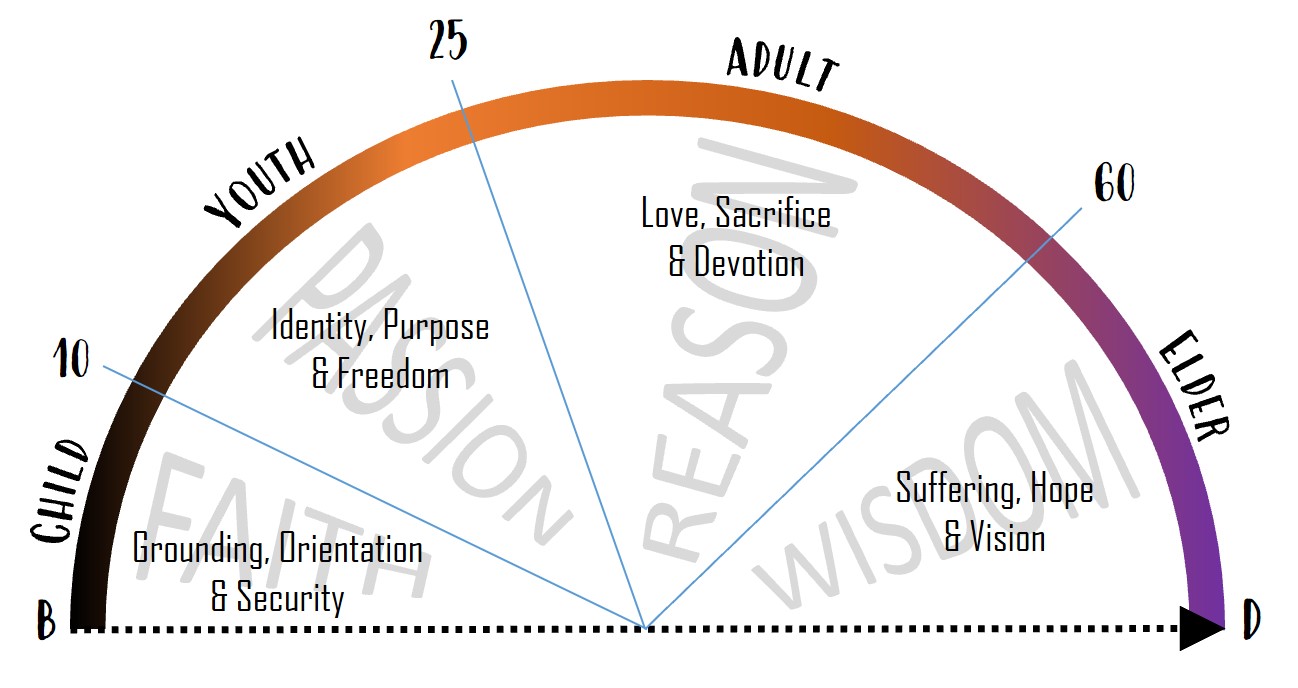
The diagram above features the arc of our individual lifespan divided into four Ages, each Age identified with one of the four mythic archetypes of development: the Child (Birth to age 10), the Youth (ages 10 to 25), the Adult (ages 25 to 60), and the Elder (age 60 to our Death). In the background of each period or Age of Life we see what I’ll call the “developmental axis” of that Age: childhood as the Age of Faith, youth as the Age of Passion, adulthood as the Age of Reason, and our later years as the Age of Wisdom.

Each of the Four Ages represents a relatively stable period of growth and maturity, centered on its axis (faith, passion, reason, or wisdom) and providing a correspondingly stable worldview to engage with reality – but also to put some mediated distance between ourselves and reality for the meaning we need. The thresholds and transitions between Ages generate some degree of stress and upheaval as our axis is needing to shift for a more existentially relevant engagement with reality.

Trauma, adversity, and setbacks during a particular Age of Life can result in the carry-over of “unfinished business” into the next, along with the coping and compensatory strategies we used during those unsettled phases just to make it through.

I call these strategies “neurotic styles.”

So while my diagram offers a clean and uncomplicated view of the Human Journey, it is not so clean in real life. Nevertheless, the value of such heuristic devices as diagrams and theories is in the way they help us discern patterns in the persistent ambiguity of what’s going on.

So far, we have the Human Journey progressing through four Ages of Life, each one centered on its own axis and contributing a dimension of experience to the full picture that we somehow need to become fully human.

Living without faith, passion, reason, or wisdom is not, as we might say, in the design intention of an awakened and self-actualized human being.

A deep inner surrender to Being (faith), an emotional investment in life (passion), a commitment to truth-seeking (reason), and an understanding of how to live well and be whole (wisdom) are all essential to our human fulfillment.

The remaining elements of my diagram identify the narratives that shape, drive, and inspire our Human Journey, and serve to differentiate Campbell’s “power of myth” into distinct themes and storylines.

In the Age of childhood, a mythic theme of grounding, orientation, and security shapes, drives, and inspires our experience. More than anything else, we need to know that reality is provident, that we are safe and belong. Faith releases inwardly to the Ground within, as trust and wonder open us to the Mystery beyond.

Stories of grounding and orientation center on the security of a home place which may be lost or put in jeopardy, but only for a time, before safety is restored and everyone lives happily ever after.

The Age of youth moves us out from our shelters of safety and onto the high adventure of identity, purpose, and freedom. Our world suddenly seems to become a performance stage where everyone is watching us and we are trying out roles for their approval, or else acting out against social standards for the recognition we seek.

If we happen to carry insecurity from childhood, a pressing and anxious need for acceptance may compel us to forfeit our pursuit of freedom. Our purpose, tragically, can be reduced to pleasing, placating, flattering and impressing the people whose acceptance we so desperately need.

This trade-away of freedom and purpose for the sake of winning somebody’s favor and approval is a common trap used to recruit youth by evangelical Christian groups and other cults.

Those who fall into the trap may take decades finding their way out of a piety of submission and obedience to a god who is morally scrupulous, impossible to please, and only conditionally forgiving. Behind it is very likely a chronic insecurity from childhood.

Adulthood is the time when many choose a life partner, build a family, start a career, while still enjoying occasional mini-adventures called vacations. Love, sacrifice, and devotion are now the storylines we use to weave our world, around an axis of reason. It’s more important than ever that our life makes sense and gives us a “reason” to engage our roles and routines with commitment and responsibility.

For love’s sake we willingly sacrifice our pursuit of other options and devote our attention, time, and energy to cultivating the healthy bonds and anchors of meaning.

At midlife, or around the age of 40, the conventional nature of our life roles and routines can suddenly feel empty and pointless. We may be tempted to think that our rescue from this aridity will come by exchanging our partner, job, or residence for a different one, when what is needed is a breakthrough to a deeper appreciation and gratitude for the life we have.

In a sense, the trajectory of life concern is needing to shift from the horizontal plane and our place in the world, to a vertical revelation of depth, presence, and the undeserved gift of just being alive.

At last we enter the Age of Life as an elder. Around this time we are beginning to lose our parents and older relatives, think about retirement, and experience the gravitational pull of mortality. While in our youth we could casually ignore the reality of death all around us, in our later years it is quite literally in our face.

Storylines of suffering, hope, and vision transform our worldview into a beautifully ironic picture, with its double vision of an Eternal Now in the midst of life’s passing.

Whereas otherworldly religion will offer its comforts of a promised life in the hereafter, spiritual wisdom opens awareness to a “peace that surpasses understanding” in the heart of this life and in the very shadow of death.

Throughout cultural history, it has been the special gift of elders to both challenge and encourage younger generations to take in the larger and longer view of life – in full acknowledgment of the fact that while we are all in this together, each of us is only here for a brief moment in time.

In our era of therapy, this longstanding and far-reaching framework for understanding the Human Journey remains ever relevant. Just step into it at the temporal point of your life and listen to what it has to say.

A New Look at Family Values

Conservative politicians and preachers frequently say that the health of society is a symptom of marriage and family health. For them, marriage and family are the foundation of everything else. Class tension, racial strife, and tribal conflict are both the sign and fallout of dysfunction at that primary level.

I’m not sure the politicians and preachers would agree with that last statement, as I will try to explain.

“Family values” has been the banner under which many conservative campaigns, as well as conservative crusades, have been organized.

By definition, conservatives are advocates for cultural institutions, traditions, and customs that “conserve” our connection to the past and the stability it offers. The past is a country that we know; it is familiar, or at least fondly remembered. As we also know, it can be a construct we imagine nostalgically, but that never really was.

Especially when the present is confusing and the future uncertain, keeping an anchor line to things and ways that have been around for a while can provide the security, identity, and orientation we feel we need.

I fully agree with the argument regarding the influence of marriage and family health on the general health of society. Of course, we should go even deeper, into the wellbeing of individuals, since every partnership and relational system is affected, for good or ill, by what individuals bring to it.

But then, what is meant by “family values”? The values, judgments, attitudes, and mores that parents happen to teach and model for their children? Or are they the values, priorities, practices, and commitments that create strong families, partnerships, and communities?

It should be the latter, but too often the “family values” espoused by conservative politicians and preachers are built on ethnocentrism, where the interests of the in-group are set against the needs, values, rights and happiness of outsiders.

Some of this in-group favoritism and out-group suspicion is a natural and evolved preference for the company, resources, and protection provided by one’s own kin and kind.

But when the democratic principles of liberty, equality, and inclusion pull on those like-kind and like-minded boundaries, conservative resistance can lift the banner of “family values” as a defensive maneuver, which can quickly take the offensive – and then become offensive to democratic vision and values.

Instead of finding a way forward, together, they actively undermine democracy and sabotage its progress.

In this post I will guide a meditation on “family values,” in the higher cultural and democratic sense. Not as defensive of in-group identity or offensive against out-group difference, but as creative of the healthy relationships that our democratic future depends on.

In the background of my diagram is the image of a Möbius band or infinity symbol, meant to convey the idea of “power” and “love” as dynamically distinct virtues which are paradoxically one. Around the two virtues are arranged my version of family values or “a family of values,” priorities and commitments that are essential to the strength, health, growth, and longevity of any relationship.

At the center of this family of values is trust, which is effectively the bond and balancing point of Power and Love.

Without trust, a relationship has nothing to hold it together. As the centering value of a healthy relationship, it is a function of each partner’s own centered power and of their shared, connected love. When partners are not centered in themselves, they cannot connect from positions of inner security and strength, and their effort at connecting tends to be more about codependency and manipulation than genuine love.

On the “power” side of this balance are three more values, each one reflecting an important dimension of Power and helping us understand the virtue of Power more holistically.

Faith should not be confused here with religious belief or the willingness to believe something “you know ain’t so,” as Mark Twain quipped. We are using it in its original sense, as an individual’s inner release or surrender to the grounding mystery of Being. It is neither cognitive, intellectual, nor orthodox, and has really nothing directly to do with what we believe about one thing or another.

Because faith is deeper than words or concepts can reach, and because our need to know intuitively that reality is provident exists prior to the acquisition of language and formal thought, faith is properly regarded as mystical or ineffable (beyond words).

Integrity is how this deeper dynamic of inner release to the grounding mystery of reality arises into a centered personality, which is why it is also called “ego integrity.” It’s still important, however, to distinguish this center of ego integrity from the question of social identity, of “who I am” in terms of the roles we play in the role-play of relationships.

As mentioned earlier, an individual’s personal integrity is what conveys the centering virtue of Power to the dynamic of trust in a healthy relationship.

Agency refers to our individual sense of self-control, creative influence, and personal responsibility. When we accept and embrace our agency, we are embracing our ability to make things happen as well as accepting the consequences of our actions. A lack of agency translates into an inability to make commitments, along with an unwillingness to accept responsibility for how our words and behavior affect others and the world around us.

Swinging back to the other side of the Möbius band, we find three more values that help us better understand the virtue of Love.

In my diagram, Empathy is on the same level as Faith to make the point that its focus is primarily inward, in distinction from another word it is frequently confused with, compassion, which looks outward. The em- (“in”) of empathy lets us know that we are talking about an individual’s deep understanding of the human experience, of what it’s like to be a human.

Empathy grows by a process of introspective reflection on such universal human experiences as abandonment, loneliness, exclusion, oppression, abuse, deprivation, inadequacy, failure and loss.

It is out of this deep acquaintance with our own human experience that a compassionate concern for another’s wellbeing arises.

A second value of Love, charity is commonly identified with donating our time, energy, and resources to others in need, which is not wrong exactly, but still shifts the focus too quickly from what we can call the “Spirit of Love” that ideally motivates our gifts of assistance, to the specific (and tax-deductible) gifts themselves.

Charity is from the Latin caritas, which derives from the Greek agape, an important word especially in the Christian New Testament referring to the selfless, generous, and universal love of God. In a real sense, charity is not “given” but flows spontaneously from one to another.

Rounding out our contemplation of Love and ultimately bringing us back to trust is fidelity, a value that shares its roots with “faith” (Latin fide). Its position on the Möbius band places fidelity in dynamic opposition with faith. Whereas faith releases to the grounding mystery within as the inner source of Power, fidelity is devotion to the health, growth, and longevity of our relationship with another. It is the outward, and in many ways the highest, demonstration of Love.

The contribution of fidelity to a lasting relationship lies in its commitment to nurturing and protecting the bond of trust rather than attaching itself to the other, or some ideal of the other. Fidelity to the relationship gives room for us and the other to grow in freedom.

As it started, it all comes back to trust.

If we’re going to preach “family values,” let’s take it all the way and put these values into practice!

You and Your World

If I told you that your identity and the world around you are not really real, you’d probably dismiss me as another of those quacky hucksters who want to sell you some crock of bullshit. There are lots of them around, and you definitely need to hold on to your common sense as well as your wallet when they start opening their boxes of foolery. Better just move on and keep your feet in reality.

But I’m not after your money, and I don’t have a cult for you to join.

When I say that your identity and the world around you aren’t really real, I mean they aren’t real in the same way your body, brain, and the physical environment around you are real.

The names of what you see when you look around yourself, the value things have for you or somebody else, the meaning of this, that, and the whole shebang – all of it is constructed and projected by your mind onto the reality of what you see. And then you apprehend the projected image as having objective existence, as a reality existing apart from you and outside your mind.

Fascinating!

It won’t be surprising to learn that personal identity (self) and its context of meaning (world) are as variant and numerous as there are egos on the planet. A review of your own experience growing up and coming of age will confirm the assertion regarding the constructed nature – let’s just say the imaginary character – of who you are and the world you live in.

If you had a better understanding of how it all gets going to begin with, you might not only accept the claim but embrace it as foundational to a revolutionary and liberating philosophy of life.

In our scientific age a valid explanation cannot invoke alien agencies, transcendent deities, or occult powers in our effort to understand reality and the projection of a world. So we will begin where our grasp on reality is firmly established, in the fact that you are, at this level at least, a brain in a body. It doesn’t sound very romantic, I know, or even all that interesting. But there’s something going on here that you need to understand.


The neuro-architecture of your brain is an evolutionary record of nervous systems in animal life on planet Earth. Your brainstem regulates the many physiological events that generate and support the life force in your body. Its work is “unconscious,” by which we mean it is autonomic, involuntary, and compulsive – below the threshold of your conscious attention and control.

At this level, you are a brain in a body staying alive from moment to moment.

Moving up a level in your brain’s neuro-anatomy engages a constellation of structures and networks known as the limbic system (hidden within the dashed circle in my diagram above). Its primary role is to adaptively match your body’s internal state to the changing situations of your physical environment.

The repertoire of limbic programs it uses to do this are called emotions, and each program is designed to assess sensory information from the environment, activate and attune your nervous system to what’s going on there, and motivate adaptive behavior that will help you stay safe, grab an opportunity, gain an advantage, or whatever the situation holds.

While the brainstem operates at a level below conscious awareness, your limbic brain does its thing before you are consciously aware of what’s going on, letting you in on the secret only after a half-second delay. For that reason, consciousness at the limbic level is said to be “preconscious.” In the evolutionary history of consciousness, this short delay served the longer prospect of adaptive learning – but only after the priority of survival was satisfied.

So let’s pause to appreciate the amazing contribution of your limbic brain to the evolutionary adventure of consciousness on Earth. Beyond the urgent task of regulating the life force in its resident body, the brain now had the capacity to manage the body more adaptively to a wide range of survival situations in its physical environment. Every new situation afforded another opportunity to recall previous episodes, anticipate what was coming, refine its strategic response, and learn from the outcome.

Whereas the brainstem’s memory is about doing the same thing, instinctually, over and over again, the limbic system can build an archive of discrete episodes of experience and call them up in situations that happen to activate any part of the pattern.

Basal animals, whose consciousness is almost entirely invested in the brainstem work of regulating the internal life force of the body, behave in today’s generation exactly as they did millions of years ago. Limbic animals, however, are capable of adapting and learning new responses to the changing situations of their environment. Although for the vast majority of them the physical environment hasn’t changed all that much over the millenniums of time, to the degree it has changed, so too has their emotional repertoire and range of learning expanded accordingly.

Of course, you are also considered a “limbic animal,” but your brain has an additional layer to its neuro-architecture. Lots of species have a cerebral cortex as well, but it is most highly evolved in humans. The bi-lateral set of structures (one on each side of the brain) that began in limbic brains continues at this higher level, but the branching associations of the cortical brain are exponentially increased, adding to emotional learning and situational adaptation a capacity for symbolic language, creative imagination, pretend play, problem solving, making meaning and abstract thought.

The remarkable product of all this cortical activity is called your world, or as labeled in the above illustration, your “world project.” With the powerful tool of symbolic language, your creative imagination is, in this very moment, telling stories and constructing a world around you. In fact, this projected context of meaning is what creates the performance space for you to be a self and become somebody. “Self” and “world,” that is to say, go together or co-arise in the creative work of your cerebral cortex.

To summarize, your brainstem anchors you in the life force of your body. Your limbic system manages your body across the changing situations of your physical environment. And now, your cerebral cortex takes the core identity of these situational costumes and projects around it the semantic theater of your world.

From the constructed vantage point of this core identity, or ego, you can look inward (subjectively) to your self and outward (objectively) to your world.

It’s common to regard the environment and your world as synonyms for the same thing, which might be named Reality. But what I referred to above as the foundational claim of a revolutionary and liberating philosophy of life itself grows from the insight that environment and world are profoundly different.

The physical environment, as well as your basal and lower limbic levels of experience, is the factual realm. Your world project, though, including your higher limbic and cortical levels of experience, make up (quite literally) a fictional realm where you pursue imaginary things like identity, purpose, freedom and meaning itself.

Just because you share the social stage with others who also pursue these things doesn’t make them any less fictional and imaginary.

Indeed, it is precisely because you and others agree on their significance that such things preoccupy your waking thoughts and fill your dreams at night.

Now, that’s a lot to digest, so let me close this meditation by inviting you to imagine what kind of world would be constructed around the prevalent limbic programs of self-interest, social anxiety, and zero-sum competition. And then how about a world arising out of compassion, generosity, and goodwill?

You and I have the power to create and choose which world we will live in.

*Click*

Existential disorientation is an apt name for our diagnostic condition as a species, what’s called “the human condition.” We wake up and find ourselves here, but we don’t really know where we are. We feel lost, homeless, in exile, stranded on a remote island, alone in the middle of everything. There is some comfort in knowing that humans have been feeling this way for a long time; ever since we “woke up” to a self-conscious existence, in fact.

Each of us repeats in our individual development what our species underwent in its evolution so many millenniums ago.

To help get our bearings, all of the great cultures came up with their own versions of what is known as the Wheel of Fortune – or the Wheel of Fate, the Wheel of Destiny, or just the Wheel of Existence. It is conceived as turning, like a wheel, but also in the image of a great circle, a kaleidoscope that, when held still, “clicks” in place a visual scheme of four quadrants, each offering a distinct perspective on where we are.

The contemplation of these four quadrants in their totality, and of the Wheel through a full turn of its four phases, has long been a foundational practice of spiritual wisdom, promising to clarify our confusion, resolve our ignorance, and finally set us free.


Starting in the top-left quadrant or phase of the Wheel, our gaze is drawn outward and upward from the Ground, though the Genesis (birth or beginning) of all things, and into the vast Cosmos encompassing us in its immensity. Ground is the power of being (the be-ing, or simply Being) that generates the multitude of beings on their various scales of organizational complexity.

This Ground isn’t underneath them as a separate reality, like the literal ground under our feet, but is rather their very essence (from esse, being): the Reality informing them from deep within.

The mathematical operator that best represents this quadrant of Reality is the ‘plus’ sign: adding, connecting, growing, filling and expanding; the sum of all things. We see that nothing exists utterly on its own, but is part of a larger order and arrangement (Greek Cosmos), just as it also contains within itself (=) smaller elements in relationship with each other (+).

Moving clockwise, we enter a second quadrant of the Wheel where all of this positive (+) order starts to break apart (÷) into more stable states. Every type of organization is relatively far from equilibrium, as we learn from complexity theory, which means that it takes energy just to maintain itself. The second law of thermodynamics identifies a principle at work in Reality that is constantly pulling on the bonds and joints that hold things together, “seeking” an arrangement that is more stable and less expensive, energetically speaking.

Because humans, particularly human egos, can be so fixated on Quadrant 1 with its value-added features and positive (+) outlook on Reality, Quadrant 2 is commonly regarded as negative in a moral sense (i.e., bad or evil), when it is merely divisive (÷) in a nonmoral, energetic sense. Its principle of Entropy provides a necessary counterbalance to the Genesis principle on the other side of things, and without which there would be an unconstrained trend of inflation toward rapid exhaustion and burnout.

Since organizational complexity entails an energetic investment pushing it farther from equilibrium, we should appreciate Entropy for its counter-pull toward a more balanced, stable, and enduring arrangement. It’s not as if Entropy had to be introduced as a corrective measure at some later point. It is present and at work from the very beginning, ensuring that the emerging organization is strong and resilient enough to resist and temporarily override its disintegrative effect.

Eventually, however, Quadrant 2 reminds us that every form of organization – from atoms to galaxies, from living bodies to global communities – will weaken in its bonds, come loose at the joints, and collapse into more stable states. In some cases, the Quadrant 1 principle of Genesis will work to renew and rebuild the order, making it as strong or stronger than before.

But in most cases – and inevitably in every case – Entropy will succeed in dividing and breaking them down to nothing, where “no thing” remains. This end-state of Entropy is known as the Abyss.

Abyss is a purely empty concept. With respect to Quadrant 2 dynamics, it is the “no thing” that every existing form, organism, and organization eventually dissolves into. We can call it the abyss of extinction because it is where things come to the End and are no more. It was originally acknowledged in mythology as the The Void, Dark Gate, Grand Finale and Final End. Today’s science confirms its mystery without understanding very much about it, as a quantum field of “dark matter” into which everything in our known universe eventually disappears and dissolves away.

If Quadrant 2 looks into the Abyss from the vantage point of an individual form or organization, Quadrant 3 follows the drop into extinction by a process of subtraction (-): removal, elimination, and erasure. While Entropy divides and breaks things down to more stable states, Kenosis (Greek for emptying-out) annihilates every last vestige of discrete existence.

Like meteors (“falling stars”) dropping through the atmosphere and disintegrating into an indeterminate dust, Quadrant 3 is where nothing remains but Nothing, a formless and undifferentiated field of “dark energy” – what scientists believe is even deeper and more elementary than dark matter.

The emptiness (Kenosis) of the Abyss takes on the character of creative potential as we approach Quadrant 4 of the Wheel. Considered from the opposite side, of Cosmos, Chaos is absolute disorder: a total lack of form, organization, regularity, harmony, coherence, reason, rationality and meaning. Like the Abyss, Chaos has been widely cursed as morally antithetical to the gods and to all that is good, right, proper, and true.

What is Chaos? It is both nothing (no thing) and the essential nature of everything, the complete absence of discrete existence, yet the “stuff” that manifests in all that exists. According to the wisdom philosophy of Hinduism, it is Nirguna Brahman: ultimate reality without qualities, which manifests as Saguna Brahman in the qualified universe we sense and know. Science makes this distinction in terms of an “implicate” and “explicate” order, a hidden dimension and its outward, physical expression.

Chaos theory conceptualizes chaos as deep inside order (Cosmos), something like a sloping drop-off into increasingly random patterns of probability, approaching a state of spontaneous creativity.

Inside Quadrant 4, we are rising with the Wheel by a dynamic in polar opposition to the Entropy of Quadrant 2. Not a loosening up and coming-apart, but a fusion and magnification (×) of Energy, creating the conditions for Quadrant 1 cosmogenesis, the “birth of order.” Whereas above the Ground we can witness the actualization of this potential in the myriad forms and systems of existence, deep down inside it a principle of exponential multiplication (×) serves as the furnace and forge, the Primordial Source, the origin and wellspring of all things.

In mythology once again, this is the creator goddess whose body and womb give birth to the Cosmos, the creator god whose breath and word call it into existence. In science, it is the Singularity that broke open to form our universe fourteen billion years ago, and continues to break open in a New Genesis even now.

*Click*

Clarity and Brilliance

The “clarity” of a diamond refers to the absence of defects, of imperfections that would otherwise obscure its transparency to light. At higher degrees of clarity a diamond will take on a “brilliance” where the magnification of light through its various facets has the effect of shining or generating a radiance from its own interior depths. Clarity is how deep into the diamond we can see, while its brilliance refers to the intensity of light it emits.

In this post I will use the attributes of clarity and brilliance in speaking of human consciousness. In other posts I have explored the distinct threads of intelligence, which are now recognized as our rational intelligence (RQ, previously IQ), our emotional intelligence (EQ, central to Social Emotional Learning or SEL), our visceral intelligence (VQ, mostly unconscious and responsible for regulating our body’s internal state and general health), and our spiritual intelligence (SQ, grounding us in Being and seeking unity with all beings).

All together, they comprise our Quadratic Intelligence, a dynamic braid of distinct threads (RQ, EQ, VQ and SQ) working together and constituting the holistic system of human consciousness.

When I first conceptualized this idea of our quadratic intelligence, I didn’t directly correlate them with the classical faculties of consciousness as developed in the Western (Greco-European) tradition: the mind (aka Intellect and Reason), the heart, and the will. It seemed obvious to me that the mind and rational intelligence are equivalent, as are the heart and emotional intelligence. The thread or strand of visceral intelligence was something of an outlier, and the will didn’t really seem to have a correlate in the quadratic system.

Only recently have I come to realize that our visceral intelligence and the classical faculty of the will make an equivalency of their own. The breakthrough happened as I was meditating on the rather obvious fact that everything going on inside my body – at the genetic, molecular, cellular, glandular, organ and organ system levels – are various kinds of action; and not just mechanical events, but actions that demonstrate inner aims, goal orientation, and intentionality.

For the longest time, Western science resisted – often dogmatically – the idea of purpose in nature and natural events.

This was likely because the Western imperial religion of Christianity had identified purpose with a transcendent deity whose will and plan determine the destiny of all things. (Instead, science eventually came to its own form of determinism, in the blind mechanics of matter. No external will or higher purpose was needed.)

This also can explain why the will has been relegated to the background in modern theories of psychology and psychotherapy. It gets a nod in the term “behavioral,” as in cognitive behavioral therapy, but is still considered an accessory to cognition and the faculty of the mind.

Today many scientists, especially biological scientists, are reconsidering the idea of purpose in nature, specifically in living processes. We don’t have to posit the existence of some extrinsic “director” to speak meaningfully of the adrenal gland’s action, for example, as “having the aim” of causing an excitatory response in the organs and muscles of the body “so that” it can manage a particularly stressful situation.

Now that science has shown definitively that intelligence is not above and outside of nature, but has instead evolved with nature and informs it from within, the association of intelligence with intentionality and purpose is opening new pathways of research.

At any rate, my realization that physiological events are not blindly mechanical but actions with purpose helped me draw the equation between the faculty of the will and the visceral intelligence of our body. What begins at unconscious levels (genes, cells, glands, organs and organ systems) gradually becomes conscious, then deliberate, and finally creative: the “will to live” (Schopenhauer), the “will to power” (Nietzsche), the “will to believe” (James) and the “will to meaning” (Frankl).

Whether conscious or unconscious, egoic or purely organic, all such actions should be associated with the will.

This equation represented an integral insight for me, bringing together in a single coherent model of human consciousness the functions and faculties of mind (rational intelligence, RQ), heart (emotional intelligence, EQ), and will (visceral intelligence, VQ), as well as our spiritual intelligence (SQ) in its introverted and extraverted, esoteric and ecstatic, peaceful and joyful, contemplative and transpersonal, grounded and communal modes, known widely across the cultures as soul and spirit.

Circling back to where we began, we can now place soul and spirit on the vertical axis of my “diamond” model of human consciousness. Soul is associated with the inner depths, essence, and grounding mystery of consciousness itself; while spirit is associated with its outer expression, radiance, and transpersonal outreach. Soul is within me; spirit is among us, in the sense that it moves through us to one another and unites us together in the higher wholeness of community (“together as one”).

We should properly speak of “my soul” but “our spirit” – or even better, the Spirit of unity, the Spirit of wholeness, or following another derivation of the root-word for whole, the Holy Spirit, where the uppercase ‘S’ indicates a move beyond the individual to the communal (transpersonal and holistic) level.

At the beginning of this post I spoke of “clarity” as the transparency that allows us to see into a diamond’s interior, and of “brilliance” as the magnified effect of light radiating from its center to our eyes. To complete the transfer of this analogy to human consciousness, all we need is to identify the diamond’s facets with our three faculties of mind, heart, and will.

Clarity, then, is the relative degree in which each facet is transparent to the depth, essence, or soul, of consciousness. And brilliance is the corresponding degree of radiance, or spirit, by which consciousness shines through its three faculties and engages with the larger Reality beyond ourselves.

This is all very interesting until we observe the extent to which our faculties can so quickly get clouded with their characteristic imperfections: the mind caught in its convictions, the heart bound by its attachments, and the will trapped by its ambitions. (The prefix ambi- refers to the conflicting drives of craving and fear, of wanting something so desperately but paralyzed by the prospect of not getting it, or of losing it if we should manage to track it down).

That’s when things get really interesting …