What is Post-theism?

The representation of god in myth and belief has served three key functions over the long course of history: as (1) the hidden agency behind the forces and events of nature, (2) the transcendent legitimation of political authority, and as (3) the advancing ideal of our moral development as a species. In some cases, these three functions have been taken up into different deities, while in monotheism they were incorporated into a single supreme god.

Since roughly the fifth century BCE, the West has been progressing through a series of cultural transformations, where each of these “functions of god” was taken over, absorbed, and transcended by the mythological god’s human creators. What was once projected outward – behind nature, above the throne, or ahead of our moral striving – was gradually and steadily internalized by the human spirit. With each step, our evolution has progressed into a new “post-theistic” era, relative to the function of god that has been rendered obsolete.

Early on, the gods of nature dissolved into physical laws, material forces, and mathematical formulations. Personified hidden agencies were no longer needed to explain weather events, the movement of planets, or the revolution of seasons. The rise of natural science pushed the Western experience into a post-theistic age, with respect to the mysteries of the cosmos.

It took longer for the political and moral frames to advance, however.Post Theism

Kings, tyrants and despots continued to claim ordination by the gods, which partly explains why temple religion has received royal and state support for centuries – even to this day. Nevertheless, the rise of democracy began to take the power to rule away from the god and his monarch. A republican or constitutional form of government might still anchor its legitimacy in a vision of human nature as possessing certain inalienable rights endowed by the Creator, but responsibility for the political order is now firmly on our own shoulders.

The rise of science and democracy, then, marked two major transitions to post-theism in the West. Today we are on the progression threshold of a third shift, now focused on morality and what it means to be “good.”

No doubt, the democratic revolution – first in Athens, then later in Philadelphia – compelled this ethical shift, since the king’s order or a denominational moral code has less warrant when the divine authority once believed to stand behind it is no longer taken literally.

But one key moment in this transformation came with the teachings of Jesus.

The prophets of Israel – particularly Amos, Hosea, Micah and Isaiah – had already dared to internalize the voice of god and speak not just for him, but as him:

21 I hate, I despise your festivals,
    and I take no delight in your solemn assemblies.
22 Even though you offer me your burnt offerings and grain offerings,
    I will not accept them;
and the offerings of well-being of your fatted animals
    I will not look upon.
23 Take away from me the noise of your songs;
    I will not listen to the melody of your harps.
24 But let justice roll down like waters,
    and righteousness like an ever-flowing stream. (Amos 5)

No longer the priests, who were religious insiders of temple/throne religion, but outsiders (some ex-priests) took on the challenge of redefining traditional standards of moral obedience, righteousness, justice and compassion. By standing in god’s place and exhorting the people to stretch out for higher truth and a wider (more inclusive) love, the prophets prepared the way for Jesus.

Like no one before him or since, Jesus somehow had the audacity to not only redefine god’s will but his very identity. The deity who had been identified with holiness, separateness, vengeance and retribution was made-over into a “prodigal god” – wastefully kind, benevolent, compassionate, and forgiving. This last virtue particularly, forgiveness, was radically deconstructed by Jesus.

In his life and teaching, forgiveness – also known as loving your enemy – became a gracious and unconditional initiative, and not just a considerate response to repentance. As a proactive virtue of love, forgiveness could become a redemptive force inside the individual, between enemies, and across the world. To get there, the old god of morality who still operated according to the logic of retribution (“you get what you deserve”) needed to be absorbed and then transcended. Jesus was so bold as to invite his disciples to outdo god by forgiving without even the expectation of repentance.

In the ensuing decades after Jesus, some of his fans and followers grasped the radical nature of what he had done. By constructing a myth about his resurrection, his ascension into identification with god, and then descending as spirit one last time to become incarnate in the community carrying on in his name, the early Christians fulfilled his vision and ushered in the last great post-theistic age.

With the prophets and later Jesus, the Western trajectory of human evolution (by co-opting the near-eastern influence of Jewish history) had internalized and gone beyond the moral ideal of god. Now such advanced virtues as universal compassion and unconditional forgiveness were not just represented and glorified in Christian worship as “the god of Jesus Christ,” but they were expected to be embodied and lived out on the ground of daily life as well.
                                                                                                

This quick review of post-theism as it progressed through the cultures of Greece and Israel should clarify where it is different from the quasi-philosophical position of atheism. While atheism is energized by its opposing stance relative to theism (“no” to its “yes”), post-theism involves not a refutation of god but rather his assimilation by the human being.

Imagined, composed, projected, glorified, obeyed, emulated, internalized and finally transcended – thus god is not so much displaced by natural science, liberal democracy and a radical ethic, as taken over and his “functions” assumed by his original creators.

For this reason, post-theism does not bother with lampooning religion or engaging in sacrilegious irreverence. It has no interest in exposing belief in god as weak-minded and childish – although it has an obligation (we might say, in the “spirit of Jesus”) to address and resolve the tendencies in religion toward dogmatism, bigotry, repression and violence.

Essentially, post-theism understands god differently than atheism. Our human representations of god are products of our own curiosity, speculation, creative imagination and spiritual insight. Even though we once needed to regard them as objectively real, we can now appreciate this need as a critical phase in the longer advancement of humanity into a way of life increasingly more grounded and responsible, more caring and inclusive, more daring and authentic.

One other important difference: in its evolutionary view of religion, post-theism affirms belief in god as developmentally appropriate. Until an individual is ready to “take god back,” an external deity provides the necessary security and support, confidence and inspiration, to both relax in faith and reach out into a higher purpose.

The historical progress of the larger culture must be repeated and fulfilled in each living generation.

On the Other Side of Meaning

I know someone whose religion is a collection of curiosities from across the landscape of world traditions. A little of this and a little of that, thrown together in no systematic or reasonable way, but still very personal and meaningful as far as it goes.

If you were to ask this individual what it all really means, he could give you a general description of the various sources – the cultural quarries and time periods represented – but what it all means, that is to say, what all of it together means, might not be obvious even to him.

More and more people are opting for this “private collection” kind of religion these days. They have given up membership in one of the “classical” world religions and probably don’t attend worship anywhere on a regular basis. Next to the Bible on the coffee table you might also find the Tao Te Ching, a book of Toltec teachings, and today’s horoscope.

They prefer this to the nervous and narrow-minded dogmatism that can be found in a growing number of “nondenominational” Bible churches across the country. In claiming to be nondenominational, these independent churches are separating themselves from the Christian brands that got their start as branch-offs of reform and reaction, many of them going back 400-500 years when late-medieval Christianity was petering out and becoming culturally irrelevant.

But now these Reformation traditions (Calvinist, Lutheran, Baptist, Methodist) are themselves showing signs of recession. What may have once been anchored in a supernaturally supported worldview is starting to require more “devotion” and intellectual sacrifice to keep it going. The Bible Church movement is an attempt to dissociate from something seen as sliding away and losing currency, kind of like cutting the line to a sinking ship that is threatening to pull you down.

One answer to what we can call the “recession of meaning,” then, is to cut ties with tradition and denominational forms of identity. But then you are faced with the challenge of credibility: who says you have it right? Where does your authority lie? In its effort to create the impression of substance and weight, Christian Fundamentalism – the ideological reaction of the early twentieth century that would provide the cultural soil for the later Bible Church movement – invented what it called the “New Testament Church.”

The inerrancy of doctrine, the validating gifts of the Spirit (especially healing, prophecy and speaking in tongues), the authority of men and proper submission of women, the only acceptable liturgy and performance of worship – these by no means universal features of early Christianity were isolated and elevated by fundamentalists as the incontestable “marks of the true Church.”

Our present-day Evangelical Right is the political arm of this same counter-cultural invention. It presents itself as conservative, as promoting a campaign to recover and preserve the original intellectual and moral foundations of Christianity, our true heritage as a nation. But it’s not really conservative at all; instead, it’s self-inventing.

This particular brand of contemporary Christianity is driving many people out of the church today. As it rapidly loses rational integrity and emotional resonance, individuals who still desire a worldview that makes sense and connects to everyday life are silently slipping out the back door. They seek a spirituality that is culturally engaged and intellectually satisfying, one with contemplative depth and aspirational focus. And since they’re not finding it in the competitive marketplace of existing religions, they are putting one together for themselves.Religious symbols

A little of this, a little of that: a collection of historically diverse ideas, rituals, odd parables and other curiosities. Perhaps the most attractive thing about these homemade religions is that they are personally assembled, intentionally practiced, and carefully evaluated for how well they “fit” the individual’s unique interests and situation in life. In a word, these religions are experimental.

Perhaps it’s because the pressure of “getting it right” has been removed, as the other-worldly orientation of classical (and fundamentalist) religion loses favor to one that is more grounded in the here and now. If it is happening, I see it as an indication not of moral decline but of spiritual progress.

More of us are seeking what Jesus in the Fourth Gospel called “abundant life” – not necessarily a life of abundance, but life in greater depth and fullness. Just in case our earthly lifespan is the only gig we get, we want above all to be real, authentic, sincere and caring in the way we choose to live out this precious nick of time.

But I wonder what might be lost in this new age of grab-and-go religion. Without an understanding of the taproots that may once have anchored and energized with spiritual significance our collection of exotic curiosities, are we perhaps left with something of impressive scope but little substance? Are we just digging lots of shallow wells, when the living water we’re after requires a more committed, focused and sustained effort?

A particular religious symbol, myth or teaching has a history that falls off and drops away like dirt from an uprooted plant when we simply lift it out of the soil of its native culture. To the degree it has a mystical resonance with its primordial experience – not back (then) into the past, but down (now) into the present mystery of reality – any genuine expression of spiritual awakening and transformation must be timeless, that is, transcending the local conditions of historical context. It is always possible for a transplanted symbol to stir the soul and come to life.

The recession of meaning today does not need us to invent something that never was, nor should we resort to scavenging for relics and borrowed wisdom from somewhere else. Irrelevancy is a signal – one commonly rationalized or medicated as a problem or pathology to be fixed – that announces the end of the world as we know it. It’s the apocalypse.

Disillusionment is painful. Having our illusions of meaning stripped away and watching them slough off like flakes of old paint is unnerving, if only because you can never be sure how much of your comforting illusion will be left. What’s left after all is unsaid and undone is by definition meaningless, and if we are particularly attached to the meaning that is slipping away it can be very distressing indeed.

That is another attraction of fundamentalism: As overcompensation for legitimate doubt it anesthetizes the pain of disillusionment with an excuse to stop thinking and asking questions. Maybe it’s also why the build-your-own religion solution is becoming so popular as well. As everything crumbles in around you, because yours is so personalized it just might survive the general apocalypse.

But the good news is that there’s life after meaning, just as there’s life under meaning and life before meaning. The key is to ask better questions and stop settling for answers.

There was a time – and you can’t really remember it because memory itself is narrative in structure and meaning-dependent – when you lived simply and nakedly in the present moment. That was before your tribe began pulling the veil (and not a little wool) over your eyes.

You can go there now, without going anywhere at all. The present mystery of reality – and your only worthwhile invitation to authentic being and abundant life – is right here, on the other side of meaning.

The Story of Truth

At this holiday season we have another chance to take a deeper look into story. What is it exactly, this peculiar arrangement of words that conjures up images in our minds, sweeps us away into other times and places, to places that never were nor likely will ever be?

Take the story of The Nativity, for example. It is the founding narrative of one of the two competing traditions behind our present-day Christmas holiday. Where is the truth in this story – which is really two distinct stories told in the Gospels of Matthew and Luke?

Nativity

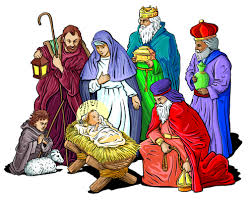
Matthew’s version includes a heavenly star and oriental court astrologers who visit Mary and Jesus at their Bethlehem home address. There’s the maniacal and jealous King Herod who orders all males under two years old murdered, in his effort to eliminate this contender to the throne. Joseph takes Mary and Jesus out of Bethlehem and eventually to Egypt until wicked King Herod dies. When the coast is clear, the First Family moves to Nazareth where Jesus will spend his youth.

Luke’s version has Joseph taking his pregnant wife, Mary, from Nazareth to his ancestral home town of Bethlehem for tax enrollment. Upon arriving the couple discovers that every hotel room is booked, and thus is forced to stay the night in an animal shack behind the inn. There Mary goes into labor and delivers Jesus. Meanwhile, an angelic choir announces to shepherds in their fields that a savior has been born in Bethlehem. They go with haste and find the First Family in the stable, just as foretold.

There are some obvious inconsistencies between these two Nativity stories – maybe you caught them.

Joseph and Mary begin in Nazareth and go to Bethlehem in Luke’s version, whereas they end up there after starting in Bethlehem in Matthew’s. Luke’s shepherds visit Jesus in an animal stable, while Matthew’s astrologers find him in a “house.” Obviously one has to be right. If you had been there, what would you have seen with your own eyes?

Before you answer, let’s note that Luke’s shepherds are probably hired hands or day laborers, down in the socioeconomic mucky bottom. They aren’t businessmen, artisans or merchants. They represent the class just barely inside the definition of class, and definitely outside of having any political clout.

Matthew’s court astrologers, on the other hand, are pretty high up on the social ladder. They may be outsiders but they come with wealth and power. Still they leave their country and kingdom in search of the “king of the Jews,” and when they find him they lay their offerings at his feet.

So did it happen just that way? But which way?

In their effort to merge these different storylines into a single coherent narrative, commentators have suggested that Matthew’s events actually took place after Luke’s – maybe as many as two years later. That accounts for Herod’s massacre of two-year-old males and gives the First Family time to get from the stable into a bona fide residence. The astrologers and shepherds never met each other, which means that our crowded manger scenes on postcards and storybooks are an historical inaccuracy.

But it’s not necessary to merge these two narratives. They are inconsistent only if your assumption is that the truth is somehow outside the stories, in the facts of history and what must have “actually happened.”

This question of which Gospel Nativity story is true – and the question of truth in story generally – cannot be answered by jumping out of the story and looking for facts to back it up. Actually, this scramble for historical evidence and the sworn testimony of eye witnesses is a very late development. It became urgent and pressing once the spell was broken.

What spell? The spell that any great story puts on the mind of whomever is willing to “go under” its entrancing power. You can’t keep interrupting the narrative with ejaculations of “Did that really happen?” and “Is that literally how it went?” Follow the example of a young child: Once upon a time carries the imagination into another world – that is to say, into a different narrative construct from the one you’re in right now.

Don’t sweat it. You’re just leaving one spell for another. You’ll be back in no time at all. For now, simply relax, close your eyes and listen …

Luke’s Nativity introduces you to the start of a world revolution, where an insurgent savior is born into poverty. The good news (gospel) of his arrival is first announced to shepherds “living in the fields,” outside and away from the power-centers of wealth, politics and religion. The Jesus of Luke’s Gospel – if you are patient enough for the whole story – continues to fill out this character who comes to level the playing field, to challenge the high and mighty, and pull the hopeless poor to their feet. Luke’s Jesus is the prince of a new kingdom, and you are invited in.

Matthew’s Nativity invites you to a revolution as well, but his messiah is fashioned on the model of Moses, the great liberator who saved his people from bondage in Egypt. In order to solidify this association, Matthew arranges for Jesus to be in Egypt (hiding from Herod) and be granted a safe exodus into the new “promised land” of Nazareth. Matthew’s story overall is about the world significance of this New Liberator, represented in a heavenly star high above and foreign magistrates from far away. Apparently no one alive “under heaven” is excluded from this very good news, not even you.

Coming back to the burning question, what can be said about the “truth” of these stories?

The Nativity stories are not true because they accurately relate how things actually went down. They were not composed as an effort to piece together evidence in a factually reliable report. We can safely make this generalization about all true stories. They are true to the degree they are successful in bringing about a transformation of consciousness, orienting the spell-bound audience to reality with a new set of values and expectations. If the story changes you, then it’s true.

But if it can’t change you, simply because you refuse to “go under” and get “caught up” in its alternative fantasy, then it’s “only a story” or “just a myth.” You might as well set it down and get on with your life, such as it is.

Just a Little More Reality (Please)

Constructivism is an approach to understanding the world we live in as a product of our own creative intelligence. “World” refers to the habitat of meaning that human beings construct around themselves for security, to support identity, and to provide a sense of purpose to their lives. As a social species, humans are compelled to carry out this construction project in tribes and communities, where the larger world they share together is known as culture.

This project of world-building has progressed apace with our evolution. Since earliest times, the spontaneous and ineffable mystery of being alive has been rendered in language first as archetype, then metaphor, myth and (quite a bit later) theory. These various conceptual devices (symbols and symbol systems) enabled our hominid ancestors to articulate an expansive and increasingly complex web of references, inside of which everything had meaning.

In this blog I’ve been exploring creative change from a number of different angles. My philosophical preferences in this quest include (1) constructivism, (2) perspectivism, (3) metaphysical nonrealism, (4) evolutionary psychology, and (5) a mystical orientation that regards all of the worlds we make up (however meaningful) as nothing more than secondary qualifications on an essentially unqualified mystery – the moment-by-moment wonder of experience itself.

Metaphysical nonrealism sounds more sophisticated than it really is. Very simply, it is an unwillingness (hence the “non” in nonrealism) to assume that the early stories of primitive and ancient cultures were based on what we today would call supernatural encounters with metaphysical realities. Just because a myth speaks of gods, devils, angels and disembodied souls doesn’t compel us to take them literally. Indeed, taking them literally is just as irresponsible – and I would add, intellectually lazy – as dismissing them out of hand as hallucinations or lies.

A representation of god in a myth needs to be interpreted and understood within the story’s own web of references, and also, moving out into the larger worldview of its authoring culture, across numerous overlapping webs. Our assumption that these stories were reports and eye-witness accounts of real things (metaphysics) and actual events (miracles) is already “breaking the spell” of the story-telling art, which is about taking us inside and transforming consciousness.

Tragically, an irreversible side-effect of mythological literalism is that it leaves the contemporary reader in a depressed state of disillusionment. No one today experiences god in the ways the Bible personifies him. No one ever has. But because we don’t, our only conclusion must be that we have fallen farther into sin, ignorance, and spiritual blindness. All the more reason to take the Bible literally and not question what we’re told.

A more interesting explanation for our current disillusionment, besides it being the consequence of mythological literalism, has to do with some conflicts that are internal to our psychological development. The evolution of our species – which can be observed in a developing individual across the lifespan – has opened our perspective on reality at different “standpoints” along the way. In earlier posts I have named these standpoints “body,” “ego” and “soul.”

In the space I have left, I want to explore three distinct “powers” that correspond to these standpoints in reality. These powers might be thought of as three strands in a braid, complementing each other but also generating conflicts between and among themselves. Such conflicts, I would argue, are a key to appreciating the complexity, wonder, ecstasy and torment of being human.

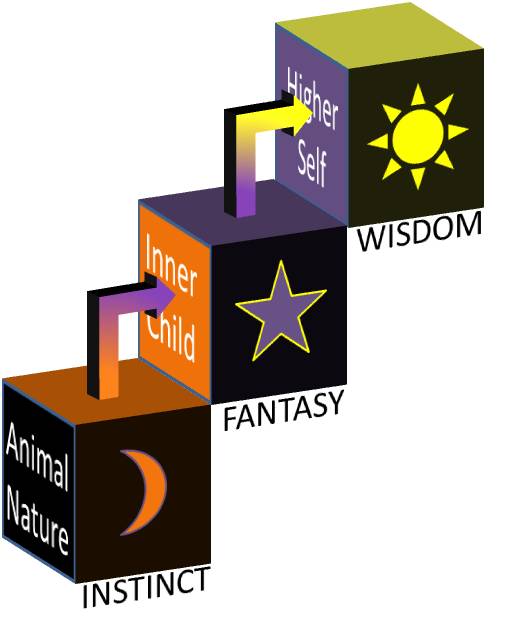
Three AspectsBody is your animal nature. The particular power-strand that resides there is instinct – the urgencies, impulses, drives and reflexes that are rooted in the very deep evolutionary past. Instinct is non-personal, which is to say that it has no concern for the personality. The moon is my symbol for it, representing the dark realm of our unconscious (and autonomic) animal life. Instinct carries on far below the light of conscious awareness. It comes before thought and precedes even feeling.

If you didn’t have instinct, you would die. The countless events, urges and reactions in the biological foundations of your animal nature are regulated constantly for the primary purpose of keeping you alive. When your life is threatened – or you perceive it to be – strong and often irresistible reflexes and “gut reactions” move you to behave in a defensive, avoidant, or perhaps hostile manner.

But you are more than a body. Because humans are a social species – collecting into clans and communities where resources can be shared, where the very young and the very old can find protection, and where world-building can begin – our hominid ancestors were faced with the challenge of channeling the dark powers of animal instinct into some kind of social order. This domestication required some impulses to be redirected into acceptable behaviors, while others were gradually “pinched off” through progressive discipline.

Your childhood brought you through experiences highly unique to the interactions inside your family system. But however it went for you, one important outcome was the formation of your identity – maybe enmeshed, codependent or estranged in some ways, but an identity nonetheless. This is your ego, which during your childhood was who you were in your relationships with others. If you are now an adult, we can speak of this center of (largely emotional) identity, restraint, agency and ambition as your inner child.

The power-strand corresponding to childhood, the ego, and your inner child is what I call fantasy. It is, very simply, the productive genius that enables you to make believe and pretend, to tell stories and still get caught up in them. My symbol for fantasy is the nighttime star, not like the shape-shifting moon pulling on sea and blood, but twinkling in constellations of mythic forms from the realm of story and dream. Even after you grow up, your story-telling inner child continues to compose the narrative plot (Greek mythos) of your personal myth.

I don’t regard the ego/inner child as something that prevents you from what you are ultimately here to become or accomplish. Just as instinct is necessary for you to stay alive, fantasy is equally as necessary for you to have an identity and make meaning. You will be telling stories until you die. If you should stop telling stories before you die, you will likely fall into a suicidal depression and die anyway. The truth of your personal myth is measured by how much more awakened and genuinely human you become in telling it.

One thing a child doesn’t have a whole lot of is experience – the months and years that afford a broader exposure to the variety of troubles, challenges, opportunities and lessons that life has to teach. It’s impossible to say when it happens, and it’s probably different for everybody, but there comes a time when the time you’ve had provides you with an understanding of “how life works.” This is known as wisdom.

To be “wise” or to have wisdom doesn’t mean that you’re smarter than everyone else, and it’s not about knowing things that are theological or metaphysical in nature. Wisdom is exquisitely practical and famously pragmatic. It involves using critical reason and making good judgments, giving attention to detail but also extracting general principles that can apply across similar situations.

Whether you would consider yourself very accomplished at wisdom, or are the type that seems to need numerous sessions in the school of hard knocks before you finally “get it,” as an adult you have been through enough of life to have a sizable collection of observations and discoveries to draw upon.

Drawing upon the lessons of life is the business of your higher self (or soul). Cultivating wisdom requires reflection, obviously, or else you would never stop long enough to pick up your lesson and carry it forward. We could add other supportive practices that enhance the cultivation of wisdom: introspection and mindfulness, self-honesty and humility, responsibility and forgiveness, being open-minded and willing to change your verdict should the evidence demand it.

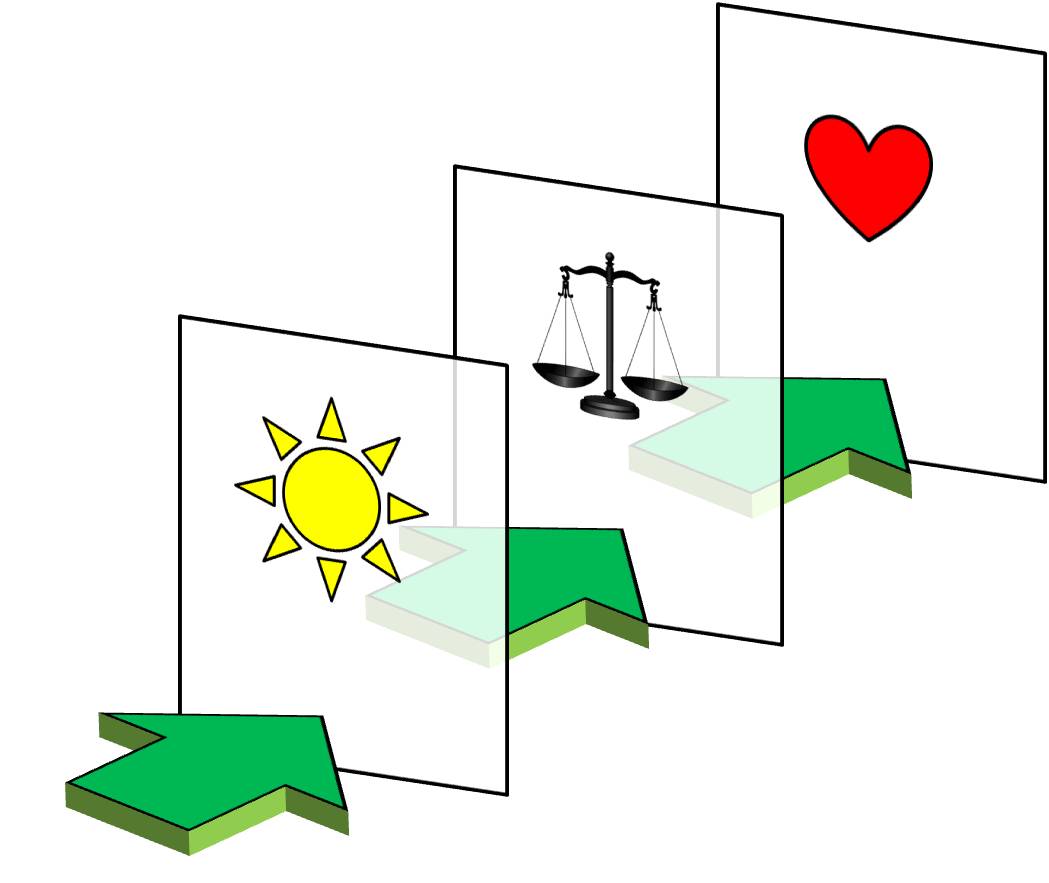
My symbol for wisdom is the sun, which is actually fairly popular across the cultures as representing clear-sighted impartiality and radiant understanding. Seeing as how wisdom is extracted from the churning stream of real experience, and how it lifts to universal validity certain truths that are purported to transcend the vicissitudes of time, perhaps this is also why the higher self is commonly regarded as immortal.

Thus, you are a microcosm unto yourself. The myth-maker of your ego/inner child/fantasy spins out the stories that give your life meaning. Below is the dark force of your body/animal nature/instinct, dependable in its rhythms yet always urgent at the threshold to your tidy world. Above middle-world, resting quietly and detached on the dome high overhead, is your soul/higher self/wisdom. With the benefit of its elevated vantage-point you can survey the entire field of your present and past experience.

Of course, your inner child must struggle with and can hopefully befriend your animal nature. And your higher self needs to gently persuade your inner child to rise above self-interest for the sake of self-actualization, to let go (just a little) of security for fulfillment, to break open the small horizons of your world in order to take in (just a little) more reality.

Excavating Christmas

Let’s get out our shovels. We are searching for the true meaning of Christmas – this season that rushes upon us and is as quickly gone again.  Our quest will proceed on the analogy of an archeological dig.

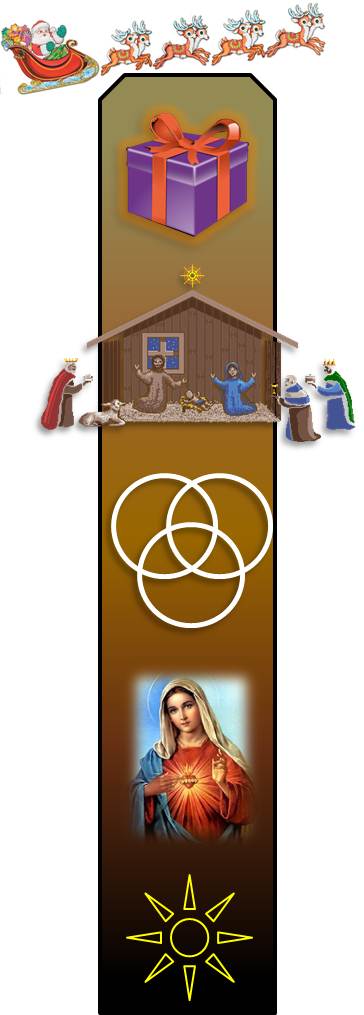
Christmas ExcavationBefore even breaking the surface, one layer in the meaning of Christmas is commercial. Earlier each year, it seems, retailers are pumping the music, putting out their holiday sets, and giving us fair warning that our chance at 60% off is “this weekend only.”

Christmas is a celebration of materialism. It is time to buy – before it’s too late. All the glitzy and gaudy trinkets, the Jing Tinglers and Flu Floopers, are brought out of storage to get us in the mood. Our credit card balance after the holidays is the lingering reminder that we got bamboozled once again.

Just barely under the surface of this layer of Christmas commercialism is the figure of Santa Claus. He’s the one we’re waiting for, hoping he’ll bring us what we really want this year. Or maybe he’s the one we’re pretending to be as we swipe to satisfy the material cravings of our children.

“Santa Claus” is an informal rendering of Saint Nicolas, which suggests that this genius of package delivery logistics is somehow (or once was) a religious notable. His backstory in folk tale and legend tells of his charitable endeavors in bringing cheer to orphans and children whose families couldn’t afford the luxury of toys.

The giving of gifts brings us down yet another layer in our excavation of Christmas. We need to be reminded every year that it’s not the gift but the thought and love behind the gift that really matters. Back in the day, according to the Bible story, wise men from the east brought Baby Jesus their gifts of gold, frankincense and myrrh.

Narrative detail would probably be more important to us had Christianity remained anchored in its foundational myths. As it happened, story gave way to theology, and abstract doctrines took over from the concrete narratives that shaped the earliest Christian experience.

Stories are arranged in a system called a mythology; doctrines are arranged in a system known as orthodoxy. Stories appeal to the imagination, doctrines to the intellect.

At the doctrinal level, Christmas is about the Second Person of the Trinity (the Son), the sinful condition of humanity, the “kenosis” or self-emptying of God in becoming human. The vehicle of this incarnational miracle was a virgin, whose status as “Christotokos” (Christ-bearer) made this a central doctrine not only for Roman Catholics but Protestants as well.

Inside of story and deep along its root-line is metaphor, which is a way of representing something that eludes our conceptual grasp. Once the metaphor is offered up by creative imagination, our minds get busy weaving a meaningful pattern of storylines around it.

Stories of immaculate conceptions and virgin births can be found across the cultures. Early Christian storytellers were not the first to ponder this metaphor as a kind of doorway or passage from eternity into time. It’s important to know at this point that eternity does not mean “everlasting” or “unending,” as it is popularly (mis)understood today. Instead of “without end,” eternity refers to what is “without beginning.”

Rather than thinking of eternity as an endless extension of time, or as another realm of existence separate from this one, imagine time as we (think we) know it moving like a horizontal stream in a “forward” direction. Eternity would be represented as a perpendicular line drawn straight down along the vertical axis. The place of this intersection is not itself part of the time-stream, but always NOW. It’s not that this present moment comes to us from the future, and neither does it recede into the past. It is timeless.

Contemplating Mary and the universal metaphor of the Virgin Mother, we can begin to appreciate her value to mystics everywhere, by whatever name she is called. She is a literary symbol, a mythical archetype, and – in a celebrated paradox – the spiritual embodiment of those qualities that must be nurtured if you are to be fully present to the mystery. What qualities?

Emptiness. The opposite of emptiness is not fullness, but preoccupation. Instead of relaxing the boundary of attention and expanding your capacity for awareness, your mind becomes increasingly cluttered. Real presence is available as you are able to drop assumptions (from the past), release expectations (for the future) and surrender all distractions.

Humbleness. From the root-word humus, “humble” and its cognate “humility” carry the idea of being fully grounded. Not exalted or “full of yourself,” not inflated or disengaged from what’s going on, but fully here and now. Humility is a position of greatest strength, balance, and resilience. In the present moment you are grounded in the really real.

Faithfulness. Having little or nothing to do with orthodox beliefs, faith refers to the act of entrusting yourself to the providential support of reality in this moment. Its opposite is not doubt, but conviction, which is not about opening up to mystery (as faith is) but closing down on meaning.

Creativity. The creative life is not about “making” something of yourself or accomplishing great things in the eyes of others. You give a lot of attention and time to making money, making progress, making up, and making do. Creativity doesn’t flow along the conventional channels of effort, work and accomplishment. Instead it breaks into time through the portal of this present moment.

I’m suggesting that while in the deeper layers Christmas might seem like it’s about something that happened a long time ago, the early Christian myth-makers were not writing history, doing theology, or just making stuff up. The Story is a creative composition, to be sure, but it’s more an exercise in mystical contemplation than anything else.

Christmas is an invitation to get to a place where you are empty, grounded, and open to the real presence of mystery. Only then – when you are centered, quiet and receptive within – can the creative life truly begin.

The revolutionary life of Jesus came through the contemplative preparation of Mary. It still does.

A View on Religion

I have a friend who’s in midlife and struggling with the creeping irrelevancy (my term) of his religious beliefs. His personal history with religion (Christianity) doesn’t go all the way back into childhood, but it’s deep enough to have been a significant force in shaping his adult worldview. He and his wife raised their children in a denomination committed to staying as close as possible to the New Testament church model.

It’s probably fair to say that he’s never been in full agreement with the positions his religion has taken with respect to sexual ethics, gender equality, cultural engagement, or truth in religion. But it allowed for some flexibility, at least in the private holding of his individual faith. Over the years, his involvement in church connected him to other believers who became good friends. They raised their kids together and shared a lot of life.

As his doubts rise over the real truth-value of his particular brand of religion, my friend is wondering if there’s truth in any religion. Over the past half-decade, he and his wife have stepped out of church-going. Their children are adults and out of the house, making choices of their own regarding religious affiliation and faith practice. So the obligation of raising a family in a supportive community with clear moral values can be released.

But they still get together with the same friends, only now their conversations are becoming increasingly strained and uncomfortable – particularly as they orbit around issues of doctrine, the Bible, and exclusive salvation in Christ alone. My observation is that he’s also struggling somewhat with the metaphysical assumptions that have invisibly supported his fading convictions.

If you no longer believe in heaven and hell as destinations of the soul, is it necessary to give up believing in the soul? If you are having second thoughts around the claim of exclusive salvation, does the notion of salvation itself need to be abandoned? And if the very idea of a god “up there,” “out there” and external to the world feels contrived and irrelevant to daily life, is atheism the only alternative?

My friend is searching for a new vocabulary that can adequately articulate his evolving spirituality and connect it meaningfully to his life-world. He is understandably concerned that his unwillingness to simply accept as truth what he once believed, and what his church friends still believe, will alienate him from people he doesn’t want to lose from his life.

Of course, many of us arrive at points along the way where the strength of a relationship is tested by our differences over important matters. Religion, politics and morality are frequently powder-keg topics that have a reputation of blowing apart long-standing friendships. Each of us needs to come to terms with how much trust, acceptance, accommodation and forgiveness we are willing to invest in any relationship.

If I reject you just because your beliefs have changed and no longer match my own, can I really be said to have known and accepted you for who you are?

This “new vocabulary” my friend is seeking is also something that I’ve been trying to work out over the years since stepping out of professional church ministry. Here’s something that’s become an essential starting point for me, in order to set up a fruitful conversation about religion, truth, and experience.

Religions are mystically convergent, but doctrinally divergent.

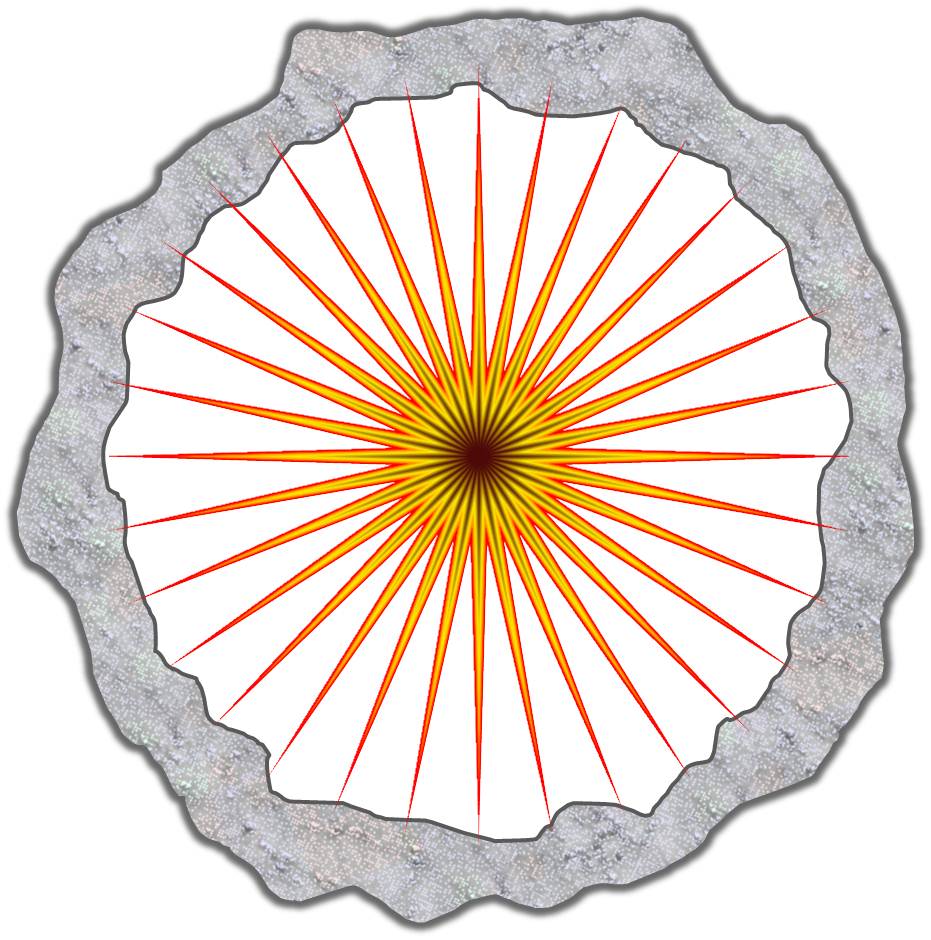
ReligionLook into the center of the picture above. Soon enough you’ll begin to see the pupil of an eye dilating and contracting as it stares back at you. That center represents what I call mystical experience. Like a black-hole pulling you through and beyond the world you think you know, the mystical experience transpires in a place that is “no place.” And yet, this now and here (now/here, nowhere) is the starting point of your existence.

The term exist literally means “to stand out,” and what you stand out from is the present source and support of your being. Mystics name this source “the ground (of being),” and experiencing it is to experience the present mystery of reality itself, the deep creative support of all things – including, of course, your life in this moment.

Authentic religion (Latin religare, “to tie back”) is motivated out of a desire to tie the business of daily life back to this Source. As a constructivist I see it as a way of keeping the mental construct of my world connected to reality, the really real. This tie-back operates in opposition to another impulse in religion, which is to fly out into the symbols, stories, theories and farther abstractions (like metaphysics) that express and explain what it all means.

I understand that not all religions have their roots in mystical experience, but my contention is that every true religion does – or at least once did, at its birth. A founder, or founding community, was inspired or disturbed by an experience of the real presence of mystery, which called for a new way of being and behaving in the world. This means that all (true) religions are mystically convergent – that is to say, they share a common ground and have their roots in essentially the same experience of mystery.

But then, the other impulse – to express and explain – takes us into the more provincial way that each religion interprets this experience of mystery into the web of meaning that connects it to the concerns of its present generation. Every community and its larger culture has a history, with all the factors of ancestry, language, geography, politics, and worldview that make it unique. If the experience of mystery is to make sense and have meaning, then it must be translated into this cultural vocabulary.

The founder of Buddhism translated his experience of mystery into a vocabulary of appearance and essence, attachment and release, illusion and enlightenment, suffering and the way of compassion. Centuries later, the founder of Christianity translated the experience (his own, not someone else’s) into a vocabulary of law and love, separation and communion, identity and inclusion, justice and unconditional forgiveness.

As you follow just these two examples of present-day world religions, your investigation will take you farther out along their divergent paths. “Nirvana” (the liberated state after selfish craving has been extinguished) is not in the Christian vocabulary, and neither is “kingdom of God” (the inclusive community of neighborly love) in the Buddhist. The farther out you go, the more divergent the paths become.

So where is truth, then? This is where my friend’s personal struggle is focused. Too many people are trying to work out this question of truth in religion at the far-out periphery of my illustration above. Their assumption is that truth is a matter of how accurate the terms (doctrines) are to the reality they describe. There comes a point, however – represented in the ring of clouds or smoke at the outer edge – where the pursuit of doctrinal clarity and precision eventually produces the opposite in a hopeless confusion of terms. (This is typically where sects, schools, and denominations take off on their separate tracks.)

To stay with my examples, either Christianity or Buddhism is the “true religion,” but not both. (Of course, a Muslim who’s caught in this same way of framing the issue, will claim that neither one is true. His own religion of Islam is the true and only way, while these others are mistaken and dangerous lies.) Truth, according to this approach, is doctrinal and all about accuracy. Who’s telling the truth? Who’s got the story right? Who’s getting saved in the end?

One problem with this line of questioning is that (as I explored in a recent post) each of these religions in its present form might be quite far off the path of its original teaching. When Buddhists, Christians or Muslims do violence against each other or their own, then it’s rather apparent that they have betrayed the revelation of their founders. It might well be the case that we are comparing somewhat (or entirely) corrupt versions of these distinct religions, which makes the project of sifting for truth especially problematic.

But here’s my point. Truth is not about how well our words and definitions match up to the present mystery of reality. The very nature of meaning is that it’s constructed (made up, put together) and conventional (supported in the agreements that a people hold in common), which also implies that meaning is relative to the context and needs to be relevant to actual life. When it ceases to be relevant – when the vocabulary and its worldview, along with the metaphysical assumptions that lie behind it, lose their connection to everyday life – should we just throw it aside and start looking for another? This is what some people are doing these days.

Or maybe we should make ourselves believe it anyway, attributing the feeling of creeping irrelevancy to our ignorance or lack of faith. If our rescue from this world and everlasting security in the life hereafter depends on getting it right, then you’d better believe it – even (or perhaps especially) if it doesn’t make sense. It’s all a mystery we can’t understand. Don’t jeopardize your salvation in your selfish insistence that religion should make a difference in this life.

I would respond to my friend this way: The beginning of true religion, as well as its proper end, is in the mystical experience where you find your ground and release yourself to the greater reality to which you belong. This experience of real presence, of the present mystery, of the really real in this moment invites you deeper into life. As you awaken to the present moment, to this moment of presence, to the Eternal Now, your neurotic compulsions will gradually relax and fall away. In that moment you will come to realize that here and now is all there is. In the real presence of mystery, all is one.

Now your task is to make sense of it, constructing a meaning to the mystery that will help you stay grounded and connected. That will be your religion. It might look a lot like the one you’ve been in for a while, but now with a refreshed relevance for having been reconciled to the same mystery that inspired Jesus so long ago. Or it might look very different.

The responsibility is yours to translate the mystery into meaning. But stay close to the mystery. Meaning will always change, as it must if relevancy is your concern.

I support you in that quest, for it is my quest as well.

Creative Choice

The creative life is not simply a life without limits, but is more about freely choosing the limits that define your desire. Without definition, the creative desire that Nietzsche called the human spirit splashes out and seeps away, falling short of realization. The other side of it for Nietzsche was the degree in which our limits can strangle the spirit and pull us down into mediocrity.

When I sit with a client, one of the things I’m interested in is his or her behavior. What are you doing? How are you conducting your life? Quite frequently we will discover that the individual isn’t really “conducting” it at all. Instead, the client feels pinned down under the weight of social duty and moral expectations. “I’ve been doing what I’m told, and now I feel like a fake. I’m not living my own life.”

Sometimes it becomes obvious that the individual’s behavior is on automatic pilot. Perhaps it’s not so much the obligations attaching to his or her social roles as it is the dead inertia of habit, trudging on without passion or engagement. This is really Nietzsche’s point, even though he’s most misunderstood here. The individual, moved for so long out of obedience, never truly awakens to his or her own freedom to choose life. It’s not that “morality” is bad, but that it can put us to sleep inside its neat little boxes.

Impulse

Desire originates as an impulse, rooted in the urgencies of our biological life. The natural aim of desire is to find satisfaction by gratifying this impulse. At this level consciousness is fully contained in our animal nature. A newborn baby exemplifies the impulsive life, in the way its behavior spontaneously seeks out the satisfaction of basic needs.

But a human being is also “hard wired” for relationships, not only by virtue of our early dependency on providers but also because these social bonds are necessary to the formation of identity. In the construction of ego, the tribe shapes an animal nature into an obedient and cooperative member of society – or at least that’s the intended outcome. The tribe accomplishes this through the imposition of various constraints; think of them as the “hold” and “push” that gradually train an animal nature into something more domesticated and well-behaved.

Constraint

Don’t do that. Do this instead. That’s what I mean by a “push” constraint. A “hold” constraint is when the instruction is more simply about not doing something, at least not here, not now. There’s a time and place for that, and this isn’t it. Hold that impulse and keep it to yourself. “Hold” constraints often carry the tribe’s shadow, in the fear, condemnation, and consequent shame that get attached to certain animal impulses.

For a while this force of social constraint needs to prevail over the individual’s impulse for immediate gratification. Tribal order and the common good require that some impulses get trained into compliance, some get sublimated in more refined outlets, and some others are kept in the closet. Nietzsche had some trouble with that, as you might expect, but his real complaint was with what typically happens next.

Over time, the control system of social constraints gets internalized, in what Freud would later name the “superego.” Not to be confused with conscience, which refers to an inner sense of how we can best get along together in community, the superego is the pressure of the group on the individual to conform. The real danger is that this “inner parent” will supervene on the individual’s evolutionary need to take control and live his or her own life.

Habit

Habit is a marvelous adaptation in the way it submerges routine behaviors into “thoughtless” performance, in order to liberate conscious attention for higher pursuits. But habit is also the rut where we can curl up and fall asleep to the challenge and mystery of being alive. As social duty is pressed upon the individual and gradually insinuated as the superego, this rut of moral obligation can become the permanent “depression” of the spirit.

This is what Nietzsche (and many others) saw all around him, but it’s not merely a nineteenth-century problem. In his opinion it is the dilemma that represents a critical break-point in human evolution. We will either wake up and start living the life we really want, or we will die in the rut of our daily grind. For Nietzsche it was fulfillment or obedience. After doing what we’re told for long enough, it comes time to choose.

But you need to be awake to choose.

Restraint

The control system of tribal morality is necessary to the construction of personal identity (ego). Our animal nature with its powerful and insistent impulses needs to be domesticated and trained into a cooperative member of society. The way it should work is that these external constraints (“hold” and “push”) gradually assist the individual in developing internal restraint, where he or she is able to “pull” back on impulse and give opportunity for the consideration of options.

What I’m calling internal restraint is not repression, which is about “push” again, this time back and down into a shadow of shame. Restraint is that critical piece of self-control where the individual is able to do something with the impulse, rather than be done by it. Paradoxically restraint is the birthplace of freedom – the evolutionary threshold that Nietzsche announced and prophesied about.

Consideration

Self-restraint thus opens the field of awareness to at least two options: act now or wait til later. But almost always there is a variety of other options that present themselves as well. Maybe you don’t act on your impulse at all. Maybe instead of swinging back you choose to let go. Maybe you find a more compassionate or courageous way to move your life forward.

The point here is that restraint makes consideration possible. Once you have options, you need to weigh them against each other to figure out which one has the best feel and fit. If you are truly free to live the life you want, then your choice cannot be coerced – not by god, government, church or superego. A forced choice is not a choice.

Vision

Finally, this foreground of consideration begins to clarify some future goals – outcomes and consequences that are likely to follow upon one option or another. At this point the individual is stretched in his or her thinking to imagine a preferred future. As the picture becomes more vivid and compelling, some ideals grow in strength as priorities and illumine the path ahead.

Nietzsche’s ideal was of the fully awakened and self-responsible creator. There’s no room here to expand on it further – I have in fact explored the idea in previous posts (see Waiting Around), but this is what I see in the mythological god. This principal figure of religious myth can be observed evolving over many centuries and across cultures, into a “fully awakened and self-responsible creator.” In other words, the mythological god is the literary representation of our human ideal, the Great Attractor of our higher potential as a species.

Unfortunately – and as Nietzsche saw it, tragically – whereas religion might have been the midwife of this spiritual birth, it too often goes the other way. The tribal control system refuses to let the child grow up and take the lead in his or her own life. The god of dogmatic orthodoxy regresses back into an authoritarian, jealous and vindictive anti-ideal. True believers strive almost neurotically to please, placate, flatter and impress their god. Just don’t piss him off, or it will surely be curtains for you.

Sun

Choice

More than ever – and this has always been true – our future as a species hangs in the balance. And as in all other times, now is the time to choose.

It’s time to step creatively into the life we really want.

The Only Way of Salvation

Religion is an answer to the problem or dilemma that besets our human condition. Throughout its long history, the answer of religion has changed according to the nature of its problem.

Earliest religion was focused on the body and a need for the business of society to stay connected to the provident rhythms of nature. It was ceremonial, meticulously ritualized, and dedicated to synchronizing cultural activity with the urgencies, cycles and seasons of life. In its elaborate productions culture spends the energy that nature provides, requiring regular refreshment to continue.

The dilemma or problem, then, had to do with the fact that culture is not a renewable resource. Despite its impressive production output, societies continue to depend on the life energy and raw materials of the planetary environment. Living off the land and taking the life of other animals for food made our earliest ancestors keenly aware of the need to respect this balance, cooperate with nature, and repay a portion by ritual offerings and sacrifices.

In time, the focus shifted to more socially unique concerns like security, membership, identity and purpose. Thus arose a religion of the ego. If life energy is drawn up from the animal nature of the body (and from the greater “mother nature” of our planet), then ego is where a large amount of this energy is expended. Pursuits of security and recognition, property and status, quickly exhaust themselves. They are not replenishing cycles but more like straight lines losing strength and trailing off in the hopeful pursuit of “enough.”

As the personality is chronically stressed by discontentment, eventually the ego fastened on a marvelous fantasy – that one day a clean escape would be made, leaving behind the mortal burden of the body and accomplishing at last a perfect state of everlasting security. What we can call “ego religion” is focused on artificial life, not natural life; on a life that is unnaturally extended along a straight line that never ends. Its fantasy is of a disembodied and entirely metaphysical existence, reunited with a “heavenly father” after a painful and frustrating sojourn with “mother nature.”

Ego religion tends to be denominational (heavily invested in the tribe and its tradition), proselytic (focused on conversion and recruiting members), moralistic (enforcing rules on how one should live), and gnostic (upholding and defending certain doctrines as necessary to salvation). As a program for resource management, social cohesion, and mind control it can’t be beat. While it demonstrates little sacred concern for nature and the body, vestiges of earlier (nature) religion persist in its holy days (holidays) coinciding with solstices, moon phases, and seasonal transitions.

What raises the concern of many today is not so much that ego religion is all those things just mentioned, but that it pushes an agenda of escape, disassociation from the body and nature, and departing to a better place. How long can it go on, where we use up the resources of one location and abandon it for the next? How much longer can we continue to generate stress – perhaps the one renewable resource of culture – and multiply the diseases of body and mind?

How long, really, can we live as “souls inside bodies,” waiting in patient hope or hastening the day when we shall be set free from this prison house and rewarded in heaven for being good and getting it right?

So that is the problem of our human condition today. The fall-out of this divided life of ours – suppressing, craving, consuming, wasting and leaving – makes coming back not only less and less appealing, but over time less and less possible. The irony is that, while religion might offer an answer to this problem, religion is itself a major cause of the problem. The vision of a scorched and lifeless landscape contained in some of its apocalyptic myths is slowly (but less slowly) becoming our self-fulfilling prophecy.

If religion is to offer an answer to the dilemma of our human condition, then it will be a call to return. Interestingly enough, this is the literal meaning of the familiar word “repent.” In this case, it’s a call to return to what we have been trying so hard to leave behind – the earth, nature, our bodies, and the burden of mortality.

This is what I am calling “soulful religion,” which is not a religion about immortality, metaphysics and the afterlife, but rather of incarnational living, creative community, human fulfillment and planetary well-being.

In fact, it seems to me that this has been The Way of Salvation from the very beginning. During the long winding diversion into metaphysics, escapism and redemptive violence, a few brave lights did emerge from time to time. They spoke of life HERE, love NOW, and of liberty beyond the confines of tribe, tradition and orthodoxy. It didn’t go well for many of them.

Ironically (again) the very crusaders who persecuted and stamped out these light-bringers later memorialized and venerated them in their churches. But not until the story could be rewritten and the savior remade into a drop-in rescuer, a god in disguise, or a scapegoat for sin. (Jesus was made into all three.) As Bible scholarship is able to do its business outside of denominational publishing houses and unmotivated by religious convictions, the emerging picture of the “historical Jesus” is looking less and less like the Savior of Christendom.

In a time when many are asking about truth in religion and the way of salvation, we need to consider this possibility. It’s not that one religion is true while the others are not; or that all religions are true in their own way; or that religion itself is nothing but superstition and lies.

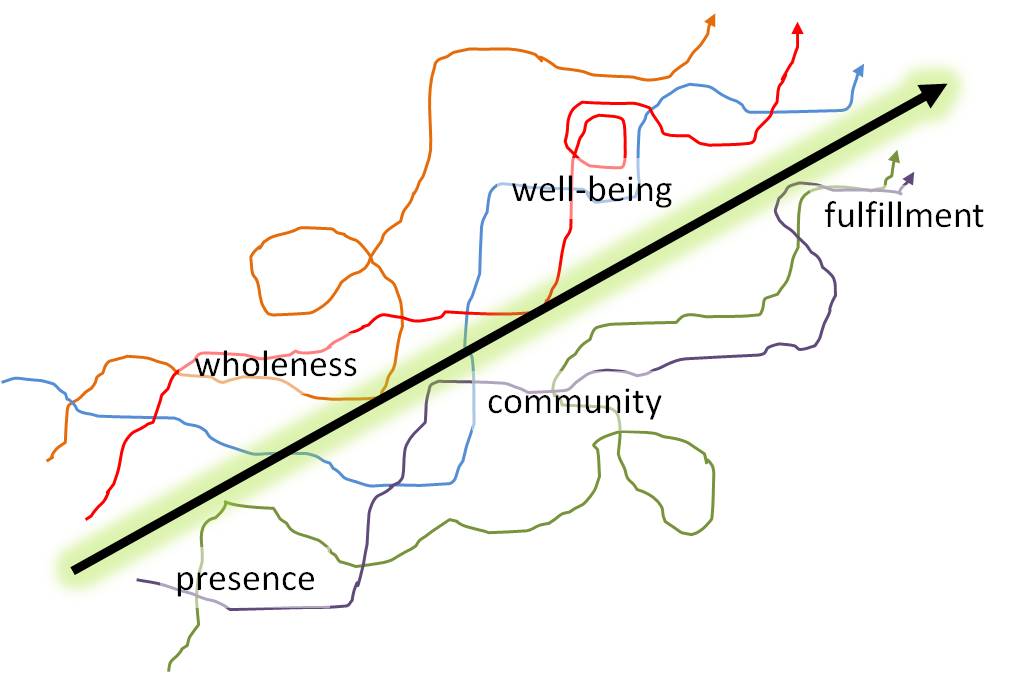
Rather, the religions are like squiggly lines moving across history, each one a meandering path through the landscape and time zones of our collective human experience. Most of the time, a given religion is busy working out its metaphysics, redefining its membership, getting back to fundamentals, or accommodating itself to the larger culture.The WayBut once in a while, the squiggle takes a turn and comes very close to the invisible guideline of fulfillment, wholeness, well-being and genuine community – to the greater wisdom and higher ideal of our own human nature. The light goes on, fear drops away, love opens out, and peace settles in. For this brief moment, as it aligns itself to The Way, a religion can be said to be true.

And in the next moment, as this truth gets defined, professed, and defended as the “only way” to god or heaven or life everlasting, it just as quickly veers away and falls off course. In some eras of history – and maybe we’re in one now – it’s possible that all religions are squiggling off in the distance, while just a few individuals around this whole planet – and maybe you’re one of them – are waking up and stepping quietly on The Way.

Human Purpose

In my last post I identified what can be thought of as the channel of creative life, summarized in the “upward-and-outward” flow from internal security, into skillful control, opening up in freedom, and fulfilling its purpose in accomplishment. These four are the positive illusions human beings must have in sufficient degree in order to keep from insanity (where we lose our minds) and inanity (where life loses significance). But there must be a complementarity and balance among them, or else this channel of creativity will get hooked or crimped along the way.

Human beings are animals – however justifiably we may see ourselves as “special” and “unique” among the animals. As such we possess an animal nature equipped with urges, drives, impulses and reflexes that have evolved for our survival and prosperity. The specialness of our species has to do with the fact that our development is socially dependent. Our brain continues to form itself throughout life, according to the challenges and opportunities of social interaction.

With the invention of language and tools, we have been able to adapt to our situation on this planet. But more than just accommodating ourselves to the circumstances, our big brain has enabled us to imagine possibilities, invent our own “socialsphere” of culture, innovating and improvising on reality in astonishing ways. All of this creative output is more than just a further extension of unconscious instinct. It is the expression and product of a certain disciplined, methodical, and technical kind of performance called “skill,” and skills must be learned.

In a skillful performance – of any kind, and it doesn’t have to be “artistic” in the narrow sense – you need to be centered and grounded within yourself. This is what I mean by security. If you don’t have the sense that you are deeply established in a reality that is supportive and provident, the consequent anxiety will interfere with your performance – if it doesn’t entirely block and frustrate your creative flow.

Once established and confident within yourself, the next step is to take up the tool or instrument that will serve as the means by which you will accomplish your outcome. This instrument doesn’t have to be physical or mechanical in nature; your own body (think of dancing) or a theoretical model that provides a way of “wrapping your mind” around something are also examples of instruments. Your skillfulness with such tools involves taking effective control in the movements (physical or mental) required for their intended function.

In the “learning phase” of skill acquisition, your attention is devoted almost exclusively to the mastery of these functional maneuvers. You must get familiar with how the instrument is designed to work. With practice, your movements will become increasingly precise and efficient, reducing the number of mistakes or “user errors.” Over time, your dedicated practice in taking control will get habituated, requiring less conscious attention as the technique becomes trained into memory.

This liberation of attention, made possible by refined and memorized control, is what we call freedom. As it is habituated and memorized, control sinks deeper below the threshold of conscious awareness, freeing your directed attention (focus) for other things. If your skill is perpetually under-practiced or gets “rusty” through lack of use, you are not likely to enjoy this higher freedom that mastery affords. Distraction, laziness, inconsistency and poor technique can keep you stuck in the learning phase. Because it takes concentrated focus and effort to master a skill, never quite getting there can become a slow drain into fatigue, discouragement, and depression.

Once mastered, however, a skill can open up an astonishing range of creative possibilities. Now you are free to express yourself by means of your instrument, leverage the change you desire, and accomplish your goal. Freedom itself is the liberation and expansion of consciousness, up and out from a dedicated attention to control, while purpose amounts to a reinvestment of this energy.

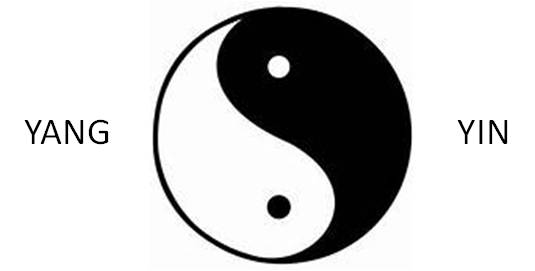
Purpose can be analyzed into its own “yin” and “yang,” as when you do something on purpose (let’s call that yin) and set out to accomplish a purpose or goal (that’s yang). Intention has to do with presence, mental focus, conscious investment and internal engagement with the here-and-now. If I ask you, “Did you do that on purpose?” what I’m wanting to know is whether you intended to do it – not by mistake, out of necessity, or because someone else told you to, but whether you did it freely, willfully, and with full presence of mind. That’s the yin of purpose.

Tao Symbol

The yang of purpose is its objective. Other terms that help fill out the definition are aim, goal, outcome and achievement. In order to accomplish something you need to have some kind of mental ideal or internal representation of what you want to bring about. The projection of that ideal into the future ahead then exerts a reciprocal force upon you by way of attraction, inspiration, or even a sense of “mission.” An objective is yang because of its built-out and externally positioned quality. It cannot be separated entirely from its yin counterpart of intention without becoming disassociated and rigid.

Creativity ultimately flows into purpose. When you are inwardly grounded and secure, masterfully in control of your instrument, and consequently free to explore the possibilities, you can engage the present moment with intention and envision your creative outcome.

A human being, like every other living organism, grows, develops and evolves according to a genetic template. This is not to suggest that life is genetically determined. In fact, science is discovering the surprising extent in which genes are responsive to the environment and experience, turning “on” and “off” in reaction to signals from outside. This is known as epigenetics. Throughout this constant interaction of genetic codes and environmental signals, an organism develops along a species-specific pathway to maturity and fulfillment.

Human beings are creators: this is perhaps the best way to characterize what “maturity and fulfillment” mean for our species. We are not simply driven by our instincts, but neither can we reach our full potential under the constraints of morality alone. I don’t mean to suggest that we should throw off all moral concern and live for our own selfish advancement. Rather we need to grow through our morality and into the higher creative life, living with embodied intention and reaching out with soulful purpose.

Each moment provides a new opportunity to embrace the present and live into what’s next.

The Creative Life

In our exploration of creative change, it is tempting to romanticize creativity into a free-ranging, spontaneous, and artistic-expressive activity that defies limitations. There is something to this, of course. The “creative life” does seem to stand at the far end of a continuum from the “secure life” where everything is safe and comfortably tucked in.

But that’s the thing about continuums: like the Yin and Yang of the Chinese Taoist symbol, a little of each extreme is inherent in its distant opposite.

Creativity and security might be thought of as the twin-yet-opposite forces in human experience that play against, around and into each other in our evolutionary quest for fulfillment. One can’t be defined without some reference to the other, but each represents a “pressing concern” that powerfully affects our quality of life. And because they are at opposite ends of a continuum, it can be enlightening to investigate their interplay in our daily experience.

Security has a lot of emotional weight, especially these days when terrorism and international politics keep reminding us how fragile the status quo really is. As one of those pressing concerns shaping our sanity and happiness, security is deeply entwined with our development, going way back into that first holding environment of our mother’s womb.

A small yet influential structure in our brains called the amygdala, which specializes in initializing internal states and reactions in situations of perceived danger, is in full operation already by the eighth month of gestation.

flower

Most organisms – and even many plant species – curl inward or retract when the “vibe of danger” is in the air. They will unfold and relax only when the coast is clear and things return to normal. Security, then, appears to be a key indicator that life takes into account on a moment-to-moment basis. Danger and risk could result in extinction, so natural wisdom (also known as instinct) will be quick to move (or “freeze”) the organism in a manner that is appropriate to the perceived threat so that security can be recovered.

Interestingly, this factor of security seems strongly associated with the notion of “ground” that I have explored in other blog posts. The descending path of meditation leads the focal center of conscious awareness deep into that “place that is no place,” beneath identity and below the reach of language. This might be the same “place” that organisms naturally “go” when they pull into themselves for security.

A human being will also contract and withdraw under hostile or inhospitable conditions. The mystic, however, is one who develops the path of inward descent in order to surrender ego, relax the body, and release fully to the present mystery of reality. This can appear as nothing but an escape from reality to those observing the meditator – in tranquil repose or undisturbed contemplation, not nervously buzzing about like the rest of us.

The ground of being is not an abstract philosophical concept, but a metaphor for that deeply inward station where who you are (ego) is relinquished and the whatness (the be-ing) that you are is manifested to awareness. Going there is how you can catch your balance, find your center, recover your focus and be fully present to what’s going on right now.

It is out of this grounded, centered, balanced and focused place that your creativity proceeds – up and out into the extended context of your life. The creative spirit ascends and flows along a “stairway” of progression thresholds – from cells to tissues to glands to organs to organ systems, and out through the body into the particular opportunity, challenge, or predicament of the situation at hand.

At each point of transmission, a mechanism or method of control supports the freedom of a higher purpose. Each cell, for instance, operates according to a mechanism of control whereby its energy needs and functional integrity are maintained. But in addition to its own energy needs, the cell “opens up” to be incorporated in a lattice of many cells functioning together as tissue.

This self-transcending intention – opening up and contributing to the higher-order purpose of a larger, more complex system – is a perfect picture of what I mean by creativity.

The point here is that this higher freedom (from the cell’s perspective) is made possible by a deeper control. This principle is demonstrated in countless ways, as in the example of a musician who is not “free” to create inspiring music until she has achieved sufficient control of her instrument. Such control at this level is conscious, voluntary and learned, while most control farther down is instinctual, autonomic and reflexive.

Now we know that if the musician-to-be is feeling insecure within herself, the facility of her control on her instrument will be compromised and she may never become an accomplished (creative) artist. Perhaps she will lack precision in her movements, as she trembles and frets. Or else she may grip down with such force that she produces a strained and unpleasant sound. She is not free to create because her insecurity is interfering with her artistic control.

If instead she is inwardly grounded, her movement on the instrument will strike the perfect balance of control and freedom, thus serving as a spring of creative intention. Her attention can then be dedicated to the purpose of playing – the feeling she wants to express and evoke, where she wants to go with the music, or where she wants to take her audience.

How does this translate to the creative life? It should be obvious, but let’s talk it out.

Creativity (or living out your creative purpose) is in dynamic interplay with security (your ability to stay grounded). When you are calm and inwardly established, the control you bring to the tasks of living will be in balance with the freedom that your skill mastery makes possible.

The greater your mastery – what I earlier called “facility” – the less conscious attention is required in the performance of a skill, which means that consciousness is liberated for creative expression and accomplishment. But if your manipulations are too effortful, to the point where you become frustrated and try harder to force an outcome, the gears will likely seize up and the performance will crash.

The creative life is living on purpose and with purpose. You are able to go beyond yourself because you are not obsessed with yourself. Letting go and getting grounded lets you take up your life with creative intention.