God Above and The Ground of Being

It’s interesting how the evolution of life, the development of a species, and the maturation of individuals within a species all tend to proceed from simpler to more complex forms and stages of existence. The human embryo carries vestigial gills and a tail from our prehuman ancestors. In a not entirely dissimilar fashion, children grow into mental abilities following the same sequence as our species over many thousands of years. What we see at one level (life, species, individual) is evident in the other levels as well.

Culture is the construction zone where the degree of advancement in our human species gets transmitted from individual-level breakthroughs, into the collective consciousness of society, and back again to the individual in the form of innovations in the traditional way of life.

In the interest of social cohesion and stability, a preferred path of change would be able to keep some of what has been (as tradition), as it moves forward into what will be. The role of institutions can be understood in this sense, as conservative and stabilizing structures in the flow of cultural change. The very definition of religion, from the Latin religare meaning “to connect or tie back,” identifies it as an institution in this sense – indeed as the conservative and stabilizing structure in culture.

When the European Enlightenment got the intelligentsia excited about the possibility of throwing off the superstitions of the past to embrace a future of science, religion was the obvious and easy target. Without a doubt, there was much about the institution of Christendom that wouldn’t listen and constructively respond to new discoveries and developments going on at the ground level of human experience.

As the official Church condemned new theories and excommunicated the brave souls who dared contradict its now-archaic orthodoxy, the best (and perhaps the only) recourse for many was to simply push the whole outfit into the ditch and move on with progress. The modern West turned its attention to factual evidence and the technical possibilities of this world, content to leave spirituality, religion, and God Above in an early chapter of its new autobiography: The Enlightened Man’s Emancipation from Ignorance and Myth.

The Christianity we all know (and fewer of us love) is a type of religion known as theism, for the way it is oriented on and organized around the belief in a supreme being who is large and in charge. Our fortunate birth and prosperity in this life, followed (hopefully, if we get it right) by beatitude in the hereafter, is our Pilgrim’s Progress supervised by God Above.

We happen to be living in the twilight of theism, during a late phase known as orthodoxy. At this point it is primarily about believing the right things, and doing whatever it takes to defend and propagate “the one true faith” around the world. By now, for a large majority of Christian true believers, the present mystery (we can even call it the real presence) of God has receded permanently behind something much more pressing and important – and manageable: the right opinion (ortho+doxa) about God.

At the end of the day it’s all a very heady enterprise and increasingly irrelevant to everyday life. People are leaving the Church in droves, with the Enlightenment campaign of atheism once again on the rise. As a counter-measure, the engines of orthodoxy are locking into gear and plowing full steam ahead, until Jesus comes again or all hell breaks loose (rumor has it these might be the same event).

Fundamentalists, ultra-conservatives, and right-wing evangelicals are certainly not helping their cause, as bright and reasonable people who continue their quest for a grounded, connected, and personally relevant spiritual life are leaving the crazies to their end-game.

I spend more time than I would like trying to explain how the impulse to cast theism out with the dirty bathwater of dogmatic and dysfunctional religion, while certainly understandable to some extent, is not the real solution to our problem. For one thing, the theistic paradigm and its role in society should not be simply identified with any of its historical incarnations.

In other words, a corrupt version of theism is not necessarily a reason to reject theism itself outright. It happens that every institution is prone to desperate measures when threatened by the natural course of change. In this way, an institution is the cultural equivalent of an individual ego – a conservative and stabilizing construct of identity that resists becoming what it isn’t used to being.

What follows is a perspective on theistic religion, exploring its development through distinct phases starting with its rise out of animism and following through its twilight into post-theistic forms of spirituality. My model for this developmental schema is not only based in the evidence of archaeology, but, just as important and even more useful, on the phases stretching from early childhood to maturity in the living individual today.

Evolution of ReligionEarliest theism, just like early childhood, was lived in a world constructed of stories. There was no obvious boundary separating “fact” from “fiction,” the given facts of reality from the make-believe of fantasy. Theism was born in mythology (from the Greek mythos referring to a narrative plot, which is the structural arch that serves as the unifying spine of a story).

Its gods began as literary figures personifying the causal agencies behind the order and change of the sensory-physical realm. Myths were not regarded as explanations of reality (as a kind of primitive science), but instead were performances of meaning that conjured the gods into being with each rendition.

It’s difficult to appreciate or understand this phenomenon as we try to grasp it with adult minds, but perhaps you can remember how it was for you back then. The fantasy world of myth doesn’t merely fade into the metaphysical background when the story concludes. Rather, that world exists only in the myth and is called into expression every time the myth is performed afresh.

We modern adults entertain a delusion which assumes the persistence of reality in the way we imagine it to be, even when our stories (at this later stage known as theories) aren’t actively spinning in our minds. The paradigm-stretching frontier of quantum physics is confirming how mistaken this assumption is, and how much we really understood (though perhaps not consciously) as children.

At some point in late childhood and early adolescence the individual recognizes that real life requires an adjustment from imaginary friends, magical time warps, and free-spirited performances of backyard fantasy, to the daily grind of household chores and lesson plans.

A more complex and complicated social experience means that opportunities for reigniting the creative imagination must be “staged,” that is, relegated to a consecrated time and location that will be relatively free of interruptions. Here, in this sacred space, the stories will be recited; but in view of limited time, only the major scenes and signature events are called to mind.

The required investment of time, attention, and energy in social responsibilities will not return the degree of enchantment and inspiration an individual needs to be happy. There needs to be a place for mythic performance and reconnecting with the grounding mystery. Besides, the mythological god can’t be left hanging in suspended narrative when it’s time to get back to the grindstone.

Theism had to adapt along with this emerging division between sacred and secular (temporal, daily) concerns. It did this by creating a special precinct where the majority could enter and observe an ordained minority dress up, recite the stories, and enact mythic events linking their broken time (divided and parsed out among countless duties) back to the deep time of an eternal (timeless) life.

Just as the holy precinct of ceremony served to connect a profane existence “outside the temple” (Latin profanus) to the sacred stories that weaved a tapestry of higher meaning, the god who originally lived in those stories was relocated to a supernatural realm overhead, standing by and watching over the business below. Even if the stories weren’t actively spinning, people could take comfort in knowing (technically believing) that he was in his place and doing his job.

On a designated day the community gathered in the temple, and at just the right moment an official would sound a bell, light a candle, unveil an icon, or recite a scripted prayer invoking (calling in) the presence of the god. At that very moment, all were in agreement (at least those paying attention) that the deity would descend from his abode in heaven and receive their worship.

A ritual enactment of sacred story would typically culminate at a point where the congregation was invited to step into deep time once again. Afterwards a signal was given bringing the ceremony to an end, and the people would depart to their workaday worlds.

With a growing population and the inevitable pluralism that comes with it, getting to the chapel on time becomes more of a challenge for a lot of people. How can theism survive when the ceremonies and sacred performances start losing attendance? What happens when god above no longer has an official invitation to condescend to the supplications of his gathered assembly of devotees?

This is what happens: former true believers give up their denominational affiliation and do their best to continue on their own. They will still look up when they speak of god, point to heaven and cross themselves when they score a goal, and perhaps bow their heads and say a prayer before breakfast.

Once in a while they might make their way back to the chapel (maybe on time) to observe a performance of one of the really big stories. As they watch, a dim memory of childhood enchantment will stir somewhere deep inside them and they will feel the magic once more.

How can theism hold on when its ceremonial system – the land and buildings, the gold-plated symbols and silken vestments, the professional staff of ordained ministers, and the hard-won market share of rapidly defecting souls – is sliding into obsolescence and bankruptcy? The answer brings us to the third and final phase in the lifespan of theism, the twilight of institutionalized religion known as orthodoxy.

The enchanted storytelling of early childhood gives way to staged ceremony in young adulthood, which in turn and with further reduction eventually gets packaged up into neat boxes of truth called doctrines. An obvious advantage of this reduction of theism to doctrines lies in its handy portability, in the way it can be carried conveniently inside the head and transferred into more heads by rote memorization and Sunday School curricula.

If the first phase of theism (storytelling) featured the bard, and the second phase (ceremony) depended on the mediation of priests, this third phase (orthodoxy) belongs to the theologians. They are the experts who tell us what to believe about god and other metaphysical things.

Since theism at this point has become a rather sophisticated set of beliefs, the best (and perhaps only) way to impress their importance on its members is to make the doctrines necessary to what more and more people are lacking and so desperately looking for: security and longevity – specifically that odd fusion of security and longevity defined in the doctrine of everlasting life.

As time goes on, this notion of a future escape from a life burdened by fatigue, boredom, and absurdity grows more attractive, until the true believer is willing to give up everything – or, if necessary, to destroy everything – for its sake.

In the Age of Orthodoxy people still speak of the god above, of the miracles of long ago, or of a coming apocalypse and future rapture of the saints, but you’ll notice that the critical point of reference is consistently outside the present world. Celebrity hucksters and pulpiteers try to fill the vacuum with staged demonstrations of “faith healing” and prophetic clairvoyance, but the inspiration is cheap and unsatisfying. Mega-churches and sports stadiums become personality cults centered on the success, charisma, theatrics, and alluring ideal of their alpha leaders.

In a sense, this transformation of old-style sermon auditions into entertaining religious theater represents a final attempt of theism to push back the coming night. There’s no getting around the fact that orthodoxy just isn’t that interesting, and as it rapidly loses currency in the marketplace of relevant concerns, more and more people are saying good-bye to church, to organized religion and its god-in-a-box.

As a cultural transition, the crossover from managed religion to something more experiential and inwardly grounded corresponds to that phase for the individual, when a deeper thirst for life in its fullness forces him or her to push back from the table of conventional orthodoxy and its bland concoction of spiritual sedatives.

In the twilight of theism, people are starting to give voice to their doubts, but also, increasingly, to their questions, their long-buried intuitions, and their rising new-world aspirations. They want more than anything to be real, to be fully present, and deeply engaged in life with creative authority.

This inward turn is the critical move of post-theism. It’s not about pulling down orthodoxy or refuting its god, but rather simply letting go and quietly sinking into being. Quietly is a reminder that words at this point are like hooks that can snag and slow one’s descent, running the risk of turning even this into another religion with its own esoteric orthodoxy.

The ego and its constructed word-world of meaning need to be left behind so that consciousness can softly settle into the still center of contemplative awareness. Here all is one. There is only this.

Here is born (or reborn) that singular insight which inspired us to tell stories in the first place. Now, perhaps, with a lifetime of experience and some wisdom in our bones, we can tell new stories.

It’s always been and will always be here and now.

Do You Know Anyone Like That?

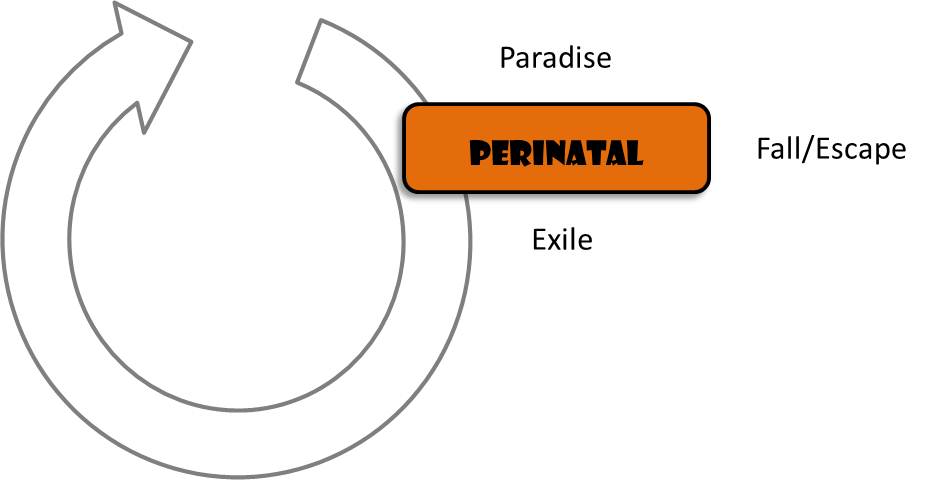
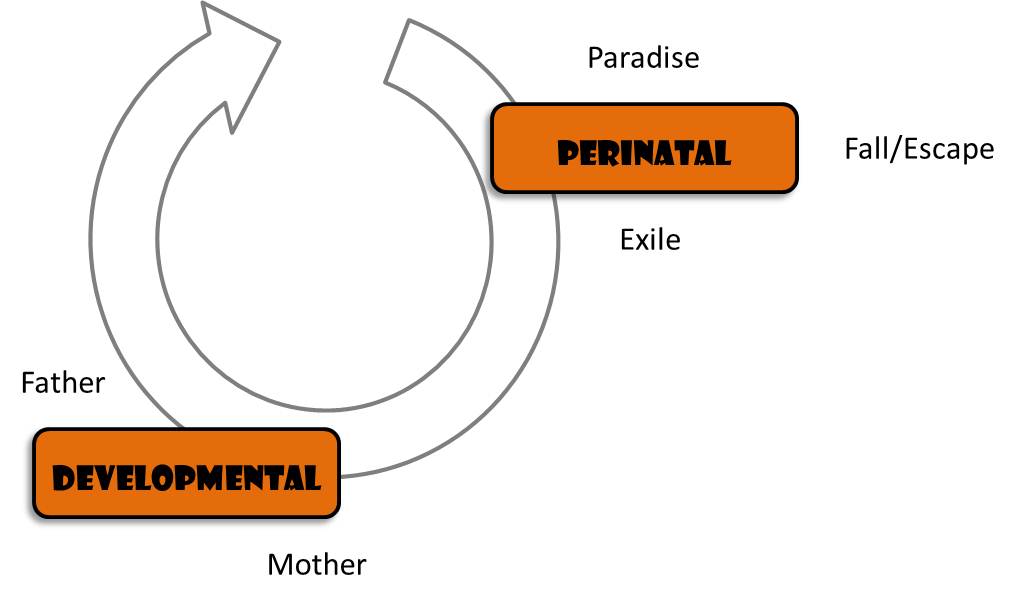
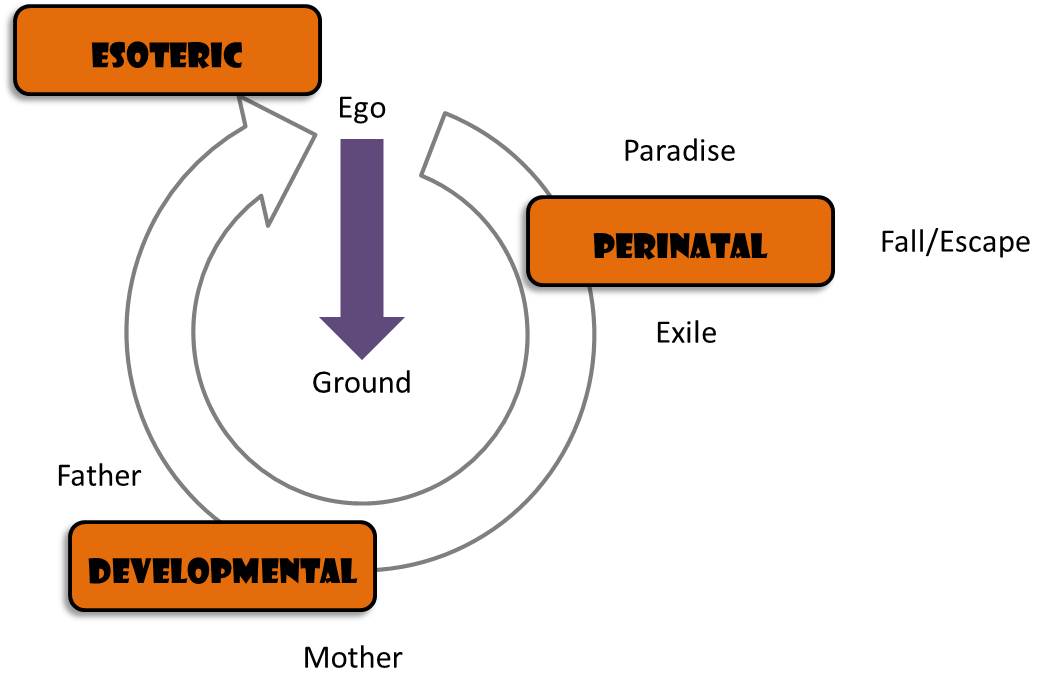
Mythic Quest CycleIn “The Mythic Quest of Captain Ego” I offered a model that helps us track individual identity through a gauntlet of developmental challenges that both shape the ego and continue to influence it throughout the lifespan by way of deep patterns called archetypes. These archetypes belong to larger clusters that correspond to the formative phases of birth (the perinatal cluster), early childhood (the developmental cluster), and a critical passage that is unlocked only to the degree that these earlier challenges were relatively successful, opening into an experience of the grounding mystery of being itself (esoteric cluster).

It is at this threshold, in fact, where ego (identity) is surrendered to soul (communion), that theism as a paradigm of religion gives way to post-theism. Indeed, if we can better understand how it goes (or gets blocked) for the ego, we will have in hand a key insight into the evolutionary purpose (and common pathologies) of theism as well. This is because theism and ego are coeval (of the same age and equal duration). How it goes with ego, so it goes with theism – and vice versa. In this post I will explore the healthy and dysfunctional forms of both.

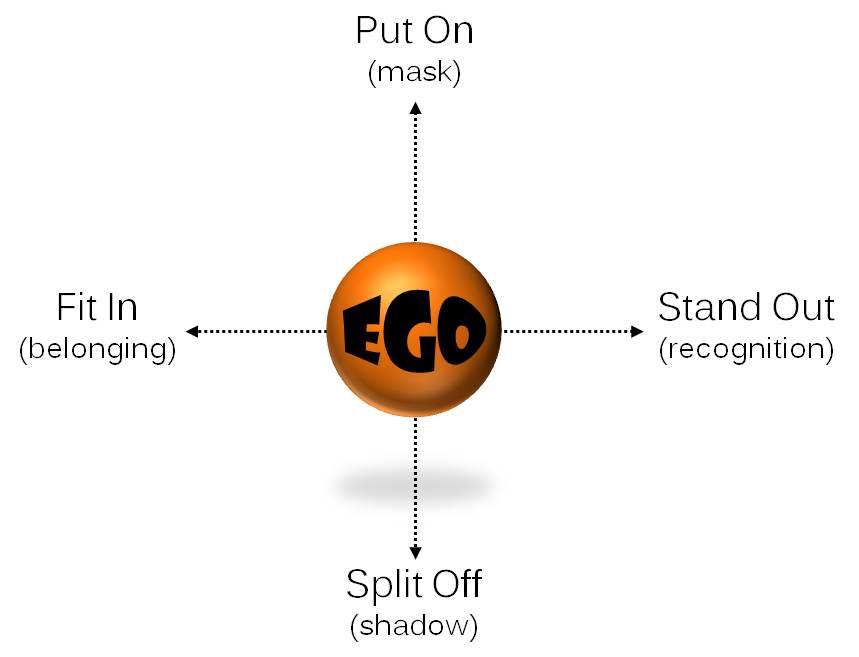
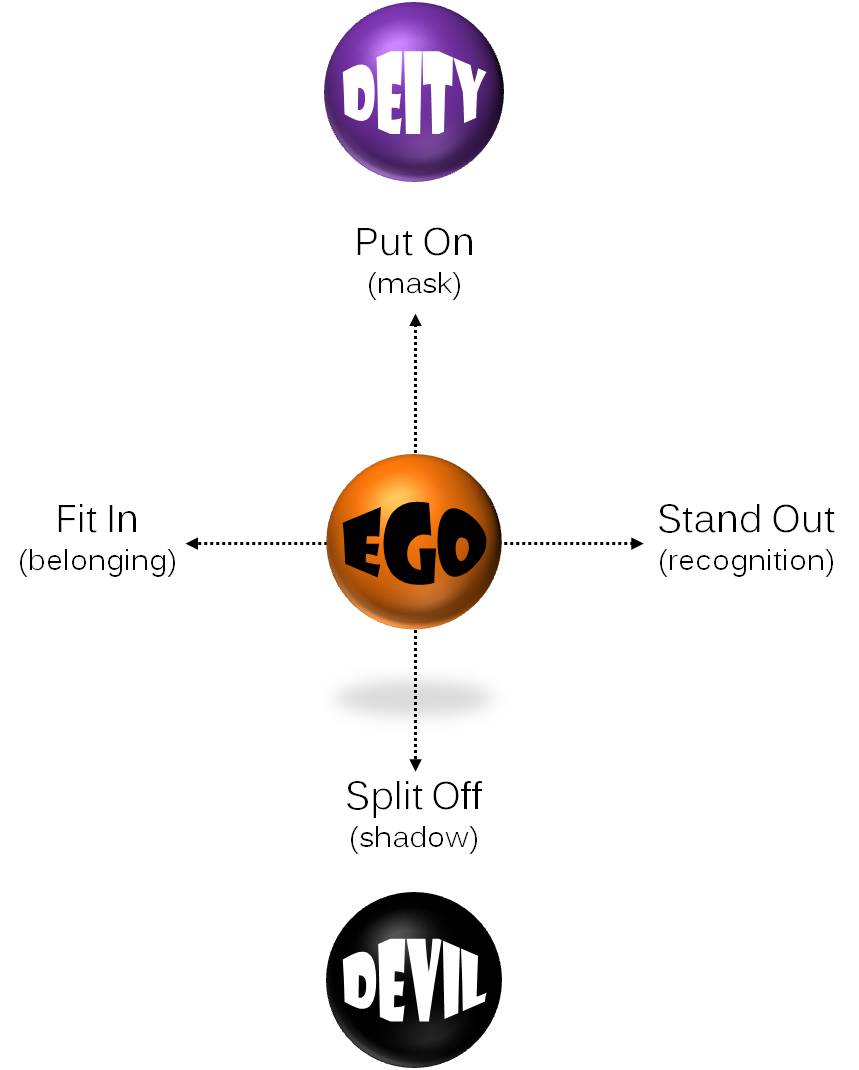
Before I begin, however, perhaps that last statement – about ego and theism developing together – needs to be explained. The essential idea is that ego, as the executive center of the personality, has its counterpart in the deity who is executive-in-charge of the tribe and its world. “Tribe” is here playing a mediating role, shaping the individual’s identity as “one of us” according to the moral ideal represented in the patron deity. At this stage (in theism) the game is all about clear roles and rule-bound relationships, as the arena where the social constructs of identity, membership, and obligation are set in place.

The patron deity serves a dual function as the sovereign authority behind the tribe’s moral code, and as the focus of worship and aspiration in its members. In obeying their god, individuals are cooperating for the common good, while in glorifying the divine virtues of grace, mercy, compassion, patience, wisdom, forgiveness (etc.) – and seeking all the while to be like the deity in these ways – they are gradually growing toward that ideal. Along the way, what had been addressed as outside the self (i.e., the patron deity) is slowly internalized, as it were, until the individual is able to drop the identifier of “me and mine” altogether and simply be one with everything.

It happens, and all too frequently, that ego development gets hung up (or blocked), which, if the hang-up is fairly widespread across the tribe, can have a distortion-effect on the deity as represented in art, story, theory and doctrine. As a people regress, so does their patron deity. Just as in positive development the deity contains dormant or newborn virtues of a morally advanced community, when its official custodians (the priests and theologians) slip or get pulled into degenerate vices such as dogmatism, bigotry, vengeance and cruelty, the deity undergoes a similar makeover and soon the tribe as a whole falls into its gravity.

Ego StrengthSo what is a healthy ego and deity, and what are their contrasting pathologies? First we should recall that ego-formation comes about, initially at least, through a process of restraint-and-redirection, as the impulsive drives and animal urgencies of the body are trained into socially appropriate behavior. Of course, the underlying urgency of biology and instinct doesn’t just stop doing what nature requires, which means that ego is first gained and thereafter suspended just above the borderline separating the personality from this primordial (deeper, darker) animality.

Added to this responsibility of managing the animal impulses of the body – at least the small percentage of milder inclinations that can be controlled – is the task of establishing a center in the personality where moods can be kept in balance. As distinct from urges and impulses, moods are global and sustained internal states that work to match an organism to its environment and motivate behavior that is adaptive to the challenge at hand. Because circumstances change and new challenges are always presenting themselves, particularly in the social arena where ego is at home, the personality needs to adjust quickly.

A third factor of ego strength is its ability to hold the personality together as a whole. Various and sometimes divergent streams of affect (feeling), motivation, thought, and disposition need to be supervised, coordinated, or reconciled for the sake of maintaining a unified self. There are times when a certain stream comes close to breaching the ego’s hold, which, if successful, could result in guilt, embarrassment, or personal injury. As the executive center, ego serves the important function of self-integrity.

In summary, then, healthy ego development – and let’s remember that this will be true of the divine ego of the patron deity as well – is demonstrated in a stable, balanced, and unified identity. The personality is kept from falling through the floor into animal urgency, it is able to maintain a center of emotional composure, and it is held together under a governing director who monitors all things “me and mine” (our Captain Ego). From this stable, balanced, and unified platform, an individual is capable of leaping out into a larger reality, transcend the self entirely, and consciously join the present communion of all things – which is the mystical experience of spirituality.

Against this profile of healthy identity we can more easily describe the different types of pathology that afflict both ego and the patron deity.

You should probably know that I am deeply skeptical over the modern confidence in naming and classifying so-called mental disorders. Biological psychiatry and diagnostic psychotherapy have invented a complicated web of clinical disorders without a clear definition of mental order. Critics of this enterprise – and it is a wonderful conspiracy of inventors, drug manufacturers, and insurance companies, served by a cadre of well-compensated physicians and therapists – are highly doubtful that health and suffering can be so cleanly divided into “normal” and “abnormal.”

With that said, my description of pathology in the ego and theism’s deity is not intended to deny the legitimate cases where something is really, and deeply, wrong with the brain (in ego’s case). While I have chosen the names of a few outstanding and “popular” pathologies for my purpose, I readily concede that there are times when biology has “gone wrong” and a patient needs medical (drug and/or surgical) intervention. But such cases are much rarer than is commonly believed, which is part of the delusion that the conspiracy is intent on perpetuating.Ego PathologySo here we go. When the boundary separating ego from the lower animal urgencies is not very strong, the personality is not able to control the border and keep spontaneous impulses in check. Consequently the identity system will unpredictably collapse and be overtaken by sudden urges or reactions, making the person behave in socially inappropriate ways that end up damaging relationships. Do you know anyone like this?

What I’m calling borderline personality, then, is not so much a clinical disorder as an extreme variance in identity formation where ego strength is insufficient to keep the personality above the surface of animal urgencies. Individuals who lack a stable ego often suffer from loneliness from having offended their former friends, and a chronic restlessness in never knowing when the floor might fall out from beneath them.

What happens when the missing part of ego strength is the center that would otherwise hold a person’s moods in balance? Wide and erratic swings, and not only of the familiar “manic” to “depressive” poles. Wild fluctuations in mood inevitably land the individual in situations where the body’s internal state is completely incompatible with his or her present circumstances. Because moods are more global and enduring than the momentary feeling responses that naturally occur in the course of normal experience, a bipolar person can be so totally possessed by a mood that he or she is insensitive to the surrounding cues.

The bipolar personality is also socially disruptive, but in a different way from the borderline personality. While the borderline issue puts everyone on the edge of not knowing when the next outburst or collapse is going to happen, bipolarity trains those around the individual to withhold confidences and responsibilities from him or her out of concern that they won’t be followed through to completion. Do you know anyone like that?

Finally, when ego strength is unable to hold the personality together as a unified system, the numerous undercurrents of identity, attitude, motivation and behavior that might normally be allowed expression by Captain Ego in appropriate social environments and situations, can simply and unexpectedly “show up.” Roberto Assagioli, the Italian founder of psychosynthesis – stressing the necessary work of constructing a healthy self, as opposed to Freud’s strategy of taking apart the sick self with psychoanalysis – referred to these relatively self-contained minor identities within the dominant personality as “subpersonalities.” They are normal components in the normally complex personality system.

But when the ego is too weak to maintain a unified self, the personality “dissociates,” giving way to any one or a number of these subpersonalities. Observers of this phenomenon are often perplexed at how so-and-so is suddenly “an entirely different person” than he or she was just moments before. This isn’t about impulses breaking through the floor, but rather coherent substreams of alter-identity that take over in a social situation.

(At one point, this was named “multiple personality disorder” by psychiatry, but it later got relabeled as “dissociative identity disorder.” I’m suggesting that it is far more normal (or better, common) than the clinical designation will admit.)

Now that we have a model of ego strength before us, along with an understanding of the major pathologies that compromise it, I will return to my original suggestion. Just as there is a developmental partnership between the healthy ego and its patron deity, where the external causality and higher virtues represented in the deity are gradually internalized by the caring and self-responsible ego, so we should expect to find instances where ego pathology (borderline, bipolar, dissociative) is reflected in depictions of God – for example as temperamental, capricious, and internally divided (think of the subpersonalities of Yahweh in the Bible as threatening and wrathful, or as compassionate and forgiving).

Do you know a religion like that?

The Mythic Quest of Captain Ego

As an advocate for post-theism I give frequent attention to the question of how it differs from theism. I’ve made the point that the “post” in post-theism should not be interpreted to mean that theism is being left behind for a more preferable secular atheism. Whereas atheism takes its very existence from the debate over whether or not god is to be taken literally, post-theism (at least the variant of post-theism I’m interested in promoting) presses beyond the debate to consider how our representations of god in art, story, and theology either support or arrest our spiritual evolution.

Central to my argument is the claim that a distinct concept of god, personified in myth as one who watches over and provides for us in exchange for our worship and obedience, is not only conducive to our moral development (and therefore in the interest of our tribe as well) but also awakens in us the higher virtues of compassion, responsibility, benevolence, and forgiveness. A longitudinal review of a religion’s mythology (i.e., its library of sacred stories) reveals an unmistakable development of its principal literary figure (i.e., the deity) in this same direction. In other words, the mythological god sets before the community a moral exemplar and stimulant to what we are in the process of becoming.

And whence do these stories arise? Do they come to us by a vertical drop out of heaven or from a period in history when people actually witnessed metaphysical realities, supernatural interventions, and miraculous events? This search for origins and evidence is really exposing the fact that the stories have already lost their power. When multiple narratives cross and weave the very fabric of your worldview, the literary god who lives in the stories functions as a causal agent in the way everything holds together. Once the background assumptions in the myth lose currency, however, or fall out of alignment with present-day theories of the universe, the literal existence of that god suddenly becomes a question for debate.

Because we have lost (or outgrown) our ability to simply inhabit our stories and engage the god who lives in them, the only way theism can hold on is by insisting that its myths are not myths at all, but rather factual reports of things long ago, far ahead, or otherwise outside the world in which we live. So you have no choice but to either take it literally, as orthodoxy requires, or else toss it all on the pile of outdated cultural junk.

Post-theism, on the other hand, encourages a fresh exploration of myth and its resident deity. But rather than reducing mythology to the stories different tribes tell about their gods (comprising the various religions), it insists that we not leave out of consideration the third component of theism, ego, around whose evolutionary destiny this whole thing turns. Beyond being a mechanism of societal cohesion and control, theistic religion has our individual formation, awakening, liberty, and transcendence at heart – at least this is what I aim to show.

Let’s track the hero adventure of this quirky social construct of identity known as ego (or “I”). Depending on where in this adventure we decide to insert ourselves for a look, everything, from its internal state and sense of self, its dependency and regard for others, its perception of time, and its mental model of reality as a whole, will be construed according to a few basic energizing concerns. These concerns are, we might say, the pressure points where individual consciousness confronts reality with its most urgent and timely need.

I see these as formative periods when the linkage (religare again) of consciousness to reality is having to be renegotiated, in the passage through self-consciousness and into what lies beyond. For the sake of simplicity, I will focus on just three such formative periods. It seems to me that these three stages of transformation provide a way of viewing ego development as consisting of trimesters (though not all of equal duration) and culminating in the transition of consciousness to the more spiritually grounded (and selfless) experience we call soul.

PerinatalThe transpersonal psychologist Stanislav Grof has conducted a lot of research into the basic images, metaphors, and mythic themes that inform non-ordinary states of consciousness. Particularly intriguing are the deep and universal images with roots in our pre-personal memories of our mother’s womb and the birth experience.

A kind of paradisal garden prevailed in utero where the biological requirements of our body were instantaneously met. In that environment our consciousness registered a feeling of undifferentiated oneness, blissfully absent the pang of need.

(Already nearly a century ago, Romain Rolland, in a personal letter to Sigmund Freud, encouraged the good doctor to investigate what he named an “oceanic feeling” of oneness with reality, which Rolland believed may lie beneath all religions. Freud adopted the term, but proceeded to reduce it to “narcissistic elation.”)

Then the time came for our “eviction.” The walls around us began to contract and we were forced down a narrow passage with no foreseeable exit. We know from obstetrics that the birth experience is stressful on a fetus: falling out of the bliss state and down a constricting tunnel constitutes, following Grof’s theory, our first experience of trauma as a human being. Occasionally the birth canal and pelvic girdle of the mother are such that a safe passage is difficult or even impossible, which amplifies the distress considerably.

The light at the end of the tunnel introduces the newborn to a strange reality, very different from the one left behind. Instead of an oceanic state of warm satisfied comfort, the infant is jostled about in a dizzying kaleidoscope of flashes, shadows, and odd shapes, accompanied by the intrusion of harsh sounds and fluctuating temperatures. For the first time, need forces itself into consciousness with the inaugural gasp for air and sharp pangs of hunger. This is definitely “east of Eden,” the beginning of life in exile.

When we look out across the mythology of world religions, this pattern of Bliss-Fall-Exile starts showing up everywhere. Even when we survey the so-called secular literature of poetry, novels, and even non-fiction writing, this same archetype of a three-part transition into a state of separation and loss (along with a longing to return to “the way it used to be”) is remarkably widespread. The reason is that this archetype – this “first form” or primal pattern – is really down there, in the earliest strata of our perinatal memory.

DevelopmentalFollowing our expulsion from Eden and finding ourselves in exile, our next challenge involved two more archetypes – Mother and Father. While for many of us these terms match up to our actual biological parents, this isn’t necessarily the case.

“Mother” names the provident power in whom we found nourishment, comfort, warmth, and emotional bonding. She was our secure base, the one place we could go for the reassurance that “all is well.” Our first attachment (after the Fall) was to Mother, and she provided the safe place where we could simply relax into being.

“Father,” contrastingly, was our first Other, whose presence was as an Outsider. His existence called to us from across a chasm of otherness and issued the challenge to step out into our own developing individuality. The secure base represented in the enveloping embrace of Mother needed to be left behind, if only momentarily, in order to prove ourselves capable and worthy of recognition. Father was the pat on the back when we succeeded in a task, as well as the voice who encouraged us to give it another try when we fell short.

Obviously I am invoking the developmental archetypes of Mother and Father in their ideal forms. In actuality no mother is the “perfect mother” and no father the “perfect father.” Consequently ego’s adventure through this phase of the journey is for most of us complicated by fears of abandonment, rejection, criticism – and of the failure that will surely subject us to these dreadful ends. A general insecurity drags on us like gravity, causing us to hesitate when we should better move ahead, or foolishly leap before we take the time to carefully look where we are likely to land.

There can be little doubt that these developmental archetypes are beneath some of the earliest metaphors of God in religion: mother earth and father sky. In the middle of their embrace, our ancestors experienced the provident mystery of reality. Soil and fruit were gifts from mother earth; sun and rain were gifts from father sky. Life itself was sustained in the love they shared, in the way they cooperated for the provision of what early humans required to survive and prosper.

Even in the Bible, reflecting a time when this divine partnership was replaced with the notion of an exclusive sky god – our Father in heaven – the maternal qualities of the earth were still celebrated in song and poetry, as Yahweh’s good and bountiful creation. As time went on, however, and a metaphysical dualism took over late Judaism and early Christianity, the earth was increasingly depersonalized and degraded into a mere resource for humans to exploit. Along with the earth, woman and the body, too, were demoted in value, regarded as the footholds of sin and death.

This is where the mythic quest of Captain Ego is currently stuck, in my opinion. Because our consciousness (speaking collectively) is caught in the web of neurotic disorders – fixated on security (Mother) or overly ambitious for esteem and self-importance (Father) – we are unable to advance on the path to genuine fulfillment. Some of us have, or are in the process of making our way through this impasse. Thankfully, some of those who succeeded cared enough to return with insights and guidance for the rest of us. They passed along their wisdom, and where it hasn’t been corrupted and twisted back into an orthodoxy of world escape, sectarian fundamentalism, or redemptive violence by their so-called followers, we can find help in their teachings.

EsotericThis final set of archetypes I call “esoteric,” not because it is secret knowledge but rather because it involves a decisively inward turn (Greek esoterikos = inner) of consciousness. The esoteric teachings of religion take us directly into mystical spirituality, where the initiate is led along a descending path toward an experience too deep for words. In order to make the descent, ego must drop through a series of levels by letting go of the various convictions, beliefs, expectations, and attachments that give it identity, that together define who “I” am.

Of course this also means that ego needs to “let go of god” – or its idea of God. In the process, theology, which is only a theory of God, falls apart and dissolves away, releasing awareness at last into the ineffable mystery of being itself, or what some mystics name “divine presence.” This divine presence is not the “presence of god,” as if the deity who was somewhere else a moment ago is now here with me. It is pure presence, the Real Presence of mystery, the present mystery of reality. This is what is meant by the “post” in post-theism, referring to the experience of presence after ego has let go of its god.

A number of mystics speak of this experience of the grounding mystery as a kind of return to the envelopment of bliss we enjoyed before this whole adventure got underway. In his interview with Bill Moyers (“The Power of Myth”), Joseph Campbell is invited to contemplate the implications of saying “not that Eden was, but that Eden will be.” (Eden is the Hebrew name for the garden paradise in Genesis.)

After a pause Campbell replies: “Eden is.”

Our Quest for Oneness

Despite the fact that so much of religion tends to divide and antagonize (including terrorize), I’ve been exploring its essential function as a unifying force in human culture. We take as our starting point the root meaning of the word “religion” itself, deriving from the Latin religare, to link back or reconnect. Whatever distortions or corruptions it has taken on over the centuries, it seems to me that we should check these against the deeper or original intention of religion before we simply reject it out of hand as obsolete, oppressive, and dangerous.

As with everything cultural, religion emerged and evolved over time according to the developmental needs, crises, and opportunities of our species. Stone Age religion certainly looked different from anything we can observe today, though perhaps some strong family resemblance continues in present-day aboriginal societies that still live in close communion with “wild” nature. I’ve promoted a theory which interprets this development of religion as correlated with three centers of consciousness (or mental locations) that open up in sequence and steadily add to our general picture of what is real and what really matters.

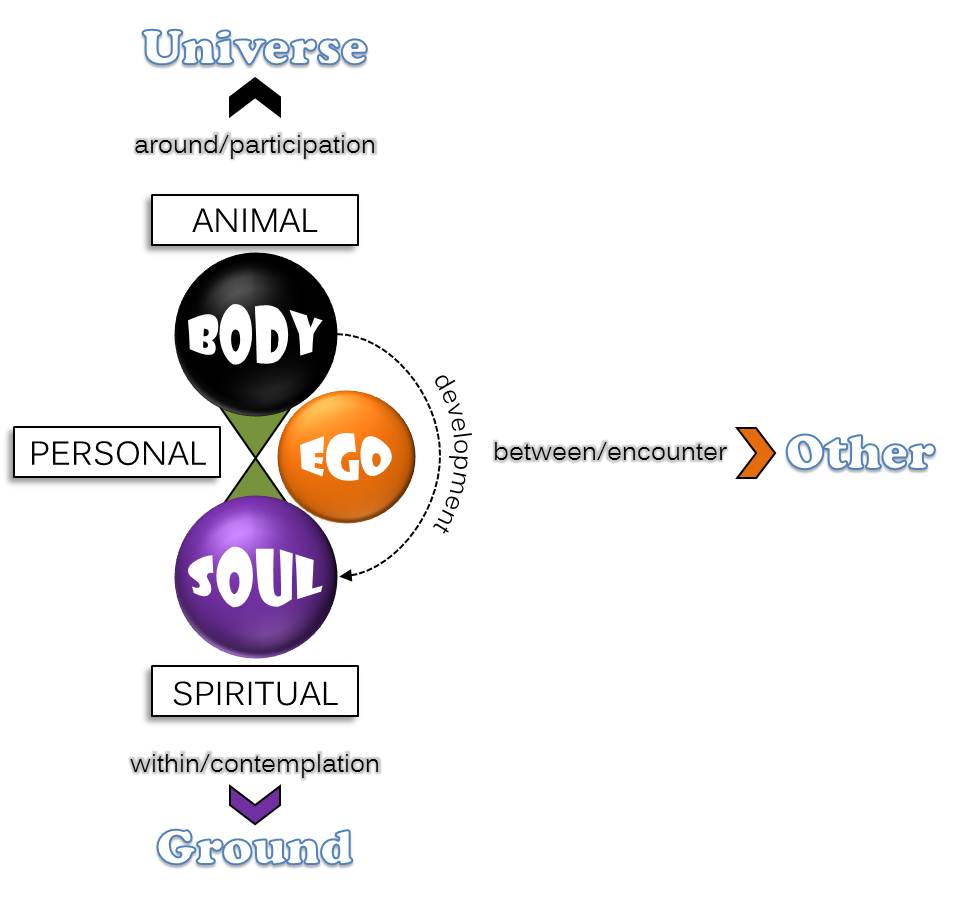
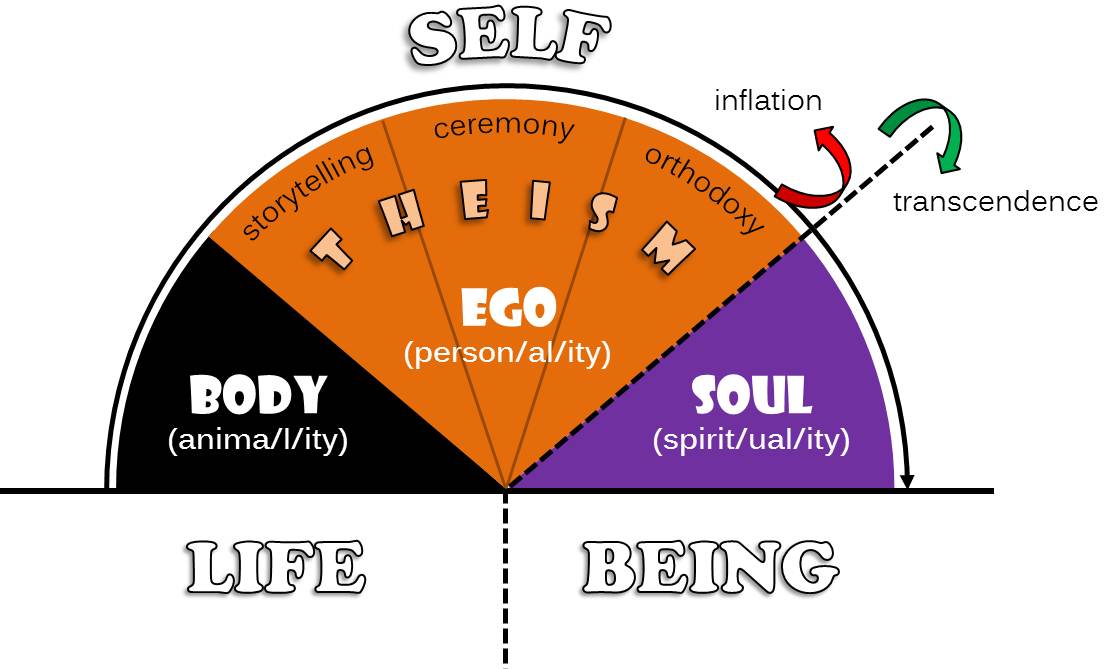
Triune 1The names of these three centers of consciousness employ familiar terms (body, ego, soul), but with important adjustments from the way they are popularly understood. A primary polarity is represented in body and soul, which simply identify the two directional orientations of human awareness: outward to the sensory-physical realm (body) and inward to the intuitive-mystical realm (soul). These are not “parts of the self” but rather mental locations that open awareness to distinct dimensions of experience.

A popular confusion draws an equation between soul and ego, my third mental location. But in fact ego and soul are not two names for the same thing. Soul, once again, refers to our inward orientation and deep inner life, while ego is our socially constructed center of identity. While I admit that an established center of identity (ego = I) is what makes our primary split in orientation possible in the first place, ego actually inhabits its own realm: the socio-moral arena of life in our tribe.

In the above illustration, the primary polarity of body and soul is indicated by a green connector while ego sits on its own. This makes the point that ego is a construct of culture, both a product and symptom of society, which makes it the wild card in our evolutionary adventure. More on that below.Triune 2

Religion is thus designed to coordinate these three centers of consciousness (body, soul, ego) and their corresponding realms. Together these centers comprise the animal, spiritual, and personal aspects of a human being. Our development, as individuals and a species, advances sequentially through stages beginning in the body, moving through an ego-dominant period, and deepening all the while into a more inwardly grounded mode of being.

I have designated these general stages of religion as animistic (body-centered), theistic (ego-centered), and post-theistic (soul-centered). Just because development has advanced beyond a stage doesn’t mean that the experiences and concerns peculiar to that stage are no longer relevant. On the contrary, those experiences and concerns are taken up and incorporated into the next stage and updated according to its emergent paradigm of meaning.

As the wild card in the set, ego represents a strong element of risk against the eventual fulfillment of this project. In previous posts I have tried to describe the factors that tend to compromise what psychology rightly names “ego strength” – the well-centered self confidence that develops as our needs for safety, love, power and worth are adequately met.

In the best of all possible worlds, we grow up in a family environment where these needs are fulfilled and our personal identity (ego) is securely established. Of course, we don’t live in the best of all possible worlds and our caretakers are not perfect. As a consequence, the ego adapts and compensates for the insecurity by defending itself, pretending to be what it’s not, and insisting on being the center of reality. Interestingly, but not really surprisingly, theism – as the model of religion that co-evolves with the ego – often portrays its principal deity in corresponding ways, as craving glory, jealous of rivals, and prone to violence in his campaign for supremacy.

Since in previous posts I’ve deconstructed the perverse influence of ego insecurity on the otherwise respectable and developmentally necessary stage of theism, I want to move now in a completely opposite direction with my analysis. It’s easy to commit the mistake of effectively dismissing theism as only a transitional stage (more like a phase) along our way to something better. From my comments on the ego, about the inevitable and worldwide neuroses that pull theism into various dangerous corruptions (sectarianism, exclusionary membership, extremism, and redemptive violence), you might assume I have nothing good to say about either one of them.

On the contrary.

Triune FullThe diagram above shows where theism fits into the evolutionary scheme of religion. Our animal nature of the body connects us (religare) outwardly to the sensory-physical Universe, while our spiritual nature (or what I prefer to call our higher self) links us inwardly to the intuitive-mystical Ground. Both “Universe” and “Ground” are synonyms of sort, each communicating the idea of oneness: Universe as the nuance of totality (the All), and Ground as essence. As I said earlier, this body-soul axis forms the primary polarity in which human beings live. Ego (our wild card variable) tugs development in a horizontal direction, where we find a third nuance of oneness, encountered as the Other.

This, I would say, is the real genius in theism: regarding the present mystery of reality in its specific incarnation as one who stands opposite of me, in a space of absolute difference insofar as the other is deep-down unique and truly an individual (from individuum, the indivisible). In the process of ego development, identity is shaped and challenged in relationship with others who come out to meet us from the dark recess of otherness. We’re not talking about the role-plays of social performance that govern so much of our daily interaction, but about the direct encounter between one self and another.

To conceive of God as Other in this sense, as a transcendent and absolute self who comes out to meet us or calls us out of our selves to an encounter, considers the present mystery of reality in terms of a one-to-one relationship. As the Jewish writer Martin Buber explained in his seminal book I and Thou, this faith in reality as arising out of the primal relationship of self and Other frames our whole existence in the dynamics of mutuality, dialogue, estrangement, and reconciliation.

This might encourage us to re-read our Bible as a mythological exploration (of quest, encounter, and response) into reality as the reciprocal adventure of humanity’s longing for God and God’s outreach to humanity. To simply take the Bible literally and make God into a literal being (i.e., a god) only serves to strip out its internal complexity, leaving nothing more than supposedly factual reports of supernatural events and once-upon-a-time miracles. When this happens, the Bible becomes, in the words of Francis Bacon, “an idol of the tribe.” It stops speaking and becomes only words.

What if instead we engaged the Bible as a literary portrait – really a collection of portraits – of the human being as formed in relationship with Holy Otherness, as falling out of union and trying to hide our nakedness from The Gaze, as distracting ourselves in mediocrity or striving for superiority, and at last hearing the call to an awakened life and returning to intimacy with The One who never left us? That would be a very different Bible from the one pumped from most pulpits today, would it not?

As I said at the beginning, our developmental advance from one mental location (and one stage of religion) to the next doesn’t mean that we grow up and get past those deeper needs and concerns. Just as theism doesn’t (or shouldn’t) seek to discredit the animist vision of reality as it sets out to expand on the dynamics of relationship, neither does (or should) post-theism dismiss the genuine insight of I and Thou at the heart of theism as it cultivates a more contemplative engagement with the grounding mystery of Being itself.

Our quest for oneness at each stage turns out to be a chapter (and ongoing theme) in the longer human journey to communion. Whether we celebrate our place in the living Universe, reach out with care to the holy Other, or sink inward to the nameless Ground of our being, we are fulfilling a most enduring and sacred of human quests.

Lost in The Message

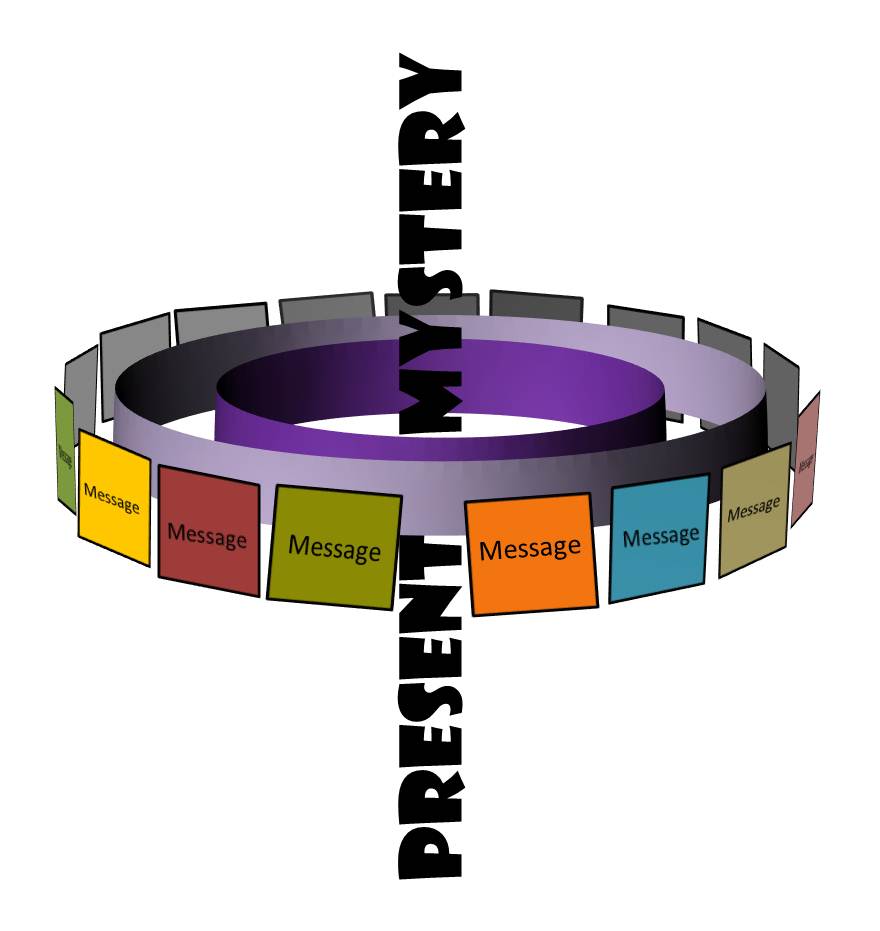
Present Mystery FullWhat’s your message? What philosophy of life – theories, beliefs, values, and aims – do you live by? Each of us has a message, a personalized interpretation of what life is about, what really matters. Some of us are more consistent in the way we put our philosophy of life into practice, and some philosophies of life are more thoughtfully composed than others. But we all have one – or I should say, each of us has one, which means that all of us taken together represent billions of different messages concerning the nature of reality, the purpose of existence, the meaning of life, and how we ought to live.

If we shift focus from individuals to societies, we can see that entire groups of people are characterized by the messages of their respective traditions. There’s a Christian message and a Buddhist message, and inside each we will find variations on the principal message: Roman Catholic, Baptist, Evangelical or Progressive Christian; Mahayana, Theravada, Zen or Pure Land Buddhist. These group-level distinctions are more numerous than you might first expect, and the variations on a message will multiply exponentially the deeper we look, until, once again, we find ourselves face-to-face with this individual Christian or that individual Buddhist (or whatever brand of message we happen to be considering).

Any message (at whatever level) can only speak out of the range of experiences informing it. No human being can hold everything inside his or her frame of reference, and even when we adopt someone else’s message into our own, we are unable to escape the limitations inherent to just having a perspective. Some cultural messages, like the religions mentioned a moment ago, claim that their perspective on reality was revealed to them by someone who did (or does) in fact comprehend everything in a limitless perspective, which is a contradiction supernaturally transcended in this case.

But you have only to study it in closer detail to discover that their so-called revealed message carries assumptions about the universe that are millenniums out of date, along with ethical values and directives that today many regard as barbaric at best. Even if their message once had the mystique of encompassing all of reality, it’s obvious now that it cannot – and didn’t back then, either.

So all of us carry messages that articulate a philosophy of life, conclusions and conjectures that orient us meaningfully in reality. My message is not exactly the same as yours by virtue of our different backgrounds, histories, situations and personalities (to use very broad categories). And neither of us holds the same philosophy of life today as we did, say, ten years ago. The slow process of maturity changes us, and along the way we come upon opportunities, suffer losses, and learn things that our former self could not have imagined or wished for.Present Mystery 3So many messages, so many different philosophies of life might inspire a more thoughtful exploration of meaning, if only we could get past the outer orbit where we all are promoting our messages as the best or only right one. But let’s say for now that we can. If there are so many variants in how human beings interpret reality and make sense of things, what can be said about the nature of meaning itself? If you have yours and I have mine, then at least we should be able to agree that meaning is more complex than our divergent messages would have us believe.

Indeed, the “meaning of life” that each of us is busy constructing is incapable of being reduced to a publishable message. There is just too much information, too many angles and perspectives, too many different ways of arranging and connecting the countless points of human experience, to break it all down into a single exhaustive philosophy of life. If we can step deeper into the complexity of what we might dare call THE human experience, we have to be willing to leave behind the either/or logic of competing messages and develop a tolerance for paradox.

It is possible that your message and mine are two legitimate spins on the meaning of life, constructed out of two distinct vantage points on the present mystery of reality and generated out of experiences that are deep-down unique according to the specific conditions that make us two different individuals. Our competing messages or philosophies of life may be irreconcilable, but perhaps all our efforts at negotiating a total agreement or eliminating our competition are fundamentally misguided. We are finally coming to understand that our ambition for one supreme and absolute message will most likely lead to our collective extinction.

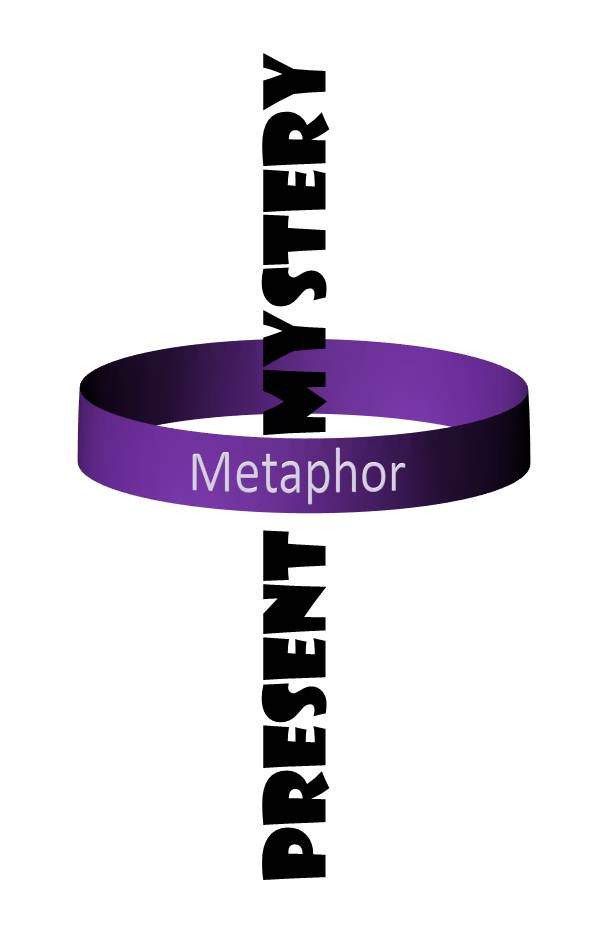
Meaning, then, has to do with the haphazard and more intentionally systematic ways that human beings select from the moving stream of experience those sensations, impressions, and patterns that correspond to the apparatus of our nature as sentient beings. We “tune into” reality along frequencies matching our human needs for safety, nourishment, intimacy, identity, freedom, purpose and significance. It’s that last (and highest) need, for significance, which drives our incessant activity of meaning-making: constructing a “world” and composing a philosophy of life (our message) that will orient us meaningfully in reality.Present Mystery 2The construction of meaning begins in the act of reflecting on experience and forming a mental image that depicts it internally to the mind. As we would expect, the images which first ascend into consciousness are generated out of the primary experiences of being in the provident garden of our mother’s womb, falling out of union and pressed through a narrow passage into exile, thereafter compelled by the pang of need to find the sustenance, protection, and warm bonds of security that will ensure our survival.

The entire drama of birth is preserved in this way, as powerful archetypal impressions coded into our subconscious memory. These reflex images continue to serve as primal templates for what concerns us existentially as human beings; they are foundation for everything else we construct “higher up” in the configuration of meaning called our world. (I’ll refer the reader to the work of Stanislav Grof for more on that topic.)

Because they provide this bridge from direct and spontaneous experience into the organized construction site of our world, these reflex images are known as metaphors (from meta, across + phorein, to carry). Not to be confused with the similes and analogies by which we compare and make sense of things we know in other ways, metaphors operate as grounding for language, anchors that tie our otherwise free-floating world systems to the present mystery of reality. When they are engaged (typically at deep intuitive levels), these images draw consciousness down to its source. Rather than representing something (some thing) external to the mind, an archetypal metaphor is a “dark depiction” of our own essential ground.

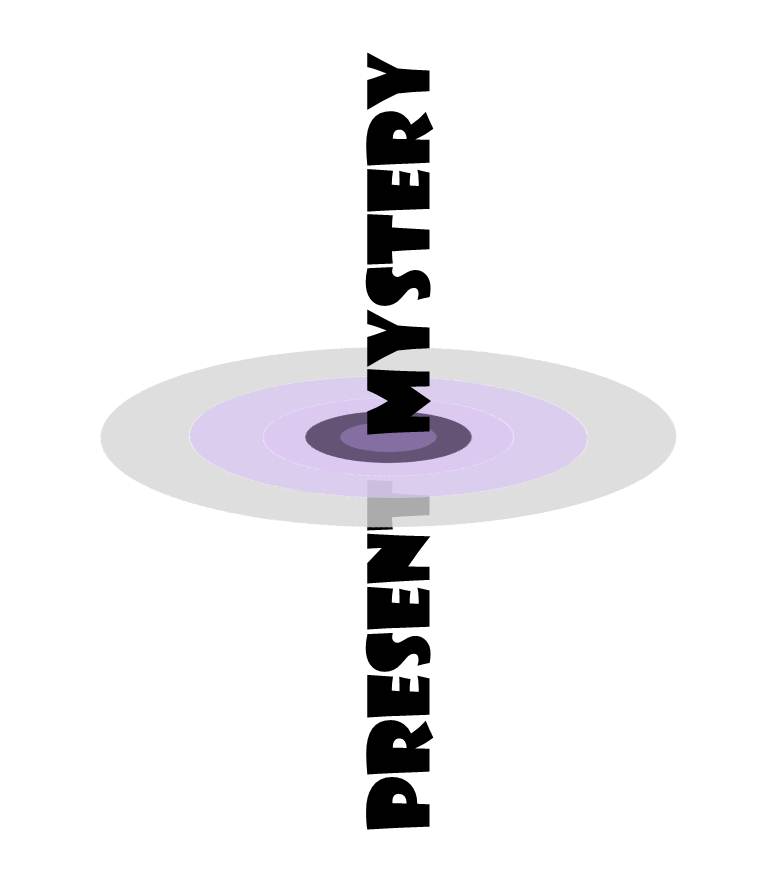
And what is this ground exactly? We can’t say, for the simple reason that its reality as the ground of being is deeper than words can reach. Once the threshold between meaning and mystery is crossed, in the direct and spontaneous experience of reality, we leave meaning behind and enter the ineffable presence of being-in-the-moment. Not a being, but being-itself.Present Mystery 1This is where everything begins – not in the once-upon-a-time sense of begin, but as the timeless source of your existence in each moment. The present mystery of reality, which might also be named the Real Presence of Mystery, is evident all around you in its countless manifestations. As one of these manifestations of the present mystery, you also have the opportunity to descend through the interior of your own being, into deeper and deeper registers of contemplative experience until, releasing the last (which were really the first) forms of self-definition, awareness breaks through to … this.

We can review the long history of religion as the pouring-forth of mystery into meaning, and meaning into the numerous messages or philosophies of life encircling our planet today. With so many parties and denominations calling at us to join in agreement and have a seat in the sanctuary, more people than ever before are feeling lost in the message. So much of it leaves us baffled, but also slightly offended at the demand that we distrust ourselves and let someone else do our thinking for us.

More people now than ever are seeking to push through the mob of placards and pickets, ready even to drop their own heart-crossed creeds in the quest for a deeper truth. Because they are straining against the outflow of world construction that’s been going on for many generations, the effort and intention of these seekers is interpreted by the custodians of orthodoxy as defiance, disobedience, and rebellion. But they are not interested in anarchy. They aren’t promoting atheism or dabbling in New Age superstitions.

What they seek is Real Presence – in themselves, in their relationships and communities, in the way they live on the earth. For all I know, you may be one of them.

Post-Theism and the Great Work of Religion

The progress of religion towards post-theism has its critics on either side, with devoted theists decrying it as just another form of atheism, and atheists voicing their suspicion that it’s taking us backwards into superstition and tribalism when we need to be moving forward into the enlightenment of science and technology. Theists are sure that the “post” in post-theism is motivated out of a desire to get rid of god, to get past our need for what god represents and provides. On the other side, atheists hear “theism” in post-theism and are convinced that it’s nothing more than a postmodern reconstruction of the same old neurosis.

But the “post” and “theism” in post-theism are misunderstood in each case. In fact, post-theism represents the direction religion must go – indeed it’s the direction that religion is already going, despite the slide at its margins into the corruptions of complacency and terrorism. You might be surprised to learn that you are a post-theist, but I make no presumptions.

Animist_TheistReligion began in the body, where the visceral urgencies of our animal life resonate with and link into (religare means to connect) the rhythms of nature. Earliest religion was animistic, preoccupied with the provident support of reality and the life-force that ebbs and flows along the rhythmic cycles of natural time. The pressing concern was to live in accord with these cycles, to flourish in the fertile grooves of dependency and to celebrate the mystery, both tremendous and fascinating (Rudolph Otto’s mysterium tremendum et fascinans), in which we exist.
There were no “gods” as yet, no external causes or agencies behind the forces impinging on us. The thunderstorm, for instance, wasn’t regarded as controlled or sent by some supervising intelligence separate from the storm. Rather the thunderstorm was itself the violent and refreshing expression of life-force. Its power manifested a vital energy and aroused sympathetic vibrations in our nervous system.

As time went on and the smaller family clans of our early human ancestors grew larger and more socially complex, this new cultural environment of the tribe gradually eclipsed a direct relationship with nature. In order for the individual to become a compliant member of the group, animal urgencies of the body had to be “trained” into morally acceptable behavior as befit the tribal order. The social construction of identity thus domesticated our animal nature and installed a deputy manager in the ego, with the authority of executive management retained by the tribe.

It was probably the question of “who’s in charge” – as key to the smooth operation of social roles and duties – that first inspired a reconsideration of nature as managed by external agencies, giving rise to the notion of deities as supervising directors behind what is happening around us. Conceiving a sovereign intelligence “on the other side” of our limiting conditions transformed the human-nature relationship into an exchange of services. As human devotees offered their prayers, worship, and sacrifices to a patron deity, it was hoped that the deity would in turn grant success in childbirth, a bountiful harvest, victory over an enemy, comfort in suffering, beatitude in the next life, or whatever boon was under the deity’s control and discretion.

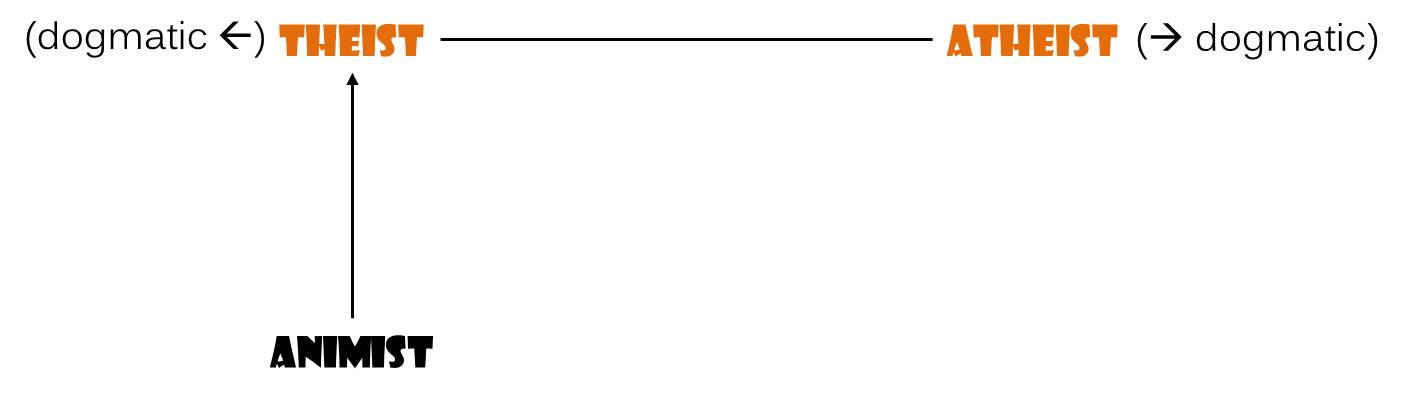
Theist_AtheistSomewhere along the line, someone called “B.S.” and the game changed. The denial of (a) god’s existence might have been a simple refusal to accept the reality of something unavailable to direct experience. It may have come as science was starting to penetrate the veil of what’s really behind the phenomena of nature. Or perhaps it was provoked by the confrontation of a divine will and humane values, as ethical defiance of a deity’s demand for child sacrifice, for instance. Then again, our First Atheist may have simply been unable, with intellectual integrity, to accept the popular personification or orthodox theory of god.

The moment someone publicly said “No” to (this or that idea of) god, theism became an option and people had to choose between believing or not believing – that is, between taking the traditional myths and doctrines literally, or dismissing them as bunk and balderdash. Due to the morally charged nature of the tribe, and of the individual’s identity as a member of the tribe, this polarity of options quickly collapsed into a conflict of opposing views. Inevitably, it seems, theists and atheists are compelled by force of their differing convictions into dogmatic positions, each refusing to listen to the other and both fantasizing a world where the other no longer exists.

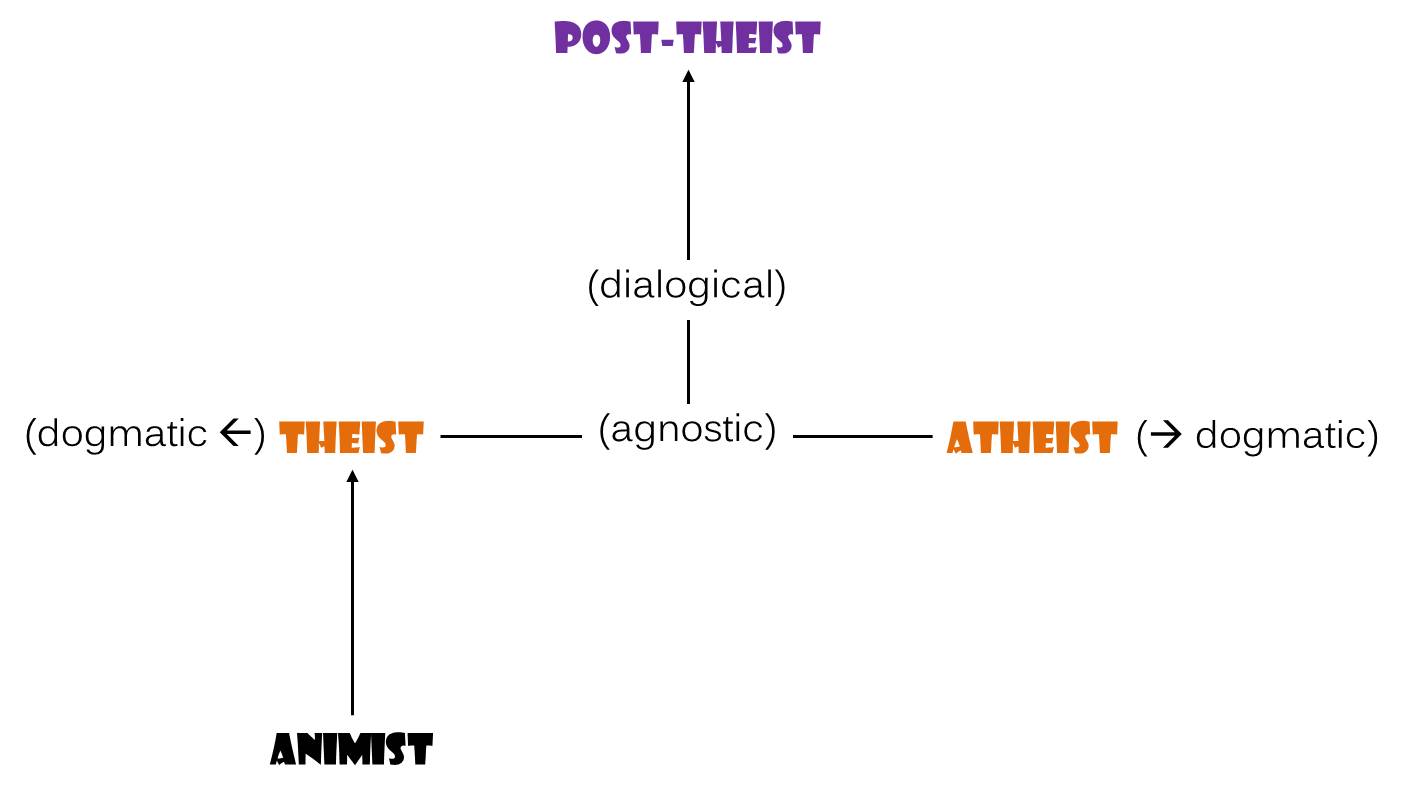
The rise of post-theism begins right here, in the tension generated between the poles of theism and atheism. It’s important to understand that post-theism is not merely a marketing makeover of theism, nor is it a postmodern restatement of atheism. And even though the dogmatists on both sides cannot (will not) acknowledge post-theism as a viable “third option,” there is a growing number of both theists and atheists who are creatively promoting its advance. This is because more contemporary thinking individuals are coming around to the realization that, one way or the other, we really just don’t know.

AgnosticBetween the dogmatic positions on either side of the theist-atheist debate, a significant population of truth-seekers around the planet and across cultures are finding space to breathe, as they acknowledge that the grounding mystery of being, which the myths and metaphors of religion attempt to name, is beyond language and the grasp of our minds. To say that it does or doesn’t exist in the guise of one deity or another is to miss the real insight of this agnostic confession. The point is that all our attempts to talk about it, as part of an effort to prove or disprove its objective existence, move us out and away from the very truth we are contemplating.

Post-theism begins, then, as theists and atheists alike humbly admit that the Real Presence of mystery (or the present mystery of reality, including, of course, the reality of our own existence) is ineffable – incapable of being described in words or reduced to meaning. Any honest thinking person cannot dismiss the awareness that language and the meaning we construct only qualifies this mystery, but will never contain it. For that reason we must renounce the tendency in ourselves towards dogmatism, and leave open a “space” in our belief systems for a deep, silent wonder.

Fighting over the existence of god is thus a contest over meaning that gets us no closer to the grounding mystery and provident uplift of life in this moment. Whether theist or atheist, each of us needs to descend through that open space and ponder the umbilical opening where meaning crystallizes and dissolves again into the mystery. Obviously this requires us to be sufficiently centered and self-aware, as well as contemplatively engaged in the moment. If you and I can both speak out of that agnostic space of not-knowing, offering our perspectives and beliefs in a spirit of humility, the Great Work of religion can proceed.

DialogicalThe theist-atheist debate is a win-lose contest (and all too quickly becomes a war). Dialogue, on the other hand, is this activity of sharing our perspective without a need to persuade or convince a dialogue partner to our position. We speak and listen with openness, curiosity, respect, and in a mutual understanding of the necessary incompleteness (and possible distortions) in our relative points of view. Through the back-and-forth of dialogue, meaning (logos) forms between (dia) the partners. It is no longer merely a reciprocal sharing but becomes a mutual co-creation of higher meaning.

Full ChartWith my illustration now complete, what I’m calling the “Great Work” of religion approaches fulfillment. With its commitment to keeping an open space of agnostic confession and enjoining other perspectives in healthy dialogue, post-theism takes up the responsibility of constructing shared meaning. This constructivist phase is where the providential uplift of the grounding mystery, experienced in the mystical depths of contemplative awareness, finally bears fruit in a paradoxical vision: The truth of both/and honors our differences as it energizes the ongoing pursuit of inclusive community.


Note: The color-code of text in my diagram corresponds to that in previous posts.

  • Black = Body, vitality, animal nature, carnal, instinct, urgency
  • Orange = Ego, identity, inner child, personal, fantasy, obedience
  • Purple = Soul, authenticity, higher self, spiritual, wisdom, responsibility

Our Creative Brain

I am fascinated with the human brain, and since I own one, I try as best I can to understand how it works. Without reducing all that I am to my brain and what goes on inside it, I nevertheless have a strong suspicion that everything I am is deeply dependent on this three-pound wonder between my ears. In reflecting further on the matrix of meaning and the myths by which we construct our worlds, I’ve come to a revelation concerning how all of this might be brain-based after all.

Web of Meaning_MatrixHere is my illustration of what I call the matrix of meaning – the crisscrossing polarities of primary concerns (orange) and narrative motifs (black) – and the web we construct on its frame as we weave the pattern known as our world. A deeper exploration of the matrix itself can be found in my post “Myth and the Matrix of Meaning” (http://wp.me/p2tkek-j2), while more about the peculiar construction of the web and its zones of meaning is in “Meaning and Paradox” (http://wp.me/p2tkek-sv). The opposition inherent to the four polarities gives the matrix its creative energy, which in turn compels this incessant human activity of meaning-making.

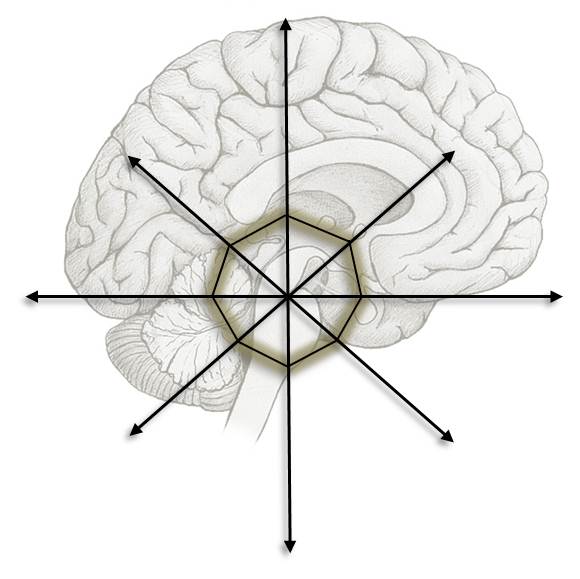
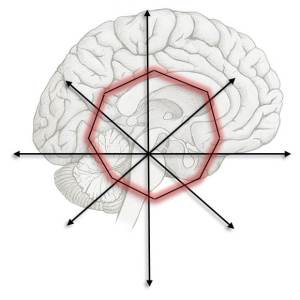
As I reflect on the matrix and particularly on the zones of meaning with the brain in the back of my mind (how’s that for a twist?), I begin to see how the three zones correspond to three main evolutionary divisions in our brain’s anatomy: (1) the primitive brain stem enfolded by (2) the limbic system and crowned with (3) a cerebral cortex. Each division evolved with specific responsibilities to the whole, and all of them work together for the survival, adaptation, and fulfillment of our potential as a species.

NeutralityThe brain stem (informally known as our “reptilian brain”) is responsible for the internal state and basic life-support of our body. Activities such as breathing, heartbeat, blood pressure, body temperature and the countless visceral events that must be coordinated in regulating the dynamic balance called homeostasis are monitored and adjusted from the autonomic control center of the brain stem.

Notice how the first zone of meaning, neutrality, is deeply similar to the brain stem’s preoccupation with homeostasis. Could it be that this natural balance-point in the body’s internal state is at the root of our preference for familiarity, comfort, and living on “autopilot”?

We like to stay where things are manageable, where the situational demands on our attention and effort are minimal. If we could, a part of us would prefer lounging in the warm sun as long as our animal nature is content.

Meaning-making begins, then, with our basic needs for safety, warmth, and nourishment. Once the channels of provision are flowing, it’s easy for us to stay in those grooves and succumb to the sleepy rhythm of the day-to-day.

Conflict

But as we know, we can’t stay there indefinitely. Life throws us curve balls and our automatic routines are upset. In addition to a brain stem that
works compulsively to keep us alive, humans (and all other mammals) possess a limbic system, which gives us the ability to respond emotionally to our environment.

Obviously any organism that can link up an association between an external object or event and its own internal state, so that the merest stimulus suggesting that object or event in the future elicits an anticipatory response, will have a survival advantage over an organism lacking this emotional talent.

Once again we can see a correlation between the brain and meaning-making. Emotion is equipped for life in the “conflict” zone, where the polarities in the matrix generate stress and strain. The limbic brain is also the niche in our nervous system where ego begins its career, also known as our inner child. In our quest for identity (ego = “I”) – typically most desperate and dramatic during adolescence – we are trying to figure out where we belong and how we are special.

Stories of privilege, entitlement, and superiority serve to bolster the ego and make us feel that everything revolves around “me and mine.” If the body seeks homeostasis and validates our narratives of contentment and the status quo, ego frequently instigates conflict in its ambition to be first, highest, and best. There’s no need to recount the damage done to ourselves, our relationships, and our planet as ego tries to exploit conflict in its favor, whatever the cost. I want to win, don’t you?

Paradox

The most recently evolved division of our brain is the cerebral cortex – all those billions of neurons and quadrillions of connections that carry the impulses of experience into conscious thought. At this level the brain is further organized into lobes, circuits, and nuclei specialized to process specific kinds of information coming across our senses.

Beyond this sifting-and-sorting business, however, the cortex also gives us the ability to restrain our urges and reflexes, to extract general ideas from concrete examples, to think critically and strategically, to imagine what’s possible and to transcend opposites. The farthest forward of specialized structures and last to come fully online is our prefrontal cortex, which is involved in self-control, rationality, forethought, and responsible behavior.

Another interesting feature of the cerebral cortex is its lateral division into left and right hemispheres. While the differences between the two hemispheres are commonly misrepresented in popular literature, research has revealed the left side (above and behind our left eye) as more gifted in abstraction and analysis, while the right side tends to be better with information that is concrete and intuitive. In the “conversation” between the hemispheres, conducted across a structure called the corpus callosum, our higher brain is able to reconcile opposites as paradoxes rather than have to come down on one side or the other (dualism).Zones_Brain

What we’re talking about here is our higher self, also known as the soul, which is where our adult intelligence resides. Only as we are able to move out of neutrality and rise above the conflict can we refine our appreciation for the complex nature of experience. The greatest paradox of them all – the timeless mystery within us and the turning cosmos around us – is home to the soul, the zone where we construct and celebrate ultimate meaning.

Meaning and Paradox

A while back in a post entitled Myth and the Matrix of Meaning I offered a way of understanding our personal and cultural myths (referring simply to a narrative plot, from the Greek mythos) as constructed upon a deep system of codes (matrix) which generate the concerns and motifs that preoccupy us as human beings. If our lives are to have meaning, the stories we tell and put into action must orient us meaningfully inside this matrix.

Meaning is not something we look for and find in reality, but rather something we as humans project onto reality. We spin meaning like a spider spins a web: it comes out of us, anchors to the matrix at specific points (which I’ll review in a moment), stretches across the present mystery of reality, and serves as a habitat. So the popular notion of our “search for meaning” is fundamentally mistaken. If we find meaning, it’s only because someone else put it there. Perhaps we’ve stumbled upon a floor clipping of our own or an unpublished draft we don’t remember setting aside long ago.

The belief that meaning is out there to be discovered is part of the heritage of theism, which, particularly in its monotheistic variant, promotes the myth that (a) god purposefully created the universe and made it meaning-full. Our “search for meaning,” then, is coming behind god and finding what he put there beforehand. Conceivably there is nothing that does not “have” meaning; we just need the intelligence and wisdom to discover it, or else count on some angel or ordained expert to reveal it to us. As theism loses currency these days, more and more people are having to come to terms with the responsibility of making the meaningful life they want.

The matrix of meaning consists of four primary human concerns and four narrative motifs. Each concern and motif exists in polarity with another concern or motif. Thus the concern of Security stands in opposition to that of Suffering, while Freedom stands opposite of Fate. Other creative and interesting relationships among the primary concerns are the more lateral associations of each concern with its neighbors on either side. Similarly the motifs comprise oppositions of Love and War, Work and Play. This dynamic of polarity – opposites that are connected along a continuum – gives the matrix its creative energy.

For a deeper dig into the primary concerns and narrative motifs making up the matrix, you might be interested in the post referenced earlier. At this point, however, I want to explore the composition of meaning as it is spun around, between, and across these supercharged polarities of the matrix.

Web of Meaning_MatrixFirst Zone of Meaning: Neutrality

The design of the matrix, as illustrated in the above diagram and already mentioned, is all about polarity. If we could go to the very center of all this creative opposition we would arrive at a point where each polarity is effectively neutralized, approaching a kind of perfect and non-energetic equilibrium. One set of stories that human beings weave defines a zone in the web of meaning (colored bronze in the diagram) which I will name neutrality. This is where we feel comfortable and things are “manageable” – stress and conflict are minimal, we are holding it together, and things are copacetic.

When life is fairly predictable and we know our way around, a trance state can start to set in. Living our lives doesn’t require much deliberation, as the routine pushes us along and behavior becomes automatic. Humans perhaps have a natural preference for neutrality, where the situational requirements on our active attention and focused effort are reduced and we can accomplish our daily tasks without too much mental investment.

It is also in this first zone of meaning that the more profound insights into reality picked up by sage philosophers and mystics are “dumbed down” into the platitudes and catchphrases of pop-culture. We think that repeating a fifty-cent affirmation at the beginning of each day will fill us with spiritual vitality, or that going to church will add significance to our lives. We glorify our messiahs and turn shamans into celebrities, then give them book deals and send them into early retirement.

Second Zone of Meaning: Conflict

Moving out from the center puts us deeper into the countervailing forces of polarity, where the strain of this-against-that is acutely felt. This zone of meaning (defined by a mauve strand in the web) is definitely not comfortable and our well-practiced habits of life don’t move us very effectively through the stress. Consequently it amplifies into distress, interfering with our ability to manage well, think straight, and accomplish our goals. Quite often our disturbed state will upset the status quo in our relationships, stirring up miscommunication and discord.

One short-term value of conflict is that it can focus us in an instant, which makes it a common tactic of politicians and preachers when they want to jolt their constituents and congregations out of complacency. Conflict just feels electric and alive. Occasionally we will actually seek it out as a kind of therapy for lethargy and boredom with life-as-usual. Antagonism – directing our energy in opposition to something we hate or can’t stand – can be a quick fix when irrelevance starts seeping under the floor-boards of our world. If it goes on interminably, however, we can lose hope and start looking elsewhere for purpose.

Many of us at this point (or in this zone) take steps to relieve our distress by self-medicating (with food and intoxicants), seeking help from medical or mental health professionals, or using exercise to burn off our nervous energy. If we do nothing, then our nervous system is at risk of crashing into depression. We might try a meditation technique for a while and experience some initial benefits, but it’s not long before the strain of life – or in a more existentialist vein, the “burden of existence” – turns the discipline into one more demand on our precious and shrinking resource of time.

Third Zone of Meaning: Paradox

While popular wisdom, which turns out not always so wise, calls us back from the strain of daily life into the zone of neutrality where meaning is flat and predictable once again, our real challenge at this point is to step through the strain and into the higher tension of paradox (violet strand). But whereas the tension of the second zone is merely unproductive and exhausting strain, the tension of paradox is creative. This is where a dualism such as freedom versus fate is finally understood as a proper polarity: freedom in fate, and fate in freedom.

Creativity is itself paradoxical, as a marriage of freedom and fate, chaos and order, wild energy and fixed form, raging waters and the stable riverbed. Each of the four polarities in the matrix can be appreciated in this same way (as paradox), but only as we are able to push above the neurotic dualism of everyday life strain. It’s not freedom or fate, security or suffering, love or war, play or work but all of these currents swirling together in the vibrant stream of reality.

We come to learn that our moral campaigns and utopian ideals where fate, suffering, war, and work are eradicated and the world returns to its original paradisaical state of bliss, are nothing more than fantasies – and sometimes dangerous delusions. It’s at this stage, in fact, that we become aware of our human responsibility in constructing meaning and creating the worlds we want to live in.

The present mystery of reality is transparent and opaque, random and provident, the ground of being and the abyss of extinction. And just as in quantum physics, reality will “show up” according to what we set out to prove.


Imagine that each of the zones in my diagram outlines a world we have constructed and inhabit. Each step outward across the web of meaning translates the tension inherent to the matrix into a larger and more complex (and also complicated) worldview.

We can choose to live small and stay where the tension is minimal, where our daily habits allow us to sleepwalk through life.

Or we might sign our allegiance to one dogmatic orthodoxy or another, drawing excitement, purpose, and hope from a crusade we believe in.

We also have the option of stepping through the veil of conflict and taking in a bigger picture, where the world (our world) is not such a simple place – for neutrality and dualism are both simplistic constructs. As our web of meaning is capable of supporting an appreciation for polarity and paradox, we can live with ever-greater fidelity to the way things really are.

Ego’s God

Post-theism, unlike atheism with which it is commonly confused, advocates for the necessity of theism in the full development of human beings. If I am critical of theism – referring to the belief in higher beings who supervise and intervene on human affairs – it is not because I think its contribution to our progress as a species is no longer needed, but that its worldview for the most part is so outdated as to render it largely irrelevant to life today. I have explored this loss of relevance in recent posts already (Religion and the Snow Cone Universe and The Three Stages of Religion), so I’ll rest my case for now.

According to the general course of religion’s evolution across the millenniums, theism occupies the middle stage between animism and post-theism, which makes it either a successful bridge or a tragic barrier to what Abraham Maslow named the “farther reaches of human nature.” When it succeeds, the personal ego can be transcended in the interest of communion, responsibility, love, and fulfillment. But when it fails in its essential function, theism locks the ego down in regressive attitudes and self-preoccupation, where “me and mine” become anchors of an insatiable consumerism, dogmatic orthodoxy, and redemptive violence.

The present failure of theism is partly due to its insistence on defending an obsolete worldview, but even more to this lockdown on the ego – on its insecurities around death and its ambition for immortality. My title for this post has a double meaning, referring on one hand to the way that god inspires and endorses an acceptable range of possibilities in the formation of individual identity (ego), as a member of this or that tribe. I consider this the essential function of theism. Obedience to the will of god, worship of god’s attributes, and conformity with the character of god as represented in the myths and testimonies of tradition, draw ego development in the direction of this ideal.

The other reading of my title is more consistent, in my opinion, with what theism today has become: Ego is god. This is where it becomes “all about me and for my sake,” where religion is reduced to the services that meet my needs and will ensure my everlasting destiny in heaven when I die. If these services and assurance were not there, ego would have no reason to stay with religion or “be religious.” Today churches compete for the attention, entertainment, satisfaction, membership, and fair-trade donations of the ego-as-god.

To understand how we got here, we need to examine more closely the process of ego formation and the forces that hold ego together. There is widespread consensus in developmental psychology that ego (referring to the individual’s separate center of identity) is not something we are born with, but must be constructed through the process known as socialization. The ego is thus a social construct and is molded, i.e., disciplined, shaped, dressed up, and acknowledged as “one of us,” an insider, a person of value and member of the tribe.Ego Dynamics On the way through this gauntlet of moral engineering, the identity under construction must negotiate two opposing values: to fit in with the group, but at the same time to stand out as an individual. It could be argued that the ego’s need to belong (fit in) precedes and is therefore deeper than its need for recognition (to stand out). But then again, the mere urgency of needing to fit in presupposes some degree of separation or exposure. So I will assume that these two opposing values arise together, forming an inherent tension (and anxiety) in the process and product of socialization known as ego.

In order to fit in and stand out, the ego must be provided with rules and expectations. Every tribe (referring here to any organized and internally engaged human population, beginning with the nuclear family) will have its conventions as to what being “one of us” must look and act like. As the individual toggles back-and-forth between belonging (but without getting buried in anonymity) and recognition (but without losing the connection of human intimacy), ego is trying on various personae or masks.

Each mask represents commitment to a role, and every role is part of a role-play, the elaboration of which is known as culture. In the early years an individual will try on a variety of masks, pretending to be a doctor or nurse, cowboy or Indian, cop or robber, grocery clerk or celebrity fashion model. Through it all, of course, is the felt pressure to be a “good boy” or “good girl” according to the morality of the tribe. Eventually certain masks will become more or less permanent identifiers, as the identity an individual settles on or is stuck with. Typically these demarcate the roles that will involve him or her in such conventional pursuits as marriage, family, and career.

Some masks and the energies they elicit are discouraged by the tribe, as perhaps not appropriate to “who we are” or to the way a good boy or girl should behave. As Carl Jung explained, these roles and their associated inclinations must then be split off and pushed out of sight, in order to ensure the individual’s acceptance by others. This split-off aspect doesn’t just fall away and disappear, however, but lurks behind the ego as its shadow – alluring, scandalous, forbidden, and dangerous. Jung theorized that our full individuation into a whole self is only possible as we are able to come to terms with our shadow and find ways of reconciling it back into our personality. Only then, after integration, balance, and stability have been achieved, can we transcend or go beyond the ego into higher transpersonal experiences.

A primary function of theism, as I’ve said, is to arrange and orient tribal life around an image of ultimate reality, personified and projected as a provident agency behind the mortal realm where we humans live and die. The deity (referring to this personified representation in myth, art, and theology) puts on display, as it were, the attributes that devotees glorify in worship and strive to obey in daily life. In this way, the moral development of culture over the millenniums has followed a trending line of ascent, from basic commitments to the primary group, through an opening-up to outsiders (strangers), and into still more enlightened practices of benevolence and forgiveness (as it concerns the enemy).Ego_Deity_DevilPost-theism urges us to continue this progression, to the point where we have fully incarnated the virtues of our deity – or to put it another way, where the projected image of our own dormant nature is finally reached and awakened in the way we live. At that point we can take up the responsibilities of loving each other, caring for the earth, and being faithful “higher powers” to the generations depending on us. They are just starting out on the adventure of ego-formation, which means that we must be creative mythmakers, wise advisors, and provident stewards of the theism that is shaping them. An important stipulation is that our representation of God (as deity) must be congruent with the cosmology that contemporary science is revealing to us.

But whereas theism might lend a bridge for the longer arc of our spiritual evolution, it is currently hung up on the ego – and hung up by the ego, in the form of deities who are calling for jihads, damning outsiders, and demanding purity over love. God’s shadow, which is the condemned and unacceptable parts of ourselves that have split off and taken metaphysical reality as the devil, is seen at work in liberal politics, in the civil rights of minorities, the decline in church membership, and in the general deviance of our youth.

In the crusade of true believers and fundamentalists against the menacing shadow of evil in the world, “the devil” is actually magnified and empowered. Violence against terrorism only intensifies aggression, just as the state-sanctioned murder of murderers only justifies more murder as a solution to our problem. The split within us thus gets played out as a split down the middle of reality, and in our campaigns to root out and destroy the shadow in our enemy, we are pushing ourselves and everything with us to the verge of extinction.

Ego is not god, but neither is God an ego. The thing that religion seems so desperate to rescue out of the world will bring about the end of the world and take us all down – unless we can wake up first.

The Three Stages of Religion

In Religion and the Snow Cone Universe I explored the essential function of religion as a way of connecting (religare, tie together) the inner and outer realms of human experience. Our mystical communion with the grounding mystery is metaphorically represented and depicted across a collection of sacred stories known as mythology. These myths (mythos, narrative plot) are recited by the community in ritual performances and worked out in daily life according to the local customs and precepts of morality.

A critically important qualification in all of this is that the mythology of religion must align with our current understanding of the cosmos. When it does, our spirituality (inner realm, grounding mystery) can flow out and connect meaningfully with our science (outer realm, cosmic order), generating an awareness that everything “turns as one” (universe). When this alignment is missing, our myths become incredible and increasingly irrelevant. Rather than being able to inhabit our stories, enacting them and living them out, we are left with the choice of taking them literally as eye-witness accounts of supernatural and miraculous events of the past or tossing them aside as so much childish superstition.

All of that is looking at religion as positioned at the center of a vertical axis, with spirituality below (or within) and science above (or around). This central position helps us appreciate the intended function of religion (to connect these two realms) as well as understand how and where it begins to fail. In this post I will turn this axis 90º to the horizontal and picture it as a moving time-line from left (the past) to right (the future). The question now is, “How has religion evolved through the millenniums, and is this evolution more or less haphazard or does it proceed according to a deeper design?”

Snow Cone 2I will build a case that religion evolves as human beings develop, which means that the larger cultural shifts we observe across the centuries are deeply correlated to changes unfolding (or arrested) at the individual level of human consciousness. The above illustration is pulled forward from my most recent post (Religion and The Snow Cone Universe), but in place of the word “religion” I have inserted a graphic representing what I will explain as three stages in the evolution and organization of consciousness. “Stage” here will be used in two senses of the word: as a developmental period of time and as a kind of platform (think theater stage) that provides consciousness with a specific vantage point on reality.

Thankfully we don’t need to do a lot of research or dig into cultural archaeology to start making sense of these stages I have in mind, for they are represented in the very structure of your consciousness as a human being. Just as your individual development is unfolding according to a sequence of distinct stages, so religion has been evolving along that same advancing line. So, I’ll ask you to sit back and take a look at yourself.

Stage One: BODY

Let’s just get the hard fact out of the way: You’re an animal. You breathe, burp, and bleed just like other animals. You were born, grew up, and one day you will die – just like other animals. Inside and under your skin is a complicated system of tissues, glands, organs and nerves, pulsing together as an interconnected web of urgencies. The urge to breathe, for instance, is a compulsion that evolved around the need of your cells for oxygen (and to blow off carbon dioxide); breathing is an urgency. Many other urgencies are presently taking care of what this animal nature of yours requires to live.

Like other animals, you possess an instinctive intelligence that has been evolving for millions of years and across numerous species. Through a network of impulses, reflexes, drives, and adaptive routines instinct serves to uphold a dialogue between the internal urgencies keeping you alive and the larger rhythms of your external environment. The cycles of Sun, moon, and seasons are intricately timed with your needs for activity and rest, arousal and reproduction, nourishment and shelter. You don’t have to think about this provident coincidence since the urgency that anchors it in your throbbing viscera is unconscious and graciously impersonal.

From the stage of your body, reality is physical, vibrant, sensual – and alive. Since everything in you and around you is caught up in a pulsing tango (and tangle) of urgency and rhythm, from this vantage point nothing is inert or uninvolved. Colors, sounds, odors, flavors, temperature, current, texture, pressure and weight: a kind of glory cascades across the dazzling variety of forms, effervescing to the surface and dancing on your senses. It’s not you over here and that over there, but you and that together, partners in the same cosmic dance.

At this stage religion is animistic, connecting and closing the circuit between the inner mystery and outer cosmos by a mythology of hidden agencies. Anima is Latin for vital force or life-force, a related term to spirit, meaning breath. It’s not that something else is on the other side of what we perceive with our senses, but rather that what we perceive with our senses participates in and manifests forces that hold everything together. Again, these are not supernatural personalities (deities) pushing things around (that idea comes later) but creative energies expressing outward from the interior of things.

Stage Two: EGO

In addition to being an animal and having an animal nature, you – and this especially refers to the you you think you are – are an identity project of your tribe. Ego is also from the Latin, translating as I, the subjective center of a separate self. You needed this separate center so your tribe could shape an identity around it and assign your place in the larger role-play of society. For this to happen with reasonable success, your animal nature (body) needed to be trained (i.e., socialized) to behave properly – not to bite, pass gas, or mate in public. In addition to such constraints on unacceptable behavior you were conditioned by your tribe to be polite, cooperate with others, and pick up your toys.

All of this social shaping of identity (ego) is what we generally call morality. The individual is expected to follow the rules and respect authority, and not only because those in charge have their hands on the carrots and sticks. It just makes for an easier life together in community. Your tribe dutifully (but not always very competently) instructed you with the preferences, values, and beliefs that demonstrated obedience. Because all of this happened in the first decade or so of your life, the part of your personality where these moral sentiments and reflexes still reside is known as your inner child. Most of what goes on in there is deeply conditioned but nonrational – prompted and carried along on scripts of flattery and shame, praise and blame, guilt and appeasement.

Another strong virtue of early childhood was your gift for fantasy. Daydream, dress-up, role play and pretending to be someone (else) occupied much of your time. Fairy tales and closet monsters were sources of endless fascination or bedtime anxiety. Fantasy is your creative intelligence for making things up and acting as if what you can’t see is more real than what you can. Your tribe exploited this native ability of yours and got you invested in the collective fantasy of meaning-making, producing a kind of semantic shelter in the world you shared. As long as this world-construct was confirmed and reinforced in the habits of everyday life, the illusion of its reality could be maintained.

Religion at this stage is theistic (from theos, god) referring to the belief in higher powers that model human character and supervise the world from the margins. When you were a child these higher powers were literally your “taller powers” – i.e., the adults who were in charge of things and provided for your needs. Theism postulates (but doesn’t prove) an intention behind and above the world, representing an important advancement on the spontaneous and impersonal life-force of animism. The gain was that theism introduced the notion of there being a plan and purpose in the nature of things that we can interrogate, petition, and perhaps even influence for our benefit.

Stage Three: SOUL

Currently, and for the past several millenniums, human beings have been comfortably established in second-stage culture and religion. The reason is simply that ego has been the dominant mental location of human consciousness for that long. Theism, as the religious system coordinating deity, tribe, and ego, has provided orientation and meaning to our species for a long time. Until fairly recently, that is, when our cosmology (scientific model of the universe) began to render the old myths unbelievable.

When one stage is passing and before the next stage is fully entered, the phase we find ourselves in can be very disorienting. Once-true believers lose faith, members leave their churches, denominations don’t seem to work anymore, and the “spiritual but not religious” look for inspiration from other sources. We can also see the endangered religions growing more desperate and violent, putting up their defenses and terrorizing nonbelievers. It is tempting to conclude that such is the nature of religion itself, and that we will be much better off without it.

To understand the third stage of religion, however, we need to look beyond the anxiety, hostility, and depression of the disoriented ego. Your inner child is not capable of creating the life you really want. It’s not only stuck in the problem, it’s where the problem is centered. What you really need is to ascend to the mental location of your higher self – rational and responsible as an adult ought to be, but also emotionally balanced and intellectually engaged. You don’t need to leave your passion and creativity back in childhood (or repressed in your personality).

What is soul? Let’s first say what it isn’t, exposing some popular efforts to hang on to ego. It isn’t a ghostly replica of the body’s physical form, and it’s not another word for the immortal ego. Soul isn’t what continues on after you die, as a disembodied personality moving residence to the next earthly incarnation, new celestial home, or some metaphysical higher plane. All of these explanations are trying to figure out what happens to you when you die, when you – again, at the mental location of ego – are nothing more than a temporal construct of social roles, attitudes, and beliefs. Your third-stage challenge is to open yourself to a post-ego way of being, where “me and mine” are no longer anchors of ultimate concern.

The “post” in post-ego – as well as in post-theism, the religion of our third stage – doesn’t require that you renounce your ego, throw it down, or try to stomp it out of existence. It simply means after, referring to a way of life oriented on the essential realization that All is One, which logically comes after the illusion of your separateness (ego) has been transcended. In the light of this realization you instantly understand that you, as an individual, are a participant in the larger communion of beings. Morality is no longer about obedience to another’s command, but is rather about making choices and taking action with a much (much) larger context in mind.

Notice how this insight marks an advance beyond the animism of Stage One, where the emphasis was more on the peculiar manifestation of the life-force in a tree, a thunderstorm, or in the body itself. This is the difference between instinct (unconscious, compulsive, urgent) and wisdom (fully conscious, contemplative, intentional). A higher capacity for holding the awareness that All is One had to wait on the ability to open your mind without losing it, to detach your focus without getting distracted, and to jump from your highest thought into the mystery encompassing all things.