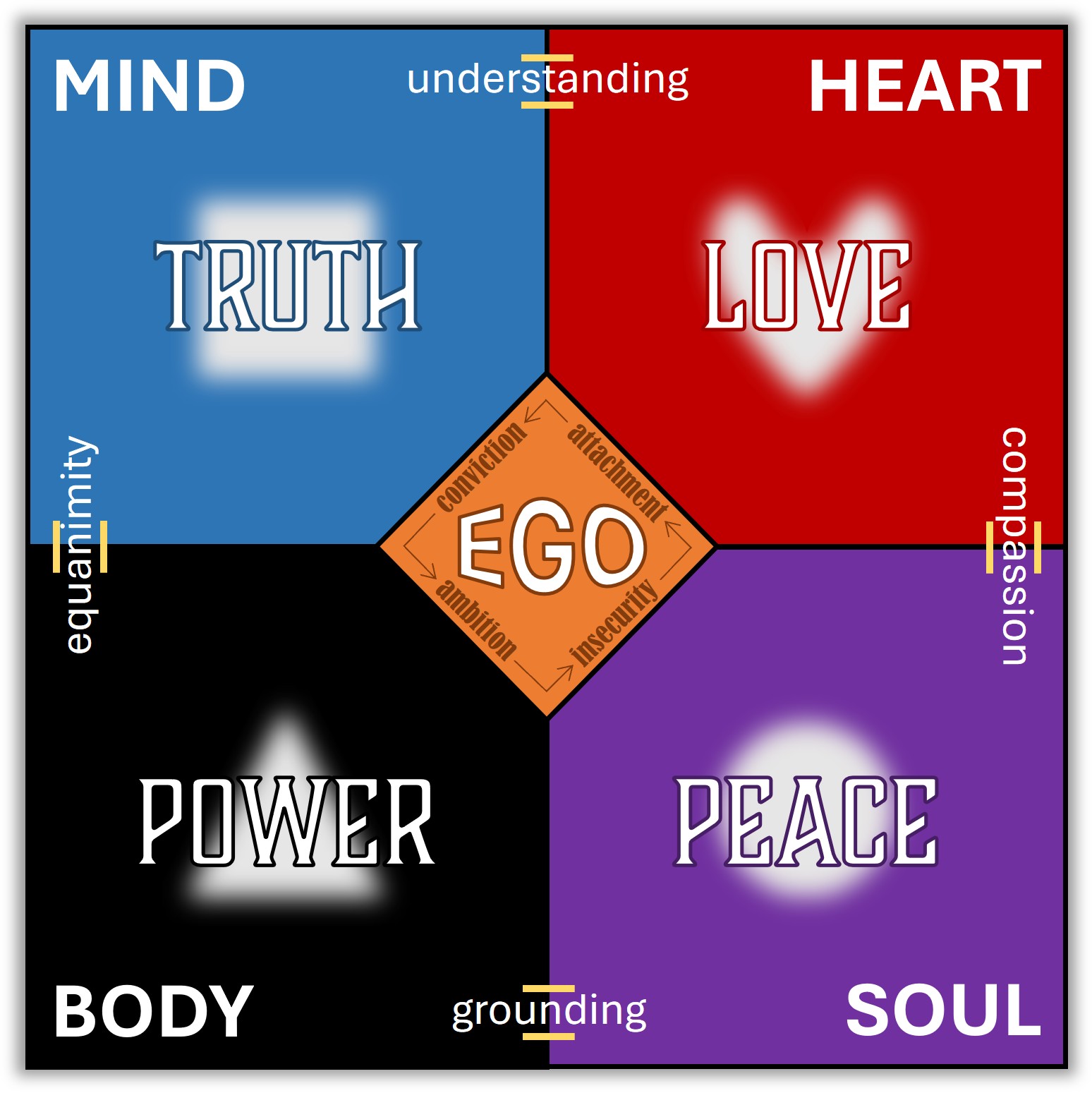
The Truth of What You Are

This identity you are managing inside the world is not what you really are. What you are is deeper and more essential than who you are. What you are is a human being – or better yet, a human manifestation of being, while who you are is about your personal identity – the wardrobe of personas you put on and take off as you pretend to be somebody special on the social performance stages of your life.

The self-conscious center of autonomy, agency, and ambition that acts out your various roles of identity is called the ego (Latin for “I”).

It’s important to understand that your ego is really nothing but an actor looking for work, and its work is out on the performance stages of your world, playing the roles that identify you to others and assign your part in the scripts. From ego’s mental location, you look out into an objective world (i.e., the theater and stage) that is “thrown or put before” you (objectāre), as you also look into a subjective self (i.e., your human nature: what you are) that is “thrown under” you (subjectāre).

Ego’s first function, psycho-developmentally speaking, is to serve as a mechanism of self-restraint, by exercising executive control over the channels of urgency and impulse coming up from the body. A second function of your ego, following on this progress in self-control, is to redirect or sublimate those primal instincts into prosocial behavior, which is to say, into behavior that is compliant with your tribe’s moral frame.

In this context, a moral frame sets the standards of what a “good person” and “right action” mean inside the theater and on stage.

Your ego was coaxed and shaped early on by your tribe with instructions to behave as a “good boy” or “nice girl” should. To the degree you complied, your reward was acceptance, approval, recognition, and belonging. Your objective world – what I prefer to call your quality world (after William Glasser) – thus came into shape around you, anchoring and reflecting back a sense of yourself as somebody special.

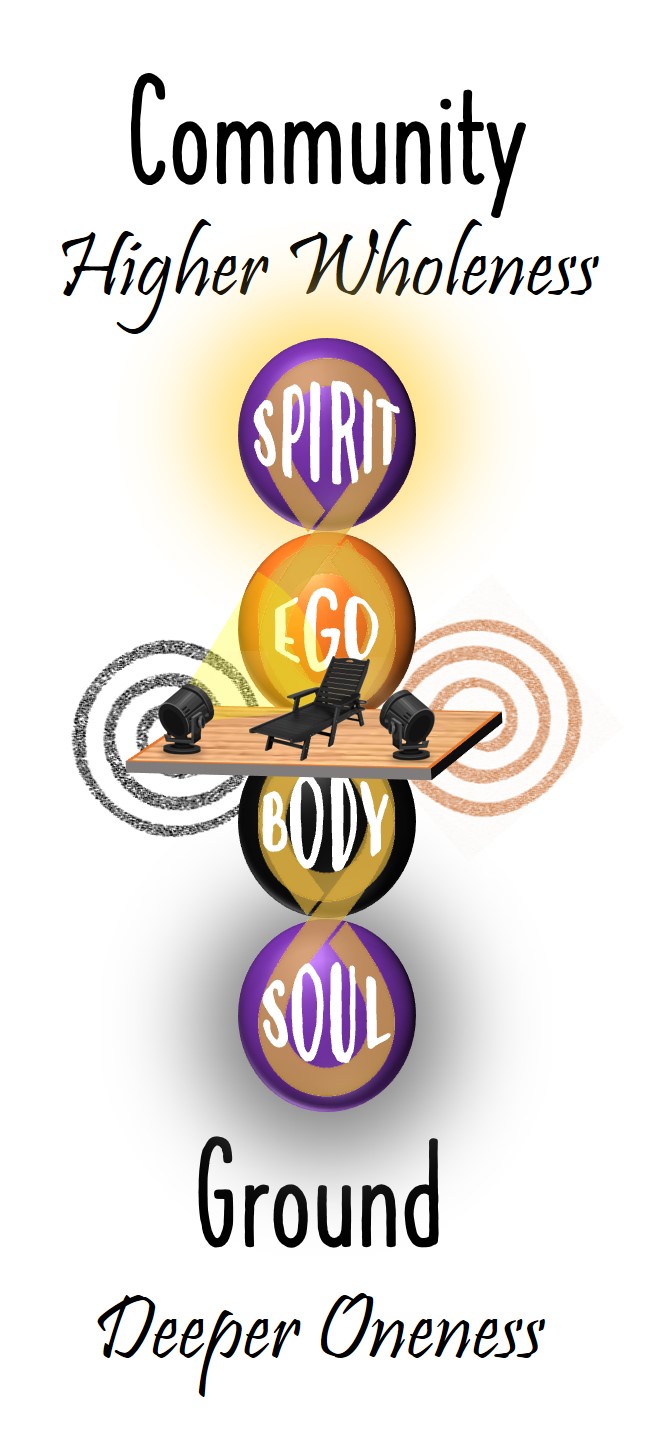
In the above illustration, a spiral has locked your ego into a neurotic obsession over the question of identity: “Who am I?” Because the moral standards and social expectations of your quality world are, or can be, fickle and unforgiving, the task of managing your embattled self-esteem requires practically all of your attention. “Am I _______ enough? Do I have what it takes? Will people like me?”

Earlier, a critical distinction was made between who you are – this ego-and-persona-in-a-quality-world experience – and what you are, referring instead to something deeper and more essential: a human manifestation of being, or a human being for short. This is your authentic or true self, what easily gets lost from view in your relentless pursuit of personal identity.

Your true self is actually a communion of body and soul, where “body” names the phenotype of your biology as a human organism, and “soul” names the in-reaching depths of consciousness in the ground of your being.

Body and soul are also mental locations. But whereas ego centers you inside the theater of your quality world and on social performance stages of identity, these other mental locations orient you in Reality – not in roles and role-plays, but in the really real.

The organism of your body participates in and belongs to the greater Web of Life and the sensory-physical environment of Nature. “Organism” and “environment” constitute a basic unity, as Alan Watts reminded us, and willful ignorance of this basic unity amounts to “a serious and dangerous hallucination” (The Joyous Cosmology).

On the other side of this Yang-Yin communion, your soul rests in the Ground of Being and contemplates (beholds in awareness) the higher wholeness of all existence in a holy image of the Universe. Not to be mistaken for just another name of the physical environment at the largest scale, Universe is the consilient (“leaping together”) unity of all things, the harmony of beings – which, of course, includes you.

The beheld image of a unified Reality (i.e., the Universe) is a correlate of your grounding in Being; one implies the other.

So, the mental location of consciousness in your body orients you as an organism in a physical environment, as the mental location of consciousness in your soul grounds you in Being and beholds all things as the Universe. However, the mental location of consciousness in your ego separates you from this essential communion, in preparation for the adventures and misadventures of becoming somebody special in a largely make-believe world.

Precisely because ego-formation separates you from the body-and-soul communion of your true self as a human being, in pursuit of something that is imaginary, ephemeral, and inherently precarious, the spiritual wisdom traditions of Sophia Perennis have long regarded it with suspicion.

Anything that is separate from Reality is by definition not real.

What’s more, ego’s ambition to do enough, be better, have more, go farther, and get the reward – gold stars, trophies, diplomas, promotions, wealth and power, immortality in heaven – diverts your focus and energy away from the wonder of being alive and fully human.

Rather than suing for the suppression or extinguishment of ego, however, Sophia Perennis invites you to appreciate its delusion of separateness as providing consciousness with a detached position (a third mental location) from which you might ponder and celebrate the mysteries of being human.

Only from the distance afforded by self-conscious awareness is it even possible to see that you have a body and a soul, despite the fact that you (that is, your ego: “I”) don’t really own them, nor are body and soul mere parts of you. They are, together in communion, your true self.

As long as consciousness remained immersed in this communion of body and soul, there could be no apprehending the marvelous facts of your place in the great Web of Life and of your roots in the Ground of Being. And yes, putting on an identity and playing your part on the performance stages of your quality world ushers you into the uniquely human realms of culture, freedom, purpose and meaning, where the ecstasies of becoming somebody special await.

The danger and temptation lie in the way your pursuit of identity can pull you into a tightening neurotic spiral, where the ambitions and attachments of who you are make you forget or fail to discover the truth of what you are.

Educating the Human Spirit

In a recent post entitled The Vocational Clarity Table of Elements I made a case against a growing sentiment which regards a college education as a waste of time and money.

Of course, I had to preface my argument by first acknowledging the dismal statistics – 80% of college students change their major multiple times, 50% will not complete their program, and of the half that do make it, 75% end up finding jobs outside their degree.

I called that “the trap of going to college.” Colleges don’t help – because they don’t address the real problem – by implementing interventions and accommodations to keep students from dropping out. Students are still dropping out, and now colleges are burdened with funding all those ineffective failure preventions.

The real solution, I argued, lies in a change of paradigm, away from intervention and more intentionally toward a paradigm of empowerment.

While the mindset and methods of intervention are based on the assumption that students are deficient in what they need to be successful in school and life – and this paradigm governs Western education across all grades – the mindset and methods (i.e., the paradigm) of empowerment assumes otherwise.

Students already possess the potential, intelligence, curiosity and desire to learn; the work of education is to ignite this potential and “lead out” (ēducāre) each student’s natural curiosity into a deeper and wider understanding of themselves, of the world around them and their place in it.

Do students arrive to college confused, already depleted, bored with school, and emotionally disengaged? Yes, obviously. Is that because they are missing some key element that only a subject or service expert can provide? Interventionists say, Yes, our role is to keep students in their program – whatever the cost.

Proponents of empowerment – let’s call them education catalysts – recognize that the mental, cognitive, and emotional condition of these at-risk college students is itself a consequence of intervention and accommodation strategies from the early grades.

If the goal of intervention is to prevent failure and keep students in school, empowerment seeks to support and guide their progress in vocational clarity. Rather than trying to “fix the problem” (i.e., the high confusion, disengagement, and dropout rates), we will better serve college students by taking time to discover what they already have inside themselves, develop their individual intelligence, clarify their interests, and guide them (ēducāre) in exploring occupations that center the types of activity they enjoy and find interesting.

We would be wrong to conclude that a college education is only about getting graduates into jobs that align with their degrees, however. Vocational clarity is more than just having a clear path of purpose through college.

Even though the concept of vocation has been folded into other career-related terms like occupation and profession, its scope is much larger and reaches much farther. From the Latin vocāre, vocational clarity is about an individual’s “calling,” purpose, and direction in life.

Certainly, college and career fit into this bigger picture and longer view, but without a clear calling, purpose, and direction in life, students (like the rest of us) tend to fixate their expectations for fulfillment on jobs, status, and salaries – only to be disappointed.

In light of this, I have updated my Vocational Clarity Table of Elements to include an additional dimension of elements that directly addresses this quest of the student for fulfillment in life. That earlier model (now 1.0) placed John L. Holland’s concept of “interest” at the nexus of horizontal (outward) and vertical (inward) axes.

In Holland’s scheme, interest attaches (outwardly) to types of activity and the associated skills of work, as well as serving as a focusing lens (inwardly) of one’s deeper intelligence and talent.

In that earlier post I advocated for the empowerment paradigm of education, predicting that the statistics measuring student success will dramatically improve as colleges and universities intentionally (mindset) and strategically (methods) work to activate the potential students already have within themselves. Holland’s career theory and interest assessment have proven effective in helping individuals match their natural endowment (i.e., talent and intelligence) to occupations in the world of work.

The additional dimension of elements (2.0) returns to the nexus of interest, but now ascends the vertical axis to identify elements that engage students with the bigger picture and longer view of life. If interest serves as a focusing lens of intelligence – coming up from within, as it were – it also directs intelligence in the exploratory initiative of curiosity.

Developmentally, curiosity is most active in early childhood, losing much of its wide-open wonder in subsequent years as society shapes and fills (i.e., instructs) the mind with its cultural operating system.

But the creative, playful, and exploratory curiosity of childhood doesn’t have to be foreclosed under the regime of realistic and practical concerns – what many of us regard as adult life.

Curiosity projects the human spirit through the lens of interest along trajectories of aspiration that seek, or long for, fulfillment. There are five human aspirations: for peace (what I name our mystical aspiration), for love (our ethical aspiration), and three more that are centered in our vocational quest for freedom, purpose, and meaning.

My more complete model of vocational clarity – the Vocational Clarity Table of Elements 2.0 – identifies in human beings, and therefore in every college student, the longing for a chosen path of purpose that makes life meaningful.

Taking into account this higher element of aspiration, it becomes painfully obvious how an instructional system designed to fit students into standardized rubrics of knowledge and technique is actually working against their aspirations for freedom, purpose, and meaning.

Instead of clarity in their big picture and long view of life, student horizons are collapsing (being collapsed) around the trivial pursuits of grades, degrees, and jobs. Such things can be measured and managed, which explains why instruction has largely replaced education, since we can control what we put into (instruct) students and what they are required to recall on assessments.

But that spiritual longing? Those aspirations of the human spirit?

Who knows what could happen if educators embraced their vocational role as catalysts – igniting, activating, equipping, guiding, and then releasing the force that students already have within themselves?

No telling.

How to Avoid the Trap of Going to College

When I visit students in classrooms as the manager of career services on a college campus, I stand in front of them, introduce myself, and gesture as if I am pulling open my shirt to reveal an imaginary superhero insignia.

Greetings! I am here to save you from the trap of going to college.

This trap has a lock and the lock has a combination, I continue. When you understand the combination, your risk of falling into the trap of going to college will decrease dramatically.

Then I write the combination on the classroom whiteboard: “80-50-75.”

Eighty percent of students going to college will change their major multiple times.

I see heads nodding in my audience: Done that.

This tells us that students are trying to decide why they are in college and where they are going, but many can’t figure it out. One thing is for sure: they are confused.

A consequence of this persistent confusion is that half of students going to college – 50% (the average between four-year universities and two-year community colleges) will not complete their program or transfer. It’s not that they are not capable or intelligent enough to succeed, but perhaps they come to realize that college is a waste of time and money – if you don’t know why you’re here or where you’re going.

Now I draw an invisible line with my hand down the middle of my classroom audience.

So, 50% of you will complete your program and graduate – congratulations! But hold on. Here’s the final number in the combination of that lock on the trap of going to college: Seventy-five percent of college graduates end up getting jobs outside their degrees.

Eyes widen.

Typically, the blame for this last statistic is pinned on the job market. There just aren’t any openings, so these graduates have to find Plan B – or is this now Plan C? The more likely reason, however, is that these disillusioned graduates, who were certainly successful in completing their programs, come to realize that the occupations their degrees prepared them for aren’t really all that interesting.

What about the 25% who do find jobs that align with their degrees? Well, they can be further divided into those who end up loving what they do, and others who discover that their job is stressful, exhausting, uninteresting or even flat-out boring.

Whether they were chasing the salary, following in the shoes or taking the advice of family members, or just “going to college” because that’s what you’re supposed to do after high school, they came to the painful realization that they had climbed a ladder which was leaning against the wrong wall.

How can students avoid the trap of going to college? By clarifying the big picture and long view of their life, which includes a career doing work they will love.

When we are curious about someone’s occupation, we don’t typically ask them about their salary – at least not at first. Instead we ask, “What do you do?” What types of activity are centered in the day-to-day responsibilities of their job? Work is inherently about activity – manual, mental, creative, social, strategic, and routine. Any occupation will center 2-3 of these types of work activity.

Getting paid a high salary for work we don’t enjoy or find interesting, but that instead makes us feel stressed, burned-out, or bored, can nevertheless motivate us to show up – for a while.

Eventually we will reach our threshold: How much of our life at work are we willing to spend doing something that doesn’t connect to our interests, intelligence, and talents?

For many the answer is, “Quite a long time.” Which explains why the notion of work in our day is associated not primarily with creativity, satisfaction, enjoyment and meaning, but rather with “labor,” strain, necessity, and exhaustion. Work is what you have to do, not what you want to do.

But can work be a generator of satisfaction, fulfillment, and even joy? The answer is Yes – to the degree you find it interesting.

John L. Holland (1919-2008) found that the correlation of interest to activity, and types of activity (just six) across the wide variety of occupations in the world of work, is a strategically useful concept in the quest for a promising career and in the productive engagement with responsibilities of work in one’s current occupation.

College students – preferably in the earlier secondary grades, before they arrive in college – need a lens that can help them better understand what they have within themselves (interest, intelligence, and talent) and identify occupations in the world of work that center the types of activity they already enjoy and find interesting.

This is how they can develop vocational clarity, which will guide them in making good, sustainable choices in college – and well beyond.

A good tool can filter out the noise and help students focus in on the signal.

By using a career site like O*Net (the Occupational Information Network, sponsored by the U.S. Department of Labor) and its Interest Profiler tool, students can avoid the trap of going to college and instead find their path through college into careers doing work they will love.

A Way Through the Mess

In the degree we each lack peace within ourselves, the power dynamics between us will be misaligned, dysfunctional and mutually damaging, allowing for very little possibility of love lifting us beyond our differences into selfless goodwill and genuine community.

The worldwide spiritual wisdom tradition known as Sophia Perennis holds a communal vision for humanity, saved, as it were, not by our technical ingenuity or an escape to heaven, but by the liberating power of love, grounded in peace. This tradition flows underneath and cuts across all the world cultures, gathering and safeguarding the insights, principles, and techniques for cultivating the spiritual practice of a liberated life.

Plumbing the mystical depths of human experience and scaling the heights of our most enlightened ethical aspirations, Sophia Perennis is a timeless – and always timely – testimony to our better angels.

As a vision of human wellbeing and fulfillment, its elements cannot be more simple, straightforward, and clear. It is we who make it complicated. Let’s step through this together in an effort to understand its message and identify where things tend to get stuck and twisted up in unnecessary complications.

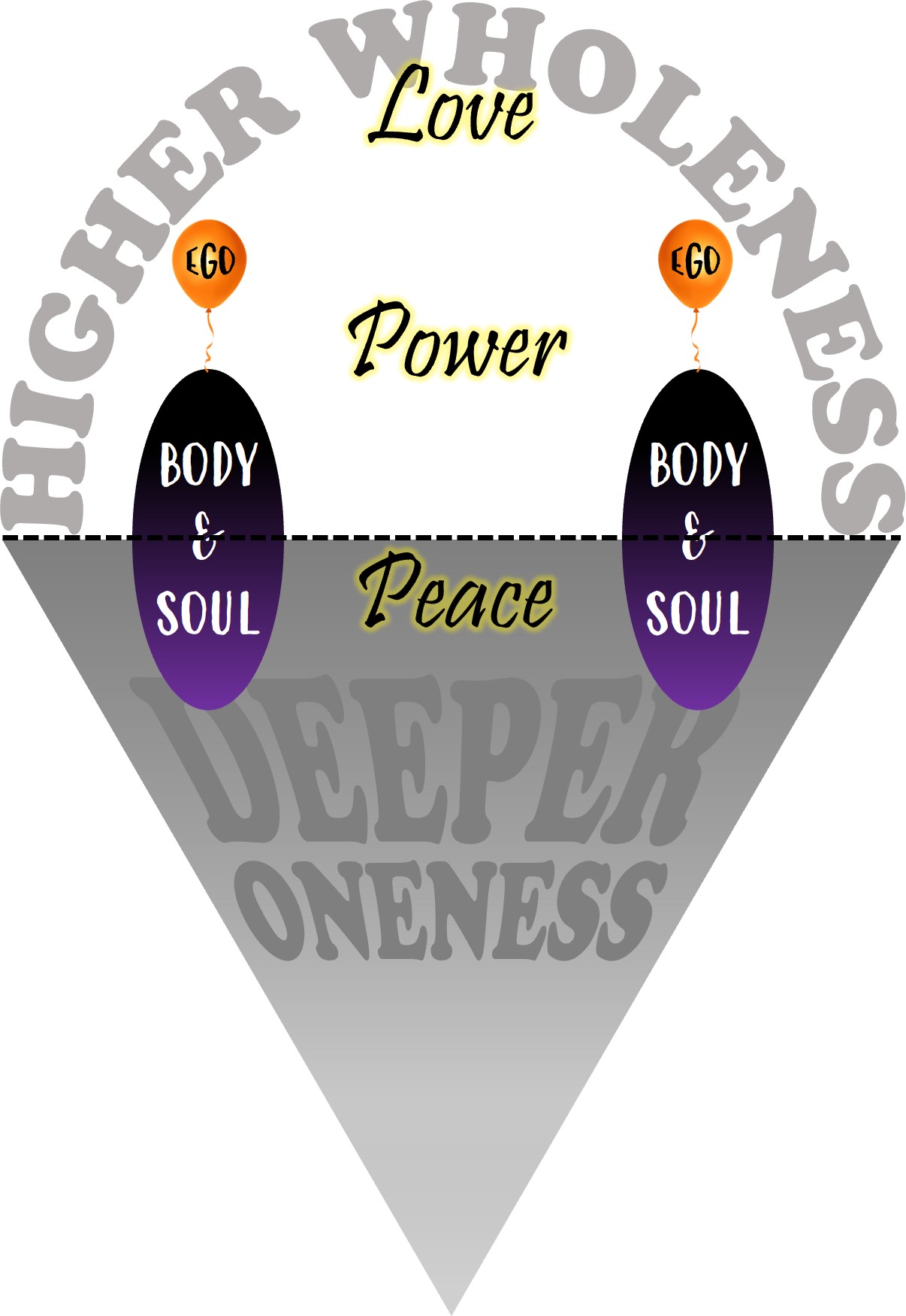
The illustration above depicts two individuals, you and me, each a self-conscious person (an ego) trying to hang on and make our way in the world. Our egos, referring to the centered “I” of our individual self-conscious experience, are depicted as balloons tethered to a human nature comprised of an animal body and a spiritual soul.

The “and” is intentional and quite emphatic, as body-and-soul are not two things, two parts, or – as taught in many religions – our immortal self (soul) inside a mortal shell (body).

According to Sophia Perennis, our true self is a complementarity, or even more essentially, a communion of body and soul. So, while it may seem obvious to us that we have a body and have a soul, this possessive regard of our human nature turns out to be nothing but a mirage-effect of observing ourselves from the tethered position of ego.

In fact, ego is itself only an encapsulated quantum of animate (body-and-soul) consciousness, siphoned and contained inside its own balloon of reflexive (i.e., self-) awareness.

Our essential nature, in contrast to our conditioned and inflated identity (ego), is in constant touch with Reality. The body is connected to the sensory-physical environment, its Web of Life, and to the cosmic home of our Universe. It depends on, participates in, and contributes to the higher wholeness of all things. Inwardly, descending the interior depths of consciousness, the soul rests in the grounding mystery and deeper oneness of being-itself. Deep within, our essential nature dwells in Being, in the pure presence of Here and Now.

Deeper oneness and higher wholeness, the generative Ground of Being and the manifold Unity of Existence, the hidden wellspring and universal order of all things – these are together the Yin and the Yang, respectively, of the Tao we call Reality.

A consequence of ego’s separation from our essential nature is a certain degree of insecurity – of feeling isolated, exposed, and vulnerable inside a socially constructed and self-made illusion.

When we began our individual journeys to an ego-centered identity, we compensated for this loss of existential security by attaching ourselves, first to Mother, then to others, and from there to our kind (race, ethnicity, class, party, and creed), as well as to the status symbols of our tribe.

Ego is primarily a center of self-conscious experience, but it’s also an actor who slips into suits to play various roles on the social stage. From childhood, through youth, and well into adulthood, the principal share of our attention and energy is invested in this project of taking on identity contracts and becoming (or trying to become) somebody special.

The more profound our insecurity, the tighter we cling to our attachments and the smaller our identity shrinks.

Identifying as a White, middle class, Southern Baptist Christian (or whatever) means that we identify with other White, middle class, Southern Baptist Christians (and so on). They are the ones around whom we feel safe and comfortable. We like them because they are like us.

Others, though, who are of different races, classes, backgrounds and beliefs, pose a threat to our small identity. For our own safety we try to avoid them, keeping them at a distance with bigoted stereotypes, and even vote for politicians who legislate against their equal rights and freedoms. Our lack of inner peace (i.e., our existential insecurity) drives our use of power in ways that are biased in our favor and damaging to those whose mere existence threatens our crabbed and fragile identity.

Needless to say, when we are entangled in codependent relationships and running from or fighting against others who are just too different, too alien, to be trusted, all pathways to transpersonal community and genuine love are blocked. More accurately, such pathways are simply not available to us because our love of power – driven by a lack of peace – compels our defensive resistance to the power of love.

Now we can see how the world got into its current condition. Hopefully, too, we have a better understanding of our own complicity in the mess about which we so often fret and complain.

Even more importantly, we may be starting to see our way through to the wellbeing and fulfillment that we, together with all of our fellow human beings, so deeply long to find.

First Things

If we don’t really understand ourselves, how can we know what we need to be healthy, happy, and whole? In our ignorance we are left groping for what feels good, for what might help us get ahead of the game, or at least distract us from the anxiety of not knowing what “the game” is all about. Is it about material security, sensual pleasures, personal prosperity, out-Jonesing the Joneses?

Actually, we do know what human beings need to be healthy, happy, and whole.

The answer has been stored in the transcultural superconscious “cloud drive” of our species for thousands of years. Known as the Perennial Philosophy or Sophia Perennis, this deep tradition of wisdom spirituality has been cultivating, “uploading,” and safeguarding the answers to our ultimate questions as human beings.

The problem is that fewer of us today are “downloading” its wisdom into the concrete situations of life. Percentage-wise, a much smaller portion of the living human population on Earth even knows that such a repository of spiritual wisdom exists, compared to earlier centuries when the great mythologies and philosophies of life informed the world cultures.

We are left with social media and the news of the day to find our bearings.

Sophia Perennis is not merely the work product of some ancient authors who had the good fortune of living during times and under empires that afforded them leisure to ponder the ultimate concerns of human existence. In fact, its cloud drive of spiritual wisdom is more than an anthology of sage writings collected from around the world.

Locating Sophia Perennis in the Superconscious of our species – at the opposite end of a continuum of consciousness with roots in the collective Unconscious of Jungian psychology – acknowledges its primary form in living insights, images, concepts and ideals rather than as academic treatises on parchment in clay jars.

Each time some individual – anywhere – discovers a timeless truth or finds her way to a deeper understanding of the path to human health, happiness, and wholeness (in a word, to wellbeing), the insight of that discovery is instantly uploaded to the superconscious cloud drive of spiritual wisdom.

From that moment, it is available for download by anyone else – anywhere – in the world. Its mere presence in the superconscious cloud drive of spiritual wisdom makes access that much more likely for many others.

The addition of insights, maxims, skills, and techniques strengthens this “morphogenetic field” (R. Sheldrake), reducing the time, effort, and suffering it might take for others elsewhere and later on to attain a similar enlightenment or spiritual breakthrough.

So then, what answers can we find in the perennial tradition of spiritual wisdom to our questions about what humans need to be healthy, happy, and whole?

In brief, there are just three things we need: Peace, Power, and Love.

These “first things” (or principles) are correlated to the three dimensions of human consciousness: the Soul (esoteric/contemplative: Peace), the Ego (intra/interpersonal: Power), and the Spirit (communal/transpersonal: Love).

My illustration diagrams these three dimensions of human consciousness in a way that indicates their dynamic interactions. The critical pathway in human development and evolution is rooted in the Soul’s deep interior (Greek esoteros) and our need for Peace. From there it flows to the Ego and our need for Power. Finally, fulfillment is reached in the Spirit’s breakthrough to the higher wholeness of community and our need for Love.

Fulfilling a given need ensures a healthy support for the need next in line, so to speak. Thus a sufficient base of inner Peace provides the support that a healthy center of personal Power requires. This in turn establishes the stable point from which the transpersonal leap into communal Love is taken.

A complete picture of human health, happiness, and wholeness, then, is grounded in Peace, centered and connected in Power, and included in the unifying energy of Love.

Of course, we might also track this dynamic flow across the dimensions of human consciousness through the more common traps and obstacles along the way. Rather than focus on the many variations of more or less “normal” psychopathology, however, let’s review the positive steps and gains on that upward trajectory to human fulfillment.

The developing center of self-conscious identity in the ego is the “mythic hero” we will be tracking, with the positive steps and gains labeled in orange-colored text. (Throughout this blog, orange is my color code for all things ego-related.) In agreement with most Western schools of psychology, ego is here regarded as a critically important and positive achievement in personality development.

Without “ego strength” the personality lacks stability, balance, and integrity. Most so-called mental disorders are the symptom and consequence of a deficiency in ego strength.

When a newborn is received into the embrace and nurturing environment of responsive caregivers, its infantile nervous system calibrates to a frequency (state or mood) that is fully grounded in a Reality experienced as provident.

Inwardly, the body releases or relaxes into a state of calm as attention opens gently to the Here and Now.

This is what Sophia Perennis names faith, which is fundamentally – that is, energetically – different from how it is typically understood in the religions. Neither a belief nor even a willingness to believe, faith in the spiritual wisdom tradition refers to the release and surrender of basic trust in the Present Mystery of Reality. The corresponding experience is Peace: an ineffable assurance that all is well.

Absent this grounding of faith, anxiety possesses the nervous system instead – and every subsequent step and stage in development will be complicated by its disturbing effect.

Upon this stable foundation of basic, or existential, trust in Reality, other developmental strengths naturally emerge. The well-centered ego brings the nascent personality into integrity and forms sympathetic bonds of affinity with others. In this balance of (introverted) integrity and (extraverted) affinity – or what is effectively the healthy balance of personal Power, an adolescent ego enjoys a measure of freedom from urgency and reaction, which it redirects into the agency of deliberation, choice, creative purpose, and personal responsibility.

While Sophia Perennis safeguards the wisdom principles and practices that have helped seekers through the centuries cultivate inner Peace and personal Power, its teachings on the human need for Love make it clear that our fulfillment as individuals and a species lies in our devoted service to community.

Literally “together as one,” community certainly includes the transpersonal fellowship of ego-centered human beings, but also the extra-human realm of the planet, its web of life, and the cosmos as a whole. Our little-appreciated name for the cosmic environment, universe, carries this insight regarding the higher wholeness of all beings: “turning as one.”

In the spiritual sense, Love is much more than an urge, a desire, or a feeling, but refers to the force that fills, lifts, and includes us in the higher wholeness of all things. In serving wholeness we become whole.

Timeless Wisdom

It’s natural – or we should better say, it’s the expected outcome of our socialization as a self in a world – to find ourselves inside something that seems very real. From those early days, our tribe is busy orienting us to its worldview, beliefs, and way of life, instructing and shaping us into a conscientious member. By the time it’s all finished – with the corners tightened and the cracks papered over – we won’t know the difference between construct and Reality.

To illustrate this, my diagram depicts a “self” in its “world,” where we feel very solid and our world seems very real.

For many of us, this will be where we live out our days: managing an identity and believing the world – that is to say, agreeing intellectually with its representation of the way things are and committing ourselves emotionally to its truth.

The identity we often struggle to manage is actually a duality, with a center (self) and a boundary (world). One doesn’t exist or have any meaning without the other.

As our self develops and the world around us changes, we can suffer from confusion and disorientation. In earlier and more traditional societies, each time this happened our tribe could be expected to come with its rituals, interventions, and wise counsel to help us find our center in the world once again.

Historically this custodial responsibility for linking us back to the tradition, worldview, and life-ways of our tribe was handled by religion (religare, to link back). This is less often the case anymore, given the erosion of religion’s credibility in the Age of Science and its tendency toward otherworldly distractions.

Religion’s influence has actually gone in the opposite direction from its original design intention of facilitating healthy identity development across the lifespan, to the point now where “this world” is to be renounced, forsaken, and finally left behind for the Real Deal somewhere else and later on.

Thankfully, the perennial tradition of wisdom spirituality, which is the underground stream to all those overland tributaries of religion, has conserved and further cultivated their original charter of linking back, re-centering, orienting identity to the social roles and responsibilities of life in this world.

While the religions typically turn the focus of attention elsewhere, Sophia Perennis invites our contemplation on two normally invisible thresholds in the self-world construct of identity. In fact, the very notion that self and world are the center and boundary of a social construction is a central insight of wisdom spirituality.

What we ordinarily regard as solid (self) and real (world) are merely the subjective and objective orientations, respectively, of our personal identity, centered by the ego. Only as consciousness is looped back upon itself does it become self-conscious inside its own world boundary. Understanding this “makeshift” or constructed nature of self-and-world gradually brings those two aforementioned thresholds into view.

This is also where the difference between wisdom spirituality and otherworldly religion is most obvious.

The first of these thresholds is within the self, at the point where consciousness drops away from its center (at the ego) and descends the Essential Depth of Being itself. Also called the Ground of Being and the grounding Mystery of existence, this mystical dimension is the deeper oneness in all things, with each thing manifesting its power but in the disguise of a limited temporal form.

In a variety of meditative and contemplative techniques perfected over the millenniums, Sophia Perennis reminds us that our center of identity, which puts on and takes off the roles that match us to our age-appropriate responsibilities of life at each stage, might also be surrendered for a deeper experience of ineffable Mystery, boundless presence, inner peace, and authentic life.

Give it a name if you need to. Call it God if you want. Personify it as a god that you can worship and obey. But just know, this is your mind’s way of scooping a bucket from the Living Stream of Mystery.

A second threshold is at the boundary of our world. The illusion for a normal socialized identity conceives of the world as “all there is,” expanding outward ad infinitum. As more discoveries push the limits of knowledge farther out, our world grows in size. And while that is true, the threshold at the boundary of our world is not the limit of what we know against what we don’t know yet.

Beyond our world, according to Sophia Perennis, is not just larger possible worlds but the Consilient Unity of all beings. Also called the Web of Life and the living Universe, this ethical dimension is the higher wholeness of our interconnected existence, the harmony of the Whole.

As consilience refers to a “leaping together” of centered individuals, the emphasis is on the unique contribution of each to the universal order. This synergistic effect plays across the Web of relationships in an exponential fashion, amplifying and unifying the myriad elements into a dynamic complexity. The Web is a vibratory, living, sentient, self-conscious, and transpersonal Whole.

Our intentional participation in the Consilient Unity of existence is only possible to the degree we are able to “see through” our personal world to Ultimate Reality, pulling aside its veil of meaning, getting over ourselves, and joining the harmony of the Whole.

The difference between Sophia Perennis and the religions on the matter of salvation couldn’t be more stark. While the religions prescribe a rescue mission for the self out of its world, the perennial tradition of wisdom spirituality teaches the principles and practices for dropping into the deeper oneness of Being and celebrating our place in the higher wholeness of all beings.

Sages, prophets, and mystics through the ages have been saying that what we seek is already within us and all around us. We just need to open our eyes and really see.

Endangered Species

It’s weird to think that humans are still on the journey to actualizing our full potential as a species. All other species, as far as we can tell, reach fulfillment in each generation, where the young develop to maturity as the adults nurture them along. For the most part, genetic codes and the drives of instinct ensure that each individual actualizes the inner aim (entelechy) of the species.

We use the designation “endangered” for those species that are at risk of falling into extinction due to climate conditions, loss of habitat, over-predation by other species, critically low birth rates, or devastating disease. The human species is certainly not endangered in any of those senses, although our own ambition, ingenuity, and ignórance (willful ignorance) will someday – probably sooner than later – bring about our self-destruction, if we continue on our present course.

But modern humans are indeed an endangered species, if we think of it in terms of falling short of our ideal, of what a human being is intended by nature to become. To understand the dynamic in play, we need to acknowledge a factor in human evolution and development that isn’t present in other species: self-consciousness and its executive center of identity named ego (Latin for “I”).

This wildcard factor of ego is both the leading indicator of human progress and the “Achilles’ heel” that threatens to bring us down.

Joseph Campbell discovered “the hero with a thousand faces” throughout world mythology, and he believed that the Hero’s Journey is really what the stories are all about. Whether a particular myth is focused on the adventures of a hero or heroine, or instead throws the horizon of wonder out to the larger cosmos and the acts of a god, its power as story is anchored to the center of self-conscious experience in the mythmaker and his or her audience.

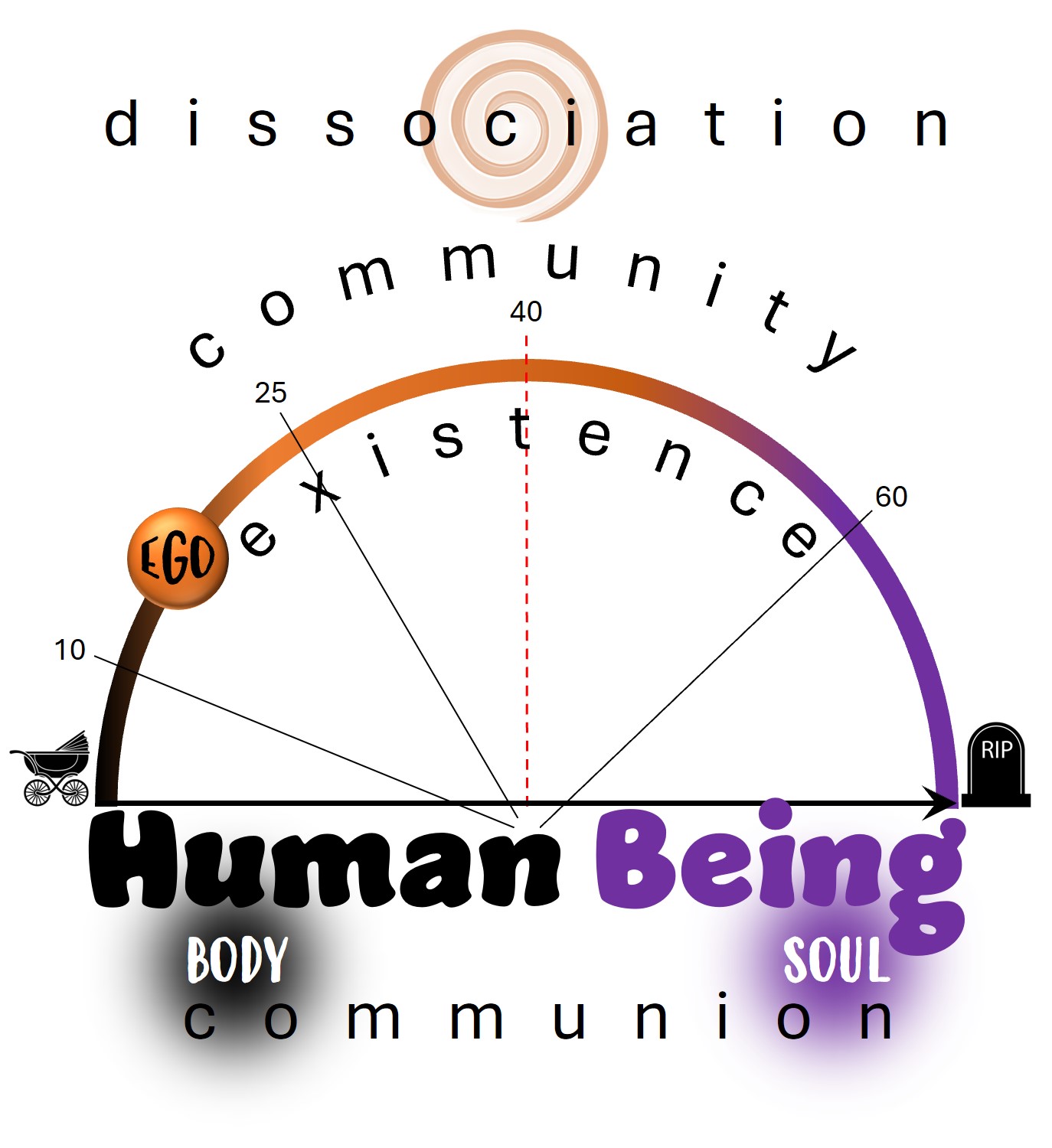
We might think of the mythos or plotline of these stories as tapestry upon a frame constructed of the dynamic principles and dimensions of our self-conscious (egocentric) experience. The illustration above diagrams these dimensions on a vertical axis with the terms communion, existence, community, and dissociation. Moving across horizontally is the arc of development that tracks the progress and perils of ego’s heroic adventure.*

Communion refers to the deeper oneness of body and soul, the outward and inward orientations, respectively, of our animate consciousness as human beings. “Human” and “being” distinguish these complementary orientations in a way that can also be read as the human (manifestation of) being.

Human, then, names our animal nature and species as homo sapiens: the genotype, biology, physiology and neuroanatomy that identify us among the classifications across the web of life on Earth. This is the expression or manifestation of being that we recognize as ourselves.

Being refers to the generative power-to-be evident (or manifested) in the astonishing diversity of beings: molecular beings, rock beings, tree beings, bird beings, cloud beings, star beings … and human beings. Each of us is a communion of human and being, outer and inner, body and soul.

It is out of this communion that ego begins its journey into existence, referring literally to the act or process of “stepping or standing out” (ex + sistere) from the deeper oneness of body and soul. To be conscious of ourselves, a portion of consciousness must detach from communion in order to secure an external vantage-point from which these can be appropriated as “my body” and “my soul” – that is, as belonging to “me,” the self-conscious “I” (ego).

But of course, our essential nature as human manifestations of being is not property of the ego, which makes its claim delusional and its perception of the body and soul as separate an illusion.

This is where many religions veer away from the perennial wisdom tradition (Sophia Perennis), affirming and embellishing on ego’s delusion of independence and ownership rather than acknowledging the illusion of separateness – from the position of egoic consciousness – and then finding ways to “part the veil” to Reality and the liberated life.

Typically, a religion will either condemn the ego as something to be subdued, or glorify it as something to be saved. According to Sophia Perennis, whether the strategy involves renouncing or rescuing the ego, our focus (on the ego) is fundamentally misplaced. The assumption of its substantiality comes along with the certainty of its separate existence – which is the illusion we need to get beyond.

Developmentally speaking, ego formation is intended for the purpose of facilitating human progress into community. This refers not only to our relationships with other ego-centered persons, but with all of life and the even the cosmos itself, at which scale is named the Universe (“turning as one”). While communion is the deeper (undifferentiated) oneness of body and soul in the grounding mystery of Being, community is the higher (diversified) wholeness of all things, together as One.

The long process of individual development and of our evolution as a species is about focusing consciousness through the lens of ego where the Universe becomes aware of itself in, and as, us. Through us, the Universe feels what it is to be human, sees itself through human eyes, and is able to act in the freedom of will and with the bigger picture in mind.

Sophia Perennis (often personified in the myths as a woman) stands at the threshold with the veil of illusion pulled aside, inviting us to the Infinite Life outside our cocoon.

Our experience of, and inclusion within, the higher wholeness of community and the greater Universe can be overwhelming if we happen to be bound by insecurity to our ego and desperately trying to hold our own. The orange-colored spiral in the illustration above depicts this tightening loop of anxiety, frustration, and depression that pulls the ego off its intended course and into a state of dissociation.

In religious mythology, this state or condition of dissociation is represented metaphorically in the experiences of possession (loss of self), captivity (loss of freedom), and exile (loss of belonging).

It is not our destiny as humans to succumb to dissociation from Reality. And yet, the centripetal pull of dissociation into more extreme states of anxiety, frustration, and depression works to separate us not just from Reality, but also from our own common sense. We are in danger of reaching a point where nothing makes sense, nothing really matters, and any hope of getting out and finding our way back is utterly lost.

We might as well take each other and everything else down with us.


*The diagram above charts a typical human lifespan, advancing through the life stages of the Child (birth to age 10), Youth (ages 11-25 years), Adult (ages 26-60), and Elder (age 61 to death). At midlife (around age 40), an individual will typically undergo what’s known as a “midlife crisis,” where the dynamics of existence and dissociation can throw the ego’s hero journey profoundly – in some cases catastrophically – off course.

The Vocational Clarity Table of Elements

Just imagine what it would be like if 100 percent of college students completed their programs and found their way into careers doing work they love.

A lofty goal, no doubt.

Obviously that would be a remarkable improvement over today’s 50 percent completion rate. For the preconditions of this (what should be alarming) dropout from college, we are confronted by the fact that 80 percent of college students change their majors multiple times.

Not knowing why they are in college or where they are going is not really the fault of the students themselves. A majority of them are fresh out of high school and just now crossing the developmental threshold from childhood to adulthood. For thirteen years (K-12 grades) they were pushed from behind by taller powers who directed them to the next assignment, the next assessment, the next grade.

With a high school diploma in hand, they now stand on college campuses disoriented, waiting for somebody to tell them what to do and where to go now.

A bewildering array of programs urges some pretty major decisions right from the start: A two- or four-year degree? An academic path to a higher credential, or a workforce path to a job? Maybe a certificate or occupation skills award instead of a degree? Make your choice. Pick a major. Get to class! It’s no wonder that persistence and completion rates are so low in colleges and universities across the country.

Now throw in the fact that your average human brain doesn’t come fully online with its capacity for grasping the big picture and long view on life until the mid twenties, and suddenly those stubborn confusion and dropout rates start to make sense.

Does college come too early, then, or should colleges take a different approach in the support they offer to students? At the moment, due to the high risk of failure for students, colleges are directing more money and effort into interventions designed to keep students on the path to completion. They’ve been at it for decades now, for exactly as long as students have been confused and dropping out of college.

Coincidence?

If the principal goal and concern of college is to get students to graduation, then the cost of interventions can be justified and more intervention initiatives will be devised and funded – until the institution itself goes bankrupt.

But what if vocational clarity were the priority – not instead of program completion and graduation, but as first and highest among a college’s institutional commitments? Vocational clarity can be defined as “a clear understanding of one’s calling (Latin vocare), purpose, and direction in life” – big picture and long view stuff. It’s about much more than picking from a catalog of degrees, majors, and courses and then showing up to class.

The major obstacle confronting a commitment to vocational clarity in higher education is the very paradigm of intervention currently in place. Its focus on risk and the use of preventative support to lower the probability of failure also carries an implicit assumption that students are deficient in what they need to succeed.

From the K-12 “push from behind” to post-secondary “stop the bleed” measures, education has become something that is done to students rather than with them.

And you’d better believe that students can feel the difference.

A priority on vocational clarity requires a paradigm shift in education from intervention to empowerment. Its focus is on student potential, not deficiency. Instead of lowering the risk of failure by stepping in with what students are presumed to be missing, empowerment is designed to awaken and ignite what they already have inside themselves. Let’s be bold and name it the human spirit.

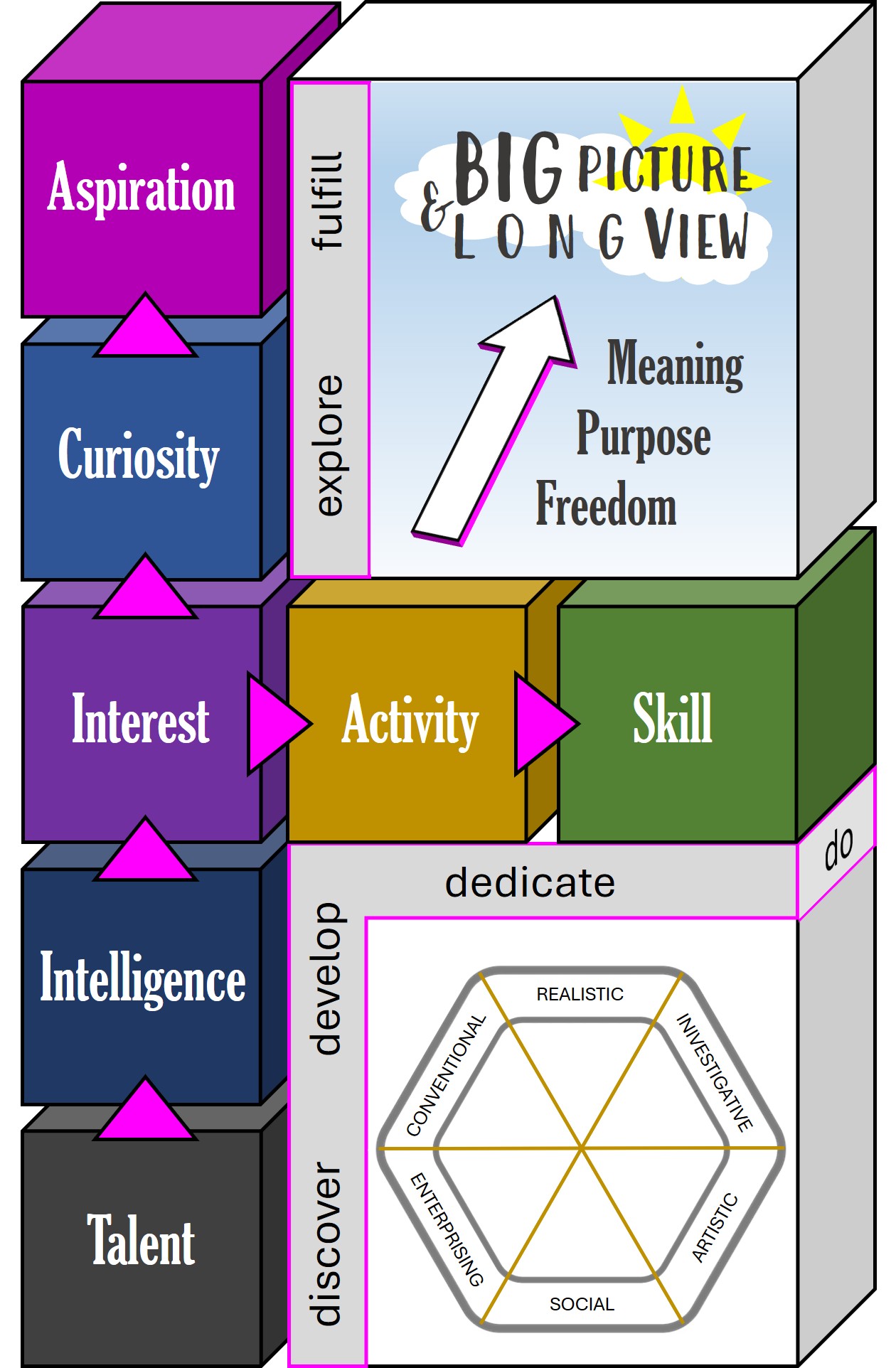
The graphic above offers a framework for understanding vocational clarity as comprised of certain essential “elements” arranged according to a catalytic process that begins with the discovery of natural talents or gifts, and culminates in the mastery of skills that enable students to do – perform, achieve, create, and produce meaningful results. My “table of elements” consists in a vertical set that correlates to the student’s inner potential, and a horizontal set that channels this potential outward to the adult world of life and work.

As a method of empowerment, the vocational clarity process begins not with the job market but instead with an assessment of a student’s natural talents, intelligence, and interests. The concept of “interest” is based in the research and career development theory of John L. Holland (1919-2008) who understood it as strategically positioned between an individual’s natural gifts (talent) and the specialized performance tasks of work (skill).

Importantly different from the fleeting focus of attention (squirrel!), interest refers to stable and enduring traits of the personality.

Inwardly, interest is also correlated to individual intelligence – not how smart someone is, but how they are smart (c.f., Ken Robinson). For example, creative talent underlies aesthetic intelligence and can be assessed as “artistic” interest (one of Holland’s six types). It should go without saying that someone with a strong aesthetic intelligence, but who may not measure up to an academic standard of what admission boards consider (logico-mathematically) intelligent, is just smart in a different way.

Holland’s interest codes and assessment tool provide for more than a useful method of matching students to relevant occupations and career paths (interest » activity » skill). It also gives insight into a student’s inner potential – into their unique endowment of the human spirit (interest » intelligence » talent).

By indicating their interest on a scale of values (more or less) in various tasks described in the assessment – not whether they currently have the skills to perform each task or would like to do it professionally someday – the student’s preference for different types of activity is gradually clarified and measured. (This distinction between a specific example and its general type is critically important to keep in mind while completing the interest assessment to ensure the accuracy of its results.)

John Holland realized that the countless job tasks across the more than 1,000 distinct occupations in the world of work can be distributed under just six types of activity, with each occupation centering 2-3 of these types of activity in the day-to-day responsibilities of work.

These six types of activity correlate directly, according to his theory, to six “workplace personalities”: realistic DOERS, investigative THINKERS, artistic CREATORS, social HELPERS, enterprising PERSUADERS, and conventional ORGANIZERS.

Once students have the “depth reading” of their inner potential, they can proceed with focused research into the more relevant occupations matching their interests, learn about the credentials that may be needed in preparation, where to find those credentials, and how to get started in the best direction.

Now they’re not just going to college but going through college, eventually into careers doing work they will love. And because they have an inspiring big picture and long view ahead of them, the college program of courses become stepping stones on the path bringing them closer to the life they really want.

These students are much more likely to keep their major and complete their program – because they have a clear understanding of where it leads. When colleges offer strategic support in the form of interest assessments, vocational guidance, and career counseling, failure and dropout rates are dramatically reduced.

It’s not rocket science.

The Reality in Your Hand

They are delicious – or can be. I’m sure you’ve had one before. Snow cones are perhaps the most popular and biggest rip-off treats at amusement parks and county fairs. Pack some shaved ice into a paper cone and drizzle your favorite sugary syrup on top.

Three bucks, please.

But have you ever looked more closely at a snow cone? What you’ll see is a model of Reality – right there in your hand.

The sphere of shaved ice arching above the rim of your paper cone represents the expansive System of existence, where everything is connected, included, and incorporated into a universal order.

Rather than a mere collection of countless elements, however, the System of Reality is a consilience – literally a “jumping together” of simpler forms into a higher pattern.

A synergistic dynamic of 1+1=3 catches the individual forms and incorporates them into this higher wholeness, not canceling their unique contributions but instead building on their diversity.

At this systemic level, Reality is not something else or a mere aggregate of things, but All of it together as One.

In its systemic nature, Reality is a “nested” affair where the cosmos includes systems of galaxies, galaxies include solar systems, solar systems include planetary systems, planetary systems include ecosystems, metabolic systems, social systems, and nervous systems. All of it together turns as One: a uni-verse.

That’s pretty cool, right?

Now, turn your attention to the paper cone in which the spherical System of Reality is supported. What’s inside is hidden from view, and yet without it the System would lack stability and substance (referring to what “stands under”). In our model of Reality, this internal dimension of depth is the Ground, the underlying essence (Greek esse = being) that generates everything into existence (Latin existere = to stand out).

Don’t think of what’s inside the cone as just “more shaved ice and syrup” – more individual forms like what you see in the visible overarching System. Deep down and inside Reality is a grounding mystery that has no tangible form, no distinct features, not even a definite location.

Ground is the “withinness” of things: the ineffable and undifferentiated power of being-itself.

Using the snow cone as our model of Reality can easily mislead us to believe that the Ground is underneath and separate from the individual forms themselves, when it is really the essence of all things – the deep down withinness of everything.

Yet another dimension of Reality is represented by the line, or transverse plane, slicing across the top of the paper cone, separating the System from the Ground – but again, only in the illustration. In Reality, System and Ground are not separate sections but complementary dimensions of existence: the higher wholeness (consilience) and deeper oneness (essence) of all things.

This third dimension is the Field where individual forms stand in proximity to each other and interact in various ways.

Interaction is the critical dynamic of the Field, where the cómponent nature of Reality is such that every individual form is a consilient System of smaller elements, but also constitutes the Ground or essence of higher and larger scales of organization.

Cómponence is a newly coined word for naming this structural principle where wholes are “made of” parts which are themselves wholes to still smaller parts. Although the term itself is not widely used, it best describes the paradigm of modern science: particles in various patterns of interaction.

Interactions in the Field occur between and among individual forms (e.g., particles) that emerge by a process of differentiation out of the Ground. Matter differentiates from energy, life differentiates from matter, consciousness differentiates from life, and self-consciousness (ego) differentiates from consciousness: At each stage in this evolutionary process, the Ground manifests in distinct forms that also separate from and engage with one another. Separation is the “space” where interactions in the Field occur.

At a certain point in the interaction of individual forms, a synergy begins to lift their engagement into a higher frequency called participation.

They are no longer just connecting or colliding with each other; an “attractor” above them starts to guide and coordinate their interactions into a pattern of higher wholeness. With this move of transcendence (literally “going beyond”), Reality pulls the interactions between and among separate forms into its System.

Eventually, as in the case of self-conscious forms known as human egos, these creative affiliations give rise to intentional communities of trust, compassion, generosity, and goodwill. The worldwide wisdom tradition of Sophia Perennis regards this up-shift from mere personal (i.e., egocentric) interests and concerns to the transpersonal dimension of shared interests and communal concerns as the critical threshold in human transformation.

So far, only rarely has our species successfully gained liberation from the bonds of egoism to enjoy the larger vision and expansive freedom of transpersonal awareness. And whenever it has happened, it’s just a matter of time before ego ambitions drag the Enlightenment Project back down the dark spiral of “What’s in it for me?”

Alas, the Enlightenment Project itself is a long journey fraught with setbacks and drop-offs that threaten to end human history in an apocalypse of mutual self-destruction.

As the shared record of spiritual wisdom – the DNA of the Enlightenment Project – Sophia Perennis has been discovering, developing, and preserving both the aspiration and the understanding of what human nature has in its potential to become.

Every generation has the opportunity to cultivate this wisdom from seeds inherited from previous generations, along with the responsibility of imparting its fruits to the generations still to come.

So you see, that snow cone in your hand is a lot more than just shaved ice and syrup in a paper cup.


Other posts on the “snow cone” theme:

A Renaissance in Our Time

As a proponent of the type of religion known as post-theism, I have devoted a large number of posts in this blog to its proper definition. We shouldn’t think of post-theism as either Atheism or Theism 2.0, since its principal concern is not with the objective existence of god but rather the liberated life “after” (post-), or on the other side of, god.

Post-theism affirms god’s central position through the middle stages in the sequence of faith development (from the research of James Fowler, these are the stages of mythic-literal, synthetic-conventional, and individuative-reflective faith). But it regards this god as a mythopoetic metaphor of the Present Mystery of Reality, of the Ground of Being or being-itself, and not a being separate and apart from us.

This seeming denial of god’s objective existence has gotten post-theism labeled and dismissed as just another updated (2.0) version of atheism, when it is really unconcerned with the question of god’s existence but seeks rather to interpret the meaning of god in relation to the evolution of spirituality and faith development.

In fact, an insistence on the priority of god’s metaphorical meaning over god’s objective existence is not a denial but a necessary realignment of god as symbol.

Ever since the first mythmakers, humans have known that God (uppercase G: the Present Mystery) is within us – as well as between, among, all around, and beyond us. The gods (lowercase g: mythopoetic metaphors of God) were intended and understood as imaginated, personified, and fictional representations of this essential-universal Mystery.

No human ever encountered these beings in the real world (i.e., Reality) – nor did they expect to. That is, until theism lost its focus and styled itself the defender of god’s existence against the rising wave of empirical science and secular humanism.

Regardless, a direct encounter with god has remained only an expectation, conveniently postponed until after death when the believer anticipates seeing god on his throne in heaven.

From that moment onwards, theistic religion became increasingly regressive, otherworldly, and irrelevant. The focus of piety shifted more to repetition compulsions like cross-referencing Bible studies, reciting creeds with the standing congregation, and participating in ritual commemorations of biblical scenes from long ago.

Post-theism comes about either by the normal course of faith development, or through crisis and confusion generated inside the insulated echo chamber of theism. It is fully accepting of the prospect of living in the theistic environment of symbols, stories, sacraments, and sanctuaries – as long as these are appreciated for their transparency to the Mystery within, between, among, around and beyond, and not allowed to become idols in its place.

As I see it, post-theism would ideally find a hospitable and symbol-rich habitat in theism, serving to keep its role-play game honest and properly grounded.

My own experience as a professional pastor in a conservative mainline Protestant tradition of Christian theism for 15 years confirmed a general openness to the Mystery, with a correlated interest in looking through god to the Present Mystery (or real Presence) of God, beyond names and forms.

Unfortunately, while I enjoyed some freedom to explore this Mystery with members of my congregation, our denomination was already closing down around its confessional standards of orthodoxy and against the larger environmental forces of pluralism, secularism, and globalism which had been challenging the tradition for decades to meet this new reality with a relevant spirituality and faith.

This helped me appreciate post-theism in a new light: as not just another stage in the development of religion, but as a renaissance-in-waiting inside theism for the time when conditions are right for it to awaken.

As long as theism maintains its protected membership of believers, the insights of a post-theistic spirituality may surface only intermittently in private devotion and small group discussions. Theistic ideology can sample and digest only small doses at a time, however, which allows it to recover its orthodox composure between such excursions into the Present Mystery.

When the number of waking post-theists reaches critical mass, a more formal censure and discipline may be in order. And when that conspiracy of pluralism, secularism, and globalism outside the doors confronts the tribal morality with its diversity of values, views, and ways of life, conditions are primed for a major transformation.

This very concurrent crisis of internal breakthroughs and external break-ins has erupted in episodes of post-theistic renaissance throughout the history of higher culture.

Jeremiah, Siddhartha, Mencius, Jesus, al-Ḥallāj, Johannes (“Meister”) Eckhart, Martin Luther, Giovanni Pico della Mirandola, Paul Tillich, and Martin Luther King, Jr. (among many others) charted new frontiers in post-theistic spirituality. Whether by the mystical-inward or ethical-outward path, each challenged his fellow believers and an entire generation to drop beneath or go beyond their tribal gods for an experience of the Present Mystery of Reality.

All of them refused to take the gods of their traditions literally, but instead they broke with tradition – or rather sought to break their traditions open – to a deeper (mystical) and larger (ethical) concept of God.

For the Second Temple Jewish tradition of early Roman times, it was Jesus who challenged his contemporary Jews to find God – what he called the power or kingdom of God – outside both the Temple precincts and their Hebrew lineage, as well as in the reality under their very feet, like a buried treasure (cf Matthew 13:44).

Because the entire Temple structure was designed on the idea that God (imaginated in the Hebrew god, Yahweh) stands apart from humans and must be satisfied with sacrifices before he can forgive sins, Jesus’ gospel (“good news”) of God’s unconditional forgiveness and radical inclusion of all people in holy community was rightfully regarded as a threat to Jewish identity and religion.

The early Christian movement was born out of this post-theistic vision of Jesus, picking up his insight to the point of identifying love as the very heart and essence of God (1 John 4:16). Although it was the ecclesiastical organization and political mission of the institutionalized Church that would soon enough spread Christianity so effectively around the globe, it was this post-theistic renaissance ignited by the life, message, and ministry of Jesus that got the whole thing going.

But just that quickly, Jesus’ vision faded from the Christian religion, behind the shutters and locks of a protected membership.

Many Christians today who are post-theistic in their spirituality, mystically grounded and ethically committed to the work of genuine community, have left the Church or were excommunicated because their faith (Fowler: conjunctive and universalizing) didn’t fit inside the boxes of Christian orthodoxy.

Others remain inside, finding their theology enriched by a fresh infusion of Mystery, nurturing the growth and progress of faith in their fellow believers as opportunities arise.

They are looking for, finding, or forming their own communities – I call them “Wisdom Circles” – where the Mystery of God and the meaning of god, the liberated life and a more perfect union, are explored in creative dialogue together.