Most people of a religious bent – even a more dogmatic fundamentalist – will readily admit that they don’t know everything about God. I mean, it’s GOD after all. But what they know for sure is that their concept of God is the correct one. And for the dogmatic fundamentalist, theirs is the ONLY correct one and all others are false gods.
But why are these other gods false gods? A typical answer is that, if someone else’s god is not really the Devil in disguise or happens to be an actual deity but just not the one TRUE god, then it’s merely a figment of human imagination personified in an idol. That’s why we might use the lowercase ‘g’ in reference to them, while the uppercase ‘G’ is reserved for the true believer’s God – the ONE and ONLY.
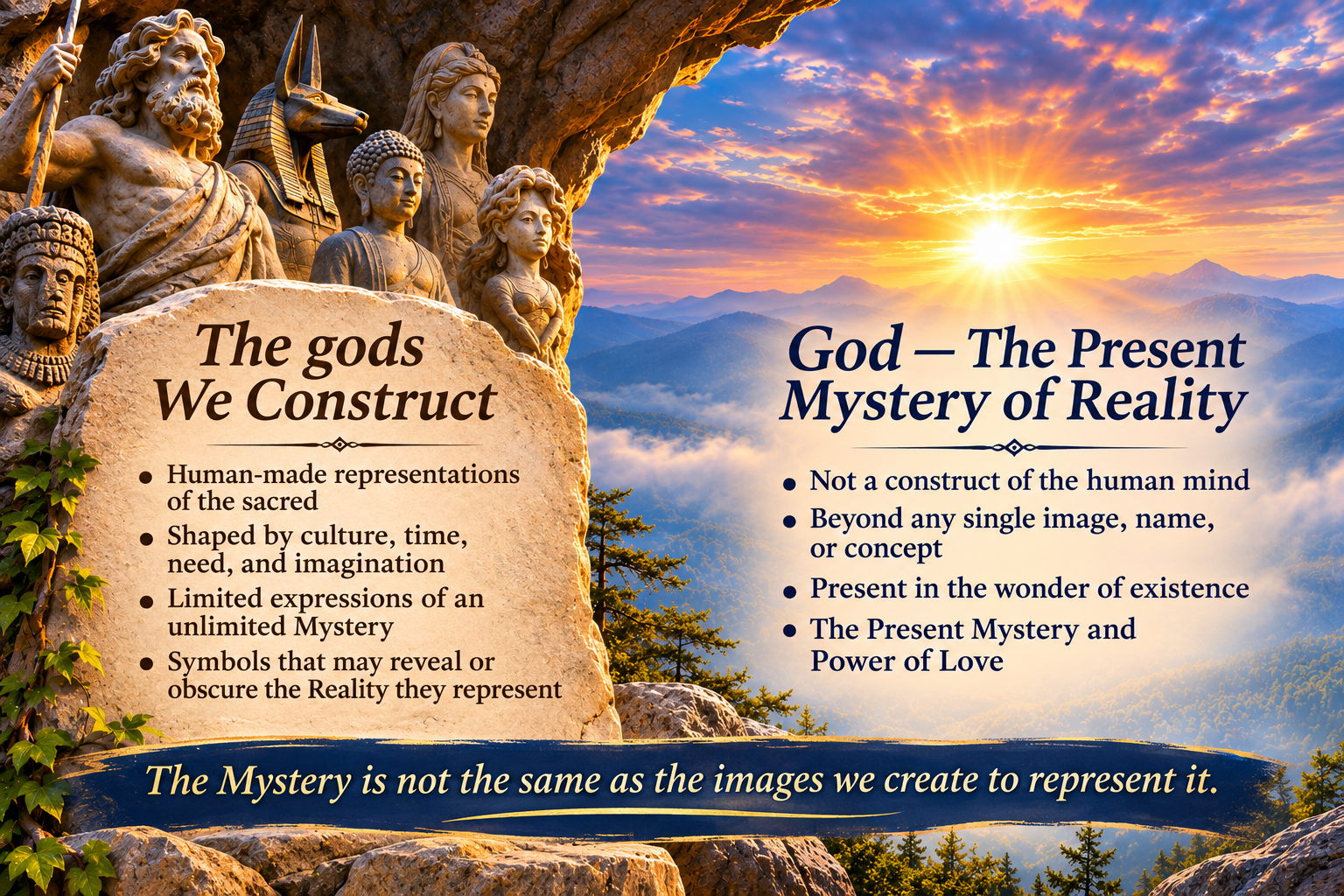
As I see it, everyone should use the lowercase ‘g’ when speaking of God, whether someone else’s or their own.
The uppercase God is a Mystery that cannot be named or known. The very moment we give it a name – and even more, a personality profile – we have conceived (in the sense of constructed or invented) a god, a kind of idol in the mind. All kinds of trouble tends to gather around idols: First we become fond of them, then we feel the need to defend them, and finally we look for opportunities to shove them down other people’s throats.
One of the serious liabilities of god – referring now to these doctrinal, artistic, and mythological idols – lies (sic) in the way it encourages us to think of it as something out there and separate from us, up in heaven perhaps and outside the world. Even if its genetic umbilical cord suggests an origin in the experience of the Present Mystery (aka the uppercase God), a god’s personal history can foment certainty, missionary fervor, and even violent extremism in its name.
I am not suggesting that every god is born out of an authentic spiritual experience. Many aren’t. Perhaps even most gods enter the human historical scene by different routes: ignorant superstition, creative storytelling, ideological marketing, or the accretion of bad guesses and untested assumptions over the slow roll of tradition through many centuries.
However they get into our minds, gods easily mislead us into believing they are real – above the clouds, behind the storm, under the mask, or inside our hearts.
We think up something, then we believe what we think, and eventually our own creation enforces belief – locks it down under emotional commitment and puts it beyond question – by the promise of heaven or the threat of hell. Calling this “faith” is a gross misappropriation of the word’s original meaning, which speaks (or once spoke) to the experience of speechless awe and trusting surrender to the Present Mystery of Reality.
In A Post-theistic Theology I explored an architectural framework of four principles behind the many constructs of God (our various and sundry gods) in and outside of religion. The proper non-object of spiritual contemplation is the Present Mystery and Power of Love – not a god somewhere separate from us but the inner ground of all things (Mystery), manifesting in each (Presence), connecting each to others (Power), and lifting them all together into a harmony of higher wholeness (Love).
The many gods of religion (including yours and mine) will embody and personify these four principles in some manner and degree.
The more “transparent” a given lowercase god is to the Present Mystery and Power of Love makes its portait more true – less about itself and more about its function in serving as a vehicle and revelation of the uppercase God. This appreciative inquiry into the significance of god is what distinguishes post-theism from both theism and atheism, who are interminably locked in their debate over the existence of god.
In an important sense, post-theism is less a religion than a new understanding of religion and the liberated life such a new understanding makes possible. With its own kind of devotional cultivation of the Present Mystery and Power of Love, post-theism challenges all religions to hold our gods up to its Light for an “epiphany test,” to see how much of it shines through and how much is blocked by their common features, peculiar attributes, and inevitable design flaws.
Eventually we may hope for complete transparency in our gods, which is another way of saying that we have finally grown beyond our need to have the Present Mystery depicted, portrayed, and personified in order to hold our attention and shape our belief. The “post” in post-theism refers to the stage in psychospiritual development when we find ourselves on the other side of theism and its gods, enjoying what Don Cupitt calls “solar living” – living freely and fearlessly, generously and joyously, from the inside-out, pouring ourselves whole-heartedly into life.
To gaze upon, to look through, to see beyond: These are the stages of human spiritual development as we grow in our understanding of the gods we talk about and where they stand in relation to the ineffable Mystery of God.
It struck me a number of years ago how the traditional language of divine immanence (as a reality within all things) versus divine transcendence (as a reality beyond all things) only seems contradictory. And it’s not that it is merely paradoxical, either. Instead, I realized that these important terms mean very different things depending on whether we are speaking of being (ontos) or knowing (noos). These critical distinctions are useful in defining the difference between our gods and God as the Present Mystery and Power of Love.
The Present Mystery is ontically immanent, meaning that it is within all things – not just here with us, but deep within us as the Ground of Being. Because the Present Mystery is the essential Reality sourcing, supporting, and suffusing our very existence, it is effable to us – beyond the reach of words and the grasp of our minds. It is therefore properly regarded as noetically transcendent.
The uppercase God is the Mystery present in all things, ontically immanent and noetically transcendent.
This mystical experience is where most religions got started, before their adventures took them in different tribal and cultural directions. In the Presence of Mystery, a human being experiences their life as grounded in Being, sensing a Mystery rising into manifestation in the countless forms of existence all around them.
In the early stages of religion, certain of these forms seemed to stand out from the rest as especially clear manifestations of the Present Mystery, revealed in the peculiar Power of their energy, beauty, rarity, strength, speed or some other trait. Plant powers, animal powers, human powers (e.g., wisdom, technology, governance), elemental powers (e.g., storms, sea, mountains), cosmic powers (e.g., sun, moon, stars) – all of these, and more, would eventually be regarded as incarnations of the Present Mystery, represented in a pantheon of gods or as attributes of one supreme and matchless deity.
In all their theistic distinctions, the lowercase gods are regarded as outside and separate from us in their being, or ontically transcendent in the terms used here. At the same time, and precisely because of this perceptual distance between the mind and its mental object (or theistic construct), all of those attributes make a god noetically immanent, or something we presume to know, define, and profess as sacred beliefs.
Over time, we grow fonder and more defensive of our special creation, affectionately named “my god.”
The danger, of course, lies in how easily this tether tying a god back to its source and ground in God can stretch and snap, turning it into an idol – the ONE and ONLY god.

