The View from Down Under

De Mello: “The trouble with people is that they’re busy fixing things they don’t even understand. We’re always fixing things, aren’t we? It never strikes us that things don’t need to be fixed. They really don’t. This is a great illumination. They need to be understood. If you understood them, they’d change.”

“Problems” motivate our efforts to fix them. A problem means that something is wrong – at least in our everyday way of speaking. A math problem, interestingly enough, is not broken but waits to be solved or figured out. If you come out with the wrong answer, then you’ve got a real problem.

My favorite one-word synonym for reality is mystery – as in the present mystery of reality, or the real presence of mystery. This mystery is the deeper ground beneath/within us, as well as the greater whole around/beyond us. At the personal level this mystery turns up as you and me, doing our best to figure things out.

All of this could inspire contemplation and wonder, but what we seem to bump up against most often are problems. Whereas reality is a vibrant web of causes and conditions, effects and forces that seems to go “down” and “out” to infinity, our personal worlds are simple by comparison. Even though we want to believe – or do we have a need to believe? – that the mystery of our own lives is a problem to solve or perhaps even “fix,” chances are good that many of our problems are self-created. To paraphrase Nietzsche: If all you have is a hammer, everything you see is a nail.

De Mello invites us to consider a different way of approaching reality – not with our tools but with intelligence. Specifically with a contemplative intelligence, one that takes in the Big Picture, sinks through appearances, and ponders the mystery in its depths. There will always be time to “figure it out” or “fix it up” the way you want it – or maybe there won’t, who knows?

But if we’re busy constantly trying to fix what we think is wrong or broken, the genuine mystery of being alive in this moment and somehow connected to all things passes by our blinders. The deeper ground and greater whole become invisible to us. Can we reach the point where they eventually become inaccessible to us as well – so tangled in problems that we lose our sensitivity to the mystery?

Our worlds have problems, but reality is a mystery. It’s when a natural force like a tornado comes into our world and upsets the arrangement, leaving damage and injury in its wake, that it becomes a problem. From a distance the weather phenomenon is fascinating and awesome. Just don’t come too close to me and mine.

Relationships have conflicts, and if these conflicts go on too long, we might say they’re broken and need fixing. I suppose it’s possible that many of my chronic troubles with others have to do with deeper or larger patterns that I don’t understand. It’s easier to point the finger of blame – at the other, of course. What if relational conflicts are really (that is, in reality) places where we come together at our differences, but just don’t understand the higher Tao that’s playing your Yin against my Yang?

As a constructivist, I appreciate the way in which our worlds provide the security, identity, significance and purpose we need to make life meaningful. Also as a constructivist, I accept these as “positive illusions” – things we need in order to keep our sanity and express our creative nature as a species.

We make it up, find problems in what we make, and spend our time and energy fixing the problems. It’s inevitable, I suppose.

What would happen if we took a more contemplative approach to our lives? Spending less time reacting to the problems we create – which only tends to generate more problems – and more time understanding our own creativity and its roots in reality, could make a real difference.

Understanding something doesn’t necessarily mean that we can explain it. The two metaphors are intriguing: explanation refers to “folding out” or opening up what is hidden in the deeper layers, while understanding involves “standing under” something and seeing it from the opposite angle of ordinary perception. The undersides of many things can be rather shocking.

Explanation is a kind of diagnosis, a necessary step toward fixing what’s wrong or broken. Moreover, it’s analytical, surgical and reductionistic in the way it spreads out the innards of something for closer examination. Once the frog is fully dissected, of course, all you have is frog parts. The living mystery is not just the parts in working order and functioning properly. It’s something more, something else, which vanished when Kermit went kaput.

This is not to say that explanation has no place in our quest for knowledge. Western science and philosophy have built up quite a library over the centuries – picking reality apart, cutting it up, breaking it down, charting its innards. We have come to know a lot about the composition of things, how they can be re-engineered, genetically modified, and synthetically replicated to do more for us.

But what if the real problem is our present discontent, our greed for more, a chronic frustration that fuels unrealistic expectations and set us up for disappointment? The deeper the disappointment, the harder we poke. The harder we poke, the more inflamed things become. Smaller problems multiply from the Big Problem.

Perhaps we need to get a different perspective on things. Before we start pulling them apart to fix them, let’s try to understand what’s really going on.

Easter Reality

Religious high holy days are anchored deep in myth and symbol. These are times when true believers – as well as the larger number of unaffiliated and “occasional pilgrims” – step into the sacred stories and reflect once again on the miracles of old. Too many of them probably do this out of family obligation or annual custom, gazing on the holiday symbols with the wondering eyes of their youth.

The following day, however, they will be back at it – back at life in the real world. No miracles here. No angelic visitations, virgin births, voices from the clouds or revived corpses in the news. It used to be that these and other miraculous events were regarded as signs, still very much set in story and not encountered in contemporary life, pointing to a higher realm of being that supports this one.

Signs are significant because they signify things. Meaning is all about reference – this pointing to that, one thing leading to another, and all of it making sense in the Big Picture. Once upon a time (here I go telling a story) people lived inside a Big Picture, and mythology served the valuable function of pulling them back from the daily distractions of secular life and reorienting them in a single coherent system of meaning.

I say “once upon a time” because people today generally don’t live their lives with a Big Picture in mind. If there is one, it’s the rather cold and indifferent cosmos of science, now somewhere on an unfathomable timeline between BANG and FIZZLE (or maybe CRUNCH). For quite a while, as modern religion was losing its market share in the intellectual landscape of the Western mind, church leaders blamed science for the vacancies in their pews. Empirical skepticism (“I’ll believe it when I can measure it”) was accused of producing secular atheism (“God can’t be measured, and therefore doesn’t exist”).

But here’s what really happened.

The sacred stories began losing currency, not because they were scientifically discredited, but rather because they became increasingly irrelevant to daily life. And as the symbols lost their power to signify, the metaphors closed up on themselves and degenerated into “miracles.” Consequently the Big Picture that had oriented human beings for so long fell apart. Now – occasionally, on high holy days – we pause to fetch from the wreckage those dim reminders, those alien curiosities from another age.

So what becomes of these articles of religious nostalgia? If symbols need stories, and stories need other stories; and if all these stories (the collective mythology of a culture) comprise the Big Picture that once made life meaningful, what purpose is there in dusting the icons, pressing the vestments, and singing the hymns if we don’t really know it as our truth?

I didn’t say “believe it,” for we can make ourselves believe just about anything. There are a lot of true believers who talk a lot about god, read their Bible religiously and do their best to take it literally. If the biblical god doesn’t bust through the starry canopy and talk to us as he once did, it’s only because we live in the Last Days and he is busy preparing for the Final Judgment.

As for Jesus, Christmas got him into our world and Easter got him back out. It all happened a long time ago, but he’s coming again. Just you wait. In the meantime – and it is a mean time – we have to keep the faith, resist the devil, legislate for (our) religion, and guard our stuff.

I saw a bumper sticker the other day: “God – Guns – USA.” Now that’s a very small picture, which can be found all around the planet today. Just insert another god and a different tribe, and that truck might be driving down the road in Syria or Kenya or North Korea.

What can Easter mean in a time when evidence of god is lacking but the testimony for god is all too out-spoken and dogmatic? Just because it’s “in the Bible” doesn’t automatically make it relevant. After all, the Bible is testimony, not evidence. Furthermore, it’s a very special kind of testimony – not exactly the eye-witness accounts as many true believers defend it these days, but creative testimony, poetic testimony.

As mythology, the Bible wasn’t written as retrospective journalism on objective miracles and actual encounters with a supernatural personality. Rather, it issued from the creative imaginations of people just like you and me, inspired by the realization that their lives (just like ours) opened up to a greater mystery.

In those moments, in those places, and in the company of those rare and illumined ones who seemed to live in unbroken awareness of this mystery, the everyday world was touched, elevated and glorified with a higher significance.

Jesus came with a message about compassion, charity, and unconditional forgiveness. He not only talked it but he walked it as well, living it out in his dealings with others – in the company of his friends, in his encounters with strangers, and in the presence of his enemies.

It wasn’t long before the authorities caught wind of his growing reputation and grew uneasy over his dangerous influence on the people. Dangerous because he was waking people up from the trance of personal self-interest, religious orthodoxy, and militant nationalism.

The authorities were nervous that this trouble-maker might shift the axis of control that protected their privileged position as deputies of god and brokers of salvation. They quoted scripture in self-defense, accused Jesus of going against tradition, and at last succeeded in charging him with heresy, atheism and disturbing the peace (also known as the trance-state of spiritual sleep). He was executed and his followers disbanded.

But then, maybe among a small band of his discouraged survivors, memories were recalled and weaved together in stories. In recalling his words they remembered his message, and as his message reignited their hearts they realized that his vision was still short of fulfillment. The spirit of Jesus was not gone but now lived in them. The torch of his cause was theirs to carry forward.

An empty tomb and abandoned grave clothes are not evidence, but only the absence of evidence. They are signs, metaphors, and symbols opening out to a greater mystery. They say, “Not here.” But where then? Exactly where is Jesus alive?

Up in heaven, if you believe in heaven. In the sacraments of the Church, if that’s your thing.

I would say that if what we are calling the spirit of Jesus is not evident in the way we live and treat each other, then we’re still waiting for Easter.

Inner Dialogue

Robinson: “Each of us, if we are in any way integrated, has a center from which our lives are lived, and our ‘world’ is what is enclosed within the circumference of that circle. Yet often we are more conscious of the edges than the centers, corresponding to the bounds of an animal’s territory which it stakes all to defend. The edges may be hard, the boundaries barricaded, while the centers are relatively unformed. The effect of dialogue is to bring to consciousness, and therefore to strengthen, our centers – so that where we stand will often in the process become clearer and firmer. But we do that by being prepared to soften our edges, to open up the frontiers, and let down our defenses.”

Human beings are world-builders. By now it should be clear that we are using this term in reference to the habitats of meaning that give humans the illusions of security, identity, significance and purpose. These are regarded as illusions simply because they are language-dependent and not found as “facts” in reality. As spiders spin webs out of their own bodies and then depend on their webs for survival, each of us spins a world around ourselves and calls it home.

At the center of my world is “me,” this self-identified maker of meaning. Underneath me are the various supports that hold me up and define who I am. Gender, family, class and tribe are the primary roles that locate me in society and give me recognition as a member. Together we inhabit a shared world called culture, which is a web that stretches across generations and geographical regions and is reinforced by sacred stories called myths. These stories anchor our common identity in a prehistory of ancestors, founders and heroes, as well as in a supernatural realm of gods, saviors and saints.

The movement of postmodernism was energized by the discovery that beneath our web-worlds is a reality much less “solid” than we thought. The foundation of divine providence, for instance, or even something as seemingly rock-bottom as matter itself, are shown to be just deeper constructs of language. The security we feel in being held up by something loving and reliable (matter and mother have a common origin) is perhaps an irresistible need of ours, stemming back not just to our individual infancies but into our existential condition as a species.

And what about the boundary of my world? What’s beyond that? If I don’t think about it too much I can persist in the illusion of a significance and a purpose that continue to infinity. God’s in control, everything happens for a reason, and all things work together for good. It’s a mark of faith not to ask questions, or so we’re told.

But eventually we bump up against … not reality, but other worlds. I am confronted with your very different way of representing reality, and if mine was merely a representation and not the way things really are, I might be worried. We can have differences, but they will have to be superficial, minor disagreements. When push comes to shove, I can’t compromise on my convictions. Not that I won’t. I can’t – there’s too much at stake.

John A.T. Robinson is perhaps best known for his 1963 book Honest to God, in which he challenged the mythological literalism of the Bible and urged his readers to consider the possibility that the divine reality is not merely something bigger than we can imagine, but might even be something other than what we can imagine. Robinson took his inspiration from the likes of Paul Tillich and Dietrich Bonhoeffer, both of whom advocated for a divine mystery beyond our religious conceptions and doctrinal convictions.

The present mystery of reality is not meaningful but beyond the meanings we construct and attach to it. Our dogmatic and aggressive defense of meaning belies an insecurity often unacknowledged – except where we readily point it out in our opponent. If we could relax a little at our edges and meet each other with more honesty, humility and faith, we might realize that our meanings are a lot less absolute and unchanging than we pretend they are.

But as Robinson explains, the condition of our boundaries – how flexible or rigid they are, how open or closed, how responsive to mystery or reactive to difference – is a function of how integrated we are inside. Internal balance, contemplative clarity, intellectual coherence and spiritual grounding are all terms that relate to our center, where each of us is rooted in the present mystery of reality. If we neglect this dimension of our life and become disconnected at our roots, the natural concerns of survival and evolutionary fitness will become combative obsessions at the edges.

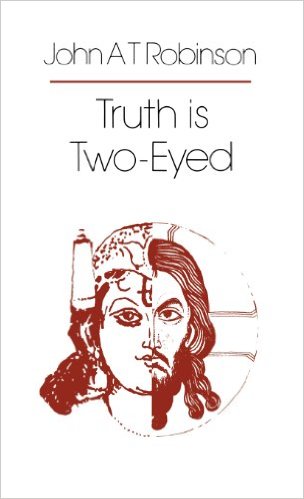
Now in this book (Truth is Two-Eyed), Robinson is exploring what he calls an “inner dialogue,” where the spider in the middle of the web – our self-identified ego and the meaning we spin into our separate worlds – opens up (or down) through its own center and into the real presence of mystery.

With “one eye” we see this relationship of self to mystery in terms of communion, between an “I” and a “Thou.” Importantly, this Thou is not the personified god of mythology and doctrinal orthodoxy, but an irreducible “Other” or otherness at the heart of our human experience of reality. This is the Western Way.

And with our second “eye” we see the present mystery of reality less as an interplay of I and Thou, than as a single undifferentiated Oneness playing both parts of the relationship. We are not so much confronted by reality as immersed in it, saturated with it, and essentially the same as it. This is not the same as saying, “I am god,” for the I and Thou are both manifestations of one mystery. This is the Eastern Way.

Robinson is inviting us to consider spirituality as a dialogue of “meeting” (Western Way) and “merging” (Eastern Way), communion and absorption, as our response to the mystery and our identification with it. We can engage this dialogue outwardly, at the table with Christians and Buddhists, for instance, where different constructs of meaning (worlds) seek to understand each other.

But this outer dialogue is not likely to produce the kind of mutual respect and profound appreciation we so desperately need on this planet unless we are each engaged in the inner dialogue of a deep, contemplative  spirituality.

Just relax. It’s going to be all right.

Reality Choices

Anderson: “We have to make choices from a range of different stories – stories about what the universe is like, about who the good guys and the bad guys are, about who we are – and also have to make choices about how to make choices. The only thing we lack is the option of not having to make choices – although many of us try hard, and with some success, to conceal that from ourselves.”

Another of my favorite authors from seminary days is the sociologist Peter Berger, whose book The Heretical Imperative explores this postmodern necessity of choosing the worlds we live in. The word heresy – which conjures up images of papal excommunications, the famous Scopes trial over evolutionary science in the school curriculum, and my own experience inside a Calvinist-Reformed denomination – simply means “having to choose.”

A heretic is someone who acknowledges the reality of options, along with the consequent need to choose between or among them. From the vantage point of orthodoxy, the heretic is dangerous not just because s/he makes the wrong choice, but because s/he might encourage others to think that they have options, too.

My own denominational background would never acknowledge post-theism as a theological option for true believers. There’s too much history, too much mystique around sacred sources (e.g., the Bible and the Standards of Faith) to permit even the consideration that our personification of god might be more about us than about the real presence of mystery. The good people in the pews on Sunday mornings must be reinforced in their dogmatism. All other ways of representing the mystery – or the choice of not representing it at all – must be condemned as wrong.

But as Anderson points out, we can’t get by anymore without having to make choices. And it’s not the choice between The Right Way and all possible wrong ways. Many of the optional paths lead into very perceptive, coherent and responsible lifestyles and worldviews.

Our postmodern predicament is having outdated worldviews “behind” us, as it were, in the traditions that have shaped our history and identity as tribal members, while “ahead” of us are all these different (contrasting and incompatible) worldviews competing for the emotional currency of our belief.

Behind us is singleness of vision – the “correct thinking” of orthodoxy – while in front of us is this marketplace of rival “software” vendors peddling their exotic thought-forms. There’s at least the illusion of freedom ahead, but for many the security in a one way/right way mentality is too valuable to give up.

We don’t want to admit that we have a choice, because if we do we might be asked to justify our selection. Frankly, most people don’t want to think that much – especially about spiritual things, which really means metaphysical things like god and the soul. Besides, according to the Tradition we must rely on revelation when it comes to such matters, and who do you think holds the keys to that? Long ago god left us with the Bible, and thankfully we now have the scholars and preachers to tell us what it means.

But what scholars and preachers? You have only to step out of one church and into another – of the same denomination even – to realize that options are inescapable and the “obligation” to choose ever-present. Of course, you can bury your head in the sand of one tradition, but even there you will be confronted with a story of differences, dialogue, compromise or dissension. Very human choices, all along the way.

For a long time – we’re talking many hundreds of years – the custodians of cultural orthodoxy were successful in convincing tribal members that the way they saw things was the way things really were. This was easy to do since the custodians themselves (scholars, priests, lawyers and magistrates) were under the same spell. Looking out on reality, why wouldn’t you assume that how things seem to you is the way things really are?

The trance remains strong and widespread even today.

We are coming to understand, however, that worldviews are stories about reality, and that every story is told from a very particular vantage-point. Each possible vantage-point offers only a limited perspective on reality, and whoever steps into that space brings with him or her a dense filter of personal assumptions, ego ambitions, and intellectual commitments.

Every time you change your position in reality – just stepping out the door and into the street, for instance – you are making a choice whether or not to believe the story you have been telling yourself up to that point. Actually, if you had the vision for it you would see a complex web of stories connecting and crisscrossing in such fine detail as to comprise a veil between your mind and reality.

Perhaps this veil is itself your mind, who can say?

If reality is a mystery, then maybe every vantage-point is at base just a few very simple questions: What is IT? How does IT feel? What does IT mean? Our efforts at answering these questions are the stories we tell, and the worlds we inhabit are made up of countless such stories. Yes, our worlds are made up. This discovery is what inspired the postmodern movement.

For more about IT, see my blog at http://braintracts.wordpress.com/2013/03/23/it/

Once you realize that you have no choice but to make choices, that you make choices by telling stories, and that your view of reality (your world) is nothing but a dense web of stories, what comes next is the doubt whether it’s all worthwhile. If there’s a good chance that IT is not exactly as you think IT is, then what can you count on?

Well, I hate to say it, but it’s up to you. You will have to decide. Choose wisely.

Waking Up

De Mello: “Spirituality is the most practical thing in the whole wide world. I challenge anyone to think of anything more practical than spirituality as I have defined it – not piety, not devotion, not religion, not worship, but spirituality – waking up, waking up!”

Human beings are creators, and what we create are worlds. A “world” is a construct of language, a habitation of meaning, a web we spin for the sake of establishing some measure of security, orientation and purpose across the expansive and fathomless mystery we call reality. Like cocoons, we weave our world-homes and crawl inside.

Then we fall asleep.

But just as a cocoon is only intended as a temporary compartment, an incubator for a time as the swooning caterpillar undergoes metamorphosis, our worlds aren’t able to permanently contain the creative energy of the human spirit.

I saw it too many times in my career as a pastor, and later as a counselor: there is a “spiritual frustration” behind all our fussing and fighting, all the crime and unrest, all the neuroses and sink-holes of depression that are swallowing so many today. In ministry I wasted much time and energy – before I realized what was really going on – placating this restless demon and restitching the splitting seams of outgrown worlds.

The general trend in the current conversation on religion and spirituality is to define it – spirituality – as your private practice of prayer, communion with your higher power or inner guide, along with any odd assortment of ideas, symbols and rituals that make it meaningful to you. Religion, on the other hand, is “organized religion” – public, dogmatic, authoritarian and traditional.

In other words, boring and irrelevant.

The truth is, religion has become rather disconnected from life on our planet in this global age. As its boundaries bump up against rival belief systems, religion becomes increasingly reactive, defensive and violence-prone. But it’s also the case that religion is losing the currency game. Adherents go to church and sing praises to a deity they’ve never met, for the simple reason that he is only a literary character, what I call the mythological god.

As I’ve explained in previous Conversations, the mythological god is a personified representation of what some human beings regard as the supreme power behind the universe. So far, so boring. He got more interesting as the tribe fashioned this deity into its own likeness, with a rather unstable personality, a really BIG ego, and all the necessary vengeance at the ready for sinners, outsiders, and enemies.

Back in the day, a tribe (as I’m calling it) was a local human group of stratified classes, ranks of authority, strong boundaries, a deep genealogy and a tight moral code to keep it all from falling apart. Religion functioned as the center-pole around which this arrangement was oriented, and the mythological god was positioned at the top of the pole. The icon of sacred order.

All around the planet during this tribal age you could find the same general set of ordained functionaries, positioned and properly respected as guardians of truth. Priests looked after the ceremonial aspect, scribes kept the scrolls in order, and prophets or shamans served as therapeutic inlets of ecstatic experience – just enough conscience or craziness to preserve the illusion that Someone Else is in charge.

At some point, however, the evolution of human consciousness produced a more individually grounded and skeptical intelligence. People started to wonder why the god they heard and read about in the holy books wasn’t still sounding down from the clouds or filling the temples with holy smoke.

The guardians did their best to protect the tradition and its orthodox heritage by making up “adjustment stories” about the god’s heavenly transcendence, our loss of direct contact with him due to our fall into sin and depravity, and about how the god was preparing for an apocalyptic return – very soon, and maybe tomorrow. Don’t rock the boat.

So for centuries now, individuals living in the dawning light of a higher spiritual awareness have accepted these adjustment stories as sacred revelation.

It’s a little like all the minor adjustments that astrologers were making to the earth-centered universe before Copernicus. Because Earth was really traveling through space and whirling around the sun, earlier scientists had to make mathematical adjustments to the orbital paths of the other planets, in order to keep them moving in perfect circles around us. This was because god only works with perfect circles, not ellipses or squiggles.

In some of my earlier Conversations I’ve been pumping for a “post-theistic” spirituality. As theism is a conceptual model of religion based on the objective reality of a divine personality “up there” and in charge, “post”-theism is an invitation to contemplate the possibility that this god, along with the world-order he supervises, is intended as an evolutionary incubator of spirituality.

A defensive theist may well cry, “Atheism!” But the “post” in post-theism is meant as an acknowledgement of theism’s strategic place in human spiritual formation. It’s closed system –  however large this closed system may be permitted to get – provides the security, orientation and sense of purpose that human beings need.

To say that its god lives only in the myths is not to deny his existence, but instead reflects a new-found appreciation for sacred stories and their power to shape and reshape consciousness. Just because god’s existence is literary and not literal, doesn’t mean that he’s now obsolete and better left to the dark ages.

Religion is the outer structure to spirituality’s creative life, the body to its soul. Post-theism is not what comes after religion, and neither is it just a word to validate the kind of designer superstitions available under best-seller titles at the local bookstore. It’s a way of seeing spirituality in an evolutionary context, and religion as the staging area of our awakening.

Truth in religion is in the flexibility of its present arrangement, as well as in its willingness – let’s call it faith – to release the need to be right, in order that we might become more real.

There’s nothing more practical, and more urgently needed today, than waking up.

The Nature of Reality

If you were the only sentient being in this universe, you probably would never become aware of the discrepancy between your worldview and reality-as-it-is. Of course there would be perceptual mistakes, as when the cool oasis in the distance turns out to be only a mirage. But these would amount to minor illusions. Over time you would carry forward your lessons and make the necessary adjustments.

The term “reality” is used pretty loosely, even today when the discrepancy between our personal worlds and what they are meant to represent is finally acknowledged – at least by some. This acknowledgement is one of the marks of our postmodern mind. Human beings are meaning-makers, and the closed webs of meaning that we create – individually and together as cultures – are the worlds we inhabit.

Even one of my conversation partners for this round uses “reality” in reference to our individual and cultural constructions – as in you have your reality and I have mine. Personally I prefer the term “world” when speaking of these constructs of human language, perspective, and meaning. Especially on the level where such constructs serve as more global habitats of meaning.

This saves “reality” as the way things really are, apart from and beyond our constructs. You have your world, I have mine; but there’s still something outside our boxes, so to speak. Besides being fantasies conjured out of the creative nothingness of our imaginations, at least part of our world is meant as a representation of the way things really are. Even if we’re wildly off base – which is probably the case at least some of the time – there remains the present mystery of reality.

Just because we (mis)take our constructions or representations for the way things really are doesn’t mean we should be content to persist in that delusion. If I am fully convinced that the end of history will be crashing in at any moment, this is not my reality. Even as I take it with all seriousness, sell my possessions and abandon civilization for refuge in the desert, reality is what it is. There have been countless examples where delusional prophets were forced to apologize to their followers and review their calculations the following day.

So we live inside worlds of our own making. These worlds may be fairly reliable representations of the way things really are, but they also serve as shelters against the unknown. A happy and productive life would likely be impossible if we had to figure out everything from scratch upon waking each morning. Meaning provides a sense of security.

But this relationship between meaning and security isn’t exactly reciprocal, in that more security doesn’t always support a more meaningful life. In fact, as we lock ourselves up inside our personal and cultural worlds, grateful for what is familiar, stable and certain, the air in there quickly goes stale. Because meaning seems to be a function of relevance, reference and transcendence, it is diminished to the degree that our awareness shrinks to the dimensions of our mental boxes. Smaller boxes feel more secure, but they are less meaningful.

The authors I will be reading and reflecting on are definitely “outside the box,” as we say.

DeMello

Anthony De Mello (Awareness: The Perils and Opportunities of Reality, 1990) was a Jesuit priest whose life and writings were a lively dialogue with Oriental spirituality. Based on retreat talks he gave on mindfulness, freedom and happiness, this book takes a humorous yet revolutionary tour through what it means to be truly aware.


Anderson


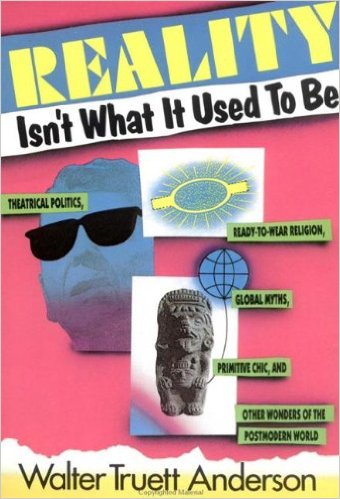
Walter Truett Anderson (Reality Isn’t What It Used To Be, 1990) wrote one of the definitive popular guides to postmodernism. In that book, he helps us become more self-consciously aware of our role as creators of the worlds we inhabit. The relationship of our brain to language, and of the constructs of language to the perennial question of truth are considered.

Robinson


John A.T. Robinson (Truth is Two-Eyed, 1979) was the Dean  of Trinity College in Cambridge, England. He challenged current thought on matters of theology, especially the way Christian orthodoxy has made god into an article of doctrine and forgotten God as spiritual Presence. The “two eyes” in Robinson’s title represent Oriental and Western approaches to truth.


I can already imagine a conversation among these three, where De Mello investigates the inner-psychological groundwork of awareness, Anderson interrogates the constructions of reality that spring up from there, and Robinson explores how very different world-constructions can challenge and enrich each other in healthy dialogue.

Throughout my reading and reflections on passages from these authors, I want to carry forward from my previous Conversations the insight that reality is a present mystery. However we frame it up, whatever filters we use to make it useful to our needs, the nature of reality is such that it is both within us as the ground of our being and beyond us as the universe to which we belong.

You are invited to join the conversation as well. Read along with me and share your insights by leaving comments along the way.

Welcome!

Welcome to my thoughtstream on the topic of creative change. I appreciate your visit and hope you’ll stay a while.

Tracts of Revolution explores the dynamics of human creativity as it swirls in our cells, pulses through our bodies, connects us to each other, and constructs the magnificent panoply of world cultures. You will find two distinct currents to this thoughtstream that may interest you.

“Conversations” are blog posts reflecting on the creative works of authors and artists of our present day and recent past. These creators communicated their visions of reality and the human future through words and other art-forms, partly to share them with the rest of us, but also because they finally couldn’t resist the force that seized and inspired them. I name that force “the creative spirit,” and am convinced that it inhabits all of us – while only a relatively few of us are courageous (or foolhardy) enough to “go with the flow.”

I have a lot to say about spirituality and religion, but this shouldn’t lead to the conclusion that I consider the creative spirit especially religious or “spiritual” in a more narrowly religious sense. The authors I bring into conversation are both religious and nonreligious, believers and atheists, metaphysically-minded psychonauts and down-to-earth humanists. In my opinion, it doesn’t matter what ideological camp you inhabit, what country you call home, what language you speak, which way you’re oriented, or whether you are charming or abrasive. You and I are creators, and it’s time we take responsibility for this incredible power with which the universe has endowed our species.

For a more practical and therapeutic approach to creativity, check out my blog Braintracts. Over the past 30+ years I have developed a life-change program that helps individuals take creative control of their lives and step more intentionally into the worlds they really want to inhabit. This approach is brain-based and solution-focused, pulling from the current research of neuroscience and the best practices in human empowerment (counseling and coaching).

The Medieval art/science of metallurgy investigated the molecular secrets of changing natural ores into metals and other alloys. The process was mysterious and the research traditions of those early scientists often took on the shroud of an almost gnostic mysticism. Mentallurgy is my attempt to remove the shroud of secrecy from the question of how the power of attention is transformed into the attitudes, beliefs, moods and drives behind human behavior. If you don’t particularly like the world you presently inhabit, then create a different one! Mentallurgy can show you how. Click over to www.braintracts.wordpress.com

Resting and Longing

Tillich: “The concern of faith is identical with the desire of love: reunion with that to which one belongs and from which one is estranged. The separation of faith and love is always the consequence of the deterioration of religion.”

As I near the end of my conversation with Schleiermacher, Kierkegaard and Tillich on the subject of faith, I’m impressed once again by how vibrant, experiential and deeply mystical they all regarded it. This is quite different from popular Christianity, where faith is either identified with the boxes of belief we hold onto, or our willingness to stop thinking for ourselves and simply adopt the beliefs of someone else – even if that someone else is an author of a book in the Bible.

At the deepest level, faith does not have an object. Rather it is the total release of yourself to the ground of being, or to what I have named the present mystery of reality (or real presence of mystery). This ground is only found by an interior descending path of contemplative awareness, not by looking outside yourself into the environment of your life.

And yet, a more mystically grounded spirituality will not dismiss your outer reality as just dead matter or a seductive distraction.

Your physical senses connect you to a marvelously diverse expression of that same ground, as every other form is similarly rooted in the one mystery of being. In the creative swell, this ground generates the multiplicity of things; and in its own time, each thing recedes, dissolves and returns its small loan of energy to the source.

As one of these forms, you are a manifestation to me of real presence – a creative expression of the ground as an embodied person. It’s astonishing how the ineffable (nameless) mystery of reality reaches out to me through your physical form, your quirky personality, the various roles you play, through the conceited, insecure and occasionally pompous ego acting out your life. (No worries: I have one, too!)

The force that draws us together and holds us in communion, is love. This is the ground as spirit, surrounding and moving between us. Of course, if you’re too quirky and conceited, I may not feel especially interested or attracted to you. Our insecurities might make it challenging for us to be too close, and our separate convictions might rub the wrong way, causing us to feel uncomfortable, threatened and defensive when we’re together.

But whether we like it or not, despite our differences and however fond or freaked out we are by them, the spiritual truth is that we are fellow expressions and co-participants of this universe (“turning as one”), which is simply another word for communion (“together as one”) and the creative, unifying power of love.

Perhaps this is our best working definition of religion – from the Latin religare, to link back. Healthy religion is a relevant system of spiritual practices, artistic symbols, sacred stories and social rituals that link us each internally to the ground within, relationally in shared community, and universally to the planetary and cosmic environment.

Faith is about the contemplative clarity with which we individually connect and release ourselves to the ground, while love is the communal bond that contains our seemingly separate lives and moves us into intersections where we must meet and discover each other. According to this definition, love doesn’t have to feel good and make us tingle.

If we resist its rhythm and aim, in fact, we should expect to feel pain. As pain is the signal that something is wrong and needs careful attention, its intrusion on our relationships might inspire us to inquire where we are interfering with love’s greater design. What do we need to let go of and leave behind, or perhaps stretch out for and go beyond, in order to flow more gracefully and creatively in The Way?

Faith, then, is resting in the ground – in that profound and ineffable mystery supporting you in this present moment. Love is the longing that moves through you and connects you to everything else. Resting and longing: these are the dynamics of healthy spirituality and relevant religion. Remove one of them from the balance and you have either self-absorbed insecurity (today’s counterfeit spirituality) or glorified intolerance (today’s dogmatic religion).

As things continue to deteriorate, we succumb to anxiety and depression, get caught in more destructive conflicts with each other, and undermine our planet’s ability to sustain life.

The fact that we are here at this evolutionary moment in time means that we belong together. Like it or not, we live in the same house and come from the same place. And even now we are passing away, eventually to make room for our successors – if the wake of our own trash and toxins and holy convictions still leaves a sufficient clearing for the possibility of enlightenment.

It’s not yet too late. But we have got to wake up.

The Inner Voice

Kierkegaard: “In eternity, conscience is the only voice that is heard. It must be heard by the individual, for the individual has become the eternal echo of this voice. It must be heard. There is no place to flee from it.”

The sixteenth-century Reformation in Christianity began in Luther’s discovery of the individual conscience and his belief that this inner voice is the very voice of god. Up to that point, institutional religion had successfully spun the delusion of the individual’s separation from god, and of our collective need for intervention that only the institution can provide. Any insight or guidance or judgment you might inwardly discern was not to be trusted.

So when Luther decided to regard his inner voice as the voice of god, this single decision severed the chain of external control.

Of course, there had been others before Luther’s time who valued individual authority over compliance with “the system” (call it institution, society, fashion, or empire). They were revolutionaries, if their visions and ways of life caught on with others; or saints, if it took some time for them to be respected and appreciated; or maybe just misfits and odd-balls, if no one else really “got it.”

But Luther made his declaration on the cusp of a dawning new age – modernity, with its growing obsession with individuality and the individual’s experience.

Inside this discovery and its more widespread acceptance throughout western European culture, we can also detect the seed of what is now called “postmodernism.” While perspectivism had been developing in painting for a couple centuries already, Luther applied it to faith and morality. If this is how I feel, then maybe this feeling is a divine prompting. This is how things seem from where I stand.

At trial for all the commotion and cultural upset that he had caused, Luther announced the new maxim of perspectivism: “Here I stand. I cannot do otherwise.” I am compelled by the force and authority of my own experience. Kaboom.

In effort to justify its dominance of the individual, tribal orthodoxy does two things: (1) It claims for itself a divinely ordained authority, sustained by a sacred tradition reaching back to supernatural events (revelations, miracles) where this transfer of truth and power was made; and (2) it weakens the creative spirit of the individual with a doctrine of depravity, guilt, and shame (in short, a doctrine of sin).

Your corrupt nature, inherent selfishness, and fundamental inability to save yourself makes you utterly dependent on (the external, metaphysical) god for salvation. Thankfully (and you’d better be thankful), a way has been provided. Long ago we (the tribe) were given the secret, which we have guarded over many centuries. Listen up, join us, believe this, sit here. The devil – counterpart to our god – is still loose and at large in the world, so be vigilant! His most seductive temptation is to encourage your self-consciousness.

Luther was still too much entranced with this orthodox instruction to take full responsibility for his life or look too deeply into his own human nature. The doctrine of sin persisted – one might even say it was amplified in the emerging traditions of Protestant Christianity. Now that the institutional middleman is out of the way, it’s just you standing naked before god. Egad.

So what does this have to do with Kierkegaard and the future rise of postmodernism? Whereas Luther had been an unabashed theist, believing that his inner voice was nothing less than the directive of a god who existed outside of himself, Kierkegaard followed the root system of this interior experience, into the very ground of his own existence. For this reason, he is rightfully honored as an early proponent of Existentialism.

Existentialism is a philosophy of life. Whereas other philosophical traditions had involved rather abstract speculations on metaphysical realities (god, soul, mind), Existentialism dedicated its focus to the time-bound, flesh-and-blood individual who is working out the meaning of life along the meandering course of daily experience.

At this early stage we don’t yet have recognition of the fact that the individual is constructing this meaning as a world-creator and not simply finding it “out there” ready-made. But it’s coming. A necessary step in this direction was Kierkegaard’s replacement of Luther’s conscience as a voice of revelation from elsewhere (the external god) with the notion of conscience as the voice of inner guidance, available to the perceptive and internally grounded individual.

Isn’t all of this just a set-up for rampant individualism? When we start listening in on the universal wisdom as it resounds up from the depths of our own human nature; as we tune into this inner voice of spiritual grounding and guidance; when we begin taking responsibility for our choices and the worlds we create and destroy with them; finally, as we come to appreciate ourselves and acknowledge each other as present (and passing) incarnations of the One Mystery – after all of this, won’t the world come apart and the devil win?

Seriously?

Of course, there is a risk. Not everyone will join the revolution. Tribal orthodoxy works hard to keep you compliant. There will be hell to pay by anyone who dares to question the sacred trust of its holy tradition, supernatural revelations, ordained authorities and inerrant Bible. Too many of us value emotional security over spiritual fulfillment to put so much on the line.

After all, it’s working, isn’t it? It hasn’t all come crashing down yet, thanks to the true believers who are keeping the faith. Get in here and hang on with us!

There, there. Shhhhh. Close your eyes and go back to sleep.

Faith and Discovery

Schleiermacher: “If there is religion at all, it must be social, for that is the nature of human beings. There is also a spiritual nature which we have in common with others of our species, which demands that we express and communicate all that is in us. The more violently we are moved and the more deeply we are impressed, the stronger that social impulse works.”

Contemplating the likely origins of religion helps us appreciate its roots in individual experience rather than in what might be called “orthodox instruction.” For those who believe that religion – their religion, the true religion – was lowered from heaven already fully assembled and given by revelation to a founder, prophet or saint, faith must be taught. You must read your Bible, listen to your teachers, and take in the points of doctrine upon which your salvation depends.

The credibility of this long tradition of orthodox instruction requires that your Bible is inerrant, your teachers enlightened, and those points of doctrine absolutely infallible. If there’s a break anywhere in the chain – maybe scripture is metaphorical or made-up, just one teacher was mistaken or confused, or just one dogma is derived from a mistranslation – then the whole institution loses authority and disintegrates.

To protect itself, institutional religion implants in us a virus of doubt and suspicion against the validity of individual experience. Because you are fallen, ignorant, sinful and depraved, your own perceptions, insights and judgments are corrupt and unreliable. In fact, if you allow their seduction you will be lured away from truth. Don’t think for yourself. Don’t pay attention to your misgivings over how far-fetched, fantastic and irrelevant to daily life the orthodoxy seems. Certainly don’t trust yourself, your human nature, or the greater nature of reality within, beneath, and all around you.

Mystics throughout history and across cultures – and I would also say, the mystic in you – have regarded the orthodox instruction of institutional religion with mild tolerance, outspoken criticism, or active opposition depending on how authoritarian and abusive it can become. They typically won’t spend too much time and energy in the effort, partly because the errors are deep and long-standing, but also because they understand that the entire system of religion is more a human production than a divine revelation.

To say that religion is a human production, however, is not to discredit it, as orthodoxy claims (unless, of course, you’re talking about other religions). The source of religion is in discovery, not revelation. Whereas revelation is something the mythological god did to get the truth to us (from up/over there), discovery is a process whereby the present mystery of reality (the really real) is gradually or suddenly perceived, as our assumptions and expectations are removed.

Questioning our long-standing beliefs, conducting careful experiments, and generally paying closer attention to what’s going on is how discovery unfolds. To the degree that institutional religion discourages or straightaway condemns such practices, it is the enemy of discovery – the enemy of experience.

Out of this age-old process of discovery, individuals just like you have drawn deep insights concerning human nature, the real presence of mystery, and the present mystery of reality. Their first efforts at translating these powerful intuitions into symbols, metaphors, story and song/dance – for the purpose of expressing them and communicating them to others – mark the beginnings of religion.

Symbols don’t capture the mystery, but only provide a way of consciously participating in it. Metaphors aren’t literal descriptions but merely poetic representations of experience. For their part, story (sacred myth) and song/dance (earliest ritual) are the outpouring of spiritual discovery into the social arena of cultural life.

Schleiermacher identified an “impulse” in you that cannot allow these spiritual breakthroughs to be kept to yourself and quietly cultivated in some kind of private religion. Where it begins is undeniably private, by which we mean individual, profound, and deeply internal. But once expressed – and the power, magnitude and anticipated repercussions of spiritual discovery push it irresistibly up and out into your shared life with others – it enters the public sphere.

You talk about yours. I talk about mine. Through dialogue we find connections and resonances in the ways we separately represent our deeper experience. We translate something profound and ineffable into words, art, melody and movement. Inwardly we know that all this expressive meaning is ultimately a futile exercise, however irresistible, of enclosing the formless infinite in our mental boxes. The stories we tell are imaginative portrayals of what cannot be represented. The symbols we elevate for our mutual contemplation are acknowledged as mere allusions to a wordless mystery, always within our reach yet forever beyond our grasp.

We know this, you and I. But that guy over there – he’s new to the conversation. So we invite him in and show him our work. We tell him our stories and teach him a few steps of the dance.

Where did all this come from? he asks with fascination.

I look over at you, and you wink back at me. From god, we answer in unison.

A long time ago and in a land far away, earlier than our history books can reach and in a place inaccessible to science, the truth was given to our ancestors by supernatural revelation. Since that time, the countless generations of true believers have preserved what you see here, for the sake of your salvation. Have a seat, forget what you think you know, and pay attention to our every word.

Thus was religion born. And then we forgot how it happened …