Who Tells America’s Story?

Our present era of “fake news” has introduced the American public to a key premise of constructivism, which is that meaning is constructed by human minds and always perspective-dependent. What we call “news” is someone’s perspective on what happened and what it means. Until now we have counted on the news media to tell us the truth, thinking they are giving us “just the facts.”

But there are no plain facts, only data that have been selected from the ambiguous “data cloud” of reality. Our authorities are those who hold the rights of authorship and tell the rest of us stories of what it all means. If authority is power, then this power is a function of how convincing or inspiring an author’s story is, how effectively it influences the belief and behavior of others.

Just now we’re starting to understand the extent in which fact selection, taking perspective, and constructing meaning are determined by a deeper belief regarding the persistent ambiguity of what’s really going on.

Actually this deeper belief is energized by a need to resolve the ambiguity so it can be made to mean something. What I’m calling the “persistent ambiguity” of reality is profoundly intolerable to our minds, which work continuously to turn it into stories that make sense. Stories frame a context, make connections, establish causality, assign responsibility, attach value, and reveal a purpose (or likely consequence) that motivates us to choose a path and take action.

The resolution of ambiguity breaks in either of two directions: downward to (either/or) division or upward to (both/and) unity.

Once the divisions are made – and remember, these are based on narrative constructs of difference – the battlefront is suddenly obvious to us and we are compelled to choose a side. Below the grey ambiguity is where we find the diametrical opposites of “this OR that.” There is no room for compromise, and one side must win over (or be better than) the other.

Above the ambiguity is not simply more grey, but “this AND that” – not differences homogenized but mutually engaged in partnership. An upward resolution in unity means that distinctions are not erased but rather transcended in a higher wholeness. Up here, “this” and “that” are seen as symbions (interdependent organisms) in a larger ecosystem which both empowers and draws upon their cooperation.

Now for some application.

The reality of American life is and has always been persistently ambiguous. From the beginning there have been differences among us, and some of the most highly charged differences fall under the constructs of religion, race, and politics. We need to remind ourselves that these constructs are fictional categories and not objective realities. Being Black or White is one thing (in reality); what it means to be Black or White is quite another (in our minds).

Race relations in American history have been complicated because each side is telling stories that exclude the other. The same can be said of religion and politics as well.

Some of us are telling a story of division. According to this story different races, religions, and political parties cannot peacefully coexist, much less get along or work together. The ultimate resolution for them – called in some circles the End of the World or Final Judgment – will be a permanent separation of “this” from “that.”

No more grey forevermore, Amen.

The more open-minded and cautiously hopeful among us nevertheless complain that because so many of these others are telling stories of conflict and exclusion, it might be better for the rest of us to leave them behind. They observe how our current president and the Religious Right that supports him share a conviction that “winning the deal” or “converting the sinner” is the only way forward. Once these stalwart true believers lose cultural real estate and finally die out, we will be able to make real progress.

But that’s a story too, isn’t it?

What about this:

America is a national story about (1) racial diversity, religious freedom, and political dialogue; (2) around the central values of self-reliance, civic engagement, and enlightened community; (3) protecting the rights of all citizens to pursue happy, meaningful, and fulfilled lives.

Is this story true? Well, what does it mean for a story to be true? According to constructivism, the truth of a story has to do with its power to shape consciousness, set a perspective, orient us in reality and inspire us to creatively engage the challenges we face with faith, hope, purpose, and solidarity. For most of our history true stories have brought us together in community. Indeed, they are the very origin of human culture.

The provisional answer, then, must be that an American story of upward resolution (unity) will be true to the degree in which we devote ourselves to its realization. Short of inspired engagement, a story merely spins in the air without ever getting traction in reality. It never has a chance of coming true.

Are there racial conflicts, religious bigotry, and political sectarianism in America? Yes, of course. But look more closely and you’ll find many, many more instances of interracial concord and friendship, a grounded and life-affirming spirituality, and individuals of different political persuasions talking with (rather than at) each other about ideals they hold in common.

If we give the media authority to tell our American story, we can expect to hear and see more about where the ambiguity is breaking downward into division. Why is that? Because the media depend on advertisers, advertisers need eyeballs on their ads, and stories of aggression, violence, and conflict get our attention. Cha-ching.

Strangely, but perhaps not surprisingly, if we hear the same story of division several times during a media cycle, our brain interprets it as if there were several different events – more frequent, more prevalent, and more indicative of what’s going on in the world.

There’s no denying that we need leaders today who genuinely believe in the greater good, who dedicate their lives to its service, and who tell a story that inspires the rest of us to reach higher. Complaining about and criticizing the leaders we have will only amplify what we don’t want.

The real work of resolving the persistent ambiguity of life is on each of us, every single day. Starting now, we can choose peace, wholeness, harmony, unity, and wellbeing.

The stories we tell create the world in which we live. America is worthy of better stories.

Ignoring Jesus by Making Him God

In orthodox Christianity Jesus is regarded as the Divine Son and Second Person of the Trinity; nothing less than God. Theologians – referring to those who presume to speak authoritatively about God (logos, the study of or talk about theos, god) – have ensconced him fully inside their doctrinal systems.

Over the centuries believers have witnessed to direct encounters with Jesus himself, but theologians are typically cautious when it comes to validating their authenticity. How can you recognize someone you’ve never met?

This point should not be dismissed too quickly. None of us today has a personal memory of meeting the historical Jesus, so the recognition must be based on popular depictions (like the gorgeous wavy-haired European Jesus in a Warner Sallman painting) or a conception more symptomatic of our individual and cultural biases. Maybe you saw the scars in his hands and feet. But then again, thousands in history besides Jesus have been crucified, so how can you know for sure?

The Jesus of orthodox theology is not the same Jesus who came from Nazareth, who lived and died in the first century. Archaeologists and historians are more helpful when it comes to clarifying our picture of what that Jesus may have been like.

But what about the New Testament Gospels? An internal comparison of the narratives themselves shows them to be more myth than history. I don’t mean this as an excuse to ignore what they have to say or relegate them to nothing more than Palestinian fairy tales.

These Gospel narratives were composed after the death of Jesus but before the dogma-machine of Christian orthodoxy got underway. They are not exercises in theology as much as productions in mythology, stories told as meditations on Jesus as a symbol of God. Not Jesus as God as later theologians would insist, but on Jesus as a threshold figure linking the realm of everyday life to the present mystery of reality, beyond names and forms.

Not one of the New Testament authors had known Jesus personally.

The traditional appellations of “Matthew” (a disciple of Jesus) “Mark” (an assistant of the apostle Paul) “Luke” (a disciple and biographer of Paul) and “John” (another disciple of Jesus) were added later. Their contribution was to collect and invent stories that featured Jesus as one who mediated for others an experience of spirit, but who could now only be remembered, not encountered. Even Paul, writing perhaps 15 to 20 years prior to the earliest Gospel (Mark c. 70 CE), had never met the historical Jesus.

Since they lived in closer proximity in time and place to where Jesus had been alive, the New Testament storytellers could depict him with greater realism than can a twenty-first century North American believer. Consequently those stories have seemed more like historical accounts to us than sacred fiction. Add to that our modern prejudice against fiction generally, which regards it as more fantasy than truth, and it’s no wonder that so many Christians (and others) read the Gospels as history.

This gives me an opportunity to reach back to a couple recent posts in this blog of mine, published under the general title “Idols of Orthodoxy.” There I offered a way of interpreting symbols – not mathematical or roadside symbols, but specifically symbolic objects like national flags, wedding rings, religious icons, and the human figure of Jesus.

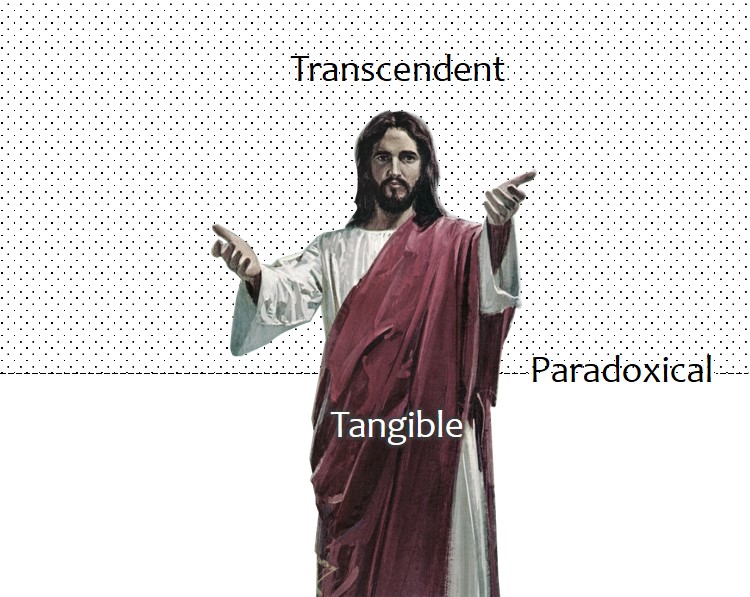
A symbol in this sense will always have a tangible (i.e., sensory-physical) aspect – colored patterns on cloth; a band of precious metal; a portrait in stone, wood, or paint; or the body and behavior of a living person.

Who the historical Jesus was, what he said and did, and the effect he had on his contemporaries – some of whom felt arrested and transformed in his presence, others who conspired in his arrest and execution for rousing the rabble – are what the Gospel writers attempted to render in their mythological depictions of him. Again, they hadn’t actually been there, but they tried to capture his influence by placing their fictional subject within a constellation of mythological themes, heroic characters, and revealing episodes.

Thus Jesus the symbol of God became the Second Adam, a New Moses, the son of David, Suffering Servant, Lamb of God, and Word-made-flesh. By wrapping Jesus into this web of myth, they attempted to re-present him to their contemporary audiences, labeling and linking him to ideas then current in the way people characterized the transcendent mystery or Spirit of God. Under none of those titles was Jesus understood to be equal with God in any straightforward sense (which is our working definition of idolatry).

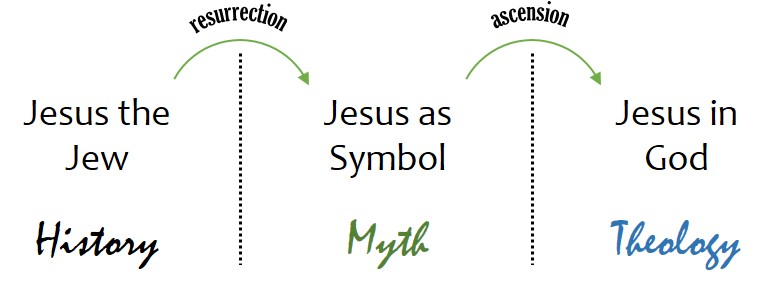
What we have in the early centuries of Christianity, then, is a progression – forward movement but not necessarily improvement – from the historical figure of Jesus, into the contemplation of Jesus as a symbol of God, and arriving finally in a theological orthodoxy that effectively ignores Jesus by making him God.

The paradoxical tension of the second phase (New Testament mythology) has snapped, leaving us with a deity out of this world – but coming soon! – and a Jesus long gone and all but forgotten.

As my diagram shows, the second-phase storytellers inserted what we might call transitional mechanisms into their narratives in order to get Jesus out of the historical past and into their contemplative present (in the episode of his resurrection), and then later (with the ascension) into his identification with God.

By rotating the diagram 90° to the left we thus have the phenomenology of symbol perfectly illustrated: the (once-) tangible Jesus of history, the symbol in whom both human and divine are paradoxically united, and the transcendent mystery beyond name and form – although theologians are famously reluctant to admit it.

As a few early Christian theologians (particularly the so-called Cappadocian Fathers: Basil the Great, his brother Gregory of Nyssa, and their close friend Gregory of Nazianzus) were bending logic in their contemplation on Jesus as a symbol of God – “fully divine, fully human, neither separate nor confused” – the emperor Constantine was urging his new kingdom of bishops to make a decision for one side or the other.

The council decided in favor of making Jesus into God. And now he is nowhere to be found.

Romancing the Inner Child

Jesus is said to have held up the model of a child in helping his audience appreciate what is required to “enter the kingdom of God,” by which he did not mean an afterlife in heaven but the liberated life here and now. Preachers have been exhorting their congregations to be like children ever since, which turns out not to be such good advice after all.

The misunderstanding has to do with the difference between being childlike and acting childish. Jesus was elevating the childlike virtues of faith, wonder, and curiosity: engaging with life in this way keeps us present to what’s really going on. On the other hand, when we behave childishly we are decidedly not present to the mystery of the moment, but rather disengaged and spinning neurotically inside ourselves.

Our Western romance of childhood regards it as a time of enchantment, freewheeling fantasy, and simple innocence. Growing up caused our disenchantment and introduced us to the world of adult preoccupations, not to mention the moral ambiguity we often find ourselves in. (We’ll come back to that in a bit.)

In many of us there is a longing to return to that idyllic state, and perhaps not a few Christians regard our getting there a precondition of salvation itself (cf., the saying of Jesus).

To put things in perspective, my diagram illustrates three ‘dimensions’ of human psychology. Our Animal Nature is where psychology is rooted in biology and the sentient organism of our body. At the other end of the continuum is our Higher Self where psychology opens toward self-actualization and ‘unity consciousness’ (i.e., our sense of All-as-One). The development into maturity proceeds through a third dimension, where the personality individuates upon a separate center of self-conscious identity – the “I” (Latin ego) from which we take a uniquely personal perspective on things.

This third dimension of ego consciousness is strategically important to the awakening of our Higher Self, as it is from the vantage point of its center that we are enabled to look ‘down’ (or inward) to the grounding mystery of being, and ‘up’ (or outward) to the prospect of genuine community. The distinction of these two ‘poles’ of the continuum of consciousness – a ground within that simply is and a community beyond that only might be – is necessary to keep in mind, as our successful transit will depend on how well things go with ego formation.

For it to go well, each of us needs to achieve ego strength, which isn’t really an individual achievement so much as the outcome of a larger conspiracy of other social agents and forces, like our mother, father, other taller powers, siblings and peers. When this conspiracy is provident, our subjective need to feel safe, loved, capable, and worthy is adequately met, resulting in a personality that is stable, balanced, and unified under an executive center of identity (or ego).

As we continue our growth into maturity, our centered personality gradually takes for itself the responsibility of constructing its own ‘habitat of meaning’ or personal world. Now the story of who we are (i.e., our personal myth) is ours to determine, at least to some extent, and we have full authorial rights. This is what I mean by creative authority.

With a healthy individuated identity in place, possessed of ego strength and creative authority, we can choose to ‘drop’ from this center and into the grounding mystery within, or ‘leap’ from it in the interest of connecting in genuine community.

Either move depends on an ability to get over ourselves, which in turn is a function of that emotional complex in our personality that was our primary mode of engaging with reality in those early years, but which is now our Inner Child.

When things have gone well for us, the childlike virtues of faith, wonder, and curiosity continue to orient and inspire our adult life. We can surrender ourselves in existential trust, behold the present mystery of reality in wide-eyed astonishment, and explore its myriad features with an insatiable desire to understand.

Such virtues are at the heart of not only healthy religion, but of our best science and art as well. We are less prone to confuse our constructs of goodness, truth, and beauty with the mystery that is beyond names and forms. Instead, they can serve as symbols and guidelines leading us deeper into that mystery where All is One.

But if our early environment as actual children did not support our need to feel safe, loved, capable, and worthy, we devised ways of still getting at least some of what we needed in spite of the circumstances. A profound insecurity made us neurotically self-centered and motivated our manipulation of others for the sake of getting what we needed. For a while perhaps, it worked – but never entirely or for very long.

These childish stratagems of behavior: pitching tantrums, sulking under the covers, telling lies, intimidating our rivals, cheating the system – whatever it takes to get what we want (“Trumpence”) – are now tucked away in the repertoire of our Inner Child. Whenever our insecurity gets poked, triggered, or hooked, our adult Higher Self gets pushed offline and this emotional terrorist takes over.

This is the part of us that actually prevents our entrance to the kingdom of God. When we are in this childish mode, not only is our own grounding mystery inaccessible to us, but genuine community is an utter impossibility. Indeed, we have become its diabolical adversary.

Not really if, but to the degree that we have this diabolical Inner Child inside us just waiting to get poked, it is of critical importance that we give sufficient time and mindful practice to the activation of our Higher Self. Scolding, blaming, shaming, and punishing ourselves and each other will only keep us stuck in the neurotic spiral.

To make progress on the path, we need to remind ourselves – and occasionally be reminded – that it’s not all about us.

Idols of Orthodoxy, Part 2

You probably saw this coming. In Idols of Orthodoxy I took my reader into the phenomenology of symbols; not an interpretation of this or that symbol – although we used as our example the American flag – but of how symbols themselves are experienced. With that groundwork in place, now we can address a symbol which is central to the Christian religion: Jesus as a symbol of God.

Right away some will protest that Jesus is not merely a ‘symbol’ of God, but God himself. As I want to show, however, this particular point of orthodox doctrine is really a form of idolatry, which is one of the ‘ditches’ we fall into when the tension inherent to a symbol snaps, the other ditch being dualism.

For much of its history, Christian orthodoxy has jumped back and forth between dualism – Jesus and God are two separate objects, one human and the other divine – and idolatry, where Jesus is God, pure and simple.

The attraction of both dualism and idolatry is in their simplicity: thinking in terms of two objects or only one doesn’t require much intellectual effort. Indeed it might be our avoidance of cognitive exercise and the resultant atrophy of thinking that predisposes many of us to take symbols merely at their face value.

What other way can we see them?

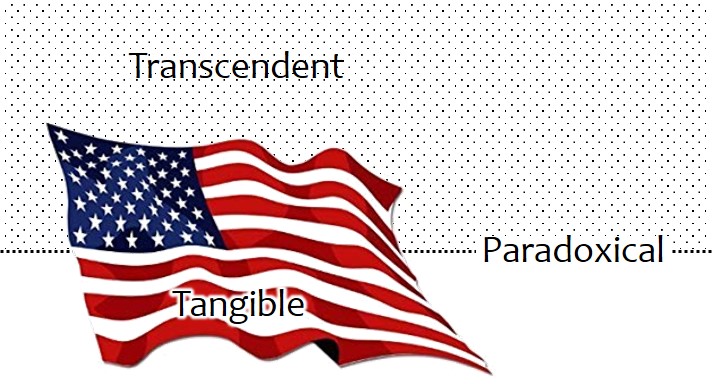
Recalling my earlier example of the American flag, Old Glory, we distinguished among a symbol’s three aspects. Its tangible aspect is sensory-physical: the material cloth with its pattern of colors. This is the aspect we perceive with our physical senses. As it relates to Jesus as a symbol of God, we are speaking of the flesh-and-blood individual who lived 2,000 years ago.

His contemporaries saw and heard him as one like themselves in many ways, although some of what he said and did was not only uncommon but downright scandalous and provocative.

Jesus’ career as a symbol of God probably didn’t begin until later in life, most likely breaking into the awareness of his disciples only during his final days and following his death.* Before then, everyone was just trying to make sense of this self-styled wisdom teacher, social activist, and rabble-rouser who seemed intent on disrupting the status quo. His message was appealing, in the way he talked of a foundational dignity in every human being regardless of race, religion, sex, or moral character.

He often focused his audience’s anticipation on a transcendent mystery and power which he spoke of as hidden in the ordinary, disguised in the common, and present even in what we are quick to condemn and discard as worthless. His favorite medium for teaching was a particular type of story known as parable, which as the word implies (para, side by side + bole, to throw) proffered metaphors, similes, and analogies for seeing into the depths of everyday life.

Apparently he lived his own life in such congruity with the present mystery he spoke of, that others began to regard Jesus himself as this mystery personified.

So just as the American flag has a tangible aspect, so did Jesus. And just as it represents a mystery that we can’t pin down or rationally explain (i.e., the American spirit), over time Jesus began to represent for his disciples a mystery named the spirit of God.

As a reminder, the metaphor of spirit (literally breath, air, or wind) in both cases refers to a mystery that cannot be seen except for its effects. Wind isn’t exactly some thing, but is rather an energy or force that moves things and moves through things. It’s important not to lose this primal acknowledgment of mystery as the power infusing everything in the foreground with being, vitality, and significance. In the phenomenology of symbol this is its transcendent aspect.

Just as Jesus’ metaphors and parables were misunderstood by many of his day as pointing to a separate and supernatural object, so did later Christian orthodoxy lose the sense of Jesus as a symbol of God opening to a present mystery that cannot be objectified but only unveiled (or revealed). It’s not that we have a tangible object in Jesus himself and another transcendent object in God – two things, in other words, which are somehow related – but a transcendent mystery revealed in, through, and as his symbolic form.

The only way we can preserve this tension (of in, through, and as) inherent in the symbol is by grasping its paradoxical aspect: not this-or-that (dualism) or this-is-that (idolatry) but both this-and-that. A symbol is both tangible (seen, heard, touched) and transcendent in the way it manifests a mystery which is invisible, ineffable, and beyond our grasp. It’s as if one aspect is turned toward us and the other away from us, as it holds the tension of both.

Yes, we could construct an abstraction named “the American spirit” or “the spirit of God,” but almost immediately thereafter this tension will snap and its symbol fall to one side or the other of a dividing line.

Either Jesus was just another one of us (this side of the line) or he must have been God (the other side). When the paradoxical aspect of a symbol is lost (i.e., the tension snaps) we are left with only two choices. Neither one is all that sophisticated, and both are symptoms of a moribund imagination. Only as we are able to recover our competency for symbol will the metaphors and myths that have long revealed the deeper truths and higher potentials of our human experience begin to make sense again.


*This breakthrough in awareness of Jesus as a symbol of God was the insight metaphorically represented in the Resurrection. The truth of what he said, how he lived, and what he was did not end on his cross but continues in those with the same courage to be authentically and compassionately human.

A Closer Look at Growing Up

Now the serpent was more crafty than any other wild animal that the Lord God had made. He said to the woman, “Did God say, ‘You shall not eat from any tree in the garden’?” The woman said to the serpent, “We may eat of the fruit of the trees in the garden; but God said, ‘You shall not eat of the fruit of the tree that is in the middle of the garden, nor shall you touch it, or you shall die.’” But the serpent said to the woman, “You will not die; for God knows that when you eat of it your eyes will be opened, and you will be like God, knowing good and evil.” So when the woman saw that the tree was good for food, and that it was a delight to the eyes, and that the tree was to be desired to make one wise, she took of its fruit and ate; and she also gave some to her husband, who was with her, and he ate. Then the eyes of both were opened, and they knew that they were naked; and they sewed fig leaves together and made loincloths for themselves.

22 Then the Lord God said, “See, the man has become like one of us, knowing good and evil; and now, he might reach out his hand and take also from the tree of life, and eat, and live forever”— 23 therefore the Lord God sent him forth from the garden of Eden, to till the ground from which he was taken. 24 He drove out the man; and at the east of the garden of Eden he placed the cherubim, and a sword flaming and turning to guard the way to the tree of life.

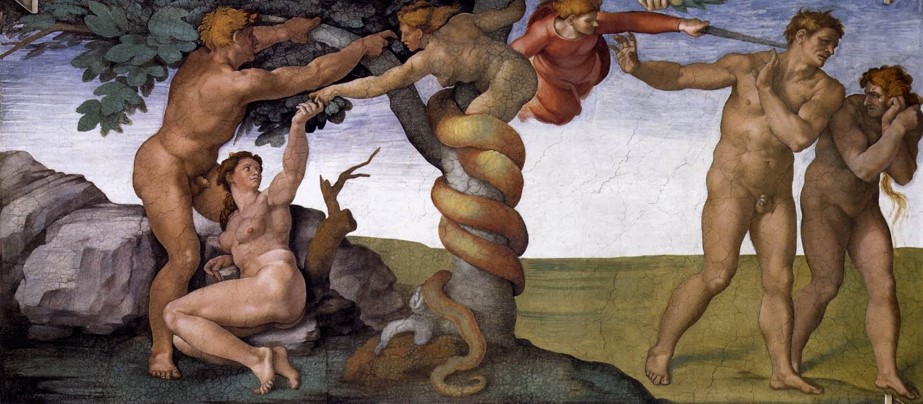
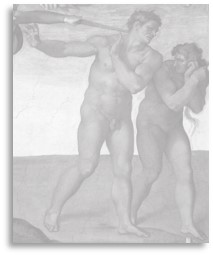
Michelangelo’s scene in the Sistine Chapel of the temptation and expulsion of the First Couple from Eden follows the mythic narrative of Genesis 3 fairly closely – except perhaps for their depiction as meaty white Europeans. But we can forgive the artist for creating in his own likeness, as we all tend to do that.

Myths of creation and of how we humans found ourselves in, or brought about, our present predicament are widespread among the world cultures. Typically things start off in a paradisaical state and then some act of ignorance, stupidity, or disobedience breaks the spell and we find ourselves on the outs. The orthodox Christian interpretation has long taken this as historical, which soon enough ran up against the findings of anthropology and evolutionary science.

The Church authorities made the mistake of insisting on the literal-historical meaning of this and other biblical myths, making it today impossible for an orthodox Christian to also be a well-informed and reality-oriented world citizen. If the Bible isn’t telling the literal truth, they worry, then nothing in it can be trusted. If the story of our expulsion from the garden didn’t really happen, then why do we need to be saved? Finally, if the Bible is the “word of God” but turns out to be more myth than history, then what the hell … and heaven, for that matter?!

There is a way to understand this Bible story without having to reject science, logic, and common sense. But it requires that we loosen up on our insistence that truth can only be literal. It can also be metaphorical, referring to the way a word, scene, or entire story reveals a mystery that can only be experienced, not explained. When you read or hear such a story not as an explanation of prehistorical facts but rather as a veil drawn aside on your own human experience, that is truth in another sense.

So how does the Genesis story show us what’s really going on, about what’s true of our human experience? Let’s take a closer look.

Serpents make appearances in many world myths and their metaphorical meaning will be different depending on the cultural and historical context. They might represent the principle of time, in the way they slither in lines and shed their skin to be reborn. There’s probably an acquired reflex deep in our hominid genes that jumps at snakes but reveres their lethal power.

To observe a slithering serpent as a “traveling esophagus” (Joseph Campbell) is to identify it with the most elementary of survival drives. We know from science that our body is not a spontaneous and unique expression of biology, but instead has genetic roots deep in life’s adventure on Earth. Over many millions of years this organism and its nervous system evolved by seeking out niches of nourishment, safety, mastery, and procreation. These are the survival drives of our animal nature, represented by a serpent in the Genesis myth.

It takes at least a second reading for Christians, especially, to realize that the garden serpent is not an evil principle but rather belongs to Yahweh’s created order which he declared “very good.” In other words, this isn’t the devil (or Satan) as later orthodoxy would insist. (When the myth was first invented, there was as yet no such absolute principle of personified evil working in opposition to an absolute good.) The serpent merely tempts Eve to seize an opportunity that might work to her advantage – that she will be “like god, knowing good and evil.”

At this stage of the story, Adam and Eve are still innocent and naive. They only know what they’ve been told by their higher power. Their world was created by someone else, is managed by someone else, and the way they should behave is dictated by someone else. Sound familiar? In other words, Adam and Eve are children – not literally children in the story, but serving as archetypes of “the child.”

When we are young children, our own animal nature and its survival drives compels behavior that inevitably runs up against the ‘dos’ and ‘don’ts’ of morality, that is to say, of the rule system that lays down the code of what sorts of behavior are commanded or prohibited. Because our animal nature has been at it for millions of years already, it takes time and repeated disciplinary actions for our tribe to bring these impulses in line.

In those early years when our animal nature is ‘tempting’ us to cheat, lie, and manipulate others for what we need, our sense of right and wrong is contained by what we might call a morality of obedience. It’s not necessary that we understand why some action is right or wrong, only that we obey the rule that tells us how to behave. Our taller powers said it, they call the shots, and we must do as they say. When we obey there might be a reward, but more certain still is the penalty (both physical and emotional) that follows our disobedience. The psychological consequence of disobedience is called a guilty conscience.

Part of growing into a mature adult involves breaking free of this morality of obedience where our behavior is motivated by external incentives. While it’s a social necessity that the animal natures of children are brought into compliance with the rule system of the tribe, adults are expected to take responsibility for their own lives and behavior. In one sense, it’s nice to have everything laid out for us, with all the “shalts” and “nots,” lollipops and paddles at the ready.

But our adult experience is not so simplistic or clear-cut. We need to accept the full burden of our existence along with its unresolved, and in many cases unresolvable, ambiguity. To merely “trust and obey,” as the orthodox hymn goes, would be to refuse the responsibility of being an adult. It becomes imperative, then, that we shift from a morality of obedience to an ethic of responsibility.

There will be times when our own higher adult self sees the inherent egoism of obedience – doing something for a reward, refraining to avoid punishment, thinking all the while “what’s in it for me?” In the adult world more variables have to be considered, differing perspectives allowed, and in some cases doing the right thing puts us in conflict with the morality of our tribe. We need to be willing to bear some conscientious guilt by departing from the norm or disobeying a rule when these are enforcing oppression, exploitation, and privilege.

So what does the Genesis myth tell us? That we all need to grow up. That we need to listen to our animal nature as we obey those in charge. But that eventually we will have to step from under the authority of those telling us how to live and figure it out on our own. Taking for ourselves the “knowledge of good and evil,” making our own decisions and accepting the consequences, constructing a world that is safe, stable, and provident for those young Adams and Eves now depending on us – this is our destiny as responsible adults, making our way just “East of Eden.”

Idols of Orthodoxy

Religion is notorious for confusing its representations of God – our conventional nickname for ultimate reality – with the present mystery which, as they say in the Orient, is beyond names and forms. These representations, falling inside the general category of symbols, typically have their origin in experiences that can’t be definitively rendered in language.

So an image is found or created, which serves as a reference to the unnameable as well as a mediator for the mystery to be experienced afresh.

It would be a grave mistake, however, if we were to restrict this phenomenology of symbols to religion alone. The fact is, every sphere of human culture and personal life harbors symbols of what can’t be grasped in a purely rational and objective manner. Take for example our national flag, “Old Glory.”

As a symbol, the flag has three distinct aspects that together are the secret to its inspirational and evocative power. In the foreground – right there in front of you – is the cloth and familiar pattern of color, stars, and stripes. This is the symbol’s tangible aspect. You can see it, touch it, and hear it flapping in the breeze.

Other symbols might be more auditory than visual, as we find once again in the sphere of religion in the sacred utterance of God’s name or the holy syllable ‘om’, regarded in the East as representing being-and-becoming in a single sound.

The tangible aspect of a symbol, then, is essentially sensory-physical: it’s right there. But the American flag also stands for something, doesn’t it? We say that it represents … what, exactly?

If we answer “our nation,” then do we simply mean that Old Glory is a visual icon representing the living citizenry of the U.S.? Does it stand for the geographical landmass with its delineation of sovereign states? No, we are referring to something more – something other – than mere demographics and geography.

Is it then simply the idea of America – the concept or mental category that names a sociopolitical entity, as one nation among many? Perhaps. Other nations have their flags as well, don’t they? This one represents Malawi, that one Switzerland, and so on. Maybe the symbol is just a handy label for an abstract idea.

Actually, that’s fairly accurate when it comes to those other national flags. But isn’t there more going on with yours?

Now it could be that Old Glory is nothing more to you than a pattern of colors on cloth, period. Using it as a dusting rag or painting tarp would be perfectly acceptable. No big deal.

On the other hand, maybe for you the American flag is a sacred symbol, even if not quite religious (or it just might be). For you the flag represents a mystery commonly named “the American Spirit” – something intangible that makes the people here different and special. Not the living generations only, but also the generations past who struggled and fought for the ideals of freedom, justice, and solidarity, along with the still unborn generations of America’s future.

Spirit is a perfectly appropriate term for this ‘something more’ represented by the American flag. This is the symbol’s transcendent aspect, referring to what “goes beyond” the sensory-physical object under your gaze. We find this word – this metaphor of spirit – used widely all over the world and from earliest times to speak of mystery. Literally it means “breath, air, or wind,” and it lends itself well as a name for what can’t be named, a mystery that is invisible yet evident in its effects.

Like your breath, you can’t see the American spirit (or the spirit of God), but it moves in and out of what you are, giving life depth and meaning and linking you outward to all things.

At this point it might seem as if we’re talking about two things: the tangible object of the symbol itself and its transcendent object. Even in my description above, it was difficult to keep my words from objectifying the mystery of spirit. In the metaphor of breath, air, or wind we still tend to regard it as something (i.e., some thing) external to us, a metaphysical or supernatural object perhaps, but an object nonetheless. What’s stopping us from thinking of it as a spirit?

This difficulty is due to our insistence (or naivete) on interpreting the symbol in two dimensions (or aspects) only: There’s this sensory-physical thing here, and that elusive mysterious thing over there.

Unless we’re careful, we are about to fall into the ditch of dualism where the mystery condenses into an external object and its symbol becomes an idol. I’m using the term to speak of what happens when something tangible, conditioned, and finite is mistaken for (or confused with) the transcendent mystery it was intended to represent. Once again, religion is only our most obvious example of this problem.

In order to keep ourselves from falling into the ditch of dualism, it is critical that the symbol’s third aspect be recognized. Its paradoxical aspect is where the dualism of “this or that” and the idolatry of “this is that” are avoided by the creative tension of both “this and that.”

For those who still honor it as a national symbol of the American spirit, our American flag is both tangible cloth and transcendent mystery. As an active and valid symbol, the cloth is sanctified and the mystery is manifested in its unique form. At the very moment of contemplation, the symbol serves to mediate for us an experience of mystery, of ‘something more’ that we can’t directly apprehend or rationally explain.

We are grounded, connected, and included in something larger than ourselves.

This phenomenology of symbol, with its inherent dangers of dualism and idolatry, applies across the various domains of human culture – politics, religion, business, sports, personal life, and even science. When the paradoxical tension of a symbol snaps, leaving us with two things to figure out, or just one (and only one) to command our worship, the symbol dies, and along with it the human spirit of which you and I are incarnations.

Of whatever type, orthodoxy takes control as our ability (or tolerance) for living in the creative tension of paradox is lost. When all we’re left with are idols of orthodoxy, the long graceful arc of the human story will come to its premature end.

The Heart of Genuine Community

Our most pressing challenge right now is not global warming, school security, or building a wall against Mexico. Somewhere in the DNA of all those troubles is an aberrant code which is undermining our success in working together for solutions that really matter.

Simply put, we can’t work creatively together if we can’t get along; and we can’t get along if we ignore or neglect the practical wisdom regarding what makes for healthy connections.

Genuine community is a chronic obsession of mine in this blog on creative change. It seems patently obvious to me that our human future is the future of all humans, not just a few or some. We may pin our hopes on a salvation by god or technology, but if we persist in our ignórance of what genuine community requires of us, in the end there will be no one left to save.

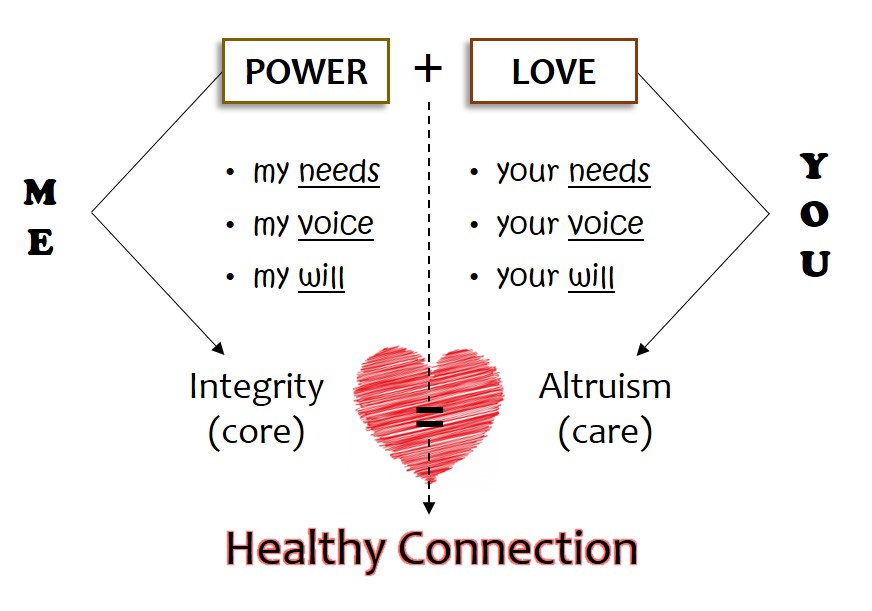
Let’s see if we can get this practical wisdom in front of us and make sense of it. When it comes to healthy connections, which are what provide the conditions for genuine community to arise, the whole picture can be simplified as a balance of power and love. Unless there is a dynamic balance of these two factors a relationship will not be what I’m calling a ‘healthy connection’, and consequently it will compromise rather than empower genuine community.

It will help if we make this personal, so I’ll ask you bring to mind one of your most important relationships right now. In what follows, you will take the perspective of “Me” in the illustration above, and your partner will be “You.” (Don’t be confused: it will make sense as we go.)

Both you and your partner need to be in positions of power for your relationship to be healthy. As I’m using the term here, power is not associated with dominance, aggression, or manipulation, but is instead the virtue of inner strength that results from being securely centered in yourself. Thus centered, you have direct inner access to your own human needs, individual voice, and personal will.

What we call the human spirit is channeled not only through what makes you both human (your basic needs), but also through what makes you unique persons and different from each other.

‘Voice’ refers to the expression of your individual perspectives, interests, and choices. A healthy connection honors how each of you ‘leans into life’, as we might say. ‘Will’ includes your personal desires and commitment to what you want to ‘make real’ (or realize) through active intention. When you and your partner are each centered in all three – your needs, voice, and will – your relationship can become the synergy (1+1=3) of what you both bring to the encounter.

We have to qualify the statement by saying that synergy is still only a possibility at this point because the other factor in the balance has yet to be considered. Love is the willingness (recall that will is power) to make room for – literally to “accommodate” – the needs, voice, and will of your partner. Staying true to yourself and remaining centered in your own power is thus counterbalanced by a commitment to protect the right (and responsibility) of your partner to do the same.

Admittedly this definition of love sounds less like the warm affection and ardent regard that are traditionally identified with it. But in the balance of power and love which is the heart of a healthy connection, love does not simply play the ‘soft and gooey’ to power’s ‘hard and prickly’ stereotype.

While power is a function of your own integrity, love (as altruism) is opening to your partner as an equal, respecting her needs, listening to his voice, and including his or her will in your shared construction of meaning (or dialogue).

In short, love means that you genuinely care.

To the degree that you are stuck in the stereotypes of ‘prickly’ power versus ‘gooey’ love, these essential factors are difficult if not impossible to balance. Add to this the fact that you, insofar as you are a normal person, tend to lose your center when the forces of stress and change threaten your security – which you then try to recapture by manipulating the world around you – it’s not surprising that ‘power grabs’ are your strategem of choice when things break down.

I find it interesting the way our Western mind has parted-out power to business and politics, love to morality and religion, and truth to science and philosophy. This evident schizophrenia – whom can we trust to reveal what really matters? – is presently keeping us as a culture from the grounded and responsible orientation in reality that we seek.

Such a creative re-orientation will come as we are able to join together in genuine community. One day we will engage a dialogue and co-create a world big enough to include us all. That day will indeed be the dawn of a new age.

Before that day can come, however, and as we struggle in these ‘end times’ of our present age, one against another, we will need to learn how to honor the sacred balance of power and love.

Only this truth can set us free.

Your Fact-Value Map

All you need to know is that there are just four kinds of people in the world. There are those who live as close as possible to what their own senses validate as real; we’ll call them Skeptics (from Greek skopeîn, to examine). They have their opposite in the Agnostics who keep reminding themselves how much, really, is unknown. Third are the Pessimists, who tend to focus on finding and solving problems. Fourth and opposite of them are the Optimists, with their lofty aspiration after ideals.

Okay, so there aren’t only four kinds of people in the world – there are lots more than just four. And yet, I will make a case in this post that each of us stands somewhere in the matrix of these four positions.

I call this matrix the fact-value map (or fact-and-value map). One axis of the matrix orients us to facts, and the other to values. As you probably know, the war of “facts” and “values” – or the hard sciences versus the humanities; e.g., engineering versus art – is one of the enduring scuffles that have shaped the Western mind in recent centuries.

But I don’t agree that they are warring opposites – unless we jump to extremes and define one against the other. Facts and values are not opposites in that sense; they are not diametrical, but rather complementary. Both are necessary elements in our construction of meaning.

Each alone is insufficient, like trying to build a house with boards but no nails, or with nails only and no boards.

So let me start again. All you need to know is that YOU stand somewhere between the obvious and the unknown, between problems and ideals. Where exactly you stand will determine what kind of house you build – that is to say, the particular construction style of the world you inhabit. Standing between these poles places you on a continuum: closer to their balancing center, farther on one side or the other, or perhaps out toward either extreme.

You do your best to blend the elements, like a careful alchemist or winemaker. But once in a while, whether precipitated by something going on around you or within, you can flip out of balance and become a dogmatic Skeptic or Agnostic, Pessimist or Optimist. So let’s pretend that, for right now at least, you are somewhere inside the fact-value map and not pegged at the extremes.

Now let my two-dimensional map tip through the third dimension, falling away from you to become a grid you can walk on. Step out and take your position at the intersection of the Fact and Value axes. (As a reminder, the Fact axis stretches between what is obvious to your sense experience and what is unknown – not merely beyond your senses but perhaps unknowable. Crossing through this is the Value axis, with problems to solve on one side and ideals to cherish on the other.)

From where you stand now, you can rotate 360° and look across the four quadrants of the matrix.

Next, plot two points on each axis, reflecting where you see the balance of its elements in your life and worldview at the present time. Less of one will place a point closer to you at the center; more of the other will put a second point farther in the other direction along the same axis. If you started with the Fact axis, do the same with the Value axis.

With four points plotted on the map, two somewhere on either side of center on each axis, your final instruction is to draw an ellipse that intersects all four points on the map. Most likely your ellipse will overlap all quadrants of the fact-value map, but skewed more or less to represent your unique balance among the four elements.

Let’s think of the elliptical boundary as your personal ‘world horizon’, inside of which are found the raw materials – the “boards and nails” – that you use to construct meaning and build your world.

In my illustration, an individual is standing at the intersection of the fact-value map with his world horizon skewed into the quadrant of “unknown problems.” This tells us that he is oriented in his life as an Agnostic Pessimist (or a Pessimistic Agnostic): his mind is open to what he doesn’t know, but he tends to regard it as something requiring his vigilance and preparedness since so much of what is unknown can be danger lurking in the shadow of the obvious.

This person is likely a plan-for-the-worst type who has learned that bracing for unknown problems is his best way of handling them once they present themselves. True enough, he can get overwhelmed at times by imagining troubles that aren’t really there and never materialize. But at least he’s ready for them, and that feels better than the prospect of being unpleasantly surprised and broad-sided.

Inside his world horizon you can see something lying on the ground that looks like a token with the letter ‘A’ imprinted on it. ‘A’ stands for archetype, which refers to a “first form” (Greek arche+typos) or primary image that represents many things – in this case all things, aka what’s going on or the way things really are.

I’m making a case that each of us lives inside a unique world horizon, and that we carry in our nervous system an imprint which, insofar as we entertain its image in our dreams and daytime reflections, is also a mental idea that symbolizes our world and what life is all about.

So, back to you.

As you survey your world horizon on the fact-value map, what token image serves to represent what it all means to you? Whether you happen to be an Agnostic Pessimist/Pessimistic Agnostic, a Pessimistic Skeptic/Skeptical Pessimist, a Skeptical Optimist/Optimistic Skeptic (that’s me, by the way), or an Optimistic Agnostic/Agnostic Optimist – there is something that summarizes the whole shebang for you in a single image, metaphor, or idea.

Maybe life is a beach, or rather a bitch. Perhaps an open door, or a brick wall. A bubbling spring, or a sucking drain. An undeserved blessing, or a deadly curse. What is it for you?

This is a good time to ask, “So what?”

Well, if each of us lives inside a world of our own making, and the world we happen to inhabit is actually making us sick with anxiety, tense with frustration, or stuck in depression, then we should be able to remodel our world into one that supports our happiness, fulfillment, and wellbeing.

Where to start? I suggest choosing a different archetype, tossing it into the quadrant you want to relocate to, and let it begin attracting and forming in you a new mindset. It will take time and consistent practice, but you can do it. Hell, look at what you’ve already done.

Once you can change your mind, a new world will come along shortly.

A Nation of Children

I see and hear comments in the media, about how we have elected “a toddler” to the White House. Obviously what they mean to say is that our president behaves like a child – not imaginative and playful and innocent, but reactive and manipulative and narcissistic; not so much childlike as childish.

It does strike me as odd how long-standing Republicans and reluctant Trump supporters that I know are willing to overlook these traits. We would have been even worse off, they say, had we elected Hillary as president. Apparently Donald Trump was the lesser of two evils. While all politicians have a shadow – and of course we need to admit that each one of us has a shadow side as well – I wonder if Trump’s “dark side” is something our nation and the world can bear for very much longer.

Trump supporters frequently say they voted for him because he “tells it like it is” and that he’s not afraid to “take what belongs to him” – which presumably, with him acting on our behalf, will also translate into taking (back) what is ours. And that may be true … for wealthy, white, heterosexual male citizens and corporate executives in these United States.

That’s not all of us, for sure; indeed it’s only a very small percentage of our population. And the fact that Trump himself belongs to that exclusive and elite group doesn’t seem to matter.

Putting partisan politics aside, I’d like to analyze the rise of Donald Trump to the US presidency not in terms of political philosophies, moral values, or as the final ascendancy of capitalism (wealth, individualism, private ownership) over democracy (equity, communalism, public access) out of the historically creative tension of these two ideologies. Instead I will contemplate how this kind of person arrived at the helm of our nation’s leadership.

My theory is that Trump’s election is symptomatic of something going on in each of us – or at least in most of us, even if “most of us” (i.e., the majority) didn’t actually vote him into office. I’m thinking of our nation on the analogy of an individual human being: each of us has an animal nature (our biophysical body), an inner child where we process life experiences and respond emotionally, and a higher self that enables us to take a more rational perspective in constructing a larger and longer meaning of life.

Now as adults, the pattern of reflexes, moods, strategies, and beliefs that formed when we were children is still carried within us, in an emotional complex called our inner child. You know what I’m talking about. It’s that part of us that gets triggered by stress, illness, hunger, pain, and loss (or the threat of these). Our emotional inner child is oriented and motivated by a desire for security, that there is enough of what we need and we can trust those around us.

Because we weren’t in control of the world back then, we relied on our taller powers for what we needed. And because they had their own inner children that got triggered occasionally (or chronically), we had to devise means of getting our way when they didn’t deliver, interfered, or weren’t around to help.

These ‘adaptive strategies’ soon became our modi operandi when things didn’t go our way, and for the most part they worked, if not entirely or all the time.

As our strategies were really intended to manipulate the outer world in order to get what we needed and feel secure (safe, loved, capable, and worthy), I prefer to call them neurotic styles. It is these which partly make up that emotional complex of our inner child. When we feel threatened somehow, our insecurity is triggered and those old patterns turn on and take over. From the perspective of other adults around us, we are suddenly being childish, unreasonable, selfish, and neurotic. And it’s true.

When life is manageably stable and we have enough of what we need, our higher self can lead the way. We can take in the larger picture and see farther down the road. We can project alternative scenarios of the future, consider different sides of an issue, include others in our decisions, take responsibility for our actions, and be mindful of how our choices affect the systems to which we belong.

When our higher self is engaged, we tend to vote for candidates who demonstrate these same virtues of adult rationality.

But when our security is threatened, whether by changing conditions and actual events, or because some alarmist has triggered our fear response, it’s more challenging to keep our higher self online. Instead, our inner child takes over. The inner child of candidate Trump said just the right things to make a large swath of American voters believe that their America had been stolen from them and they had the right to take it back.

Back from China and its cheap tricks. Back from Mexico and its drug lords. Back from cheating trade partners. Back from Big Government regulators. Back from Blacks, from women, and from homosexuals. Back from the poor, insofar as they are freeloaders on our wealth and freedom.

Soon America will be “great again.”

His tantrums sounded bold and confident. He could be guilty of narcissism, if he didn’t have our best interests at heart. Finally, someone showed up who could speak power to truth and confirm what we had been afraid of all along. Does it matter that he says and does whatever it takes to get his way – what I coined “Trumpence”? Well, no (says our inner child); getting what you want is really all that matters.

So, my theory goes: The American people elected Donald Trump as president because – at least at the time, and probably still – we were a nation of (inner) children. Traumatic, global, infrastructural, and systemic changes had pitched us off-balance, prompting us to imagine any number of apocalyptic scenarios where we would never again get what we needed.

With our security threatened, what choice did we have? More of the same? Complicated plans that would take years to realize and all of us working together? Unacceptable! There’s no time for that.

Like other emotional terrorists, candidate Trump poked our insecurities and promised that we could get back what we (never) had. Our body was old enough to vote, but the part of us that penciled in the bubbles and pulled the lever was much less mature.

The Shining Way to the Kindom of Spirit

Of all my reflections on the topics of spirituality, psychology, and community, this post represents my best effort so far. If I write nothing more from this point, I think I’ve made a meaningful contribution.

But I’ll keep at it anyway.

A few of the “big ideas” that repeatedly make an appearance include the grounding mystery, ego strength, and genuine community. These amount to so much scaffolding providing structure for the more detailed work of clarifying what’s really going on for each of us – and for all of us.

My diagram depicts this scaffolding on the image of a grapevine plant, with its deep roots, outreaching stem and leaves, and the berry cluster announcing its ‘self-actualization’ or, as we might say, its raison d’être (reason for being).

The terms arranged along the vertical axis name specific accomplishments, intentions, and virtues which are central to our own journey of self-actualization as human beings.

My returning reader knows that by ‘self-actualization’ I am not referring to some kind of elite individual attainment of miraculous powers and supernatural abilities, but rather to the process whereby our deepest nature is gradually awakened and fully expressed.

The Great Process of our universe, with the emergence of life and its increasingly complex networks of mutuality and interdependence, has brought us at last to the brink of what I call genuine community. I will even boldly designate this as its ultimate aim: sentient, self-conscious agents living in creative and inclusive fellowship.

But how can we finally get there? With the advent of self-conscious agency, evolution has given the fulfillment or frustration of this aim over to us. It’s our choice now whether or not we will connect, for good or ill.

This awareness has long been the inspiration behind the spiritual wisdom traditions of our world cultures.

In this post we will explore what I have elsewhere named the Shining Way, referring to that bright path of deeper insights and higher truths, by the light of which humans can find their way to fulfillment and genuine community. There are many places along the way where we can get snagged and hung up, and in other posts I have analyzed the causes and consequences of these common neuroses. They all tend to culminate in the formation of convictions which lock our minds inside boxes (like thought cages) that help us feel secure and certain about things.

Here, however, I will leave pathology aside and clarify instead the key elements of the Shining Way itself. Each of us can use this description as a kind of mirror on our own life experience: How true is this of me? Where am I still growing? Where am I hung up?


Faith

This term is not to be confused with the set of beliefs, values, and practices that characterize a given religion – for example, the Christian faith, the Jewish faith, or your personal religion. Its deeper etymology reaches far below such surface expressions of religious life and into the place where consciousness simultaneously descends and expands beyond our personal identity as self-conscious agents.

Underneath and supporting ego are the mind and body, or in more technical terms a sentient nervous system and its host organism. The body metabolizes matter for the energy it needs, and this energy is used in part to electrify nerve circuits and brain networks that support our conscious experience of sensing, thinking, feeling, and willing. There is an obvious dependency of ego on mind, of mind on body, of body on matter – and as quantum science confirms, of matter on energy – all of which comprises what I name the grounding mystery.

Faith is our capacity for letting go of ego preoccupations in order to center our mind, calm our body, and simply relax into being. Those preoccupations tend to tangle us up in worry, frustration, disappointment, and fatigue. In letting go of them, at least for a few moments, we can rest back upon the deeper support of existence itself.

In ancient languages faith derived from the root meaning “to trust,” in the sense of releasing control in grateful acknowledgment of the present providence (personified in many religions as a provident presence) of reality.

Integrity

When ego can develop upon a stable foundation of faith, our personality is able to organize around its own autonomous center. Integrity is a word that means “one, whole” in the way a complex system holds together in functional harmony. Certainly this has a clear moral significance, referring to consistency in judgment and behavior across dissimilar ethical situations.

As we’re using the term here, however, integrity is even more a psychological achievement indicating a well-integrated personality. Our inner life is stable and centered (by virtue of faith) in a condition called ego strength. If ego is our centered identity in engagement with the social world around us, its strength is a virtue of how effectively our internal impulses, motives, feelings, and opinions are “held together” in a coherent and harmonious sense of self.

Empathy

You will have noticed in my diagram that the three “inner” virtues of the Shining Way are not connected in a simple linear manner. This is because our third element, empathy, is a capacity made available only to the degree that a unified sense of self allows us access to our own human experience. It helps to imagine faith and integrity as providing a calm transparency to the “atmosphere” of our inner life, which mediates a clear vision of how experiences of all kinds make us feel.

As a human being you have experienced love, frustration, failure, joy, longing, confusion, loneliness, pain and loss, among many other feelings. Notice that we are not speaking exactly of external circumstances or objective events, as much as how those circumstances and events made you feel inside. Each of us has a unique threshold of sensitivity and tolerance, along with our own set of beliefs and expectations that serve to spin meaning around our experiences. Some of us may be more sensitive or tolerant than others, but nevertheless we all know what love, longing, or loss feel like.

Empathy literally refers to the inner (em) experience (pathos) of being alive. Importantly, it is not (yet) our sensitivity to the suffering of another, which is called ‘sympathy’ (sym = with or alongside) in Greek and ‘compassion’ in Latin. And while modern Western psychology defines empathy as compassion with an added component of cognitive understanding as to what another person is going through, it is actually an intuition rooted in the depths of our own human experience.

Compassion

Only one deeply in touch with her own human experience, who has contemplated his personal experiences of life, can reach out with understanding to another who is undergoing a similar experience. With compassion, the Shining Way opens to the realm of relationships and to the inviting frontier of genuine community.

Our sensitivity to what others are going through is directly a function of our own intimacy with attachment and loss, love and loneliness, success and failure, joy and sorrow. Such empathetic self-understanding will frequently motivate us to help another in distress, confusion, or bereavement. To step into their experience with them (sym+pathos, com+passio) for the sake of providing companionship, encouragement, comfort, or consolation in their need strengthens the human bond on which genuine community depends.

Just a note on the choice of the term compassion over sympathy, even though their respective etymologies mean the same thing. In ethical discourse, sympathy has over time developed more into the idea of emotional resonance – “I feel sad because you feel sad” – while compassion has evolved the aspect of motivated behavior – “I am sad with you and want to help you feel better.”

Goodwill

Compassion, then, is more than just a desire or willingness to join another person in their suffering. Its intention is to help lessen the pain, provide support, improve conditions, to somehow assist with their healing or liberation. Goodwill is very simply a matter of willing the good, of acting benevolently in the interest of another’s health, happiness, and wellbeing. Whereas compassion is the resonance of feeling we have for someone going through an experience with which we are deeply and intimately familiar, goodwill names the variety of ways that move this feeling into action.

Without the inner clarity that comes by faith, integrity, and empathy, pity instead of true compassion might motivate our charity, but this shouldn’t be confused with what we’re calling goodwill. The “good” that is willed is much more than a tax-deductible donation, or a middle-class gesture at managing a guilty conscience. When we pity another person, we are secretly relieved that we are not in their situation: “I am sad for you.”

Charity in Western capitalist societies has become a way of aiding victims of systemic injustice, without confronting the system itself. In some instances, acting for the greater good can put us into opposition with the traditions, institutions, and authorities who profit from keeping things the way they are.

Fidelity

With goodwill we have at last entered that higher zone of human self-actualization called genuine community. When we who are inwardly grounded and securely centered make compassionate connections with others around us, our benevolent acts of kindness, generosity, advocacy, encouragement, and forgiveness conspire to create what I call the kindom of spirit.

As a kindom, genuine community arises with the awareness that we are all related as sentient and self-conscious agents. Despite the fact that each of us stands in our own separate center of identity – but we should also say precisely because of this – we can see that all of us are very much the same in our deeper nature as human beings. And as a kindom of spirit, we seek the harmony, wholeness, and wellbeing of each one, one with another, and all of us together as one.

Fidelity is faithfulness to the kindom of spirit. By its virtue we dedicate ourselves to strengthening our connections, repairing ruptures, resolving conflicts, fostering creativity, transcending fear, and nurturing our shared aspirations for the liberated life.