Perhaps the greatest irony of the human experience – and this goes back now thousands of years – is how chasing the prize of personal identity ends up putting us in a cage. The slow rise of ego (or self-) consciousness over the millenniums of human history brought with it a growing insecurity due to the separation required for us to be conscious of ourselves, and not merely conscious of what’s going on.
The separate center of self-conscious personal identity, or ego (“I”) for short, was a necessary exaptation to the challenges and opportunities of a more complex social reality than our hominid ancestors had previously known. Specialized functions and a broader field of differentiated roles elicited in the individual an awareness of needing to be good at (i.e., accepting of, compliant with, and skilled in) performing a role, or set of roles, in order to fit in and stand out as somebody special.
To fit in is to have a place, to be accepted, feel secure, and belong.
Our deeper, pre-human, history shaped this survival need so that the herd would keep us alive. There is safety in numbers, which is why, when we feel exposed or threatened, many of us seek refuge in anonymity: becoming invisible reduces our chances of getting picked off and dragged away.
Human biology is equipped with instincts dedicated to our survival, and these operate below the threshold of conscious awareness so as to preclude any delay or risk that would come with having to deliberate over a course of action.
Competing with this more primitive drive to be safe and feel secure is our ego’s need to stand out – to be recognized, seen by others as unique, capable, and worthy.
Because the roles assigned to us are basically functional and generic, we want to impress those watching and in charge with our performance. Their approval – and, even better, their admiration – is likely to translate into added rewards and status promotions. Standing out is inherently risky, however, where a lackluster performance could provoke criticism and possible rejection.
So this is how we end up in a cage. A distinctly egoic (self-conscious) need to stand out competes with an instinctual (unconscious) drive to fit in.
While the progression threshold of human evolution has been moving our species into social environments where a differentiation of roles is increasingly necessary to the advancement of culture, this more primal instinct serving our need for security tends to coil itself around our identity, limiting our creative freedom as performers.
This competition of aims between the body (instinct: survival) and the ego (identity: self-esteem) is what makes our human experience so complicated, stressful, and conflict-ridden.
If all went by design, each of us would step into our own center of self-conscious personal identity (ego) under the provident authority of taller powers (parents, teachers, coaches, mentors and other adults) who are secure enough in themselves to be unconditionally devoted to our healthy development and wellbeing.
Under the care and by the guidance of these provident taller powers, we would grow to become:
- Securely connected,
- Positively motivated,
- Open-minded, and
- Fully accepting of what comes.
Can you imagine such a world? I’m sure you can. But just as surely, you would agree that the world we’ve got is something else.
If there’s a legitimate definition to what is sometimes called ‘original sin’, it would be based on the fact that no parent or taller power is secure enough in themselves not to pass some of that insecurity to their offspring. To get a sense of why this is the case, we would need to go another generation back in time, to the taller powers who shaped them.
And so on, generation by generation, all the way to the mythically famous first couple raising their boys East of Eden.
Now, Adam and Eve’s taller power was actually their Higher Power – Yahweh, Ancient of Days, the world creator and future desert warlord. Apparently, He had a few insecurities of His own, which were passed on to His human children back there in the Garden.
Healthy identity development requires a provident foundation of loving support. When we have that to a sufficient degree, our body settles into a baseline nervous state of relaxed calm, which in turn allows the emerging ego to regard our situation and other people in an attitude of basic trust.
When a foundation of loving support is not there, the body senses danger and adjusts our nervous state to be more cautious and reactive. This vigilance translates into attachment behavior where we grab on and grip down on what we expect will make us feel more secure – or at least less insecure.
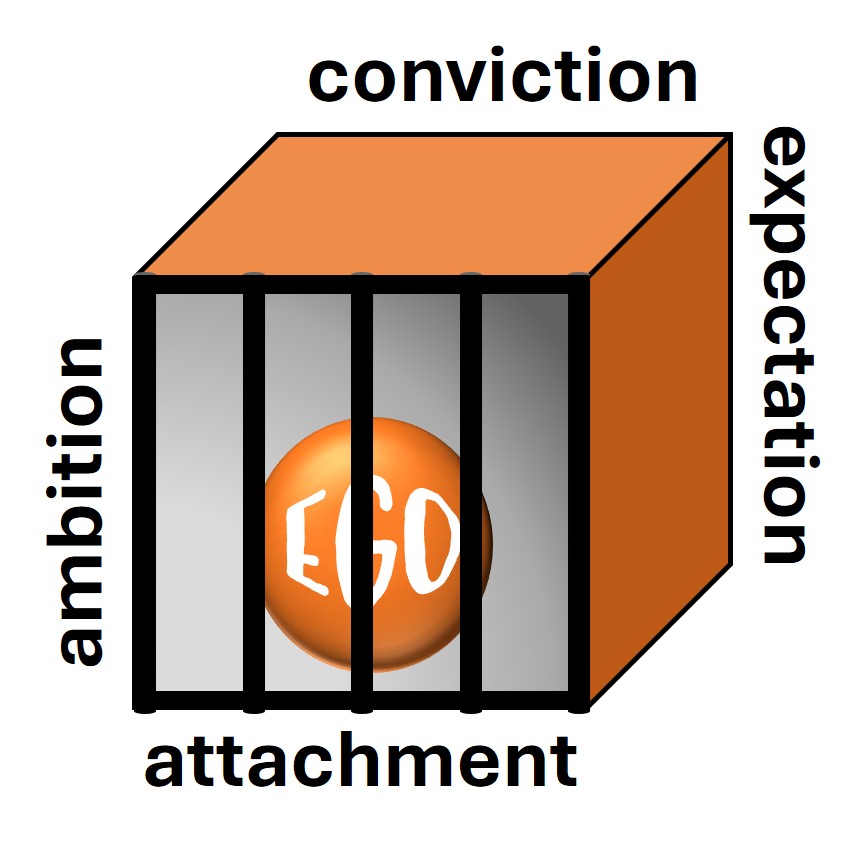
This is how what William Glasser named the “quality world” of healthy identity becomes a cage and takes us prisoner. Here’s the progression:
- Insecurity drives attachment behavior, where we clutch our pacifier (i.e., whatever makes us feel better) >>
- Attachment fuels the twin drives of ambition, craving relief but fearing it won’t work out or be enough >>
- The fission of craving and fear forges a rigid and inflexible (i.e., absolutist) conviction to defend us against Reality >>
- Conviction produces the expectation that things go the way we need them to, or in a way we can predict, prepare for, and control.
There you have it: 1-2-3-4. The four walls to the cage we find ourselves inside.
Because the steps into our miserable condition are mapped directly onto the path of healthy progress toward a centered identity, ego strength, and our own creative authority, it’s common to think that ego is the problem.
The “solutions” to this supposed problem of ego have been of two main types: either (1) deliver the ego from its cage by some feat of salvation, or (2) extinguish the ego and call it all an illusion. Admittedly oversimplified, these are the Occidental (western) and Oriental (eastern) programs, respectively.
A deeper and more ancient tradition of spiritual wisdom, serving originally as the wellspring of both of these alternative visions, is known as the Perennial Philosophy or Sophia Perennis. This wisdom tradition endorses neither the deliverance nor extinguishment models, but instead invites us to merely wake up and see the cage we are in.
Bring the light of conscious awareness to each of its four walls to understand the cage and how we got here – and voila! we are free.
What ‘pacifiers’ are we clutching for security? Throughout our lives, these will range from baby binkies, blankets, and teddy bears, to trophies, certificates, diplomas, and professional titles. Hold each one in thought and say to it directly, “Once upon a time, I gave you the power to make me feel secure and happy. But you can’t do this for me, so now I am taking back my power.”
Almost instantly we can feel a shift in our ambition. As we lift each pacifier into the discriminating light of awareness and consciously take back our power, the craving subsides along with the anxiety that had been energizing our worry, second thoughts, and self-doubt. It is as if our will has been unshackled from the floor.
Without the neurotic drives of craving and fear forging our judgments concerning what’s real, what matters, and who is right (“Me!”), our mind is no longer a captive (or convict) of our beliefs. Now, instead of conviction, our mind is free to open out in curiosity to the Reality that our judgments had closed out for so long.
And then what?
Whatever happens next doesn’t have to meet our expectations for us to respond creatively to the opportunities before us. Another benefit, since disappointment is inversely proportionate to the expectations we place on Reality (others, the world around us, and life itself), holding fewer expectations – which is importantly different from merely lowering our expectations – allows us to behold and fully honor whatever shows up.
When we wake up and truly understand our suffering, the cage simply vanishes and we are free.
 Tracts of Revolution
What a brilliant read. Thank you.
In considering what you wrote I’m kind of thinking that my “pacifier” might be when I look up at my 80 and 90-year-old friends who I play a weekly Bridge game with, and sensing how they are taking my humor. All indications are that they love my humor and me. But, I always think that it’s important to be a little bit outlandish in my humor because it gives other people permission to be a little bit free-er than they normally have been.
But, there is a little bit of anxiety attached to all that monitoring of my humor. And it’s that anxiety that I think I need to release and say you don’t have any power anymore. I would probably add thank you for your service because I must’ve needed you (anxiety) during a time when I didn’t have the peace of mind to move forward without you. So thank you anxiety, but I take my power back. I am now centered in peace of mind to move forward without you. So thank you anxiety, but I take my power back now. I like it.
I can see this being helpful and liberating for other pacifiers I will no doubt find in the road to liberation!!
Thank you again.
Jackie Burns 209-819-9093
jackieb2102@yahoo.com though I don’t use unless I’ve been texted that an email was sent.