Ego sucks.
I don’t mean that as a judgment, but as a simple statement of fact. I happen to believe that our separate center of self-conscious identity – ego (Latin for “I”) for short – represents a transformational breakthrough in the evolution of human consciousness, and we need it to get around in the world.
However, its breakthrough comes at a cost, which is that for ego to even exist (also from the Latin ex=sistere meaning to “stand out”), it must siphon its share of energy from the essential supply of consciousness known as the Human Spirit.
That’s why it is simply a statement of fact to say that ego sucks.
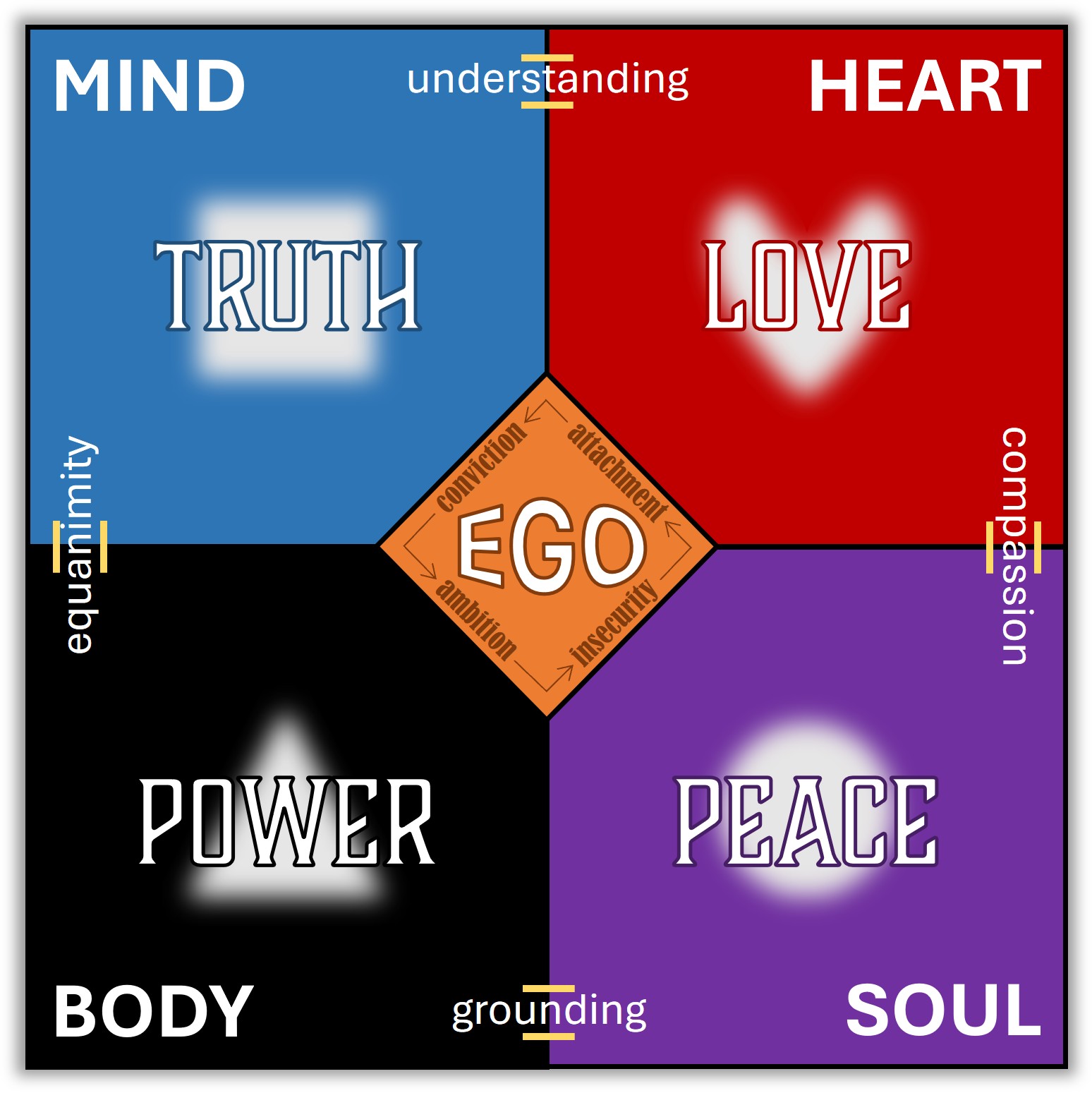
I offer the graphic above as a heuristic, or teaching tool, for helping to clarify the picture of where ego sits in relation to the Human Spirit in each of us. What I just named the “essential supply of consciousness” in humans is elsewhere in this blog explored as our quadratic intelligence.
The quadratic model itself draws together important traditions and theories of research, each tradition focusing on one of the four threads of intelligence:
- Visceral intelligence (VQ) – Sigmund Freud’s Id
- Emotional intelligence (EQ) – Daniel Goleman
- Rational intelligence (RQ) – cognitive psychology
- Spiritual intelligence (SQ) – Danah Zohar
Together, these four threads comprise the “braid” of our quadratic intelligence. Identifying this braid with the Human Spirit may seem like a bold move, given the long history in religion of equating Spirit and Soul. But in the still-deeper history of the spiritual wisdom traditions, collectively known as the Perennial Philosophy or Sophia Perennis, their distinction is paramount.
In the present post, we will opt with the wisdom traditions in regarding Spirit and Soul not as separate parts or things-in-themselves, but rather as essential distinctions in the dimensional wholeness of human consciousness.
It should make sense as we step into it, so let’s get started.
In the graphic above, each thread in the braid of our quadratic intelligence is identified with the faculty that centers and hosts its distinctive activity. Thus:
- Visceral intelligence (VQ) is centered in the Body which is our locus of Power
- Emotional intelligence (EQ) is centered in the Heart which is our locus of Love
- Rational intelligence (RQ) is centered in the Mind which is our locus of Truth
- Spiritual intelligence (SQ) is centered in the Soul which is our locus of Peace
Let’s take a moment to acknowledge the extent to which these four aspirations (as we might call them) for Power, Love, Truth, and Peace have shaped our human experience over the long millenniums of history.
Our tendency to fuse these aspirations to concrete and temporal achievements, attainments, and possessions in life is the contribution of ego, which lacks the capacity to even comprehend how aspiration might be an objectless longing of the Human Spirit.
In this post we won’t go too far into the complications introduced by ego. They are designated by four terms enclosing it in the illustration: insecurity (leads to) attachment (which forges) convictions (that in turn fuel) ambitions for the achievements, attainments, and possessions it believes will bring happiness – or at least less insecurity.
But those ambitions only generate more insecurity, sending ego round-and-round the cage in a perpetual spiral of exhausting discontent.
This characteristic of ego has caused some to conclude that our liberation from its cage will only come as ego is successfully suppressed, extinguished, or altogether eliminated from the picture. The futility of such an approach lies in the fact that any attempt to control the ego is an ambition of the ego itself, which only squeezes the frantic spiral even tighter and frequently leads to depression.
Then we go to therapy or the pharmacy to find out what “I” (ego) must do to get unstuck!
Let’s set that sucking sinkhole aside for now and focus instead on the Human Spirit and its four faculties (threads and centers) of intelligence. Back to the graphic above, we should take a little more time clarifying what we earlier named the four associated aspirations – Power, Love, Truth and Peace.
What are these experiences, and how are they related? We’ll take them briefly one at a time.
The Human Spirit’s aspiration for Power is centered in the Body. We are not talking here about power-over something or someone else, which is typically how ego regards it. Very simply, the Body’s Power is the lifeforce in its cells, tissues, and organs, focused through the urgencies of survival, the drives of instinct, and in the will to live, grow, and flourish as a living animal.
The generator of this lifeforce lies in the visceral organs of the Body, which is why the thread is identified as visceral intelligence (VQ).
Our aspiration for the experience of Love is centered in the Heart and its thread of emotional intelligence (EQ), which evolved for the purpose of giving animals the ability to respond, learn, and adapt to their environment. Love also includes interest, desire, affection, tenderness, kindness and care – all distinct frequencies of our longing for harmony, community, and wholeness.
The physical organ of our heart is where such feelings are centered.
Truth is the aspiration of the Human Spirit centered in the Mind. In the evolution of animal life, the species that developed an ability for creating mental maps, making conceptual distinctions, and using logical thought in the construction of meaning outperformed those without it.
Processing impressions and experiences of the world through a set of more or less rational beliefs allows for an abstract, generalized, and comprehensive worldview, freeing the “rational animal” from having to rely only on instinct (VQ) and situational learning (EQ).
Here, Truth is a measure of the transparency of belief.
The Greek word for Truth, aletheia, literally means to uncover or reveal, referring again to the degree in which a mental construct (or belief) in the Mind serves to focus, clarify, or amplify our knowledge of Reality. Whereas ego frequently gets locked inside our beliefs, in which case they are called convictions (convict = a captive or prisoner), the Human Spirit, as Mind, longs to see through them to the really real.
Another way of defining conviction is as a belief with no transparency, that actually blocks (or covers) our view of Reality.
The thread of spiritual intelligence (SQ) has only recently found acceptance in the scientific literature, and only after theorists were able to set aside and get past the metaphysical realism that has grown around the Soul under the stewardship of religion.
More accurately, we should regard Soul as the faculty of the Human Spirit that engages consciousness with the inner mystery of Being. It is neither inside nor separate from the Body, as many religions teach, but adds its thread to the quadratic braid, anchoring to the deeper oneness of Reality and hosting our aspiration for inner Peace.
So far, our expedition around the four faculties of the Human Spirit has been fairly schematic, defining each and moving from one to the next. What’s left now is to get a sense of how the Human Spirit flows through these distinct centers and threads of intelligence for the holistic experience properly named spirituality.
We will leave the more thorough definitions for another time, but in the space that remains let’s turn our attention once more to the graphic illustrating what I will now call “four-square spirituality.” Crossing the boundaries between our four faculties and their respective aspirations are four channels, each of which facilitates the flow of the Human Spirit’s circulatory system.
- The channel and spiritual practice of grounding connects and facilitates the flow between Body and Soul. In grounding, Power and Peace come together.
- The channel and spiritual practice of compassion connects and facilitates the flow between Soul and Heart. In compassion, Peace and Love come together.
- The channel and spiritual practice of understanding connects and facilitates the flow between Heart and Mind. In understanding, Love and Truth come together.
- The channel and spiritual practice of equanimity connects and facilitates the flow between Mind and Body. In equanimity, Truth and Power come together.
And so it flows, continually.
Spirituality is thus the committed discipline of four essential practices: grounding, compassion, understanding, and equanimity. In cultivating these practices, the Human Spirit enjoys greater and greater liberation, wellbeing, and fulfillment.
Perhaps time will grant us a future opportunity when we can explore these four practices of spirituality in more depth. At least for now, the profound difference between the neurotic spiral of ego’s religion and the holistic balance of a vibrant and active spirituality should be plainly evident.
Stay tuned.
 Tracts of Revolution